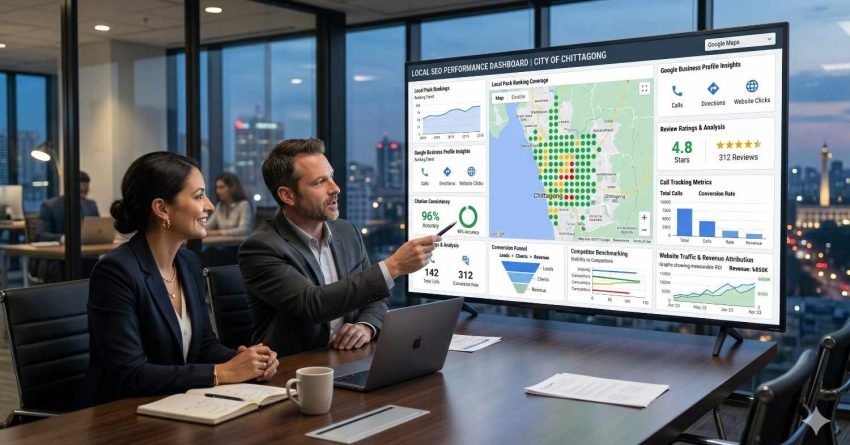
A complete local SEO report tells you exactly how visible your business is in geographically qualified searches, how that visibility is changing, and how it connects to real outcomes like calls, form fills, and store visits. Too many local SEO reports lean on screenshots, vanity rankings, and traffic charts that look impressive but reveal little about actual business performance.
This guide exists because most clients are never taught what a transparent local SEO report should contain. Knowing the difference protects your investment and forces accountability from any local SEO partner.
You will learn the metrics, data sources, cadence, red flags, and reporting standards that separate genuine local visibility growth from polished but hollow client deliverables every business owner deserves.
What Is Local SEO Reporting and Why It Matters
Local SEO reporting is the structured, repeatable process of measuring how a business performs in geographically qualified search results across Google Search, Google Maps, the local pack, and connected discovery surfaces. A proper report is not a screenshot collection. It is a decision-making document that ties visibility, engagement, and conversion data together so business owners can clearly see what is working, what is stagnating, and where investment should shift.
Reporting matters because local search behavior is fundamentally different from traditional organic search. Results vary by physical location, intent shifts across devices, and the local pack often outranks every organic blue link on the page. Without a structured report that captures these dynamics, business owners are left guessing whether their SEO investment is generating leads, calls, foot traffic, and revenue, or simply producing traffic charts that move in the right direction without ever touching the bottom line.
Local SEO is the discipline of optimizing a business for geographically qualified searches across Google Search, Maps, and the local pack — our complete local SEO guide walks through every ranking factor, optimization tactic, and measurement layer that supports the metrics described in this report.
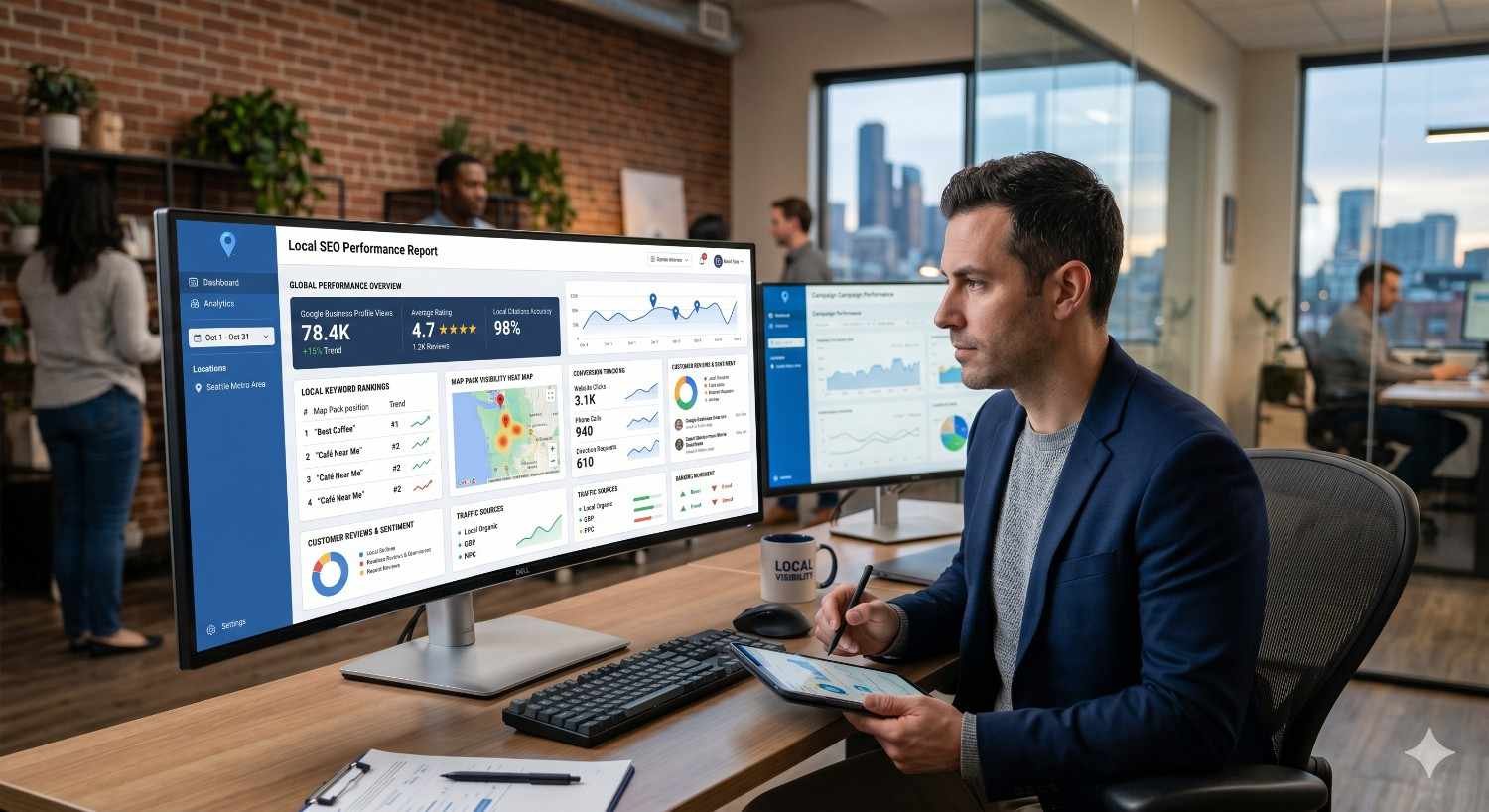
Core Metrics Every Local SEO Report Should Include
A complete local SEO report covers three distinct metric categories. Each one answers a different question, and a report missing any of them is structurally incomplete.
Visibility Metrics
Visibility metrics show whether your business is appearing in front of the right searchers at the right moments. These include local pack rankings, organic local keyword rankings, Google Business Profile impressions, branded versus non-branded query splits, and grid-based geo-ranking snapshots.
Engagement Metrics
Engagement metrics reveal what searchers do once they see your listing. These include profile views, photo views, website clicks from GBP, direction requests, phone call clicks, message interactions, and click-through rates on local-intent landing pages.
Conversion and Revenue Metrics
Conversion metrics link visibility back to business outcomes. These cover tracked phone calls, form submissions from local landing pages, booking completions, store visits where measurable, and assisted conversions where local SEO contributed to a multi-touch journey. A report that stops at impressions and rankings is incomplete.
Visibility, engagement, and conversion metrics each tell a different part of the local performance story, and our local SEO KPIs explained <!–NEW PAGE NEEDED–> resource breaks down every KPI definition, benchmark range, and prioritization framework used by data-driven local SEO teams.
Google Business Profile Performance Data
Your Google Business Profile is the single most influential surface in local SEO, which makes GBP performance data the foundation of any honest local report. Google’s own performance insights provide a rich, often underutilized dataset that should be the first section a client reviews each month.
The report should include profile views segmented by search and Maps, the actual search queries triggering your listing, breakdowns of how users discovered you (direct, discovery, branded), photo views compared to category averages, post engagement metrics if you are publishing, message volume and response time, and trends in calls, direction requests, and website clicks. Each metric should be shown month-over-month and year-over-year so seasonality is visible. According to BrightLocal’s 2024 Local Consumer Review Survey, more than 76% of consumers regularly look at multiple businesses on Google before deciding, meaning GBP engagement signals are often a stronger predictor of leads than ranking position alone.
Google Business Profile data is the single most important reporting layer for any local business, and our Google Business Profile optimization guide goes deeper into every category, attribute, post type, and engagement signal that drives the performance numbers covered in this section.
Local Keyword Rankings and Map Pack Visibility
Local rankings cannot be reported the same way as traditional organic rankings. The map pack is location-dependent, which means a business may rank in the top three within half a mile of its storefront and disappear entirely two miles away. A report showing a single ranking number for each keyword tells you almost nothing about real local visibility.
Modern local SEO reports rely on grid-based rank tracking that plots your business position across a geographic grid of search points, typically a 5×5, 7×7, or 9×9 grid centered on your location. The report should show the percentage of grid points where you appear in the top three, top ten, and twenty-plus positions, alongside the average ranking across all points. This grid visualization is the single most accurate representation of local pack visibility, and any report missing it is omitting the most important local ranking layer.
The report should also include traditional organic local rankings for high-intent geo-modified keywords (such as “dentist in Austin” or “plumber near me”), tracked from the target city’s IP location for accuracy.
Map pack visibility behaves very differently from traditional keyword rankings because results shift based on the searcher’s exact location, and our local keyword rank tracking <!–NEW PAGE NEEDED–> guide explains every tracking method, grid-based tool, and reporting format that captures true local visibility.
Local Citation and NAP Consistency Tracking
Citations are mentions of your Name, Address, and Phone number across business directories, data aggregators, niche platforms, and review sites. Inconsistent NAP data confuses Google, dilutes trust signals, and is one of the most common causes of stalled local rankings.
A complete report should include the total number of active citations, the percentage of citations with fully consistent NAP data, a flagged list of citations with discrepancies, new citations acquired during the reporting period, citations lost or removed, and the status of submissions to major data aggregators. Reports should also note coverage on industry-specific directories relevant to the client’s vertical.
| Citation Data Point | What It Reveals |
| Total active citations | Overall local footprint |
| NAP consistency rate | Trust signal integrity |
| New citations acquired | Forward momentum |
| Inconsistencies flagged | Active cleanup needed |
| Aggregator status | Distribution to long-tail directories |
Citation consistency directly influences how confidently Google trusts your business data, and our local citation building guide covers the complete process of auditing, cleaning, and acquiring authoritative citations across directories, niche platforms, and data aggregators.

Review Management and Reputation Metrics
Reviews influence local rankings, click-through rates from the local pack, and conversion rates once a user lands on your profile or website. A serious local SEO report includes a dedicated reviews section that goes far beyond your star rating.
The report should cover average rating across Google and major secondary platforms, total review count and velocity (new reviews per month), response rate and average response time, sentiment analysis across recent reviews, recurring themes in positive and negative feedback, competitor review benchmarks, and any flagged or removed reviews. Tracking velocity matters because Google rewards businesses that consistently earn fresh reviews rather than those with a large but stale review base.
Reputation movement is often the leading indicator of ranking shifts months later. A drop in review velocity, an uptick in negative sentiment, or a slowing response rate should be surfaced before they manifest as ranking declines.
Reviews influence both rankings and conversion rates, and our online review management <!–NEW PAGE NEEDED–> resource walks through every framework for review generation, response protocols, sentiment analysis, and reputation recovery used by high-performing local brands.
Local Backlink and Authority Reporting
While local SEO is heavily weighted toward proximity, relevance, and engagement signals, link authority remains a meaningful ranking factor, particularly in competitive verticals and saturated metro areas. The backlink section of a local SEO report should focus on geographically and topically relevant link acquisition rather than vanity domain authority numbers.
Expected data includes new referring domains during the period, total referring domains overall, the locality and topical relevance of new links, lost or broken backlinks, anchor text distribution, and authority score movement using a consistent tool. The report should differentiate between local-relevance links (chamber of commerce mentions, local news features, neighborhood blogs, community sponsorships) and general-relevance links, since the former carry disproportionate weight for local rankings.
Geographically relevant backlinks send powerful trust signals to Google for local rankings, and our local link building strategies guide explains the full process of identifying, earning, and tracking the kinds of community-anchored links that move local visibility.
Website Performance and Local Traffic Analytics
A local SEO report must include traffic data that has been properly segmented to isolate genuine local activity from broader organic traffic. Reporting on total organic sessions without separating local-intent visits from informational traffic creates a misleading picture of local performance.
Expected analytics data includes organic sessions filtered to local landing pages, branded versus non-branded query splits from Search Console, geographic distribution of visitors, top-performing local landing pages, average engagement time on local pages, scroll depth where measurable, and Core Web Vitals scores for key landing pages. Search Console data should be filtered by query intent and country/region to surface true local search behavior.
Page experience metrics deserve their own callout. A local landing page with poor mobile load times, layout shifts, or interactivity delays will lose conversions even when rankings improve.
Website analytics turn raw search activity into business intelligence, and our local SEO analytics setup <!–NEW PAGE NEEDED–> guide breaks down every GA4 event, Search Console filter, and geo-segmentation workflow needed to isolate genuinely local traffic from broader organic activity.

Conversion Tracking for Local Businesses
The single most important section of a local SEO report — and the one most commonly missing or under-developed — is conversion tracking. Rankings, impressions, and clicks are intermediate metrics. Calls, form submissions, bookings, and visits are the outcomes that justify SEO investment.
A complete conversion section should include tracked phone calls (via call tracking software that attributes each call to its source), website form submissions on local landing pages, booking completions or appointment requests, click-to-call interactions from mobile devices, store visit data where Google provides it, conversion rate by landing page, and assisted conversion paths showing where local SEO contributed to a multi-touch journey. Each metric should be tied to a dollar value or lead value where the business can provide it, so the report ties directly to revenue.
A report that doesn’t connect rankings to revenue is incomplete, and our local conversion tracking <!–NEW PAGE NEEDED–> guide covers the full setup of call tracking, form attribution, store visit measurement, and offline conversion modeling that ties local SEO to real business outcomes.
Competitor Benchmarking in Local Markets
Local SEO performance is relative. Your visibility only matters in comparison to the businesses competing for the same geographic and category-based searches. A report without competitor benchmarking gives you absolute numbers without context.
The benchmarking section should compare your business against three to five direct local competitors across map pack visibility, average grid rank, review count and velocity, citation footprint, referring domain count, and estimated share of local voice. Share of local voice is the most useful single metric here: it shows what percentage of total visibility within your local market belongs to you versus your competitors. Movement in this number reveals whether you are gaining or losing ground, regardless of whether your absolute metrics are growing.
Understanding where you stand against the businesses ranking above you is essential for shaping next-quarter strategy, and our local competitor analysis <!–NEW PAGE NEEDED–> guide explains every benchmarking method, gap analysis framework, and share-of-voice calculation that informs competitive local SEO decisions.
Reporting Frequency and Cadence Best Practices
Reporting cadence should match the speed at which local SEO data meaningfully changes. Daily reporting creates noise and surfaces signal-poor fluctuations. Quarterly-only reporting leaves problems undiscovered for too long. The accepted standard for local businesses is a monthly comprehensive report supported by always-on dashboard access and a quarterly strategic review.
A healthy reporting cadence looks like this:
| Cadence | Purpose |
| Real-time dashboard | Always-on access to rankings, GBP metrics, and conversions |
| Monthly written report | Full performance analysis, commentary, next-step recommendations |
| Quarterly strategy review | Trend analysis, competitive shifts, roadmap recalibration |
| Annual executive summary | Year-over-year growth, ROI, strategic positioning |
Each report should include written commentary, not just data. Numbers without interpretation are not insight. Every monthly report should explain what changed, why it changed, and what is being done about it in the coming period.
Red Flags in Local SEO Reports (What Your Agency May Be Hiding)
Some reporting habits exist purely to obscure underperformance. Recognizing them protects your investment.
Common red flags include reports that lead with vanity metrics like total impressions without conversion context, ranking screenshots taken from non-local IPs that show flattering but inaccurate positions, missing grid-rank visualizations, conversion data that mysteriously omits call tracking, absence of competitor benchmarking, identical month-over-month commentary suggesting templated reporting, sudden metric definition changes that conceal declines, and reluctance to share access to GBP insights, Search Console, or analytics. A report that cannot be audited is not a report — it is marketing.
Honest reporting acknowledges flat months, declining metrics, and strategic course corrections. If every report shows steady upward growth across every metric, the report is almost certainly being curated rather than measured.
Some reporting habits exist purely to mask poor execution, and our SEO agency red flags <!–NEW PAGE NEEDED–> resource walks through every warning sign — from vanity metrics to undisclosed subcontracting — that signals it may be time to evaluate your current provider.

How to Choose a Transparent Local SEO Reporting Partner
The right local SEO partner builds reporting as a structural pillar of the engagement, not as an afterthought. Before signing any agreement, ask the prospective provider to walk you through a redacted sample report, identify which metrics they consider non-negotiable, explain how they tie rankings to revenue, demonstrate their grid-rank tracking, and confirm that you will retain ownership of all GBP, analytics, and tracking accounts.
Look for partners who proactively report bad months, who explain unfamiliar metrics in plain language, who set realistic expectations around timelines, and who tie every recommendation to a measurable business outcome. The reporting framework itself is a strong signal of the underlying execution quality. Agencies that report carelessly almost always execute carelessly.
For businesses that want a structured, transparent reporting cadence backed by genuine local execution, our local SEO services bring together the strategy, optimization, and full-funnel measurement framework outlined throughout this guide.
Conclusion
A complete local SEO report unifies visibility, engagement, conversion, citation, review, backlink, and competitor data into one transparent, decision-ready document tied directly to business outcomes.
Strong reporting is the operating system of strong local SEO. Each spoke resource linked above goes deeper into the metric layers introduced here, building a complete reporting framework around your business.
We help businesses turn reporting into measurable local growth. Partner with White Label SEO Service for transparent, conversion-focused local SEO reporting that drives real results.
Frequently Asked Questions
What should a local SEO report include?
A complete local SEO report includes GBP performance, map pack rankings, citation status, review metrics, backlink data, segmented traffic, conversion tracking, and competitor benchmarking with written commentary.
How often should a client receive a local SEO report?
Most local businesses should receive a comprehensive written report monthly, supported by real-time dashboard access and a deeper quarterly strategic review covering trends, competitor shifts, and roadmap changes.
What is a good local pack ranking?
Appearing in the top three positions of the map pack across 60% or more of your geo-grid points is considered strong. Anything below 25% grid coverage typically signals optimization work is needed.
How do I know if my local SEO agency is doing real work?
Look for grid-rank tracking, transparent GBP insights, call tracking data, honest commentary on flat or declining months, and direct access to your analytics accounts. Vague reports usually hide poor execution.
What are the most important local SEO KPIs?
The highest-impact KPIs are map pack grid visibility, GBP conversion actions (calls, directions, website clicks), tracked phone calls, form submissions from local pages, review velocity, and share of local voice.
Should a local SEO report include competitor data?
Yes. Local visibility is relative, so every report should benchmark you against three to five direct competitors across rankings, reviews, citations, backlinks, and share of local voice for full context.
Can I track offline conversions from local SEO?
Yes. Call tracking software, store visit data from Google, in-store coupon attribution, and CRM-linked form tracking allow most local businesses to measure offline conversions tied directly to local search activity.