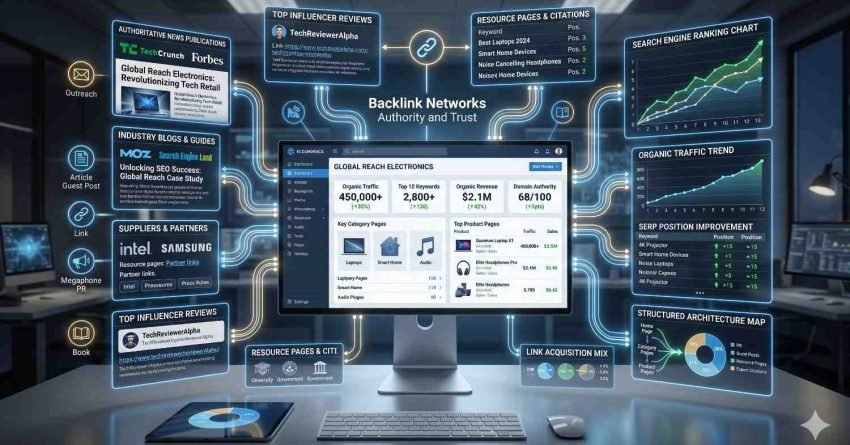
Ecommerce link building is the practice of earning relevant, authoritative backlinks to an online store’s homepage, category pages, and product pages to improve organic rankings, referral traffic, and revenue. Unlike content-heavy publisher sites, ecommerce stores face a structural challenge: the pages that matter most commercially are also the hardest pages to attract editorial links to. That gap is exactly why a deliberate, strategy-led approach matters so much for online retailers.
For store owners and SEO teams, links remain among the strongest ranking signals search engines use, and competitor link velocity directly shapes how fast organic visibility moves. Falling behind on link acquisition almost always shows up as lost category-page rankings.
This guide covers what ecommerce link building is, why it matters, the foundations to fix first, the core strategies that work, which pages to target, anchor text, common mistakes, measurement, and how to execute it sustainably.
What Is Ecommerce Link Building?
Ecommerce link building is the structured process of acquiring hyperlinks from external websites that point to an online store’s pages — typically the homepage, key category pages, product pages, or supporting content assets. Each external link acts as a credibility signal, telling search engines that another site finds your store worth referencing.
What separates ecommerce from other niches is the type of pages being linked to. Publishers and SaaS companies typically earn links to content. Ecommerce sites need links flowing to transactional URLs that exist primarily to sell — which means traditional content outreach alone rarely solves the problem. A successful ecommerce link profile blends content-led link earning with category-targeted outreach, brand mentions, partnership links, and supplier reclamation.
The mechanics are the same as any link building discipline: external sites pass authority through hyperlinks, search engines treat those references as endorsement signals, and a healthy referring-domain growth curve correlates strongly with stronger SERP performance. The difference is execution, not theory.
Link building is the SEO discipline of earning hyperlinks from external websites back to your own, and for a broader walkthrough that covers the fundamentals of link building across every industry, our complete primer explains how links pass authority, why search engines treat them as votes of confidence, and how the practice has evolved since the original PageRank algorithm.

Why Backlinks Matter for Ecommerce SEO
Backlinks remain one of Google’s top-three ranking inputs, alongside content relevance and user signals. For ecommerce sites, where multiple competitors often sell identical products at similar prices, the link profile frequently becomes the deciding factor in which store ranks on page one versus page three.
According to Ahrefs’ research on backlinks and rankings, the top-ranking pages on Google have an average of 3.8x more backlinks than positions 2–10 combined, a relationship that holds across competitive ecommerce verticals.
Beyond rankings, backlinks deliver three compounding benefits for online stores. They drive qualified referral traffic from publications your buyers already read. They build the brand recognition signals search engines now use as part of broader trust evaluation. And they accelerate indexing and crawl frequency for new product launches, category expansions, and seasonal pages — a particularly valuable side effect for stores with large catalogs.
Backlinks are one of three pillars that drive ecommerce search visibility alongside on-page optimization and technical health, and our complete walkthrough of ecommerce SEO fundamentals covers how these three pillars work together to grow qualified organic traffic, product page rankings, and revenue from search.
Site Foundations Before You Build Links
Building links to a structurally broken site is one of the most expensive mistakes in ecommerce SEO. Link equity needs clean crawl paths, fast page loads, and properly canonicalized URLs to flow correctly. Without those foundations, earned links pass a fraction of their potential value.
Technical SEO Readiness
Before outreach starts, an ecommerce site should be crawlable, indexable, and free of duplicate-content traps caused by faceted navigation, session parameters, or pagination. Core Web Vitals should pass on the templates that matter most — category and product templates — because slow target pages bleed both rankings and the equity incoming links would have passed.
Site Architecture
Internal linking determines how authority earned from external links flows through the site. A flat, well-organized architecture with clear category and subcategory pathways ensures that a backlink to your homepage strengthens product pages downstream. Sites with broken internal hierarchies waste the equity outreach campaigns generate.
Crawl budget waste, duplicate parameters, and slow product pages quietly drain the equity that incoming links should be passing, which is why our complete technical SEO checklist walks through every audit point — from indexation control to Core Web Vitals — that an ecommerce site should pass before investing in outreach.

Core Ecommerce Link Building Strategies
There is no single “best” link building strategy for ecommerce. Established stores typically run three to five tactics in parallel, calibrated to budget, team capacity, and the specific authority gap they need to close. The strategies below represent the full toolkit — most stores benefit from selecting the three that match their stage rather than attempting all of them at once.
Digital PR and Brand Mentions
Digital PR is the modern engine of high-authority link acquisition. It works by creating newsworthy stories — original data studies, trend reports, expert commentary, or culturally relevant brand moments — and pitching them to journalists at major publications. Done well, a single campaign can earn dozens of editorial links from outlets that no manual outreach campaign could ever reach.
Digital PR earns links by creating stories, data studies, and brand moments that journalists genuinely want to cover, and our complete guide to digital PR strategies breaks down the full process — from angle ideation and dataset building to journalist outreach and coverage tracking — that ecommerce brands use to land high-authority editorial placements.
Guest Posting on Relevant Industry Sites
Guest posting earns contextually relevant links by contributing original articles to publications your audience reads. The strategy has evolved significantly since its peak — Google now ignores low-quality, mass-produced guest posts entirely — but high-quality contributions on genuinely relevant industry sites still deliver real ranking impact.
Contributing original articles to relevant industry publications remains a reliable way to earn contextually relevant links, and our guest posting outreach guide walks through every step — prospecting, pitching, topic selection, and editorial standards — that separates white-hat guest posts from low-value placements Google now ignores.
Broken Link Building
Broken link building identifies dead resources on relevant sites and offers your page as a working replacement. It converts at unusually high rates because you’re solving an actual problem the linking site already has — a broken URL that’s hurting their user experience.
Finding dead resources on relevant sites and offering your page as a working replacement is one of the highest-conversion outreach methods available, and our complete walkthrough of the broken link building process explains how to prospect dead links at scale, filter by topical fit, and craft outreach that consistently converts.
Resource and Listicle Placements
Resource pages and curated listicles — “best tools for X,” “top resources for Y” — are natural homes for ecommerce category pages, buying guides, and free tools. They tend to be evergreen, well-linked themselves, and editor-friendly when pitched correctly.
Curated resource pages and listicle roundups remain natural homes for ecommerce category pages, guides, and buying tools, and our complete breakdown of resource page link building shows how to identify the right pages, qualify their linking history, and pitch placements that editors actually approve.
HARO and Expert Citations
Platforms like HARO, Qwoted, and Featured connect journalists with sources. Responding thoughtfully and quickly to relevant queries places founders, marketers, and brand experts inside major publications — often with links back to the brand’s site.
Responding to journalist queries through HARO and similar platforms places founders and brand experts inside major publications, and our complete guide to HARO and journalist outreach walks through how to filter queries, write pitches that get selected, and convert quotes into permanent editorial links.
Linkable Assets
A linkable asset is a page so genuinely useful that other sites cite it without being asked. Examples include original research, free calculators, interactive comparison tools, ultimate guides, and industry benchmarks. These assets do the work of outreach passively over months and years.
A linkable asset is a page so genuinely useful that other sites cite it without being asked, and our complete guide to building linkable assets covers the full asset spectrum — from original research and free calculators to interactive tools and definitive guides — that consistently earn passive backlinks at scale.
Supplier, Manufacturer, and Partner Links
Many ecommerce stores miss the easiest links available to them: the brands they stock. Manufacturer “where to buy” pages, supplier partner directories, and brand authorized-retailer listings are usually one polite email away. These links carry strong topical relevance and are rarely competitive to acquire.
A focused supplier reclamation campaign typically uncovers a meaningful number of missed link opportunities — our dedicated guide on manufacturer link building <!–NEW PAGE NEEDED–> walks through how to identify every brand you stock, audit their existing retailer pages, and request inclusion with a high response rate.
Influencer and Creator Partnerships
Influencer partnerships drive both referral traffic and links when structured correctly. The links sometimes come directly from an influencer’s blog or YouTube description, and often more powerfully through the press coverage influencer campaigns attract.

Which Pages Should Get Links on an Ecommerce Site?
The fastest way to waste a link building budget is sending every earned link to the homepage. While homepage links are valuable and pass equity site-wide through internal linking, deep linking to category and product pages is where ecommerce link building separates itself from generic SEO.
Category pages typically deserve the largest share of intentional outreach because they target high-volume commercial keywords and have the structural authority to rank competitively. Product pages benefit more from supplier links, brand mentions, and review placements than from cold outreach. Supporting content — buying guides, comparison pages, and category-adjacent blog content — often absorbs the link types that wouldn’t land naturally on transactional URLs.
A practical rule of thumb: roughly half of intentional outreach should target category and category-supporting pages, a quarter the homepage, and the remainder split across product pages and content assets. The exact ratio shifts based on the site’s existing link profile and the gaps it needs to fill.
Category pages sit at the strongest intersection of commercial intent and link-worthiness, and our complete guide to optimizing ecommerce category pages walks through the on-page structure, internal linking, and content frameworks that turn category URLs into your most valuable link targets.
Anchor Text Strategy for Ecommerce Links
Anchor text — the clickable text of a hyperlink — tells Google what the destination page is about. For ecommerce sites, anchor text strategy is unusually high-stakes because the natural anchor profile of a transactional page differs significantly from a content page.
Healthy ecommerce anchor profiles lean heavily on branded anchors (the store name), naked URLs, and generic phrases (“this store,” “click here”), with a smaller proportion of partial-match and exact-match commercial anchors. Profiles that flip this ratio — heavy on exact-match keyword anchors pointing at category pages — trigger Google’s over-optimization signals quickly, often resulting in algorithmic suppression that’s difficult to recover from.
When in doubt, default to brand-led anchors. The links pass equity just as effectively, and the safety margin is significantly larger.
Anchor text tells Google what a destination page is about, but over-optimized exact-match anchors trigger algorithmic suppression faster than almost any other off-page signal, and our complete framework for building a natural anchor text profile breaks down healthy ratios, safe variations, and the warning signs of an anchor profile heading toward a penalty.
Ecommerce Link Building Mistakes That Hurt Rankings
Most link-related ranking drops trace back to a short, predictable list of mistakes. Avoiding them is often more valuable than acquiring the next high-authority link.
Paying for links openly, buying from private blog networks (PBNs), participating in link exchanges at scale, and using identical anchor text across hundreds of placements remain the highest-risk practices. Less obvious but equally damaging: building links too quickly (unnatural velocity), targeting low-quality directories, and ignoring the relevance dimension entirely by chasing domain authority numbers in isolation.
Google’s algorithmic systems have become increasingly skilled at devaluing low-quality links silently rather than issuing manual actions, which means the damage often shows up as stalled growth rather than a clear penalty. Auditing the link profile quarterly and disavowing genuinely toxic links remains a healthy maintenance habit for any growing ecommerce site.
Manual actions and algorithmic suppression nearly always trace back to a short list of recurring link building mistakes, and our complete walkthrough on identifying toxic backlinks covers how to audit your existing profile, recognize spam patterns early, and use the disavow file correctly when remediation becomes necessary.

How to Measure Ecommerce Link Building Performance
Counting links earned is the weakest possible measurement of link building success. A campaign that earns 50 low-relevance links from weak domains can underperform a campaign that earns three editorial placements from genuinely authoritative publications.
Useful metrics group into three layers. Acquisition metrics measure what’s coming in: new referring domains per month, the authority distribution of those domains, and topical relevance scoring. Profile-health metrics measure the cumulative state of the link profile: anchor text distribution, referring-domain growth curves versus competitors, and dofollow ratios. Outcome metrics measure what links are doing for the business: target-page ranking movement, organic traffic to linked pages, referral traffic, and ultimately revenue attributable to organic growth.
Tools like Ahrefs, Semrush, and Google Search Console form the standard measurement stack. The discipline isn’t in the tools — it’s in defining which metrics matter at which stage of the campaign and reporting honestly against them.
Counting links earned is the weakest possible measure of link building success, and our complete framework on link building KPIs walks through the referring-domain growth curves, anchor distribution checks, and traffic-attribution methods that separate vanity reporting from real performance tracking.
In-House vs. Outsourced Ecommerce Link Building
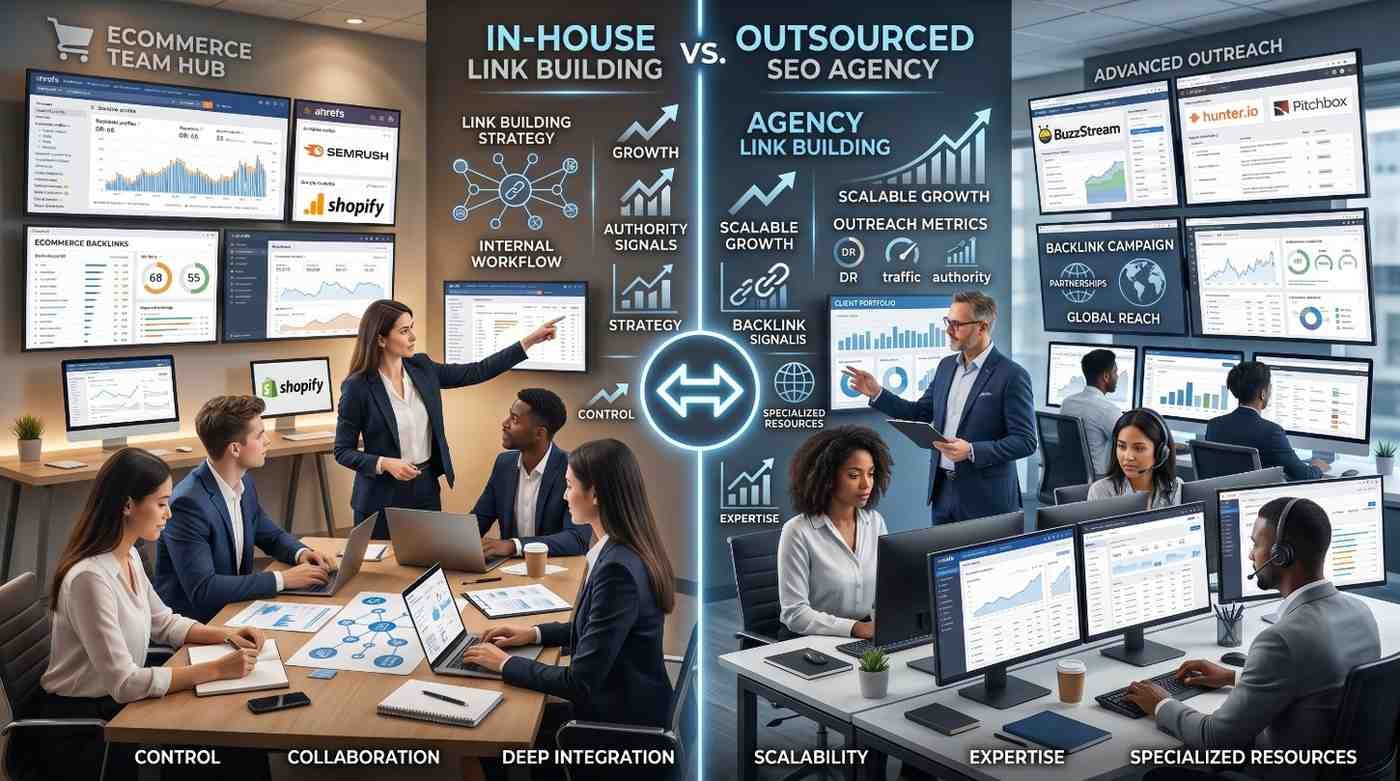
By this point in the guide, the practical question is no longer “what is link building?” but “how do we actually execute this every month, consistently, without dropping other priorities?” That decision usually comes down to in-house capacity, budget, and how predictable the team needs the monthly link velocity to be.
In-house link building works well for stores with a dedicated outreach person, an established content team, and strong existing publisher relationships. The economics favor scale: once the cost of a full-time outreach hire is absorbed, marginal link cost drops significantly. The trade-off is ramp time — a new in-house program typically needs six to nine months before it’s producing reliably.
Outsourced or agency-led link building works well for stores that need consistent monthly velocity faster than hiring allows, want access to publisher relationships an in-house team would take years to build, or need senior strategy without senior salary cost. The trade-off is unit economics: managed link building typically costs more per link, but the time-to-impact is faster and the operational burden is lower.
Many stores blend the two: an in-house owner who manages strategy, internal asset creation, and supplier reclamation, paired with an agency partner handling digital PR or high-volume outreach.
For ecommerce teams that need consistent monthly link velocity without hiring an outreach team in-house, our managed link building services combine vetted publisher relationships, strategy, and reporting into a single engagement built specifically around ecommerce growth goals.
Conclusion
Ecommerce link building succeeds when it connects technical foundations, the right strategies, the right target pages, and disciplined measurement into one coordinated system.
Treat each strategy in this guide as a component of a broader topical authority effort, and use the linked spoke resources to go deeper as your program matures.
When you’re ready to scale link acquisition without building a full outreach team, White Label SEO Service delivers ecommerce-focused link building backed by strategy, transparency, and measurable growth.
Frequently Asked Questions
What is the best link building strategy for ecommerce sites?
The best strategy combines digital PR for high-authority editorial links, supplier and manufacturer outreach for low-effort wins, and linkable assets to attract passive backlinks. Layering all three outperforms any single tactic.
How many backlinks does an ecommerce site need to rank?
There’s no fixed number. What matters is matching or exceeding the referring-domain count of the sites currently ranking for your target keywords, then growing steadily at a rate consistent with your industry.
Can you build links directly to product pages?
Yes, but it’s harder than linking to homepages or category pages. Product page links most often come from supplier listings, brand mentions in reviews, and influencer or affiliate placements rather than cold outreach.
How long does ecommerce link building take to show results?
Most stores see measurable ranking movement within three to six months of consistent link acquisition. Larger jumps in organic revenue typically appear between months six and twelve as link equity compounds.
Is buying backlinks safe for ecommerce sites?
No. Paid links that pass PageRank violate Google’s guidelines and frequently trigger algorithmic suppression or manual actions. Legitimate sponsored placements must use nofollow or sponsored attributes to remain compliant.
What’s the difference between dofollow and nofollow links for ecommerce?
Dofollow links pass ranking authority to the destination page; nofollow links don’t pass equity directly but still drive referral traffic, brand exposure, and indirectly support search visibility through user signals.
How much should an ecommerce store budget for link building?
Most growing ecommerce stores invest between $2,000 and $10,000 per month depending on competition and revenue stage. Highly competitive verticals or enterprise stores routinely budget significantly more.