
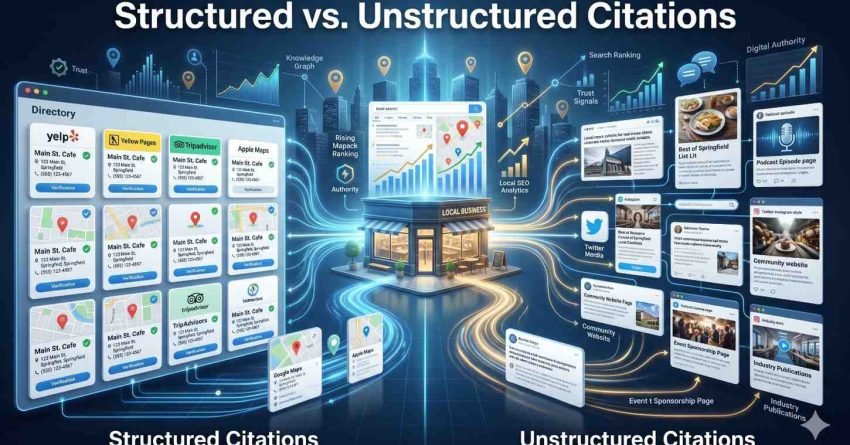
Local citations come in two distinct forms: structured citations are standardized listings on business directories with consistent fields, while unstructured citations are casual mentions of your business across blogs, news sites, and social platforms. Both signal local relevance to search engines and strengthen your visibility in local results.
Local search competition keeps tightening, and citation accuracy now directly affects how confidently Google ranks your business across map results and organic local listings today.
This guide breaks down both citation types, explains the key differences, shows how each impacts local rankings, and outlines a practical strategy for managing them.
What Are Local Citations?
A local citation is any online mention of your business name, address, and phone number, commonly referred to as NAP. These mentions appear across directories, websites, apps, and platforms, and they help search engines verify that your business exists, operates where you claim, and matches the entity Google indexes in its knowledge graph.
Citations are one of the strongest off-site signals in local search, and our local citations guide explains how they fit into a broader local SEO strategy from start to finish. Within that ecosystem, every citation falls into one of two categories: structured or unstructured. Understanding the distinction matters because each type serves a different purpose and requires a different approach to build, maintain, and optimize.
Core Elements of a Citation
Every effective citation includes four foundational data points. The business name must match your legal or branded identity exactly. The address must reflect a verifiable physical location, formatted consistently. The phone number must be a local or toll-free line tied to that location. Many directories also accept a website URL and primary business category, which expand the citation’s value beyond basic verification.
These four fields, when standardized across the web, form the data layer Google uses to confirm your business legitimacy and rank you for queries with local intent.

Structured Citations Explained
Structured citations are listings on business directories where information is submitted into predefined fields. Platforms like Yelp, Bing Places, Apple Maps, Yellow Pages, and industry-specific directories like Avvo for attorneys or Healthgrades for medical practices all follow this format. You fill out a profile, the platform displays your data in a standardized layout, and that listing becomes a citation.
Where Structured Citations Live
Structured citations exist on three main directory tiers. The first tier includes major data aggregators and primary platforms such as Google Business Profile, Bing Places, Apple Business Connect, and Facebook. The second tier covers established general directories like Yelp, Yellow Pages, and Foursquare. The third tier consists of industry-specific or geo-targeted directories that align with your service category or local market.
How Structured Citations Influence Rankings
Structured citations build trust through consistency and volume. When Google encounters your business listed identically across dozens of authoritative directories, it gains confidence that your data is accurate, which strengthens your eligibility to rank in the local pack and Google Maps. Most structured citations begin with your Google listing, and a properly executed Google Business Profile setup ensures your name, address, and phone details stay consistent across every directory that pulls from it.

Unstructured Citations Explained
Unstructured citations are mentions of your business in non-directory formats. They appear inside blog posts, news articles, press releases, podcast show notes, social media posts, forum discussions, and any content where your NAP data appears in natural language rather than a standardized form. The mention itself counts as a citation even when no link is included.
Where Unstructured Citations Appear
Common sources include local news coverage, industry publications, sponsorship recognition pages, community event recaps, customer testimonials hosted on third-party sites, podcast episode descriptions, and editorial roundups. A restaurant featured in a “best brunch spots” article on a local food blog earns an unstructured citation. A law firm quoted in a regional news report earns one. A contractor sponsoring a school fundraiser earns one when the school’s website mentions the business.
How Unstructured Citations Build Authority
Unstructured citations carry strong contextual signals because they appear inside relevant content. When a business is mentioned in a topical article on a trusted local publication, search engines interpret the mention as a real-world endorsement, not just a directory submission. These citations often arrive with backlinks, which compounds their SEO value. Earning unstructured mentions often overlaps with outreach work, and our local link building strategies resource shows how to attract editorial coverage that doubles as both a citation and a backlink.
Structured vs. Unstructured: Key Differences
Both citation types support local rankings, but they differ across several dimensions that affect how you should prioritize them. Inconsistent business details damage both equally, and our NAP consistency guide explains exactly how to audit, standardize, and maintain your business information across the web.
Comparison Table
| Dimension | Structured Citations | Unstructured Citations |
| Format | Standardized directory fields | Natural language within content |
| Source | Business directories and aggregators | Blogs, news sites, podcasts, social media |
| Control | High — you submit and edit listings | Low — earned through outreach, PR, or coverage |
| Volume Potential | High — hundreds of directories available | Lower — limited by editorial opportunities |
| Backlink Inclusion | Sometimes (often nofollow) | Frequently (often editorial dofollow) |
| Contextual Relevance | Low — generic listing format | High — embedded in topical content |
| Maintenance Effort | Ongoing — listings drift, need audits | Minimal once published, harder to update |
| Primary SEO Value | Verification, prominence, trust signals | Authority, relevance, contextual signals |
The key insight: structured citations build the foundation of trust and consistency, while unstructured citations layer authority and contextual relevance on top of that foundation. Skipping either category leaves a gap competitors will exploit.
Why Both Citation Types Matter for Local SEO
Google’s local algorithm evaluates businesses across three pillars: proximity, relevance, and prominence. Citations directly influence prominence, one of the three pillars Google evaluates, and our breakdown of local SEO ranking factors shows how citations interact with proximity, relevance, and review signals to determine where you appear in the map pack.
Structured citations establish your business as a verified entity. They confirm to Google that your operating details are accurate, your business is active, and your information is trustworthy enough to display in search results. Without a solid structured citation base, even strong content and reviews struggle to translate into local pack visibility, especially in competitive markets.
Unstructured citations build the authority layer. They tell Google that your business matters within its local community and industry. A plumber mentioned in three regional news stories carries more topical authority than one with only directory listings, because those mentions appear inside trusted content that real audiences read. Search engines weight that context heavily when ranking businesses for non-branded local queries.
Relying on only one citation type creates predictable weaknesses. Directory-only profiles look thin on authority signals. Content-only mentions without directory consistency create data drift that erodes trust. A complete local SEO foundation needs both working together.

How to Build and Manage Both Citation Types
Citation strategy works best when you sequence the work correctly. Build the structured foundation first, then layer unstructured citations through targeted outreach and content visibility.
Building Structured Citations
Start with the core platforms every local business needs: Google Business Profile, Bing Places, Apple Business Connect, Facebook, and Yelp. Standardize your NAP exactly as it appears on your website, then submit to data aggregators that distribute information to hundreds of secondary directories. From there, target tier-two general directories, followed by industry and geographic-specific platforms relevant to your category.
Manual citation work is time-consuming and easy to get wrong, which is why many businesses use a dedicated local citation building service to handle directory submissions, accuracy audits, and ongoing maintenance at scale.
Earning Unstructured Citations
Unstructured citations require outreach rather than submission. Pitch local news outlets with newsworthy angles, offer expert commentary to journalists through platforms covering your niche, sponsor community events that publish recognition pages, partner with local nonprofits, and create linkable assets like industry reports or local guides that earn organic coverage. Each successful placement compounds because it typically includes a backlink alongside the citation.

Common Citation Mistakes That Hurt Local Rankings
Citation work goes wrong in predictable ways. The most common error is NAP inconsistency, where different directories show slightly different business names, suite numbers, or phone formats. Even minor variations confuse search engines and weaken your prominence signal.
Duplicate listings cause the second most damaging problem. When the same business appears multiple times on Yelp or Google Maps, ranking authority splits between profiles, and Google may suppress both rather than choose one. Acquired locations, address changes, and rebrands frequently create duplicates that go unnoticed for months.
Submitting to low-quality or spammy directories actively hurts visibility. Scraper sites, link farms, and unmoderated directories signal manipulation rather than legitimacy. Quality matters more than quantity at every tier of the citation pyramid.
Ignoring ongoing maintenance is the silent killer. Directories change formats, businesses relocate, phone numbers update, and listings drift over time. Without quarterly audits, citation accuracy degrades steadily until rankings reflect the decay. If your rankings have plateaued despite citation work, a thorough local SEO audit will surface duplicate listings, mismatched NAP data, and toxic directories pulling your visibility down.
Conclusion
Structured and unstructured citations work as complementary signals, with one establishing data integrity across directories and the other building topical authority through editorial mentions. Together they form the prominence layer Google uses to rank local businesses.
The most resilient local SEO strategies treat citation work as ongoing infrastructure rather than a one-time submission project. Markets shift, listings drift, and competitive pressure compounds month over month.
For the full picture of how citations integrate with on-page, technical, and review strategy, our complete local SEO guide ties every ranking lever into one execution roadmap. We help businesses build durable local visibility through White Label SEO Service’s citation, content, and authority programs.
Frequently Asked Questions
What is the main difference between structured and unstructured local citations?
Structured citations appear in standardized directory listings with predefined fields, while unstructured citations are natural-language mentions of your business inside blog posts, news articles, podcasts, or social media content.
Do unstructured citations help local SEO without a backlink?
Yes. Even without a hyperlink, a mention of your business name, address, or phone number in trusted content provides a contextual signal that search engines use to verify legitimacy and assess topical authority for local queries.
How many local citations does a business need?
There is no fixed number. Most local businesses benefit from 30 to 80 high-quality structured citations across primary, secondary, and industry directories, plus ongoing unstructured citations earned through PR, partnerships, and content outreach.
Are structured citations still relevant in 2026?
Yes. Structured citations remain a foundational trust signal for Google’s local algorithm. While their relative weight has shifted as reviews and behavioral signals grew, they still anchor data consistency and prominence for competitive local markets.
Can inconsistent citations hurt my local rankings?
Yes. NAP inconsistencies across directories create data conflicts that reduce Google’s confidence in your business information, weakening your eligibility to appear in the local pack and Google Maps results for relevant searches.
Which type of citation should I build first?
Build structured citations first to establish a consistent data foundation. Once core directory listings are accurate and verified, pursue unstructured citations through outreach, PR, and content marketing to layer authority on top of that foundation.
How often should I audit my local citations?
Audit citations at least quarterly. Phone numbers change, listings drift, duplicates appear, and directories update their formats. Regular audits catch NAP inconsistencies before they erode your local prominence and rankings.