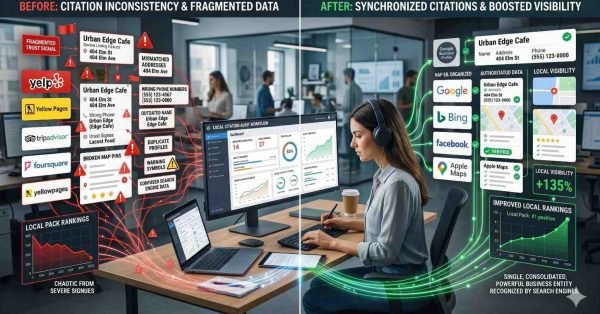
The strongest local citations for any business in 2026 start with Google Business Profile, Bing Places, Apple Business Connect, Yelp, Facebook, and the three primary data aggregators that distribute your NAP data across the entire local ecosystem. Together, these directories form the backbone of every map pack ranking and trust signal Google relies on.
Local citation building is no longer about volume. Search engines now reward businesses that maintain accurate, authoritative listings on directories users actually trust and visit.
This roundup ranks the top universal directories, the best industry-specific sources, the data aggregators behind them, and the exact mistakes that quietly stall local rankings.
What Are Local Citations and Why They Matter
A local citation is any online mention of your business name, address, and phone number (NAP), with or without a link back to your website. Citations appear on directories, review sites, social platforms, data aggregators, and industry-specific listings.
Search engines use citations as trust signals. When Google sees the same NAP across hundreds of reputable sources, it gains confidence that your business is real, established, and located where you claim. That confidence translates into higher map pack visibility, stronger local rankings, and more qualified search traffic from nearby buyers.
Citations also drive direct discovery. A potential customer searching Yelp, Apple Maps, or BBB will find your listing whether or not they ever land on your website. Citations are one ranking signal inside a broader system, and our complete local SEO guide walks through every factor that shapes map pack visibility and organic local rankings.

How We Selected the Top Citation Sources
Not every directory deserves a submission. We evaluated each source against five criteria that determine real impact on local search performance.
- Domain authority and trust: how search engines view the directory as a citation source
- Audience reach: monthly users, app installs, and active search volume
- NAP accuracy and edit control: how easily owners can keep listings clean
- Review and engagement signals: whether the platform feeds Google’s trust ecosystem
- Industry relevance: general-purpose coverage versus vertical authority
A consistent process matters more than directory count, which is why our citation building strategy explains how to prioritize, submit, and audit listings at scale.
Universal Business Directories Every Business Needs
These platforms apply to virtually every local business, regardless of industry. Submitting to all eight should be the baseline for any citation strategy.
Google Business Profile
Google Business Profile is the single most important local listing in existence. It powers the map pack, Google Maps, and the local knowledge panel. A complete, verified, and actively maintained profile is the foundation of every local SEO program.
Bing Places for Business
Bing Places feeds Bing search, Yahoo, DuckDuckGo, and several voice search platforms. While volume is lower than Google, the audience skews toward higher-income desktop users, making it a high-value addition with minimal effort.
Apple Business Connect
Apple Business Connect powers Apple Maps, Siri, and Spotlight Search across every iPhone, iPad, and Mac. With iOS dominating premium mobile markets, Apple Maps citations now rival Bing in strategic importance.
Yelp for Business
Yelp remains a top destination for review-driven discovery. Its data also flows into Apple Maps, Alexa, and dozens of partner platforms, multiplying every accurate listing several times over.
Facebook Business Page
A verified Facebook page acts as both a citation source and a social trust signal. The platform’s check-ins, reviews, and local recommendations feed into how Google evaluates real-world business activity.
Better Business Bureau (BBB)
A Better Business Bureau profile signals legitimacy in a way few other directories can. BBB pages frequently appear in branded SERPs and influence buyer trust during the decision stage.
Yellow Pages (YP.com)
Yellow Pages maintains strong domain authority and feeds dozens of secondary directories. The free listing remains worthwhile despite the platform’s reduced consumer usage.
Foursquare
Foursquare’s location data powers Uber, Snapchat, Twitter/X, Apple Maps, and thousands of apps. A claimed Foursquare listing influences citations and location data well beyond the Foursquare site itself.

Industry-Specific Citation Sources Worth Targeting
Vertical directories often carry more weight than general directories within their niche. Search engines treat industry authority as a strong relevance signal.
- Healthcare: Healthgrades, Zocdoc, WebMD, Vitals, RateMDs
- Legal: Avvo, FindLaw, Justia, Martindale, Lawyers.com
- Restaurants and Hospitality: TripAdvisor, OpenTable, Resy, Zomato
- Home Services: Angi, HomeAdvisor, Houzz, Thumbtack, Porch
- Real Estate: Zillow, Realtor.com, Redfin, Trulia
- Automotive: Cars.com, Edmunds, CarGurus, DealerRater
- Financial: NerdWallet (advisor listings), Bankrate, BrokerCheck
Finding vertical directories takes structured discovery, and our niche directory research framework shows exactly how to surface high-authority industry listings competitors overlook.
Data Aggregators That Power the Citation Ecosystem
A handful of aggregators feed business data to hundreds of downstream directories. Submitting to these three sources distributes accurate NAP information across the entire local web.
Data Axle (formerly Infogroup)
Data Axle supplies business data to major search engines, GPS systems, and financial services platforms. A clean Data Axle record cascades to dozens of secondary sources automatically.
Foursquare (Factual)
Beyond its consumer app, Foursquare’s enterprise location service is the backbone behind a significant portion of mobile and app-based business listings. Aggregators amplify whatever data you give them, so reviewing our NAP consistency standards ensures every push from a single source stays clean across hundreds of downstream sites.
Localeze (Neustar / TransUnion)
Localeze distributes verified business listings to dozens of partner directories, mapping apps, and voice search platforms. It remains one of the most efficient ways to seed accurate citations at scale.
How to Build and Manage Citations Effectively
Effective citation building follows a predictable sequence. Skipping steps creates duplicates, inconsistencies, and ranking volatility that take months to fix.
- Standardize NAP format across every channel before submission
- Claim the foundational universal directories in priority order
- Submit to all three data aggregators to seed downstream listings
- Add industry-specific directories ranked by relevance to your niche
- Pursue geo-relevant citations like chambers of commerce and local business associations
- Audit quarterly for duplicates, outdated information, and abandoned profiles
- Monitor reviews and engagement across every active platform
Citation work pays off when paired with the other signals Google weighs, and our breakdown of local ranking factors shows where directories fit alongside reviews, on-page, and link signals.

Common Citation Mistakes That Hurt Local Rankings
Most local ranking problems trace back to a small set of preventable citation issues. Recognizing them early saves months of recovery work.
- Inconsistent NAP variations across listings, especially in suite numbers and phone formats
- Duplicate listings created by ownership changes, relocations, or unclaimed records
- Submitting to low-quality directories that hurt rather than help trust signals
- Ignoring secondary listings generated by data aggregators
- Treating citations as a one-time project instead of an ongoing program
- Mismatched categories between Google Business Profile and other directories
- Outdated hours, services, or website URLs during business changes
Inconsistent listings often hide deeper structural problems, and a full local SEO audit surfaces the duplicate profiles, missing schema, and citation gaps blocking rankings.
Building citations is one piece of a larger growth engine, and our local SEO services handle directory submissions, audits, and ongoing optimization as a managed program.
Conclusion
The strongest local citation strategies combine the universal directories every business needs, the vertical sources buyers actually trust, and the aggregators that distribute clean data across the wider local web. Accuracy beats volume at every level.
Citations only deliver compounding returns when they sit inside a complete local SEO program. Reviews, on-page signals, schema, and links all reinforce the trust each accurate listing creates.
At White Label SEO Service, we build, clean, and maintain citation portfolios that turn directory accuracy into sustainable local visibility, qualified discovery traffic, and measurable lead growth.
Frequently Asked Questions
How many local citations does a business need to rank?
Most businesses see strong results from 40 to 80 accurate citations covering the universal directories, three data aggregators, and a focused list of industry and geographic sources. Quality and consistency matter far more than total count.
Are paid citation services worth the investment?
Paid submission to authoritative aggregators like Data Axle, Localeze, and Yext can save significant manual work while ensuring listings reach hundreds of downstream directories. Free submissions remain effective for the top universal platforms.
How often should I audit my business citations?
A quarterly audit is the minimum standard for active businesses. Audit immediately after any address change, phone number update, rebrand, or merger, since stale citations can suppress local rankings within weeks.
Do citations still matter as much as they used to?
Citations remain a foundational trust signal, though their relative weight has shifted toward review velocity, engagement, and proximity. Accurate citations are now table stakes rather than a primary growth lever.
What is the difference between a citation and a backlink?
A citation is any mention of your business NAP, even without a hyperlink. A backlink is a clickable link from another site. Some citations include backlinks, but the citation value lies in the NAP mention itself.