
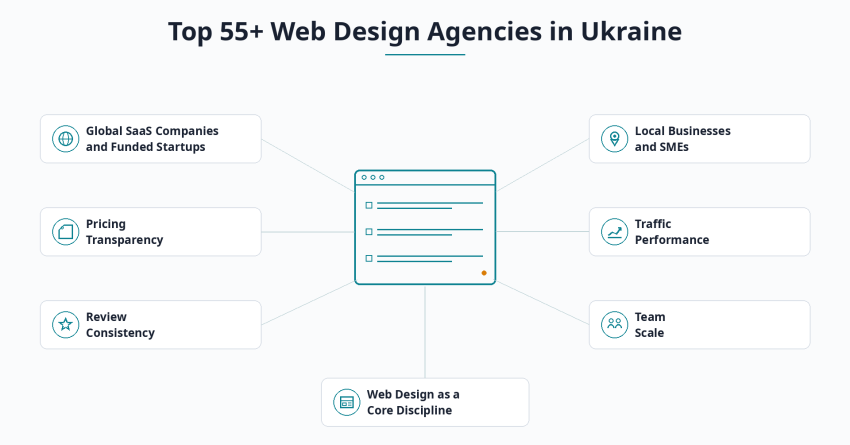
Top Web Design Agencies in Ukraine in 2026 (At a Glance)
Picking a web design agency in Ukraine looks simple until you actually start comparing options. Dozens of studios claim the same things: strong design, good communication, proven results. The real differences only show up once you look past the homepage.
Ukraine’s agency scene splits into two very different worlds. One side builds for global SaaS companies and funded startups with six-figure budgets. The other serves local businesses and SMEs that need something functional without the enterprise price tag. An agency that excels in one world often struggles in the other, and most buyers never ask which side they’re actually dealing with.
This overview walks through the agencies worth knowing in 2026, based on verifiable data rather than marketing copy. Each one is scored against the same criteria: pricing transparency, traffic performance, review consistency, team scale, and how seriously they treat web design as a core discipline rather than an add-on service.
List of The Top 53+ Web Design Agencies in Ukraine (2026)
Scroll the table below to compare pricing, team size, and specialization across the full agency set before jumping into the detailed profiles.
| Rank | Agency | Best For | Min. Project Cost | Team Size |
| 1 | SmartSites | Performance-driven design + SEO/paid media | $1,000 | 309 |
| 2 | Halo Lab | Design-led UX and product thinking | $10,000 | 133 |
| 3 | Duck.Design | Fast, subscription-based design | $1,000 | 151 |
| 4 | CHI Software | Development-heavy, AI-backed design | $50,000 | 389 |
| 5 | Designli | UX-first, structured product planning | $10,000 | 76 |
| 6 | Newwave Solutions | Scalable design with cost efficiency | $5,000 | 172 |
| 7 | Tubik | UX/UI-driven, brand-focused design | $5,000 | 42 |
| 8 | Probey Services | Cost-effective, technical execution | $1,000 | 64 |
| 9 | Ekreative | Custom design with engineering depth | $10,000 | 155 |
| 10 | SEO Tech Experts LLC | SEO-driven visibility design | $1,000 | 2 |
| 11 | Clickable Agency | Brand-led visual identity | $1,000 | 41 |
| 12 | Simpalm | Design with custom software/apps | $10,000 | 69 |
| 13 | Funnel Boost Media | Conversion-focused, lead-gen design | $1,000 | 45 |
| 14 | Fulcrum Digital | Enterprise design + cloud/data engineering | $40,000 | 240 |
| 15 | Uptech | Startup design + long-term product partnership | $15,000 | 110 |
Deep Dive: A Closer Look at the Top 16+ Web Design Agencies in Ukraine (2026)
Line up any ten of these agencies side by side and the surface looks almost identical. Modern portfolios, confident case studies, similar service lists. The real separation shows up in how each one actually operates once a contract starts: who touches the project daily, how pricing scales as scope changes, and whether the agency’s whole business model matches what the client actually needs.
That’s the lens for every profile below. Not just what they built, but what kind of client they’re quietly built for.
1. SmartSites – Best for Performance-Driven Web Design Supported by SEO and Paid Media

- Website: smartsites.com
- Minimum Project Cost: $1,000
- Average Client Satisfaction Rating: 4.74 (based on 1,671 reviews)
- Team Size: 309 (LinkedIn)
- Years in Business: 14
- Monthly Website Visits: 15,700
- Employee Review Score: 4.4 (based on 109 reviews)
Volume changes how an agency operates, and SmartSites has built its entire model around it. Running thousands of campaigns across hundreds of clients means the team isn’t improvising a process for your project. They’re applying one that’s already been tested at scale.
That consistency suits a specific type of buyer. A business that already knows its goals, has a defined budget, and just needs capable execution gets real value here. What they get less of is open-ended exploration. If your positioning is still unclear or your market strategy is in flux, a systemized agency can feel like it’s moving faster than your thinking.
Where SmartSites separates itself is the connective tissue between design and performance channels. The website isn’t treated as a standalone deliverable. It’s built to work alongside SEO structure and paid campaign flow from the first wireframe, which is a different starting point than agencies that design first and bolt on marketing after launch.
Core Services
Website builds here prioritize conversion mechanics over decorative flourishes — clear layouts, fast load times, and structures that scale as traffic grows. SEO gets embedded directly into the site’s architecture rather than treated as a follow-up task, which means page hierarchy and internal linking are planned before a single page goes live. Paid media support ties landing pages directly to active ad campaigns, so traffic quality and lead cost stay aligned. Online stores get built around product discoverability and checkout friction reduction rather than just visual merchandising. Beyond the launch, email flows, analytics dashboards, and conversion tracking stay connected to the site so the business can actually measure what’s working.
Why They Rank #1
The review volume alone signals something most agencies can’t claim: thousands of clients across different industries reporting similar outcomes. That kind of consistency at scale is rare. The team size supports handling multiple complex projects simultaneously without the bottlenecks smaller shops run into. Entry pricing stays accessible even though the agency operates at enterprise scale, which is an unusual combination. Reviews consistently point to professionalism and measurable outcomes rather than vague satisfaction.
Snapshot of Client Reviews
Clients describe tangible shifts: better lead flow, cleaner ROI numbers, traffic that actually converts. That pattern holds across different sectors, which usually means the process is repeatable rather than lucky. Responsiveness comes up frequently, with clients noting structured updates and fast turnaround on requests. The more common critique centers on wanting more proactive strategic suggestions rather than execution-only delivery, but the overall sentiment stays firmly practical.
Our Take
A strong match for small and mid-sized businesses that want proven systems over experimental strategy, especially when SEO, paid media, and design all need to move together. Companies looking for deep brand positioning work or highly bespoke builds may find the process too standardized. Against Ukraine-based studios on this list, SmartSites wins on operational scale and process maturity rather than creative originality.
2. Halo Lab – Best for Design-Led Web Experiences with Strong UX and Product Thinking

- Website: halo-lab.com
- Minimum Project Cost: $10,000
- Average Client Satisfaction Rating: 4.75 (based on 129 reviews)
- Team Size: 133 (LinkedIn)
- Years in Business: 12
- Monthly Website Visits: 29,700
- Employee Review Score: 4.4 (based on 8 reviews)
Halo Lab’s headquarters sit in Dubai, but the operational core runs through Odesa, which puts it in an interesting spot for this list. Ukraine’s design talent has always split between budget-conscious local work and globally competitive product execution, and Halo Lab leans hard into the second category.
The agency’s work shows up strongest on complex digital products: SaaS platforms, web applications, branded systems that need to function across multiple touchpoints. Their language around “dedicated teams” signals the real offer isn’t just a finished website. It’s embedded production capacity, which matters for a founder trying to move fast without building an internal team from scratch.
That same depth can become a liability for simpler needs. A local service business looking for a straightforward marketing site may find the engagement model heavier than necessary, both in cost and process.
Core Services
Design work here starts from usability research rather than visual trends, which shows up in how layouts prioritize user flow over decorative choices. Startups and growing teams get support through product audits and MVP design, letting ideas get validated before full development investment happens. Branding projects extend beyond logos into full visual systems that stay consistent across every digital touchpoint. Development stays in-house across Webflow, custom CMS builds, and cloud applications, which keeps design intent intact through to the final build rather than getting diluted by an external dev handoff. Mobile and web experiences get planned together from the start, avoiding the disconnect that happens when platforms get designed in isolation.
Why They Rank #2
A high satisfaction score across a meaningful review volume signals consistency rather than a handful of lucky projects. The combination of UX depth and in-house development capability means design intent survives all the way to production. Team size supports genuinely complex, multi-phase projects without outsourcing critical pieces. Clients repeatedly highlight proactive communication rather than reactive status updates. The agency suits businesses that treat design as a strategic function, not a cosmetic one.
Snapshot of Client Reviews
The recurring theme is clarity under complexity. Clients in healthcare, SaaS, real estate, and product platforms describe handing over a messy idea and getting back a coherent design system. Project management draws consistent praise too, with mentions of on-time delivery and organized workflows showing up across different industries and project sizes.
Our Take
Best suited to startups, SaaS teams, and product-driven companies that need design depth backed by real development capability. A small Ukraine-based business needing something simple may find the engagement overbuilt for the actual need. Compared to SmartSites, Halo Lab trades volume-driven process for design-first product thinking.
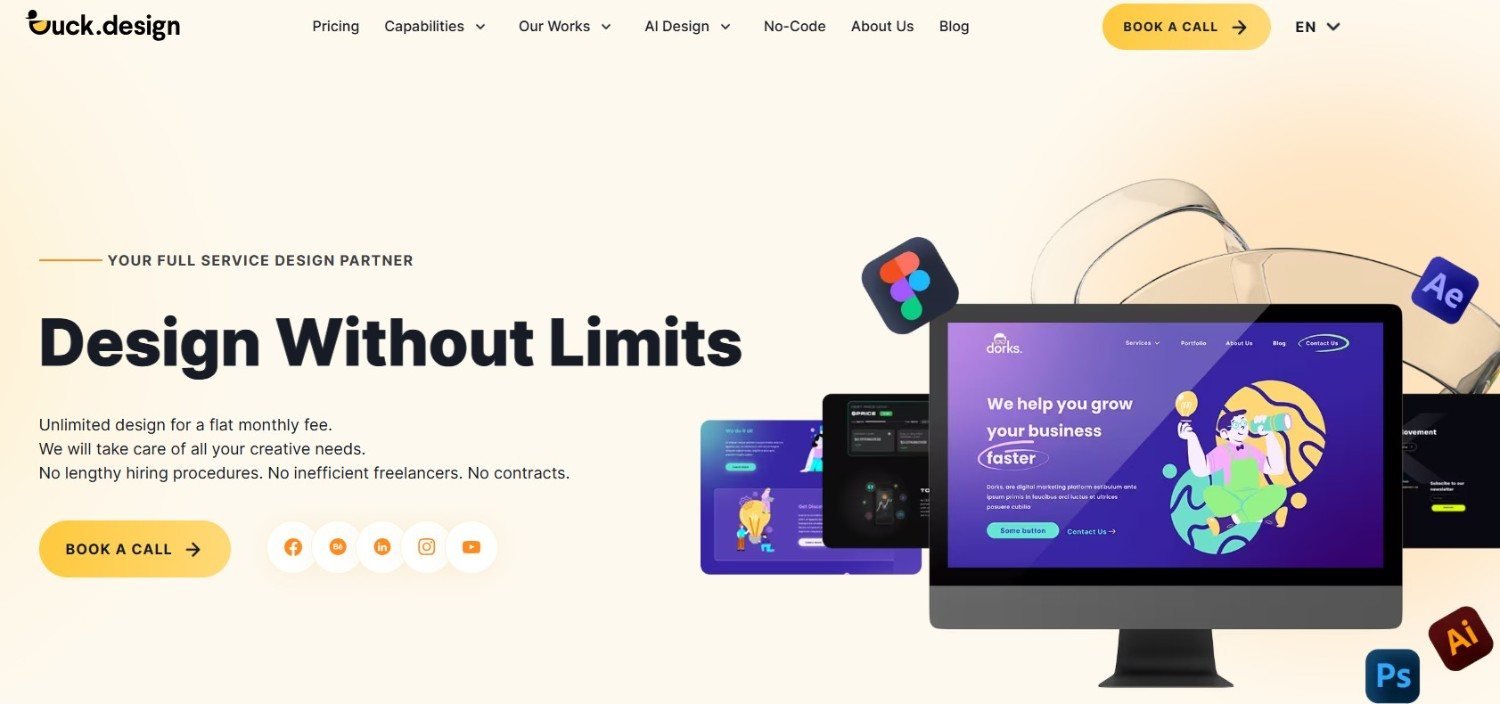
3. Duck.Design – Best for Fast, Flexible Web Design with a Subscription-Based Model
- Website: duck.design
- Minimum Project Cost: $1,000
- Average Client Satisfaction Rating: 4.83 (based on 210 reviews)
- Team Size: 151 (LinkedIn)
- Years in Business: 9
- Monthly Website Visits: 30,000
- Employee Review Score: 4.5 (based on 2 reviews)
Duck.Design skips the traditional agency relationship entirely. There’s no lengthy discovery phase or drawn-out contract negotiation. You subscribe, submit tasks, and output comes back on a predictable cadence. That structural choice reshapes what working with them actually feels like.
The model fits teams that move fast by nature. SaaS companies iterating on features weekly. eCommerce brands constantly refreshing visuals. Startups that need design output without the overhead of managing a full creative partnership. For businesses in Ukraine still figuring out longer-term budgets, the predictability of a subscription cost can feel far less risky than committing to a large fixed-scope contract.
What gets traded away is strategic depth. Each task gets handled competently, but you’re not getting deep positioning work baked into every deliverable. For a client who already knows exactly what they need, that’s rarely a problem. For one still searching for direction, the gap becomes more noticeable.
Core Services
Interface and website design work here centers on simplifying complexity, turning convoluted user flows into something intuitive without losing functional depth. Product design support covers wireframes and UI systems that keep digital products visually and functionally consistent as they scale. Branding and packaging work extends across both digital and physical touchpoints, maintaining a unified visual identity. The subscription structure itself is the biggest differentiator: clients get ongoing access to a design team without the overhead of hiring, with cost staying predictable regardless of how much work moves through the pipeline each month.
Why They Rank #3
A high satisfaction score across a sizable review base reflects consistency at speed, which is a harder combination to pull off than it sounds. The flexible pricing model removes a lot of the budget anxiety that comes with traditional project-based contracts. Clients repeatedly note how quickly the team grasps UX requirements without extended discovery. Professionalism and efficiency show up as recurring themes across very different project types.
Snapshot of Client Reviews
The language in these reviews skews toward output rather than process. Clients talk less about “strategy” and more about turnaround speed and ease of collaboration. Measurable results surface too — one SaaS client reported better customer satisfaction tied directly to UI improvements, while another saw bounce rate drop meaningfully after a redesign.
Our Take
A strong fit for teams that already know their direction and need fast, reliable execution. Particularly useful for SaaS, startups, and eCommerce brands running frequent iterations. Less suited to businesses wanting deep strategic guidance or a fully custom build developed from a blank slate. Against Halo Lab, Duck.Design clearly prioritizes speed over depth, and for the right client, that’s the correct trade.
4. CHI Software – Best for Development-Heavy Web Design Backed by Advanced Engineering and AI Expertise

- Website: chisw.com
- Minimum Project Cost: $50,000
- Average Client Satisfaction Rating: 4.43 (based on 35 reviews)
- Team Size: 389 (LinkedIn)
- Years in Business: 19
- Monthly Website Visits: 3,200
- Employee Review Score: 3.6 (based on 55 reviews)
CHI Software isn’t primarily a design shop that happens to code. It’s an engineering company that happens to design. That distinction matters immediately, because it shapes every other decision about fit.
Their center of gravity sits in AI integration, cloud infrastructure, data pipelines, and custom platform development. Web design exists as a component of that larger technical offering rather than the main event. Given Kharkiv and Lviv’s long-standing reputation for deep technical talent, CHI’s positioning tracks with the broader regional strength more than the pure creative studio model does.
The $50,000 minimum project cost filters the client base immediately. This isn’t a partner for a marketing site refresh. It’s built for companies with complex internal systems, product roadmaps tied to technical architecture, or platforms where the website is one piece of a much larger engineering puzzle. Buyers looking for a sharp but simple site often misjudge CHI as overkill, when the real misalignment is that they never needed engineering depth in the first place.
Why They Rank #4
Nearly two decades in business gives CHI a track record few peers on this list can match. Team size supports simultaneous handling of multiple complex, long-running builds without resourcing conflicts. Client feedback consistently centers on technical confidence, with reviewers describing developers who integrate into internal teams with minimal oversight. The agency proves itself well-suited to high-complexity, development-heavy projects where design is only one layer of the requirement.
Snapshot of Client Reviews
The language here reads differently than reviews for design-first agencies. Clients talk about architecture decisions, system integration, and developers who operate with real autonomy. Several reviews highlight reliable delivery timelines and strong ownership over technical outcomes, the kind of feedback that signals an engineering partner rather than a creative vendor.
Our Take
A strong match for funded startups, SaaS platforms, and enterprise teams needing web design tightly coupled with serious engineering. Not the right call for a small brochure site. For AI-driven products, IoT systems, or complex internal software, CHI brings a depth most design-first studios simply don’t carry.
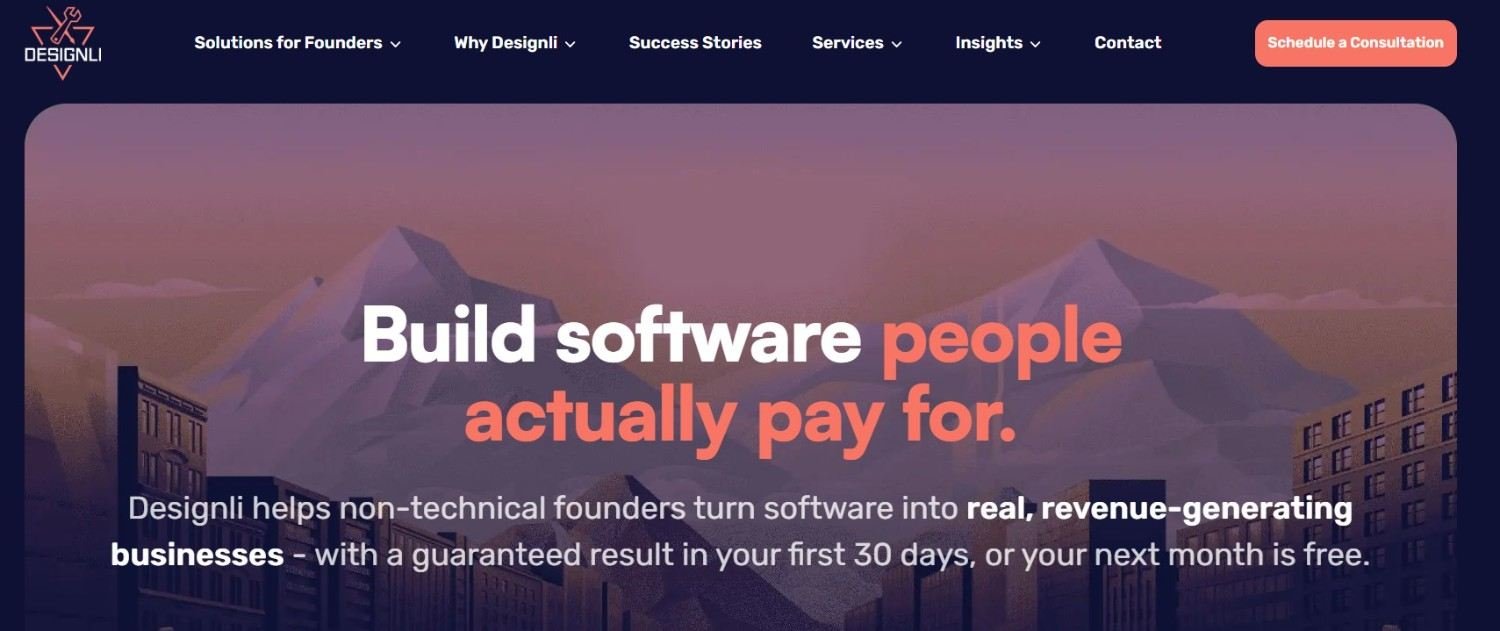
5. Designli – Best for UX-First Web Design and Structured Product Planning
- Website: designli.co
- Minimum Project Cost: $10,000
- Average Client Satisfaction Rating: 4.98 (based on 271 reviews)
- Team Size: 76 (LinkedIn)
- Years in Business: 12
- Monthly Website Visits: 6,300
- Employee Review Score: 5.0 (based on 1 review)
Designli targets a very specific buyer profile: the non-technical founder carrying an idea, some urgency, and real anxiety about choosing the wrong development partner. That’s not a side benefit of their process. It’s the whole design of their engagement model.
Much of Ukraine’s agency landscape leans technical-first, which works well for founders who already speak the language of engineering. Designli goes the opposite direction, building structure into the product itself through roadmaps, prototypes, and consistent communication cadences. For early-stage SaaS products or custom applications, that structure can prevent a lot of wasted spend before a line of code gets written.
Based in Greenville rather than Ukraine, Designli isn’t a local-market agency in the traditional sense. But for Ukrainian startups building for U.S. or global audiences, that outside vantage point can actually be useful rather than a drawback. The caveat is simple: if the need is just a website, this level of structured planning becomes unnecessary overhead.
Core Services
Interface design work here starts from observed user behavior rather than assumption, with navigation and interaction patterns built around how people actually use the product. Web applications get designed and developed with scalability baked in from the earliest wireframes. Mobile and web experiences get planned in parallel to maintain consistency across every device a user might reach for. Product-led businesses get support through functional prototypes and MVP builds that validate direction before full-scale investment. A structured discovery phase called SolutionLab runs before any design work begins, mapping scope, user journeys, and technical requirements so the team isn’t guessing mid-build.
Why They Rank #5
An exceptionally high satisfaction score across a large review volume signals rare consistency. The structured workflow model reduces the ambiguity that derails a lot of early-stage product builds. UX depth paired with genuine product thinking sets Designli apart from agencies that treat interface design as a cosmetic layer. Communication stays transparent throughout, which matters enormously for founders without a technical background guiding the project.
Snapshot of Client Reviews
Trust is the word that surfaces again and again. Clients describe a team that explains technical tradeoffs without condescension, which keeps founders engaged rather than sidelined during their own product’s development. Prototype quality and clear timelines get mentioned frequently, along with guidance during the earliest, most uncertain planning stages.
Our Take
The right fit for founders building actual software, not simply a business looking for a standard website. Designli shines when the buyer needs patience, structure, and product-level thinking rather than pure execution speed. Ukrainian companies selling into global markets may especially benefit from that founder-friendly process.
6. Newwave Solutions – Best for Scalable Web Design Backed by Reliable Development and Cost Efficiency

- Website: newwavesolution.com
- Minimum Project Cost: $5,000
- Average Client Satisfaction Rating: 4.93 (based on 203 reviews)
- Team Size: 172 (LinkedIn)
- Years in Business: 14
- Monthly Website Visits: 3,800
- Employee Review Score: 4.7 (based on 4 reviews)
Newwave Solutions competes openly on cost and output rather than premium positioning. Lower hourly rates, flexible team structures, offshore delivery models — none of this is hidden behind vague language. It’s the explicit pitch.
That positioning puts Newwave in direct contrast with Ukraine-based agencies, which, despite a reputation for strong engineering, are no longer the cheapest option across Eastern Europe. Vietnam-based teams like Newwave fill that pricing gap directly, which matters a great deal to a Ukrainian startup watching burn rate closely, particularly during MVP builds or internal tooling projects where polish matters less than speed and budget control.
Operating across Japan and Korea as well suggests comfort working across time zones and within more rigid enterprise reporting structures. The tradeoff that comes with any offshore model is communication consistency, which can vary project to project, but when managed with clear expectations upfront, tends to work out reasonably well.
Core Services
Website and interface design here prioritizes real usability needs over visual trend-chasing, built to scale alongside the business rather than require a redesign at the next growth stage. Custom software and broader platform builds get handled alongside website development, supporting projects that extend well past a simple marketing site. Mobile and web experiences get developed in tandem for consistency across devices. Ongoing QA and maintenance keep sites stable and secure well past launch day. Newer technologies get incorporated where relevant, supporting future scalability rather than locking clients into a dated stack.
Why They Rank #6
A high satisfaction rating across a substantial review count reflects dependable delivery at scale. Team size supports long-term, multi-phase engagements without resourcing bottlenecks. Clients consistently describe proactive problem-solving rather than reactive fixes. Pricing stays notably reasonable compared to development-heavy peers like CHI Software. Responsiveness and reliability come up as recurring strengths across the review base.
Snapshot of Client Reviews
The tone across reviews stays practical: efficiency, fast delivery, strong value for the spend. One client reported a 25% increase in sales alongside improved processing time following implementation. Technical capability draws particular praise in mobile apps, healthcare, and fintech builds. A smaller number of reviews mention occasional communication gaps or language friction, which tracks with the realities of an offshore delivery model.
Our Take
Best suited to budget-conscious teams that still need genuine technical execution, particularly for MVPs or scaling development capacity without local hiring. Less ideal for businesses wanting tight creative direction or heavily brand-focused design work. Against CHI Software, Newwave wins clearly on cost while CHI wins on technical depth.
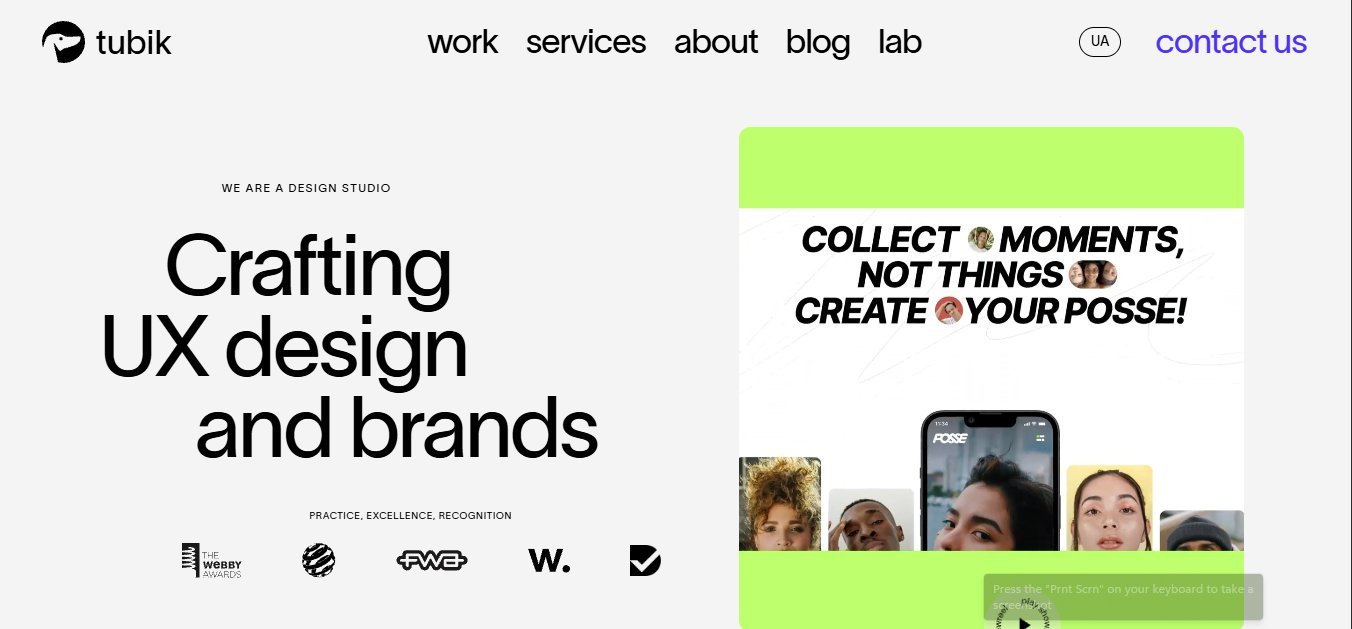
7. Tubik – Best for UX/UI-Driven Web Design and Brand-Focused Digital Experiences
- Website: tubikstudio.com
- Minimum Project Cost: $5,000
- Average Client Satisfaction Rating: 4.85 (based on 40 reviews)
- Team Size: 42 (LinkedIn)
- Years in Business: 12
- Monthly Website Visits: 10,800
- Employee Review Score: 4.9 (based on 5 reviews)
Tubik reads more like a design studio than a full-service agency, and that distinction shapes everything about how they operate. A smaller team, a sharper focus on craft, and noticeably less noise around being a one-stop shop for every digital need. Their lane stays narrow on purpose: UI/UX, branding, product design.
Being based in Dnipro rather than Kyiv or Lviv shifts the operating rhythm too, typically meaning lower overhead and more tightly focused teams working at a different pace than larger agencies juggling dozens of simultaneous accounts.
Their reputation extends beyond Ukraine through recognition at Webby Awards, Red Dot, and Awwwards, the kind of credibility that comes from design depth rather than marketing spend. Their strongest work sits inside digital product ecosystems: SaaS platforms, fintech tools, marketplaces, and more experimental UI work. What shows up less often is deep strategic or growth-oriented guidance, since some clients expect more input on positioning than Tubik positions itself to provide.
Core Services
Interface work grounds itself in usability research and real interaction patterns rather than aesthetic trends alone. Website builds balance visual identity against functional clarity, keeping designs intuitive without sacrificing personality. Branding projects produce full visual identity systems, extending consistency across every digital asset a brand touches. Supporting graphic work enhances engagement while keeping cohesion across products and platforms intact.
Why They Rank #7
A strong satisfaction score specifically around UX/UI quality signals genuine design craft rather than generic service delivery. Creativity paired consistently with usability sets Tubik apart from studios that lean too far toward either extreme. Communication stays clear and professional throughout engagements based on review patterns. Flexibility and collaborative working style draw frequent praise. The agency suits brands that prioritize user experience and design value above almost everything else.
Snapshot of Client Reviews
The tone differs noticeably from performance-first agencies. Clients focus on creativity, clean execution, and attention to detail, with phrases like “exceeded expectations” surfacing repeatedly. Engagement improvements and better user experience after redesigns get mentioned consistently across SaaS and product-focused clients.
Our Take
Best suited to teams that already have clarity on direction and need strong design execution layered on top. A strong fit for SaaS products, startups, and design-heavy platforms. Less useful if deep strategic or growth planning needs to happen alongside the design work. Against Duck.Design, Tubik clearly trades speed for depth, and the quality of output reflects that choice.
8. Probey Services – Best for Cost-Effective, Reliable Web Design with Strong Technical Execution

- Website: probeyservices.com
- Minimum Project Cost: $1,000
- Average Client Satisfaction Rating: 5.00 (based on 226 reviews)
- Team Size: 64 (LinkedIn)
- Years in Business: 9
- Monthly Website Visits: 1,500
- Employee Review Score: 4.5 (based on 14 reviews)
Probey Services operates at a scale you notice immediately: larger teams, multiple offices, a broad stack of services under one roof. The model is built to absorb volume, not just handle individual projects one at a time, which appeals to businesses that want a single vendor rather than juggling several specialists.
Scale changes the texture of the relationship though. Ukraine-based agencies often feel closer and more direct, with tighter communication loops and smaller teams. Probey sits further toward the structured, process-heavy end of that spectrum, which can help some projects move smoothly and slow others down depending on how much flexibility the engagement actually needs.
Pricing stays genuinely competitive, which stands out against mid-tier Ukrainian firms that are no longer as inexpensive as they were several years ago. The tradeoff worth watching: when a single company covers everything from design to SEO to app development, no single discipline necessarily gets the deepest specialist attention. For a buyer who already knows exactly what they need executed, that’s rarely an issue. For one still exploring direction, the process can feel more rigid than ideal.
Core Services
Website builds stay clean and functional, prioritizing responsiveness and load performance over decorative excess. Mobile app and backend development often run alongside web projects, producing cohesive digital ecosystems rather than disconnected pieces. SEO and paid media get folded in post-launch to support visibility and lead generation. Branding and supporting graphic work keep visual consistency intact across every marketing touchpoint. Ongoing support and maintenance help sites stay stable and current well beyond the initial launch.
Why They Rank #8
A perfect satisfaction score across a genuinely large review base is rare and signals consistent delivery at volume. Entry pricing stays accessible compared to many competitors offering a similarly broad service stack. Technical execution pairs with organized project management throughout engagements. The agency adapts flexibly as client requirements shift mid-project. Delivery timelines stay reliable, and quality holds steady across review after review.
Our Take
A strong fit for businesses wanting scale and cost efficiency without managing multiple separate vendors. Particularly useful for startups and SMEs needing full digital support under one roof. Less suited to brands seeking highly tailored design or deep creative direction. Against Newwave, Probey feels more structured; against Tubik, considerably less design-focused.
9. Ekreative – Best for Custom Web Design Paired with Reliable Software Engineering

- Website: ekreative.com
- Minimum Project Cost: $10,000
- Average Client Satisfaction Rating: 4.97 (based on 93 reviews)
- Team Size: 155 (LinkedIn)
- Years in Business: 16
- Monthly Website Visits: 587
- Employee Review Score: 4.7 (based on 14 reviews)
Ekreative isn’t really hired for a single deliverable. Most engagements evolve into something closer to an ongoing technical partnership, where the agency gets folded into the client’s broader system rather than handed a one-off brief.
Sixteen years in business has built habits around sustained delivery: not just launching a product, but maintaining it, updating it, and catching problems before they escalate into real issues. That’s where a lot of younger agencies struggle. Operating out of Ukraine gives Ekreative a pricing advantage, but the real value sits in the depth of technical work they’re comfortable handling across complex builds, long timelines, and shifting requirements.
What you won’t find here is boutique-style creative exploration. Ekreative leans toward structure, execution, and practicality over abstract conceptual work. For the right client needing sustained technical reliability, that’s exactly the fit. For a client wanting loose, exploratory creative direction, the relationship can feel rigid early on.
Core Services
Website builds stay functional and maintainable first, with design choices closely tied to what’s technically feasible rather than purely aesthetic ambition. Custom software development often runs parallel to web projects, supporting internal tools and customer-facing platforms within the same ecosystem. eCommerce builds prioritize performance, stability, and secure transaction handling. Mobile and web development happen together to keep platforms consistent across every device a customer might use.
Why They Rank #9
A high satisfaction rating across a solid review volume signals reliability rather than a handful of standout projects. The team’s reputation for bug-free, dependable delivery stands out in a market where technical debt often piles up quickly. Complex technical requirements get handled by an experienced team without major missteps. The agency adapts well as project scope shifts over time, a quality harder to find than it sounds.
A Snapshot of Client Reviews
Clients don’t lead with “creativity” in their feedback. They lead with reliability. Deadlines get mentioned often, along with communication that stays consistent even when imperfect. Time zone or language gaps surface occasionally, but they tend to get resolved quickly rather than derailing the project. A recurring pattern shows client teams treating Ekreative almost like internal developers, which is usually the clearest signal of trust.
Our Take
Best suited to companies building serious, long-running products rather than simple marketing sites. A partner that can stay engaged for years and handle real complexity fits well here. A buyer wanting quick creative exploration or loose direction may feel early friction.
10. SEO Tech Experts LLC – Best for SEO-Driven Web Design Focused on Visibility and Growth

- Website: seotechexperts.ae
- Minimum Project Cost: $1,000
- Average Client Satisfaction Rating: 5.00 (based on 198 reviews)
- Team Size: 2 (LinkedIn)
- Years in Business: 16
- Monthly Website Visits: 6,400
- Employee Review Score: 4.5 (based on 12 reviews)
SEO Tech Experts isn’t fundamentally a web design-first agency, and that needs stating upfront before anything else. Their actual center of gravity sits in search: SEO, AEO, GEO, local visibility, and paid campaigns. Web design exists as a supporting component inside that larger performance system rather than the main offering.
That positioning makes them a different kind of fit for Ukraine’s market. A business only needing a cleaner-looking site has better design-focused options elsewhere on this list. But a business whose real problem is visibility — weak rankings, poor local search presence, an underperforming service page — finds more relevance here.
Their Dubai-based positioning matters too. Dubai’s local search market is brutally competitive, particularly across healthcare, real estate, hospitality, and professional services, and agencies that survive there tend to obsess over rankings and lead flow rather than visual polish alone. One caution worth flagging: their public review profile is thin on one major platform, so buyers should verify case studies and reporting style directly before committing to a larger engagement.
Core Services
Website structure here gets built around technical SEO fundamentals: page speed, crawlability, and clean architecture that search engines can actually parse. Local SEO and eCommerce optimization get particular attention, supporting Shopify stores and location-based service businesses alike. WordPress and Shopify builds stay flexible enough for ongoing optimization rather than static once-and-done launches. Paid advertising gets tightly aligned with landing pages and conversion paths to maximize return on ad spend. SEO audits and content strategy support sustained traffic growth well past the initial launch.
Why They Rank #10
A perfect satisfaction rating across a genuinely large review count is a strong signal, even with the caveat around one platform’s thinner profile. SEO-integrated design sets this agency apart from studios that treat search as an afterthought. Entry pricing stays accessible for small and mid-sized businesses. Reviews point to real traffic, lead, and sales growth rather than vague satisfaction. Communication and responsiveness draw consistent praise.
Snapshot of Client Reviews
The available feedback is strong, including one client reporting a 330% sales increase within 18 months, alongside praise for timeliness and affordability. A single strong review doesn’t prove consistency across every industry, though the agency’s own case material points to broader rankings and visibility wins beyond that one example.
Our Take
A strong fit for businesses where the real website problem is actually a search problem. Particularly useful for local services, healthcare, real estate, eCommerce, and lead-generation-focused businesses. Less ideal for brand-heavy redesigns or complex product UX work. Against Clickable Agency, this team leans more SEO-first than campaign-creative.
11. Clickable Agency – Best for Brand-Led Web Design with Strong Visual Identity

- Website: clickable.agency
- Minimum Project Cost: $1,000
- Average Client Satisfaction Rating: 5.00 (based on 20 reviews)
- Team Size: 41 (LinkedIn)
- Years in Business: 10
- Monthly Website Visits: 251
- Employee Review Score: 5.0 (based on 7 reviews)
Clickable Agency distinguishes itself through a strong focus on branding, visual identity, and creative clarity rather than purely functional output. Based in Ukraine, the agency tends to attract businesses that want a website feeling distinctive and cohesive, built around a defined brand voice rather than a template-driven structure.
What consistently surfaces in client feedback is the agency’s ability to take abstract brand ideas and translate them into polished, working design systems. The process typically starts at brand fundamentals — logos, typography, visual language — and carries that thinking straight through into UX/UI and final web design. That approach suits companies that see their website as a genuine brand asset rather than just a digital brochure.
Rather than operating purely as a performance-focused vendor, Clickable positions itself closer to a creative partner. That framing appeals especially to startups, creative brands, and growing businesses wanting design work with real personality behind it.
Core Services
Website design here emphasizes visual hierarchy and brand consistency alongside straightforward usability. Branding and corporate identity work covers logo design, full brand books, typography systems, and visual guidelines that create a cohesive foundation before any web page gets built. Illustrations, animations, and supporting graphics get layered in to boost engagement across digital touchpoints. Messaging and communication platforms get developed alongside visual systems, ensuring brand voice scales consistently across every marketing surface.
Why They Rank #11
A perfect satisfaction rating across every reviewed project signals strong consistency, even accounting for a smaller review base. Creative quality paired with genuine branding depth sets this agency apart from more purely functional competitors. Communication stays clear and project management well-organized according to review patterns. Pricing remains competitive relative to the design quality delivered. The agency suits brand-led and creative projects particularly well.
Snapshot of Client Reviews
Clients talk about outcomes as much as aesthetics: higher conversion rates, stronger engagement, faster turnaround on deliverables. One client specifically mentioned a complete landing page delivered within five days. Another reported measurable gains tied directly to campaign performance. Direct, frequent communication without long response gaps comes up repeatedly across reviews.
Our Take
A strong fit for businesses focused on traffic, campaign performance, and fast-moving growth where design needs to convert rather than just look polished. Less suited to complex product builds or long-term platform development. Against Tubik, Clickable leans noticeably more performance-driven and less design-pure, with results sitting closer to the center of the value proposition.
12. Simpalm – Best for Web Design Paired with Custom Software and Mobile App Development
- Website: simpalm.com
- Minimum Project Cost: $10,000
- Average Client Satisfaction Rating: 4.72 (based on 117 reviews)
- Team Size: 69 (LinkedIn)
- Years in Business: 16
- Monthly Website Visits: 3,700
- Employee Review Score: 3.25 (based on 34 reviews)
Simpalm operates with a strong technical foundation, built around solving problems that span well beyond a standard website. The agency’s reputation leans toward patience with ambiguity, which matters because a lot of Simpalm engagements start before the client has fully defined what they need.
The business model centers on pairing web design with custom software and mobile app development under one team, which appeals especially to product-led companies that don’t want to coordinate separate vendors for each piece of their digital presence. Sixteen years in business has built real depth across industries, from nonprofits to growth-stage startups needing functional internal tools.
The entry pricing sits high enough that small, Ukraine-only local businesses may find better value elsewhere. For a company building something closer to a genuine product ecosystem, though, the combined design-and-engineering offer removes a lot of coordination overhead that comes with managing multiple specialized vendors.
Core Services
Interface design prioritizes clarity and scalability, built to support both end users and underlying business goals simultaneously. Web projects frequently pair with custom software builds, letting functionality scale alongside visual design rather than becoming a separate afterthought. Native and cross-platform mobile apps get developed in parallel with web platforms for a consistent user experience regardless of device. eCommerce builds emphasize performance, security, and long-term scalability. WordPress-based sites stay structured for flexibility and ongoing optimization as business needs shift.
Why They Rank #12
A strong reputation for technical problem-solving comes through consistently in client feedback. The collaborative, client-focused approach helps projects move forward even when initial requirements are loosely defined. Delivering both web design and complex software under a single team removes coordination friction that multi-vendor projects often create. Communication and project management draw reliable praise throughout engagements. The agency suits product-led and growth-oriented businesses particularly well.
Snapshot of Client Reviews
The tone across reviews stays steady rather than dramatic. Clients mention patience, clear communication, and an ability to turn vague early-stage ideas into working products. Several reviews point to cleaner prototypes and internal business tools that genuinely improved team efficiency, which speaks to projects that started loosely defined and still landed well.
Our Take
Best suited to startups, nonprofits, and mid-sized companies needing a product-minded web partner, particularly where design connects to apps, portals, or internal workflows. For Ukraine-only local businesses, pricing may feel elevated relative to need. Against Designli, Simpalm feels more delivery-focused and less oriented toward founder coaching through the process.
13. Funnel Boost Media – Best for Conversion-Focused Web Design Built to Support SEO and Lead Generation

- Website: funnelboostmedia.net
- Minimum Project Cost: $1,000
- Average Client Satisfaction Rating: 4.66 (based on 440 reviews)
- Team Size: 45 (LinkedIn)
- Years in Business: 13
- Monthly Website Visits: 2,300
- Employee Review Score: 4.6 (based on 11 reviews)
Funnel Boost Media isn’t chasing design awards, and that becomes obvious quickly once you see how every conversation ties back to SEO, PPC, and conversion performance rather than aesthetics alone. The website exists to generate leads, full stop.
Based in San Antonio, the agency operates in a market where local SEO competition is genuinely brutal at the city level, unlike some European or Ukrainian markets where ranking pressure varies more by niche. That competitive environment has shaped a model built specifically around service businesses: contractors, clinics, local operators who need calls coming in soon, not a polished brand experience six months from now.
A lot of agencies build something visually strong that simply doesn’t rank, and Funnel Boost seems uninterested in that tradeoff entirely. The flip side is that deep product design thinking or complex UX systems aren’t really their strength. Visibility comes first, every time.
Core Services
Website builds stay clean and conversion-focused, with messaging and layout structured around lead capture rather than visual experimentation. Local and national SEO strategy gets tightly woven into site architecture from the start, supporting organic rankings for high-intent search terms. PPC campaigns align directly with landing page structure to improve conversion rates and overall return on ad spend. Ongoing optimization keeps sites performing well past launch, adjusted continuously based on real performance data rather than a set-and-forget approach.
Why They Rank #13
A high review volume signals consistent delivery across a large client base rather than a handful of strong outcomes. Web design, SEO, and paid media stay tightly aligned rather than operating as separate workstreams. Entry pricing remains accessible for small and mid-sized businesses. The agency’s clear focus on measurable conversions over visual awards shows up throughout client feedback. Positive employee sentiment supports consistent execution quality.
Snapshot of Client Reviews
Responsiveness surfaces more than any other theme across reviews: fast replies, clear updates, no vague reporting gaps. A recurring pattern involves clients switching from previous agencies that overpromised and underdelivered, with Funnel Boost winning trust by being direct about realistic outcomes from the start.
Our Take
Best suited to local service businesses prioritizing leads over design recognition, particularly contractors, clinics, and small-to-mid businesses trying to dominate local search. For product-level UX or complex custom builds, better options exist elsewhere on this list. But for a business whose core need is simply “more calls coming in,” Funnel Boost is built precisely for that outcome.
14. Fulcrum Digital — Best for Enterprise Web Design Integrated with Data Engineering and Cloud Modernization
- Website: fulcrumdigital.com
- Minimum Project Cost: $40,000
- Average Client Satisfaction Rating: Not publicly listed
- Team Size: 240 (estimated, LinkedIn)
- Years in Business: 20+
- Monthly Website Visits: 6700
- Employee Review Score: N/A
Fulcrum Digital operates at the enterprise end of web design, where a website is rarely standalone and usually part of a data and cloud ecosystem. The agency pairs design with data engineering and cloud modernization, so enterprise clients get a web presence built on modern infrastructure rather than a surface layer over legacy systems.
The model appeals especially to large organizations modernizing how they collect, move, and use data across the business. A website built by Fulcrum typically connects to data pipelines, cloud platforms, and internal systems, which means design and engineering advance together instead of being handed off between separate vendors. Twenty-plus years in business has built depth across regulated industries and complex enterprise environments.
The entry pricing sits at $40,000, which places Fulcrum firmly in enterprise territory and beyond what small businesses or startups can justify. For a large company rebuilding its digital platform around data and cloud, the integrated offer removes the friction of coordinating design, data, and infrastructure across multiple firms.
Core Services
Enterprise web design prioritizes scale, security, and integration with existing systems rather than visual novelty alone. Data engineering builds the pipelines and architecture that feed content, analytics, and personalization into the website. Cloud modernization moves legacy platforms onto modern infrastructure for reliability and performance. Custom software supports the portals, dashboards, and internal tools surrounding the public site. Ongoing support keeps the platform stable as data volumes and business requirements grow.
Why They Rank #14
A strong reputation for enterprise delivery comes through in the agency’s positioning and long client relationships. The combination of web design, data engineering, and cloud modernization under one team removes handoffs that slow enterprise projects. Twenty-plus years in business signals stability that large organizations value when committing to a platform rebuild. The high entry price filters for serious enterprise engagements rather than small projects.
Snapshot of Client Reviews
The tone across commentary stays measured and enterprise-focused. Clients mention disciplined delivery, strong technical depth, and an ability to handle complex integrations without losing sight of the business goal. The emphasis lands on reliability and long-term platform health rather than quick visual wins.
Our Take
Best suited to large enterprises modernizing a data-driven digital platform, particularly where the website must connect to cloud infrastructure and data systems. For smaller businesses, the $40,000 entry price will feel out of reach. Against product studios, Fulcrum feels more infrastructure-led and less oriented toward startup speed.
15. Uptech — Best for Startup-Focused Web Design Paired with Long-Term Product Engineering Partnership

- Website: uptech.team
- Minimum Project Cost: $15,000
- Average Client Satisfaction Rating: Not publicly listed
- Team Size: 110 (estimated, LinkedIn)
- Years in Business: 10+
- Monthly Website Visits: 2300
- Employee Review Score: N/A
Uptech is a startup-focused product studio from Kyiv that pairs web design with long-term product engineering, so founders get a partner rather than a one-off vendor. The team designs and builds web products for early-stage companies that need a credible site and a technical partner who stays involved after launch.
The model appeals especially to founders who want continuity between design and development. A website built by Uptech typically grows into a fuller product over time, with the same team handling design, engineering, and iteration as the startup finds product-market fit. Ten-plus years in business has built depth across fintech, healthtech, and consumer apps, where a polished web presence must connect to real product functionality.
The entry pricing sits at $15,000, which keeps Uptech accessible for funded startups while filtering for founders serious about product quality. For a startup needing both a strong website and a long-term engineering partner, the combined offer removes the cost of finding and onboarding separate design and development teams.
Core Services
Startup web design prioritizes a credible, conversion-ready presence that helps early-stage companies look established from day one. Product engineering builds the web applications, dashboards, and platforms that sit behind the marketing site. Mobile app development runs alongside web work so startups get a consistent product across devices. UI/UX design focuses on clear user flows that turn visitors into active users. Long-term partnership support keeps the product evolving through feedback, iteration, and new feature releases.
Why They Rank #15
A strong reputation for startup partnership comes through in the agency’s positioning and long client relationships. The combination of web design and ongoing product engineering under one team gives founders continuity that separate vendors cannot match. Ten-plus years in business signals stability that startups value when committing to a long-term build. The accessible entry price keeps the studio within reach of funded early-stage companies.
Snapshot of Client Reviews
The tone across commentary stays warm and founder-focused. Clients mention clear communication, reliable delivery, and a team that treats the product as its own. The emphasis lands on partnership and steady iteration rather than a single launch moment.
Our Take
Best suited to funded startups needing a web presence and a long-term product engineering partner, particularly where design must connect to a real product rather than a brochure site. For large enterprises, the startup focus may feel too narrow. Against enterprise agencies, Uptech feels more founder-friendly and more oriented toward speed and iteration.
How to Choose the Right Web Design Agency in Ukraine?
Most poor decisions in this process don’t look bad at the outset. The proposal reads clean. The visuals look sharp. The price feels reasonable. Then halfway through the build, things start drifting — delays creep in, expectations misalign, and the finished site looks fine but doesn’t actually move the business forward. Ukraine has no shortage of talent. The real risk comes from how buyers evaluate the options in front of them.
1. Check Who They Actually Build For
Many agencies based in Kyiv and Lviv serve international SaaS and tech clients almost exclusively, and that shapes their entire operating rhythm. A local or mid-market business engaging one of these teams often feels the mismatch quickly: timelines stretch longer than expected, scope balloons beyond what’s actually needed, and costs creep upward from the original estimate.
Look past the visual portfolio and study who’s actually behind the past work. The type of business a studio typically serves reveals far more about fit than any pitch deck ever will.
2. Don’t Get Sold on Design Alone
This is where a lot of engagements quietly go wrong. The agency with the most striking visual portfolio gets picked, and six months later the business is restructuring pages, rewriting content, or bringing in a separate SEO partner to fix what should have been planned correctly from day one.
Strong agencies think beyond surface visuals, factoring in page hierarchy, internal linking structure, and how content actually supports search visibility, especially for businesses planning to compete against established local SEO players or expand into new international markets. When design and SEO strategy get handled by completely separate teams with no coordination, problems tend to surface later rather than sooner.
3. Understand How They Price (and Why)
A quiet pricing split runs through this entire market. Some agencies charge rates built for Western client budgets. Others operate closer to local SME pricing realities. That gap is real and worth understanding before signing anything.
Low pricing often signals limited strategic input or recycled template components reused across clients. High pricing, meanwhile, doesn’t automatically guarantee stronger outcomes — sometimes the premium pays for process overhead rather than measurably better performance. Ask directly how projects get scoped, and what happens financially when requirements shift mid-build. A vague answer to that question is usually itself the answer.
4. Look at How They Handle Communication
Nearly every agency claims strong communication. Far fewer actually deliver it. Time zone differences, language nuance, and internal team structure matter more than most buyers expect going in, especially when teams work remotely or across Kyiv, Lviv, and other distributed locations.
Pay close attention to responsiveness before signing anything. Slow replies during the sales process rarely improve once a contract is signed and the relationship becomes less of a priority for the agency. Clear thinking tends to show up even in small early interactions.
5. Ask How They Think About Growth
A website launch is rarely the actual finish line. SaaS businesses need continuous improvement cycles. eCommerce brands care deeply about conversion rates and product page performance. Local businesses care more about search visibility than design recognition.
Some agencies naturally extend into longer-term growth support, including things like ongoing SEO strategy or ecommerce-specific optimization. Others stop entirely at delivery and move on to the next client. Nothing needs to be locked in upfront, but knowing whether an agency can actually grow alongside the business matters for long-term planning.
6. Pay Attention to What They Don’t Show
Every agency showcases its strongest work — that’s expected and unremarkable. What’s more revealing is what stays hidden: failed projects, missed timelines, clients who didn’t renew after the initial engagement ended.
Direct answers to these questions rarely come easily. But reading between the lines of review patterns tends to reveal the real story, paying attention not just to star ratings but to how clients actually describe the working process itself.
| Business Stage | What to Prioritize | Agencies That Typically Fit |
| Early-stage startup, non-technical founder | Structured planning, founder guidance | Designli |
| Funded startup building a product | Long-term engineering partnership | Uptech, Halo Lab |
| SME needing a straightforward site | Cost efficiency, fast turnaround | Duck.Design, Probey Services |
| Business with a visibility problem | SEO-integrated design | SEO Tech Experts LLC, Funnel Boost Media |
| Enterprise modernizing legacy systems | Cloud/data engineering depth | Fulcrum Digital, CHI Software |
| Brand-first creative business | Visual identity, brand systems | Clickable Agency, Tubik |
What Are The Common Mistakes When Choosing Web Design Agencies in Ukraine?
Poor agency choices rarely happen because a buyer was careless. They happen because the wrong signals looked convincing at the time. Ukraine’s web design market carries genuinely strong talent, but the range across that talent pool is wide. A small Dnipro design studio, a Kyiv-based development team, and a large global outsourcing firm are not solving remotely the same problem for a client.
1. Choosing Based on Visual Style Alone
A polished portfolio can hide shallow strategic thinking underneath it, and this happens often with design-led studios specifically. The homepage looks genuinely beautiful. The animations feel expensive and considered. But no one on the team has explained how that site will actually generate leads, support organic search, or guide a visitor toward meaningful action.
This risk runs especially high in Ukraine’s tech-heavy market, where visually strong design work is common. Business-aware design, the kind that connects aesthetics to actual outcomes, proves considerably harder to find consistently.
2. Ignoring Export Market Fit
Designing a website for a Ukrainian audience is simply not the same exercise as designing one for German, American, British, or Gulf-region buyers.
Different markets expect different trust signals entirely. U.S. buyers often look for detailed case studies, clear guarantees, and transparent pricing. German buyers tend to prioritize precision, security assurances, and thorough documentation. Gulf-region buyers frequently expect stronger visual polish paired with confident service positioning. Many businesses miss this distinction entirely, building one English-language site and assuming it performs equally well everywhere. It rarely does.
3. Treating SEO as a Later Step
This mistake tends to get expensive fast. The agency builds the site first, and only afterward does someone ask about rankings, metadata, internal linking, local landing pages, or technical architecture. By that point, fixing the gap means reworking pages that should have been planned correctly from the very start.
For Ukrainian companies competing internationally, SEO simply cannot sit as an afterthought tacked onto design. Site architecture needs to support search visibility from the first planning conversation.
4. Not Checking Who Will Actually Work on the Project
The sales conversation almost always sounds impressive. Senior team members join the call. The case studies on screen look genuinely strong.
Then the project kicks off, and the day-to-day team looks completely different from who sat on that initial call. This happens frequently in agency-dense markets like Kyiv and Lviv, where senior talent often gets stretched thin across many simultaneous accounts. Ask specifically who handles strategy, design, development, QA, and ongoing communication before any contract gets signed.
5. Underestimating Communication Style
Ukraine’s technical talent pool is genuinely strong — that was never really the concern. The real variable is rhythm. Some agencies work quietly, reporting progress only at defined milestones. Others expect detailed written briefs upfront. Some teams push back comfortably on a client’s initial idea. Others wait passively for explicit instruction before moving forward.
None of these approaches are inherently wrong. But if an internal team needs frequent check-in calls, fast approval cycles, or direct access to leadership, that expectation needs to get clarified early, before the engagement structure gets locked in.
6. Picking the Cheapest Offshore Option
Low cost feels attractive right up until the project starts quietly leaking time and budget elsewhere. Cheap web design frequently means thin discovery work, generic templated components, limited quality assurance, and unclear ownership once the site actually launches. Upfront savings often get consumed later fixing content gaps, structural issues, speed problems, or mobile responsiveness failures.
Ukraine stopped being the “cheap outsourcing” market it once was years ago. Strong teams price accordingly now, and that pricing discipline is usually a better signal of quality than a red flag to avoid.
7. Forgetting About Post-Launch Ownership
A website launch is not the finish line of the relationship, even though it often gets treated that way. Someone has to handle ongoing edits, bug fixes, analytics review, CMS updates, tracking implementation, security patching, and performance monitoring well after the initial build wraps.
Many buyers focus their entire evaluation on the build phase and forget to ask about the first ninety days after launch. This matters especially for eCommerce, SaaS, healthcare, and local service websites, all of which tend to change constantly. If the agency disappears the moment delivery happens, the site starts aging immediately with no one maintaining it.
8. Not Matching the Agency to the Business Stage
A startup building a minimum viable product does not need the same kind of partner as a law firm redesigning its service website. A SaaS company may need product-level UX, technical SEO depth, and ongoing link-building support further down the road. A local clinic may need strong trust signals, local SEO fundamentals, and genuinely fast mobile page performance. An online store likely cares more about ecommerce-specific SEO and reducing checkout friction than brand storytelling.
Matching the agency’s actual strength to the business’s current stage, rather than its aspirational future stage, prevents a lot of wasted spend and misaligned expectations.
How Web Design Agency Rankings in Ukraine Are Changing in 2026
The agency landscape in Ukraine looks different heading into 2026 than it did even two years earlier, and three shifts explain most of that movement.
Pricing compression sits at the center of it. Ukrainian agencies built their early reputation on being a reliable, more affordable alternative to Western studios. That gap has narrowed considerably as experienced teams raise rates to match their actual skill level, pushing some budget-conscious buyers toward newer offshore markets in Southeast Asia instead.
AI-assisted design tooling is reshaping how fast agencies can move through early-stage work. Wireframing, layout variations, and even first-draft copy now get generated faster than a few years ago, which shifts where an agency’s real value sits. It’s moving away from raw production speed and toward judgment: knowing which generated option to keep, discard, or refine based on actual user behavior and business goals.
Nearshoring patterns are shifting too, with more Western companies deliberately choosing Ukrainian partners specifically for cultural and time-zone alignment with European clients, rather than treating Ukraine purely as a lower-cost labor pool. That shift rewards agencies investing in genuine strategic capability over those competing purely on hourly rate.
Together, these shifts mean the agencies climbing these rankings over the next few years likely won’t be the ones executing fastest. They’ll be the ones combining technical reliability with real judgment about what actually drives results for the specific client sitting in front of them.
Conclusion
Most businesses don’t actually lose money on bad design work itself. They lose it on misalignment between what an agency does well and what the project actually needed. The agency looked right on paper. The pitch made complete sense in the room. But the work never quite matched the real underlying goal, and that pattern repeats more often than most buyers expect.
Ukraine carries serious design and engineering talent across its agency landscape. The challenge was never finding capable teams. It’s choosing the specific kind of capability that matches a business’s stage, target market, and realistic expectations for the engagement.
A strong website rarely comes from picking the agency with the biggest name or the lowest quote. It comes from genuine clarity before the build even starts. Get that part right early, and nearly everything downstream moves faster and with far less friction.
Methodology of Our Study:
How we ranked the top web design agencies in Ukraine for 2026.
The goal behind ranking these web design companies was to build a transparent, data-grounded assessment of the market rather than relying on subjective opinion or paid placement. Every ranking reflects real-world performance signals that actually matter for business outcomes, not just visual polish or marketing spend.
Data Sources:
All figures were independently gathered and analyzed during 2026. Sources include SEMrush for monthly traffic estimates, Clutch, DesignRush, G2, Google Business Profile, and TrustPilot for client satisfaction ratings and review volume, Glassdoor and Indeed for employee satisfaction data, LinkedIn for team headcount, and each agency’s own website for service offerings, pricing structure, and years in operation.
Scoring Categories and Weighting:
Four dimensions make up the final composite score, each broken into weighted sub-criteria contributing to a total out of 100.
Service Focus and Value Assessment carries 20% weight, measuring how central web design is to an agency’s core offering alongside client-reported cost ratings. Brand Authority carries the heaviest weight at 45%, built from website traffic, LinkedIn team size, and years in business, reflecting how established and operationally capable an agency actually is. Client Satisfaction contributes 30%, prioritizing both average rating and total review volume, since consistency across a large sample matters more than a handful of glowing reviews. Employee Satisfaction adds 25%, built from average employee ratings and review count, since internal culture tends to predict service quality externally. A Cost Accessibility adjustment of negative 20% applies a modest penalty for higher hourly rates and steep minimum project costs, keeping the rankings from simply rewarding the most expensive options by default.
Each agency’s final weighted score reflects a fair comparison across firms of very different sizes, pricing models, and business structures, surfacing the agencies that genuinely excel across satisfaction, operational strength, internal morale, and accessible pricing together rather than any single metric in isolation.
No agency paid for inclusion or placement anywhere in this guide, and all scores reflect publicly available data collected at the time of publication. Rankings reflect the market landscape as it stood during research; while individual metrics shift over time, the underlying evaluation framework prioritizes longer-term capability signals, which makes dramatic ranking swings unlikely in the near term.
This guide and its underlying research were compiled and published by the team behind White Label SEO Service as an independent market resource, with no agency involved in scoring or selection.
Frequently Asked Questions
How many web design agencies in Ukraine were actually evaluated for this ranking?
Over 100 agencies were reviewed using Clutch, DesignRush, LinkedIn, and traffic data before narrowing to the top 55+ included in the full list and the top 15 covered in detailed profiles.
Is a Ukraine-based agency always cheaper than a Western one?
Not anymore. Experienced Ukrainian agencies now price closer to Western rates, while newer offshore markets have become the lower-cost alternative for budget-sensitive projects.
What’s the biggest red flag when vetting a web design agency in Ukraine?
Vague answers about who actually works on the project day-to-day, beyond the senior team present during the sales call, signal a mismatch between pitch and delivery.
Should SEO be handled by the same agency doing the web design?
Not necessarily, but the two must be coordinated from the planning stage. Agencies that separate design and SEO entirely tend to produce sites that look good but rank poorly.
How long should a business budget for post-launch support after a website goes live?
At minimum, plan for ongoing support through the first 90 days after launch, covering bug fixes, analytics review, and content adjustments based on real user behavior.


