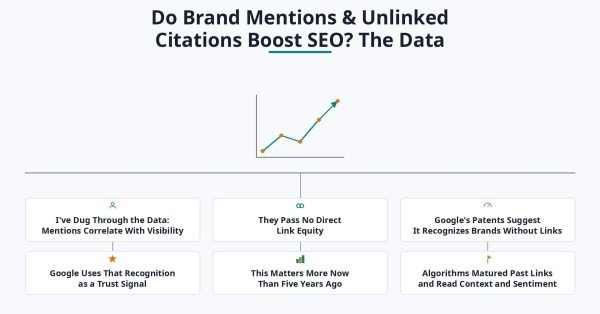
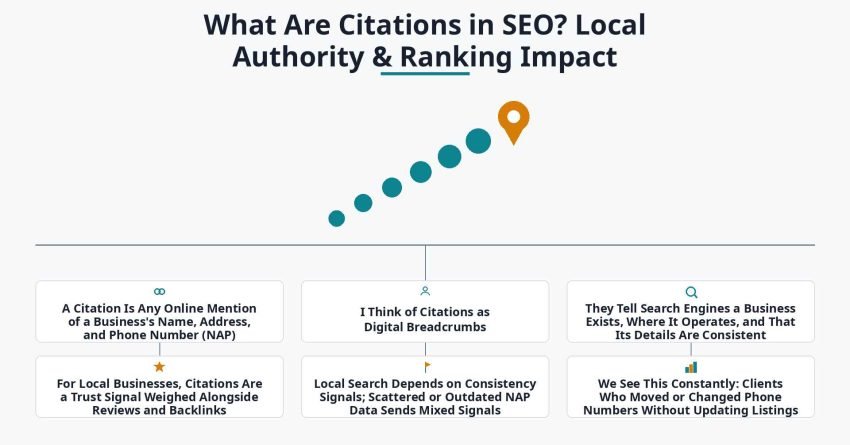
A citation is any online mention of a business’s name, address, and phone number (NAP), whether or not it links back to the business’s website. I think of citations as digital breadcrumbs. They tell search engines a business exists, where it operates, and that its details are consistent across the web. For local businesses in particular, citations are a trust signal that search engines weigh alongside reviews and backlinks.
Local search results depend heavily on consistency signals, and a business with scattered or outdated NAP data sends mixed signals to ranking systems. We see this constantly with clients who’ve moved locations or changed phone numbers without updating their directory listings.
This guide covers what citations actually are and how they differ from backlinks, the main types and sources worth prioritizing, how they influence local rankings and trust, and how to audit, build, and measure them without wasting time on low-value directories.
What Is a Citation in SEO?
A citation in SEO is any online reference to a business’s name, address, and phone number, regardless of whether it includes a hyperlink. I’ve worked with businesses that assumed citations only counted if they linked back to the site, but that’s not accurate. Even an unlinked mention on a local news site or directory counts as a citation.
Citations fall into two broad categories: structured and unstructured. Structured citations live on dedicated business directories with defined fields for name, address, and phone number. Unstructured citations show up in blog posts, news articles, or social mentions where the business information appears in natural text rather than a form field.
Structured vs. Unstructured Citations
Structured citations are easier for search engines to parse because the data sits in consistent fields across platforms like Yelp or the Better Business Bureau. Unstructured citations carry weight too, but they rely on the surrounding content being credible and relevant to the business’s location and industry.
What Does NAP Mean and Why Does It Matter?
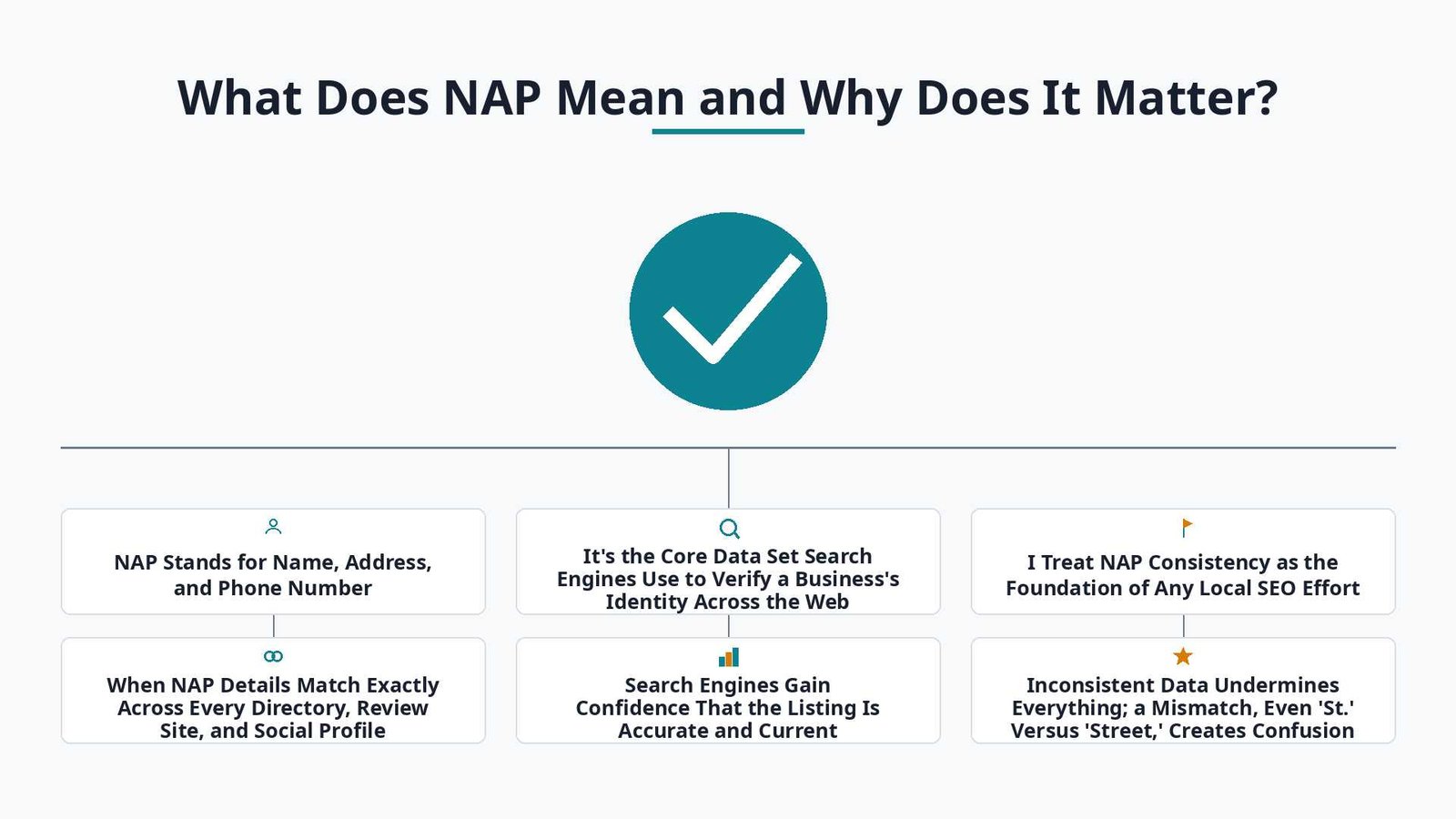
NAP stands for Name, Address, and Phone number, and it’s the core data set search engines use to verify a business’s identity across the web. I treat NAP consistency as the foundation of any local SEO effort, because inconsistent data undermines everything built on top of it.
When a business’s NAP details match exactly across every directory, review site, and social profile, search engines gain confidence that the listing is accurate and current. A mismatch, even something as small as “St.” versus “Street,” can create confusion about whether two listings represent the same business or two different ones.
Types of Citations (Structured, Unstructured, Data Aggregators)
Citations break down into three functional categories: structured directory listings, unstructured mentions, and data aggregator feeds that distribute business information to dozens of smaller platforms automatically. Each type plays a distinct role in building a business’s local footprint.
Structured citations are the most common starting point for most businesses. These are dedicated directory profiles on platforms where you manually enter business details into predefined fields.
Structured Citations (Directories & Platforms)
Structured citations appear on platforms built specifically to host business listings, including general directories and industry-specific platforms. These listings typically include the business category, hours, website link, and sometimes photos alongside the core NAP data.
Unstructured Citations (Mentions, Blogs, News)
Unstructured citations occur when a business’s name and location get mentioned in editorial content, such as a “best of” roundup article or a local news story covering a community event. These carry strong trust value because they appear in organic, non-promotional contexts rather than paid listings.
Data aggregators function differently from either structured or unstructured citations. A data aggregator collects a business’s information once and distributes it programmatically to a network of smaller directories and apps, which is why correcting information at the aggregator level can fix dozens of downstream listings simultaneously.
How Do Citations Impact Local SEO Rankings?
Citations influence local rankings primarily through consistency and volume, acting as a corroboration signal that confirms a business’s legitimacy and location to search engines. I’ve seen businesses improve local pack visibility within a few months simply by cleaning up duplicate and inconsistent listings, without touching any other ranking factor.
Moz’s Local Search Ranking Factors study has repeatedly identified citation signals, including consistency and volume, as a measurable component of local pack rankings. The correlation isn’t as dominant as it was a decade ago, but it remains part of the broader trust equation search engines use.
Citations as a Local Pack Ranking Factor
The local pack, the map-based results shown for geographically relevant searches, draws on proximity, relevance, and prominence, and citation consistency feeds directly into that prominence signal. Businesses with widespread, accurate citations tend to appear more trustworthy to the algorithms evaluating those three factors.
Citations vs. Backlinks: What’s the Difference?
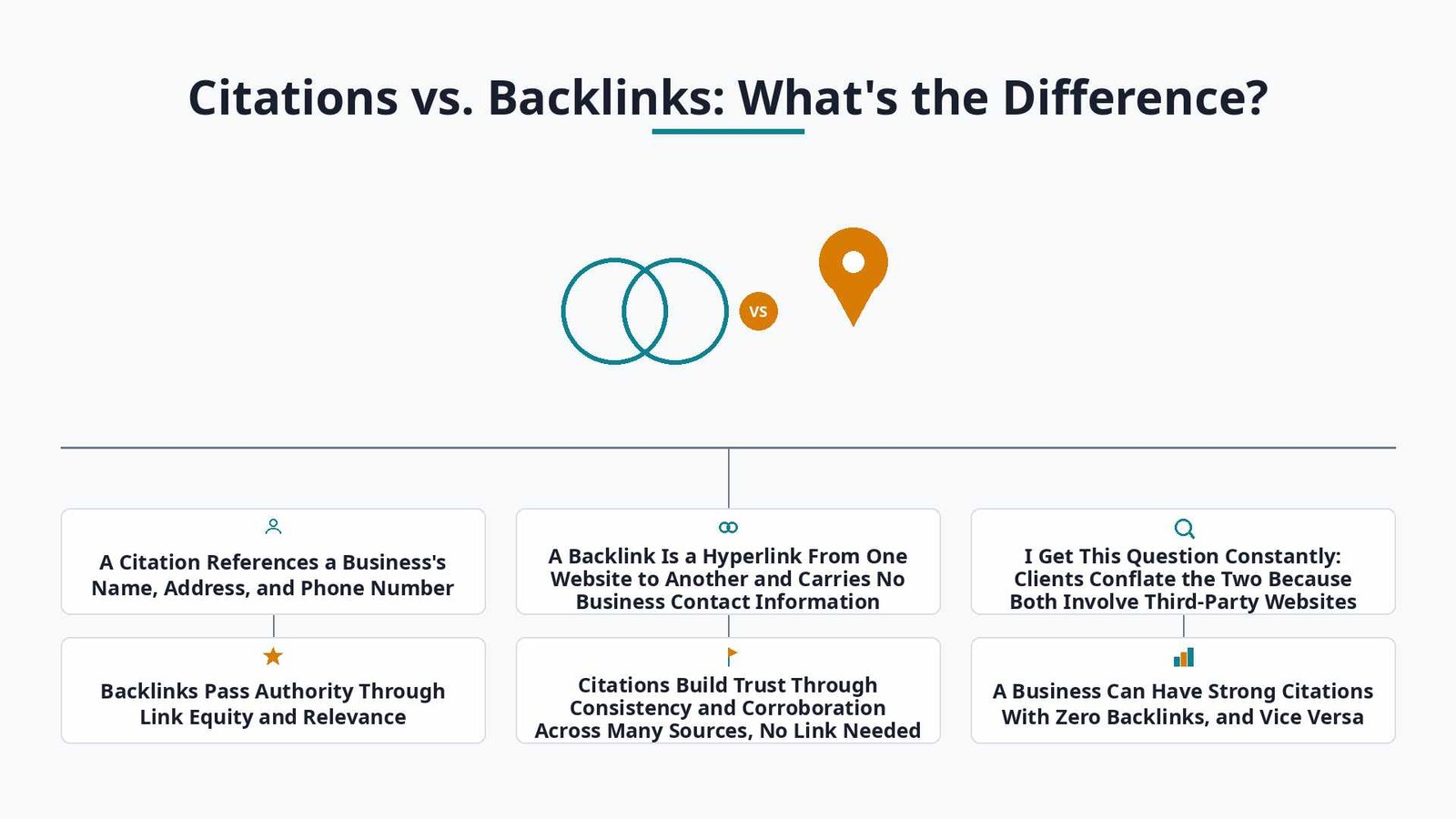
A citation references a business’s name, address, and phone number, while a backlink is a hyperlink from one website to another regardless of whether it contains business contact information. I get this question constantly from clients who conflate the two because both involve third-party websites referencing their business.
Backlinks pass authority primarily through link equity and relevance, judged largely on the linking domain’s trust and topical alignment. Citations build trust through consistency and corroboration across many sources, even when no link exists at all. A business can have strong citation coverage with zero backlinks, and vice versa, which is why local SEO strategies treat them as separate, complementary tactics rather than interchangeable ones.
The Most Important Citation Sources for US Businesses
For businesses operating in the United States, a small set of foundational platforms carry outsized weight because they feed data to dozens of secondary directories and mapping services. Getting these core listings right first prevents a lot of downstream cleanup work later.
Google Business Profile sits at the top of this list by a wide margin, since it directly powers the local pack and Google Maps listings. Beyond Google, a handful of major data aggregators distribute information across the broader directory ecosystem.
Primary Data Aggregators (Google Business Profile, Data Axle, etc.)
Data aggregators like Data Axle, Foursquare, and Neustar Localeze feed business information to hundreds of smaller apps, GPS systems, and niche directories automatically. Submitting accurate information to these aggregators once can prevent inconsistent data from propagating across the wider web.
How NAP Consistency Affects Trust and Rankings
NAP consistency affects trust because search engines use matching data points across multiple sources to confirm that a business listing is accurate and currently operating. I’ve audited accounts where a single outdated phone number on a legacy directory was actively suppressing local visibility months after the business had otherwise cleaned up its listings.
Inconsistent NAP data doesn’t just confuse algorithms. It confuses customers too, who might call a disconnected number or drive to a former address. That dual impact, on both machine trust and human trust, is why NAP consistency gets treated as a foundational ranking signal rather than a minor technical detail.
How to Audit Your Existing Citations
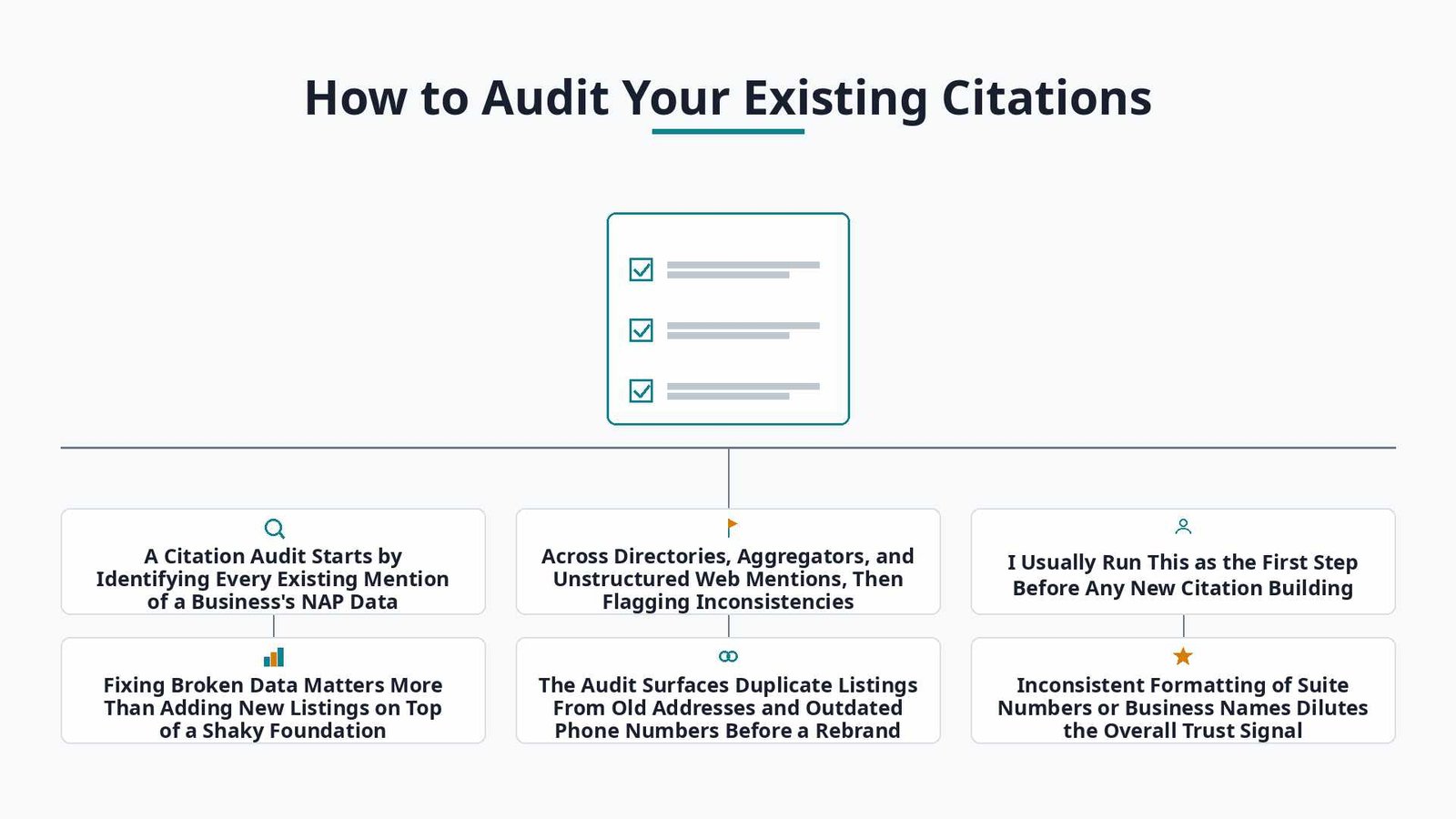
A citation audit starts by identifying every existing mention of a business’s NAP data across directories, aggregators, and unstructured web mentions, then flagging inconsistencies for correction. I usually run this as the first step before any new citation building, because fixing broken data matters more than adding new listings on top of a shaky foundation.
The audit process typically surfaces duplicate listings from old addresses, outdated phone numbers from before a rebrand, and inconsistent formatting of suite numbers or business names. Each of these inconsistencies dilutes the overall trust signal a business sends to search engines.
How to Build Citations the Right Way
Building citations the right way means prioritizing accuracy and relevance over sheer volume, starting with the platforms that carry the most authority and distribution reach. I always tell clients that 20 accurate, relevant citations outperform 200 inconsistent or irrelevant ones.
The two main approaches are manual submission, where a business or its team creates and verifies each listing individually, and using a citation service that handles bulk submission across a pre-vetted network of directories.
Manual Submission vs. Citation Services
Manual submission gives full control over accuracy and allows for industry-specific customization on each platform, but it takes significant time across dozens of directories. Citation services trade some of that granular control for speed and consistency, distributing standardized NAP data across a large directory network in bulk.
Industry-Specific and Niche Citations
Industry-specific citations are directory listings built for a particular trade or sector, such as legal directories for law firms or healthcare directories for medical practices. These niche platforms often carry more topical relevance than general directories, even with smaller overall traffic and domain authority.
A contractor benefits more from a listing on an industry-specific trade directory than from another generic business directory, because the topical relevance signals specialization directly to both search engines and prospective customers.
Common Citation Mistakes That Hurt Rankings
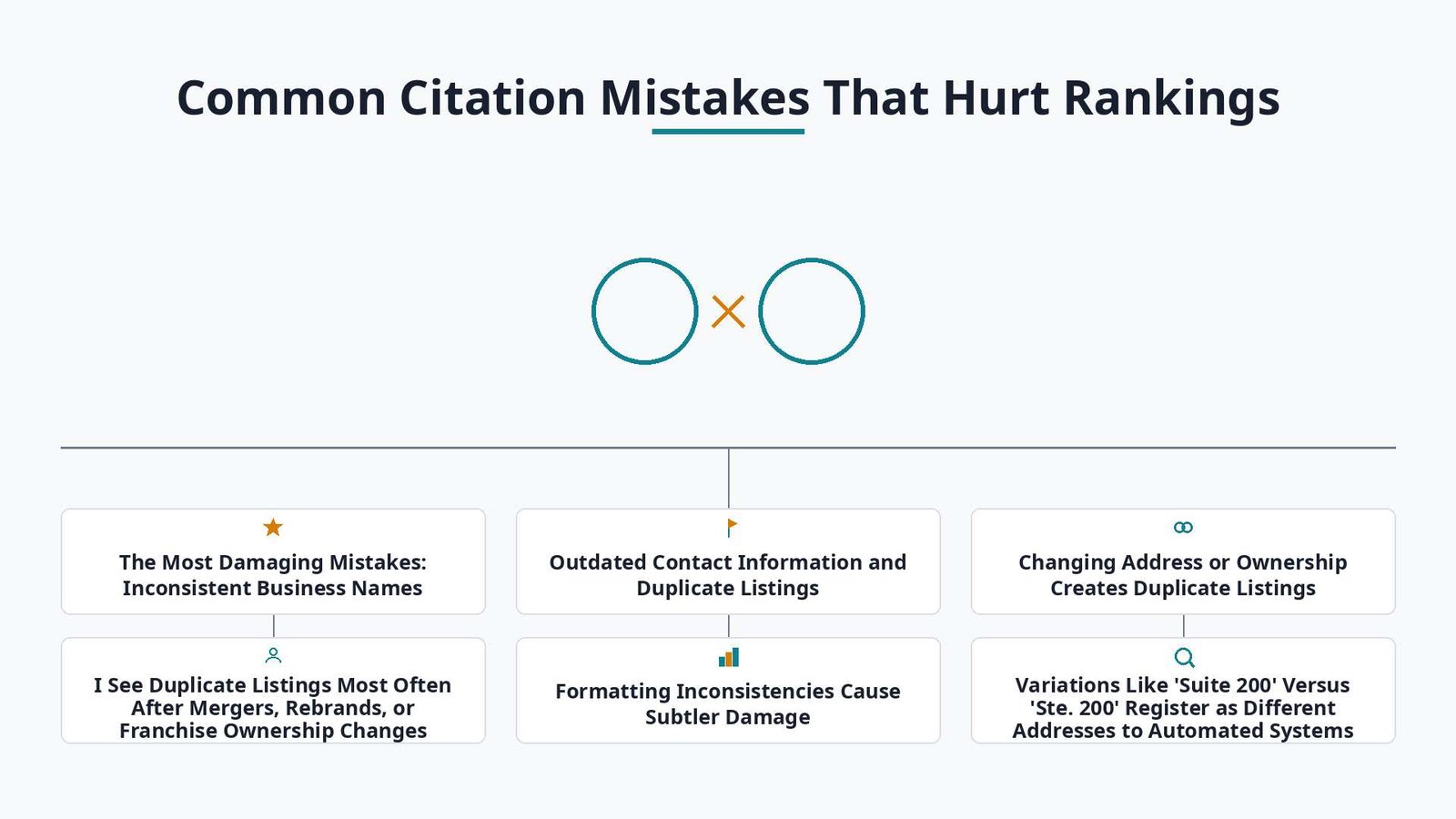
The most damaging citation mistakes involve inconsistent business names, outdated contact information, and duplicate listings created when a business changes address or ownership without cleaning up legacy profiles. I see duplicate listings most often after mergers, rebrands, or franchise ownership changes.
Formatting inconsistencies cause subtler damage, since variations like “Suite 200” versus “Ste. 200” can register as different addresses to automated matching systems, even though a human reader would recognize them as identical.
How Citations Fit Into a Broader Local SEO Strategy
Citations work as one component within a larger local SEO strategy that also includes on-page optimization, review management, and localized content. I never recommend treating citation building as a standalone tactic, since its impact compounds when paired with consistent signals elsewhere.
A business with perfect citation consistency but no customer reviews and a poorly optimized Google Business Profile will still struggle in the local pack, because citations address only one piece of the broader local SEO strategy puzzle.
How Long Do Citations Take to Impact Rankings?
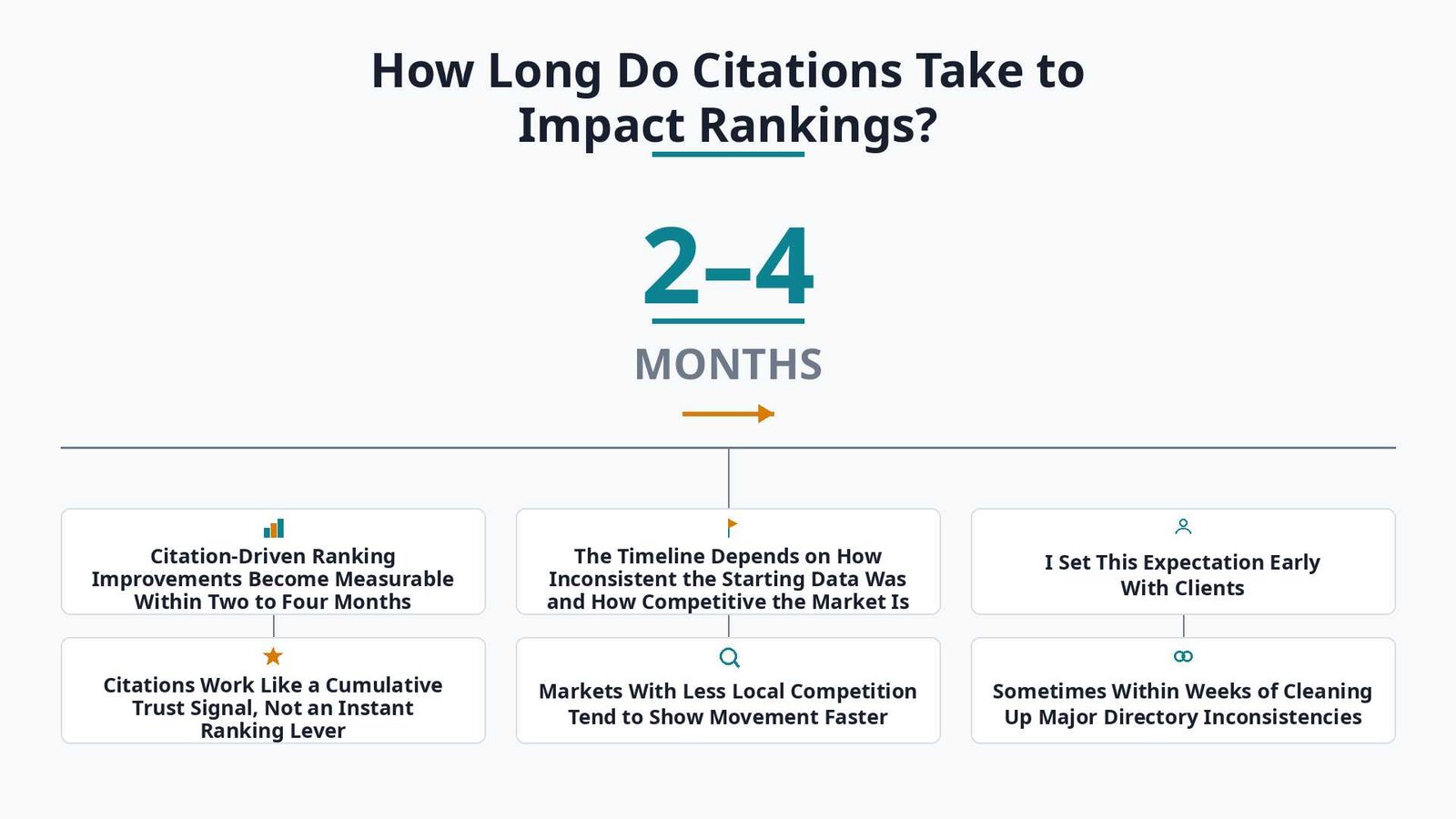
Citation-driven ranking improvements typically become measurable within two to four months, though the timeline depends heavily on how inconsistent the starting data was and how competitive the local market is. I set this expectation early with clients because citations work more like a cumulative trust signal than an instant ranking lever.
Markets with less local competition tend to show movement faster, sometimes within weeks of cleaning up major directory inconsistencies.
Do Citations Still Matter in 2026?
Citations still matter in 2026, though their relative weight has declined as search engines rely more heavily on review signals, user engagement data, and content relevance. I still prioritize citation cleanup for every local client, but it now functions as table-stakes hygiene rather than a primary growth lever.
The businesses that neglect citations entirely still show measurable trust gaps compared to competitors with clean, consistent listings, even if citations alone no longer move rankings as dramatically as they did years ago.
How to Measure Citation Impact and ROI
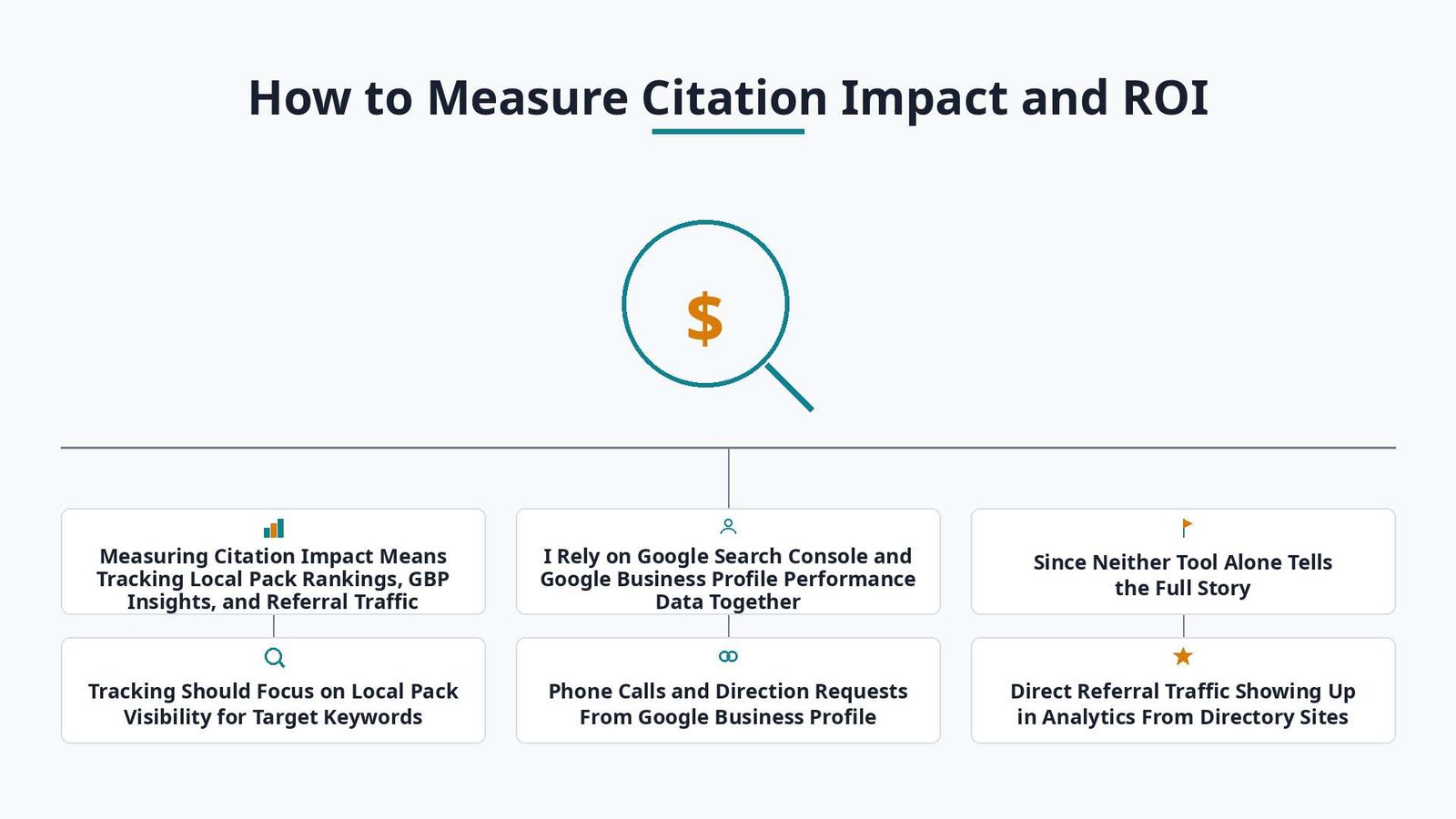
Measuring citation impact involves tracking local pack rankings, Google Business Profile insights, and referral traffic from directory listings before and after a citation cleanup or building campaign. I rely on Google Search Console and Google Business Profile performance data together, since neither tool alone tells the full story.
Tracking should focus on local pack visibility for target keywords, phone calls and direction requests originating from Google Business Profile, and any direct referral traffic showing up in analytics from directory sites.
Conclusion
Citations build the trust and consistency signals that support local search visibility, working alongside reviews, backlinks, and on-page optimization. We see the strongest results when citation cleanup happens before new listings get built. Our team at White Label SEO Service handles citation audits and consistency management as part of full local SEO campaigns.
Frequently Asked Questions
Are citations still a ranking factor in 2026?
Yes, citations remain a ranking factor in 2026, though their influence has declined relative to reviews and engagement signals. They still function as a trust and consistency check for search engines.
How many citations does a business need?
There’s no fixed number, but 20 to 50 accurate, relevant citations typically cover the core platforms that matter. Quality and consistency outweigh raw volume every time.
Can incorrect citations hurt my rankings?
Yes, incorrect or inconsistent citations can hurt rankings by confusing search engines about which listing represents the real business. They can also mislead customers trying to contact or visit the business.
Do citations help with Google’s AI Overviews?
Citations contribute indirectly by reinforcing the trust and consistency signals that feed into a business’s overall local authority. AI-generated answers still draw on the same underlying local ranking signals.
Are paid citation services worth it?
Paid citation services are worth it for businesses without the time to manually submit and verify dozens of listings. They trade some granular control for speed and bulk consistency.
How often should citations be updated?
Citations should be updated immediately after any change to business name, address, or phone number. Routine audits every six to twelve months catch drift even without major business changes.
Do citations help businesses without a physical location?
Citations help less for businesses without a physical location, since many directories require a verifiable address. Service-area businesses can still use citations on platforms that support service-area listings.