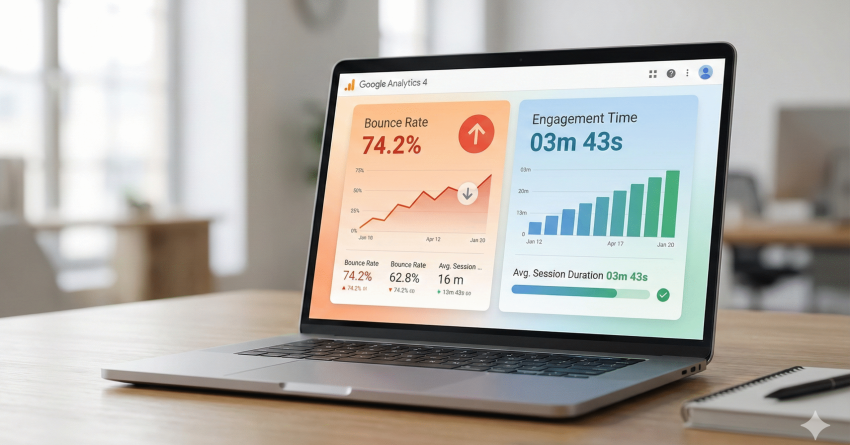
You log into Google Analytics 4 (GA4).
You see bounce rate. You see average engagement time.
One number looks “bad.” One looks “good.”
But what do they really mean for your content quality, SEO, and conversions?
In this guide, we’ll break bounce rate and time on site into simple language, show how top white label SEO providers treat engagement data, and explain how White Label SEO Service turns these metrics into real wins for agencies.
Want someone to read your analytics and tell you exactly what to fix?
Book a free “Engagement & Content Health Audit” with White Label SEO Service and get a 90-day action plan based on your GA4 data.
How Top White Label SEO Competitors Handle Analytics (and What’s Missing)
Recent roundups of top white label SEO companies (like 51Blocks, SUSO Digital, The HOTH, WebFX, SEOReseller, FatJoe, Embarque and others) show a clear pattern:
- They talk a lot about rankings, traffic, and backlinks.
- Many offer dashboards and white label reports.51 Blocks+2Swydo+2
- Some highlight AI-friendly SEO and entity optimization.
What’s often missing:
- Clear explanations of engagement metrics like bounce rate, engagement rate, and average engagement time in GA4.
- Simple stories that connect those metrics to content quality, search intent, and user experience.
- Productized services built around “we’ll fix what your metrics are trying to tell you.”
That’s a big opportunity for White Label SEO Service:
Not just “here’s a report,” but “here’s what your bounce rate + time on site mean and what we’re doing about it.”
Bounce Rate in GA4: What It Really Means
GA4 Changed the Rules
In Universal Analytics, bounce rate basically meant “one-page session with no interaction.”
In GA4, bounce rate is the percentage of sessions that were not engaged.
An engaged session is one that:
- Lasts longer than 10 seconds, or
- Has a key event (like a conversion), or
- Has 2+ page views.Google for Developers+2Google Help+2
So now:
- Engagement rate = engaged sessions / sessions
- Bounce rate = 100% − engagement rate Reddit+3Google Help+3Orbit Media Studios+3
This means bounce rate is no longer just “one page = bad.”
It’s more like “how many visits had zero meaningful engagement.”
When a High Bounce Rate Is a Red Flag
A high bounce rate can mean:
- People don’t like what they see.
- The page is too slow to load.
- The content doesn’t match the search intent.
- The page layout or design is confusing.
But context matters.
A simple FAQ page, blog post, or calculator might do its job in one page view.
If users get what they came for, “bounce” does not always equal “bad.”
Time on Site & Engagement Time: The Other Side of the Story
Average Engagement Time in GA4
In GA4, user engagement measures how long your site is actually in focus on the screen.Google Help+1
Average engagement time tells you:
- How long people actively paid attention to your content.
- Not just how long a tab was open in the background.
This is much closer to “are people really reading or interacting with this page?”
Time on Site vs Time on Page
People use the terms loosely, but in a GA4 world:
- Average engagement time per session ≈ “time on site” feeling.
- There are per-page engagement metrics that show time spent on a specific page.Google Help+2Swetrix+2
Short version:
- Bounce rate = “how many people didn’t engage.”
- Engagement time = “how long engaged people stayed and paid attention.”
Both are Google Analytics entities that feed into your understanding of content performance.
4 Common Patterns (And What They Really Say About Your Content)
Let’s pull bounce rate and engagement time together like a simple NLP-style pattern matcher.
Pattern 1 High Bounce, Low Engagement Time
What it looks like:
- Bounce rate: high
- Average engagement time: very low
What it usually means:
- The page is missing the search intent.
- The headline or meta description over-promised.
- The page may be slow or broken.
You should check:
- Page load (Core Web Vitals, especially LCP).
- Above-the-fold clarity (does the H1 match the query?).
- Simpler layout and faster first contentful paint.
Pattern 2 High Bounce, High Engagement Time
What it looks like:
- Bounce rate: high
- Engagement time: strong (people stick around, then leave)
What it might mean:
- The content answered the question completely in one page.
- Users didn’t need to click anywhere else.
For example:
- “How many coats of paint do I need?”
- The user reads your full guide, gets the answer, then leaves.
This isn’t always bad. It might mean:
- Your content is very helpful, but
- You’re missing internal links and CTAs to keep the journey going.
Pattern 3 Low Bounce, Low Engagement Time
What it looks like:
- Bounce rate: low
- Engagement time: low
This can mean:
- People are clicking around (so they count as “engaged”),
- But they are not staying or finding anything worth reading.
It may signal:
- Confusing navigation.
- Weak content across multiple pages.
- People hunting, not finding.
This is a UX + content quality problem, not just a “SEO” issue.
Pattern 4 Low Bounce, High Engagement Time
What it looks like:
- Bounce rate: low
- Engagement time: high
This is usually the sweet spot:
- People are interacting and staying.
- They might be reading multiple pages, watching videos, or filling forms.
Here, you should:
- Double down on these pages.
- Use them as templates and content models for new SEO assets.
How White Label SEO Service Reads These Metrics (E-E-A-T in Action)
Experience Real GA4 Work, Not Just Theory
We treat GA4 metrics like real-world signals, not just pretty charts:
- We set up events, conversions, and engagement tracking in GA4.Google for Developers+2AgencyAnalytics+2
- We connect results to SEO pages, content clusters, and search intent.
This comes from hands-on experience with agency accounts, not just blog posts.
Expertise Combining SEO, Content & Analytics
Top white label SEO agencies win by mixing technical SEO, content marketing, and analytics insights
White Label SEO Service adds a layer:
- We analyze bounce rate, engagement rate, average engagement time, and event count together.Orbit Media Studios+3Google for Developers+3Google Help+3
- We tie them to semantic SEO and NLP terms used on the page.
- We map behavior back to Google entities like GA4, Search Console, and even Knowledge Graph concepts when shaping topics.
Authoritativeness & Trustworthiness
We align with Google’s official documentation on engagement and bounce rate, not random myths.
We also:
- Explain numbers in plain language for agencies and clients.
- Avoid vanity metrics focus on outcomes (leads, sales, qualified traffic).
- Share clear, repeatable frameworks for content improvement.
Tired of guessing what your analytics mean for SEO?
Let White Label SEO Service translate GA4 metrics into a content roadmap you can present to clients as your own strategy.
What These Metrics Really Say About Your Content (9 Hidden Signals)
Here are 9 things bounce rate + engagement time can reveal when you read them together.
1. Does Your Intro Match Search Intent?
If people bounce in under 10 seconds, your headline + intro likely don’t match the query.
- Fix your H1, subhead, and opening paragraph.
- Use the main keyword, entity, and a clear benefit early.
2. Is Your Page Load Time Killing You?
Very short sessions + high bounce often point to speed issues.
Check:
- Core Web Vitals (LCP, INP, CLS).
- Large images, heavy scripts, or bloated page builders.
3. Are Your CTAs Invisible?
High engagement time but high bounce often means:
- People read, then don’t know what to do next.
Add:
- Clear calls to action
- Internal links to deeper content
- Sticky or in-content CTAs that feel natural
4. Is Your Content Depth Right for the Query?
Short engagement on complex topics = content too thin.
Long engagement on simple FAQs might be okay.
Check:
- Does the page fully answer the question?
- Are there supporting examples, visuals, and step-by-step guides?
5. Are You Satisfying “People Also Ask” Questions?
Look at GA4 + Search Console queries. Then ask:
- Are we answering related questions users also search for?
Adding short Q&A sections can improve both semantic relevance and engagement time.
6. Are You Using the Right Semantic & NLP Terms?
Users expect to see familiar terms around your topic:
- For analytics: “bounce rate”, “engagement rate”, “average engagement time”, “session”, “conversion event”.
- For SEO: “organic traffic”, “search intent”, “content quality”, “user experience”.
If those are missing, your content may feel off-topic or shallow.
7. Does Your Layout Help or Hurt Reading?
If engagement time drops on long pages:
- Check readability (font size, line length, spacing).
- Use H2/H3/H4 headings, bullet lists, and short paragraphs.
Good UX keeps people scrolling and reduces bounce rate indirectly.
8. Is Traffic Source Impacting Metrics?
Bounce rate from:
- Paid social = usually higher and noisier.
- Organic search = more honest signal about your content
We always segment by channel before judging a page.
9. Are Your “Hero Pages” Pulling Their Weight?
Look at:
- Your top landing pages by organic sessions.
- Their bounce rate and engagement time trends over time.Loves Data+2AgencyAnalytics+2
These are the pages where small improvements = big returns.
Want us to find your top underperforming pages and fix them?
White Label SEO Service will audit your GA4, locate your “silent losers,” and optimize them for engagement and rankings white labeled for your agency.
Who Is This Service For?
Our bounce rate vs time on site analysis and content optimization service is ideal if you are:
- A digital marketing agency reselling SEO and content.
- A web design/dev shop wanting to show real performance, not just pretty designs.
- A B2B/SaaS company trying to understand why people land and leave.
- A local or eCommerce brand wanting more leads or sales from existing traffic.
If you have GA4 installed and content online, we can turn your data into a clear action plan.
Key Takeaways
- In GA4, bounce rate is the inverse of engagement rate and counts sessions that were not engaged.
- Average engagement time shows how long people actually paid attention, not just how long a tab was open.Google Help+2Swetrix+2
- The combo of bounce rate + engagement time reveals patterns in content relevance, UX, and search intent match.
- Most white label SEO competitors report basic metrics but don’t turn them into clear content improvement frameworks.
- White Label SEO Service uses GA4, semantic SEO, NLP terms, and E-E-A-T to turn your analytics into a real roadmap for better rankings and conversions.
Lessons Learned
- Metrics are signals, not judgments. High bounce isn’t always bad, low bounce isn’t always good.
- Context is everything device, channel, page type, and intent all change how you read data.
- Engagement metrics become powerful when tied to keywords, entities, and content changes, not just charts.
- Agencies that can explain GA4 in plain language are easier to trust and easier to keep on retainer.
FAQs
1. Is a high bounce rate always bad?
No. If a page answers a simple question and users leave satisfied, a high bounce rate can be fine especially if engagement time is strong and you’re getting conversions.Loves
2. What’s a “good” engagement time?
It depends on page type:
- Short FAQ: 20–60 seconds might be normal.
- In-depth guide: 2–5 minutes can be a good sign.
Don’t chase some “universal number.” Instead compare:
- Page vs page
- Device vs device
- Before vs after content changesGoogle Help+1
3. How can I quickly improve bounce rate and time on site?
Start with:
- Clear, intent-matched headlines.
- Faster load speeds and cleaner layouts.
- Strong internal links and CTAs.
- Content that actually answers user questions, with semantic and NLP-friendly wording around the topic.
4. How does White Label SEO Service use these metrics for agencies?
We:
- Audit your GA4 setup.
- Analyze bounce rate, engagement rate, and engagement time by page and channel.
- Identify pages with the biggest upside.
- Rewrite, restructure, and interlink content to improve both engagement and SEO performance.
- Deliver white-label reports you can send directly to clients as your own work.