Most agencies are obsessed with more leads.
But if your lead-to-sale conversion rate is weak, more leads just means more noise, more follow-ups, and more frustration.
The real unlock is this:
How many of your leads become customers and why?
That’s what this guide is about.
You’ll see how White Label SEO Service turns traffic and leads into revenue, not just “form fills.”
Want a done-for-you audit of your lead-to-sale funnel?
Book a free “Lead-to-Sale Conversion Checkup” with White Label SEO Service and get a 30–90 day roadmap you can sell under your own brand.
How Top White Label SEO Competitors Operate (and What They Miss)
Recent 2025 lists of top white label SEO agencies DashClicks, 51Blocks, SUSO Digital, WebFX, SEOReseller, The HOTH, and others all highlight:
- Technical SEO audits
- Keyword research & on-page optimization
- Link building & digital PR
- Content creation
- White label reporting & dashboards
They’re excellent at:
- Growing organic traffic
- Increasing lead volume
- Providing white labeled SEO reports
But when you dig into their offers and case studies, you’ll notice a gap:
- Very little about lead-to-sale conversion optimization
- Limited focus on CRM data, pipeline stages, and sales enablement
- CRO / UX sometimes offered, but usually as a separate specialty service, not tightly integrated with SEO
This is where White Label SEO Service can stand apart:
Not just “we got you leads,” but “we helped you close more deals with the leads you already have.”
What is Lead-to-Sale Conversion Rate?
Simple Definition
Your lead-to-sale conversion rate tells you:
Out of all the leads you generated, how many became paying customers?
At a basic level:
Lead-to-sale conversion rate = (Number of sales / Number of leads) × 100
In digital terms, that could mean:
- Leads = form submissions, demo requests, quote requests, or qualified calls
- Sales = closed/won deals in your CRM (HubSpot, Salesforce, Pipedrive, etc.)
This sits after the classic website conversion rate (visitor → lead) you see in Google Analytics 4 (GA4), which measures how many visitors took a conversion action.
Benchmarks (So You Know What “Good” Means)
Recent 2025 benchmark reports show:
- Website visitor → lead conversion rates often sit around 2–5% depending on industry.
- Lead → sale conversion rates vary a lot:
- B2B SaaS landing pages: ~1–3%
- Professional services: often 3–7%+
- Some high-trust verticals (legal, finance) can hit even higher numbers.
Don’t chase someone else’s number.
Instead: track your own baseline, then improve it step by step.
How Google & Analytics Think About “Conversion”
To stay aligned with search and analytics best practices, we lean on clear definitions:
- In Google Ads, conversion rate = conversions ÷ total ad interactions.Google Help
- In Google Analytics 4, conversion rate is tied to conversion events (e.g., form_submit, purchase, sign_up):
- Session conversion rate = sessions with a conversion ÷ total sessions
- User conversion rate = users who converted ÷ total users GA4.com+4Analytics Mania+4MeasureSchool+4
Your lead-to-sale rate lives one step further down the funnel:
- GA4 → tracks lead events
- CRM → tracks opportunities & deals
- Together, they show how traffic turns into revenue.
Step-by-Step Guide to Boost Lead-to-Sale Conversion Rate
Short paragraphs. Clear steps. Zero fluff. Let’s go.
Step 1 Define Your Lead Stages (Don’t Skip This)
You can’t improve what you can’t see clearly.
Define simple stages in your CRM:
- Lead filled a form / called / booked a demo
- MQL (Marketing Qualified Lead) fits basic criteria (industry, size, service)
- SQL (Sales Qualified Lead) actually interested and worth serious follow-up
- Opportunity in an active deal (proposal, quote, negotiation)
- Won / Lost final outcome
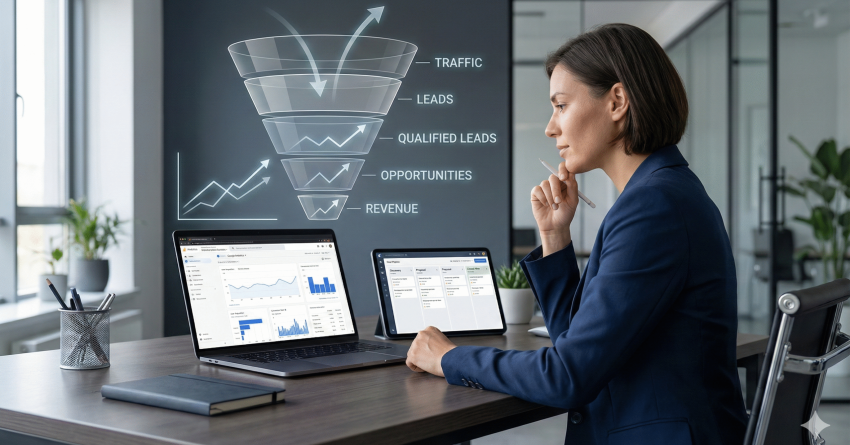
This gives you multiple conversion points:
- Visitor → Lead
- Lead → MQL → SQL
- SQL → Opportunity → Sale
The more clearly you define these in your CRM and reports, the easier it is to see where the leaks are.
Step 2 Map GA4 & Google Entities to Your Funnel
Connect your analytics world to your sales world.
- Set conversion events in GA4 for key lead actions (form_submit, request_quote, book_demo).
- Connect GA4 / Google Ads with your CRM using UTMs or integrations.
- Use Google Analytics 4, Google Ads, and Google Search Console together to see:
- Which keywords drive leads
- Which pages produce the best lead quality
- Which channels produce deals (not just clicks)
This is where many white label SEO providers stop at “leads,” but White Label SEO Service follows the trail into revenue.
Step 3 Fix Intent Mismatch on High-Volume Landing Pages
If you get a lot of leads but few sales, there’s usually a search intent mismatch.
Ask:
- Does the headline match what the visitor searched?
- Does the offer match where they are in the buyer’s journey (TOFU, MOFU, BOFU)?
- Are you promising “instant results” to people who really need “long-term strategy”?
Use semantic and NLP-friendly copy:
- Talk in the language of problems and outcomes: “increase MQL quality”, “shorten sales cycle”, “improve pipeline velocity”.
- Include entities like CRM, Google Analytics 4, Google Ads, and “lead scoring” so pages reflect how modern marketing actually works.
This helps both humans and search engines understand that you’re serious about conversion, not just clicks.
Step 4 Qualify Leads Better (Without Killing Volume)
Low lead-to-sale rates often come from weak qualification:
- Anyone can fill a form.
- Not everyone should hit your sales calendar.
Fix this by:
- Adding a few smart fields:
- Company size / monthly budget
- Service needed
- Urgency (timeline to start)
- Using simple lead scoring rules in your CRM.
- Routing higher-fit leads to your best closers.
You’ll usually see:
- Fewer junk leads
- Higher SQL → close rates
- Less burnout on your sales team
Step 5 Speed Up & Structure Your Follow-Up
Lead-to-sale conversion rate often dies in the first 24 hours.
Benchmarks from CRO and B2B conversion studies show that faster follow-ups dramatically improve close rates.
Make sure you have:
- Instant confirmation email with a clear next step
- Same-day response from a human (even if it’s brief)
- A simple follow-up sequence:
- Day 0: “Got your request + next steps”
- Day 1–3: follow-up with a helpful resource or case study
- Day 5–7: reminder + soft deadline for booking a call
Tie this to GA4 events and CRM tasks so nothing slips through the cracks.
Need help building a follow-up system that your sales team will actually use?
White Label SEO Service can map GA4 events, CRM stages, and email sequences into a clear, branded funnel for your agency and clients.
Step 6 Add Proof (E-E-A-T) Where It Matters Most
People don’t buy services. They buy confidence.
To boost E-E-A-T (Experience, Expertise, Authoritativeness, Trustworthiness):
- Show real case studies with before/after numbers (conversion rate, pipeline growth, revenue).
- Add testimonials and reviews near your form and pricing sections.
- Include author bios and company credentials (years in business, number of clients, certifications).
- Use schema markup (Organization, Review, FAQ) so Google can understand and display trust signals.
These signals help both:
- Humans → feel safer choosing you
- Search engines → see you as a trustworthy entity in your niche
Step 7 Align Sales Scripts With Landing Page Promises
If your page says one thing and your sales call says something else, leads drop off.
Fix this by:
- Sharing landing page copy and value propositions with your sales team.
- Using the same phrases and benefits on calls that users saw on the site.
- Making sure salespeople know which keyword / campaign a lead came from.
This keeps the story consistent across:
- Google Search / Ads → Landing page → Sales call → Proposal
Consistency = trust.
Trust = higher lead-to-sale conversion.
Step 8 Run Simple A/B Tests on Key Bottlenecks
You don’t need a heavy CRO stack to start testing.
Pick one bottleneck at a time:
- Form page with many leads but poor close rate
- Pricing page with a high exit rate
- Demo/quote request page with low completion rate
Test:
- Headline variations
- Shorter vs longer forms
- Different CTAs (“Book a Strategy Call” vs “Get a Free Audit”)
Use GA4, your landing page tool, or even Google Optimize alternatives to track conversion changes.
Step 9 Review Lead-to-Sale Metrics Monthly (Not Yearly)
At least once a month, review:
- Leads generated by channel (SEO, PPC, email, referrals)
- Lead → sale conversion rate per channel
- Average deal size per channel
- Time to close (sales cycle length)
Compare to benchmark ranges and your own history.
This is where White Label SEO Service can send you a white-labeled “Lead-to-Sale Health Report” that you present directly to clients.
Who is This Service For?
The lead-to-sale optimization framework from White Label SEO Service is perfect if you are:
- A digital marketing agency tired of being judged only on “lead volume”
- A PPC / SEO shop that wants to show pipeline and revenue impact
- A B2B or SaaS company with plenty of leads but weak close rates
- A local or service business (home services, legal, finance) where each new customer is high value
If leads are coming in but revenue feels stuck, this is your next move.
Key Takeaways
- Top white label SEO competitors are excellent at traffic and leads, but most don’t deeply optimize lead-to-sale conversion or connect SEO to CRM outcomes.
- Lead-to-sale conversion rate sits after website conversion and depends on tracking leads from GA4 into your CRM and pipeline.Databox+4Analytics Mania+4GA4.com+4
- Conversion benchmarks vary by industry, but the real power is measuring your own funnel and improving it over time.
- Focusing on intent match, qualification, follow-up speed, E-E-A-T signals, and consistent messaging can significantly boost lead-to-sale rates without needing more traffic.
- White Label SEO Service can package all this into a white-labeled offer, so your agency becomes the hero that improves both leads and sales.
Lessons Learned
- More leads ≠ more sales if qualification and follow-up are broken.
- Data must be connected GA4 + CRM + sales notes tell the real story together.
- E-E-A-T isn’t just for Google; it’s also what convinces humans to say “yes.”
- The agencies that win long-term are the ones that talk about pipeline, revenue, and close rates, not just impressions and clicks.
FAQs
1. What is a “good” lead-to-sale conversion rate?
It depends on your industry and offer, but many B2B and service brands see 2–7% as a normal range, with high-performers pushing above that for warm, qualified leads.
2. Do I need a complicated tech stack to track this?
No. You mainly need:
- Google Analytics 4 to track website conversions
- A CRM (HubSpot, Salesforce, Pipedrive, etc.) to track deals
- Clean UTM and pipeline stages
From there, White Label SEO Service can help you interpret the data and build a simple reporting framework.
3. Can I improve lead-to-sale conversion without new traffic?
Yes that’s the whole point.
By:
- Fixing qualification
- Improving follow-up
- Aligning content with search intent and E-E-A-T
- Adding proof and better CTAs
You can often increase revenue without increasing ad spend or traffic.
4. How does White Label SEO Service plug into my agency offers?
We work behind the scenes:
- Audit your funnels (GA4 + CRM + landing pages).
- Identify leaks in the lead-to-sale journey.
- Recommend and implement fixes (copy, UX, tracking, email flows).
- Deliver white-labeled reports and roadmaps you can present as your own service.
Ready to turn more leads into paying customers without needing more traffic?
Partner with White Label SEO Service and add a “Lead-to-Sale Conversion Optimization” package to your agency today.