
White label SEO partnerships have generated millions in revenue for agencies that once struggled to deliver organic results. These aren’t theoretical projections—they’re documented outcomes from real businesses that transformed their service offerings through strategic outsourcing.
The difference between agencies that thrive and those that stagnate often comes down to one decision: whether to build SEO capabilities in-house or leverage proven white label expertise. For marketing managers and agency owners watching competitors scale faster, understanding what actually works matters more than industry hype.
This deep dive examines verified success stories, the strategies behind breakthrough results, and the specific factors that separate high-performing white label partnerships from disappointing ones.

What Makes White Label SEO Partnerships Successful
Success in white label SEO isn’t accidental. Agencies achieving consistent wins share specific operational patterns that distinguish them from those cycling through providers every six months.
The Foundation of Profitable Partnerships
Profitable white label relationships start with alignment—not just on deliverables, but on communication standards, reporting expectations, and client management philosophy. Agencies that treat white label providers as vendors rather than strategic partners consistently underperform.
The most successful partnerships establish clear escalation paths before problems arise. When a client’s rankings drop unexpectedly or algorithm updates hit hard, both parties know exactly who handles what. This operational clarity prevents the finger-pointing that destroys client relationships.
Revenue impact becomes measurable within the first quarter for well-structured partnerships. Agencies report that white label SEO services typically deliver 40-60% profit margins, compared to 15-25% margins when building equivalent in-house teams.
Key Performance Indicators That Matter
Vanity metrics kill white label partnerships. Agencies focused solely on keyword rankings miss the metrics that actually drive client retention and referrals.
Traffic quality indicators matter more than raw volume. A successful white label campaign tracks:
- Organic conversion rates by landing page
- Revenue attributed to organic search
- Customer acquisition cost compared to paid channels
- Time-on-site and engagement depth for organic visitors
Client retention rates serve as the ultimate success metric. Top-performing white label partnerships maintain client relationships averaging 18-24 months, compared to industry averages of 8-12 months for agencies handling SEO internally without specialized expertise.
Reporting transparency directly correlates with partnership longevity. Agencies receiving detailed, white-labeled reports they can confidently present to clients report significantly higher satisfaction scores than those receiving basic ranking updates.
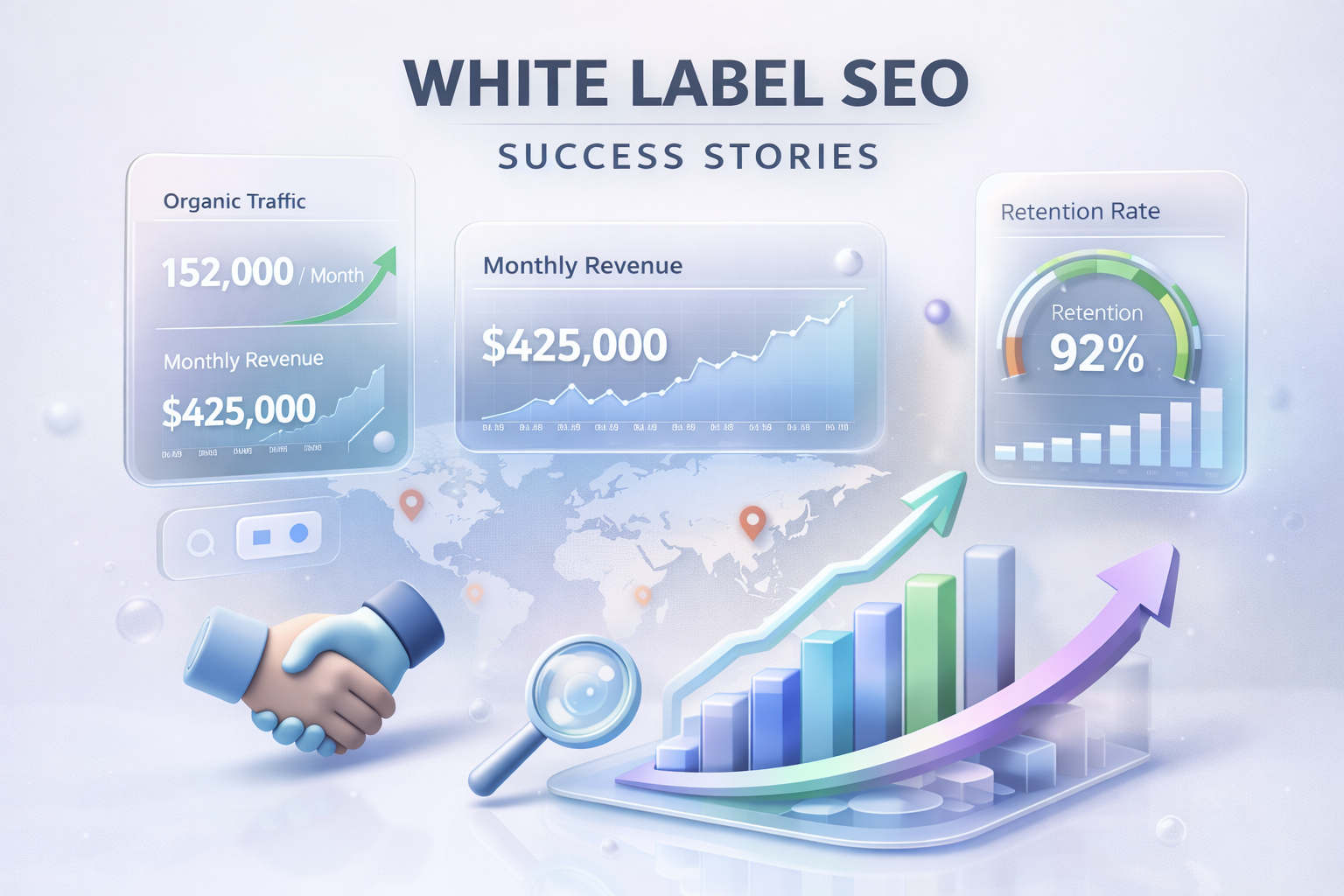
Real Agency Transformation Stories
Abstract principles mean little without concrete examples. These documented cases illustrate how different agency types leveraged white label SEO to achieve specific business outcomes.
Small Agency Scaling From Local to National
A 12-person marketing agency in Austin specialized in paid media for regional home service companies. Their clients repeatedly requested SEO services, but hiring specialists seemed financially risky given unpredictable demand.
The challenge: Clients were leaving for full-service competitors. The agency estimated losing $180,000 annually in potential revenue from SEO requests they couldn’t fulfill.
The approach: They partnered with a white label provider offering dedicated account management and custom reporting. The provider handled technical audits, content strategy, and link acquisition while the agency maintained all client communication.
Results after 12 months:
- Added 14 SEO retainer clients
- Generated $312,000 in new annual recurring revenue
- Maintained 85% client retention rate
- Expanded service area from Texas to five additional states
The agency owner noted that white label SEO became their highest-margin service line within eight months, despite having zero internal SEO expertise.
Digital Marketing Firm Recovering From Failed In-House Attempt
A mid-sized digital marketing firm in Chicago had previously hired two SEO specialists who delivered inconsistent results. After 18 months of client complaints and staff turnover, they dissolved the internal team entirely.
The challenge: Rebuilding client trust while managing the perception that they’d “failed” at SEO. Several key accounts had already begun exploring alternatives.
The approach: Rather than announcing a pivot, they quietly transitioned to a white label model. The provider conducted comprehensive audits of existing client campaigns, identifying technical issues the previous team had missed.
Results after 18 months:
- Recovered 4 of 6 at-risk client relationships
- Achieved average organic traffic increases of 156% across retained clients
- Reduced SEO-related client complaints by 89%
- Saved approximately $140,000 annually in salary and benefits costs
The firm’s managing director emphasized that the white label provider’s systematic approach—documented processes, regular strategy reviews, and proactive communication—created accountability that their internal team had lacked.
Startup Agency Building Credibility Through Results
A two-person agency launched specifically to serve e-commerce brands in the outdoor recreation niche. The founders had strong paid social expertise but recognized that sustainable growth required organic search capabilities.
The challenge: Competing against established agencies with decade-long track records and extensive case studies. Prospects questioned whether a new agency could deliver meaningful SEO results.
The approach: They partnered with a white label provider specializing in e-commerce SEO, gaining immediate access to proven methodologies and technical resources. The provider’s experience with product schema, category page optimization, and seasonal content strategies addressed gaps the founders couldn’t fill independently.
Results after 24 months:
- Built a portfolio of 22 active e-commerce clients
- Documented average revenue increases of 78% from organic search
- Achieved featured snippet placements for 340+ product-related queries
- Grew agency revenue from $0 to $1.2 million annually
The founders credited their white label partner’s niche expertise as the primary differentiator in competitive pitches. Prospects responded to specific e-commerce case studies rather than generic SEO promises.
Industry-Specific Success Patterns
White label SEO success varies significantly by industry vertical. Understanding these patterns helps agencies set realistic expectations and identify high-potential client segments.
Healthcare and Medical Practice Growth
Healthcare SEO presents unique challenges: YMYL (Your Money or Your Life) content standards, strict compliance requirements, and intense local competition. White label providers with healthcare experience navigate these complexities more effectively than generalist approaches.
Documented outcomes in healthcare verticals:
Medical practices partnering with specialized white label providers report patient inquiry increases averaging 45-120% within 12 months. The key differentiator is content that satisfies both search algorithms and medical accuracy standards.
A multi-location dental group in the Southeast worked with their agency’s white label partner to implement location-specific content strategies. Each practice location received optimized service pages, localized blog content, and consistent NAP (Name, Address, Phone) management across directories.
Results: Organic patient inquiries increased by 89% across all locations, with the highest-performing location seeing a 134% increase. The practice attributed approximately $2.1 million in new patient revenue to organic search over 18 months.
Legal Services and Law Firm Expansion
Law firm SEO requires balancing aggressive competition with ethical advertising constraints. White label providers familiar with state bar regulations and legal marketing best practices deliver results that in-house generalists often cannot match.
Common success patterns in legal verticals:
Personal injury firms represent the most competitive—and potentially lucrative—legal SEO segment. Agencies serving this market report that white label partnerships with legal SEO expertise generate client acquisition costs 60-70% lower than paid search alternatives.
A regional personal injury firm working through their marketing agency’s white label partner focused on building topical authority around specific injury types rather than competing for broad “personal injury lawyer” terms.
Results: The firm achieved first-page rankings for 47 long-tail injury-specific queries within 9 months. Case inquiries from organic search increased by 156%, with an estimated case value of $3.4 million attributed to SEO-generated leads over 14 months.
E-commerce and Online Retail Performance
E-commerce SEO success depends heavily on technical implementation—site architecture, product schema, faceted navigation handling, and page speed optimization. White label providers with e-commerce platform expertise (Shopify, WooCommerce, Magento) consistently outperform generalists.
Measurable e-commerce outcomes:
Product page optimization represents the highest-impact opportunity for most e-commerce clients. Agencies report that white label partners focusing on product schema implementation and category page content achieve organic revenue increases averaging 35-85% within the first year.
An outdoor gear retailer partnered with their agency’s white label provider to address a site migration that had devastated organic traffic. The provider conducted a comprehensive technical audit, identified 2,400+ broken internal links, and implemented a systematic redirect strategy.
Results: Organic traffic recovered to pre-migration levels within 4 months and exceeded previous benchmarks by 67% within 12 months. The retailer attributed $890,000 in recovered and new organic revenue to the remediation effort.
Measuring ROI in White Label SEO Campaigns
Demonstrating return on investment separates successful white label partnerships from those that end in mutual frustration. Agencies need frameworks for quantifying value that resonate with different client types.
Revenue Attribution Models That Work
Direct revenue attribution for SEO remains challenging, but effective white label partnerships implement tracking systems that connect organic performance to business outcomes.
First-touch attribution credits SEO for conversions where organic search was the initial touchpoint. This model works well for awareness-stage content but undervalues SEO’s role in longer sales cycles.
Multi-touch attribution distributes credit across all touchpoints in the customer journey. For B2B clients with extended consideration phases, this approach more accurately reflects SEO’s contribution.
Incrementality testing compares performance in markets with active SEO investment against control markets without optimization. While resource-intensive, this methodology provides the most defensible ROI calculations.
Agencies using white label partners with robust analytics capabilities report client retention rates 40% higher than those relying on basic ranking reports. The ability to connect SEO activities to revenue outcomes transforms client conversations from cost justification to growth planning.
Client Reporting Best Practices
Effective reporting bridges the gap between technical SEO metrics and business outcomes clients actually care about. White label providers offering customizable, white-labeled reports enable agencies to maintain brand consistency while delivering sophisticated analysis.
Report elements that drive retention:
Executive summaries leading with business impact—revenue influenced, leads generated, market share gained—before diving into technical metrics. Clients who see clear business value rarely question monthly retainers.
Competitive context showing how client performance compares to industry benchmarks and direct competitors. Relative progress often matters more than absolute numbers.
Forward-looking recommendations demonstrating ongoing value. Reports that only look backward feel like invoices; reports that identify future opportunities feel like strategic partnerships.
Agencies report that switching from generic ranking reports to business-focused dashboards reduces client churn by 25-35% on average.
Common Challenges and How Top Performers Overcome Them
Even successful white label partnerships encounter obstacles. Understanding common challenges—and proven solutions—helps agencies navigate difficulties without abandoning otherwise productive relationships.
Communication Breakdowns and Resolution Strategies
Miscommunication ranks as the primary cause of white label partnership failures. Agencies and providers operating with different assumptions about deliverables, timelines, or quality standards inevitably disappoint each other.
Prevention strategies that work:
Documented service level agreements specifying response times, revision limits, and escalation procedures. Successful partnerships treat these documents as living references, not filing cabinet artifacts.
Regular strategy calls—weekly for active campaigns, bi-weekly for maintenance phases—prevent small misalignments from becoming major conflicts. Agencies report that partnerships with structured communication cadences last 2.3x longer than those relying on ad-hoc contact.
Dedicated account managers on both sides create accountability and relationship continuity. When contacts change frequently, institutional knowledge disappears and mistakes repeat.
Quality Control and Consistency Issues
Content quality inconsistency frustrates agencies more than almost any other white label challenge. A brilliant blog post followed by a mediocre one damages client confidence and creates uncomfortable conversations.
Quality assurance approaches:
Style guides and brand voice documentation provided upfront eliminate guesswork. White label providers working from detailed briefs produce significantly more consistent output than those receiving minimal direction.
Sample review periods before full campaign launches allow agencies to calibrate expectations and provide feedback. Investing time in the first 2-3 deliverables prevents months of corrections later.
Revision protocols specifying what constitutes acceptable work and how many revision rounds are included prevent scope creep while ensuring quality standards are met.
Scaling Without Sacrificing Results
Rapid growth strains white label partnerships. Providers handling 5 clients deliver different experiences than those managing 50 for the same agency. Successful scaling requires intentional capacity planning.
Scaling strategies from high-growth agencies:
Tiered service levels matching client value to resource allocation. Premium clients receive senior strategist attention; smaller accounts follow proven playbooks with less customization.
Gradual volume increases with performance checkpoints. Adding 2-3 clients monthly while monitoring quality metrics prevents the sudden capacity crunches that degrade results.
Backup provider relationships for overflow periods. Agencies with secondary white label partnerships weather demand spikes without turning away business or compromising existing client work.
Building Long-Term Partnership Value
The most successful white label relationships evolve beyond transactional service delivery into genuine strategic partnerships. This evolution requires intentional investment from both parties.
Developing Specialized Expertise Together
Agencies that grow with their white label partners—developing shared expertise in specific verticals or service types—create competitive advantages that generalist competitors cannot easily replicate.
Partnership development approaches:
Joint case study development documenting successes in target verticals. These assets benefit both parties: agencies gain sales collateral while providers demonstrate capabilities to prospective agency partners.
Shared training investments where providers educate agency teams on SEO fundamentals. Agencies with baseline SEO knowledge communicate more effectively with clients and identify opportunities providers might miss.
Co-developed service packages addressing specific market needs. When agencies and providers collaborate on productized offerings, both parties benefit from clearer positioning and more efficient delivery.
Future-Proofing Against Industry Changes
SEO evolves constantly. Algorithm updates, new search features, and shifting user behaviors require ongoing adaptation. White label partnerships that anticipate change outperform those that merely react.
Adaptation strategies:
Regular industry briefings from providers keeping agencies informed about relevant developments. Agencies that can proactively discuss algorithm updates with clients demonstrate expertise even when they’re not executing the work directly.
Flexible service structures accommodating new optimization opportunities. Partnerships locked into rigid deliverable lists struggle when priorities shift—as they did when AI overviews began appearing in search results.
Continuous testing and learning cultures where both parties experiment with new approaches and share findings. The agencies achieving breakthrough results often benefit from providers willing to try innovative tactics on appropriate client accounts.
Conclusion
White label SEO success stories share common threads: clear communication, aligned expectations, and commitment to measurable outcomes over vanity metrics. The agencies achieving transformative results treat their white label partners as extensions of their teams rather than interchangeable vendors.
For marketing managers and agency owners evaluating white label options, these documented successes demonstrate what’s possible with the right partnership structure. The patterns are replicable—strategic alignment, quality-focused delivery, and business-outcome reporting create sustainable competitive advantages.
White Label SEO Service helps agencies deliver enterprise-level organic results without the overhead of building internal teams. Connect with our partnership team to explore how documented success patterns can translate to your specific client portfolio and growth objectives.
Frequently Asked Questions
How long does it typically take to see results from white label SEO partnerships?
Most agencies report measurable improvements within 3-6 months, with significant results appearing between months 6-12. Technical fixes often show faster impact, while content and authority building require longer timelines. Setting realistic expectations with clients from the start prevents frustration during the initial investment period.
What profit margins can agencies expect from white label SEO services?
Well-structured white label partnerships typically deliver 40-60% profit margins on SEO services. This compares favorably to 15-25% margins when building equivalent in-house capabilities. Margins improve as agencies scale volume with their providers and develop efficient workflows.
How do successful agencies handle client communication about white label partnerships?
Most successful agencies don’t explicitly disclose white label relationships, instead positioning the work as their own service delivery. This approach is standard industry practice and allows agencies to maintain brand consistency. The key is ensuring quality and responsiveness match what clients would expect from direct service.
What should agencies look for when selecting a white label SEO provider?
Priority factors include industry-specific experience, communication responsiveness, reporting customization capabilities, and documented case studies in relevant verticals. Agencies should also evaluate cultural fit—providers whose values and work styles align with theirs create smoother long-term partnerships.
How do white label partnerships handle algorithm updates and ranking fluctuations?
Quality providers proactively monitor algorithm changes and communicate impacts to agency partners before clients notice issues. The best partnerships include regular strategy reviews where both parties assess performance trends and adjust approaches based on search landscape evolution.
Can small agencies compete with larger competitors using white label SEO?
Absolutely. White label partnerships give small agencies access to enterprise-level expertise and resources without corresponding overhead costs. Many documented success stories involve agencies with fewer than 10 employees outperforming larger competitors through strategic white label relationships and niche specialization.
What’s the biggest mistake agencies make with white label SEO partnerships?
Treating the relationship as purely transactional rather than strategic. Agencies that invest time in onboarding, provide detailed client briefs, and maintain regular communication consistently achieve better results than those who simply hand off work and expect magic. Partnership quality directly correlates with outcome quality.