

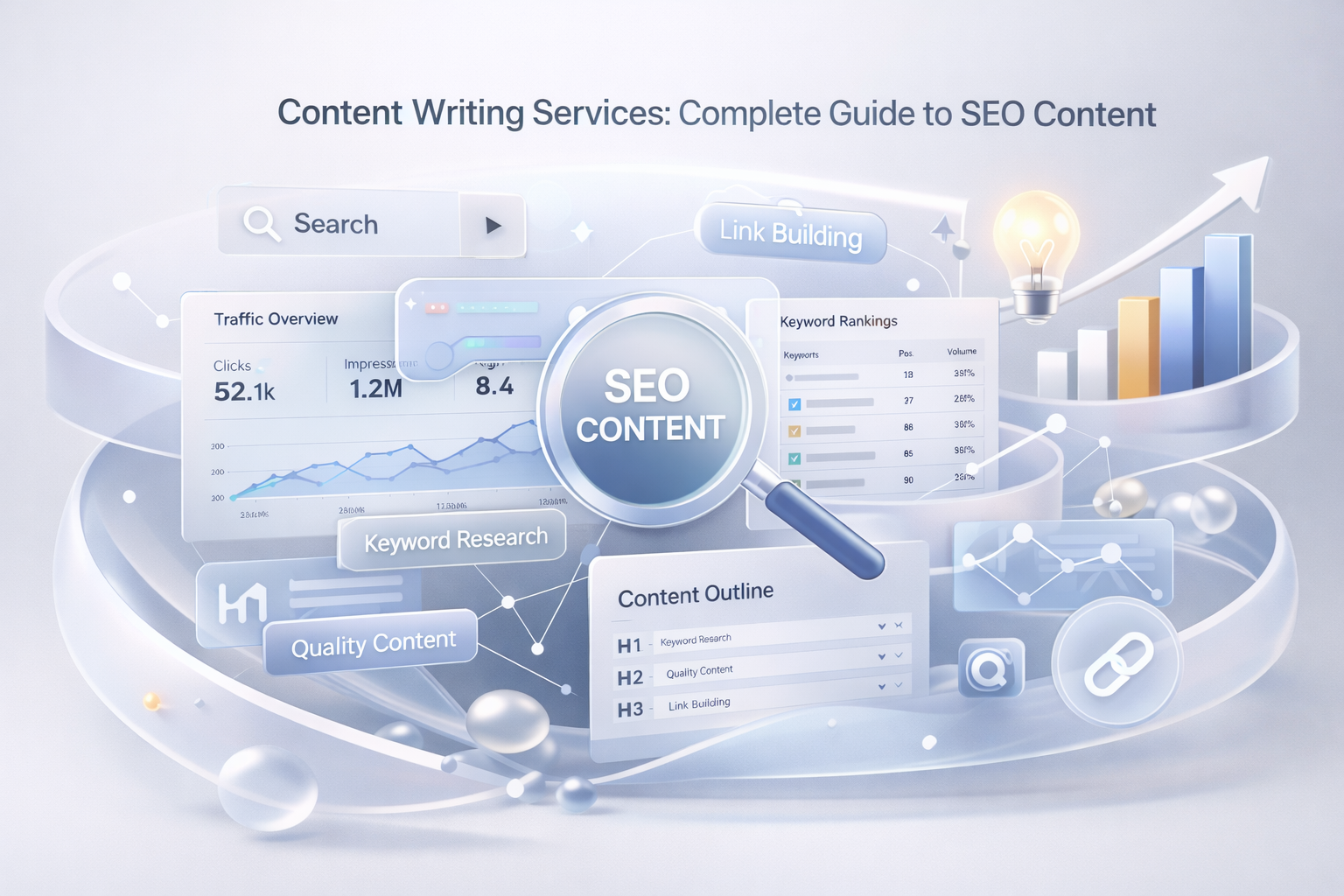
Content writing services transform how businesses attract organic traffic, generate leads, and build lasting search visibility. Professional SEO content creation combines strategic keyword research, search intent optimization, and quality writing to help websites rank higher and convert more visitors.
Whether you’re evaluating content partners for the first time or scaling an existing content program, understanding how SEO content works gives you a significant competitive advantage. The difference between content that ranks and content that disappears often comes down to process, expertise, and strategic alignment.
This guide covers everything you need to know about content writing services: what they include, how SEO content differs from traditional writing, realistic pricing expectations, and how to measure ROI. You’ll also learn the exact process professional content teams follow and the red flags to avoid when choosing a provider.

What Are Content Writing Services?
Content writing services provide businesses with professionally written material designed to inform, engage, and convert target audiences. These services range from blog posts and website copy to technical documentation and long-form guides. The goal is creating content that serves both user needs and business objectives.
Definition and Core Components
Content writing services encompass the research, planning, writing, and optimization of written materials for digital platforms. A comprehensive content writing service typically includes topic research, outline development, draft creation, editorial review, and revisions.
The core components break down into three categories. First, strategic planning determines what content to create based on audience needs and business goals. Second, content production involves the actual writing, editing, and formatting. Third, optimization ensures the content performs well in search engines and resonates with readers.
Professional content services differ from freelance writing in their systematic approach. Rather than producing isolated pieces, quality providers develop content that fits within a broader strategy. Each piece connects to others, building topical authority over time.
Types of Content Writing Services
Blog Writing Services
Blog content forms the foundation of most content marketing strategies. Blog writing services produce articles that target specific keywords, answer user questions, and establish thought leadership. Effective blog content balances SEO requirements with genuine reader value.
Blog posts typically range from 1,000 to 2,500 words for standard topics, with comprehensive guides extending to 3,000+ words. The best blog writing services include keyword research, competitive analysis, and on-page optimization as standard deliverables.
Website Copywriting
Website copy includes homepage content, about pages, service descriptions, and other core site pages. This content serves a different purpose than blog posts. It must communicate brand value, build trust, and guide visitors toward conversion actions.
Website copywriting requires understanding user psychology and conversion principles. The copy must be concise yet compelling, addressing visitor objections while highlighting benefits. Professional website copywriters balance SEO requirements with persuasive writing techniques.
Product Description Writing
E-commerce businesses rely on product descriptions to drive sales. Effective product content goes beyond listing features. It connects product attributes to customer benefits, addresses common questions, and differentiates products from competitors.
Product description writing at scale requires systematic processes. Writers need product information, brand guidelines, and SEO parameters to produce consistent, optimized content across hundreds or thousands of SKUs.
Technical Content Writing
Technical content serves specialized audiences who need detailed, accurate information. This includes documentation, white papers, case studies, and industry-specific guides. Technical writers must understand complex subjects and translate them into accessible content.
The challenge with technical content lies in balancing accuracy with readability. Subject matter expertise alone isn’t enough. Writers must also understand how to structure information for different audience knowledge levels.
Long-Form Content Creation
Long-form content includes pillar pages, ultimate guides, and comprehensive resources that cover topics in depth. This content type typically exceeds 2,500 words and serves as cornerstone material for topic clusters.
Long-form content requires significant research and planning. These pieces often take 2-4 weeks to produce properly, involving multiple rounds of review and optimization. The investment pays off through sustained organic traffic and link acquisition.
Content Writing vs. Copywriting: Key Differences
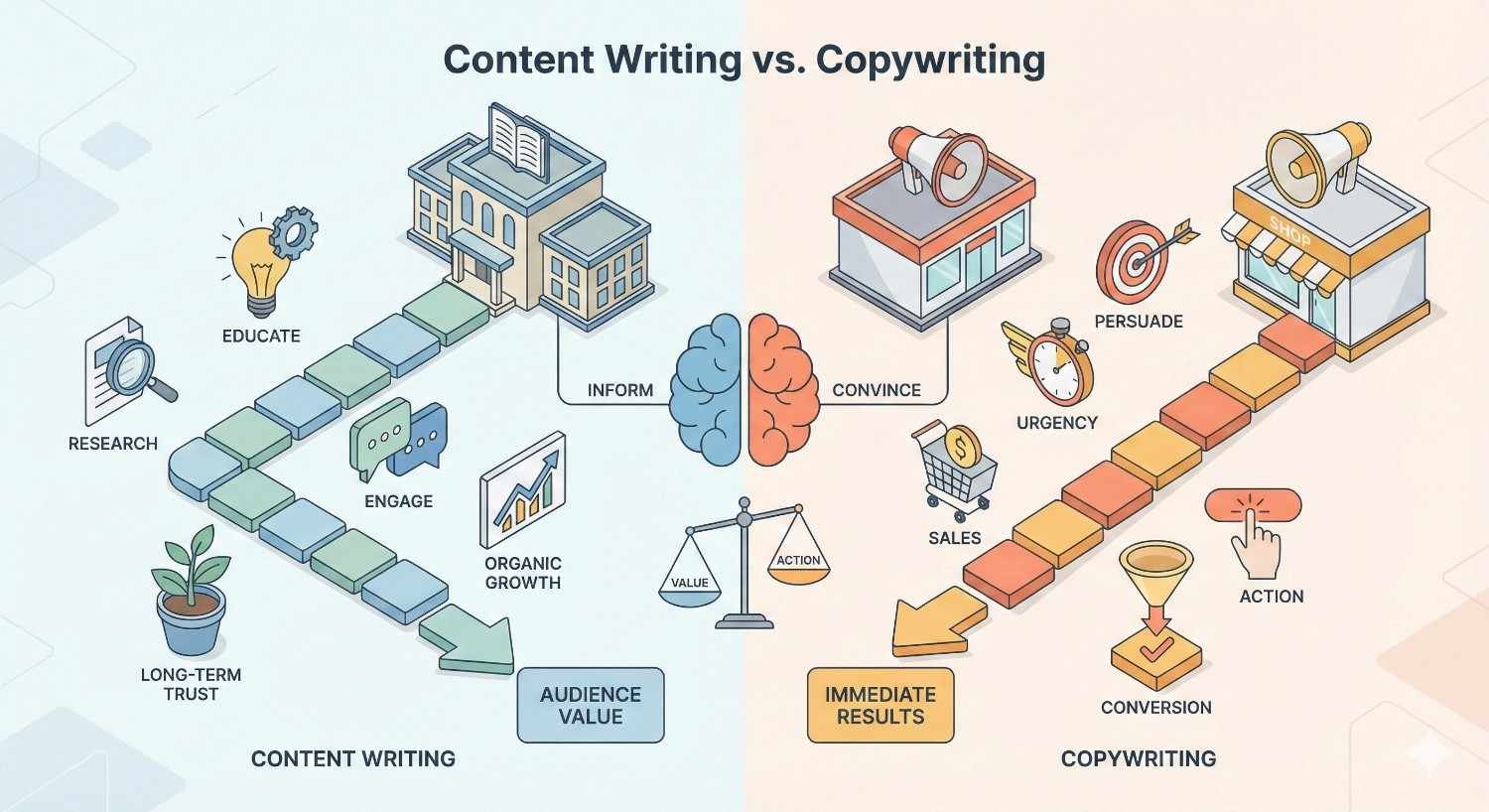
Content writing and copywriting serve different primary purposes, though they overlap significantly in practice. Understanding the distinction helps you choose the right service for specific needs.
Content writing focuses on informing, educating, and engaging audiences. The primary goal is providing value that builds trust and authority over time. Blog posts, guides, and educational resources fall into this category. Success metrics include traffic, engagement, and audience growth.
Copywriting focuses on persuading readers to take specific actions. Sales pages, email campaigns, and advertising copy prioritize conversion over education. Success metrics center on conversion rates, click-through rates, and revenue generated.
Modern SEO content often blends both approaches. A well-written blog post educates readers while guiding them toward relevant products or services. The best content writers understand both disciplines and apply them strategically based on content goals.
What Is SEO Content Writing?
SEO content writing creates material specifically designed to rank in search engines while providing genuine value to readers. It combines traditional writing skills with technical optimization knowledge and strategic keyword targeting.
How SEO Content Differs from Traditional Content
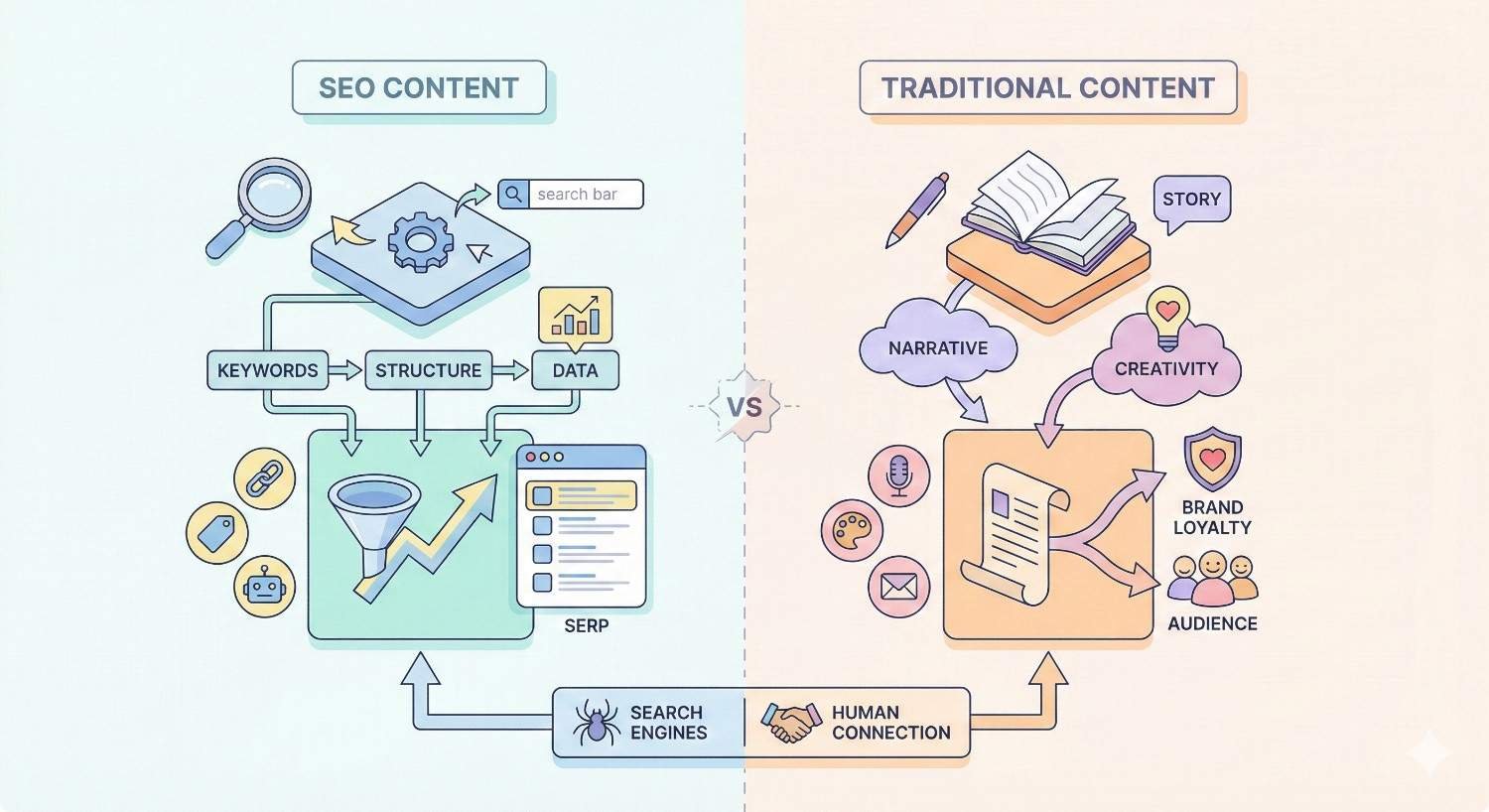
Traditional content writing prioritizes reader engagement and brand voice. Writers focus on clarity, storytelling, and emotional connection. While these elements matter, traditional content often ignores how search engines discover and rank content.
SEO content writing adds a strategic layer. Writers consider keyword opportunities, search intent, competitive positioning, and technical optimization factors. Every piece serves a dual purpose: satisfying reader needs and signaling relevance to search algorithms.
The practical differences appear throughout the writing process. SEO writers research keywords before outlining content. They structure articles with search-friendly headings. They optimize meta elements, internal links, and content length based on competitive analysis.
This doesn’t mean SEO content sacrifices quality. The best SEO content reads naturally while incorporating optimization elements seamlessly. Readers shouldn’t notice the SEO work. They should simply find helpful, well-organized content that answers their questions.
The Role of Search Intent in SEO Content
Search intent describes what users actually want when they type a query. Understanding intent is the foundation of effective SEO content. Content that mismatches intent won’t rank, regardless of how well it’s written or optimized.
Search intent falls into four primary categories. Informational intent seeks knowledge or answers. Navigational intent looks for specific websites or pages. Commercial intent researches products or services before purchasing. Transactional intent indicates readiness to buy or take action.
Matching content to intent requires analyzing what currently ranks for target keywords. If Google shows how-to guides for a query, creating a product page won’t work. The search results reveal what users want and what Google considers relevant.
Intent analysis also shapes content format and depth. Informational queries often need comprehensive guides. Commercial queries benefit from comparison content. Transactional queries require clear calls to action and conversion-focused copy.
Core Elements of SEO-Optimized Content
Keyword Research & Integration
Keyword research identifies the terms and phrases your target audience uses when searching. Effective research goes beyond search volume to consider competition, intent, and relevance to your business.
Primary keywords anchor each piece of content. Secondary keywords and related terms add semantic depth. The goal isn’t keyword density but natural coverage of the topic’s vocabulary. Search engines understand synonyms and related concepts, so forced repetition hurts more than helps.
Integration should feel invisible to readers. Keywords appear in titles, headings, and body content where they fit naturally. Awkward phrasing or obvious keyword insertion signals low-quality content to both readers and search engines.
On-Page Optimization Factors
On-page optimization covers technical elements that help search engines understand and rank content. Title tags, meta descriptions, header structure, and URL formatting all contribute to search visibility.
Title tags should include primary keywords while remaining compelling to click. Meta descriptions don’t directly affect rankings but influence click-through rates from search results. Headers (H2, H3, H4) organize content logically and signal topic structure to crawlers.
Internal linking connects content to related pages on your site. This helps search engines discover content and understand topical relationships. It also keeps readers engaged by offering relevant next steps.
Content Structure & Readability
Structure affects both user experience and search performance. Well-organized content with clear headings, short paragraphs, and logical flow keeps readers engaged. Engagement signals like time on page and scroll depth indirectly influence rankings.
Readability matters for your specific audience. Technical content for engineers can use industry terminology. Consumer content should use simpler language. The goal is matching complexity to audience expectations.
Visual elements break up text and improve comprehension. Bullet points, numbered lists, tables, and images make content scannable. Most readers skim before committing to read fully, so scannable content performs better.
E-E-A-T Signals in Content
E-E-A-T stands for Experience, Expertise, Authoritativeness, and Trustworthiness. Google uses these quality signals to evaluate content, particularly for topics affecting health, finances, or safety.
Experience demonstrates first-hand knowledge. Content that shares real examples, case studies, or practical insights signals genuine experience with the topic. Generic advice without specific details lacks this quality signal.
Expertise shows deep subject knowledge. Accurate information, proper terminology, and comprehensive coverage indicate expertise. Author credentials and bylines strengthen expertise signals.
Authoritativeness comes from recognition by others. Backlinks from respected sites, citations, and brand mentions build authority. Content that others reference and share demonstrates authoritative status.
Trustworthiness requires accuracy, transparency, and reliability. Citing sources, providing contact information, and maintaining consistent quality build trust. Factual errors or misleading claims destroy it.
How Content Writing Services Drive Organic Growth
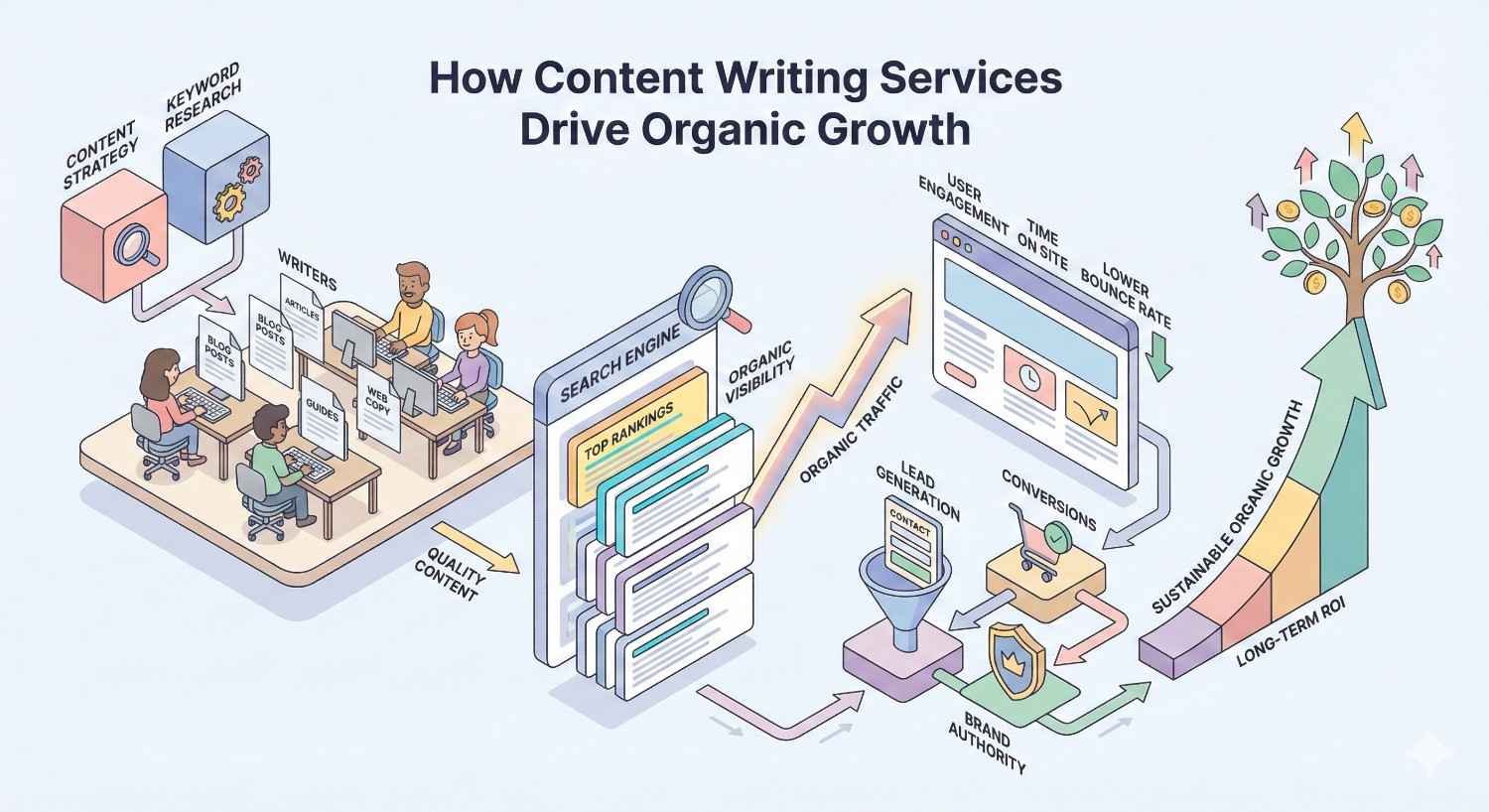
Content writing services directly impact organic search performance by creating the material search engines index and rank. Without quality content, even technically perfect websites struggle to attract organic traffic.
The Connection Between Content and Search Rankings
Search engines exist to connect users with relevant information. Content provides that information. Google’s algorithms evaluate content quality, relevance, and authority to determine rankings. Better content generally means better rankings.
The connection works through multiple mechanisms. Content targets specific keywords, making pages eligible to rank for those queries. Comprehensive content covers topics thoroughly, capturing long-tail variations. Quality content earns backlinks, which strengthen domain authority.
According to research from Backlinko, the average first-page Google result contains approximately 1,447 words. This doesn’t mean length guarantees rankings, but it indicates that comprehensive coverage correlates with search success.
Content also creates indexable pages. Each quality piece adds another entry point to your site. A site with 50 well-optimized pages has more ranking opportunities than one with 10 pages, assuming quality remains consistent.
Content’s Role in the SEO Ecosystem
Technical SEO Support
Content supports technical SEO by providing material for search engines to crawl and index. Site architecture depends on content organization. Internal linking structures require content to link between. XML sitemaps list content pages for crawler discovery.
Technical issues can prevent great content from ranking. But technical optimization without quality content produces empty rankings. The two disciplines work together. Content gives technical SEO something valuable to optimize.
On-Page Optimization
On-page SEO happens within content. Title tags, headers, meta descriptions, and body copy all require written material. Content writers who understand on-page principles create material that’s optimized from the start.
This integration saves time and improves results. When writers handle on-page optimization during creation, content launches ready to perform. Retrofitting optimization onto existing content takes more effort and often produces inferior results.
Link Building & Authority
Quality content attracts backlinks naturally. Other sites link to resources that help their audiences. Comprehensive guides, original research, and unique insights earn links that generic content never will.
Content also supports active link building efforts. Outreach campaigns need something valuable to promote. Guest posting requires quality articles. Digital PR depends on newsworthy content. Without strong content, link building becomes exponentially harder.
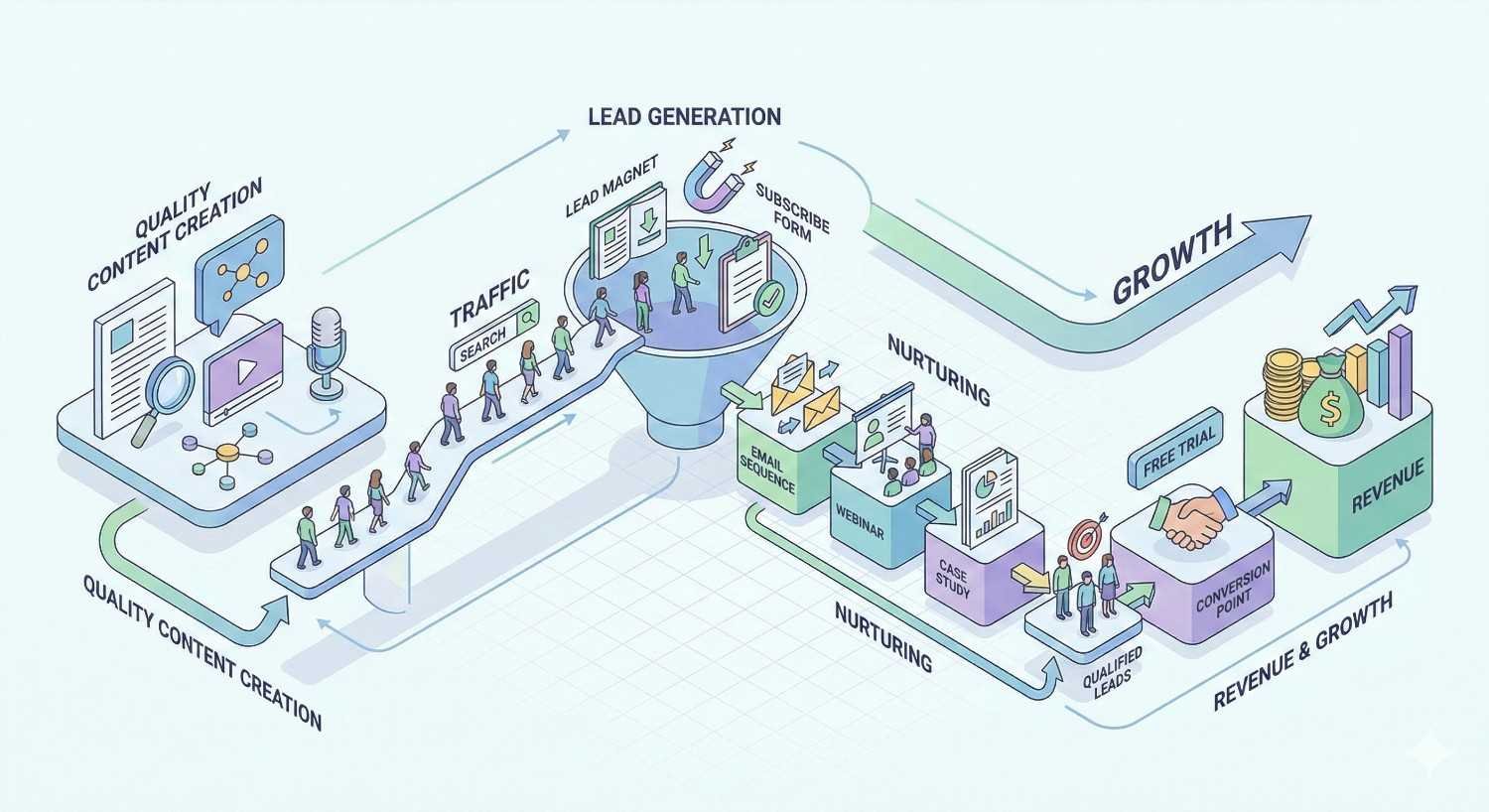
How Quality Content Generates Traffic, Leads, and Revenue
The path from content to revenue follows a logical progression. Content ranks for relevant keywords. Rankings generate organic traffic. Traffic includes potential customers. Some visitors convert into leads or sales.
Each step requires intentional optimization. Content must target keywords with commercial potential, not just high volume. Pages need clear conversion paths. Calls to action must align with visitor intent and journey stage.
The timeline varies significantly. New content typically takes 3-6 months to reach stable rankings. Competitive keywords take longer. But once content ranks, it generates traffic continuously without ongoing advertising costs.
This compounding effect makes content investment attractive. A blog post that costs $500 to produce might generate $50,000 in equivalent paid traffic value over its lifetime. The ROI potential exceeds most marketing channels.
Measuring Content Performance: Key Metrics
Organic Traffic Growth
Organic traffic measures visitors arriving through unpaid search results. Google Analytics 4 tracks this metric, showing trends over time and traffic by page. Growing organic traffic indicates content strategy success.
Look beyond total numbers to traffic quality. Pages attracting your target audience matter more than pages attracting random visitors. Segment traffic by landing page to identify which content drives valuable visits.
Keyword Rankings
Ranking positions show where your content appears in search results for target keywords. Tracking tools like Ahrefs, SEMrush, or dedicated rank trackers monitor positions over time.
Focus on keywords that matter to your business. Ranking #1 for an irrelevant term provides no value. Track primary keywords for each content piece plus important secondary terms. Position improvements indicate optimization success.
Engagement Metrics
Engagement metrics reveal how visitors interact with content. Time on page, scroll depth, and pages per session indicate content quality and relevance. High engagement suggests content satisfies user intent.
Bounce rate requires context. A high bounce rate on a comprehensive guide might indicate users found their answer quickly. A high bounce rate on a landing page suggests problems. Interpret engagement metrics relative to content purpose.
Conversion Tracking
Conversions connect content to business outcomes. Track form submissions, email signups, purchases, or other valuable actions. Attribution models show which content contributes to conversions.
Not all content converts directly. Top-of-funnel educational content builds awareness. Middle-funnel content nurtures consideration. Bottom-funnel content drives decisions. Measure each type against appropriate expectations.
Types of SEO Content Services
Different content types serve different strategic purposes. Understanding the options helps you build a comprehensive content program that addresses all stages of the customer journey.
Blog Content Writing Services
Blog content targets informational queries and builds topical authority. Regular blog publishing signals site freshness and creates ongoing ranking opportunities. Most content strategies center on blog production.
Effective blog services include keyword research, competitive analysis, and strategic planning. Writers should understand your industry and audience. Content should fit within a broader topic strategy rather than targeting random keywords.
Blog frequency depends on resources and goals. Publishing 2-4 quality posts monthly works for most businesses. Higher frequency accelerates results but requires proportionally more investment. Quality always trumps quantity.
Landing Page & Website Content
Landing pages target commercial and transactional queries. These pages convert visitors into leads or customers. They require different writing approaches than informational blog content.
Website content establishes brand positioning and guides visitor journeys. Homepage copy, service pages, and about content shape first impressions. This content changes less frequently but requires careful optimization.
Landing page services should include conversion optimization expertise. Writers must understand persuasion principles, objection handling, and call-to-action best practices. SEO knowledge alone isn’t sufficient for high-converting pages.
Pillar Pages & Topic Clusters
Pillar pages serve as comprehensive resources on broad topics. They link to cluster content covering specific subtopics. This structure builds topical authority and creates clear site architecture.
Pillar content typically ranges from 3,000 to 5,000+ words. These pages require significant research and planning. They serve as cornerstone content that attracts links and establishes expertise.
Topic cluster strategy requires planning beyond individual pieces. The pillar and clusters must connect logically. Internal linking must flow properly. Content services offering pillar development should include strategic planning.
Product & Service Page Content
Product and service pages drive direct conversions. They must communicate value propositions, address objections, and motivate action. SEO optimization ensures these pages appear for relevant commercial queries.
E-commerce product content requires scalable processes. Writing unique descriptions for hundreds of products demands efficiency without sacrificing quality. Templates and guidelines help maintain consistency.
Service page content must differentiate your offerings. Generic descriptions don’t convert. Specific benefits, proof points, and clear next steps turn visitors into inquiries.
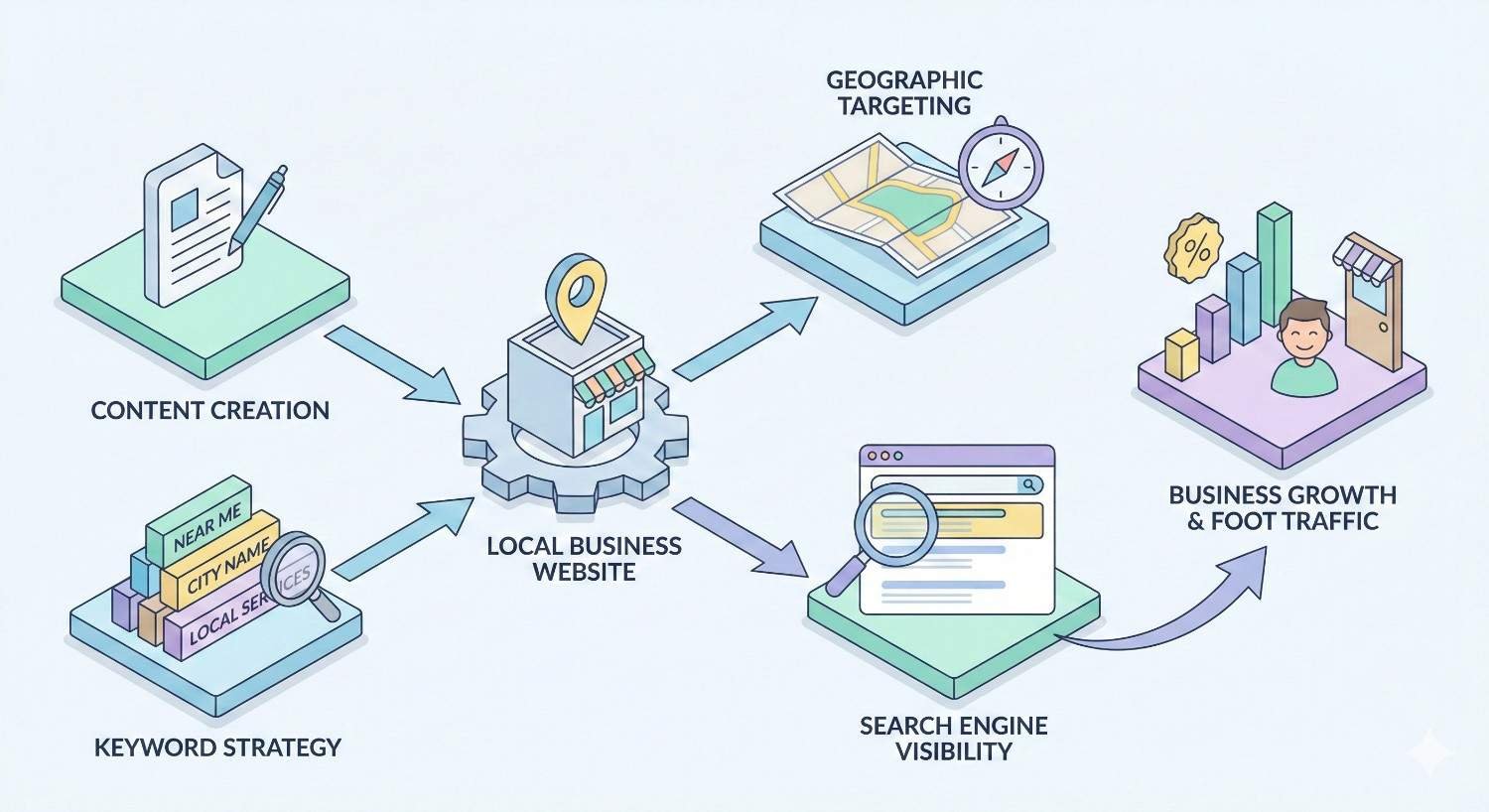
Local SEO Content
Local content targets geographic-specific queries. Location pages, local guides, and area-specific content help businesses rank in local search results. This content type matters for businesses serving specific regions.
Local content requires understanding local SEO principles. NAP consistency, local keywords, and geographic relevance all factor into local rankings. Content services should integrate with broader local SEO strategy.
Multi-location businesses need scalable local content approaches. Each location needs unique content, not duplicated pages with swapped city names. Quality local content services handle this complexity.
Content Refresh & Optimization Services
Existing content often underperforms its potential. Content refresh services update, expand, and re-optimize older content to improve rankings. This approach often delivers faster results than creating new content.
Refresh services audit existing content for opportunities. Pages ranking on page two might reach page one with updates. Outdated content might regain rankings with current information. Thin content might perform better with added depth.
The refresh process includes competitive re-analysis, keyword gap identification, and content expansion. Updated content should exceed what currently ranks, not just match it.
The SEO Content Writing Process
Professional content services follow systematic processes that ensure consistent quality and optimization. Understanding this process helps you evaluate providers and set appropriate expectations.
Step 1: Keyword Research & Topic Discovery
Every piece of content starts with keyword research. This research identifies target terms, assesses competition, and validates topic viability. Skipping this step leads to content that never ranks.
Keyword research tools like Ahrefs, SEMrush, and Google Keyword Planner provide search volume, difficulty scores, and related terms. But tools only provide data. Interpreting that data requires experience and strategic thinking.
Topic discovery expands beyond single keywords. Related questions, subtopics, and content gaps all inform what to cover. Comprehensive topic research ensures content addresses the full scope of user needs.
Step 2: Search Intent Analysis
Intent analysis determines what type of content to create. Reviewing current search results reveals what Google considers relevant. Content must match this intent to have ranking potential.
Analyze the top 10 results for target keywords. Note content types, formats, and angles. Identify common elements and gaps. Your content should match successful patterns while offering something additional.
Intent can shift over time. Queries that once showed informational results might now show commercial content. Regular intent analysis ensures content strategy stays aligned with search reality.
Step 3: Competitive Content Analysis
Competitive analysis examines what currently ranks. This reveals the quality bar your content must exceed. It also identifies opportunities competitors miss.
Analyze competitor content for depth, structure, and unique value. Note word counts, heading structures, and topics covered. Identify weaknesses you can exploit and strengths you must match.
Competitive analysis shouldn’t lead to copying. The goal is understanding the landscape, not replicating it. Your content should offer something competitors don’t, whether deeper coverage, better examples, or unique perspectives.
Step 4: Content Brief Development
Content briefs translate research into writing instructions. A comprehensive brief includes target keywords, intent analysis, competitive insights, structural recommendations, and specific requirements.
Briefs ensure writers understand expectations before starting. They reduce revision cycles and improve first-draft quality. Detailed briefs are especially important when working with external writers unfamiliar with your business.
Brief components typically include primary and secondary keywords, target word count, required sections, internal linking targets, and tone guidelines. The more specific the brief, the better the resulting content.
Step 5: Writing & On-Page Optimization
Writing transforms briefs into content. Professional writers balance SEO requirements with engaging, readable prose. The best content satisfies both search algorithms and human readers.
On-page optimization happens during writing, not after. Writers incorporate keywords naturally, structure content with proper headings, and include internal links. Retrofitting optimization produces inferior results.
First drafts rarely achieve perfection. Expect revision cycles to refine messaging, improve flow, and enhance optimization. Quality content services build revision rounds into their processes.
Step 6: Editorial Review & Quality Assurance
Editorial review catches errors and ensures quality standards. This includes grammar and spelling checks, fact verification, and brand voice consistency. Published content reflects on your business.
Quality assurance extends beyond proofreading. Reviewers verify keyword integration, check internal links, and confirm optimization elements. Technical accuracy matters as much as writing quality.
Multiple review stages improve outcomes. Writer self-review, peer editing, and final quality checks each catch different issues. Rushing content to publication without proper review risks embarrassing errors.
Step 7: Publication & Performance Monitoring
Publication involves more than clicking publish. Proper formatting, image optimization, schema markup, and technical checks ensure content launches correctly. Broken elements hurt both user experience and search performance.
Performance monitoring tracks how content performs after publication. Initial indexing, ranking movements, and traffic trends all provide feedback. This data informs future content decisions.
Content rarely reaches peak performance immediately. Rankings typically stabilize after 3-6 months. Monitoring during this period identifies opportunities for optimization or promotion.
What to Look for in Content Writing Services
Choosing the right content partner significantly impacts results. Not all services deliver equal quality or value. Knowing what to evaluate helps you make informed decisions.
SEO Expertise & Strategy Integration
Content writing without SEO expertise produces content that doesn’t rank. Look for providers who demonstrate deep understanding of search algorithms, ranking factors, and optimization techniques.
Ask about their keyword research process, intent analysis approach, and competitive analysis methods. Providers should explain how they ensure content ranks, not just how they write well.
Strategy integration matters as much as individual piece quality. Content should fit within a broader plan. Providers should understand your existing content, identify gaps, and recommend strategic priorities.
Industry Knowledge & Subject Matter Expertise
Generic writers produce generic content. Industry expertise enables deeper, more valuable content that resonates with your specific audience. Look for providers with experience in your sector.
Subject matter expertise shows in content quality. Experts use correct terminology, understand nuances, and provide insights generic writers miss. This expertise builds reader trust and demonstrates E-E-A-T signals.
For technical industries, verify writers can handle complexity. Request samples in your field. Assess whether content demonstrates genuine understanding or surface-level research.
Content Quality Standards
Quality standards should be explicit and measurable. Ask about editing processes, revision policies, and quality benchmarks. Providers should articulate what “quality” means in concrete terms.
Plagiarism checks, grammar standards, and factual accuracy requirements indicate professional operations. Providers cutting corners on quality assurance will eventually deliver substandard work.
Request samples before committing. Evaluate writing quality, optimization integration, and overall professionalism. Samples reveal more than sales conversations.
Transparent Pricing & Deliverables
Clear pricing prevents surprises. Understand exactly what’s included and what costs extra. Hidden fees for revisions, research, or optimization indicate problematic providers.
Deliverables should be specific. Word counts, revision rounds, turnaround times, and included services should all be documented. Vague promises lead to mismatched expectations.
Compare pricing against value, not just cost. Cheap content that doesn’t rank wastes money. Premium content that drives results delivers ROI. Evaluate providers on outcome potential, not hourly rates.
Performance Tracking & Reporting
Quality providers track content performance and share results. Regular reporting shows what’s working and what needs adjustment. Providers who avoid performance discussions may lack confidence in their work.
Ask what metrics they track and how they report. Monthly performance summaries, ranking updates, and traffic analysis demonstrate accountability. Providers should want to prove their value.
Performance data also enables optimization. Identifying underperforming content creates improvement opportunities. Providers should use data to refine strategy, not just report numbers.
Red Flags to Avoid
Certain warning signs indicate problematic providers. Recognizing these red flags helps you avoid costly mistakes.
Guaranteed rankings promise what no one can deliver. Google’s algorithm is complex and constantly changing. Legitimate providers explain realistic expectations, not guaranteed outcomes.
Extremely low prices usually mean extremely low quality. Professional content requires skilled writers, thorough research, and careful optimization. Providers charging $0.03 per word cannot deliver this profitably.
No samples or portfolio suggests inexperience or poor quality. Established providers proudly share their work. Reluctance to show samples raises questions.
Vague processes indicate disorganized operations. Professional services can explain exactly how they work. Providers who can’t articulate their process likely don’t have one.
No revision policy leaves you stuck with unsatisfactory content. Quality providers stand behind their work with reasonable revision allowances.
Content Writing Services Pricing: What to Expect
Understanding pricing models and cost factors helps you budget appropriately and evaluate proposals. Content pricing varies significantly based on quality, expertise, and service scope.
Pricing Models Explained
Per-Word Pricing
Per-word pricing charges based on content length. Rates typically range from $0.10 to $1.00+ per word depending on quality level and expertise required. A 2,000-word article might cost $200 to $2,000.
This model provides predictable costs based on content volume. It works well for straightforward content with clear length requirements. However, it can incentivize padding content to increase word counts.
Per-word pricing doesn’t account for research complexity or optimization depth. A technical article requiring extensive research costs the same as a simple topic at the same word count. Consider whether flat per-word rates make sense for your content needs.
Per-Project Pricing
Project pricing sets fixed costs for defined deliverables. A pillar page might cost $1,500-$5,000 regardless of final word count. This model accounts for research, strategy, and optimization beyond raw writing.
Project pricing aligns incentives better than per-word models. Providers focus on quality and completeness rather than length. Complex projects with variable scope fit this model well.
Ensure project scope is clearly defined. Vague project definitions lead to disputes about what’s included. Detailed statements of work protect both parties.
Monthly Retainer Models
Retainers provide ongoing content production for fixed monthly fees. A typical retainer might include 4-8 blog posts monthly plus strategy support for $2,000-$10,000 depending on volume and quality.
Retainers work well for consistent content needs. They provide predictable budgeting and ensure dedicated capacity. Long-term relationships also improve content quality as providers learn your business.
Retainer commitments require confidence in the provider. Start with smaller engagements before committing to ongoing relationships. Ensure contracts include reasonable termination provisions.
Performance-Based Pricing
Performance pricing ties costs to results. Providers might charge based on traffic generated, rankings achieved, or leads produced. This model aligns provider incentives with your outcomes.
Performance models are less common because results depend on many factors beyond content quality. Technical SEO issues, domain authority, and competition all affect performance. Providers accepting pure performance risk typically charge premiums.
Hybrid models combining base fees with performance bonuses offer middle ground. Base fees cover production costs while bonuses reward exceptional results.
Factors That Affect Content Writing Costs
Several factors influence content pricing beyond basic word counts.
Topic complexity affects research requirements. Technical subjects, regulated industries, and specialized niches require more expertise and research time. Expect premium pricing for complex topics.
Writer expertise correlates with quality and cost. Subject matter experts command higher rates than generalist writers. The premium often delivers proportionally better results.
Turnaround time impacts pricing. Rush projects require prioritization and overtime. Standard timelines of 1-2 weeks per piece cost less than 48-hour turnarounds.
Optimization depth varies between providers. Basic keyword integration costs less than comprehensive optimization including competitive analysis, intent matching, and technical SEO elements.
Revision rounds add cost if not included in base pricing. Clarify revision policies upfront to avoid surprise charges.
ROI Expectations: What Quality Content Delivers
Content investment should generate returns exceeding costs. Understanding realistic ROI expectations helps you evaluate whether content services make financial sense.
Quality content typically delivers ROI through multiple channels. Organic traffic reduces paid advertising needs. Lead generation creates sales opportunities. Brand authority supports premium pricing. Each benefit contributes to overall return.
ROI timelines extend beyond immediate results. Content published today might generate traffic for years. Calculate lifetime value, not just first-month performance. A $1,000 article generating 100 visitors monthly for 3 years delivers 3,600 visitors at $0.28 per visitor.
Compare content ROI to alternative channels. Paid search might cost $2-10 per click for competitive keywords. Content achieving similar traffic at lower per-visitor costs delivers superior ROI over time.
SEO Content Timelines: How Long Until You See Results?
Understanding realistic timelines prevents frustration and enables proper planning. SEO content doesn’t deliver instant results, but patience pays off with sustainable traffic growth.
Realistic Ranking Timelines for New Content
New content typically takes 3-6 months to reach stable rankings. This timeline reflects how search engines discover, evaluate, and rank new pages. Expecting faster results leads to disappointment.
Initial indexing happens within days to weeks. Google discovers new content through crawling and sitemaps. But indexing doesn’t mean ranking. The evaluation period follows.
During evaluation, Google tests content against user signals. Click-through rates, engagement metrics, and user satisfaction all factor into ranking decisions. This testing period explains why rankings fluctuate initially.
According to Ahrefs research, only 5.7% of newly published pages reach the top 10 within a year for at least one keyword. Most content takes longer to achieve significant rankings.
Factors That Accelerate or Delay Results
Domain Authority
Established domains with strong backlink profiles rank new content faster. Google trusts authoritative sites more, reducing the evaluation period. New domains face longer timelines regardless of content quality.
Building domain authority takes time and consistent effort. Quality content, link acquisition, and technical excellence all contribute. There are no shortcuts to authority.
Keyword Competition
Competitive keywords take longer to rank. If top results come from high-authority sites with comprehensive content, displacing them requires exceptional work and patience.
Less competitive keywords offer faster wins. Long-tail variations and niche topics often rank within weeks. Strategic keyword selection balances opportunity with timeline expectations.
Content Quality & Depth
Superior content ranks faster than mediocre content. Comprehensive coverage, unique insights, and excellent user experience signal quality to search engines.
Depth matters more than length alone. Thoroughly covering a topic in 2,000 words beats padding to 4,000 words. Quality assessment considers value delivered, not word counts.
Technical SEO Foundation
Technical issues delay rankings regardless of content quality. Crawl errors, slow page speed, and mobile problems all hurt performance. Ensure technical foundations are solid before investing heavily in content.
Technical audits should precede major content initiatives. Fixing issues after content publication wastes the initial ranking opportunity. Get technical SEO right first.
Setting Accurate Expectations with Stakeholders
Communicating realistic timelines prevents organizational frustration. Stakeholders expecting immediate results will question content investment before it has time to work.
Frame content as a long-term investment, not a quick fix. Compare to building a sales team: initial investment precedes revenue generation. Content follows similar patterns.
Set milestone expectations rather than outcome guarantees. Indexing within two weeks, initial rankings within three months, and stable positions within six months provide measurable progress markers.
Report on leading indicators during the waiting period. Content production volume, indexing status, and early ranking movements show progress before traffic materializes.
In-House vs. Outsourced Content Writing Services
Choosing between internal teams and external providers involves tradeoffs. Understanding the advantages and limitations of each approach helps you make the right decision for your situation.
Pros and Cons of In-House Content Teams
Advantages of In-House Teams
In-house writers develop deep brand and product knowledge. They understand your business intimately, enabling more authentic content. Institutional knowledge accumulates over time.
Direct management provides control over priorities and processes. You can redirect resources quickly as needs change. Communication happens without external coordination overhead.
Long-term cost efficiency may favor in-house teams at scale. Once salaries and overhead are covered, additional content has low marginal cost.
Disadvantages of In-House Teams
Fixed costs continue regardless of content needs. Slow periods still require paying salaries. Scaling up requires hiring, which takes time and carries risk.
Skill gaps limit capabilities. A single writer can’t excel at every content type. Building comprehensive in-house capabilities requires multiple specialized hires.
Fresh perspectives become harder to maintain. In-house teams can develop blind spots and stale approaches. External viewpoints often spark innovation.
Benefits of Outsourcing to Content Writing Agencies
Outsourcing provides flexibility and scalability. Increase or decrease volume based on needs without hiring or layoffs. Access specialized expertise for specific projects without permanent commitments.
Agencies bring diverse experience across industries and content types. This breadth enables best practice application and creative approaches. Fresh perspectives challenge assumptions.
Cost structures align with output. You pay for content delivered, not capacity maintained. This efficiency benefits businesses with variable content needs.
Professional agencies maintain quality systems and processes. Editing, quality assurance, and optimization happen systematically. Individual freelancers rarely match agency infrastructure.
Hybrid Models: When to Use Both
Many organizations combine in-house and outsourced resources. This hybrid approach captures benefits of both while mitigating limitations.
In-house teams might handle brand-critical content requiring deep institutional knowledge. Outsourced partners handle volume production, specialized topics, or overflow capacity.
Hybrid models require clear role definition. Confusion about responsibilities creates gaps and duplication. Document who handles what and how handoffs work.
Coordination overhead increases with hybrid approaches. Budget time for communication, briefing, and quality alignment. The flexibility benefits must outweigh coordination costs.
How to Evaluate and Onboard Content Partners
Evaluating potential partners requires systematic assessment. Request samples, check references, and conduct trial projects before major commitments.
Evaluation Criteria:
- Portfolio quality and relevance to your industry
- Process documentation and transparency
- Communication responsiveness and clarity
- Pricing structure and value alignment
- Client references and retention rates
Onboarding sets the foundation for successful partnerships. Invest time in sharing brand guidelines, voice documentation, and strategic context. Partners who understand your business produce better content.
Start with smaller projects to test fit before scaling. A trial blog post reveals more than sales conversations. Evaluate quality, process, and communication before committing to retainers.
Content Strategy Integration: Beyond Individual Articles
Individual content pieces matter less than strategic content programs. Integrating content into broader strategy multiplies impact and builds sustainable competitive advantage.
Building a Content Calendar for SEO
Content calendars organize production and ensure consistent publishing. They align content with business priorities, seasonal trends, and strategic initiatives.
Effective calendars balance multiple content types. Mix blog posts, pillar content, and commercial pages. Vary topics to build comprehensive topical coverage.
Plan 3-6 months ahead while remaining flexible. Strategic planning requires lead time, but market changes demand adaptability. Build revision processes into calendar management.
Calendar tools range from simple spreadsheets to dedicated platforms. Choose tools matching your team size and complexity. Overengineered systems create overhead without proportional benefit.
Topic Clusters & Internal Linking Strategy
Topic clusters organize content around central themes. Pillar pages cover broad topics comprehensively. Cluster content addresses specific subtopics, linking back to pillars.
This structure signals topical authority to search engines. Comprehensive coverage of related topics demonstrates expertise. Internal links distribute authority and guide crawlers.
Internal linking requires intentional planning. Each piece should link to relevant related content. Anchor text should be descriptive and varied. Orphan pages without internal links underperform.
Audit existing content for linking opportunities. Older content often lacks links to newer pieces. Regular link audits ensure the internal network stays connected.
Content Audits & Gap Analysis
Content audits assess existing content performance and quality. They identify underperforming pieces, outdated content, and optimization opportunities.
Gap analysis reveals missing topics. Compare your content coverage to competitors and user needs. Gaps represent ranking opportunities competitors haven’t captured.
Audit frequency depends on content volume. Sites with hundreds of pages benefit from quarterly audits. Smaller sites might audit annually. The goal is maintaining content quality and strategic alignment.
Audit outcomes drive action. Update underperforming content, consolidate thin pages, and prioritize gap-filling. Audits without follow-through waste effort.
Aligning Content with Business Goals
Content should serve business objectives, not just traffic metrics. Align content strategy with revenue goals, market positioning, and growth priorities.
Map content to the customer journey. Awareness content attracts new audiences. Consideration content nurtures interest. Decision content drives conversions. Each stage requires different content approaches.
Measure content against business outcomes. Traffic matters less than qualified traffic. Rankings matter less than rankings for commercial keywords. Connect content metrics to revenue impact.
Regular strategy reviews ensure alignment. Business priorities shift. Content strategy should adapt accordingly. Quarterly reviews balance consistency with responsiveness.
Tools & Technologies for SEO Content
The right tools improve efficiency and effectiveness. Understanding available options helps you build an appropriate technology stack.
Keyword Research Tools
Google Keyword Planner
Google’s free tool provides search volume data and keyword suggestions. It’s designed for advertisers but useful for SEO research. Data comes directly from Google, ensuring accuracy.
Limitations include grouped volume ranges and advertiser-focused metrics. For detailed SEO research, supplement with other tools.
Ahrefs / SEMrush
These comprehensive platforms offer keyword research, competitive analysis, and rank tracking. They provide detailed metrics including keyword difficulty, click potential, and SERP features.
Ahrefs excels at backlink analysis and content gap identification. SEMrush offers broader marketing features including advertising and social tools. Both provide excellent keyword research capabilities.
Investment ranges from $99 to $400+ monthly depending on plan level. The cost is justified for serious SEO programs. Free trials help evaluate fit.
Specialized Tools (Clearscope, Surfer SEO, MarketMuse)
Content optimization tools analyze top-ranking content and provide optimization recommendations. They identify terms and topics to include for comprehensive coverage.
Clearscope grades content against competitors and suggests improvements. Surfer SEO provides real-time optimization guidance during writing. MarketMuse offers AI-powered content planning and optimization.
These tools complement rather than replace keyword research platforms. They’re most valuable for optimizing individual pieces rather than strategic planning.
Content Optimization Platforms
Optimization platforms streamline the writing and optimization process. They integrate keyword research, competitive analysis, and content grading into unified workflows.
Features typically include content briefs, optimization scoring, and collaboration tools. Writers receive guidance while creating content rather than optimizing afterward.
Evaluate platforms based on your workflow needs. Solo writers need different features than large teams. Integration with existing tools matters for efficiency.
Analytics & Performance Tracking
Google Search Console
Search Console provides direct data from Google about your site’s search performance. It shows queries driving impressions and clicks, indexing status, and technical issues.
This free tool is essential for SEO. No other source provides the same direct Google data. Regular monitoring identifies opportunities and problems.
Google Analytics 4
GA4 tracks website traffic and user behavior. It shows how visitors find your site, what they do there, and whether they convert. Content performance analysis depends on GA4 data.
The transition from Universal Analytics requires learning new interfaces and concepts. Event-based tracking differs from session-based models. Invest time in understanding GA4 properly.
Rank Tracking Tools
Dedicated rank trackers monitor keyword positions over time. They provide historical data, competitor comparisons, and ranking alerts.
Options range from features within Ahrefs/SEMrush to specialized tools like AccuRanker or SERPWatcher. Choose based on tracking volume needs and budget.
AI Writing Tools: Role & Limitations
AI writing tools have transformed content production. They can generate drafts, suggest improvements, and accelerate research. But they have significant limitations.
AI excels at structure and initial drafts. It can outline topics, generate first versions, and handle routine content. This acceleration frees human writers for higher-value work.
AI struggles with accuracy, originality, and expertise. It can produce plausible-sounding but incorrect information. It lacks genuine experience and insight. It tends toward generic rather than distinctive content.
The best approach combines AI efficiency with human expertise. Use AI for acceleration, not replacement. Human review, fact-checking, and enhancement remain essential.
Google’s guidance emphasizes content quality regardless of creation method. AI-generated content isn’t penalized if it’s helpful and accurate. But low-quality AI content faces the same consequences as low-quality human content.
Common Content Writing Mistakes That Hurt SEO
Avoiding common mistakes improves content performance. Understanding what not to do is as important as knowing best practices.
Keyword Stuffing & Over-Optimization
Keyword stuffing repeats target keywords unnaturally. This outdated tactic triggers spam filters and degrades user experience. Modern algorithms detect and penalize over-optimization.
Natural keyword usage reads smoothly. If keyword placement feels forced, it probably is. Write for readers first, then verify adequate keyword coverage.
Over-optimization extends beyond keywords. Excessive exact-match anchor text, manipulative internal linking, and artificial optimization signals all risk penalties. Pursue optimization thoughtfully, not aggressively.
Ignoring Search Intent
Content mismatched to intent won’t rank regardless of quality. Creating product pages for informational queries or guides for transactional searches wastes effort.
Always analyze search results before creating content. Understand what users want and what Google rewards. Align content format and approach accordingly.
Intent can be nuanced. Some queries have mixed intent requiring content that serves multiple needs. Analyze carefully rather than assuming.
Thin Content & Lack of Depth
Thin content provides insufficient value. Short articles that barely scratch topics fail to satisfy users or demonstrate expertise. Search engines recognize and demote thin content.
Depth means comprehensive coverage, not just word count. A 1,500-word article thoroughly covering a narrow topic beats a 3,000-word article superficially covering a broad one.
Evaluate depth against competitors. If top results provide detailed coverage, matching or exceeding that depth is necessary to compete.
Duplicate Content Issues
Duplicate content confuses search engines about which version to rank. It dilutes authority across multiple URLs and can trigger penalties in extreme cases.
Technical duplicates occur through URL parameters, www/non-www variations, and HTTP/HTTPS versions. Canonical tags and redirects resolve these issues.
Content duplicates occur when similar content exists on multiple pages. Product descriptions copied across sites, syndicated content, and internal redundancy all create problems. Ensure each page offers unique value.
Neglecting Content Updates
Content decays over time. Information becomes outdated. Competitors publish better content. Rankings decline without maintenance.
Regular content audits identify update opportunities. Refresh statistics, add new information, and improve optimization. Updated content often regains lost rankings.
Prioritize updates based on potential impact. High-traffic pages with declining performance deserve immediate attention. Low-traffic pages might warrant consolidation or removal.
Prioritizing Quantity Over Quality
Publishing volume doesn’t guarantee results. Ten mediocre articles perform worse than two excellent ones. Quality compounds while quantity dilutes.
Resource constraints force tradeoffs. When choosing between more content or better content, choose better. Build quality foundations before scaling volume.
Quality standards should be non-negotiable. Rushing content to meet arbitrary publishing schedules sacrifices the quality that drives results. Adjust schedules rather than standards.
Conclusion
Content writing services provide the foundation for sustainable organic growth. From keyword research and intent analysis to writing and optimization, professional content creation combines multiple disciplines into cohesive strategies that drive traffic, leads, and revenue.
Choosing the right content partner requires evaluating SEO expertise, industry knowledge, quality standards, and pricing transparency. The investment in quality content delivers compounding returns over time, making it one of the most cost-effective marketing channels available.
We help businesses build comprehensive content strategies that drive measurable results. White Label SEO Service provides end-to-end content writing services, from strategic planning through performance optimization. Contact us to discuss how professional content creation can accelerate your organic growth.
Frequently Asked Questions About Content Writing Services
How much do content writing services cost?
Content writing services typically range from $0.10 to $1.00+ per word depending on quality level and expertise required. A 2,000-word blog post might cost $200 to $2,000. Monthly retainers for ongoing content production range from $2,000 to $10,000+ based on volume and service scope.
What’s the difference between content writing and SEO writing?
Content writing focuses on creating engaging, informative material for readers. SEO writing adds strategic optimization including keyword research, intent matching, and technical elements that help content rank in search engines. The best SEO content combines both approaches seamlessly.
How do I know if content writing services are working?
Track organic traffic growth, keyword rankings, engagement metrics, and conversions. Effective content shows ranking improvements within 3-6 months, followed by sustained traffic growth. Connect content performance to business outcomes like leads and revenue for complete ROI assessment.
How often should I publish new content?
Most businesses benefit from publishing 2-4 quality pieces monthly. Consistency matters more than volume. Higher frequency accelerates results but requires proportional investment. Quality should never be sacrificed for publishing speed.
Can AI replace human content writers?
AI tools accelerate content production but cannot replace human expertise. AI struggles with accuracy, originality, and genuine insight. The best approach combines AI efficiency for drafts and research with human review, fact-checking, and enhancement for quality assurance.
What should I provide to a content writing service?
Provide brand guidelines, target audience information, business goals, and any existing content strategy documentation. Share examples of content you admire and clarify your brand voice. The more context you provide, the better content partners can serve your needs.
How long does SEO content take to rank?
New content typically takes 3-6 months to reach stable rankings. Factors including domain authority, keyword competition, and content quality affect timelines. Competitive keywords may take longer, while less competitive long-tail terms can rank within weeks.