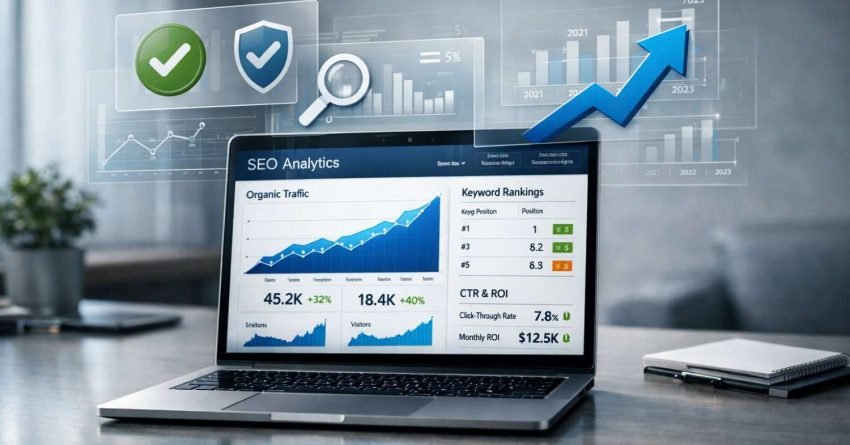
SEO services generate measurable results when executed strategically, with businesses typically seeing significant organic traffic increases within 6-12 months of consistent implementation. The difference between success and failure often comes down to realistic expectations, proper execution, and understanding that search visibility compounds over time rather than appearing overnight.
For business owners and marketing managers evaluating SEO investments, separating fact from fiction has never been more critical. The industry contains both legitimate providers delivering substantial ROI and those making promises they cannot keep. This analysis examines what the data actually shows about SEO effectiveness.
You will learn the specific timelines for results, which ranking factors matter most, how to measure real ROI, and what distinguishes effective SEO strategies from wasteful spending. Every claim here is backed by research and industry data.
Understanding How SEO Services Create Business Value
SEO services work by improving your website’s visibility in search engine results pages for queries your potential customers actively search. This visibility translates directly into website traffic, which then converts into leads, sales, and revenue based on your conversion optimization.
The fundamental mechanism is straightforward. Search engines like Google use complex algorithms to determine which pages best answer user queries. SEO services optimize your website to better match these algorithmic preferences while simultaneously improving user experience. When done correctly, your pages rank higher, more people find your business, and revenue increases.
According to BrightEdge research, organic search drives 53% of all website traffic across industries. This makes SEO the single largest traffic source for most businesses, exceeding paid advertising, social media, and direct traffic combined. The data confirms that search visibility directly correlates with business opportunity.
The Compounding Nature of SEO Results
Unlike paid advertising where traffic stops when spending stops, SEO creates compounding returns. A page that ranks well continues generating traffic for months or years with minimal ongoing investment. This compounding effect explains why Ahrefs data shows that pages ranking in the top 10 are typically over 2 years old on average.
The compounding works in multiple directions. Higher rankings generate more traffic. More traffic generates more engagement signals. Better engagement signals reinforce rankings. Meanwhile, each new piece of optimized content adds to your total organic visibility, creating a snowball effect that accelerates over time.
This compounding nature means early SEO investments often appear to underperform while later investments seem to overperform. The reality is that results accumulate. Businesses that maintain consistent SEO efforts for 12-24 months typically see dramatically better returns than those expecting immediate results.
Evidence-Based SEO Timelines: What the Data Shows
One of the most common questions business owners ask is how long SEO takes to work. The honest answer requires nuance, but data provides clear benchmarks.
A comprehensive study by Ahrefs analyzing over 2 million keywords found that only 5.7% of pages rank in the top 10 within one year of publication. However, this statistic requires context. Pages from high-authority domains rank significantly faster, and pages targeting lower-competition keywords achieve results more quickly.
Realistic Timeline Expectations by Business Stage
New websites (0-6 months old): Expect minimal organic traffic during this period. Focus should be on technical foundation, content creation, and initial authority building. Measurable ranking improvements typically begin appearing around month 4-6 for low-competition terms.
Established websites (1-3 years old): Results come faster due to existing domain authority. New content can rank within weeks for moderate-competition keywords. Significant traffic increases typically occur within 3-6 months of strategic SEO implementation.
Mature websites (3+ years old): These sites often see the fastest results from SEO services. Existing authority means new optimizations can produce ranking improvements within weeks. However, these sites may also have accumulated technical debt requiring cleanup.
Semrush’s State of Search report indicates that businesses implementing comprehensive SEO strategies see an average organic traffic increase of 45-65% within the first year. The variance depends heavily on starting point, competition level, and execution quality.

Factors That Accelerate or Delay Results
Several variables significantly impact how quickly SEO produces results:
Domain authority acts as a multiplier. Sites with established authority see faster results because Google already trusts their content. Building authority from scratch takes time but creates lasting competitive advantages.
Competition level determines difficulty. Ranking for “best CRM software” requires substantially more effort than ranking for “CRM software for veterinary clinics.” Targeting appropriate competition levels based on your current authority accelerates visible results.
Content quality and relevance directly impacts ranking potential. Thin, generic content rarely ranks regardless of other optimization efforts. Comprehensive, genuinely useful content ranks faster and maintains positions longer.
Technical health can either enable or prevent results. Sites with crawling issues, slow load times, or mobile problems may see no improvement until these foundations are fixed.
Measuring Real SEO ROI: Beyond Vanity Metrics
Effective SEO measurement focuses on business outcomes rather than vanity metrics. Rankings and traffic matter only insofar as they generate revenue.
The most meaningful SEO metrics connect directly to business value:
Organic revenue tracks actual sales or leads generated from organic search traffic. This is the ultimate measure of SEO effectiveness. First Page Sage research shows that SEO delivers an average ROI of 748% across industries, though results vary significantly by sector and execution quality.
Customer acquisition cost (CAC) from organic search typically decreases over time as SEO compounds. Compare this against paid advertising CAC to understand relative efficiency. Mature SEO programs often achieve CAC 60-80% lower than paid channels.
Lifetime value of organic customers often exceeds other channels because organic visitors typically have higher intent. They searched for solutions, found your content, and chose to engage. This self-selection produces higher-quality leads.
Calculating Your Potential SEO ROI
A practical ROI calculation requires understanding your current metrics and realistic projections:
Start with your current organic traffic and conversion rate. If you receive 10,000 monthly organic visitors converting at 2%, you generate 200 monthly conversions. If each conversion is worth $500, organic search produces $100,000 monthly revenue.
Now project improvements. A 50% traffic increase (achievable within 12 months for most businesses) would generate 15,000 visitors, 300 conversions, and $150,000 monthly revenue. The $50,000 monthly increase represents $600,000 annual additional revenue.
Compare this against SEO investment. Quality SEO services for mid-market businesses typically range from $3,000-$10,000 monthly. Even at the high end, $120,000 annual investment generating $600,000 additional revenue produces 5x ROI.
These calculations are conservative. They assume conversion rates remain constant, but SEO services often improve conversion through better user experience and content optimization.
The Core Components of Effective SEO Services
Understanding what SEO services actually include helps evaluate whether you are receiving genuine value or paying for ineffective tactics.
Technical SEO: The Foundation
Technical SEO ensures search engines can properly crawl, index, and understand your website. Without solid technical foundations, content and link building efforts produce diminished results.
Critical technical elements include:
Site architecture determines how search engines discover and prioritize your content. Logical hierarchy, proper internal linking, and clear navigation help both users and crawlers understand your site structure.
Page speed directly impacts rankings and user experience. Google’s Core Web Vitals have become ranking factors, with pages meeting thresholds receiving preference in search results.
Mobile optimization is non-negotiable. Google uses mobile-first indexing, meaning your mobile site determines rankings even for desktop searches. Sites without proper mobile optimization face significant ranking disadvantages.
Crawlability and indexation ensure your content actually appears in search results. Robots.txt errors, canonical issues, and indexation problems can prevent otherwise excellent content from ranking.
Content Strategy and Creation
Content remains the primary vehicle for ranking. Search engines exist to connect users with helpful content, making content quality the most important long-term ranking factor.
Effective content strategy involves:
Keyword research identifies what your potential customers actually search for. This research reveals not just terms but intent, competition levels, and content format preferences.
Content gap analysis compares your current content against competitors and user needs. Gaps represent ranking opportunities where new content can capture traffic.
Content creation produces genuinely useful resources that satisfy user intent better than existing alternatives. This means comprehensive coverage, clear organization, and practical value.
Content optimization improves existing pages to better match search intent and algorithmic preferences. Often, optimizing existing content produces faster results than creating new content.
Authority Building Through Link Acquisition
Links from other websites remain among the strongest ranking signals. They function as votes of confidence, indicating that other sites consider your content valuable enough to reference.
Quality matters far more than quantity. A single link from a highly authoritative, relevant website provides more ranking value than dozens of links from low-quality sources. Backlinko’s analysis of 11.8 million search results confirmed that the number of referring domains correlates strongly with rankings.
Legitimate link building strategies include:
Creating linkable assets such as original research, comprehensive guides, and useful tools that naturally attract links because they provide genuine value.
Digital PR and outreach connects your content with journalists, bloggers, and industry publications who might reference your work.
Guest contributions on relevant industry publications build authority while generating referral traffic and links.
Broken link building identifies broken links on other sites and offers your content as a replacement resource.
Red Flags: Identifying Ineffective or Harmful SEO Services
Not all SEO services deliver value. Some employ outdated tactics that waste money, while others use manipulative techniques that risk penalties.
Warning Signs of Low-Quality SEO Providers
Guaranteed rankings should immediately raise concerns. No legitimate SEO provider can guarantee specific rankings because Google’s algorithm considers hundreds of factors outside anyone’s control. Providers making such guarantees either plan to underdeliver or use risky tactics.
Extremely low pricing often indicates corner-cutting. Quality SEO requires skilled professionals, proper tools, and significant time investment. Providers charging $500 monthly cannot deliver comprehensive services profitably without sacrificing quality.
Lack of transparency about methods suggests potential problems. Reputable providers explain their strategies, share their processes, and provide clear reporting. Providers who cannot or will not explain what they do may be hiding ineffective or risky tactics.
Focus on vanity metrics rather than business outcomes indicates misaligned priorities. Providers emphasizing rankings for irrelevant keywords or traffic that does not convert are optimizing for appearance rather than results.
Tactics That Risk Penalties
Google actively penalizes manipulative SEO tactics. Penalties can devastate organic traffic, sometimes permanently.
Link schemes including purchased links, link exchanges, and private blog networks violate Google’s guidelines. While these tactics sometimes produce short-term gains, penalties often follow, erasing gains and damaging long-term potential.
Keyword stuffing and other on-page manipulation tactics trigger algorithmic filters that suppress rankings. Modern algorithms easily detect unnatural keyword usage.
Duplicate or thin content at scale signals low quality to search engines. Sites publishing large volumes of low-value content often see site-wide ranking suppression.
Cloaking and hidden text show different content to search engines than users see. These deceptive practices result in manual penalties when detected.
What Separates High-Performing SEO Campaigns
Research into successful SEO campaigns reveals consistent patterns that distinguish high performers from average results.
Strategic Foundation Before Tactical Execution
Top-performing campaigns begin with thorough strategic planning rather than jumping directly into tactics. This planning phase includes:
Competitive analysis identifies what successful competitors do well and where opportunities exist. Understanding the competitive landscape prevents wasted effort on unwinnable battles while revealing underserved opportunities.
Audience research ensures content addresses actual user needs rather than assumed needs. This research informs keyword targeting, content formats, and messaging approaches.
Goal alignment connects SEO activities to specific business objectives. Clear goals enable meaningful measurement and prevent optimization for metrics that do not matter.
Resource allocation matches effort to opportunity. Not all keywords deserve equal investment. Strategic allocation focuses resources on highest-potential opportunities.
Consistent Execution Over Extended Periods
SEO success requires sustained effort. Campaigns that start strong but lose momentum rarely achieve their potential.
HubSpot’s research indicates that companies publishing 16+ blog posts monthly receive 3.5x more traffic than those publishing 0-4 posts. While quantity alone does not guarantee success, consistent content production compounds over time.
This consistency applies across all SEO activities. Regular technical audits catch problems before they compound. Ongoing link building maintains authority growth. Continuous optimization improves existing content performance.
Data-Driven Iteration and Improvement
High-performing campaigns use data to continuously improve rather than following static plans.
Performance tracking identifies what works and what does not. Pages that underperform receive attention. Successful approaches get replicated.
Algorithm adaptation responds to search engine updates. Google makes thousands of algorithm changes annually. Campaigns that monitor and adapt maintain performance through updates.
Competitive monitoring tracks competitor movements. When competitors gain ground, analysis reveals their tactics. When they lose ground, opportunities emerge.
Industry-Specific SEO Performance Data
SEO effectiveness varies by industry due to differences in competition, search behavior, and conversion patterns.
B2B Services and Professional Services
B2B companies often see exceptional SEO ROI because their customers actively search for solutions. Demand Gen Report data shows that 71% of B2B buyers start their research with generic searches rather than branded queries, making organic visibility critical for lead generation.
B2B SEO typically focuses on:
- Educational content addressing buyer questions
- Comparison and evaluation content for consideration stage
- Case studies and proof points for decision stage
Average time to significant results: 6-9 months for established businesses.
E-commerce and Retail
E-commerce SEO directly impacts revenue through product visibility. Wolfgang Digital’s research found that organic search drives 33% of e-commerce revenue on average, making it the largest single channel for most online retailers.
E-commerce SEO priorities include:
- Product page optimization for transactional queries
- Category page optimization for broader searches
- Content marketing for informational queries that build awareness
Average time to significant results: 4-8 months depending on site authority.
Local Businesses
Local SEO produces some of the fastest, most measurable results because competition is geographically limited.
BrightLocal’s survey indicates that 98% of consumers read online reviews for local businesses, and 87% used Google to evaluate local businesses in the past year. Local visibility directly drives foot traffic and calls.
Local SEO focuses on:
- Google Business Profile optimization
- Local citation building and consistency
- Review generation and management
- Localized content creation
Average time to significant results: 3-6 months for most local businesses.
Making Informed SEO Investment Decisions
Armed with evidence about SEO effectiveness, business owners can make informed decisions about whether and how to invest.
When SEO Makes Sense
SEO investment typically makes sense when:
Your customers search for solutions. If potential customers use search engines to find products or services like yours, SEO creates opportunity. Keyword research reveals search volume and validates demand.
You can commit to sustained effort. SEO rewards consistency over time. Businesses unable to maintain effort for 12+ months may not see full returns on investment.
You have realistic expectations. Understanding that results compound over months rather than appearing immediately prevents premature abandonment of effective strategies.
Your website can convert traffic. SEO drives visitors, but conversion depends on website quality, offer relevance, and user experience. Sites with fundamental conversion problems should address those before investing heavily in traffic.
When to Consider Alternatives
SEO may not be the right priority when:
Immediate results are essential. Businesses needing revenue within weeks should consider paid advertising while building organic presence for long-term sustainability.
Search volume does not exist. Some products or services are too new or niche for significant search demand. These businesses may need to create demand through other channels before SEO becomes viable.
Competition is overwhelming. Extremely competitive markets may require substantial investment before seeing results. Smaller businesses might achieve faster ROI through less competitive channels initially.
Evaluating SEO Service Providers
When selecting an SEO partner, evaluate:
Track record and case studies demonstrate proven ability to deliver results. Request specific examples relevant to your industry and business size.
Transparency and communication indicate how the relationship will function. Providers who clearly explain their approach and maintain regular communication typically deliver better outcomes.
Strategic thinking separates order-takers from true partners. Providers who ask thoughtful questions about your business, goals, and customers will create more effective strategies.
Realistic projections suggest honesty and expertise. Providers who promise specific rankings or guaranteed results either lack understanding or plan to disappoint.
Conclusion
The evidence clearly demonstrates that SEO services work when implemented strategically with realistic expectations. Data from multiple sources confirms that organic search drives the majority of website traffic, delivers strong ROI compared to other channels, and creates compounding returns that increase over time.
Success requires understanding that SEO is a long-term investment rather than a quick fix. Businesses that commit to consistent effort over 12-24 months, focus on quality over shortcuts, and measure results against business outcomes rather than vanity metrics consistently achieve meaningful returns.
At White Label SEO Service, we help businesses build sustainable organic growth through strategic SEO implementation. Our data-driven approach focuses on measurable business outcomes, transparent communication, and long-term partnership. Contact us to discuss how evidence-based SEO can drive growth for your business.
Frequently Asked Questions
How long does it take to see results from SEO services?
Most businesses see initial ranking improvements within 3-6 months, with significant traffic increases typically occurring between 6-12 months. New websites generally require longer timeframes than established sites due to the time needed to build domain authority.
What is a realistic ROI expectation for SEO investment?
Industry research shows average SEO ROI of 748%, though results vary significantly by industry and execution quality. Most businesses achieving positive ROI see returns within 12-18 months of consistent investment.
How much should SEO services cost?
Quality SEO services for small to mid-sized businesses typically range from $1,500-$10,000 monthly depending on scope, competition level, and business goals. Extremely low-priced services often indicate corner-cutting that produces poor results.
Can SEO guarantees be trusted?
No legitimate SEO provider can guarantee specific rankings because Google’s algorithm considers hundreds of factors outside anyone’s control. Providers making ranking guarantees should be approached with significant skepticism.
What is the difference between SEO and paid advertising?
SEO builds organic visibility that continues generating traffic without ongoing ad spend, while paid advertising stops producing results when spending stops. SEO typically has higher upfront investment but lower long-term cost per acquisition.
How do I know if my SEO provider is delivering value?
Evaluate SEO performance through business metrics like organic traffic growth, conversion rates from organic visitors, and revenue attributed to organic search. Rankings alone do not indicate success if they do not translate to business outcomes.
Is SEO still effective with AI and algorithm changes?
SEO remains highly effective because search engines still need to connect users with helpful content. Algorithm changes and AI integration have shifted tactics but not the fundamental value of organic visibility.
What SEO tactics should I avoid?
Avoid link purchasing schemes, keyword stuffing, duplicate content at scale, and any tactic that prioritizes manipulation over genuine value creation. These approaches risk penalties that can devastate organic traffic.
How does local SEO differ from traditional SEO?
Local SEO focuses on geographic visibility through Google Business Profile optimization, local citations, and location-specific content. Results typically come faster than traditional SEO due to limited geographic competition.
Should I do SEO in-house or hire an agency?
The decision depends on available expertise, resources, and priorities. Agencies provide specialized expertise and scalability, while in-house teams offer deeper business knowledge and direct control. Many businesses use hybrid approaches.