
The right SEO strategy depends entirely on where your customers are and how they search for what you offer. Local SEO targets geographic-specific searches to drive foot traffic and local leads, while traditional SEO builds broader organic visibility across national or global audiences. Understanding when to use each approach, or combine them, directly impacts your traffic growth, lead quality, and marketing ROI.
This distinction matters more than ever. Search engines now deliver dramatically different results based on user location and intent. A business optimizing for the wrong approach wastes budget and misses qualified prospects. Whether you operate a single storefront, a multi-location franchise, or a purely digital business, choosing the correct SEO strategy shapes your competitive position.
This guide breaks down exactly how local SEO and traditional SEO differ, when each delivers the strongest returns, and how to build a strategy that matches your business model. You’ll learn the specific ranking factors, cost considerations, and implementation approaches that drive real results.
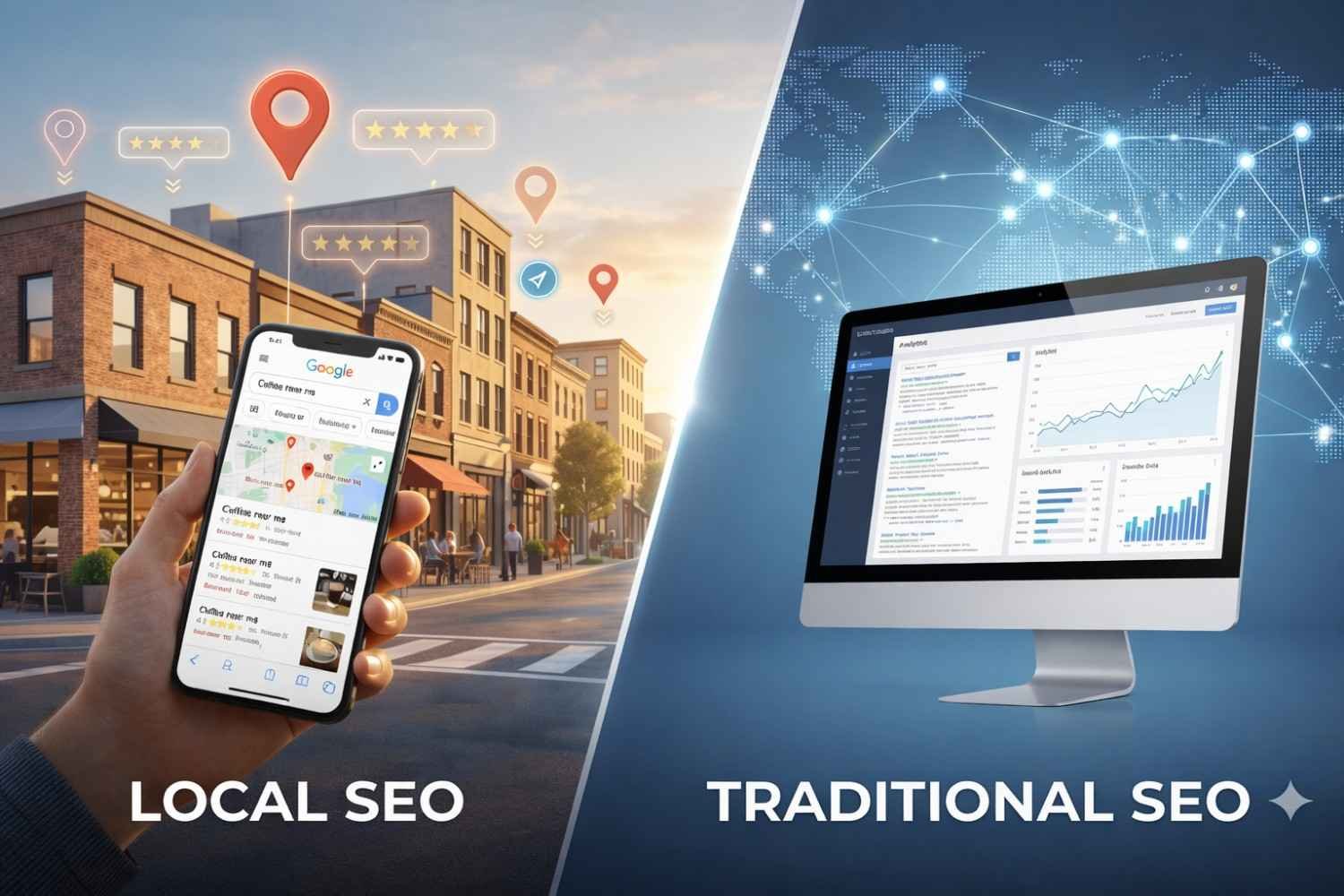
What Is Local SEO?
Local SEO is the practice of optimizing your online presence to attract customers from specific geographic areas. When someone searches “dentist near me” or “best coffee shop in Austin,” local SEO determines which businesses appear in those results. This strategy focuses on proximity, relevance, and prominence within a defined service area.
The goal is straightforward: connect local searchers with nearby businesses that meet their needs. Local SEO drives phone calls, direction requests, website visits, and ultimately, in-person transactions. For businesses serving customers within a specific radius, local search visibility often generates the highest-converting traffic available.
Core Components of Local SEO
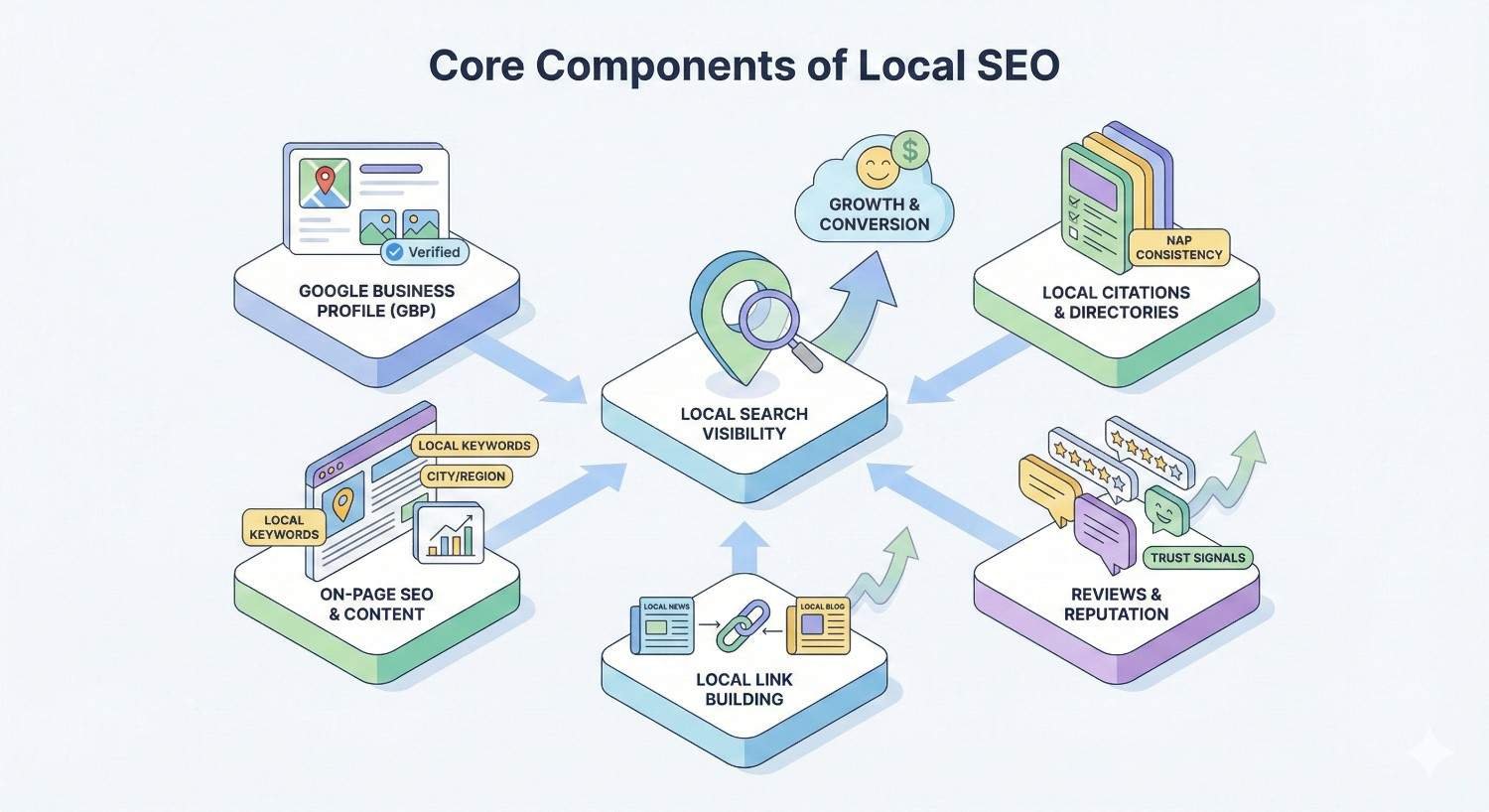
Local SEO operates through several interconnected elements that signal geographic relevance to search engines.
Google Business Profile serves as the foundation. This free listing controls how your business appears in Google Maps and local pack results. Complete profiles with accurate information, photos, and regular updates outperform incomplete listings consistently.
Local citations are mentions of your business name, address, and phone number across directories, review sites, and local platforms. Consistency matters enormously here. Conflicting information confuses search engines and erodes trust signals.
Reviews and ratings directly influence local rankings and click-through rates. Businesses with more positive reviews and higher average ratings earn better visibility and more customer trust. Active review management, including responding to feedback, strengthens this signal.
Location-specific content helps search engines understand your service areas. This includes location pages, locally-relevant blog content, and geographic keywords integrated naturally throughout your site.
Local link building focuses on earning backlinks from geographically relevant sources: local news sites, community organizations, business associations, and regional publications.
Google Business Profile Optimization
Your Google Business Profile functions as your primary local search asset. Optimization goes far beyond filling in basic fields.
Start with complete, accurate information. Business name should match your real-world signage exactly. Address must be precise and consistent with other citations. Phone number should connect to a local line, not a call center. Categories need careful selection, with your primary category reflecting your core business.
Photos significantly impact engagement. Businesses with quality images receive 42% more direction requests and 35% more website clicks than those without. Upload exterior shots, interior images, team photos, and product pictures regularly.
Posts keep your profile active and provide fresh content signals. Share updates, offers, events, and news weekly. These posts appear directly in your Business Profile and can influence click behavior.
Attributes communicate specific business features: wheelchair accessibility, outdoor seating, free WiFi, women-owned, and dozens of other options. Complete attribute selection helps you appear in filtered searches.
Q&A sections allow you to proactively answer common questions. Seed this section with your own questions and detailed answers before customers ask.
Local Ranking Factors
Google’s local algorithm weighs three primary factors: relevance, distance, and prominence.
Relevance measures how well your Business Profile matches search intent. Complete profiles with detailed descriptions, appropriate categories, and comprehensive information score higher on relevance.
Distance considers how far each potential result is from the searcher’s location or the location specified in the query. You cannot directly control distance, but you can ensure your address is accurate and your service areas are properly defined.
Prominence reflects how well-known and trusted your business is. This factor incorporates review quantity and quality, citation consistency, backlink profile, and overall web presence. Prominence is where ongoing SEO effort creates competitive advantage.
Secondary factors include website optimization, behavioral signals like click-through rates and engagement, and the quality of your local content. Mobile optimization matters particularly for local search, as most local queries happen on smartphones.
What Is Traditional SEO?
Traditional SEO, often called national or organic SEO, focuses on improving visibility across broader search queries without geographic constraints. When someone searches “how to train a puppy” or “best project management software,” traditional SEO determines which pages rank.
This approach targets informational, commercial, and transactional queries where location is irrelevant to the searcher’s intent. The competition is typically broader, the content requirements more substantial, and the timeline to results longer than local SEO.
Traditional SEO builds sustainable organic traffic through content authority, technical excellence, and backlink strength. Success creates compounding returns as domain authority grows and content assets accumulate.
Core Components of Traditional SEO
Traditional SEO rests on three pillars: technical foundation, content strategy, and authority building.
Technical SEO ensures search engines can efficiently crawl, index, and understand your site. This includes site architecture, page speed, mobile responsiveness, structured data, and crawl optimization.
Content strategy creates comprehensive resources that satisfy search intent across your target topics. This means understanding what searchers want, creating content that delivers it better than competitors, and organizing that content logically.
Link building earns backlinks from authoritative external sites. These links function as votes of confidence, signaling to search engines that your content deserves visibility. Quality matters far more than quantity.
On-page optimization ensures individual pages are properly structured with appropriate title tags, meta descriptions, header hierarchy, internal links, and keyword usage.
User experience signals increasingly influence rankings. Pages that satisfy users, measured through engagement metrics and behavioral data, outperform those that don’t.
Technical SEO Foundations
Technical SEO creates the infrastructure that allows content and authority efforts to succeed.
Site speed directly impacts rankings and user experience. Google’s research shows that as page load time increases from one to three seconds, bounce probability increases 32%. Core Web Vitals, measuring loading performance, interactivity, and visual stability, now function as ranking signals.
Mobile optimization is non-negotiable. Google uses mobile-first indexing, meaning the mobile version of your site determines rankings. Responsive design, touch-friendly navigation, and fast mobile load times are baseline requirements.
Crawlability ensures search engines can access and understand your content. This involves proper robots.txt configuration, XML sitemaps, logical URL structures, and internal linking that distributes authority effectively.
Indexation management controls which pages appear in search results. Canonical tags prevent duplicate content issues. Noindex directives keep low-value pages out of the index. Proper pagination handling ensures content is attributed correctly.
Structured data helps search engines understand page content and can enable rich results. Schema markup for articles, products, FAQs, and other content types improves how your pages appear in search results.
National/Global Ranking Factors
Traditional SEO ranking factors operate at scale, evaluating your content against potentially millions of competing pages.
Content quality and relevance remain paramount. Google’s systems assess whether content demonstrates expertise, provides comprehensive coverage, and satisfies the specific intent behind each query. Thin, superficial content cannot compete regardless of other optimization.
Backlink profile signals authority and trust. The quantity, quality, relevance, and diversity of sites linking to you influence rankings significantly. Links from authoritative, topically-relevant sites carry the most weight.
Domain authority accumulates over time through consistent content creation and link acquisition. Established domains with strong histories have inherent advantages over newer sites.
User engagement signals provide feedback on content quality. Click-through rates from search results, time on page, pages per session, and return visits all inform Google’s understanding of content value.
Topical authority rewards comprehensive coverage of subject areas. Sites that thoroughly address topics across multiple related pages demonstrate expertise that single-page competitors cannot match.
Search intent alignment determines whether your content format and depth match what searchers want. Informational queries need educational content. Commercial queries need comparison and evaluation content. Transactional queries need product or service pages.
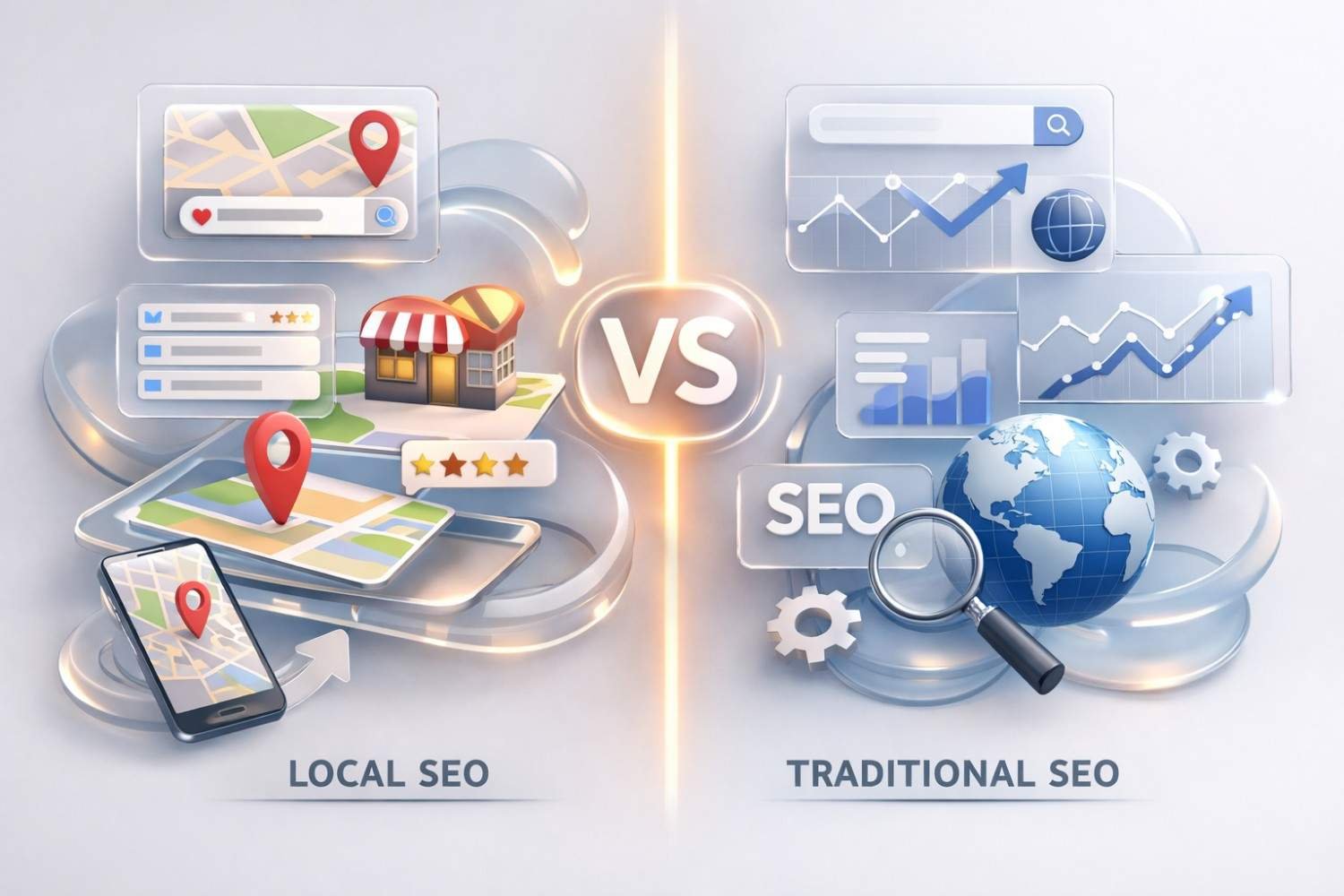
Key Differences Between Local SEO and Traditional SEO
While both disciplines aim to improve organic visibility, local and traditional SEO differ fundamentally in targeting, ranking factors, SERP features, and content requirements.
Geographic Targeting vs Broad Reach
The most obvious distinction is geographic scope.
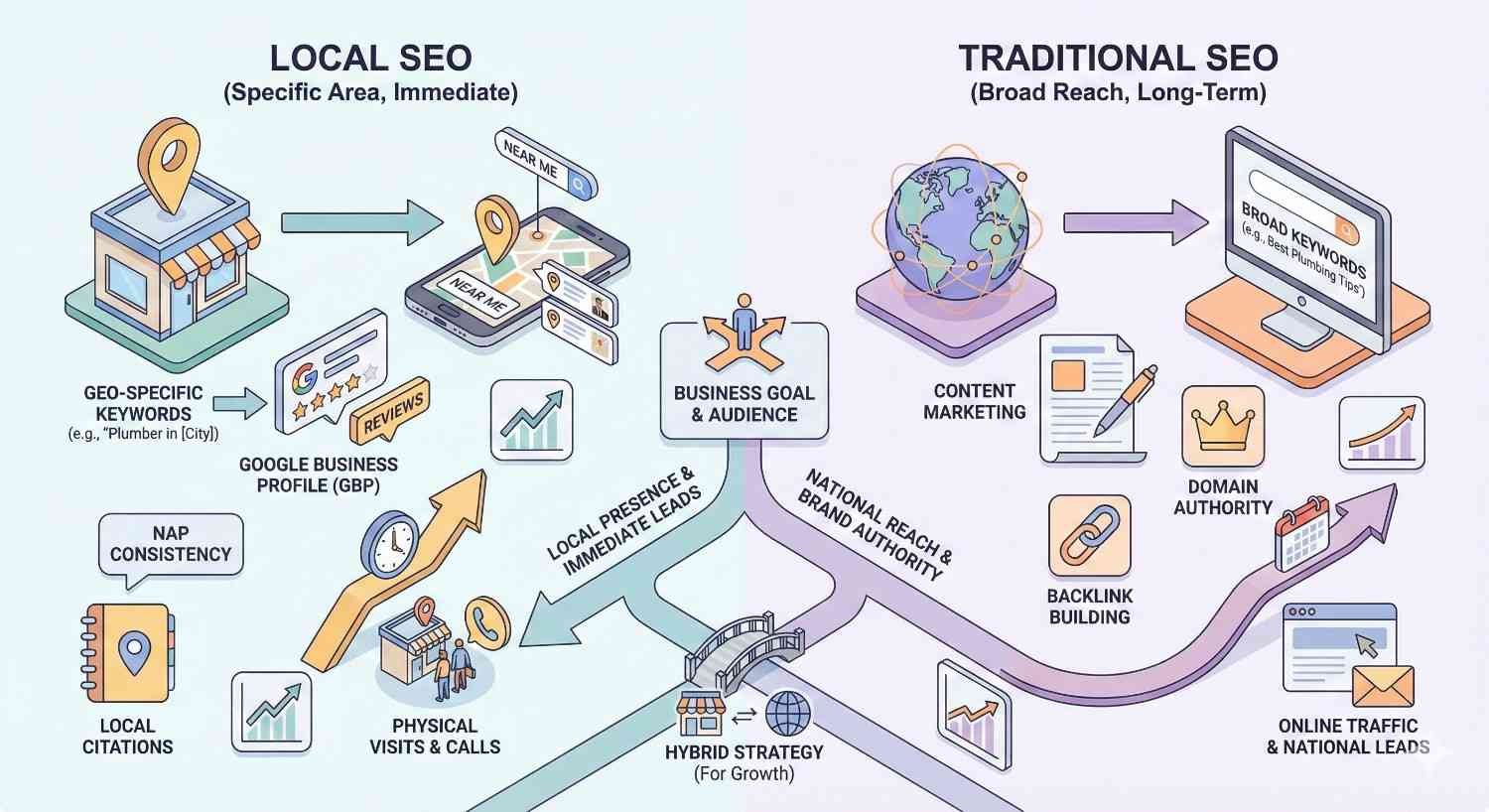
Local SEO targets searchers within specific areas. A plumber in Phoenix competes primarily with other Phoenix plumbers, not plumbers nationwide. The addressable market is smaller but more qualified. Every visitor has geographic proximity, making them more likely to convert.
Traditional SEO targets searchers regardless of location. A SaaS company selling project management software competes globally. The addressable market is massive but less inherently qualified. Visitors come from everywhere, requiring additional qualification before conversion.
This difference shapes every strategic decision. Local businesses need visibility within their service radius. National businesses need visibility wherever potential customers search.
Geographic targeting also affects keyword strategy. Local keywords include location modifiers: “personal injury lawyer Chicago” or “HVAC repair near me.” Traditional keywords focus on topic and intent without location: “best CRM software” or “how to improve employee retention.”
Ranking Factors Comparison
While some ranking factors overlap, the weighting differs substantially.
Local SEO prioritizes:
- Google Business Profile optimization and completeness
- Review quantity, quality, and recency
- Citation consistency across directories
- Proximity to searcher location
- Local backlinks from community sources
- NAP (Name, Address, Phone) consistency
Traditional SEO prioritizes:
- Backlink quality and authority
- Content depth and comprehensiveness
- Technical site performance
- Topical authority across related content
- User engagement and satisfaction signals
- Domain age and trust
Google Business Profile has no equivalent in traditional SEO. Reviews matter far less for national rankings. Conversely, the extensive content requirements for traditional SEO competitiveness rarely apply to local businesses.
Understanding these differences prevents misallocated effort. A local restaurant investing heavily in long-form blog content might see minimal return compared to the same effort spent on review generation and Business Profile optimization.
SERP Features and Visibility
Local and traditional searches produce dramatically different search results pages.
Local SERPs typically include:
- Local Pack (map with three business listings)
- Google Maps results
- Local business knowledge panels
- Location-based organic results
- “Near me” and location-modified queries
The Local Pack dominates local search visibility. These three listings with map integration appear above traditional organic results for most local queries. Earning a Local Pack position often matters more than ranking first organically.
Traditional SERPs typically include:
- Standard organic listings
- Featured snippets
- People Also Ask boxes
- Knowledge panels
- Image and video carousels
- Shopping results (for commercial queries)
- Sitelinks for branded queries
Featured snippets and People Also Ask boxes create opportunities for visibility above the first organic position. Traditional SEO strategies often target these SERP features specifically.
The visual real estate differs too. Local results emphasize business information: ratings, hours, phone numbers, directions. Traditional results emphasize content: titles, descriptions, dates, authorship.
Content Strategy Differences
Content requirements diverge significantly between local and traditional SEO.
Local content strategy focuses on:
- Location pages for each service area
- Service pages with local relevance
- Local news and community involvement
- Customer testimonials and case studies
- FAQ content addressing local concerns
- Google Business Profile posts
Volume requirements are modest. A local business might need 20-50 well-optimized pages to compete effectively. Content updates focus on freshness signals and local relevance rather than comprehensive topic coverage.
Traditional content strategy requires:
- Comprehensive pillar content on core topics
- Supporting content clusters around each pillar
- Regular publishing to build topical authority
- Content addressing every stage of the buyer journey
- Competitive content that exceeds existing resources
- Ongoing content updates and expansion
Volume requirements are substantial. Competing nationally often requires hundreds of pages covering topics comprehensively. Content must be better than what already ranks, not just adequate.
The investment difference is significant. Traditional SEO content strategies require sustained production over months or years. Local SEO content needs are more finite and achievable.
When to Use Local SEO vs Traditional SEO
Choosing the right approach depends on your business model, customer behavior, and growth objectives.
Business Types That Benefit from Local SEO
Local SEO delivers the strongest returns for businesses where customer proximity matters.
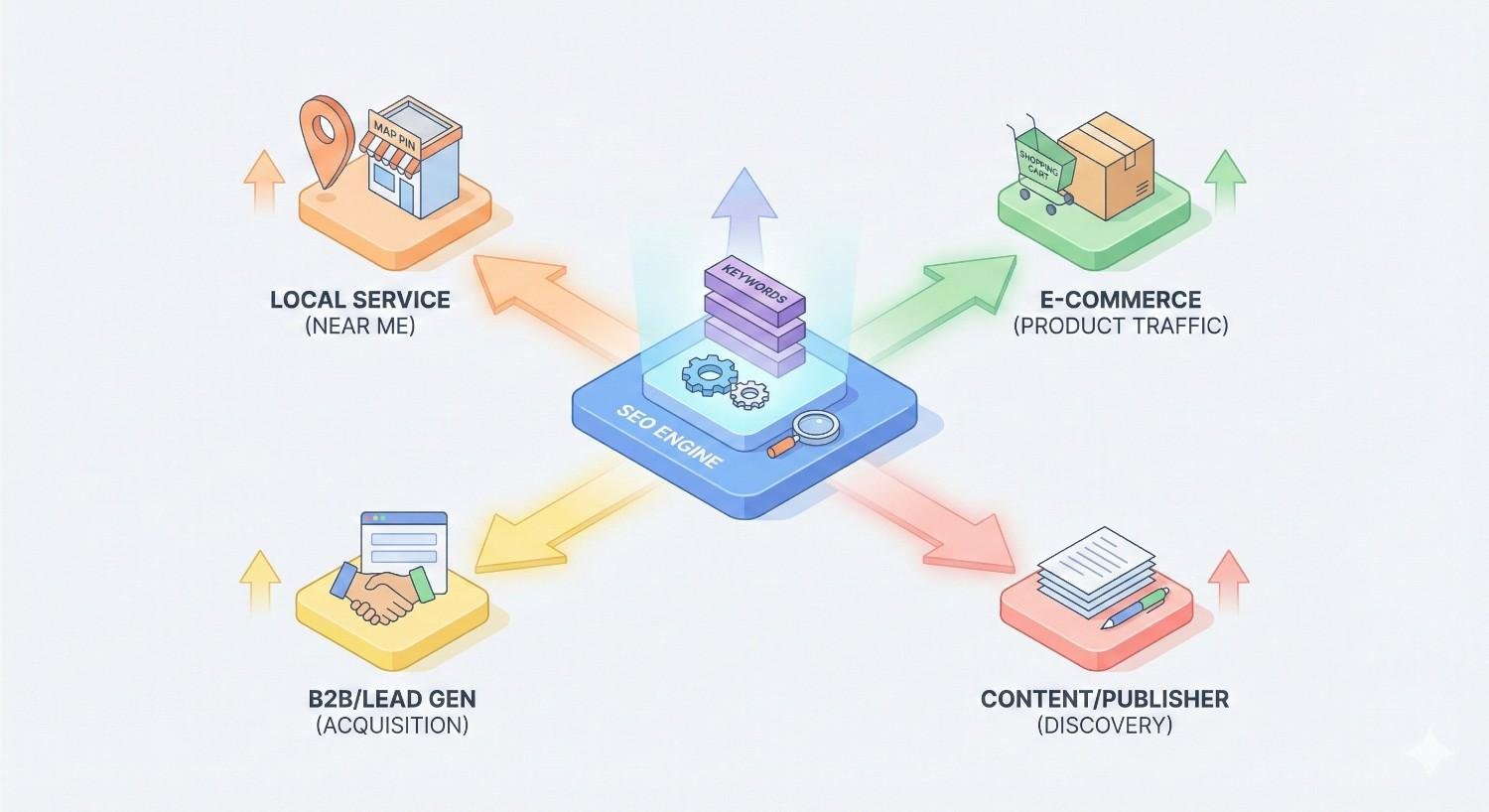
Service-area businesses like plumbers, electricians, HVAC technicians, and landscapers depend entirely on local visibility. Customers search for these services when they need them, and they need providers who can physically reach them.
Brick-and-mortar retail including restaurants, shops, salons, and gyms compete for foot traffic. Local search visibility directly drives store visits and in-person transactions.
Professional services such as lawyers, accountants, dentists, and doctors serve clients within geographic areas. While some professionals work remotely, most maintain local practices serving local populations.
Multi-location businesses need local SEO for each location. A restaurant chain with 50 locations needs 50 optimized Google Business Profiles and location-specific visibility strategies.
Home services including cleaning, pest control, moving, and home improvement serve defined service areas. These businesses live or die by local search visibility.
The common thread: customers need physical access to the business or the business needs physical access to customers.
Business Types That Benefit from Traditional SEO
Traditional SEO suits businesses where geography is irrelevant to the transaction.
E-commerce businesses selling products nationwide or globally compete on traditional search terms. A company selling specialty coffee equipment competes with every other coffee equipment seller, regardless of location.
SaaS and software companies serve customers anywhere with internet access. Geographic targeting makes no sense when the product is delivered digitally.
Online publishers and media monetize traffic through advertising or subscriptions. More traffic from anywhere means more revenue.
Digital service providers including agencies, consultants, and freelancers who work remotely can serve clients anywhere. Traditional SEO expands their addressable market beyond local constraints.
Information products like courses, ebooks, and membership sites have no geographic limitations. Traditional SEO reaches the entire potential market.
B2B companies often serve national or international markets. While some B2B relationships are local, many involve remote collaboration and digital delivery.
Hybrid Approach: When You Need Both
Many businesses benefit from combining local and traditional SEO strategies.
Multi-location businesses with national brands need local visibility for each location while building overall brand authority. A national law firm with offices in 20 cities needs both local optimization for each office and traditional SEO for practice area content.
E-commerce with physical locations like retailers with both online stores and brick-and-mortar presence need traditional SEO for product searches and local SEO for store visits.
Service businesses expanding geographically might start with local SEO in their home market while using traditional SEO to build authority that supports expansion into new markets.
Franchises require local SEO for individual franchisees while the franchisor builds national brand visibility through traditional SEO.
Businesses with both local and remote customers like a marketing agency serving local clients while also working with clients nationwide need visibility in both contexts.
The hybrid approach requires careful coordination. Content must serve both purposes without creating confusion or cannibalization. Resources must be allocated appropriately between local and traditional efforts.
Local SEO vs Traditional SEO: Cost and ROI Comparison
Understanding the investment requirements and expected returns helps you allocate marketing budgets effectively.
Investment Requirements
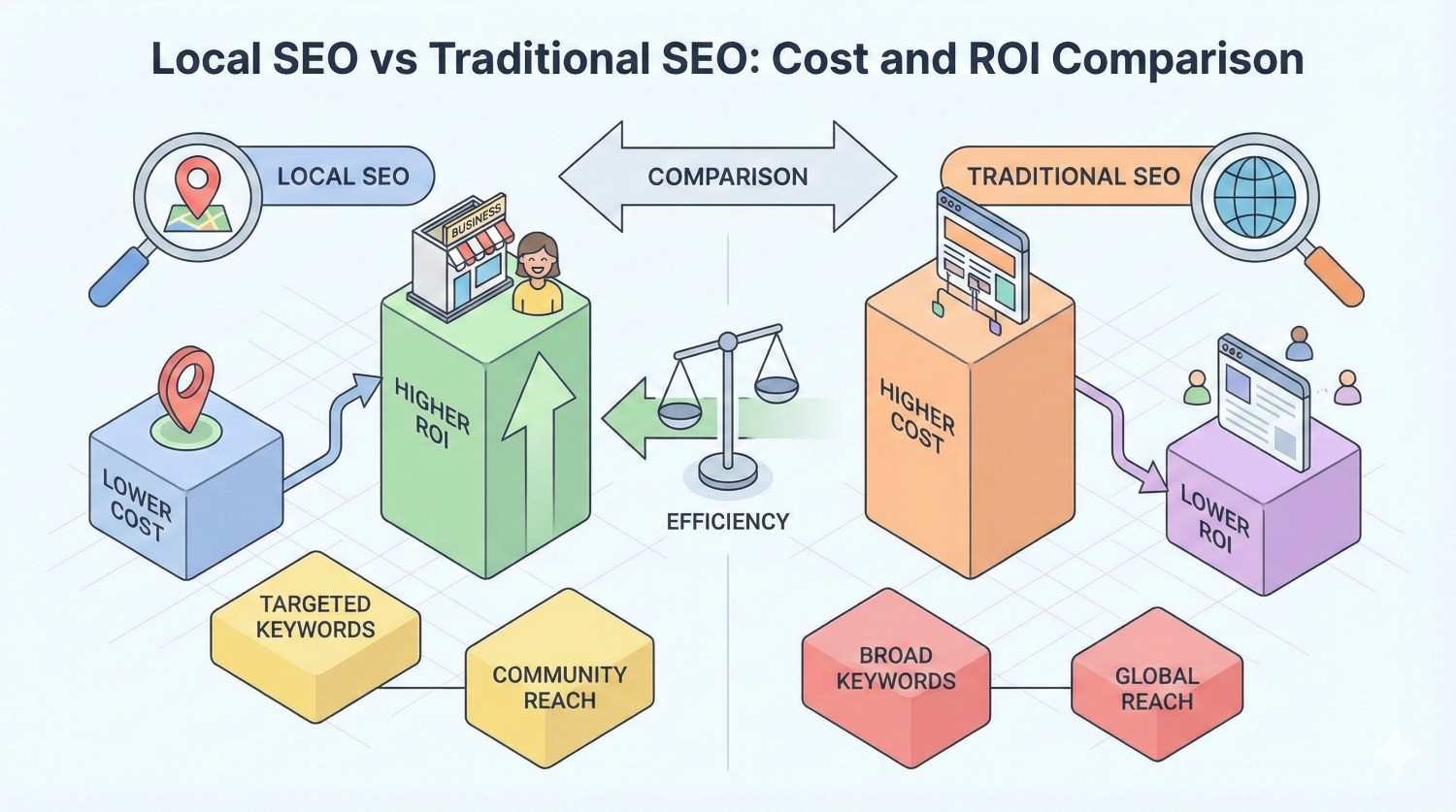
Local SEO typically requires lower initial and ongoing investment than traditional SEO.
Local SEO costs include:
- Google Business Profile setup and optimization: Often one-time or minimal ongoing
- Citation building and management: $200-500 monthly for most businesses
- Review generation and management: Time investment plus potential software costs
- Local content creation: Limited volume requirements
- Local link building: Fewer links needed, often achievable through community involvement
Total monthly investment for local SEO typically ranges from $500-2,500 for small to medium businesses, depending on competition and service area size.
Traditional SEO costs include:
- Technical SEO audit and implementation: $2,000-10,000+ initially
- Content strategy and production: $2,000-10,000+ monthly for competitive niches
- Link building: $1,000-5,000+ monthly for quality acquisition
- Ongoing optimization and monitoring: Continuous investment required
Total monthly investment for traditional SEO typically ranges from $3,000-15,000+ for businesses competing in moderately competitive spaces. Highly competitive industries require significantly more.
The cost difference reflects scope. Local SEO optimizes for a defined geographic area against limited competition. Traditional SEO competes nationally or globally against everyone targeting the same keywords.
Timeline to Results
Both approaches require patience, but timelines differ.
Local SEO results often appear faster, particularly for businesses in less competitive markets. Initial improvements in Local Pack visibility can occur within 1-3 months of optimization. Meaningful traffic and lead increases typically materialize within 3-6 months.
Factors accelerating local results:
- Lower competition in the service area
- Existing business history and reviews
- Quick wins from Business Profile optimization
- Citation cleanup creating immediate consistency
Traditional SEO results require longer timelines due to broader competition and authority-building requirements. Initial ranking improvements for lower-competition keywords might appear in 3-6 months. Significant traffic growth from competitive keywords typically requires 6-12+ months of sustained effort.
Factors affecting traditional SEO timelines:
- Domain age and existing authority
- Competition level for target keywords
- Content production capacity
- Link acquisition pace
- Technical foundation quality
New domains face the longest timelines. Google’s systems take time to trust new sites, regardless of content quality. Established domains with existing authority see faster results from new optimization efforts.
Measuring Success and ROI
Success metrics differ between local and traditional SEO.
Local SEO metrics include:
- Google Business Profile views and actions
- Direction requests and phone calls
- Local Pack rankings for target keywords
- Website visits from local searches
- In-store visits attributed to search
- Lead form submissions with local intent
- Review quantity and average rating
ROI calculation for local SEO often connects directly to customer acquisition. If your average customer value is $500 and local SEO generates 20 new customers monthly at $1,500 investment, ROI is clear and positive.
Traditional SEO metrics include:
- Organic traffic growth
- Keyword rankings across target terms
- Domain authority progression
- Backlink acquisition rate
- Conversion rate from organic traffic
- Revenue attributed to organic search
- Content performance by topic cluster
ROI calculation for traditional SEO involves longer attribution windows. Traffic growth precedes conversion growth, which precedes revenue impact. Patience and proper tracking are essential.
Both approaches should ultimately connect to business outcomes: revenue, leads, customers. Vanity metrics like rankings and traffic matter only insofar as they drive results.
How to Choose the Right SEO Strategy for Your Business
Strategic SEO decisions should flow from business fundamentals, not assumptions or trends.
Assessing Your Target Audience
Start with customer behavior analysis.
Where do your customers search? If customers search with location intent (“near me,” city names, “in [location]”), local SEO is essential. If they search topically without location modifiers, traditional SEO applies.
How do customers find businesses like yours? Talk to existing customers. Ask how they discovered you. Survey new leads about their search behavior. Actual data beats assumptions.
What’s the customer journey? Local purchases often involve shorter consideration periods. Someone searching “emergency plumber” needs help now. Traditional purchases may involve extended research. Someone searching “best CRM software” might evaluate options for weeks.
Where are your customers located? If 90% of customers come from within 30 miles, local SEO is your priority. If customers are distributed nationally or globally, traditional SEO makes sense.
What devices do customers use? Local searches skew heavily mobile. Traditional searches split more evenly between mobile and desktop. This affects technical optimization priorities.
Evaluating Your Business Model
Your business structure determines which approach fits.
Physical presence: Do you have locations customers visit? Do you travel to customer locations? Physical interaction requirements point toward local SEO.
Service delivery: Can you serve customers anywhere? Is your product or service delivered digitally? Geographic independence suggests traditional SEO.
Scalability: Can you handle customers from anywhere? A local restaurant cannot serve customers in another state. A SaaS company can serve anyone with internet access.
Competition: Who are you actually competing against? Local businesses compete locally. National businesses compete nationally. Your competitive set determines your SEO battlefield.
Growth plans: Where do you want to be in 3-5 years? If expansion into new geographic markets is planned, consider how SEO strategy supports that growth.
Setting Realistic SEO Goals and Expectations
Effective SEO requires realistic expectations aligned with your situation.
For local SEO, realistic goals include:
- Local Pack visibility within 3-6 months
- Increased calls and direction requests within 6 months
- Review growth of 2-5 new reviews monthly
- Local traffic increases of 20-50% within 6-12 months
For traditional SEO, realistic goals include:
- Ranking improvements for long-tail keywords within 3-6 months
- Traffic growth of 10-30% within 6-12 months
- Competitive keyword rankings within 12-18 months
- Significant authority building within 18-24 months
Unrealistic expectations lead to frustration and premature strategy abandonment. SEO is a long-term investment, not a quick fix. Set milestones that acknowledge the timeline realities.
Budget alignment matters too. Underfunding SEO produces underwhelming results. If you cannot invest adequately in traditional SEO, focusing resources on local SEO might produce better returns.
Common Mistakes When Choosing Between Local and Traditional SEO
Avoiding common errors saves time, money, and opportunity cost.
Ignoring Local Search When You Have Physical Locations
Businesses with physical locations that neglect local SEO leave money on the table.
The mistake: Focusing entirely on traditional SEO while ignoring Google Business Profile optimization, citation building, and local content.
Why it happens: Business owners or marketers may not understand local search mechanics. They see SEO as one thing and miss the local-specific requirements.
The cost: Competitors with optimized local presence capture customers actively searching for nearby solutions. These are high-intent searchers ready to buy.
The fix: Every business with a physical location needs a claimed, verified, and optimized Google Business Profile. Citation consistency across major directories is baseline. Review generation should be systematic.
Even businesses that also need traditional SEO should not neglect local fundamentals. The effort required is modest compared to the visibility gained.
Over-Investing in National SEO for Local Businesses
Purely local businesses sometimes chase national rankings that won’t drive relevant traffic.
The mistake: A local plumber investing in content targeting “how to fix a leaky faucet” hoping to rank nationally.
Why it happens: National keywords have higher search volume, which looks attractive. Content marketing advice often assumes national audiences.
The cost: Resources spent creating content that, even if it ranks, won’t generate local customers. Someone in Miami reading your plumbing guide won’t hire your Phoenix plumbing company.
The fix: Focus content efforts on locally-relevant topics. “Plumbing problems common in Phoenix homes” serves local intent. “How to find a reliable plumber in Phoenix” targets local searchers. National informational content rarely converts for local businesses.
Exceptions exist. If you sell products nationally while also serving local customers, national content makes sense. But purely local service businesses should prioritize local visibility.
Neglecting Technical SEO Foundations
Both local and traditional SEO require technical foundations that businesses often overlook.
The mistake: Pursuing content and link building while ignoring site speed, mobile optimization, crawlability, and indexation issues.
Why it happens: Technical SEO is less visible and less intuitive than content creation. Problems aren’t obvious without proper auditing.
The cost: Technical issues create ceilings on performance. A slow, poorly-structured site cannot rank well regardless of content quality or link strength.
The fix: Conduct technical audits before investing heavily in content or links. Address critical issues first: site speed, mobile usability, crawl errors, indexation problems. Build on a solid foundation.
Technical SEO is not optional for either approach. Local businesses need fast, mobile-friendly sites. National businesses need technically excellent sites to compete at scale.
How Local SEO and Traditional SEO Work Together
For many businesses, the most effective approach combines both strategies in a coordinated effort.
Building a Unified SEO Strategy
Integration requires intentional planning, not parallel efforts that ignore each other.
Start with shared foundations. Technical SEO serves both local and traditional goals. Site speed, mobile optimization, and crawlability benefit all search visibility. Invest here first.
Coordinate keyword targeting. Map which keywords serve local intent versus national intent. Avoid creating competing pages targeting similar terms. Use location pages for local keywords and topic pages for national keywords.
Align content calendars. Plan content that serves both audiences where possible. A piece on industry trends might attract national traffic while establishing expertise that supports local authority.
Share link building efforts. Some link opportunities serve both goals. Local press coverage builds local citations while also providing backlinks. Industry publications build national authority while potentially mentioning locations.
Unify tracking and reporting. Monitor both local and traditional metrics in coordinated dashboards. Understand how efforts in one area affect the other.
Content That Serves Both Local and National Audiences
Strategic content can address multiple audience segments simultaneously.
Location-enhanced topic content: Create comprehensive topic content, then develop location-specific versions or sections. A guide to “choosing a personal injury lawyer” can include location-specific considerations while serving national informational intent.
Local case studies with broader lessons: Document local client successes in ways that provide value to national audiences. The specific example is local; the insights apply broadly.
Industry content with local angles: Cover industry trends or news with commentary on local implications. This serves readers interested in the topic generally while demonstrating local expertise.
Resource content with local resources: Create comprehensive guides that include both national resources and local options. A guide to small business funding might cover national programs while highlighting local grants and lenders.
The key is intentionality. Don’t create content hoping it serves both purposes. Design content specifically to address both local and national needs.
Link Building for Local and Traditional SEO
Link acquisition strategies can support both goals with proper planning.
Local link opportunities that build authority:
- Local news coverage of business achievements
- Chamber of commerce and business association memberships
- Sponsorships of local events and organizations
- Partnerships with complementary local businesses
- Local university or educational institution connections
These links provide local relevance signals while also contributing to overall domain authority.
National link opportunities that support local presence:
- Industry publications mentioning your business
- Guest contributions to relevant blogs
- Resource page inclusions
- Expert commentary in news articles
- Tool or resource creation that earns links
National links build domain authority that strengthens local rankings. Google’s local algorithm considers overall web presence as part of prominence.
Integrated approach: Pursue both types of opportunities. Local links are often easier to acquire and provide immediate local benefit. National links are harder but build authority that compounds over time.
Conclusion
Choosing between local SEO and traditional SEO is not about which is better universally. It is about which approach matches your business model, customer behavior, and growth objectives. Local SEO delivers targeted visibility for businesses serving geographic areas. Traditional SEO builds broader organic reach for businesses without location constraints. Many businesses benefit from combining both strategies in coordinated efforts.
The decision framework is straightforward: assess where your customers are, how they search, and what drives conversions for your business. Invest in the approach that connects you with qualified prospects most efficiently. Avoid the common mistakes of ignoring local search when you have physical presence or chasing national rankings that won’t convert for local businesses.
At White Label SEO Service, we help businesses build sustainable organic growth through strategies tailored to their specific situations. Whether you need local visibility, national authority, or an integrated approach, our team develops and executes SEO programs that drive real business results. Contact us to discuss which strategy fits your goals and how we can help you achieve them.
Frequently Asked Questions
Is local SEO easier than traditional SEO?
Local SEO is generally less complex and requires lower investment than traditional SEO. The competitive set is smaller, content requirements are more modest, and results often appear faster. However, “easier” depends on your specific market. Highly competitive local markets like legal services in major cities can be extremely challenging.
How long does local SEO take compared to traditional SEO?
Local SEO typically shows initial results within 1-3 months, with meaningful business impact within 3-6 months. Traditional SEO requires longer timelines, often 6-12 months for significant traffic growth and 12-18 months for competitive keyword rankings. Both require ongoing effort to maintain and improve results.
Do I need separate websites for local and traditional SEO?
No, separate websites are not necessary and often counterproductive. A single well-structured website can serve both local and national audiences. Use location pages for local targeting and topic-focused content for national reach. Separate sites split authority and create management complexity.
Can an e-commerce business benefit from local SEO?
Yes, if the e-commerce business has physical locations or serves specific geographic markets. Retailers with stores benefit from local SEO driving foot traffic. E-commerce businesses targeting specific regions can use local SEO for geographic visibility. Purely online businesses without location relevance should focus on traditional SEO.
What tools are used for local SEO vs traditional SEO?
Local SEO tools include Google Business Profile, local citation platforms like BrightLocal or Whitespark, review management software, and local rank tracking tools. Traditional SEO tools include Google Search Console, Google Analytics, keyword research platforms like Ahrefs or Semrush, technical audit tools, and backlink analysis software. Many tools serve both purposes.
Can you do local SEO and traditional SEO at the same time?
Absolutely. Many businesses run both strategies simultaneously. The key is coordination: shared technical foundations, aligned content strategies, and integrated tracking. Resources should be allocated based on which approach drives more value for your specific business model.
Which type of SEO is better for my business?
The better approach depends on your business model. If customers need physical access to you or you need physical access to customers, prioritize local SEO. If you can serve customers anywhere regardless of location, focus on traditional SEO. If both apply, develop an integrated strategy addressing both needs.