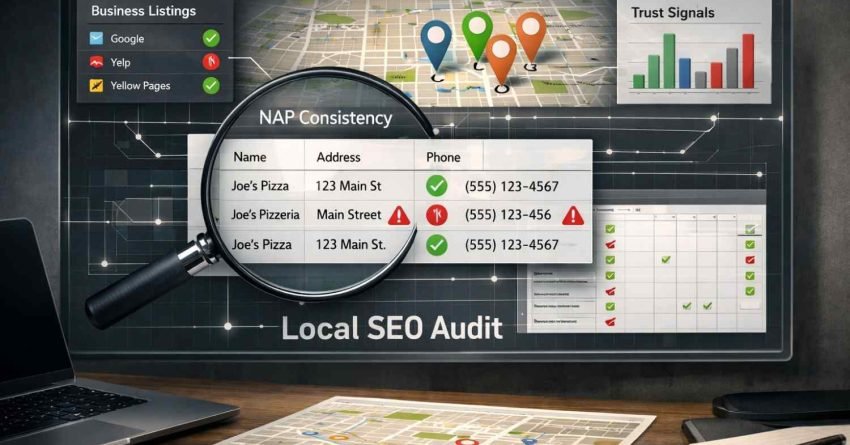
A citation audit identifies every online mention of your business name, address, and phone number, then flags inconsistencies that hurt your local search visibility. For businesses relying on local customers, even small NAP errors across directories can suppress rankings and confuse potential buyers.
This matters now more than ever. Google’s local algorithm weighs citation consistency heavily when determining which businesses appear in the Map Pack. Inaccurate listings signal unreliability to both search engines and customers.
This guide walks you through the complete citation audit process, from gathering your master data to fixing errors and choosing the right tools. You will leave with a clear action plan to strengthen your local SEO foundation.

What Is a Citation Audit?
A citation audit is a systematic review of every place your business information appears online. The goal is to find and correct inaccuracies in your NAP data across directories, social platforms, data aggregators, and industry-specific sites.
Think of it as a health check for your local SEO presence. Just as you would audit financial records for errors, a citation audit ensures your digital footprint accurately represents your business across the web.
Definition of Business Citations
A business citation is any online mention of your company’s name, address, and phone number. Citations appear on platforms like Google Business Profile, Yelp, Yellow Pages, Facebook, industry directories, and local chamber of commerce websites.
Citations fall into two categories. Structured citations appear in formal business directories with dedicated fields for NAP data. Unstructured citations occur when your business information appears in blog posts, news articles, or social media mentions without a standardized format.

Why Citation Accuracy Matters for Local SEO
Search engines use citations to verify your business exists and operates where you claim. According to Moz’s Local Search Ranking Factors, citation signals account for a significant portion of local pack ranking factors.
When your NAP data matches across multiple authoritative sources, Google gains confidence in your business legitimacy. Inconsistent information creates doubt. If your address shows differently on Yelp than on your Google Business Profile, search engines cannot determine which version is correct.
This uncertainty directly impacts visibility. Businesses with consistent citations typically outrank competitors with scattered, conflicting information across the web.
Why Your Business Needs Regular Citation Audits
Citation data degrades over time. Businesses move locations, change phone numbers, rebrand, or acquire new companies. Each change creates potential inconsistencies if old listings remain uncorrected.
Beyond your own changes, third-party data aggregators and automated systems can introduce errors. A single incorrect entry in a major data aggregator can propagate across dozens of directories within weeks.
Impact on Local Search Rankings
Local search algorithms treat citation consistency as a trust signal. BrightLocal’s research shows that businesses with accurate, consistent citations across major platforms see measurably better local pack performance.
The relationship is straightforward. Consistent NAP data helps Google confidently match your business to relevant local searches. Inconsistent data creates algorithmic hesitation, often resulting in lower rankings or exclusion from local results entirely.
For businesses competing in crowded local markets, citation accuracy can determine whether you appear on page one or remain invisible to nearby customers actively searching for your services.
NAP Consistency and Trust Signals
NAP stands for Name, Address, and Phone number. These three data points form the foundation of local business identity online.
Consistency means more than approximate matches. “123 Main Street” and “123 Main St.” may refer to the same location, but search engines process them as different strings. “ABC Company” and “ABC Company, LLC” create similar confusion.
Establishing a single, standardized NAP format and enforcing it across all platforms eliminates ambiguity. This standardization sends clear trust signals to search engines and prevents customer confusion when they encounter your business across multiple touchpoints.
Avoiding Duplicate and Conflicting Listings
Duplicate listings occur when the same business has multiple entries on a single platform. This commonly happens after relocations, phone number changes, or when employees create new listings without checking for existing ones.
Duplicates cause several problems. They split reviews and engagement across multiple profiles, dilute your citation authority, and confuse customers who may contact outdated information. Google may also penalize businesses with obvious duplicate manipulation.
Conflicting listings present different information for the same business across platforms. A customer finding one address on Google and another on Yelp loses trust immediately. Regular audits catch these conflicts before they damage your reputation.
How to Conduct a Citation Audit Step by Step
A thorough citation audit follows a systematic process. Rushing through or skipping steps leads to missed errors that continue undermining your local SEO efforts.
Set aside dedicated time for this process. Depending on your business history and online presence, a complete audit may take several hours to a full day. The investment pays dividends through improved local visibility.
Step 1 – Compile Your Master NAP Data
Before searching for errors, establish your single source of truth. Document your exact, official business information in one place.
Record your business name exactly as it should appear everywhere. Include your complete street address with consistent formatting. List your primary phone number, including area code format. Add your website URL and any secondary contact information.
This master document becomes your reference for every comparison. Any deviation from this standard represents an error requiring correction.
Step 2 – Identify All Existing Citations
Create a comprehensive list of every platform where your business information appears. Start with major directories and expand outward.
Check these categories systematically:
- Major search engines (Google Business Profile, Bing Places, Apple Maps)
- General directories (Yelp, Yellow Pages, Foursquare, Facebook)
- Industry-specific directories relevant to your business
- Local directories (chamber of commerce, city business listings)
- Data aggregators (Neustar Localeze, Factual, Infogroup, Acxiom)
Search for your business name, phone number, and address variations. You may discover listings you never created, often generated automatically by data aggregators or scraped from other sources.
Step 3 – Check for NAP Inconsistencies
Compare each discovered citation against your master NAP data. Document every discrepancy, no matter how minor.
Common inconsistencies include abbreviated versus spelled-out street types, missing suite numbers, old phone numbers, former business names, and incorrect zip codes. Even punctuation differences matter for exact-match algorithms.
Create a spreadsheet tracking each citation source, the current information displayed, and the specific corrections needed. This documentation streamlines the correction process and provides a record for future audits.
Step 4 – Find and Remove Duplicate Listings
Search each major platform for multiple listings of your business. Use variations of your business name and address to catch duplicates that may not appear in standard searches.
When you find duplicates, determine which listing to keep. Generally, preserve the listing with more reviews, longer history, or verified status. Then follow each platform’s process for reporting and removing duplicate entries.
Google Business Profile, Yelp, and most major directories have specific procedures for duplicate removal. Some require verification of business ownership before processing removal requests.
Step 5 – Verify Category and Business Information
Beyond NAP data, check that business categories, hours, descriptions, and attributes accurately reflect your current operations.
Incorrect categories limit your visibility for relevant searches. A restaurant incorrectly categorized as a catering service misses customers searching for nearby dining options. Review each platform’s category options and select the most accurate primary and secondary categories.
Verify business hours match your actual schedule. Outdated hours frustrate customers who arrive to find you closed. Check that descriptions, payment methods, and service attributes remain current.
Step 6 – Document and Prioritize Corrections
Organize your findings by priority. Not all citation errors carry equal weight.
High priority corrections include major directories with significant traffic, platforms where you have reviews or customer engagement, and data aggregators that feed information to multiple downstream sources.
Medium priority includes industry-specific directories and local business listings. Lower priority covers minor directories with minimal traffic or authority.
Create an action plan with specific tasks, responsible parties, and deadlines. Track completion status to ensure nothing falls through the cracks.
Best Citation Audit Tools and Resources
Manual citation audits work but consume significant time. Various tools automate discovery and monitoring, making regular audits more practical.
Choose tools based on your budget, technical comfort level, and the scale of your citation management needs.
Free Citation Audit Tools
Several platforms offer free citation scanning with limited functionality.
Moz Local provides a free check showing your business presence across major directories. The scan identifies inconsistencies and missing listings without requiring payment.
BrightLocal’s Citation Tracker offers a free trial period for comprehensive citation discovery. The tool searches across hundreds of directories and aggregators.
Google Search itself serves as a free audit tool. Search your business name, phone number, and address in quotes to discover citations across the web.
Paid Citation Management Platforms
Paid tools provide ongoing monitoring, automated corrections, and broader coverage.
Yext offers real-time citation management across an extensive publisher network. Changes made in Yext propagate automatically to connected directories.
BrightLocal provides citation building, monitoring, and cleanup services with detailed reporting. The platform suits agencies managing multiple client locations.
Whitespark specializes in citation building and local search tools. Their Local Citation Finder discovers citation opportunities competitors have claimed.
Evaluate each platform’s directory coverage, update frequency, and pricing structure before committing. Many offer trials allowing you to assess fit before purchasing.
Common Citation Errors and How to Fix Them
Certain citation errors appear repeatedly across businesses. Understanding these patterns helps you identify and correct issues efficiently.
Each error type requires a specific correction approach. Some fixes happen quickly while others require patience as changes propagate through data networks.
Inconsistent Business Names
Business name variations create significant confusion. “Joe’s Pizza,” “Joe’s Pizza Restaurant,” and “Joe’s Pizza & Subs” may all refer to the same business but appear as separate entities to search algorithms.
Legal name changes, DBA registrations, and informal naming conventions contribute to this problem. Marketing teams may use different names for branding purposes without considering SEO implications.
Fix this by establishing one official business name and systematically updating every citation to match exactly. Resist the temptation to add keywords or location modifiers to your business name in directories, as this violates most platform guidelines.
Outdated Addresses and Phone Numbers
Business relocations and phone system changes leave trails of outdated information across the web. Data aggregators may retain old information for years after changes occur.
Address errors directly impact customers attempting to visit your location. Phone number errors result in lost leads when potential customers reach disconnected lines or wrong numbers.
Correct these by updating data aggregators first, as they feed information to many downstream directories. Then systematically update individual platforms. Monitor for several months, as some directories refresh data slowly.
Incorrect Categories and Attributes
Category errors limit visibility for relevant searches. A plumber categorized as a general contractor misses searches specifically for plumbing services.
Attribute errors include incorrect service areas, wrong payment methods, or outdated accessibility information. These details influence both search visibility and customer decisions.
Review category options on each platform carefully. Select the most specific accurate category as your primary, with broader categories as secondaries. Update attributes whenever your business operations change.
How Often Should You Audit Your Citations?
Audit frequency depends on your business stability and competitive environment.
Conduct a comprehensive audit at least annually. This catches gradual data degradation and ensures accuracy across all platforms.
Perform targeted audits after any business change affecting NAP data. Relocations, phone number changes, rebranding, and acquisitions all require immediate citation updates followed by verification audits.
Businesses in highly competitive local markets benefit from quarterly monitoring. More frequent checks catch errors before they significantly impact rankings.
Set calendar reminders for regular audits. Citation management is not a one-time project but an ongoing maintenance requirement for sustained local SEO performance.
Citation Audit Checklist for Business Owners
Use this checklist to ensure thorough citation audits:
Preparation
- Document your official NAP data in a master reference file
- List all known citation sources from previous marketing efforts
- Gather login credentials for claimed business profiles
Discovery
- Search major directories for your business listings
- Check data aggregators for your business information
- Search Google for your business name, phone, and address variations
- Review industry-specific directories in your vertical
Analysis
- Compare each citation against your master NAP data
- Flag all inconsistencies regardless of size
- Identify duplicate listings on each platform
- Verify categories and business attributes
Correction
- Prioritize fixes by platform authority and traffic
- Update data aggregators before individual directories
- Submit duplicate removal requests where needed
- Document all changes made with dates
Verification
- Recheck corrected citations after 2-4 weeks
- Confirm duplicate removals processed successfully
- Monitor for new errors appearing from data propagation
- Schedule next audit date
Conclusion
Citation audits protect your local search visibility by ensuring consistent, accurate business information across the web. Regular audits catch errors before they compound, maintaining the trust signals search engines need to rank your business confidently.
The process requires systematic effort but delivers measurable results. Businesses with clean citation profiles consistently outperform competitors with scattered, conflicting information across directories and data aggregators.
We help businesses build sustainable organic growth through comprehensive local SEO strategies, including citation management. Contact White Label SEO Service to discuss how professional citation auditing can strengthen your local search foundation.
Frequently Asked Questions
What is a citation audit in local SEO?
A citation audit is a systematic review of every online mention of your business name, address, and phone number. The audit identifies inconsistencies, duplicates, and errors across directories, social platforms, and data aggregators that may negatively impact local search rankings.
How long does a citation audit take?
A thorough manual citation audit typically takes 4-8 hours for a single-location business. Businesses with multiple locations, long operating histories, or previous name changes require more time. Automated tools can reduce discovery time significantly while still requiring manual review and corrections.
Can I do a citation audit myself?
Yes, business owners can conduct citation audits independently using free tools and manual searches. The process requires attention to detail and patience. Many businesses choose professional services for efficiency, especially when managing multiple locations or addressing extensive citation problems.
What tools are best for citation audits?
Moz Local, BrightLocal, and Whitespark offer comprehensive citation audit capabilities. Free options include Moz’s basic scan and manual Google searches. Paid platforms provide broader coverage, ongoing monitoring, and automated correction features that justify their cost for businesses prioritizing local SEO.
How do citation errors affect my rankings?
Citation errors create trust issues with search algorithms. Inconsistent NAP data makes Google uncertain about your business legitimacy and location accuracy. This uncertainty typically results in lower local pack rankings compared to competitors with consistent, verified citation profiles across authoritative platforms.
Should I delete duplicate citations?
Yes, duplicate citations should be removed or merged. Duplicates split your reviews and engagement, confuse customers, and may trigger spam filters. Keep the listing with more reviews or longer history, then follow each platform’s duplicate removal process to consolidate your presence.
How often should I audit my business citations?
Conduct comprehensive citation audits at least annually. Perform immediate audits after any business change affecting your name, address, or phone number. Businesses in competitive local markets benefit from quarterly monitoring to catch errors before they impact rankings significantly.