
Local citations are online mentions of your business’s name, address, and phone number — and they are one of the most foundational signals search engines use to verify your business’s existence, location, and relevance in local search results.
Every time your business appears on a directory, review platform, or local website with accurate contact information, you are building the citation profile that Google and other search engines rely on to rank you in the local pack, Google Maps, and localised organic results.
This guide covers what local citations are, why they matter for local SEO, the different types of citations, the most important sources to target, how NAP consistency works, how to build and audit your citation profile, how citations compare to backlinks, and what multi-location businesses need to know.

What Are Local Citations?
A local citation is any online reference to your business that includes some combination of your business name, address, and phone number — collectively referred to as NAP data. Citations appear across a wide range of platforms: business directories, review sites, social media profiles, local news websites, industry associations, and data aggregators that distribute your information to hundreds of downstream platforms.
The concept is straightforward, but its strategic importance is significant. Search engines like Google cannot physically verify that your business exists at a given address. Instead, they rely on the consistency and volume of citations across the web to build confidence in your business’s legitimacy, location, and relevance. The more consistently your NAP data appears across authoritative platforms, the stronger the trust signal you send to search engines.
Citations do not need to include a link to your website to carry value. An unlinked mention of your business name and address on a reputable local directory still contributes to your local authority. This distinguishes citations from backlinks, which require a hyperlink to pass authority — a distinction explored in detail later in this guide.
It is also worth noting that citations are not limited to formal directory listings. A local newspaper article that mentions your business name and address, a blog post that references your location, or a community website that lists your contact details all count as citations. The breadth of citation types is one reason why a structured approach to building and managing them is essential.
The Anatomy of a Local Citation: NAP Data Explained
NAP stands for Name, Address, and Phone Number — the three core data points that define a local citation. Each element carries specific requirements for consistency.
Your business name should appear exactly as it is registered and as it appears on your Google Business Profile. Variations such as abbreviations, added descriptors, or inconsistent punctuation can create conflicting signals. Your address must include the full street address, city, state or region, and postcode, formatted consistently across every platform. Your phone number should use a consistent format — including country code for international businesses — and should be a local number rather than a toll-free number wherever possible, as local numbers reinforce geographic relevance.
Some citations extend beyond core NAP data to include website URL, business hours, categories, descriptions, and images. These extended citations carry additional value because they provide search engines with richer context about your business and improve the user experience on the platforms where they appear.
Why Local Citations Matter for Local SEO
Local citations matter because they are one of the primary signals Google uses to determine which businesses to show in the local pack — the map-based results that appear at the top of local search queries. According to Whitespark’s Local Search Ranking Factors study, citation signals consistently rank among the top factors influencing local pack visibility, alongside Google Business Profile signals, reviews, and on-page SEO.
The mechanism is one of corroboration. When Google finds your business name, address, and phone number appearing consistently across dozens of authoritative platforms, it interprets that consistency as evidence that your business is real, established, and located where you say it is. This corroboration increases Google’s confidence in ranking your business for relevant local queries.
Citations also contribute to local organic rankings — the standard blue-link results that appear below the local pack. While the influence is less direct than on local pack rankings, a strong citation profile supports the broader local authority signals that influence organic visibility in localised search results.
Beyond rankings, citations serve a practical discovery function. Many users find businesses directly through the directories and platforms where citations appear — Google Maps, Yelp, TripAdvisor, Bing Places, Apple Maps, and hundreds of industry-specific directories. A well-maintained citation profile ensures your business is discoverable across every platform your potential customers use.
How Citations Influence Local Pack Rankings
Google’s local pack algorithm evaluates three core dimensions: relevance, distance, and prominence. Citations primarily influence prominence — the measure of how well-known and established a business is across the web. A business with a high volume of accurate, consistent citations across authoritative platforms signals greater prominence than a competitor with fewer or inconsistent listings.
Citation volume matters, but citation quality and consistency matter more. Ten accurate citations on high-authority platforms will outperform fifty inconsistent citations on low-quality directories. This is why a strategic approach to citation building — prioritising the right platforms and maintaining NAP accuracy — produces better results than mass submission to every available directory.
For businesses ready to move beyond the fundamentals and build a citation profile that actively drives local rankings, our local SEO services cover every component of local search visibility, from citation building and Google Business Profile optimisation to local link acquisition and performance tracking.

Types of Local Citations: Structured vs. Unstructured
Local citations fall into two broad categories: structured and unstructured. Understanding the difference between them is essential for building a citation strategy that covers the full range of signals search engines use to evaluate local authority.
Structured Citations: Directories, Aggregators, and Platforms
Structured citations appear on platforms specifically designed to list business information in a consistent, formatted way. These include general business directories such as Google Business Profile, Yelp, Bing Places, Apple Maps, and Facebook; data aggregators such as Data Axle, Neustar Localeze, and Foursquare; and industry-specific directories relevant to your business category.
The defining characteristic of a structured citation is that the platform provides dedicated fields for each piece of business information — name, address, phone number, website, hours, and categories. This structured format makes it easy for search engines to extract and verify your NAP data, which is why structured citations on high-authority platforms carry significant weight in local ranking algorithms.
Structured citations on core data aggregators are particularly important because aggregators distribute your business information to hundreds of downstream platforms. A single accurate listing on a major aggregator can generate dozens of consistent citations across the web, amplifying the authority of a single submission.
Unstructured Citations: Mentions Across the Web
Unstructured citations are mentions of your business information that appear outside of formal directory platforms — in editorial content, blog posts, news articles, community websites, social media posts, and review content. Unlike structured citations, unstructured mentions do not follow a fixed format and may include only partial NAP data.
Despite their informal nature, unstructured citations carry real value. A mention of your business in a local news article, a recommendation on a community forum, or a reference in an industry blog all contribute to your citation profile. These mentions are often harder to acquire than structured directory listings, which makes them a signal of genuine local authority rather than manufactured presence.
Understanding the distinction between citation formats is the first step toward building a balanced local presence — our dedicated guide to structured and unstructured citation types breaks down every format, platform category, and strategic use case in full detail.
The Most Important Local Citation Sources
Not all citation sources carry equal weight. The authority of the platform where your citation appears directly influences the value that citation contributes to your local SEO profile. A tiered approach to citation building — starting with the highest-authority sources and working down — ensures you capture the most impactful signals first.
Tier 1: Core Data Aggregators
Data aggregators sit at the top of the citation hierarchy because they distribute business information to hundreds of downstream platforms. The major aggregators in most markets include Data Axle (formerly Infogroup), Neustar Localeze, Foursquare, and Factual (now part of Foursquare). Submitting accurate NAP data to these aggregators creates a foundation of consistent information that propagates across the broader citation ecosystem.
Aggregator submissions are not always instant. Distribution to downstream platforms can take weeks or months, which is one reason why citation building requires a long-term perspective. However, the compounding effect of accurate aggregator data — generating consistent citations across hundreds of platforms from a single submission — makes aggregators the highest-leverage starting point for any citation strategy.
Tier 2: Major General Directories
The second tier includes the major general-purpose directories and platforms that carry high domain authority and significant user traffic. Google Business Profile is the most important single citation source for any local business, followed by Bing Places, Apple Maps, Yelp, Facebook, and Foursquare. These platforms are where a large proportion of local search activity occurs, and accurate, complete listings on each of them are non-negotiable for local visibility.
Beyond the core platforms, second-tier directories include established general business directories such as Yellow Pages, Manta, Hotfrog, and Citysearch. While their direct traffic value varies by market, their domain authority and the consistency signals they contribute to your citation profile make them worth targeting in the early stages of citation building.
Tier 3: Industry-Specific and Local Directories
The third tier covers industry-specific directories relevant to your business category and local directories specific to your geographic market. A healthcare business should be listed on Healthgrades, Zocdoc, and WebMD’s directory. A legal firm should appear on Avvo, FindLaw, and Justia. A restaurant should be on TripAdvisor, OpenTable, and Zomato. These niche directories carry strong relevance signals because they contextualise your business within its industry, reinforcing the category signals that influence local pack rankings.
Local directories — city-specific business directories, local chamber of commerce listings, and regional news site business sections — add geographic relevance signals that general directories cannot provide. A listing on your city’s official business directory or your local chamber of commerce website tells search engines precisely where your business operates.
Not all directories carry equal weight, and knowing which platforms to prioritise first can significantly accelerate your local ranking progress — our guide to the best local citation sources maps every tier of citation platform, from core data aggregators to niche industry directories, with submission guidance for each.
NAP Consistency: The Foundation of Citation Authority
NAP consistency refers to the accuracy and uniformity of your business name, address, and phone number across every platform where your business appears. It is not simply a best practice — it is the structural foundation on which your entire citation profile’s authority rests.
When your NAP data is inconsistent across platforms — different phone numbers, abbreviated street addresses, variations in your business name — search engines encounter conflicting signals about your business. Rather than reinforcing each other, inconsistent citations create noise that reduces Google’s confidence in your business information. The result is diminished local ranking authority, even if you have a high volume of citations.
Moz’s Local Search Ranking Factors research has consistently identified citation consistency as a significant local ranking signal, with inconsistent NAP data cited as one of the most common and damaging issues in local SEO audits. The problem is compounded by the fact that inconsistencies often originate from a single source — an outdated aggregator record, an old website address, or a phone number change that was never updated across all platforms — and then propagate across the citation ecosystem over time.
What Counts as a NAP Inconsistency?
NAP inconsistencies range from obvious errors to subtle formatting differences that are easy to overlook. Common inconsistency types include: using “St.” on some platforms and “Street” on others; listing a suite number on some directories but not others; using a local phone number on some platforms and a toll-free number on others; and using a shortened or informal version of your business name on some listings.
Even minor formatting differences can create conflicting signals. “123 Main Street, Suite 4” and “123 Main St #4” refer to the same address, but search engines parsing these as data points may treat them as different locations. At scale — across hundreds of citation sources — these small inconsistencies accumulate into a significant authority problem.
Maintaining accurate business information across every platform is one of the highest-leverage actions in local SEO, and even minor formatting differences can erode the trust signals your citations are meant to build — our complete guide to NAP consistency for local SEO explains every variation type, how search engines interpret inconsistencies, and the exact process for auditing and correcting your data.
How to Build Local Citations: The Core Process
Building local citations is a structured process that begins with establishing your canonical NAP data — the single, authoritative version of your business information that will be used consistently across every platform. Before submitting to any directory, define exactly how your business name, address, and phone number should appear, and document this as your citation standard.
The building process then follows a tiered sequence: start with core data aggregators to seed your information across the citation ecosystem, move to major general directories and core platforms, and then work through industry-specific and local directories relevant to your market. This sequence ensures that the highest-authority signals are established first and that aggregator distribution begins as early as possible.
Each submission requires careful attention to consistency. Use your canonical NAP data exactly — do not abbreviate, reformat, or vary any element between platforms. Select the most accurate business category available on each platform, as category signals contribute to relevance rankings. Complete every available field, including website URL, business hours, description, and images, to maximise the value of each listing.
Manual Citation Building vs. Automated Submission
Manual citation building involves submitting your business information to each platform individually, verifying each listing, and monitoring for accuracy over time. It is time-intensive but provides the highest level of control over listing quality and consistency. Manual building is particularly important for high-authority platforms where listing quality directly influences ranking signals.
Automated submission tools — such as Moz Local, BrightLocal, and Whitespark — allow you to submit your NAP data to multiple platforms simultaneously from a single dashboard. These tools significantly reduce the time required to build a broad citation profile and provide ongoing monitoring for inconsistencies and new listing opportunities. The trade-off is that automated submissions may not capture every available field on every platform, and some platforms require manual verification regardless of how the initial submission was made.
Using Citation Building Services
Managed citation building services handle the entire process on your behalf — from establishing canonical NAP data and submitting to priority platforms to monitoring for inconsistencies and managing ongoing updates. For businesses without the internal resources to manage citation building systematically, a managed service provides the expertise and scale required to build a citation profile that genuinely moves local rankings.
The process of building citations correctly — from choosing the right platforms to formatting your NAP data consistently — determines whether your citation profile strengthens or dilutes your local authority, and our guide to building local citations step by step walks through every stage of the process, including manual submission, aggregator seeding, and quality control.
How to Audit and Clean Up Existing Citations
For most businesses, citation building is not a clean-slate exercise. Years of directory submissions, business moves, phone number changes, and automated data distribution mean that the majority of established businesses have a citation profile that contains inconsistencies, duplicates, and outdated information. An audit is the process of identifying and correcting these issues.
A citation audit begins with a comprehensive discovery phase: finding every platform where your business is listed, regardless of whether you created the listing yourself. Tools such as BrightLocal’s Citation Tracker, Moz Local, and Whitespark’s Citation Finder automate much of this discovery process by scanning hundreds of directories and aggregators for mentions of your business name and address.
Once all existing citations are identified, each is evaluated against your canonical NAP data. Inconsistencies are flagged for correction, duplicate listings are identified for removal or consolidation, and outdated information — old addresses, disconnected phone numbers, closed locations — is updated or suppressed. The correction process varies by platform: some allow direct editing through a business dashboard, others require a claim-and-verify process, and some require contacting the platform’s support team directly.
Tools for Finding and Fixing Citation Errors
The most widely used citation audit tools each offer distinct capabilities. BrightLocal provides a comprehensive citation tracker that scans over 300 directories and generates a detailed accuracy report. Moz Local offers automated distribution to major aggregators alongside ongoing monitoring for inconsistencies. Whitespark’s Citation Finder is particularly strong for identifying competitor citation sources and discovering new listing opportunities.
Manual auditing — searching for your business name and address combinations directly in Google, remains a valuable complement to tool-based discovery, particularly for identifying unstructured citations and mentions on platforms that automated tools may not index.
Identifying and correcting inaccurate or duplicate citations is just as important as building new ones, and a structured audit is the only reliable way to find every inconsistency across the web, our local citation audit process covers every tool, method, and correction workflow you need to clean up your citation profile and restore NAP accuracy at scale.
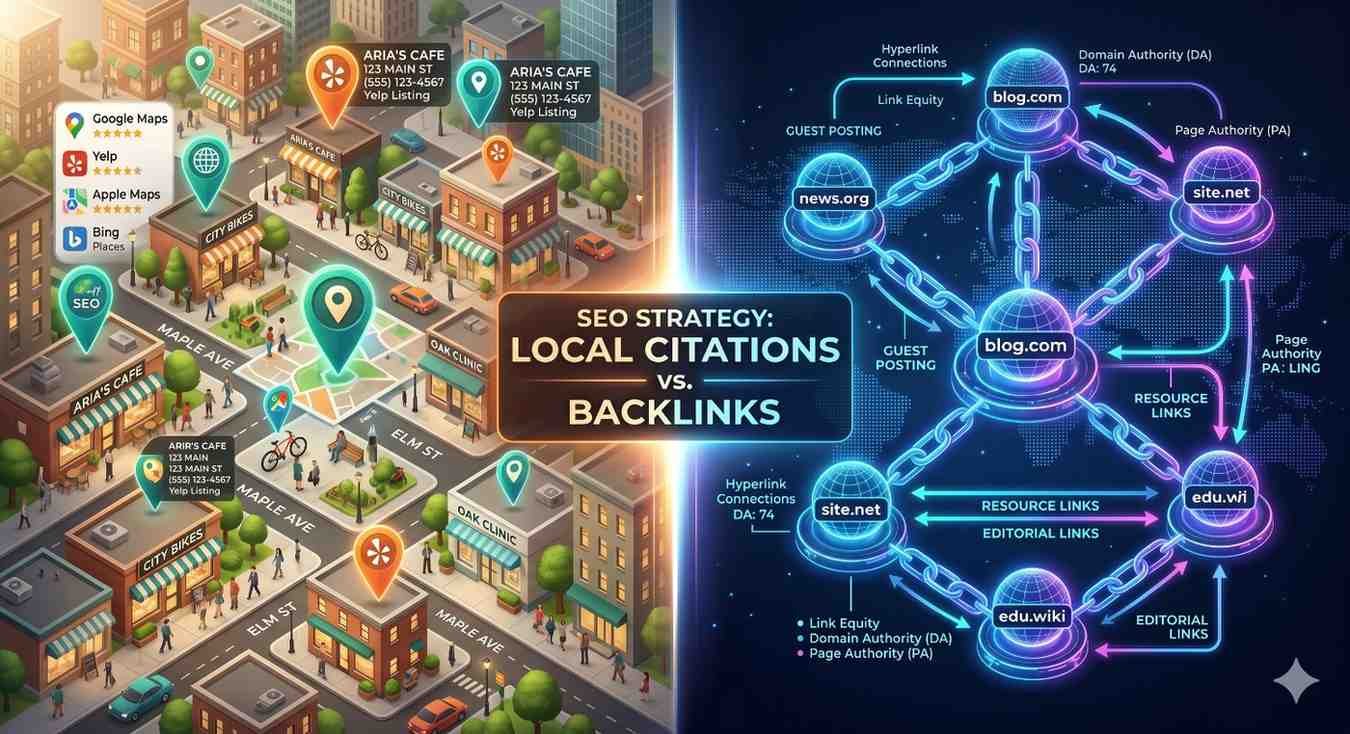
Local Citations vs. Backlinks: Understanding the Difference
Local citations and backlinks are both authority signals in local SEO, but they operate through fundamentally different mechanisms and serve different ranking functions. Understanding the distinction helps you allocate your local SEO effort appropriately and avoid the common mistake of treating them as interchangeable.
A citation is a mention of your business information — name, address, phone number — that contributes to local authority through corroboration and consistency. A citation does not need to include a hyperlink to carry value. Its authority comes from the accuracy and consistency of your NAP data across trusted platforms, not from the transfer of link equity.
A backlink is a hyperlink from another website to yours. Backlinks pass PageRank — a measure of link authority — from the linking page to the linked page. In local SEO, backlinks from locally relevant websites (local news sites, community organisations, local business associations) carry additional geographic relevance signals that reinforce your local authority.
When Citations and Backlinks Work Together
The most powerful local SEO profiles combine strong citation consistency with a healthy backlink profile. Citations establish the foundational trust signals that confirm your business’s existence and location. Backlinks build the domain authority and topical relevance that influence both local pack and organic rankings.
Many high-authority citation sources — Google Business Profile, Yelp, industry directories — also provide a backlink to your website as part of the listing. These citation-backlink combinations deliver both types of authority signal simultaneously, which is why prioritising high-authority directory listings over low-quality ones produces compounding returns.
Both citations and backlinks contribute to local authority, but they operate through different mechanisms and serve different ranking functions — our dedicated comparison of local citations vs. backlinks explains exactly how each signal works, when to prioritise one over the other, and how to build both as part of a unified local SEO strategy.
Local Citations for Multi-Location Businesses
Multi-location businesses face a distinct set of citation challenges that single-location strategies do not address. Each business location requires its own complete, consistent citation profile — with location-specific NAP data, dedicated Google Business Profile listings, and individual directory submissions for each address. Managing this at scale requires a systematic approach that balances consistency across the brand with accuracy at the individual location level.
The most common citation problem for multi-location businesses is address confusion — where citations for one location appear under another location’s listing, or where a single aggregator record contains multiple addresses for the same business. These cross-location inconsistencies are particularly damaging because they create conflicting signals about where each location actually operates, reducing Google’s confidence in ranking any of them accurately.
A structured multi-location citation strategy begins with a location data management system — a centralised record of the canonical NAP data for every location, maintained as the single source of truth for all citation submissions and updates. Changes to any location’s information — a new phone number, a relocated address — must be updated in the central record first and then propagated to every citation source for that location.
Managing Citation Consistency Across Multiple Locations
For businesses with more than a handful of locations, manual citation management becomes impractical. Location data management platforms such as Yext, Rio SEO, and Uberall provide centralised dashboards for managing listings across hundreds of directories simultaneously, with automated update distribution when location data changes.
The investment in a location data management platform is justified by the scale of the problem: a business with ten locations may have thousands of individual citations across the web, each of which needs to be accurate and consistent. A single phone number change across ten locations, managed manually, could require hundreds of individual platform updates — a process that takes weeks and introduces significant risk of inconsistency.
Managing citation consistency across multiple business locations introduces a distinct set of challenges that single-location strategies do not address, our guide to multi-location citation management covers every aspect of building, auditing, and maintaining accurate citation profiles for businesses operating across multiple cities, regions, or countries.
How Long Do Local Citations Take to Impact Rankings?
Local citations do not produce overnight ranking changes. The timeline from citation building to measurable ranking impact depends on several factors: the authority of the platforms where citations are built, the current state of your citation profile, the competitiveness of your local market, and how quickly search engines crawl and index new listings.
For businesses starting from a minimal citation profile, the first meaningful ranking signals from citation building typically emerge within four to twelve weeks. This timeline reflects the time required for search engines to crawl new listings, for aggregator distribution to propagate across downstream platforms, and for the cumulative weight of new citations to register in local ranking algorithms.
According to BrightLocal’s Local Consumer Review Survey, businesses with complete and consistent listings across major platforms see significantly higher engagement rates than those with incomplete or inconsistent information — reinforcing that citation quality affects not just rankings but also the conversion rate of the traffic those rankings generate.
Setting Realistic Expectations for Citation Results
Citation building is a foundational investment, not a quick-win tactic. Its value compounds over time: a citation profile built correctly today continues to generate authority signals for years, while a citation profile built carelessly — with inconsistencies, duplicates, and low-quality sources — requires remediation work that delays the ranking benefits.
The most realistic expectation for citation building is that it establishes the local authority foundation on which other local SEO activities — Google Business Profile optimisation, local link building, review acquisition — can build. Businesses that treat citation building as a one-time task rather than an ongoing programme tend to see their citation profiles degrade over time as business information changes and platforms update their data.
For businesses that want to accelerate citation building and ranking progress without managing the process in-house, our managed local SEO programme provides structured citation acquisition, ongoing monitoring, and performance reporting as part of a complete local search strategy.

How White Label SEO Service Builds and Manages Local Citations
At White Label SEO Service, local citation management is a structured, data-driven process built around three core principles: accuracy, authority, and consistency. Every citation campaign begins with a comprehensive audit of the existing citation profile — identifying every platform where the business appears, flagging inconsistencies, and establishing the canonical NAP data that will govern all future submissions.
Citation building then follows a tiered sequence: core data aggregators first, followed by major general directories and core platforms, then industry-specific and local directories relevant to the business’s market and category. Each submission is verified for accuracy, and ongoing monitoring ensures that citation data remains consistent as business information changes over time.
For agencies and businesses managing multiple clients or locations, our white-label citation management service provides the same structured approach at scale — with branded reporting, centralised location data management, and a dedicated team that handles every aspect of citation building, auditing, and maintenance.
What to Expect from a Managed Citation Service
A managed citation service removes the operational burden of citation building from your team while ensuring the process is executed with the precision that local SEO requires. Clients receive a full citation audit at the outset, a prioritised submission plan based on their market and category, regular accuracy monitoring, and performance reporting that connects citation activity to local ranking outcomes.
The timeline for results follows the same pattern as self-managed citation building — four to twelve weeks for initial ranking signals, with compounding authority gains over the following months. The difference is that a managed service eliminates the risk of inconsistency errors, ensures no high-authority platforms are missed, and provides the ongoing maintenance that keeps a citation profile accurate as business information evolves.
Whether you are building citations for the first time or cleaning up years of inconsistent data, White Label SEO Service provides a fully managed citation solution — combining platform expertise, NAP accuracy protocols, and ongoing monitoring to ensure your local presence is built on a foundation that search engines trust.
Conclusion
Local citations are the foundational trust signals that search engines use to verify your business’s existence, location, and relevance — built from consistent NAP data across structured directories, data aggregators, and unstructured web mentions that collectively establish your local authority.
A complete citation strategy covers every dimension explored in this guide: building the right sources in the right order, maintaining NAP consistency, auditing for errors, and understanding how citations interact with backlinks and Google Business Profile signals to drive local pack and organic visibility.
At White Label SEO Service, we build and manage citation profiles that give search engines every reason to rank your business — contact us today to start building the local authority your business deserves.
Frequently Asked Questions
What is a local citation in SEO?
A local citation is any online mention of your business’s name, address, and phone number. Search engines use citations to verify your business’s location and legitimacy, making them a core local ranking signal.
Do local citations still matter for SEO in 2025?
Yes. Citation signals remain among the top local ranking factors identified in industry research. Consistent, accurate citations across authoritative platforms continue to influence local pack and organic rankings significantly.
How many local citations do I need to rank?
There is no fixed number. Citation quality and consistency matter more than volume. Prioritise accurate listings on high-authority platforms — aggregators, major directories, and industry-specific sites — over mass submission to low-quality directories.
What happens if my NAP data is inconsistent across directories?
Inconsistent NAP data sends conflicting signals to search engines, reducing their confidence in your business information. This can suppress local rankings even when citation volume is high. Auditing and correcting inconsistencies is essential for citation authority.
What is the difference between a structured and unstructured citation?
A structured citation appears on a platform with dedicated fields for business information, such as a directory or review site. An unstructured citation is an editorial mention of your business on a blog, news site, or community platform that may include partial NAP data.
How long does it take for citations to improve local rankings?
Initial ranking signals from citation building typically emerge within four to twelve weeks, depending on platform authority, market competitiveness, and how quickly search engines crawl new listings. Compounding authority gains continue to build over subsequent months.
Can I build local citations myself, or do I need a service?
You can build citations manually, but the process is time-intensive and requires careful attention to NAP consistency across every platform. A managed citation service reduces the risk of errors, ensures comprehensive platform coverage, and provides ongoing monitoring that manual management rarely sustains.