Choosing the right SaaS website design agency can directly impact your conversion rates, user acquisition costs, and long-term growth trajectory. After evaluating over 100 agencies based on portfolio quality, client outcomes, pricing transparency, and SaaS-specific expertise, I’ve narrowed this list to the 40+ agencies I genuinely trust to deliver results in 2026.
This ranking matters because SaaS websites face unique challenges that generalist agencies often miss. From product-led growth funnels to freemium conversion optimization, your website needs to function as a 24/7 sales engine, not just a digital brochure.
In this guide, you’ll find tiered rankings from elite agencies to budget-friendly options, detailed comparison tables, selection criteria for every SaaS stage, and actionable advice for making the right choice. Let’s dive in.
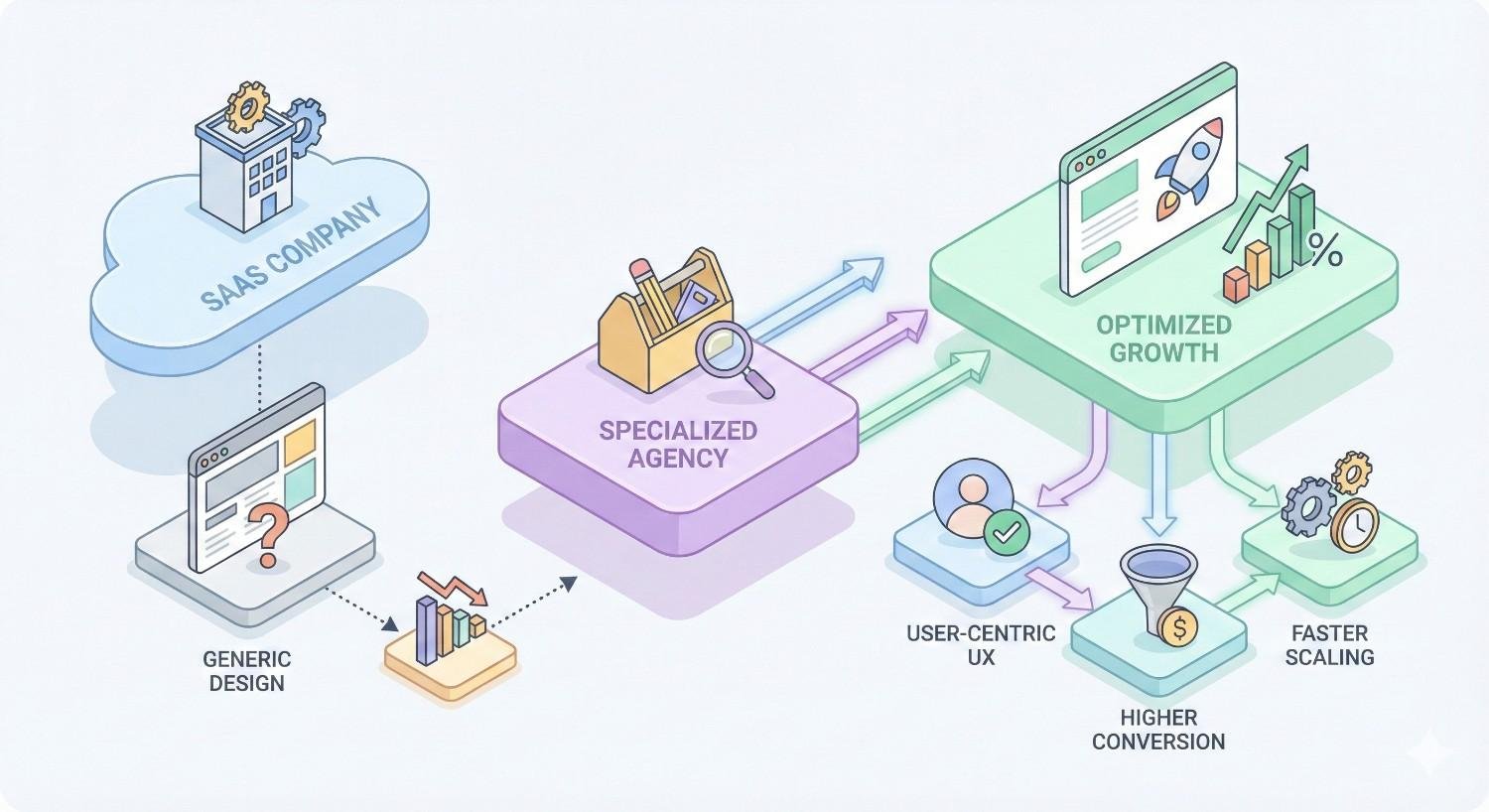
Why SaaS Companies Need Specialized Website Design Agencies
SaaS businesses operate differently than traditional companies. Your website isn’t just a marketing asset. It’s often your primary sales channel, onboarding tool, and brand experience rolled into one. Generic web design approaches fail to address these interconnected demands.
The Unique Challenges of SaaS Website Design
SaaS websites must accomplish multiple objectives simultaneously. They need to explain complex products simply, convert visitors into trial users, support existing customers, and rank competitively in search results.
The buyer journey is rarely linear. Prospects might visit your pricing page before reading a single feature description. They might compare you against three competitors in separate browser tabs. Your design must anticipate these behaviors and guide users toward conversion at every touchpoint.
Technical complexity adds another layer. SaaS products often require interactive demos, integration showcases, and dynamic pricing calculators. These elements demand designers who understand both user experience principles and technical implementation constraints.
How SaaS Websites Differ from Traditional Business Sites
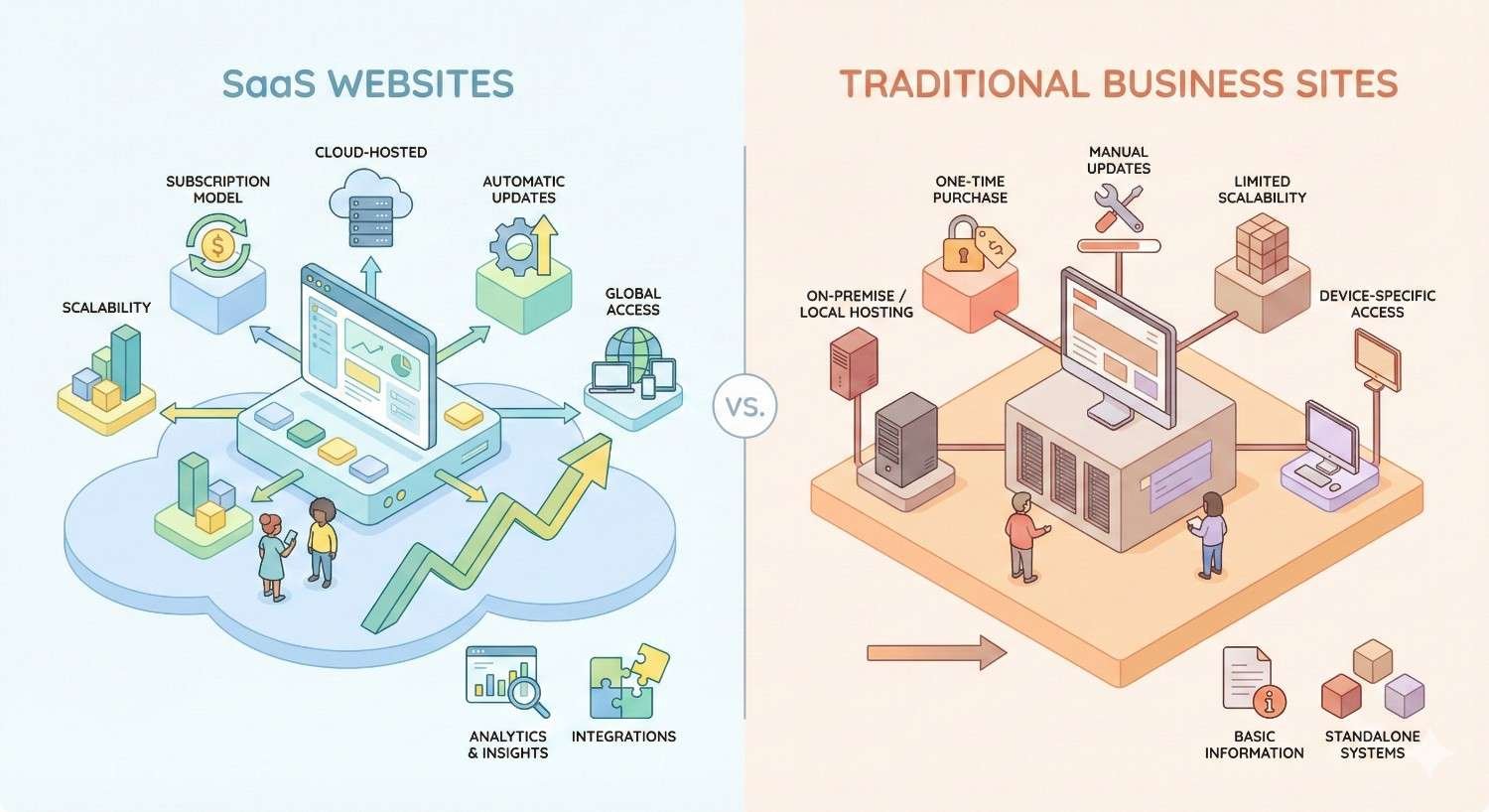
Traditional business websites focus on brand awareness and lead capture. SaaS websites must do this while also functioning as product experiences.
Consider the homepage alone. A traditional B2B company might showcase services and client logos. A SaaS homepage needs to communicate value proposition, demonstrate the product interface, address multiple buyer personas, and provide clear paths to trial signup or demo booking.
Navigation structures differ significantly. SaaS sites typically require dedicated sections for features, integrations, pricing, documentation, and customer resources. Each section serves different user intents at different funnel stages.
Page speed and performance carry higher stakes. Google’s research confirms that 53% of mobile users abandon sites that take longer than three seconds to load. For SaaS companies paying for traffic through paid acquisition, slow sites directly increase customer acquisition costs.
The ROI of Investing in Expert SaaS Web Design
The financial case for specialized SaaS design is straightforward. Small conversion rate improvements compound into significant revenue gains.
A SaaS company with 100,000 monthly visitors and a 2% trial conversion rate generates 2,000 trials monthly. Improving that conversion rate to 3% through better design adds 1,000 additional trials. If 20% of trials convert to paid customers at $100/month average revenue, that single percentage point improvement generates $240,000 in additional annual recurring revenue.
Expert SaaS agencies understand these economics. They design with conversion metrics in mind, not just aesthetic preferences. They know which elements drive action and which create friction.
Beyond conversions, professional SaaS design reduces customer acquisition costs by improving organic search performance, increasing time on site, and building trust that shortens sales cycles.
How I Evaluated and Ranked These SaaS Design Agencies
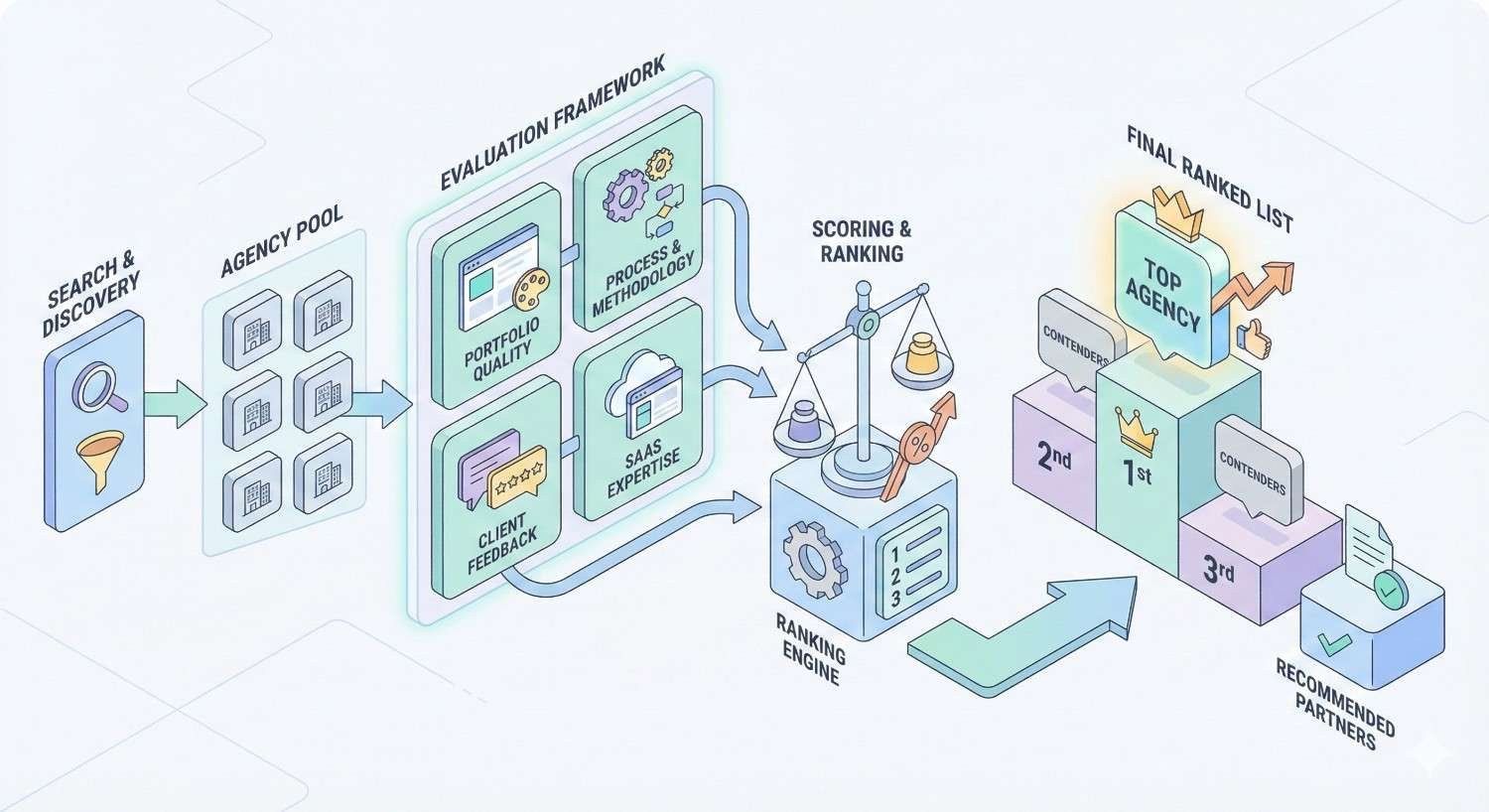
Ranking 40+ agencies requires systematic evaluation. I developed a methodology that balances quantitative metrics with qualitative assessment to identify agencies that consistently deliver results for SaaS clients.
My Ranking Methodology Explained
Each agency was scored across five weighted categories:
Portfolio Quality (30%): Evaluated based on design sophistication, SaaS-specific elements, and diversity of successful projects.
Client Results (25%): Documented outcomes including conversion improvements, traffic growth, and business impact metrics.
SaaS Expertise (20%): Depth of experience with SaaS-specific challenges like product demos, pricing pages, and integration ecosystems.
Process and Communication (15%): Clarity of project methodology, client collaboration approach, and post-launch support.
Value and Pricing (10%): Cost relative to deliverables and ROI potential for different SaaS company stages.
Agencies needed minimum scores in each category to qualify. Strong performance in one area couldn’t compensate for significant weaknesses elsewhere.
Trust Signals and Credibility Factors
Trust extends beyond portfolio screenshots. I verified several credibility indicators for each agency.
Client testimonials and case studies with specific, measurable outcomes carry more weight than generic praise. Agencies that publish detailed before-and-after metrics demonstrate confidence in their results.
Industry recognition through awards, speaking engagements, and thought leadership content indicates peer validation. Agencies contributing to the SaaS design conversation typically maintain higher standards.
Team transparency matters. Agencies that showcase their designers, strategists, and developers signal accountability. Anonymous agencies with no visible team often outsource work unpredictably.
Longevity and stability reduce project risk. Agencies operating successfully for five or more years have proven their business model and client satisfaction levels.
Portfolio Quality Assessment Criteria
Portfolio evaluation focused on SaaS-specific design competencies rather than general aesthetics.
Information architecture was assessed for logical user flows, clear navigation hierarchies, and appropriate content organization for complex products.
Conversion-focused design elements were examined including call-to-action placement, form design, social proof integration, and friction reduction techniques.
Visual consistency across pages, responsive design quality, and brand system implementation demonstrated attention to detail and systematic thinking.
Technical sophistication was evaluated through interactive elements, animation quality, page performance, and accessibility compliance.
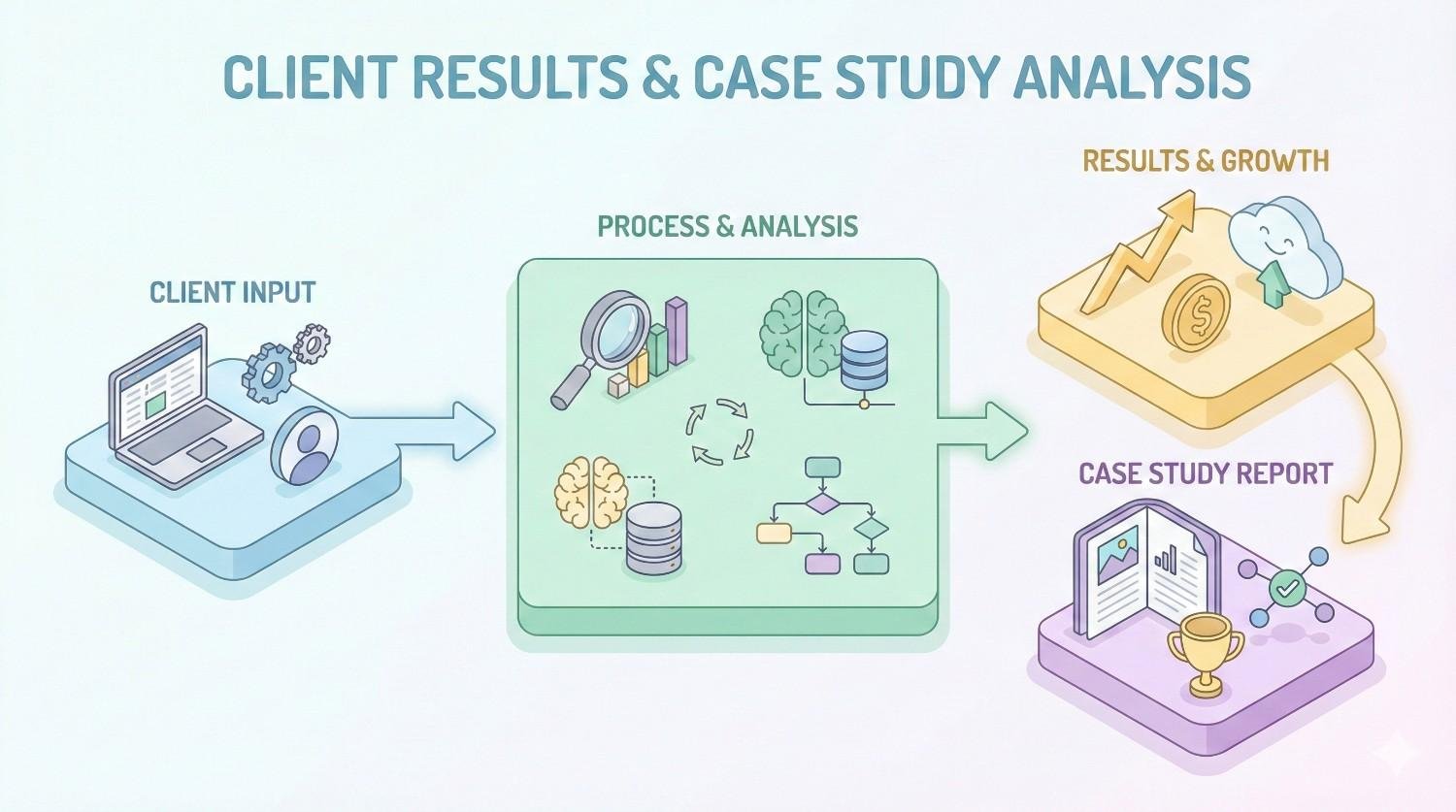
Client Results and Case Study Analysis
Documented results separated top-tier agencies from competent ones. I prioritized agencies that could demonstrate:
Conversion rate improvements with specific percentages and timeframes. Claims like “increased conversions” without numbers received less weight than “improved trial signups by 47% within 90 days.”
Traffic and SEO gains showing organic visibility improvements post-launch. Well-designed SaaS sites should support content marketing and search performance.
Business impact metrics connecting design work to revenue outcomes, reduced churn, or improved customer acquisition efficiency.
Client retention indicated by ongoing relationships and repeat projects. Agencies that maintain long-term client partnerships typically deliver consistent value.
Top 10 Elite SaaS Website Design Agencies (Tier 1)
These agencies represent the highest tier of SaaS website design expertise. They command premium pricing but deliver exceptional results for companies ready to invest in world-class digital experiences.
#1 Refine Labs Design – Best Overall SaaS Design Agency
Refine Labs Design earns the top position through consistent excellence across all evaluation criteria. Their portfolio includes recognizable SaaS brands with documented conversion improvements averaging 35-50% post-launch.
Strengths: Deep understanding of demand generation principles, exceptional copywriting integration, and data-driven design decisions. Their process includes conversion research before design begins.
Best for: Growth-stage SaaS companies with $5M+ ARR seeking comprehensive website overhauls.
Pricing: $75,000-$200,000 for full website projects.
Notable clients: Multiple Series B and C funded SaaS companies across marketing technology, sales enablement, and HR tech verticals.
#2 Webflow Enterprise Partners – Best for Enterprise SaaS
The top Webflow Enterprise Partners combine design excellence with technical capabilities that enterprise SaaS companies require. These agencies deliver sophisticated sites that marketing teams can update without developer dependencies.
Strengths: Complex animation capabilities, enterprise-grade security compliance, and scalable design systems. They excel at creating sites that balance visual impact with operational efficiency.
Best for: Enterprise SaaS platforms needing sophisticated marketing sites with internal team management capabilities.
Pricing: $100,000-$300,000 for enterprise implementations.
Notable capabilities: Custom CMS architectures, advanced personalization, and integration with enterprise marketing stacks.
#3 Kalungi – Best for SaaS Startups
Kalungi specializes in B2B SaaS startups, offering website design as part of comprehensive go-to-market packages. Their approach combines strategic positioning with execution.
Strengths: Understanding of early-stage SaaS challenges, efficient processes that respect startup budgets, and integrated marketing strategy. They design sites that can scale with company growth.
Best for: Seed to Series A SaaS startups needing foundational websites that support initial growth.
Pricing: $25,000-$75,000 for startup website packages.
Notable approach: Their “SaaS CMO” model provides strategic oversight alongside design execution.
#4 Directive Consulting – Best for Conversion-Focused Design
Directive brings performance marketing expertise to website design. Every design decision connects to measurable conversion outcomes.
Strengths: Rigorous A/B testing methodology, deep analytics integration, and continuous optimization approach. They treat websites as living conversion systems rather than static assets.
Best for: SaaS companies prioritizing measurable conversion improvements and willing to invest in ongoing optimization.
Pricing: $50,000-$150,000 for initial builds plus ongoing optimization retainers.
Notable results: Published case studies showing 200%+ improvements in demo request rates for B2B SaaS clients.
#5 Powered by Search – Best for Product-Led Growth SaaS
Powered by Search understands the unique requirements of product-led growth models where websites must drive self-service signups and support freemium conversion funnels.
Strengths: Expertise in PLG-specific user journeys, freemium conversion optimization, and product-website integration. They design experiences that reduce friction between marketing site and product.
Best for: PLG SaaS companies where website-to-product handoff directly impacts growth metrics.
Pricing: $40,000-$120,000 depending on project scope.
Notable expertise: Deep experience with developer tools, productivity software, and collaboration platforms.
#6 New Breed – Best for B2B SaaS Platforms
New Breed combines HubSpot expertise with B2B SaaS specialization. Their websites integrate seamlessly with marketing automation and CRM systems.
Strengths: Revenue operations alignment, sophisticated lead scoring integration, and account-based marketing support. They design sites that support complex B2B sales processes.
Best for: B2B SaaS companies using HubSpot seeking websites that maximize platform capabilities.
Pricing: $60,000-$175,000 for comprehensive website projects.
Notable integration: Deep HubSpot CMS expertise enabling advanced personalization and reporting.
#7 Cato Creative – Best for SaaS Rebranding
Cato Creative excels at transforming outdated SaaS brands into modern, competitive market positions. Their process addresses brand strategy before design execution.
Strengths: Brand strategy depth, visual identity development, and cohesive system creation. They deliver complete brand transformations, not just website redesigns.
Best for: Established SaaS companies needing comprehensive rebranding alongside website updates.
Pricing: $80,000-$250,000 for full rebrand and website projects.
Notable approach: Their discovery process includes competitive positioning analysis and customer perception research.
#8 Omniscient Digital – Best for Full-Service SaaS Marketing
Omniscient Digital offers website design within broader content and SEO strategy. Their sites are built to support long-term organic growth.
Strengths: Content strategy integration, SEO-first architecture, and programmatic content capabilities. They design sites that scale with content marketing ambitions.
Best for: SaaS companies investing heavily in content marketing and organic acquisition.
Pricing: $50,000-$125,000 for website projects, often bundled with content strategy.
Notable expertise: Programmatic SEO implementations that have driven millions of organic visits for SaaS clients.
#9 Superside – Best for UX-Driven SaaS Design
Superside combines design subscription models with deep UX expertise. Their approach emphasizes user research and iterative design improvement.
Strengths: Scalable design resources, strong UX research capabilities, and rapid iteration cycles. They provide ongoing design support beyond initial launches.
Best for: SaaS companies needing continuous design support and UX optimization.
Pricing: Subscription models starting at $5,000/month for ongoing design, custom pricing for website projects.
Notable model: Their subscription approach provides predictable costs and continuous improvement.
#10 Velocity Partners – Best for Rapid SaaS Launches
Velocity Partners delivers high-quality SaaS websites on accelerated timelines without sacrificing strategic depth.
Strengths: Efficient processes, experienced teams that minimize revision cycles, and proven templates that accelerate delivery. They balance speed with quality.
Best for: SaaS companies with tight launch deadlines or competitive pressures requiring fast execution.
Pricing: $35,000-$90,000 for accelerated website projects.
Notable capability: Four to six week delivery timelines for complete SaaS websites.
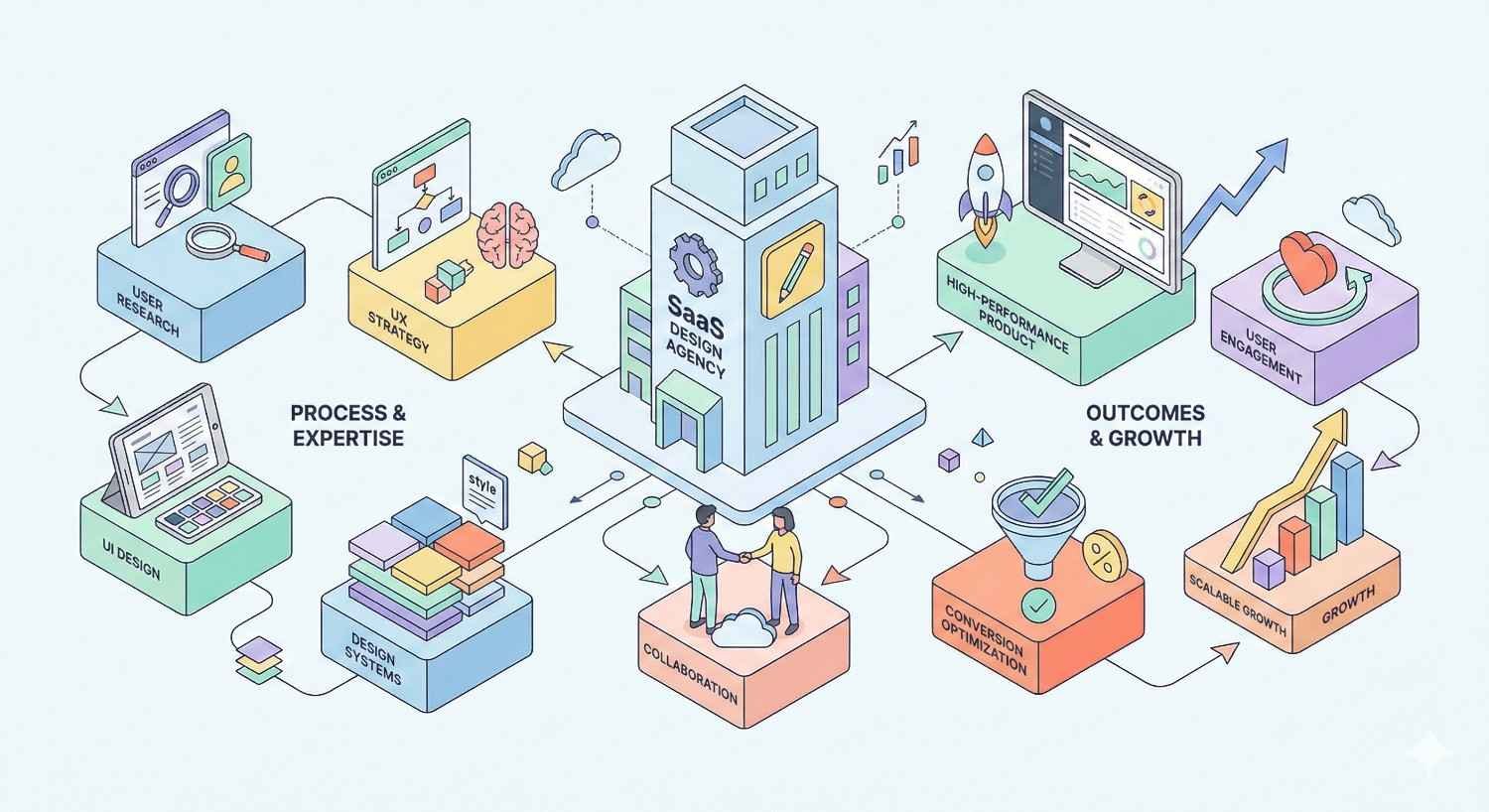
High-Performance SaaS Design Agencies (Tier 2: #11-25)
These agencies deliver excellent results at more accessible price points. They may specialize in specific SaaS stages or verticals, making them ideal matches for companies with particular needs.
Agencies Specializing in Early-Stage SaaS (#11-15)
#11 Draft.dev Design Services Focuses on developer-focused SaaS with technical content integration. Strong understanding of developer audience expectations and documentation-heavy sites. Pricing: $20,000-$50,000
#12 Roketto Canadian agency with strong B2B SaaS portfolio. Combines inbound marketing expertise with clean, conversion-focused design. Pricing: $30,000-$75,000
#13 Lean Labs Growth-driven design methodology with sprint-based delivery. Ideal for startups wanting iterative improvement over big-bang launches. Pricing: $15,000-$45,000
#14 Beacon Digital Marketing B2B focus with particular strength in fintech and cybersecurity SaaS. Understands compliance and trust requirements for sensitive industries. Pricing: $40,000-$100,000
#15 Ironpaper New York-based agency with strong demand generation integration. Designs sites that support sophisticated lead nurturing programs. Pricing: $35,000-$85,000
Agencies Excelling in Growth-Stage SaaS (#16-20)
#16 Klient Boost Performance marketing agency with website design capabilities. Every design decision ties to paid acquisition efficiency. Pricing: $25,000-$70,000
#17 Single Grain Full-service digital marketing with SaaS specialization. Strong content integration and SEO-focused architecture. Pricing: $40,000-$120,000
#18 Metric Theory (now part of Jellyfish) Data-driven approach with strong analytics integration. Designs sites optimized for measurement and continuous improvement. Pricing: $50,000-$150,000
#19 Walker Sands B2B technology focus with PR integration capabilities. Strong at building credibility and thought leadership into site design. Pricing: $60,000-$175,000
#20 Sculpt B2B social media expertise combined with website design. Understands how social proof and community integrate with SaaS sites. Pricing: $30,000-$80,000
Agencies with Strong Industry Vertical Focus (#21-25)
#21 Bay Leaf Digital Healthcare and life sciences SaaS specialization. Understands HIPAA compliance and healthcare buyer journeys. Pricing: $45,000-$125,000
#22 Elevation Marketing Manufacturing and industrial SaaS focus. Designs for complex technical products with long sales cycles. Pricing: $35,000-$90,000
#23 Gorilla 76 Industrial B2B specialization with strong manufacturing SaaS portfolio. Understands technical buyer needs. Pricing: $40,000-$100,000
#24 Mojo Media Labs Education technology and nonprofit SaaS expertise. Designs for mission-driven organizations with unique stakeholder needs. Pricing: $30,000-$75,000
#25 SmartBug Media HubSpot Diamond Partner with strong SaaS portfolio. Deep marketing automation integration capabilities. Pricing: $50,000-$140,000
Reliable SaaS Website Design Agencies (Tier 3: #26-40+)
These agencies offer solid SaaS website design at accessible price points. They’re excellent choices for budget-conscious companies or those with straightforward requirements.
Budget-Friendly SaaS Design Options (#26-32)
#26 Growth Marketing Pro Lean team delivering efficient SaaS websites. Strong template-based approach that reduces costs without sacrificing quality. Pricing: $10,000-$30,000
#27 Tuff Growth Performance-focused agency with affordable website packages. Good for startups needing functional sites quickly. Pricing: $15,000-$40,000
#28 Codeless Content-first approach with website design capabilities. Strong for content-heavy SaaS sites. Pricing: $20,000-$50,000
#29 Deviate Labs Growth hacking mindset applied to website design. Creative approaches to conversion optimization. Pricing: $12,000-$35,000
#30 Ladder.io Data-driven growth agency with website capabilities. Strong analytics integration and testing culture. Pricing: $18,000-$45,000
#31 NoGood Performance branding agency with SaaS experience. Balances brand building with conversion focus. Pricing: $25,000-$60,000
#32 Accelerate Agency UK-based with competitive pricing for US clients. Strong SEO integration and content strategy. Pricing: $15,000-$40,000
Regional SaaS Design Specialists (#33-37)
#33 Brolik (Philadelphia) East Coast agency with strong B2B SaaS portfolio. Good for companies preferring local partnerships. Pricing: $35,000-$85,000
#34 Brafton (Boston) Content marketing agency with website design. Strong for content-heavy SaaS strategies. Pricing: $25,000-$65,000
#35 Obility (Portland) Pacific Northwest agency with B2B tech focus. Strong paid media integration. Pricing: $30,000-$75,000
#36 Interrupt Media (Ohio) Midwest agency with manufacturing and industrial SaaS expertise. Competitive pricing with strong results. Pricing: $20,000-$55,000
#37 Digitopia (Denver) Mountain region agency with growing SaaS portfolio. HubSpot expertise and inbound focus. Pricing: $25,000-$60,000
Emerging SaaS Design Agencies to Watch (#38-40+)
#38 Skale Link building agency expanding into SaaS website design. Strong SEO foundation. Pricing: $20,000-$50,000
#39 Animalz Content agency adding design capabilities. Excellent for content-led SaaS growth strategies. Pricing: $30,000-$70,000
#40 Productive Shop Newer agency with impressive early portfolio. Worth watching as they build track record. Pricing: $15,000-$40,000
#41+ Additional Agencies:
- Foundation Marketing
- Compound Growth Marketing
- Algolia Design Partners
- Clearscope Creative
- Mutiny Design Services
SaaS Website Design Agency Comparison Table
Pricing Comparison by Agency Tier
| Tier | Price Range | Typical Timeline | Best For |
| Tier 1 (Elite) | $75,000-$300,000 | 12-20 weeks | Series B+ funded SaaS |
| Tier 2 (High-Performance) | $30,000-$120,000 | 8-14 weeks | Growth-stage SaaS |
| Tier 3 (Reliable) | $10,000-$50,000 | 4-10 weeks | Early-stage/bootstrapped |
Services Offered Comparison Matrix
| Service | Tier 1 Agencies | Tier 2 Agencies | Tier 3 Agencies |
| Brand Strategy | ✓ Comprehensive | ✓ Moderate | ○ Limited |
| UX Research | ✓ Extensive | ✓ Standard | ○ Basic |
| Custom Development | ✓ Full custom | ✓ Semi-custom | ○ Template-based |
| Conversion Optimization | ✓ Ongoing | ✓ Launch-focused | ○ Basic |
| SEO Integration | ✓ Advanced | ✓ Standard | ✓ Basic |
| Post-Launch Support | ✓ Retainer options | ✓ Limited | ○ Minimal |
Specialization and Industry Focus Breakdown
| Specialization | Top Agencies |
| Enterprise SaaS | Webflow Enterprise Partners, Walker Sands |
| Startup SaaS | Kalungi, Lean Labs, Growth Marketing Pro |
| PLG/Freemium | Powered by Search, Directive |
| B2B SaaS | New Breed, Ironpaper, SmartBug |
| Developer Tools | Draft.dev, Powered by Search |
| Healthcare SaaS | Bay Leaf Digital, Beacon Digital |
| Industrial SaaS | Gorilla 76, Elevation Marketing |
How to Choose the Right SaaS Website Design Agency
Selecting the right agency requires matching their capabilities to your specific situation. The best agency for a funded Series B company differs dramatically from the ideal choice for a bootstrapped startup.
Matching Agency Expertise to Your SaaS Stage
Pre-seed to Seed Stage ($0-$1M ARR): Prioritize agencies that understand resource constraints. Look for efficient processes, template-based approaches that reduce costs, and teams experienced with early-stage pivots. Tier 3 agencies often provide the best value here.
Series A Stage ($1M-$5M ARR): You need agencies that can build scalable foundations. The website should support your next 18-24 months of growth without requiring complete rebuilds. Tier 2 agencies typically offer the right balance of quality and investment.
Series B+ Stage ($5M+ ARR): At this stage, your website significantly impacts enterprise sales cycles and market perception. Tier 1 agencies deliver the sophistication that matches your market position and buyer expectations.
Budget Considerations and Pricing Models
Agency pricing typically follows three models:
Fixed Project Pricing: Most common for website builds. You receive defined deliverables for a set price. Advantages include budget predictability. Risks include scope creep and change order costs.
Retainer Models: Monthly fees for ongoing design support. Better for companies needing continuous optimization. Typical retainers range from $5,000-$25,000 monthly.
Hybrid Models: Fixed project pricing for initial build plus retainer for ongoing optimization. Often the best approach for growth-stage SaaS.
Budget allocation guidance:
- Allocate 5-15% of annual marketing budget for website investment
- Plan for 20-30% contingency for scope changes
- Budget separately for ongoing optimization post-launch
Evaluating Portfolio Fit and Design Style
Portfolio review should focus on relevant examples rather than overall aesthetic appeal.
Look for SaaS-specific work: Agencies showing primarily e-commerce or corporate sites may lack SaaS expertise regardless of design quality.
Examine similar company stages: An agency’s enterprise portfolio doesn’t guarantee startup success. Look for companies at your stage.
Assess conversion elements: Beyond visual design, evaluate how portfolios handle pricing pages, demo requests, and trial signups.
Check mobile experiences: Review portfolio sites on mobile devices. SaaS buyers increasingly research on mobile even for B2B purchases.
Questions to Ask Before Hiring a SaaS Design Agency
Process Questions:
- What does your discovery process include?
- How do you incorporate conversion research into design decisions?
- What’s your revision policy and how do you handle scope changes?
Team Questions:
- Who specifically will work on our project?
- What’s your team’s SaaS experience?
- Will we have a dedicated point of contact?
Results Questions:
- Can you share specific conversion metrics from similar projects?
- What results should we realistically expect?
- How do you measure project success?
Technical Questions:
- What platforms do you recommend and why?
- How do you handle site performance optimization?
- What’s your approach to SEO during the design process?
Red Flags to Avoid When Selecting an Agency
Guaranteed results without research: No agency can promise specific conversion improvements before understanding your current situation.
Unusually low pricing: Significantly below-market pricing often indicates offshore outsourcing, junior teams, or template-only approaches.
No SaaS-specific portfolio: Agencies claiming SaaS expertise should demonstrate it through relevant work examples.
Vague processes: Professional agencies can clearly explain their methodology. Vagueness suggests inconsistent delivery.
Poor communication during sales: If response times lag during the sales process, expect worse during projects.
No post-launch support options: Websites require ongoing optimization. Agencies without support offerings may prioritize new projects over client success.
What to Expect from a SaaS Website Design Project
Understanding typical project structures helps you plan resources and set appropriate expectations.
Typical Project Timeline and Milestones
Discovery Phase (2-4 weeks):
- Stakeholder interviews and goal alignment
- Competitive analysis and market research
- User research and persona development
- Content audit and information architecture planning
Strategy and Planning (2-3 weeks):
- Sitemap and user flow development
- Content strategy and messaging framework
- Technical requirements documentation
- Project timeline and milestone agreement
Design Phase (4-8 weeks):
- Wireframe development and approval
- Visual design concepts and iteration
- Responsive design specifications
- Design system documentation
Development Phase (4-8 weeks):
- CMS setup and configuration
- Page development and content integration
- Functionality implementation
- Quality assurance and testing
Launch and Optimization (2-4 weeks):
- Staging review and final revisions
- Launch preparation and execution
- Post-launch monitoring and fixes
- Initial optimization recommendations
Total timeline typically ranges from 12-20 weeks for comprehensive projects.
Deliverables You Should Receive
Strategy Deliverables:
- Competitive analysis report
- User persona documentation
- Sitemap and information architecture
- Content strategy and messaging guide
Design Deliverables:
- Wireframes for all page templates
- High-fidelity design mockups
- Responsive design specifications
- Design system and style guide
Development Deliverables:
- Fully functional website
- CMS training documentation
- Technical documentation
- Performance optimization report
Post-Launch Deliverables:
- Analytics setup and configuration
- Launch checklist completion
- 30-day support period
- Optimization recommendations
Communication and Collaboration Process
Effective agency partnerships require clear communication structures.
Kickoff Meeting: Align on goals, introduce teams, and establish communication norms.
Weekly Status Updates: Regular check-ins on progress, blockers, and upcoming milestones.
Milestone Reviews: Formal presentations at key project phases with stakeholder feedback opportunities.
Feedback Protocols: Clear processes for providing consolidated feedback to avoid conflicting direction.
Escalation Paths: Defined processes for addressing concerns or disagreements.
Expect to dedicate 5-10 hours weekly from your team during active project phases.
Post-Launch Support and Maintenance
Website launches mark the beginning, not the end, of optimization work.
Immediate Post-Launch (First 30 days):
- Bug fixes and technical issues
- Content corrections and updates
- Performance monitoring and optimization
- Initial conversion tracking validation
Ongoing Maintenance:
- Security updates and patches
- Platform and plugin updates
- Performance monitoring
- Backup management
Continuous Optimization:
- A/B testing and conversion optimization
- Content updates and additions
- SEO improvements
- Feature enhancements
Budget $1,000-$5,000 monthly for ongoing maintenance and optimization depending on site complexity.
SaaS Website Design Trends Shaping 2026
Staying current with design trends ensures your website meets evolving user expectations and competitive standards.
AI-Powered Personalization in SaaS Websites
AI personalization has moved from experimental to expected. Leading SaaS websites now customize experiences based on visitor behavior, company data, and intent signals.
Dynamic content adaptation adjusts messaging based on visitor industry, company size, or previous interactions. A visitor from a healthcare company sees healthcare-specific use cases and testimonials.
Intelligent chatbots provide personalized guidance through complex product information. They qualify visitors and route them to appropriate resources or sales conversations.
Predictive recommendations surface relevant content, features, or pricing based on visitor patterns. This reduces friction and accelerates buyer journeys.
Implementation requires integration between website platforms, CRM systems, and AI tools. Agencies with experience in these integrations deliver more sophisticated personalization.
Interactive Product Demos and Micro-Animations
Static screenshots no longer suffice for demonstrating SaaS products. Interactive elements have become essential for engagement and comprehension.
Embedded product tours let visitors experience key workflows without signup friction. These interactive demos increase trial conversion rates by helping prospects self-qualify.
Micro-animations guide attention and provide feedback. Subtle motion indicates clickable elements, confirms actions, and creates more engaging experiences.
Video integration has evolved beyond simple explainers. Product walkthrough videos, customer testimonials, and use case demonstrations now integrate seamlessly into page designs.
3D elements and illustrations differentiate brands in crowded markets. Custom visual systems create memorable experiences that generic stock imagery cannot match.
Conversion Rate Optimization Best Practices
CRO has matured from tactical testing to strategic design integration.
Above-the-fold optimization remains critical. The first viewport must communicate value proposition, establish credibility, and provide clear next steps.
Social proof placement has become more sophisticated. Rather than generic logo bars, effective sites integrate contextual proof near decision points.
Form optimization continues evolving. Progressive profiling, smart defaults, and friction reduction techniques improve completion rates.
Exit intent strategies capture visitors before they leave. Targeted offers, content upgrades, and chat interventions recover otherwise lost opportunities.
Mobile-First and Performance Optimization Standards
Mobile performance has become non-negotiable for SaaS websites.
Core Web Vitals directly impact search rankings and user experience. Google’s page experience signals now include Largest Contentful Paint, First Input Delay, and Cumulative Layout Shift as ranking factors.
Mobile-first design means designing for mobile constraints first, then expanding for desktop. This approach ensures mobile experiences aren’t afterthoughts.
Performance budgets set limits on page weight and load times. Professional agencies establish and maintain these budgets throughout development.
Image optimization through modern formats like WebP and AVIF reduces load times without sacrificing quality. Lazy loading and responsive images further improve performance.
Frequently Asked Questions About SaaS Design Agencies
How much does a SaaS website design agency cost?
SaaS website design costs range from $10,000 to $300,000 depending on agency tier, project scope, and customization requirements. Early-stage startups typically invest $15,000-$40,000, growth-stage companies $40,000-$120,000, and enterprise SaaS $100,000+. Budget 20-30% contingency for scope changes.
How long does a SaaS website redesign take?
Complete SaaS website redesigns typically require 12-20 weeks from kickoff to launch. Simpler projects with template-based approaches can launch in 6-8 weeks. Enterprise projects with extensive custom development may extend to 24+ weeks. Discovery and strategy phases often take longer than expected.
Should I hire a specialized SaaS agency or a generalist?
Specialized SaaS agencies deliver better results for most SaaS companies. They understand SaaS-specific challenges like product demos, pricing page optimization, and freemium conversion funnels. Generalist agencies may offer lower prices but often miss nuances that impact conversion rates and user experience.
What makes a SaaS website high-converting?
High-converting SaaS websites combine clear value propositions, strategic social proof placement, low-friction conversion paths, and fast performance. They address multiple buyer personas, provide appropriate content for each funnel stage, and make next steps obvious. Continuous optimization based on data drives ongoing improvement.
Can I redesign my SaaS website in phases?
Phased redesigns work well for companies with budget constraints or risk concerns. Common approaches include launching core pages first, then expanding to secondary pages. However, phased approaches require careful planning to maintain consistency and may extend total project timelines. Discuss phasing options with agencies during evaluation.
My Final Recommendations by SaaS Company Type
Different SaaS companies have different needs. Here are my specific recommendations based on company stage and situation.
Best Agencies for Funded SaaS Startups
Series A companies should consider Kalungi, Lean Labs, or Ironpaper. These agencies understand growth-stage needs without enterprise-level pricing. They build scalable foundations that support your next funding round.
Series B+ companies should evaluate Refine Labs Design, Directive, or New Breed. At this stage, your website significantly impacts enterprise sales cycles. Investment in top-tier agencies pays dividends through improved conversion rates and market perception.
Best Agencies for Bootstrapped SaaS Founders
Bootstrapped founders need maximum value from limited budgets. Growth Marketing Pro, Tuff Growth, and Lean Labs offer efficient approaches that deliver professional results without excessive investment.
Consider template-based approaches from these agencies. Modern templates provide strong foundations that skilled agencies customize effectively. You sacrifice some uniqueness but gain significant cost savings.
Prioritize agencies offering clear, fixed pricing. Budget predictability matters more when every dollar counts.
Best Agencies for Enterprise SaaS Platforms
Enterprise SaaS requires agencies that understand complex stakeholder needs, compliance requirements, and sophisticated buyer journeys.
Webflow Enterprise Partners, Walker Sands, and Metric Theory deliver enterprise-appropriate sophistication. They understand how websites support long sales cycles and multiple decision-makers.
Evaluate agencies’ experience with your specific enterprise vertical. Healthcare, financial services, and government SaaS have unique requirements that generalist agencies may miss.
Best Agencies for SaaS Companies Seeking Rapid Growth
Growth-focused companies should prioritize agencies with strong conversion optimization capabilities.
Directive, Powered by Search, and Klient Boost combine design with performance marketing expertise. They design sites optimized for paid acquisition efficiency and organic growth.
Look for agencies offering ongoing optimization services. Initial launches establish baselines, but continuous testing drives compounding improvements.
Conclusion
Selecting the right SaaS website design agency directly impacts your conversion rates, customer acquisition costs, and market positioning. The 40+ agencies ranked in this guide represent the most trustworthy options across different budget levels, company stages, and specializations.
Your ideal agency match depends on your specific situation. Funded startups benefit from Tier 1 agencies that deliver enterprise-quality results. Bootstrapped founders find excellent value in Tier 3 agencies with efficient processes. Growth-stage companies often find the best balance in Tier 2 agencies combining quality with reasonable investment.
At White Label SEO Service, we help SaaS companies build sustainable organic growth that complements great website design. When you’re ready to maximize your new website’s search visibility and drive qualified traffic, reach out to discuss how our SEO strategies integrate with your website investment for compounding returns.
Frequently Asked Questions
What should I prioritize when choosing a SaaS website design agency?
Prioritize agencies with proven SaaS portfolio work, documented conversion results, and clear processes. Match their typical client stage to yours. An agency excellent for enterprise SaaS may not serve startups well, and vice versa.
How do I know if an agency truly specializes in SaaS?
Look for SaaS-specific case studies with measurable outcomes, team members with SaaS industry backgrounds, and content demonstrating SaaS expertise. Ask about their experience with pricing pages, product demos, and freemium conversion optimization.
What’s the difference between a website redesign and a website refresh?
Redesigns involve comprehensive overhauls including strategy, information architecture, visual design, and development. Refreshes update visual elements while maintaining existing structure. Redesigns typically cost 3-5x more but deliver greater impact.
Should I choose an agency based on the platform they use?
Platform expertise matters but shouldn’t be the primary selection criterion. Most professional agencies work across multiple platforms. Choose based on overall fit, then discuss platform recommendations. Common SaaS website platforms include Webflow, WordPress, and HubSpot CMS.
How involved will my team need to be during the project?
Expect to dedicate 5-10 hours weekly from key stakeholders during active project phases. Discovery and content development require the most internal involvement. Agencies need access to subject matter experts, brand guidelines, and decision-makers for efficient progress.
What happens if I’m not satisfied with the design concepts?
Professional agencies include revision rounds in their contracts. Typically, you’ll receive 2-3 rounds of revisions per design phase. Communicate concerns early and provide specific, consolidated feedback. Major direction changes beyond contracted revisions may incur additional costs.
How do I measure ROI from my website design investment?
Track conversion rates, traffic growth, time on site, and bounce rates before and after launch. Connect website metrics to business outcomes like demo requests, trial signups, and sales pipeline. Most SaaS companies should see measurable improvements within 90 days of launch.