
National SEO services position your business to capture organic search traffic across an entire country, not just a single city or region. Unlike local SEO campaigns targeting specific geographic areas, national strategies compete for high-volume, competitive keywords that drive traffic from coast to coast.
For businesses selling products or services nationwide, this approach transforms search engines into scalable customer acquisition channels. The difference between ranking on page one versus page three can mean millions in lost revenue annually.
This guide covers everything you need to know about national SEO: how it works, realistic timelines, ranking factors, costs, and how to evaluate providers. Whether you’re launching a national campaign or scaling an existing one, you’ll find actionable insights to inform your strategy.
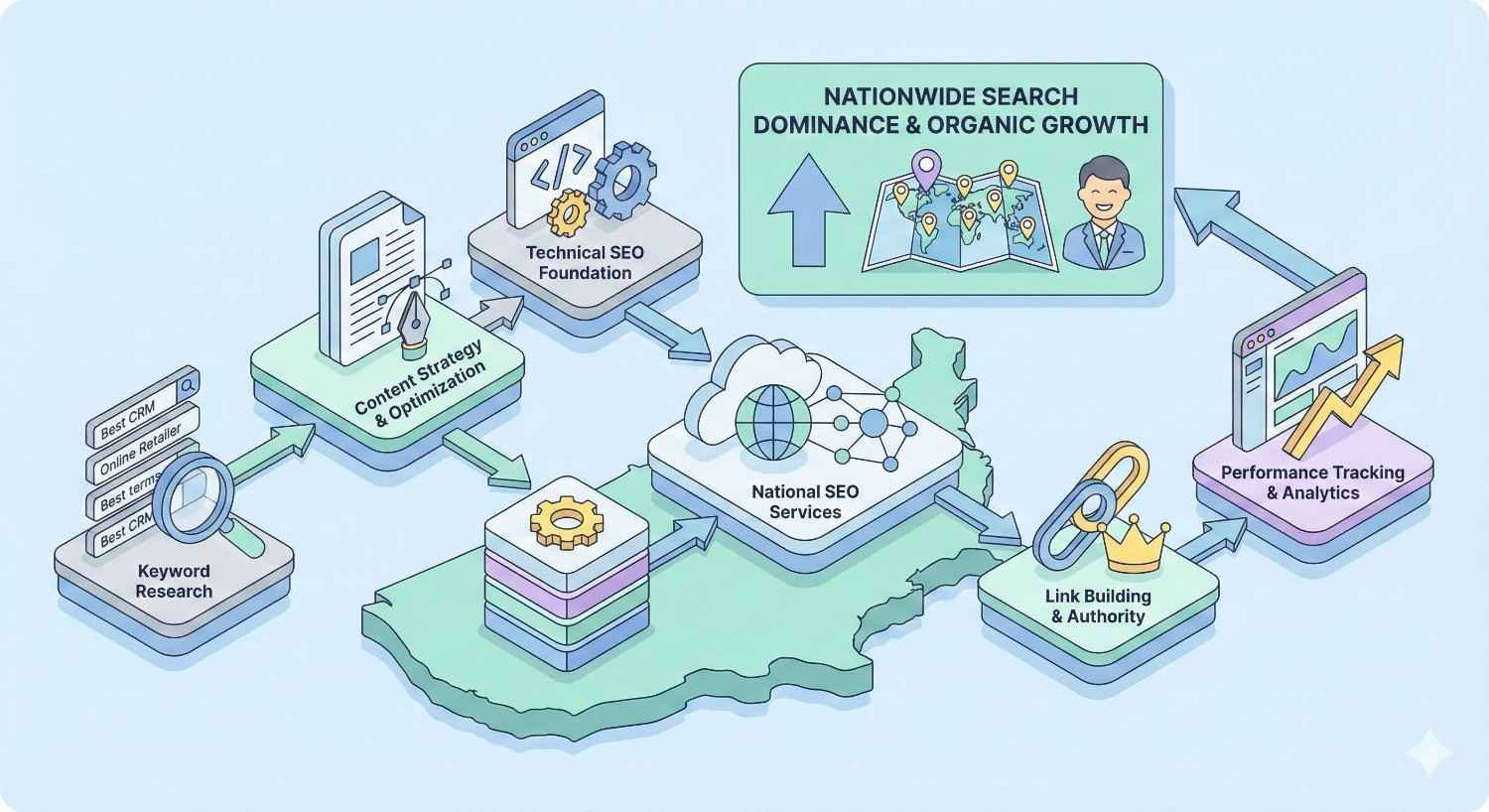
What Are National SEO Services?
National SEO services encompass the strategies, tactics, and ongoing optimization work required to rank a website for non-geographic keywords across an entire country. Rather than targeting “plumber in Chicago” or “dentist near me,” national campaigns pursue terms like “best project management software” or “how to invest in stocks.”
The scope is broader. The competition is fiercer. The potential reward is exponentially larger.
These services typically include technical SEO audits, content strategy development, link building at scale, on-page optimization, and performance tracking. The goal is establishing your website as an authoritative resource that Google trusts to serve users regardless of their physical location.
National SEO requires a fundamentally different approach than local optimization. You’re not competing against a few dozen local businesses. You’re competing against established brands, well-funded startups, and content publishers who have spent years building domain authority.
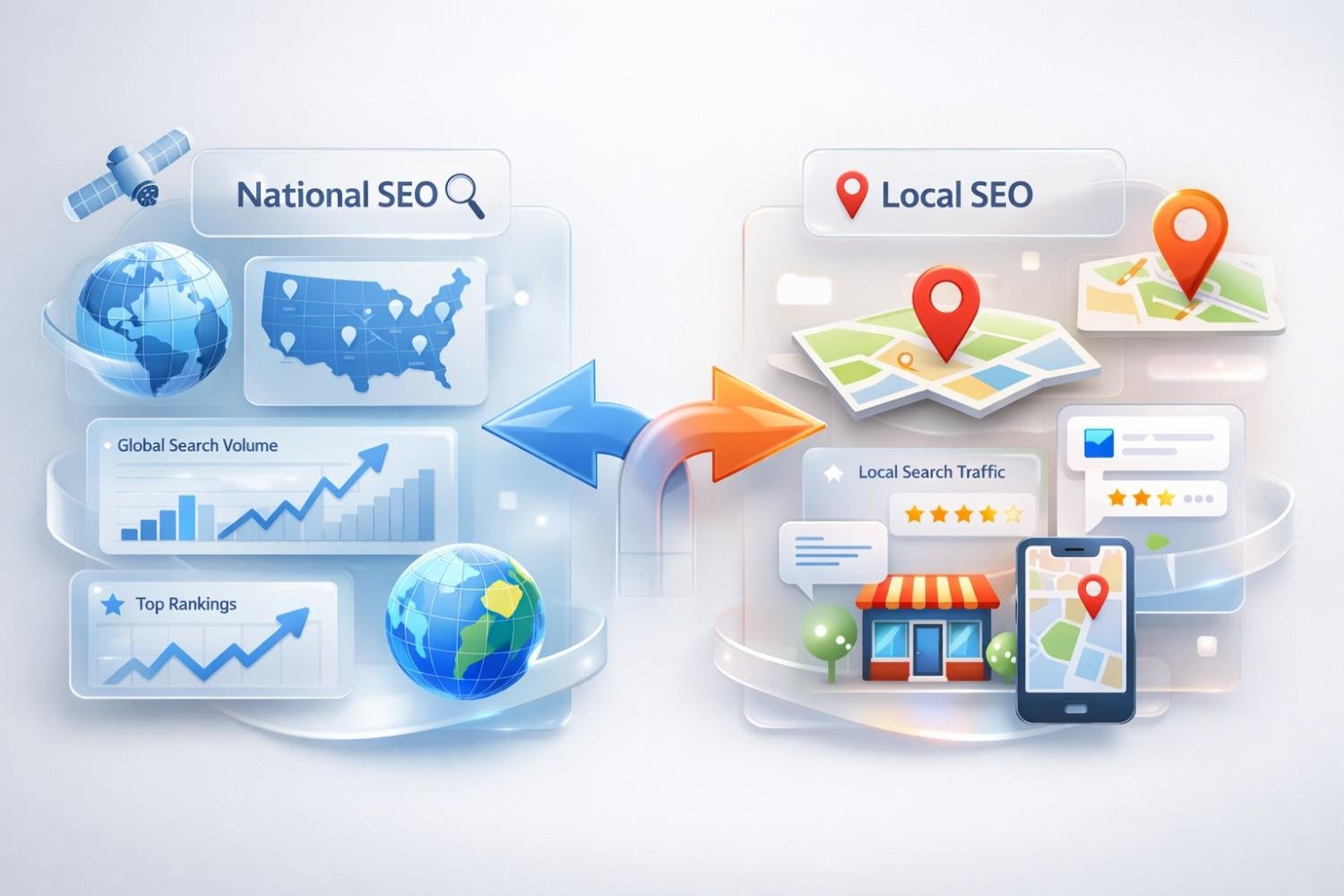
National SEO vs. Local SEO: Key Differences
The distinction between national and local SEO extends far beyond geographic targeting. Understanding these differences helps you allocate resources appropriately and set realistic expectations.
Keyword Competition and Volume
Local keywords typically have lower search volume but also lower competition. “Personal injury lawyer Los Angeles” might get 1,000 monthly searches with moderate competition. “Personal injury lawyer” as a national term could see 50,000+ searches with intense competition from established legal directories and national firms.
Ranking Factors
Local SEO relies heavily on Google Business Profile optimization, local citations, and proximity signals. National SEO depends more on domain authority, content depth, backlink profiles, and topical relevance. Google’s local algorithm weighs different signals than its organic algorithm.
Content Requirements
Local businesses can rank with relatively thin content if their local signals are strong. National campaigns require comprehensive, authoritative content that demonstrates expertise across the entire topic landscape. A 500-word service page won’t compete nationally against 5,000-word guides from established competitors.
Link Building Approach
Local link building focuses on community partnerships, local directories, and regional publications. National link acquisition requires digital PR, industry publications, and high-authority domains that pass significant ranking power.
Timeline to Results
Local SEO can show meaningful results in 3-6 months for moderately competitive markets. National campaigns typically require 6-12 months minimum before significant ranking improvements materialize, with 12-24 months for competitive industries.
Who Needs National SEO Services?
Not every business benefits from national SEO. The investment makes sense for specific business models and growth objectives.
E-commerce Brands
Online retailers shipping nationwide need visibility for product and category keywords. Whether you sell specialty coffee equipment or industrial supplies, national rankings drive qualified traffic that converts into orders.
SaaS and Technology Companies
Software companies serve customers regardless of location. Ranking for “CRM software,” “email marketing tools,” or “accounting software for small business” captures prospects actively searching for solutions.
Professional Service Firms with National Reach
Law firms, consulting companies, and financial advisors serving clients across multiple states benefit from national visibility. Even if you have physical offices in specific cities, national rankings establish thought leadership and generate leads from new markets.
Publishers and Media Companies
Content-driven businesses monetizing through advertising, subscriptions, or affiliate revenue need traffic at scale. National rankings for informational queries drive the volume required for sustainable revenue.
Franchise Organizations
Franchisors building brand awareness across markets use national SEO to support franchisee success. Corporate-level content and authority benefit every location in the network.
Direct-to-Consumer Brands
DTC companies bypassing traditional retail channels depend on organic search for customer acquisition. National rankings reduce reliance on paid advertising and improve unit economics.
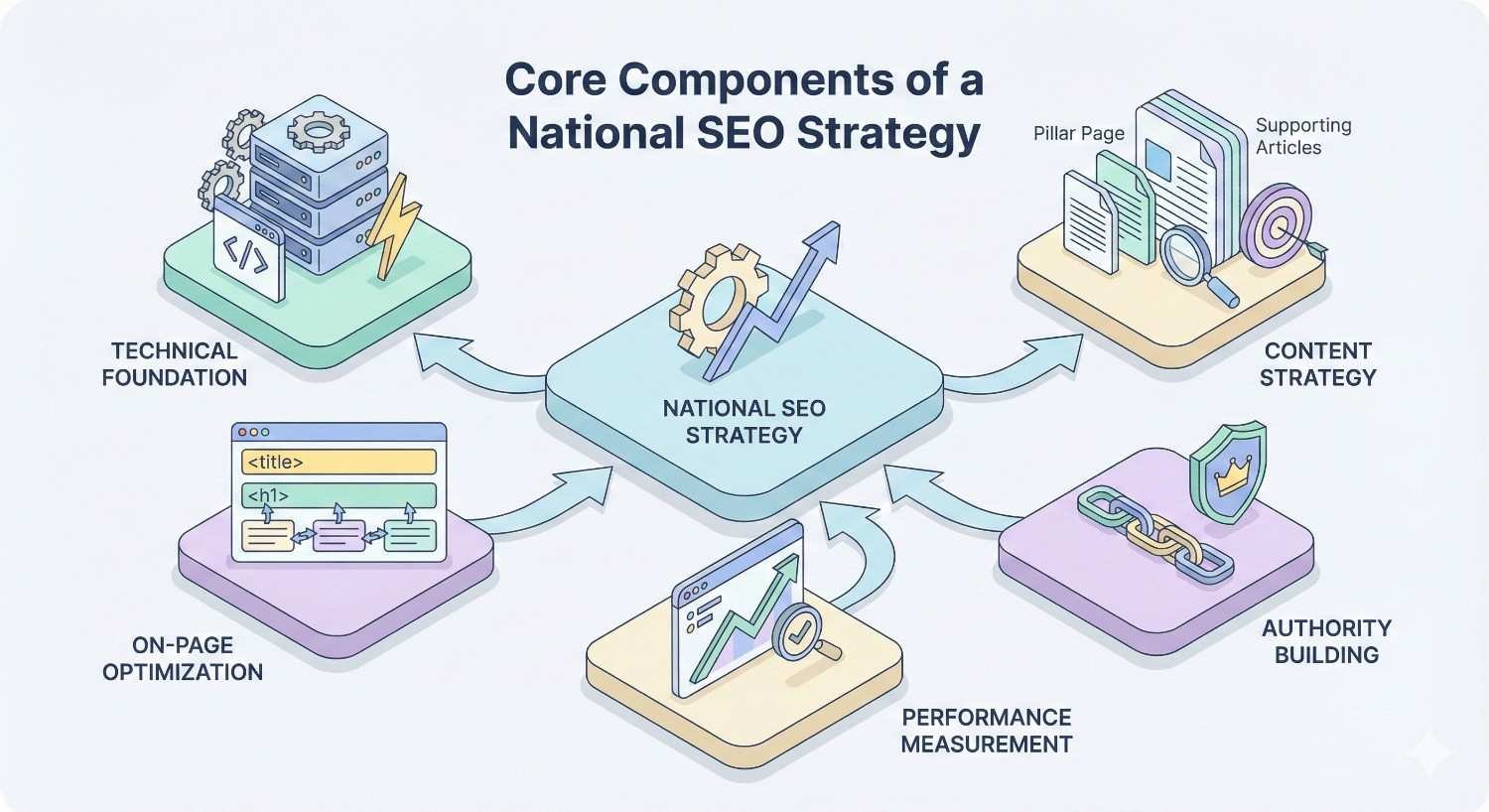
Core Components of a National SEO Strategy
Effective national SEO integrates multiple disciplines into a cohesive strategy. Each component reinforces the others, creating compound growth over time.
Technical Foundation
Your website must be crawlable, fast, and properly structured before content and links can drive results. Technical issues create ceilings that limit ranking potential regardless of other efforts.
Content Strategy
Comprehensive content covering your topic landscape signals expertise to search engines. This includes pillar pages, supporting articles, and content addressing every stage of the buyer journey.
Authority Building
Backlinks from relevant, authoritative websites remain a primary ranking factor. National campaigns require systematic link acquisition from high-quality sources.
On-Page Optimization
Title tags, meta descriptions, header structures, and internal linking help search engines understand your content and its relevance to specific queries.
Performance Measurement
Tracking rankings, traffic, conversions, and ROI ensures resources flow toward tactics that deliver results. Data-driven optimization separates successful campaigns from wasted budgets.
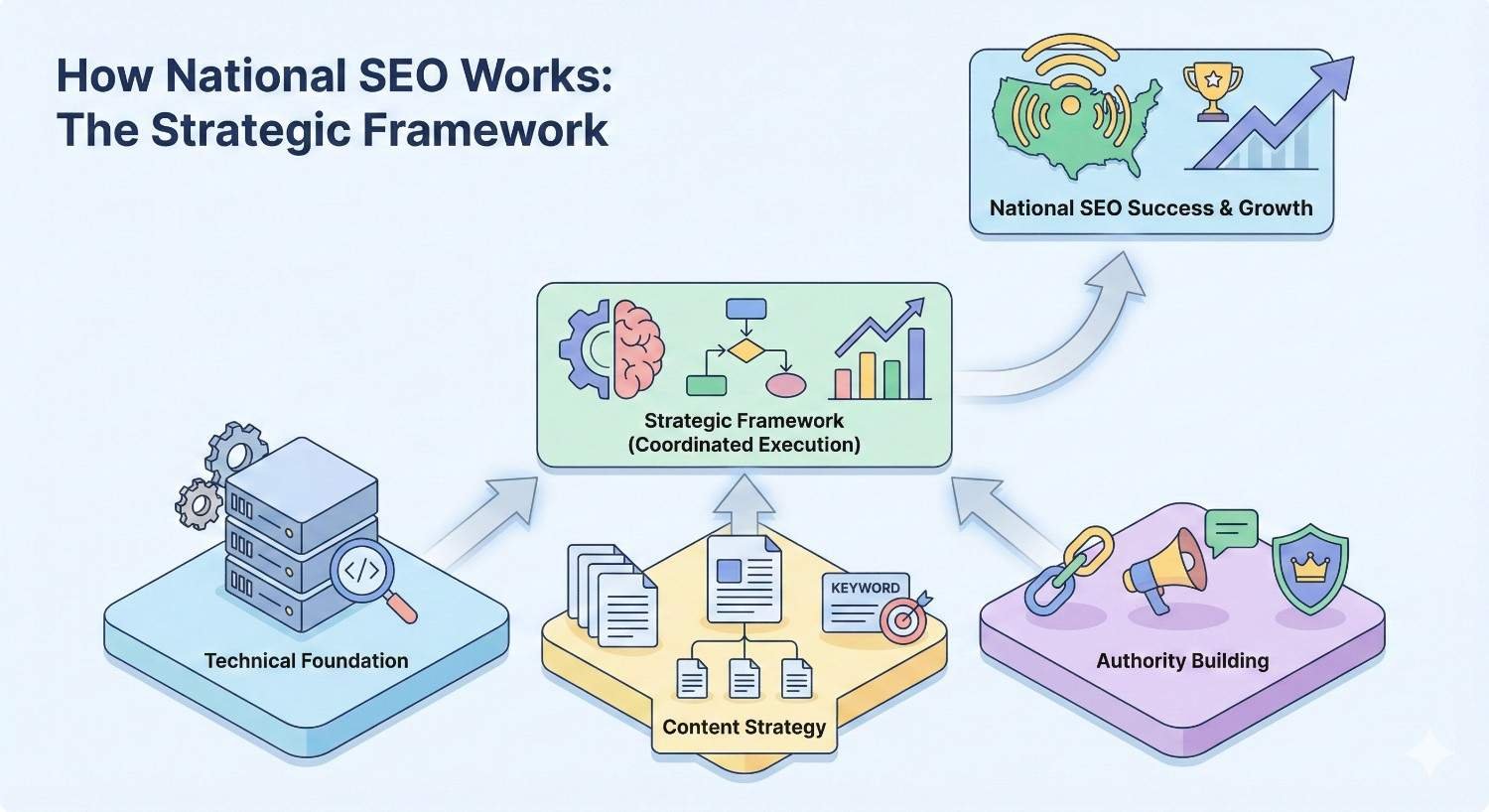
How National SEO Works: The Strategic Framework
National SEO success requires coordinated execution across technical, content, and authority-building disciplines. Understanding how these elements work together helps you evaluate strategies and providers.
The framework isn’t linear. Technical optimization, content development, and link building happen simultaneously, with each element supporting the others. A technically perfect website with no content won’t rank. Great content on a broken website won’t either.
Technical SEO Foundation for Nationwide Visibility
Technical SEO ensures search engines can efficiently crawl, index, and understand your website. For national campaigns targeting thousands of keywords, technical excellence becomes non-negotiable.
Site Architecture and Crawlability
Your website structure should help both users and search engines navigate content logically. Flat architectures where important pages sit within 3-4 clicks of the homepage typically perform better than deeply nested structures.
XML sitemaps guide crawlers to important pages. Robots.txt files prevent crawling of duplicate or low-value content. Canonical tags consolidate ranking signals when similar content exists across multiple URLs.
For large websites, crawl budget management becomes critical. Search engines allocate limited resources to each domain. Ensuring crawlers spend time on valuable pages rather than faceted navigation or parameter variations improves indexation efficiency.
Core Web Vitals and Page Speed
Google’s Core Web Vitals measure real-user experience across three dimensions: loading performance (Largest Contentful Paint), interactivity (First Input Delay), and visual stability (Cumulative Layout Shift).
Sites meeting Core Web Vitals thresholds gain a ranking advantage, particularly in competitive SERPs where other factors are roughly equal. Beyond rankings, faster sites convert better. Research from Google shows that improving Core Web Vitals correlates with reduced bounce rates and increased conversions.
Common speed optimizations include image compression, code minification, browser caching, CDN implementation, and reducing render-blocking resources. For complex sites, server-side rendering or static site generation can dramatically improve performance.
Mobile Optimization
Google uses mobile-first indexing, meaning the mobile version of your site determines rankings even for desktop searches. Responsive design that adapts to screen sizes is table stakes.
Beyond responsive layouts, mobile optimization includes touch-friendly navigation, appropriately sized tap targets, readable font sizes without zooming, and eliminating intrusive interstitials that frustrate mobile users.
Schema Markup and Structured Data
Schema markup helps search engines understand content context and can trigger rich results in SERPs. Product schema enables price and availability displays. FAQ schema can expand your SERP real estate. Organization schema reinforces brand entity recognition.
For national campaigns, implementing appropriate schema across page types improves click-through rates and helps Google understand entity relationships within your content.
Content Strategy for National Reach
Content is the vehicle through which you demonstrate expertise and capture search demand. National campaigns require content strategies that address breadth (covering the full topic landscape) and depth (providing comprehensive coverage of individual topics).
Keyword Research at Scale
National keyword research identifies the full universe of terms your target audience uses when searching for solutions you provide. This goes beyond obvious head terms to include:
- Long-tail variations with specific modifiers
- Question-based queries reflecting different awareness stages
- Comparison and alternative keywords
- Problem-aware searches before solution awareness
- Industry-specific terminology variations
Tools like Ahrefs, Semrush, and Google Keyword Planner provide search volume and competition data. But effective research also requires understanding search intent behind keywords and mapping terms to appropriate content types.
Topic Clusters and Pillar Pages
Topic cluster architecture organizes content around central pillar pages supported by related cluster content. A pillar page on “email marketing” might link to cluster articles covering “email subject line best practices,” “email automation workflows,” and “email deliverability optimization.”
This structure signals topical authority to search engines. Internal links between cluster content and pillar pages distribute ranking power and help users navigate related information.
Content Gap Analysis
Analyzing competitor content reveals topics they cover that you don’t. These gaps represent ranking opportunities. If competitors ranking for your target keywords all have content on specific subtopics, that content likely contributes to their rankings.
Gap analysis also identifies content quality differentials. If existing content on a topic is thin or outdated, comprehensive new content can capture rankings from weaker competitors.
E-E-A-T Optimization
Google’s quality guidelines emphasize Experience, Expertise, Authoritativeness, and Trustworthiness. For national rankings, demonstrating E-E-A-T becomes increasingly important as competition intensifies.
Experience signals include first-hand testing, original research, and practical application of concepts. Expertise appears through technical accuracy, appropriate terminology, and depth of coverage. Authority builds through citations, backlinks, and brand recognition. Trust develops through transparency, accurate information, and clear sourcing.
Author bylines with credentials, expert quotes, original data, and comprehensive sourcing all contribute to E-E-A-T signals that influence rankings.
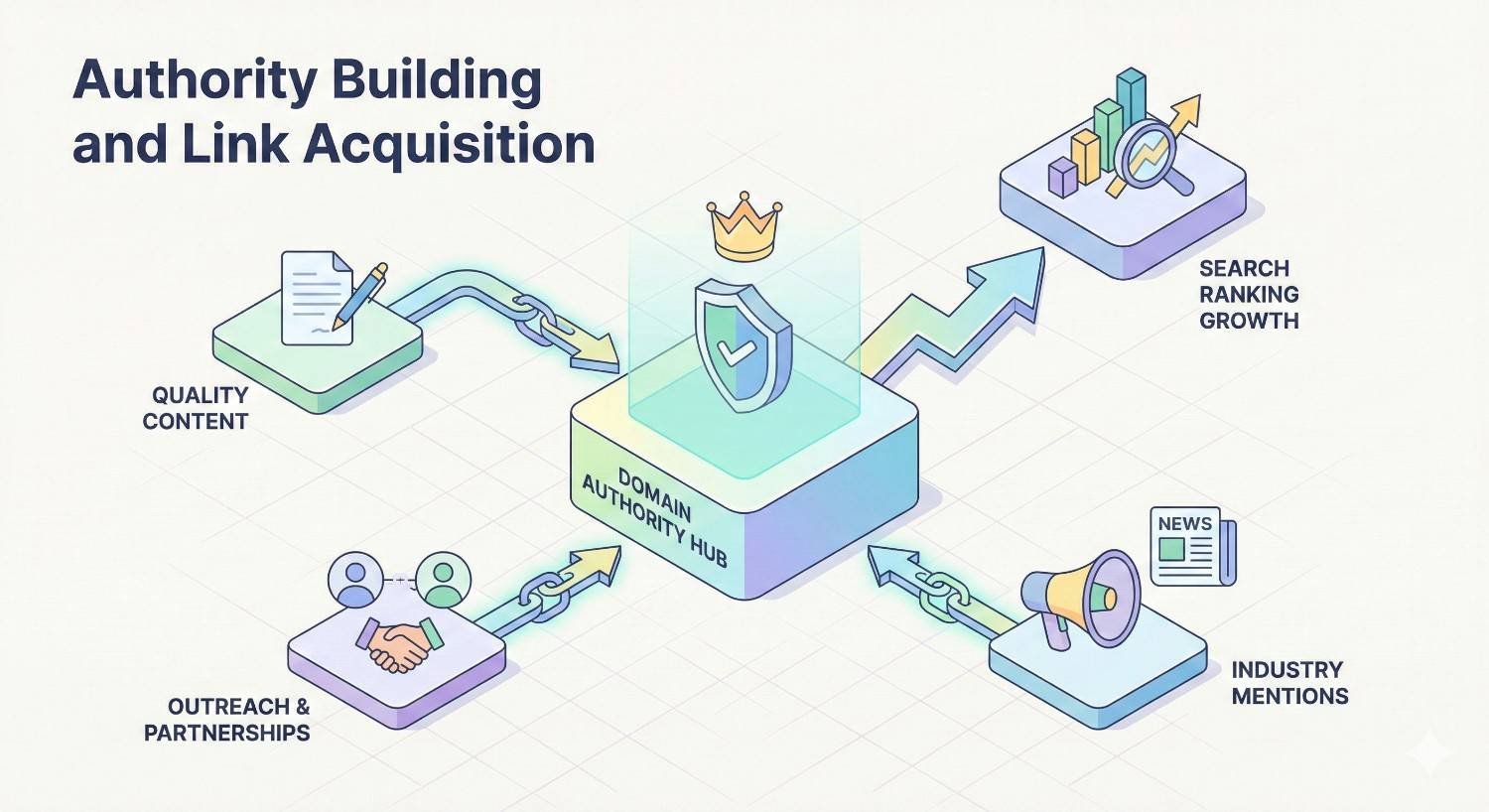
Authority Building and Link Acquisition
Backlinks remain among the strongest ranking factors for competitive national keywords. Links from authoritative, relevant websites signal to Google that your content deserves visibility.
Digital PR Strategies
Digital PR earns links through newsworthy content that journalists and publishers want to reference. This includes original research, data studies, expert commentary on industry trends, and resources that serve as definitive references.
Effective digital PR requires understanding what makes content linkable. Unique data that supports stories journalists are already writing generates more links than promotional content about your company.
High-Authority Backlink Development
Beyond PR, link building includes guest posting on relevant industry publications, resource page link building, broken link replacement, and partnership-based link exchanges with complementary businesses.
Quality matters more than quantity. One link from a high-authority domain in your industry provides more ranking value than dozens of links from low-quality directories or irrelevant websites.
Brand Mention Optimization
Unlinked brand mentions represent link opportunities. When publications mention your company without linking, outreach can convert mentions into backlinks. Monitoring tools track brand mentions across the web, enabling systematic reclamation.
Brand search volume and branded query patterns also influence how Google perceives your authority. Building brand awareness through PR, advertising, and content distribution creates signals that support organic rankings.
On-Page Optimization for Competitive Keywords
On-page optimization ensures individual pages are properly structured to rank for target keywords. While technical SEO addresses site-wide factors, on-page optimization focuses on page-level elements.
Title Tag and Meta Description Strategy
Title tags remain a primary ranking factor. Including target keywords naturally while maintaining click-worthy copy balances SEO and user experience. Titles should accurately describe page content while differentiating from competitors in search results.
Meta descriptions don’t directly influence rankings but significantly impact click-through rates. Compelling descriptions that preview content value and include calls to action improve traffic from existing rankings.
Header Hierarchy Optimization
Proper heading structure (H1, H2, H3) helps search engines understand content organization and topic relationships. Each page should have one H1 containing the primary keyword. H2s break content into major sections. H3s provide further subdivision.
Headers also improve user experience by making content scannable. Users often skim headers before deciding to read full sections.
Internal Linking Architecture
Internal links distribute ranking power throughout your site and help search engines discover content relationships. Strategic internal linking from high-authority pages to pages you want to rank passes link equity where it’s needed.
Anchor text in internal links provides context about linked page content. Descriptive anchors help both users and search engines understand what to expect from linked pages.
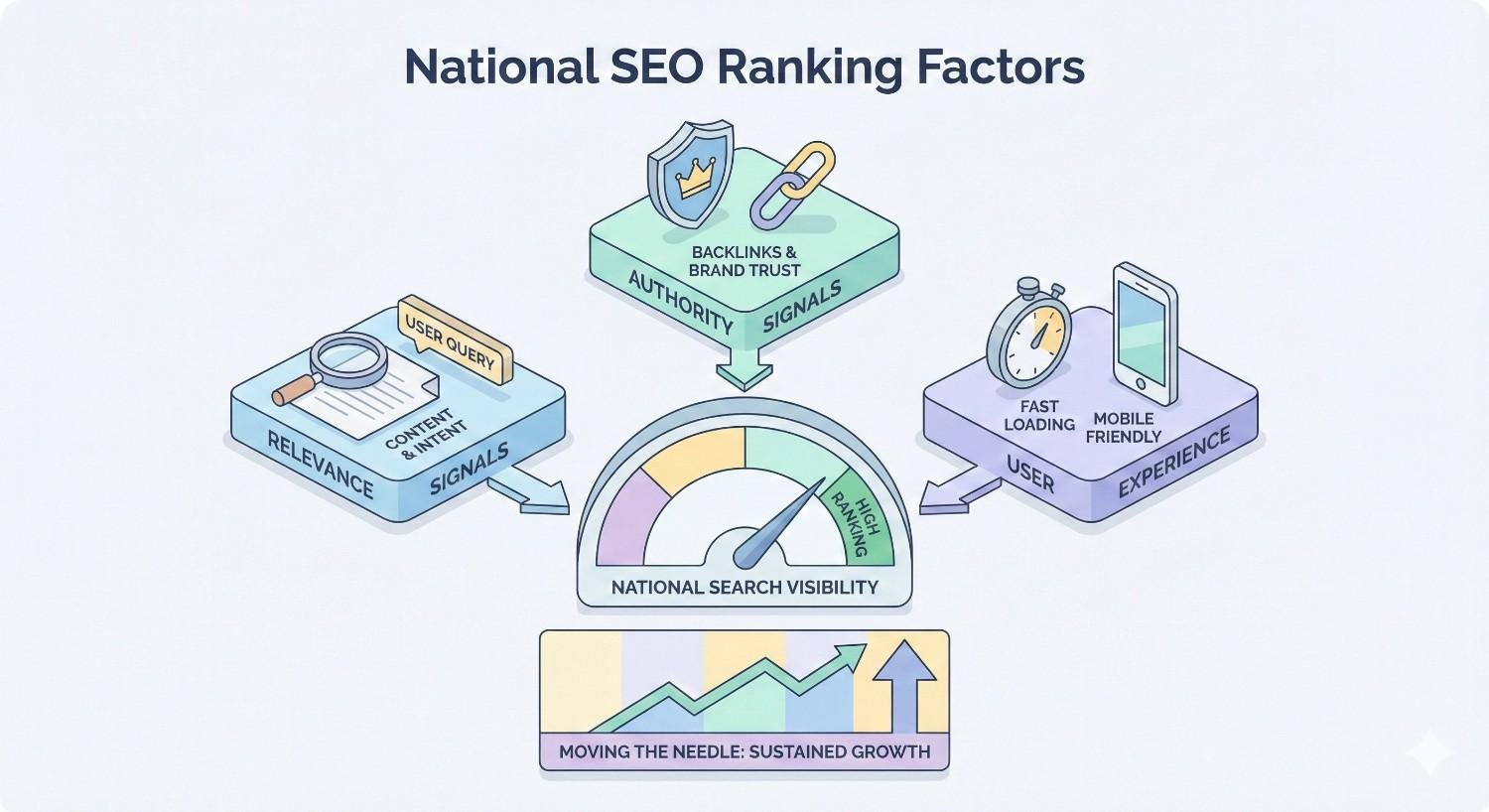
National SEO Ranking Factors: What Actually Moves the Needle
Understanding ranking factors helps prioritize efforts and evaluate whether your strategy addresses what actually influences results. Google uses hundreds of signals, but some carry significantly more weight than others.
Google’s Algorithm Signals for National Rankings
Google’s algorithm evaluates pages across multiple dimensions to determine rankings. For national keywords, certain signals become particularly important due to increased competition.
Relevance Signals
Google must understand that your page addresses the searcher’s query. This involves analyzing page content, title tags, headers, and the semantic relationship between your content and the query. Pages that comprehensively address query intent rank better than those with superficial coverage.
Authority Signals
Domain authority, measured through backlink profiles and brand recognition, influences ranking potential. New domains competing for national keywords face an uphill battle against established sites with years of accumulated authority.
Page-level authority also matters. Individual pages with strong backlink profiles can rank even on domains with moderate overall authority.
Quality Signals
Content quality assessments consider depth, accuracy, freshness, and user satisfaction. Google’s quality rater guidelines provide insight into how human evaluators assess content, which informs algorithmic quality signals.
User Experience Signals
Page speed, mobile usability, and engagement metrics influence rankings. Pages that load slowly, display poorly on mobile, or fail to satisfy user intent may see ranking limitations regardless of other factors.
Content Quality and Relevance Signals
Content quality extends beyond word count. Google evaluates whether content actually helps users accomplish their goals.
Comprehensive Coverage
Pages ranking for competitive national keywords typically cover topics more thoroughly than lower-ranking alternatives. This doesn’t mean longer is always better, but it does mean addressing the full scope of user questions around a topic.
Accuracy and Freshness
Outdated or inaccurate content loses rankings over time, particularly for topics where information changes. Regular content updates signal ongoing relevance and maintain ranking positions.
Original Value
Content that provides unique insights, original data, or perspectives not available elsewhere earns better rankings than content that simply aggregates existing information. Google’s helpful content system specifically targets content created primarily for search engines rather than users.
Search Intent Alignment
Content must match what users actually want when searching. Informational queries require educational content. Transactional queries need product or service pages. Misaligned content won’t rank regardless of quality because it doesn’t serve user needs.
Domain Authority and Trust Signals
Authority accumulates over time through consistent quality and external validation. Building authority requires patience and sustained effort.
Backlink Profile Quality
The quantity, quality, and relevance of backlinks pointing to your domain influence authority. Links from trusted, relevant sources carry more weight than links from unrelated or low-quality sites.
Backlink velocity, the rate at which you acquire new links, also matters. Natural link profiles show steady growth rather than sudden spikes that might indicate manipulation.
Brand Signals
Branded search volume, direct traffic, and brand mentions across the web contribute to authority signals. Google recognizes established brands and may give them ranking advantages for relevant queries.
Domain Age and History
Older domains with clean histories often have ranking advantages over new domains. This doesn’t mean new sites can’t rank, but they typically require more effort to establish authority.
User Experience and Engagement Metrics
How users interact with your site after clicking from search results provides feedback that influences rankings.
Click-Through Rate
Pages with higher click-through rates from search results may receive ranking boosts. Compelling titles and meta descriptions that accurately represent content improve CTR.
Dwell Time and Pogo-Sticking
When users click a result and quickly return to search results to try another option, it signals dissatisfaction. Pages that keep users engaged and satisfy their queries send positive signals.
Page Experience
Core Web Vitals, mobile usability, HTTPS security, and absence of intrusive interstitials all contribute to page experience scores that influence rankings.
Realistic SEO Timelines: What to Expect from National Campaigns
SEO is not a quick fix. National campaigns require sustained investment over months and years to achieve meaningful results. Understanding realistic timelines helps set appropriate expectations and maintain commitment through the early phases when visible progress is limited.
Month 1-3: Foundation and Technical Optimization
The first quarter focuses on establishing the technical and strategic foundation for long-term success.
Technical Audit and Remediation
Comprehensive technical audits identify issues limiting crawlability, indexation, and ranking potential. Common issues include duplicate content, broken links, slow page speed, mobile usability problems, and improper canonical implementation.
Fixing technical issues removes barriers to ranking but doesn’t immediately improve positions. Think of it as clearing the path rather than running the race.
Keyword Research and Strategy Development
Thorough keyword research maps the full landscape of ranking opportunities. This research informs content strategy, site architecture decisions, and prioritization of efforts.
Strategy development translates research into actionable plans with clear priorities, timelines, and resource requirements.
Initial Content Optimization
Existing content often has quick-win optimization opportunities. Updating title tags, improving header structures, adding internal links, and expanding thin content can capture rankings for terms where you’re already close to page one.
Baseline Measurement
Establishing baseline metrics for rankings, traffic, and conversions enables accurate measurement of progress. Without clear baselines, demonstrating ROI becomes difficult.
Month 4-6: Content Development and Initial Traction
The second quarter shifts toward content creation and begins showing early signs of progress.
Content Production at Scale
New content targeting priority keywords enters production. This includes pillar pages, supporting articles, and content addressing gaps identified during research.
Quality content takes time to produce. Rushing content creation to hit volume targets typically results in thin content that fails to rank.
Initial Link Building
Link acquisition campaigns begin generating backlinks to priority pages. Early links often come from lower-authority sources while relationships with higher-authority publishers develop.
Early Ranking Movements
Some keywords, particularly longer-tail terms with lower competition, begin showing ranking improvements. These early wins validate strategy direction and provide momentum.
Traffic Increases
Organic traffic typically begins increasing during this phase, though often modestly. Traffic growth accelerates as more content indexes and rankings improve.
Month 6-12: Authority Building and Ranking Momentum
The second half of year one is where sustained effort begins compounding into meaningful results.
Accelerated Link Acquisition
Link building efforts mature, generating higher-quality backlinks from authoritative sources. Digital PR campaigns produce coverage and links from industry publications.
Content Expansion
Content production continues, filling gaps in topic coverage and supporting existing content with related articles. Topic clusters become more comprehensive.
Competitive Keyword Progress
Rankings for more competitive keywords begin improving as domain authority grows and content demonstrates relevance. Moving from page three to page two, then page two to page one, happens incrementally.
Significant Traffic Growth
Organic traffic growth accelerates as rankings improve across more keywords. The compound effect of multiple ranking improvements creates noticeable traffic increases.
Year 1+: Sustainable Growth and Market Dominance
Beyond the first year, successful campaigns transition from building foundation to maintaining and expanding market position.
Ranking Consolidation
First-page rankings for priority keywords stabilize. Ongoing optimization maintains positions against competitor efforts.
Market Expansion
With core keywords secured, expansion into adjacent topics and new keyword categories continues growth. The authority built during year one makes ranking for new terms faster.
Competitive Defense
Monitoring competitor activity and responding to ranking threats protects hard-won positions. SEO is not set-and-forget; maintaining rankings requires ongoing effort.
ROI Realization
The full ROI of SEO investment becomes clear as traffic and conversions reach scale. Customer acquisition costs through organic search typically decrease over time as rankings compound.
Measuring National SEO Success: KPIs and Performance Tracking
Effective measurement connects SEO activities to business outcomes. Tracking the right metrics ensures resources flow toward tactics that deliver results.
Organic Traffic Growth Metrics
Traffic metrics quantify how many users reach your site through organic search.
Total Organic Sessions
The primary traffic metric tracks total visits from organic search. Month-over-month and year-over-year comparisons reveal growth trends.
Traffic by Landing Page
Understanding which pages drive traffic identifies content performing well and content needing improvement. High-traffic pages warrant optimization attention to maximize conversion potential.
Traffic by Keyword Category
Segmenting traffic by keyword themes reveals which topic areas drive results. This informs content investment decisions and identifies underperforming categories.
New vs. Returning Visitors
The balance between new and returning organic visitors indicates whether SEO drives customer acquisition or supports retention. Most campaigns prioritize new visitor acquisition.
Keyword Ranking and SERP Visibility
Ranking metrics track your position in search results for target keywords.
Keyword Position Tracking
Monitoring rankings for priority keywords shows progress toward visibility goals. Daily or weekly tracking reveals trends and identifies sudden changes requiring investigation.
Share of Voice
Share of voice measures your visibility relative to competitors across a keyword set. Increasing share of voice indicates growing market presence.
Featured Snippet Capture
Tracking featured snippet ownership for relevant queries measures success in capturing position zero. Featured snippets drive significant traffic for informational queries.
SERP Feature Presence
Beyond traditional rankings, presence in image packs, video carousels, People Also Ask boxes, and other SERP features contributes to visibility.
Conversion Tracking and Lead Attribution
Traffic without conversions doesn’t drive business results. Conversion tracking connects SEO to revenue.
Goal Completions
Tracking form submissions, phone calls, chat initiations, and other conversion actions from organic traffic quantifies lead generation.
Conversion Rate by Landing Page
Identifying which pages convert traffic effectively reveals optimization opportunities. High-traffic, low-conversion pages need attention.
Assisted Conversions
Organic search often introduces users who convert through other channels later. Assisted conversion tracking captures SEO’s full contribution to revenue.
Lead Quality Assessment
Not all leads are equal. Tracking lead quality from organic sources ensures SEO drives valuable prospects, not just volume.
ROI Calculation for SEO Investment
Ultimately, SEO must deliver positive return on investment. ROI calculation requires connecting SEO costs to revenue generated.
Customer Acquisition Cost
Dividing total SEO investment by customers acquired through organic search yields customer acquisition cost. Comparing this to other channels reveals SEO’s relative efficiency.
Lifetime Value Consideration
SEO-acquired customers often have higher lifetime value than paid acquisition customers. Factoring LTV into ROI calculations provides a complete picture.
Revenue Attribution
Attributing revenue to organic search requires tracking the customer journey from first organic visit through purchase. Multi-touch attribution models distribute credit across touchpoints.
Payback Period
Calculating how long until SEO investment generates positive returns helps set expectations. Most national campaigns require 12-18 months to achieve positive ROI, with returns accelerating thereafter.
How Much Do National SEO Services Cost?
SEO pricing varies widely based on scope, competition, and provider quality. Understanding pricing models and cost factors helps you budget appropriately and evaluate proposals.
Pricing Models: Retainer vs. Project-Based vs. Performance
Different pricing structures suit different situations. Each has advantages and limitations.
Monthly Retainer
Most national SEO engagements use monthly retainer pricing. You pay a fixed monthly fee for ongoing services including strategy, content, link building, and optimization.
Retainers provide predictable costs and sustained effort. They align provider incentives with long-term results rather than short-term deliverables.
Typical retainers for national SEO range from $3,000 to $15,000+ monthly depending on scope and competition level.
Project-Based Pricing
Some engagements use project pricing for defined deliverables like technical audits, content creation, or site migrations. Project pricing works well for specific initiatives but doesn’t support ongoing optimization.
Project costs vary based on scope. A comprehensive technical audit might cost $2,000-$10,000. A content strategy with pillar page creation could run $5,000-$25,000.
Performance-Based Pricing
Some providers offer pricing tied to results, such as rankings achieved or traffic generated. Performance models can align incentives but also create risks. Providers may pursue quick wins over sustainable strategies or use tactics that risk penalties.
Performance pricing often includes base fees plus bonuses for achieving targets. Be cautious of providers promising guaranteed rankings, as no one can guarantee specific positions.
What Influences National SEO Pricing?
Several factors determine appropriate investment levels for national campaigns.
Competition Level
Highly competitive industries require more resources to achieve rankings. Legal, finance, insurance, and health keywords face intense competition from well-funded competitors. Less competitive niches may achieve results with smaller investments.
Current Website State
Sites with existing authority, quality content, and clean technical foundations require less work than sites starting from scratch. Comprehensive audits reveal how much remediation is needed.
Keyword Scope
Targeting 50 keywords requires different resources than targeting 500. Broader keyword targets increase content and link building requirements.
Content Requirements
Industries requiring extensive content creation, such as those with complex products or long buyer journeys, need larger content budgets.
Link Building Difficulty
Some industries have abundant link opportunities through industry publications and partnerships. Others require more creative approaches and larger investments to acquire quality links.
Average Investment Ranges for National Campaigns
While every situation differs, general investment ranges help set expectations.
Small-Scale National Campaigns: $3,000-$5,000/month
Suitable for less competitive niches, smaller keyword targets, or businesses with existing authority. Includes basic technical optimization, limited content creation, and modest link building.
Mid-Scale National Campaigns: $5,000-$10,000/month
Appropriate for moderately competitive industries with broader keyword targets. Includes comprehensive technical SEO, regular content production, and systematic link acquisition.
Enterprise National Campaigns: $10,000-$25,000+/month
Required for highly competitive industries, large websites, or aggressive growth targets. Includes dedicated resources, extensive content programs, and sophisticated link building strategies.
Important Note: Cheaper isn’t better. Providers offering national SEO for $500/month either lack the resources to deliver results or use tactics that risk penalties. Quality SEO requires skilled professionals, tools, and sustained effort that can’t be delivered at bargain prices.
How to Choose a National SEO Company
Selecting the right SEO partner significantly impacts results. The wrong choice wastes budget and time while potentially damaging your site through poor practices.
Red Flags: SEO Tactics to Avoid
Certain practices indicate providers who may harm rather than help your rankings.
Guaranteed Rankings
No one can guarantee specific rankings. Google’s algorithm is complex and constantly changing. Providers promising “#1 rankings guaranteed” either don’t understand SEO or are willing to mislead you.
Secret Proprietary Methods
Legitimate SEO follows established best practices. Providers claiming secret techniques they can’t explain are often hiding questionable tactics.
Extremely Low Pricing
Quality SEO requires skilled professionals and sustained effort. Providers offering national SEO for a few hundred dollars monthly cannot deliver meaningful results. They may use automated tools, low-quality content, or spammy links that risk penalties.
Focus on Vanity Metrics
Providers emphasizing rankings for obscure keywords, traffic from irrelevant sources, or other metrics that don’t connect to business outcomes may be hiding lack of real results.
No Interest in Your Business Goals
Effective SEO aligns with business objectives. Providers who don’t ask about your goals, target customers, or success metrics can’t develop strategies that drive meaningful outcomes.
Reluctance to Explain Tactics
You should understand what your SEO provider does. Reluctance to explain link building sources, content strategies, or technical approaches suggests tactics that wouldn’t survive scrutiny.
Questions to Ask Before Hiring an SEO Agency
Thorough vetting helps identify providers likely to deliver results.
What is your approach to link building?
Quality providers explain their link acquisition strategies, including types of sites they target and how they earn links. Vague answers or mentions of “private blog networks” are warning signs.
Can you share case studies from similar industries?
Relevant experience matters. Providers should demonstrate success with businesses similar to yours in terms of industry, competition level, and goals.
How do you measure and report results?
Clear reporting processes with meaningful metrics indicate accountability. Ask to see sample reports and understand what metrics they track.
Who will work on my account?
Understanding team structure and experience levels helps assess capability. Will senior strategists be involved, or will your account be handled entirely by junior staff?
What does your onboarding process look like?
Structured onboarding with discovery, audits, and strategy development indicates professional operations. Providers who want to “start immediately” without understanding your business likely use cookie-cutter approaches.
How do you handle communication?
Regular communication keeps you informed and enables course corrections. Understand meeting frequency, reporting cadence, and how questions are handled.
What a Transparent SEO Partnership Looks Like
Quality SEO relationships share common characteristics.
Clear Expectations
Both parties understand goals, timelines, deliverables, and success metrics from the start. Ambiguity creates frustration and misaligned expectations.
Regular Reporting
Monthly reports detail activities completed, results achieved, and plans for the coming period. Reports should connect activities to outcomes rather than just listing tasks.
Strategic Discussions
Beyond reporting, regular strategic conversations ensure the approach evolves based on results and changing business needs. SEO isn’t set-and-forget.
Honest Communication
Quality providers share both successes and challenges. If something isn’t working, you should hear about it along with plans to address it.
Education
Good partners help you understand SEO better over time. They explain why they recommend certain approaches and help you make informed decisions.
Aligned Incentives
The best partnerships align provider success with your success. Providers invested in your long-term results rather than just retaining your business make better decisions.
National SEO Services: Industry-Specific Considerations
While core SEO principles apply across industries, specific verticals face unique challenges and opportunities.
E-commerce and Retail SEO at Scale
E-commerce sites present distinct SEO challenges due to large product catalogs and complex site structures.
Product Page Optimization
Thousands of product pages require scalable optimization approaches. Templated title tags, unique product descriptions, and proper schema markup help product pages rank for specific queries.
Category Page Strategy
Category pages often target higher-volume keywords than individual products. Optimizing category pages with unique content, proper internal linking, and clear hierarchy drives significant traffic.
Faceted Navigation Management
Filters for size, color, price, and other attributes create potential duplicate content and crawl budget issues. Proper handling through canonicalization, robots directives, or parameter handling prevents these problems.
Seasonal and Inventory Considerations
Managing pages for out-of-stock products, seasonal items, and discontinued products requires strategies that preserve SEO value while maintaining good user experience.
SaaS and Technology Companies
Software companies face intense competition for valuable keywords with high customer lifetime values.
Feature and Use Case Content
Creating content around specific features, use cases, and integrations captures long-tail traffic from prospects with specific needs.
Comparison and Alternative Content
“[Competitor] alternatives” and “[Product A] vs. [Product B]” keywords capture prospects actively evaluating solutions. This content requires careful positioning to be helpful rather than purely promotional.
Technical Documentation SEO
Help documentation and technical resources can rank for problem-solving queries that introduce prospects to your solution.
Free Tool and Resource Strategies
Free tools, calculators, and templates attract links and traffic while demonstrating product value. These assets support both acquisition and link building.
Professional Services and B2B
Service businesses face unique challenges in demonstrating expertise and generating qualified leads.
Thought Leadership Content
In-depth content demonstrating expertise builds trust with prospects evaluating service providers. This content also attracts links from industry publications.
Service Page Optimization
Clear service pages optimized for relevant keywords capture prospects searching for specific solutions. Balancing SEO optimization with persuasive copy requires careful attention.
Case Study and Portfolio Content
Showcasing past work provides social proof while creating content opportunities around specific industries, challenges, or solutions.
Local and National Balance
Many professional service firms serve both local and national clients. Balancing local SEO for geographic markets with national visibility for broader terms requires coordinated strategy.
Healthcare, Finance, and YMYL Industries
Your Money or Your Life (YMYL) industries face heightened scrutiny from Google due to potential impact on user wellbeing.
E-E-A-T Requirements
YMYL content requires clear demonstration of expertise and authority. Author credentials, expert review, citations to authoritative sources, and transparent information about the organization all matter more in these industries.
Compliance Considerations
Healthcare and financial content must comply with industry regulations. SEO strategies must work within these constraints while still achieving visibility.
Trust Signals
Reviews, testimonials, certifications, and affiliations carry extra weight in YMYL industries. Building and displaying these trust signals supports both conversions and rankings.
Content Accuracy and Updates
YMYL content must be accurate and current. Regular review and updates ensure information remains correct as regulations, treatments, or financial conditions change.
Common National SEO Mistakes That Hurt Rankings
Avoiding common mistakes prevents wasted resources and ranking setbacks.
Chasing Short-Term Tactics Over Sustainable Strategy
The pressure for quick results leads many businesses toward tactics that provide temporary gains but create long-term problems.
Link Schemes
Buying links, participating in link networks, or excessive link exchanges violate Google’s guidelines. These tactics may work temporarily but risk manual penalties or algorithmic devaluation that devastate rankings.
Keyword Stuffing
Overusing keywords in content, titles, or meta tags makes content unreadable and signals manipulation to search engines. Natural language that serves users performs better long-term.
Thin Content at Scale
Publishing large volumes of low-quality content to target more keywords dilutes site quality and can trigger helpful content system penalties. Fewer, higher-quality pages outperform content farms.
Ignoring Algorithm Updates
Tactics that worked years ago may now be ineffective or harmful. Staying current with algorithm changes and adjusting strategies accordingly prevents sudden ranking losses.
Ignoring Technical SEO Fundamentals
Technical issues create ceilings that limit ranking potential regardless of content quality or link building efforts.
Crawlability Problems
If search engines can’t crawl your site efficiently, they can’t index and rank your content. Blocked resources, broken links, and poor site structure prevent content from reaching its ranking potential.
Speed and Performance Issues
Slow sites frustrate users and receive ranking penalties. Ignoring Core Web Vitals while focusing on content and links leaves performance gains on the table.
Mobile Experience Failures
With mobile-first indexing, poor mobile experience directly impacts rankings. Sites that look great on desktop but fail on mobile face significant disadvantages.
Indexation Issues
Pages that aren’t indexed can’t rank. Noindex tags, canonical errors, and crawl budget problems can prevent important pages from appearing in search results.
Misaligned Content Strategy and Search Intent
Creating content that doesn’t match what users actually want wastes resources and fails to rank.
Wrong Content Format
If users searching a keyword want comparison tables and you provide long-form guides, your content won’t satisfy intent. Analyzing what currently ranks reveals expected formats.
Targeting Impossible Keywords
New sites targeting extremely competitive keywords without sufficient authority waste resources. Strategic keyword selection balances opportunity with realistic ranking potential.
Ignoring the Buyer Journey
Content only targeting bottom-funnel transactional keywords misses opportunities to capture prospects earlier in their journey. Comprehensive strategies address awareness, consideration, and decision stages.
Duplicate Intent Across Pages
Multiple pages targeting the same keyword compete against each other. Consolidating content or differentiating intent prevents internal cannibalization.
Our Approach to National SEO: Strategy, Execution, and Results
At White Label SEO Service, we’ve developed a systematic approach to national SEO that delivers sustainable organic growth for businesses across industries worldwide.
Discovery and SEO Audit Process
Every engagement begins with comprehensive discovery to understand your business, goals, and current SEO state.
Business Understanding
We learn your products, services, target customers, competitive landscape, and business objectives. SEO strategy must align with business goals to deliver meaningful results.
Technical Audit
Our technical audit examines crawlability, indexation, site architecture, page speed, mobile experience, and structured data implementation. We identify issues limiting ranking potential and prioritize fixes by impact.
Content Audit
We analyze existing content for quality, relevance, and optimization opportunities. This reveals quick wins from improving existing pages and gaps requiring new content.
Backlink Analysis
Examining your backlink profile and competitors’ profiles reveals authority gaps and link building opportunities. We identify toxic links requiring disavowal and quality link sources to pursue.
Competitive Analysis
Understanding what competitors do well and where they’re vulnerable informs strategy development. We analyze their content, links, and technical implementation to identify advantages we can create.
Custom Strategy Development
Discovery findings inform custom strategies tailored to your specific situation and goals.
Keyword Strategy
We develop comprehensive keyword targets based on search volume, competition, relevance, and business value. Prioritization ensures resources focus on highest-impact opportunities.
Content Strategy
Content plans specify what to create, when to publish, and how content supports keyword targets. We balance pillar content, supporting articles, and conversion-focused pages.
Technical Roadmap
Technical recommendations are prioritized and scheduled based on impact and implementation complexity. We coordinate with your development team to ensure efficient execution.
Link Building Plan
Link acquisition strategies identify target publications, outreach approaches, and content assets that attract links. We set realistic targets based on competitive requirements.
Implementation and Ongoing Optimization
Strategy without execution delivers nothing. Our implementation processes ensure consistent progress toward goals.
Technical Implementation Support
We provide detailed specifications for technical fixes and work with your team to ensure proper implementation. For clients without development resources, we can handle implementation directly.
Content Production
Our content team produces SEO-optimized content that serves users while targeting priority keywords. Every piece goes through quality review before publication.
Link Building Execution
Systematic outreach and digital PR campaigns generate quality backlinks from relevant, authoritative sources. We track link acquisition and adjust tactics based on results.
Continuous Optimization
SEO isn’t set-and-forget. We continuously monitor performance, test improvements, and adjust strategies based on results and algorithm changes.
Reporting, Communication, and Accountability
Transparent communication keeps you informed and ensures accountability for results.
Monthly Reporting
Comprehensive monthly reports detail rankings, traffic, conversions, and activities completed. We explain what the numbers mean and how they connect to business outcomes.
Regular Strategy Calls
Monthly or bi-weekly calls review progress, discuss challenges, and align on priorities. These conversations ensure strategy evolves with your business needs.
Accessible Team
Questions don’t wait for scheduled calls. Our team responds promptly to inquiries and keeps you informed of significant developments.
Clear Accountability
We set specific targets and hold ourselves accountable for achieving them. If something isn’t working, we tell you and explain how we’re addressing it.
Conclusion
National SEO services transform organic search into a scalable customer acquisition channel that drives sustainable growth. Success requires technical excellence, comprehensive content, authoritative backlinks, and patient execution over months and years.
The businesses that commit to this approach build competitive advantages that compound over time. While competitors chase quick fixes, strategic SEO investment creates durable market positions that become increasingly difficult to displace.
We help businesses worldwide build sustainable organic growth through strategic SEO. If you’re ready to dominate search results across your market, contact White Label SEO Service for a consultation. Let’s discuss your goals and develop a strategy to achieve them.
Frequently Asked Questions About National SEO Services
How long does it take to see results from national SEO?
Most national SEO campaigns show initial ranking improvements within 3-6 months, with significant traffic growth typically occurring between months 6-12. Highly competitive industries may require 12-18 months for meaningful results. The timeline depends on your starting authority, competition level, and investment scope.
Is national SEO worth it for small businesses?
National SEO can be worthwhile for small businesses selling products or services nationwide, but it requires realistic expectations about investment and timeline. Smaller businesses may benefit from starting with less competitive long-tail keywords while building authority, then expanding to more competitive terms as resources allow.
What’s the difference between national SEO and international SEO?
National SEO targets rankings within a single country, while international SEO targets multiple countries and often multiple languages. International SEO involves additional considerations like hreflang implementation, country-specific domains or subdirectories, and content localization. National SEO is complex; international SEO adds another layer of complexity.
Can I do national SEO myself or do I need an agency?
You can execute national SEO in-house if you have the expertise, tools, and time. However, national campaigns require specialized skills across technical SEO, content strategy, and link building that most businesses don’t have internally. Agencies provide concentrated expertise and established processes that accelerate results.
How do you measure national SEO success?
National SEO success is measured through organic traffic growth, keyword rankings, conversion rates, and ultimately revenue attribution. Key metrics include total organic sessions, rankings for priority keywords, leads or sales from organic traffic, and customer acquisition cost compared to other channels.
What happens if I stop SEO services?
Rankings don’t disappear immediately when you stop SEO, but they typically decline over time as competitors continue optimizing and content becomes outdated. The rate of decline depends on competition level and how much authority you’ve built. Most businesses see noticeable ranking drops within 3-6 months of stopping SEO efforts.
How much should I budget for national SEO services?
National SEO budgets typically range from $3,000-$15,000+ monthly depending on competition level, keyword scope, and growth targets. Highly competitive industries like legal, finance, or insurance often require investments at the higher end. Budget should align with the revenue opportunity from ranking improvements.