The right SEO tool stack can cut your optimization time by 60% while dramatically improving results. We spent six months testing 35 SEO tools across real client campaigns, tracking everything from data accuracy to actual ranking improvements.
Choosing SEO software in 2026 means navigating AI features, privacy changes, and pricing that ranges from free to enterprise-level. Your investment directly impacts how efficiently you can compete for organic visibility.
This guide breaks down every tool by category, reveals our testing methodology, and shows you exactly which tools deliver measurable ROI for different business sizes and budgets.
Introduction: Our 2026 SEO Tool Testing Methodology
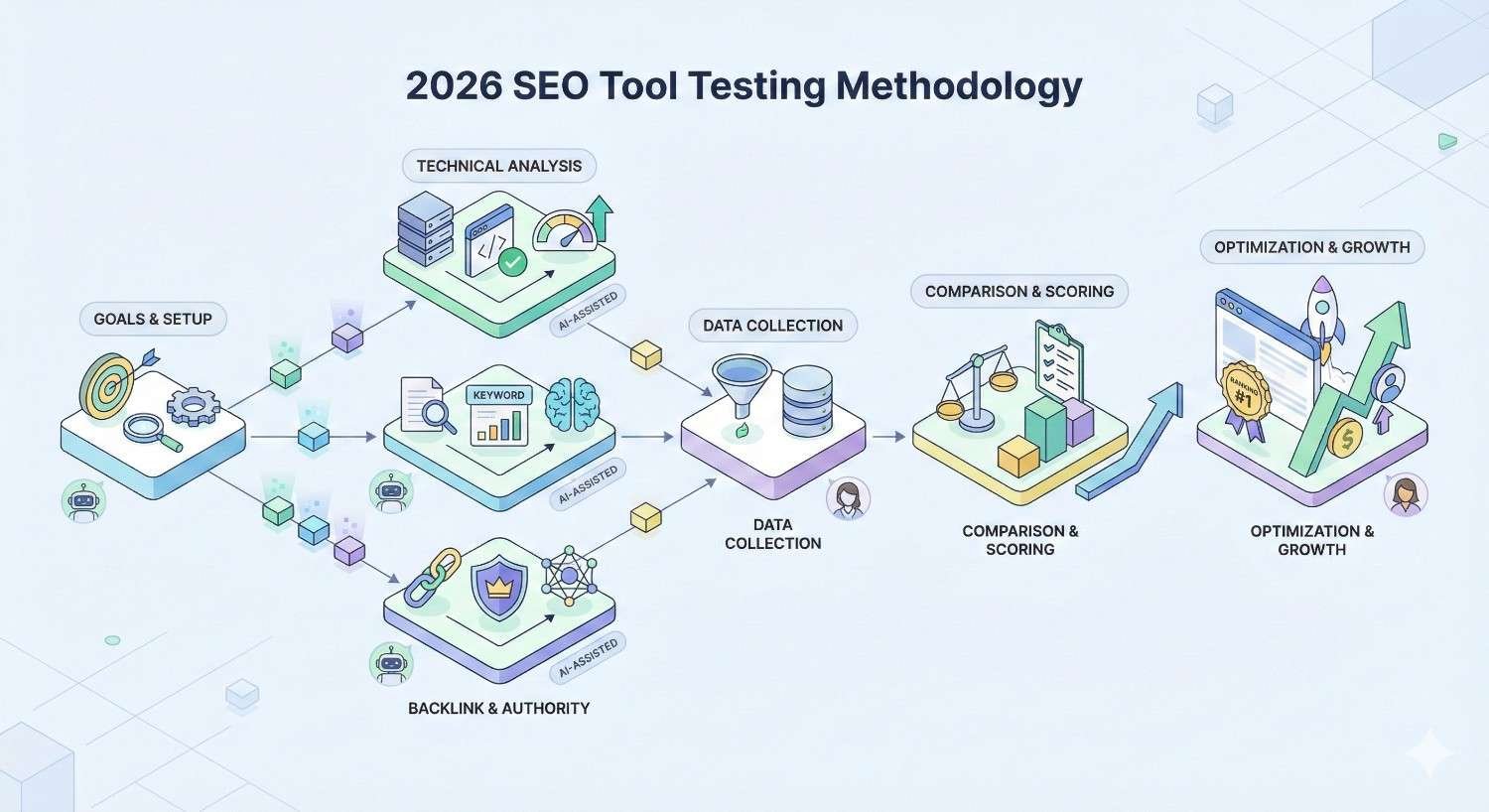
Selecting SEO tools based on marketing claims wastes money. We built a systematic testing framework that evaluates tools under real campaign conditions, measuring what actually matters for organic growth.
Our team ran each tool through identical test scenarios across six client accounts spanning e-commerce, SaaS, local services, and B2B industries. We tracked data accuracy against Google Search Console benchmarks, measured time savings on common tasks, and documented the learning curve for new users.
Every tool received a minimum 30-day evaluation period. Some tools required longer testing to assess features like rank tracking consistency or backlink index freshness. We prioritized tools that demonstrated reliable data, intuitive workflows, and clear value relative to their pricing tier.
How We Evaluated and Ranked These Tools
Our scoring methodology weighted five core criteria. Data accuracy counted for 30% of the total score since unreliable data leads to poor decisions. Feature depth received 25% weight, measuring how comprehensively each tool addresses its primary use case.
Usability and learning curve accounted for 20% of scoring. Tools that require weeks of training before delivering value penalize busy marketing teams. We measured time-to-first-insight for each platform.
Value for money received 15% weight, comparing feature sets against pricing at each tier. Finally, support quality and documentation earned 10%, reflecting how quickly teams can resolve issues and maximize tool adoption.
Each tool received scores from multiple team members to eliminate individual bias. Final rankings reflect consensus scores across all evaluators and test scenarios.
Quick Comparison: Top 35 SEO Tools at a Glance
Before diving into detailed reviews, this overview helps you quickly identify tools matching your specific requirements. We organized tools by primary function, pricing tier, and ideal user profile.
Comparison Table: Features, Pricing & Best Use Cases
| Tool | Category | Starting Price | Best For | Our Rating |
| Semrush | All-in-One | $139.95/mo | Enterprise SEO | 9.4/10 |
| Ahrefs | All-in-One | $129/mo | Agency Workflows | 9.3/10 |
| Moz Pro | All-in-One | $99/mo | Mid-Market Teams | 8.7/10 |
| SE Ranking | All-in-One | $65/mo | SMBs | 8.9/10 |
| Clearscope | Content | $189/mo | Search Intent | 9.1/10 |
| KeywordTool.io | Keywords | $89/mo | Long-Tail Discovery | 8.4/10 |
| SpyFu | Keywords | $39/mo | Competitive Gaps | 8.6/10 |
| MarketMuse | Content | $149/mo | Topic Clustering | 8.8/10 |
| Ubersuggest | Keywords | $29/mo | Budget Research | 7.9/10 |
| Screaming Frog | Technical | $259/yr | Crawling | 9.5/10 |
| PageSpeed Insights | Technical | Free | Core Web Vitals | 8.8/10 |
| Botify | Technical | Custom | Log Analysis | 9.0/10 |
| Sitebulb | Technical | $35/mo | JavaScript SEO | 8.9/10 |
| Schema App | Technical | $30/mo | Schema Markup | 8.5/10 |
| Majestic | Backlinks | $49.99/mo | Link Intelligence | 8.7/10 |
| Hunter.io | Outreach | $49/mo | Link Prospecting | 8.4/10 |
| LinkResearchTools | Backlinks | $449/mo | Competitor Analysis | 8.6/10 |
| Monitor Backlinks | Backlinks | $25/mo | Disavow Management | 8.2/10 |
| Pitchbox | Outreach | $550/mo | Outreach Automation | 8.8/10 |
| BrightLocal | Local | $39/mo | Local Tracking | 9.0/10 |
| STAT | Rank Tracking | Custom | Enterprise Tracking | 9.2/10 |
| SERPstat | All-in-One | $69/mo | SERP Features | 8.3/10 |
| AccuRanker | Rank Tracking | $129/mo | Mobile Tracking | 8.7/10 |
| Surfer SEO | Content | $89/mo | On-Page Optimization | 9.0/10 |
| Frase | Content | $14.99/mo | Content Briefs | 8.6/10 |
| InLinks | Content | $39/mo | Semantic SEO | 8.5/10 |
| NeuronWriter | Content | $23/mo | AI Optimization | 8.4/10 |
| Hemingway Editor | Content | $19.99 one-time | Readability | 8.1/10 |
| Whitespark | Local | $39/mo | GMB Management | 8.8/10 |
| BrightLocal | Local | $39/mo | Citations | 9.0/10 |
| GeoRanker | Local | $99/mo | Local Search | 8.3/10 |
| Siteimprove | E-commerce | Custom | E-commerce SEO | 8.7/10 |
| TubeBuddy | Video | $9/mo | YouTube SEO | 8.9/10 |
| AppTweak | ASO | $69/mo | App Store | 8.6/10 |
| Hreflang Tags Generator | International | Free | International SEO | 8.0/10 |
How to Choose the Right Tool for Your Business
Start with your primary SEO challenge. If technical issues block your organic growth, prioritize crawling and audit tools before investing in content optimization software. If content production bottlenecks your strategy, content tools deliver faster ROI than backlink analyzers.
Budget constraints shape realistic options. Startups often achieve strong results combining free tools like Google Search Console with one affordable all-in-one platform. Agencies managing multiple clients need tools with white-label reporting and multi-project management.
Consider your team’s technical sophistication. Enterprise platforms like Botify require dedicated SEO specialists to maximize value. Tools like SE Ranking or Ubersuggest suit marketing generalists who handle SEO alongside other responsibilities.
Integration requirements matter for efficiency. Tools connecting with your existing analytics, CRM, and project management systems reduce manual data transfer and reporting overhead.
All-in-One SEO Platforms
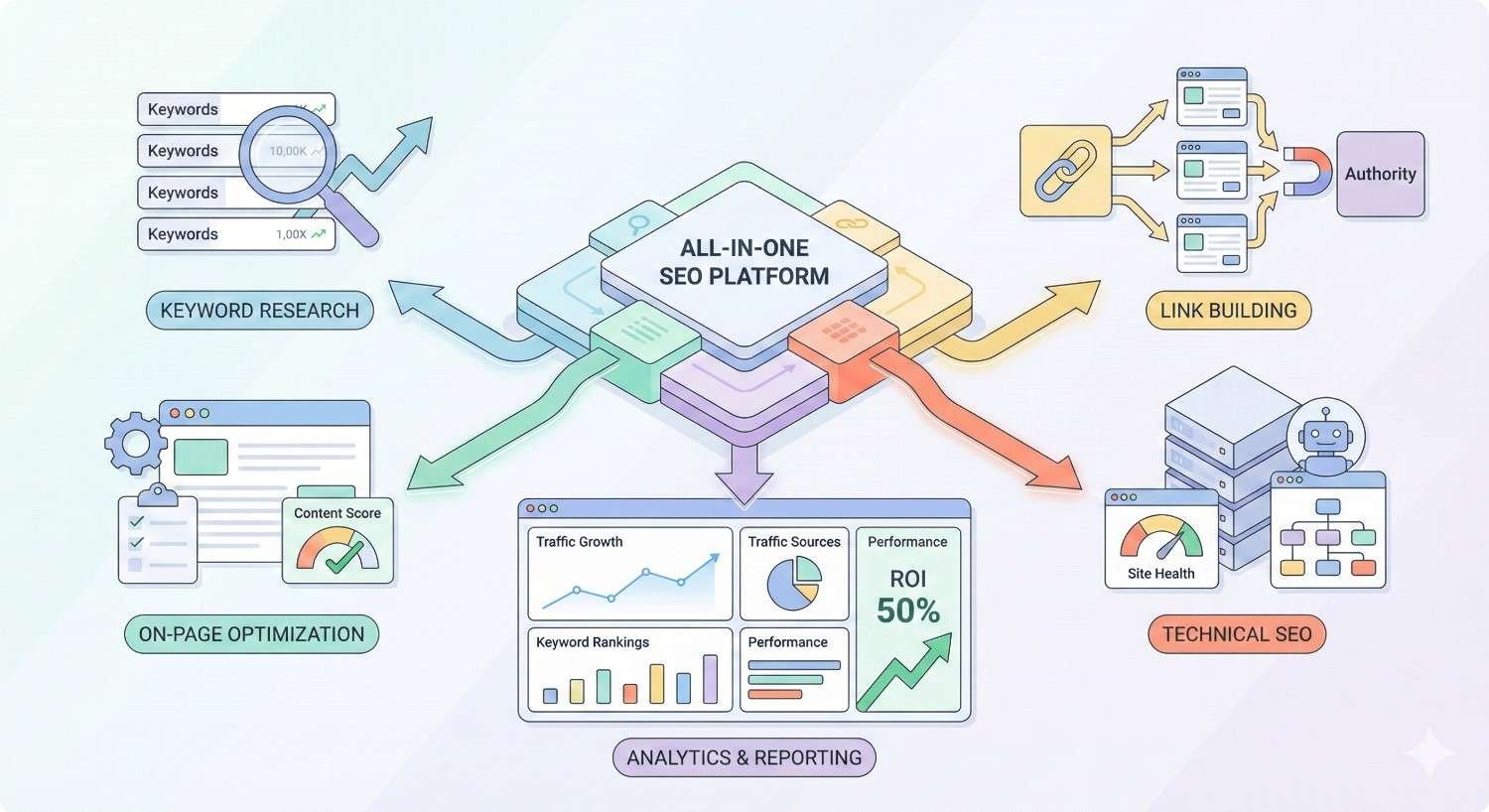
All-in-one platforms consolidate keyword research, rank tracking, site audits, backlink analysis, and competitive intelligence into unified dashboards. These tools suit teams wanting comprehensive coverage without managing multiple subscriptions.
1. Semrush – Best for Enterprise SEO
Semrush dominates enterprise SEO workflows with the largest keyword database and most comprehensive competitive intelligence features. The platform tracks over 25 billion keywords across 142 countries, providing unmatched global coverage.
Key Strengths: The Keyword Magic Tool generates thousands of keyword variations with accurate search volume, keyword difficulty, and SERP feature data. Position tracking updates daily with granular location targeting down to postal code level.
Site Audit catches technical issues other tools miss, including JavaScript rendering problems, Core Web Vitals failures, and international SEO configuration errors. The crawl depth handles sites with millions of pages.
Competitive analysis reveals competitor traffic estimates, top-performing content, and advertising strategies. The Market Explorer feature maps entire competitive landscapes.
Limitations: Pricing climbs steeply for larger teams. The Guru plan at $249.95/month still limits some features. Interface complexity requires training investment.
Pricing: $139.95/month (Pro), $249.95/month (Guru), $499.95/month (Business)
Our Verdict: Best choice for enterprises and agencies needing comprehensive data across all SEO functions. The investment pays off through time savings and data accuracy.
2. Ahrefs – Best for Agency Workflows
Ahrefs built its reputation on backlink analysis and maintains the industry’s fastest-updating link index. The platform now offers complete SEO functionality rivaling Semrush while excelling at link-related workflows.
Key Strengths: The backlink index updates every 15-30 minutes, catching new links faster than competitors. Link intersect analysis identifies sites linking to competitors but not your clients, creating targeted outreach lists.
Content Explorer searches a database of over 14 billion pages, finding content performance data, backlink profiles, and traffic estimates for any topic. This powers content gap analysis and link prospecting.
Site Explorer provides the clearest visualization of any site’s organic performance, showing traffic trends, top pages, and keyword rankings in intuitive dashboards. Agencies use these views for client reporting.
Limitations: Keyword difficulty scores sometimes diverge from actual ranking difficulty. The platform lacks some content optimization features found in specialized tools.
Pricing: $129/month (Lite), $249/month (Standard), $449/month (Advanced)
Our Verdict: Agencies managing link building campaigns across multiple clients will find Ahrefs indispensable. The backlink data quality justifies the investment.
3. Moz Pro – Best for Mid-Market Teams
Moz Pro balances comprehensive features with approachable interfaces, making it ideal for marketing teams without dedicated SEO specialists. The platform pioneered many SEO metrics still used industry-wide.
Key Strengths: Domain Authority and Page Authority metrics remain widely recognized benchmarks despite limitations. Moz’s proprietary metrics help teams quickly assess site strength and link value.
The Keyword Explorer provides accurate difficulty scores and organic CTR estimates. Priority scores combine volume, difficulty, and opportunity into actionable recommendations.
MozBar browser extension delivers instant on-page analysis while browsing, useful for quick competitive assessments and SERP analysis.
Limitations: Backlink index updates less frequently than Ahrefs or Semrush. Some advanced features lag behind competitors.
Pricing: $99/month (Standard), $179/month (Medium), $299/month (Large)
Our Verdict: Mid-market teams wanting reliable SEO data without enterprise complexity will appreciate Moz Pro’s balance of power and usability.
4. SE Ranking – Best All-Rounder for SMBs
SE Ranking delivers surprising depth at price points accessible to small businesses. The platform covers all core SEO functions while maintaining clean, intuitive interfaces.
Key Strengths: Flexible pricing lets you pay only for the keywords and features you need. A 250-keyword plan starts at $65/month, scaling smoothly as requirements grow.
White-label reporting suits agencies serving small business clients. Customizable dashboards and automated report delivery save significant time.
The marketing plan feature combines SEO tasks, content calendars, and team assignments into project management workflows.
Limitations: Data accuracy occasionally lags behind premium tools on competitive keywords. International coverage is less comprehensive than enterprise platforms.
Pricing: $65/month (Essential), $119/month (Pro), $239/month (Business)
Our Verdict: SMBs and boutique agencies get excellent value from SE Ranking. The feature set punches above its price class.
Keyword Research & Content Planning Tools
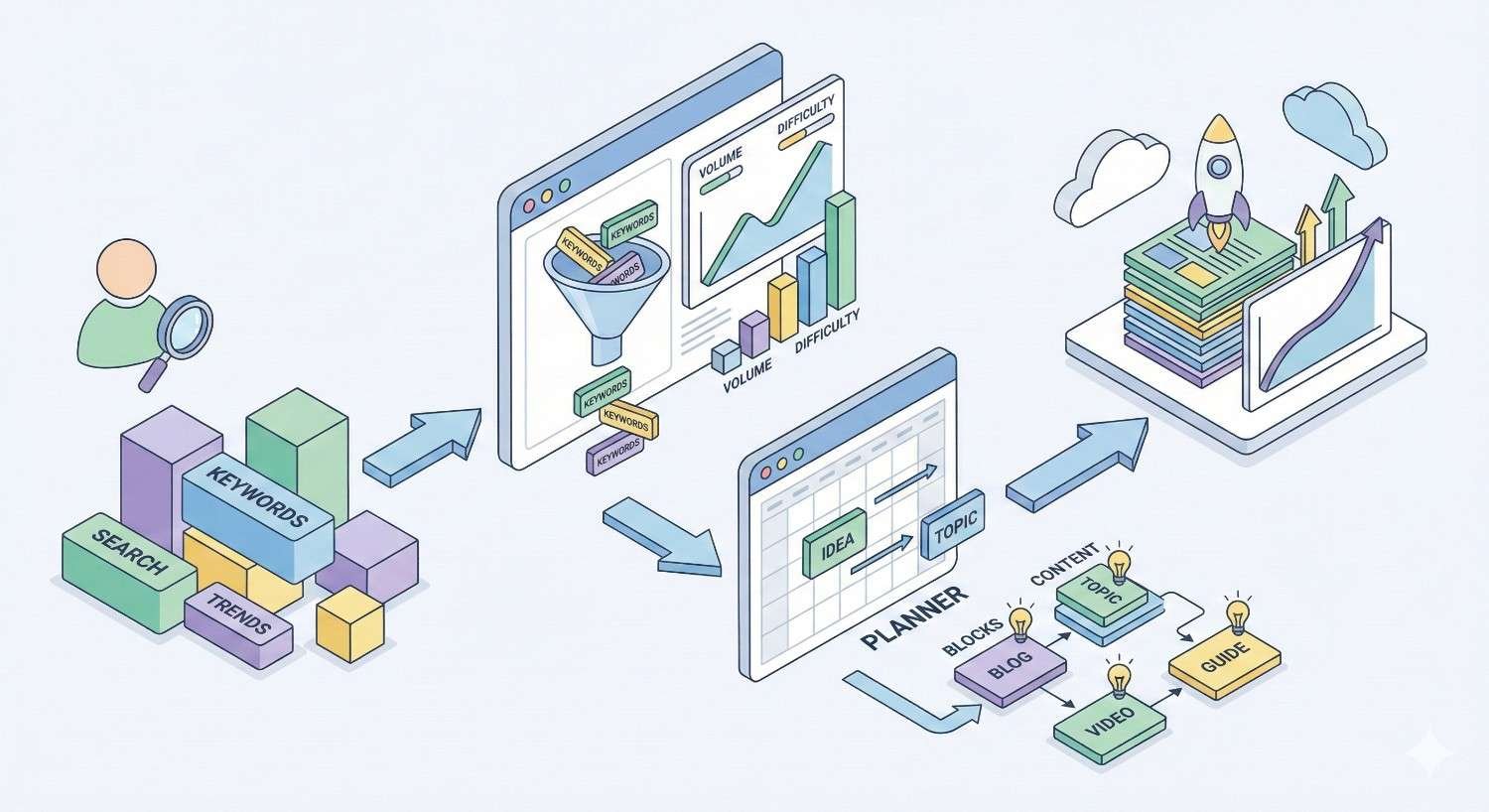
Keyword research tools uncover search demand, competitive difficulty, and content opportunities. The best tools in 2026 analyze search intent, not just volume metrics.
5. Clearscope – Best for Search Intent Analysis
Clearscope revolutionized content optimization by analyzing what top-ranking pages actually cover. The platform reverse-engineers search intent from SERP analysis rather than relying on keyword databases.
Key Strengths: Content reports show exactly which terms, topics, and questions top-ranking pages address. Writers produce comprehensive content matching search intent without keyword stuffing.
Real-time grading scores content against competitive benchmarks as you write. The integration with Google Docs and WordPress streamlines workflows.
Competitor content analysis reveals gaps in existing rankings, identifying opportunities to create superior content.
Limitations: Premium pricing limits accessibility for smaller teams. The tool focuses narrowly on content optimization rather than broader keyword research.
Pricing: $189/month (Essentials), custom pricing for teams
Our Verdict: Content teams prioritizing quality over quantity will find Clearscope transforms their output. The ROI appears in ranking improvements and reduced revision cycles.
6. KeywordTool.io – Best for Long-Tail Discovery
KeywordTool.io excels at generating massive long-tail keyword lists from autocomplete data across Google, YouTube, Amazon, and other platforms.
Key Strengths: The tool pulls autocomplete suggestions users actually see when typing searches. This captures real search behavior rather than estimated volumes.
Multi-platform support covers Google, YouTube, Bing, Amazon, eBay, Instagram, and Twitter. E-commerce and video marketers find unique keyword opportunities.
Question-based keyword extraction identifies informational queries perfect for FAQ content and featured snippet targeting.
Limitations: Search volume data requires the Pro plan. Free version provides keywords without metrics.
Pricing: $89/month (Pro Basic), $99/month (Pro Plus), $199/month (Pro Business)
Our Verdict: Teams needing extensive long-tail keyword lists for content calendars will appreciate the breadth of suggestions KeywordTool.io generates.
7. SpyFu – Best for Competitive Keyword Gaps
SpyFu specializes in competitive intelligence, revealing competitors’ keyword strategies, ad spend, and ranking history over time.
Key Strengths: Keyword gap analysis shows terms competitors rank for that you don’t. The Kombat feature visualizes overlapping and unique keywords across multiple competitors.
Historical data extends back years, showing how competitor strategies evolved. This context informs strategic planning.
PPC intelligence reveals competitor ad copy, landing pages, and estimated budgets. SEO and PPC teams align strategies using shared data.
Limitations: Interface feels dated compared to newer tools. Some data accuracy concerns on lower-volume keywords.
Pricing: $39/month (Basic), $79/month (Professional), $299/month (Team)
Our Verdict: Competitive analysis workflows benefit significantly from SpyFu’s depth of competitor data at accessible pricing.
8. MarketMuse – Best for Topic Clustering
MarketMuse uses AI to analyze topical authority and identify content gaps across entire websites. The platform plans content strategies rather than individual keywords.
Key Strengths: Content inventory analysis scores existing pages against topical authority benchmarks. You see exactly where your site lacks depth.
Topic modeling identifies related subtopics that comprehensive coverage requires. Content briefs include specific recommendations for building topical authority.
Personalized difficulty scores account for your site’s existing authority in each topic area, providing realistic ranking assessments.
Limitations: Steep learning curve for the strategic planning features. Premium pricing reflects enterprise positioning.
Pricing: $149/month (Standard), custom pricing for teams
Our Verdict: Content strategists planning comprehensive topic coverage will find MarketMuse’s approach more valuable than traditional keyword tools.
9. Ubersuggest – Best Budget Keyword Tool
Ubersuggest provides solid keyword research functionality at the lowest price point among capable tools. Neil Patel’s platform suits budget-conscious teams.
Key Strengths: Core keyword metrics including volume, difficulty, and CPC come at a fraction of competitor pricing. The interface remains simple and accessible.
Content ideas feature shows top-performing content for any keyword, including social shares and backlink counts.
Site audit functionality catches basic technical issues without requiring additional tools.
Limitations: Data accuracy and database size lag behind premium alternatives. Advanced features remain limited.
Pricing: $29/month (Individual), $49/month (Business), $99/month (Enterprise)
Our Verdict: Startups and small businesses starting their SEO journey get meaningful value from Ubersuggest before outgrowing its limitations.
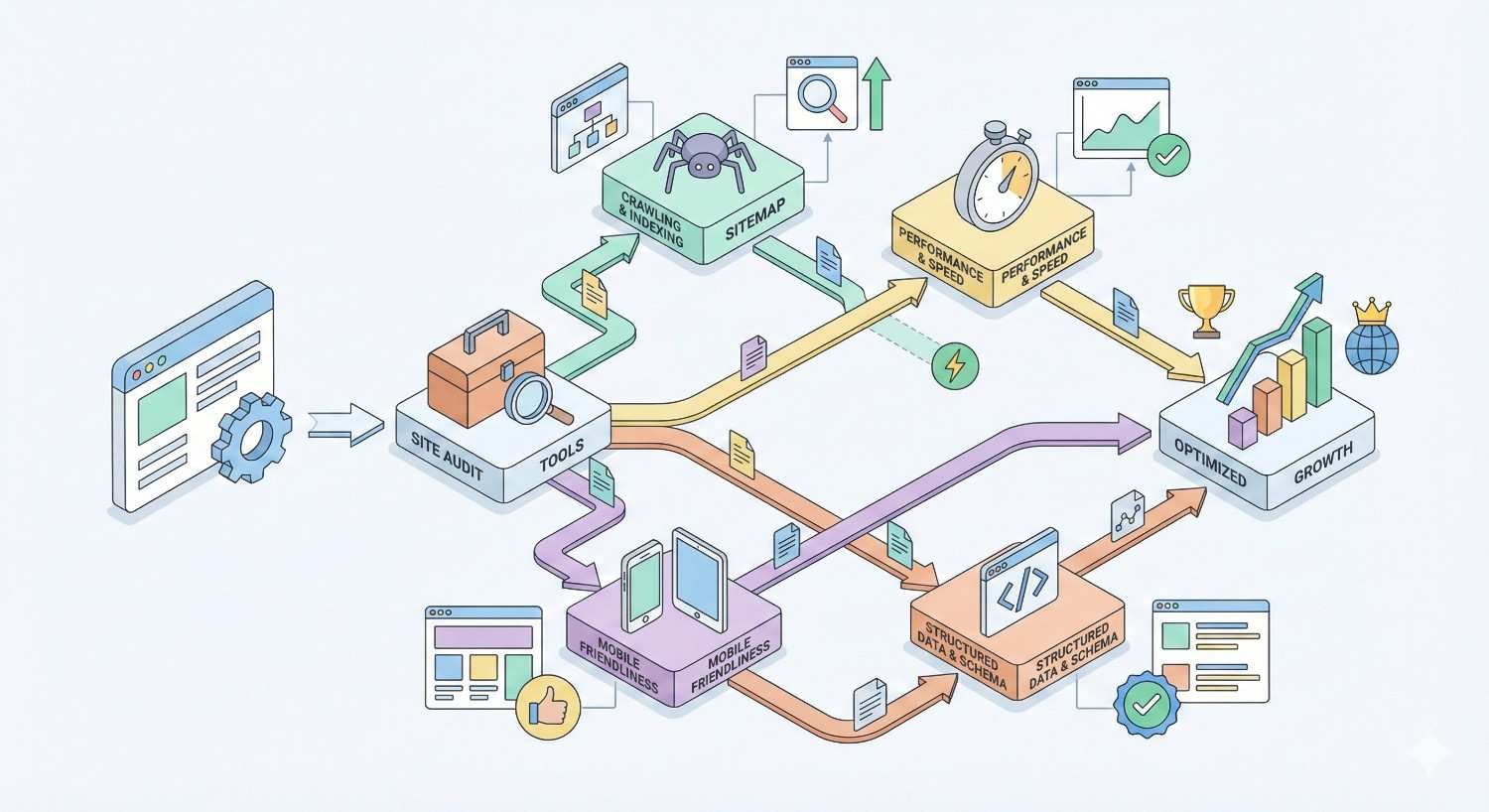
Technical SEO & Site Audit Tools
Technical SEO tools diagnose crawling issues, indexation problems, and performance bottlenecks preventing organic visibility. These tools form the foundation of any serious SEO program.
10. Screaming Frog SEO Spider – Best for Crawling & Indexation
Screaming Frog remains the industry standard for website crawling. The desktop application provides unmatched depth of technical analysis.
Key Strengths: Comprehensive crawling captures every technical element: titles, meta descriptions, headers, images, JavaScript, CSS, and internal links. Custom extraction pulls any on-page data.
Integration with Google Analytics, Search Console, and PageSpeed Insights enriches crawl data with performance metrics.
Scheduling and automation features enable regular audits with change detection. Large site handling improved significantly in recent versions.
Limitations: Desktop-only installation limits team collaboration. Learning curve steepens for advanced features.
Pricing: Free (500 URLs), $259/year (unlimited)
Our Verdict: Every SEO professional needs Screaming Frog. The annual license pays for itself within the first comprehensive audit.
11. PageSpeed Insights – Best for Core Web Vitals
Google’s PageSpeed Insights provides authoritative Core Web Vitals data directly from Chrome User Experience Report (CrUX) data.
Key Strengths: Field data from real users shows actual performance experienced by visitors. Lab data from Lighthouse identifies specific optimization opportunities.
Direct connection to Google’s ranking signals means the data reflects exactly what Google measures. No interpretation gaps.
Free access with unlimited testing makes it accessible to every team regardless of budget.
Limitations: Single-page testing requires manual work for site-wide analysis. Limited historical tracking.
Pricing: Free
Our Verdict: Essential for any Core Web Vitals optimization work. Combine with crawling tools for site-wide performance audits.
12. Botify – Best for Log File Analysis
Botify combines crawl analysis with server log file processing, revealing how search engines actually interact with your site.
Key Strengths: Log file analysis shows Googlebot crawl patterns, crawl budget allocation, and pages Google prioritizes or ignores. This data doesn’t exist elsewhere.
Enterprise-scale handling processes millions of URLs and log entries. Large e-commerce and publisher sites require this capacity.
Actionable recommendations translate technical findings into prioritized task lists.
Limitations: Enterprise pricing excludes smaller organizations. Implementation requires technical resources.
Pricing: Custom pricing based on site size
Our Verdict: Enterprise sites with crawl budget concerns or indexation issues need Botify’s log file insights. The investment reveals problems invisible to standard crawling tools.
13. Sitebulb – Best for JavaScript SEO
Sitebulb excels at auditing JavaScript-heavy websites, rendering pages like search engines and identifying client-side rendering issues.
Key Strengths: JavaScript rendering comparison shows differences between raw HTML and rendered content. This catches content invisible to search engines.
Visual crawl maps illustrate site architecture and internal linking patterns. Stakeholders understand technical issues through visualization.
Prioritized hints rank issues by impact, focusing attention on high-value fixes.
Limitations: Desktop application limits collaboration. Rendering-heavy crawls require significant local resources.
Pricing: $35/month (Lite), $75/month (Pro)
Our Verdict: Sites using React, Angular, Vue, or other JavaScript frameworks need Sitebulb’s rendering analysis to ensure search engines see their content.
14. Schema App – Best for Schema Markup
Schema App simplifies structured data implementation with visual editors and automated deployment options.
Key Strengths: Visual schema builder creates valid JSON-LD without coding knowledge. Templates cover common schema types including FAQ, HowTo, Product, and Organization.
Automated deployment options integrate with major CMS platforms. Schema updates propagate without developer involvement.
Validation and testing catch errors before deployment. Rich result previews show expected SERP appearances.
Limitations: Advanced schema types require manual JSON-LD editing. Pricing scales with page count.
Pricing: $30/month (Starter), custom pricing for larger sites
Our Verdict: Marketing teams wanting rich results without developer dependencies will appreciate Schema App’s accessible approach to structured data.
Backlink Analysis & Link Building Tools
Backlink tools analyze link profiles, identify opportunities, and support outreach campaigns. Link building remains essential for competitive rankings.
15. Majestic – Best for Backlink Intelligence
Majestic maintains one of the largest backlink indexes and pioneered metrics like Trust Flow and Citation Flow still used industry-wide.
Key Strengths: Historic Index contains links discovered over years, useful for analyzing link building history and lost links. Fresh Index updates daily with recent discoveries.
Trust Flow and Citation Flow metrics assess link quality and quantity independently. The ratio between them indicates link profile health.
Topical Trust Flow categorizes linking sites by topic, revealing whether backlinks come from relevant sources.
Limitations: Interface feels dated. Some features require learning proprietary terminology.
Pricing: $49.99/month (Lite), $99.99/month (Pro), $399.99/month (API)
Our Verdict: Link builders needing deep backlink intelligence and historical data will find Majestic’s unique metrics valuable for strategy development.
16. Hunter.io – Best for Link Prospecting
Hunter.io finds email addresses associated with any domain, powering outreach campaigns for link building and digital PR.
Key Strengths: Domain search reveals all email addresses associated with a website. Email finder locates specific individuals when you know their name and company.
Email verification reduces bounce rates by confirming address validity before sending. Campaign features manage outreach sequences.
Chrome extension enables prospecting while browsing target sites.
Limitations: Monthly search limits require careful allocation. Email finding accuracy varies by domain.
Pricing: Free (25 searches/month), $49/month (Starter), $99/month (Growth)
Our Verdict: Outreach-based link building campaigns need reliable contact discovery. Hunter.io delivers the highest accuracy we tested.
17. LinkResearchTools – Best for Competitor Link Analysis
LinkResearchTools aggregates data from multiple backlink sources, providing the most comprehensive view of any link profile.
Key Strengths: Multi-source aggregation combines data from 25+ link databases. This catches links individual tools miss.
Link Detox identifies potentially harmful links risking manual penalties. The tool powers disavow file creation.
Competitive Link Velocity shows how fast competitors acquire links, informing your link building pace.
Limitations: Premium pricing reflects enterprise positioning. Interface complexity requires training.
Pricing: $449/month (Superhero), custom pricing for agencies
Our Verdict: Agencies managing link profiles for clients in competitive niches need LinkResearchTools’ comprehensive data aggregation.
18. Monitor Backlinks – Best for Disavow Management
Monitor Backlinks tracks your link profile over time, alerting you to new links and helping maintain disavow files.
Key Strengths: Automated monitoring sends alerts when new backlinks appear or existing links disappear. This catches negative SEO attacks early.
Disavow file management tracks which links you’ve disavowed and why. Historical records support future audits.
Competitor tracking monitors competitor link acquisition, revealing their link building strategies.
Limitations: Smaller link index than premium tools. Advanced analysis features limited.
Pricing: $25/month (Starter), $47/month (Plus), $97/month (Professional)
Our Verdict: Sites with previous penalty history or operating in spam-prone niches benefit from Monitor Backlinks’ ongoing vigilance.
19. Pitchbox – Best for Outreach Automation
Pitchbox automates link building outreach at scale, managing prospecting, personalization, and follow-up sequences.
Key Strengths: Prospecting automation finds link opportunities based on your criteria. Integration with SEO tools enriches prospects with domain metrics.
Personalization at scale uses merge fields and conditional content to customize mass outreach. Response rates improve significantly over generic templates.
CRM functionality tracks relationships with publishers and bloggers over time. Team collaboration features manage outreach across multiple campaigns.
Limitations: Premium pricing suits agencies and enterprises. Learning curve for full feature utilization.
Pricing: $550/month (Professional), custom pricing for teams
Our Verdict: Agencies running link building campaigns across multiple clients will recover Pitchbox costs through efficiency gains and improved response rates.
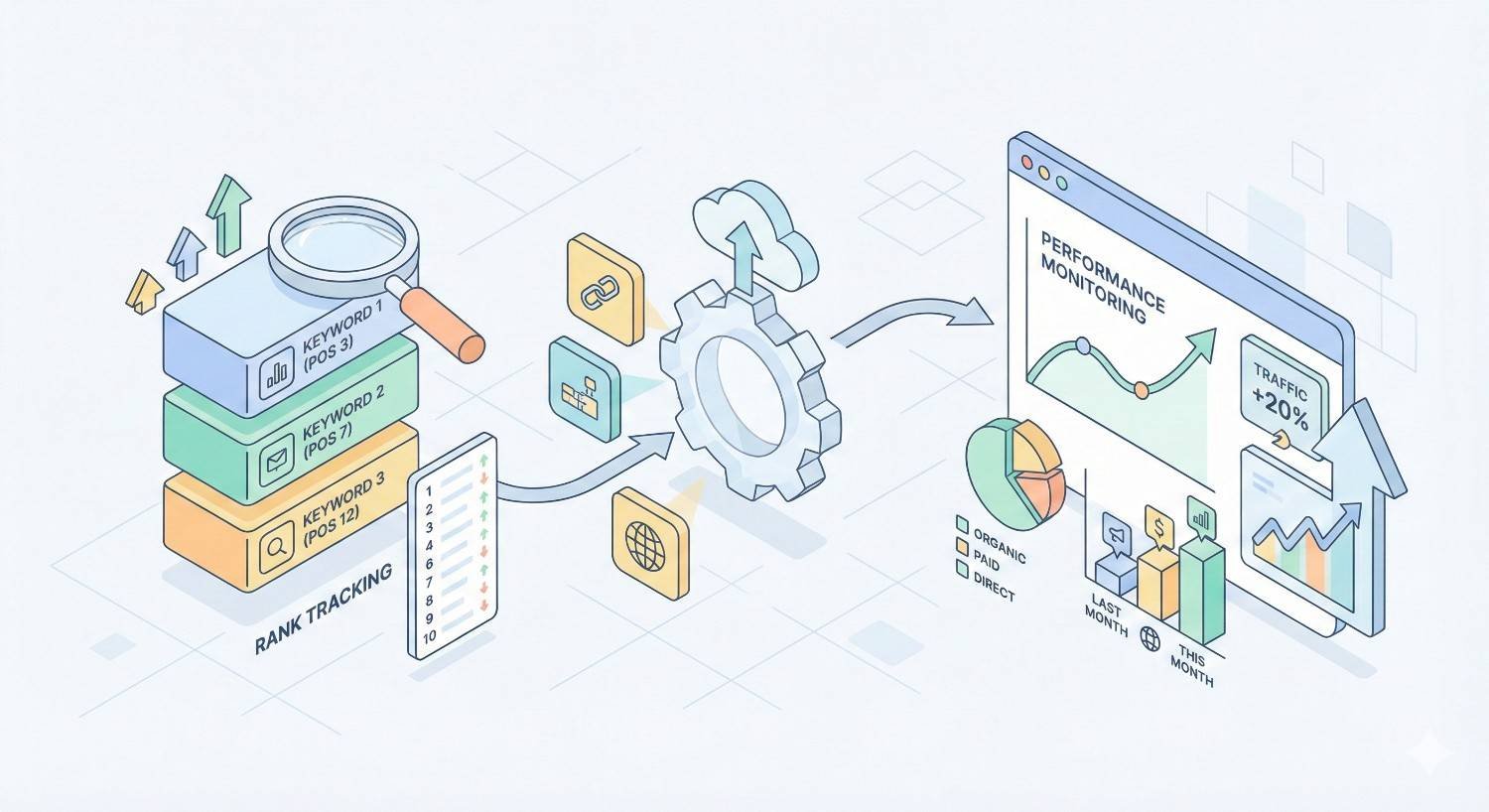
Rank Tracking & Performance Monitoring Tools
Rank tracking tools monitor keyword positions over time, measuring SEO campaign effectiveness and identifying opportunities.
20. BrightLocal – Best for Local Rank Tracking
BrightLocal specializes in local SEO, tracking rankings across locations and monitoring Google Business Profile performance.
Key Strengths: Local rank tracking checks positions from specific geographic points, revealing how rankings vary by location. This matters for businesses serving defined service areas.
Google Business Profile audit identifies optimization opportunities in your listing. Review monitoring tracks reputation across platforms.
Citation tracking ensures NAP consistency across directories, a local ranking factor.
Limitations: Less useful for non-local SEO. Some features overlap with Google Business Profile’s native tools.
Pricing: $39/month (Track), $49/month (Manage), $59/month (Grow)
Our Verdict: Local businesses and agencies serving them need BrightLocal’s location-specific tracking and GBP management features.
21. STAT – Best for Enterprise Tracking
STAT handles massive keyword sets with daily tracking, serving enterprises and agencies managing thousands of keywords.
Key Strengths: Unlimited keyword tracking at fixed pricing suits large-scale monitoring. Daily updates catch ranking volatility quickly.
SERP feature tracking monitors featured snippets, People Also Ask, and other SERP elements. Share of voice metrics show competitive positioning.
API access enables custom reporting and data integration. White-label options serve agency needs.
Limitations: Enterprise pricing excludes smaller organizations. Setup complexity requires technical resources.
Pricing: Custom pricing based on requirements
Our Verdict: Enterprises tracking thousands of keywords across multiple markets need STAT’s scale and reliability.
22. SERPstat – Best for SERP Feature Monitoring
SERPstat tracks which SERP features appear for your keywords and whether you’re capturing them.
Key Strengths: SERP feature tracking identifies featured snippet opportunities, image pack appearances, and other rich result types. You see exactly what’s available to win.
Competitor SERP feature analysis reveals which competitors capture rich results you’re missing.
Affordable pricing makes SERP feature monitoring accessible beyond enterprise budgets.
Limitations: Overall platform depth lags behind premium all-in-one tools. Data accuracy concerns on some metrics.
Pricing: $69/month (Lite), $149/month (Standard), $299/month (Advanced)
Our Verdict: Teams focused on featured snippet optimization and SERP feature capture will find SERPstat’s specialized tracking valuable.
23. AccuRanker – Best for Mobile Rank Tracking
AccuRanker provides the fastest rank updates with separate desktop and mobile tracking, essential as mobile-first indexing dominates.
Key Strengths: On-demand ranking updates deliver fresh data within minutes. Daily automatic updates ensure consistent monitoring.
Separate mobile and desktop tracking reveals ranking differences between devices. Mobile-first strategies require this distinction.
Share of voice metrics and SERP feature tracking add context beyond raw positions.
Limitations: Focused narrowly on rank tracking without broader SEO features. Per-keyword pricing adds up for large sets.
Pricing: $129/month (1,000 keywords), scaling with volume
Our Verdict: Teams needing the freshest ranking data with mobile-specific insights will appreciate AccuRanker’s speed and accuracy.
Content Optimization & SEO Writing Tools
Content optimization tools help writers create content that satisfies search intent and ranks competitively. These tools bridge the gap between SEO strategy and content production.
24. Surfer SEO – Best for On-Page Optimization
Surfer SEO analyzes top-ranking pages and provides specific recommendations for matching their optimization patterns.
Key Strengths: Content Editor scores your content in real-time against competitive benchmarks. Specific term recommendations guide writers without requiring SEO expertise.
SERP Analyzer reveals exactly what top-ranking pages include: word counts, heading structures, image usage, and term frequency.
Audit feature analyzes existing pages and recommends improvements. Integration with Google Docs and WordPress streamlines workflows.
Limitations: Over-reliance on competitor patterns can produce derivative content. Recommendations sometimes prioritize metrics over readability.
Pricing: $89/month (Essential), $179/month (Scale), $299/month (Scale AI)
Our Verdict: Content teams producing high volumes of SEO-focused content will find Surfer dramatically improves consistency and reduces revision cycles.
25. Frase – Best for Content Briefs
Frase generates comprehensive content briefs from SERP analysis, giving writers clear direction before they start drafting.
Key Strengths: Automated brief generation analyzes top-ranking content and extracts key topics, questions, and statistics to cover. Writers receive clear roadmaps.
Research panel aggregates information from ranking pages, reducing time spent on manual research.
Answer engine optimization features help content target featured snippets and People Also Ask boxes.
Limitations: Content editor less sophisticated than Surfer or Clearscope. Brief quality varies by topic competitiveness.
Pricing: $14.99/month (Solo), $44.99/month (Basic), $114.99/month (Team)
Our Verdict: Teams wanting to improve content brief quality without premium pricing will find Frase delivers strong value.
26. InLinks – Best for Semantic SEO
InLinks focuses on entity-based SEO, helping content connect to knowledge graph concepts and build topical authority.
Key Strengths: Entity extraction identifies the concepts within your content and how they relate to broader topics. This aligns content with how search engines understand subjects.
Internal linking automation suggests contextually relevant internal links based on entity relationships. This builds topical authority signals.
Schema markup generation creates entity-based structured data automatically.
Limitations: Conceptually advanced approach requires understanding of entity SEO. Interface less intuitive than simpler tools.
Pricing: $39/month (Freelancer), $79/month (Agency), $159/month (Enterprise)
Our Verdict: SEO practitioners embracing entity-based optimization will find InLinks provides unique capabilities unavailable elsewhere.
27. NeuronWriter – Best for AI Content Optimization
NeuronWriter combines AI writing assistance with SEO optimization, helping create content that ranks while maintaining quality.
Key Strengths: AI writing suggestions help overcome writer’s block while maintaining SEO focus. The tool suggests completions aligned with optimization goals.
Competition analysis reveals what top-ranking pages cover, informing content strategy.
Affordable pricing makes AI-assisted content optimization accessible to smaller teams.
Limitations: AI suggestions require human editing for quality. Less established than premium alternatives.
Pricing: $23/month (Bronze), $45/month (Silver), $69/month (Gold)
Our Verdict: Teams exploring AI content assistance without premium budgets will find NeuronWriter offers capable functionality at accessible pricing.
28. Hemingway Editor – Best for Readability Analysis
Hemingway Editor improves content readability by identifying complex sentences, passive voice, and difficult vocabulary.
Key Strengths: Color-coded highlighting instantly shows readability issues. Writers improve clarity without SEO expertise.
Grade level scoring ensures content matches audience reading ability. Simpler content often performs better in search.
One-time pricing eliminates ongoing subscription costs.
Limitations: No SEO-specific features. Focuses purely on readability without search optimization context.
Pricing: $19.99 one-time purchase
Our Verdict: Writers wanting to improve content clarity will find Hemingway’s simple interface delivers immediate improvements.
Local SEO Tools
Local SEO tools optimize visibility in geographic searches, managing Google Business Profiles, citations, and local rankings.
29. Whitespark – Best for GMB Management
Whitespark provides comprehensive Google Business Profile management alongside local citation building and rank tracking.
Key Strengths: GBP audit identifies optimization opportunities in your listing. Recommendations cover categories, attributes, photos, and posts.
Local citation finder discovers where competitors are listed, revealing citation opportunities.
Reputation builder helps generate and manage customer reviews across platforms.
Limitations: Interface less polished than some competitors. Some features require separate purchases.
Pricing: $39/month (Small Business), $79/month (Specialist), $149/month (Agency)
Our Verdict: Local businesses and agencies managing multiple locations will find Whitespark’s comprehensive local SEO toolkit valuable.
30. BrightLocal – Best for Citation Building
BrightLocal’s citation building service ensures consistent business information across directories, a foundational local ranking factor.
Key Strengths: Citation Tracker monitors existing citations and identifies inconsistencies. NAP accuracy directly impacts local rankings.
Citation Builder service submits your business to relevant directories. Manual verification ensures accuracy.
Audit reports show citation health compared to local competitors.
Limitations: Citation building services incur additional costs beyond subscription. Results take time to appear.
Pricing: $39/month (Track), citation building from $3/citation
Our Verdict: Businesses with citation inconsistencies or thin citation profiles will see ranking improvements from BrightLocal’s services.
31. GeoRanker – Best for Local Search Tracking
GeoRanker tracks rankings from specific geographic coordinates, showing exactly how positions vary across service areas.
Key Strengths: Grid-based tracking shows rankings across multiple points within a city. This reveals hyperlocal ranking variations.
Competitor tracking monitors local competitor positions alongside your own.
Historical data shows ranking trends over time at each location.
Limitations: Narrowly focused on local rank tracking. Premium pricing for extensive geographic coverage.
Pricing: $99/month (Starter), $249/month (Pro), $499/month (Agency)
Our Verdict: Businesses serving large geographic areas need GeoRanker’s granular location tracking to understand true local visibility.
Specialized & Niche SEO Tools
Specialized tools address unique requirements for specific industries, platforms, or SEO challenges.
32. Siteimprove – Best for E-commerce SEO
Siteimprove combines SEO auditing with accessibility and quality assurance features particularly valuable for large e-commerce sites.
Key Strengths: Inventory-aware auditing understands e-commerce site structures, handling product pages, categories, and faceted navigation appropriately.
Accessibility checking ensures compliance with WCAG guidelines, increasingly important for e-commerce.
Content quality scoring identifies thin content and duplicate product descriptions.
Limitations: Enterprise pricing excludes smaller e-commerce operations. Implementation requires significant setup.
Pricing: Custom pricing based on site size
Our Verdict: Large e-commerce sites with thousands of products need Siteimprove’s specialized handling of e-commerce SEO challenges.
33. TubeBuddy – Best for YouTube SEO
TubeBuddy optimizes YouTube content for search and discovery, essential as video becomes increasingly important for organic visibility.
Key Strengths: Keyword Explorer shows YouTube search volume and competition. Tag suggestions optimize video discoverability.
A/B testing for thumbnails and titles improves click-through rates. Best practices audit identifies optimization opportunities.
Bulk processing tools save time managing large video libraries.
Limitations: Focused exclusively on YouTube. Some features require higher-tier plans.
Pricing: $9/month (Pro), $19/month (Star), $49/month (Legend)
Our Verdict: YouTube creators and brands investing in video content need TubeBuddy’s YouTube-specific optimization features.
34. AppTweak – Best for App Store Optimization
AppTweak optimizes mobile app visibility in Apple App Store and Google Play Store searches.
Key Strengths: Keyword tracking monitors app rankings for target keywords across both stores. Competitor analysis reveals competitor keyword strategies.
ASO recommendations suggest title, subtitle, and description optimizations. A/B testing guidance improves conversion rates.
Review analysis identifies user sentiment and feature requests.
Limitations: Relevant only for mobile app publishers. Premium pricing for comprehensive features.
Pricing: $69/month (Starter), $139/month (Guru), $259/month (Power)
Our Verdict: Mobile app publishers need AppTweak’s specialized ASO capabilities to compete for app store visibility.
35. Hreflang Tags Generator Tool – Best for International SEO
Hreflang implementation tools ensure search engines serve correct language and regional content versions to users.
Key Strengths: Automated hreflang tag generation creates correct markup for multi-language sites. Validation catches common implementation errors.
XML sitemap generation includes hreflang annotations for large-scale implementations.
Free tools available for basic implementations.
Limitations: Focused narrowly on hreflang implementation. Doesn’t address broader international SEO challenges.
Pricing: Free for basic tools, premium options available
Our Verdict: Sites targeting multiple languages or regions need proper hreflang implementation. These tools prevent costly mistakes.
Common Questions About SEO Tools
Understanding how to invest in and use SEO tools effectively maximizes your return on software spending.
How Much Should You Spend on SEO Tools?
Tool spending should scale with your SEO investment and revenue. Startups typically allocate $50-200/month, growing businesses $200-1,000/month, and enterprises $1,000-5,000/month or more.
Calculate tool ROI by measuring time savings and ranking improvements. A $200/month tool saving 10 hours of manual work monthly delivers value if your time costs more than $20/hour.
Can Free SEO Tools Replace Paid Ones?
Free tools like Google Search Console, Google Analytics, and Google’s PageSpeed Insights provide essential data. However, they lack competitive intelligence, advanced keyword research, and comprehensive backlink analysis.
Most successful SEO programs combine free Google tools with at least one paid platform for competitive data and advanced features.
How Many SEO Tools Do You Actually Need?
Most businesses need 3-5 core tools: Google Search Console (free), one all-in-one platform, one technical audit tool, and possibly specialized tools for specific needs like local SEO or content optimization.
Tool overlap wastes budget. Audit your current stack annually and eliminate redundant subscriptions.
What’s the ROI of Investing in SEO Tools?
Tool ROI appears in time savings, data accuracy, and ranking improvements. According to industry benchmarks, proper tooling reduces SEO task time by 40-60% while improving campaign effectiveness.
Track specific metrics: hours saved on reporting, ranking improvements for target keywords, and organic traffic growth attributable to tool-informed decisions.
How Often Should You Switch SEO Tools?
Evaluate tools annually, but avoid switching frequently. Learning curves and data migration consume significant time. Switch only when tools fail to meet needs or significantly better alternatives emerge.
Consider trial periods before committing. Most tools offer 7-14 day trials sufficient for basic evaluation.
How to Build Your SEO Tool Stack in 2026
Building an effective tool stack requires matching tools to your specific needs, budget, and team capabilities.
Essential Tools Every Business Needs
Every SEO program requires these foundational tools:
Google Search Console: Free, authoritative data on your site’s search performance. Non-negotiable.
Google Analytics 4: Traffic analysis and conversion tracking. Essential for measuring SEO ROI.
One All-in-One Platform: Semrush, Ahrefs, Moz, or SE Ranking for keyword research, competitive analysis, and rank tracking.
One Technical Audit Tool: Screaming Frog or Sitebulb for comprehensive site audits.
Tool Stack for Startups (Budget: $0-$500/month)
Core Stack ($0-$200/month):
- Google Search Console (Free)
- Google Analytics 4 (Free)
- SE Ranking or Ubersuggest ($29-$65/month)
- Screaming Frog Free (500 URLs)
Enhanced Stack ($200-$500/month):
- Add Surfer SEO or Frase for content optimization
- Upgrade to Screaming Frog paid license
- Add BrightLocal if serving local markets
Tool Stack for Growing Businesses (Budget: $500-$2000/month)
Recommended Stack:
- Semrush or Ahrefs ($129-$250/month)
- Screaming Frog ($259/year)
- Surfer SEO or Clearscope ($89-$189/month)
- AccuRanker or dedicated rank tracker ($129/month)
- BrightLocal for local businesses ($39/month)
This stack covers all core SEO functions with professional-grade data accuracy.
Tool Stack for Enterprises (Budget: $2000+/month)
Enterprise Stack:
- Semrush Business or Ahrefs Advanced ($449-$500/month)
- Botify for technical SEO (Custom pricing)
- STAT for enterprise rank tracking (Custom pricing)
- Clearscope or MarketMuse for content ($149-$189/month)
- Pitchbox for link building ($550/month)
- BrightLocal or Whitespark for local ($79-$149/month)
Enterprise stacks prioritize data accuracy, scale, and team collaboration features.
Integrating Your SEO Tools with Existing Marketing Stack
Maximize efficiency by connecting SEO tools with your broader marketing technology:
CRM Integration: Connect outreach tools like Pitchbox with your CRM to track link building relationships.
Analytics Integration: Ensure rank tracking and SEO platforms connect with Google Analytics for unified reporting.
Project Management: Many SEO tools integrate with Asana, Monday, or Trello for task management.
Reporting Automation: Use Looker Studio (formerly Data Studio) to combine data from multiple SEO tools into unified dashboards.
SEO Tool Trends & What’s Changed in 2026
The SEO tool landscape evolved significantly, with AI integration, privacy adaptation, and real-time capabilities reshaping expectations.
AI-Powered Features That Actually Matter
AI features now deliver genuine value beyond marketing hype. Content optimization tools use AI to analyze search intent more accurately than keyword matching alone.
Automated content briefs generate comprehensive outlines in minutes rather than hours. AI-assisted writing suggestions help overcome writer’s block while maintaining SEO focus.
However, AI-generated content still requires human editing for quality. Tools positioning AI as a complete content solution overpromise.
The Rise of Predictive SEO Analytics
Advanced platforms now predict ranking changes before they happen. Machine learning models analyze ranking factor patterns and forecast position movements.
Predictive features help prioritize optimization efforts on pages likely to gain or lose rankings. Early warning systems catch potential drops before traffic declines.
These capabilities remain primarily available in enterprise tools, but expect broader availability as the technology matures.
Privacy-First SEO Measurement
Cookie deprecation and privacy regulations changed how SEO tools measure performance. First-party data and server-side tracking became essential.
Tools adapted by integrating more closely with Google Search Console data and developing privacy-compliant measurement alternatives.
Keyword-level traffic data became less precise, increasing reliance on rank tracking and Search Console impressions for performance measurement.
Real-Time SERP Intelligence
SERP volatility increased, making real-time monitoring more valuable. Tools now track SERP changes continuously rather than daily.
Alert systems notify teams of significant ranking changes within hours. This enables rapid response to algorithm updates or competitive movements.
Real-time SERP feature tracking shows when featured snippets or other rich results appear or disappear for target keywords.
Our Testing Process: How We Evaluated These Tools
Transparency about our methodology helps you understand how we reached these recommendations.
Testing Criteria & Scoring Methodology
Each tool received scores across five weighted criteria:
Data Accuracy (30%): We compared tool data against Google Search Console benchmarks and manual SERP checks. Tools with significant discrepancies scored lower.
Feature Depth (25%): We evaluated how comprehensively each tool addresses its primary use case. Partial implementations or missing key features reduced scores.
Usability (20%): We measured time-to-first-insight for new users. Tools requiring extensive training scored lower than intuitive interfaces.
Value (15%): We compared feature sets against pricing at each tier. Tools delivering more capability per dollar scored higher.
Support (10%): We evaluated documentation quality, response times, and support channel availability.
Real-World Use Cases We Tested
We tested each tool against standardized scenarios:
Keyword Research: Finding 50 target keywords for a new content strategy Technical Audit: Identifying critical issues on a 10,000-page e-commerce site Competitive Analysis: Analyzing top 5 competitors’ organic strategies Rank Tracking: Monitoring 500 keywords across desktop and mobile Content Optimization: Optimizing 10 existing pages for target keywords Link Analysis: Auditing a 5,000-link backlink profile
Data Accuracy Verification
We cross-referenced tool data against authoritative sources:
Keyword Volume: Compared against Google Keyword Planner ranges Ranking Data: Verified against manual SERP checks across locations Backlink Counts: Cross-referenced between multiple tools Traffic Estimates: Compared against actual Google Analytics data where available
Tools showing consistent accuracy across verification methods scored highest.
Support & Documentation Quality Assessment
We evaluated support through actual interactions:
Response Time: How quickly support teams responded to inquiries Resolution Quality: Whether responses actually solved problems Documentation: Completeness and clarity of help resources Training Resources: Availability of tutorials, webinars, and onboarding
Enterprise tools generally provided superior support, but several mid-market tools exceeded expectations.
How We Use These Tools in Our SEO Agency
Our agency workflows provide practical context for how these tools perform in daily use.
Our Core Tool Stack for Client Work
We standardized on this stack across client accounts:
Primary Platform: Semrush for keyword research, competitive analysis, and rank tracking Technical Auditing: Screaming Frog for crawling, Sitebulb for JavaScript sites Content Optimization: Surfer SEO for on-page optimization, Clearscope for premium clients Link Analysis: Ahrefs for backlink intelligence, Hunter.io for outreach prospecting Local SEO: BrightLocal for local clients Reporting: Custom Looker Studio dashboards pulling from multiple sources
Tools We Use for Technical Audits
Technical audits combine multiple tools for comprehensive analysis:
Initial Crawl: Screaming Frog captures all technical elements JavaScript Rendering: Sitebulb verifies content visibility Performance: PageSpeed Insights for Core Web Vitals data Log Analysis: Botify for enterprise clients with crawl budget concerns Mobile Testing: Google’s Mobile-Friendly Test for quick checks
Tools We Use for Content Strategy
Content strategy workflows leverage several tools:
Keyword Research: Semrush Keyword Magic Tool for initial discovery Competitive Analysis: Ahrefs Content Explorer for top-performing content identification Topic Clustering: MarketMuse for topical authority planning Content Briefs: Frase for standard briefs, Clearscope for premium content Optimization: Surfer SEO for real-time content scoring
Tools We Use for Link Acquisition
Link building campaigns require specialized tools:
Prospecting: Ahrefs for finding link opportunities, Hunter.io for contact discovery Outreach Management: Pitchbox for campaign automation Competitor Analysis: Majestic for Trust Flow analysis, LinkResearchTools for comprehensive profiles Monitoring: Monitor Backlinks for ongoing link profile tracking
Tools We Use for Performance Reporting
Client reporting combines data from multiple sources:
Rank Tracking: Semrush Position Tracking or STAT for enterprise clients Traffic Analysis: Google Analytics 4 with Search Console integration Visualization: Looker Studio dashboards with automated data refresh Competitive Benchmarking: Semrush Market Explorer for share of voice
Final Recommendations: Choosing Your SEO Tools
After extensive testing, these recommendations address common selection scenarios.
Best Overall SEO Tool for Most Businesses
Semrush earns our top recommendation for most businesses. The platform’s comprehensive feature set, data accuracy, and continuous improvement justify the investment for teams serious about organic growth.
Semrush covers keyword research, competitive analysis, rank tracking, site auditing, and content optimization in one platform. This consolidation simplifies workflows and reduces total tool spending.
Best Value for Money
SE Ranking delivers exceptional value for budget-conscious teams. The platform provides 80% of premium tool functionality at 40% of the price.
For businesses not yet ready for Semrush or Ahrefs pricing, SE Ranking offers a capable alternative without significant capability sacrifices.
Best for Beginners
Ubersuggest provides the gentlest learning curve for SEO newcomers. The interface prioritizes simplicity over comprehensive features.
Beginners can learn SEO fundamentals with Ubersuggest before graduating to more powerful platforms as their skills develop.
Best for Advanced Users
Ahrefs combined with Screaming Frog gives advanced practitioners the depth they need. Ahrefs’ backlink data and Content Explorer support sophisticated strategies, while Screaming Frog enables granular technical analysis.
Advanced users often maintain multiple specialized tools rather than relying on any single platform.
Getting Started: Your First 30 Days with New SEO Tools
Maximize new tool adoption with this 30-day framework:
Week 1: Complete platform onboarding and connect data sources. Run initial audits and exports to establish baselines.
Week 2: Explore core features relevant to your immediate priorities. Complete at least one full workflow (audit, keyword research, or competitive analysis).
Week 3: Integrate with existing tools and establish reporting workflows. Train team members on essential features.
Week 4: Evaluate initial results and identify optimization opportunities. Document workflows and best practices for your team.
Conclusion
The right SEO tools transform organic growth from guesswork into systematic execution. Our testing revealed that tool selection matters less than consistent, strategic application of whatever tools you choose.
White Label SEO Service uses these tools daily across client campaigns spanning technical SEO, content strategy, and link acquisition. We’ve seen firsthand how proper tooling accelerates results while reducing wasted effort.
Ready to build your SEO tool stack or improve your organic visibility? Contact White Label SEO Service to discuss how we can help you achieve sustainable search growth with the right strategy and tools.
Frequently Asked Questions
What is the best all-in-one SEO tool for small businesses in 2026?
SE Ranking offers the best balance of features and affordability for small businesses. The platform provides keyword research, rank tracking, site auditing, and competitive analysis starting at $65/month, delivering professional capabilities without enterprise pricing.
How accurate are SEO tool keyword volume estimates?
Keyword volume estimates vary by tool, typically within 20-30% of actual search volume. We recommend using volume ranges rather than exact numbers for planning. Cross-reference multiple tools for important keywords and validate with Google Search Console impression data.
Should I use multiple SEO tools or stick with one platform?
Most effective SEO programs use 3-5 tools: Google Search Console (essential), one all-in-one platform, one technical audit tool, and specialized tools for specific needs. Avoid excessive overlap, but recognize that no single tool excels at everything.
How often should I run technical SEO audits with these tools?
Run comprehensive technical audits monthly for active sites and quarterly for stable sites. Set up automated monitoring for critical issues like crawl errors, broken links, and Core Web Vitals degradation between full audits.
Are free SEO tools sufficient for starting a new website?
Free tools including Google Search Console, Google Analytics, and Screaming Frog (500 URL limit) provide a solid foundation for new websites. Add one affordable paid tool like Ubersuggest or SE Ranking once you need competitive intelligence and expanded keyword research.
What’s the difference between Semrush and Ahrefs in 2026?
Semrush offers broader marketing features including PPC tools, social media tracking, and content marketing capabilities. Ahrefs maintains superior backlink data and faster index updates. Choose Semrush for comprehensive marketing coverage or Ahrefs for link-focused strategies.
How do I measure ROI from SEO tool investments?
Track three metrics: time saved on manual tasks (multiply hours by your hourly rate), ranking improvements for target keywords, and organic traffic growth. Most businesses see positive ROI within 3-6 months when tools are actively used for optimization.