
Inconsistent business citations cost local businesses visibility, trust, and revenue every single day. When your name, address, or phone number appears differently across directories, search engines struggle to verify your legitimacy—and potential customers get confused or lost entirely.
Citation cleanup services exist to solve this exact problem. They systematically find, correct, and maintain accurate business information across hundreds of online directories, data aggregators, and platforms. For businesses serious about local SEO performance, this isn’t optional maintenance—it’s foundational work.
This guide covers everything you need to know: what citation cleanup involves, why it matters for rankings, common problems that need fixing, how professional services work, realistic timelines, costs, and how to choose the right provider for your business.
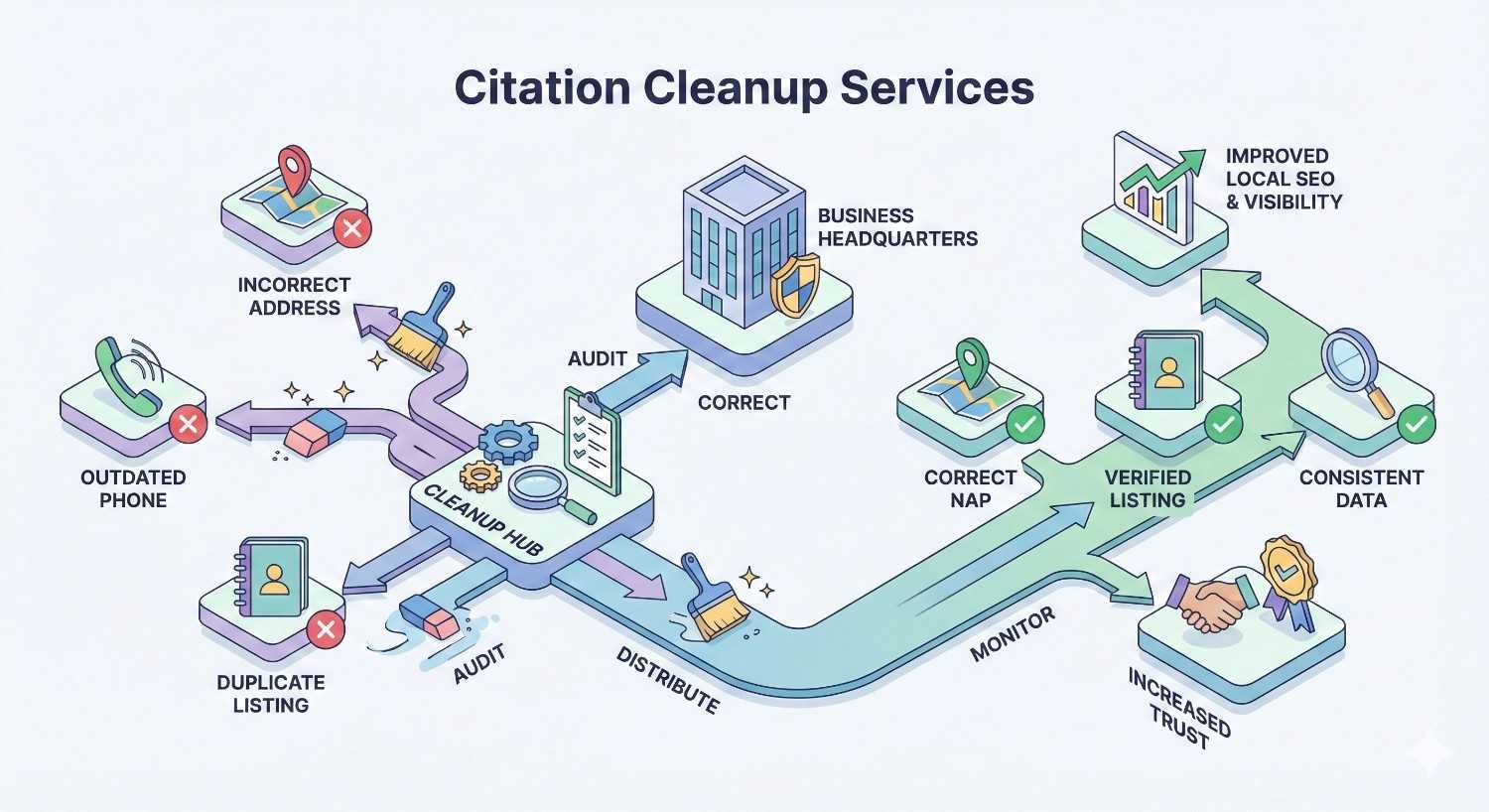
What Are Citation Cleanup Services?
Citation cleanup services specialize in identifying and correcting inaccurate, inconsistent, or duplicate business listings across the web. These services audit your existing citations, locate errors, submit corrections to directories and data aggregators, and monitor your listings over time to prevent new inconsistencies from emerging.
The goal is simple: ensure every mention of your business online displays identical, accurate information. This consistency sends strong trust signals to search engines and helps customers find and contact you without friction.
Definition of Business Citations
A business citation is any online mention of your company’s core identifying information—typically your business name, address, and phone number (NAP). Citations appear on business directories like Yelp and Yellow Pages, data aggregators like Data Axle and Foursquare, social media platforms, industry-specific directories, and local chamber of commerce websites.
Citations can be structured (appearing in a formal business listing format) or unstructured (mentioned within blog posts, news articles, or reviews). Both types contribute to how search engines understand and verify your business identity.
Search engines use citations as a validation mechanism. When multiple authoritative sources display consistent information about your business, it reinforces your legitimacy and geographic relevance. When information conflicts, it creates uncertainty that can suppress your local search visibility.
How Citation Errors Occur
Citation errors rarely happen through malicious intent. They accumulate naturally over time through normal business operations and data ecosystem dynamics.
Business changes create the most common errors. Moving locations, changing phone numbers, rebranding, or adjusting your legal business name all generate inconsistencies if old listings aren’t updated. Many businesses have moved multiple times over the years, leaving a trail of outdated addresses across dozens of directories.
Data aggregator propagation compounds the problem. Major data aggregators supply business information to hundreds of downstream directories. If incorrect data enters an aggregator, it spreads automatically across their entire network—sometimes faster than you can correct it manually.
User-generated content introduces errors when customers or third parties create listings on your behalf. Well-meaning users might submit your business to a directory with a slightly different name spelling or an outdated phone number they found elsewhere.
Automated scraping by directories can pull inconsistent information from various sources, creating listings you never knew existed with details you never provided.
Types of Citation Inconsistencies
Citation inconsistencies fall into several categories, each creating different problems for local SEO and customer experience.
NAP variations include differences in how your business name appears (abbreviations, punctuation, legal suffixes), address formatting (suite numbers, street abbreviations, zip code extensions), and phone number formats (with or without area codes, different numbers entirely).
Duplicate listings occur when the same business appears multiple times on a single platform—often with slightly different information on each listing. This fragments your reviews, confuses customers, and dilutes your authority signals.
Outdated information persists when old listings remain active after business changes. Former addresses, disconnected phone numbers, and previous business names continue appearing in search results.
Category mismatches happen when your business is listed under incorrect or suboptimal categories, reducing your visibility for relevant searches.
Missing information weakens listings that lack complete details—missing hours, website URLs, or business descriptions reduce both user experience and ranking potential.
Why Citation Cleanup Matters for Local SEO
Citation accuracy directly influences how search engines evaluate and rank local businesses. Google’s local search algorithm uses citations as one of several key ranking factors, making cleanup work essential for businesses competing in local search results.
Beyond rankings, citation consistency affects how customers perceive and interact with your business. Conflicting information creates friction that costs you leads and sales.
Impact on Local Search Rankings
Moz’s annual Local Search Ranking Factors survey consistently identifies citation signals among the top factors influencing local pack and localized organic rankings. While the exact algorithmic weight varies, the correlation between citation consistency and ranking performance is well-documented across the SEO industry.
Search engines use citations to verify business legitimacy and geographic relevance. When your NAP information matches across authoritative sources, it confirms you’re a real business operating at a specific location. This verification strengthens your candidacy for local search results.
Inconsistent citations create the opposite effect. Conflicting information introduces uncertainty into the algorithm’s evaluation. Search engines may struggle to determine your correct address, question whether multiple listings represent the same business, or simply rank competitors with cleaner citation profiles higher.
The impact compounds in competitive markets. When multiple businesses compete for limited local pack positions, citation quality often serves as a tiebreaker. Businesses with consistent, widespread citations across authoritative directories gain an edge over competitors with messy citation profiles.
NAP Consistency and Trust Signals
NAP consistency functions as a trust signal for both search engines and users. Consistent information across multiple independent sources suggests your business is established, legitimate, and accurately represented online.
Search engines interpret this consistency as validation. If Yelp, Yellow Pages, Facebook, and industry directories all display identical information, it reinforces the accuracy of that data. The algorithm can confidently associate your business with a specific location and contact information.
Inconsistency triggers the opposite response. When sources conflict, search engines must determine which information is correct—or whether the listings even represent the same business. This uncertainty can suppress rankings while the algorithm attempts to resolve the discrepancy.
For users, NAP consistency builds confidence. Customers researching local businesses often check multiple sources before making contact. Finding the same information everywhere reassures them they have the correct details. Finding conflicting information raises questions about which data is current and whether the business is still operating.
Effects on Customer Experience
Citation errors create real friction in the customer journey. Every incorrect phone number, outdated address, or duplicate listing represents a potential lost customer.
Wrong phone numbers mean missed calls. Customers who dial disconnected numbers or reach wrong numbers often move on to competitors rather than searching for correct contact information.
Incorrect addresses waste customer time and create frustration. Someone who drives to your old location—especially if another business now occupies that space—may not make the effort to find your current address.
Duplicate listings fragment your online presence. Reviews get split across multiple profiles, making your business appear less established. Customers may contact the wrong listing and receive no response if you’re only monitoring one.
Inconsistent business names create confusion about whether listings represent the same company. Customers may not realize “Smith’s Plumbing” and “Smith Plumbing Services LLC” are the same business, missing reviews or information on one listing while viewing another.
These friction points accumulate. Each small inconsistency represents a percentage of potential customers lost to confusion, frustration, or simple inability to reach you.
Common Citation Problems That Need Fixing
Understanding the specific problems citation cleanup addresses helps you assess your own situation and evaluate service providers. Most businesses accumulate multiple types of errors over time, often without realizing the extent of the problem.
Duplicate Listings
Duplicate listings rank among the most damaging citation problems. They occur when your business appears multiple times on the same platform, typically with slightly different information on each listing.
Duplicates commonly arise from multiple sources creating listings independently. A business owner might claim a listing on Google, while an employee creates another, and a data aggregator submits a third. Each listing may have minor variations in business name, address formatting, or phone number.
The damage from duplicates extends beyond simple confusion. Reviews get distributed across multiple profiles, diluting your apparent reputation. Customers may contact one listing while you monitor another, missing inquiries entirely. Search engines may struggle to determine which listing is authoritative, potentially suppressing all of them.
Duplicate suppression requires identifying all instances, determining which listing to keep (typically the one with the most reviews and engagement), and requesting removal or merger of the others. This process varies by platform—some make it straightforward, others require extensive documentation and follow-up.
Incorrect Business Information
Incorrect information encompasses any inaccurate details in your listings beyond simple formatting differences. This includes wrong phone numbers, incorrect addresses, outdated business names, inaccurate hours, and wrong website URLs.
These errors often originate from data aggregators. When incorrect information enters the aggregator ecosystem, it propagates to downstream directories automatically. Correcting the source doesn’t always fix downstream listings, which may retain cached data for months.
Incorrect information also accumulates through user submissions. Customers, competitors, or automated systems may suggest edits to your listings—sometimes introducing errors rather than fixing them. Platforms like Google allow users to suggest changes, which may be applied without your knowledge.
The correction process requires identifying all instances of incorrect information, submitting corrections through each platform’s update mechanism, and following up to ensure changes are applied. Some platforms process updates quickly; others take weeks or months.
Outdated Addresses and Phone Numbers
Address and phone number changes create some of the most persistent citation problems. When businesses move or change phone numbers, old information remains embedded across dozens or hundreds of directories.
The challenge intensifies because many directories don’t actively verify or update their data. A listing created five years ago may still display your original address even if you’ve moved twice since then. Some directories make updates difficult, requiring business verification processes that take weeks to complete.
Old phone numbers create immediate customer loss. Someone searching for your business, finding an old listing, and calling a disconnected number has no easy path to reaching you. They’ll likely call a competitor instead.
Old addresses cause similar problems, compounded by the frustration of wasted travel time. Customers who arrive at your former location—especially if it’s now occupied by a different business—face confusion and inconvenience that damages their perception of your company.
Inconsistent Business Names
Business name inconsistencies appear minor but create significant problems for citation consistency and search engine understanding.
Common variations include abbreviations (St. vs Street, Inc. vs Incorporated), punctuation differences (Smith’s vs Smiths vs Smith’s), and legal suffix variations (LLC, Inc., Corp., or no suffix). While humans easily recognize these as the same business, search algorithms may not.
Name inconsistencies often originate from different people creating listings at different times. An owner might use the full legal name on one platform while an employee uses a shortened version elsewhere. Data aggregators may have yet another variation in their records.
The solution requires establishing a canonical business name and systematically updating all listings to match. This standardization helps search engines confidently associate all your citations with a single business entity, strengthening your overall citation profile.
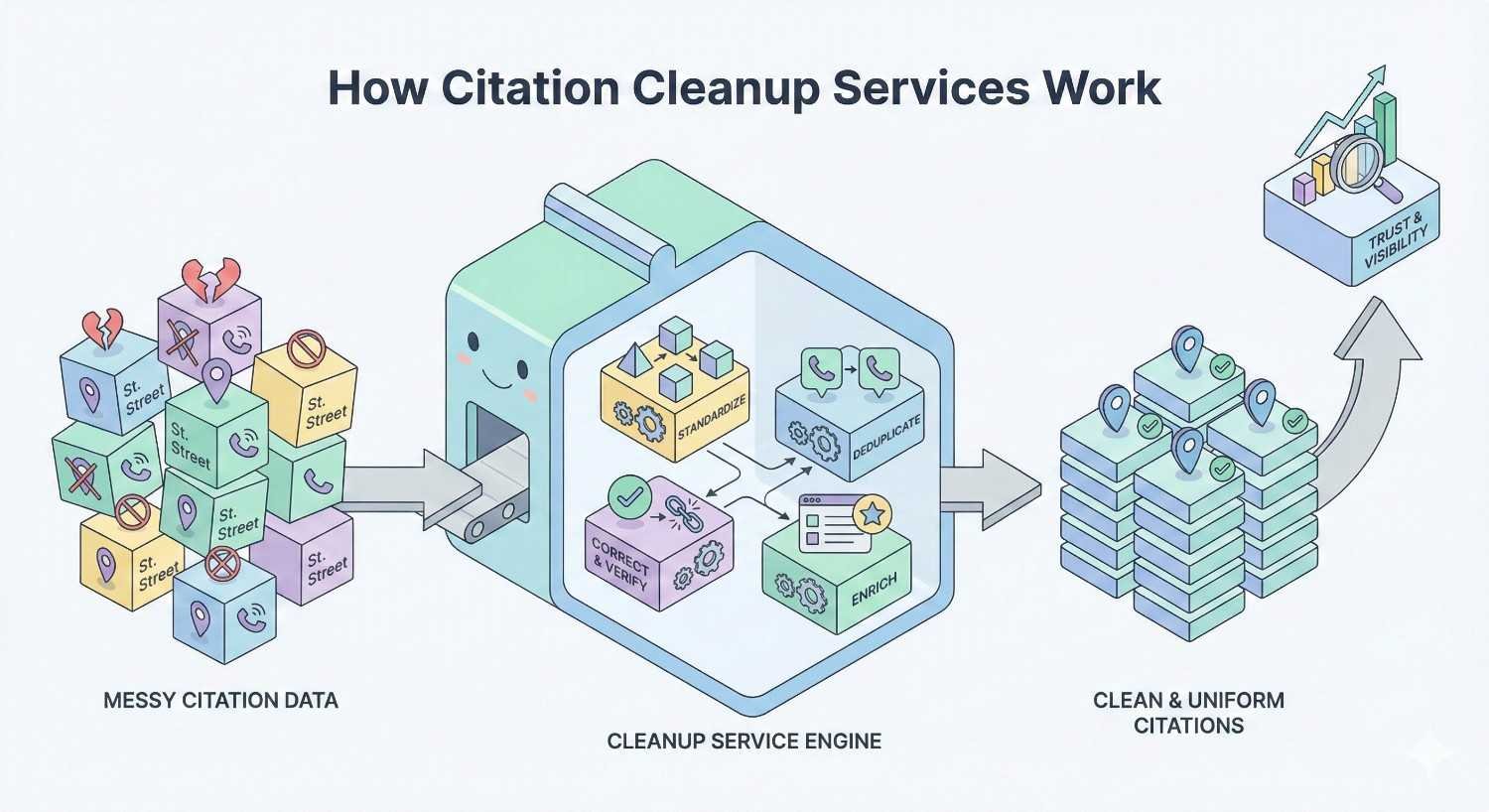
How Citation Cleanup Services Work
Professional citation cleanup follows a systematic process designed to identify all existing citations, locate errors and inconsistencies, submit corrections, and maintain accuracy over time. Understanding this process helps you evaluate providers and set realistic expectations.
Citation Audit Process
The cleanup process begins with a comprehensive audit of your existing citations. This audit identifies everywhere your business appears online and documents the information displayed on each listing.
Professional services use specialized tools to scan hundreds of directories, data aggregators, and platforms simultaneously. Manual audits are possible but extremely time-consuming—a thorough manual audit of major directories alone can take dozens of hours.
The audit produces a complete inventory of your citations, including platforms where you have listings, the specific information displayed on each, verification status (claimed vs. unclaimed listings), and any duplicates identified.
This inventory serves as the foundation for all subsequent cleanup work. It reveals the scope of the problem, identifies priority corrections, and establishes a baseline for measuring progress.
Identifying and Locating Errors
With the audit complete, the next phase involves analyzing each citation for errors and inconsistencies. This analysis compares every listing against your canonical business information—the correct, standardized details you want displayed everywhere.
Errors fall into several categories requiring different correction approaches. Simple formatting differences (address abbreviations, phone number formats) may be corrected through standard update processes. Substantive errors (wrong addresses, incorrect phone numbers) require more urgent attention. Duplicates need suppression or merger requests.
The analysis also identifies unclaimed listings—citations that exist but aren’t under your control. Claiming these listings gives you the ability to update information directly rather than relying on platform correction processes.
Priority ranking helps focus efforts on the most impactful corrections first. Errors on high-authority platforms like Google Business Profile, Yelp, and major data aggregators typically receive priority over smaller niche directories.
Correction and Submission Process
The correction phase involves submitting updates to every platform with incorrect information. This process varies significantly by platform—each directory has its own update mechanism, verification requirements, and processing timeline.
Data aggregators often provide the highest leverage. Correcting information with major aggregators like Data Axle, Foursquare, and Localeze can propagate updates to dozens of downstream directories automatically. However, propagation isn’t guaranteed, and some downstream sites retain cached data.
Major directories typically require individual submissions. Google Business Profile, Yelp, Facebook, and similar platforms have their own update processes. Some accept changes immediately; others require verification or review periods.
Smaller directories vary widely in their update processes. Some accept email requests; others require account creation and manual editing; some have no clear update mechanism at all.
Professional services maintain relationships and familiarity with platform-specific processes, enabling faster and more reliable corrections than businesses attempting DIY cleanup.
Monitoring and Maintenance
Citation cleanup isn’t a one-time project—it requires ongoing monitoring and maintenance to remain effective. New errors can emerge from data aggregator updates, user-suggested edits, automated scraping, or business changes.
Monitoring involves regular scans of your citation profile to detect new inconsistencies. Professional services typically run these scans monthly or quarterly, depending on the service level.
When new errors appear, the correction process repeats. Prompt attention prevents errors from propagating through the data ecosystem and minimizes customer impact.
Maintenance also includes proactive updates when your business information changes. Moving locations, changing phone numbers, or rebranding requires systematic updates across all citations—not just the platforms you remember having listings on.
Top Citation Sources That Require Cleanup
Not all citations carry equal weight. Understanding which sources matter most helps prioritize cleanup efforts and evaluate whether a service provider covers the platforms that impact your business.
Major Data Aggregators
Data aggregators sit at the top of the citation ecosystem. These companies collect, verify, and distribute business information to hundreds of downstream directories and platforms. Errors at the aggregator level propagate widely, making aggregator accuracy essential.
Data Axle (formerly Infogroup) supplies data to numerous directories, GPS systems, and search platforms. Their database feeds information to sites you may never have heard of but that still influence your citation profile.
Foursquare powers location data for Apple Maps, Uber, and thousands of apps and websites. Inaccurate Foursquare data affects your visibility across this entire ecosystem.
Localeze (now part of Neustar) distributes to search engines, directories, and navigation systems. Their data appears in places most business owners never think to check.
Correcting aggregator data provides leverage—a single correction can improve dozens of downstream citations. However, propagation takes time and isn’t always complete, so direct corrections to important downstream sites remain necessary.
Primary Business Directories
Primary directories carry significant authority and receive substantial user traffic. These platforms directly influence local search rankings and serve as common research destinations for potential customers.
Google Business Profile stands as the most critical citation for most businesses. It directly controls your appearance in Google’s local pack, Maps, and knowledge panels. Accuracy here is non-negotiable.
Yelp maintains strong domain authority and significant user traffic, particularly for restaurants, retail, and service businesses. Yelp listings often rank prominently in organic search results.
Facebook serves as both a social platform and a business directory. Many users search for businesses directly on Facebook, making profile accuracy important.
Apple Maps powers location searches for iPhone users—a substantial portion of mobile searches. Apple Maps data comes partly from aggregators and partly from direct submissions.
Bing Places influences Bing search results and feeds data to various Microsoft products and partners.
Industry-Specific Directories
Industry directories serve niche audiences actively searching for specific business types. While they may have lower overall traffic than general directories, their users have high intent and relevance.
Healthcare businesses need accurate listings on Healthgrades, Zocdoc, Vitals, and WebMD.
Legal professionals should prioritize Avvo, FindLaw, Justia, and Martindale-Hubbell.
Home services businesses benefit from accuracy on HomeAdvisor, Angi, Thumbtack, and Houzz.
Restaurants need correct information on OpenTable, TripAdvisor, Zomato, and delivery platforms.
The specific directories that matter depend on your industry. Professional citation services should identify and address the directories most relevant to your business category.
Social Media Platforms
Social media profiles function as citations even though they’re primarily engagement platforms. Business information on social profiles contributes to your overall citation consistency and appears in search results.
Facebook business pages display NAP information prominently and rank well in branded searches.
LinkedIn company pages appear in search results and provide another citation touchpoint.
Instagram business profiles include contact information that should match your other citations.
Twitter/X profiles may display location and contact information, contributing to your citation footprint.
Consistency across social platforms reinforces the accuracy signals from traditional directories and ensures customers find correct information regardless of where they discover your business.
DIY vs Professional Citation Cleanup
Business owners face a choice between handling citation cleanup themselves or hiring professional services. Both approaches can work, but they suit different situations and resource availability.
When to Handle Citations Yourself
DIY citation cleanup makes sense for businesses with limited citation footprints, available time, and comfort with administrative tasks.
New businesses with few existing citations can often manage their own listings. If you’ve only been operating for a year or two and haven’t moved or changed phone numbers, your citation profile is likely manageable.
Single-location businesses with stable information face simpler cleanup than multi-location enterprises. Fewer listings mean less work, and consistency is easier to maintain.
Businesses with available staff time can assign citation management to an employee. The work isn’t technically complex—it’s primarily administrative and time-consuming.
DIY cleanup requires patience and systematic tracking. You’ll need to audit your citations manually (or use affordable audit tools), create a spreadsheet tracking each listing and its status, submit corrections individually to each platform, and follow up on pending changes.
The main cost of DIY is time. A thorough cleanup can take 20-40+ hours depending on your citation footprint, and ongoing maintenance requires regular attention.
Benefits of Professional Services
Professional citation cleanup services offer advantages that justify their cost for many businesses.
Time savings represent the most immediate benefit. Professional services handle the tedious work of auditing, submitting corrections, and following up—freeing your time for revenue-generating activities.
Expertise and relationships accelerate the correction process. Professional services know each platform’s update mechanisms, verification requirements, and escalation paths. They’ve solved the same problems hundreds of times and know the fastest routes to resolution.
Comprehensive coverage ensures nothing gets missed. Professional tools scan more directories than manual audits can reasonably cover, identifying citations you didn’t know existed.
Ongoing monitoring catches new errors before they cause problems. Professional services include regular scans and maintenance, preventing the gradual accumulation of new inconsistencies.
Scalability matters for multi-location businesses. Managing citations for dozens or hundreds of locations requires systems and processes that professional services have already built.
Cost Comparison and ROI
The financial comparison between DIY and professional services depends on how you value your time and the opportunity cost of citation problems.
DIY costs include audit tools (free to $50/month for basic options), your time investment (20-40+ hours initially, plus ongoing maintenance), and the learning curve for platform-specific processes.
Professional service costs typically range from $200-500 for one-time cleanup projects to $100-300/month for ongoing management services. Multi-location businesses pay more based on location count.
ROI calculation should consider the value of improved local rankings, reduced customer friction, and time freed for other activities. A business generating $10,000/month from local customers might see significant returns from even modest ranking improvements. The time saved—potentially 40+ hours—has real value whether you’re a business owner or paying an employee.
For most established businesses with meaningful local search competition, professional services provide positive ROI through a combination of time savings, faster results, and more comprehensive coverage.
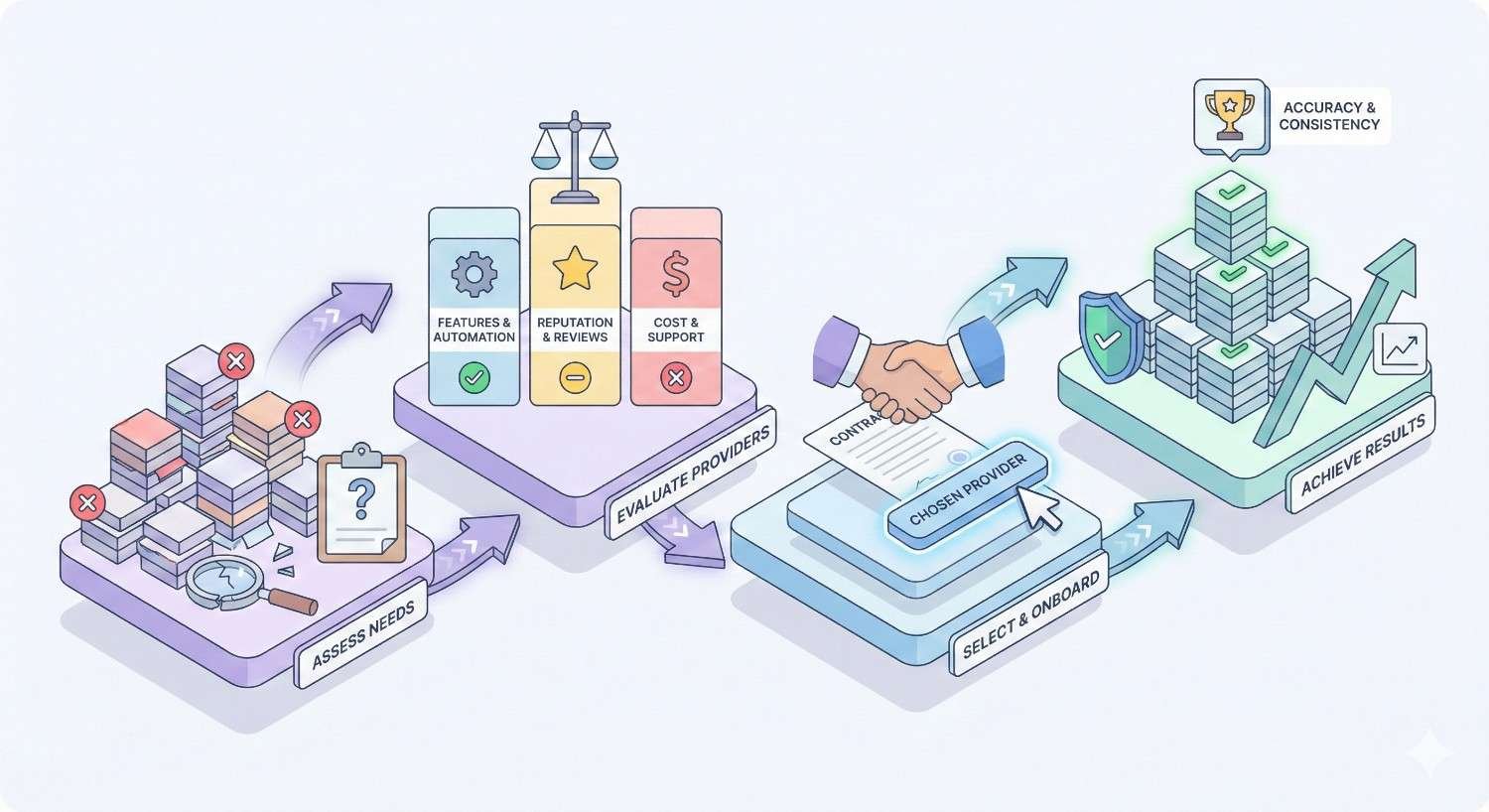
How to Choose a Citation Cleanup Provider
Selecting the right citation cleanup provider requires evaluating their capabilities, processes, and fit for your specific situation. Not all services deliver equal value, and the wrong choice can waste money without solving your problems.
Key Features to Look For
Comprehensive audit capabilities should cover major data aggregators, primary directories, industry-specific sites, and social platforms. Ask specifically which sources they scan and how many total sites their audit covers.
Manual correction processes matter because automated submissions often fail or get rejected. Providers should have staff who manually submit and follow up on corrections, not just software that blasts update requests.
Aggregator relationships accelerate corrections at the source. Providers with direct relationships or API access to major aggregators can often process updates faster than those submitting through standard channels.
Ongoing monitoring should be included or available as an add-on. One-time cleanup without monitoring allows new errors to accumulate, eventually requiring another cleanup project.
Transparent reporting lets you verify work completion. You should receive detailed reports showing which citations were found, what errors existed, what corrections were submitted, and current status.
Industry experience relevant to your business type helps ensure they understand which directories matter for your category and any industry-specific challenges.
Questions to Ask Before Hiring
Before committing to a provider, get clear answers to these questions:
“How many directories do you audit and which ones?” The answer should include specific numbers and names of major platforms, not vague claims about “hundreds of sites.”
“What’s your process for submitting corrections?” Look for descriptions of manual work, not just automated submissions. Ask how they handle platforms that reject initial correction requests.
“How do you handle data aggregators?” Providers should explain their approach to aggregator corrections and realistic expectations for downstream propagation.
“What reporting will I receive and how often?” You should get detailed reports showing work completed, not just summary statements.
“What’s included in your pricing and what costs extra?” Understand whether ongoing monitoring, additional corrections, or multi-location management incur additional fees.
“Can you provide references or case studies?” Established providers should have examples of successful cleanup projects they can share.
Red Flags to Avoid
Certain warning signs suggest a provider may not deliver quality service:
Guarantees of specific ranking improvements indicate either dishonesty or misunderstanding of how local SEO works. Citation cleanup improves one ranking factor among many—no one can guarantee specific ranking outcomes.
Extremely low prices often mean automated-only processes, limited directory coverage, or offshore teams submitting low-quality corrections. Quality citation work requires significant manual effort.
Vague descriptions of their process suggest they may not have systematic approaches. Legitimate providers can explain exactly how they audit, correct, and monitor citations.
No ongoing monitoring options indicate a provider focused on one-time projects rather than long-term citation health. This approach leaves you vulnerable to new errors.
Pressure tactics or urgency claims (“your citations are destroying your rankings—sign up today!”) suggest sales-focused operations rather than service-focused providers.
Inability to explain which directories they cover or provide sample reports raises questions about their actual capabilities and processes.
Citation Cleanup Tools and Software
Various tools support citation cleanup efforts, whether you’re handling cleanup yourself or evaluating what professional services use. Understanding the tool landscape helps you make informed decisions.
Citation Audit Tools
Audit tools scan directories to identify your existing citations and flag inconsistencies. They provide the foundation for any cleanup effort.
Moz Local offers citation auditing as part of its local SEO toolkit. It scans major directories and aggregators, identifying listings and inconsistencies. The tool also facilitates corrections through its platform.
BrightLocal provides comprehensive citation auditing with detailed reports on citation accuracy across dozens of directories. Their Citation Tracker monitors ongoing citation health.
Whitespark specializes in local SEO tools, including citation auditing and building. Their Local Citation Finder identifies existing citations and opportunities for new ones.
Semrush Listing Management includes citation auditing within its broader SEO platform, useful for businesses already using Semrush for other purposes.
Free options exist but typically cover fewer directories and provide less detailed reporting. For serious cleanup efforts, paid tools provide significantly better coverage and functionality.
Management Platforms
Management platforms go beyond auditing to facilitate corrections and ongoing management. They often integrate with directories and aggregators to streamline the update process.
Yext offers a comprehensive platform that pushes business information to its network of directories and aggregators. While expensive, it provides centralized control over listings across many platforms.
Moz Local includes management features alongside its audit capabilities, allowing corrections through the platform for supported directories.
BrightLocal combines auditing with management tools, including submission services for corrections and new citations.
Synup provides listing management with a focus on multi-location businesses, offering centralized control and reporting across locations.
These platforms vary significantly in pricing, directory coverage, and features. Evaluate based on your specific needs—a single-location business has different requirements than a franchise with hundreds of locations.
Monitoring Solutions
Monitoring tools track your citation profile over time, alerting you to new inconsistencies or changes. Ongoing monitoring prevents the gradual accumulation of errors that necessitates periodic major cleanup projects.
Most management platforms include monitoring features. BrightLocal’s Citation Tracker, Moz Local’s ongoing scans, and Whitespark’s monitoring capabilities all serve this function.
Google Alerts provides free monitoring for mentions of your business name, though it won’t catch all citation issues.
Brand monitoring tools like Mention or Brand24 can supplement citation-specific monitoring by tracking online mentions of your business.
The key is establishing some form of regular monitoring rather than waiting until problems become severe. Monthly or quarterly scans catch issues early when they’re easier to correct.
Citation Cleanup Timeline and Expectations
Understanding realistic timelines helps you plan appropriately and evaluate whether a service provider’s promises are credible. Citation cleanup takes time—anyone promising instant results doesn’t understand the process.
Typical Timeframes for Corrections
Different platforms process corrections at different speeds, creating a range of timelines within any cleanup project.
Google Business Profile changes often process within days to a few weeks, though some changes require additional verification that extends the timeline.
Major directories like Yelp, Facebook, and Bing typically process updates within one to four weeks, depending on the type of change and verification requirements.
Data aggregators may take four to twelve weeks to process updates and propagate them to downstream directories. Some downstream sites update quickly once aggregator data changes; others retain cached data for months.
Smaller directories vary widely—some process changes within days, others take months, and some have no clear update mechanism at all.
A comprehensive cleanup project typically shows significant progress within 30-60 days, with full completion taking 90-180 days depending on the scope of errors and the specific platforms involved.
Factors Affecting Speed
Several factors influence how quickly your citation cleanup progresses:
Scope of errors directly impacts timeline. A business with 50 incorrect citations takes longer to clean up than one with 10. More errors mean more submissions and more follow-up.
Platform responsiveness varies and is largely outside your control. Some platforms process updates quickly; others have backlogs or slow verification processes.
Verification requirements add time when platforms require proof of business ownership or legitimacy before processing changes. This is especially common for address changes or business name updates.
Aggregator propagation introduces delays between correcting source data and seeing downstream updates. Even after an aggregator accepts your correction, downstream sites may not reflect changes for weeks or months.
Duplicate suppression often takes longer than simple corrections. Removing duplicate listings requires platform review and approval, which some platforms handle slowly.
Setting Realistic Expectations
Approach citation cleanup with realistic expectations to avoid frustration and accurately evaluate service provider performance.
Expect gradual improvement, not instant transformation. You’ll see some corrections process quickly while others take months. Progress happens in waves as different platforms complete their update cycles.
Some citations may never be fully correctable. Certain directories have abandoned update processes, gone out of business, or simply don’t respond to correction requests. A small percentage of problematic citations may persist despite best efforts.
New errors will emerge over time. Even after successful cleanup, data aggregator updates, user suggestions, and automated scraping will introduce new inconsistencies. Ongoing monitoring and maintenance are necessary to preserve your clean citation profile.
Ranking improvements take additional time. Even after citations are corrected, search engines need to recrawl and reprocess the updated information. Ranking improvements from citation cleanup typically appear weeks to months after corrections are complete.
Citation Cleanup Pricing and Costs
Understanding typical pricing helps you budget appropriately and evaluate whether quotes you receive are reasonable. Pricing varies based on service scope, business complexity, and provider positioning.
Average Service Costs
Citation cleanup pricing falls into several tiers based on service level and business complexity.
Basic one-time cleanup for single-location businesses typically ranges from $200-500. This includes an audit, corrections to major directories and aggregators, and a completion report.
Comprehensive one-time cleanup with broader directory coverage and more thorough follow-up ranges from $500-1,500 for single locations.
Ongoing management services typically cost $100-300/month for single locations, including regular monitoring, maintenance corrections, and periodic reporting.
Multi-location businesses pay per-location rates that decrease with volume. A 10-location business might pay $100-200 per location for initial cleanup, with ongoing management at $50-100 per location monthly.
Enterprise solutions for large multi-location businesses often involve custom pricing based on location count, service level, and integration requirements.
Pricing Models Explained
Providers structure pricing in several ways, each with different implications for your budget and expectations.
One-time project pricing covers a defined scope of work—typically an audit and correction of identified errors. This model works well for businesses that want to clean up existing problems and handle ongoing maintenance themselves.
Monthly subscription pricing includes ongoing monitoring and maintenance alongside initial cleanup. This model suits businesses that want hands-off citation management and protection against future errors.
Per-location pricing scales costs with business complexity. Multi-location businesses pay based on how many locations need management, often with volume discounts.
Tiered service levels offer different coverage depths at different price points. Basic tiers might cover only major directories; premium tiers include industry-specific sites and more comprehensive monitoring.
Platform-based pricing charges based on the management platform used rather than services rendered. Yext and similar platforms charge subscription fees for access to their directory networks.
Factors That Influence Price
Several factors affect what you’ll pay for citation cleanup services:
Number of locations is the primary cost driver for multi-location businesses. More locations mean more citations to audit, correct, and monitor.
Severity of existing problems influences project scope. A business with hundreds of errors across dozens of directories requires more work than one with minor inconsistencies on a few platforms.
Directory coverage requirements affect pricing. Basic coverage of major directories costs less than comprehensive coverage including industry-specific sites and smaller local directories.
Service level and support vary by provider and tier. Premium services include dedicated account managers, faster response times, and more detailed reporting.
Contract length often affects monthly pricing. Annual commitments typically cost less per month than month-to-month arrangements.
Additional services like citation building (creating new listings), review management, or local SEO consulting add to total costs if bundled with cleanup services.
Maintaining Clean Citations Long-Term
Citation cleanup isn’t a one-time project—it’s an ongoing process. Without maintenance, new errors accumulate and eventually require another major cleanup effort. Proactive maintenance costs less and delivers better results than periodic crisis cleanup.
Ongoing Monitoring Best Practices
Establish regular monitoring to catch new errors before they cause problems.
Monthly scans of your citation profile identify new inconsistencies quickly. Most management platforms automate this process, alerting you to changes that need attention.
Google Business Profile monitoring deserves special attention given its importance. Check for user-suggested edits, which Google may apply without notifying you. Review your listing weekly for unexpected changes.
Review monitoring across platforms helps you spot duplicate listings or incorrect information that customers mention in reviews.
Search your business name periodically to identify new listings or citations you weren’t aware of. New directories emerge, and your business may be added without your knowledge.
Track correction status for pending updates. Some corrections take months to process—maintain a tracking system so nothing falls through the cracks.
Preventing Future Inconsistencies
Proactive measures reduce the frequency of new errors.
Establish a canonical NAP and document it clearly. Everyone in your organization should use identical business name, address, and phone number formatting when creating listings or providing information to third parties.
Centralize listing management so one person or team controls all citation-related activities. Distributed responsibility leads to inconsistent information.
Update aggregators first when business information changes. Correcting aggregator data helps prevent incorrect information from spreading to downstream directories.
Claim all listings you can identify. Claimed listings give you direct control over information and alert you to suggested changes.
Respond quickly to business changes. When you move, change phone numbers, or rebrand, prioritize citation updates. The longer incorrect information persists, the more it spreads.
When to Schedule Regular Audits
Even with ongoing monitoring, periodic comprehensive audits catch issues that slip through regular scans.
Quarterly audits suit most businesses. A thorough review every three months identifies accumulated issues before they become severe.
Post-change audits should follow any significant business changes. After moving, changing phone numbers, or rebranding, conduct a full audit 60-90 days later to verify updates propagated correctly.
Annual deep audits provide comprehensive review even for businesses with strong ongoing monitoring. Use this opportunity to evaluate your citation profile against competitors and identify new directory opportunities.
Trigger-based audits make sense when you notice ranking drops, increased customer complaints about incorrect information, or other signs of citation problems.
Conclusion
Citation cleanup addresses a foundational element of local SEO that many businesses overlook until problems become severe. Inconsistent NAP information across directories undermines search engine trust, confuses potential customers, and costs you visibility and revenue.
The cleanup process—auditing existing citations, correcting errors, and maintaining accuracy over time—requires systematic effort but delivers measurable returns. Whether you handle cleanup yourself or hire professional services depends on your resources, citation footprint complexity, and how you value your time.
White Label SEO Service provides comprehensive citation cleanup and ongoing management for businesses serious about local search performance. Our team handles the tedious work of auditing, correcting, and monitoring your citations so you can focus on serving customers. Contact us to discuss your citation cleanup needs and get a clear picture of your current citation health.
Frequently Asked Questions About Citation Cleanup
What is the difference between citation building and citation cleanup?
Citation building creates new listings on directories where your business doesn’t currently appear. Citation cleanup fixes errors and inconsistencies in existing listings. Most businesses need both—cleanup to correct current problems and building to expand their citation footprint on relevant directories.
How do I know if I need citation cleanup?
Search your business name and look for inconsistencies in the results. Check whether your address, phone number, and business name appear identically across Google, Yelp, Facebook, and other directories. If you find variations, duplicates, or outdated information, you need cleanup. Businesses that have moved, changed phone numbers, or rebranded almost certainly have citation problems.
Will citation cleanup improve my Google ranking?
Citation cleanup improves one factor that influences local rankings—NAP consistency and citation accuracy. It won’t guarantee specific ranking improvements because many factors affect local search positions. However, businesses with clean citation profiles consistently outperform those with messy citations, all else being equal.
How often should citations be audited?
Quarterly audits work well for most businesses, with additional audits following any business changes like moves or phone number updates. Ongoing monitoring between audits catches new issues as they emerge. Businesses in highly competitive local markets may benefit from monthly monitoring.
Can I do citation cleanup myself?
Yes, DIY citation cleanup is possible for businesses with limited citation footprints and available time. You’ll need to manually audit directories, submit corrections individually to each platform, and track progress over time. The work isn’t technically complex but requires patience and systematic follow-through. Most businesses find professional services more cost-effective when accounting for time investment.
How long does citation cleanup take?
Initial cleanup typically shows significant progress within 30-60 days, with full completion taking 90-180 days depending on error scope and platform processing times. Some platforms update quickly; others take months. Data aggregator corrections may take 8-12 weeks to propagate to downstream directories.
What happens if I don’t fix my citations?
Unaddressed citation problems tend to worsen over time as errors propagate through data aggregators and new inconsistencies accumulate. You’ll likely see suppressed local rankings, customer complaints about incorrect information, and lost business from people who can’t reach you. The longer problems persist, the more extensive (and expensive) cleanup becomes.