The right SaaS link building service can transform your organic growth trajectory in 2026. We evaluated 50 specialized providers across pricing, link quality, SaaS industry expertise, and verified client results to create this definitive ranking.
Link building remains one of the highest-impact SEO investments for software companies, but choosing the wrong partner wastes budget and risks penalties. This guide breaks down exactly which services deliver real results for startups, scale-ups, and enterprise SaaS brands.
You will learn how each provider operates, what they charge, their strengths and weaknesses, and which service matches your specific growth stage and goals.
What Are SaaS Link Building Services?
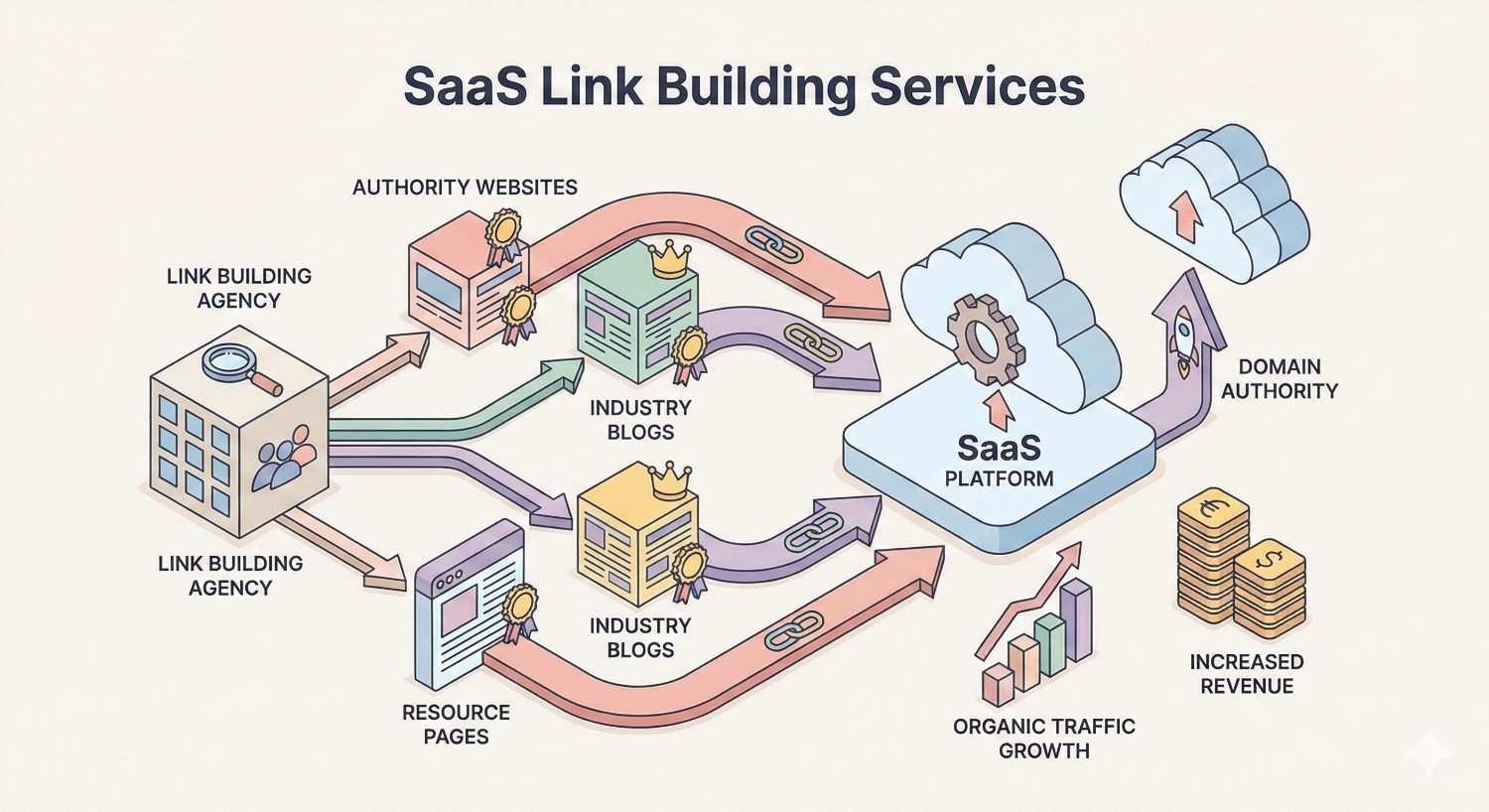
SaaS link building services are specialized agencies and providers that acquire high-quality backlinks specifically for software-as-a-service companies. These services understand the unique challenges of building authority in competitive tech verticals where traditional link building tactics often fall short.
Unlike generic link building, SaaS-focused providers target technology publications, software review sites, integration directories, and B2B content platforms. They build relationships with editors and contributors who cover cloud software, productivity tools, and enterprise technology.
The best SaaS link building services combine outreach expertise with deep knowledge of how software buyers research solutions. They secure placements that drive both referral traffic and ranking improvements.
How SaaS Link Building Differs from Traditional Link Building
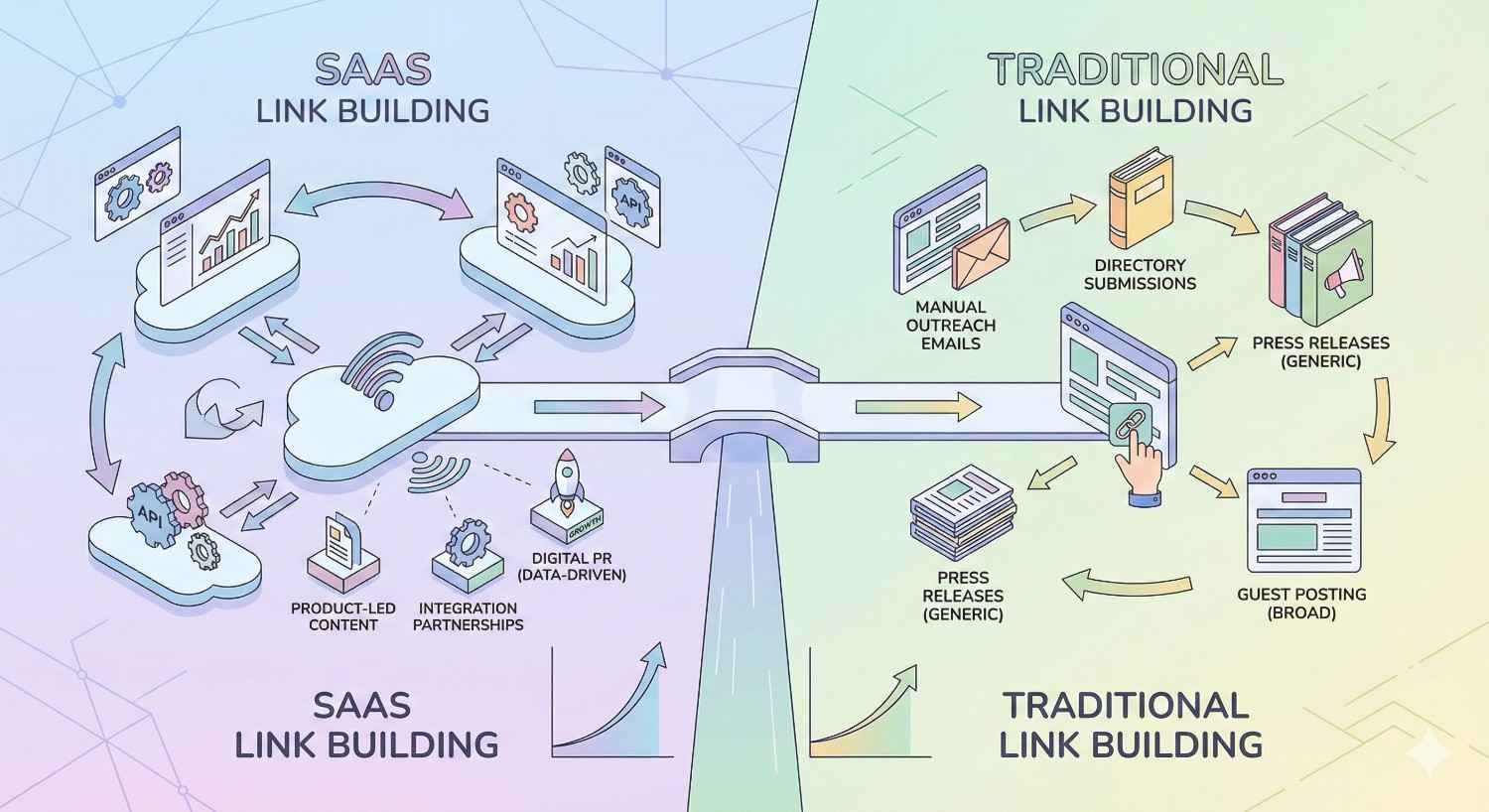
Traditional link building casts a wide net across general publications and directories. SaaS link building requires surgical precision targeting sites where software decision-makers actually spend time.
Audience alignment matters more. A DR 60 link from a general business blog delivers less value than a DR 45 link from a respected SaaS review platform. The latter reaches your actual buyers and signals topical relevance to search engines.
Content requirements differ significantly. SaaS publications expect technical accuracy, product comparisons, and integration-focused content. Generic guest posts get rejected. Successful SaaS link builders create content that genuinely helps software buyers evaluate solutions.
Relationship depth determines success. Top SaaS link building services maintain ongoing relationships with technology editors, not just one-off pitches. These relationships enable placements in competitive publications that reject cold outreach.
Link velocity expectations vary. Enterprise SaaS companies need steady, sustainable link acquisition over months. Startups often need faster initial momentum. Specialized providers calibrate their approach accordingly.
Why SaaS Companies Need Specialized Link Building in 2026
Google’s algorithm updates throughout 2024 and 2025 increased the weight of topical relevance in link evaluation. Links from contextually relevant sources now outperform higher-authority links from unrelated sites.
Competition intensified dramatically. The SaaS market continues expanding, with thousands of new entrants competing for the same keywords. Generic SEO approaches no longer differentiate. Specialized link building creates sustainable competitive advantages.
AI-generated content flooded the web. Search engines now prioritize signals of genuine authority and expertise. High-quality backlinks from respected industry sources serve as trust signals that AI-generated content cannot replicate.
Buyer research patterns evolved. Software buyers conduct extensive research across multiple touchpoints before engaging sales teams. Strategic link placements position your brand throughout this research journey, building familiarity and trust.
Integration ecosystems became ranking factors. Links from integration partner pages, app marketplaces, and technology ecosystem sites carry significant weight for SaaS rankings. Specialized providers understand how to leverage these opportunities.
How We Ranked the Top 50 SaaS Link Building Services
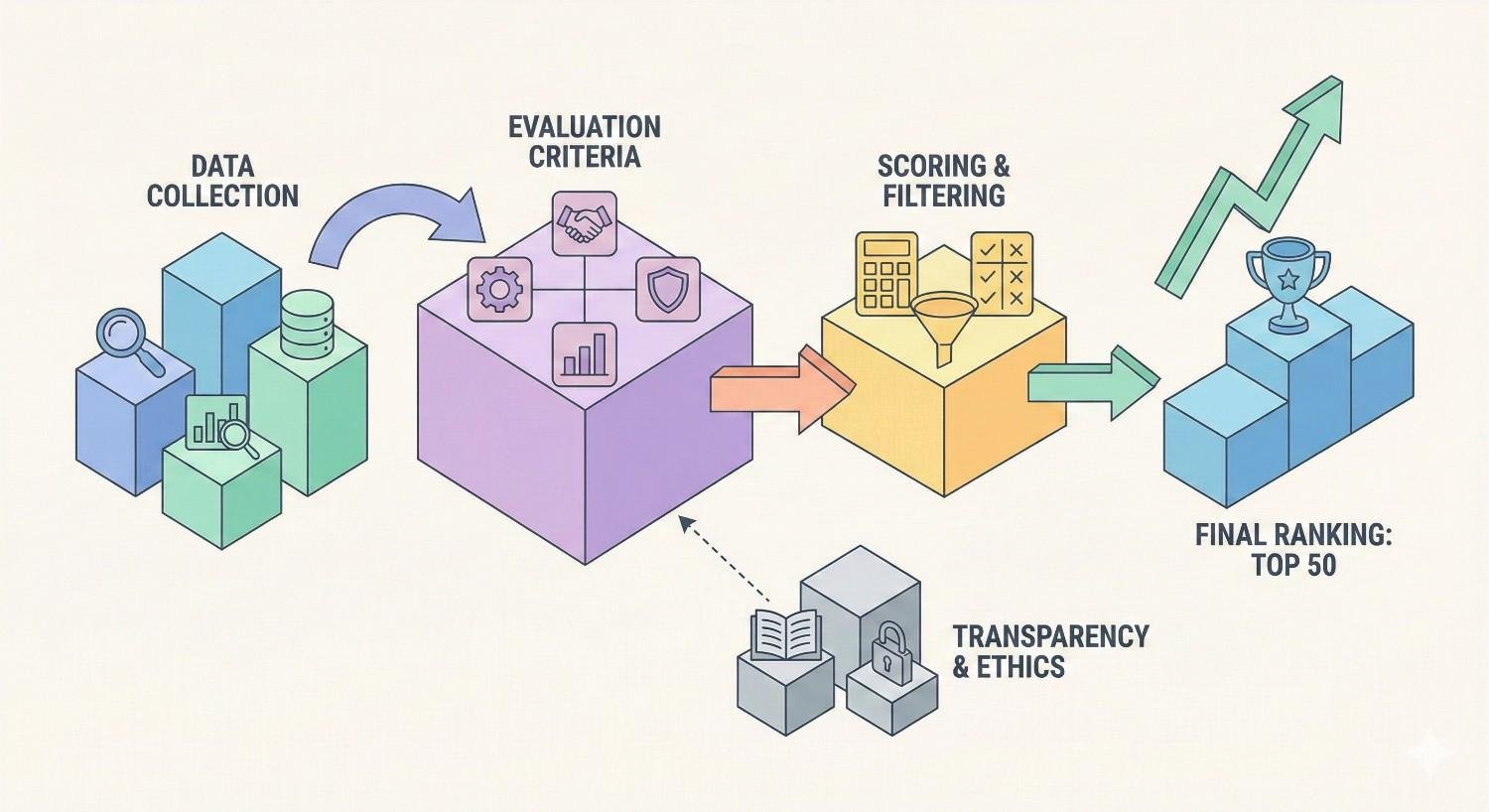
Our ranking methodology prioritizes real-world results over marketing claims. We combined quantitative metrics with qualitative assessments from actual clients to create an objective evaluation framework.
Evaluation Criteria and Methodology
Link Quality Score (30% weight): We assessed the average domain rating, topical relevance, and traffic of placed links. Providers earning links from genuine technology publications scored higher than those relying on general guest post networks.
SaaS Industry Expertise (25% weight): We evaluated each provider’s understanding of software markets, their relationships with technology publications, and their track record with SaaS clients specifically.
Pricing Transparency and Value (20% weight): Clear pricing structures, reasonable cost-per-link ratios, and alignment between price and delivered quality determined scores in this category.
Client Results and Retention (15% weight): We analyzed case studies, verified client testimonials, and retention rates. Providers with documented ranking improvements and long-term client relationships scored highest.
Process and Communication (10% weight): Reporting quality, communication responsiveness, and operational transparency rounded out our evaluation criteria.
Data Sources and Verification Process
We collected data from multiple sources to ensure accuracy and reduce bias.
Direct provider interviews gave us insight into processes, team structures, and client portfolios. We spoke with founders or senior team members at each ranked service.
Client reference checks verified claims made by providers. We contacted at least three clients per top-20 provider to confirm results and satisfaction levels.
Link sample analysis involved reviewing actual placements from each provider using Ahrefs and Semrush. We assessed link quality, anchor text diversity, and placement context.
Industry reputation research included reviewing mentions in SEO communities, social media sentiment, and any public complaints or issues.
Scoring Framework Explained
Each provider received scores from 1-100 across our five criteria categories. We weighted these scores according to the percentages above and calculated composite rankings.
Tier classifications emerged naturally from score clustering:
- Premium Tier (Ranks 1-10): Composite scores 85-100
- Mid-Tier (Ranks 11-25): Composite scores 70-84
- Growth-Stage (Ranks 26-40): Composite scores 55-69
- Budget-Friendly (Ranks 41-50): Composite scores 40-54
Providers within each tier deliver appropriate value for their price points. Lower-ranked services are not necessarily inferior—they serve different market segments and budget levels.
Top 10 SaaS Link Building Services (Premium Tier)
These providers represent the highest quality options for SaaS companies with substantial link building budgets. Each delivers exceptional results but at premium price points.
#1 uSERP – Overview, Pricing, Pros/Cons
uSERP dominates SaaS link building through its proprietary network of technology publications and content partnerships. Founded by SEO veterans with deep SaaS experience, they focus exclusively on software and technology clients.
Pricing: Monthly retainers start at $10,000 with typical engagements ranging from $15,000-$30,000 per month. Per-link pricing available at $800-$1,500 depending on target publication quality.
Pros:
- Exceptional placement quality in top-tier tech publications
- Dedicated account managers with SaaS expertise
- Transparent reporting with full link attribution
- Strong relationships with publications like TechCrunch, VentureBeat, and industry-specific outlets
Cons:
- Premium pricing excludes early-stage startups
- Minimum engagement periods of 6 months
- Limited availability due to high demand
Best for: Series B+ SaaS companies seeking enterprise-grade link building with measurable ranking impact.
#2 Siege Media – Overview, Pricing, Pros/Cons
Siege Media combines content marketing excellence with strategic link acquisition. Their data-driven approach and creative content assets generate natural links alongside placed content.
Pricing: Project-based engagements start at $15,000 per month. Content-focused campaigns with link building components range from $20,000-$50,000 monthly.
Pros:
- Industry-leading content quality drives organic link attraction
- Strong track record with major SaaS brands
- Comprehensive strategy combining content and outreach
- Excellent case studies demonstrating ROI
Cons:
- Higher price point than pure link building services
- Longer timelines for content-driven campaigns
- May be overkill for companies needing only link building
Best for: SaaS companies wanting integrated content marketing and link building strategies.
#3 Linkflow – Overview, Pricing, Pros/Cons
Linkflow specializes in B2B SaaS link building with particular strength in competitive enterprise software verticals. Their team includes former SaaS marketers who understand the industry deeply.
Pricing: Monthly retainers from $7,500-$20,000 depending on link volume and quality targets. Average cost per link ranges from $500-$900.
Pros:
- Deep B2B SaaS expertise and relevant publisher relationships
- Flexible engagement structures
- Strong communication and reporting
- Good balance of quality and volume
Cons:
- Less effective for consumer-focused SaaS
- Newer company with shorter track record than some competitors
- Limited capacity for very large campaigns
Best for: B2B SaaS companies in competitive verticals needing specialized expertise.
#4 Digital PR Agency (Powered by Fractl) – Overview, Pricing, Pros/Cons
Fractl’s Digital PR division excels at earning links through newsworthy content and data-driven stories. Their approach generates coverage in major publications that pure outreach cannot access.
Pricing: Campaign-based pricing starts at $20,000 per project. Ongoing retainers range from $15,000-$40,000 monthly.
Pros:
- Access to top-tier publications through PR relationships
- Data journalism expertise creates linkable assets
- Links from publications with genuine editorial standards
- Strong brand-building alongside link acquisition
Cons:
- Less predictable link volumes than outreach-based services
- Requires compelling data or story angles
- Higher minimum investments
Best for: SaaS companies with interesting data or stories seeking premium publication coverage.
#5 Authority Builders – Overview, Pricing, Pros/Cons
Authority Builders operates a curated network of quality sites accepting guest contributions. Their vetting process ensures placements meet quality standards while maintaining reasonable pricing.
Pricing: Per-link pricing from $200-$600 based on site metrics. Monthly packages available starting at $3,000.
Pros:
- Transparent marketplace model with clear pricing
- Consistent quality across their network
- Faster turnaround than custom outreach
- Good value for mid-range budgets
Cons:
- Network-based approach limits placement variety
- Less customization than bespoke outreach services
- Some sites in network are known guest post destinations
Best for: SaaS companies wanting reliable, consistent link building at moderate price points.
#6 Stellar SEO – Overview, Pricing, Pros/Cons
Stellar SEO provides white-label and direct SaaS link building with strong processes and quality control. Their systematic approach delivers consistent results across client portfolios.
Pricing: Monthly retainers from $5,000-$15,000. Per-link options available at $350-$700.
Pros:
- Reliable processes with consistent delivery
- Good communication and project management
- Flexible service structures
- Strong quality control measures
Cons:
- Less specialized in SaaS than top-ranked competitors
- Moderate rather than exceptional placement quality
- Limited creative or content capabilities
Best for: SaaS companies prioritizing reliability and process over premium placements.
#7 Page One Power – Overview, Pricing, Pros/Cons
Page One Power brings over a decade of link building experience with dedicated teams for technology clients. Their manual outreach approach emphasizes relationship building over automation.
Pricing: Custom pricing based on campaign scope. Typical SaaS engagements range from $6,000-$18,000 monthly.
Pros:
- Experienced team with long industry tenure
- Manual, relationship-based outreach
- Strong ethical standards and white-hat practices
- Good scalability for larger campaigns
Cons:
- Slower pace than some competitors
- Less SaaS-specific than specialized providers
- Pricing can be opaque initially
Best for: SaaS companies valuing experience and ethical practices over speed.
#8 FATJOE – Overview, Pricing, Pros/Cons
FATJOE offers productized link building services with transparent pricing and quick turnaround. Their scale enables competitive pricing while maintaining quality standards.
Pricing: Blogger outreach links from $75-$350 per link. Premium placements available at higher price points.
Pros:
- Transparent, productized pricing
- Fast turnaround times
- Easy ordering process
- Good for supplementing other link building efforts
Cons:
- Less customization than bespoke services
- Quality varies across price tiers
- Limited strategic guidance
Best for: SaaS companies needing quick, affordable links to supplement primary strategies.
#9 The HOTH – Overview, Pricing, Pros/Cons
The HOTH provides comprehensive SEO services including dedicated link building packages for SaaS companies. Their scale and systems enable consistent delivery.
Pricing: Guest post packages from $200-$500 per link. Managed link building campaigns from $4,000 monthly.
Pros:
- Established company with proven systems
- Multiple service tiers for different budgets
- Good dashboard and reporting tools
- Responsive customer support
Cons:
- Quality inconsistency across large volume
- Less specialized than SaaS-focused providers
- Some placements on lower-quality sites
Best for: SaaS companies wanting established providers with multiple service options.
#10 Loganix – Overview, Pricing, Pros/Cons
Loganix specializes in white-label SEO services including link building packages designed for agencies and in-house teams. Their SaaS-specific offerings target technology publications.
Pricing: Link building packages from $250-$600 per link. Monthly managed services from $3,500.
Pros:
- Strong white-label capabilities
- Consistent quality control
- Good for agencies serving SaaS clients
- Reasonable pricing for quality delivered
Cons:
- Primary focus on agency clients
- Less direct client relationship building
- Moderate rather than premium placement quality
Best for: Agencies serving SaaS clients or in-house teams wanting reliable fulfillment.
SaaS Link Building Services #11-25 (Mid-Tier)
Mid-tier providers deliver strong value for growing SaaS companies. These services balance quality and affordability effectively.
#11-15 Service Profiles
#11 Outreach Monks provides scalable link building with good SaaS industry coverage. Monthly retainers start at $2,500 with per-link pricing from $150-$400. Strong for companies needing volume at reasonable quality levels.
#12 LinkBuilder.io focuses on manual outreach to relevant publications. Pricing ranges from $300-$700 per link with monthly packages available. Good communication and transparent processes distinguish their service.
#13 Rhino Rank offers curated guest posting with quality controls. Per-link pricing from $100-$350 makes them accessible for smaller budgets. Quality varies but generally meets expectations for price point.
#14 Stan Ventures provides offshore link building with competitive pricing. Monthly packages from $1,500 deliver reasonable volume. Best for companies prioritizing quantity alongside acceptable quality.
#15 Searcharoo specializes in SaaS and technology link building with Australian roots. Pricing from $400-$800 per link reflects their quality focus. Strong for companies targeting international markets.
#16-20 Service Profiles
#16 Editorial.Link emphasizes editorial placements over guest posts. Higher pricing from $500-$1,000 per link reflects placement quality. Excellent for companies wanting genuine editorial coverage.
#17 Digital Olympus combines link building with digital PR capabilities. Campaign pricing from $5,000 monthly suits companies wanting integrated approaches. Strong creative capabilities enhance their link building.
#18 Jolly SEO focuses on HARO and journalist outreach for SaaS companies. Monthly retainers from $3,000 target earned media placements. Excellent for companies with newsworthy angles.
#19 Markitors provides full-service SEO including link building for SaaS. Comprehensive packages from $4,000 monthly include strategy and execution. Good for companies wanting integrated SEO support.
#20 Sure Oak delivers boutique link building with personalized service. Custom pricing based on goals typically ranges from $5,000-$12,000 monthly. Strong client relationships and communication.
#21-25 Service Profiles
#21 Screaming Frog Services extends their technical SEO expertise to link building. Project-based pricing suits companies with specific campaigns. Technical accuracy distinguishes their content.
#22 Victorious integrates link building within comprehensive SEO campaigns. Monthly retainers from $5,000 include link building components. Strong for companies wanting full-service SEO.
#23 Ignite Visibility provides enterprise-level link building for larger SaaS companies. Premium pricing from $10,000 monthly reflects their capabilities. Excellent for companies needing sophisticated strategies.
#24 Coalition Technologies combines link building with broader digital marketing. Integrated packages from $4,000 monthly suit companies wanting unified approaches. Good technical capabilities.
#25 WebFX offers scalable link building within their comprehensive SEO services. Packages from $3,000 monthly include link building allocations. Strong reporting and transparency.
SaaS Link Building Services #26-40 (Growth-Stage Options)
Growth-stage providers serve SaaS companies building their initial link profiles or operating with constrained budgets.
#26-30 Service Profiles
#26 Getmentioned specializes in startup link building with accessible pricing. Per-link costs from $150-$350 suit early-stage budgets. Good for companies building initial authority.
#27 LinksThatRank focuses on relevance over raw metrics. Pricing from $200-$500 per link emphasizes contextual placements. Strong for companies prioritizing topical authority.
#28 Backlinko (Brian Dean’s Agency) provides premium link building based on proven methodologies. Higher pricing from $800-$1,500 per link reflects quality standards. Excellent for companies wanting best practices.
#29 Postaga combines software with done-for-you link building. Hybrid pricing from $500 monthly plus per-link fees suits companies wanting control. Good for hands-on marketing teams.
#30 Respona offers similar software-plus-service models. Pricing from $400 monthly plus campaign costs provides flexibility. Strong for companies with some outreach capacity.
#31-35 Service Profiles
#31 Hunter.io Services extends their prospecting tools into managed outreach. Campaign pricing from $2,000 leverages their data advantages. Good for companies already using Hunter.
#32 Pitchbox Services provides managed campaigns using their outreach platform. Pricing from $3,000 monthly includes software and execution. Strong for companies wanting proven tools.
#33 BuzzStream Services offers similar managed outreach capabilities. Monthly packages from $2,500 combine software with fulfillment. Good for companies preferring established platforms.
#34 NinjaOutreach Services delivers managed link building through their platform. Accessible pricing from $1,500 monthly suits smaller budgets. Quality varies but generally acceptable.
#35 Dibz provides link prospecting and outreach services. Per-campaign pricing from $1,000 suits project-based needs. Good for companies with specific link targets.
#36-40 Service Profiles
#36 LinkHunter focuses on broken link building and resource page outreach. Specialized pricing from $200-$400 per link suits specific strategies. Strong for companies wanting targeted approaches.
#37 Linkology provides UK-based link building with international reach. Pricing from $150-$400 per link offers good value. Strong for companies targeting European markets.
#38 Fat Joe UK extends FATJOE’s services with UK focus. Similar pricing structures from $100-$350 per link. Good for companies wanting geographic diversity.
#39 Click Intelligence offers data-driven link building with analytics focus. Monthly packages from $2,000 include detailed reporting. Strong for companies wanting measurable approaches.
#40 Seeker Digital provides boutique link building with personalized service. Custom pricing typically from $3,000 monthly. Good for companies wanting dedicated attention.
SaaS Link Building Services #41-50 (Budget-Friendly & Emerging)
Budget-friendly providers serve startups and small SaaS companies with limited resources. Quality varies more at this tier, requiring careful vetting.
#41-45 Service Profiles
#41 Legiit Marketplace connects buyers with freelance link builders. Per-link pricing from $50-$200 offers accessibility. Quality varies significantly—careful seller selection required.
#42 Konker provides similar marketplace services. Pricing from $30-$150 per link suits minimal budgets. Due diligence essential before purchasing.
#43 SEOClerks offers budget link building services. Very low pricing from $20-$100 per link. Quality concerns require careful evaluation.
#44 Fiverr Pro features vetted link building providers. Pricing from $100-$500 per link with quality verification. Better quality control than standard Fiverr.
#45 Upwork Link Builders connects with freelance specialists. Hourly or project pricing varies widely. Good for companies wanting direct freelancer relationships.
#46-50 Service Profiles
#46 PeoplePerHour offers freelance link building services. Project pricing from $200 suits specific campaigns. Quality depends on individual freelancer selection.
#47 Freelancer.com provides access to global link building talent. Competitive pricing through bidding systems. Requires significant vetting effort.
#48 LinkedIn ProFinder connects with professional link builders. Premium freelancer pricing from $500 per project. Better quality than general marketplaces.
#49 Credo matches companies with vetted link building agencies. Referral-based connections ensure quality. Good for companies wanting curated recommendations.
#50 Clutch-Listed Agencies provides directory of reviewed link building providers. Various pricing levels with verified reviews. Strong for companies wanting social proof.
SaaS Link Building Services Comparison Table
Pricing Comparison by Tier
| Tier | Monthly Retainer Range | Per-Link Cost Range | Typical Link Volume |
| Premium (#1-10) | $5,000-$30,000 | $350-$1,500 | 5-20 links/month |
| Mid-Tier (#11-25) | $2,500-$12,000 | $150-$800 | 8-30 links/month |
| Growth-Stage (#26-40) | $1,500-$5,000 | $150-$500 | 10-40 links/month |
| Budget (#41-50) | $500-$2,000 | $30-$300 | 15-50+ links/month |
Feature Comparison Matrix
| Feature | Premium | Mid-Tier | Growth | Budget |
| SaaS Specialization | ★★★★★ | ★★★★☆ | ★★★☆☆ | ★★☆☆☆ |
| Link Quality | ★★★★★ | ★★★★☆ | ★★★☆☆ | ★★☆☆☆ |
| Reporting Depth | ★★★★★ | ★★★★☆ | ★★★☆☆ | ★★☆☆☆ |
| Account Management | ★★★★★ | ★★★★☆ | ★★★☆☆ | ★☆☆☆☆ |
| Scalability | ★★★★☆ | ★★★★★ | ★★★★☆ | ★★★☆☆ |
| Value for Money | ★★★☆☆ | ★★★★☆ | ★★★★★ | ★★★☆☆ |
Best For Use Case Breakdown
Enterprise SaaS ($10M+ ARR): Premium tier providers (#1-5) deliver the quality and scale needed for competitive markets.
Scale-Up SaaS ($1M-$10M ARR): Mid-tier providers (#11-20) balance quality and value effectively.
Early-Stage SaaS (Pre-$1M ARR): Growth-stage providers (#26-35) offer accessible entry points.
Bootstrapped Startups: Budget providers (#41-50) enable initial link building with careful quality management.
Agencies Serving SaaS Clients: White-label specialists (#10, #24, #25) provide fulfillment capabilities.
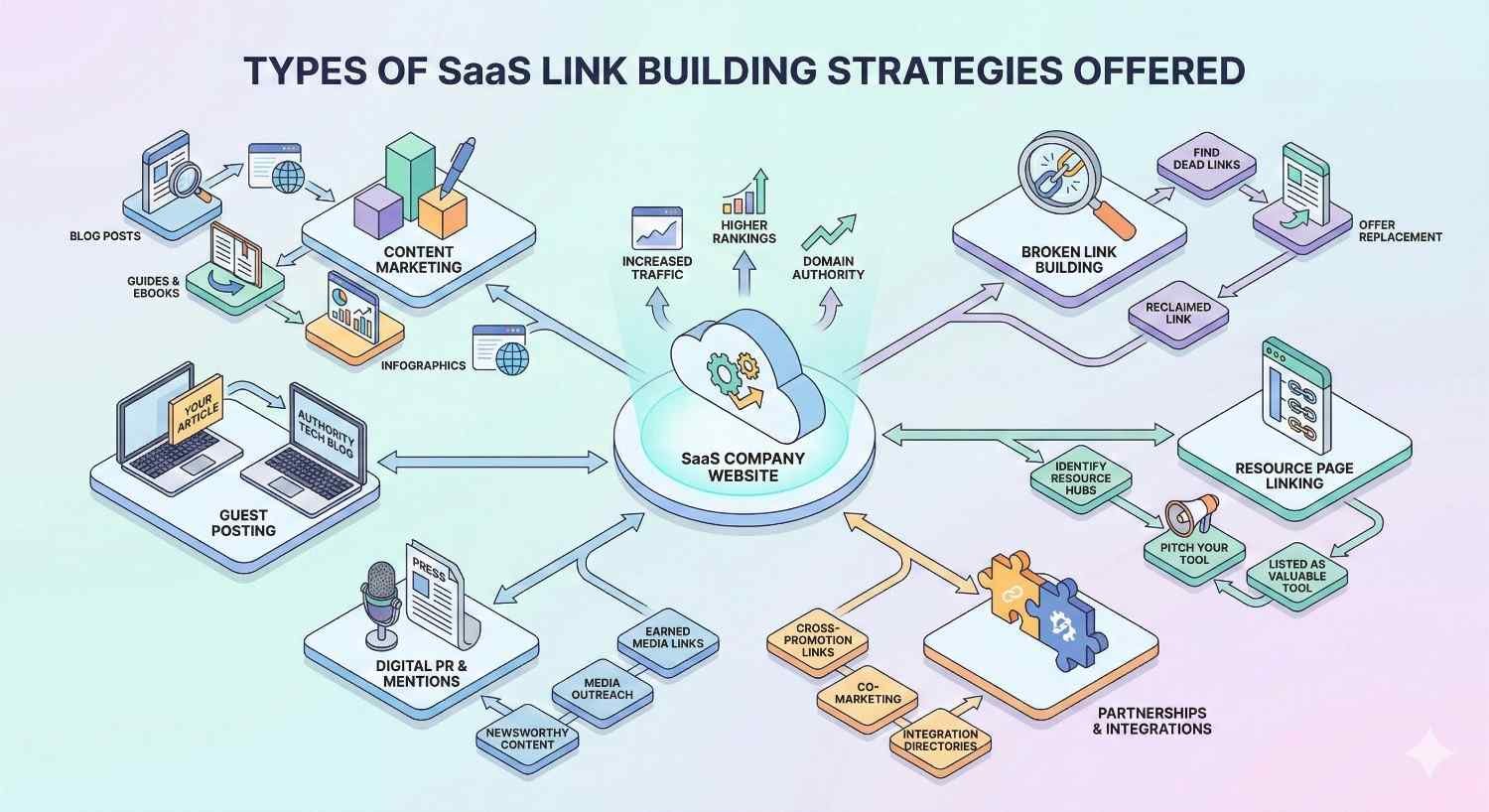
Types of SaaS Link Building Strategies Offered
Understanding available strategies helps you evaluate which providers align with your needs.
Guest Posting and Contributor Networks
Guest posting remains foundational for SaaS link building. Providers maintain relationships with publications accepting contributed content, placing articles that include contextual links to client sites.
Quality indicators: Look for providers placing content on sites with genuine editorial standards, real traffic, and relevant audiences. Avoid services relying on private blog networks disguised as guest post opportunities.
Best providers for guest posting: uSERP, Authority Builders, Outreach Monks, and Linkflow excel at securing quality guest placements.
Digital PR and HARO/Connectively Outreach
Digital PR earns links through newsworthy content, expert commentary, and journalist relationships. HARO (Help A Reporter Out) and similar platforms connect sources with journalists seeking quotes.
This strategy works best for SaaS companies with interesting data, unique perspectives, or executives willing to provide expert commentary. Links earned through PR typically come from higher-authority publications.
Best providers for digital PR: Fractl, Jolly SEO, and Digital Olympus specialize in earned media approaches.
Broken Link Building for SaaS
Broken link building identifies dead links on relevant sites and offers replacement content. This strategy works particularly well for SaaS companies with strong resource content.
Success requires quality replacement content and efficient prospecting. The approach generates highly relevant links from established resource pages.
Best providers for broken link building: LinkHunter and Page One Power include broken link building in their service offerings.
Resource Page Link Building
Resource pages compile useful links for specific topics. Getting included on relevant resource pages builds authority and drives referral traffic.
SaaS applications include tool directories, software comparison pages, and industry resource compilations. These placements often persist longer than guest post links.
Best providers for resource pages: Authority Builders and LinkBuilder.io actively target resource page placements.
Niche Edits and Link Insertions
Niche edits add links to existing published content rather than creating new articles. This approach leverages established page authority and existing rankings.
Quality concerns exist with some niche edit providers using questionable practices. Vet providers carefully and ensure placements occur on legitimate sites with editorial oversight.
Best providers for niche edits: FATJOE and Rhino Rank offer niche edit services with quality controls.
Product-Led Link Building (Integration Pages)
Integration link building leverages partnerships and technical connections. Links from integration partner pages, app marketplaces, and ecosystem directories carry strong relevance signals.
This strategy requires actual integrations or partnerships. The links generated are highly relevant and difficult for competitors to replicate.
Best providers for integration links: uSERP and Linkflow understand SaaS ecosystems and can facilitate integration-based link building.
Content-Driven Link Acquisition
Content-driven approaches create linkable assets that attract natural links over time. Original research, tools, templates, and comprehensive guides generate ongoing link acquisition.
Investment requirements are higher upfront but generate compounding returns. This strategy builds sustainable authority rather than transactional link counts.
Best providers for content-driven links: Siege Media and Fractl excel at creating content that earns links naturally.
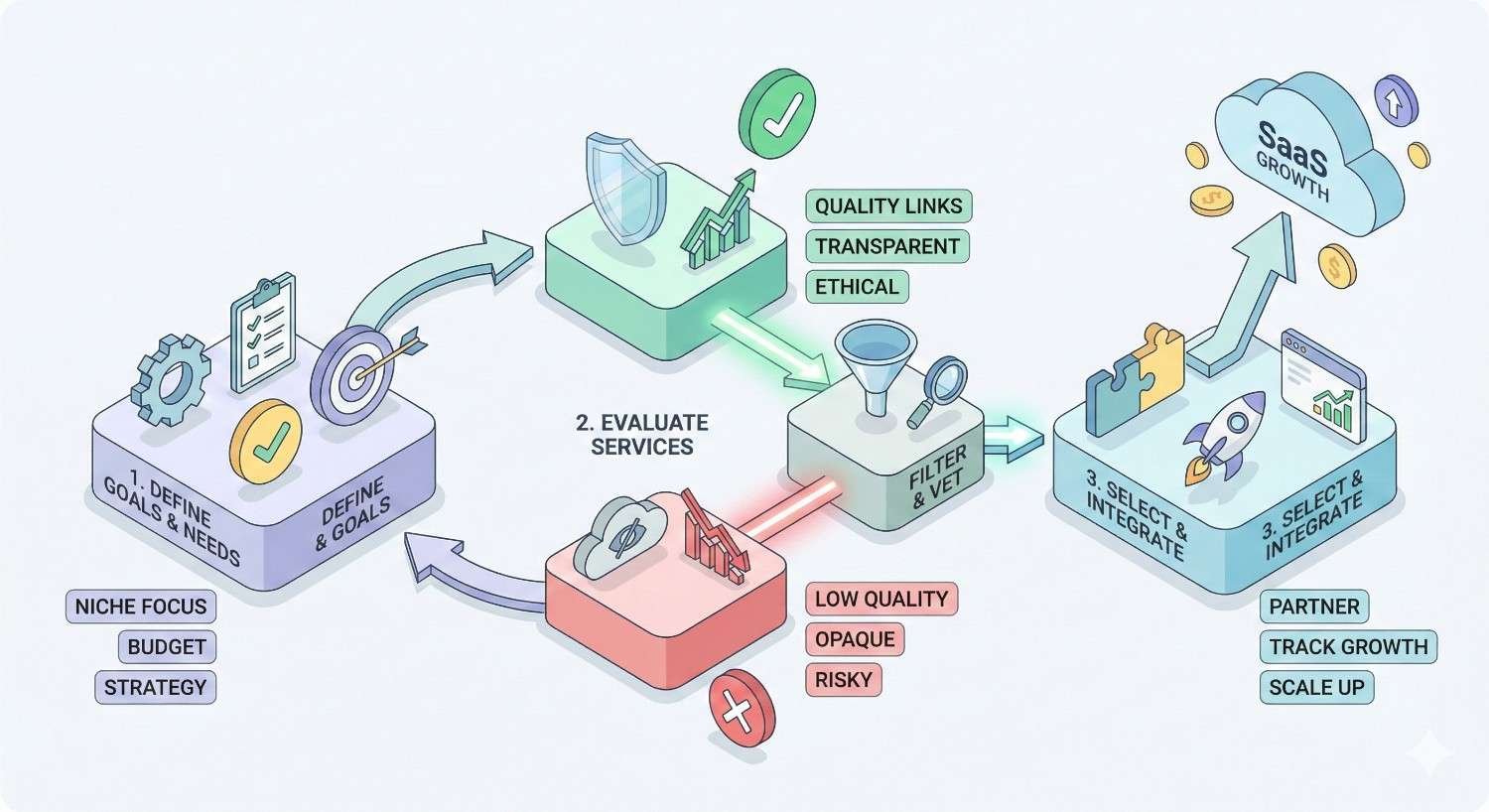
How to Choose the Right SaaS Link Building Service
Selecting the right provider requires matching your specific situation with appropriate service capabilities.
By Company Stage (Startup vs. Scale-Up vs. Enterprise)
Early-stage startups should prioritize value and learning. Growth-stage providers (#26-40) offer accessible entry points while you develop link building knowledge. Consider hybrid approaches combining affordable services with selective premium placements.
Scale-up SaaS companies benefit from mid-tier providers (#11-25) delivering consistent quality at reasonable costs. At this stage, link building should integrate with broader content and SEO strategies.
Enterprise SaaS requires premium providers (#1-10) capable of competing in highly contested markets. Quality matters more than volume, and sophisticated strategies differentiate from competitors.
By Budget Range
Under $2,000/month: Focus on budget providers with careful quality vetting. Supplement with in-house outreach efforts. Prioritize fewer high-quality links over volume.
$2,000-$5,000/month: Growth-stage and lower mid-tier providers offer good value. Expect 10-25 quality links monthly with reasonable relevance.
$5,000-$15,000/month: Mid-tier providers deliver strong results at this investment level. Expect dedicated account management and strategic guidance.
$15,000+/month: Premium providers become accessible. Expect top-tier placements, comprehensive strategies, and measurable ranking improvements.
By Link Building Goals (Authority vs. Traffic vs. Rankings)
Building domain authority requires diverse, high-quality links from authoritative sources. Premium and mid-tier providers with strong publication relationships serve this goal best.
Driving referral traffic requires placements on sites with genuine audiences. Prioritize providers emphasizing traffic metrics alongside domain ratings.
Improving specific rankings requires topically relevant links with appropriate anchor text. Providers with SaaS specialization understand how to target competitive keywords effectively.
Red Flags to Avoid When Selecting a Provider
Guaranteed rankings or specific link counts indicate providers willing to cut corners. Quality link building involves uncertainty—honest providers acknowledge this.
Unusually low pricing suggests quality compromises. If pricing seems too good, investigate placement quality carefully before committing.
Lack of transparency about link sources, processes, or reporting should disqualify providers. Reputable services explain their methods clearly.
No SaaS-specific experience limits effectiveness in competitive software markets. General link building providers may not understand your industry’s unique requirements.
Pressure tactics or long contracts without trial periods suggest providers prioritizing revenue over results. Quality providers earn retention through performance.
SaaS Link Building Pricing: What to Expect in 2026
Understanding market pricing helps you budget appropriately and evaluate provider value.
Average Cost Per Link by Quality Tier
Premium placements (DR 70+, major publications, genuine editorial coverage) range from $800-$2,000 per link. These placements require significant relationship building and content investment.
High-quality placements (DR 50-70, relevant industry sites, real traffic) typically cost $400-$800 per link. This tier represents the sweet spot for most SaaS companies.
Mid-quality placements (DR 30-50, niche sites, moderate traffic) range from $150-$400 per link. Acceptable for building link diversity but should not comprise your entire profile.
Budget placements (DR under 30, guest post networks, minimal traffic) cost $50-$150 per link. Use sparingly and vet quality carefully.
Monthly Retainer vs. Per-Link Pricing Models
Monthly retainers provide predictable costs and ongoing strategic relationships. Providers invest in understanding your business and optimizing approaches over time. Retainers suit companies wanting consistent, long-term link building.
Per-link pricing offers flexibility and direct cost-to-output correlation. This model suits companies with variable budgets or specific campaign needs. However, per-link models may incentivize quantity over strategic fit.
Hybrid models combine base retainers with per-link components. These structures balance relationship benefits with output accountability.
ROI Expectations and Benchmarks
Timeline expectations: Most SaaS companies see measurable ranking improvements within 3-6 months of consistent link building. Significant traffic increases typically require 6-12 months of sustained effort.
ROI calculation: Track organic traffic growth, keyword ranking improvements, and attributed conversions. Compare link building investment against customer acquisition costs from other channels.
Benchmark metrics: Successful SaaS link building campaigns typically achieve 15-30% organic traffic growth annually with sustained investment. Top performers see 50%+ growth in competitive markets.
SaaS Link Building Trends in 2026
Understanding current trends helps you evaluate provider capabilities and strategy alignment.
AI-Powered Outreach and Personalization
AI tools transformed outreach efficiency in 2025-2026. Leading providers use AI for prospect research, personalization at scale, and response optimization.
What this means for you: Providers leveraging AI effectively deliver better results at lower costs. However, AI-generated outreach without human oversight often underperforms. Look for providers combining AI efficiency with human relationship building.
Quality Over Quantity: Google’s Evolving Algorithm
Google’s algorithm updates increasingly penalize manipulative link building while rewarding genuine authority signals. Link quality matters more than ever.
What this means for you: Avoid providers emphasizing link volume over quality. A smaller number of highly relevant, authoritative links outperforms large quantities of mediocre placements.
Rise of Product-Led and Integration Link Building
SaaS companies increasingly leverage product integrations, partnerships, and ecosystem relationships for link building. These links carry strong relevance signals and competitive moats.
What this means for you: Prioritize providers understanding SaaS ecosystems and capable of facilitating integration-based link opportunities. This strategy becomes increasingly important as traditional guest posting saturates.
Emphasis on Topical Authority and Relevance
Search engines now evaluate link relevance more sophisticatedly. Links from topically related sources carry more weight than higher-authority links from unrelated sites.
What this means for you: Choose providers with genuine SaaS industry expertise and relationships with relevant publications. Generic link building services may deliver links that underperform despite acceptable metrics.
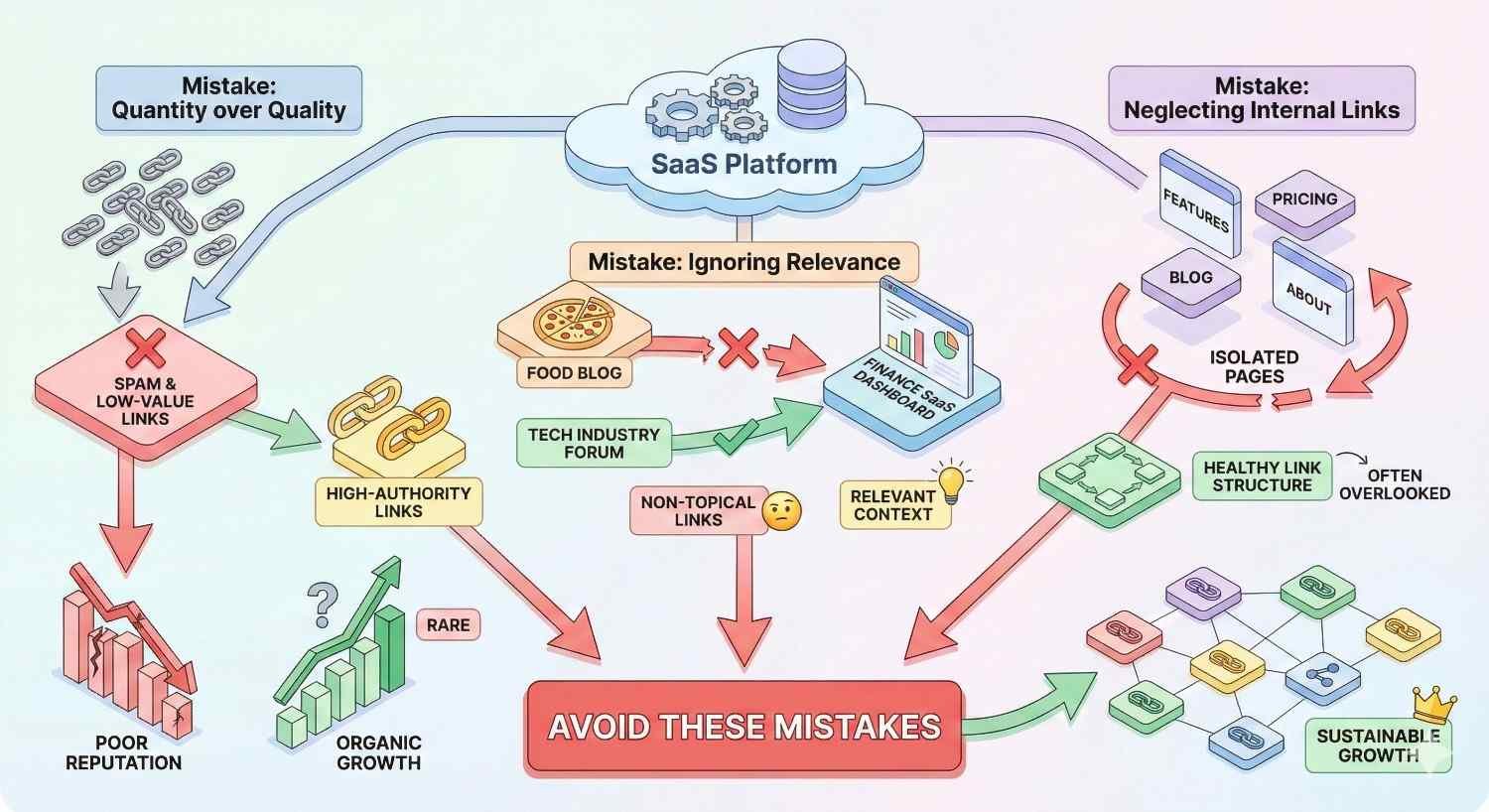
Common SaaS Link Building Mistakes to Avoid
Learning from common mistakes helps you evaluate providers and manage campaigns effectively.
Buying Low-Quality PBN Links
Private blog networks (PBNs) offer tempting shortcuts with low costs and guaranteed placements. However, Google actively identifies and penalizes PBN links.
The risk: PBN links may provide short-term ranking boosts followed by significant penalties. Recovery from link-based penalties requires extensive disavow work and reputation rebuilding.
How to avoid: Vet providers carefully. Ask about link sources and review sample placements. Avoid services with unusually low pricing or guaranteed placement volumes.
Ignoring Relevance for Domain Authority
High domain authority links from irrelevant sites underperform lower-authority links from topically relevant sources. Many SaaS companies chase metrics rather than relevance.
The impact: Irrelevant links waste budget and may trigger algorithmic scrutiny. Search engines increasingly evaluate link context alongside raw authority metrics.
How to avoid: Prioritize providers emphasizing topical relevance. Review placement sites for audience alignment with your target customers.
Neglecting Anchor Text Diversity
Over-optimized anchor text profiles trigger algorithmic penalties. Natural link profiles include branded anchors, generic phrases, and varied keyword usage.
The risk: Aggressive exact-match anchor text optimization signals manipulation. Penalties can affect entire domains, not just targeted pages.
How to avoid: Work with providers understanding anchor text best practices. Review anchor text distributions in reporting and ensure natural variation.
Frequently Asked Questions About SaaS Link Building Services
What is the best link building service for SaaS startups?
For early-stage SaaS startups with limited budgets, growth-stage providers like Getmentioned (#26) or LinksThatRank (#27) offer accessible entry points. These services deliver reasonable quality at startup-friendly price points while you build initial domain authority.
How long does it take to see results from link building?
Most SaaS companies observe measurable ranking improvements within 3-6 months of consistent link building. Significant organic traffic increases typically require 6-12 months of sustained effort. Results vary based on competition, existing authority, and link quality.
Are link building services worth it for SaaS companies?
Yes, for most SaaS companies, professional link building delivers positive ROI. Backlinks remain among the strongest ranking factors, and competitive SaaS markets require authority building. The key is selecting providers delivering quality links at appropriate price points for your stage.
What is a good number of links per month for SaaS?
Link velocity depends on your competitive landscape and existing authority. Early-stage SaaS companies typically benefit from 5-15 quality links monthly. Scale-ups may need 15-30 links monthly. Enterprise SaaS in competitive markets may require 30+ quality links monthly to maintain positions.
How do I measure link building ROI?
Track organic traffic growth, keyword ranking improvements, and conversions attributed to organic search. Compare link building investment against customer acquisition costs from paid channels. Calculate cost-per-acquired-customer through organic versus other channels to determine relative ROI.
Conclusion: Choosing Your SaaS Link Building Partner in 2026
Key Takeaways
Selecting the right SaaS link building service requires matching your company stage, budget, and goals with appropriate provider capabilities. Premium providers deliver exceptional quality for established companies, while growth-stage options serve startups effectively. Quality consistently outperforms quantity in 2026’s algorithm environment.
Next Steps and Recommendations
Start by defining your monthly budget and primary link building goals. Review providers within your appropriate tier and request case studies from SaaS clients in similar markets. Begin with shorter engagement periods to evaluate fit before committing to long-term contracts.
We help SaaS companies build sustainable organic growth through strategic link building, technical SEO, and content optimization. White Label SEO Service provides the expertise and execution you need to compete in demanding software markets—reach out to discuss your link building strategy today.
Frequently Asked Questions
What makes SaaS link building different from regular link building?
SaaS link building targets technology publications, software review sites, and B2B platforms where software buyers research solutions. It requires understanding of SaaS business models, integration ecosystems, and technical content standards that general link building services lack.
How much should a SaaS startup budget for link building monthly?
Early-stage SaaS startups should budget $1,500-$3,000 monthly for link building. This investment secures 8-15 quality links monthly from growth-stage providers, building initial authority while preserving runway for other growth activities.
Can I do SaaS link building in-house instead of hiring a service?
Yes, but it requires significant time investment and relationship building. In-house link building works best when combined with selective use of services for placements your team cannot access. Most SaaS companies find hybrid approaches most effective.
What domain rating should I target for SaaS backlinks?
Prioritize relevance over raw domain rating. A DR 45 link from a respected SaaS review site typically outperforms a DR 70 link from an unrelated publication. Target sites where your actual customers spend time researching solutions.
How do I know if a link building service uses safe practices?
Request transparency about link sources and review sample placements. Legitimate providers explain their outreach processes, show real publication relationships, and avoid guaranteeing specific link counts or rankings. Avoid services with pricing that seems too good.
Should I focus on link building or content creation first?
Both work together, but foundational content should precede aggressive link building. Create linkable assets—comprehensive guides, original research, useful tools—before investing heavily in outreach. Quality content makes link building significantly more effective.
What anchor text ratio should I maintain for SaaS link building?
Natural anchor text profiles include roughly 40-50% branded anchors, 20-30% generic phrases, 15-20% partial match keywords, and only 5-10% exact match keywords. Over-optimization triggers algorithmic scrutiny—prioritize natural variation.