The best AI SEO agencies in 2026 combine machine learning, natural language processing, and generative engine optimization to deliver measurable organic growth. These agencies don’t just optimize for Google rankings anymore. They position your brand across ChatGPT, Perplexity, Google AI Overviews, and traditional search results simultaneously.
This shift matters because search behavior has fundamentally changed. Users now get answers from AI assistants before clicking any website. Choosing the wrong agency means missing visibility in these new discovery channels entirely.
This guide ranks the top 15 AI SEO agencies, breaks down their services and pricing, and gives you a clear framework for selecting the right partner based on your business stage, industry, and growth goals.

What Are AI SEO Agencies & How They Transform Search Visibility
AI SEO agencies leverage artificial intelligence technologies to automate, predict, and optimize search performance at scale. Unlike traditional SEO firms that rely primarily on manual analysis and established best practices, AI-powered agencies use machine learning algorithms to identify patterns, forecast opportunities, and execute strategies that would be impossible through human effort alone.
These agencies transform search visibility by processing massive datasets in real-time. They analyze competitor movements, algorithm fluctuations, and user behavior patterns simultaneously. The result is faster identification of ranking opportunities, more precise content optimization, and proactive responses to search landscape changes.
The core value proposition centers on efficiency and prediction. AI SEO agencies can audit thousands of pages in minutes, identify content gaps across entire markets, and forecast which keywords will trend before competitors notice them. This capability gap between AI-powered and traditional approaches continues to widen as machine learning models improve.
The Evolution from Traditional SEO to AI-Powered Search Optimization
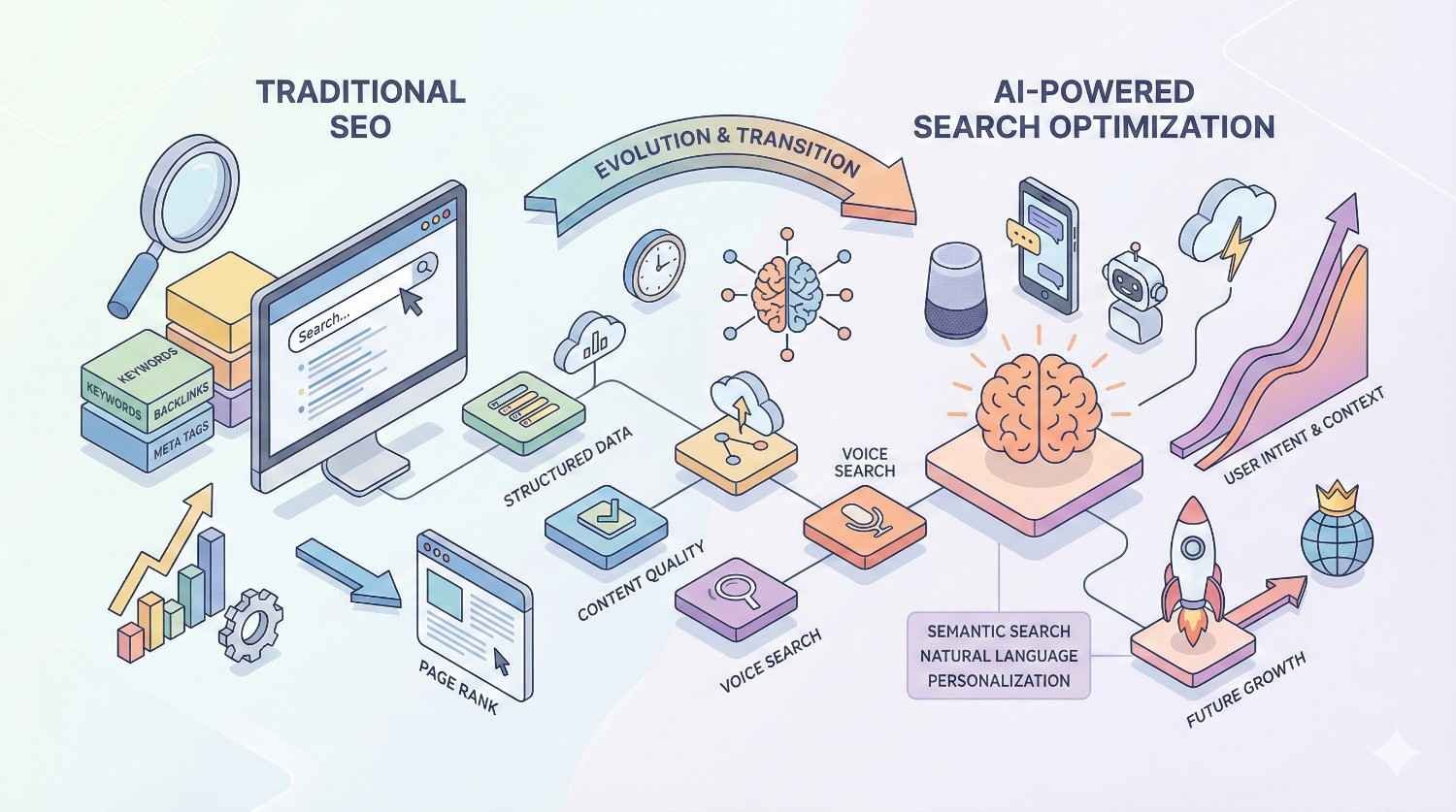
Traditional SEO operated on a relatively straightforward model. Practitioners conducted keyword research, optimized on-page elements, built backlinks, and monitored rankings. Success depended on understanding Google’s ranking factors and executing proven tactics consistently over time.
The first wave of AI integration focused on automation. Tools began crawling sites faster, generating reports automatically, and flagging technical issues without manual review. This phase improved efficiency but didn’t fundamentally change strategy.
The second wave introduced predictive capabilities. Machine learning models started forecasting keyword difficulty, predicting content performance, and identifying ranking opportunities before they became competitive. Agencies using these tools gained significant advantages in timing and resource allocation.
The current phase integrates generative AI into the optimization process itself. Content creation, entity optimization, and semantic analysis now happen with AI assistance. More importantly, agencies must now optimize for AI systems that generate answers, not just search engines that rank pages.
This evolution demands new expertise. Understanding how large language models source information differs fundamentally from understanding how Google’s algorithm ranks pages. The agencies leading in 2026 have built capabilities across both paradigms.
Core AI Technologies Reshaping SEO Services (NLP, Machine Learning, Automation)
Natural Language Processing (NLP) enables agencies to understand content the way search engines do. NLP tools analyze semantic relationships, entity connections, and topical relevance at scale. They identify whether content truly satisfies search intent or merely contains target keywords.
Advanced NLP applications include sentiment analysis for brand monitoring, intent classification for keyword research, and semantic gap analysis for content strategy. Agencies use these capabilities to create content that aligns with how both humans and algorithms interpret meaning.
Machine Learning (ML) powers the predictive and pattern-recognition capabilities that define AI SEO. ML models trained on ranking data can forecast which pages will gain or lose positions. They identify correlations between content characteristics and performance that human analysts would miss.
Practical ML applications include automated A/B testing for title tags, predictive traffic modeling, and anomaly detection for algorithm updates. The most sophisticated agencies build proprietary ML models trained on their client data, creating competitive advantages that compound over time.
Automation handles the execution layer. AI-powered automation manages technical audits, reporting, alert systems, and repetitive optimization tasks. This frees human strategists to focus on creative and strategic work that AI cannot replicate.
The integration of these technologies creates compounding effects. NLP identifies opportunities, ML predicts outcomes, and automation executes at scale. Agencies that master this integration deliver results that manual approaches cannot match.
GEO (Generative Engine Optimization) vs Traditional SEO: Key Differences
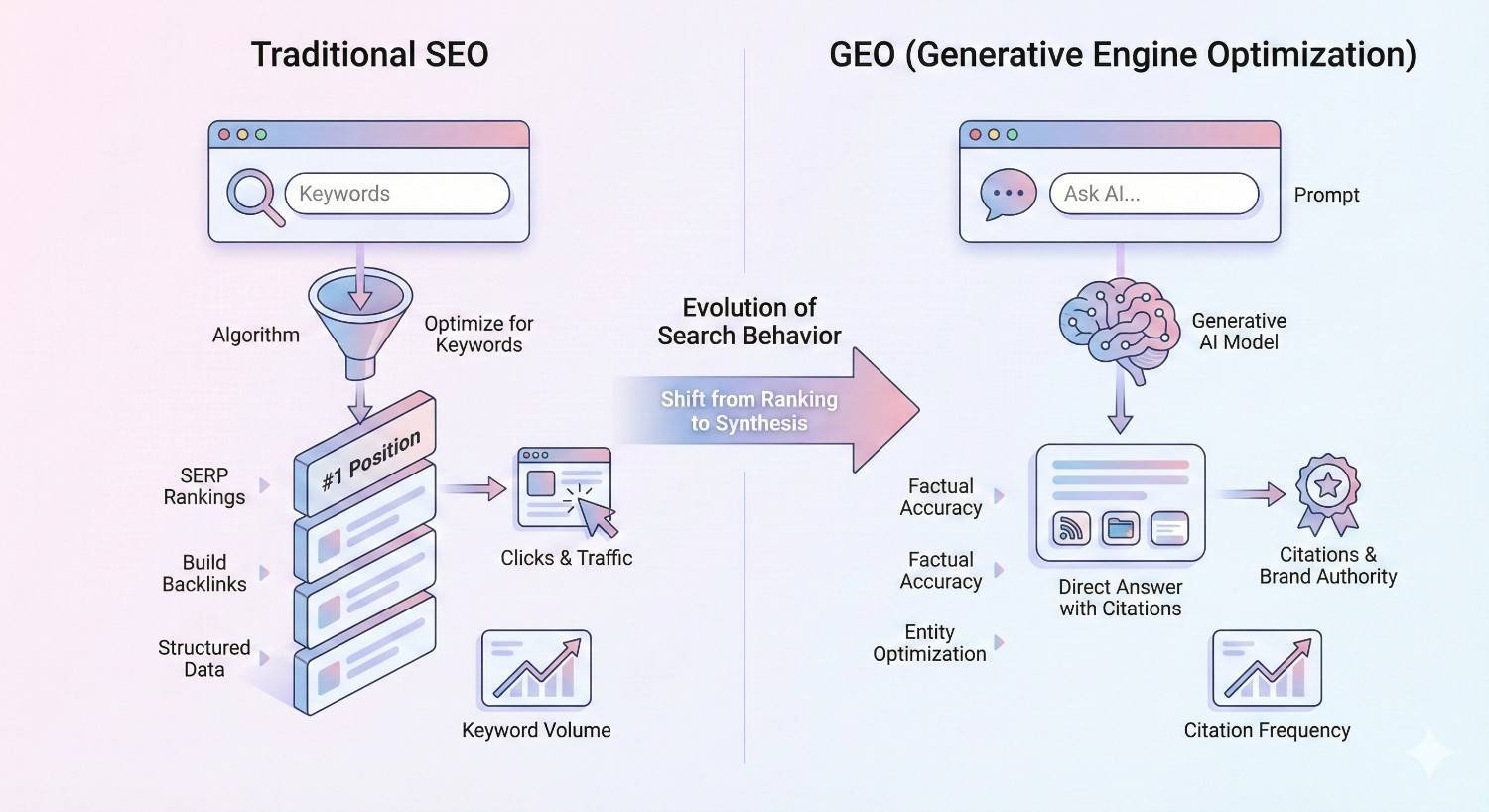
Generative Engine Optimization represents a fundamental shift in how businesses achieve search visibility. Traditional SEO focuses on ranking web pages in search engine results pages. GEO focuses on getting your brand, content, and expertise cited by AI systems that generate answers directly.
Information sourcing differs completely. Google ranks pages based on hundreds of signals including backlinks, technical performance, and content quality. AI systems like ChatGPT and Perplexity synthesize information from their training data and real-time retrieval, prioritizing authoritative sources, clear factual statements, and well-structured information.
Success metrics require new frameworks. Traditional SEO measures rankings, organic traffic, and click-through rates. GEO requires tracking brand mentions in AI responses, citation frequency, and visibility across multiple AI platforms. Many traditional analytics tools cannot measure GEO performance at all.
Content optimization strategies diverge significantly. Traditional SEO emphasizes keyword placement, meta tags, and internal linking. GEO prioritizes entity clarity, factual density, structured data, and authoritative positioning. Content optimized for GEO often includes more citations, clearer definitions, and explicit expertise signals.
The competitive landscape operates differently. In traditional SEO, you compete for ten organic positions per query. In GEO, AI systems may cite only one or two sources per response, or synthesize information without clear attribution. Winning in GEO often means being the definitive source that AI systems trust most.
The most effective AI SEO agencies in 2026 optimize for both paradigms simultaneously. They understand that traditional search still drives significant traffic while building visibility in generative AI platforms that increasingly shape how users discover information.

How We Evaluated the Top AI SEO Agencies for 2026
Ranking AI SEO agencies requires evaluation criteria that reflect the unique capabilities these firms must demonstrate. Traditional agency rankings often emphasize client lists, team size, or years in business. These factors matter less than demonstrated AI integration, measurable results, and transparency about methodologies.
Our evaluation process prioritized evidence over claims. Any agency can describe AI capabilities on their website. We looked for documented case studies, verifiable client results, and clear explanations of how AI technologies integrate into their service delivery.
We also weighted adaptability heavily. The AI SEO landscape changes rapidly. Agencies that built rigid processes around specific tools or platforms often struggle when those tools evolve or new platforms emerge. The top-ranked agencies demonstrate flexibility and continuous learning.
Evaluation Criteria: Technical Capabilities, AI Integration & Performance Metrics
Technical SEO capabilities form the foundation. We assessed each agency’s ability to conduct comprehensive technical audits, identify crawlability issues, optimize site architecture, and resolve complex technical problems. AI tools enhance these capabilities but cannot replace fundamental technical expertise.
AI integration depth distinguishes leaders from followers. We evaluated whether agencies use AI tools superficially for reporting and automation, or deeply integrate machine learning into strategy development, content optimization, and performance prediction. Surface-level AI adoption provides minimal competitive advantage.
Performance metrics and attribution reveal whether agencies can demonstrate ROI. We looked for sophisticated attribution models, clear KPI frameworks, and transparent reporting practices. Agencies that cannot clearly connect their work to business outcomes ranked lower regardless of their technical capabilities.
Proprietary technology development indicates investment in differentiation. Agencies building custom tools, training proprietary models, or developing unique methodologies demonstrate commitment to staying ahead. Those relying entirely on third-party tools face commoditization pressure.
Team expertise composition matters significantly. We assessed the balance between AI/ML specialists, traditional SEO practitioners, content strategists, and data analysts. The best agencies combine deep AI expertise with experienced SEO professionals who understand search fundamentals.
Agency Vetting Process: Case Studies, Client Results & Transparency Standards
Our vetting process began with case study analysis. We examined documented results for specificity, verifiability, and relevance. Case studies that included specific metrics, timeframes, and methodologies ranked higher than vague success claims.
We contacted references when possible. Client testimonials on agency websites provide limited insight. Direct conversations with current and former clients revealed service quality, communication practices, and actual results versus promised outcomes.
Transparency standards received significant weight. Agencies that clearly explain their methodologies, pricing structures, and tool usage demonstrate confidence in their approach. Those hiding behind proprietary secrets or vague descriptions often lack substantive differentiation.
We evaluated thought leadership and industry contribution. Agencies publishing original research, contributing to industry knowledge, and sharing insights demonstrate expertise beyond client work. This intellectual contribution also indicates teams that stay current with rapid industry changes.
Contract terms and client retention rates provided additional signals. Agencies with flexible contracts and high retention rates typically deliver consistent value. Those requiring long commitments with high early termination fees may lack confidence in their results.
Why AI SEO Requires Different Expertise Than Traditional SEO
Traditional SEO expertise centers on understanding search engine algorithms, content optimization, and link building. These skills remain valuable but insufficient for AI SEO leadership.
Data science capabilities become essential. AI SEO requires understanding how machine learning models work, how to interpret their outputs, and how to train or fine-tune models for specific applications. Agencies without data science expertise cannot fully leverage AI technologies.
Prompt engineering and AI interaction represent new skill requirements. Optimizing for generative AI systems requires understanding how these systems process and prioritize information. This differs fundamentally from understanding how traditional search algorithms rank pages.
Multi-platform optimization demands broader expertise. Traditional SEO focused primarily on Google. AI SEO requires understanding Google’s AI Overviews, ChatGPT’s retrieval mechanisms, Perplexity’s citation systems, and emerging AI platforms. Each operates differently.
Rapid adaptation capabilities matter more than ever. The AI landscape evolves monthly. Agencies must continuously learn new tools, adapt to platform changes, and update strategies. Traditional SEO changed gradually over years. AI SEO changes rapidly and unpredictably.
Integration complexity requires systems thinking. AI SEO involves coordinating multiple AI tools, data sources, and optimization strategies. Agencies must build workflows that integrate these elements effectively rather than using tools in isolation.
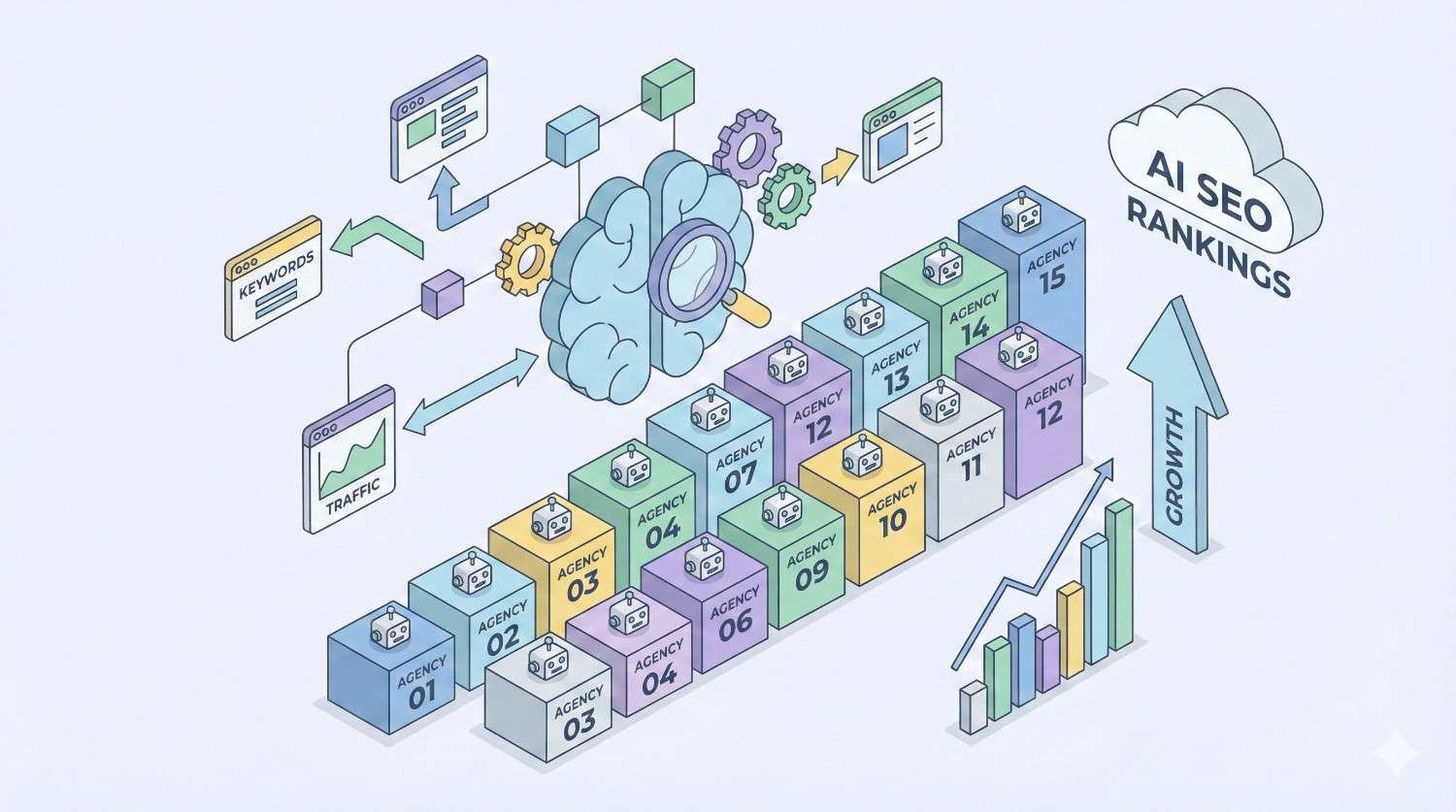
Top 15 AI SEO Agencies in 2026 – Comprehensive Rankings
The following rankings reflect our comprehensive evaluation across technical capabilities, AI integration, documented results, and client feedback. These agencies represent the current leaders in combining artificial intelligence with search engine optimization.
Rankings consider both traditional SEO excellence and emerging GEO capabilities. The best agencies excel at both, understanding that search visibility now spans traditional results pages and AI-generated responses.
Pricing information reflects typical engagement ranges. Actual costs vary based on scope, industry complexity, and specific requirements. All agencies offer custom proposals based on individual business needs.
#1-5: Enterprise-Level AI SEO Agencies (Full-Service Solutions)
#1: Directive Consulting
Core AI SEO Services & Specializations Directive Consulting leads in B2B and SaaS AI SEO, combining customer generation methodology with advanced AI integration. Their approach focuses on revenue attribution rather than vanity metrics, using AI to identify high-intent keywords and optimize conversion paths.
AI Technology Stack & Proprietary Tools Directive developed proprietary attribution modeling that connects SEO activities to pipeline and revenue. Their tech stack integrates Clearscope, Semrush, and custom ML models for competitive analysis. They use AI-powered content optimization tools calibrated specifically for B2B buying cycles.
Ideal Client Profile & Industry Focus Best suited for B2B SaaS companies, technology firms, and enterprise software providers with annual revenues exceeding $10 million. Clients typically have complex sales cycles and need SEO strategies that support multi-touch buyer journeys.
Pricing Model & Investment Range Monthly retainers typically range from $15,000 to $50,000+ depending on scope. Enterprise engagements with multiple business units or global requirements often exceed this range. They offer performance-based components for qualified clients.
Notable Results & Case Study Highlights Documented results include a SaaS client achieving 312% increase in qualified pipeline within 18 months and an enterprise software company reducing customer acquisition cost by 40% through organic channel optimization.
Unique Differentiators & Competitive Advantages Customer generation framework that ties all SEO activities to revenue outcomes. Deep specialization in B2B means strategies account for long sales cycles, multiple stakeholders, and complex buying processes that generalist agencies often misunderstand.
#2: Siege Media
Core AI SEO Services & Specializations Siege Media excels at AI-powered content strategy and link acquisition. They combine data-driven content creation with sophisticated outreach automation, producing content that earns links naturally while ranking for competitive terms.
AI Technology Stack & Proprietary Tools Proprietary content ideation tools use ML to identify topics with high link potential and search volume. Their outreach platform leverages AI for prospect identification, personalization at scale, and relationship tracking. Content optimization integrates multiple AI writing assistants with human editorial oversight.
Ideal Client Profile & Industry Focus Ideal for brands investing heavily in content marketing, particularly in finance, SaaS, e-commerce, and lifestyle verticals. Clients typically need both traffic growth and authority building through high-quality link acquisition.
Pricing Model & Investment Range Retainers range from $10,000 to $30,000 monthly for standard engagements. Content-intensive programs with aggressive publishing schedules and link building targets command higher investment. Project-based content campaigns available for specific initiatives.
Notable Results & Case Study Highlights Case studies document clients earning 500+ referring domains annually through content-led link building. Traffic growth examples include 200%+ organic traffic increases within 12 months for competitive niches.
Unique Differentiators & Competitive Advantages Integration of content creation and link building creates compounding effects. Their data-driven approach to content ideation consistently produces pieces that earn links organically, reducing reliance on traditional outreach.
#3: iPullRank
Core AI SEO Services & Specializations iPullRank brings technical SEO depth combined with advanced AI and machine learning applications. Founded by Mike King, a recognized thought leader in technical SEO and AI applications, the agency emphasizes data science approaches to search optimization.
AI Technology Stack & Proprietary Tools Custom machine learning models for log file analysis, crawl optimization, and ranking prediction. They develop client-specific AI solutions rather than relying solely on off-the-shelf tools. Strong integration with Google’s AI and ML APIs for advanced analytics.
Ideal Client Profile & Industry Focus Best for enterprise clients with complex technical environments, large-scale websites, and sophisticated data requirements. Particularly strong with e-commerce, publishers, and technology companies needing advanced technical solutions.
Pricing Model & Investment Range Enterprise engagements typically start at $20,000 monthly with complex technical projects commanding $40,000+. They also offer technical audit projects and consulting engagements for specific challenges.
Notable Results & Case Study Highlights Technical optimization projects have delivered 50%+ improvements in crawl efficiency and corresponding ranking gains. Machine learning implementations have identified ranking opportunities worth millions in potential revenue.
Unique Differentiators & Competitive Advantages Depth of technical and data science expertise exceeds most competitors. Mike King’s industry influence ensures the agency stays at the forefront of AI SEO developments. Custom ML solutions provide capabilities unavailable through standard tools.
#4: Victorious
Core AI SEO Services & Specializations Victorious combines AI-powered SEO with strong emphasis on transparency and client education. Their approach integrates machine learning for keyword research, content optimization, and performance prediction while maintaining clear communication about methodologies.
AI Technology Stack & Proprietary Tools Proprietary keyword research platform uses ML to identify opportunity clusters and predict ranking difficulty. Content optimization tools integrate semantic analysis with competitive gap identification. Automated reporting provides real-time performance visibility.
Ideal Client Profile & Industry Focus Serves mid-market to enterprise clients across diverse industries including legal, healthcare, finance, and technology. Particularly effective for businesses needing both national and local SEO strategies.
Pricing Model & Investment Range Monthly retainers range from $8,000 to $25,000 for most engagements. Enterprise programs with multiple locations or complex requirements scale accordingly. Transparent pricing with clear deliverable expectations.
Notable Results & Case Study Highlights Documented client results include 400%+ organic traffic growth for competitive legal markets and first-page rankings for high-value commercial terms within 6-12 months.
Unique Differentiators & Competitive Advantages Transparency in reporting and methodology builds strong client relationships. Their educational approach helps clients understand AI SEO, enabling better collaboration and realistic expectation setting.
#5: Straight North
Core AI SEO Services & Specializations Straight North delivers full-service AI SEO with particular strength in lead generation and conversion optimization. Their approach integrates SEO with broader digital marketing, using AI to optimize the entire customer acquisition funnel.
AI Technology Stack & Proprietary Tools Lead tracking and attribution platform uses ML to connect SEO activities with qualified leads and sales. AI-powered content tools optimize for both search visibility and conversion. Automated competitive monitoring identifies market opportunities.
Ideal Client Profile & Industry Focus Ideal for B2B companies focused on lead generation, particularly in manufacturing, professional services, and industrial sectors. Clients typically need SEO integrated with paid media and conversion optimization.
Pricing Model & Investment Range Retainers typically range from $5,000 to $20,000 monthly depending on scope and competitive intensity. Integrated digital marketing programs combining SEO with other channels available at higher investment levels.
Notable Results & Case Study Highlights Lead generation focused results include clients achieving 300%+ increases in qualified leads from organic search. ROI documentation shows clear connections between SEO investment and revenue growth.
Unique Differentiators & Competitive Advantages Lead validation and tracking provide clearer ROI measurement than most competitors. Integration with paid media and conversion optimization creates comprehensive growth strategies rather than isolated SEO tactics.
#6-10: Mid-Market AI SEO Specialists (Growth-Focused Agencies)
#6: Titan Growth
Core AI SEO Services & Specializations Titan Growth pioneered patented SEO technology with their TitanBOT platform, which reverse-engineers search engine behavior. Their AI-first approach focuses on understanding how search engines actually crawl and evaluate websites.
AI Technology Stack & Proprietary Tools TitanBOT technology simulates search engine crawling behavior, identifying issues invisible to standard audit tools. Proprietary ranking prediction models inform strategy development. Automated monitoring detects algorithm changes and competitive movements.
Ideal Client Profile & Industry Focus Serves growth-stage companies and established brands seeking competitive advantages through technology. Strong presence in e-commerce, travel, and consumer brands.
Pricing Model & Investment Range Retainers range from $7,500 to $20,000 monthly for standard engagements. Technology licensing options available for enterprises wanting to integrate TitanBOT capabilities internally.
Notable Results & Case Study Highlights Clients have achieved 200%+ organic revenue growth through technical optimizations identified by proprietary technology. Case studies document ranking improvements for highly competitive commercial terms.
Unique Differentiators & Competitive Advantages Patented technology provides insights unavailable through any other agency or tool. Technical depth combined with strategic application creates sustainable competitive advantages.
#7: Seer Interactive
Core AI SEO Services & Specializations Seer Interactive emphasizes data-driven SEO with strong analytics integration. Their approach combines AI-powered analysis with deep audience research, creating strategies based on actual user behavior rather than assumptions.
AI Technology Stack & Proprietary Tools Advanced analytics integration connects SEO data with business intelligence platforms. ML-powered audience analysis identifies behavioral patterns and intent signals. Custom dashboards provide actionable insights rather than raw data.
Ideal Client Profile & Industry Focus Best for data-mature organizations wanting sophisticated analytics integration. Strong in healthcare, education, and enterprise B2B sectors where complex buyer journeys require nuanced understanding.
Pricing Model & Investment Range Monthly retainers typically range from $10,000 to $30,000. Analytics and data integration projects available as standalone engagements. Consulting services for organizations building internal capabilities.
Notable Results & Case Study Highlights Analytics-driven optimizations have delivered 150%+ improvements in conversion rates from organic traffic. Audience research has identified untapped market segments worth significant revenue.
Unique Differentiators & Competitive Advantages Analytics depth exceeds most SEO agencies. Integration with broader business intelligence enables strategies that connect SEO to organizational goals rather than isolated metrics.
#8: Ignite Visibility
Core AI SEO Services & Specializations Ignite Visibility delivers comprehensive digital marketing with AI-enhanced SEO at the core. Their approach integrates SEO with social media, paid advertising, and conversion optimization for unified growth strategies.
AI Technology Stack & Proprietary Tools Proprietary forecasting tools predict traffic and revenue outcomes. AI-powered content optimization integrates with their broader content marketing services. Automated reporting consolidates performance across all digital channels.
Ideal Client Profile & Industry Focus Serves mid-market companies seeking integrated digital marketing rather than isolated SEO services. Strong in franchise, multi-location, and consumer brand sectors.
Pricing Model & Investment Range SEO-focused retainers range from $5,000 to $15,000 monthly. Integrated digital marketing programs combining multiple services available at higher investment levels.
Notable Results & Case Study Highlights Integrated campaigns have delivered 250%+ growth in organic traffic combined with improvements across other channels. Multi-location clients have achieved consistent local ranking improvements.
Unique Differentiators & Competitive Advantages Integration across digital marketing disciplines creates synergies unavailable from SEO-only agencies. Strong educational content and thought leadership demonstrate expertise.
#9: WebFX
Core AI SEO Services & Specializations WebFX combines AI-powered SEO with extensive service breadth and transparent pricing. Their MarketingCloudFX platform integrates AI across SEO, content, and analytics functions.
AI Technology Stack & Proprietary Tools MarketingCloudFX platform provides AI-powered recommendations, automated reporting, and performance tracking. ContentGeniusFX uses AI for content optimization and ideation. RevenueCloudFX connects marketing activities to revenue outcomes.
Ideal Client Profile & Industry Focus Serves small to mid-market businesses across diverse industries. Particularly effective for companies wanting comprehensive digital marketing with clear pricing and deliverables.
Pricing Model & Investment Range Transparent pricing with packages starting around $3,000 monthly for smaller businesses. Mid-market engagements typically range from $5,000 to $15,000 monthly. Clear deliverable expectations at each price point.
Notable Results & Case Study Highlights Documented results include clients generating $6 billion+ in revenue through their services collectively. Individual case studies show 100-300% traffic improvements across various industries.
Unique Differentiators & Competitive Advantages Pricing transparency and clear deliverables reduce uncertainty for clients. Proprietary technology platform provides capabilities typically available only to larger agencies.
#10: Thrive Internet Marketing Agency
Core AI SEO Services & Specializations Thrive delivers AI-enhanced SEO with particular strength in local and multi-location optimization. Their approach combines technical SEO fundamentals with AI-powered local search strategies.
AI Technology Stack & Proprietary Tools AI-powered local SEO tools optimize Google Business Profiles and local citations at scale. Content optimization integrates semantic analysis with local relevance signals. Automated reputation management monitors and responds to reviews.
Ideal Client Profile & Industry Focus Ideal for multi-location businesses, franchises, and local service providers. Strong in healthcare, legal, home services, and retail sectors with physical locations.
Pricing Model & Investment Range Retainers range from $3,000 to $10,000 monthly for most engagements. Multi-location programs scale based on location count and competitive intensity.
Notable Results & Case Study Highlights Local SEO campaigns have achieved top 3 map pack rankings for competitive local terms. Multi-location clients have seen 200%+ increases in local organic visibility.
Unique Differentiators & Competitive Advantages Local SEO depth exceeds most national agencies. Scalable systems for multi-location optimization provide efficiency advantages for franchise and chain businesses.
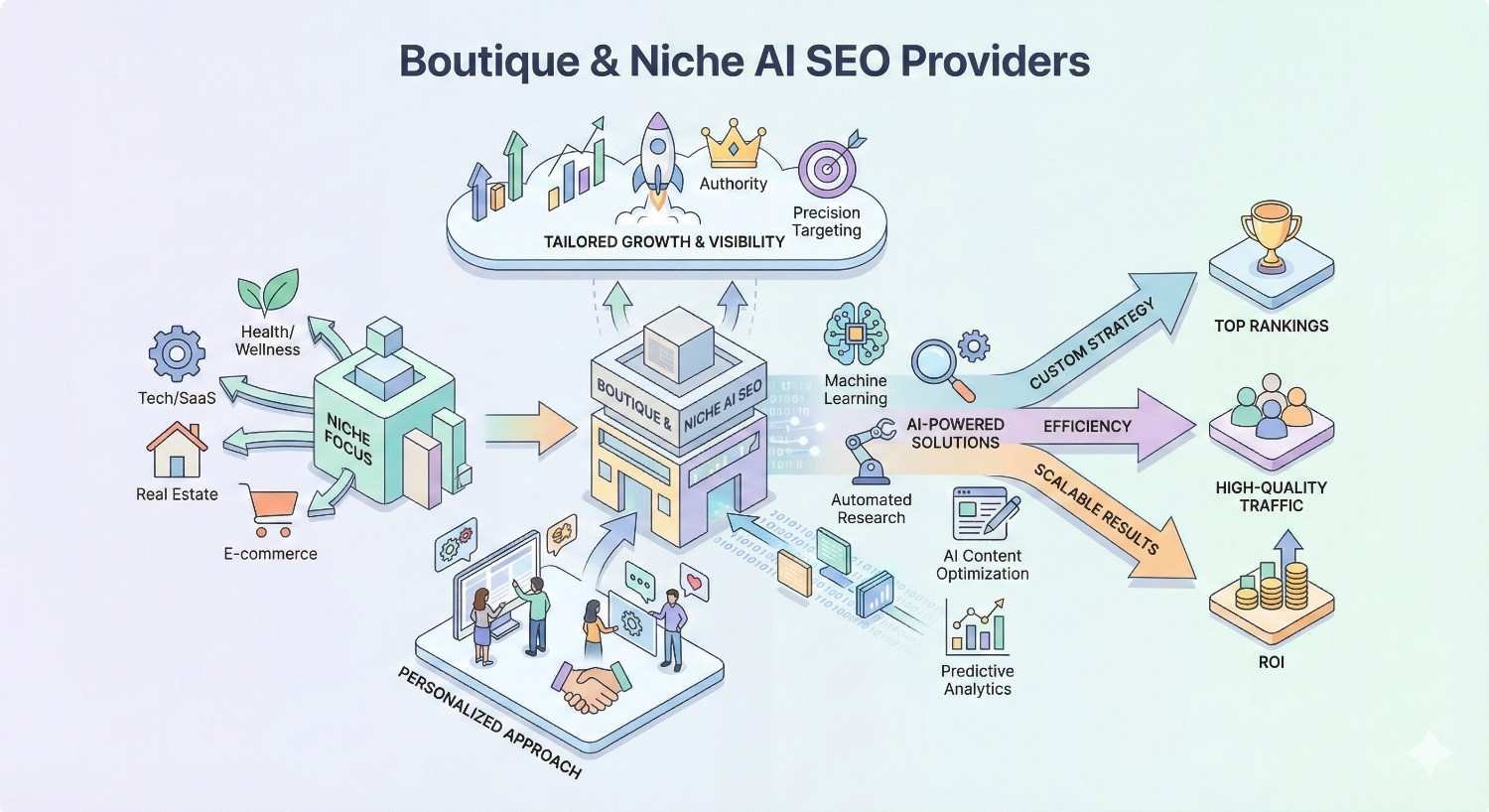
#11-15: Boutique & Niche AI SEO Providers (Specialized Solutions)
#11: Previsible
Core AI SEO Services & Specializations Previsible specializes in AI-powered SEO forecasting and predictive analytics. Their focus on prediction and measurement helps clients understand expected outcomes before committing resources.
AI Technology Stack & Proprietary Tools Proprietary forecasting models predict traffic, rankings, and revenue outcomes with documented accuracy. ML-powered scenario planning helps clients evaluate different strategic approaches.
Ideal Client Profile & Industry Focus Best for data-driven organizations needing accurate forecasting for budget planning and stakeholder communication. Particularly valuable for enterprises with complex approval processes.
Pricing Model & Investment Range Consulting and forecasting engagements typically range from $5,000 to $15,000 for initial projects. Ongoing advisory relationships available for continuous forecasting and optimization.
Notable Results & Case Study Highlights Forecasting accuracy documentation shows predictions within 10-15% of actual outcomes for most engagements. Clients have used forecasts to secure budget approval for major SEO investments.
Unique Differentiators & Competitive Advantages Forecasting specialization provides unique value for organizations needing predictable outcomes. Documentation of prediction accuracy builds credibility with skeptical stakeholders.
#12: Graphite
Core AI SEO Services & Specializations Graphite focuses on AI SEO for high-growth startups and technology companies. Their approach emphasizes speed, scalability, and integration with product-led growth strategies.
AI Technology Stack & Proprietary Tools AI-powered content velocity tools enable rapid content production without quality sacrifice. Automated technical monitoring identifies issues before they impact growth. Integration with product analytics connects SEO to user behavior.
Ideal Client Profile & Industry Focus Ideal for venture-backed startups and growth-stage technology companies. Particularly effective for SaaS, marketplace, and platform businesses with aggressive growth targets.
Pricing Model & Investment Range Retainers typically range from $10,000 to $25,000 monthly for growth-stage companies. Startup packages available for earlier-stage companies with smaller budgets.
Notable Results & Case Study Highlights Startup clients have achieved 10x organic traffic growth within 18 months. Case studies document SEO contributions to successful funding rounds and acquisitions.
Unique Differentiators & Competitive Advantages Startup specialization means understanding growth metrics, runway constraints, and investor expectations. Speed of execution matches startup pace rather than traditional agency timelines.
#13: Acronym
Core AI SEO Services & Specializations Acronym specializes in enterprise AI SEO with global capabilities. Their approach addresses the complexity of multinational SEO including localization, hreflang implementation, and regional search engine optimization.
AI Technology Stack & Proprietary Tools Global SEO platform manages multi-language, multi-region optimization at scale. AI-powered translation and localization ensure content maintains SEO value across markets. Automated monitoring tracks performance across regional search engines.
Ideal Client Profile & Industry Focus Best for multinational enterprises with presence in multiple countries and languages. Strong in travel, hospitality, retail, and consumer brands with global footprints.
Pricing Model & Investment Range Enterprise engagements typically start at $25,000 monthly with global programs commanding $50,000+ depending on market count and complexity.
Notable Results & Case Study Highlights Global optimization projects have delivered consistent ranking improvements across 20+ markets simultaneously. Localization strategies have captured market share from regional competitors.
Unique Differentiators & Competitive Advantages Global SEO expertise exceeds most agencies. Understanding of regional search engines beyond Google provides advantages in markets like China, Russia, and South Korea.
#14: Path Interactive
Core AI SEO Services & Specializations Path Interactive delivers AI-enhanced SEO with strong integration of user experience and conversion optimization. Their approach recognizes that rankings without conversions provide limited business value.
AI Technology Stack & Proprietary Tools AI-powered UX analysis identifies friction points affecting both rankings and conversions. Content optimization balances search visibility with user engagement. Automated testing platforms optimize page elements continuously.
Ideal Client Profile & Industry Focus Ideal for e-commerce and lead generation businesses where conversion rate directly impacts ROI. Strong in retail, financial services, and B2B technology sectors.
Pricing Model & Investment Range Retainers range from $8,000 to $20,000 monthly for most engagements. Conversion optimization projects available as standalone services or integrated with SEO.
Notable Results & Case Study Highlights Combined SEO and CRO programs have delivered 50%+ improvements in organic revenue beyond traffic gains alone. User experience optimizations have improved both rankings and conversion rates simultaneously.
Unique Differentiators & Competitive Advantages Integration of SEO with conversion optimization creates compounding value. Understanding that traffic without conversion wastes resources differentiates from traffic-focused competitors.
#15: Go Fish Digital
Core AI SEO Services & Specializations Go Fish Digital combines AI-powered SEO with digital PR and reputation management. Their approach builds authority through earned media while optimizing technical and content foundations.
AI Technology Stack & Proprietary Tools AI-powered media monitoring identifies PR opportunities and tracks brand mentions. Content ideation tools identify topics with both search and PR potential. Automated outreach platforms scale relationship building.
Ideal Client Profile & Industry Focus Best for brands needing both SEO and reputation management. Particularly effective for companies facing negative search results or wanting to build thought leadership.
Pricing Model & Investment Range Retainers typically range from $7,500 to $20,000 monthly for integrated SEO and PR programs. Reputation management projects available for specific challenges.
Notable Results & Case Study Highlights Integrated campaigns have earned coverage in major publications while improving organic rankings. Reputation management projects have displaced negative results with positive content.
Unique Differentiators & Competitive Advantages Integration of SEO with digital PR creates link building opportunities unavailable through traditional outreach. Reputation management expertise addresses challenges most SEO agencies cannot handle.
AI SEO Services Breakdown: What Top Agencies Actually Deliver
Understanding what AI SEO agencies actually deliver helps set realistic expectations and evaluate proposals effectively. The services described below represent capabilities you should expect from top-tier providers, though specific implementations vary by agency.
These services integrate AI at different levels. Some use AI for automation and efficiency. Others leverage machine learning for prediction and optimization. The best agencies combine both approaches while maintaining human strategic oversight.
AI-Powered Technical SEO Audits & Automation
Technical SEO forms the foundation of search visibility. AI-powered audits identify issues faster and more comprehensively than manual analysis, enabling agencies to prioritize fixes based on predicted impact.
Automated Site Crawling & Issue Detection
AI-powered crawlers analyze websites continuously rather than periodically. They identify technical issues including broken links, redirect chains, duplicate content, and crawlability problems as they occur.
Machine learning models prioritize issues based on predicted ranking impact. Not all technical problems affect rankings equally. AI helps agencies focus resources on fixes that will actually improve performance.
Advanced crawlers simulate how different search engines and AI systems access content. This reveals issues that might affect visibility in Google AI Overviews or AI assistant responses that standard crawls miss.
Predictive Technical SEO Recommendations
Beyond identifying current issues, AI systems predict future problems. They analyze patterns that typically precede ranking drops, enabling proactive intervention before visibility suffers.
Predictive models also identify optimization opportunities. They analyze competitor technical implementations and identify gaps where improvements could yield ranking advantages.
These recommendations include priority scoring based on effort versus impact. Agencies can show clients exactly which technical investments will deliver the greatest returns.
Real-Time Performance Monitoring & Alerts
Continuous monitoring detects ranking changes, traffic anomalies, and technical issues immediately. Automated alerts notify agency teams when metrics deviate from expected patterns.
AI-powered anomaly detection distinguishes between normal fluctuations and meaningful changes requiring attention. This reduces alert fatigue while ensuring important issues receive prompt response.
Integration with Google Search Console, analytics platforms, and third-party tools provides comprehensive visibility. Agencies can correlate ranking changes with technical issues, content updates, or algorithm changes.
AI Content Strategy & Generative Engine Optimization (GEO)
Content strategy has evolved dramatically with AI integration. Agencies now use AI for research, planning, optimization, and quality assurance while maintaining human creative direction.
AI-Assisted Content Gap Analysis & Topic Clustering
AI tools analyze entire markets to identify content opportunities. They compare client content against competitors, identifying topics where gaps exist and ranking potential is high.
Topic clustering algorithms group related keywords and concepts into strategic content plans. This ensures comprehensive coverage while avoiding cannibalization between pages.
Predictive models forecast which topics will trend, enabling agencies to create content before competition intensifies. This timing advantage can mean the difference between ranking easily and facing intense competition.
Semantic SEO & Entity-Based Content Optimization
Modern SEO requires understanding entities and their relationships, not just keywords. AI tools analyze how search engines understand topics and ensure content aligns with these semantic structures.
Entity optimization involves clearly establishing what entities content discusses and how they relate to each other. This helps both traditional search engines and AI systems understand and trust content.
Semantic analysis tools evaluate content comprehensiveness. They identify missing concepts, related entities, and contextual information that would strengthen topical authority.
Optimizing for ChatGPT, Bard, Perplexity & AI Overviews
GEO requires understanding how different AI systems source and present information. Each platform has different retrieval mechanisms, citation preferences, and content evaluation criteria.
Optimization strategies include structured data implementation, clear factual statements, authoritative sourcing, and content formatting that AI systems can easily parse and cite.
Agencies monitor client visibility across AI platforms, tracking when and how content appears in AI-generated responses. This emerging measurement capability differentiates leaders from followers.
AI Content Quality Assurance & E-E-A-T Validation
AI tools evaluate content against E-E-A-T criteria before publication. They assess expertise signals, authority indicators, and trust factors that influence both rankings and AI citations.
Quality assurance includes checking factual accuracy, source credibility, and content freshness. AI can flag outdated information, questionable claims, and missing citations that could undermine credibility.
These tools also detect AI-generated content characteristics that might trigger quality filters. Agencies ensure content maintains human quality standards even when AI assists creation.
AI-Driven Keyword Research & Search Intent Analysis
Keyword research has transformed from manual database queries to AI-powered opportunity identification. Modern approaches predict potential, classify intent, and identify competitive gaps automatically.
Predictive Keyword Opportunity Identification
Machine learning models analyze keyword data to predict ranking difficulty and traffic potential more accurately than traditional metrics. They consider factors including content requirements, competitive intensity, and SERP features.
Predictive tools identify emerging keywords before they appear in standard databases. By analyzing search trends, news, and social signals, agencies can target opportunities before competitors notice them.
Opportunity scoring combines multiple factors into actionable recommendations. Agencies can show clients exactly which keywords offer the best return on content investment.
AI-Powered Search Intent Classification
Understanding search intent determines content strategy success. AI tools classify intent more accurately than manual analysis, distinguishing between informational, navigational, transactional, and commercial investigation queries.
Advanced intent analysis identifies intent layers within queries. Many searches have primary and secondary intents that content should address. AI helps agencies create content satisfying complete user needs.
Intent classification also predicts SERP features. Knowing whether queries trigger featured snippets, AI Overviews, or video results shapes content format decisions.
Competitive Intelligence & Market Gap Analysis
AI-powered competitive analysis reveals competitor strategies, content gaps, and market opportunities. These tools analyze thousands of competitor pages to identify patterns and weaknesses.
Gap analysis identifies topics competitors rank for that clients don’t address. It also finds topics where competitor content is weak, presenting opportunities for superior content.
Market analysis extends beyond direct competitors to identify adjacent opportunities. AI can identify related markets where client expertise could capture additional traffic.
Machine Learning for Link Building & Authority Development
Link building remains essential for SEO success. AI enhances prospecting, outreach personalization, and relationship management while maintaining the human connections that earn quality links.
AI-Powered Prospect Identification & Outreach Personalization
Machine learning models identify link prospects more efficiently than manual research. They analyze content relevance, domain authority, linking patterns, and response likelihood to prioritize outreach.
AI-powered personalization creates customized outreach at scale. Tools analyze prospect content, interests, and communication style to craft messages that resonate individually while maintaining efficiency.
Prospect scoring predicts response likelihood and link value. Agencies focus efforts on prospects most likely to result in valuable links rather than wasting time on low-probability targets.
Link Quality Scoring & Risk Assessment
AI tools evaluate link quality more comprehensively than traditional metrics. They assess relevance, authority, traffic, and risk factors to ensure link building improves rather than harms rankings.
Risk assessment identifies potentially harmful links before they cause problems. Machine learning models trained on penalty data recognize patterns associated with algorithmic or manual penalties.
Quality scoring also evaluates existing backlink profiles. Agencies can identify links to disavow and opportunities to strengthen profiles through targeted acquisition.
Automated Relationship Management & Follow-Up Sequences
Relationship management tools track interactions with prospects and partners. They automate follow-up sequences while maintaining personalization that builds genuine relationships.
AI scheduling optimizes outreach timing based on response patterns. Sending emails when prospects are most likely to engage improves response rates significantly.
Long-term relationship tracking enables ongoing link opportunities. Rather than one-time outreach, agencies build relationships that yield multiple links over time.
AI Analytics, Forecasting & Performance Attribution
Analytics capabilities distinguish sophisticated agencies from basic providers. AI-powered analytics provide predictive insights, accurate attribution, and actionable recommendations.
Predictive Traffic & Revenue Modeling
Forecasting models predict traffic and revenue outcomes from SEO investments. These predictions help clients understand expected returns and plan resources accordingly.
Scenario modeling evaluates different strategic approaches. Agencies can show clients how various investment levels or strategic choices would likely affect outcomes.
Forecast accuracy tracking builds credibility. Agencies that document prediction accuracy demonstrate analytical capabilities and build trust with data-driven clients.
Multi-Touch Attribution & Conversion Path Analysis
SEO rarely operates in isolation. Multi-touch attribution models show how organic search contributes to conversions alongside other channels.
Conversion path analysis reveals how users move from initial organic discovery through conversion. This understanding shapes content strategy and identifies optimization opportunities.
Attribution modeling also demonstrates SEO value to stakeholders. Clear connection between SEO activities and business outcomes justifies continued investment.
Automated Reporting & Insight Generation
AI-powered reporting goes beyond data presentation to insight generation. Tools analyze performance data and surface meaningful patterns, anomalies, and opportunities.
Automated narrative generation explains what happened and why. Reports include context and recommendations rather than just metrics.
Custom dashboards provide real-time visibility into metrics that matter most. Clients can access performance data whenever needed rather than waiting for periodic reports.
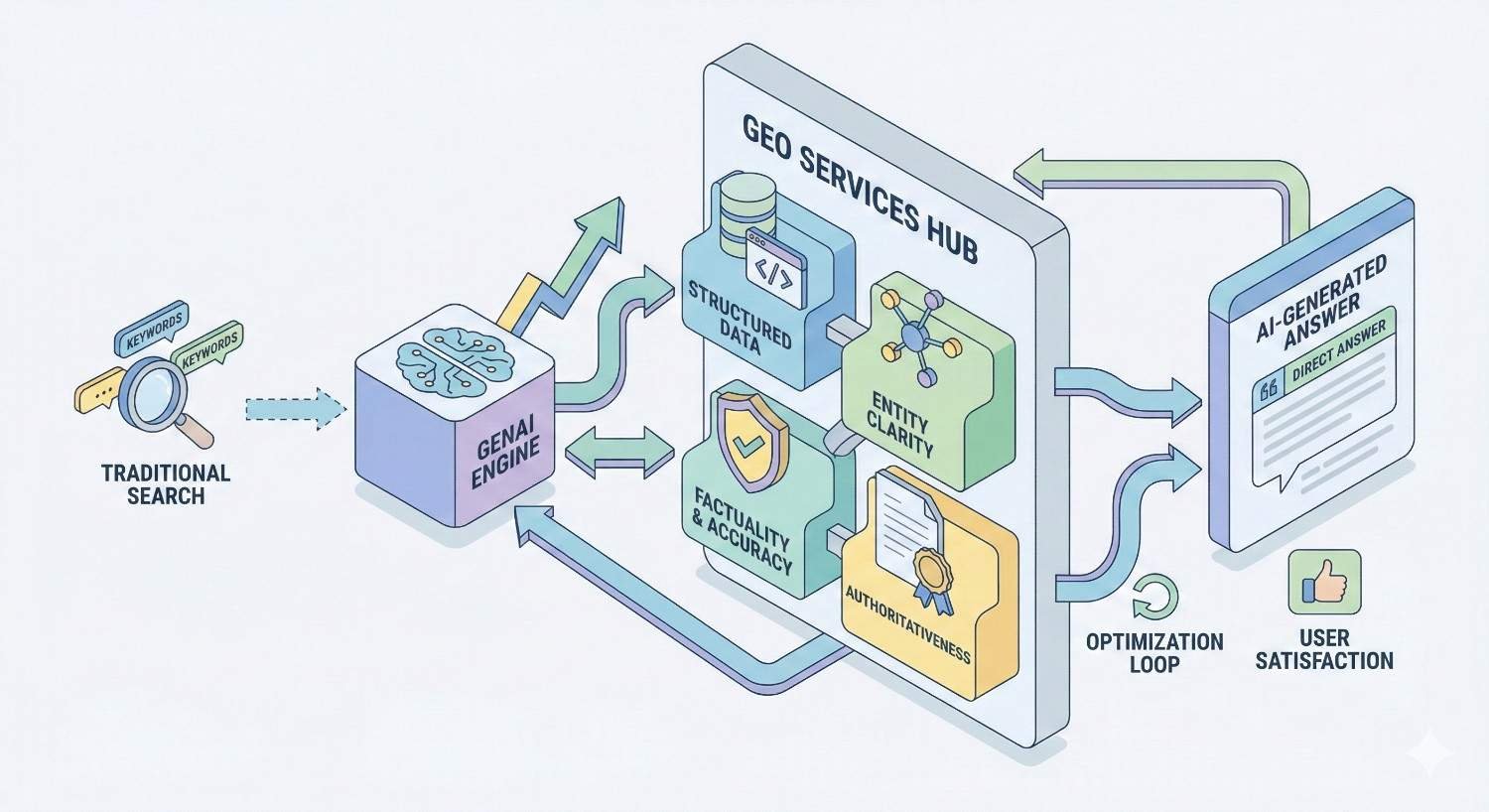
GEO Services Explained: Optimizing for Generative AI Search Engines
Generative Engine Optimization represents the most significant shift in search visibility since mobile optimization. As AI assistants increasingly answer questions directly, appearing in these responses becomes essential for maintaining visibility.
GEO requires different strategies than traditional SEO. Understanding how AI systems source information, what they prioritize, and how to measure visibility in AI responses shapes effective optimization approaches.
What Is Generative Engine Optimization (GEO)?
GEO encompasses strategies and tactics designed to increase brand and content visibility within AI-generated responses. This includes appearing in ChatGPT answers, Google AI Overviews, Perplexity citations, and other AI assistant outputs.
Unlike traditional SEO where success means ranking on page one, GEO success means being the source AI systems cite when answering relevant questions. This often requires being the most authoritative, clear, and trustworthy source on a topic.
GEO also involves understanding AI system limitations and behaviors. These systems sometimes hallucinate, misattribute information, or fail to cite sources. Effective GEO strategies account for these characteristics.
How ChatGPT, Bard, Perplexity & AI Overviews Source Information
ChatGPT draws from training data and, with browsing enabled, real-time web searches. It prioritizes authoritative sources, clear factual statements, and well-structured information. Citation behavior varies by query type and browsing mode.
Google AI Overviews synthesize information from Google’s index, prioritizing sources that already rank well for relevant queries. Strong traditional SEO performance correlates with AI Overview visibility, though the relationship isn’t direct.
Perplexity explicitly cites sources, making attribution more transparent than other platforms. It prioritizes recent, authoritative content and provides clear links to sources. This transparency makes Perplexity visibility easier to track and optimize.
Claude and other AI assistants each have unique sourcing behaviors. As the AI landscape evolves, agencies must continuously learn how new and updated systems find and present information.
GEO Optimization Strategies: Citations, Authority & Structured Data
Citation optimization involves creating content that AI systems want to cite. This means clear factual statements, explicit expertise signals, and comprehensive topic coverage. Content should be easily quotable with clear attribution.
Authority building for GEO emphasizes signals AI systems recognize. This includes author credentials, publication reputation, citation by other authoritative sources, and consistent accuracy over time.
Structured data helps AI systems understand content context and relationships. Schema markup, clear heading hierarchies, and explicit entity definitions all improve how AI systems parse and utilize content.
Content formatting for GEO differs from traditional SEO. AI systems often prefer concise, factual statements over lengthy explanations. Bullet points, clear definitions, and explicit answers to common questions improve citation likelihood.
Measuring GEO Performance: Visibility Metrics Beyond Traditional Rankings
Traditional ranking tracking doesn’t capture GEO performance. New measurement approaches track brand mentions in AI responses, citation frequency, and visibility across multiple AI platforms.
Brand mention monitoring tracks when AI systems mention your brand, products, or content. This requires querying AI systems with relevant prompts and analyzing responses for brand presence.
Citation tracking monitors when AI systems explicitly cite your content as a source. Platforms like Perplexity make this easier with clear source attribution.
Share of voice analysis compares your AI visibility against competitors. Understanding relative visibility helps prioritize optimization efforts and demonstrate progress.
Sentiment analysis evaluates how AI systems characterize your brand. Appearing in AI responses matters less if the context is negative or inaccurate.
AI SEO Agency Pricing Models & Investment Expectations (2026)
Understanding pricing helps set realistic budgets and evaluate proposals effectively. AI SEO typically costs more than traditional SEO due to technology investments, specialized expertise, and more sophisticated deliverables.
Pricing varies significantly based on agency positioning, client size, competitive intensity, and scope. The ranges below represent typical market rates, though specific quotes depend on individual circumstances.
Monthly Retainer Structures: What to Expect at Different Price Points
$3,000-$7,500/month: Startup & Small Business Packages
At this investment level, expect foundational AI SEO services suitable for smaller websites and less competitive markets. Deliverables typically include technical audits, keyword research, on-page optimization, and basic content guidance.
AI integration at this level often involves off-the-shelf tools rather than proprietary technology. Agencies use platforms like Clearscope, Surfer SEO, or Semrush with AI features enabled.
Content production may be limited or require additional investment. Most agencies at this price point provide optimization guidance rather than content creation.
Reporting includes standard metrics and AI-generated insights. Strategic consultation time is typically limited to monthly calls.
This investment level suits businesses with smaller websites, local markets, or less competitive industries. Companies in highly competitive national markets typically need higher investment for meaningful results.
$7,500-$15,000/month: Growth-Stage & Mid-Market Solutions
Mid-market investment unlocks more sophisticated AI capabilities and comprehensive service delivery. Expect dedicated strategists, custom reporting, and more aggressive optimization programs.
AI integration typically includes proprietary tools or advanced configurations of enterprise platforms. Agencies may develop custom models for specific client needs.
Content production often includes some volume within retainer pricing. Agencies may produce several optimized pieces monthly with additional content available at incremental cost.
GEO services become more prominent at this level. Agencies actively optimize for AI visibility and track performance across generative platforms.
Strategic consultation increases significantly. Expect regular calls, proactive recommendations, and integration with broader marketing efforts.
This investment level suits growth-stage companies, mid-market businesses, and enterprises with focused SEO needs. It provides meaningful resources for competitive markets without enterprise-level complexity.
$15,000-$50,000+/month: Enterprise & Custom AI SEO Programs
Enterprise investment provides comprehensive AI SEO programs with dedicated teams, custom technology, and strategic partnership rather than vendor relationships.
AI integration at this level often includes custom ML model development, proprietary tool creation, and deep integration with client systems. Agencies may embed team members within client organizations.
Content production scales significantly. Enterprise programs often include substantial content volumes with sophisticated optimization and quality assurance.
GEO services include comprehensive visibility tracking, multi-platform optimization, and proactive adaptation to AI system changes.
Strategic partnership means agencies function as extensions of internal teams. They participate in planning, provide executive reporting, and align SEO with broader business objectives.
This investment level suits large enterprises, companies in highly competitive markets, and organizations where organic search drives significant revenue.
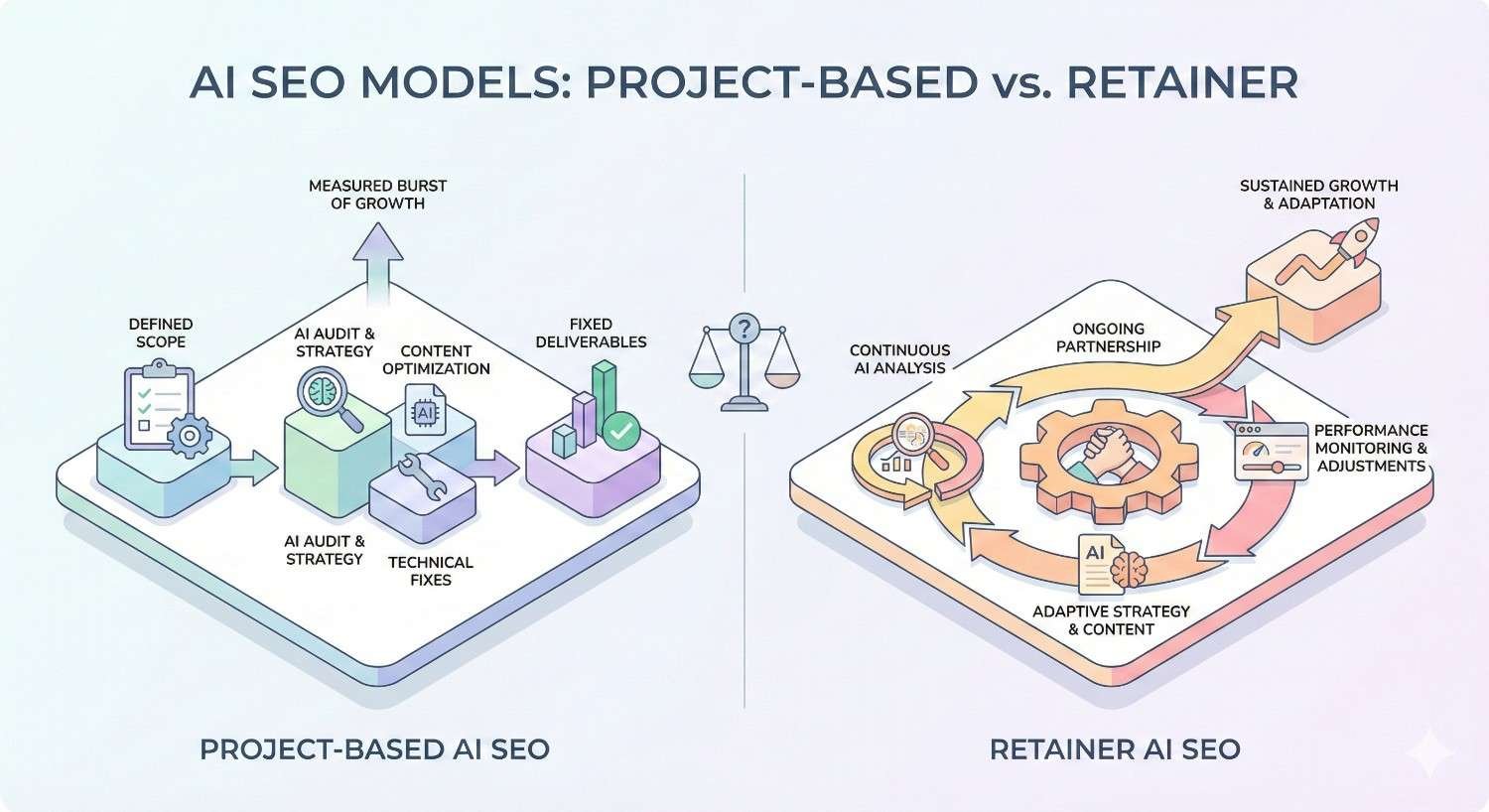
Project-Based vs Retainer: Which Model Works Best for AI SEO?
Retainer models suit ongoing optimization needs. SEO requires continuous effort, and retainers provide consistent resources for sustained improvement. Most AI SEO engagements use retainer structures.
Project-based models work for specific initiatives. Technical audits, site migrations, content strategy development, or competitive analysis can be scoped as projects with defined deliverables.
Hybrid approaches combine both models. Ongoing retainers handle continuous optimization while projects address specific initiatives requiring concentrated effort.
AI SEO typically favors retainers because machine learning models improve with continuous data. Agencies that work with clients over time develop better predictive capabilities and deeper understanding.
Project-based work makes sense for organizations testing agency relationships, addressing specific challenges, or supplementing internal capabilities for particular initiatives.
Hidden Costs & Additional Investments (Tools, Content, Technical Resources)
Tool costs may be separate from agency fees. Some agencies include tool access in retainers while others pass through costs. Clarify what’s included before signing.
Content production often requires additional investment beyond strategy. Agencies may provide optimization guidance with content creation priced separately.
Technical implementation may need developer resources. Agencies identify technical issues but implementing fixes often requires client development teams or additional investment.
Paid media integration costs extra when needed. Some SEO strategies benefit from paid support, particularly for new content or competitive terms.
Additional consulting beyond standard scope incurs fees. Strategic projects, executive presentations, or expanded reporting may be priced separately.
Understanding total investment including these factors prevents budget surprises. Request comprehensive proposals that clarify all potential costs.
How to Choose the Right AI SEO Agency for Your Business
Selecting the right agency determines whether your AI SEO investment delivers returns. The best agency for your business depends on your specific situation, goals, and resources.
This section provides frameworks for matching agencies to needs, identifying warning signs, and structuring relationships for success.
Matching Agency Expertise to Your Business Stage & Goals
Startups and early-stage companies need agencies comfortable with limited budgets, rapid iteration, and growth-focused metrics. Look for agencies with startup experience who understand runway constraints and investor expectations.
Growth-stage businesses need agencies that can scale efforts as the company grows. Evaluate whether agencies have experience managing increasing complexity and can grow with your needs.
Established mid-market companies need agencies with proven methodologies and predictable results. Look for documented case studies in similar industries and company sizes.
Enterprise organizations need agencies capable of managing complexity, integrating with internal teams, and navigating corporate processes. Evaluate experience with large organizations and ability to provide executive-level reporting.
Industry expertise matters significantly. Agencies with experience in your industry understand competitive dynamics, regulatory constraints, and audience behavior. Generalist agencies may need learning curves that delay results.
Goal alignment shapes agency selection. Agencies focused on traffic metrics may not suit businesses needing lead generation. Ensure agency measurement approaches align with your actual business objectives.
Red Flags: What to Avoid When Vetting AI SEO Providers
Overpromising Rankings & Guaranteed Results
No legitimate agency can guarantee specific rankings. Search algorithms involve too many variables for guarantees. Agencies promising specific positions or timeframes likely use manipulative tactics or will underdeliver.
Be skeptical of promises that seem too good. If an agency claims results dramatically better than competitors, ask for verification. Extraordinary claims require extraordinary evidence.
Guarantees often come with fine print. Read contracts carefully for conditions that make guarantees meaningless or penalties that don’t actually protect you.
Lack of Transparency in AI Tools & Methodologies
Agencies should explain their AI tools and methodologies clearly. Vague descriptions of proprietary technology often mask lack of actual differentiation.
Ask specific questions about AI integration. How do they use machine learning? What tools do they employ? How do AI insights translate to strategy? Legitimate agencies answer these questions confidently.
Proprietary tools should provide demonstrable advantages. Ask for examples of insights or capabilities their tools provide that standard tools don’t.
No Clear Performance Metrics or Reporting Standards
Agencies should define success metrics before engagement begins. Vague promises of improvement without specific KPIs make accountability impossible.
Reporting should include metrics that matter to your business. Traffic and rankings matter less than leads, revenue, or other business outcomes. Ensure agencies measure what you actually care about.
Reporting frequency and format should meet your needs. Some clients want weekly updates while others prefer monthly summaries. Clarify expectations before signing.
Overreliance on Automation Without Strategic Oversight
AI tools require human strategic direction. Agencies that automate everything without strategic oversight often produce mediocre results.
Ask about human involvement in strategy and quality assurance. Who reviews AI recommendations? How do strategists guide tool usage? What decisions require human judgment?
The best agencies use AI to enhance human capabilities, not replace them. Be wary of agencies positioning AI as a replacement for expertise rather than an enhancement.
Essential Questions to Ask During Agency Evaluation
About their AI capabilities:
- What specific AI tools and technologies do you use?
- How do you integrate AI into strategy development versus execution?
- What proprietary capabilities differentiate you from competitors?
- How do you stay current with AI developments?
About their process:
- Walk me through your typical engagement process
- How do you develop strategies for new clients?
- What does your reporting include and how often?
- How do you handle algorithm updates or unexpected changes?
About results:
- Can you share case studies from similar businesses?
- What results should we realistically expect and when?
- How do you measure and attribute success?
- What happens if results don’t meet expectations?
About the relationship:
- Who will work on our account and what’s their experience?
- How do you communicate and how often?
- What do you need from us to succeed?
- How do you handle disagreements or concerns?
Contract Terms, KPIs & Success Metrics to Establish Upfront
Contract length should balance commitment with flexibility. Three to six month initial terms with renewal options provide reasonable evaluation periods. Avoid long commitments before proving results.
Termination clauses should be reasonable. Thirty-day notice periods are standard. Excessive penalties for early termination suggest agencies lack confidence in retention through results.
KPIs should be specific and measurable. Define exactly what metrics will be tracked, what targets represent success, and how measurement will occur.
Reporting commitments should be contractual. Specify report frequency, content, and format. Include provisions for additional reporting if needed.
Scope clarity prevents disputes. Define exactly what’s included in retainer pricing and what requires additional investment. Document assumptions about content volume, technical implementation, and other variables.
Performance reviews should be scheduled. Quarterly reviews provide opportunities to assess progress, adjust strategies, and address concerns before they become problems.
AI SEO Timeline: Realistic Expectations for Results in 2026
Understanding realistic timelines prevents frustration and enables appropriate resource planning. AI SEO can accelerate results compared to traditional approaches, but meaningful outcomes still require time.
These timelines represent typical patterns. Actual results vary based on competitive intensity, starting position, resource investment, and market factors.
Months 1-3: Foundation, Audit & Strategic Implementation
The first quarter focuses on understanding your current situation and implementing foundational improvements. Expect significant activity but limited ranking changes.
Month 1 typically involves comprehensive auditing. Agencies analyze technical health, content inventory, backlink profiles, and competitive positioning. AI tools accelerate this analysis but thorough assessment takes time.
Month 2 shifts to strategy development and initial implementation. Based on audit findings, agencies develop prioritized action plans and begin executing high-impact improvements.
Month 3 continues implementation while beginning content development. Technical fixes roll out, content production begins, and initial optimization efforts take effect.
Expected outcomes by month 3:
- Complete technical audit with prioritized recommendations
- Strategy document with clear roadmap
- Initial technical improvements implemented
- Content strategy defined with production beginning
- Baseline metrics established for future comparison
Months 4-6: Early Wins, Content Velocity & Authority Building
The second quarter typically shows initial ranking improvements and traffic gains. Content production accelerates and link building efforts begin yielding results.
Months 4-5 see ranking improvements for less competitive terms. Technical improvements take effect and new content begins indexing. Early wins build momentum and validate strategy.
Month 6 often shows more significant progress. Content velocity increases, link building gains traction, and competitive terms begin improving.
Expected outcomes by month 6:
- Measurable ranking improvements for target keywords
- Traffic increases of 20-50% for many engagements
- Content library expanding with optimized pieces
- Initial backlinks acquired from quality sources
- Clearer picture of competitive positioning
Months 7-12: Compounding Growth & Competitive Positioning
The second half of year one typically shows compounding results. Earlier investments mature, content gains authority, and competitive positioning strengthens.
Months 7-9 often show accelerating growth. Content published earlier gains rankings, link building compounds authority, and technical foundation supports scaling.
Months 10-12 demonstrate sustainable growth patterns. Results become more predictable, competitive terms show improvement, and ROI becomes clearer.
Expected outcomes by month 12:
- Traffic increases of 100-200%+ for successful engagements
- Rankings for competitive terms improving significantly
- Established content library driving consistent traffic
- Authority metrics showing meaningful improvement
- Clear ROI demonstration for continued investment
Beyond Year One: Scaling, Optimization & Market Dominance
Year two and beyond focus on scaling success, optimizing performance, and building market dominance. The foundation built in year one enables more aggressive growth.
Scaling involves expanding successful strategies. More content, more links, more technical optimization build on proven approaches.
Optimization improves efficiency. Data from year one reveals what works best, enabling resource reallocation toward highest-performing tactics.
Market dominance becomes achievable. Sustained investment compounds advantages, making it increasingly difficult for competitors to catch up.
GEO visibility typically develops during this phase. As authority builds, AI systems increasingly cite your content in responses.
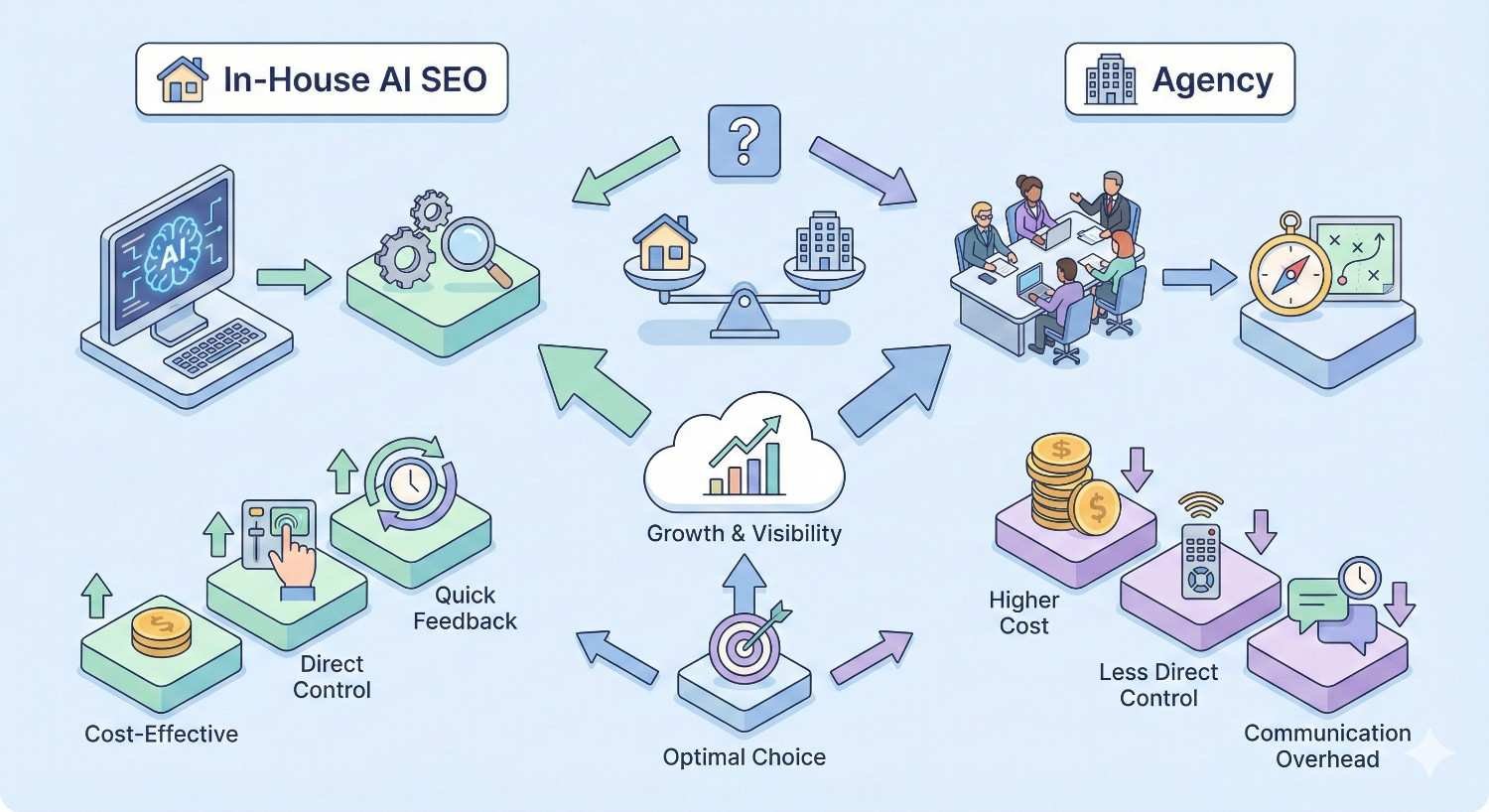
In-House AI SEO vs Agency: Making the Right Choice for Your Organization
The decision between building internal AI SEO capabilities and partnering with agencies involves tradeoffs. Neither approach is universally superior. The right choice depends on your specific situation.
When In-House AI SEO Makes Sense (Resources, Skills & Scale Required)
In-house AI SEO works best when organizations have sufficient scale, resources, and strategic commitment to build genuine capabilities.
Scale requirements typically mean websites with thousands of pages, multiple product lines, or continuous content needs. Smaller operations rarely justify dedicated AI SEO staff.
Resource requirements include budget for salaries, tools, training, and technology. Building internal capabilities requires sustained investment over years, not months.
Skill requirements span SEO expertise, data science capabilities, content creation, and technical implementation. Finding individuals with all skills is rare; teams typically need multiple specialists.
Strategic commitment means organizational support for long-term investment. Building capabilities takes years. Organizations expecting quick results or facing budget uncertainty should consider agencies.
In-house approaches work well for large enterprises with ongoing SEO needs, technology companies with data science capabilities, and organizations where SEO is core to business strategy.
The True Cost of Building Internal AI SEO Capabilities
Salary costs for qualified AI SEO professionals range from $80,000 to $200,000+ annually depending on experience and location. Building a team requires multiple hires.
Tool costs for enterprise AI SEO platforms range from $20,000 to $100,000+ annually. Multiple tools may be needed for comprehensive capabilities.
Training and development costs include conferences, courses, and learning time. AI SEO evolves rapidly, requiring continuous education.
Opportunity costs include time to build capabilities. Agencies provide immediate expertise while internal teams require development time.
Management overhead includes recruiting, performance management, and team coordination. SEO teams need leadership and integration with broader marketing.
Total costs for meaningful internal AI SEO capabilities often exceed $300,000 to $500,000+ annually when all factors are considered. This investment level makes sense for large organizations but exceeds what most mid-market companies should spend.
Hybrid Models: Combining Agency Expertise with Internal Teams
Hybrid approaches combine internal resources with agency expertise. This model often provides the best balance of capabilities, costs, and control.
Agency-led with internal support works when agencies drive strategy and execution while internal teams handle implementation, content creation, or specific functions.
Internal-led with agency support works when internal teams manage ongoing optimization while agencies provide specialized expertise, technology access, or additional capacity.
Specialized partnerships engage agencies for specific capabilities. Internal teams might handle content while agencies manage technical SEO and link building.
Transition models use agencies initially while building internal capabilities. Agencies transfer knowledge and processes as internal teams develop.
Hybrid approaches require clear role definition and strong communication. Confusion about responsibilities undermines both internal and agency efforts.
Essential AI SEO Tools & Technologies Used by Top Agencies
Understanding the tools agencies use helps evaluate their capabilities and consider whether internal use might supplement agency relationships.
AI-Powered SEO Platforms (Clearscope, MarketMuse, Surfer SEO, Frase)
Clearscope provides AI-powered content optimization. It analyzes top-ranking content and provides recommendations for improving topical coverage and relevance. Pricing starts around $170/month for basic plans.
MarketMuse offers comprehensive content intelligence including topic modeling, content briefs, and competitive analysis. Enterprise pricing typically starts at $6,000+ annually.
Surfer SEO combines content optimization with technical analysis. Its AI features include content editor, SERP analyzer, and audit tools. Pricing starts around $89/month.
Frase focuses on content research and optimization with AI writing assistance. It helps create content briefs and optimize existing content. Pricing starts around $15/month for basic features.
These platforms provide capabilities that were agency-exclusive just years ago. However, tools alone don’t replace strategic expertise.
Machine Learning Analytics Tools (Google AI, Predictive Analytics Platforms)
Google Analytics 4 includes machine learning features for predictive audiences, anomaly detection, and automated insights. It’s free for most users with enterprise options available.
Google Search Console provides AI-enhanced insights about search performance. Its recommendations and anomaly detection help identify issues and opportunities.
Predictive analytics platforms like Conductor, BrightEdge, and seoClarity offer enterprise-grade ML capabilities. Pricing typically starts at $10,000+ annually.
Custom ML implementations using Google Cloud AI, AWS SageMaker, or similar platforms enable agencies to build proprietary models. This requires significant data science expertise.
Proprietary Agency Tools vs Off-the-Shelf Solutions
Proprietary tools provide differentiation when they offer genuine capabilities unavailable elsewhere. Ask agencies to demonstrate specific advantages their tools provide.
Off-the-shelf solutions have improved dramatically. Many capabilities that required custom development now exist in commercial platforms.
The real differentiator is often how tools are used rather than which tools are used. Strategic application of standard tools can outperform sophisticated tools used poorly.
Evaluate tool claims carefully. Some agencies overstate proprietary capabilities. Ask for demonstrations and specific examples of insights their tools provide.
Can You Achieve Agency-Level Results with DIY AI SEO Tools?
For simple situations, DIY approaches can achieve meaningful results. Small websites in less competitive markets can benefit from AI tools without agency support.
For complex situations, tools alone rarely suffice. Competitive markets, large websites, and sophisticated requirements need strategic expertise beyond tool capabilities.
The expertise gap matters more than the tool gap. Agencies provide strategic thinking, experience across clients, and ability to interpret and act on tool outputs.
Realistic DIY expectations include basic optimization, content improvement, and technical issue identification. Competing in difficult markets or achieving aggressive growth typically requires professional support.
The Future of AI SEO: Trends Shaping 2026 and Beyond
Understanding emerging trends helps prepare for future changes and evaluate whether agencies are positioned for continued leadership.
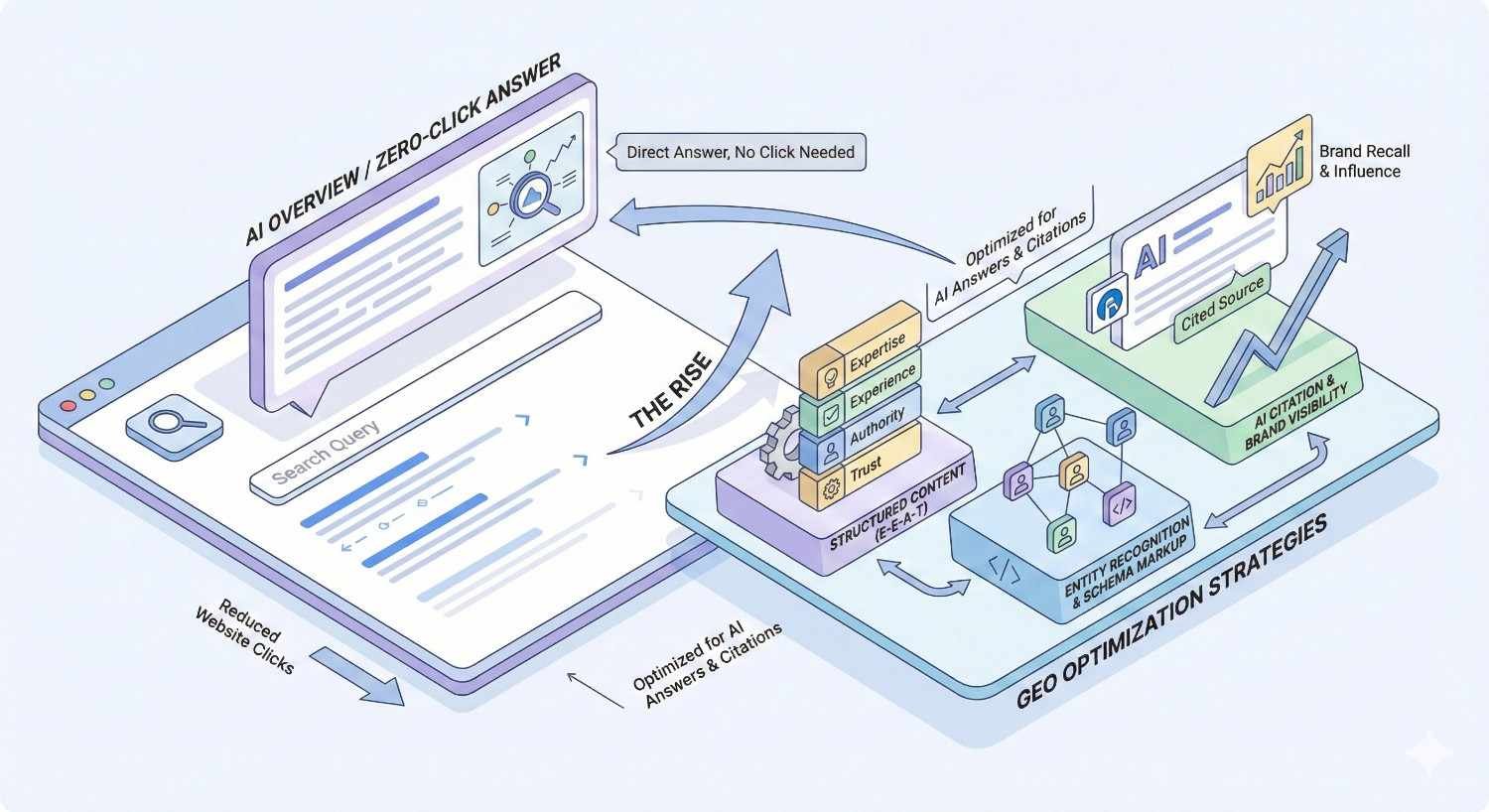
The Rise of Zero-Click Search & GEO Optimization Strategies
Zero-click searches where users get answers without visiting websites continue increasing. Research indicates that over 60% of searches now end without a click to any website.
GEO strategies address this shift by ensuring brands appear in AI-generated answers even when users don’t click through. Visibility in responses provides brand awareness and authority even without direct traffic.
Optimization for featured snippets, knowledge panels, and AI Overviews becomes essential. Content structured for extraction performs better in zero-click environments.
Measurement approaches must evolve. Traffic-focused metrics miss visibility value in zero-click contexts. Brand awareness and share of voice metrics become more important.
Multimodal Search: Optimizing for Voice, Visual & Conversational AI
Search increasingly involves voice queries, image searches, and conversational interactions. Each modality requires different optimization approaches.
Voice search optimization emphasizes natural language, question-based content, and local relevance. Voice queries tend to be longer and more conversational than typed searches.
Visual search optimization requires image optimization, visual content creation, and structured data for images. Platforms like Google Lens and Pinterest Lens drive increasing visual search volume.
Conversational AI optimization involves preparing for multi-turn interactions. Users increasingly engage in conversations with AI rather than single queries.
Agencies leading in 2026 develop capabilities across all modalities rather than focusing solely on traditional text search.
AI-Generated Content Detection & Quality Standards
Search engines and AI platforms increasingly detect and evaluate AI-generated content. Quality standards evolve to distinguish helpful AI-assisted content from low-value automated production.
Quality signals matter more than production method. Well-researched, accurate, helpful content performs well regardless of AI involvement. Thin, repetitive, or inaccurate content performs poorly.
E-E-A-T requirements intensify for AI-assisted content. Demonstrating genuine expertise, experience, and authority becomes essential when AI assists production.
Human oversight remains essential. AI can assist content creation but human review ensures accuracy, adds genuine expertise, and maintains quality standards.
Predictive SEO: Using AI to Anticipate Algorithm Changes & Market Shifts
Advanced agencies use AI to predict rather than just react to changes. Predictive capabilities provide competitive advantages through better timing and preparation.
Algorithm change prediction analyzes patterns preceding past updates to anticipate future changes. While perfect prediction is impossible, pattern recognition provides useful signals.
Market shift prediction identifies emerging topics, changing user behavior, and competitive movements before they become obvious. Early positioning captures opportunities before competition intensifies.
Trend forecasting uses AI to identify topics likely to grow in search volume. Creating content before trends peak provides ranking advantages.
Industry-Specific AI SEO Considerations
Different industries face unique AI SEO challenges and opportunities. Understanding these differences helps select agencies with relevant expertise.
AI SEO for SaaS & Technology Companies
SaaS companies typically need content-heavy strategies targeting long buyer journeys. Technical audiences require sophisticated content that demonstrates genuine expertise.
Product-led SEO integrates optimization with product features. Documentation, feature pages, and use case content drive both traffic and conversions.
Competitive differentiation requires clear positioning. AI helps identify competitive gaps and opportunities for unique positioning.
International expansion often matters for SaaS. Multi-language optimization and regional search engine considerations become important at scale.
AI SEO for E-commerce & Retail Brands
E-commerce SEO involves massive scale with thousands or millions of product pages. AI automation becomes essential for optimization at this scale.
Product page optimization at scale requires automated approaches. AI tools can optimize titles, descriptions, and structured data across entire catalogs.
Category and collection pages often drive more traffic than individual products. Strategic optimization of these pages provides significant returns.
Seasonal and trend optimization requires rapid response. AI helps identify trending products and optimize quickly enough to capture demand.
AI SEO for B2B Services & Professional Firms
B2B services typically face longer sales cycles and multiple decision-makers. Content must address various stakeholders throughout extended buying processes.
Thought leadership drives B2B SEO success. Demonstrating expertise through substantial content builds trust with sophisticated buyers.
Lead generation focus shapes strategy. Traffic matters less than qualified leads. Optimization should target high-intent queries that indicate buying readiness.
Account-based considerations may influence strategy. For companies targeting specific accounts, SEO can support ABM efforts through targeted content.
AI SEO for Healthcare, Finance & Regulated Industries
Regulated industries face additional constraints that shape AI SEO approaches. Compliance requirements, accuracy standards, and trust factors intensify.
YMYL (Your Money or Your Life) standards apply to health and financial content. Google holds this content to higher quality standards, requiring demonstrated expertise and accuracy.
Compliance review must integrate with content processes. AI can assist content creation but human compliance review remains essential.
Trust signals matter more in regulated industries. Author credentials, citations, and accuracy become critical ranking factors.
Regulatory changes create content opportunities. AI helps monitor regulatory developments and identify content needs quickly.
Common AI SEO Mistakes & How Top Agencies Avoid Them
Understanding common mistakes helps evaluate agency approaches and avoid pitfalls in your own AI SEO efforts.
Over-Automation: When AI Replaces Strategy (And Why It Fails)
AI tools can automate many SEO tasks, but automation without strategic direction produces mediocre results. The most common mistake is treating AI as a replacement for expertise rather than an enhancement.
Automated content at scale often produces thin, repetitive material that fails to rank or convert. AI can assist content creation but cannot replace genuine expertise and insight.
Automated technical fixes without prioritization waste resources on low-impact changes while missing critical issues. Human judgment determines what matters most.
Automated reporting without interpretation provides data without insight. Stakeholders need understanding, not just metrics.
Top agencies use AI to enhance human capabilities. They automate routine tasks while applying human judgment to strategy, quality assurance, and interpretation.
Ignoring E-E-A-T Signals in AI-Generated Content
AI-assisted content often lacks the experience, expertise, authoritativeness, and trust signals that search engines and users value. This oversight undermines content performance.
Experience signals require genuine first-hand knowledge. AI cannot provide authentic experience. Human experts must contribute real insights and perspectives.
Expertise signals need demonstration, not just claims. Detailed, accurate, nuanced content demonstrates expertise. Superficial AI-generated content fails this test.
Authority signals come from recognition by others. Citations, mentions, and links from authoritative sources build authority that AI content alone cannot achieve.
Trust signals require accuracy, transparency, and accountability. AI content must be reviewed for accuracy and attributed to accountable humans.
Neglecting Technical Foundations While Chasing AI Trends
Excitement about AI capabilities sometimes distracts from technical SEO fundamentals. Sites with poor technical foundations cannot rank regardless of AI sophistication.
Crawlability issues prevent search engines from discovering content. AI-optimized content that search engines cannot access provides no value.
Site speed problems hurt rankings and user experience. Technical performance remains a fundamental ranking factor.
Mobile optimization is essential. Most searches occur on mobile devices. Sites that perform poorly on mobile cannot succeed in SEO.
Top agencies maintain technical excellence while adopting AI capabilities. They understand that AI enhances fundamentals rather than replacing them.
Failing to Adapt to Generative Search Engine Behavior
Agencies focused solely on traditional rankings miss the shift toward generative search. As AI Overviews and AI assistants capture more search interactions, traditional ranking success becomes insufficient.
Visibility measurement must expand beyond rankings. Tracking presence in AI responses becomes essential for understanding true search visibility.
Content optimization must address AI sourcing behavior. Content structured for AI citation differs from content optimized solely for traditional rankings.
Strategy evolution must anticipate continued change. The generative search landscape evolves rapidly. Agencies must continuously adapt approaches.
Case Studies: Real Results from Top AI SEO Agencies
These case studies illustrate what AI SEO can achieve when implemented effectively. Results vary based on circumstances, but these examples demonstrate realistic outcomes.
Case Study 1: SaaS Company Achieves 340% Organic Traffic Growth in 12 Months
Client situation: A B2B SaaS company with $15 million ARR faced stagnant organic traffic despite previous SEO investments. Their content library was substantial but poorly optimized and not strategically organized.
AI SEO approach: The agency deployed AI-powered content auditing to assess the entire library. Machine learning identified content gaps, cannibalization issues, and optimization opportunities across 400+ pages.
Key tactics included:
- AI-assisted content consolidation reducing page count by 30% while improving quality
- Semantic optimization using NLP tools to improve topical relevance
- Predictive keyword targeting focusing on emerging opportunities
- Technical improvements identified through automated auditing
Results achieved:
- 340% organic traffic growth within 12 months
- 180% increase in organic-attributed pipeline
- 45 new first-page rankings for competitive terms
- Improved content efficiency with fewer but better-performing pages
Case Study 2: E-commerce Brand Captures 60% More Featured Snippets with GEO
Client situation: A mid-market e-commerce brand with $50 million revenue wanted to increase visibility in featured snippets and AI Overviews. They had strong product pages but limited informational content.
AI SEO approach: The agency developed a GEO-focused content strategy using AI to identify snippet opportunities and optimize content structure for AI citation.
Key tactics included:
- AI analysis of featured snippet patterns in their category
- Content creation optimized for snippet capture and AI sourcing
- Structured data implementation for enhanced SERP features
- Monitoring of AI Overview appearances and optimization based on patterns
Results achieved:
- 60% increase in featured snippet captures
- 25% visibility increase in Google AI Overviews for target queries
- 85% traffic increase to informational content
- Improved brand authority metrics across the category
Case Study 3: B2B Service Provider Reduces CAC by 45% Through AI SEO
Client situation: A professional services firm spending heavily on paid acquisition wanted to reduce customer acquisition costs through organic channel development. Their website had minimal SEO investment historically.
AI SEO approach: The agency built an organic acquisition engine using AI to identify high-intent keywords, create optimized content, and track attribution to closed business.
Key tactics included:
- AI-powered intent analysis identifying keywords indicating buying readiness
- Content strategy focused on decision-stage queries
- Lead tracking integration connecting organic visits to CRM outcomes
- Predictive modeling to forecast organic contribution to pipeline
Results achieved:
- 45% reduction in blended CAC as organic contribution increased
- 200% growth in organic-attributed leads
- $2.4 million in attributed revenue from organic channel in year one
- Sustainable organic engine reducing paid media dependency
Getting Started: Next Steps for Hiring an AI SEO Agency
Taking action on AI SEO requires preparation, clear processes, and realistic expectations. This section provides practical guidance for moving forward.
Preparing Your Business for AI SEO Success (Audit, Goals & Resources)
Conduct internal assessment before engaging agencies. Understand your current organic performance, technical health, and content assets. This baseline enables meaningful evaluation of agency proposals.
Define clear goals that connect to business outcomes. Traffic goals matter less than leads, revenue, or other metrics that affect your business. Clear goals enable agencies to develop appropriate strategies.
Identify available resources including budget, internal support, and technical capabilities. Agencies need to understand what resources exist for implementation, content creation, and technical changes.
Gather competitive intelligence about your market. Understanding who ranks for your target terms and what they do well helps agencies develop differentiated strategies.
Align stakeholders before engaging agencies. Ensure decision-makers agree on goals, budget, and timeline expectations. Misalignment creates problems throughout engagements.
RFP Template: What to Include When Requesting Agency Proposals
Company background including industry, size, current performance, and competitive context. Agencies need this information to develop relevant proposals.
Goals and objectives with specific metrics and timeframes. Vague goals produce vague proposals. Specific targets enable specific strategies.
Scope expectations including services needed, geographic focus, and any specific requirements. Clarify what you expect agencies to deliver.
Budget parameters at least in ranges. Agencies cannot propose appropriate solutions without understanding investment levels.
Timeline expectations for both selection process and results. Clarify when you need to make decisions and when you expect to see outcomes.
Evaluation criteria explaining how you will assess proposals. This helps agencies emphasize relevant capabilities.
Questions to answer requiring specific information you need for evaluation. Ask about experience, approach, team, and results.
Onboarding Best Practices: Setting Up Your Agency Partnership for Success
Kick-off thoroughly with comprehensive information sharing. Provide access to analytics, search console, CMS, and other relevant systems. Share brand guidelines, content assets, and historical context.
Establish communication cadence that works for both parties. Define meeting frequency, reporting schedule, and escalation processes.
Define roles clearly including who approves content, who implements technical changes, and who makes strategic decisions. Ambiguity creates delays and conflicts.
Set realistic expectations for timeline and results. Review projected outcomes and ensure alignment on what success looks like at various stages.
Plan for integration with other marketing activities. SEO works best when coordinated with content marketing, paid media, and other channels.
Schedule regular reviews to assess progress and adjust strategies. Quarterly reviews provide opportunities to evaluate results and refine approaches.
Conclusion
AI SEO agencies in 2026 combine machine learning, natural language processing, and generative engine optimization to deliver search visibility across traditional results and AI-powered platforms. The agencies ranked in this guide demonstrate technical excellence, proven results, and adaptability to the rapidly evolving search landscape.
Choosing the right agency requires matching capabilities to your specific situation. Consider your business stage, industry, goals, and resources when evaluating options. The best agency for an enterprise SaaS company differs significantly from the best choice for a local service business.
We help businesses navigate AI SEO complexity through comprehensive services spanning technical optimization, content strategy, and authority building. Contact White Label SEO Service to discuss how AI-powered SEO can drive sustainable organic growth for your business.
Frequently Asked Questions
How long does AI SEO take to show measurable results?
Most AI SEO engagements show initial improvements within 3-4 months, with significant results typically appearing by months 6-12. AI tools can accelerate certain aspects like technical auditing and content optimization, but search engines still require time to crawl, index, and evaluate changes. Competitive intensity, starting position, and investment level all influence timeline.
What’s the difference between AI SEO tools and AI SEO agencies?
AI SEO tools provide technology capabilities like automated auditing, content optimization, and predictive analytics. AI SEO agencies combine these tools with strategic expertise, implementation resources, and ongoing optimization. Tools alone cannot replace the strategic thinking, experience across clients, and execution capabilities that agencies provide.
Can small businesses afford AI SEO agency services?
Yes, many AI SEO agencies offer packages starting around $3,000-5,000 monthly suitable for small businesses. At this investment level, expect foundational services including technical audits, keyword research, and optimization guidance. Smaller businesses in less competitive markets can achieve meaningful results at these investment levels.
How do I measure ROI from AI SEO investments?
Effective ROI measurement connects SEO activities to business outcomes like leads, sales, or revenue. Track organic traffic growth, keyword rankings, and conversion rates. Use attribution modeling to understand how organic search contributes to customer acquisition. Compare customer acquisition costs from organic versus paid channels.
What makes GEO different from traditional SEO?
GEO focuses on visibility in AI-generated responses from platforms like ChatGPT, Perplexity, and Google AI Overviews. Traditional SEO focuses on ranking web pages in search results. GEO requires different optimization strategies emphasizing clear factual statements, authoritative sourcing, and structured data that AI systems can easily parse and cite.
Should I hire an AI SEO agency or build internal capabilities?
The decision depends on your scale, resources, and strategic commitment. Agencies provide immediate expertise and proven processes. Internal teams offer deeper integration and long-term cost efficiency at sufficient scale. Many organizations use hybrid approaches combining agency expertise with internal resources.
How do I know if an AI SEO agency is legitimate?
Evaluate agencies based on documented case studies with specific metrics, transparent methodologies, clear pricing, and verifiable client references. Be skeptical of guaranteed rankings, vague descriptions of proprietary technology, or promises that seem too good. Legitimate agencies explain their approach clearly and set realistic expectations.