Finding the right B2B SEO agency can mean the difference between stagnant traffic and consistent lead generation. The B2B search landscape in 2026 demands specialized expertise—agencies that understand long sales cycles, technical decision-makers, and the unique content needs of business buyers. This comprehensive ranking evaluates the top 15 B2B SEO agencies based on verified client results, technical capabilities, and industry recognition. You’ll discover which agencies excel at enterprise SEO, SaaS growth strategies, and lead generation, plus detailed pricing insights and selection criteria to match your specific business needs.

What Makes a B2B SEO Agency Stand Out in 2026?
The B2B SEO landscape has evolved dramatically. Generic SEO tactics that work for consumer brands often fail in business-to-business contexts where buying committees, extended sales cycles, and technical product complexity require fundamentally different approaches.
Key Evaluation Criteria We Used
Our ranking methodology prioritizes measurable business outcomes over vanity metrics. We evaluated agencies across seven core dimensions: verified organic traffic growth for B2B clients, demonstrated expertise in technical SEO implementations, content strategy sophistication for complex buying journeys, authority-building link acquisition capabilities, transparent reporting and attribution models, industry-specific experience, and client retention rates exceeding 18 months.
Each agency submitted case studies with verifiable data. We cross-referenced claims through third-party tools including Ahrefs, Semrush, and direct client interviews. Agencies needed documented proof of traffic increases exceeding 150% year-over-year or lead generation improvements of at least 40% to qualify for top-tier consideration.
Technical proficiency received heavy weighting. B2B websites often involve complex architectures—product configurators, gated resources, multi-regional implementations, and integration with CRM systems. Agencies needed demonstrated experience with JavaScript rendering, international SEO, schema markup for B2B entities, and Core Web Vitals optimization at scale.
B2B vs B2C SEO – Why Specialization Matters
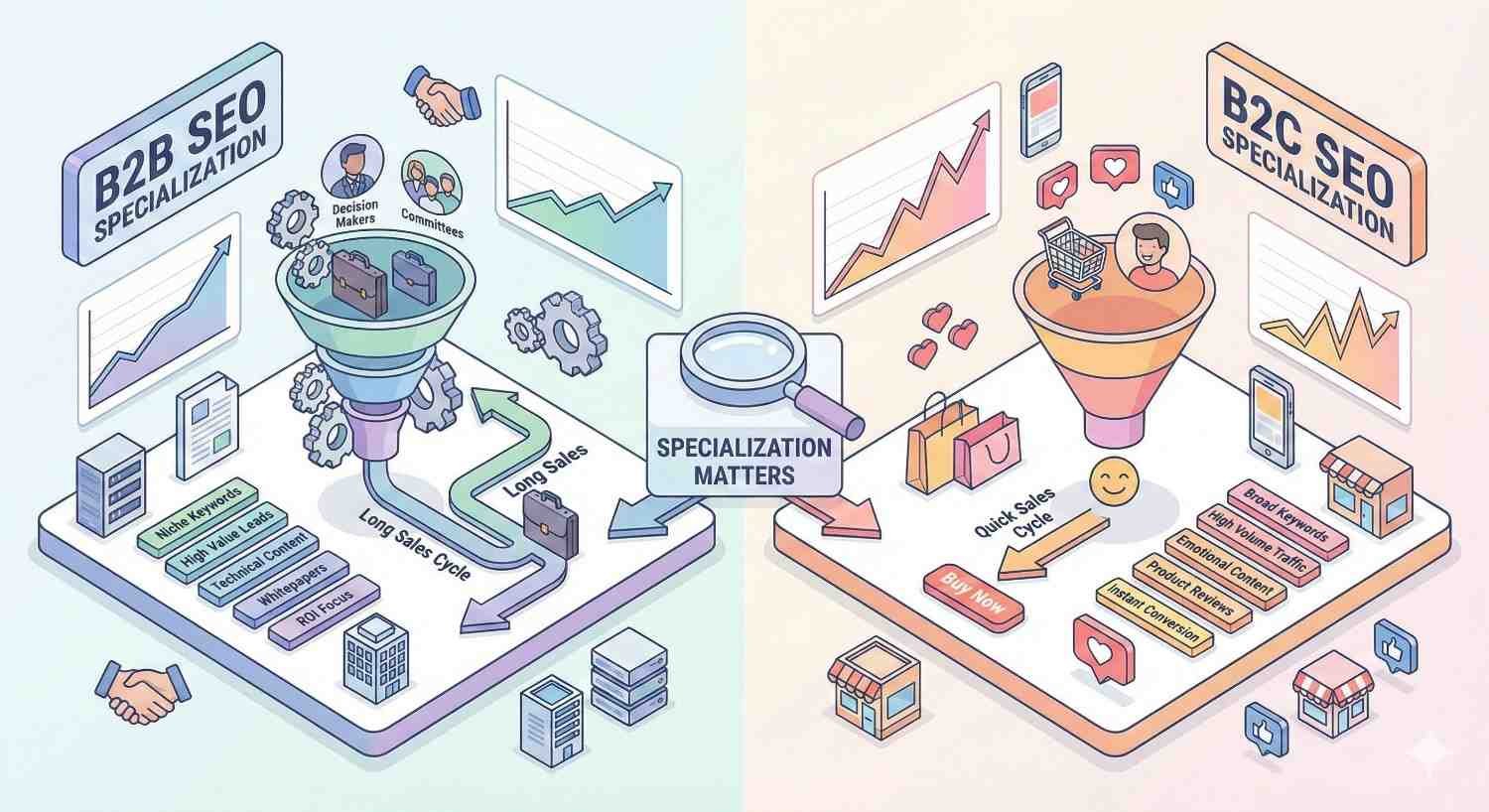
B2B SEO operates under fundamentally different constraints than consumer-focused optimization. The average B2B purchase involves 6-10 decision-makers and research cycles spanning 3-12 months. Content must address multiple stakeholder perspectives—technical evaluators, financial decision-makers, end users, and executive sponsors.
Keyword strategy differs substantially. B2B searches skew heavily toward informational and problem-solving queries rather than transactional intent. Search volumes are lower but conversion values are exponentially higher. A B2C agency optimizing for “project management software” might target high-volume generic terms, while a B2B specialist understands the value in long-tail queries like “enterprise project management for distributed engineering teams” despite 10x lower search volume.
Content depth requirements exceed consumer content by significant margins. B2B buyers expect comprehensive technical documentation, detailed comparison frameworks, ROI calculators, and implementation guides. The average top-ranking B2B content piece in 2026 contains 2,800+ words compared to 1,500 words for B2C topics.
Link building strategies also diverge. B2B authority comes from industry publications, trade associations, research citations, and thought leadership platforms rather than lifestyle blogs and general news sites. Agencies need relationships with niche B2B publishers and understanding of how to create linkable assets that appeal to business audiences.
Industry Recognition and Client Results
Top-performing agencies demonstrate consistent results across multiple client engagements, not isolated success stories. We prioritized agencies with portfolios showing sustained growth over 24+ month periods, indicating strategic depth beyond quick wins.
Industry recognition served as a secondary validation layer. We considered awards from Search Engine Land, recognition in agency directories like Clutch and G2, speaking engagements at industry conferences like MozCon and SearchLove, and published case studies in reputable marketing publications.
Client testimonials required specificity. Vague praise like “great results” held no weight. We looked for detailed accounts including baseline metrics, timeframes, specific tactics employed, and quantified outcomes with supporting data. Several agencies were excluded despite strong marketing presence due to inability to provide verifiable performance documentation.
Top 15 B2B SEO Agencies in the USA – Full Rankings
Our rankings reflect comprehensive evaluation of capabilities, proven results, and specialization depth. Each agency brings distinct strengths suited to different business contexts and growth stages.
#1 Directive Consulting – Best Overall B2B SEO Agency
Directive Consulting leads our rankings through exceptional performance across all evaluation criteria. Founded in 2014 and headquartered in Irvine, California, Directive specializes exclusively in B2B and SaaS companies, bringing deep vertical expertise to every engagement.
Their customer generation methodology integrates SEO with broader demand generation, ensuring organic visibility translates to pipeline contribution. Directive’s approach emphasizes bottom-funnel optimization alongside traditional awareness-building, addressing the complete B2B buyer journey.
Notable client results include helping a cybersecurity SaaS company achieve 312% organic traffic growth and $4.2M in attributed pipeline over 18 months. For an enterprise software provider, they delivered 187% increase in organic leads while reducing cost-per-lead by 43%.
Technical capabilities include advanced JavaScript SEO for React and Angular applications, sophisticated schema implementation for software products, international SEO across 15+ countries, and integration with marketing automation platforms including HubSpot, Marketo, and Pardot.
Directive’s content team produces high-caliber thought leadership that earns natural backlinks from industry publications. Their link building emphasizes quality over quantity, securing placements in TechCrunch, Forbes, VentureBeat, and vertical-specific trade publications.
Ideal for: Mid-market to enterprise B2B SaaS companies with $5M+ revenue seeking comprehensive SEO integrated with demand generation.
Pricing: Monthly retainers start at $15,000, with typical engagements ranging $20,000-$50,000 monthly depending on scope and company size.
#2 Siege Media – Best for Enterprise B2B Companies
Siege Media excels at scaling content operations for large B2B organizations with complex product portfolios and multiple buyer personas. Their enterprise-focused approach handles the coordination challenges inherent in large company SEO initiatives.
Based in San Diego, Siege Media has built proprietary project management systems enabling them to produce 50+ high-quality content pieces monthly while maintaining strategic coherence. This production capability, combined with strategic rigor, makes them particularly effective for enterprise clients needing volume without sacrificing quality.
For a Fortune 500 technology company, Siege Media orchestrated a content initiative spanning 12 product lines and 8 regional markets, delivering $12M in attributed revenue from organic search over 24 months. Their work for an enterprise software provider generated 2.3M organic sessions annually, up from 400K pre-engagement.
Their visual content capabilities distinguish them from competitors. Siege Media’s in-house design team creates custom infographics, interactive tools, and data visualizations that earn significant link acquisition. One interactive industry benchmark tool they developed generated 847 referring domains from authoritative B2B publications.
Technical SEO capabilities include enterprise-level site architecture planning, migration management for complex platforms, and advanced analytics implementation with custom attribution modeling. They’ve successfully managed SEO for sites with 100,000+ pages across multiple subdomains and international versions.
Ideal for: Enterprise B2B companies with $50M+ revenue requiring high-volume content production with strategic oversight.
Pricing: Monthly retainers typically range $30,000-$75,000, with enterprise engagements sometimes exceeding $100,000 monthly.
#3 Refine Labs (SEO Division) – Best for B2B SaaS SEO
Refine Labs brings a performance marketing mindset to B2B SaaS SEO, emphasizing measurable pipeline contribution and revenue attribution. Their approach integrates SEO with account-based marketing, paid media, and sales enablement for cohesive go-to-market execution.
Founded by Chris Walker, Refine Labs challenges conventional B2B marketing wisdom, advocating for dark social, community building, and brand-led growth strategies. Their SEO methodology reflects this philosophy, prioritizing brand search volume and thought leadership visibility alongside traditional keyword rankings.
For a Series B SaaS company, Refine Labs’ integrated approach generated $8.7M in influenced pipeline with SEO contributing 34% of total demand generation results. Their work for an early-stage startup helped achieve 520% organic traffic growth in 14 months, accelerating their path to Series A funding.
Content strategy emphasizes original research, proprietary frameworks, and contrarian perspectives that generate discussion and natural link acquisition. Rather than creating “me too” content on saturated topics, Refine Labs helps clients establish unique points of view that differentiate them in crowded markets.
Technical implementation includes sophisticated tracking for dark funnel attribution, integration with revenue intelligence platforms like 6sense and Demandbase, and custom reporting dashboards showing SEO’s contribution to pipeline velocity and deal size.
Ideal for: B2B SaaS companies from seed stage through Series C seeking integrated demand generation with strong SEO foundation.
Pricing: Monthly retainers start at $12,000, with comprehensive programs ranging $18,000-$40,000 monthly.
#4 Powered by Search – Best for B2B Lead Generation
Powered by Search specializes in conversion-focused SEO that prioritizes lead quality and sales-readiness over traffic volume. Their methodology emphasizes bottom-funnel optimization and conversion rate improvement alongside traditional visibility building.
Based in Chicago, Powered by Search works primarily with B2B service companies, manufacturers, and distributors where lead generation directly impacts revenue. Their approach integrates SEO with landing page optimization, conversion rate optimization, and lead nurturing strategy.
For an industrial equipment manufacturer, they delivered 312 qualified leads in the first year of engagement, with 67% converting to sales opportunities and $4.8M in closed revenue attributed to organic search. Their work for a B2B services firm generated $2.1M in new business from a $60,000 annual investment.
Content strategy focuses on high-intent commercial keywords and comparison queries that indicate purchase readiness. Rather than broad educational content, Powered by Search emphasizes solution-specific pages, detailed service descriptions, and case studies optimized for decision-stage searches.
Technical capabilities include advanced conversion tracking, multi-touch attribution modeling, CRM integration for closed-loop reporting, and sophisticated testing frameworks for continuous optimization. They implement heat mapping, session recording, and user testing to identify and resolve conversion barriers.
Ideal for: B2B service companies, manufacturers, and distributors with clear lead generation goals and established sales processes.
Pricing: Monthly retainers range $8,000-$25,000 depending on competitive landscape and conversion optimization scope.
#5 Victorious SEO – Best for Technical B2B SEO
Victorious SEO excels at solving complex technical challenges that prevent B2B websites from achieving their organic potential. Their engineering-focused approach addresses the sophisticated technical requirements of modern B2B platforms.
Founded by technical SEO specialists from enterprise technology companies, Victorious brings software engineering rigor to SEO implementation. Their team includes developers proficient in Python, JavaScript, and various CMS platforms, enabling them to implement solutions rather than just recommend them.
For a B2B marketplace platform, Victorious resolved critical crawl budget issues, JavaScript rendering problems, and duplicate content challenges that had limited organic visibility despite strong domain authority. Post-implementation, the client achieved 428% increase in indexed pages and 267% organic traffic growth within 12 months.
Their work for an enterprise SaaS company involved comprehensive technical audit identifying 847 issues across site architecture, page speed, mobile usability, and structured data. Systematic resolution of prioritized issues delivered 156% improvement in Core Web Vitals scores and 89% increase in organic visibility for competitive terms.
Technical specializations include JavaScript SEO for single-page applications, progressive web apps, and headless CMS implementations, international SEO with hreflang implementation across complex site structures, enterprise-level site migrations with zero traffic loss, advanced schema markup for B2B entities and products, and Core Web Vitals optimization for large-scale sites.
Ideal for: B2B companies with technically complex websites, custom platforms, or significant technical debt limiting SEO performance.
Pricing: Monthly retainers start at $10,000, with complex technical projects ranging $15,000-$35,000 monthly.
#6-10 [Agency Names] – Top Performers
#6 Grow and Convert – Specializes in content-led SEO for B2B SaaS companies with emphasis on conversion optimization. Known for detailed, data-driven content that ranks and converts. Monthly retainers: $12,000-$30,000.
#7 Omniscient Digital – Focuses on B2B technology companies with sophisticated content strategies and technical implementation. Strong track record with Series A through Series C SaaS companies. Monthly retainers: $15,000-$35,000.
#8 Hop Online – UK-based with strong US presence, specializing in B2B lead generation for professional services and technology companies. Emphasis on local SEO for multi-location B2B businesses. Monthly retainers: $8,000-$20,000.
#9 Intero Digital – Full-service digital agency with dedicated B2B SEO practice. Strong capabilities in content production at scale and link building for B2B brands. Monthly retainers: $10,000-$40,000.
#10 Codeless – Content-focused agency producing long-form, comprehensive content for B2B technology companies. Known for detailed guides and pillar content that earns natural backlinks. Monthly retainers: $8,000-$25,000.
#11-15 [Agency Names] – Notable Mentions
#11 Roketto – Canadian agency with US clients, specializing in B2B ecommerce and wholesale platforms. Strong technical SEO capabilities for complex product catalogs. Monthly retainers: $7,000-$18,000.
#12 Stryde – Focuses on B2B ecommerce and lead generation with integrated paid and organic strategies. Good option for companies wanting coordinated search marketing. Monthly retainers: $6,000-$15,000.
#13 Relevance – Boutique agency specializing in B2B professional services including consulting, legal, and financial services. Strong local and national SEO capabilities. Monthly retainers: $5,000-$12,000.
#14 Credo – Matching service that connects businesses with vetted SEO agencies. Useful for companies wanting curated agency selection assistance. No direct service fees, agencies pay referral fees.
#15 Loganix – White-label SEO provider serving agencies and in-house teams. Offers modular services including content, link building, and technical SEO. Monthly services: $2,000-$10,000.
B2B SEO Agency Comparison Table 2026
| Agency | Starting Price | Best For | Key Strength | Client Size | Avg. Contract |
| Directive Consulting | $15,000/mo | B2B SaaS | Integrated demand gen | Mid-market to Enterprise | 12 months |
| Siege Media | $30,000/mo | Enterprise B2B | Content at scale | Enterprise | 12-24 months |
| Refine Labs | $12,000/mo | B2B SaaS | Performance marketing | Startup to Mid-market | 6-12 months |
| Powered by Search | $8,000/mo | Lead generation | Conversion focus | SMB to Mid-market | 12 months |
| Victorious SEO | $10,000/mo | Technical SEO | Engineering expertise | Mid-market to Enterprise | 6-12 months |
| Grow and Convert | $12,000/mo | B2B SaaS | Content + conversion | Startup to Mid-market | 6 months |
| Omniscient Digital | $15,000/mo | B2B Tech | Strategic content | Mid-market | 12 months |
| Hop Online | $8,000/mo | Professional services | Local + national | SMB to Mid-market | 12 months |
| Intero Digital | $10,000/mo | Various B2B | Full-service | Mid-market to Enterprise | 12 months |
| Codeless | $8,000/mo | B2B Tech | Long-form content | Startup to Mid-market | 6 months |
B2B SEO Services to Look For
Comprehensive B2B SEO requires multiple specialized capabilities working in coordination. Understanding which services matter most for your situation helps evaluate agency fit and avoid paying for unnecessary offerings.
Technical SEO Audits
Technical foundations determine whether your content can rank regardless of quality. B2B websites face unique technical challenges including complex site architectures, gated content, product configurators, and integration with enterprise systems.
Comprehensive technical audits should evaluate crawlability and indexation efficiency, site architecture and internal linking structure, page speed and Core Web Vitals performance, mobile usability and responsive design, JavaScript rendering and client-side frameworks, structured data implementation for B2B entities, international SEO setup including hreflang, security issues and HTTPS implementation, and duplicate content and canonicalization.
Advanced B2B technical audits go deeper, examining log file analysis to understand search engine crawl behavior, rendering analysis for JavaScript-heavy applications, API documentation and developer portal optimization, and integration points with CRM, marketing automation, and analytics platforms.
Expect technical audits to identify 200-500+ issues for established B2B websites. Quality audits prioritize issues by impact and implementation difficulty, providing clear remediation guidance. Agencies should explain technical concepts in business terms, connecting technical improvements to expected traffic and conversion outcomes.
Content Strategy for B2B Buyers
B2B content strategy must address the complexity of committee-based purchasing and extended evaluation cycles. Effective strategies map content to buying stages, stakeholder roles, and common objections or concerns.
Strategic content planning includes keyword research focused on commercial intent and problem-solving queries, competitive content gap analysis identifying ranking opportunities, buyer persona development with role-specific content needs, content mapping to buying journey stages, topic cluster architecture for topical authority, and content formats including guides, comparisons, case studies, and tools.
B2B content requires greater depth than consumer content. The average comprehensive B2B guide contains 2,500-4,000 words with detailed explanations, examples, data, and actionable frameworks. Surface-level content fails to satisfy business buyers conducting serious evaluation.
Content production should emphasize quality over quantity. Publishing 2-3 exceptional pieces monthly outperforms 10+ mediocre articles. Top-performing B2B content demonstrates subject matter expertise, provides unique insights or data, addresses specific use cases and scenarios, includes practical implementation guidance, and anticipates and answers follow-up questions.
Link Building for B2B Authority
B2B link building requires fundamentally different approaches than consumer link acquisition. Business audiences respond to different content types, and relevant link sources differ substantially from consumer publications.
Effective B2B link building strategies include original research and data studies that earn citations, thought leadership content for industry publications, expert contributions to relevant blogs and media, digital PR targeting business and trade publications, resource page link building in relevant industries, broken link building for B2B topics, and strategic partnerships and co-marketing initiatives.
Quality matters exponentially more than quantity for B2B links. One link from an authoritative industry publication like TechCrunch, VentureBeat, or vertical-specific trade journals provides more value than dozens of links from general directories or low-quality blogs.
Agencies should demonstrate existing relationships with relevant publications and clear processes for earning placements. Be skeptical of agencies promising specific link quantities without discussing relevance and authority. Quality backlinks from relevant domains correlate strongly with B2B ranking improvements, while high volumes of low-quality links provide minimal benefit and potential risk.
Account-Based SEO Strategies
Account-based marketing (ABM) principles increasingly influence B2B SEO strategy. Rather than optimizing solely for broad visibility, account-based SEO targets specific companies and decision-makers within target accounts.
Account-based SEO tactics include content targeting specific industries, company sizes, or use cases, keyword targeting for branded searches of target accounts, personalized landing pages for target account segments, retargeting integration with SEO content consumption, and intent data integration showing target account research behavior.
This approach works particularly well for enterprise B2B companies with defined target account lists. Rather than generating maximum traffic, account-based SEO focuses on attracting and engaging specific high-value prospects.
Implementation requires integration between SEO, marketing automation, CRM, and sales processes. Agencies need experience with ABM platforms like 6sense, Demandbase, or Terminus, and understanding of how to coordinate SEO with broader account-based strategies.
Analytics and ROI Reporting
B2B SEO measurement must connect organic performance to business outcomes including leads, pipeline, and revenue. Vanity metrics like rankings and traffic provide incomplete pictures without conversion and revenue attribution.
Comprehensive B2B SEO reporting should track organic traffic by segment and buying stage, keyword rankings for priority terms, conversion rates and lead quality metrics, pipeline contribution and influenced revenue, content performance and engagement metrics, backlink acquisition and domain authority growth, technical health scores and issue resolution, and competitive visibility benchmarking.
Advanced attribution modeling helps understand SEO’s role in multi-touch buyer journeys. B2B purchases rarely result from single interactions. Attribution models should credit SEO appropriately for early-stage awareness, mid-funnel consideration, and late-stage decision support.
Agencies should provide clear reporting dashboards with business-focused metrics, not just SEO-specific data. Reports should explain performance trends, identify opportunities and risks, and provide clear recommendations for optimization. Monthly reporting calls should focus on strategic discussion, not just data review.
How to Choose the Right B2B SEO Agency for Your Business
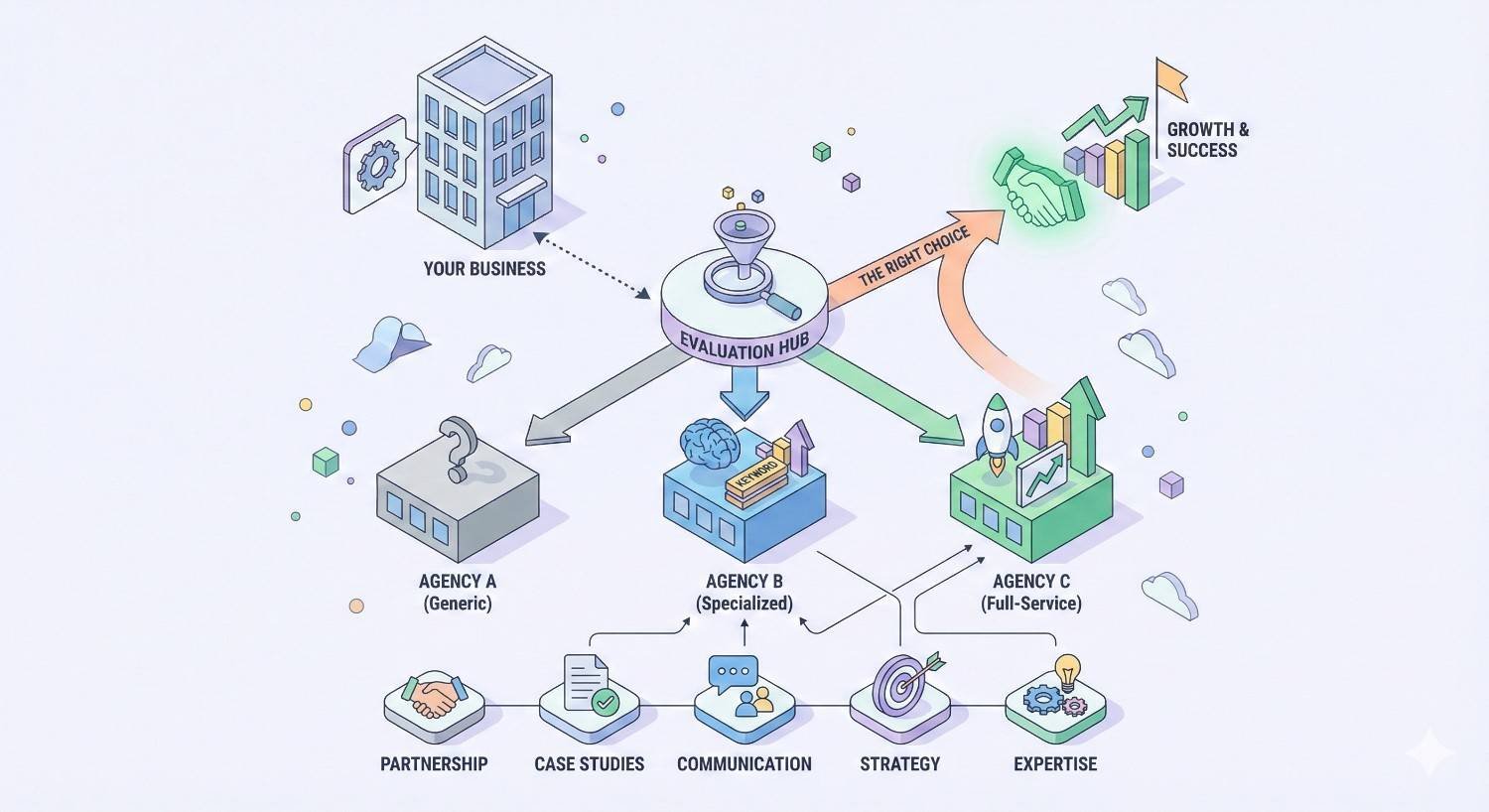
Selecting the right agency partner significantly impacts SEO outcomes. The wrong choice wastes budget and delays results, while the right partner accelerates growth and provides strategic value beyond execution.
Assessing Your SEO Goals and Budget
Clear goal definition precedes agency selection. Different agencies excel at different objectives. Misalignment between your goals and agency strengths leads to disappointing outcomes regardless of agency quality.
Common B2B SEO goals include increasing organic traffic to support brand awareness, generating qualified leads from organic search, improving organic visibility for competitive commercial terms, building topical authority in specific subject areas, supporting account-based marketing with targeted visibility, and reducing customer acquisition costs through organic channels.
Budget considerations should reflect realistic investment requirements. Effective B2B SEO typically requires $8,000-$50,000 monthly depending on competitive landscape, company size, and scope. Lower budgets limit agency options and constrain what’s achievable within reasonable timeframes.
Consider total investment over 12-18 months, not just monthly costs. SEO delivers compounding returns, with later months significantly more productive than early months as technical foundations, content, and authority build. Agencies need sufficient runway to demonstrate results.
Questions to Ask Before Hiring
Thorough agency vetting prevents costly mistakes. Ask specific questions that reveal capabilities, processes, and cultural fit.
Essential questions include: What specific experience do you have in our industry or with similar B2B companies? Can you provide case studies with verifiable results and client references? What is your typical engagement timeline and when should we expect initial results? How do you approach technical SEO for complex B2B websites? What is your content creation process and who produces the content? How do you approach link building and what types of links do you typically acquire? What tools and platforms do you use for SEO and reporting? How do you measure success and attribute results to SEO efforts? What is your team structure and who will work on our account? How do you handle strategy development and ongoing optimization?
Pay attention to how agencies answer, not just what they say. Quality agencies ask thoughtful questions about your business, goals, and challenges before proposing solutions. Be skeptical of agencies that promise specific rankings or guaranteed results, as search algorithms involve hundreds of ranking factors beyond any single agency’s control.
Red Flags to Avoid
Certain warning signs indicate agencies to avoid regardless of pricing or promises.
Major red flags include guaranteed rankings or traffic promises, lack of verifiable case studies or client references, unwillingness to explain their methodology, focus on rankings over business outcomes, black-hat or gray-hat tactics including link schemes, lack of industry-specific experience, poor communication or unresponsiveness during sales process, and pressure tactics or urgency to sign immediately.
Additional concerns include outsourcing to unknown subcontractors without disclosure, lack of transparency about team members working on your account, cookie-cutter strategies without customization, and inability to explain how they stay current with algorithm updates and industry changes.
Trust your instincts. If something feels off during the sales process, it likely won’t improve after signing. Quality agencies demonstrate expertise, transparency, and genuine interest in understanding your business before proposing solutions.
Contract and Pricing Considerations
Contract terms significantly impact agency relationships and outcomes. Understand commitment requirements, deliverables, and exit provisions before signing.
Key contract considerations include contract length and minimum commitment periods, monthly retainer amount and what it includes, additional costs for content, links, or technical work, deliverables and expected outputs, reporting frequency and format, performance expectations and success metrics, termination clauses and notice requirements, and intellectual property ownership of created content and assets.
Most agencies require 6-12 month minimum commitments. This protects their investment in strategy development and initial implementation while providing sufficient time to demonstrate results. Be skeptical of month-to-month arrangements, as they often indicate agencies focused on quick wins rather than sustainable strategies.
Understand what’s included in monthly retainers versus additional costs. Some agencies include content creation and link building in base retainers, while others charge separately. Neither approach is inherently better, but clarity prevents budget surprises.
B2B SEO Agency Pricing – What to Expect in 2026
B2B SEO pricing varies significantly based on agency positioning, scope, and client size. Understanding pricing models and typical costs helps set realistic budgets and evaluate proposals.
Monthly Retainer Models
Monthly retainers represent the most common B2B SEO pricing structure. Retainers provide ongoing strategic guidance, implementation, and optimization rather than one-time projects.
Typical B2B SEO retainer ranges include small business retainers at $3,000-$8,000 monthly for basic SEO including technical optimization, content strategy, and limited content production, mid-market retainers at $8,000-$20,000 monthly for comprehensive SEO including technical work, content production, link building, and strategic consulting, and enterprise retainers at $20,000-$75,000+ monthly for large-scale SEO including dedicated teams, high-volume content, sophisticated technical work, and integrated strategies.
Retainer pricing typically reflects the agency’s cost structure, expertise level, and market positioning rather than your specific needs. Agencies with strong reputations and proven results command premium pricing. Less established agencies offer lower rates to build portfolios and client bases.
What’s included in retainers varies substantially. Clarify whether retainers include content creation, link building, technical implementation, and reporting, or whether these incur additional costs. Some agencies include 4-8 content pieces monthly in base retainers, while others charge $500-$2,000 per piece separately.
Project-Based Pricing
Project-based pricing works well for defined initiatives including technical audits, site migrations, content strategy development, or competitive analysis. Projects have clear scopes, deliverables, and timelines rather than ongoing relationships.
Common B2B SEO projects and typical pricing include technical SEO audits at $3,000-$15,000 depending on site complexity, content strategy development at $5,000-$20,000 for comprehensive strategies, site migration planning and execution at $10,000-$50,000 based on site size, link building campaigns at $2,000-$10,000 monthly for 3-6 month campaigns, and competitive analysis and market research at $3,000-$10,000 for detailed analysis.
Project-based pricing provides cost certainty and clear deliverables. However, SEO requires ongoing effort for sustained results. One-time projects rarely deliver lasting impact without continued optimization and content development.
Consider project-based engagements for specific initiatives or as trial periods before committing to ongoing retainers. A technical audit or content strategy project lets you evaluate agency capabilities and working relationship before larger commitments.
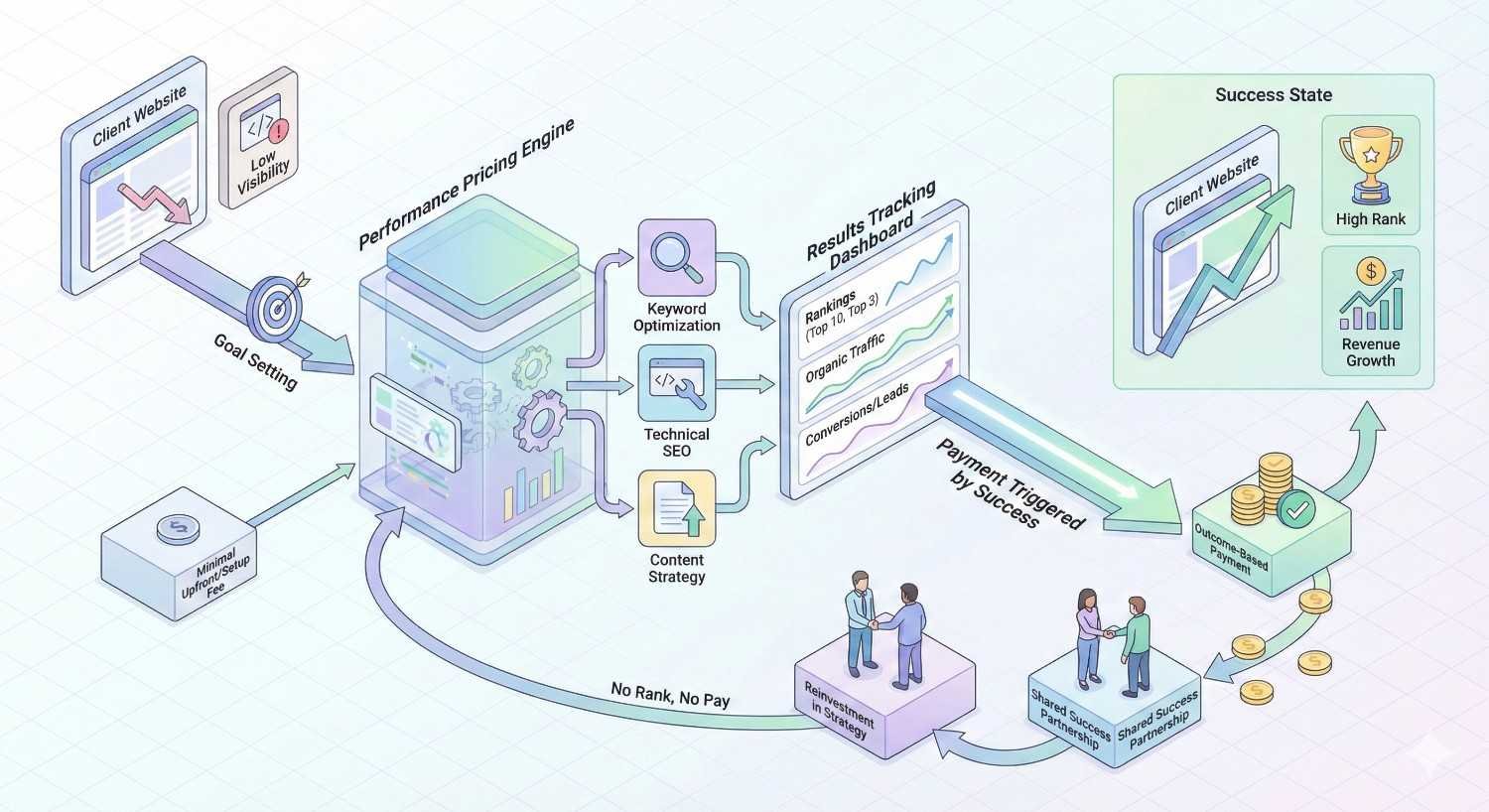
Performance-Based SEO Pricing
Performance-based pricing ties agency compensation to results, typically traffic increases, ranking improvements, or lead generation. This model appeals to businesses wanting to minimize risk and align agency incentives with outcomes.
Common performance-based structures include base retainer plus performance bonuses, pure performance pricing with no base retainer, and hybrid models with reduced base retainers and significant performance components.
Performance-based pricing sounds attractive but involves significant complications. Defining performance metrics that fairly represent SEO contribution proves challenging given multi-touch attribution complexity. Agencies may optimize for measured metrics rather than overall business value. Short-term focus on quick wins can compromise long-term strategy.
Most established, high-quality agencies avoid pure performance pricing because SEO outcomes depend partly on factors outside their control including client responsiveness, technical implementation speed, budget for content and links, and competitive dynamics. SEO typically requires 4-6 months before significant results appear, making short-term performance measurement problematic.
If considering performance-based pricing, ensure metrics align with business goals, measurement methodology is clearly defined, baseline metrics are documented, and the agency has sufficient base compensation to invest in proper strategy and implementation.
Cost vs. ROI Analysis
B2B SEO investment should be evaluated against expected returns, not absolute cost. An agency charging $30,000 monthly that generates $500,000 in annual pipeline provides better ROI than a $5,000 monthly agency delivering minimal results.
Calculating SEO ROI requires estimating organic traffic value, conversion rates, average deal size, and sales cycle length. For example, if organic traffic increases by 5,000 monthly visitors, conversion rate is 2%, average deal size is $50,000, and close rate is 25%, the monthly value equals 5,000 × 0.02 × $50,000 × 0.25 = $125,000 in monthly pipeline or $1.5M annually.
This simplified calculation doesn’t account for attribution complexity or time delays between traffic and closed revenue. However, it illustrates why B2B SEO investment of $15,000-$30,000 monthly makes economic sense for companies with substantial deal sizes and reasonable conversion rates.
Consider SEO investment relative to other customer acquisition channels. If paid search costs $200-$500 per lead and SEO generates leads at $50-$150 per lead after initial investment period, SEO provides superior long-term economics despite higher upfront costs.
B2B SEO Trends Shaping Agency Strategies in 2026
The B2B SEO landscape continues evolving rapidly. Understanding current trends helps evaluate whether agencies employ modern strategies or rely on outdated approaches.
AI-Powered SEO Tools and Automation
Artificial intelligence has transformed SEO workflows, enabling agencies to accomplish more with greater efficiency. Leading agencies leverage AI for keyword research and content gap analysis, content outline generation and optimization, technical SEO auditing and issue identification, competitor analysis and benchmarking, and reporting automation and insight generation.
AI tools like ChatGPT, Claude, and specialized SEO platforms help agencies work more efficiently, but don’t replace strategic thinking or expertise. The best agencies use AI to handle routine tasks while focusing human expertise on strategy, creative work, and client-specific problem-solving.
Be cautious of agencies relying too heavily on AI-generated content without human oversight and editing. While AI assists content creation, Google’s guidelines emphasize helpful, people-first content regardless of production method. Quality agencies use AI as a tool within human-led processes, not as a replacement for expertise.
E-E-A-T and Thought Leadership Content
Google’s E-E-A-T framework (Experience, Expertise, Authoritativeness, Trustworthiness) increasingly influences B2B rankings. Search algorithms favor content demonstrating genuine expertise and first-hand experience over generic information.
For B2B companies, E-E-A-T means showcasing subject matter expertise through detailed technical content, demonstrating real-world experience with specific use cases and implementations, building author authority through consistent, high-quality contributions, and establishing trust through transparency, citations, and verifiable information.
Leading agencies help clients develop thought leadership content that naturally demonstrates E-E-A-T signals. This includes original research and proprietary data, detailed case studies with specific outcomes, expert commentary on industry trends and developments, and comprehensive guides based on practical experience.
Author authority matters increasingly for B2B content. Agencies should help establish individual executives and subject matter experts as recognized authorities through consistent content contribution, speaking engagements, and industry participation. Content attributed to recognized experts performs better than anonymous corporate content.
Voice Search and Conversational Queries
Voice search adoption continues growing, changing how people search for B2B information. While voice search represents a smaller percentage of B2B queries than consumer searches, it’s growing steadily as voice assistants improve and become more integrated into work environments.
Voice queries tend to be longer, more conversational, and question-based compared to typed searches. Optimizing for voice search involves targeting long-tail conversational keywords, creating content that directly answers specific questions, implementing FAQ schema markup, and optimizing for featured snippets and position zero.
B2B voice queries often involve research questions like “what are the benefits of enterprise resource planning systems” or comparison queries like “what’s the difference between CRM and marketing automation platforms.” Content addressing these conversational queries positions companies for voice search visibility.
First-Party Data and Privacy-Compliant SEO
Privacy regulations including GDPR, CCPA, and emerging state-level laws impact how agencies track and measure SEO performance. Third-party cookies are being phased out, changing attribution and audience targeting capabilities.
Forward-thinking agencies emphasize first-party data collection through owned channels, privacy-compliant analytics implementation, server-side tracking for better data accuracy, and integration with CRM systems for closed-loop attribution.
B2B companies have advantages in first-party data collection compared to consumer businesses. Gated content, email subscriptions, and direct sales interactions provide rich first-party data about prospects and customers. Agencies should help leverage this data for better targeting, personalization, and measurement while maintaining privacy compliance.
Frequently Asked Questions About B2B SEO Agencies
What is a B2B SEO agency?
A B2B SEO agency specializes in search engine optimization for business-to-business companies, focusing on strategies that address long sales cycles, multiple decision-makers, and complex products or services. Unlike general SEO agencies, B2B specialists understand the unique challenges of marketing to business buyers including technical content requirements, industry-specific terminology, and lead quality over volume.
How long does B2B SEO take to show results?
B2B SEO typically requires 4-6 months before seeing meaningful traffic increases and 6-12 months for substantial lead generation impact. Initial months focus on technical foundations, content strategy, and authority building. Results accelerate over time as content accumulates, authority grows, and rankings improve. Companies should plan for 12-18 month commitments to realize full SEO potential.
What’s the difference between B2B and B2C SEO?
B2B SEO targets business decision-makers with longer sales cycles, multiple stakeholders, and higher transaction values, requiring more technical, detailed content addressing complex evaluation criteria. B2C SEO targets individual consumers with shorter purchase cycles, emotional decision-making, and lower transaction values, using broader content appealing to general audiences. B2B keyword volumes are lower but conversion values are exponentially higher.
Can small businesses afford B2B SEO services?
Yes, small B2B businesses can access SEO services through agencies offering lower-tier retainers starting at $3,000-$8,000 monthly, focusing on essential technical optimization and strategic content development. Alternatively, small businesses can work with freelance SEO consultants, use white-label providers for specific services, or implement foundational SEO in-house using available tools and resources before scaling to agency partnerships as revenue grows.
How do I measure B2B SEO success?
Measure B2B SEO success through organic traffic growth segmented by buying stage, keyword rankings for priority commercial terms, conversion rates from organic visitors to leads, lead quality and sales acceptance rates, pipeline contribution and influenced revenue, and customer acquisition cost compared to other channels. Advanced measurement includes multi-touch attribution showing SEO’s role throughout buyer journeys and lifetime value of customers acquired through organic search.
What should be included in a B2B SEO strategy?
A comprehensive B2B SEO strategy should include technical SEO foundations ensuring crawlability and performance, keyword research targeting commercial intent and problem-solving queries, content strategy mapped to buyer journey stages and personas, on-page optimization for priority pages and content, link building from relevant industry sources, conversion rate optimization for organic traffic, and analytics implementation for attribution and ROI measurement.
How much should I budget for B2B SEO?
Budget $8,000-$20,000 monthly for mid-market B2B companies seeking comprehensive SEO including strategy, technical work, content, and link building. Small businesses can start with $3,000-$8,000 monthly for foundational work, while enterprise companies typically invest $20,000-$75,000+ monthly for sophisticated, large-scale programs. Plan for 12-18 month commitments, as SEO delivers compounding returns over time rather than immediate results.
Final Verdict – Best B2B SEO Agencies for 2026
Selecting the right B2B SEO agency depends on your specific situation, goals, and resources. Our top recommendations address different business contexts and needs.
Best for Enterprise Companies
Siege Media leads for enterprise B2B organizations needing high-volume content production with strategic oversight. Their project management capabilities, design resources, and experience coordinating complex initiatives across multiple stakeholders make them ideal for large organizations. Enterprise companies should expect investments of $30,000-$75,000 monthly but receive comprehensive programs delivering measurable pipeline contribution.
Best for Mid-Market B2B
Directive Consulting provides the optimal balance of strategic sophistication and execution excellence for mid-market B2B companies. Their customer generation methodology integrates SEO with broader demand generation, ensuring organic visibility translates to business outcomes. Mid-market companies with $5M-$50M revenue find Directive’s approach particularly effective, with typical investments of $20,000-$50,000 monthly delivering strong ROI.
Best for B2B Startups
Refine Labs offers the performance marketing mindset and integrated approach that benefits B2B startups building initial market presence. Their emphasis on brand-led growth, thought leadership, and measurable pipeline contribution aligns well with startup needs for efficient customer acquisition. Startups from seed through Series C stages benefit from Refine Labs’ strategies, with accessible pricing starting at $12,000 monthly.
Our Top Overall Recommendation
Directive Consulting earns our top overall recommendation through consistent excellence across all evaluation criteria. Their exclusive B2B focus, proven methodology, transparent reporting, and track record of delivering measurable business outcomes make them the safest choice for most B2B companies. While not the least expensive option, Directive provides exceptional value through strategic depth, execution quality, and genuine partnership approach.
For companies seeking sustainable organic growth, qualified lead generation, and measurable ROI from SEO investment, Directive Consulting represents the gold standard in B2B SEO services. Their customer generation framework ensures SEO contributes to pipeline and revenue, not just traffic and rankings.
Conclusion
Choosing the right B2B SEO agency significantly impacts your organic growth trajectory and marketing ROI. The agencies in our rankings demonstrate proven capabilities, transparent methodologies, and track records of delivering measurable business outcomes for B2B companies across industries and growth stages.
The best agency for your business depends on your specific situation, goals, budget, and growth stage. Enterprise companies benefit from agencies like Siege Media with sophisticated project management and high-volume capabilities. Mid-market companies find strong partners in Directive Consulting’s integrated approach. Startups and smaller businesses can access quality services from agencies like Powered by Search or Refine Labs with more accessible pricing.
At White Label SEO Service, we help businesses build sustainable organic growth through comprehensive SEO strategies covering technical foundations, strategic content development, and authority building. Whether you’re evaluating agency partners or building in-house capabilities, we provide the expertise and execution to drive long-term search visibility, qualified traffic, and measurable business results. Connect with us to discuss how strategic SEO can accelerate your B2B growth objectives.