SaaS companies that master organic search build sustainable growth engines that compound over time. Unlike paid acquisition channels that stop delivering the moment you pause spending, SEO creates an asset that generates qualified leads month after month. The difference between SaaS businesses that scale efficiently and those burning cash on ads often comes down to search visibility.
For founders, marketing managers, and growth teams navigating competitive markets, understanding SaaS-specific SEO isn’t optional anymore. Your prospects are actively searching for solutions you provide. The question is whether they find you or your competitors first.
This guide covers everything from technical foundations and keyword strategy to content frameworks and realistic ROI expectations. You’ll walk away with a clear roadmap for building organic traffic that converts into pipeline and revenue.

What Is SaaS SEO and Why Does It Matter?
SaaS SEO is the practice of optimizing software-as-a-service websites to rank higher in search engine results, attract qualified traffic, and convert visitors into trial users, demo requests, or paying customers. It combines technical optimization, strategic content creation, and authority building tailored specifically to subscription-based business models.
The stakes are significant. According to Gartner, over 80% of B2B software buyers conduct online research before engaging with sales teams. If your SaaS product doesn’t appear when prospects search for solutions, you’re invisible during the most critical phase of their buying journey.
Organic search also delivers compounding returns. A blog post ranking for a high-intent keyword continues generating leads for years. Paid ads require continuous investment. This fundamental difference makes SEO particularly valuable for SaaS companies focused on capital efficiency and long-term growth.
How SaaS SEO Differs from Traditional SEO
Traditional SEO often focuses on driving traffic and conversions for one-time purchases. SaaS SEO operates differently because the business model depends on recurring revenue, longer sales cycles, and multiple touchpoints before conversion.
The subscription model changes everything. Customer lifetime value matters more than single transactions. This means SEO strategy must account for retention-focused content, not just acquisition. Educational resources that help users succeed with your product reduce churn and increase expansion revenue.
Sales cycles are longer and more complex. Enterprise SaaS purchases involve multiple stakeholders, extended evaluation periods, and significant due diligence. Your content strategy must address concerns at every stage, from initial problem awareness to final vendor selection.
Product-led growth creates unique opportunities. Many SaaS companies offer free trials or freemium tiers. SEO can drive users directly into the product experience, bypassing traditional sales processes entirely. This requires optimizing for keywords that indicate readiness to try solutions, not just research topics.
Competition is intensely focused. SaaS markets often have well-funded competitors investing heavily in content and SEO. Standing out requires deeper expertise, better content, and more strategic keyword targeting than generic optimization approaches.
The SaaS Customer Journey and Search Intent
Understanding how prospects search at different stages transforms your keyword strategy from guesswork into precision targeting.
Problem-aware stage: Prospects recognize a challenge but haven’t identified solutions. They search queries like “how to reduce customer churn” or “why is my team missing deadlines.” Content targeting these searches builds awareness of your category.
Solution-aware stage: Prospects know solutions exist and are exploring options. Searches include “best project management software” or “CRM comparison.” This is where comparison content and feature pages become critical.
Product-aware stage: Prospects know your product and are evaluating fit. They search “[Your Brand] pricing,” “[Your Brand] vs [Competitor],” or “[Your Brand] reviews.” Optimizing for branded and competitive terms captures high-intent traffic.
Decision stage: Prospects are ready to buy and need final validation. Searches include “[Your Brand] implementation,” “how to migrate to [Your Brand],” or “[Your Brand] enterprise features.” Content here removes final objections and accelerates deals.
Mapping content to each stage ensures you capture demand throughout the entire journey, not just at the bottom of the funnel.

Technical SEO Foundations for SaaS Websites
Technical SEO creates the infrastructure that allows search engines to discover, understand, and rank your content. For SaaS websites with complex architectures, dynamic content, and frequent updates, getting the technical foundation right is non-negotiable.
Poor technical SEO undermines even the best content strategy. If search engines can’t crawl your pages efficiently, your rankings suffer regardless of content quality.
Site Architecture and URL Structure
Your site architecture determines how search engines understand the relationship between pages and how link equity flows throughout your domain.
Flat architecture works best for most SaaS sites. Important pages should be reachable within three clicks from the homepage. Deep nesting buries content and dilutes authority. Keep your structure logical and shallow.
URL structure should be intuitive and consistent. Use patterns like:
- /features/[feature-name] for feature pages
- /solutions/[use-case] for solution pages
- /blog/[category]/[post-title] for content
- /resources/[resource-type]/[title] for gated assets
Avoid common URL mistakes:
- Parameters and session IDs in URLs
- Inconsistent capitalization
- Dates in evergreen content URLs
- Excessive folder depth
- Non-descriptive slugs
Create logical content silos. Group related content under clear categories. A project management SaaS might have silos for “team collaboration,” “task management,” and “resource planning.” This helps search engines understand topical relationships and strengthens authority signals.
Core Web Vitals and Page Speed Optimization
Google’s Core Web Vitals directly impact rankings and user experience. For SaaS websites, where first impressions determine whether visitors explore further, speed matters enormously.
Largest Contentful Paint (LCP) measures loading performance. Aim for under 2.5 seconds. Common fixes include optimizing images, implementing lazy loading, and using a content delivery network.
First Input Delay (FID) measures interactivity. Target under 100 milliseconds. Reduce JavaScript execution time, break up long tasks, and minimize main thread work.
Cumulative Layout Shift (CLS) measures visual stability. Keep it under 0.1. Set explicit dimensions for images and embeds, avoid inserting content above existing content, and use transform animations instead of properties that trigger layout changes.
Practical speed improvements:
- Compress and properly size images
- Enable browser caching
- Minify CSS, JavaScript, and HTML
- Use modern image formats like WebP
- Implement critical CSS inline
- Defer non-essential JavaScript
Test performance regularly using Google PageSpeed Insights and address issues before they impact rankings.
Crawlability, Indexation, and XML Sitemaps
Search engines must be able to discover and index your pages for them to rank. Crawlability issues silently kill SEO performance.
Robots.txt configuration controls which pages search engines can access. Ensure you’re not accidentally blocking important content. Common mistakes include blocking JavaScript files needed for rendering or entire staging environments that accidentally go live.
XML sitemaps help search engines discover pages efficiently. Include all important pages, exclude low-value pages like tag archives or paginated results, and submit sitemaps through Google Search Console. Update sitemaps automatically when content changes.
Canonical tags prevent duplicate content issues. SaaS sites often have multiple URL variations for the same content due to tracking parameters, sorting options, or session handling. Implement self-referencing canonicals on all pages and point duplicate variations to the preferred version.
Index management requires active attention. Use Google Search Console to monitor indexation status. Address “Discovered but not indexed” issues by improving content quality or internal linking. Remove low-quality pages from the index using noindex tags rather than letting them dilute site quality.
JavaScript rendering poses challenges for SaaS sites with dynamic content. Ensure critical content is available in the initial HTML or implement server-side rendering. Test how Googlebot sees your pages using the URL Inspection tool.
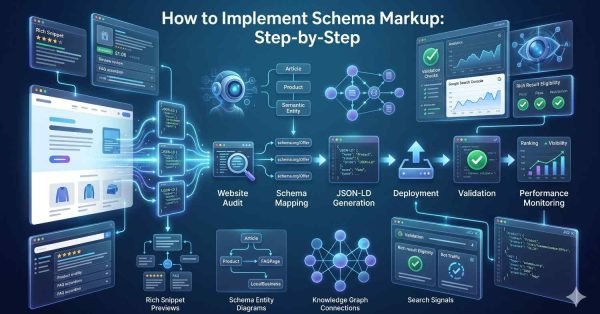
Schema Markup for SaaS Products
Structured data helps search engines understand your content and can generate rich results that improve click-through rates.
SoftwareApplication schema is essential for SaaS products. Include:
- Application name and description
- Operating system compatibility
- Pricing information
- Aggregate ratings and reviews
- Screenshots and feature lists
Organization schema establishes your company’s identity in the knowledge graph. Include contact information, social profiles, and logo.
FAQ schema on relevant pages can generate expandable FAQ results in search. Use this on pricing pages, feature pages, and comprehensive guides.
Article schema for blog content helps search engines understand publication dates, authors, and content type. This supports freshness signals and can enable article-specific rich results.
BreadcrumbList schema shows your site hierarchy in search results, improving navigation understanding and click-through rates.
Validate all structured data using Google’s Rich Results Test. Errors prevent rich results from appearing and may indicate broader implementation issues.
SaaS Keyword Research and Search Intent Mapping
Keyword research for SaaS requires understanding not just search volume but buyer intent, competitive difficulty, and conversion potential. The goal isn’t maximum traffic but maximum qualified traffic that converts into revenue.
Identifying High-Intent Keywords for Each Funnel Stage
High-intent keywords indicate readiness to take action. For SaaS, this means keywords suggesting evaluation, comparison, or purchase intent.
Bottom-funnel indicators:
- “Best [category] software”
- “[Product] pricing”
- “[Product A] vs [Product B]”
- “[Product] alternatives”
- “[Product] reviews”
- “Buy [product]” or “[product] free trial”
Mid-funnel indicators:
- “How to choose [category] software”
- “[Category] comparison”
- “What is [category] software”
- “[Use case] tools”
Top-funnel indicators:
- “How to [solve problem]”
- “Why is [problem] happening”
- “[Industry] best practices”
- “[Process] guide”
Prioritize keywords by conversion potential, not just volume. A keyword with 500 monthly searches and high purchase intent often delivers more revenue than a keyword with 10,000 searches and informational intent.
Bottom-of-Funnel vs. Top-of-Funnel Keyword Strategy
Balancing BOFU and TOFU content requires understanding your growth stage, competitive landscape, and content resources.
Bottom-funnel content converts faster. Comparison pages, alternative pages, and feature-focused content capture prospects ready to buy. These pages typically have lower traffic but higher conversion rates. For early-stage SaaS companies with limited resources, prioritizing BOFU content often makes sense.
Top-funnel content builds authority and audience. Educational content attracts larger audiences, builds brand awareness, and creates remarketing opportunities. However, conversion rates are lower and the path to revenue is longer.
The optimal mix depends on your situation:
- Early-stage with limited budget: 70% BOFU, 30% TOFU
- Growth-stage with content resources: 50% BOFU, 50% TOFU
- Established with strong brand: 40% BOFU, 60% TOFU
Don’t neglect middle-funnel content. “How to evaluate” and “what to look for” content bridges awareness and decision stages. These pages often have strong conversion potential with moderate competition.
Competitor Keyword Gap Analysis
Analyzing competitor keyword strategies reveals opportunities they’ve captured and gaps you can exploit.
Identify your true SEO competitors. These may differ from your business competitors. Use tools like Ahrefs or Semrush to find domains ranking for your target keywords. Often, media sites, review platforms, or adjacent software companies compete for the same terms.
Export competitor keyword rankings and analyze:
- Keywords where competitors rank but you don’t
- Keywords where you rank lower than competitors
- High-volume keywords with weak competitor content
- Long-tail variations competitors haven’t targeted
Prioritize gaps by opportunity:
- High intent + low competition = immediate priority
- High intent + high competition = strategic investment
- Low intent + low competition = quick wins for authority
- Low intent + high competition = usually skip
Analyze competitor content quality. Ranking isn’t just about keywords. Examine the depth, format, and unique value of competitor content. Identify where you can create something meaningfully better.
Content Strategy for SaaS SEO Growth
Content is the vehicle for capturing search demand. For SaaS companies, content strategy must balance acquisition goals with product education, thought leadership, and competitive positioning.
Building Topic Clusters and Pillar Pages
Topic clusters organize content around central themes, establishing topical authority and creating clear internal linking structures.
Pillar pages are comprehensive resources covering broad topics. A project management SaaS might create pillar pages for “Project Management Methodology,” “Team Collaboration,” and “Resource Planning.” These pages target competitive head terms and link to related cluster content.
Cluster content addresses specific subtopics in depth. For the project management pillar, clusters might include “Agile vs Waterfall,” “Daily Standup Best Practices,” and “Sprint Planning Templates.” Each cluster page links back to the pillar and to related clusters.
Benefits of cluster architecture:
- Demonstrates comprehensive topic coverage
- Creates natural internal linking opportunities
- Helps search engines understand content relationships
- Allows targeting of both head terms and long-tail keywords
- Improves user navigation and engagement
Implementation steps:
- Identify 5-10 core topics central to your product
- Create comprehensive pillar pages for each
- Map 10-20 cluster topics per pillar
- Build cluster content systematically
- Implement consistent internal linking
- Update and expand over time
Product-Led Content and Feature Pages
Product-led content showcases your solution while targeting search demand. This content type directly connects organic traffic to product value.
Feature pages target searches for specific capabilities. Create dedicated pages for major features, optimizing for “[feature] software” and “[feature] tool” keywords. Include use cases, benefits, and clear paths to trial or demo.
Use case pages address specific applications of your product. Target “[industry] + [category]” or “[role] + [solution]” keywords. Show how your product solves particular problems for specific audiences.
Integration pages capture searches for connected workflows. “[Your product] + [integration partner] integration” pages target users of complementary tools. These pages often have high conversion rates because they address specific technical needs.
Template and resource pages provide immediate value while showcasing product capabilities. Offer templates, calculators, or tools that demonstrate your product’s approach. Gate strategically to capture leads without frustrating users.
Comparison and Alternative Pages
Comparison content captures high-intent traffic from prospects actively evaluating options. These pages often have the highest conversion rates of any content type.
“[Your Product] vs [Competitor]” pages address direct comparisons. Be honest about differences while highlighting your strengths. Include feature comparisons, pricing differences, and ideal use cases for each option. Prospects respect transparency.
“[Competitor] alternatives” pages capture users dissatisfied with competitors or exploring options. Target “[Competitor] alternatives” and “tools like [Competitor]” keywords. Position your product as a strong alternative without being disparaging.
Category comparison pages like “Best [Category] Software” or “[Category] Tools Compared” capture broader evaluation searches. Include your product alongside competitors with honest assessments. These pages build trust and often rank well due to their comprehensive nature.
Best practices for comparison content:
- Update regularly as products and pricing change
- Include specific feature comparisons, not just marketing claims
- Address common switching concerns
- Provide clear recommendations for different use cases
- Include customer testimonials from switchers when available
Educational Blog Content and Resource Hubs
Educational content builds audience, establishes expertise, and creates entry points for prospects not yet ready to evaluate solutions.
Problem-focused content addresses challenges your product solves. Write about the problems, not just your solution. This content ranks for informational queries and introduces your brand during the awareness stage.
Best practice guides establish thought leadership. Share genuine expertise about your domain. The goal is becoming the trusted resource for your category, not just promoting your product.
Industry research and data attracts links and establishes authority. Original research, surveys, and data analysis create unique value that other sites reference. This content supports link building while demonstrating expertise.
Resource hubs organize educational content for easy navigation. Create dedicated sections for guides, templates, webinars, and tools. Hub pages can rank for category terms while directing visitors to specific resources.
Content Refresh and Optimization Cadence
Content requires ongoing maintenance to maintain rankings and accuracy. Establish systematic refresh processes.
Quarterly reviews for high-priority content:
- Update statistics and examples
- Refresh screenshots and visuals
- Add new sections for emerging subtopics
- Improve internal linking
- Optimize for new keyword opportunities
Annual audits for all content:
- Identify declining performers
- Consolidate thin or overlapping content
- Remove or redirect outdated pages
- Update publication dates for refreshed content
Performance-triggered updates:
- Ranking drops signal need for improvement
- Competitor content updates require response
- Product changes necessitate content updates
- User feedback indicates gaps
Track refresh impact by monitoring rankings and traffic before and after updates. Document what changes drive improvements to refine your process.
Link Building and Authority Development for SaaS
Links remain a critical ranking factor. For SaaS companies, link building requires strategies that align with your expertise and create genuine value for linking sites.
Digital PR and Thought Leadership
Digital PR generates links through newsworthy content and expert positioning. This approach builds brand awareness while earning authoritative backlinks.
Original research attracts media coverage and industry citations. Survey your customers, analyze your product data, or compile industry benchmarks. Unique data creates link-worthy assets that journalists and bloggers reference.
Expert commentary positions your team as industry authorities. Respond to journalist queries through platforms like HARO, Qwoted, or direct outreach. Consistent expert contributions build relationships and generate ongoing link opportunities.
Trend analysis and predictions attract attention during planning seasons. Publish annual predictions, quarterly trend reports, or analysis of industry developments. Timely, insightful content gets shared and linked.
Newsjacking leverages current events for visibility. When industry news breaks, provide expert perspective quickly. Speed matters for newsjacking; have processes ready to respond within hours.
Guest Posting and Niche Outreach
Strategic guest posting builds links while reaching new audiences. Focus on quality publications relevant to your target customers.
Identify target publications by analyzing where your audience reads. Industry blogs, trade publications, and complementary software blogs often accept guest contributions. Prioritize sites with engaged audiences over pure domain authority.
Pitch unique value rather than generic topics. Offer original research, unique perspectives, or practical frameworks. Publications receive countless pitches; stand out with genuinely valuable content ideas.
Build relationships before pitching. Engage with publications on social media, comment thoughtfully on their content, and share their work. Warm outreach significantly outperforms cold pitches.
Maintain quality standards. Guest posts should match or exceed the quality of your own blog. Poor guest content damages your reputation and provides minimal SEO value.
Product-Led Link Acquisition Strategies
Your product itself can generate links through features that provide value worth referencing.
Free tools and calculators attract links from sites recommending resources. Build useful tools related to your domain that don’t require signup. ROI calculators, assessment tools, and industry-specific utilities earn links naturally.
Embeddable widgets encourage sites to feature your content. Badges, charts, or interactive elements that sites can embed create link opportunities. Ensure embeds include attribution links.
Integration partnerships often include partner page links. When you integrate with other tools, request inclusion on their integrations page. These links come from relevant, authoritative domains.
Open source contributions build links and goodwill. If you release open source tools, libraries, or frameworks, documentation and community sites will link to your resources.
Internal Linking Architecture
Internal links distribute authority throughout your site and help search engines understand content relationships. Strategic internal linking improves rankings for target pages.
Link from high-authority pages to pages you want to rank. Your homepage and popular blog posts have the most authority. Use these pages to boost important conversion pages.
Use descriptive anchor text that includes target keywords naturally. Avoid generic anchors like “click here” or “learn more.” Contextual, keyword-rich anchors provide stronger signals.
Create systematic linking patterns:
- Blog posts link to relevant feature pages
- Feature pages link to related use cases
- Pillar pages link to all cluster content
- New content links to established relevant pages
Audit internal links regularly. Identify orphan pages with no internal links. Find opportunities to add links from new content to older pages. Remove or update broken internal links.
SaaS SEO Performance Tracking and KPIs
Measuring SEO performance requires tracking metrics that connect to business outcomes. Vanity metrics like total traffic matter less than qualified traffic that converts.
Essential SEO Metrics for SaaS Companies
Organic traffic measures total visitors from search. Segment by landing page type, geography, and device. Track trends over time rather than focusing on daily fluctuations.
Keyword rankings indicate visibility for target terms. Track rankings for priority keywords across funnel stages. Monitor both improvements and declines to identify issues early.
Organic conversions measure business impact. Track trial signups, demo requests, and other conversion actions from organic traffic. This is the metric that ultimately matters.
Click-through rate from search results indicates title and description effectiveness. Low CTR despite good rankings suggests optimization opportunities.
Engagement metrics like time on page, pages per session, and bounce rate indicate content quality. Poor engagement signals content that doesn’t satisfy user intent.
Backlink growth tracks authority building progress. Monitor new links acquired, referring domains, and link quality over time.
Connecting Organic Traffic to MRR and Pipeline
SEO’s business impact requires connecting traffic to revenue. This requires proper attribution and tracking infrastructure.
Implement proper attribution using UTM parameters and analytics integration. Track the full journey from organic visit to conversion to closed deal. Multi-touch attribution provides more accurate credit than last-click models.
Calculate organic pipeline value by tracking opportunities sourced from organic traffic. Work with sales to tag opportunities by original source. This demonstrates SEO’s contribution to revenue goals.
Measure customer acquisition cost for organic channels. Include content creation, tools, and team costs. Compare organic CAC to paid channels to demonstrate efficiency.
Track organic customer lifetime value. Customers acquired through organic search often have different retention and expansion patterns than other channels. Understanding these differences informs investment decisions.
SEO Reporting Dashboards and Tools
Effective reporting requires the right tools and clear visualization of key metrics.
Google Search Console provides direct data on search performance. Monitor impressions, clicks, CTR, and average position. Use the Performance report to identify opportunities and issues.
Google Analytics tracks on-site behavior and conversions. Set up goals for key conversion actions. Create segments for organic traffic analysis.
Rank tracking tools like Ahrefs, Semrush, or Moz monitor keyword positions over time. Track priority keywords daily or weekly. Set up alerts for significant ranking changes.
Build executive dashboards that connect SEO metrics to business outcomes. Focus on trends and business impact rather than technical details. Include organic traffic, conversions, pipeline contribution, and ROI.
Create operational dashboards for the SEO team with detailed metrics. Include technical health indicators, content performance, and link building progress. Use these for day-to-day optimization decisions.
Realistic SEO Timelines and ROI Expectations
SEO is a long-term investment. Setting realistic expectations prevents premature abandonment of strategies that need time to mature.
Month-by-Month SEO Growth Benchmarks
Months 1-3: Foundation
- Technical audit and fixes completed
- Keyword research and content strategy finalized
- Initial content production begins
- Baseline metrics established
- Minimal ranking improvements expected
Months 4-6: Early Traction
- Content library growing
- Initial rankings for long-tail keywords
- Technical health stabilized
- Link building campaigns active
- 10-30% traffic increase from baseline typical
Months 7-12: Acceleration
- Rankings improving for competitive terms
- Content compounding effects visible
- Authority metrics increasing
- Conversion optimization ongoing
- 50-100% traffic increase from baseline achievable
Year 2 and Beyond: Compounding
- Established rankings for priority keywords
- Significant organic traffic contribution
- Reduced reliance on paid acquisition
- Content flywheel generating consistent results
- 2-5x traffic growth from starting point realistic
These benchmarks assume consistent execution and adequate resources. Results vary based on competition, starting position, and investment level.
Calculating SEO ROI for SaaS Businesses
ROI calculation requires tracking both costs and revenue contribution over appropriate time horizons.
Calculate total SEO investment:
- Team salaries or agency fees
- Content creation costs
- Tool subscriptions
- Link building expenses
- Technical implementation costs
Measure revenue contribution:
- Organic traffic to conversion rate
- Average deal value from organic leads
- Customer lifetime value for organic customers
- Pipeline value attributed to organic
ROI formula: (Revenue from Organic – SEO Investment) / SEO Investment × 100
Consider payback period. SEO investments often take 12-18 months to generate positive ROI. Evaluate based on long-term returns, not short-term results.
Compare to alternatives. Organic CAC typically runs 60-80% lower than paid acquisition for mature programs. Factor this efficiency into ROI calculations.
Common SaaS SEO Mistakes to Avoid
Learning from common mistakes accelerates your progress and prevents wasted resources.
Ignoring Technical Debt
Technical issues accumulate over time, especially as SaaS products evolve. Neglecting technical SEO creates invisible barriers to ranking.
Common technical debt issues:
- Crawl errors from deprecated pages
- Duplicate content from product variations
- Slow page speed from accumulated scripts
- Broken internal links from site changes
- Improper redirects from URL structure changes
Prevention strategies:
- Schedule quarterly technical audits
- Include SEO review in development processes
- Monitor Search Console for emerging issues
- Document and address issues systematically
Targeting Only High-Volume Keywords
Chasing high-volume keywords ignores the reality of SaaS search behavior. Most conversions come from specific, lower-volume queries.
The volume trap:
- High-volume keywords are extremely competitive
- Broad terms attract unqualified traffic
- Ranking takes longer and requires more resources
- Conversion rates are typically lower
Better approach:
- Prioritize intent over volume
- Target long-tail variations with clear intent
- Build authority through comprehensive coverage
- Earn high-volume rankings through topical authority
Neglecting Conversion Optimization
Traffic without conversion is vanity. SEO success requires optimizing the full journey from search to signup.
Common conversion failures:
- Landing pages don’t match search intent
- No clear calls to action
- Friction in signup or demo request process
- Poor mobile experience
- Slow page load times
Optimization priorities:
- Align content with search intent
- Include clear, relevant CTAs
- Reduce form fields and signup friction
- Test and improve conversion paths
- Monitor and address drop-off points
SaaS SEO Tools and Technology Stack
The right tools improve efficiency and provide insights that inform strategy. Build a stack that covers research, execution, and measurement.
Keyword Research and Rank Tracking Tools
Ahrefs provides comprehensive keyword data, competitor analysis, and rank tracking. Strong for backlink analysis and content gap identification.
Semrush offers similar capabilities with additional features for content optimization and technical audits. Good all-in-one option for smaller teams.
Google Keyword Planner provides search volume data directly from Google. Free but limited compared to paid tools.
Moz offers keyword research, rank tracking, and domain authority metrics. User-friendly interface suitable for teams new to SEO.
Technical SEO Audit Platforms
Screaming Frog crawls websites to identify technical issues. Essential for comprehensive site audits. Desktop application with free tier for smaller sites.
Sitebulb provides visual technical audits with prioritized recommendations. More user-friendly than Screaming Frog for non-technical users.
Google Search Console offers direct insights into how Google sees your site. Free and essential for any SEO program.
PageSpeed Insights analyzes Core Web Vitals and provides optimization recommendations. Free tool directly from Google.
Content Optimization and Analytics Tools
Clearscope or Surfer SEO analyze top-ranking content and provide optimization recommendations. Useful for ensuring comprehensive topic coverage.
Google Analytics tracks traffic, behavior, and conversions. Essential for measuring SEO impact.
Hotjar or FullStory provide session recordings and heatmaps. Useful for understanding user behavior on landing pages.
Looker Studio (formerly Data Studio) creates custom dashboards combining data from multiple sources. Free and powerful for SEO reporting.
In-House SEO vs. Agency: What’s Right for Your SaaS?
The build vs. buy decision depends on your stage, resources, and strategic priorities.
When to Build an Internal SEO Team
Internal teams make sense when:
- SEO is a core growth channel requiring deep integration
- You have budget for experienced hires
- Your product requires specialized domain knowledge
- You need rapid iteration and close collaboration
- Long-term investment in organic growth is strategic priority
Typical internal team structure:
- SEO Manager/Director: Strategy and execution oversight
- Content Strategist: Editorial planning and quality
- Content Writers: Production capacity
- Technical SEO Specialist: Site health and optimization
- Link Building Specialist: Authority development
Challenges of internal teams:
- Recruiting experienced talent is difficult
- Ramp-up time before full productivity
- Ongoing training and development needs
- Risk of single points of failure
How to Evaluate and Choose a SaaS SEO Agency
Agency partnerships work well when:
- You need expertise quickly without hiring
- Budget doesn’t support full internal team
- You want to supplement internal capabilities
- You need specialized skills for specific projects
Evaluation criteria:
- Demonstrated SaaS experience and case studies
- Clear methodology and process
- Transparent reporting and communication
- Realistic timeline and ROI expectations
- Cultural fit and collaboration style
Red flags to avoid:
- Guaranteed rankings or specific results
- Unwillingness to explain strategies
- Focus on vanity metrics over business outcomes
- Lock-in contracts without performance clauses
- Lack of SaaS-specific experience
Questions to ask:
- What SaaS clients have you worked with?
- How do you measure and report success?
- What does your typical engagement look like?
- How do you handle strategy vs. execution?
- What’s your approach to content and links?
SaaS SEO Case Studies and Success Benchmarks
Real-World Examples of SaaS Organic Growth
Pattern 1: Content-Led Growth Many successful SaaS companies built organic traffic through comprehensive educational content. By becoming the definitive resource for their category, they captured demand at every funnel stage. Typical results include 3-5x organic traffic growth over 18-24 months with corresponding increases in organic signups.
Pattern 2: Product-Led SEO Companies with strong product-market fit leverage product features for SEO. Free tools, templates, and resources attract links and traffic while demonstrating product value. This approach often delivers lower CAC than pure content strategies.
Pattern 3: Comparison Content Dominance Some SaaS companies win by owning comparison and alternative searches. By creating comprehensive, honest comparison content, they capture high-intent traffic from prospects actively evaluating options. Conversion rates on this content often exceed 5-10% for demo requests.
Benchmark expectations for established programs:
- Organic traffic: 30-50% of total website traffic
- Organic contribution to pipeline: 20-40% of total
- Organic CAC: 50-70% lower than paid channels
- Content ROI: 3-5x over 24-month period
These benchmarks represent mature programs with sustained investment. Early-stage programs should expect lower numbers while building momentum.
Conclusion
SaaS SEO success requires integrating technical excellence, strategic content, and systematic authority building into a cohesive program. The companies that win organic search treat SEO as a core growth function, not an afterthought.
The strategies outlined here provide a comprehensive framework for building sustainable organic growth. From technical foundations to content strategy to performance measurement, each element contributes to long-term search visibility and qualified traffic.
We help SaaS companies implement these strategies through our full-service SEO programs at White Label SEO Service. Whether you need technical optimization, content strategy, or complete organic growth management, our team delivers measurable results. Contact us to discuss how we can accelerate your organic growth.
Frequently Asked Questions About SaaS SEO
What is the best SEO strategy for SaaS companies?
The most effective SaaS SEO strategy combines technical optimization, intent-mapped content, and strategic link building. Prioritize bottom-funnel content like comparison and alternative pages for faster conversions, then build topical authority through educational content. Success requires consistent execution over 12-18 months minimum.
How much should a SaaS company invest in SEO?
SaaS companies typically invest $5,000-$25,000 monthly in SEO depending on competition and growth goals. Early-stage startups might start with $3,000-$5,000 focused on foundations, while growth-stage companies often invest $15,000-$30,000 for aggressive scaling. Budget should cover content creation, technical optimization, and link building.
How do you measure SEO success for SaaS?
Measure SEO success through organic traffic growth, keyword rankings for priority terms, and most importantly, organic conversions. Track trial signups, demo requests, and pipeline value attributed to organic search. Connect these metrics to MRR contribution for true business impact measurement.
What are the most important ranking factors for SaaS websites?
Content quality and relevance, backlink authority, and technical health are the primary ranking factors. For SaaS specifically, demonstrating expertise through comprehensive content, earning links from industry-relevant sources, and maintaining fast, mobile-friendly sites drive rankings. User engagement signals also influence performance.
How does SaaS SEO support lead generation and MRR growth?
SEO generates qualified leads by capturing prospects actively searching for solutions. Unlike interruptive advertising, organic search reaches people with demonstrated intent. These leads typically convert at higher rates and have lower acquisition costs, directly improving unit economics and supporting sustainable MRR growth.
How long does SEO take to work for SaaS companies?
Expect initial traction within 4-6 months and meaningful results within 9-12 months. Competitive markets may require 12-18 months for significant rankings. SEO compounds over time, so year-two results typically exceed year-one substantially. Patience and consistent execution are essential.
Should SaaS companies do SEO in-house or hire an agency?
The decision depends on resources, expertise, and strategic priorities. Agencies provide faster access to expertise and are often more cost-effective for early-stage companies. Internal teams offer deeper integration and control but require significant investment. Many companies use hybrid approaches, combining internal oversight with agency execution.