Ranking for national keywords represents one of the most challenging yet rewarding goals in organic search. These high-volume, country-wide search terms can drive thousands of monthly visitors, establish brand authority, and generate substantial revenue when you reach page one. However, the path requires strategic investment, technical excellence, and patience measured in months rather than weeks.
The difference between businesses that succeed nationally and those that stall lies in understanding what national competition actually demands. Most companies underestimate the resources required or expect results too quickly, abandoning campaigns before momentum builds.
This guide covers everything you need to assess your competitive position, build the technical and content foundations required, set realistic timelines, and measure progress effectively. Whether you’re an SME exploring national expansion or an established brand strengthening market position, you’ll find actionable frameworks to guide your strategy.

What Are National Keywords?
National keywords are search terms with country-wide intent and relevance. Unlike local searches that include geographic modifiers or trigger map packs, national keywords return the same organic results regardless of where the searcher is located within a country. These terms typically carry higher search volumes, increased competition, and greater commercial value.
Understanding keyword classification helps you allocate resources appropriately and set realistic expectations for different campaign types.
National vs. Local vs. Global Keywords
Local keywords include geographic intent. Searches like “plumber in Chicago” or “best restaurants near me” trigger location-based results including Google Business Profiles and map listings. Competition is limited to businesses serving specific areas.
National keywords lack geographic modifiers and serve users across an entire country. Terms like “best project management software,” “how to start a business,” or “running shoes” deliver consistent organic results nationwide. Competition includes every relevant website in the country.
Global keywords transcend borders entirely. These searches return results from domains worldwide, often dominated by international brands and high-authority publishers. Examples include “climate change effects” or “iPhone review.”
The competitive intensity increases dramatically as you move from local to national to global. A local service business might rank within months. The same business targeting national terms faces competition from venture-backed startups, established enterprises, and media publishers with decades of domain authority.
Characteristics of High-Competition National Terms
High-competition national keywords share identifiable traits that signal the investment required to rank.
Search volume exceeds 10,000 monthly searches. While lower-volume national terms exist, the most valuable targets typically see substantial search demand. This volume attracts competitors willing to invest heavily.
Top-ranking pages have domain authority scores above 50. When you analyze the first page, you’ll find established brands, major publications, and well-funded competitors. New or smaller domains face significant authority gaps.
Content depth averages 2,000+ words. Ranking pages typically provide comprehensive coverage with detailed explanations, multiple subtopics, and extensive supporting content.
Backlink profiles include hundreds of referring domains. Top results often have thousands of backlinks from diverse, authoritative sources. Building comparable link profiles requires sustained effort.
SERP features are prominent. Featured snippets, People Also Ask boxes, and knowledge panels appear frequently. Competitors optimize specifically for these visibility opportunities.
Recognizing these characteristics early prevents wasted effort on terms where you cannot realistically compete given current resources.
Why National Keywords Matter for Business Growth
National keyword rankings deliver business outcomes that local visibility cannot match. The scale difference transforms marketing economics and competitive positioning.
Traffic Volume and Revenue Potential
A single page-one ranking for a national keyword can generate more traffic than an entire local SEO campaign. Consider the math: a local keyword with 500 monthly searches at a 25% click-through rate delivers 125 visits monthly. A national keyword with 50,000 monthly searches at the same CTR delivers 12,500 visits.
This traffic compounds across multiple rankings. Businesses that build topical authority often rank for dozens or hundreds of related national terms simultaneously. The aggregate traffic creates sustainable lead flow that reduces dependence on paid advertising.
Revenue potential scales accordingly. E-commerce businesses report that national keyword rankings drive their highest-value organic revenue. Service businesses generate leads at a fraction of paid acquisition costs. The lifetime value of organic traffic typically exceeds paid channels because searchers actively seeking solutions convert at higher rates.
Brand Authority and Market Positioning
Ranking nationally signals market leadership. When prospects search industry terms and consistently find your brand, perception shifts. You become the default option, the trusted resource, the company that clearly understands the space.
This positioning extends beyond direct conversions. Journalists researching stories find your content. Potential partners discover your expertise. Investors see market presence. Employees recognize industry leadership. National visibility creates compounding brand effects that paid advertising cannot replicate.
The authority transfer works in reverse as well. Strong brand recognition improves click-through rates on search results. Users prefer clicking familiar names, which sends positive engagement signals to search engines, further strengthening rankings.
Long-Term ROI of National Visibility
Paid advertising stops delivering the moment you stop paying. National organic rankings continue generating traffic for years with minimal ongoing investment.
The ROI calculation favors SEO dramatically over time. Initial investment in content, technical optimization, and link building may exceed equivalent paid spend. However, once rankings stabilize, maintenance costs drop significantly while traffic continues.
Ahrefs research indicates that pages ranking in the top 10 for competitive terms average over two years old. This longevity means your investment today continues paying dividends years into the future.
Businesses that build national organic visibility create defensible competitive advantages. Competitors must invest similar resources over similar timeframes to catch up. Meanwhile, you continue strengthening positions and expanding into adjacent terms.
Assessing Your Competitive Position
Before committing resources to national keyword campaigns, honest competitive assessment prevents wasted investment and sets realistic expectations.
Domain Authority and Trust Signals
Domain authority provides a rough proxy for competitive capability. Tools like Moz, Ahrefs, and Semrush calculate authority scores based on backlink profiles, linking domain diversity, and other factors.
Compare your domain authority to sites currently ranking for target keywords. If top results average DA 70+ and your site sits at DA 25, the gap requires significant link building before content alone can compete.
Trust signals extend beyond aggregate scores. Evaluate:
Domain age and history. Older domains with clean histories carry inherent advantages. New domains face sandbox effects and must prove trustworthiness over time.
Existing topical relevance. Sites already ranking for related terms have established topical authority. Google understands their expertise in the space.
Brand search volume. Branded searches indicate market awareness. Higher brand search volume correlates with ranking ability for non-branded terms.
Link profile quality. Raw numbers matter less than link quality. A site with 500 links from authoritative, relevant sources outperforms one with 5,000 links from low-quality directories.
Current Ranking Baseline Analysis
Establish where you currently stand for target keywords and related terms. This baseline enables progress measurement and identifies quick wins.
Use Google Search Console to find queries where you already appear in positions 11-30. These terms represent opportunities where incremental improvements could reach page one faster than starting from zero.
Analyze which of your pages rank for any national terms. Understanding what already works reveals patterns to replicate. Perhaps certain content formats, topic angles, or page structures perform better in your space.
Document current positions for all target keywords. Track these monthly to measure campaign impact and identify which tactics drive results.
Competitor Gap Assessment
Systematic competitor analysis reveals what’s required to rank and where opportunities exist.
Content gap analysis identifies topics competitors cover that you don’t. Tools like Ahrefs Content Gap show keywords competitors rank for where your site is absent. These gaps represent content priorities.
Backlink gap analysis reveals linking domains pointing to competitors but not you. These sites have demonstrated willingness to link to content in your space, making them outreach targets.
Content quality benchmarking compares your existing content against ranking pages. Evaluate word count, topic depth, media usage, freshness, and user experience. Identify specific improvements needed to compete.
SERP feature analysis shows which competitors capture featured snippets, People Also Ask inclusions, and other enhanced results. Understanding their optimization approaches informs your strategy.
Resource and Budget Requirements
National keyword competition requires sustained investment across multiple channels. Realistic budgeting prevents premature campaign abandonment.
Content investment includes research, writing, editing, and optimization. Comprehensive pillar content for competitive terms may require 3,000-5,000 words with supporting cluster content. Quality content at this depth costs significantly more than basic blog posts.
Technical SEO resources cover audits, implementation, and ongoing maintenance. Whether handled internally or through agencies, technical work requires specialized expertise.
Link building budgets fund outreach, digital PR, content promotion, and relationship development. Acquiring high-authority links to compete nationally typically requires dedicated resources.
Timeline expectations should assume 12-18 months for competitive national terms. Budgets must sustain activity throughout this period. Stopping after six months often means losing accumulated progress.

Technical SEO Foundation for National Competition
Technical excellence provides the foundation for national ranking success. Content and links cannot overcome fundamental technical deficiencies.
Site Architecture and Crawlability
Search engines must efficiently discover, crawl, and index your content. Architecture problems create invisible ceilings on ranking potential.
Logical URL structure organizes content hierarchically. National keyword targets should sit at appropriate depth levels with clear category relationships. Avoid burying important pages multiple clicks from the homepage.
Internal linking distributes authority and establishes topical relationships. Pillar pages targeting national keywords need substantial internal links from related content. Orphan pages with few internal links struggle to rank regardless of quality.
XML sitemaps ensure all important pages are discoverable. Submit sitemaps through Google Search Console and monitor indexation status. Large sites may need segmented sitemaps for different content types.
Crawl budget optimization matters for larger sites. Eliminate duplicate content, fix redirect chains, and block low-value pages from crawling. Ensure search engines spend crawl budget on pages that matter.
Faceted navigation handling prevents duplicate content issues on e-commerce and database-driven sites. Implement canonical tags, parameter handling, or noindex directives appropriately.
Core Web Vitals and Page Experience
Google’s page experience signals directly impact rankings. Poor performance creates competitive disadvantages against technically optimized competitors.
Largest Contentful Paint (LCP) measures loading performance. Target under 2.5 seconds. Optimize images, implement lazy loading, use content delivery networks, and minimize render-blocking resources.
Interaction to Next Paint (INP) measures responsiveness. Target under 200 milliseconds. Optimize JavaScript execution, break up long tasks, and minimize main thread blocking.
Cumulative Layout Shift (CLS) measures visual stability. Target under 0.1. Reserve space for images and ads, avoid inserting content above existing content, and use transform animations.
HTTPS security is non-negotiable. Ensure proper SSL implementation across all pages with no mixed content warnings.
Intrusive interstitial avoidance means eliminating popups that block content access, particularly on mobile devices.
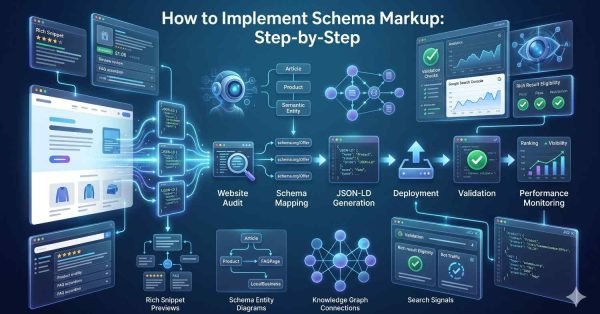
Schema Markup and Structured Data
Structured data helps search engines understand content and enables rich results that improve click-through rates.
Organization schema establishes brand entity information. Include name, logo, social profiles, and contact information.
Article schema for blog content provides publication dates, authors, and content classification. This supports freshness signals and author authority.
FAQ schema enables FAQ rich results in search listings. Pages with FAQ sections should implement corresponding markup.
Product schema for e-commerce enables price, availability, and review information in search results.
Breadcrumb schema improves site structure understanding and enables breadcrumb display in search results.
How-to schema for instructional content enables step-by-step rich results.
Validate all structured data through Google’s Rich Results Test. Monitor Search Console for markup errors and opportunities.
Mobile Optimization Requirements
Mobile-first indexing means Google primarily uses mobile versions for ranking. Mobile optimization is not optional for national competition.
Responsive design ensures content adapts appropriately across device sizes. Test across multiple screen dimensions and orientations.
Touch target sizing requires buttons and links large enough for finger tapping. Minimum 48×48 pixel touch targets with adequate spacing.
Font sizing must be readable without zooming. Base font sizes of 16px minimum with appropriate line height.
Viewport configuration through proper meta tags ensures correct rendering. Avoid fixed-width elements that cause horizontal scrolling.
Mobile page speed often differs significantly from desktop. Test mobile performance specifically and optimize accordingly.
Content Strategy for National Keyword Targeting
Content strategy for national keywords differs fundamentally from local or low-competition approaches. Success requires comprehensive topical coverage, not isolated page optimization.
Topical Authority and Content Clusters
Google increasingly evaluates topical expertise rather than individual page relevance. Building authority requires systematic coverage of entire topic areas.
Pillar content targets primary national keywords with comprehensive, authoritative pages. These cornerstone pieces cover topics exhaustively, often exceeding 3,000 words with multiple subtopics addressed.
Cluster content supports pillar pages by covering related subtopics in depth. Each cluster piece targets long-tail variations while linking back to the pillar. This structure demonstrates expertise breadth and depth.
Content mapping ensures systematic coverage without gaps or redundancy. Map all subtopics within your target area, prioritize based on search volume and business value, then execute methodically.
Semantic relationships between content pieces strengthen topical signals. Use consistent terminology, reference related content naturally, and build clear conceptual connections.
The cluster model works because it mirrors how search engines understand expertise. A site with one page about “project management” appears less authoritative than one with dozens of pages covering methodologies, tools, team management, resource allocation, and related concepts.
Search Intent Alignment at Scale
National keywords often carry mixed intent. Understanding and addressing all intent variations improves ranking potential and user satisfaction.
Informational intent seeks knowledge and understanding. Users want explanations, definitions, how-to guidance, or educational content.
Commercial investigation intent compares options before purchase. Users want reviews, comparisons, feature breakdowns, and evaluation criteria.
Transactional intent indicates readiness to act. Users want to buy, sign up, download, or complete specific actions.
Navigational intent seeks specific destinations. Users want particular brands, products, or websites.
Analyze SERP composition for target keywords. If results mix informational guides with product pages, the keyword carries mixed intent. Your content strategy may need multiple pages addressing different intent variations rather than one page trying to serve all users.
Match content format to dominant intent. Informational queries favor comprehensive guides. Commercial queries favor comparison content. Transactional queries favor product or service pages with clear conversion paths.
Content Depth vs. Competitor Benchmarks
Outranking established competitors requires demonstrably superior content. Surface-level coverage cannot displace comprehensive resources.
Word count analysis provides baseline expectations. If top results average 2,500 words, your content likely needs similar or greater depth. However, word count alone doesn’t determine quality.
Topic coverage comparison identifies what competitors include. List every subtopic, question answered, and concept explained in top-ranking content. Your content should cover everything they do plus additional value.
Unique value identification differentiates your content. What can you provide that competitors don’t? Original research, proprietary data, expert interviews, case studies, tools, or templates create differentiation that justifies ranking above existing content.
Freshness requirements vary by topic. Some subjects require current information with recent dates. Others remain evergreen. Match update frequency to topic characteristics.
Media and format enhancements improve engagement and comprehension. Consider whether videos, infographics, interactive tools, or downloadable resources would serve users better than text alone.
E-E-A-T Signals for Competitive Niches
Experience, Expertise, Authoritativeness, and Trustworthiness signals carry increased weight for competitive national terms, particularly in YMYL (Your Money or Your Life) categories.
Author credentials should be visible and verifiable. Include author bios with relevant qualifications, link to author pages with additional background, and ensure authors have demonstrable expertise.
First-hand experience signals differentiate content. Share original testing, real implementation examples, actual results achieved, and lessons learned from direct involvement.
Expert citations and quotes borrow authority from recognized sources. Interview industry experts, reference authoritative research, and cite recognized institutions.
Editorial standards demonstrate content quality processes. About pages explaining editorial guidelines, fact-checking procedures, and content review processes build trust.
Transparency signals include clear contact information, physical addresses where applicable, privacy policies, and terms of service. Anonymous or untraceable content struggles in competitive spaces.
Link Building for National Authority
Backlinks remain essential for national keyword competition. The authority gap between your site and established competitors typically requires significant link acquisition to close.
Quality vs. Quantity in Backlink Acquisition
Link quality dramatically outweighs quantity for competitive rankings. One link from a high-authority, relevant source provides more value than dozens of low-quality links.
Relevance means links come from topically related sources. A project management software company benefits more from links on productivity blogs than general business directories.
Authority refers to the linking domain’s own strength. Links from established publications, industry leaders, and trusted institutions carry more weight than links from new or low-authority sites.
Editorial placement indicates genuine endorsement. Links placed naturally within content by editorial decision outperform links in comments, forums, or user-generated sections.
Anchor text diversity maintains natural link profiles. Over-optimized anchor text with exact-match keywords can trigger algorithmic penalties. Natural profiles include branded anchors, URL anchors, generic phrases, and varied keyword references.
Link velocity should appear natural. Sudden spikes in link acquisition can appear manipulative. Steady, consistent growth patterns align with organic link earning.
Digital PR and Brand Mentions
Digital PR generates high-authority links and brand visibility simultaneously. This approach scales link building beyond manual outreach limitations.
Newsworthy content creation gives journalists reasons to cover and link to your brand. Original research, industry surveys, data studies, and trend analyses attract media attention.
Expert commentary positions your team as sources for industry stories. Build relationships with journalists covering your space. Respond quickly to relevant news with expert perspectives.
Newsjacking involves rapid response to breaking news with relevant angles. When industry developments occur, prepared experts can capture coverage and links by providing timely commentary.
Award and recognition pursuit generates links from award sites, industry publications covering winners, and social proof that attracts additional coverage.
Brand mention conversion identifies unlinked brand mentions and requests link additions. Tools like Ahrefs and Mention track brand references across the web.
Strategic Outreach for High-Authority Links
Targeted outreach to specific high-value link prospects complements broader PR efforts.
Resource page link building identifies pages that curate links to helpful resources in your space. Creating genuinely useful content earns inclusion on these pages.
Broken link building finds broken links on relevant sites and offers your content as replacement. This provides value to site owners while earning links.
Guest posting on authoritative industry publications builds links and visibility. Focus on high-quality sites with editorial standards, not link farms accepting any content.
Partnership and co-marketing links come from joint ventures, integrations, and collaborative content with complementary businesses.
Scholarship and sponsorship links from educational institutions carry high authority. Legitimate programs supporting students or causes earn .edu links.
Internal Linking Architecture
Internal links distribute authority throughout your site and establish topical relationships. Strategic internal linking amplifies external link building efforts.
Hub and spoke models concentrate links on pillar pages. Supporting content links to main targets, passing authority to pages competing for national terms.
Contextual relevance means internal links appear within relevant content, not just navigation or footers. Contextual links carry more weight.
Anchor text optimization for internal links can be more aggressive than external links. Use descriptive, keyword-relevant anchors that help users and search engines understand linked page topics.
Link equity distribution analysis identifies pages receiving insufficient internal links. Tools like Screaming Frog visualize internal link distribution and highlight opportunities.
Regular audits catch broken internal links, identify new linking opportunities as content grows, and ensure architecture remains optimal as sites evolve.
Realistic Timelines for National Keyword Rankings
Timeline expectations significantly impact campaign success. Unrealistic expectations lead to premature abandonment of effective strategies.
Factors Affecting Ranking Velocity
Multiple variables determine how quickly rankings improve. Understanding these factors enables more accurate projections.
Current domain authority establishes your starting position. Higher-authority domains see faster results because they’ve already earned baseline trust.
Keyword difficulty directly impacts timelines. Terms with difficulty scores above 70 require longer campaigns than those below 40.
Content quality differential matters. If your content significantly exceeds competitor quality, rankings can improve faster. Marginal improvements yield marginal results.
Link acquisition rate influences velocity. Faster, higher-quality link building accelerates progress. Limited link building extends timelines.
Technical foundation affects how quickly improvements translate to rankings. Sites with technical issues see delayed impact from content and link investments.
Competitive response can extend timelines. If competitors actively improve their content and links, you’re competing against moving targets.
Algorithm updates introduce variability. Major updates can accelerate or reverse progress unpredictably.
Month-by-Month Expectations (6-18 Months)
While every campaign differs, general patterns emerge for national keyword targeting.
Months 1-3: Foundation building. Technical audits and fixes, content strategy development, initial content creation, and outreach program launch. Rankings typically show minimal movement. Focus on execution quality rather than ranking changes.
Months 4-6: Early signals. New content begins indexing and appearing in search results, often in positions 30-100. Some long-tail variations may reach page two or three. Link building efforts start showing in backlink profiles.
Months 7-9: Momentum building. Primary targets may reach positions 15-30. Supporting content ranks for long-tail terms. Traffic begins increasing measurably. Authority metrics show improvement.
Months 10-12: Competitive positioning. Strong campaigns see primary targets reaching page one, often positions 5-10. Weaker campaigns may still be building toward page two. Traffic growth accelerates as multiple pages rank.
Months 13-18: Consolidation and expansion. Top positions become achievable for primary targets. Topical authority enables faster ranking for new content. Traffic compounds as cluster content ranks broadly.
These timelines assume consistent, quality execution. Gaps in content production, link building pauses, or technical issues extend timelines proportionally.
Measuring Progress Before Page One
Rankings outside page one still indicate progress. Understanding intermediate metrics prevents discouragement during the building phase.
Impression growth in Search Console shows increasing visibility even without clicks. Rising impressions for target keywords indicate Google is testing your content for those queries.
Position improvements from 80 to 40 to 20 demonstrate momentum even though traffic remains minimal. Track average position trends over time.
Indexed page growth shows content being recognized and included in Google’s index. Monitor indexation rates for new content.
Referring domain growth validates link building effectiveness. Track new referring domains monthly.
Topical keyword expansion measures how many related terms your site ranks for. Broader keyword footprints indicate growing topical authority.
Click-through rate improvements for terms where you do rank suggest content and title optimization effectiveness.
Can Small Businesses Compete for National Keywords?
Small businesses can absolutely compete for national keywords, but success requires strategic focus rather than broad attacks on the most competitive terms.
Niche Selection and Long-Tail Opportunities
The path to national visibility often runs through niche dominance first.
Underserved subtopics within broader categories offer lower competition with meaningful traffic. Instead of targeting “project management software,” a small business might target “project management for construction companies” or “project management for remote creative teams.”
Long-tail variations of competitive terms carry lower difficulty. “Best CRM software” may be unreachable, but “best CRM software for real estate agents” or “best CRM for small sales teams” present achievable targets.
Question-based keywords often have lower competition than statement keywords. “How to choose project management software” may be more accessible than “project management software.”
Emerging topics lack established competition. New technologies, methodologies, or trends offer first-mover advantages before larger competitors notice.
Geographic-national hybrids combine approaches. A business might dominate local terms while building national presence for specific niches.
Phased Approach to National Visibility
Systematic progression builds capability for increasingly competitive terms.
Phase 1: Long-tail dominance. Target lower-competition national terms where current resources can achieve rankings. Build traffic, authority, and revenue from these wins.
Phase 2: Cluster expansion. Use initial rankings as foundations for broader topical coverage. Each ranking strengthens authority for related terms.
Phase 3: Authority building. Reinvest revenue into accelerated content production and link building. Growing authority enables competition for moderately difficult terms.
Phase 4: Competitive targeting. With established authority and proven execution capability, target primary national keywords with realistic success probability.
This phased approach takes longer than direct attacks on competitive terms but produces sustainable results rather than frustrating stagnation.
Case Studies: SMEs Winning National Rankings
Smaller businesses regularly achieve national rankings through focused execution.
Specialty e-commerce success often comes from deep expertise in narrow categories. A small retailer focusing exclusively on ergonomic office equipment can outrank general furniture retailers for specific product categories by providing superior content depth and expertise signals.
B2B service providers win national terms by demonstrating specialized expertise. A boutique consulting firm focusing on a specific industry or methodology can outrank larger generalist firms for relevant searches.
Content-first businesses build authority through exceptional educational content before monetizing. Blogs that become definitive resources in their niches attract links naturally and rank for competitive terms despite limited budgets.
Tool and template providers earn links and rankings by creating genuinely useful free resources. Calculators, templates, and tools attract links that support broader ranking goals.
The common thread is focus. Small businesses that try to compete broadly against larger competitors fail. Those that dominate specific niches succeed.
Budget and Investment Considerations
Understanding investment requirements enables realistic planning and prevents underfunding that leads to campaign failure.
SEO Investment vs. Paid Advertising Costs
Comparing SEO and paid advertising reveals different investment profiles with distinct advantages.
Paid advertising delivers immediate traffic but stops when spending stops. Costs per click for competitive national keywords often exceed $5-20, with some industries seeing $50+ clicks. Monthly budgets of $10,000-50,000 may generate meaningful traffic but provide no lasting asset.
SEO investment requires patience but builds lasting value. A comparable monthly investment in content, technical optimization, and link building creates assets that continue generating traffic indefinitely.
Break-even analysis typically favors SEO over 18-24 month horizons. Initial SEO investment may exceed equivalent paid spend, but cumulative value crosses over as organic traffic compounds while paid costs continue linearly.
Risk profiles differ. Paid advertising offers predictable, controllable results. SEO involves more uncertainty but higher potential returns. Most businesses benefit from balanced approaches during the SEO building phase.
In-House vs. Agency Resource Allocation
Resource allocation decisions significantly impact outcomes and costs.
In-house advantages include institutional knowledge, brand understanding, and direct control. Internal teams can respond quickly and maintain consistent focus.
In-house challenges include expertise gaps, capacity limitations, and difficulty scaling. Building comprehensive SEO capability internally requires multiple specialized roles.
Agency advantages include specialized expertise, established processes, and scalable resources. Agencies bring experience from multiple clients and can deploy proven strategies.
Agency challenges include communication overhead, competing priorities, and potential misalignment with business goals. Quality varies significantly across providers.
Hybrid models often work best. Internal resources handle strategy, content direction, and stakeholder management while agencies provide specialized execution in technical SEO, link building, or content production.
Budget allocation between in-house and agency resources should reflect your team’s existing capabilities and capacity constraints.
Calculating Expected ROI from National Rankings
ROI projections guide investment decisions and set success benchmarks.
Traffic value calculation estimates what organic traffic would cost if purchased through paid advertising. Multiply projected traffic by average CPC for target keywords. A page ranking #3 for a keyword with 10,000 monthly searches and $15 CPC might generate 1,000 monthly visits worth $15,000 in equivalent paid traffic.
Conversion value projection estimates revenue from organic traffic. Apply historical conversion rates and average order values to projected traffic. Even conservative estimates often show substantial revenue potential.
Investment payback period divides total SEO investment by monthly value generated. Most national keyword campaigns achieve payback within 18-24 months, with ongoing returns thereafter.
Sensitivity analysis tests projections under different assumptions. What if rankings reach position 5 instead of position 3? What if traffic converts at half the expected rate? Understanding ranges prevents overcommitment based on optimistic scenarios.
Common Mistakes When Targeting National Keywords
Avoiding common pitfalls improves success probability and prevents wasted resources.
Underestimating Competition and Timelines
The most frequent mistake is expecting local SEO timelines for national competition.
Competitive analysis shortcuts lead to targeting terms beyond current capability. Thorough analysis of ranking requirements prevents wasted effort on unreachable targets.
Impatient budget allocation front-loads spending then cuts when results don’t materialize quickly. Sustainable monthly investment over 18 months outperforms aggressive spending for 6 months followed by abandonment.
Milestone misunderstanding causes discouragement when page-one rankings don’t appear in month three. Setting appropriate intermediate milestones maintains momentum and stakeholder confidence.
Competitor underestimation assumes current rankings are vulnerable. Established competitors often have years of accumulated authority and continue investing. Displacing them requires sustained effort, not quick campaigns.
Neglecting Technical and UX Foundations
Content and links cannot overcome fundamental technical problems.
Speed issues create ranking ceilings. Sites with poor Core Web Vitals struggle to rank regardless of content quality. Technical optimization must precede or accompany content investment.
Mobile problems affect the majority of users and Google’s primary index. Mobile-unfriendly sites face significant disadvantages in national competition.
Crawlability barriers prevent content from being indexed and ranked. JavaScript rendering issues, blocked resources, and architectural problems waste content investment.
User experience failures increase bounce rates and reduce engagement signals. Intrusive ads, confusing navigation, and poor design undermine ranking potential.
Short-Term Tactics That Damage Long-Term Growth
Pressure for quick results leads to tactics that create long-term problems.
Low-quality link building through PBNs, link farms, or manipulative schemes risks algorithmic and manual penalties. Recovery from penalties can take years and may never fully restore previous positions.
Thin content at scale attempting to rank for many terms with minimal investment per page builds weak foundations. Google’s helpful content updates specifically target sites with substantial low-quality content.
Keyword stuffing and over-optimization trigger algorithmic filters. Natural language that serves users outperforms forced keyword insertion.
Duplicate or scraped content provides no unique value and may trigger penalties. Original content with genuine expertise is the only sustainable approach.
Neglecting existing content while chasing new rankings allows current positions to decay. Content maintenance and updates protect existing traffic while building new rankings.
When to Prioritize National vs. Local Keywords
Strategic keyword prioritization aligns SEO investment with business model and market opportunity.
Business Model Alignment
Your business model largely determines optimal keyword focus.
Local service businesses serving specific geographic areas should prioritize local keywords. A plumber in Denver gains little from ranking nationally for “plumbing services” when they can only serve local customers.
E-commerce businesses shipping nationally should prioritize national keywords. Geographic limitations don’t apply, and national traffic directly converts to revenue.
Hybrid businesses with both local service and national product components may pursue both simultaneously with appropriate resource allocation.
Digital product and SaaS businesses typically benefit most from national focus. Customer location doesn’t affect service delivery, making national traffic equally valuable regardless of origin.
Content and media businesses monetizing through advertising or affiliate revenue should target the highest-traffic opportunities, typically national terms.
Market Opportunity Analysis
Data-driven analysis reveals where opportunities exist.
Search volume comparison quantifies traffic potential. Compare aggregate local keyword volume against national alternatives. Sometimes local keyword portfolios collectively exceed individual national terms.
Competition assessment identifies where you can realistically win. Lower competition may make local dominance achievable while national terms remain out of reach.
Conversion rate differences affect value calculations. Local searches often convert at higher rates due to immediate intent. National informational searches may have lower conversion rates despite higher volume.
Customer lifetime value varies by acquisition source. Analyze whether local or national customers provide greater long-term value to inform prioritization.
Hybrid Strategies for Multi-Location Businesses
Businesses operating across multiple locations can pursue integrated strategies.
Location page optimization captures local traffic for each service area while building domain authority that supports national efforts.
National content hubs establish topical authority that benefits both national and local rankings. Educational content ranking nationally drives awareness that converts locally.
Local link building from community organizations, local media, and regional businesses supports overall domain authority while capturing local traffic.
Geo-modified national terms bridge categories. “Best pizza in [city]” searches exist for every city, creating scalable opportunities for multi-location businesses.
Resource allocation frameworks divide investment based on revenue potential. If 70% of revenue comes from local customers, local SEO might receive proportional focus while national efforts build long-term positioning.
Measuring Success in National Keyword Campaigns
Effective measurement enables optimization, demonstrates value, and maintains stakeholder support through long campaigns.
KPIs Beyond Rankings
Rankings matter but don’t capture complete campaign value.
Organic traffic growth measures actual visitors delivered. Track overall organic sessions and segment by landing page to identify which content drives results.
Organic traffic value estimates equivalent paid advertising cost. This metric helps stakeholders understand SEO value in familiar terms.
Keyword visibility scores aggregate ranking positions across target keyword portfolios. Tools like Semrush and Ahrefs calculate visibility metrics that smooth individual ranking fluctuations.
Share of voice compares your visibility against competitors for target keywords. Increasing share of voice indicates competitive gains even before reaching top positions.
Branded search growth indicates awareness building. National visibility often increases branded searches as more users encounter your brand.
Backlink profile growth tracks authority building. Monitor new referring domains, domain authority trends, and link quality metrics.
Attribution and Revenue Tracking
Connecting SEO investment to business outcomes justifies continued investment.
Goal tracking in Google Analytics measures conversions from organic traffic. Configure goals for leads, purchases, sign-ups, and other valuable actions.
Revenue attribution assigns monetary value to organic conversions. E-commerce tracking provides direct revenue data. Lead-based businesses can apply average deal values to lead conversions.
Multi-touch attribution recognizes SEO’s role in longer customer journeys. First-touch attribution credits SEO for introducing customers who later convert through other channels.
Assisted conversion analysis in Google Analytics shows how organic traffic contributes to conversions completed through other channels.
Customer lifetime value by channel reveals whether organic customers provide greater long-term value than other acquisition sources.
Reporting Frameworks for Stakeholders
Effective reporting maintains support and communicates progress appropriately.
Executive dashboards focus on business outcomes: traffic, leads, revenue, and ROI. Avoid technical metrics that don’t connect to business value.
Monthly progress reports track leading indicators during the building phase. Impressions, position improvements, and content production demonstrate activity before traffic results materialize.
Competitive benchmarking shows progress relative to competitors. Stakeholders understand market share concepts better than abstract SEO metrics.
Forecast vs. actual comparisons build credibility when projections prove accurate. Document assumptions and track against outcomes.
Investment and return tracking maintains clear connection between spending and results. Show cumulative investment alongside cumulative value generated.
Next Steps: Building Your National SEO Strategy
Translating understanding into action requires systematic planning and execution.
Audit and Opportunity Assessment
Comprehensive audits establish baselines and identify priorities.
Technical audits evaluate site health, crawlability, speed, mobile optimization, and structured data implementation. Prioritize fixes by impact and effort.
Content audits inventory existing content, assess quality, identify gaps, and flag optimization opportunities. Map content to target keywords and user journey stages.
Backlink audits analyze current link profile quality, identify toxic links for disavowal, and benchmark against competitors.
Competitive analysis documents what’s required to rank for target keywords. Understand the content depth, link profiles, and authority levels you’re competing against.
Opportunity prioritization ranks potential targets by traffic value, competitive difficulty, and strategic importance. Focus resources on achievable, high-value opportunities.
Strategic Roadmap Development
Documented roadmaps align teams and maintain focus through long campaigns.
Quarterly objectives break 18-month campaigns into manageable phases. Define specific deliverables and milestones for each quarter.
Content calendars schedule production to ensure consistent output. Map content to target keywords and cluster structures.
Link building plans set acquisition targets and identify priority tactics. Document outreach processes and track pipeline progress.
Technical implementation schedules prioritize fixes and improvements. Coordinate with development resources and track completion.
Resource allocation plans assign budgets and responsibilities. Ensure adequate resources throughout the campaign timeline.
Review and adjustment processes build in regular strategy evaluation. Quarterly reviews assess progress and adjust tactics based on results.
Partnering with an SEO Provider
Professional SEO support accelerates results and fills capability gaps.
Capability assessment identifies where external expertise adds most value. Technical SEO, link building, and content production often benefit from specialized support.
Provider evaluation should examine track record, methodology transparency, and communication practices. Request case studies relevant to your industry and goals.
Scope definition clarifies responsibilities and deliverables. Document what the provider will deliver and what remains internal responsibility.
Performance expectations should be realistic and documented. Avoid providers promising specific rankings or unrealistic timelines.
Communication structures ensure regular updates and strategic alignment. Establish reporting cadences and escalation processes.
Contract flexibility allows adjustment as campaigns evolve. Avoid long-term commitments before proving partnership effectiveness.
Conclusion
Competing for national keywords demands strategic patience, technical excellence, and sustained investment across content and authority building. The businesses that succeed approach national SEO as a long-term growth initiative rather than a quick-win tactic, building systematic advantages that compound over time.
At White Label SEO Service, we help businesses worldwide develop and execute national keyword strategies that deliver measurable results. Our full-service approach covers technical foundations, content strategy, and authority building with transparent reporting throughout.
Ready to assess your national keyword opportunities? Contact our team for a comprehensive audit and strategic roadmap tailored to your competitive position and growth objectives.
Frequently Asked Questions
How long does it take to rank for national keywords?
Most national keyword campaigns require 12-18 months to achieve page-one rankings for competitive terms. Timelines vary based on current domain authority, keyword difficulty, content quality, and link building velocity. Lower-competition national terms may rank faster, while highly competitive terms can take two years or more.
What budget is needed to compete for national keywords?
National keyword campaigns typically require $3,000-15,000 monthly investment covering content production, technical optimization, and link building. Highly competitive industries may require higher investment. Budget must sustain activity for 12-18 months minimum to see meaningful results.
Can a new website rank for national keywords?
New websites can rank for national keywords but face longer timelines due to limited domain authority and trust signals. Starting with lower-competition long-tail variations builds foundation for eventually targeting more competitive terms. Expect 18-24 months or longer for new domains targeting competitive national keywords.
Should I focus on national or local keywords first?
Focus depends on your business model. Local service businesses should prioritize local keywords where they can serve customers. E-commerce and digital businesses benefit more from national focus. Many businesses pursue both simultaneously with appropriate resource allocation based on revenue potential.
What’s the difference between national and local SEO?
Local SEO targets geographic-specific searches and optimizes Google Business Profiles for map pack visibility. National SEO targets country-wide searches without geographic modifiers, competing against all relevant websites nationally. National SEO typically requires more content depth, higher domain authority, and stronger backlink profiles.
How do I know if my business can compete nationally?
Assess your domain authority against sites currently ranking for target keywords. If gaps exceed 30-40 points, significant authority building is needed before competitive positioning is realistic. Start with lower-competition national terms to build authority progressively toward more competitive targets.
What are the most important ranking factors for national keywords?
Content comprehensiveness, backlink quality and quantity, and technical performance are primary factors for national rankings. Topical authority built through content clusters, strong E-E-A-T signals, and user engagement metrics also significantly impact competitive positioning for national terms.