
Small stores typically invest $500 to $2,500 monthly in SEO, while large stores allocate $5,000 to $30,000 or more each month. This gap reflects fundamental differences in website complexity, competitive intensity, and growth objectives.
Understanding these cost variables helps you allocate budget strategically rather than overspending or underinvesting. The right SEO investment depends on your current digital footprint, market position, and revenue goals.
This guide breaks down exactly what drives SEO pricing at each business level, what services you should expect, and how to determine the right budget for sustainable organic growth.

What Determines SEO Costs for Different Business Sizes
SEO pricing is not arbitrary. Costs scale based on measurable factors tied directly to the work required to achieve results. Understanding these variables helps you evaluate proposals and set realistic expectations.
Business Scale and Digital Footprint
Your website’s size directly impacts SEO costs. A small store with 50 pages requires different optimization than an enterprise site with 10,000 product pages.
Small stores typically operate simpler websites with focused product catalogs. Technical audits take less time. Content optimization covers fewer pages. Link building targets a narrower set of priority pages.
Large stores face exponential complexity. Multiple product categories, thousands of SKUs, and complex navigation structures demand more extensive technical work. Crawl budget optimization, faceted navigation management, and large-scale content audits require specialized expertise and significantly more hours.
Competitive Landscape Intensity
Market competition determines how much effort is needed to rank. A local bakery competes differently than a national electronics retailer.
Small stores often target less competitive local or niche keywords. Fewer competitors mean faster ranking potential with modest link building and content investment.
Large stores compete against established brands with substantial SEO budgets. Ranking for high-volume commercial keywords requires aggressive content production, significant link acquisition, and ongoing optimization to maintain positions against well-funded competitors.
Geographic Targeting Scope
Local SEO costs less than national campaigns. International targeting adds another cost layer entirely.
Small stores typically focus on one city or region. Google Business Profile optimization, local citations, and geo-targeted content address their primary market efficiently.
Large stores pursuing national or international visibility need location-specific landing pages, hreflang implementation, multi-regional link building, and content localization. Each additional market multiplies the work required.
Technical Infrastructure Complexity
Website architecture affects ongoing SEO maintenance costs. Simple platforms require less technical intervention than custom enterprise solutions.
Small stores often use straightforward platforms like Shopify or WooCommerce. Standard technical SEO best practices apply without extensive custom development.
Large stores frequently run custom CMS platforms, complex integrations, and legacy systems. Technical SEO requires coordination with development teams, staging environment testing, and careful implementation to avoid disrupting live sites.
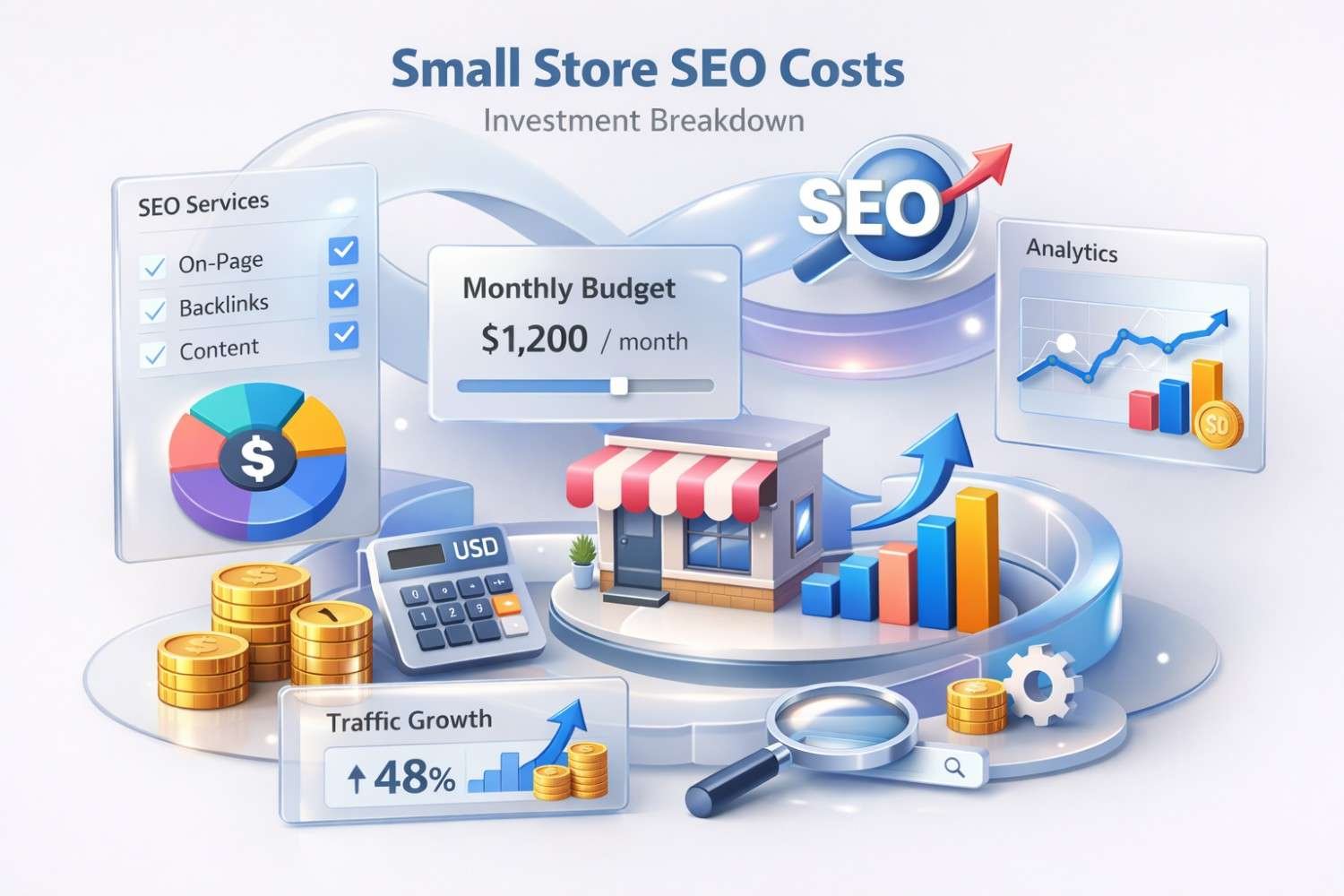
Small Store SEO Costs: Investment Breakdown
Small stores can achieve meaningful organic growth with focused, efficient SEO investment. Understanding typical costs helps you budget appropriately and evaluate agency proposals.
Typical Monthly Budget Range for Small Stores
Most small stores invest between $500 and $2,500 monthly for professional SEO services. This range covers essential optimization work without enterprise-level complexity.
At the lower end ($500-$1,000), expect foundational work: basic technical fixes, Google Business Profile optimization, and limited content creation. This suits businesses with minimal competition and local focus.
Mid-range budgets ($1,000-$1,800) support more comprehensive campaigns including regular content production, consistent link building, and deeper technical optimization.
Higher small-store budgets ($1,800-$2,500) enable competitive positioning in moderately challenging markets with expanded content strategies and more aggressive link acquisition.
Core SEO Services Included
Local SEO and Google Business Profile optimization form the foundation for most small stores. This includes profile setup, category optimization, review management strategy, local citation building, and NAP consistency across directories.
On-page technical foundations cover site speed optimization, mobile responsiveness, meta tag optimization, schema markup implementation, and fixing crawl errors identified in Google Search Console.
Content creation volume and frequency typically includes 2-4 blog posts or landing pages monthly. Content targets long-tail keywords with lower competition and clear purchase intent.
Link building scope and strategy focuses on quality over quantity. Small stores typically acquire 5-15 links monthly through local partnerships, industry directories, and targeted outreach to relevant websites.
Timeline to See Results
Small stores typically see initial ranking improvements within 3-4 months for lower-competition keywords. Meaningful traffic growth usually materializes between months 4-6.
Local SEO results often appear faster. Google Business Profile optimization can improve local pack visibility within weeks when properly executed.
Competitive keywords take longer. Expect 6-12 months for significant movement on terms where established competitors already rank well.
ROI Expectations for Small Store SEO
Small stores should target 3-5x ROI on their SEO investment within the first year. This calculation factors in customer lifetime value, not just immediate transaction value.
A store investing $1,500 monthly ($18,000 annually) should aim to generate at least $54,000-$90,000 in attributable revenue from organic search within 12-18 months.
Track conversions through Google Analytics goal setup and proper attribution modeling. Measure phone calls, form submissions, and direct purchases originating from organic search traffic.
Large Store SEO Costs: Investment Breakdown
Large stores require comprehensive SEO programs matching their operational scale. Higher investments reflect expanded scope, not inflated pricing.
Typical Monthly Budget Range for Large Stores
Large stores typically invest $5,000 to $30,000+ monthly in SEO services. Enterprise-level campaigns with aggressive growth targets can exceed $50,000 monthly.
Entry-level enterprise budgets ($5,000-$10,000) cover essential optimization across larger sites with moderate competitive pressure.
Mid-tier enterprise budgets ($10,000-$20,000) support comprehensive campaigns including substantial content production, significant link building, and dedicated technical SEO resources.
Premium enterprise budgets ($20,000-$30,000+) enable market leadership positioning with aggressive content strategies, digital PR campaigns, and advanced analytics infrastructure.
Comprehensive SEO Services Included
Enterprise technical SEO and site architecture encompasses crawl optimization, JavaScript rendering solutions, site speed at scale, structured data across thousands of pages, and coordination with development teams for implementation.
Multi-location and national/international targeting requires location-specific landing pages, hreflang implementation, regional link building strategies, and localized content production for each target market.
Content production at scale typically includes 10-30+ pieces monthly across blog posts, product descriptions, category pages, and supporting content. Content calendars align with seasonal trends and product launches.
Authority building and digital PR involves proactive media outreach, original research publication, expert commentary placement, and strategic partnerships generating high-authority backlinks.
Advanced analytics and reporting infrastructure covers custom dashboard development, multi-touch attribution modeling, competitive tracking, and executive-level reporting connecting SEO metrics to business outcomes.
Timeline to See Results
Large stores typically see measurable improvements within 4-6 months for targeted initiatives. Comprehensive ranking improvements across broad keyword portfolios take 9-18 months.
Technical improvements often show faster results. Fixing critical crawl issues or site speed problems can improve rankings within weeks.
Competitive keyword gains require sustained effort. Expect 12-24 months to significantly move rankings for high-volume commercial terms against established competitors.
ROI Expectations for Large Store SEO
Large stores should target 5-10x ROI on SEO investment, though measurement complexity increases with scale.
A store investing $15,000 monthly ($180,000 annually) should generate $900,000-$1,800,000 in attributable organic revenue within 18-24 months of sustained investment.
Enterprise attribution requires sophisticated tracking. Implement proper UTM parameters, phone call tracking, and multi-touch attribution models to accurately measure SEO contribution to revenue.
Direct Cost Comparison: Small vs Large Store SEO
Understanding the specific differences between small and large store SEO investments helps you benchmark your situation and plan appropriately.
Monthly Retainer Comparison Table
| Cost Factor | Small Store | Large Store |
| Monthly Retainer | $500-$2,500 | $5,000-$30,000+ |
| Content Pieces/Month | 2-4 | 10-30+ |
| Links Acquired/Month | 5-15 | 20-100+ |
| Pages Optimized | 10-50 | 100-10,000+ |
| Dedicated Hours | 10-30 | 40-200+ |
| Reporting Frequency | Monthly | Weekly/Monthly |
| Strategy Sessions | Quarterly | Monthly |
Service Scope Differences
Small store SEO focuses on efficiency. Services prioritize highest-impact activities within budget constraints. Work concentrates on core pages, primary keywords, and essential technical fixes.
Large store SEO requires comprehensiveness. Services must address enterprise complexity including multiple stakeholder coordination, cross-departmental implementation, and ongoing optimization across extensive page inventories.
Small stores receive generalist attention. One strategist typically handles all aspects of the campaign with support from specialists as needed.
Large stores require dedicated teams. Account managers, technical SEO specialists, content strategists, link builders, and analysts collaborate on enterprise campaigns.
Resource Allocation Breakdown
Small Store Typical Allocation:
- Technical SEO: 20%
- Content Creation: 35%
- Link Building: 30%
- Reporting/Strategy: 15%
Large Store Typical Allocation:
- Technical SEO: 25%
- Content Creation: 30%
- Link Building: 25%
- Analytics/Reporting: 10%
- Strategy/Coordination: 10%
Cost-Per-Result Metrics
Small stores often achieve lower cost-per-ranking due to reduced competition. Ranking for a local keyword might cost $200-$500 in cumulative effort.
Large stores face higher cost-per-ranking for competitive terms. National commercial keywords can require $2,000-$10,000+ in cumulative investment to achieve page-one positioning.
However, large stores benefit from economies of scale. Cost-per-page-optimized decreases significantly when spreading fixed costs across thousands of pages.
Key Cost Factors That Scale with Business Size
Certain SEO cost drivers increase proportionally with business scale. Understanding these factors helps predict budget requirements as your business grows.
Website Size and Page Volume
Every indexable page requires optimization attention. Technical audits, content reviews, and ongoing monitoring scale directly with page count.
A 50-page website needs perhaps 10 hours for comprehensive technical audit. A 5,000-page website might require 100+ hours for equivalent coverage.
Content optimization follows similar patterns. Updating meta tags, improving content quality, and adding schema markup multiplies with page volume.
Keyword Portfolio Complexity
Small stores target 20-50 primary keywords. Research, tracking, and optimization remain manageable within modest budgets.
Large stores pursue hundreds or thousands of keywords across categories, locations, and intent types. Keyword research alone can require dedicated analyst time.
Portfolio management complexity increases non-linearly. Tracking 1,000 keywords requires different tools and processes than tracking 50.
Content Production Requirements
Content volume requirements scale with keyword targets and competitive pressure. More keywords mean more pages needed to rank.
Small stores can maintain visibility with 2-4 quality pieces monthly. This pace builds topical authority gradually within focused niches.
Large stores need content velocity matching their competitive environment. Producing 20-30+ pieces monthly requires dedicated writing teams, editorial processes, and quality control systems.
Link Acquisition Strategy and Volume
Link building costs scale with both volume requirements and domain authority targets. More links and higher-quality links cost more.
Small stores can build authority with 5-15 quality links monthly. Local partnerships and niche directories provide accessible opportunities.
Large stores need substantial link velocity to move competitive rankings. Acquiring 50-100+ quality links monthly requires dedicated outreach teams and digital PR campaigns.
Technical SEO Maintenance Needs
Ongoing technical maintenance scales with site complexity. Simple sites need occasional attention. Complex sites require continuous monitoring.
Small stores might need 2-5 hours monthly for technical maintenance. Fixing occasional errors and monitoring core metrics suffices.
Large stores often need 20-40+ hours monthly for technical SEO. Continuous crawl monitoring, staging environment testing, and development coordination demand dedicated resources.
Reporting and Analytics Depth
Reporting complexity increases with stakeholder requirements and data volume. More sophisticated analysis requires more time.
Small stores receive monthly reports covering core metrics: rankings, traffic, conversions. Straightforward dashboards communicate progress efficiently.
Large stores need custom reporting infrastructure. Multi-location tracking, product category analysis, competitive monitoring, and executive dashboards require significant setup and maintenance.
How to Determine the Right SEO Budget for Your Business
Selecting appropriate SEO investment requires honest assessment of your situation, goals, and competitive environment. This framework helps you arrive at a realistic budget.
Assessing Your Current Digital Presence
Start by auditing your existing organic performance. Check Google Search Console for current impressions, clicks, and ranking positions.
Review your website’s technical health. Run crawl audits using tools like Screaming Frog to identify existing issues requiring attention.
Evaluate your content inventory. How many pages exist? What quality level? How much optimization work is needed?
Assess your backlink profile. Use Ahrefs or Moz to understand your current domain authority and link velocity compared to competitors.
Competitive Analysis and Market Position
Identify your top 5-10 organic competitors. These may differ from your perceived business competitors.
Analyze competitor domain authority, content volume, and link profiles. This reveals the investment level required to compete effectively.
Evaluate keyword difficulty for your target terms. High-difficulty keywords require proportionally higher investment to rank.
Calculate the gap between your current position and competitors. Larger gaps require more aggressive investment to close.
Revenue Goals and Customer Lifetime Value
Connect SEO investment to revenue objectives. What organic traffic volume supports your growth targets?
Calculate customer lifetime value (CLV). Higher CLV justifies greater acquisition costs including SEO investment.
Determine acceptable customer acquisition cost (CAC). SEO should deliver CAC below or comparable to other channels.
Model expected returns at different investment levels. Higher budgets typically accelerate results but face diminishing returns at extreme levels.
Growth Stage and Business Objectives
Early-stage businesses often prioritize efficiency over speed. Modest budgets build foundation while conserving capital.
Growth-stage businesses may invest aggressively to capture market share. Higher budgets accelerate ranking gains during critical expansion periods.
Mature businesses focus on maintaining and incrementally improving positions. Steady investment protects existing organic traffic while pursuing new opportunities.
Budget Allocation Framework
Conservative approach: Invest 5-10% of target organic revenue in SEO. If you want $100,000 in organic revenue, budget $5,000-$10,000 annually.
Moderate approach: Invest 10-15% of target organic revenue. This pace builds authority faster while maintaining reasonable ROI expectations.
Aggressive approach: Invest 15-25% of target organic revenue during growth phases. Higher investment accelerates market position gains.
Adjust based on competitive intensity. More competitive markets require investment toward the higher end of ranges.
What’s Included in Professional SEO Services (By Business Size)
Understanding service inclusions helps you evaluate proposals and ensure you receive appropriate value for your investment level.
Essential SEO Components for Small Stores
Technical SEO audit and fixes include crawl error resolution, site speed optimization, mobile responsiveness improvements, XML sitemap configuration, and robots.txt optimization. Initial audits identify priority issues; ongoing maintenance prevents new problems.
Local search optimization covers Google Business Profile setup and optimization, local citation building across relevant directories, review generation strategy, and local schema markup implementation.
Content strategy and creation includes keyword research for 20-50 target terms, content calendar development, and production of 2-4 optimized pieces monthly targeting identified opportunities.
Monthly reporting and consultation provides ranking tracking, traffic analysis, conversion monitoring, and strategic recommendations. Monthly calls review progress and adjust tactics.
Comprehensive SEO Components for Large Stores
Enterprise technical SEO management encompasses site architecture optimization, JavaScript rendering solutions, international targeting implementation, advanced schema deployment, and ongoing coordination with development teams.
Multi-channel content strategy includes comprehensive keyword research across product categories, editorial calendar management, content production at scale (10-30+ pieces monthly), and content performance optimization.
Authority building campaigns cover digital PR initiatives, original research publication, expert commentary placement, strategic partnership development, and high-authority link acquisition.
Conversion rate optimization integrates with SEO through landing page testing, user experience improvements, and conversion funnel analysis to maximize traffic value.
Advanced performance tracking includes custom dashboard development, multi-touch attribution modeling, competitive intelligence monitoring, and executive reporting connecting SEO to business outcomes.
Scalable Add-Ons and Specialized Services
Both small and large stores can add specialized services based on specific needs:
- Video SEO optimization
- Image search optimization
- Voice search optimization
- App store optimization
- Reputation management
- Crisis SEO response
- Migration planning and execution
- International expansion support
Pricing for add-ons varies based on scope and complexity. Request specific quotes for services beyond standard packages.
Common SEO Pricing Models Explained
SEO agencies and consultants use various pricing structures. Understanding each model helps you select the right arrangement for your situation.
Monthly Retainer Pricing
Most common for ongoing SEO services. You pay a fixed monthly fee for defined scope of work.
Advantages: Predictable budgeting, consistent attention, relationship development, aligned incentives for long-term results.
Disadvantages: Requires commitment before seeing results, scope creep potential, may pay for unused capacity.
Best for: Businesses seeking sustained organic growth with ongoing optimization needs.
Project-Based Pricing
Fixed price for defined deliverables. Common for audits, migrations, or specific initiatives.
Advantages: Clear scope and cost, defined deliverables, no ongoing commitment.
Disadvantages: No ongoing optimization, results may fade without maintenance, can miss emerging opportunities.
Best for: Specific technical projects, initial audits, or businesses testing SEO before committing to retainers.
Hourly Consulting Rates
Pay for time as needed. Rates typically range from $100-$300+ per hour depending on expertise level.
Advantages: Flexibility, pay only for what you use, access to senior expertise.
Disadvantages: Unpredictable costs, may incentivize inefficiency, limited strategic continuity.
Best for: Businesses with internal SEO capacity needing occasional expert guidance.
Performance-Based Pricing
Payment tied to results achieved. Structures vary: pay-per-ranking, revenue share, or bonus arrangements.
Advantages: Aligned incentives, reduced risk, payment tied to value delivered.
Disadvantages: May encourage short-term tactics, difficult to attribute results, can become expensive if successful.
Best for: Businesses with clear conversion tracking and willingness to share upside.
Which Model Works Best for Your Business Size
Small stores typically benefit from monthly retainers in the $500-$2,500 range. This provides consistent attention and predictable budgeting.
Project-based pricing works well for small stores needing initial audits or specific fixes before committing to ongoing services.
Large stores almost always require monthly retainers given the ongoing complexity and continuous optimization needs. Enterprise retainers typically include dedicated team members and regular strategic reviews.
Performance-based components can supplement retainers for large stores with sophisticated attribution capabilities.
Red Flags: When SEO Pricing Seems Too Good (or Bad) to Be True
Evaluating SEO proposals requires recognizing warning signs of problematic providers. Protect your investment by avoiding common pitfalls.
Warning Signs of Low-Quality SEO Services
Extremely low pricing often indicates corner-cutting. Quality SEO requires skilled professionals and significant time investment. Prices dramatically below market rates suggest automated tactics, offshore labor without quality control, or insufficient work.
Guaranteed rankings are impossible to promise legitimately. Google’s algorithm considers hundreds of factors outside any provider’s control. Guarantees suggest either dishonesty or willingness to use risky tactics.
Vague deliverables hide insufficient work. Quality proposals specify exactly what you receive: number of content pieces, links acquired, hours allocated, and specific technical work performed.
No case studies or references suggest limited track record. Established providers demonstrate results through documented client successes.
Reluctance to explain methodology indicates potential use of tactics that violate search engine guidelines. Legitimate providers explain their approach transparently.
Understanding Unrealistic Guarantees
No legitimate SEO provider can guarantee specific rankings. Google explicitly states that no one can guarantee a #1 ranking.
Promises of “instant results” contradict SEO fundamentals. Organic growth requires months of sustained effort.
Claims of “secret techniques” or “special relationships with Google” are fabrications. Google does not offer preferential treatment to any SEO provider.
Guarantees of specific traffic numbers ignore market variables outside anyone’s control. Algorithm updates, competitor actions, and seasonal trends affect results unpredictably.
Hidden Costs and Contract Terms to Watch
Long-term contracts with early termination penalties lock you in before you can evaluate results. Prefer month-to-month arrangements or contracts with reasonable exit terms.
Ownership of content and links should remain with you. Some providers retain ownership of work product, leaving you with nothing if you terminate.
Separate charges for “essential” services inflate effective costs. Ensure proposals include all necessary work, not just base services requiring expensive add-ons.
Automatic renewal clauses can trap you in unwanted ongoing commitments. Review contract terms carefully before signing.
How to Evaluate SEO Provider Credibility
Request case studies with specific metrics: traffic growth percentages, ranking improvements, and revenue impact. Verify claims are realistic and relevant to your situation.
Check references by speaking with current or former clients. Ask about communication quality, results achieved, and overall satisfaction.
Review their own SEO performance. Quality providers typically rank well for relevant terms. Poor organic visibility for an SEO company suggests limited capability.
Assess communication quality during the sales process. Responsiveness, clarity, and professionalism during proposals indicate service quality.
Verify team credentials including experience levels, certifications, and industry involvement. Quality providers employ experienced professionals, not just junior staff.
Scaling Your SEO Investment as Your Business Grows
SEO investment should evolve with your business. Understanding when and how to scale ensures continued growth without wasted resources.
When to Increase SEO Budget
Consistent ROI achievement signals capacity for increased investment. If current spending delivers strong returns, additional investment often accelerates growth.
Market expansion into new geographies or product categories requires additional SEO resources. Each new market needs dedicated optimization effort.
Competitive pressure increases when competitors invest more aggressively. Maintaining position requires matching or exceeding their investment levels.
Technical complexity grows as your website expands. More pages, features, and integrations demand more technical SEO attention.
Diminishing returns at current level suggest either budget increase or strategy refinement. Plateauing results with consistent investment indicate optimization ceiling at current spending.
Transitioning from Small to Large Store SEO Strategy
Scaling SEO requires strategic evolution, not just budget increases. Several shifts occur during transition:
Team structure changes from generalist attention to specialized roles. Technical SEO, content, and link building become distinct functions.
Process formalization replaces ad-hoc approaches. Editorial calendars, approval workflows, and quality control systems become necessary.
Tool investments expand from basic platforms to enterprise solutions. Advanced crawling, competitive intelligence, and analytics tools support larger operations.
Stakeholder management increases in complexity. Multiple departments, executives, and external partners require coordination.
Maintaining ROI During Scale-Up
Incremental increases allow ROI monitoring at each level. Avoid dramatic budget jumps that obscure performance assessment.
Maintain tracking discipline as complexity increases. Sophisticated attribution prevents losing sight of SEO contribution to revenue.
Prioritize high-impact initiatives even with larger budgets. More resources enable more work, but focus remains essential.
Regular strategy reviews ensure investment aligns with business objectives. Quarterly assessments prevent budget drift toward low-value activities.
Building In-House vs Agency Partnership Models
Pure agency model works well for small stores and businesses without SEO expertise. Agencies provide complete capability without hiring overhead.
Hybrid model suits growing businesses. In-house coordinators manage agency relationships while agencies provide specialized execution.
In-house with agency support fits large stores with substantial organic traffic. Internal teams handle ongoing optimization while agencies provide specialized projects or overflow capacity.
Full in-house makes sense only for the largest operations. Building complete SEO capability requires significant investment in talent, tools, and management.
Most businesses benefit from agency partnerships at some level. Even large in-house teams often engage agencies for specialized expertise or capacity.
Real-World Case Studies: SEO Investment and Returns
Examining actual outcomes illustrates how SEO investment translates to business results across different scales.
Small Store Success Story: Local to Regional Growth
A specialty home goods retailer with three locations invested $1,500 monthly in SEO services. Initial focus targeted local keywords for each location plus regional terms for their product specialty.
Starting position: Minimal organic visibility, 200 monthly organic sessions, no rankings in top 20 for target keywords.
Investment allocation: 30% technical fixes, 35% content creation (3 posts monthly), 25% local SEO and link building, 10% reporting.
12-month results: 2,400 monthly organic sessions (12x increase), 15 keywords ranking in top 10, Google Business Profile appearing in local pack for all locations.
Revenue impact: $127,000 attributable organic revenue in year one against $18,000 investment. ROI: 7x.
Key success factors: Focused keyword targeting, consistent content production, strong local SEO foundation.
Large Store Success Story: National Market Penetration
A regional furniture retailer expanding nationally invested $18,000 monthly in comprehensive SEO services. Strategy targeted high-volume commercial keywords while building content authority.
Starting position: Strong regional presence, 45,000 monthly organic sessions, limited national visibility.
Investment allocation: 25% technical SEO for 8,000-page site, 30% content production (25 pieces monthly), 25% link building and digital PR, 20% analytics and strategy.
24-month results: 380,000 monthly organic sessions (8.4x increase), 450+ keywords ranking in top 10, featured snippets for 35 high-volume terms.
Revenue impact: $4.2 million attributable organic revenue in year two against $432,000 cumulative investment. ROI: 9.7x.
Key success factors: Technical foundation enabling scale, aggressive content velocity, strategic digital PR generating authority.
Lessons Learned Across Business Sizes
Patience pays off. Both cases required 6+ months before significant results materialized. Early termination would have forfeited eventual returns.
Foundation first. Technical SEO fixes in early months enabled later content and link building to perform effectively.
Consistency matters. Sustained monthly investment outperformed sporadic large projects. Algorithms reward ongoing activity.
Measurement enables optimization. Both businesses tracked results carefully, enabling budget adjustments toward highest-performing initiatives.
Competitive awareness guides investment. Understanding competitor activity helped calibrate appropriate investment levels.
Making Your SEO Investment Decision
Armed with comprehensive understanding of SEO costs and factors, you can now make informed investment decisions aligned with your business situation.
Questions to Ask Potential SEO Providers
About their approach:
- What specific deliverables will I receive monthly?
- How do you prioritize work within my budget?
- What tools and processes do you use?
- How do you stay current with algorithm changes?
About results:
- Can you share case studies from similar businesses?
- What results can I realistically expect in 6, 12, and 24 months?
- How do you measure and report success?
- What happens if we don’t see expected results?
About the relationship:
- Who will work on my account and what is their experience?
- How often will we communicate?
- What is your contract structure and termination policy?
- How do you handle scope changes or additional requests?
Setting Realistic Expectations by Business Size
Small stores should expect:
- Initial ranking improvements in 3-4 months
- Meaningful traffic growth in 4-6 months
- Positive ROI typically within 9-12 months
- Gradual, steady progress rather than dramatic jumps
Large stores should expect:
- Technical improvements showing results in 2-3 months
- Content and link building impact in 4-6 months
- Comprehensive ranking improvements in 12-18 months
- Ongoing optimization needs indefinitely
Both should expect occasional ranking fluctuations. Algorithm updates and competitor actions cause temporary volatility even in successful campaigns.
Measuring SEO Success and ROI
Track leading indicators:
- Keyword ranking positions
- Organic impressions in Search Console
- Indexed page count
- Domain authority growth
- Backlink acquisition rate
Track lagging indicators:
- Organic sessions
- Organic conversions
- Organic revenue
- Customer acquisition cost from organic
- Organic traffic share vs. other channels
Calculate ROI accurately:
- Attribute conversions properly using analytics
- Include all SEO costs (agency fees, tools, internal time)
- Consider customer lifetime value, not just first purchase
- Measure over appropriate timeframes (12+ months)
Next Steps: Getting Started with Strategic SEO
Assess your current situation using the frameworks provided. Understand your competitive position, technical health, and content gaps.
Determine appropriate budget based on your business size, competitive environment, and growth objectives. Use the ranges provided as starting benchmarks.
Evaluate potential partners using the questions and red flags outlined. Request proposals from 2-3 providers for comparison.
Start with clear objectives and measurement frameworks. Define success metrics before beginning work.
Commit to appropriate timeframes. SEO requires sustained investment. Plan for 12+ months of consistent effort before evaluating overall success.
Conclusion
SEO costs vary significantly between small and large stores, driven by website complexity, competitive intensity, and growth objectives. Small stores typically invest $500-$2,500 monthly while large stores allocate $5,000-$30,000 or more.
The right investment level depends on your specific situation. Assess your digital presence, analyze competitors, and connect SEO goals to revenue objectives. Quality providers deliver measurable ROI when given appropriate resources and timeframes.
We help businesses of all sizes build sustainable organic growth through strategic SEO investment. Contact White Label SEO Service to discuss the right approach for your business and receive a customized proposal matching your goals and budget.
Frequently Asked Questions
How much should a small business spend on SEO per month?
Small businesses typically invest $500-$2,500 monthly depending on competitive intensity and growth goals. Start at the lower end if competition is minimal, increase investment as you see positive ROI and want to accelerate growth.
Why does enterprise SEO cost so much more than small business SEO?
Enterprise SEO requires more resources across every dimension: larger websites need more technical work, competitive keywords demand more content and links, and complex organizations require more coordination and reporting. Costs reflect actual work required, not arbitrary pricing.
How long does it take to see ROI from SEO investment?
Most businesses see initial ranking improvements in 3-4 months and meaningful traffic growth in 4-6 months. Positive ROI typically materializes within 9-12 months for small stores and 12-18 months for large stores pursuing competitive keywords.
Is cheap SEO ever worth it?
Extremely low-cost SEO rarely delivers value and often causes harm through low-quality tactics. However, modest budgets ($500-$1,000 monthly) can work for small stores in low-competition markets when providers focus resources efficiently on high-impact activities.
What’s the difference between local SEO and national SEO costs?
Local SEO typically costs less because it targets smaller geographic areas with less competition. National SEO requires more content, more links, and more technical work to compete across broader markets. Expect national campaigns to cost 2-5x more than equivalent local efforts.
Should I hire an agency or build an in-house SEO team?
Most small and mid-sized businesses benefit from agency partnerships. Agencies provide complete capability without hiring overhead. Large enterprises may justify in-house teams supplemented by agency support for specialized projects or overflow capacity.
How do I know if my SEO provider is delivering value?
Track measurable outcomes: ranking improvements, traffic growth, and conversions from organic search. Quality providers show consistent progress on leading indicators (rankings, impressions) before lagging indicators (traffic, revenue) improve. Request regular reporting with clear metrics tied to your business goals.