Hiring an ecommerce SEO agency typically costs between $2,500 and $10,000 per month, while building an in-house team requires $150,000 to $300,000 annually when you factor in salaries, tools, and overhead. The right choice depends on your revenue stage, growth timeline, and internal capabilities.
This decision impacts your organic traffic trajectory for years. Get it wrong, and you either overspend on agency fees that don’t scale or underinvest in a team that can’t execute.
This guide breaks down every cost component, compares total ownership over three years, and gives you a decision framework based on real numbers and ROI benchmarks.

Understanding Ecommerce SEO Investment Models
Before comparing costs, you need clarity on what each model actually delivers. Agency and in-house approaches differ fundamentally in structure, accountability, and resource allocation.
What Is Agency-Based Ecommerce SEO?
Agency-based ecommerce SEO means outsourcing your organic search strategy and execution to an external team. The agency handles technical audits, keyword research, content strategy, on-page optimization, and link building.
You pay a monthly retainer or project fee. In return, you get access to specialists across multiple SEO disciplines without hiring them directly. Most agencies assign an account manager who coordinates deliverables and reports on performance.
The agency model works on economies of scale. They spread tool costs, training investments, and specialized talent across multiple clients. This lets smaller ecommerce businesses access enterprise-level capabilities at a fraction of the cost.
Typical agency engagements include monthly strategy calls, deliverable schedules, and performance dashboards. The relationship is vendor-client, not employer-employee.
What Is In-House Ecommerce SEO?
In-house ecommerce SEO means hiring dedicated employees to manage your organic search program internally. This could be a single SEO specialist or a full team including technical SEO managers, content strategists, and link builders.
Your team works exclusively on your brand. They attend internal meetings, understand your products deeply, and align with broader marketing initiatives in real time.
In-house teams require direct management. You handle hiring, training, performance reviews, and career development. You also purchase and maintain all SEO tools and software.
The in-house model offers control and integration. Your SEO team sits alongside product, engineering, and marketing. They can push technical fixes faster and create content that reflects genuine product expertise.
Key Differences at a Glance
| Factor | Agency Model | In-House Model |
| Cost Structure | Variable monthly fee | Fixed salaries plus overhead |
| Expertise Breadth | Multiple specialists included | Limited to hired roles |
| Brand Knowledge | Learned over time | Deep and immediate |
| Scalability | Flexible up or down | Requires hiring/firing |
| Management Burden | Low (vendor relationship) | High (direct reports) |
| Tool Costs | Included in retainer | Additional expense |
| Response Time | Scheduled deliverables | Real-time availability |
The core tradeoff is control versus convenience. Agencies offer plug-and-play expertise. In-house teams offer integration and ownership.
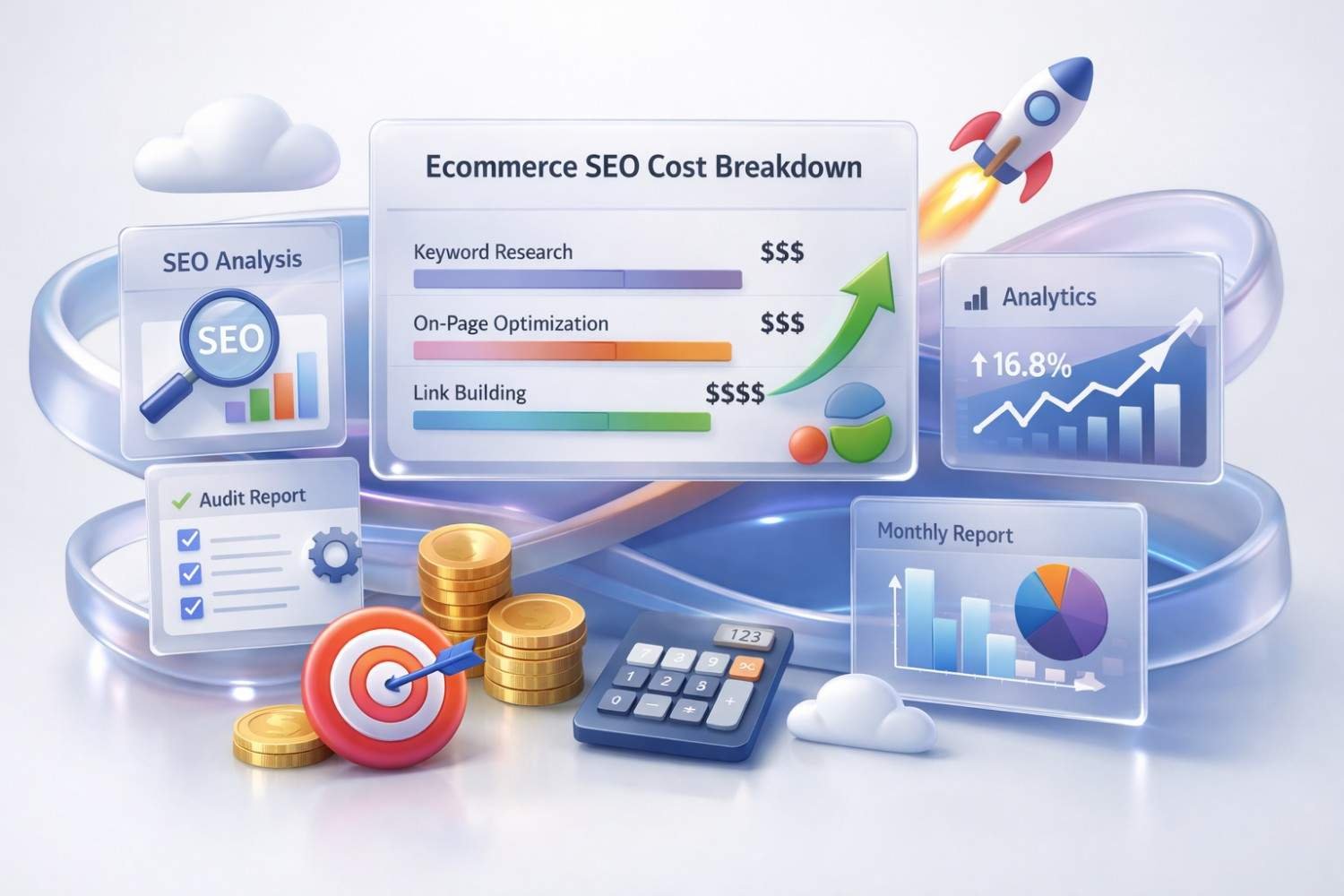
Complete Cost Breakdown: Ecommerce SEO Agency
Agency pricing varies dramatically based on scope, reputation, and deliverable volume. Understanding the full cost picture prevents budget surprises.
Monthly Retainer Fees and Pricing Tiers
Ecommerce SEO agencies typically structure pricing in tiers based on store size and competitive intensity.
Entry-Level Agencies ($1,000 to $2,500/month): These packages suit small ecommerce stores with under 500 SKUs. Expect basic technical audits, limited keyword research, and templated content recommendations. Execution support is minimal.
Mid-Market Agencies ($2,500 to $7,500/month): This range covers most growing ecommerce businesses. You get dedicated account management, comprehensive technical SEO, content strategy, and some link building. Monthly deliverables are clearly defined.
Enterprise Agencies ($7,500 to $25,000+/month): Large catalogs, multiple storefronts, and international SEO require this tier. These engagements include dedicated teams, custom reporting, and strategic consulting alongside execution.
According to Ahrefs’ agency pricing research, the most common retainer range for ecommerce clients falls between $2,500 and $5,000 per month.
Project-Based and Performance Pricing Models
Not all agencies work on retainers. Alternative pricing models include:
Project-Based Pricing: One-time engagements for specific deliverables. A technical SEO audit might cost $3,000 to $15,000 depending on site complexity. Content strategy projects range from $5,000 to $20,000.
Performance-Based Pricing: Some agencies tie fees to results. This might mean paying per ranking achieved, per traffic milestone, or a percentage of attributed revenue. Performance models often include a base retainer plus success bonuses.
Hourly Consulting: Senior SEO consultants charge $150 to $500 per hour. This works for strategic guidance when you have internal execution capacity.
Project-based models suit businesses with specific gaps to fill. Performance models align incentives but require clear attribution frameworks.
Hidden Costs and Additional Expenses
Agency retainers rarely cover everything. Budget for these common extras:
Content Production: Many agencies charge separately for content creation. Blog posts cost $200 to $1,000 each. Product description optimization might run $25 to $100 per SKU.
Link Building: Quality link acquisition often carries additional fees. Expect $200 to $1,000 per placed link depending on domain authority targets.
Technical Implementation: Agencies recommend fixes, but developer time to implement them is your cost. Budget 10 to 20 hours monthly for technical SEO implementation.
Platform-Specific Work: Shopify, Magento, and BigCommerce each have unique SEO requirements. Specialized platform expertise may cost extra.
Reporting and Analytics: Advanced custom reporting beyond standard dashboards sometimes carries setup or monthly fees.
A $5,000 monthly retainer can easily become $8,000 to $10,000 when you add content, links, and implementation costs.
What’s Typically Included in Agency Packages
Standard agency deliverables for ecommerce SEO include:
Technical SEO:
- Site architecture analysis
- Crawlability and indexation audits
- Page speed optimization recommendations
- Schema markup implementation
- Mobile usability review
- Core Web Vitals monitoring
On-Page Optimization:
- Keyword research and mapping
- Title tag and meta description optimization
- Header structure improvements
- Internal linking strategy
- Category and product page optimization
Content Strategy:
- Content gap analysis
- Editorial calendar development
- Blog topic recommendations
- Content brief creation
Link Building:
- Backlink profile analysis
- Link acquisition strategy
- Outreach campaign management
- Digital PR opportunities
Reporting:
- Monthly performance reports
- Ranking tracking
- Traffic and conversion analysis
- Competitive benchmarking
Higher-tier packages include more execution. Lower tiers focus on strategy and recommendations.
Complete Cost Breakdown: In-House Ecommerce SEO
Building an internal SEO function requires capital investment beyond salaries. Understanding total employment costs prevents underbudgeting.
Salary and Compensation Costs
Ecommerce SEO salaries vary by role, experience, and location.
SEO Specialist (1-3 years experience): Base salary ranges from $50,000 to $75,000 annually. These professionals handle day-to-day optimization tasks, content coordination, and basic technical fixes.
Senior SEO Manager (4-7 years experience): Expect $80,000 to $120,000 annually. Senior managers develop strategy, manage specialists, and coordinate with other departments.
SEO Director (8+ years experience): Director-level compensation runs $120,000 to $180,000. These leaders own the entire organic search program and report to marketing leadership.
Technical SEO Specialist: Dedicated technical SEOs command $70,000 to $110,000. They focus on site architecture, page speed, and developer coordination.
According to Glassdoor salary data, the average SEO manager salary in the United States is approximately $75,000 to $95,000.
Add 25% to 35% for benefits, payroll taxes, and insurance. A $90,000 salary becomes $115,000 to $122,000 in total compensation cost.
Tools, Software, and Technology Stack
In-house teams need their own tool subscriptions. Essential ecommerce SEO tools include:
Enterprise SEO Platforms:
- Semrush: $450 to $5,500/month
- Ahrefs: $99 to $999/month
- Moz Pro: $99 to $599/month
Technical SEO Tools:
- Screaming Frog: $259/year
- Sitebulb: $35 to $150/month
- ContentKing: $500 to $2,000/month
Analytics and Tracking:
- Google Analytics 4: Free
- Google Search Console: Free
- Looker Studio: Free to $9/user/month
Content and Keyword Tools:
- Clearscope: $170 to $1,200/month
- Surfer SEO: $89 to $219/month
- MarketMuse: $600 to $1,500/month
Rank Tracking:
- AccuRanker: $129 to $2,500/month
- STAT: Custom pricing
A comprehensive tool stack costs $1,500 to $5,000 monthly depending on catalog size and competitive requirements.
Training, Development, and Ongoing Education
SEO evolves constantly. Algorithm updates, new features, and platform changes require continuous learning.
Conference Attendance: Major SEO conferences cost $500 to $2,000 per ticket plus travel. Budget $3,000 to $5,000 annually per team member.
Online Courses and Certifications: Platforms like Semrush Academy, HubSpot, and specialized courses run $500 to $2,000 per person annually.
Industry Publications: Subscriptions to Search Engine Journal, Search Engine Land, and specialized newsletters cost $200 to $500 annually.
Internal Training Time: Learning takes time away from execution. Budget 5% to 10% of work hours for professional development.
Annual training investment per SEO professional: $4,000 to $8,000.
Recruitment and Onboarding Expenses
Finding qualified SEO talent takes time and money.
Recruitment Costs:
- Job board postings: $200 to $500 per listing
- Recruiter fees: 15% to 25% of first-year salary
- Interview time: 10 to 20 hours of internal team time
For a $90,000 position, recruiter fees alone cost $13,500 to $22,500.
Onboarding Costs: New hires need 2 to 4 months to reach full productivity. During this period, they consume management time while delivering partial output.
Calculate onboarding cost as 25% of first-year salary: approximately $22,500 for a $90,000 hire.
Turnover Risk: Average SEO tenure is 2 to 3 years. Budget for replacement costs every hiring cycle.
Infrastructure and Overhead Costs
Employment carries indirect costs beyond compensation:
Office Space: If not fully remote, allocate $500 to $1,500 monthly per employee for workspace.
Equipment: Computers, monitors, and peripherals cost $2,000 to $4,000 per employee upfront.
Management Overhead: Supervising SEO staff consumes leadership time. Value this at 10% to 15% of the manager’s salary.
HR and Administrative: Payroll processing, benefits administration, and compliance add 5% to 10% to employment costs.
Total overhead adds 15% to 25% on top of direct compensation.
Total Cost of Ownership Comparison
Raw costs don’t tell the full story. Comparing total investment over time reveals the true financial picture.
Year-One Investment Analysis
Agency Model (Mid-Market):
| Cost Component | Annual Cost |
| Monthly retainer ($5,000/month) | $60,000 |
| Additional content ($1,500/month) | $18,000 |
| Link building ($1,000/month) | $12,000 |
| Implementation support (internal) | $15,000 |
| Total Year One | $105,000 |
In-House Model (Single SEO Manager):
| Cost Component | Annual Cost |
| Salary + benefits ($90,000 × 1.3) | $117,000 |
| Tools and software | $36,000 |
| Training and development | $6,000 |
| Recruitment and onboarding | $25,000 |
| Equipment and overhead | $8,000 |
| Total Year One | $192,000 |
Year one favors the agency model by approximately $87,000 due to recruitment and onboarding costs.
Three-Year Cost Projection
Agency Model (3 Years):
| Year | Annual Cost | Cumulative |
| Year 1 | $105,000 | $105,000 |
| Year 2 | $110,000 | $215,000 |
| Year 3 | $115,000 | $330,000 |
Assumes 5% annual fee increases.
In-House Model (3 Years):
| Year | Annual Cost | Cumulative |
| Year 1 | $192,000 | $192,000 |
| Year 2 | $165,000 | $357,000 |
| Year 3 | $170,000 | $527,000 |
Years 2-3 drop as recruitment costs disappear. Assumes 3% annual raises.
Over three years, the agency model costs $197,000 less than a single in-house hire.
Cost-Per-Result Metrics
Dollar comparisons need context. Evaluate cost efficiency through:
Cost Per Ranking Improvement: Track how much you spend to move target keywords up in search results. Agencies with proven playbooks often achieve faster ranking gains.
Cost Per Organic Session: Divide total SEO investment by incremental organic sessions. Benchmark against paid acquisition costs.
Cost Per Organic Conversion: The ultimate efficiency metric. Calculate total SEO spend divided by conversions attributed to organic search.
Revenue Per SEO Dollar: For every dollar invested in SEO, how much revenue does organic search generate? Mature programs target 5:1 to 10:1 ratios.
A more expensive option that delivers better results may have lower cost-per-result metrics.
Pros and Cons: Agency vs In-House SEO Teams
Beyond costs, each model carries operational advantages and limitations.
Advantages of Hiring an Ecommerce SEO Agency
Immediate Expertise Access: Agencies employ specialists across technical SEO, content strategy, and link building. You get a full team without hiring multiple roles.
Faster Time to Impact: Established agencies have proven processes. They skip the learning curve and execute immediately.
Scalable Investment: Increase or decrease scope based on business needs. No hiring or layoff decisions required.
Diverse Experience: Agencies work across multiple ecommerce verticals. They bring cross-industry insights and tested strategies.
Reduced Management Burden: Vendor relationships require less oversight than direct reports. Your team focuses on core business functions.
Built-In Redundancy: If an agency team member leaves, the agency handles replacement. No recruitment burden falls on you.
Disadvantages of Hiring an Ecommerce SEO Agency
Divided Attention: Your account is one of many. Agency teams juggle multiple clients simultaneously.
Limited Brand Immersion: External teams never understand your products as deeply as internal staff. This affects content quality and strategic alignment.
Communication Overhead: Coordinating with an external team adds friction. Requests go through account managers rather than direct execution.
Less Control: You influence strategy but don’t control daily priorities. Agency workflows may not match your urgency.
Knowledge Dependency: If you end the relationship, institutional knowledge leaves with the agency. Transition periods create performance gaps.
Potential Misalignment: Agency incentives don’t always match yours. They may prioritize activities that show well in reports over those that drive revenue.
Advantages of Building an In-House SEO Team
Deep Brand Integration: Internal teams attend product meetings, understand inventory challenges, and align with company culture. This produces more authentic content and smarter prioritization.
Real-Time Responsiveness: Need a technical fix pushed today? In-house teams can coordinate with developers immediately without waiting for agency schedules.
Full Control: You set priorities, timelines, and quality standards. No negotiating scope or waiting for contract amendments.
Institutional Knowledge: SEO learnings stay within your organization. You build compounding expertise over time.
Cross-Functional Collaboration: In-house SEOs work directly with product, engineering, and customer service. This integration improves technical implementation and content accuracy.
Long-Term Cost Efficiency: At scale, in-house teams cost less per hour of work than agency equivalents.
Disadvantages of Building an In-House SEO Team
High Initial Investment: Recruitment, onboarding, and ramp-up costs front-load expenses. ROI takes longer to materialize.
Talent Acquisition Challenges: Skilled ecommerce SEO professionals are scarce. Hiring takes 3 to 6 months for senior roles.
Skill Gaps: One or two hires can’t cover all SEO disciplines. You may lack technical depth, content expertise, or link building capabilities.
Training Burden: Keeping skills current requires ongoing investment. Algorithm updates demand continuous learning.
Turnover Risk: When key team members leave, you lose momentum. Replacement cycles create performance dips.
Management Requirements: SEO teams need leadership, career development, and performance management. This consumes executive attention.
Factors That Influence the Right Choice for Your Business
No universal answer exists. Your specific situation determines the optimal model.
Business Size and Revenue Stage
Under $1M Annual Revenue: Agency or freelancer support makes sense. You can’t justify full-time SEO salaries at this stage.
$1M to $10M Annual Revenue: The decision point. Agencies remain cost-effective, but growing businesses may benefit from hybrid approaches.
$10M to $50M Annual Revenue: In-house investment becomes viable. Consider a senior hire supported by agency execution.
$50M+ Annual Revenue: Full in-house teams typically deliver better ROI. The volume of work justifies dedicated staff.
Revenue stage correlates with SEO complexity. Larger businesses have more pages, more competitors, and more optimization opportunities.
Ecommerce Platform Complexity
Platform choice affects SEO resource requirements:
Shopify: Relatively SEO-friendly out of the box. Limited customization means less technical work. Agencies handle Shopify SEO efficiently.
WooCommerce: More flexibility but more complexity. Technical SEO requires WordPress expertise. In-house developers help.
Magento/Adobe Commerce: Enterprise-grade complexity. Technical SEO demands significant developer coordination. In-house technical SEO specialists add value.
Custom Platforms: Unique architectures require deep platform knowledge. In-house teams who understand your codebase outperform external agencies.
Product Catalog Size and SKU Volume
Catalog size directly impacts SEO workload:
Under 500 SKUs: Manageable for agencies. Individual product optimization is feasible.
500 to 5,000 SKUs: Requires systematic approaches. Agencies need clear processes; in-house teams need automation tools.
5,000 to 50,000 SKUs: Scale demands efficiency. Template-based optimization and programmatic SEO become essential.
50,000+ SKUs: Enterprise-level catalogs need dedicated resources. In-house teams with developer support typically outperform agencies.
Large catalogs also mean more technical debt, more crawl budget concerns, and more internal linking complexity.
Internal Marketing Capabilities
Evaluate your existing team’s strengths:
Strong Content Team, Weak Technical: Agencies can fill technical gaps while internal writers produce content.
Strong Technical Team, Weak Content: In-house developers can implement recommendations. Agencies or freelancers handle content strategy.
Weak Across Both: Full-service agency support makes sense until you build internal capabilities.
Strong Across Both: You may only need strategic consulting rather than execution support.
Growth Goals and Timeline Expectations
Urgency affects the right choice:
Aggressive Growth Targets: Agencies can deploy resources faster than you can hire. Speed favors outsourcing.
Steady, Sustainable Growth: In-house teams build compounding advantages over time. Patience favors internal investment.
Turnaround Situations: If organic traffic is declining, agencies bring fresh perspectives and proven recovery playbooks.
Market Expansion: Entering new markets or launching new categories may require temporary agency support alongside in-house teams.
ROI Analysis: Measuring SEO Investment Returns
Investment decisions require ROI projections. Both models can deliver strong returns when executed well.
Agency ROI Benchmarks and Case Studies
Well-run agency engagements typically deliver:
Traffic Growth: Expect 30% to 100% organic traffic increases within 12 months for sites with optimization opportunities.
Revenue Impact: Ecommerce SEO programs targeting commercial keywords often achieve 3:1 to 7:1 revenue-to-cost ratios within 18 months.
Ranking Improvements: Quality agencies move 50% to 70% of target keywords into page-one positions within 6 to 12 months.
Agency ROI depends heavily on starting position. Sites with significant technical issues or thin content see faster initial gains.
In-House ROI Benchmarks and Performance Data
In-house teams show different ROI patterns:
Slower Initial Returns: Ramp-up periods delay impact. Expect 6 to 9 months before meaningful traffic improvements.
Higher Long-Term Returns: Mature in-house programs often outperform agencies on cost-per-result metrics after year two.
Compounding Benefits: Institutional knowledge accumulates. Year-three performance typically exceeds year-one by significant margins.
Integration Advantages: In-house teams coordinate faster with product launches, inventory changes, and promotional calendars.
How to Calculate Your Expected SEO ROI
Use this framework to project returns:
Step 1: Estimate Traffic Potential Analyze keyword opportunities using tools like Semrush or Ahrefs. Calculate potential traffic from ranking improvements.
Step 2: Apply Conversion Rates Multiply projected traffic by your organic conversion rate. Use historical data or industry benchmarks (typically 2% to 4% for ecommerce).
Step 3: Calculate Revenue Value Multiply projected conversions by average order value. This gives you potential revenue from SEO investment.
Step 4: Compare to Investment Divide projected revenue by total SEO costs. Target minimum 3:1 ratio for healthy ROI.
Example Calculation:
- Current organic traffic: 50,000 monthly sessions
- Projected growth: 50% increase = 25,000 additional sessions
- Conversion rate: 3% = 750 additional conversions
- Average order value: $150 = $112,500 monthly revenue
- Annual revenue impact: $1,350,000
- Annual SEO investment: $150,000
- ROI ratio: 9:1
Which Option Is Better for My Specific Situation?
The sections above covered costs, pros, cons, and ROI frameworks. Now we shift to practical decision-making and implementation guidance.
Hybrid Models: Combining Agency and In-House Resources
Many successful ecommerce businesses use both. Hybrid models capture advantages from each approach.
When a Hybrid Approach Makes Sense
Consider hybrid structures when:
You Have Partial Internal Capabilities: A marketing manager who understands SEO but can’t execute everything benefits from agency support.
You Need Specialized Skills: Technical SEO audits or link building campaigns may require expertise you can’t justify hiring full-time.
You’re Scaling Rapidly: Growth spurts create temporary resource gaps. Agencies provide flexible capacity.
You’re Transitioning Models: Moving from agency to in-house (or vice versa) works better with overlap periods.
You Face Seasonal Demands: Holiday preparation or product launches may require temporary reinforcement.
How to Structure Agency-In-House Collaboration
Effective hybrid models require clear role definition:
Model 1: Strategy In-House, Execution Agency Internal SEO manager sets priorities and reviews work. Agency handles content production, link building, and technical implementation.
Model 2: Execution In-House, Strategy Agency Internal team handles daily optimization. Agency provides quarterly audits, competitive analysis, and strategic direction.
Model 3: Specialized Split In-house team owns content and on-page SEO. Agency handles technical audits and link acquisition.
Model 4: Overflow Support In-house team handles baseline work. Agency activates for special projects or capacity overflow.
Clear communication protocols prevent duplication and gaps. Weekly syncs and shared project management tools are essential.
Cost Optimization Through Hybrid Models
Hybrid approaches can reduce total costs:
Reduce Agency Scope: Handling content internally while outsourcing link building cuts agency fees by 30% to 50%.
Hire Junior In-House, Outsource Senior Strategy: A $60,000 SEO coordinator plus $3,000/month consulting costs less than a $120,000 senior hire.
Project-Based Agency Work: Annual technical audits and quarterly strategy sessions cost less than monthly retainers.
Tool Sharing: Some agencies provide tool access as part of engagements, reducing your direct subscription costs.
Hybrid models require more coordination but often deliver the best cost-to-capability ratio.
How to Evaluate and Choose an Ecommerce SEO Agency
Not all agencies deliver equal value. Due diligence protects your investment.
Essential Questions to Ask Before Hiring
Experience Questions:
- How many ecommerce clients do you currently serve?
- What platforms do you specialize in?
- Can you share case studies from similar businesses?
Process Questions:
- What does your onboarding process look like?
- How do you develop keyword and content strategies?
- What’s your approach to technical SEO?
Team Questions:
- Who will work on my account?
- What’s the experience level of assigned team members?
- How do you handle team member transitions?
Results Questions:
- What KPIs do you track and report?
- What results should I expect in 6, 12, and 18 months?
- How do you define and measure success?
Communication Questions:
- How often will we meet?
- What’s your response time for questions?
- What project management tools do you use?
Red Flags and Warning Signs
Avoid agencies that:
Guarantee Specific Rankings: No one controls Google’s algorithm. Guarantees indicate either dishonesty or black-hat tactics.
Won’t Share Their Process: Legitimate agencies explain their methodology. Secrecy often hides thin deliverables.
Lack Ecommerce Experience: B2B content marketing differs from product page optimization. Verify relevant experience.
Push Long Contracts Immediately: Quality agencies earn retention through results. Demanding 12-month commitments upfront suggests confidence issues.
Can’t Provide References: Happy clients talk. Inability to connect you with references raises concerns.
Price Far Below Market: Extremely low fees mean either inexperience or unsustainable service levels.
Contract Terms and SLA Considerations
Negotiate these elements:
Contract Length: Start with 6-month terms. Avoid multi-year commitments until you’ve validated performance.
Termination Clauses: Ensure 30 to 60-day termination notice provisions. Avoid penalties for early exit.
Deliverable Specifications: Define exactly what you receive monthly. Vague scope leads to disputes.
Reporting Requirements: Specify report frequency, metrics included, and access to raw data.
Ownership Rights: Confirm you own all content, strategies, and work product created for your account.
Performance Benchmarks: Consider tying a portion of fees to agreed-upon metrics. This aligns incentives.
Vetting Agency Track Records and Results
Verify claims through:
Case Study Analysis: Request detailed case studies with specific metrics, timelines, and methodologies.
Reference Calls: Speak directly with current and former clients. Ask about communication, results, and challenges.
Portfolio Review: Examine work samples. Evaluate content quality, technical recommendations, and strategic thinking.
Online Reputation: Check reviews on Clutch, G2, and Google Business Profile. Look for patterns in feedback.
Team LinkedIn Profiles: Verify team member credentials and experience claims.
How to Build an Effective In-House SEO Team
If you choose the in-house path, structure matters as much as hiring.
Essential Roles and Team Structure
Minimum Viable Team (1-2 people):
- SEO Manager: Strategy, coordination, reporting
- Content Specialist: Writing, optimization, publishing
Growth Team (3-5 people):
- SEO Director: Strategy and leadership
- Technical SEO Specialist: Audits, implementation, developer coordination
- Content Strategist: Editorial planning, briefs, quality control
- SEO Analyst: Reporting, data analysis, competitive research
- Link Building Specialist: Outreach, digital PR, partnerships
Enterprise Team (6+ people): Add specialized roles for international SEO, local SEO, and platform-specific optimization.
Start small and expand based on workload and results.
Required Skills and Qualifications
Technical Skills:
- HTML, CSS, JavaScript basics
- Google Search Console proficiency
- Analytics platform expertise
- Crawling and auditing tools
- Schema markup implementation
Strategic Skills:
- Keyword research methodology
- Competitive analysis
- Content strategy development
- Link building tactics
Soft Skills:
- Cross-functional communication
- Project management
- Data interpretation
- Stakeholder presentation
Ecommerce-Specific Knowledge:
- Product page optimization
- Category architecture
- Faceted navigation handling
- Inventory and pricing integration
Building Your SEO Technology Stack
Essential tools for in-house teams:
Tier 1 (Must-Have):
- Google Search Console (free)
- Google Analytics 4 (free)
- Screaming Frog ($259/year)
- One enterprise platform (Semrush, Ahrefs, or Moz)
Tier 2 (Recommended):
- Rank tracking tool
- Content optimization platform
- Log file analyzer
- Page speed testing tools
Tier 3 (Nice-to-Have):
- Competitive intelligence tools
- Content management integrations
- Automated reporting platforms
- A/B testing tools
Budget $2,000 to $5,000 monthly for a comprehensive stack.
Creating Processes and Workflows
Document standard operating procedures for:
Weekly Activities:
- Ranking and traffic monitoring
- Search Console error review
- Content publishing schedule
- Competitor activity tracking
Monthly Activities:
- Performance reporting
- Keyword opportunity analysis
- Technical health checks
- Backlink profile review
Quarterly Activities:
- Comprehensive technical audits
- Content gap analysis
- Strategy review and adjustment
- Goal setting and forecasting
Annual Activities:
- Full site architecture review
- Competitive landscape analysis
- Tool stack evaluation
- Budget planning
Documented processes ensure consistency and enable scaling.
Decision Framework: Agency vs In-House Checklist
Use this framework to guide your decision.
Budget Assessment Criteria
Answer these questions:
- Can you commit $100,000+ annually to SEO investment?
- Do you have budget for recruitment and onboarding costs?
- Can you absorb 6+ months of ramp-up before seeing results?
- Is your budget stable or variable year-to-year?
If yes to most: In-house becomes viable. If no to most: Agency model fits better.
Capability Gap Analysis
Evaluate your current team:
- Do you have anyone who understands SEO fundamentals?
- Can your developers implement technical recommendations?
- Does your content team understand SEO writing?
- Do you have analytics capabilities to measure results?
Strong existing capabilities: In-house extension makes sense. Weak existing capabilities: Agency fills gaps faster.
Timeline and Urgency Factors
Consider your timeline:
- Do you need results within 6 months?
- Are you facing competitive pressure requiring immediate action?
- Is there a product launch or seasonal deadline driving urgency?
- Can you wait 9 to 12 months for in-house ramp-up?
Urgent timeline: Agency delivers faster initial impact. Patient timeline: In-house builds stronger long-term foundation.
Long-Term Strategic Alignment
Think about your 3 to 5-year vision:
- Is SEO a core competency you want to own?
- Do you plan significant ecommerce expansion?
- Will you need SEO capabilities for multiple brands or markets?
- Is organic search central to your growth strategy?
SEO as core competency: Invest in in-house capabilities. SEO as support function: Agency partnership works well.
Conclusion
Making the Right Investment Decision for Your Ecommerce Business
Ecommerce SEO investment decisions come down to your specific revenue stage, internal capabilities, and growth timeline. Agencies offer faster deployment and lower initial costs, while in-house teams deliver deeper integration and long-term cost efficiency at scale.
Neither model is universally superior. The right choice aligns with your business reality today and your strategic direction for the next three to five years. Many successful ecommerce businesses start with agencies and transition to hybrid or in-house models as they grow.
We help ecommerce businesses build sustainable organic growth through technical SEO, content strategy, and authority building. Whether you need full-service support or strategic guidance for your in-house team, White Label SEO Service delivers the expertise and execution to drive measurable results. Contact us to discuss which investment model fits your business goals.
Frequently Asked Questions
How much does an ecommerce SEO agency cost per month?
Ecommerce SEO agencies typically charge between $2,500 and $10,000 per month for mid-market businesses. Entry-level packages start around $1,000 monthly, while enterprise engagements can exceed $25,000. Total costs increase when you add content production and link building fees.
What is the average salary for an in-house SEO specialist?
In-house SEO specialists earn $50,000 to $75,000 annually at entry to mid-level positions. Senior SEO managers command $80,000 to $120,000, while directors earn $120,000 to $180,000. Add 25% to 35% for benefits and payroll taxes to calculate true employment cost.
Is it cheaper to hire an agency or build an in-house team?
Agencies cost less in year one due to avoided recruitment and onboarding expenses. Over three years, a mid-market agency engagement costs approximately $330,000 compared to $527,000 for a single in-house hire. However, in-house teams often deliver better cost-per-result metrics at scale.
How long before I see ROI from ecommerce SEO?
Most ecommerce SEO programs show meaningful traffic improvements within 6 to 12 months. Revenue impact typically follows 3 to 6 months after traffic gains. Agencies may deliver faster initial results, while in-house teams often achieve stronger long-term compounding returns.
Can I start with an agency and transition to in-house later?
Yes, this is a common and effective approach. Start with agency support to build momentum, then hire in-house talent to take over execution. Plan a 3 to 6-month overlap period for knowledge transfer. Ensure your agency contract allows for clean transition and data handoff.
What size business should hire an SEO agency vs in-house?
Businesses under $10M annual revenue typically benefit more from agency partnerships. Companies between $10M and $50M often use hybrid models. Businesses above $50M usually justify full in-house teams. Catalog size, platform complexity, and growth goals also influence this decision.
What should I look for when evaluating an ecommerce SEO agency?
Prioritize agencies with proven ecommerce experience, transparent processes, and verifiable case studies. Ask about team composition, communication frequency, and reporting standards. Avoid agencies that guarantee specific rankings or push long-term contracts before demonstrating results.