SaaS SEO pricing typically ranges from $1,000 to $25,000+ per month, depending on your growth stage, competitive landscape, and service scope. Understanding these pricing models helps you allocate budget effectively and avoid overpaying for services that don’t match your needs.
For SaaS companies, organic search represents one of the highest-ROI acquisition channels available. But navigating agency proposals, comparing retainer structures, and calculating expected returns requires clarity on how SEO pricing actually works.
This guide breaks down every major pricing model, what’s included at each tier, factors that influence costs, and how to evaluate whether an SEO investment makes sense for your business stage.
What Are SaaS SEO Pricing Models?
Definition and Core Components
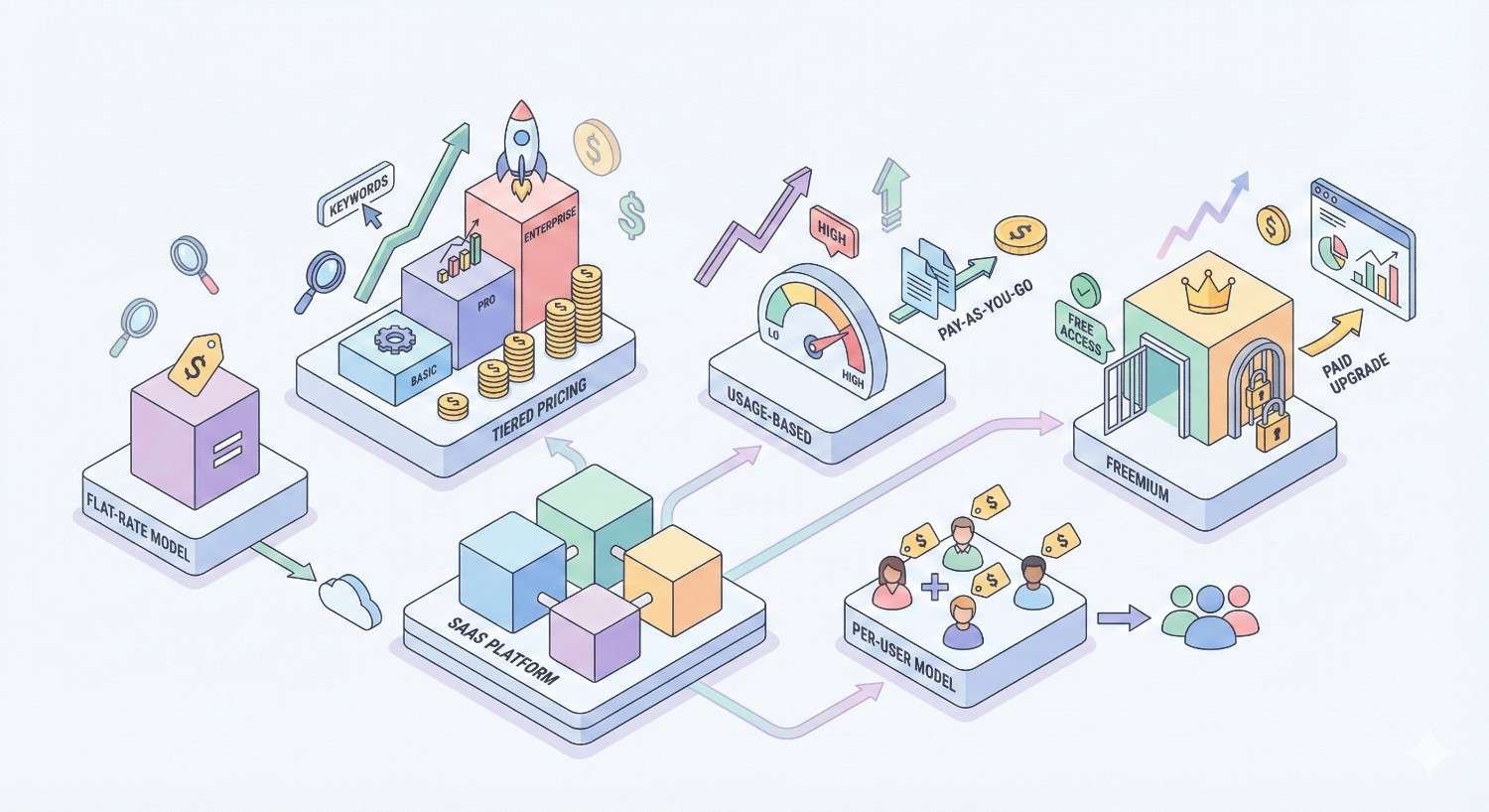
SaaS SEO pricing models define how agencies and consultants structure their fees for search engine optimization services. These models determine payment frequency, service scope, deliverables, and performance expectations.
The core components of any SEO pricing structure include labor costs for strategists and specialists, tool subscriptions for research and tracking, content production expenses, and link acquisition budgets. Agencies bundle these elements differently based on their operational model and target client profile.
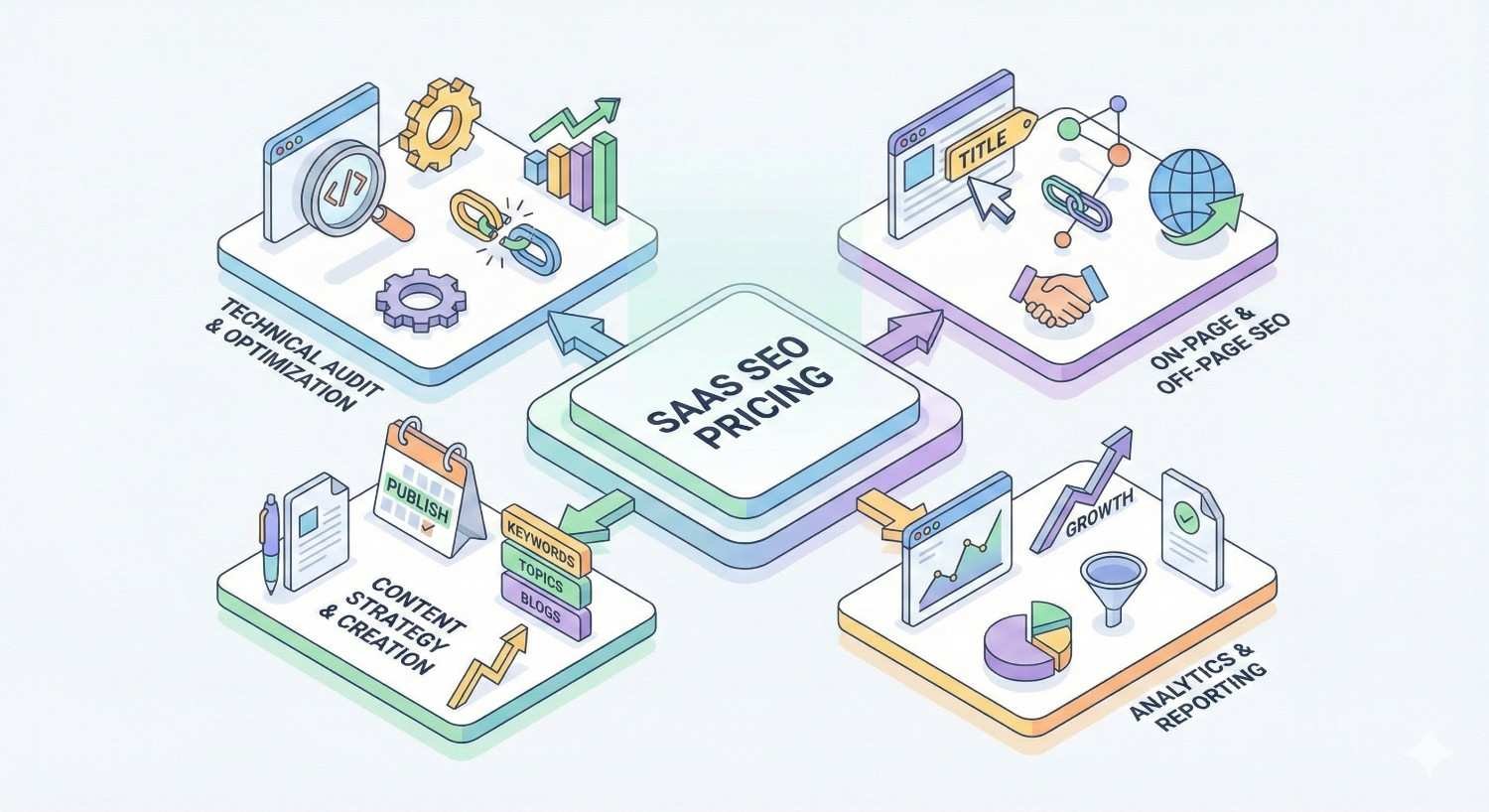
Most SaaS-focused SEO providers offer some combination of technical optimization, content strategy, link building, and ongoing performance monitoring. The pricing model you choose affects not just your monthly spend but also how accountability is structured and results are measured.
Why Pricing Structures Vary Across SEO Providers
SEO pricing varies dramatically because the service itself isn’t standardized. Unlike software subscriptions with fixed features, SEO involves custom strategy development, variable execution complexity, and outcomes influenced by factors outside the provider’s control.
Agency overhead plays a significant role. A boutique consultancy with three specialists operates differently than a 50-person agency with account managers, project coordinators, and dedicated outreach teams. These structural differences translate directly into pricing.
Geographic location matters too. Agencies based in major metropolitan areas typically charge more than those in lower-cost regions. However, remote work has compressed some of these differences, creating more pricing competition across markets.
Specialization commands premium pricing. Agencies focused exclusively on SaaS understand product-led growth, trial conversion optimization, and feature-based keyword strategies. This expertise costs more than generalist SEO services but often delivers faster, more relevant results.
Common SaaS SEO Pricing Models Explained
Monthly Retainer Pricing
Monthly retainers represent the most common pricing model for ongoing SaaS SEO services. You pay a fixed amount each month for a defined scope of work, typically including strategy, execution, and reporting.
Retainers work well for SaaS companies because SEO requires sustained effort over time. Search rankings don’t improve from one-time projects. They build through consistent technical maintenance, content publishing, and authority development.
The retainer model aligns agency incentives with long-term performance. Providers invest in understanding your product, market, and competitive landscape because they expect a multi-month or multi-year relationship.
Typical retainer commitments range from 6 to 12 months. Shorter commitments often come with higher monthly rates because agencies need to recover onboarding costs quickly. Longer commitments may include rate discounts or expanded service scope.
Project-Based Pricing
Project-based pricing covers specific, defined deliverables with clear start and end dates. Common SaaS SEO projects include technical audits, site migrations, content strategy development, and competitive analysis.
This model suits companies that need targeted expertise without ongoing commitments. Early-stage startups might commission a technical audit before building their in-house team. Established companies might hire specialists for a site redesign or international expansion.
Project pricing typically ranges from $2,500 for basic audits to $50,000+ for comprehensive site migrations with full technical implementation. The scope document defines exactly what’s included, reducing ambiguity about deliverables.
The limitation of project-based work is that SEO improvements require ongoing maintenance. A technical audit identifies issues, but someone needs to fix them and monitor for new problems. Projects often lead to retainer relationships once companies see the value of continuous optimization.
Hourly Consulting Rates
Hourly consulting works best for advisory relationships where you need expert guidance rather than execution. SaaS SEO consultants typically charge between $150 and $500 per hour depending on their experience and specialization.
This model suits companies with internal marketing teams that need strategic direction. Your team handles implementation while the consultant provides expertise on prioritization, technical decisions, and competitive strategy.
Hourly arrangements offer flexibility but can become expensive for execution-heavy work. Ten hours of consulting at $300/hour costs $3,000, which might only cover strategy development without any content creation or link building.
Many consultants offer hybrid arrangements combining a small monthly retainer for ongoing access with hourly billing for additional work. This structure provides predictable costs while maintaining flexibility.
Performance-Based Pricing
Performance-based models tie agency compensation to specific outcomes like rankings, traffic, or leads. The agency takes on more risk in exchange for potentially higher rewards when targets are met.
Pure performance pricing is rare in SEO because results depend on many factors outside agency control. Algorithm updates, competitor actions, and client-side implementation delays all affect outcomes. Most agencies won’t accept full performance risk.
Hybrid performance models are more common. These combine a reduced base retainer with bonuses for hitting defined milestones. For example, a $5,000 base retainer plus $2,000 bonus for achieving specific ranking or traffic targets.
The challenge with performance pricing is defining fair metrics. Ranking for low-competition keywords is easier than ranking for high-value commercial terms. Traffic increases mean little if visitors don’t convert. Sophisticated performance agreements require careful metric selection and baseline establishment.
Hybrid Pricing Models
Hybrid models combine elements from multiple pricing structures to balance predictability with flexibility. These arrangements have become increasingly popular as both agencies and clients seek more nuanced relationships.
A common hybrid structure includes a base retainer covering core services plus project-based pricing for additional initiatives. Your monthly retainer might cover technical monitoring, content optimization, and reporting while content production or link building campaigns are priced separately.
Another hybrid approach layers consulting hours on top of execution services. The retainer covers implementation work while strategic planning sessions are billed hourly. This separates thinking from doing and allows for variable strategic investment.
Hybrid models require clear documentation about what’s included in each component. Without precise scope definitions, disputes arise about whether specific work falls under the retainer or requires additional payment.
SaaS SEO Pricing Tiers and Package Structures
Starter/Basic Packages ($1,000–$3,000/month)
Starter packages target early-stage SaaS companies with limited budgets and foundational SEO needs. At this tier, expect focused services rather than comprehensive programs.
Typical inclusions at the starter level cover technical SEO audits with prioritized recommendations, basic keyword research for core product terms, on-page optimization for key landing pages, and monthly performance reporting.
Content production is usually limited or excluded at this tier. You might receive content briefs or optimization recommendations, but actual writing requires additional investment or internal resources.
Link building at the starter level typically involves foundational activities like directory submissions, unlinked brand mention reclamation, and basic outreach. Don’t expect aggressive authority building campaigns at this price point.
Starter packages work best for SaaS companies that have internal resources to handle implementation. The agency provides strategy and guidance while your team executes recommendations.
Growth/Mid-Tier Packages ($3,000–$7,500/month)
Growth packages serve SaaS companies ready to invest seriously in organic acquisition. This tier includes both strategy and meaningful execution capacity.
At the mid-tier level, expect comprehensive technical SEO with ongoing monitoring and implementation support. Agencies at this level typically handle fixes directly rather than just providing recommendations.
Content strategy and production become substantial at this tier. Most growth packages include 4-8 pieces of optimized content monthly, covering blog posts, landing pages, and supporting content assets.
Link building programs at the growth level involve active outreach campaigns, guest posting, digital PR, and relationship-based link acquisition. Expect 10-30 quality backlinks monthly depending on your industry and the agency’s approach.
Reporting becomes more sophisticated with custom dashboards, competitive tracking, and strategic recommendations based on performance data. Monthly or bi-weekly strategy calls keep alignment between agency activities and business priorities.
Enterprise/Premium Packages ($7,500–$25,000+/month)
Enterprise packages deliver comprehensive SEO programs for established SaaS companies competing in demanding markets. At this investment level, expect dedicated resources and strategic partnership.
Premium engagements typically include dedicated account strategists who understand your business deeply. Rather than rotating through multiple clients, these specialists focus significant attention on your account.
Content production scales substantially at the enterprise tier. Expect 10-20+ pieces monthly including long-form guides, comparison pages, feature documentation, and thought leadership content.
Link building at this level involves sophisticated campaigns including original research promotion, expert commentary placement, strategic partnerships, and high-authority media coverage. Quality and relevance take priority over volume.
Technical SEO at the enterprise level covers complex challenges like international optimization, large-scale site architecture, JavaScript rendering issues, and integration with product development workflows.
Enterprise packages often include additional services like conversion rate optimization, content localization, and integration with paid acquisition strategies. The goal is comprehensive organic growth, not just ranking improvements.
Custom and Scalable Pricing Options
Custom pricing structures serve SaaS companies with unique needs that don’t fit standard packages. These arrangements require detailed scoping and often involve longer negotiation processes.
Scalable pricing models adjust costs based on defined metrics like website size, content volume, or traffic levels. As your SaaS grows, the SEO investment scales proportionally without requiring contract renegotiation.
Some agencies offer modular pricing where you select specific services à la carte. This approach works for companies with strong internal capabilities in some areas but gaps in others. You might handle content internally while outsourcing technical SEO and link building.
Custom arrangements require clear documentation of scope, deliverables, and success metrics. Without standard packages as reference points, both parties need explicit agreement on expectations.
What’s Included in SaaS SEO Pricing?
Technical SEO Audits and Implementation
Technical SEO forms the foundation of any SaaS SEO program. Without proper technical infrastructure, content and links can’t deliver their full potential.
Initial technical audits examine crawlability, indexation, site architecture, page speed, mobile usability, and structured data implementation. For SaaS websites, audits also assess JavaScript rendering, dynamic content handling, and application-specific technical challenges.
Ongoing technical monitoring catches issues before they impact rankings. Regular crawls identify new errors, broken links, redirect chains, and indexation problems. Proactive monitoring prevents the ranking drops that occur when technical issues go unnoticed.
Implementation support varies by pricing tier. Lower-tier packages provide recommendations for your development team. Higher-tier packages include direct implementation or close collaboration with your engineers to ensure fixes are deployed correctly.
Content Strategy and Production
Content drives organic traffic for SaaS companies. Strategic content programs target keywords across the buyer journey from problem awareness through solution evaluation to purchase decision.
Content strategy development identifies topic opportunities based on keyword research, competitive analysis, and business priorities. Good strategy balances search volume with conversion potential and competitive difficulty.
Content production includes research, writing, editing, and optimization. Quality requirements for SaaS content are high because you’re often explaining complex products to sophisticated buyers. Subject matter expertise and clear communication both matter.
Content types for SaaS SEO include blog posts targeting informational queries, landing pages for commercial keywords, comparison and alternative pages, integration documentation, and resource content that attracts links.
Production volume scales with investment level. Starter packages might include content briefs only. Growth packages typically deliver 4-8 pieces monthly. Enterprise programs can produce 15-25+ pieces monthly across multiple content types.
Link Building and Authority Development
Link building remains essential for SaaS SEO despite ongoing algorithm evolution. Backlinks from relevant, authoritative websites signal trust and improve ranking potential.
Link building approaches vary significantly across agencies. Some focus on scalable tactics like guest posting and resource link building. Others emphasize digital PR and original research promotion. The best programs combine multiple approaches based on opportunity and competitive requirements.
Quality matters more than quantity for SaaS link building. Links from relevant technology publications, industry blogs, and authoritative business sites carry more weight than high-volume links from generic sources.
Link building deliverables should include transparency about acquisition methods, target sites, and actual placements. Agencies should provide regular reporting on links acquired, referring domains, and authority metrics.
Authority development extends beyond traditional link building to include brand mentions, expert positioning, and thought leadership placement. These activities build the broader reputation signals that search engines increasingly consider.
Keyword Research and Competitive Analysis
Keyword research identifies the search queries your target customers use when looking for solutions like yours. For SaaS companies, this includes product-related terms, problem-aware searches, and comparison queries.
Effective SaaS keyword research goes beyond search volume to consider intent alignment, conversion potential, and competitive difficulty. A high-volume keyword with misaligned intent wastes resources. A lower-volume keyword with strong purchase intent might deliver better ROI.
Competitive analysis examines what’s working for other companies in your space. This includes ranking analysis, content gap identification, backlink profile comparison, and SERP feature opportunities.
Ongoing keyword tracking monitors your positions and identifies new opportunities. Search landscapes evolve as competitors publish content and algorithms update. Regular research keeps your strategy current.
Reporting, Analytics, and Performance Tracking
Reporting transforms SEO activities into business intelligence. Good reporting connects tactical metrics like rankings and traffic to business outcomes like leads and revenue.
Standard reporting includes ranking positions for target keywords, organic traffic trends, backlink acquisition, and technical health metrics. These operational metrics show whether SEO activities are producing expected outputs.
Advanced reporting connects SEO performance to business metrics through proper attribution. This requires integration with your analytics platform, CRM, and potentially product analytics to track the full journey from organic visit to customer.
Reporting frequency varies by engagement level. Monthly reports are standard for most retainers. Enterprise engagements often include weekly updates and real-time dashboards for continuous visibility.
Strategic recommendations should accompany performance data. Reports that only show numbers without interpretation and action items provide limited value. Good reporting explains what happened, why it matters, and what to do next.
Factors That Influence SaaS SEO Pricing
Website Size and Technical Complexity
Larger websites require more resources to optimize and maintain. A SaaS site with 50 pages needs different investment than one with 5,000 pages across multiple product lines and documentation sections.
Technical complexity affects pricing significantly. Single-page applications, dynamic content rendering, complex JavaScript frameworks, and custom CMS platforms all require specialized expertise. Agencies charge more when technical challenges demand senior engineering involvement.
Site architecture complexity matters too. Multi-product SaaS companies with distinct user segments need more sophisticated information architecture and internal linking strategies than single-product startups.
International websites with multiple languages and regional targeting add another layer of complexity. Hreflang implementation, localized content strategy, and region-specific link building all increase scope and cost.
Competitive Landscape and Industry Niche
Highly competitive markets require larger investments to achieve meaningful results. If your competitors have been building SEO programs for years, catching up demands aggressive content production and link building.
Industry competitiveness varies dramatically. B2B SaaS categories like CRM, project management, and marketing automation are extremely competitive. Niche vertical SaaS serving specific industries often faces less SEO competition.
Keyword difficulty directly impacts required investment. Ranking for “project management software” requires substantially more resources than ranking for “veterinary practice management software.” Agencies price accordingly.
Competitive analysis during the sales process should inform pricing. Agencies that quote without understanding your competitive landscape may underestimate required investment or overpromise results.
Current Domain Authority and Backlink Profile
Your starting position affects how much work is needed to achieve goals. A new domain with no backlinks needs foundational authority building before content can rank competitively.
Established domains with existing authority can often achieve results faster with less link building investment. The content and technical optimization work remains similar, but the authority development component scales down.
Backlink profile quality matters as much as quantity. A domain with many low-quality links might need cleanup work before building new authority. Toxic link profiles can require disavow file management and reputation recovery.
Agencies should assess your current domain metrics during scoping. This baseline informs realistic timeline expectations and appropriate investment levels.
Content Requirements and Publishing Frequency
Content-intensive strategies cost more than technical-focused approaches. If your competitive analysis reveals that ranking requires comprehensive content hubs with dozens of supporting articles, budget accordingly.
Publishing frequency affects both production costs and results timelines. Publishing 2 articles monthly builds authority slowly. Publishing 8-12 articles monthly accelerates growth but requires proportionally larger investment.
Content quality requirements vary by industry. Technical SaaS products often need subject matter expert involvement, increasing production costs. Consumer-focused SaaS might achieve results with less specialized content.
Existing content assets affect required investment. Companies with substantial content libraries might focus on optimization rather than new production. Companies starting from zero need larger content budgets.
Geographic Targeting (Local vs. Global)
Geographic scope significantly impacts SEO complexity and cost. Local SaaS companies targeting a single market face simpler optimization challenges than global companies targeting multiple countries and languages.
International SEO requires country-specific keyword research, localized content, regional link building, and technical implementation of language and country targeting. Each additional market multiplies certain workstreams.
Multi-language content production adds substantial cost. Translation alone isn’t sufficient for SEO. Content needs localization for regional search behavior and cultural relevance.
Regional link building requires relationships and outreach capabilities in each target market. Agencies with global networks can execute international campaigns but charge accordingly for this capability.
Agency Experience and Reputation
Agency expertise commands premium pricing. Specialists with proven SaaS SEO track records charge more than generalist agencies learning the space.
Reputation and demand affect pricing. Agencies with strong case studies, industry recognition, and waitlists can charge premium rates. Newer agencies often compete on price while building their portfolio.
Team composition matters. Agencies staffed with senior strategists and experienced specialists cost more than those relying heavily on junior staff. The quality difference often justifies the price difference.
Specialization depth influences pricing. Agencies focused exclusively on SaaS understand your business model, metrics, and growth challenges. This specialized knowledge accelerates results and reduces wasted effort.
How to Compare SaaS SEO Pricing Models
Evaluating Scope of Services vs. Cost
Direct price comparison without scope analysis leads to poor decisions. A $3,000 retainer including content production delivers different value than a $3,000 retainer covering strategy only.
Create a standardized comparison framework listing all potential services. Map each agency’s proposal against this framework to identify what’s included, excluded, and available as add-ons.
Calculate effective hourly rates when possible. If an agency quotes $5,000 monthly for approximately 40 hours of work, the effective rate is $125/hour. Compare this against hourly consulting rates and internal costs.
Consider deliverable quality, not just quantity. Eight mediocre blog posts provide less value than four excellent ones. Request samples and case studies to assess quality standards.
Understanding Contract Terms and Commitments
Contract length affects both pricing and flexibility. Longer commitments often come with lower monthly rates but reduce your ability to change direction if results disappoint.
Understand cancellation terms before signing. Some contracts allow termination with 30-day notice. Others require payment through the full term regardless of performance.
Scope change provisions matter for growing companies. Your needs will evolve. Contracts should include clear processes for adjusting scope and pricing as requirements change.
Payment terms vary across agencies. Some require payment in advance. Others bill monthly in arrears. Understand cash flow implications, especially for larger engagements.
Assessing Transparency and Deliverables
Transparency about methods and activities indicates agency quality. Providers should explain their approach, not hide behind proprietary processes.
Deliverable specificity protects both parties. Vague promises like “content optimization” mean different things to different people. Specific deliverables like “8 blog posts of 1,500+ words with keyword targeting” set clear expectations.
Reporting commitments should be explicit. Understand what metrics you’ll receive, how frequently, and in what format. Request sample reports during the sales process.
Communication expectations need definition. How often will you meet? Who’s your primary contact? What’s the expected response time for questions? Clear communication protocols prevent frustration.
Red Flags in SEO Pricing Proposals
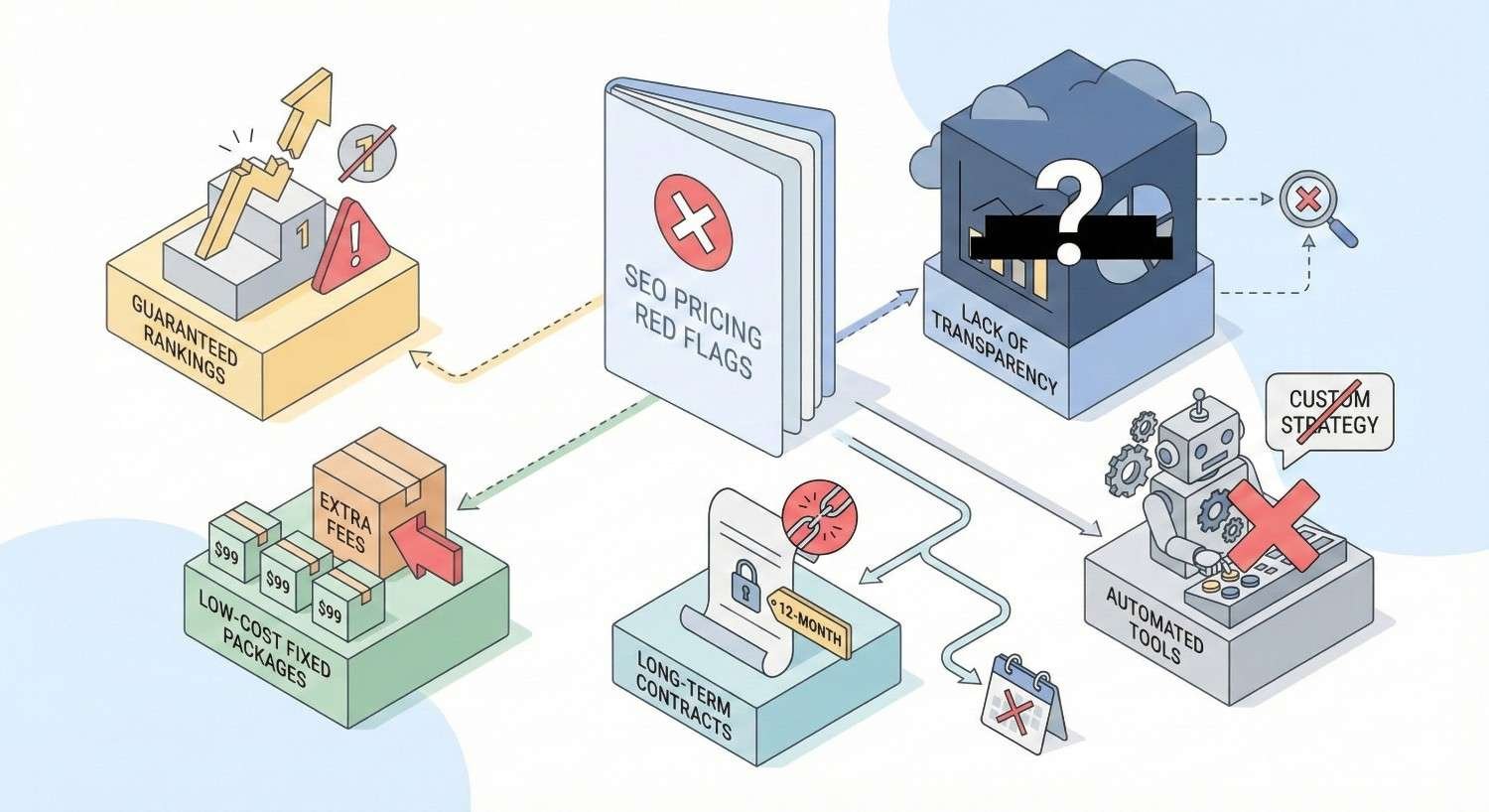
Guaranteed rankings should trigger skepticism. No agency can guarantee specific positions because Google’s algorithm isn’t controllable. Agencies making guarantees either don’t understand SEO or are being dishonest.
Prices dramatically below market rates suggest quality problems. SEO requires skilled labor. Agencies charging $500/month for comprehensive services are either cutting corners or operating unsustainably.
Vague deliverables indicate potential scope disputes. If a proposal doesn’t specify exactly what you’ll receive, expect disagreements about whether commitments were met.
Reluctance to share methods raises concerns. Legitimate agencies explain their approach. Those hiding behind secrecy may be using tactics that could harm your site.
Pressure tactics suggest desperation. Quality agencies have enough demand that they don’t need high-pressure sales. Take time to evaluate options properly.
SaaS SEO Pricing vs. Other Marketing Investments
SEO vs. PPC Cost Comparison
PPC delivers immediate traffic but requires continuous spending. The moment you stop paying, traffic stops. SEO builds assets that continue generating traffic without ongoing media costs.
Cost per acquisition typically favors SEO over time. Research from Databox shows that organic search delivers lower customer acquisition costs than paid channels for most B2B companies once SEO programs mature.
PPC provides faster feedback loops. You can test messaging, landing pages, and audience targeting within days. SEO tests take months to produce conclusive data.
The optimal approach combines both channels. PPC validates keywords and messaging quickly. SEO builds sustainable traffic for proven opportunities. Budget allocation should shift toward SEO as programs mature and organic traffic grows.
SEO vs. Content Marketing Agency Costs
Content marketing agencies and SEO agencies overlap but aren’t identical. Content agencies focus on production quality and brand storytelling. SEO agencies optimize content for search visibility.
Pure content agencies typically charge $5,000-$15,000 monthly for strategy and production without SEO optimization. Adding SEO expertise either requires a separate agency or finding a provider that combines both capabilities.
Integrated content and SEO programs deliver better results than siloed approaches. Content created without SEO consideration often misses ranking opportunities. SEO without quality content struggles to earn links and engagement.
Evaluate whether agencies truly integrate disciplines or just claim to. Ask how SEO insights inform content strategy and how content quality standards are maintained alongside optimization requirements.
Long-Term ROI of SEO Investment
SEO investments compound over time. Content published today continues generating traffic for years. Links acquired build permanent authority. Technical improvements create lasting infrastructure.
The compounding nature of SEO means early investments deliver outsized long-term returns. A blog post ranking well might generate thousands of visits monthly for years without additional investment.
ROI timelines for SaaS SEO typically show meaningful results in 6-12 months with full program maturity in 18-24 months. Patience is required, but the payoff justifies the wait.
Calculate lifetime value of organic traffic to understand true ROI. If organic visitors convert at 2% and customers have $10,000 LTV, each 1,000 organic visitors represents $200,000 in potential lifetime revenue.
How to Calculate ROI on SaaS SEO Spend
Defining SEO Success Metrics for SaaS
Traffic metrics provide leading indicators but don’t capture business value directly. Organic sessions, new users, and pageviews show whether SEO activities are generating visibility.
Engagement metrics indicate traffic quality. Time on site, pages per session, and bounce rate reveal whether organic visitors find your content relevant. Poor engagement suggests targeting or content quality issues.
Conversion metrics connect SEO to business outcomes. Track organic traffic through your funnel: visits to signups, signups to trials, trials to paid customers. This funnel visibility enables true ROI calculation.
Revenue attribution completes the picture. Connect organic acquisition to customer lifetime value to understand the full financial impact of SEO investment.
Attribution Models for Organic Traffic
Last-click attribution credits the final touchpoint before conversion. This model undervalues SEO because organic search often introduces prospects who convert later through other channels.
First-click attribution credits the initial touchpoint. This model better captures SEO’s role in demand generation but ignores the nurturing that happens between first visit and conversion.
Multi-touch attribution distributes credit across all touchpoints. This approach most accurately reflects how B2B SaaS buyers actually research and decide. Implementing multi-touch requires proper tracking infrastructure.
Position-based attribution gives extra weight to first and last touches while distributing remaining credit across middle interactions. This model balances acquisition and conversion credit reasonably.
Choose an attribution model and apply it consistently. The specific model matters less than consistent application over time, which enables trend analysis and investment optimization.
Forecasting Revenue from Organic Growth
Traffic forecasting starts with keyword opportunity analysis. Estimate potential traffic from target keywords based on search volume and expected ranking positions.
Apply historical conversion rates to traffic forecasts. If your site converts organic visitors at 1.5% and you expect 10,000 additional monthly visits, forecast 150 new conversions monthly.
Factor in customer lifetime value for revenue projections. Those 150 conversions multiplied by average customer value produces revenue forecasts that justify SEO investment.
Build conservative, moderate, and aggressive scenarios. SEO outcomes are uncertain. Presenting a range of possibilities helps stakeholders understand both opportunity and risk.
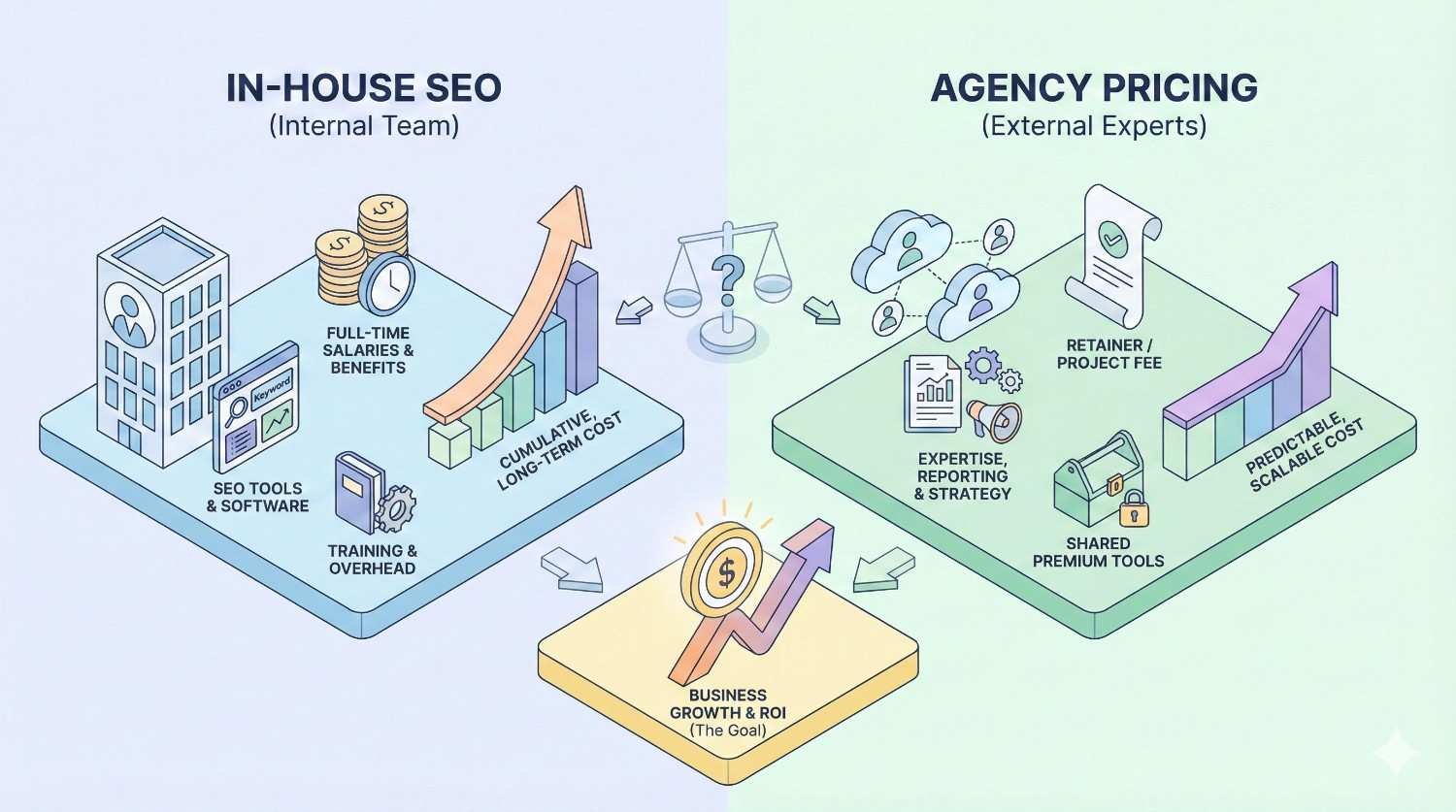
In-House SEO vs. Agency Pricing: Cost Analysis
Full-Time SEO Hire Costs
Senior SEO managers in the US command salaries of $80,000-$150,000 depending on experience and location. Add 25-35% for benefits, taxes, and overhead to calculate true employment cost.
A fully-loaded SEO hire costs approximately $100,000-$200,000 annually. This single person must cover strategy, technical SEO, content, link building, and analytics. Few individuals excel across all areas.
Building a complete in-house team requires multiple hires. A strategist, content specialist, and technical SEO together might cost $250,000-$400,000 annually before tools and overhead.
Tool costs add significantly to in-house expenses. Enterprise SEO platforms, content tools, link research databases, and analytics software can total $20,000-$50,000 annually.
Agency Retainer vs. Salary Comparison
A $7,500 monthly agency retainer costs $90,000 annually. This buys access to a team of specialists rather than a single generalist hire.
Agencies provide immediate expertise without ramp-up time. New hires need months to learn your business, build processes, and become productive. Agencies bring established methodologies and can execute immediately.
Agencies offer flexibility that employment doesn’t. Scaling up or down with an agency requires contract adjustment. Scaling employees involves hiring, training, or difficult termination processes.
The agency model includes built-in redundancy. If your in-house SEO leaves, you lose all momentum while recruiting and training a replacement. Agencies maintain continuity regardless of individual staff changes.
When to Build In-House vs. Outsource
Early-stage companies typically benefit from agency relationships. Limited budgets can’t support full teams, and agencies provide broader expertise than single hires.
Growth-stage companies often use hybrid models. An in-house SEO manager handles strategy and coordination while agencies provide execution capacity for content and link building.
Enterprise companies may justify full in-house teams when SEO volume and complexity warrant dedicated resources. Even then, many maintain agency relationships for specialized projects or capacity overflow.
Consider your competitive advantage. If SEO is core to your business model, building internal expertise makes strategic sense. If SEO supports but doesn’t define your business, outsourcing may be more efficient.
How to Choose the Right SaaS SEO Pricing Model for Your Business
Matching Pricing Models to Business Stage
Pre-revenue startups should consider project-based engagements. Commission a technical audit and content strategy, then execute with internal resources or freelancers until revenue supports ongoing investment.
Seed-stage companies with initial traction can justify starter retainers. $1,500-$3,000 monthly provides strategic guidance and foundational optimization while preserving runway.
Series A companies should invest in growth-tier programs. $5,000-$10,000 monthly enables meaningful content production and link building that accelerates organic acquisition.
Series B and beyond can support enterprise programs. At this stage, SEO should be a significant growth channel with investment scaled to match opportunity size.
Budget Allocation Strategies for Startups vs. Scale-Ups
Startups should allocate 5-10% of marketing budget to SEO initially. This provides enough investment to build foundations without over-committing before product-market fit is proven.
Scale-ups with proven organic potential should increase allocation to 15-25% of marketing budget. SEO’s compounding returns justify front-loaded investment during growth phases.
Balance SEO investment against other channels based on performance data. If organic delivers better unit economics than paid, shift budget accordingly. Let results guide allocation.
Reserve budget for content production specifically. Many SEO programs underperform because content budgets are insufficient. Plan for $500-$2,000 per piece for quality SaaS content.
Questions to Ask Before Signing an SEO Contract
Ask about their experience with SaaS companies specifically. Request case studies showing results for businesses similar to yours in model, stage, and market.
Understand who will actually work on your account. Meet the team members, not just sales representatives. Assess their expertise and communication style.
Request detailed scope documentation. What exactly is included? What requires additional investment? How are scope changes handled?
Clarify reporting and communication expectations. How often will you meet? What metrics will you receive? How quickly can you expect responses to questions?
Ask about their approach to your specific challenges. Generic answers suggest they haven’t thought deeply about your situation. Specific, informed responses indicate genuine expertise.
Understand their perspective on timeline and expectations. Agencies promising quick results either don’t understand SEO or are setting you up for disappointment. Realistic timelines build trust.
Conclusion: Making Informed SEO Investment Decisions
Key Takeaways on SaaS SEO Pricing
SaaS SEO pricing ranges from $1,000 to $25,000+ monthly depending on scope, competition, and agency expertise. The right investment level depends on your growth stage, competitive landscape, and internal capabilities.
Monthly retainers provide the most common and effective structure for ongoing SEO programs. Project-based and hourly models serve specific needs but don’t support sustained organic growth as effectively.
Value assessment requires looking beyond price to understand scope, quality, and expected outcomes. The cheapest option rarely delivers the best ROI. Neither does the most expensive necessarily justify its premium.
Next Steps for Evaluating SEO Partners
We help SaaS companies build sustainable organic growth through technical excellence, strategic content, and authority development. Our team at White Label SEO Service understands the unique challenges of SaaS SEO and delivers programs matched to your growth stage and competitive requirements.
Ready to explore how SEO investment can accelerate your organic acquisition? Contact White Label SEO Service for a detailed assessment of your SEO opportunity and a customized proposal aligned with your business goals.
Frequently Asked Questions About SaaS SEO Pricing
How much should a SaaS company spend on SEO?
Most SaaS companies should allocate $3,000-$10,000 monthly for meaningful SEO programs, though early-stage startups can start with $1,000-$2,500 for foundational work. Investment should scale with revenue growth and competitive intensity in your market.
What is the average cost of SEO for SaaS?
The average SaaS company spends between $5,000 and $7,500 monthly on SEO services according to industry surveys. Enterprise SaaS companies often invest $15,000-$25,000+ monthly for comprehensive programs covering technical optimization, content production, and link building.
Are cheap SEO services worth it?
Low-cost SEO services below $1,000 monthly rarely deliver meaningful results for SaaS companies. These services typically lack the strategic depth, content quality, and link building capability needed to compete in B2B software markets. Underspending often wastes budget entirely rather than saving money.
How long does it take to see results from SEO?
Most SaaS SEO programs show initial ranking improvements in 3-4 months, meaningful traffic growth in 6-9 months, and significant business impact in 12-18 months. Competitive markets and new domains require longer timelines. Patience and consistent investment are essential.
What’s included in a typical SEO retainer?
Standard SEO retainers include technical audits and monitoring, keyword research, on-page optimization, content strategy, monthly reporting, and strategic consultation. Higher-tier retainers add content production, link building, and more frequent communication. Always confirm specific deliverables before signing.
Should I hire an in-house SEO or work with an agency?
Agencies typically provide better value for companies spending under $150,000 annually on SEO because you access a full team of specialists rather than a single generalist. In-house hires make sense when SEO volume justifies dedicated resources and you can afford multiple specialists covering different disciplines.
What questions should I ask an SEO agency before hiring them?
Ask about their specific SaaS experience, who will work on your account, detailed scope and deliverables, reporting frequency and metrics, their approach to your competitive challenges, and realistic timeline expectations. Request case studies and references from similar companies.