Technical SEO services typically cost between $500 and $50,000+, depending on website complexity, service scope, and provider expertise. Most small-to-medium businesses invest $1,000 to $5,000 monthly for ongoing technical SEO support, while one-time audits range from $500 to $10,000.
Understanding these pricing structures helps you allocate budget effectively and avoid overpaying for services that don’t match your needs. Whether you’re fixing crawl errors, improving Core Web Vitals, or preparing for a site migration, knowing what to expect financially puts you in control.
This guide breaks down every pricing model, cost factor, and service package so you can make informed decisions about your technical SEO investment.
What Are Technical SEO Services?
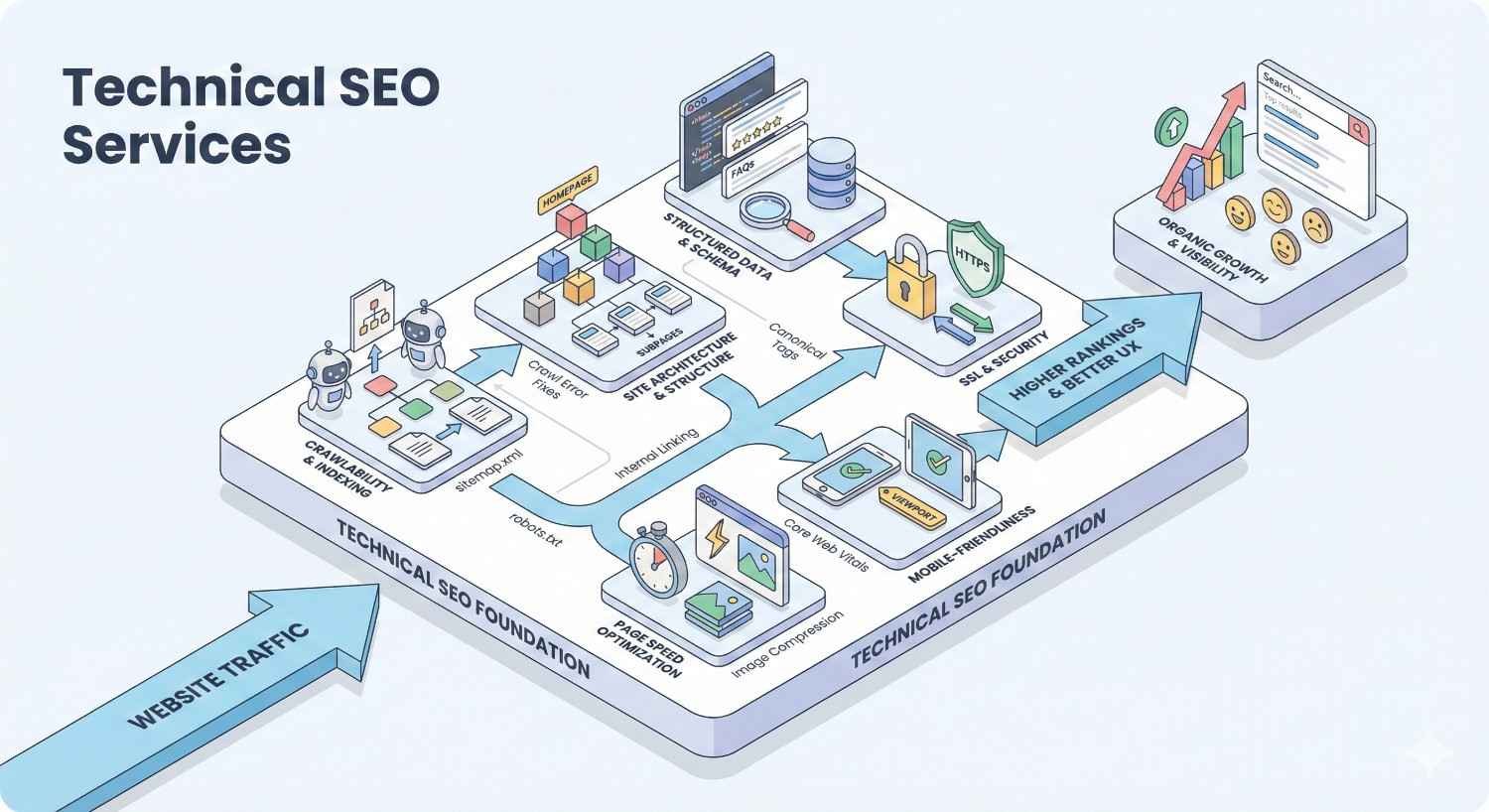
Technical SEO services focus on optimizing the infrastructure of your website so search engines can crawl, index, and rank your pages effectively. Unlike content-focused strategies, technical SEO addresses the backend elements that determine whether your site even appears in search results.
Think of it as the foundation of a house. You can have beautiful furniture and perfect interior design, but if the foundation is cracked, everything else suffers. Technical SEO ensures your website’s foundation is solid before you invest heavily in content or link building.
Core Components of Technical SEO
Technical SEO encompasses several interconnected elements that work together to improve search visibility.
Crawlability and indexation ensure search engine bots can access and understand your pages. This includes managing robots.txt files, XML sitemaps, and internal linking structures that guide crawlers through your site efficiently.
Site speed and performance directly impact both rankings and user experience. Google’s Core Web Vitals measure loading performance, interactivity, and visual stability. Sites that fail these metrics often see ranking drops, particularly on mobile.
Mobile optimization has become non-negotiable since Google’s mobile-first indexing. Your site must render properly and perform well on smartphones and tablets.
Security protocols like HTTPS encryption protect user data and serve as a ranking signal. Sites without SSL certificates face browser warnings that drive visitors away.
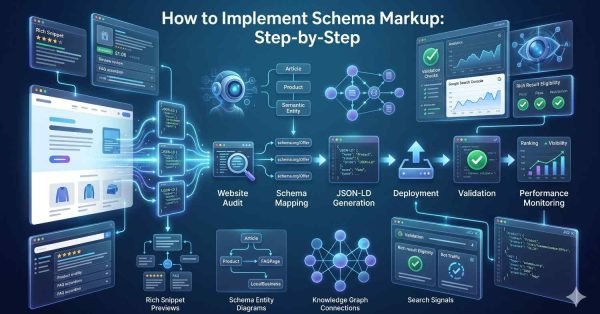
Structured data and schema markup help search engines understand your content contextually, enabling rich snippets and enhanced SERP features.
How Technical SEO Differs From On-Page and Off-Page SEO
On-page SEO focuses on content optimization. This includes keyword placement, meta tags, header structures, and content quality. You’re optimizing what users see and read.
Off-page SEO builds authority through external signals. Link building, brand mentions, and social signals fall into this category. You’re influencing how others perceive and reference your site.
Technical SEO operates beneath both layers. It ensures the infrastructure supports your on-page content and allows search engines to discover the authority you’re building off-page. Without solid technical foundations, your content and links can’t perform to their potential.
A site with excellent content but severe crawl errors won’t rank. A site with strong backlinks but slow load times will lose positions to faster competitors. Technical SEO removes these barriers.
Why Technical SEO Is Essential for Search Visibility
Search engines can’t rank what they can’t find. Technical issues create invisible barriers between your content and search results.
Crawl budget waste occurs when bots spend time on duplicate pages, redirect chains, or blocked resources instead of your valuable content. Large sites particularly suffer from this inefficiency.
Indexation problems mean pages never enter Google’s index at all. You could have the best content in your industry, but if it’s not indexed, it doesn’t exist to searchers.
User experience signals increasingly influence rankings. Slow sites, poor mobile experiences, and security warnings all correlate with lower positions and higher bounce rates.
According to Google’s own documentation, technical health directly impacts how well your site performs in search. Fixing technical issues often produces faster ranking improvements than content changes because you’re removing obstacles rather than competing for attention.
Technical SEO Services Pricing Models
Providers structure their pricing in several ways. Understanding each model helps you choose the arrangement that fits your budget, timeline, and ongoing needs.
Hourly Rate Pricing
Hourly billing works well for specific, time-limited tasks. You pay only for actual work performed, making it suitable for small fixes or consultations.
Typical hourly rates range from $75 to $300 depending on provider expertise and location. Freelancers often charge $75 to $150 per hour, while senior consultants at established agencies may bill $200 to $300 or more.
This model suits businesses that need occasional technical help rather than ongoing support. A quick audit review, specific bug fixes, or consultation calls fit hourly arrangements well.
The downside is unpredictability. Complex issues can balloon hours quickly, and you may face surprise invoices if scope creeps. Always request time estimates before work begins.
Monthly Retainer Pricing
Retainers provide consistent, ongoing technical SEO support for a fixed monthly fee. This model dominates the industry for businesses serious about maintaining technical health.
Monthly retainers typically range from $1,000 to $10,000 for most businesses. Enterprise clients may pay $15,000 to $30,000 or more for dedicated teams and priority support.
Retainers include a set number of hours or defined scope of services each month. You get predictable budgeting, ongoing monitoring, and a provider who understands your site deeply over time.
This model works best when technical SEO requires continuous attention. Sites with frequent content updates, complex architectures, or competitive industries benefit from always-on support.
Project-Based Pricing
Project pricing assigns a fixed cost to a defined scope of work. You know exactly what you’ll pay before work begins, eliminating budget surprises.
Project costs vary dramatically based on scope. A basic technical audit might cost $500 to $2,500. A complete site migration with technical optimization could run $10,000 to $50,000 or more.
This model suits one-time initiatives with clear deliverables. Site launches, platform migrations, major redesigns, and comprehensive audits fit project-based arrangements well.
The challenge lies in scope definition. Vague project boundaries lead to disputes about what’s included. Ensure detailed statements of work before signing any project agreement.
Performance-Based Pricing
Performance pricing ties fees to results. You pay based on ranking improvements, traffic gains, or other measurable outcomes.
This model sounds attractive but carries significant risks. Technical SEO improvements often take months to materialize. Providers may cut corners or focus on easy wins rather than foundational fixes.
Most reputable agencies avoid pure performance pricing for technical SEO because results depend on many factors beyond their control. Algorithm updates, competitor actions, and client-side implementation delays all affect outcomes.
Hybrid models sometimes work better. A base retainer plus performance bonuses aligns incentives without creating perverse motivations.
Enterprise vs. SMB Pricing Structures
Enterprise pricing reflects the complexity and scale of large organizations. Sites with millions of pages, multiple domains, international presence, and complex tech stacks require specialized expertise.
Enterprise technical SEO typically starts at $10,000 monthly and can exceed $50,000 for comprehensive programs. These engagements often include dedicated account teams, custom tooling, and executive-level reporting.
SMB pricing accommodates smaller budgets and simpler needs. A local business with a 50-page WordPress site has different requirements than a multinational e-commerce platform.
SMB technical SEO ranges from $500 to $5,000 monthly depending on site complexity and service depth. Many agencies offer tiered packages specifically designed for smaller businesses.
How Much Do Technical SEO Services Cost?
Concrete numbers help you benchmark proposals and set realistic budgets. These ranges reflect current market rates across different provider types and regions.
Average Technical SEO Pricing Ranges (2024-2025)
Current market data shows consistent pricing patterns across the industry.
One-time technical audits: $500 to $10,000
- Basic audits covering core issues: $500 to $2,500
- Comprehensive audits with prioritized recommendations: $2,500 to $5,000
- Enterprise audits with custom analysis: $5,000 to $10,000+
Monthly retainers: $1,000 to $30,000
- Small business ongoing support: $1,000 to $3,000
- Mid-market comprehensive programs: $3,000 to $10,000
- Enterprise dedicated teams: $10,000 to $30,000+
Project-based work: $2,500 to $75,000+
- Site speed optimization projects: $2,500 to $10,000
- Platform migrations: $5,000 to $30,000
- Complete technical overhauls: $15,000 to $75,000+
These ranges represent typical market rates. Outliers exist in both directions. Extremely cheap services often deliver poor quality, while premium pricing doesn’t always guarantee superior results.
Freelancer vs. Agency Pricing Comparison
Freelancers and agencies serve different needs at different price points.
Freelancer advantages:
- Lower overhead means lower rates (typically 30-50% less than agencies)
- Direct communication with the person doing the work
- Flexibility in scope and scheduling
- Specialized expertise in specific technical areas
Freelancer limitations:
- Limited bandwidth for large projects
- No backup if they’re unavailable
- May lack enterprise-level experience
- Fewer resources and tools
Agency advantages:
- Team depth for complex projects
- Established processes and quality control
- Broader expertise across technical specialties
- Continuity if individual team members leave
Agency limitations:
- Higher rates to cover overhead
- Communication may go through account managers
- Less flexibility in custom arrangements
- May assign junior staff to smaller accounts
Typical pricing comparison:
| Service | Freelancer | Agency |
| Hourly rate | $75-$150 | $150-$300 |
| Basic audit | $500-$1,500 | $1,500-$3,500 |
| Monthly retainer | $1,000-$3,000 | $2,500-$7,500 |
| Site migration | $3,000-$10,000 | $8,000-$25,000 |
Choose based on your project complexity, budget constraints, and need for ongoing support rather than assuming one option is universally better.
Regional Pricing Variations (US, UK, EU, APAC)
Geographic location significantly impacts technical SEO pricing due to cost-of-living differences and market maturity.
United States: Highest rates globally, particularly from agencies in major metros. Expect $150 to $300+ hourly for quality providers. Monthly retainers commonly start at $2,500.
United Kingdom: Rates comparable to US in London, lower elsewhere. Hourly rates typically £100 to £200. Monthly retainers from £1,500 to £10,000.
European Union: Wide variation by country. Western European rates approach UK levels. Eastern European providers offer quality work at 40-60% lower rates.
Asia-Pacific: Significant range from premium Australian agencies to budget providers in Southeast Asia. Quality varies dramatically at lower price points.
Offshore considerations: Lower rates don’t always mean lower quality, but communication challenges, time zone differences, and varying technical standards require careful vetting. Many businesses find hybrid approaches work well, using local strategists with offshore implementation support.
Cost Breakdown by Service Type
Different technical SEO services carry different price tags based on complexity and time requirements.
Technical SEO audits: $500 to $10,000 Audits vary based on depth, site size, and deliverable detail. Basic automated reports cost less than manual expert analysis with prioritized action plans.
Core Web Vitals optimization: $1,500 to $15,000 Performance work requires developer resources and often involves code changes. Costs scale with site complexity and current performance gaps.
Site architecture restructuring: $3,000 to $25,000 Reorganizing URL structures, internal linking, and navigation requires careful planning and implementation to avoid traffic losses.
Schema markup implementation: $500 to $5,000 Structured data work ranges from basic organization schema to complex product, FAQ, and how-to markup across large sites.
Site migration support: $5,000 to $50,000+ Migrations carry high risk and require extensive planning, redirect mapping, and post-launch monitoring. Costs reflect the stakes involved.
International SEO setup: $2,500 to $20,000 Hreflang implementation, country-specific optimization, and multi-language technical structures require specialized expertise.
Ongoing monitoring and maintenance: $500 to $5,000 monthly Continuous crawl monitoring, error detection, and proactive fixes prevent small issues from becoming major problems.
Factors That Affect Technical SEO Pricing
Understanding what drives costs helps you evaluate proposals and negotiate effectively. These factors explain why two seemingly similar projects might have vastly different price tags.
Website Size and Complexity
Page count directly impacts audit time, implementation effort, and ongoing monitoring requirements.
A 50-page brochure site takes hours to audit thoroughly. A 500,000-page e-commerce catalog takes weeks. Pricing scales accordingly.
Complexity factors beyond page count:
- Number of unique templates and page types
- Dynamic content and JavaScript rendering
- Multiple domains or subdomains
- Legacy systems and technical debt
- Custom CMS or platform modifications
Sites built on standard platforms with clean architectures cost less to optimize than custom-built systems with years of accumulated technical issues.
Current Technical Health and Audit Scope
Starting condition affects how much work is needed. A well-maintained site might need minor tweaks. A neglected site might require complete technical overhaul.
Audit scope considerations:
- Surface-level automated scans vs. deep manual analysis
- Number of issues to investigate and prioritize
- Competitive analysis inclusion
- Historical performance review
- Integration with other SEO audits
Providers who offer suspiciously cheap audits often deliver automated reports with minimal analysis. Comprehensive audits require expert time to interpret data and create actionable recommendations.
Industry and Competition Level
Competitive industries demand more sophisticated technical SEO to gain any advantage.
Finance, legal, health, and e-commerce sectors face intense competition. Technical excellence becomes table stakes rather than a differentiator. Providers working in these spaces often charge premium rates reflecting the expertise required.
Less competitive local markets or niche B2B industries may achieve results with more modest technical investments.
Platform and CMS Requirements
Your technology stack influences implementation complexity and provider expertise requirements.
Common platforms and their implications:
WordPress: Most providers have deep experience. Extensive plugin ecosystem simplifies many fixes. Generally lower implementation costs.
Shopify: Platform limitations restrict some technical changes. Requires providers who understand Shopify-specific constraints and workarounds.
Custom platforms: Require developers familiar with your specific stack. Limited provider options may increase costs.
Enterprise CMS (Adobe, Sitecore, etc.): Specialized expertise commands premium rates. Implementation often requires coordination with internal IT teams.
Headless/JavaScript frameworks: Technical SEO for React, Vue, or Angular sites requires specialized knowledge. Rendering and indexation challenges add complexity.
Agency Experience and Reputation
Established agencies with proven track records charge more than newcomers building their portfolios.
Premium pricing indicators:
- Published case studies with measurable results
- Industry recognition and awards
- Thought leadership and conference speaking
- Enterprise client logos
- Specialized certifications
You’re paying for reduced risk when you hire experienced providers. They’ve seen your problems before and know how to solve them efficiently.
Newer providers may deliver excellent work at lower rates as they build reputation. The tradeoff is less predictability and potentially longer learning curves.
Ongoing Maintenance vs. One-Time Projects
Continuous engagement typically costs less per hour than one-time projects because providers can plan resources and build efficiency over time.
One-time project considerations:
- Higher per-hour rates to cover business development costs
- More extensive scoping and documentation requirements
- Knowledge transfer needs at project end
- No ongoing relationship benefits
Ongoing retainer benefits:
- Lower effective hourly rates
- Provider learns your site deeply over time
- Proactive issue detection before problems escalate
- Priority support and faster response times
- Continuous improvement rather than periodic fixes
Many businesses start with a one-time audit, then transition to ongoing support once they understand their technical SEO needs.
What’s Included in Technical SEO Services?
Knowing what services should include helps you evaluate proposals and ensure you’re getting comprehensive coverage. Quality providers address all these areas systematically.
Technical SEO Audit and Site Crawl Analysis
Every technical SEO engagement should begin with thorough assessment. Audits identify issues, prioritize fixes, and establish baselines for measuring progress.
Comprehensive audits include:
- Full site crawl using professional tools (Screaming Frog, Sitebulb, DeepCrawl)
- Crawl error identification and categorization
- Duplicate content detection
- Redirect chain and loop analysis
- HTTP status code review
- Log file analysis for crawl behavior insights
- Comparison against Google Search Console data
Deliverables should include:
- Prioritized issue list with severity ratings
- Specific fix recommendations for each issue
- Estimated impact of addressing each problem
- Implementation guidance or developer-ready specifications
Beware audits that simply export tool reports without analysis. The value lies in expert interpretation and actionable recommendations, not raw data.
Site Architecture and URL Structure Optimization
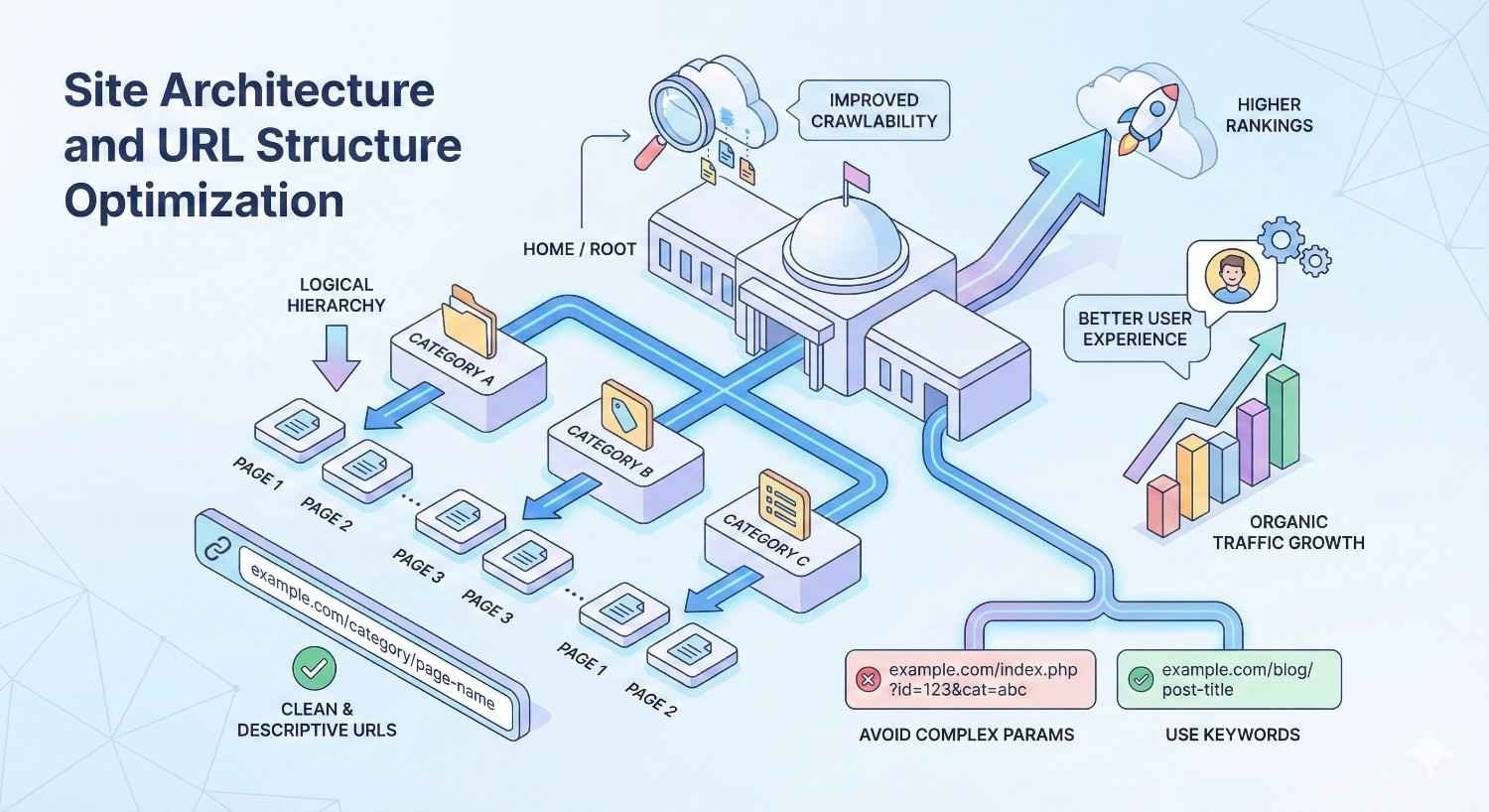
How your site is organized affects both crawlability and user experience. Architecture work ensures logical structure that search engines can navigate efficiently.
Architecture services include:
- URL structure analysis and recommendations
- Internal linking audit and optimization
- Navigation and menu structure review
- Breadcrumb implementation
- Pagination handling (rel=prev/next, infinite scroll)
- Faceted navigation management for e-commerce
- Orphan page identification
- Click depth optimization
Well-structured sites distribute link equity effectively and help search engines understand content relationships. Poor architecture wastes crawl budget and buries important pages.
Page Speed and Core Web Vitals Optimization
Performance optimization has become critical since Google incorporated Core Web Vitals into ranking signals. Speed work requires both technical SEO knowledge and development skills.
Core Web Vitals metrics:
- Largest Contentful Paint (LCP): Loading performance, target under 2.5 seconds
- Interaction to Next Paint (INP): Interactivity, target under 200 milliseconds
- Cumulative Layout Shift (CLS): Visual stability, target under 0.1
Speed optimization services:
- Image optimization and modern format implementation (WebP, AVIF)
- Code minification and compression
- Render-blocking resource elimination
- Browser caching configuration
- CDN implementation and optimization
- Third-party script management
- Server response time improvements
- Lazy loading implementation
Performance work often requires developer involvement beyond SEO expertise. Ensure your provider either includes development resources or coordinates effectively with your team.
Mobile-First and Responsive Design Fixes
Google predominantly uses mobile versions of sites for indexing and ranking. Mobile optimization is no longer optional.
Mobile optimization includes:
- Mobile rendering verification
- Viewport configuration
- Touch element spacing
- Font size and readability
- Mobile page speed optimization
- Mobile-specific crawl error resolution
- Responsive design validation across devices
Sites that perform well on desktop but poorly on mobile will see ranking impacts. Technical SEO must address mobile experience as the primary concern.
Indexation and Crawlability Improvements
Getting pages properly indexed is fundamental to search visibility. Indexation work removes barriers between your content and search results.
Indexation services include:
- Index coverage analysis via Google Search Console
- Noindex tag audit and correction
- Canonical tag implementation and validation
- Parameter handling configuration
- Crawl budget optimization
- JavaScript rendering verification
- Index bloat reduction
- Strategic noindex application for low-value pages
Many sites have indexation problems they don’t know about. Pages may be accidentally blocked, canonicalized incorrectly, or simply never discovered by crawlers.
Schema Markup and Structured Data Implementation
Structured data helps search engines understand your content and enables rich results in SERPs. Proper implementation can significantly improve click-through rates.
Schema services include:
- Schema type selection based on content
- JSON-LD implementation (preferred format)
- Organization and local business markup
- Product and offer schema for e-commerce
- FAQ and how-to schema
- Article and author markup
- Event and course schema
- Review and rating markup
- Validation and testing
- Rich result monitoring
Schema implementation requires understanding both technical requirements and strategic opportunities. Not all schema types benefit all sites equally.
XML Sitemap and Robots.txt Configuration
These foundational files guide search engine crawlers. Misconfiguration can cause serious indexation problems.
Sitemap services:
- XML sitemap generation and optimization
- Sitemap index creation for large sites
- Image and video sitemap implementation
- News sitemap setup (for publishers)
- Sitemap submission and monitoring
- Dynamic sitemap configuration
Robots.txt services:
- Crawl directive optimization
- Sensitive area protection
- Crawl budget management
- Sitemap reference inclusion
- Testing and validation
Simple files with significant impact. Errors in robots.txt can accidentally block entire site sections from indexing.
HTTPS Security and Site Migration Support
Security and migration work carries high stakes. Mistakes can cause significant traffic losses that take months to recover.
Security services:
- SSL certificate implementation
- HTTP to HTTPS migration
- Mixed content resolution
- Security header configuration
- HSTS implementation
Migration support:
- Pre-migration planning and risk assessment
- URL mapping and redirect strategy
- 301 redirect implementation
- Post-migration monitoring
- Traffic and ranking recovery tracking
- Issue identification and resolution
Migrations require meticulous planning. Experienced providers have checklists and processes developed through handling many migrations successfully.
International SEO and Hreflang Setup
Multi-language and multi-region sites face unique technical challenges. Hreflang implementation tells search engines which version to show different users.
International SEO services:
- Hreflang tag implementation and validation
- Country and language targeting configuration
- International URL structure recommendations
- Geotargeting setup in Search Console
- Content duplication management across regions
- International site architecture planning
Hreflang errors are common and can cause wrong-language pages to rank in different markets. Proper implementation requires attention to detail and ongoing monitoring.
Technical SEO Pricing by Service Package
Most providers offer tiered packages to serve different needs and budgets. Understanding what each tier typically includes helps you choose appropriately.
Basic Technical SEO Audit Packages ($500–$2,500)
Entry-level packages suit small sites needing initial assessment or businesses exploring technical SEO for the first time.
Typical inclusions:
- Automated crawl analysis
- Core technical issue identification
- Basic prioritized recommendations
- Summary report with key findings
- Limited manual analysis
Typical exclusions:
- Deep competitive analysis
- Custom tool configurations
- Implementation support
- Ongoing monitoring
- Developer specifications
Best for:
- Small business websites under 100 pages
- Initial technical health assessment
- Budget-conscious businesses
- Sites with minimal technical complexity
At this price point, expect identification of major issues but limited strategic guidance. You’ll know what’s wrong but may need additional help fixing it.
Comprehensive Technical SEO Packages ($2,500–$10,000)
Mid-tier packages provide thorough analysis and actionable recommendations for most business websites.
Typical inclusions:
- Manual expert analysis combined with tool data
- Complete crawl and indexation review
- Core Web Vitals assessment
- Mobile optimization analysis
- Schema markup recommendations
- Detailed prioritized action plan
- Developer-ready fix specifications
- Competitive technical benchmarking
- Follow-up consultation
Typical exclusions:
- Hands-on implementation
- Ongoing monitoring
- Multiple rounds of revision
- Enterprise-scale analysis
Best for:
- Mid-sized business websites (100-10,000 pages)
- E-commerce sites needing comprehensive review
- Sites preparing for redesign or migration
- Businesses ready to invest in technical excellence
This tier delivers substantial value for most businesses. You receive expert analysis and clear direction for implementation.
Enterprise Technical SEO Solutions ($10,000–$50,000+)
Enterprise packages address the complexity and scale of large organizations with sophisticated technical requirements.
Typical inclusions:
- Dedicated technical SEO team
- Custom crawl infrastructure for large sites
- Log file analysis and crawl behavior insights
- JavaScript rendering analysis
- International SEO assessment
- Platform-specific optimization
- Executive reporting and stakeholder presentations
- Implementation oversight and QA
- Ongoing strategic consultation
- Priority support and response times
Additional enterprise considerations:
- Integration with internal teams and processes
- Custom tool development or configuration
- Multi-property and multi-domain analysis
- Compliance and security requirements
- Change management support
Best for:
- Sites with 100,000+ pages
- Multi-national organizations
- Complex technical architectures
- High-stakes competitive environments
- Organizations requiring dedicated resources
Enterprise engagements often involve discovery phases to scope requirements accurately before final pricing.
Custom Technical SEO Retainers
Ongoing retainers provide continuous technical SEO support tailored to your specific needs and budget.
Retainer structures vary:
- Hours-based: Set number of hours monthly, flexible allocation
- Scope-based: Defined services performed each month
- Hybrid: Core services plus flexible hours for emerging needs
Common retainer inclusions:
- Monthly crawl monitoring and error detection
- Core Web Vitals tracking and optimization
- Indexation monitoring and issue resolution
- Schema maintenance and updates
- Technical implementation support
- Regular reporting and recommendations
- Priority response for urgent issues
Retainer pricing factors:
- Site size and complexity
- Frequency of content changes
- Level of support required
- Response time expectations
- Reporting depth and frequency
Custom retainers work best when you have ongoing technical needs but want flexibility in how support hours are used each month.
How to Evaluate Technical SEO Service Providers
Choosing the right provider matters as much as choosing the right service level. These evaluation criteria help you identify quality providers and avoid costly mistakes.
Questions to Ask Before Hiring
Smart questions reveal provider expertise and fit for your needs.
Experience questions:
- How many technical SEO projects have you completed similar to mine?
- Can you share case studies or references from comparable clients?
- What’s your experience with my specific platform/CMS?
- Who will actually do the work on my account?
Process questions:
- What does your audit process include?
- How do you prioritize recommendations?
- What tools do you use and why?
- How do you handle implementation—do you do it or guide our team?
Communication questions:
- How often will we communicate and through what channels?
- What reporting will I receive and how frequently?
- Who is my primary point of contact?
- What’s your response time for urgent issues?
Results questions:
- How do you measure success for technical SEO?
- What results have similar clients achieved?
- What timeline should I expect for seeing improvements?
- How do you handle situations where results don’t meet expectations?
Quality providers answer these questions confidently with specific examples. Vague responses or reluctance to share details should raise concerns.
Red Flags in Technical SEO Pricing Proposals
Certain warning signs indicate providers to avoid.
Pricing red flags:
- Prices significantly below market rates without clear explanation
- Vague scope descriptions that could mean anything
- No breakdown of what’s included vs. excluded
- Pressure to sign quickly without time to evaluate
- Unwillingness to customize based on your needs
Expertise red flags:
- Can’t explain their process in understandable terms
- Guarantee specific rankings or traffic numbers
- Focus only on tools without mentioning strategy
- No questions about your business goals
- Unfamiliar with your platform or industry
Process red flags:
- No discovery phase before proposing solutions
- One-size-fits-all packages with no customization
- Unwillingness to provide references
- No clear deliverables or timelines
- Vague about who does the actual work
Trust your instincts. If something feels off during the sales process, the working relationship likely won’t improve.
What Deliverables to Expect
Clear deliverables ensure you receive value for your investment.
Audit deliverables should include:
- Comprehensive issue inventory with severity ratings
- Prioritized action plan with estimated impact
- Specific fix recommendations (not just “fix this”)
- Developer-ready specifications where applicable
- Baseline metrics for measuring progress
- Executive summary for stakeholders
Ongoing engagement deliverables:
- Regular reporting on technical health metrics
- Issue detection and resolution documentation
- Implementation verification and QA
- Progress tracking against initial findings
- Recommendations for continuous improvement
Project deliverables:
- Detailed project plan with milestones
- Regular status updates during execution
- Documentation of all changes made
- Testing and validation results
- Post-project monitoring and adjustment
Get deliverables specified in writing before engagement begins. Ambiguity leads to disappointment.
How to Measure Technical SEO ROI
Measuring return on technical SEO investment requires tracking the right metrics over appropriate timeframes.
Direct technical metrics:
- Crawl errors reduced
- Pages indexed vs. submitted
- Core Web Vitals scores
- Mobile usability issues resolved
- Schema validation errors fixed
Search performance metrics:
- Organic traffic changes
- Ranking improvements for target keywords
- Click-through rate changes
- Impressions growth
- New keyword rankings acquired
Business impact metrics:
- Organic conversions and revenue
- Lead quality from organic traffic
- Cost per acquisition from organic vs. paid
- Market share of organic visibility
Timeline expectations: Technical fixes often show impact within weeks for crawl and indexation issues. Ranking and traffic improvements typically take 2-6 months to materialize fully. Major initiatives like migrations may take 6-12 months to fully stabilize.
Track metrics before, during, and after technical SEO work to demonstrate value clearly.
Technical SEO Pricing vs. Full-Service SEO Costs
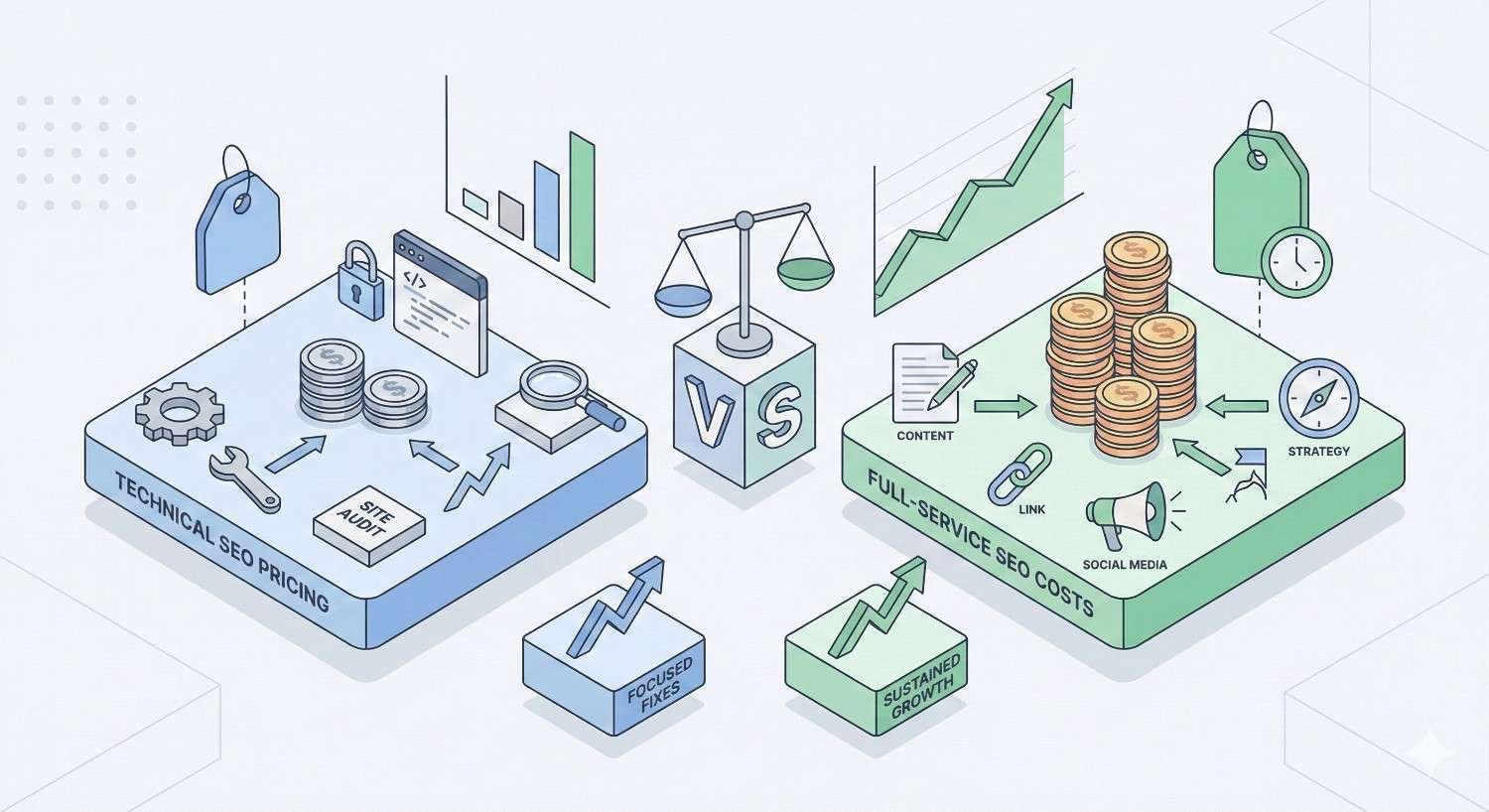
Technical SEO rarely exists in isolation. Understanding how it fits within broader SEO investment helps you allocate budget effectively.
Technical SEO as Part of a Broader SEO Strategy
Technical SEO creates the foundation that content and link building efforts build upon. Without solid technical health, other SEO investments underperform.
The SEO hierarchy:
- Technical foundation: Ensure search engines can crawl, index, and understand your site
- Content optimization: Create and optimize content that targets valuable keywords
- Authority building: Earn links and mentions that demonstrate expertise and trust
Investing heavily in content while ignoring technical issues wastes resources. Your content can’t rank if it’s not indexed properly or loads too slowly.
Most comprehensive SEO strategies allocate 20-30% of budget to technical SEO, with the remainder split between content and link building based on specific needs.
Bundled SEO Services Pricing Comparison
Full-service SEO packages typically cost more than technical-only services but provide comprehensive coverage.
Typical full-service SEO pricing:
- Small business: $1,500 to $5,000 monthly
- Mid-market: $5,000 to $15,000 monthly
- Enterprise: $15,000 to $50,000+ monthly
What full-service typically includes:
- Technical SEO monitoring and fixes
- Content strategy and creation
- On-page optimization
- Link building and outreach
- Reporting and analytics
- Strategic consultation
Cost comparison example:
| Service Type | Monthly Cost | Includes |
| Technical SEO only | $2,000 | Technical audit, monitoring, fixes |
| Content SEO only | $3,000 | Content strategy, creation, optimization |
| Link building only | $2,500 | Outreach, link acquisition |
| Full-service bundle | $6,000 | All above, integrated strategy |
Bundled services often provide better value than purchasing components separately, plus ensure strategic alignment across all activities.
When to Invest in Technical SEO Alone
Standalone technical SEO investment makes sense in specific situations.
Technical-only is appropriate when:
- You have internal content and link building capabilities
- Your site has significant technical debt requiring focused attention
- You’re preparing for a migration or major platform change
- Technical issues are clearly blocking otherwise strong content
- Budget constraints require prioritizing the highest-impact work first
Technical-only may be insufficient when:
- Your content is thin or poorly optimized
- You have minimal backlink profile
- Competitors outpace you in content and authority
- You need comprehensive SEO strategy guidance
- Your team lacks SEO expertise beyond technical implementation
Assess your current situation honestly. Technical SEO alone won’t overcome fundamental content or authority gaps, but it can unlock potential that’s currently blocked by infrastructure issues.
How to Budget for Technical SEO Services
Realistic budgeting ensures you can sustain SEO investment long enough to see results. These guidelines help you plan effectively.
Setting Realistic Expectations for SMBs and Startups
Smaller businesses must balance ambition with resource constraints.
Minimum viable technical SEO investment:
- One-time audit: $1,000 to $3,000
- Basic monthly monitoring: $500 to $1,000
- Annual technical maintenance: $6,000 to $15,000
Recommended SMB approach:
- Start with comprehensive audit to understand current state
- Prioritize fixes based on impact and implementation difficulty
- Address critical issues first, even if budget limits scope
- Establish ongoing monitoring to catch new issues early
- Plan for periodic deep reviews (quarterly or semi-annually)
Budget allocation for limited resources: If total SEO budget is $2,000 monthly:
- Technical SEO: $400-600 (20-30%)
- Content: $800-1,000 (40-50%)
- Link building: $400-600 (20-30%)
Startups should prioritize technical foundations before scaling content production. Building on a weak foundation wastes future investment.
Allocating SEO Budget Across Technical, Content, and Links
Optimal allocation depends on your current situation and competitive landscape.
Technical-heavy allocation (40% technical, 30% content, 30% links): Appropriate when:
- Site has significant technical debt
- Recent platform migration or redesign
- Crawl and indexation issues blocking performance
- Core Web Vitals failing thresholds
Content-heavy allocation (20% technical, 50% content, 30% links): Appropriate when:
- Technical foundation is solid
- Content gaps exist vs. competitors
- Targeting new keywords or topics
- Building topical authority
Link-heavy allocation (20% technical, 30% content, 50% links): Appropriate when:
- Technical and content are strong
- Authority gap vs. competitors
- Competing in high-authority niches
- Content exists but lacks visibility
Reassess allocation quarterly based on progress and changing needs. Rigid budgets miss opportunities to capitalize on what’s working.
Long-Term Investment vs. Quick Fixes
Technical SEO delivers best results through sustained investment rather than one-time projects.
Quick fix limitations:
- Addresses symptoms, not root causes
- Issues often recur without ongoing attention
- Misses opportunities for continuous improvement
- No proactive detection of new problems
Long-term investment benefits:
- Builds compounding technical health over time
- Catches issues before they impact rankings
- Develops deep provider understanding of your site
- Enables strategic rather than reactive work
Recommended approach: Start with a comprehensive audit and initial fix project, then transition to ongoing retainer for maintenance and continuous improvement. This combination addresses immediate issues while preventing future problems.
Budget for at least 12 months of technical SEO investment to see meaningful results. Shorter engagements rarely provide enough time for fixes to impact rankings and for ongoing optimization to compound.
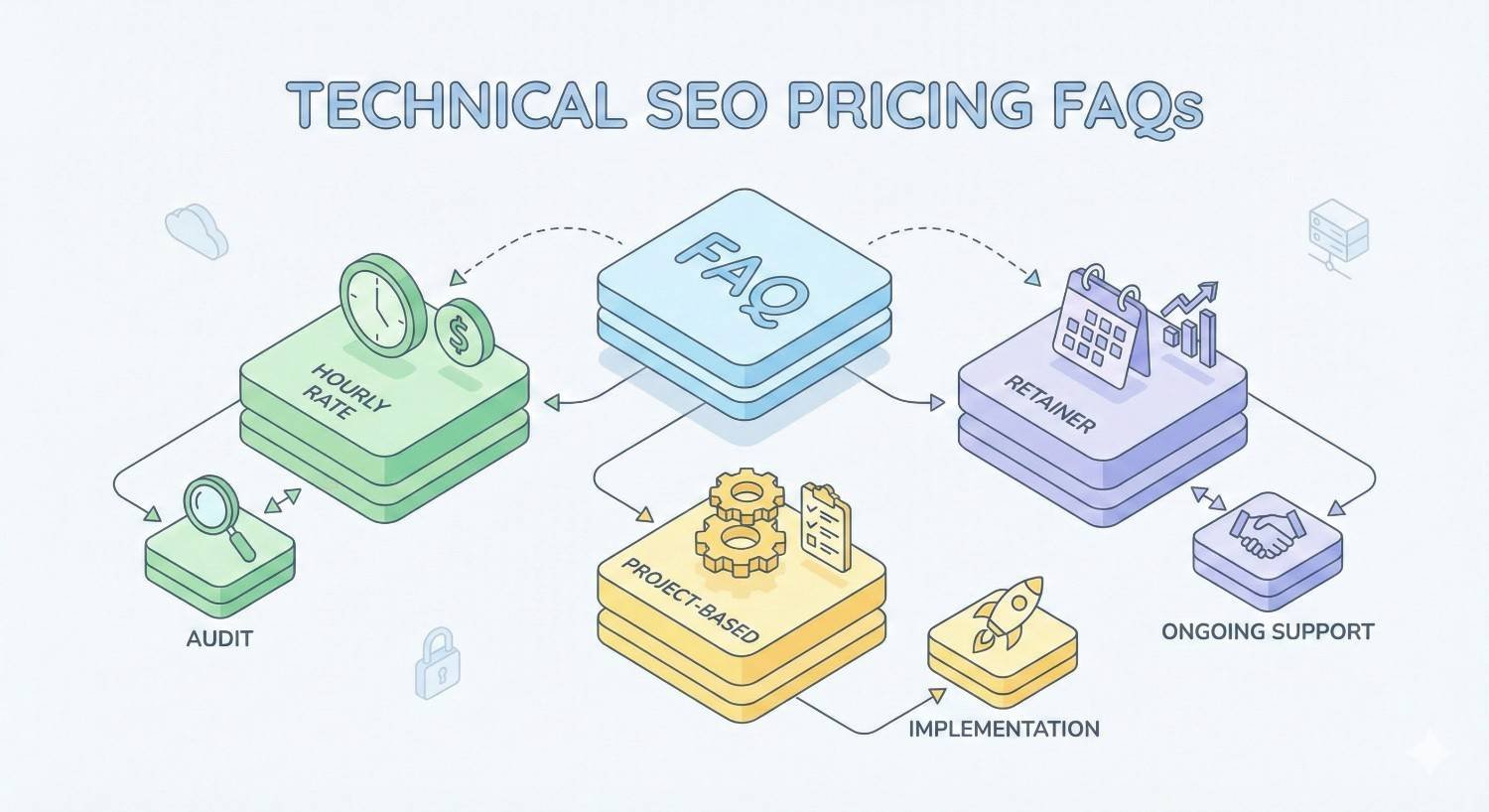
Technical SEO Pricing FAQs
How much should I pay for a technical SEO audit?
Quality technical SEO audits range from $500 for basic automated analysis to $10,000+ for comprehensive enterprise assessments. Most small-to-medium businesses should expect to pay $1,500 to $5,000 for thorough manual analysis with prioritized recommendations. The right investment depends on your site size, complexity, and how actionable you need the deliverables to be.
Are cheap technical SEO services worth it?
Extremely cheap technical SEO services rarely deliver value. Providers charging significantly below market rates typically use automated tools without expert analysis, miss critical issues, or lack the expertise to provide actionable recommendations. You often end up paying twice—once for cheap work and again to fix what was missed. Invest in quality from the start.
What is the average monthly cost for technical SEO?
Average monthly technical SEO retainers range from $1,000 to $5,000 for most businesses. Small sites with basic needs might pay $500 to $1,500 monthly, while complex sites or competitive industries often require $5,000 to $15,000 or more. Enterprise organizations typically invest $10,000 to $30,000+ monthly for dedicated technical SEO teams.
Do I need ongoing technical SEO or a one-time fix?
Most websites benefit from ongoing technical SEO rather than one-time fixes. Sites constantly change through content updates, platform modifications, and third-party integrations. New technical issues emerge regularly. Ongoing monitoring catches problems before they impact rankings. One-time audits work for initial assessment, but sustained investment prevents regression and enables continuous improvement.
How do I know if technical SEO pricing is fair?
Fair technical SEO pricing reflects the provider’s expertise, your site’s complexity, and the scope of services included. Compare multiple proposals for similar scope. Ensure deliverables are clearly defined. Check that pricing aligns with market ranges for your region and site size. Be wary of prices significantly above or below market rates without clear justification.
How long does technical SEO take to show results?
Technical SEO improvements typically show initial impact within 2-8 weeks for crawl and indexation fixes. Ranking and traffic improvements usually take 3-6 months to materialize fully. Major initiatives like site migrations may require 6-12 months to stabilize completely. Factors affecting timeline include issue severity, implementation speed, and competitive landscape.
Should I hire an agency or freelancer for technical SEO?
Choose based on your project complexity and ongoing needs. Freelancers offer lower rates and direct communication, ideal for smaller sites or specific projects. Agencies provide team depth, established processes, and continuity, better suited for complex sites or comprehensive programs. Many businesses start with freelancers for initial work, then transition to agencies as needs grow.
Get a Custom Technical SEO Pricing Quote
Understanding pricing ranges helps you budget, but every website has unique needs. Custom quotes ensure you get exactly the services your site requires at appropriate investment levels.
Our Technical SEO Service Packages
White Label SEO Service offers flexible technical SEO packages designed for businesses at every stage.
Starter Package: Comprehensive technical audit with prioritized recommendations for small business websites. Ideal for initial assessment and understanding your technical SEO landscape.
Growth Package: Audit plus implementation support and quarterly monitoring for growing businesses. Includes hands-on fixes and ongoing technical health tracking.
Scale Package: Full-service technical SEO retainer with dedicated support, continuous monitoring, and proactive optimization. Designed for established businesses serious about technical excellence.
Enterprise Solutions: Custom programs for large-scale websites with complex requirements. Dedicated teams, custom tooling, and strategic partnership approach.
What’s Included in Our Pricing
Every engagement includes transparent scope and clear deliverables.
All packages include:
- Detailed technical audit using industry-leading tools
- Expert analysis and prioritized recommendations
- Clear documentation and reporting
- Direct access to technical SEO specialists
- Implementation guidance and support
No hidden fees or surprise charges. We scope projects thoroughly upfront and communicate clearly if additional work becomes necessary.
Request Your Free Technical SEO Assessment
We start every potential engagement with a complimentary technical SEO assessment. This initial review identifies your most critical technical issues and helps us recommend the right service level for your needs.
What you’ll receive:
- Overview of your site’s technical health
- Identification of critical issues requiring attention
- Recommended service approach and investment level
- No obligation to proceed
At White Label SEO Service, we believe in earning your business through demonstrated expertise. Our free assessment shows you exactly what we can do before you commit to any investment.
Ready to understand your technical SEO needs and get accurate pricing? Contact our team to schedule your complimentary assessment and receive a custom quote tailored to your specific situation.
Conclusion
Technical SEO pricing varies significantly based on service scope, provider expertise, and website complexity. Understanding these factors empowers you to budget appropriately and evaluate proposals effectively.
White Label SEO Service helps businesses worldwide build sustainable organic growth through expert technical SEO, content strategy, and authority building. Our transparent pricing and proven processes deliver measurable results.
We’re ready to assess your technical SEO needs and provide a custom quote that fits your budget and goals. Contact us today to start your free technical SEO assessment and take the first step toward stronger search visibility.
Frequently Asked Questions
What factors most significantly impact technical SEO pricing?
Website size, complexity, current technical health, and provider expertise have the greatest impact on pricing. A 50-page site costs far less to audit and optimize than a 500,000-page e-commerce platform. Sites with significant technical debt require more work than well-maintained properties.
Can I do technical SEO myself to save money?
Basic technical SEO tasks like submitting sitemaps or fixing obvious errors are manageable for technically inclined site owners. However, comprehensive technical SEO requires specialized tools, deep expertise, and significant time investment. Most businesses find professional services more cost-effective than learning and executing technical SEO internally.
What’s the difference between a technical SEO audit and ongoing technical SEO services?
Audits provide point-in-time assessment of your site’s technical health with recommendations for improvement. Ongoing services include continuous monitoring, proactive issue detection, regular fixes, and strategic optimization over time. Audits identify problems; ongoing services prevent and solve them continuously.
How do I compare technical SEO proposals from different providers?
Compare proposals based on scope clarity, deliverable specificity, provider expertise, and total value rather than price alone. Ensure each proposal covers the same services before comparing costs. Ask for clarification on anything vague. The cheapest option rarely provides the best value.
Is technical SEO a one-time expense or ongoing investment?
Technical SEO works best as an ongoing investment. Websites constantly change, new issues emerge, and search engine requirements evolve. One-time audits provide valuable snapshots, but sustained investment prevents regression and enables continuous improvement that compounds over time.
How quickly can technical SEO improvements impact my rankings?
Crawl and indexation fixes often show impact within weeks. Ranking improvements typically take 3-6 months to materialize fully as search engines recrawl, reindex, and reevaluate your site. Major technical overhauls may take 6-12 months to show complete results.
What should I prioritize if I have a limited technical SEO budget?
Prioritize issues blocking indexation first, as unindexed pages can’t rank regardless of other factors. Next, address Core Web Vitals failures affecting user experience and rankings. Then focus on crawl efficiency and structural improvements. Work with your provider to identify highest-impact fixes within your budget constraints.