
Content siloing organizes your website into tightly themed sections that signal topical expertise to search engines, directly improving rankings and crawl efficiency. This architectural approach transforms scattered content into a structured system where every page reinforces related pages.
Without proper siloing, websites leak link equity across unrelated topics, confusing both users and search algorithms. The result is diluted authority and missed ranking opportunities.
This guide covers silo types, implementation steps, best practices, common mistakes, and measurement strategies to help you build site architecture that drives sustainable organic growth.
What Is Content Siloing in SEO?
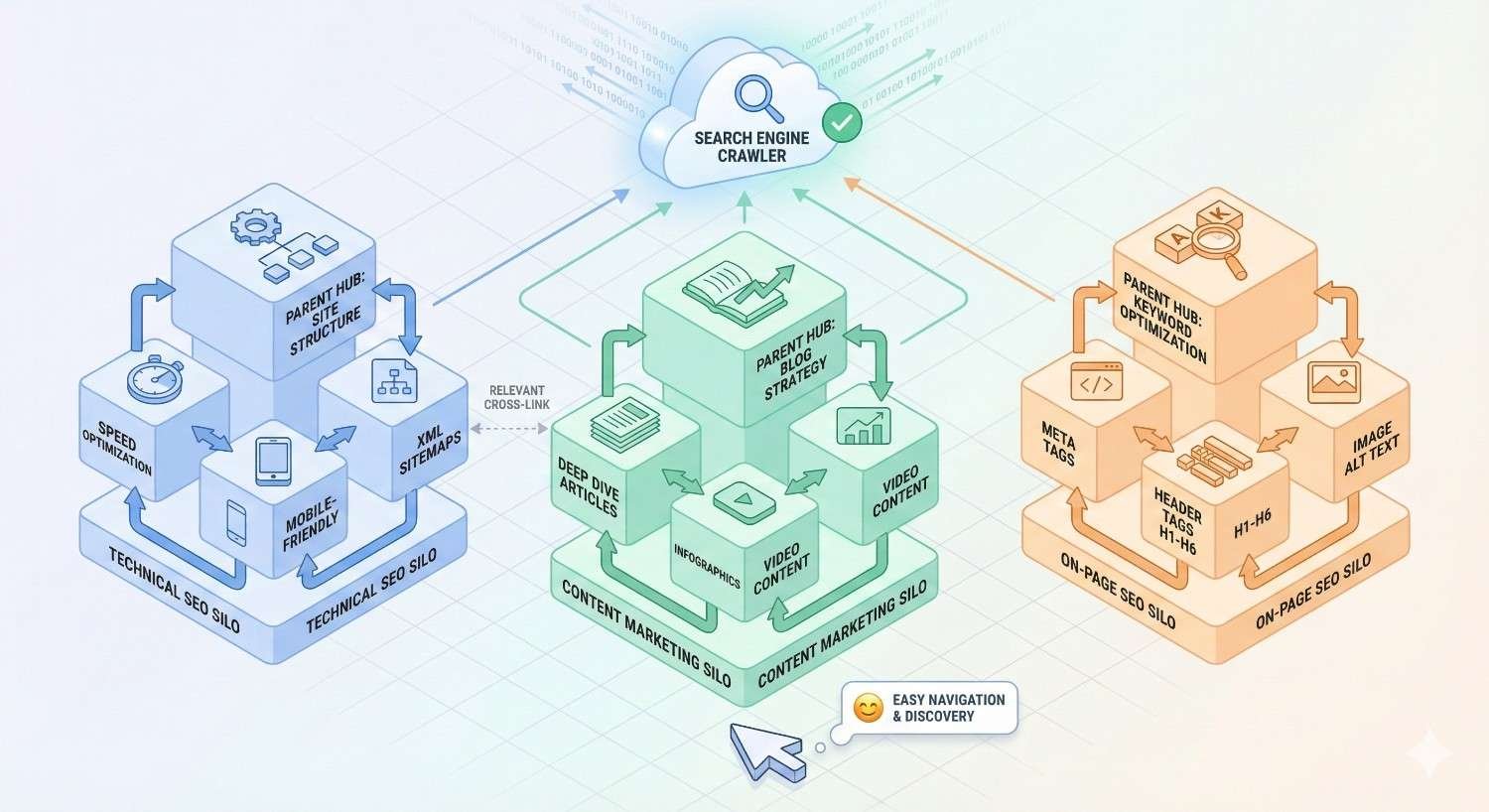
Content siloing is an information architecture strategy that groups related content into distinct, themed categories. Each silo contains a pillar page supported by closely related subtopic pages, all connected through strategic internal linking. The goal is to create clear topical boundaries that help search engines understand your site’s expertise areas.
Think of silos as filing cabinets. Each cabinet holds folders on one subject. You wouldn’t store tax documents in your recipe cabinet. Similarly, content silos keep SEO topics separate from web design topics, preventing topical confusion.
Search engines evaluate websites partly based on how well they demonstrate comprehensive knowledge of specific subjects. A site with random, disconnected content appears less authoritative than one with organized, deep coverage of defined topics. Siloing creates the structural foundation for topical authority.
The Core Components of a Content Silo
Every effective content silo contains three essential elements working together.
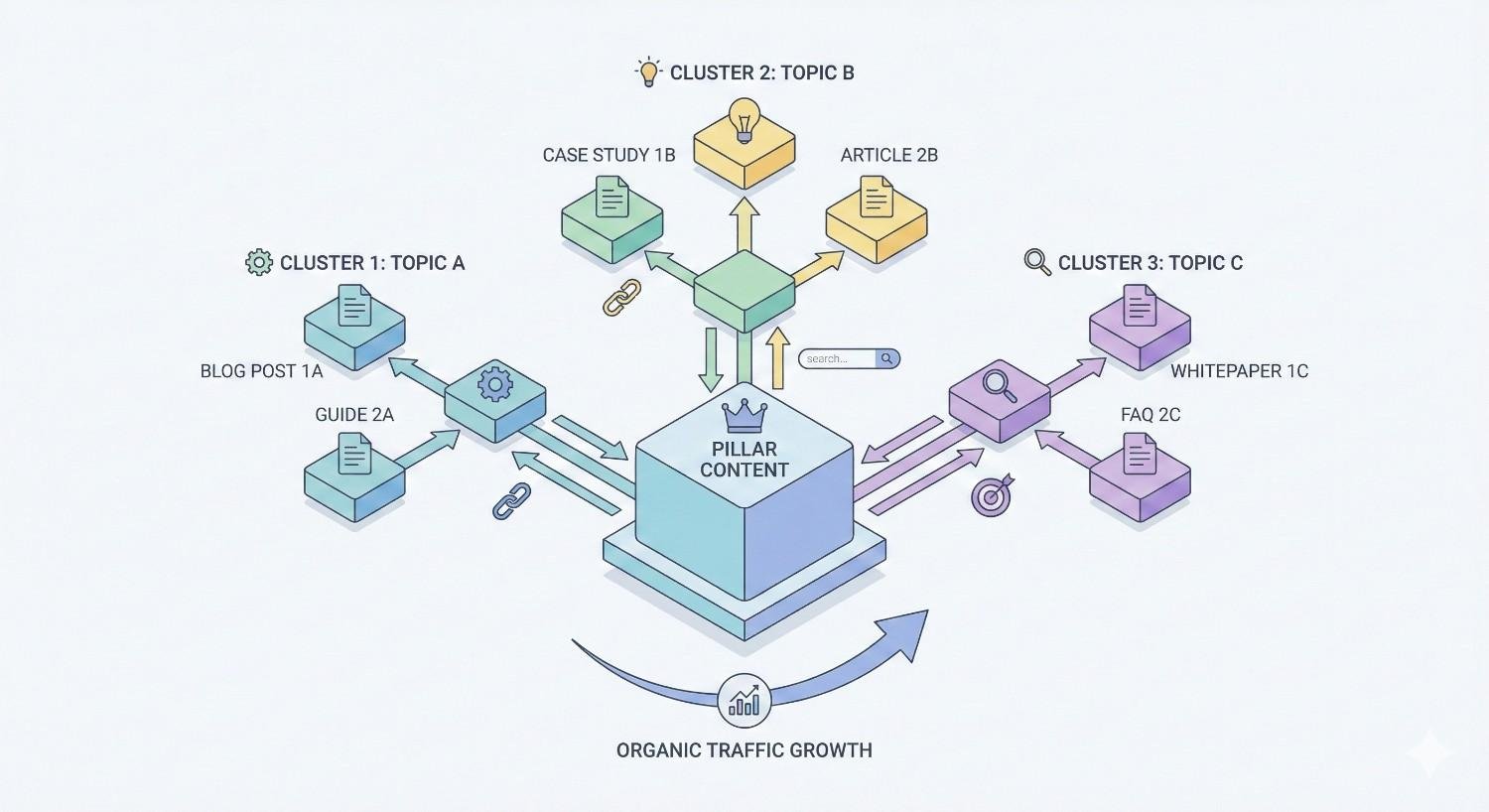
Pillar Content serves as the silo’s foundation. This comprehensive page covers the main topic broadly, targeting primary keywords with high search volume. Pillar pages typically run 2,000-5,000 words and provide complete overviews that link down to supporting content.
Supporting Content consists of detailed pages addressing specific subtopics within the silo theme. These pages target long-tail keywords and answer focused questions. Each supporting page links back to the pillar and potentially to other supporting pages within the same silo.
Internal Linking Structure connects all silo content through deliberate link patterns. Links flow from pillar to supporting pages, from supporting pages back to pillar, and between related supporting pages. This creates a closed loop of topical relevance.
Navigation elements like category pages, breadcrumbs, and menus reinforce silo boundaries. URL structure can also reflect silo organization, though this isn’t strictly required for effective siloing.
How Content Silos Differ from Traditional Site Architecture
Traditional website architecture often follows flat or random structures. Pages exist without clear categorical relationships. Internal links connect based on convenience rather than topical relevance. The result is a website that functions but doesn’t communicate expertise to search engines.
Flat architecture places all pages at the same hierarchical level, typically one click from the homepage. While this maximizes crawl accessibility, it provides no topical signals. Every page appears equally important and equally related to every other page.
Random linking occurs when content creators add internal links based on what seems helpful in the moment. A blog post about email marketing might link to a page about logo design simply because both mention branding. This dilutes topical signals.
Siloed architecture introduces intentional hierarchy and topical boundaries. Pages belong to defined categories. Links follow rules that reinforce those categories. Search engines receive clear signals about which topics your site covers authoritatively.
The key difference is intentionality. Traditional architecture happens by default. Siloed architecture happens by design.
Why Content Siloing Matters for Organic Visibility
Content siloing directly impacts three factors that determine organic rankings: topical authority, internal link equity distribution, and crawl efficiency. Understanding these connections helps you prioritize siloing in your SEO strategy.
Search algorithms have evolved beyond simple keyword matching. Modern ranking systems evaluate whether websites demonstrate genuine expertise on topics. They analyze content depth, breadth, and organization. Siloing addresses all three dimensions.
Websites competing in crowded niches need every advantage. Siloing provides structural advantages that compound over time as you add more content to established silos.
How Silos Strengthen Topical Authority
Topical authority measures how comprehensively and expertly a website covers a subject. Search engines assess this through content analysis, link patterns, and user engagement signals. Siloing directly strengthens topical authority signals.
When you create a silo around “technical SEO,” you’re telling search engines that your site has dedicated, organized resources on this topic. The pillar page provides breadth. Supporting pages provide depth. Internal links demonstrate relationships between concepts.
Each new page added to a silo strengthens the entire silo’s authority. A supporting page about “crawl budget optimization” reinforces the technical SEO pillar while benefiting from the pillar’s established authority. This creates a flywheel effect.
Contrast this with scattered content. A single page about technical SEO surrounded by unrelated content sends weak authority signals. Search engines see one page, not a comprehensive resource. The page must compete on its own merits without structural support.
Research from Ahrefs confirms that websites with organized topical coverage consistently outrank those with scattered content, even when individual page quality is similar.
The Role of Internal Linking in Silo Architecture
Internal links serve as the connective tissue of content silos. They distribute link equity, establish topical relationships, and guide both users and crawlers through your content.
Link equity flows through internal links. When your homepage receives external backlinks, that authority passes to linked pages. Siloed internal linking ensures equity flows to topically related pages, concentrating authority where it matters most.
Anchor text in internal links provides additional topical signals. When multiple pages link to your “keyword research” page using relevant anchor text, search engines receive reinforced signals about that page’s topic.
Strategic internal linking within silos creates what SEOs call “link neighborhoods.” Pages in the same neighborhood share topical relevance and pass contextual authority to each other. This neighborhood effect amplifies ranking potential for all pages in the silo.
The linking rules matter. Links within silos should be generous. Links between silos should be minimal and purposeful. This maintains topical boundaries while allowing necessary cross-references.
Impact on Crawl Efficiency and Indexation
Search engine crawlers have limited resources to spend on any website. Crawl budget determines how many pages get crawled and how frequently. Siloed architecture optimizes crawl efficiency.
Clear hierarchical structure helps crawlers understand page importance. Pillar pages receive more internal links, signaling higher priority. Supporting pages receive appropriate link depth, indicating their role in the hierarchy.
Organized URL structures (when used with physical silos) help crawlers predict content relationships. A URL like /technical-seo/crawl-budget/ immediately communicates topical context before the page is even crawled.
Siloing reduces crawl waste. When content is organized logically, crawlers spend less time on navigation and more time on content. They can efficiently discover new pages by following predictable link patterns.
For large websites with thousands of pages, crawl efficiency becomes critical. Siloing ensures important pages get crawled regularly while preventing crawler resources from being wasted on low-value pages.
Types of Content Silo Structures
Content silos can be implemented through URL structure, internal linking, or both. Each approach has advantages depending on your website platform, existing architecture, and SEO goals. Understanding the options helps you choose the right implementation strategy.
The best approach depends on your starting point. New websites can implement physical silos from day one. Established websites often find virtual silos easier to implement without disrupting existing rankings.
Physical Silos (URL-Based Structure)
Physical silos organize content through URL hierarchy. The URL path reflects the silo structure, creating visible topical organization.
A physical silo for “content marketing” might use this URL structure:
- /content-marketing/ (pillar page)
- /content-marketing/blog-writing/ (supporting page)
- /content-marketing/content-calendar/ (supporting page)
- /content-marketing/content-distribution/ (supporting page)
This approach provides clear signals to search engines and users. The URL itself communicates topical relationships. Users can navigate by modifying URLs. Crawlers can infer content relationships from URL patterns.
Physical silos require planning before content creation. Changing URL structures later requires redirects, which carry some risk. This approach works best for new websites or major redesigns.
The main advantage is clarity. Everyone—users, search engines, content creators—can immediately understand the site’s topical organization by looking at URLs.
Virtual Silos (Link-Based Structure)
Virtual silos create topical organization through internal linking without changing URL structure. Pages can live at any URL while still belonging to defined silos based on how they link to each other.
This approach uses internal links to establish relationships:
- Pillar pages link to all supporting pages in their silo
- Supporting pages link back to their pillar
- Supporting pages link to related supporting pages within the silo
- Cross-silo links are minimized or eliminated
Virtual silos offer flexibility. You can implement them on existing websites without changing URLs. You can reorganize silos by adjusting links rather than creating redirects. Content can potentially belong to multiple silos if appropriate.
The challenge is maintenance. Without URL-based organization, keeping track of silo membership requires documentation. Content creators need clear guidelines about linking rules. Auditing becomes more complex.
Virtual silos work well for established websites where URL changes would be disruptive, or for websites using flat URL structures by design.
Hybrid Silo Approaches
Most successful implementations combine physical and virtual silo elements. URL structure provides the foundation while internal linking reinforces and extends the organization.
A hybrid approach might use category-based URLs for main silos while using internal links to create sub-silos or connect related content across categories when genuinely relevant.
For example, an e-commerce site might use physical silos for product categories (/running-shoes/, /hiking-boots/) while using virtual linking to connect related products across categories (linking trail running shoes to hiking boots for customers interested in outdoor footwear).
Hybrid approaches provide the clarity of physical silos with the flexibility of virtual silos. They’re particularly effective for complex websites with multiple content types and overlapping topics.
The key is consistency. Whatever combination you choose, apply it systematically across your entire website.
How to Build a Content Silo Strategy
Building effective content silos requires systematic planning before content creation. Rushing into siloing without proper research leads to poorly defined categories, missing content, and wasted effort. Follow these steps to build silos that drive results.
The process takes time upfront but saves significant effort later. A well-planned silo structure guides content creation for years, ensuring every new page strengthens your topical authority.
Step 1: Conduct Topical Research and Keyword Clustering
Start by identifying the topics your website should cover authoritatively. This requires understanding your business goals, audience needs, and competitive landscape.
List all topics relevant to your business. For an SEO agency, this might include technical SEO, content strategy, link building, local SEO, and e-commerce SEO. Each major topic becomes a potential silo.
Conduct keyword research for each potential silo. Use tools like Ahrefs, Semrush, or Google Keyword Planner to identify keywords within each topic area. Look for:
- High-volume head terms (potential pillar targets)
- Long-tail variations (potential supporting content)
- Question-based queries (FAQ and how-to content)
- Related terms and synonyms (semantic coverage)
Cluster keywords by topical relevance. Group keywords that share search intent and would logically appear on the same page or within the same content section. These clusters inform your silo structure.
Validate silo viability by checking search volume and competition. Each silo should have enough keyword opportunity to justify the content investment. Silos with minimal search demand may not warrant dedicated resources.
Step 2: Map Your Silo Architecture
Create a visual map of your planned silo structure. This document guides all future content decisions and helps team members understand the organizational system.
For each silo, define:
- Pillar topic and target keywords
- Supporting topics and their target keywords
- Logical hierarchy (which supporting topics are most important)
- Internal linking rules (how pages will connect)
- Content gaps (topics you need to cover but haven’t yet)
Use spreadsheets, mind mapping tools, or dedicated SEO platforms to document your architecture. The format matters less than having a clear, accessible reference.
Consider user journeys when mapping silos. How do visitors move through your content? What questions do they ask first, and what follow-up questions arise? Structure silos to match natural information-seeking behavior.
Review competitor silo structures for inspiration. Analyze top-ranking websites in your space to see how they organize content. Look for gaps in their coverage that you can fill.
Step 3: Create Pillar and Supporting Content
With your architecture mapped, begin content creation starting with pillar pages. Pillars establish the foundation that supporting content builds upon.
Pillar content requirements:
- Comprehensive coverage of the main topic
- 2,000-5,000 words depending on topic complexity
- Clear sections that can link to supporting content
- Target primary keywords with highest search volume
- Provide genuine value as a standalone resource
Write pillar content to be evergreen. Avoid time-sensitive information that requires frequent updates. Focus on fundamental concepts that remain relevant.
Supporting content requirements:
- Deep focus on specific subtopics
- 1,000-2,500 words typically
- Target long-tail keywords and specific questions
- Link back to pillar page naturally
- Link to related supporting pages when relevant
Create supporting content in priority order. Start with topics that have the highest search volume or strongest business relevance. Build out silos systematically rather than randomly.
Maintain consistent quality across all silo content. Every page represents your expertise. Weak supporting pages undermine the authority of the entire silo.
Step 4: Implement Internal Linking Rules
Establish clear linking rules before publishing content. Consistent internal linking is what transforms individual pages into cohesive silos.
Core linking rules:
- Every supporting page links to its pillar page
- Pillar pages link to all supporting pages
- Supporting pages link to related supporting pages within the same silo
- Cross-silo links are used sparingly and only when genuinely helpful
- Anchor text is descriptive and keyword-relevant
Use contextual links within body content rather than relying solely on navigation or footer links. Contextual links carry more weight and provide better user experience.
Create a linking checklist for content creators. Before publishing any page, verify that all required links are in place and follow established rules.
Audit existing content when implementing silos on established websites. Update old pages to include appropriate silo links. Remove or modify links that violate silo boundaries.
Step 5: Optimize Navigation and URL Structure
Navigation and URL structure should reinforce your silo organization. Users and search engines should be able to understand your site structure through these elements.
URL optimization:
- Use descriptive, keyword-rich URLs
- Reflect silo hierarchy in URL paths (for physical silos)
- Keep URLs concise but meaningful
- Use hyphens to separate words
- Maintain consistent URL patterns across silos
Navigation optimization:
- Include silo categories in main navigation
- Use dropdown menus to show silo hierarchy
- Implement breadcrumbs showing page location within silos
- Create category/hub pages for each silo
- Ensure mobile navigation maintains silo clarity
Breadcrumbs deserve special attention. They provide clear hierarchical signals to search engines while helping users understand their location. Implement breadcrumb schema markup for enhanced SERP display.
Test navigation with real users. Can they find content within silos easily? Do they understand the site’s organization? User behavior signals impact rankings, so navigation usability matters for SEO.
Content Silo Best Practices for SEO
Following best practices ensures your silos deliver maximum SEO value. These guidelines address common challenges and help you avoid pitfalls that undermine silo effectiveness.
Best practices evolve as search algorithms change. Stay current with SEO industry developments and be prepared to adjust your approach based on performance data.
Maintaining Topical Relevance Within Silos
Every page within a silo must genuinely belong there. Topical relevance isn’t just about keywords—it’s about conceptual fit and user expectations.
Ask these questions when adding content to a silo:
- Does this topic logically relate to the pillar theme?
- Would users expect to find this content in this section?
- Does linking this page to other silo pages make sense?
- Does this content strengthen or dilute the silo’s topical focus?
Avoid forcing content into silos where it doesn’t fit. If a topic spans multiple silos, either choose the best fit or create a separate silo for it. Forced categorization creates confusion.
Review silo content periodically. As your site grows, some pages may drift from their original silo focus. Update or relocate content that no longer fits.
Maintain consistent terminology within silos. If your technical SEO silo uses “crawl budget,” don’t switch to “crawl allocation” randomly. Consistent language reinforces topical coherence.
Avoiding Cross-Silo Contamination
Cross-silo contamination occurs when excessive linking between silos blurs topical boundaries. Some cross-linking is natural and helpful, but too much undermines silo effectiveness.
Signs of cross-silo contamination:
- Pages link to more content outside their silo than within
- Users frequently bounce between unrelated silos
- Search engines show pages for queries outside their silo topic
- Internal link analysis shows weak silo clustering
Prevention strategies:
- Establish maximum cross-silo link limits (e.g., no more than 1-2 per page)
- Require justification for cross-silo links
- Use nofollow on cross-silo links if necessary (rarely needed)
- Audit link patterns regularly
When cross-silo links are genuinely helpful, use them. If your content marketing silo discusses keyword research, linking to your SEO silo’s keyword research page serves users. The key is intentionality—link because it helps users, not because it’s convenient.
Balancing Depth vs. Breadth in Silo Design
Silos need both depth (detailed coverage of subtopics) and breadth (coverage of all relevant subtopics). Finding the right balance depends on your resources and competitive landscape.
Depth considerations:
- How detailed are competitor pages on subtopics?
- What questions do users have about each subtopic?
- How much unique value can you add?
- What’s the search volume for detailed queries?
Breadth considerations:
- What subtopics do competitors cover that you don’t?
- What questions remain unanswered in your silo?
- Are there emerging subtopics you should address?
- What’s the total keyword opportunity across subtopics?
Start with breadth to establish topical coverage, then add depth to high-priority subtopics. A silo with ten shallow pages often outperforms one with three deep pages because it demonstrates broader expertise.
Monitor competitor content development. When competitors add new subtopics to their silos, evaluate whether you should match their coverage.
Using Breadcrumbs and Navigation to Reinforce Silos
Breadcrumbs and navigation elements provide structural signals that reinforce silo organization. Implement them thoughtfully to maximize SEO benefit.
Breadcrumb best practices:
- Show complete path from homepage to current page
- Use silo category names in breadcrumb trail
- Implement BreadcrumbList schema markup
- Make breadcrumbs clickable for user navigation
- Display breadcrumbs consistently across all pages
Navigation best practices:
- Feature silo categories prominently in main navigation
- Use descriptive labels that match silo themes
- Implement mega menus for complex silo structures
- Ensure navigation works well on mobile devices
- Include secondary navigation within silo sections
Category pages serve as silo landing pages. Optimize them with unique content, not just lists of links. These pages can rank for category-level keywords while distributing authority to supporting pages.
Common Content Siloing Mistakes to Avoid
Even well-intentioned siloing efforts can fail due to common mistakes. Understanding these pitfalls helps you avoid them and build more effective silo structures.
Most mistakes stem from over-engineering or under-maintaining silos. Find the balance between rigid structure and practical flexibility.
Over-Siloing and Creating Orphan Pages
Over-siloing happens when you create too many silos or make silo boundaries too rigid. The result is fragmented content that lacks the critical mass needed for topical authority.
Signs of over-siloing:
- Silos contain only 2-3 pages each
- Many pages have no internal links
- Users can’t find related content
- Crawlers struggle to discover pages
Orphan pages have no internal links pointing to them. They’re invisible to crawlers following link paths and receive no link equity from other pages. Over-siloing often creates orphans by isolating content in tiny, disconnected silos.
Prevention strategies:
- Require minimum content volume before creating new silos
- Audit for orphan pages regularly using crawling tools
- Consolidate small silos into broader categories
- Ensure every page has at least 2-3 internal links pointing to it
If a topic doesn’t warrant at least 5-10 pages, it probably shouldn’t be a standalone silo. Include it as a subtopic within a broader silo instead.
Inconsistent Internal Linking Patterns
Inconsistent linking undermines silo effectiveness. When some pages follow linking rules while others don’t, the silo structure becomes unclear to search engines.
Common inconsistencies:
- New content published without silo links
- Old content never updated with links to new pages
- Different content creators following different rules
- Links added based on convenience rather than strategy
Solutions:
- Create documented linking guidelines
- Include linking requirements in content briefs
- Audit links quarterly and fix inconsistencies
- Use internal linking tools to identify gaps
Automation can help maintain consistency. Tools like Link Whisper or Yoast SEO suggest internal links based on content analysis. Use these as starting points, then apply human judgment.
Ignoring User Experience for SEO Structure
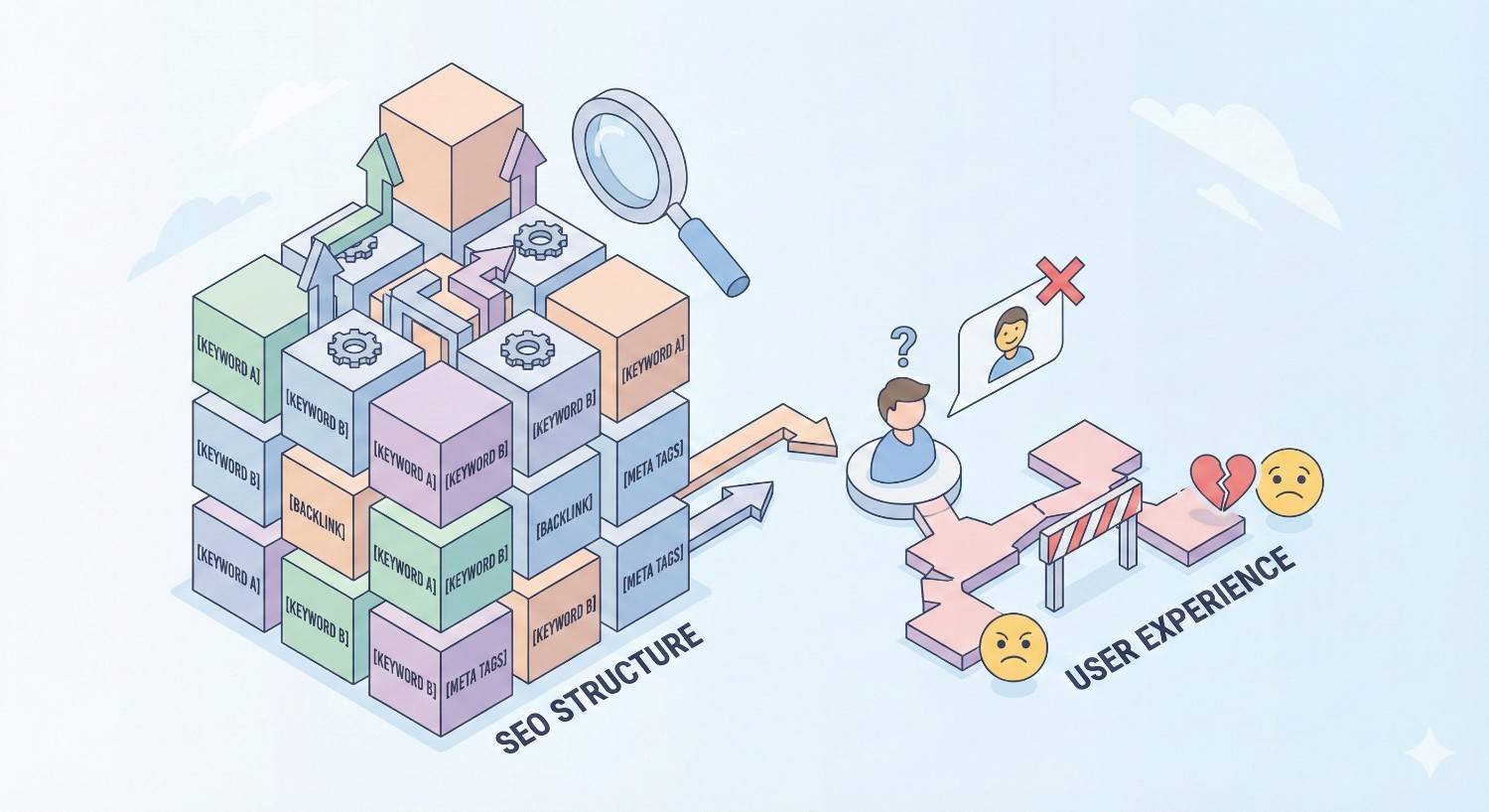
Silos should serve users, not just search engines. When silo structure makes content harder to find or navigate, you’ve prioritized SEO over UX—and ultimately hurt both.
UX problems from poor siloing:
- Users can’t find content that spans multiple topics
- Navigation is confusing or overly complex
- Related content is hidden due to silo boundaries
- Page layouts prioritize links over readability
Balance SEO and UX:
- Test navigation with real users
- Allow helpful cross-silo links when they serve users
- Don’t sacrifice content quality for linking opportunities
- Monitor engagement metrics for signs of UX problems
User engagement signals influence rankings. If your silo structure frustrates users, causing high bounce rates and low time on page, the SEO benefits will be undermined.
Implementing Content Silos on Existing Websites
Implementing silos on established websites requires careful planning to avoid losing existing rankings. The process involves auditing current structure, planning changes, and executing migrations systematically.
Existing websites have accumulated authority and rankings that must be preserved. Rushed implementations can cause significant traffic losses that take months to recover.
Auditing Your Current Site Structure
Before making changes, understand your current state. A thorough audit reveals what’s working, what’s broken, and what opportunities exist.
Audit components:
- Content inventory: List all pages with their topics, keywords, and performance metrics
- Internal link analysis: Map current linking patterns using crawling tools
- URL structure review: Document current URL patterns and hierarchy
- Performance baseline: Record current rankings, traffic, and engagement metrics
Use tools like Screaming Frog, Sitebulb, or Ahrefs Site Audit to crawl your site and analyze structure.
Identify existing topical clusters. Even without intentional siloing, your content likely has natural groupings. These become the foundation for formal silos.
Document problem areas:
- Orphan pages with no internal links
- Pages with excessive cross-topic linking
- Content that doesn’t fit any clear category
- Duplicate or thin content that should be consolidated
Restructuring Without Losing Rankings
Restructuring requires a phased approach that minimizes risk while achieving silo goals.
Phase 1: Internal linking changes
Start with virtual siloing through internal links. This carries minimal risk since URLs don’t change. Update internal links to follow silo rules. Add links to orphan pages. Remove or modify problematic cross-silo links.
Monitor rankings and traffic during this phase. If problems emerge, you can quickly reverse link changes.
Phase 2: Navigation updates
Update navigation to reflect silo structure. Add category pages if needed. Implement breadcrumbs. These changes are relatively low-risk but highly visible.
Phase 3: URL restructuring (if needed)
URL changes carry the highest risk. Only proceed if physical silos are essential to your strategy. Plan redirects carefully and implement them systematically.
Risk mitigation:
- Make changes incrementally, not all at once
- Monitor Search Console for crawl errors and ranking changes
- Keep detailed records of all changes for troubleshooting
- Have rollback plans ready if problems emerge
Managing Redirects and URL Changes
When URL changes are necessary, proper redirect implementation is critical. Mistakes here cause ranking losses, broken links, and poor user experience.
Redirect best practices:
- Use 301 (permanent) redirects for URL changes
- Redirect old URLs to their exact new equivalents
- Update internal links to point to new URLs (don’t rely solely on redirects)
- Submit updated sitemap to Search Console
- Monitor for redirect chains and loops
Common redirect mistakes:
- Redirecting all old URLs to homepage
- Creating redirect chains (A→B→C instead of A→C)
- Forgetting to update internal links
- Not monitoring for 404 errors from missed redirects
Test redirects thoroughly before and after implementation. Use tools to verify that all old URLs redirect correctly and that no pages return 404 errors.
Allow time for search engines to process changes. Ranking fluctuations are normal for 4-8 weeks after major URL restructuring. Don’t panic and make additional changes during this period.
Tools and Resources for Content Silo Management
The right tools make silo planning, implementation, and maintenance significantly easier. These resources help you visualize structure, analyze links, and manage content organization.
Tool selection depends on your budget, technical capabilities, and website size. Start with free options and upgrade as needed.
Site Architecture Visualization Tools
Visualizing your site structure helps identify problems and plan improvements. These tools create visual maps of your website’s architecture.
Screaming Frog SEO Spider crawls your site and generates visual site architecture diagrams. The free version handles up to 500 URLs. See how pages connect and identify structural issues.
Sitebulb provides advanced visualization with interactive diagrams showing link relationships, content clusters, and crawl paths. Particularly useful for large, complex websites.
Visual Site Mapper offers free basic site mapping for smaller websites. Good for quick overviews without installing software.
Dynomapper creates visual sitemaps with content inventory features. Useful for planning silo restructuring on existing sites.
Use visualization tools before and after silo implementation to verify that your structure matches your plan.
Internal Linking Analysis Platforms
Internal link analysis reveals how link equity flows through your site and whether your silo structure is working as intended.
Ahrefs Site Audit includes internal linking reports showing link distribution, orphan pages, and linking opportunities. The internal link opportunities report suggests contextual links based on content analysis.
Semrush Site Audit provides internal linking analysis with recommendations for improving link structure. Identifies pages with too few or too many internal links.
Link Whisper is a WordPress plugin that suggests internal links as you write and helps manage existing links. Particularly useful for maintaining consistent linking patterns.
InLinks uses entity-based analysis to suggest internal links based on topical relationships. Aligns well with semantic SEO approaches to siloing.
Regular link audits catch problems before they impact rankings. Schedule quarterly reviews of internal link patterns.
Content Clustering and Keyword Research Tools
Content clustering tools help identify topical relationships and plan silo structures based on keyword data.
Keyword Insights automatically clusters keywords by search intent and topical relevance. Useful for planning silo structures based on actual search behavior.
Cluster AI groups keywords into clusters and suggests content hierarchies. Helps identify pillar and supporting content opportunities.
MarketMuse analyzes topical coverage and identifies content gaps. Shows how your content compares to competitors’ topical authority.
Surfer SEO includes content clustering features alongside its optimization tools. Useful for planning and optimizing silo content.
Combine keyword clustering with manual analysis. Tools provide data, but human judgment determines whether clusters make sense as silos.
Measuring the Performance of Your Content Silos
Measurement validates whether your silo strategy is working and identifies opportunities for improvement. Track the right metrics and analyze them in the context of silo performance.
Establish baselines before implementing silos so you can measure the impact of your changes accurately.
Key Metrics to Track
Focus on metrics that directly reflect silo effectiveness rather than vanity metrics that don’t indicate real performance.
Organic traffic by silo: Track traffic to each silo separately. Growing silos indicate successful topical authority building. Declining silos need attention.
Keyword rankings by silo: Monitor rankings for pillar and supporting page keywords. Improving rankings across a silo suggest the structure is working.
Internal link metrics: Track the number of internal links per page, link equity distribution, and orphan page count. These indicate structural health.
Engagement metrics by silo: Compare bounce rate, time on page, and pages per session across silos. Poor engagement may indicate content quality or navigation issues.
Conversion metrics by silo: If silos align with business goals, track conversions attributed to each silo. This connects SEO performance to business outcomes.
Create dashboards that display silo-level metrics alongside site-wide metrics. This context helps you understand whether individual silos are outperforming or underperforming.
Using Google Search Console for Silo Analysis
Google Search Console provides free data for analyzing silo performance. Use its features strategically to gain silo-specific insights.
Performance filtering: Filter performance reports by page URL patterns to see silo-specific data. If your silos use URL-based structure, filter by URL prefix (e.g., /technical-seo/).
Query analysis: Review which queries drive traffic to each silo. Are you ranking for intended keywords? Are there unexpected queries suggesting content opportunities?
Page indexing: Check that all silo pages are indexed. Indexing problems may indicate crawl issues related to silo structure.
Internal links report: Search Console shows which pages have the most internal links. Verify that pillar pages receive more internal links than supporting pages.
Core Web Vitals by silo: If certain silos have performance issues, they may underperform in rankings. Identify and fix technical problems affecting specific silos.
Export Search Console data regularly for trend analysis. Month-over-month and year-over-year comparisons reveal whether silos are gaining or losing authority.
Attribution and ROI of Silo-Based Content Strategy
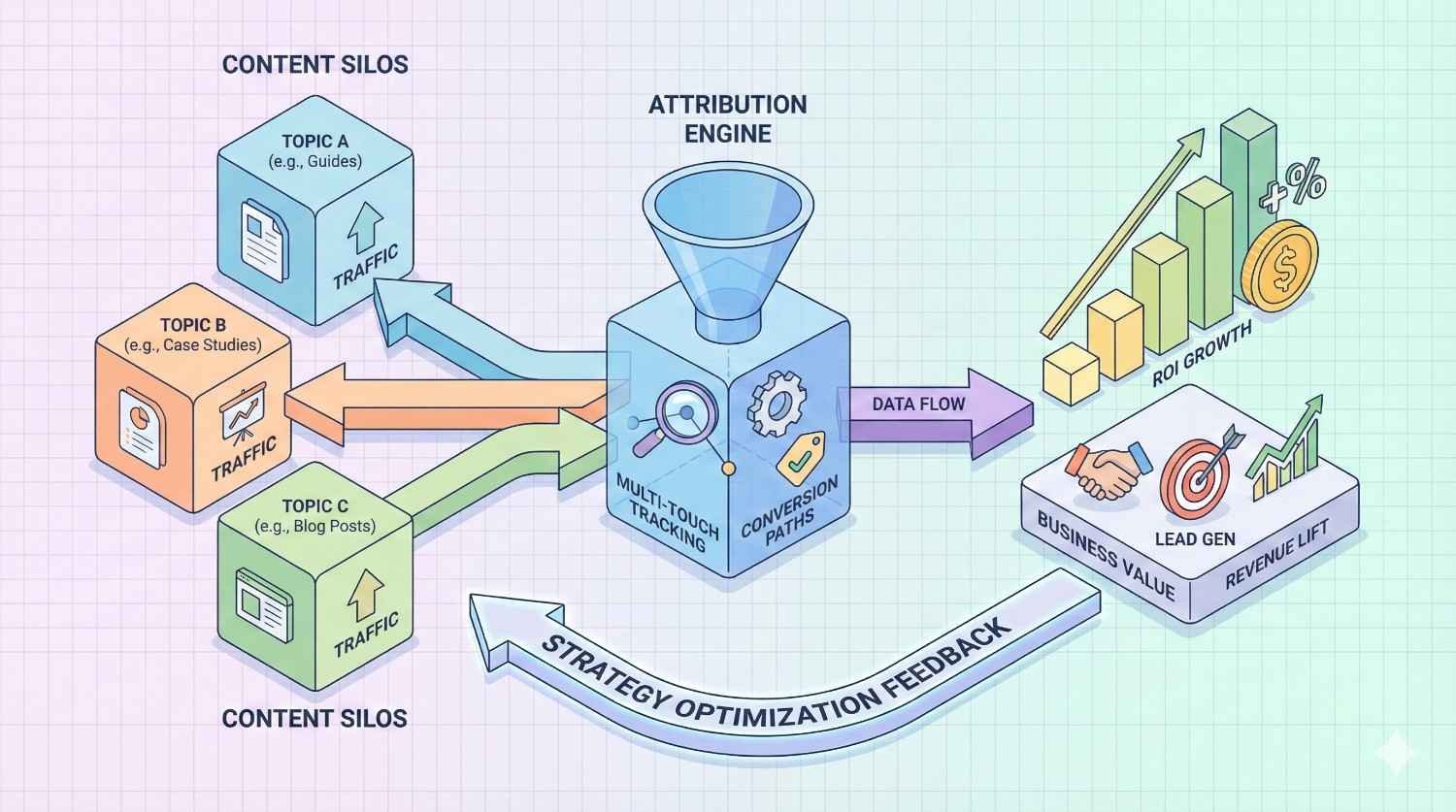
Connecting silo performance to business outcomes justifies continued investment in content architecture. Attribution models help demonstrate ROI.
Traffic value calculation: Estimate the value of organic traffic to each silo based on equivalent paid search costs. Tools like Ahrefs and Semrush provide traffic value estimates.
Lead attribution: Track which silos generate leads or conversions. Use UTM parameters, goal tracking, or CRM integration to attribute business outcomes to specific silos.
Content investment tracking: Document the resources invested in each silo (content creation, optimization, link building). Compare investment to returns for ROI calculation.
Competitive benchmarking: Compare your silo performance to competitors. Are you gaining or losing market share in specific topic areas?
Present ROI data to stakeholders to secure resources for ongoing silo development. Concrete numbers are more persuasive than abstract SEO metrics.
Content Siloing for Different Website Types
Different website types require adapted siloing approaches. E-commerce, service businesses, and publishers each have unique structural needs and opportunities.
Apply core siloing principles while adapting implementation to your specific website type and business model.
E-commerce Sites and Product Categorization
E-commerce websites have natural silo structures in their product categories. The challenge is optimizing these structures for SEO while maintaining shopping functionality.
Category pages as pillars: Product category pages serve as silo pillars. Optimize them with unique content beyond product listings. Include buying guides, comparison information, and category-specific advice.
Product pages as supporting content: Individual product pages support their category. Ensure products link back to categories and to related products within the same category.
Faceted navigation challenges: Filters and facets can create duplicate content and crawl issues. Use canonical tags, robots directives, or parameter handling to manage faceted URLs.
Cross-category products: Some products fit multiple categories. Choose a primary category for URL structure and use virtual linking to connect to secondary categories.
Content integration: Add blog content to e-commerce silos. A “running shoes” silo might include buying guides, training tips, and shoe care articles alongside product pages.
E-commerce silos should balance SEO structure with conversion optimization. Don’t sacrifice user experience for rigid silo boundaries.
Service-Based Businesses and Location Silos
Service businesses often need silos organized by service type and geographic location. This creates a matrix structure requiring careful planning.
Service silos: Create silos for each major service offering. A law firm might have silos for personal injury, family law, and business law. Each silo contains service pages, related blog content, and case studies.
Location silos: For businesses serving multiple locations, create location-based silos. These might include location landing pages, local service pages, and location-specific content.
Matrix structure: When services and locations intersect, decide on primary organization. Either nest locations within services (/personal-injury/chicago/) or services within locations (/chicago/personal-injury/).
Local SEO integration: Location silos support local SEO efforts. Include NAP information, local schema markup, and location-specific content in location silos.
Avoiding thin content: Location pages often become thin, duplicated content. Add unique, valuable content to each location page—local case studies, team members, community involvement.
Content Publishers and Editorial Silos
Publishers and media sites organize content by topic, format, or editorial section. Siloing helps build authority in specific subject areas.
Topic-based silos: Organize content by subject matter. A technology publication might have silos for AI, cybersecurity, consumer electronics, and enterprise software.
Editorial sections: Traditional editorial sections (news, features, opinion) can serve as silos or cross-cut topic silos. Decide which organization best serves your audience and SEO goals.
Author authority: Consider author pages as mini-silos. Authors who consistently write about specific topics build personal topical authority that benefits their content.
Evergreen vs. news content: Separate evergreen content (guides, tutorials) from time-sensitive news. Evergreen silos build lasting authority while news content captures trending traffic.
Tag and category management: Publishers often over-use tags, creating thin archive pages. Consolidate tags into meaningful categories that function as silos.
High-volume publishers need automated systems to maintain silo structure. Editorial guidelines and CMS configurations help ensure consistent organization.
Advanced Content Silo Strategies
Once basic siloing is established, advanced strategies can further enhance topical authority and ranking potential. These approaches require more sophisticated planning and execution.
Advanced strategies build on fundamentals. Master basic siloing before attempting complex implementations.
Multi-Level Silo Hierarchies
Large websites may need silos within silos—multi-level hierarchies that organize extensive content libraries.
Three-level structure example:
- Level 1: Main silo (Digital Marketing)
- Level 2: Sub-silos (SEO, PPC, Social Media, Email Marketing)
- Level 3: Topic clusters within sub-silos (Technical SEO, On-Page SEO, Link Building within SEO)
Implementation considerations:
- Each level needs sufficient content to justify the hierarchy
- Internal linking must flow appropriately through all levels
- Navigation must remain usable despite complexity
- URL structures can become unwieldy—consider hybrid approaches
When to use multi-level silos:
- Websites with hundreds or thousands of pages
- Topics with natural sub-categorization
- Competitive niches requiring deep topical coverage
- Enterprise websites with multiple business units
Avoid over-complicating structure. If two levels suffice, don’t add a third just because you can.
Combining Silos with Topic Clusters
Topic clusters and content silos share similar goals but differ in implementation. Combining them creates powerful content architectures.
Topic clusters focus on hub-and-spoke content relationships. A pillar page links to cluster content, and cluster content links back. The emphasis is on comprehensive topic coverage.
Content silos focus on organizational structure and link equity flow. The emphasis is on topical boundaries and authority concentration.
Combined approach:
- Use silo structure for site-wide organization
- Implement topic clusters within silos for content planning
- Pillar pages serve as both silo hubs and cluster centers
- Supporting content addresses cluster subtopics while following silo linking rules
This combination provides both structural clarity (silos) and content comprehensiveness (clusters). The approaches complement rather than conflict.
Semantic SEO and Entity-Based Siloing
Modern search algorithms understand entities and their relationships. Entity-based siloing aligns your structure with how search engines process information.
Entity identification: Identify the key entities in your niche—people, organizations, concepts, products. These entities become the foundation for silo planning.
Entity relationships: Map how entities relate to each other. These relationships inform internal linking and content connections.
Entity coverage: Ensure each silo comprehensively covers its central entity and related entities. This builds the semantic context search engines use to evaluate expertise.
Schema markup: Implement structured data that explicitly identifies entities and relationships. This helps search engines understand your content’s semantic structure.
Knowledge graph alignment: Structure content to match how information appears in knowledge graphs. This increases chances of appearing in knowledge panels and AI-generated responses.
Entity-based siloing requires deeper understanding of semantic SEO principles. It’s most valuable for websites competing in knowledge-intensive niches.
How We Help Businesses Build Effective Content Silos
Building and maintaining content silos requires expertise, resources, and ongoing attention. Our team provides comprehensive silo strategy services that drive measurable organic growth.
We’ve implemented silo architectures for businesses across industries, from startups building their first content strategy to enterprises restructuring thousands of pages.
Our Silo Architecture Planning Process
We begin every engagement with thorough analysis and strategic planning. This foundation ensures silo structures align with business goals and competitive realities.
Discovery phase: We analyze your current site structure, content inventory, competitive landscape, and business objectives. This reveals opportunities and constraints that shape silo strategy.
Keyword and topic research: Our team conducts comprehensive keyword research, clustering terms into logical topic groups. We identify pillar opportunities, supporting content needs, and content gaps.
Architecture design: We create detailed silo maps showing page hierarchy, internal linking rules, and URL structures. These documents guide implementation and serve as ongoing references.
Stakeholder alignment: We present recommendations to your team, explaining the rationale and expected outcomes. Your input ensures silos align with business priorities and operational capabilities.
Content Strategy and Creation Within Silos
Silo structure without quality content delivers no results. We develop and execute content strategies that fill silos with valuable, ranking-worthy pages.
Content planning: We create editorial calendars prioritizing content by search opportunity and business value. Each piece fits within the silo structure and supports overall topical authority.
Content creation: Our writers produce pillar pages, supporting articles, and supplementary content optimized for both search engines and users. Every piece follows silo linking guidelines.
Content optimization: We optimize existing content to fit silo structures, updating internal links, improving topical relevance, and filling coverage gaps.
Quality assurance: All content undergoes editorial review for accuracy, readability, and SEO optimization before publication.
Ongoing Monitoring and Optimization
Silos require maintenance to remain effective. We provide ongoing monitoring and optimization services that keep your architecture performing.
Performance tracking: We monitor silo-level metrics including traffic, rankings, and engagement. Regular reports show what’s working and what needs attention.
Technical audits: Quarterly technical audits identify structural issues—orphan pages, broken links, crawl problems—before they impact performance.
Content updates: We refresh existing content to maintain relevance and competitiveness. Outdated content undermines silo authority.
Strategic adjustments: As your business evolves and search algorithms change, we adjust silo strategies accordingly. Flexibility ensures long-term success.
Conclusion
Content siloing transforms scattered website content into organized, authoritative topic hubs that search engines reward with higher rankings. The strategy requires upfront planning and consistent execution, but delivers compounding returns as silos mature and strengthen.
Effective siloing combines structural organization with quality content and strategic internal linking. Whether you implement physical silos, virtual silos, or hybrid approaches, the principles remain consistent: group related content, link strategically within groups, and maintain topical boundaries.
We help businesses worldwide build content architectures that drive sustainable organic growth. Contact White Label SEO Service to discuss how strategic siloing can improve your search visibility and deliver measurable business results.
Frequently Asked Questions
How long does it take to see results from content siloing?
Most websites see initial ranking improvements within 3-6 months of implementing silo structures. Full results typically emerge over 6-12 months as search engines recrawl content and recognize topical authority patterns. Factors like site age, competition level, and content quality influence timeline.
Can I implement content silos on a WordPress website?
Yes, WordPress supports both physical and virtual siloing. Use categories for physical silo structure and plugins like Link Whisper for internal link management. Custom post types can create additional silo structures for different content types.
How many pages should a content silo contain?
Effective silos typically contain 5-15 supporting pages plus a pillar page, though larger silos work for broad topics. The key is having enough content to demonstrate comprehensive coverage without forcing unrelated content into the silo.
Should I use nofollow links between different silos?
Generally, no. Standard followed links between silos are fine when they genuinely help users. Excessive cross-silo linking is the problem, not the links themselves. Reserve nofollow for truly unrelated or low-value links.
What’s the difference between content silos and topic clusters?
Content silos focus on site architecture and link equity flow through organizational structure. Topic clusters focus on comprehensive content coverage around central topics. The approaches complement each other and are often used together.
How do I handle content that fits multiple silos?
Choose the primary silo based on the content’s main focus and place it there structurally. Use internal links to connect it to relevant content in other silos. Avoid duplicating content across silos.
Can content siloing hurt my existing rankings?
Poorly executed siloing can temporarily impact rankings, especially if URL changes create redirect issues. Implement changes incrementally, monitor performance closely, and have rollback plans ready. Proper implementation typically improves rather than hurts rankings.