
Thin content silently destroys organic visibility, wastes crawl budget, and signals low quality to search engines. Pages lacking substantive value trigger algorithmic filters that suppress rankings across your entire domain.
This problem affects every website type, from e-commerce stores with thousands of product pages to blogs publishing frequent updates. Understanding thin content mechanics is essential for protecting and growing organic traffic.
This guide covers thin content identification, the specific types damaging your rankings, Google algorithm impacts, and strategic solutions for fixing and preventing content quality issues.
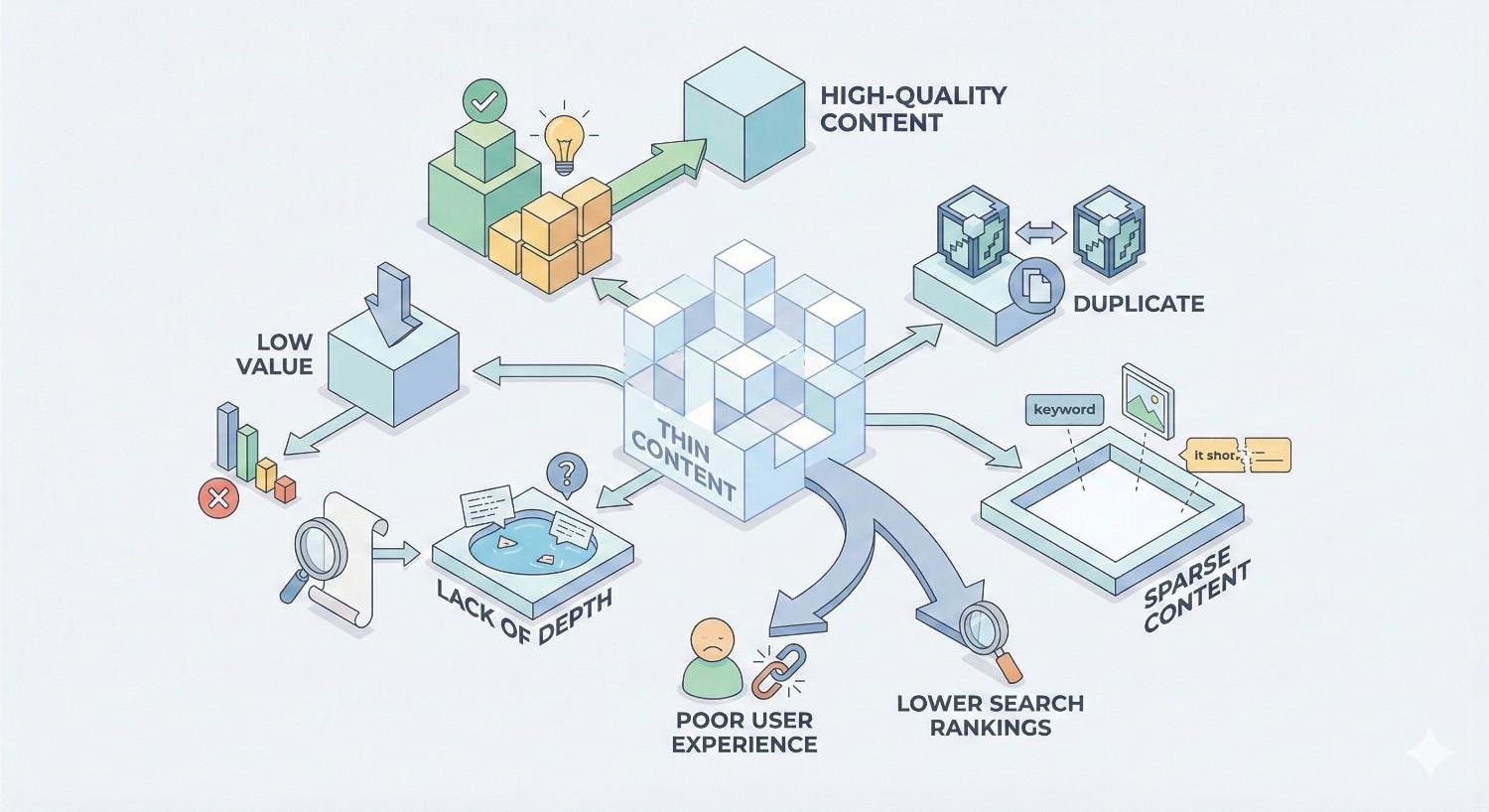
Understanding Thin Content: Definition and Core Characteristics
Thin content represents one of the most persistent SEO challenges facing website owners. Google explicitly identifies thin content as a quality issue that can trigger manual actions or algorithmic suppression. Understanding what qualifies as thin content helps you audit existing pages and prevent future problems.
The Technical Definition of Thin Content
Thin content refers to pages providing little or no unique value to users. Google’s quality guidelines define thin content as pages with insufficient original content, automatically generated text, or content scraped from other sources without adding meaningful value.
The definition extends beyond word count. A 2,000-word article filled with repetitive information qualifies as thin content. Conversely, a 300-word page answering a specific question comprehensively may provide substantial value.
Key characteristics include:
- Minimal original information or analysis
- Content that exists primarily for search engines rather than users
- Pages that fail to satisfy the search intent behind queries
- Duplicate or substantially similar content across multiple URLs
- Automatically generated text without human editorial oversight
How Search Engines Identify Thin Content
Search engines use multiple signals to evaluate content quality and depth. Google’s algorithms analyze content at the page level and site-wide level, meaning thin content on some pages can affect rankings for your entire domain.
Content analysis signals include:
Natural language processing evaluates semantic depth, topical coverage, and information density. Pages covering topics superficially without addressing related subtopics signal thin content.
User engagement metrics provide behavioral signals. High bounce rates, low time on page, and pogo-sticking (returning to search results quickly) indicate content failed to satisfy user intent.
Crawl patterns reveal content quality issues. When Googlebot encounters numerous low-value pages, it may reduce crawl frequency and indexation priority for your domain.
Duplicate content detection identifies pages with substantially similar content. Google’s algorithms compare content fingerprints across your site and the broader web.
Thin Content vs. Low-Quality Content: Key Differences
While related, thin content and low-quality content represent distinct issues requiring different solutions.
Thin content specifically refers to insufficient depth or substance. A page might be well-written and accurate but simply lacks enough information to be useful. Product pages with only a title and price exemplify thin content.
Low-quality content encompasses broader issues including:
- Factual inaccuracies or outdated information
- Poor writing, grammar, or readability
- Misleading or deceptive content
- Content that fails to demonstrate expertise
A page can be thin without being low-quality (accurate but insufficient) or low-quality without being thin (lengthy but poorly written). Both issues damage SEO performance, but remediation strategies differ.
Thin content typically requires expansion, consolidation, or removal. Low-quality content requires rewriting, fact-checking, or expert review.
Types of Thin Content That Damage Your Rankings
Different thin content types require specific identification and remediation approaches. Understanding each category helps prioritize your content audit and fix the most damaging issues first.
Automatically Generated Content
Auto-generated content uses software to create pages at scale without meaningful human input. This includes:
- Content spun from existing articles using synonym replacement
- Pages generated from database fields without editorial enhancement
- AI-generated content published without human review or value-add
- Template-based pages with minimal variable content
Google’s guidelines explicitly identify auto-generated content as a webmaster quality issue. The March 2024 core update specifically targeted sites publishing AI-generated content at scale without adding unique value.
Auto-generated content fails because it lacks the expertise, analysis, and unique perspective that makes content valuable. Even grammatically correct auto-generated text typically lacks depth, nuance, and genuine helpfulness.
Duplicate or Near-Duplicate Pages
Duplicate content creates multiple URLs with identical or substantially similar content. Common causes include:
- URL parameters creating multiple versions of the same page
- HTTP and HTTPS versions both accessible
- WWW and non-WWW versions not consolidated
- Printer-friendly page versions
- Session IDs in URLs
- Pagination without proper canonical implementation
Near-duplicate content presents similar challenges. Product pages with only color or size variations, location pages with only city names changed, or blog posts covering the same topic with minor rewording all qualify.
Duplicate content wastes crawl budget, dilutes ranking signals, and confuses search engines about which version to index and rank.
Doorway and Gateway Pages
Doorway pages target specific keywords or locations without providing unique value. They exist primarily to funnel users to other pages rather than satisfy search intent directly.
Common doorway page patterns include:
- Multiple pages targeting “[service] in [city]” with identical content except location names
- Pages optimized for keyword variations that all lead to the same destination
- Affiliate landing pages with no unique content or value proposition
- Pages designed to rank for queries then redirect users elsewhere
Google considers doorway pages a spam tactic. Sites using doorway pages risk manual actions and algorithmic penalties affecting the entire domain.
Scraped or Copied Content
Scraped content takes material from other websites without permission or attribution. This includes:
- Copying product descriptions from manufacturers
- Republishing articles from other sites
- Aggregating content from multiple sources without original analysis
- Using RSS feeds to auto-publish content from other sites
Even with attribution, scraped content provides no unique value. Search engines prefer original sources and may filter or penalize sites publishing primarily scraped material.
Low Word Count Pages with Minimal Value
While word count alone doesn’t determine content quality, pages with minimal text often lack sufficient depth to satisfy user intent.
Problematic low word count scenarios include:
- Blog posts under 300 words on complex topics
- Service pages with only a headline and contact form
- Category pages with only product listings and no contextual content
- FAQ pages with one-sentence answers to complex questions
The issue isn’t word count specifically but whether the content comprehensively addresses the topic. Some queries require extensive coverage; others need concise answers. Matching content depth to search intent determines whether low word count constitutes thin content.
Affiliate Pages Without Unique Content
Affiliate pages promoting products without original reviews, comparisons, or analysis qualify as thin content. Google’s product reviews guidelines specifically address this issue.
Thin affiliate content includes:
- Pages with only manufacturer descriptions and affiliate links
- Product roundups without genuine testing or evaluation
- Comparison pages without original analysis or recommendations
- Review pages that summarize other reviews without adding value
Successful affiliate content requires first-hand experience, unique insights, and information unavailable elsewhere. Simply aggregating product information with affiliate links provides no value search engines want to reward.
Thin Product or Category Pages
E-commerce sites frequently struggle with thin product and category pages. Common issues include:
Product pages lacking:
- Unique product descriptions (using manufacturer copy)
- Detailed specifications and features
- Usage information and applications
- Customer reviews and ratings
- Related product recommendations
Category pages lacking:
- Introductory content explaining the category
- Buying guides or selection criteria
- Featured products with context
- Internal links to related categories
With thousands of products, creating unique content for each page challenges resources. However, thin product pages compete poorly against retailers investing in content quality.
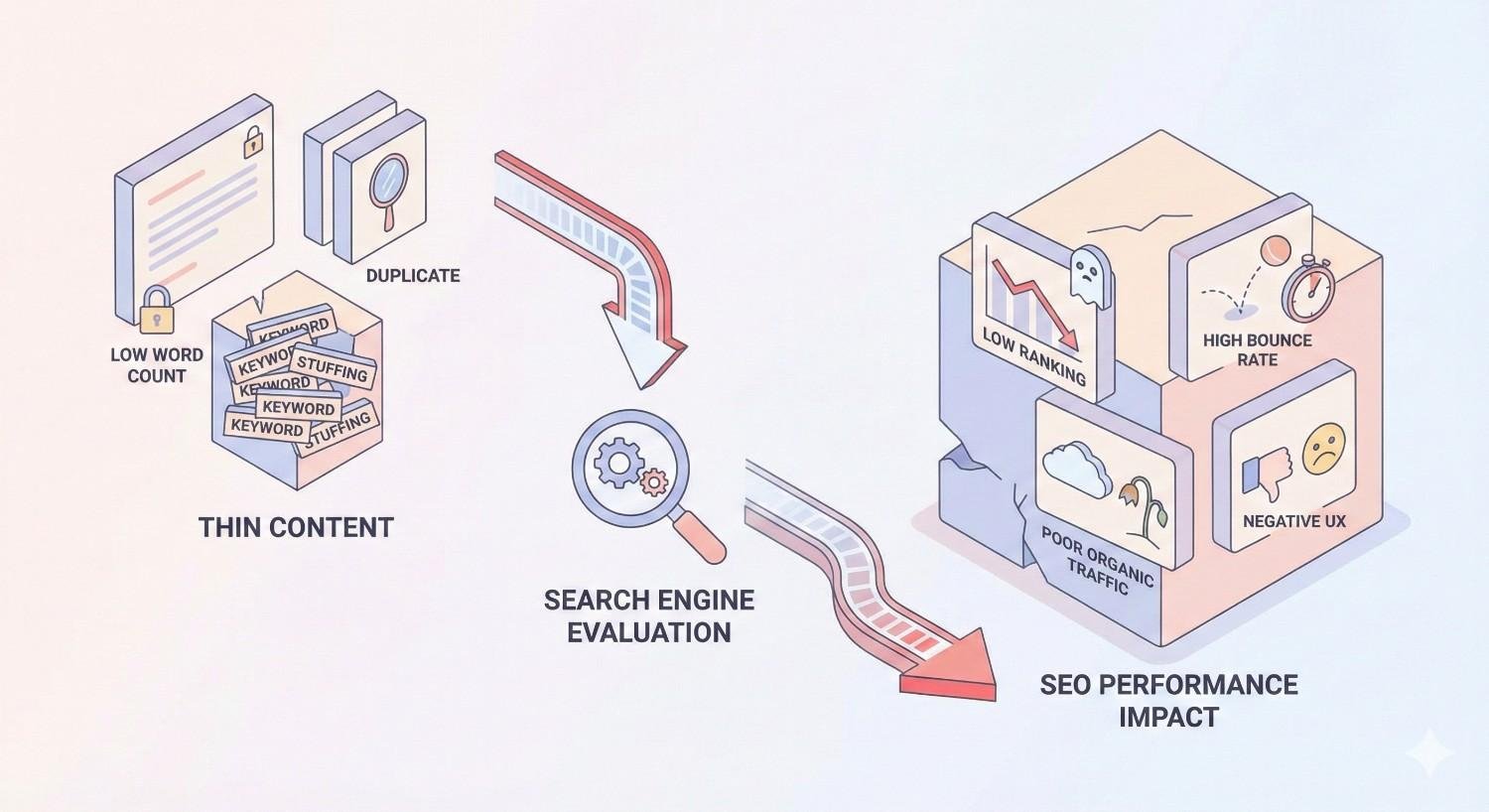
How Thin Content Impacts Your SEO Performance
Thin content creates cascading negative effects across multiple SEO dimensions. Understanding these impacts helps prioritize remediation and justify resource investment in content quality.
Ranking Penalties and Algorithmic Filters
Google applies both manual actions and algorithmic filters to sites with thin content problems.
Manual actions result from human reviewers identifying quality violations. Google Search Console displays manual action notifications, and recovery requires fixing issues and submitting reconsideration requests.
Algorithmic filters apply automatically based on quality signals. Unlike manual actions, algorithmic suppression doesn’t generate notifications. Sites may experience ranking drops without clear indication of the cause.
The Panda algorithm, now integrated into Google’s core ranking systems, specifically targets thin content. Sites with significant thin content percentages may see domain-wide ranking suppression, not just individual page demotions.
Crawl Budget Waste and Indexing Issues
Every website has limited crawl budget, the resources Googlebot allocates to crawling your site. Thin content pages consume crawl budget without providing ranking value.
Crawl budget impacts include:
- Googlebot spending time on low-value pages instead of important content
- Reduced crawl frequency for your entire site
- New content taking longer to get indexed
- Important pages potentially not getting crawled at all
For large sites with thousands of pages, crawl budget optimization becomes critical. Thin content pages dilute crawl efficiency and slow indexation of valuable content.
User Experience Signals and Bounce Rate
Thin content fails to satisfy user intent, generating negative engagement signals:
- High bounce rates: Users leave immediately after arriving
- Low time on page: Insufficient content to engage users
- Pogo-sticking: Users return to search results and click competitors
- Low pages per session: Users don’t explore further
While Google states user engagement metrics aren’t direct ranking factors, these signals correlate with content quality issues that algorithms do measure. Poor engagement indicates content isn’t meeting user needs.
Domain Authority Dilution
Thin content dilutes your site’s overall quality signals. When a significant percentage of indexed pages provide minimal value, it affects how search engines perceive your entire domain.
Quality dilution effects:
- Lower average content quality scores across your domain
- Reduced trust signals for your site overall
- Internal links from thin pages carry less value
- New content starts with lower baseline authority
Sites with predominantly high-quality content benefit from positive quality associations. Sites with substantial thin content face the opposite effect.
Lost Traffic and Revenue Opportunities
The ultimate impact of thin content is lost organic traffic and revenue. Pages that could rank and drive conversions instead languish in search results or remain unindexed entirely.
Opportunity costs include:
- Keywords you could rank for but don’t
- Traffic going to competitors with better content
- Conversions lost to poor user experience
- Brand visibility reduced in search results
Fixing thin content often produces significant traffic gains. Sites recovering from thin content issues frequently see 30-50% organic traffic increases within 3-6 months of implementing fixes.
Google Algorithm Updates Targeting Thin Content
Understanding algorithm history helps contextualize current requirements and anticipate future changes. Google has consistently increased content quality standards over time.
Google Panda and Content Quality Assessment
Google Panda launched in February 2011, specifically targeting thin and low-quality content. The update affected approximately 12% of search results initially, demonstrating the scale of thin content problems.
Panda introduced site-wide quality assessment. Rather than evaluating pages individually, Panda considered overall site quality. Sites with significant thin content saw rankings drop across all pages, not just the problematic ones.
Key Panda signals included:
- Content originality and uniqueness
- Depth of information provided
- Expertise demonstrated in content
- User engagement and satisfaction
- Advertising-to-content ratio
Panda ran as a periodic filter initially, with sites experiencing ranking changes during updates. Google later integrated Panda into core ranking algorithms, making it a continuous signal rather than periodic filter.
Helpful Content Update Impact
Google’s Helpful Content Update, launched in August 2022 and significantly expanded in September 2023, introduced a site-wide classifier specifically targeting unhelpful content.
The update targets content created primarily for search engines rather than users. Sites with substantial unhelpful content receive a negative classifier that suppresses rankings across the entire domain.
Helpful Content Update criteria include:
- Content demonstrates first-hand experience and expertise
- Site has a primary purpose beyond attracting search traffic
- Content provides substantial value beyond what’s available elsewhere
- Readers feel satisfied after consuming the content
- Content isn’t produced at scale without quality oversight
Recovery from Helpful Content classifier requires removing or substantially improving unhelpful content and demonstrating sustained quality improvement over months.
Core Updates and Content Depth Requirements
Google’s core updates, released several times yearly, continuously refine content quality assessment. Each core update typically raises the bar for content depth and expertise.
Core update patterns affecting thin content:
- Increased emphasis on topical authority and comprehensive coverage
- Greater weight on expertise signals and author credentials
- Preference for content demonstrating first-hand experience
- Higher standards for YMYL (Your Money or Your Life) topics
Sites with thin content often experience negative impacts during core updates as quality thresholds increase. Conversely, sites investing in content depth frequently gain visibility.
Product Reviews Update Standards
Google’s Product Reviews Updates, beginning in April 2021, specifically target thin affiliate and review content.
Product review quality signals include:
- Evidence of first-hand product testing
- Quantitative measurements and comparisons
- Discussion of benefits and drawbacks
- Comparison with alternatives
- Information about product sourcing and evaluation methodology
Thin product reviews lacking these elements face ranking suppression. Sites publishing genuine, in-depth reviews with original research gain competitive advantage.
How to Identify Thin Content on Your Website
Systematic identification precedes effective remediation. Multiple tools and techniques help locate thin content across your site.
Using Google Search Console to Find Low-Performing Pages
Google Search Console provides direct insight into how Google perceives your content. Key reports for thin content identification include:
Performance Report Analysis:
Filter by pages and sort by impressions or clicks. Pages with high impressions but low clicks may have thin content failing to satisfy searchers. Pages with zero impressions despite being indexed may be filtered for quality issues.
Coverage Report:
Review “Indexed, not submitted in sitemap” and “Discovered – currently not indexed” categories. Pages Google chooses not to index often have quality issues including thin content.
Manual Actions:
Check for any manual actions related to thin content. Google explicitly notifies about thin content manual actions, providing specific URLs affected.
Page Indexing:
Review which pages Google has indexed versus excluded. Patterns in excluded pages often reveal thin content issues.
Content Audit Tools and Techniques
Dedicated SEO tools provide comprehensive content auditing capabilities:
Screaming Frog SEO Spider:
Crawl your entire site and export page data including word count, title tags, meta descriptions, and response codes. Filter for pages below word count thresholds and review for thin content patterns.
Sitebulb:
Provides content quality scoring and identifies pages with potential thin content issues. Visual reports help prioritize remediation efforts.
Semrush Site Audit:
Includes thin content detection as part of comprehensive site audits. Identifies pages with low word counts and duplicate content issues.
Ahrefs Site Audit:
Flags pages with minimal content and provides context about potential impacts on SEO performance.
Analyzing Word Count and Content Depth
Word count analysis provides a starting point for thin content identification, though it shouldn’t be the only criterion.
Recommended minimum word counts by page type:
- Blog posts: 1,000-2,000+ words for comprehensive topics
- Product pages: 300-500+ words of unique content
- Category pages: 200-400+ words of contextual content
- Service pages: 800-1,500+ words covering the service comprehensively
- Location pages: 400-800+ words with unique local information
Export your site’s pages with word counts and flag those below thresholds for manual review. Low word count doesn’t automatically mean thin content, but it indicates pages requiring evaluation.
Evaluating User Engagement Metrics
Google Analytics provides engagement data revealing content quality issues:
Key metrics to analyze:
- Bounce rate by page: High bounce rates may indicate thin content failing to satisfy intent
- Average time on page: Very low time suggests insufficient content to engage users
- Pages per session: Low values from landing pages may indicate quality issues
- Exit rate: High exit rates on non-conversion pages suggest content problems
Compare metrics against site averages and identify outliers. Pages with significantly worse engagement than similar content types warrant thin content review.
Identifying Duplicate Content Issues
Duplicate content detection requires both internal and external analysis:
Internal duplicate detection:
- Use Screaming Frog or Sitebulb to identify pages with identical or near-identical content
- Check for URL parameter variations creating duplicates
- Review pagination implementation for duplicate content issues
- Analyze faceted navigation for duplicate page generation
External duplicate detection:
- Use Copyscape or Siteliner to check for content appearing elsewhere
- Search unique phrases from your content to find copies
- Review manufacturer content usage on product pages
Crawl Analysis for Thin Content Detection
Log file analysis reveals how Googlebot interacts with your content:
Log file insights:
- Pages Googlebot crawls frequently versus rarely
- Pages receiving crawl attention but not getting indexed
- Crawl patterns suggesting quality assessment
- Resources wasted on thin content pages
Tools like Screaming Frog Log File Analyzer or Botify provide log file analysis capabilities. Patterns in crawl behavior often reveal thin content issues before ranking impacts become apparent.
How to Fix Thin Content Issues: Strategic Solutions
Remediation strategy depends on the specific thin content type and business value of affected pages. Not all thin content requires the same solution.
Content Expansion and Enhancement Strategies
For pages with ranking potential and business value, expansion often provides the best solution.
Effective expansion approaches:
- Add comprehensive coverage of subtopics users expect
- Include original research, data, or analysis
- Incorporate expert quotes or perspectives
- Add practical examples and case studies
- Include visual content supporting the text
- Address related questions users commonly ask
Expansion quality standards:
Don’t add words for word count’s sake. Every addition should provide genuine value. Expanded content should demonstrate expertise and satisfy user intent more completely than before.
Prioritization framework:
Focus expansion efforts on pages with:
- Existing ranking potential (impressions in Search Console)
- Business value (conversion potential)
- Competitive opportunity (weak competitor content)
- Topical importance (core to your expertise)
Content Consolidation and Merging
When multiple thin pages cover similar topics, consolidation creates one comprehensive resource.
Consolidation process:
- Identify pages covering overlapping topics
- Determine the best URL to retain (highest authority, best URL structure)
- Combine content from all pages into the retained URL
- Implement 301 redirects from consolidated pages to the retained URL
- Update internal links to point to the consolidated page
Consolidation benefits:
- Combines ranking signals from multiple pages
- Creates more comprehensive content
- Reduces crawl budget waste
- Simplifies site architecture
Strategic Content Deletion and Pruning
Some thin content provides no value and should be removed entirely.
Candidates for deletion:
- Pages with zero traffic and no ranking potential
- Outdated content no longer relevant
- Duplicate pages that can’t be consolidated
- Auto-generated pages providing no value
- Pages targeting keywords with no search volume
Deletion process:
- Verify the page has no valuable backlinks (redirect if it does)
- Confirm no internal links point to the page
- Remove the page and return 404 or 410 status
- Remove from XML sitemap
- Monitor Search Console for crawl errors
Implementing Canonical Tags and Redirects
Technical solutions address duplicate content without removing pages.
Canonical tags:
Use rel=”canonical” to indicate the preferred version when duplicate content must exist. Common applications include:
- URL parameter variations
- Print-friendly page versions
- Syndicated content
- Pagination sequences
301 redirects:
Permanently redirect duplicate or consolidated pages to the preferred version. Redirects pass ranking signals and prevent duplicate content issues.
Implementation best practices:
- Self-referencing canonicals on all pages
- Consistent canonical implementation across HTTP/HTTPS and WWW/non-WWW
- Canonical tags pointing to indexable, 200-status pages
- Redirect chains limited to single hops
Adding Unique Value to Product and Category Pages
E-commerce thin content requires scalable solutions for large product catalogs.
Product page enhancements:
- Write unique product descriptions highlighting benefits and use cases
- Add detailed specifications beyond manufacturer data
- Include sizing guides, compatibility information, or usage instructions
- Incorporate customer reviews and ratings
- Add FAQ sections addressing common questions
- Include related product recommendations with context
Category page enhancements:
- Write introductory content explaining the category
- Add buying guides helping users choose products
- Include featured products with editorial context
- Provide filtering guidance and selection criteria
- Link to related categories and resources
Noindex vs. Delete: When to Use Each Approach
Choosing between noindex and deletion depends on page characteristics.
Use noindex when:
- Pages serve user needs but shouldn’t rank (account pages, thank you pages)
- Pages must exist for site functionality
- You want to preserve the URL for potential future use
- Pages have valuable backlinks you want to preserve
Use deletion when:
- Pages provide no value to users or search engines
- Pages have no backlinks worth preserving
- Content is outdated and won’t be updated
- Pages were created in error or for spam purposes
Noindex implementation:
Add meta robots noindex tag or X-Robots-Tag header. Monitor Search Console to confirm pages drop from index.
Creating Comprehensive Content That Ranks
Prevention exceeds remediation in efficiency. Establish content standards ensuring new pages meet quality thresholds.
Comprehensive content characteristics:
- Covers the topic more thoroughly than competitors
- Addresses all user questions and subtopics
- Demonstrates expertise through depth and accuracy
- Provides unique value unavailable elsewhere
- Satisfies search intent completely
Content development process:
- Research competitor content and identify gaps
- Analyze search intent and user questions
- Create detailed outlines covering all subtopics
- Write with expertise and original insights
- Review against quality standards before publishing
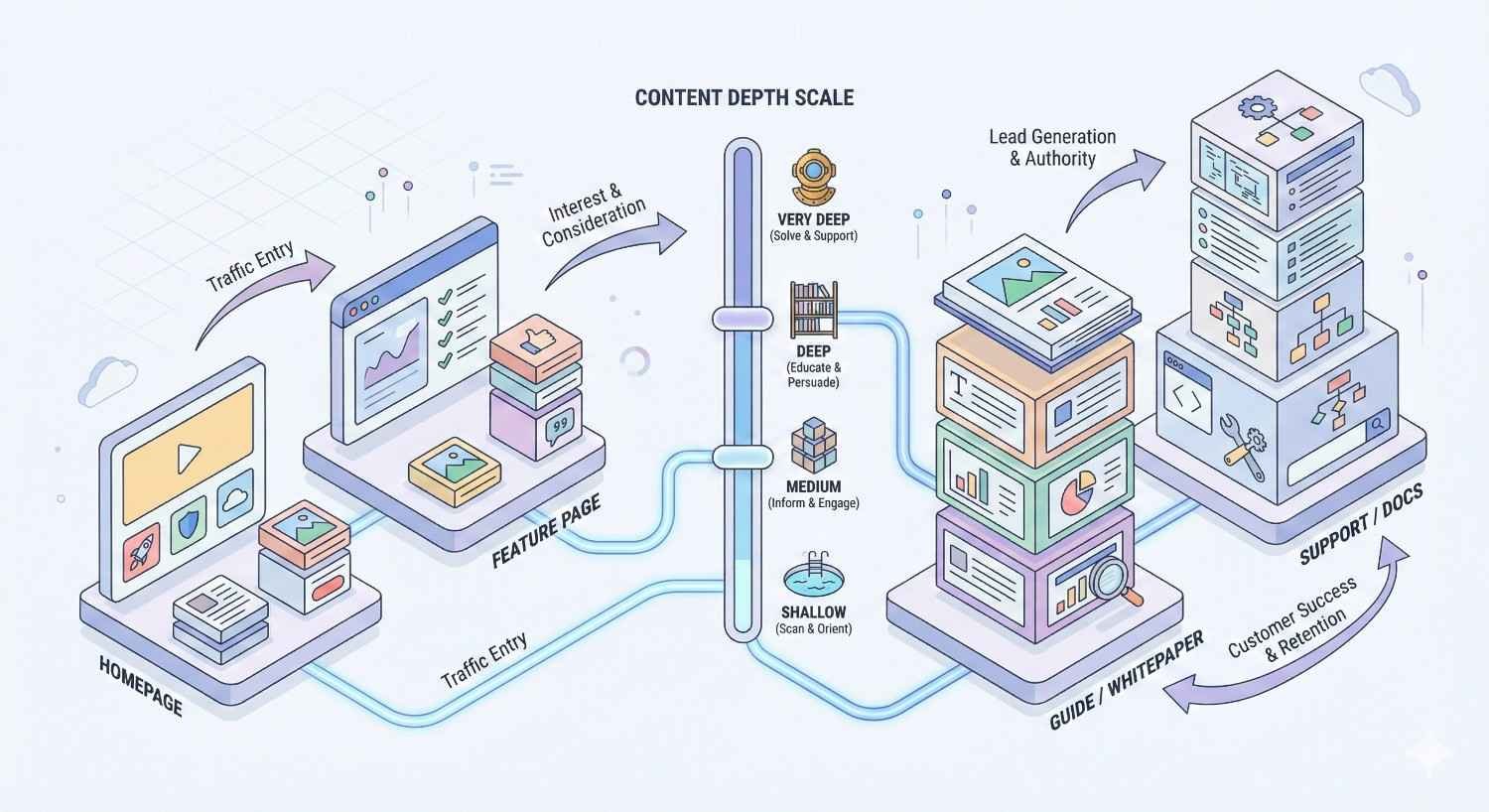
Content Depth Requirements by Page Type
Different page types serve different purposes and require appropriate content depth. One-size-fits-all word counts don’t account for intent variations.
Blog Posts and Informational Content
Informational content typically requires substantial depth to rank competitively.
Blog post guidelines:
- Short-form (500-1,000 words): News updates, announcements, simple how-tos
- Standard (1,000-2,000 words): Most informational topics, guides, explanations
- Long-form (2,000-4,000+ words): Comprehensive guides, pillar content, complex topics
Depth requirements:
- Cover all subtopics users expect
- Answer related questions within the content
- Provide examples, data, and evidence
- Include actionable takeaways
- Demonstrate expertise through accuracy and insight
Product Pages and E-commerce Content
Product pages balance conversion optimization with content depth.
Essential product page elements:
- Unique product description (150-500+ words)
- Detailed specifications and features
- High-quality images with alt text
- Customer reviews and ratings
- Pricing and availability information
- Related products and accessories
- FAQ section addressing common questions
Content depth varies by product complexity:
- Simple products: 200-400 words of unique content
- Complex products: 500-1,000+ words covering features, applications, comparisons
Category and Collection Pages
Category pages often get neglected but provide significant ranking opportunities.
Category page content requirements:
- Introductory paragraph explaining the category (100-200 words)
- Buying guide or selection criteria (200-400 words)
- Featured products with editorial context
- Subcategory links with descriptions
- FAQ section for category-level questions
Total category page content: 300-600+ words beyond product listings
Service Pages and Landing Pages
Service pages must balance conversion focus with content depth for rankings.
Service page structure:
- Clear service description and benefits (200-400 words)
- Process or methodology explanation (200-300 words)
- Pricing or engagement information
- Case studies or results (200-400 words)
- FAQ section (200-400 words)
- Clear calls to action
Total service page content: 800-1,500+ words for competitive keywords
Location Pages and Local SEO Content
Location pages require unique local content to avoid thin content issues.
Location page requirements:
- Unique introduction mentioning the location naturally (100-150 words)
- Location-specific service information (200-300 words)
- Local team or office information
- Directions and parking information
- Local testimonials or case studies
- Area-specific FAQ content
Total location page content: 400-800+ words of unique content per location
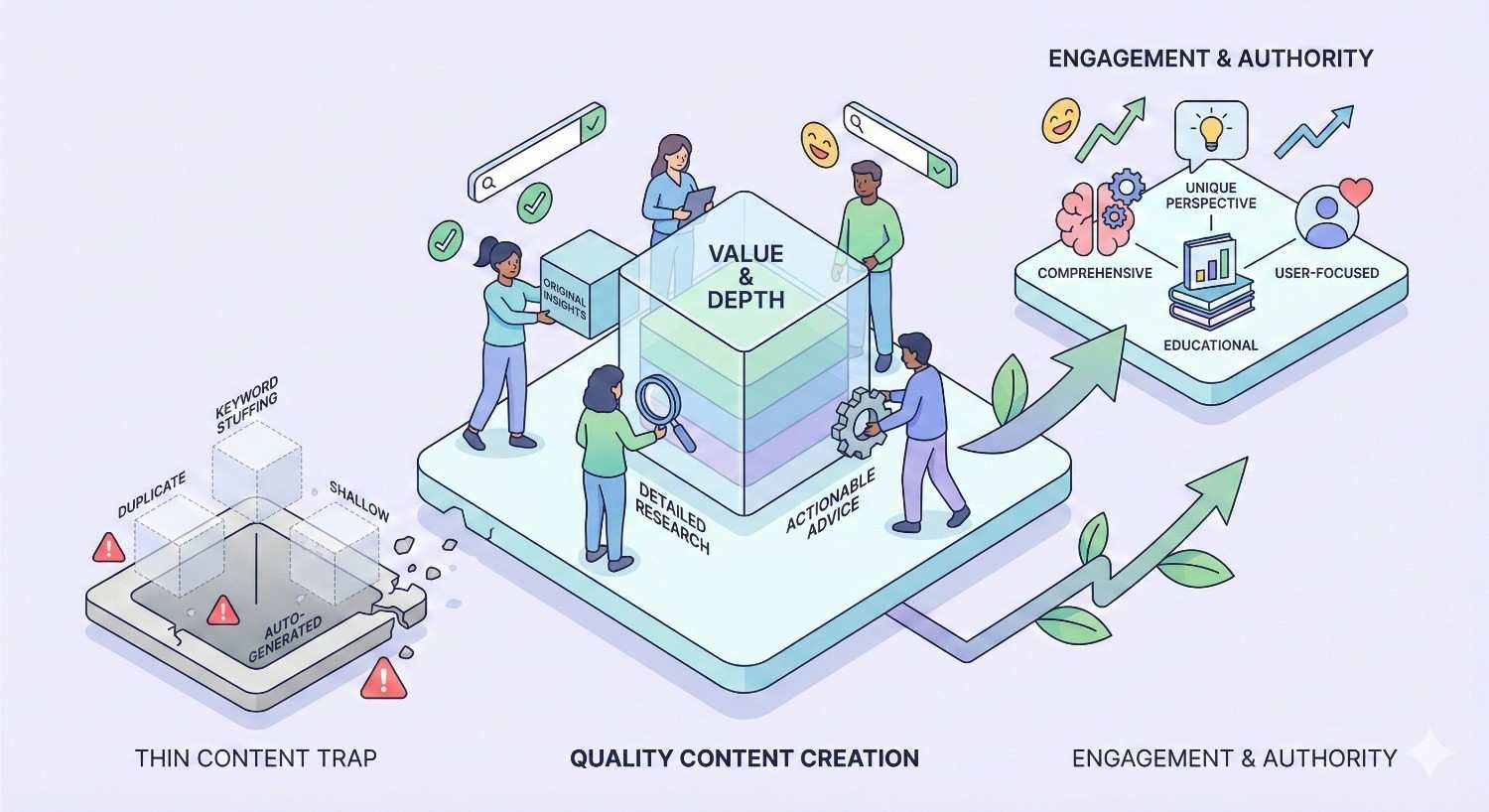
Preventing Thin Content During Content Creation
Proactive prevention costs less than reactive remediation. Establish systems ensuring content meets quality standards before publication.
Content Planning and Research Frameworks
Thorough planning prevents thin content at the source.
Pre-writing research process:
- Analyze search intent for target keywords
- Review top-ranking competitor content
- Identify subtopics and questions to address
- Gather data, examples, and evidence
- Create detailed outline covering all elements
Content briefs should include:
- Target keyword and search intent
- Required subtopics and questions to answer
- Minimum word count based on competition
- Required elements (images, data, examples)
- Internal linking requirements
- Quality standards and review criteria
Establishing Minimum Content Standards
Document standards ensuring consistent quality across all content.
Standard elements to define:
- Minimum word counts by content type
- Required sections and elements
- Quality review checklist
- Expertise and accuracy requirements
- Formatting and structure guidelines
Quality gates:
Implement review processes preventing thin content publication:
- Editorial review before publication
- SEO review for optimization and depth
- Subject matter expert review for accuracy
- Final quality check against standards
Search Intent Matching and User Needs Analysis
Content depth should match what users need to satisfy their intent.
Intent analysis process:
- Search the target keyword and analyze SERP features
- Review what top-ranking content covers
- Identify the depth and format users expect
- Note questions and subtopics addressed
- Determine minimum viable content depth
Intent types and depth requirements:
- Informational: Comprehensive coverage of the topic
- Commercial investigation: Comparisons, reviews, detailed analysis
- Transactional: Product information, pricing, purchase details
- Navigational: Clear path to desired destination
Competitive Content Gap Analysis
Competitor analysis reveals content depth requirements for ranking.
Gap analysis process:
- Identify top 5-10 ranking pages for target keyword
- Analyze content length, structure, and topics covered
- Note unique elements each competitor includes
- Identify gaps no competitor addresses
- Plan content exceeding competitor depth
Competitive advantage through depth:
Don’t just match competitors. Identify opportunities to provide more comprehensive coverage, unique insights, or better user experience.
Editorial Guidelines for Content Depth
Documented guidelines ensure consistent quality across writers and topics.
Editorial guideline elements:
- Content quality philosophy and standards
- Research requirements and source standards
- Depth expectations by content type
- Review and approval processes
- Update and maintenance requirements
Writer training:
Ensure all content creators understand thin content risks and quality expectations. Provide examples of acceptable and unacceptable content depth.
Thin Content Challenges for E-commerce Websites
E-commerce sites face unique thin content challenges due to large product catalogs and dynamic inventory.
Managing Product Variations and Similar Items
Product variations create duplicate content risks when each variation has a separate URL.
Variation management strategies:
- Use canonical tags pointing to the main product page
- Implement variation selectors on single product pages
- Create unique content for significantly different variations
- Use structured data to communicate variations to search engines
Similar product differentiation:
When products are genuinely similar, create unique content highlighting:
- Specific use cases for each product
- Comparison with similar items
- Unique benefits or features
- Customer reviews specific to each product
Handling Out-of-Stock and Seasonal Products
Temporary unavailability shouldn’t create thin content or indexing issues.
Out-of-stock handling:
- Keep pages live with full content
- Clearly indicate unavailability
- Suggest alternatives or notify-when-available options
- Maintain internal links to the page
Seasonal product management:
- Keep pages indexed year-round for evergreen rankings
- Update content seasonally with relevant information
- Use structured data to indicate availability
- Plan content updates before peak seasons
Scaling Unique Product Descriptions
Large catalogs make unique descriptions challenging but not impossible.
Scaling strategies:
- Prioritize unique content for high-value products
- Create templates with customizable sections
- Use product attributes to generate unique combinations
- Supplement with user-generated content (reviews)
- Batch similar products for efficient content creation
Minimum viable uniqueness:
Even with templates, ensure each product page has:
- Unique opening sentence
- Product-specific benefits or applications
- Unique meta descriptions
- Product-specific FAQ content
Filter and Faceted Navigation Issues
Faceted navigation can create thousands of thin, duplicate pages.
Faceted navigation solutions:
- Noindex filter combination pages
- Use canonical tags pointing to main category pages
- Implement AJAX filtering without URL changes
- Allow indexing only for valuable filter combinations
- Use robots.txt to block parameter-heavy URLs
Valuable filter pages:
Some filter combinations have search value (e.g., “red running shoes”). Identify valuable combinations and create optimized landing pages with unique content.
Thin Content Issues for Blogs and Publishers
Publishing sites face thin content challenges from frequent posting and archive page proliferation.
Short News Articles and Updates
Brief news updates may qualify as thin content despite serving legitimate purposes.
News content strategies:
- Add context and analysis beyond basic facts
- Include background information for new readers
- Provide expert commentary or perspective
- Link to comprehensive coverage of ongoing stories
- Update articles as stories develop
When short is appropriate:
Breaking news and brief updates serve user needs. Ensure these pages:
- Provide complete information for the update
- Link to comprehensive coverage
- Get updated as more information becomes available
Tag and Archive Page Optimization
Tag and archive pages often create thin content at scale.
Tag page optimization:
- Limit tags to meaningful categories with multiple posts
- Add introductory content explaining the tag topic
- Noindex tags with few posts
- Consolidate similar tags
- Consider noindexing all tag pages if they provide minimal value
Archive page management:
- Noindex date-based archives (monthly, yearly)
- Add contextual content to author archives
- Implement proper pagination with rel=”next/prev” (though Google no longer uses this signal, it helps users)
- Consider infinite scroll or load-more instead of pagination
Author Pages and Contributor Content
Author pages support E-E-A-T but often lack sufficient content.
Author page requirements:
- Comprehensive author bio (150-300 words)
- Credentials and expertise indicators
- Links to author’s best content
- Social proof and external presence
- Contact or follow options
Multi-author considerations:
- Establish minimum content requirements for author pages
- Noindex pages for authors with minimal contributions
- Consolidate guest author pages if appropriate
Pagination and Content Distribution
Pagination can create thin content when content is split across too many pages.
Pagination best practices:
- Show sufficient content per page (avoid single-item pages)
- Implement view-all option when practical
- Use canonical tags appropriately
- Ensure each paginated page provides value
- Consider infinite scroll for user experience
Thin Content in Multi-Location and Franchise Businesses
Location pages present significant thin content risks when scaled without unique content.
Creating Unique Location Pages at Scale
Each location page needs genuinely unique content to avoid thin content classification.
Unique content elements per location:
- Location-specific introduction and description
- Local team information and photos
- Location-specific services or offerings
- Local testimonials and reviews
- Area-specific information (parking, landmarks, neighborhoods)
- Local community involvement or partnerships
Content development process:
- Create a comprehensive template with required sections
- Gather unique information from each location
- Write location-specific content for each section
- Review for uniqueness before publication
- Update regularly with fresh local content
Avoiding Template-Based Location Content
Templates become thin content when only location names change.
Template problems:
- Identical content with city name swapped
- Same testimonials across all locations
- Generic service descriptions
- No local differentiation
Template solutions:
- Use templates for structure, not content
- Require minimum unique content per section
- Include location-specific data and information
- Feature local team members and their expertise
- Add location-specific FAQ content
Local Differentiation Strategies
Genuine differentiation requires understanding what makes each location unique.
Differentiation approaches:
- Highlight location-specific services or specialties
- Feature local team expertise and experience
- Include local case studies and results
- Address location-specific customer needs
- Incorporate local events and community involvement
Content gathering:
Work with location managers to identify unique aspects:
- What questions do local customers frequently ask?
- What services are most popular at this location?
- What makes this location’s team unique?
- What local partnerships or involvement exists?
Technical SEO Considerations for Thin Content
Technical implementation affects how search engines discover, crawl, and evaluate thin content.
Crawl Budget Optimization
Efficient crawl budget usage ensures important pages get crawled while thin content doesn’t waste resources.
Crawl budget strategies:
- Block thin content from crawling via robots.txt
- Noindex thin pages to prevent indexing attempts
- Remove thin pages from XML sitemaps
- Fix crawl errors consuming budget
- Improve site speed to enable more efficient crawling
Priority signals:
Help search engines understand page importance:
- Internal linking emphasizing valuable content
- XML sitemap including only quality pages
- Clear site architecture with logical hierarchy
Internal Linking Architecture
Internal links distribute authority and signal page importance.
Internal linking for thin content:
- Don’t link to thin content pages from valuable content
- Consolidate link equity to comprehensive pages
- Update internal links when consolidating content
- Use descriptive anchor text for remaining links
Link equity preservation:
When removing thin content:
- Redirect pages with backlinks
- Update internal links to point to consolidated content
- Preserve link equity through proper redirect implementation
XML Sitemap Management
Sitemaps should include only pages you want indexed.
Sitemap best practices:
- Include only indexable, valuable pages
- Remove thin content pages from sitemaps
- Update sitemaps after content consolidation
- Monitor sitemap coverage in Search Console
- Use sitemap index files for large sites
Sitemap signals:
Including pages in sitemaps signals you consider them important. Don’t include thin content you’re trying to deemphasize.
Robots.txt and Indexing Directives
Proper use of robots.txt and meta robots prevents thin content indexing.
Robots.txt applications:
- Block crawling of thin content directories
- Prevent parameter-based URL crawling
- Block internal search results pages
- Prevent crawling of admin or staging areas
Meta robots applications:
- Noindex individual thin content pages
- Nofollow links on thin content pages
- Combine with canonical tags when appropriate
Important distinction:
Robots.txt blocks crawling; meta robots controls indexing. Use both appropriately based on whether you want pages crawled but not indexed, or not crawled at all.
Measuring Success After Fixing Thin Content
Track specific metrics to evaluate remediation effectiveness and guide ongoing optimization.
Key Performance Indicators to Track
Monitor multiple metrics to assess thin content fix impact.
Primary KPIs:
- Organic traffic: Overall and to fixed pages specifically
- Indexed pages: Total indexed pages in Search Console
- Impressions: Search visibility for target keywords
- Click-through rate: Engagement with search listings
- Average position: Ranking improvements for target keywords
Secondary KPIs:
- Crawl stats: Pages crawled per day, crawl frequency
- Engagement metrics: Bounce rate, time on page, pages per session
- Conversions: Goal completions from organic traffic
- Revenue: E-commerce revenue from organic traffic
Expected Timeline for Recovery
Thin content recovery takes time. Set realistic expectations.
Typical recovery timeline:
- Weeks 1-4: Google recrawls and reprocesses fixed pages
- Months 1-3: Initial ranking improvements for fixed pages
- Months 3-6: Broader domain quality improvements
- Months 6-12: Full recovery from site-wide quality issues
Factors affecting timeline:
- Severity of thin content problem
- Scope of fixes implemented
- Site’s overall authority and trust
- Competitive landscape
- Crawl frequency for your site
Monitoring Indexation Changes
Track how fixes affect Google’s indexation decisions.
Indexation monitoring:
- Check Search Console Coverage report weekly
- Monitor “Indexed” count trends
- Review “Excluded” reasons for patterns
- Track specific fixed pages for indexation status
Positive signals:
- Increasing indexed page count
- Fewer pages in “Discovered – currently not indexed”
- Reduced “Crawled – currently not indexed” pages
- Faster indexation of new content
Traffic and Ranking Improvements
Document improvements to demonstrate ROI and guide future efforts.
Traffic analysis:
- Compare organic traffic before and after fixes
- Segment by page type to identify what’s working
- Track traffic to specific fixed pages
- Monitor traffic quality (engagement, conversions)
Ranking tracking:
- Track target keywords for fixed pages
- Monitor SERP feature appearances
- Compare rankings to pre-fix baseline
- Identify keywords gaining visibility
Common Thin Content Mistakes to Avoid
Learn from common errors to avoid setbacks during remediation.
Over-Pruning and Deleting Valuable Pages
Aggressive deletion can remove pages with hidden value.
Over-pruning risks:
- Deleting pages with valuable backlinks
- Removing pages ranking for long-tail keywords
- Eliminating pages with conversion value
- Creating broken internal links
Prevention strategies:
- Check backlinks before deleting any page
- Review Search Console data for impressions and clicks
- Analyze conversion data for pages considered for deletion
- Implement redirects for any page with external links
Adding Fluff Content Without Value
Expanding content with filler words doesn’t fix thin content.
Fluff content problems:
- Repetitive information restated differently
- Obvious statements that add no insight
- Excessive introductions and conclusions
- Content that increases word count without value
Quality expansion:
Every addition should:
- Provide new information or insight
- Answer a user question
- Add practical value
- Demonstrate expertise
Ignoring User Intent in Content Expansion
Expansion must align with what users actually need.
Intent misalignment:
- Adding content users don’t want
- Expanding in directions that don’t serve the query
- Creating comprehensive content for simple queries
- Missing the core information users seek
Intent-aligned expansion:
- Research what users actually search for
- Analyze what top-ranking content covers
- Address questions users commonly ask
- Match content depth to intent complexity
Inconsistent Content Quality Standards
Inconsistent standards create ongoing thin content problems.
Consistency issues:
- Different writers producing varying quality
- Standards not documented or enforced
- Quality declining over time
- New content creating thin content while fixing old
Maintaining standards:
- Document clear quality guidelines
- Implement review processes for all content
- Train writers on expectations
- Audit new content regularly
Professional SEO Support for Thin Content Resolution
Complex thin content issues often benefit from professional expertise and systematic approaches.
When to Conduct a Professional Content Audit
Professional audits provide comprehensive analysis and prioritized recommendations.
Indicators you need professional help:
- Large site with thousands of pages
- Significant traffic decline without clear cause
- Manual action for thin content
- Limited internal SEO expertise
- Previous fix attempts unsuccessful
Professional audit benefits:
- Systematic identification of all thin content
- Prioritized remediation recommendations
- Technical implementation guidance
- Competitive analysis and benchmarking
- Ongoing monitoring and optimization
Strategic Content Planning and Execution
Professional content strategy prevents future thin content while fixing existing issues.
Strategic planning elements:
- Content gap analysis and opportunity identification
- Editorial calendar development
- Content brief creation and standards
- Writer training and quality guidelines
- Performance tracking and optimization
Ongoing Content Quality Monitoring
Continuous monitoring prevents thin content recurrence.
Monitoring activities:
- Regular content audits (quarterly or semi-annually)
- New content quality review
- Performance tracking and analysis
- Competitive monitoring
- Algorithm update impact assessment
Building a Sustainable Content Strategy
Long-term success requires systematic approaches to content quality.
Sustainable strategy components:
- Documented content standards and processes
- Quality review workflows
- Regular audit and optimization cycles
- Team training and development
- Technology and tool investment
Conclusion
Thin content undermines SEO performance through ranking suppression, crawl budget waste, and domain authority dilution. Systematic identification and strategic remediation restore organic visibility and create sustainable ranking improvements.
Success requires matching content depth to user intent, implementing appropriate technical solutions, and establishing quality standards preventing future thin content. The investment in content quality compounds over time as search engines reward comprehensive, valuable content.
We help businesses identify and resolve thin content issues through comprehensive audits, strategic content planning, and ongoing optimization. Contact White Label SEO Service to discuss your content quality challenges and build a sustainable organic growth strategy.
Frequently Asked Questions
What is considered thin content by Google?
Google considers content thin when it provides little or no unique value to users. This includes automatically generated content, scraped material, doorway pages, and pages with insufficient depth to satisfy search intent. Word count alone doesn’t determine thin content; value and comprehensiveness matter more.
How do I know if my website has thin content issues?
Check Google Search Console for manual actions, review the Coverage report for indexing issues, and analyze page performance data. Pages with high impressions but low clicks, or pages not getting indexed despite being submitted, often indicate thin content problems.
Can thin content affect my entire website’s rankings?
Yes. Google’s algorithms assess site-wide content quality. Significant thin content percentages can trigger domain-wide ranking suppression, affecting even high-quality pages. The Helpful Content Update specifically applies a site-wide classifier based on overall content quality.
Should I delete thin content or try to improve it?
The decision depends on the page’s potential value. Pages with ranking opportunity, backlinks, or business value should be improved or consolidated. Pages with no traffic, no backlinks, and no potential should be deleted. Always check backlinks and Search Console data before deleting.
How long does it take to recover from thin content issues?
Recovery typically takes 3-6 months for noticeable improvements, with full recovery from severe issues taking 6-12 months. Timeline depends on the scope of problems, extent of fixes, site authority, and how quickly Google recrawls and reprocesses your content.
What’s the minimum word count to avoid thin content?
No universal minimum exists. Content depth should match search intent and competitive requirements. A 300-word page answering a simple question completely isn’t thin, while a 1,000-word page failing to address the topic adequately is. Analyze competitor content and user needs to determine appropriate depth.
How do I prevent thin content when scaling content production?
Establish documented quality standards, create detailed content briefs, implement editorial review processes, and train writers on expectations. Use content templates for structure while requiring unique, valuable content for each piece. Regular audits catch thin content before it accumulates.