
Link building remains one of the most powerful ranking factors in SEO. When authoritative websites link to your content, search engines interpret those links as votes of confidence, directly influencing where your pages appear in search results.
Understanding how link building works gives you control over a critical growth lever. Without quality backlinks, even exceptional content struggles to compete against established competitors with stronger link profiles.
This guide covers the complete link building process, from creating assets worth linking to, through outreach and acquisition, to measuring ROI and avoiding costly mistakes.
What Is Link Building?
Link building is the practice of acquiring hyperlinks from external websites that point back to your own. These backlinks serve as pathways for users and search engine crawlers, connecting your content to the broader web ecosystem. The process involves creating valuable content, identifying opportunities, and building relationships that result in other sites referencing your pages.
The Definition of Link Building
Link building encompasses all activities designed to increase the number and quality of inbound links pointing to a website. This includes content creation, outreach campaigns, digital PR, and relationship development with publishers, journalists, and industry influencers.
A backlink occurs when another website includes a clickable hyperlink to your page within their content. Each link acts as a reference, signaling to both users and search engines that your content provides value worth citing.
The practice has evolved significantly since the early days of SEO. Modern link building focuses on earning links through genuine value creation rather than manipulative tactics that search engines now penalize.
How Search Engines Use Links
Search engines like Google use links as a primary method for discovering new pages and determining how pages should rank relative to each other. When Googlebot crawls the web, it follows links from page to page, indexing new content and updating its understanding of existing pages.
Beyond discovery, links function as ranking signals. Google’s original PageRank algorithm treated each link as a vote, with links from authoritative pages carrying more weight. While the algorithm has evolved considerably, the fundamental principle remains: links from trusted, relevant sources boost your rankings.
Search engines evaluate links based on multiple factors including the linking site’s authority, the relevance of the linking page to your content, the anchor text used, and the context surrounding the link placement.
The Difference Between Internal and External Links
Internal links connect pages within the same domain. They help users navigate your site, distribute link equity across your pages, and establish content hierarchy. Strategic internal linking improves crawlability and helps search engines understand which pages matter most.
External links point from one domain to another. When you link out to other sites, you’re providing external links. When other sites link to you, those are inbound links or backlinks. Link building specifically focuses on acquiring these inbound external links.
Both link types matter for SEO, but external backlinks carry unique weight because they represent third-party endorsement. You control your internal links, but earning external links requires creating content valuable enough that others choose to reference it.
Why Link Building Matters for SEO
Links remain among the top three ranking factors according to Google’s own statements. Without a strong backlink profile, competing for valuable keywords becomes significantly harder, regardless of content quality or technical optimization.
How Links Influence Search Rankings
Search engines interpret backlinks as indicators of content quality and trustworthiness. A page with numerous high-quality backlinks typically outranks similar content with fewer or lower-quality links.
The relationship between links and rankings has been confirmed repeatedly through industry studies. Backlinko’s analysis of 11.8 million search results found that the number of domains linking to a page correlated with higher rankings more than any other factor studied.
Links influence rankings through several mechanisms. They pass authority from the linking page to yours, they signal topical relevance when coming from related sites, and they demonstrate that real humans found your content valuable enough to share.
Link Equity and Authority Transfer
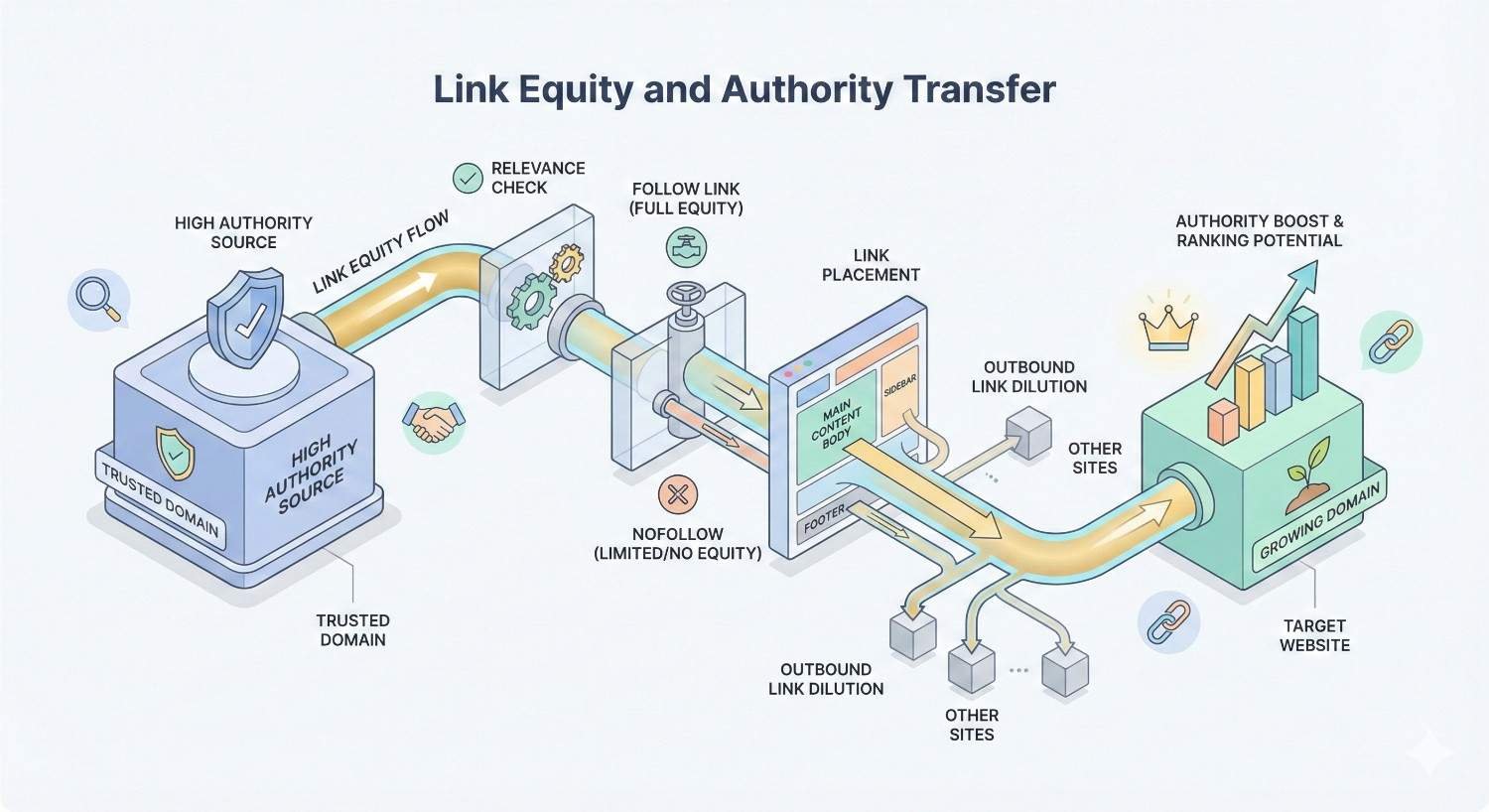
Link equity, sometimes called link juice, refers to the value passed from one page to another through hyperlinks. When an authoritative page links to your content, some of that authority transfers to you.
Not all links pass equal equity. Factors affecting link equity include the linking page’s own authority, the number of other links on that page, the relevance of the linking content, and whether the link uses dofollow or nofollow attributes.
Authority accumulates over time. As you build more quality backlinks, your domain authority increases, making it easier to rank for competitive keywords and making your own outbound links more valuable to others.
The Role of Links in Discoverability and Indexing
Search engine crawlers discover new content primarily by following links. Without any backlinks, a new page may take significantly longer to be indexed, or might not be indexed at all.
Links from frequently crawled sites accelerate indexing. When a major news site or popular blog links to your content, search engines typically discover and index that content within hours rather than days or weeks.
Beyond initial indexing, links help search engines understand content relationships. The anchor text and surrounding context of links provide semantic signals about what your page covers, influencing which queries it ranks for.
How Link Building Actually Works: The Core Process
Effective link building follows a systematic process. While tactics vary, the fundamental workflow involves creating something worth linking to, finding opportunities, conducting outreach, securing the link, and measuring results.
Step 1: Creating Link-Worthy Content Assets
Link building starts with content that provides genuine value. Without something worth linking to, outreach efforts fail. Link-worthy assets typically fall into several categories.
Original research and data attract links because they provide unique information others want to cite. Industry surveys, proprietary data analysis, and benchmark studies generate consistent backlinks from journalists and bloggers seeking authoritative sources.
Comprehensive guides that cover topics more thoroughly than existing content become reference resources. When your guide is the best available resource on a topic, other content creators naturally link to it when discussing related subjects.
Visual assets including infographics, diagrams, and interactive tools earn links because they’re easy to embed and share. A well-designed infographic explaining a complex concept can generate dozens of backlinks as others use it to illustrate their own content.
Free tools and calculators provide ongoing value that generates links continuously. A mortgage calculator, SEO audit tool, or industry-specific calculator becomes a linkable asset that earns backlinks for years.
Step 2: Identifying Link Opportunities
Once you have link-worthy content, you need to find websites likely to link to it. This involves research across several dimensions.
Competitor backlink analysis reveals who links to similar content. Using tools like Ahrefs or Semrush, you can identify every site linking to your competitors and evaluate whether they might also link to your content.
Resource page prospecting finds curated lists of helpful resources in your industry. These pages exist specifically to link out to valuable content, making them ideal targets for outreach.
Broken link discovery identifies pages linking to content that no longer exists. By finding broken links on relevant sites and offering your content as a replacement, you provide value while earning a backlink.
Journalist and blogger research identifies writers who cover your topics. Building a database of relevant contacts enables targeted outreach when you publish new content they might want to cover.
Step 3: Outreach and Relationship Building
Outreach involves contacting website owners, editors, and content creators to request links or propose collaborations. Effective outreach requires personalization and genuine value proposition.
Cold outreach emails should demonstrate familiarity with the recipient’s work, clearly explain why your content benefits their audience, and make the ask simple and specific. Generic mass emails rarely succeed.
Relationship building produces better long-term results than transactional outreach. Engaging with potential link partners on social media, commenting thoughtfully on their content, and providing value before asking for anything creates goodwill that improves response rates.
Follow-up matters significantly. Most successful link placements require multiple touchpoints. A polite follow-up email sent a week after initial outreach often generates responses that the first email didn’t.
Step 4: Earning or Acquiring the Link
The actual link acquisition happens through various mechanisms depending on your approach and the opportunity type.
Editorial links occur when someone discovers your content and links to it without any outreach. This happens when your content ranks well, gets shared on social media, or becomes known as an authoritative resource.
Negotiated placements result from successful outreach. The site owner agrees to add your link to existing content, include it in a new article, or feature your content in a roundup or resource list.
Contributed content involves creating content specifically for another site. Guest posts, expert quotes, and contributed articles include links back to your site as part of the author bio or within the content itself.
Digital PR generates links through media coverage. When journalists write about your company, research, or newsworthy activities, they typically include links to your site as a source.
Step 5: Monitoring and Measuring Link Performance
Link building requires ongoing measurement to understand what works and demonstrate ROI. Tracking involves both link acquisition metrics and downstream impact on rankings and traffic.
New link monitoring tracks when you acquire backlinks, from which domains, and with what anchor text. Tools like Ahrefs, Moz, and Semrush provide alerts when new backlinks appear.
Link quality assessment evaluates whether acquired links meet quality standards. Not all links help rankings, and some can potentially harm them. Regular audits ensure your link profile remains healthy.
Ranking correlation analysis connects link building activities to ranking improvements. While isolating link building’s impact from other SEO factors is difficult, tracking keyword rankings alongside link acquisition reveals patterns.
Traffic attribution measures referral traffic from backlinks and organic traffic increases that correlate with link building campaigns. This data helps calculate ROI and justify continued investment.
Types of Links and How They’re Built
Different link types carry different values and require different acquisition approaches. Understanding these distinctions helps prioritize efforts and set realistic expectations.
Editorial Links (Earned Links)
Editorial links occur naturally when content creators discover your content and choose to reference it without any prompting. These links carry the highest value because they represent genuine endorsement.
Earning editorial links requires creating exceptional content that stands out in your industry. Original research, unique perspectives, and comprehensive resources attract editorial links over time as they gain visibility.
The challenge with editorial links is unpredictability. You cannot directly control when or if they occur. However, promoting your content through social media, email newsletters, and community engagement increases the likelihood of discovery.
Editorial links typically come with natural, varied anchor text that search engines view favorably. Because the linking author chooses the anchor text without guidance, it reflects how real users describe your content.
Manual Outreach Links
Manual outreach links result from proactive efforts to contact website owners and request link placements. This approach provides more control over link acquisition but requires significant time investment.
Successful outreach links depend on providing genuine value to the linking site. Simply asking for a link rarely works. Instead, you need to demonstrate how linking to your content benefits their audience.
Common outreach scenarios include suggesting your resource as an addition to existing content, proposing guest post collaborations, offering expert quotes for articles in progress, and alerting site owners to broken links you can replace.
Response rates for outreach campaigns typically range from 1-10% depending on your approach, the quality of your content, and the relevance of your targets. Personalization and relationship building significantly improve these rates.
Self-Created Links
Self-created links come from actions you take directly, such as adding your site to directories, commenting on blogs, participating in forums, or creating profiles on various platforms.
These links generally carry minimal SEO value. Search engines recognize that self-created links don’t represent third-party endorsement and weight them accordingly. Many self-created link opportunities use nofollow attributes.
However, self-created links aren’t worthless. They can drive referral traffic, build brand awareness, and contribute to a natural-looking link profile. The key is moderation and relevance.
Avoid excessive self-created linking, particularly from low-quality sources. Aggressive self-linking patterns can trigger spam filters and potentially harm your rankings.
Which Link Types Carry the Most Value
Editorial links from authoritative, relevant sites carry the most ranking value. A single editorial link from a major publication often outweighs dozens of lower-quality links.
Manual outreach links from quality sites provide significant value when they come from relevant, authoritative sources. The key factors are the linking site’s authority, relevance to your topic, and the context of the link placement.
Self-created links provide minimal direct ranking value but contribute to a diverse, natural-looking link profile. A healthy backlink profile includes various link types rather than relying exclusively on one acquisition method.
Quality consistently matters more than quantity. Google’s documentation emphasizes that links from trusted, relevant sources carry more weight than large numbers of low-quality links.
Link Building Strategies That Work
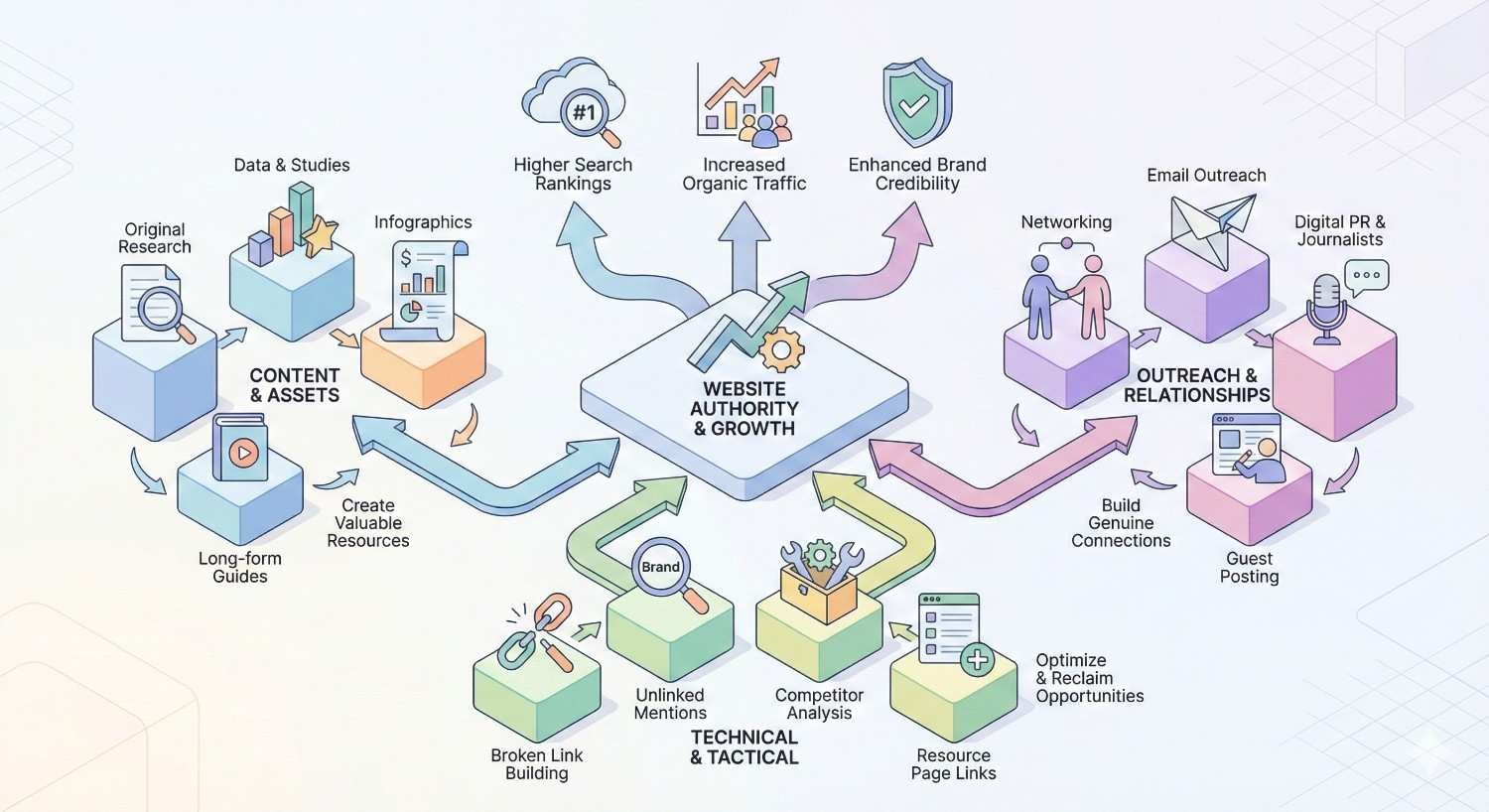
Multiple proven strategies exist for building quality backlinks. The most effective approach combines several tactics based on your resources, industry, and content assets.
Content Marketing and Digital PR
Content marketing creates assets designed to attract links naturally while also serving as outreach ammunition. The strategy involves identifying topics with link potential, creating superior content, and promoting it to relevant audiences.
Digital PR extends content marketing by actively pitching stories to journalists and publications. This includes newsjacking current events, conducting original research that generates headlines, and positioning company leaders as expert sources.
Successful digital PR campaigns can generate dozens of high-authority links from news sites and industry publications. A single viral campaign can produce more quality links than months of traditional outreach.
The combination works because content marketing creates the assets while digital PR ensures they reach audiences with the ability to link. Neither approach works as well in isolation.
Guest Posting and Contributor Opportunities
Guest posting involves writing articles for other websites in exchange for author bylines that include links back to your site. When done correctly, guest posting builds authority, drives referral traffic, and earns quality backlinks.
Quality guest posting targets relevant, authoritative publications where your expertise adds genuine value. The content should meet or exceed the publication’s normal standards, not serve merely as a vehicle for links.
Contributor programs at major publications offer ongoing opportunities. Sites like Forbes, Entrepreneur, and industry-specific publications accept regular contributors who can include contextual links within their articles.
The key to sustainable guest posting is focusing on audience value rather than link acquisition. Publications that accept low-quality guest posts typically provide low-quality links. Aim for sites where getting published represents a genuine achievement.
Broken Link Building
Broken link building identifies dead links on relevant websites and offers your content as a replacement. This strategy provides clear value to site owners by helping them fix user experience problems.
The process involves finding resource pages or articles in your niche, checking for broken outbound links, creating or identifying content that could replace the dead resource, and reaching out to suggest the replacement.
Tools like Ahrefs and Check My Links browser extension help identify broken links at scale. Focus on pages with multiple broken links, as site owners are more likely to update pages that clearly need attention.
Broken link building works because you’re solving a problem rather than just asking for a favor. Site owners appreciate being alerted to broken links, and providing a ready replacement makes fixing the issue easy.
Resource Page Link Building
Resource pages curate helpful links on specific topics. These pages exist specifically to link out, making them ideal targets for outreach.
Finding resource pages involves search queries like “keyword + resources,” “keyword + useful links,” or “keyword + recommended sites.” Industry-specific variations often reveal valuable opportunities.
Successful resource page outreach requires content that genuinely belongs on the list. Your resource should be at least as valuable as others already included, preferably better.
Personalized outreach explaining why your resource benefits the page’s audience produces better results than generic requests. Reference specific resources already on the page to demonstrate you’ve actually reviewed it.
Unlinked Brand Mentions
Unlinked mentions occur when websites reference your brand, products, or content without including a hyperlink. Converting these mentions into links represents low-hanging fruit because the site has already demonstrated interest in your brand.
Monitoring tools like Google Alerts, Mention, and Ahrefs Alerts identify when your brand appears online. Regular monitoring catches mentions quickly while they’re still relevant.
Outreach for unlinked mentions is straightforward: thank the author for the mention and politely request they add a link. Because they’ve already chosen to reference you, conversion rates for these requests typically exceed standard outreach.
This strategy works particularly well for established brands with significant online presence. The more your brand gets mentioned, the more opportunities exist to convert mentions into links.
Competitor Backlink Analysis
Analyzing competitor backlinks reveals link opportunities you might otherwise miss. If a site links to your competitor, they may also link to you given the right approach.
Start by identifying your top-ranking competitors for target keywords. Use backlink analysis tools to export their complete link profiles, then filter for high-quality, relevant linking domains.
Evaluate each opportunity for replicability. Some competitor links come from unique relationships or circumstances you can’t replicate. Focus on links from sites that regularly link to multiple sources in your industry.
Common replicable opportunities include resource pages that list multiple competitors, roundup posts featuring industry tools or services, and publications that cover your industry regularly.
What Makes a Good Backlink?
Not all backlinks provide equal value. Understanding quality factors helps prioritize link building efforts and evaluate campaign success.
Domain Authority and Trust
Domain authority measures a website’s overall strength based on its backlink profile. Links from high-authority domains pass more equity than links from low-authority sites.
Third-party metrics like Moz’s Domain Authority, Ahrefs’ Domain Rating, and Semrush’s Authority Score provide useful proxies for evaluating linking domains. While these metrics don’t directly influence Google’s algorithm, they correlate with ranking ability.
Trust matters alongside authority. Some high-authority domains have questionable reputations due to past spam or manipulation. Links from trusted sources in your industry carry more weight than links from generic high-authority sites.
Evaluate potential linking sites by examining their content quality, audience engagement, and overall reputation. A link from a respected industry publication typically provides more value than a link from a generic high-DA site.
Relevance and Topical Alignment
Topical relevance significantly impacts link value. A link from a site covering related topics signals to search engines that your content belongs in that topical cluster.
Page-level relevance matters as much as domain-level relevance. A link from a relevant article on a general news site may provide more value than a link from an irrelevant page on an industry-specific site.
Contextual relevance extends to the surrounding content. Links embedded within relevant paragraphs that discuss related topics carry more weight than links in sidebars, footers, or unrelated content sections.
Prioritize link opportunities from sites and pages closely aligned with your topic. A smaller number of highly relevant links often outperforms a larger number of tangentially related links.
Anchor Text Optimization
Anchor text is the clickable text of a hyperlink. Search engines use anchor text as a signal for what the linked page covers, making it a factor in ranking for specific keywords.
Natural anchor text profiles include variety. Over-optimized profiles with too many exact-match keyword anchors can trigger spam filters. Healthy profiles include branded anchors, URL anchors, generic phrases, and natural variations.
You have limited control over anchor text in earned links, which is actually beneficial. When others choose anchor text naturally, it creates the varied profile search engines expect.
For links you can influence, such as guest posts or contributed content, use natural language that fits the surrounding context. Avoid forcing exact-match keywords where they don’t fit naturally.
Link Placement and Context
Where a link appears on a page affects its value. Links within main body content typically carry more weight than links in headers, footers, sidebars, or author bios.
Editorial links embedded within relevant paragraphs signal stronger endorsement than navigational links or list inclusions. The surrounding text provides context that helps search engines understand the link’s purpose.
Links appearing early in content may carry slightly more weight than links buried at the bottom. However, natural placement that fits the content flow matters more than forcing links into specific positions.
Evaluate link opportunities based on where your link would appear. A contextual link within a relevant article provides more value than a footer link on a high-authority homepage.
DoFollow vs NoFollow Links
DoFollow links pass link equity and directly influence rankings. NoFollow links include an attribute telling search engines not to pass equity, though they may still provide indirect benefits.
Google has evolved its treatment of nofollow links. The rel=”nofollow” attribute is now treated as a hint rather than a directive, meaning Google may choose to count some nofollow links for ranking purposes.
NoFollow links still provide value through referral traffic, brand exposure, and contributing to a natural link profile. A healthy backlink profile includes both dofollow and nofollow links.
Don’t dismiss nofollow opportunities entirely, but prioritize dofollow links when possible. Major publications and user-generated content platforms typically use nofollow, but links from these sources still benefit your overall online presence.
How Long Does Link Building Take to Show Results?
Link building is a long-term investment. Understanding realistic timelines helps set appropriate expectations and maintain commitment through the initial period before results materialize.
Typical Timeline for Link Building Impact
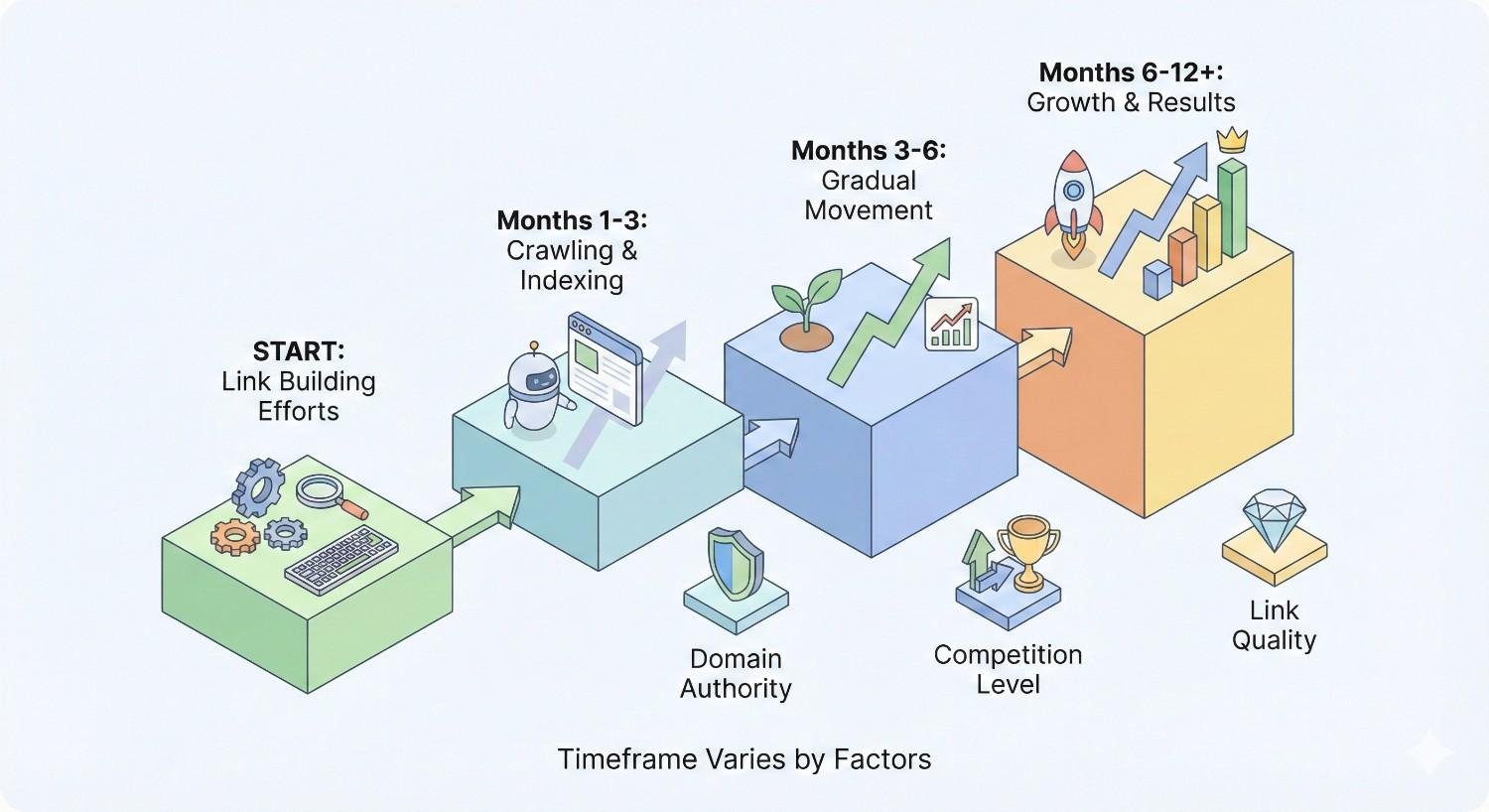
New links typically take 3-6 months to fully impact rankings. Search engines don’t immediately credit new links, and the ranking improvements they enable unfold gradually.
Initial indexing of new links happens within days to weeks depending on how frequently search engines crawl the linking site. However, the ranking impact accumulates over time as search engines process the link’s context and authority signals.
Competitive keywords require more links and more time than less competitive terms. Moving from page two to page one for a moderately competitive keyword might take 6-12 months of consistent link building.
Cumulative effects mean results accelerate over time. The first few months may show minimal movement, but as your link profile strengthens, each additional quality link produces more noticeable impact.
Factors That Affect Link Building Speed
Your starting point significantly affects timeline. Sites with existing authority see faster results from new links than brand-new domains starting from zero.
Link quality impacts speed more than quantity. A few links from highly authoritative, relevant sites can produce faster results than many links from lower-quality sources.
Competition level determines how many links you need and how long reaching competitive positions takes. Highly competitive industries require sustained link building over years, not months.
Content quality affects how well links convert to rankings. Links to thin or low-quality content produce less impact than links to comprehensive, valuable resources that satisfy user intent.
Setting Realistic Expectations
Expect minimal visible results in the first three months. This period involves building momentum that won’t yet show in rankings or traffic.
Months four through six typically show initial movement. You may see improvements for lower-competition keywords and gradual increases in domain authority metrics.
Significant results for competitive keywords usually require six to twelve months of consistent effort. Major ranking improvements for high-value terms often take even longer.
Link building works best as an ongoing program rather than a one-time campaign. Sustained effort produces compounding returns as your authority grows and each new link builds on previous gains.
Common Link Building Mistakes to Avoid
Link building mistakes can waste resources or actively harm your rankings. Understanding common pitfalls helps avoid costly errors.
Buying Links and PBNs
Purchasing links violates Google’s guidelines and risks penalties. While some sites sell links openly, these transactions are detectable and can result in manual actions or algorithmic devaluation.
Private Blog Networks (PBNs) involve creating or acquiring multiple websites specifically to link to a main site. Google actively identifies and penalizes PBN schemes, and the risk has increased as detection methods improve.
The short-term gains from purchased links rarely justify the long-term risks. Penalties can devastate organic traffic, and recovery requires disavowing links and waiting months for reconsideration.
If an opportunity seems too easy or too cheap, it’s likely a scheme that will eventually backfire. Legitimate link building requires effort precisely because valuable links are difficult to acquire.
Low-Quality Directory Submissions
Mass directory submissions were once a common link building tactic. Today, most directories provide no SEO value and some can actually harm your profile.
Quality directories still exist and can provide value. Industry-specific directories, local business directories like Google Business Profile, and curated resource lists differ from spam directories that accept any submission.
Evaluate directories based on editorial standards, relevance to your industry, and whether real users actually use them. If a directory accepts any submission without review, it’s unlikely to provide value.
Focus directory efforts on a small number of high-quality, relevant directories rather than mass submissions to hundreds of low-quality sites.
Over-Optimized Anchor Text
Anchor text manipulation was once effective but now triggers penalties. Profiles with unnaturally high percentages of exact-match keyword anchors signal manipulation to search engines.
Natural anchor text profiles include mostly branded anchors, URL anchors, and generic phrases like “click here” or “this resource.” Exact-match keyword anchors should represent a small minority.
If you’ve built links with over-optimized anchors, consider diversifying future link building to balance your profile. In severe cases, disavowing manipulative links may be necessary.
Let anchor text occur naturally whenever possible. When you can influence anchor text, prioritize natural language that fits the context over keyword optimization.
Irrelevant or Spammy Link Sources
Links from irrelevant sites provide minimal value and can signal manipulation. A link from a gambling site to a B2B software company looks unnatural regardless of the linking site’s authority.
Spammy link sources include hacked sites, link farms, foreign-language sites unrelated to your market, and sites with obvious quality issues. These links can actively harm your rankings.
Audit your backlink profile regularly to identify problematic links. Tools like Google Search Console, Ahrefs, and Semrush help identify potentially harmful backlinks.
Use Google’s disavow tool for links you cannot remove that may be harming your site. However, use disavow conservatively, as incorrectly disavowing legitimate links can hurt rankings.
Ignoring Link Velocity and Natural Patterns
Link velocity refers to the rate at which you acquire new backlinks. Sudden spikes in link acquisition can appear unnatural and trigger scrutiny.
Natural link profiles grow gradually with occasional spikes around newsworthy events or viral content. Consistent, steady growth looks more natural than erratic patterns.
Avoid acquiring large numbers of links in short periods unless you have a legitimate reason like major news coverage or a viral campaign. Spread link building efforts over time for more natural patterns.
Monitor your link velocity alongside competitors. If your acquisition rate dramatically exceeds industry norms without corresponding content or news events, it may appear manipulative.
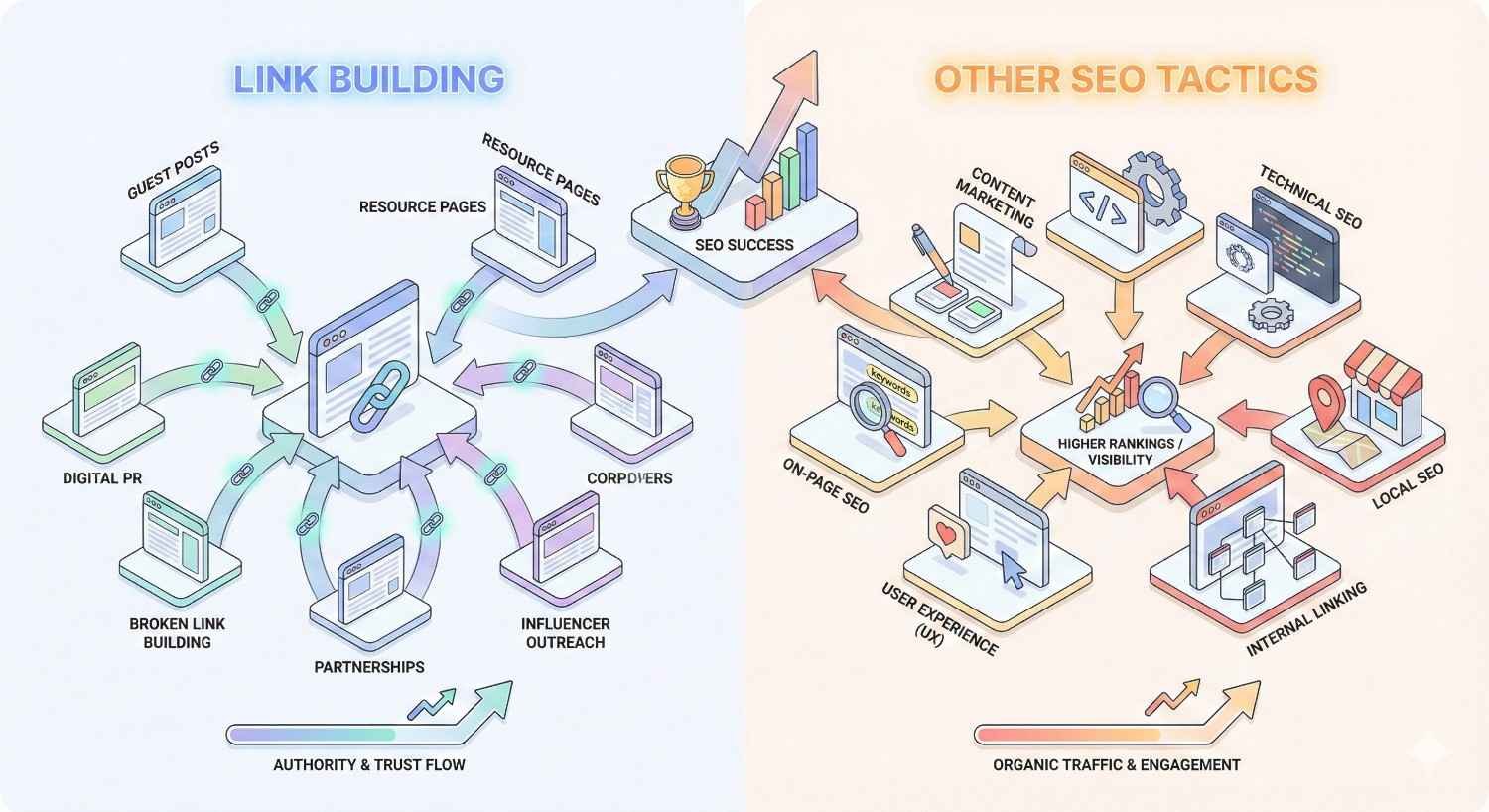
Link Building vs Other SEO Tactics
Link building is one component of comprehensive SEO. Understanding how it relates to other tactics helps allocate resources effectively.
Link Building vs Content Marketing
Content marketing and link building are complementary rather than competing tactics. Content marketing creates the assets that attract and justify links, while link building ensures those assets reach audiences who can link to them.
Content without promotion often fails to attract links regardless of quality. Link building without quality content fails because there’s nothing worth linking to. The combination produces better results than either approach alone.
Resource allocation between content and link building depends on your current situation. Sites with strong content but weak link profiles should emphasize link building. Sites with strong links but thin content should prioritize content development.
The most effective programs integrate both continuously. Create content with link potential, promote it through outreach and digital PR, then use the resulting links to improve rankings that drive more organic discovery.
Link Building vs Technical SEO
Technical SEO ensures search engines can crawl, index, and understand your site. Without solid technical foundations, link building efforts may be wasted on pages that can’t rank.
Technical issues like slow page speed, poor mobile experience, or crawl errors can prevent pages from ranking regardless of their link profiles. Address technical fundamentals before investing heavily in link building.
However, technical SEO alone rarely produces competitive rankings for valuable keywords. Most competitive searches require both technical excellence and strong backlink profiles.
Prioritize technical SEO for new sites or sites with known issues. Once technical foundations are solid, shift emphasis toward content and link building for competitive keywords.
How Link Building Fits Into a Complete SEO Strategy
Effective SEO integrates technical optimization, content strategy, and link building into a cohesive program. Each element supports the others.
Technical SEO creates the foundation. Content strategy identifies opportunities and creates assets. Link building amplifies content reach and builds the authority needed to compete.
Budget allocation varies by situation. Early-stage sites may need heavier technical and content investment. Established sites with solid foundations often benefit most from increased link building focus.
Measure all three areas and adjust allocation based on results. If technical issues limit performance, address them first. If content gaps exist, fill them. If authority is the limiting factor, emphasize link building.
Tools and Resources for Link Building
Effective link building requires tools for research, outreach, and monitoring. The right toolkit increases efficiency and improves results.
Backlink Analysis Tools
Backlink analysis tools reveal your link profile and your competitors’ profiles. This data informs strategy and identifies opportunities.
Ahrefs provides comprehensive backlink data, competitor analysis, and content research features. Its backlink index is among the largest available, making it valuable for thorough competitive analysis.
Semrush offers backlink analytics alongside broader SEO and marketing features. Its link building tool includes outreach management capabilities.
Moz Link Explorer provides backlink data with Moz’s proprietary Domain Authority and Page Authority metrics. The free tier offers limited but useful functionality.
Google Search Console provides free data about links Google has discovered pointing to your site. While less comprehensive than paid tools, it shows what Google actually sees.
Outreach and CRM Platforms
Outreach tools manage contact databases, email sequences, and response tracking. They increase efficiency for high-volume link building campaigns.
Pitchbox combines prospecting, outreach, and relationship management specifically for link building and digital PR campaigns.
BuzzStream provides contact management, email outreach, and link monitoring in a platform designed for link builders and PR professionals.
Hunter.io helps find email addresses for outreach targets. It integrates with various CRM and outreach platforms.
General CRM tools like HubSpot or even spreadsheets can work for smaller-scale link building. The key is tracking contacts, outreach attempts, and responses systematically.
Content Research and Ideation Tools
Content research tools identify topics with link potential and analyze what content earns links in your industry.
BuzzSumo shows which content gets shared and linked most in any topic area. Use it to identify content formats and topics that attract links.
Ahrefs Content Explorer finds content by topic and sorts by backlinks, helping identify what earns links in your niche.
AnswerThePublic reveals questions people ask about topics, helping create content that addresses real information needs.
Google Trends shows topic popularity over time, helping identify rising topics before they become saturated.
Link Monitoring and Tracking Tools
Link monitoring tools alert you to new backlinks, lost links, and changes in your link profile. This data helps measure campaign success and identify issues.
Most backlink analysis tools include monitoring features. Ahrefs, Semrush, and Moz all offer alerts for new and lost backlinks.
Linkody focuses specifically on link monitoring with features for tracking link status, anchor text, and linking page changes.
Google Search Console shows links Google has discovered, though with some delay. Regular checks reveal trends in your link profile growth.
Set up monitoring for both your site and key competitors. Competitor link alerts reveal new opportunities as they acquire links you might also pursue.
Should You Build Links In-House or Hire an Agency?
The decision between in-house link building and agency partnership depends on your resources, expertise, and goals.
DIY Link Building: Pros and Cons
In-house link building provides direct control over strategy, messaging, and relationship building. You understand your brand and industry better than any external partner.
The primary challenge is expertise and time. Effective link building requires skills in content creation, outreach, and relationship management. Building these capabilities takes time and investment.
DIY works well for companies with existing marketing teams who can dedicate time to link building. It’s also appropriate when brand voice and relationship continuity matter significantly.
The learning curve is steep. Expect several months of experimentation before developing effective processes. Budget for tools, training, and the opportunity cost of staff time.
When to Hire a Link Building Agency
Agencies make sense when you need results faster than internal capability building allows. Established agencies have existing relationships, proven processes, and experienced staff.
Consider an agency when link building isn’t a core competency you need to develop internally. If your competitive advantage lies elsewhere, outsourcing link building may be more efficient.
Agencies also help when you need to scale quickly. Building an internal team takes time, while agencies can deploy resources immediately.
The tradeoff is cost and control. Agencies charge for their expertise and overhead. You also have less direct control over tactics and relationships.
What to Look for in a Link Building Partner
Evaluate agencies based on their approach, not just their promises. Ask detailed questions about how they identify opportunities, conduct outreach, and measure success.
Request case studies with specific metrics. Vague claims of “improved rankings” matter less than documented link acquisition from quality sources.
Understand their link quality standards. Agencies that promise large numbers of links cheaply likely use tactics that could harm your site. Quality link building is labor-intensive and priced accordingly.
Check references from current or recent clients. Ask about communication, reporting, and whether results matched expectations.
Ensure alignment on tactics. Some agencies use approaches that violate search engine guidelines. Understand exactly what they’ll do on your behalf.
Typical Link Building Costs and Pricing Models
Link building pricing varies widely based on quality, scale, and approach. Understanding typical models helps evaluate proposals.
Per-link pricing ranges from $100-500 for lower-quality links to $500-2,000+ for high-authority placements. Be skeptical of very cheap per-link pricing, as it often indicates low-quality sources.
Monthly retainer models typically range from $2,000-10,000+ depending on scope and agency reputation. Retainers usually include a target number of links or outreach activities.
Project-based pricing works for specific campaigns like digital PR pushes or content-driven link building initiatives. Costs depend on scope and deliverables.
Internal costs for DIY link building include staff time, tools (typically $200-500/month for essential tools), and content creation. Calculate fully-loaded costs when comparing to agency pricing.
Measuring Link Building Success
Measurement demonstrates ROI and guides strategy refinement. Track both direct link metrics and downstream business impact.
Key Link Building Metrics to Track
Track the number of new referring domains acquired monthly. Referring domains matter more than total backlinks because multiple links from one domain provide diminishing returns.
Monitor Domain Rating or Domain Authority trends. While these third-party metrics don’t directly influence Google, they indicate overall link profile strength.
Track link quality indicators including average linking domain authority, relevance scores, and dofollow percentage. Quality metrics matter more than quantity.
Measure outreach efficiency through response rates, conversion rates, and cost per acquired link. These operational metrics help optimize processes.
How to Monitor Backlink Quality
Regular audits identify problematic links before they cause issues. Review new links monthly to ensure they meet quality standards.
Evaluate linking domains for relevance, authority, and legitimacy. Flag links from irrelevant sites, low-quality domains, or potentially spammy sources.
Check that links remain live and dofollow. Links can be removed or changed to nofollow without notification. Monitoring catches these changes.
Compare your link profile to competitors. If your profile looks significantly different in terms of link types, anchor text distribution, or source quality, investigate why.
Connecting Links to Rankings and Traffic
Correlate link acquisition with ranking changes for target keywords. While other factors influence rankings, patterns often emerge showing link building impact.
Track organic traffic to pages receiving new backlinks. Increased traffic following link acquisition suggests the links are providing value.
Monitor referral traffic from backlinks. Quality links from relevant sites should drive some direct traffic in addition to SEO benefits.
Use landing page analysis to understand which linked pages convert visitors. This connects link building to business outcomes beyond traffic.
Reporting on Link Building ROI
Calculate cost per link including all expenses: agency fees, staff time, tools, and content creation. Compare this to the value of ranking improvements.
Estimate traffic value using tools that calculate what equivalent paid traffic would cost. If link building drives $10,000 in monthly organic traffic value at $3,000 monthly cost, ROI is clear.
Track lead generation and revenue from organic traffic to pages benefiting from link building. This connects link building directly to business results.
Report on both leading indicators (links acquired, domain authority growth) and lagging indicators (rankings, traffic, conversions). Leading indicators show progress before business results materialize.
Conclusion
Link building works by creating valuable content, identifying opportunities, conducting strategic outreach, and earning backlinks that signal authority to search engines. The process requires patience, as results typically take three to six months to materialize, but the compounding returns make it one of the highest-ROI investments in SEO.
Success depends on quality over quantity, relevance over raw authority, and sustainable practices over shortcuts. The strategies outlined here, from content marketing and digital PR to broken link building and competitor analysis, provide a framework for building authority systematically.
We help businesses build sustainable link profiles that drive long-term organic growth. Contact White Label SEO Service to discuss how strategic link building can accelerate your search visibility and deliver measurable business results.
Frequently Asked Questions
How much does link building cost?
Link building costs range from $100-2,000+ per link depending on quality, or $2,000-10,000+ monthly for agency retainers. DIY approaches require tool investments of $200-500/month plus significant staff time. Quality links from authoritative, relevant sources cost more but provide substantially better ROI.
Can I build links myself or do I need an agency?
You can build links yourself if you have time to learn effective techniques and conduct ongoing outreach. Agencies provide faster results through established relationships and proven processes. The choice depends on your available resources, timeline, and whether link building expertise aligns with your core business capabilities.
What are the risks of link building?
The primary risks involve acquiring low-quality or manipulative links that trigger Google penalties. Buying links, using private blog networks, or building links from irrelevant spam sites can result in ranking drops or manual actions. Following quality guidelines and focusing on earned links from legitimate sources minimizes these risks.
How many backlinks do I need to rank?
The number varies dramatically by keyword competition. Low-competition terms might rank with a handful of quality links, while highly competitive keywords may require hundreds of referring domains. Focus on link quality and relevance rather than hitting arbitrary quantity targets.
Do nofollow links help SEO?
Nofollow links provide indirect benefits including referral traffic, brand exposure, and contributing to a natural link profile. Google now treats nofollow as a hint rather than directive, meaning some nofollow links may pass ranking value. Don’t dismiss nofollow opportunities, but prioritize dofollow links when possible.
How long do backlinks take to affect rankings?
New backlinks typically take 3-6 months to fully impact rankings. Search engines don’t immediately credit new links, and the ranking improvements unfold gradually as authority accumulates. Competitive keywords require longer timeframes and more sustained link building effort.
What’s the difference between link building and link earning?
Link building encompasses all activities to acquire backlinks, including outreach and promotion. Link earning specifically refers to attracting links naturally through content quality without direct solicitation. Effective strategies combine both: creating link-worthy content (earning) and promoting it to relevant audiences (building).