
HARO link building remains one of the most effective white-hat strategies for earning editorial backlinks from high-authority publications like Forbes, Business Insider, and industry-leading websites. Unlike traditional outreach where you pitch content, HARO flips the script by connecting you directly with journalists actively seeking expert sources.
For business owners and marketing teams focused on sustainable organic growth, this approach delivers something rare in SEO: genuine editorial links that search engines trust. The challenge is execution. Most pitches fail because they lack strategy.
This guide covers everything from account setup to scaling systems, including realistic timelines, cost breakdowns, and the exact pitch frameworks that consistently earn placements.
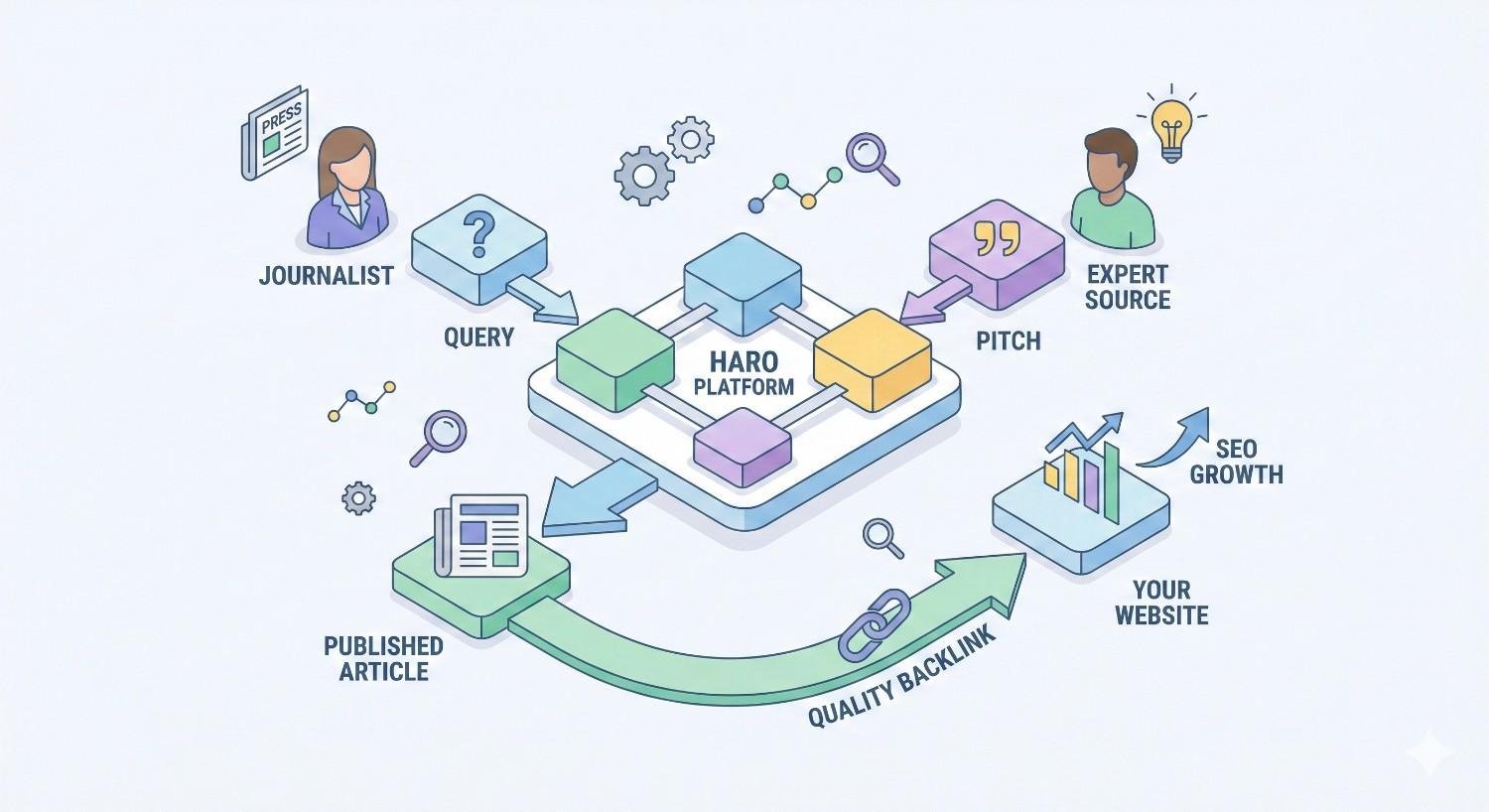
What Is HARO Link Building?
HARO link building is the practice of using Help A Reporter Out (now part of Connectively) to earn backlinks by responding to journalist queries. When reporters need expert quotes for their articles, they post requests through the platform. You respond with valuable insights, and if selected, you typically receive a backlink to your website within the published piece.
This method differs fundamentally from guest posting or link exchanges. You are not asking for links. Journalists are asking for your expertise. The resulting backlinks carry editorial weight because they appear naturally within news articles and feature stories on established media sites.
The platform sends three email digests daily containing queries across categories like business, technology, health, finance, and lifestyle. Each query represents a potential link opportunity from publications ranging from local news outlets to major national media.
How HARO Works for Link Acquisition
The process follows a straightforward workflow. Journalists submit source requests describing what expertise they need, their deadline, and publication details. These requests get compiled into category-specific emails sent to registered sources at 5:35 AM, 12:35 PM, and 5:35 PM Eastern Time.
When you spot a relevant query, you craft a pitch responding directly to what the journalist asked. Your response includes your expert insight, credentials establishing why you are qualified to comment, and contact information. Journalists review submissions and select sources that best fit their story angle.
If chosen, your quote appears in the published article. Most journalists include a backlink to your website or company page as attribution. The entire cycle from query to publication typically spans one to four weeks, though breaking news stories move faster.
Success depends on speed, relevance, and the quality of your response. Journalists receive dozens or hundreds of pitches per query. Standing out requires understanding what makes a response genuinely useful versus generic filler.
Types of Links You Can Earn Through HARO
HARO delivers several link categories based on publication type and journalist preferences. Understanding these helps set realistic expectations for your link building campaign.
Tier-one media links come from major publications with domain ratings above 80. These include outlets like Forbes, Inc., Entrepreneur, Business Insider, and HuffPost. Landing these links significantly impacts domain authority but requires highly polished pitches and genuine expertise.
Industry publication links target niche-specific outlets covering your sector. A SaaS company might earn links from TechCrunch or VentureBeat. An accounting firm could land placements in Accounting Today or Journal of Accountancy. These links carry strong topical relevance signals.
Regional and local media links come from city newspapers, local business journals, and regional news sites. While domain ratings vary, these links build geographic relevance for local SEO campaigns.
Blog and content site links originate from established blogs, content platforms, and digital magazines. Quality ranges widely, so evaluating each opportunity matters before investing pitch time.
Most HARO links are dofollow, though some publications default to nofollow for external links. Even nofollow links from high-authority sites provide referral traffic and brand visibility benefits.
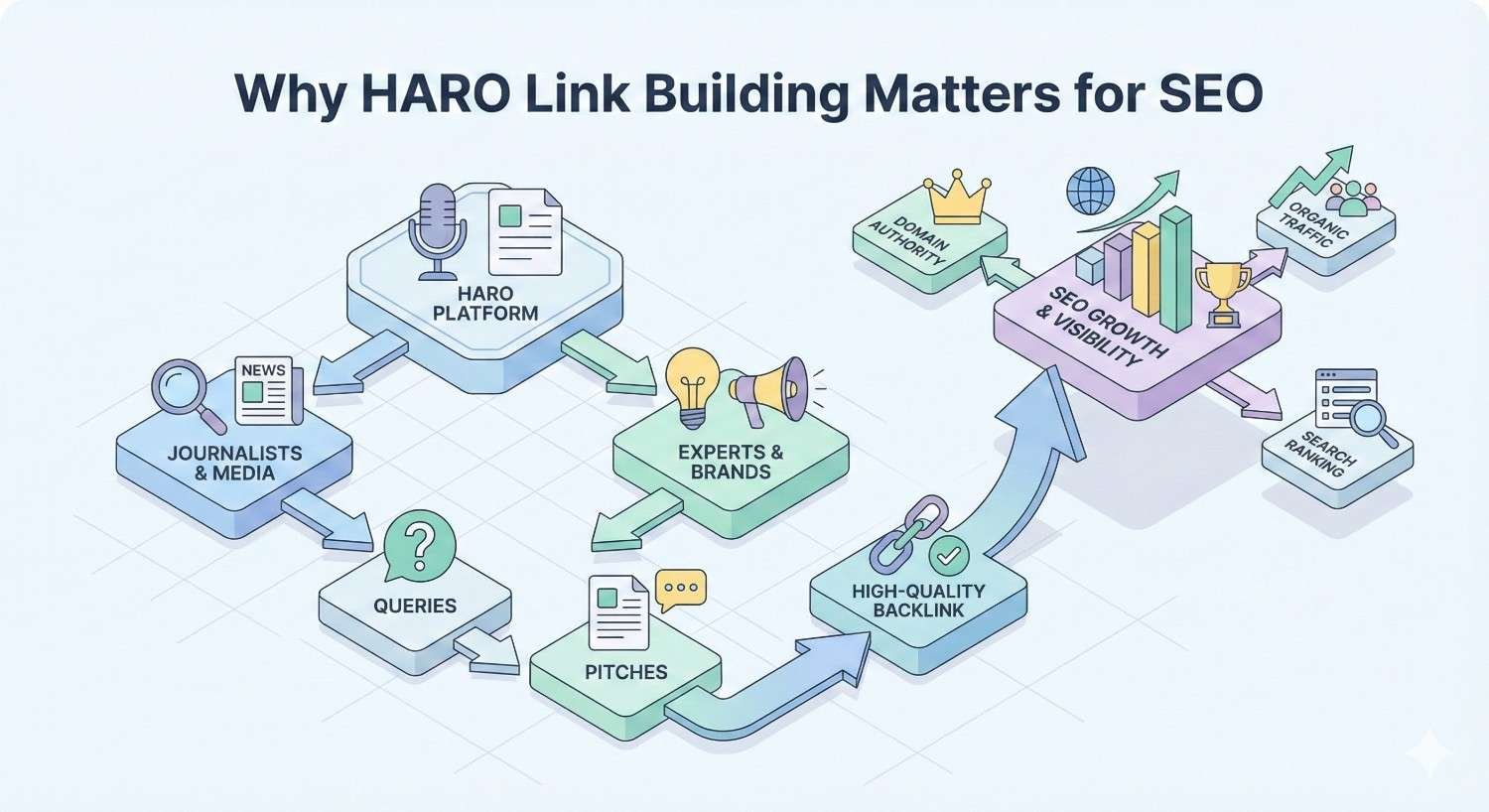
Why HARO Link Building Matters for SEO
Link building remains a core ranking factor, but not all backlinks deliver equal value. Search engines evaluate links based on the linking site’s authority, editorial context, and relevance to your content. HARO excels at generating links that check every quality box.
The fundamental advantage is editorial legitimacy. When a journalist at a respected publication chooses to cite your expertise and link to your site, that represents a genuine editorial decision. Search engines recognize this distinction between earned media mentions and manufactured link schemes.
For businesses competing in crowded markets, HARO provides access to link opportunities that would otherwise require expensive PR agencies or years of relationship building. A well-crafted pitch can land a Forbes backlink that competitors spend thousands trying to acquire through other channels.
Authority and Trust Signals from Media Backlinks
Media backlinks send powerful trust signals because they originate from sites that search engines already recognize as authoritative information sources. Google’s systems evaluate the trustworthiness of linking domains when determining how much ranking value to pass through each backlink.
Publications like The New York Times, Reuters, and major industry outlets have established trust through years of editorial standards and fact-checking processes. When these sites link to your domain, some of that trust transfers to your site in Google’s evaluation.
Beyond algorithmic benefits, media mentions build brand credibility with human visitors. Displaying “As Featured In” logos from recognized publications increases conversion rates and establishes thought leadership positioning. This dual benefit of SEO value plus brand authority makes HARO links particularly valuable for businesses building market presence.
The editorial context also matters. HARO links appear within article body content, surrounded by relevant text about your expertise area. This contextual placement signals topical relevance more strongly than sidebar links or author bio placements common in guest posting.
How HARO Links Impact Domain Rating
Domain Rating and Domain Authority metrics respond positively to high-quality backlink acquisition. While these third-party metrics do not directly influence Google rankings, they correlate with the underlying factors Google does measure.
A single backlink from a DR 90+ publication can noticeably move your domain metrics, especially for newer sites with limited backlink profiles. Ahrefs data shows that links from high-DR sites pass more “link equity” than equivalent numbers of links from lower-authority sources.
The compounding effect matters for long-term SEO strategy. As your domain rating increases, your content becomes more competitive for difficult keywords. Pages that previously could not rank begin appearing in top positions because your overall domain strength supports them.
HARO’s value proposition becomes clear when comparing effort-to-impact ratios. Earning one DR 85 link through HARO might require 20 pitches over two weeks. Acquiring equivalent authority through guest posting could require months of outreach and content creation.
HARO vs. Traditional Link Building Methods
Traditional link building encompasses tactics like guest posting, broken link building, resource page outreach, and digital PR campaigns. Each method has distinct advantages and limitations compared to HARO.
Guest posting requires creating full articles for other sites, typically 1,000+ words per placement. The time investment is substantial, and many guest post opportunities come from lower-authority sites. HARO pitches take 15-30 minutes and can land links from publications that do not accept guest contributions.
Broken link building involves finding dead links on relevant sites and suggesting your content as a replacement. Success rates are low, often below 5%, and the process requires significant prospecting time. HARO queries represent pre-qualified opportunities where someone actively wants your input.
Digital PR campaigns can generate massive link volumes from news coverage but require newsworthy angles, data studies, or creative assets. Costs for professional PR campaigns start at several thousand dollars monthly. HARO provides a free or low-cost alternative for consistent media placements.
Link exchanges and PBNs violate Google’s guidelines and carry penalty risks. HARO links are explicitly white-hat because journalists make independent editorial decisions about inclusion.
The strategic approach combines HARO with complementary tactics. Use HARO for high-authority editorial links while building topical relevance through guest posts and resource link building.
How to Get Started with HARO Link Building
Starting with HARO requires minimal setup but benefits from strategic preparation. Before sending your first pitch, establish the foundation that increases success rates and streamlines ongoing efforts.
The initial investment is your time understanding the platform mechanics and preparing response templates. Most new users underestimate how competitive popular queries become. Preparation separates successful HARO practitioners from those who abandon the tactic after a few ignored pitches.
Setting Up Your HARO Account
Registration at Connectively (formerly HARO) takes under five minutes. Visit the platform, select the source registration option, and complete the profile form with your professional information.
Your profile should accurately represent your expertise areas and professional background. Journalists sometimes review source profiles before selecting respondents, so treat this as a mini-resume. Include your job title, company name, and a brief description of your expertise domains.
Email configuration matters for response speed. HARO queries have tight deadlines, sometimes same-day. Configure your email client to prioritize HARO digests or set up filters that flag incoming queries for immediate review.
Consider creating a dedicated email address for HARO to separate query notifications from regular business communications. This prevents important queries from getting buried in crowded inboxes.
Choosing the Right HARO Subscription Plan
HARO offers tiered subscription options balancing cost against features. The free plan provides full access to queries but limits functionality that power users need.
Free Plan includes all three daily query emails across all categories. For businesses testing HARO or with limited bandwidth, this provides sufficient access to evaluate the tactic’s potential.
Standard Plan (approximately $19/month) adds keyword alerts, allowing you to receive notifications when queries match specific terms. This feature saves significant time by surfacing relevant opportunities automatically.
Advanced Plan (approximately $49/month) includes profile enhancements and priority placement in journalist searches. For businesses making HARO a core link building channel, these features improve visibility and response rates.
Premium Plan (approximately $149/month) provides the highest visibility and additional features for agencies or businesses scaling HARO operations significantly.
Most businesses should start with the free plan for 30-60 days to establish baseline response rates before upgrading. If you consistently find relevant queries and achieve placements, paid features accelerate results.
Configuring Your Query Preferences
Category selection determines which queries appear in your daily emails. HARO covers broad categories including Business and Finance, High Tech, Healthcare and Medical, Lifestyle and Fitness, and General.
Select categories matching your expertise rather than casting the widest net. Receiving queries outside your knowledge areas wastes review time and tempts low-quality responses that damage your reputation with journalists.
For most B2B companies, Business and Finance plus High Tech cover relevant opportunities. E-commerce brands benefit from Lifestyle and Fitness additions. Professional services firms should include their specific industry category.
Keyword alerts in paid plans let you specify terms triggering instant notifications. Configure alerts for your industry terminology, competitor names, and trending topics in your space. When a query mentions “SaaS pricing” or “e-commerce conversion,” you receive immediate notification rather than waiting for the next digest.
How to Write HARO Pitches That Get Published
Pitch quality determines HARO success more than volume. Journalists report receiving 50-200+ responses per query. Standing out requires understanding what makes responses useful versus what gets immediately deleted.
The fundamental principle is providing genuine value. Journalists need quotable insights that enhance their articles. Generic statements, self-promotional content, and off-topic responses waste everyone’s time and build negative reputation.
Anatomy of a Winning HARO Response
Effective HARO pitches follow a consistent structure optimized for journalist workflows. Reporters scan responses quickly, so front-load the most important elements.
Opening hook (1-2 sentences): Directly address the query with your key insight. Do not introduce yourself first. Lead with the value you are providing.
Supporting detail (2-4 sentences): Expand on your initial point with specific examples, data, or context. This gives journalists quotable material beyond your headline statement.
Credentials (2-3 sentences): Explain why you are qualified to comment on this topic. Include relevant experience, professional background, or specific expertise that establishes authority.
Contact information: Provide your full name, title, company, website URL, and email. Make it easy for journalists to attribute and link correctly.
Total length: Keep responses under 300 words. Journalists appreciate concise, focused pitches they can quickly evaluate and excerpt.
Example structure for a query about remote work productivity:
“Remote teams consistently outperform office-based counterparts when given proper async communication tools. Our data shows response times improve 40% when teams shift from real-time chat to structured documentation.
The key is reducing context-switching. Every Slack notification interrupts deep work. Teams using async-first approaches report completing complex projects 25% faster because focused work blocks remain protected.
I’m [Name], CEO of [Company], where we’ve managed distributed teams across 12 countries for eight years. We’ve tested virtually every remote work configuration and measured productivity impacts across 200+ team members.
Contact: [email] | [website]”
Subject Line Best Practices
Subject lines determine whether journalists open your email. With hundreds of responses competing for attention, your subject line must immediately communicate relevance and value.
Include the query topic: Reference the specific subject so journalists can quickly categorize your response.
Add your unique angle: Differentiate from generic responses by hinting at your specific expertise or insight.
Keep it under 60 characters: Longer subject lines get truncated in email previews.
Avoid clickbait: Journalists recognize and ignore sensationalized subject lines.
Effective examples:
- “Remote Work Productivity: 8-Year Data from 12-Country Team”
- “SaaS Pricing Expert: Why Freemium Fails for Enterprise”
- “E-commerce Returns: Retailer Perspective with $50M Experience”
Weak examples to avoid:
- “Response to your query”
- “Expert available for interview”
- “URGENT: Must-read insights inside”
Crafting Your Expert Bio and Credentials
Your credentials section establishes why journalists should trust and cite you. This is not a full resume but a targeted proof of expertise relevant to the specific query.
Quantify experience: “15 years in digital marketing” carries more weight than “experienced marketer.”
Specify relevant achievements: If the query concerns startup funding, mention companies you have funded or raised capital for.
Include recognizable affiliations: Industry associations, certifications, or notable clients add credibility.
Match credentials to query: Emphasize different aspects of your background depending on what each query requires.
For a query about SEO trends, an effective credentials section might read:
“I’m [Name], Director of SEO at [Company], where I’ve managed organic growth strategies for 50+ clients including [Notable Brand]. Previously, I led SEO at [Previous Company], growing organic traffic from 100K to 2M monthly visitors. I regularly speak at MozCon and SearchLove on technical SEO topics.”
Response Timing and Speed Strategies
Speed significantly impacts HARO success rates. Journalists often select sources from early responses, especially for time-sensitive stories. Responding within the first hour of query publication dramatically increases selection probability.
Monitor query timing: HARO emails arrive at predictable times (5:35 AM, 12:35 PM, 5:35 PM ET). Schedule your day to review queries immediately upon arrival.
Prepare templates: Create response frameworks for common query types in your industry. Customize templates for each specific query rather than sending generic versions.
Use keyword alerts: Paid plan alerts notify you instantly when relevant queries post, bypassing the digest delay.
Batch similar queries: When multiple queries relate to your expertise, respond to all before moving to other tasks. Context-switching between query review and other work reduces efficiency.
Set response time limits: Allocate 15-20 minutes maximum per response. If a query requires extensive research, it may not be the right opportunity.
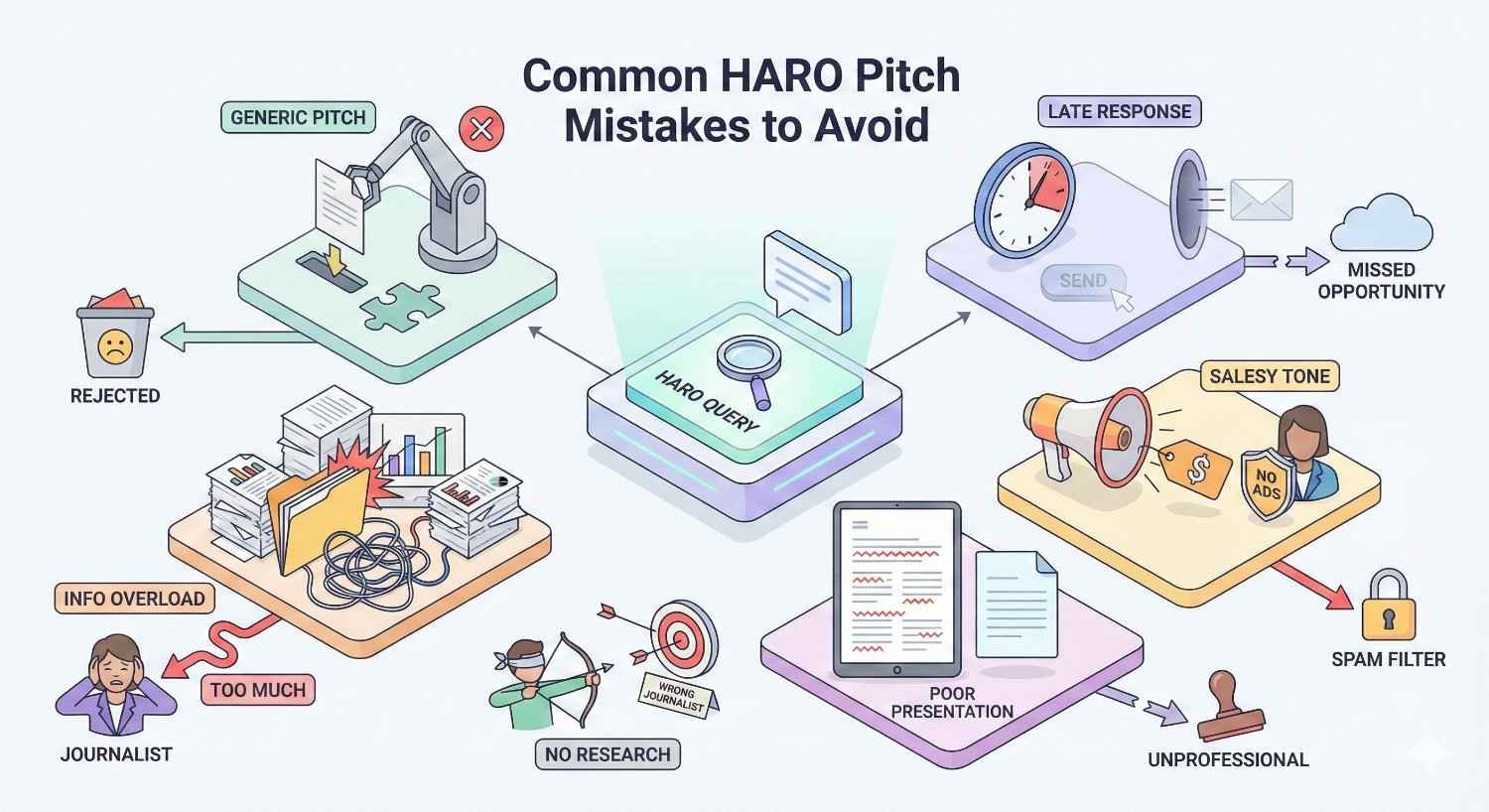
Common HARO Pitch Mistakes to Avoid
Understanding failure patterns helps you avoid wasted effort and reputation damage with journalists.
Ignoring query requirements: If a journalist requests sources from specific industries or with particular experience, do not respond unless you qualify. Irrelevant pitches annoy journalists and get you blocked.
Self-promotional content: Journalists want insights, not advertisements. Pitches that read like marketing copy get deleted immediately.
Generic responses: Statements that could apply to any query provide no value. Specificity and unique perspective differentiate winning pitches.
Missing deadlines: Late responses rarely get considered. If you cannot respond before the deadline, skip that query.
Poor formatting: Walls of text without structure are difficult to scan. Use short paragraphs and clear organization.
Exaggerating credentials: Journalists verify sources. Misrepresenting your expertise damages credibility and can result in platform bans.
Responding to everything: Quality over quantity matters. Ten thoughtful, relevant responses outperform 100 generic pitches.
HARO Link Building Strategy by Industry
Different industries face unique HARO opportunities and challenges. Query volume, competition levels, and journalist expectations vary significantly across sectors. Tailoring your approach to industry-specific dynamics improves success rates.
HARO for SaaS and Technology Companies
Technology queries appear frequently in HARO, covering topics from cybersecurity to software development to startup operations. Competition is high because many tech companies recognize HARO’s value.
Opportunity areas: Product development insights, technical explanations for mainstream audiences, startup growth strategies, remote work and productivity tools, data privacy and security.
Differentiation strategies: Provide specific metrics from your product or company. Journalists covering tech appreciate concrete data over general observations. If your SaaS reduced customer churn by 30%, that specific insight beats generic retention advice.
Publication targets: TechCrunch, Wired, Fast Company, VentureBeat, and industry-specific outlets like SaaStr or Product Hunt regularly source through HARO.
Positioning tip: Frame technical expertise in accessible language. Journalists writing for general business audiences need sources who can explain complex topics simply.
HARO for E-commerce and Retail Brands
E-commerce queries span consumer trends, retail operations, supply chain logistics, and digital marketing tactics. Seasonal spikes occur around major shopping periods.
Opportunity areas: Consumer behavior insights, pricing strategies, customer experience optimization, fulfillment and logistics, sustainability in retail.
Differentiation strategies: Share specific campaign results or operational data. A response citing “our Black Friday email sequence generated $2M in 48 hours” provides more value than general email marketing advice.
Publication targets: Retail Dive, Modern Retail, Practical Ecommerce, and mainstream business publications covering consumer trends.
Positioning tip: Consumer-facing brands can leverage customer research and survey data. Journalists appreciate sources with direct insight into buyer behavior.
HARO for Professional Services and Agencies
Consultants, agencies, and professional services firms have natural expertise positioning for HARO. The challenge is differentiating from numerous competitors claiming similar credentials.
Opportunity areas: Industry-specific expertise (legal, financial, marketing), business strategy, hiring and HR, client relationship management.
Differentiation strategies: Reference specific client outcomes without violating confidentiality. “A recent client in manufacturing reduced operational costs 25% through process automation” demonstrates expertise through results.
Publication targets: Industry trade publications, business journals, and mainstream outlets covering professional topics.
Positioning tip: Develop signature frameworks or methodologies that provide unique angles. A proprietary approach to client onboarding or project management gives journalists something distinctive to reference.
HARO for Local Businesses
Local businesses can leverage HARO for both national exposure and regional media placements. Geographic specificity often reduces competition for relevant queries.
Opportunity areas: Local economic trends, small business operations, community engagement, industry-specific local expertise.
Differentiation strategies: Emphasize local market knowledge and community connections. National journalists covering local business trends need sources with ground-level perspective.
Publication targets: Local newspapers, regional business journals, and national outlets seeking local examples for broader stories.
Positioning tip: Monitor queries mentioning your city or region. These lower-competition opportunities often yield placements in local publications valuable for geographic SEO signals.
Scaling Your HARO Link Building Efforts
Consistent HARO success requires systematization. Ad-hoc responses when time permits generate inconsistent results. Building repeatable processes transforms HARO from occasional tactic to reliable link acquisition channel.
Building a HARO Response System
Effective HARO systems standardize the workflow from query receipt to response submission.
Query triage process: Establish criteria for which queries deserve responses. Factors include publication authority, topic relevance, deadline feasibility, and competition level. Create a scoring system to quickly evaluate opportunities.
Response workflow: Define who reviews queries, who drafts responses, and who approves final submissions. For teams, assign category ownership so specific people monitor their expertise areas.
Template library: Develop response templates for recurring query types. Templates should be starting points requiring customization, not copy-paste solutions.
Tracking system: Log every response including query details, submission date, and outcome. This data reveals patterns in what works and identifies improvement opportunities.
Review cadence: Schedule specific times for HARO work rather than checking sporadically. Dedicated focus periods improve response quality and speed.
Tools and Templates for Efficient Pitching
Several tools streamline HARO operations beyond the native platform features.
Email management: Tools like SaneBox or email filters automatically prioritize HARO digests and keyword alerts.
Response tracking: Spreadsheets or project management tools (Notion, Airtable, Asana) log submissions and outcomes. Track query topic, publication, response date, and result.
Template storage: Document management systems keep response templates organized and accessible. Tag templates by topic for quick retrieval.
Link monitoring: Tools like Ahrefs, Moz, or Google Alerts notify you when new backlinks appear, confirming successful placements.
Pitch templates should include:
- Opening hook variations for common topics
- Credentials paragraphs tailored to different expertise areas
- Contact information blocks formatted for quick insertion
- Subject line formulas with fill-in-the-blank structures
Outsourcing HARO Responses vs. In-House
Scaling HARO creates a build-versus-buy decision. Both approaches have merit depending on your resources and goals.
In-house advantages: Authentic expertise, faster response times, direct relationship building with journalists, lower ongoing costs.
In-house challenges: Time investment from senior team members, inconsistent effort during busy periods, learning curve for optimization.
Outsourcing advantages: Dedicated focus, established processes, scalable volume, expertise in pitch optimization.
Outsourcing challenges: Higher cost, potential authenticity concerns, communication overhead, less control over positioning.
Hybrid approach: Many businesses handle high-priority queries in-house while outsourcing volume responses. This preserves authenticity for important opportunities while maintaining consistent presence.
When evaluating agencies, assess their process for capturing your expertise. Effective HARO services conduct thorough onboarding to understand your positioning, credentials, and preferred topics.
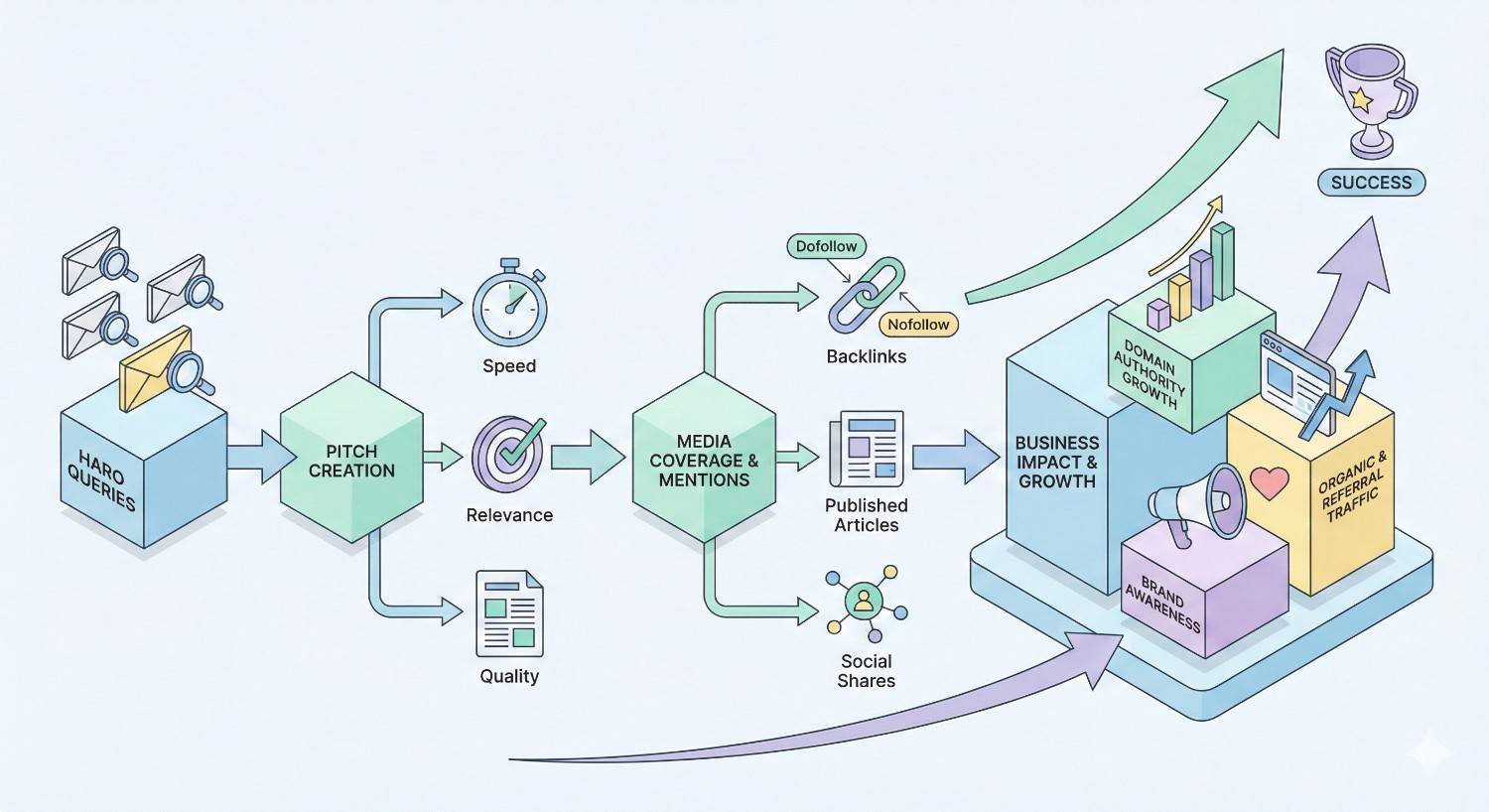
Tracking and Measuring HARO Success Rates
Measurement enables optimization. Without tracking, you cannot identify what works or calculate ROI.
Key metrics to track:
- Response rate: Percentage of pitches resulting in journalist contact
- Placement rate: Percentage of pitches resulting in published mentions
- Link rate: Percentage of placements including backlinks
- Domain rating of placements: Authority level of linking sites
- Time to placement: Duration from pitch to publication
Benchmark expectations: Industry data suggests 5-15% placement rates for well-crafted pitches. Rates below 5% indicate pitch quality issues. Rates above 15% suggest strong positioning and targeting.
Attribution tracking: Use UTM parameters on your website URL to track referral traffic from HARO placements. This connects link building efforts to actual site visits and conversions.
Reporting cadence: Monthly reviews of HARO performance identify trends and inform strategy adjustments. Quarterly analysis evaluates ROI and determines resource allocation.
HARO Alternatives for Media Link Building
HARO is not the only platform connecting sources with journalists. Several alternatives offer different features, audience focuses, and competition levels. Diversifying across platforms increases total opportunity volume.
Qwoted
Qwoted positions itself as a modern alternative to HARO with enhanced matching technology. The platform uses algorithms to connect journalists with relevant sources based on expertise profiles.
Key features: AI-powered matching, detailed source profiles, direct journalist messaging, mobile app for quick responses.
Best for: Sources wanting more targeted query matching and willing to invest time in detailed profile creation.
Considerations: Smaller journalist pool than HARO, but potentially higher relevance per query.
SourceBottle
SourceBottle operates similarly to HARO with journalist queries distributed to registered sources. The platform has strong presence in Australian and UK markets alongside US coverage.
Key features: Free basic access, category filtering, international publication coverage.
Best for: Businesses targeting international media or seeking additional query volume beyond HARO.
Considerations: Lower overall volume than HARO, but reduced competition per query.
Terkel
Terkel focuses on expert roundup content, connecting sources with publishers creating compilation articles featuring multiple expert perspectives.
Key features: Guaranteed placement for accepted responses, clear publication timelines, topic-specific matching.
Best for: Sources comfortable with roundup format and seeking consistent placement volume.
Considerations: Links typically come from content sites rather than major news publications. Authority levels vary.
Featured.com
Featured.com (formerly Terkel’s parent platform) operates a marketplace model where sources respond to specific content opportunities with guaranteed publication for selected responses.
Key features: Transparent publication details, quality scoring for sources, diverse topic coverage.
Best for: Sources wanting predictable outcomes and willing to compete on response quality.
Considerations: Requires consistent high-quality responses to maintain good standing.
Help a B2B Writer
Help a B2B Writer specifically targets B2B content creators seeking expert sources for business-focused content. The niche focus reduces competition and increases relevance for B2B companies.
Key features: B2B-specific queries, content marketing focus, smaller but targeted community.
Best for: B2B companies, SaaS businesses, and professional services firms.
Considerations: Lower volume than general platforms, but higher relevance and reduced competition.
How Long Does HARO Link Building Take to Show Results?
Setting realistic timeline expectations prevents frustration and enables proper resource planning. HARO is not a quick-win tactic. Building momentum requires consistent effort over months.
Realistic Timelines for HARO Success
First placement: Most consistent practitioners land their first placement within 4-8 weeks of active pitching. This assumes 3-5 quality responses per week targeting relevant queries.
Consistent results: Reaching predictable monthly placements typically requires 3-6 months of sustained effort. During this period, you refine pitch quality, identify optimal query types, and build journalist relationships.
Significant SEO impact: Backlink effects on rankings generally appear 2-4 months after link publication. Combined with the time to earn placements, expect 6-12 months from program launch to measurable ranking improvements.
Compounding returns: HARO effectiveness increases over time. Journalists remember reliable sources. Your pitch quality improves with practice. Domain authority gains make your site more attractive for future placements.
Factors That Affect HARO Response Rates
Multiple variables influence how quickly you achieve results.
Expertise depth: Genuine subject matter experts with unique perspectives earn placements faster than generalists. Deep knowledge enables specific, valuable responses.
Query relevance: Responding only to highly relevant queries improves success rates. Casting wide nets with marginal-fit responses wastes effort.
Competition level: Popular topics attract more responses. Niche expertise areas face less competition per query.
Response quality: Well-structured, specific, quotable pitches outperform generic responses regardless of other factors.
Timing consistency: Regular daily engagement with queries builds momentum. Sporadic effort produces sporadic results.
Credential strength: Established professionals with verifiable expertise earn journalist trust faster than unknown sources.
HARO Link Building Costs and ROI
Understanding the economics of HARO helps justify resource allocation and compare against alternative link building investments.
Free vs. Paid HARO Plans
The free HARO plan provides full query access, making it viable for businesses testing the tactic or operating with limited budgets.
Free plan limitations: No keyword alerts, basic profile features, standard visibility in journalist searches.
Paid plan value: Keyword alerts alone can justify Standard plan costs by surfacing relevant queries instantly. For businesses where HARO is a primary link building channel, time savings from alerts exceed subscription costs.
Break-even calculation: If paid features save 2 hours monthly in query review time, and your hourly cost exceeds $25, the Standard plan pays for itself.
Agency HARO Services Pricing
Professional HARO services range from basic pitch writing to full-service programs including strategy, response management, and reporting.
Per-pitch pricing: Some agencies charge $50-150 per submitted pitch, regardless of outcome.
Monthly retainer models: Full-service programs typically range from $1,000-5,000 monthly depending on volume commitments and service levels.
Performance-based pricing: Some providers charge per successful placement, typically $200-500 per published link.
Value assessment: Compare agency costs against the value of links earned. A $3,000 monthly retainer generating 5 DR 70+ links delivers $600 cost-per-link, competitive with other high-quality link building methods.
Calculating ROI from HARO Backlinks
ROI calculation requires assigning value to backlinks, which varies by business model and competitive landscape.
Link value benchmarks: Industry estimates for high-authority editorial links range from $500-2,000+ per link based on what equivalent placements would cost through other channels.
Traffic value method: Calculate the organic traffic value of ranking improvements attributable to HARO links. If improved rankings generate $10,000 monthly in traffic value, and HARO costs $2,000 monthly, ROI is positive.
Brand value consideration: Media mentions provide brand exposure beyond SEO value. Factor in PR equivalent value when assessing total return.
Long-term perspective: HARO links are permanent assets (assuming publications remain online). A link earned today continues providing value for years, improving lifetime ROI calculations.
Common HARO Link Building Questions
How Many HARO Pitches Should I Send Per Day?
Quality matters more than quantity. Most successful practitioners send 3-7 pitches daily, focusing only on highly relevant queries where they can provide genuine value. Sending 20+ generic pitches daily damages your reputation and wastes time better spent crafting excellent responses.
What Is a Good HARO Success Rate?
Placement rates between 5-15% indicate effective pitching for most industries. Rates below 5% suggest pitch quality or targeting issues. Rates above 15% reflect strong expertise positioning and excellent response quality. Track your rates monthly to identify improvement opportunities.
Can HARO Links Be Nofollow?
Yes, some publications default to nofollow for external links regardless of editorial context. While dofollow links pass more direct SEO value, nofollow links from high-authority sites still provide brand exposure, referral traffic, and indirect ranking benefits through increased brand searches.
How Do I Find My Published HARO Links?
Set up Google Alerts for your name and company. Use backlink monitoring tools like Ahrefs or Moz to detect new links. Check your email for journalist notifications, though not all reporters confirm publication. Manually search for your quotes periodically using distinctive phrases from your pitches.
Is HARO Considered White Hat SEO?
HARO is explicitly white hat because links result from genuine editorial decisions by journalists. You provide expertise, journalists independently choose to cite and link to you. This differs fundamentally from link schemes, exchanges, or paid placements that violate search engine guidelines.
Building a Sustainable HARO Link Building Program
Long-term HARO success requires integration with broader marketing strategy rather than treating it as an isolated tactic.
Integrating HARO into Your Overall Link Strategy
HARO should complement, not replace, other link building methods. Use HARO for high-authority editorial links while pursuing guest posts for topical relevance, resource links for foundational authority, and digital PR for campaign-based coverage.
Portfolio approach: Aim for diverse link sources. Over-reliance on any single channel creates vulnerability. HARO might represent 20-30% of monthly link acquisition in a balanced program.
Content synergy: HARO placements can inform content strategy. Topics generating journalist interest likely resonate with your audience. Develop comprehensive content around themes where you earn frequent placements.
Internal linking: When HARO placements mention specific topics, ensure your site has strong content on those subjects. Internal links from HARO-boosted pages distribute authority throughout your site.
Long-Term Relationship Building with Journalists
Repeat placements with the same journalists become easier over time. Building genuine relationships transforms cold pitching into warm outreach.
Follow-up appropriately: After placement, send a brief thank-you note. Do not pitch immediately, but express appreciation for the opportunity.
Provide ongoing value: Share relevant research or insights with journalists covering your industry, even without active queries. Becoming a reliable resource leads to direct outreach for future stories.
Respect boundaries: Journalists are busy. Do not over-communicate or pitch irrelevant opportunities. Quality interactions build reputation better than frequent contact.
Social engagement: Follow and engage with journalists on LinkedIn and Twitter. Thoughtful comments on their work build familiarity before you ever pitch.
When to Consider Professional HARO Services
Several scenarios justify outsourcing HARO to specialized providers.
Time constraints: If your team cannot consistently dedicate time to daily query review and response, outsourcing maintains momentum.
Scale requirements: Businesses needing high link volumes may find agency capacity more efficient than building internal teams.
Expertise gaps: Professional HARO services bring optimized processes and pitch frameworks developed across many clients.
Opportunity cost: Senior team members responding to HARO queries may have higher-value uses for their time. Outsourcing frees expertise for core business activities.
Evaluation criteria: When selecting providers, assess their onboarding process, communication frequency, reporting transparency, and track record with similar businesses.
Conclusion
HARO link building delivers what most link acquisition tactics cannot: genuine editorial backlinks from authoritative publications earned through expertise rather than manipulation. The approach requires patience, consistent effort, and commitment to providing real value to journalists.
For businesses serious about sustainable organic growth, HARO represents a cornerstone tactic within a diversified link building strategy. The compounding benefits of media relationships, domain authority gains, and brand visibility make the investment worthwhile for those willing to execute properly.
At White Label SEO Service, we help businesses build comprehensive link acquisition programs including HARO strategy, execution, and measurement. Contact our team to discuss how professional HARO services can accelerate your authority building efforts.
Frequently Asked Questions
How quickly can I expect my first HARO backlink?
Most businesses land their first placement within 4-8 weeks of consistent pitching. Success depends on expertise relevance, pitch quality, and response volume. Starting with 3-5 quality pitches weekly targeting highly relevant queries establishes momentum faster than sporadic high-volume approaches.
Do HARO links actually improve search rankings?
Yes, HARO links from authoritative publications positively impact rankings because they represent genuine editorial endorsements. The effect typically appears 2-4 months after link publication as search engines crawl and evaluate the new backlinks within your overall link profile.
What makes a HARO pitch get selected over competitors?
Winning pitches provide specific, quotable insights directly addressing the journalist’s question. Lead with your unique perspective, support with concrete examples or data, and include credentials establishing why you are qualified. Avoid generic statements that any source could provide.
Is the free HARO plan sufficient for link building?
The free plan provides full query access and works well for businesses testing HARO or with limited bandwidth. Paid plans add keyword alerts and enhanced visibility that improve efficiency for serious practitioners. Start free, then upgrade if HARO becomes a core channel.
How do I know if a HARO query is worth responding to?
Evaluate query relevance to your expertise, publication authority, deadline feasibility, and likely competition level. Respond only when you can provide genuine value. Marginal-fit queries waste time and can damage your reputation with journalists who receive irrelevant pitches.
Can HARO work for local businesses targeting specific geographic areas?
Yes, local businesses benefit from both regional publication queries and national outlets seeking local examples. Monitor queries mentioning your city or region for lower-competition opportunities. Local media placements also provide valuable geographic relevance signals for local SEO.
Should I hire an agency for HARO or keep it in-house?
The decision depends on available time, expertise, and scale requirements. In-house execution preserves authenticity and builds direct journalist relationships. Agencies provide consistent effort and optimized processes. Many businesses use hybrid approaches, handling priority queries internally while outsourcing volume.