

Editorial links are backlinks that websites give you voluntarily because your content genuinely deserves to be referenced. Unlike paid placements or self-created links, these endorsements come from editors, journalists, and content creators who find your work valuable enough to cite as a resource for their own audiences.
For business owners and marketing teams focused on sustainable organic growth, editorial links represent the gold standard of link building. They signal trust to search engines, drive qualified referral traffic, and compound in value over time.
This guide breaks down exactly what editorial links are, why they matter for your rankings, how to earn them strategically, and the metrics that prove their ROI.
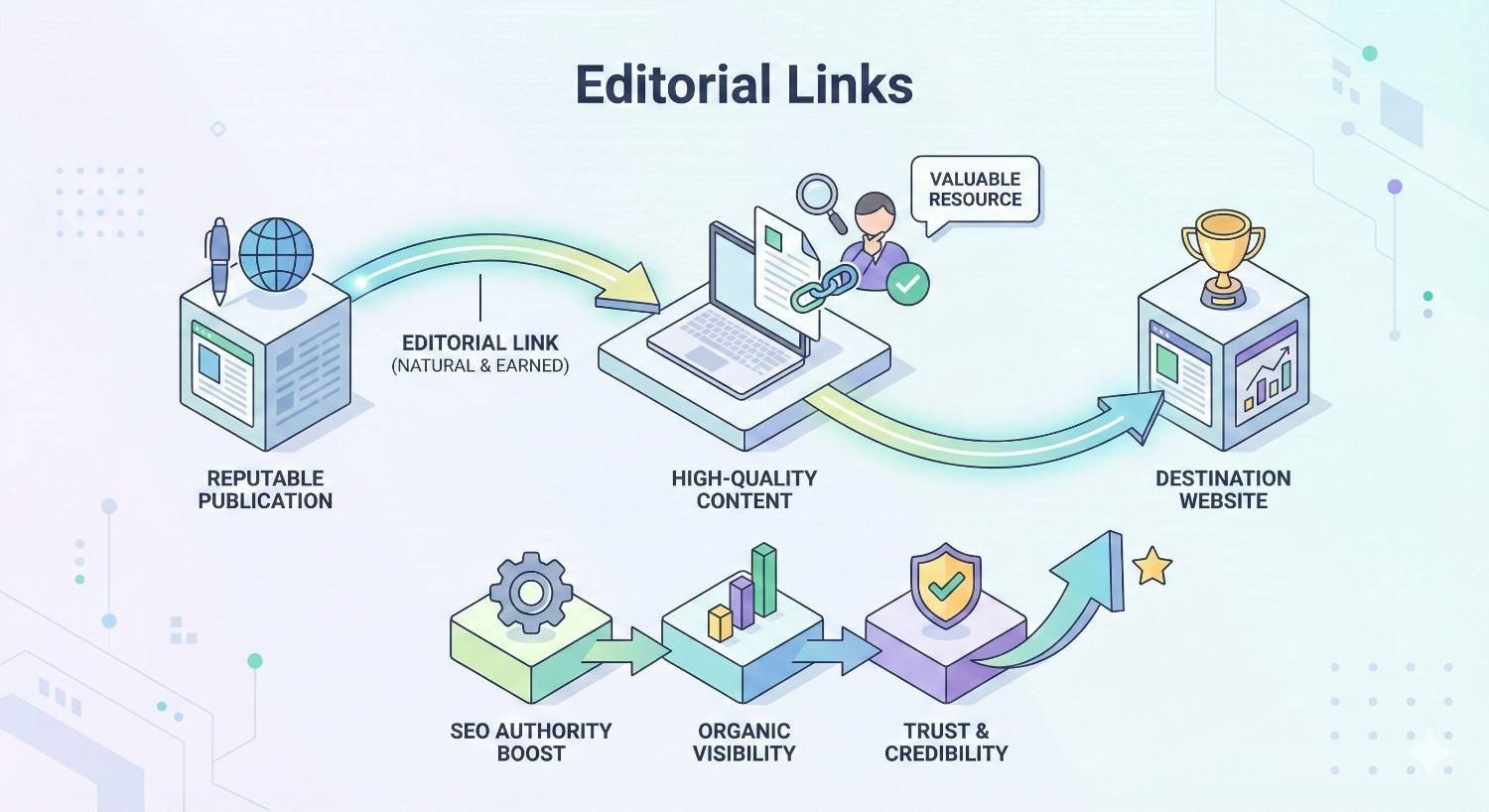
What Are Editorial Links?
Understanding editorial links starts with recognizing what makes them fundamentally different from other backlink types. These links carry weight precisely because they cannot be manufactured or purchased directly.
Definition of Editorial Links
An editorial link is a hyperlink placed within content by an author, editor, or publisher who independently decides your page deserves to be referenced. The linking site receives no payment, exchange, or direct request for the specific link placement.
These links occur naturally when someone researching a topic discovers your content and determines it adds value for their readers. The decision to link happens within the editorial process, not through a transaction or reciprocal agreement.
Think of editorial links as citations in academic papers. A researcher cites sources that strengthen their argument or provide necessary context. Similarly, web publishers link to resources that support their content and serve their audience.
The key distinction is editorial discretion. Someone with publishing authority made an independent judgment that your content merits inclusion. This voluntary endorsement is what gives editorial links their power in search algorithms.
How Editorial Links Differ from Other Link Types
The link building landscape includes many backlink categories, but editorial links occupy a unique position based on how they’re acquired.
Paid links involve direct financial transactions. You pay a website to place your link, which violates Google’s guidelines and carries penalty risks. Editorial links involve no payment for placement.
Guest post links come from content you create specifically for another site. While valuable, these links exist because you initiated the relationship and provided the content. Editorial links happen without your direct involvement in the linking page’s creation.
Directory links and forum links are self-created. You submit your site to a directory or drop links in comment sections. These carry minimal weight because no editorial judgment occurred.
Reciprocal links involve mutual agreements to link to each other. Search engines recognize these patterns and discount their value accordingly.
Editorial links stand apart because they represent genuine third-party validation. The linking site gains nothing except providing a useful resource to their audience. This purity of intent is exactly what search engines want to reward.
Why Editorial Links Matter for SEO
Search engines have spent decades refining how they evaluate links. Editorial links consistently emerge as the most valuable signal because they’re the hardest to fake and the most reliable indicator of content quality.
Editorial Links as Trust Signals
Google’s algorithm fundamentally relies on links as votes of confidence. When a reputable site links to your content editorially, it transfers a portion of its trust to your domain.
This trust signal works because editorial links require someone to stake their reputation on your content. A journalist linking to your research in a news article is implicitly telling readers and search engines that your information is credible.
The trust transfer compounds across your site. As you accumulate editorial links to various pages, your entire domain builds authority. New content you publish benefits from this established trust, often ranking faster than competitors with weaker link profiles.
Trust signals also influence how Google crawls your site. Domains with strong editorial link profiles typically get crawled more frequently, meaning your new content gets indexed and evaluated faster.
Impact on Domain Authority and Rankings
Domain Authority, while a third-party metric from Moz rather than a Google ranking factor, correlates strongly with ranking performance because it measures similar signals.
Editorial links from high-authority sources create measurable ranking improvements. A single editorial link from a major publication can move needle more than dozens of low-quality links combined.
The ranking impact works through several mechanisms. First, the direct authority transfer improves your page’s ability to compete for keywords. Second, the referral traffic from editorial links sends positive engagement signals. Third, editorial links often trigger additional links as other sites discover your content through the original mention.
According to Backlinko’s analysis of ranking factors, the number of domains linking to a page remains one of the strongest correlations with Google rankings. Editorial links from unique domains carry particular weight because they represent independent validation from separate sources.
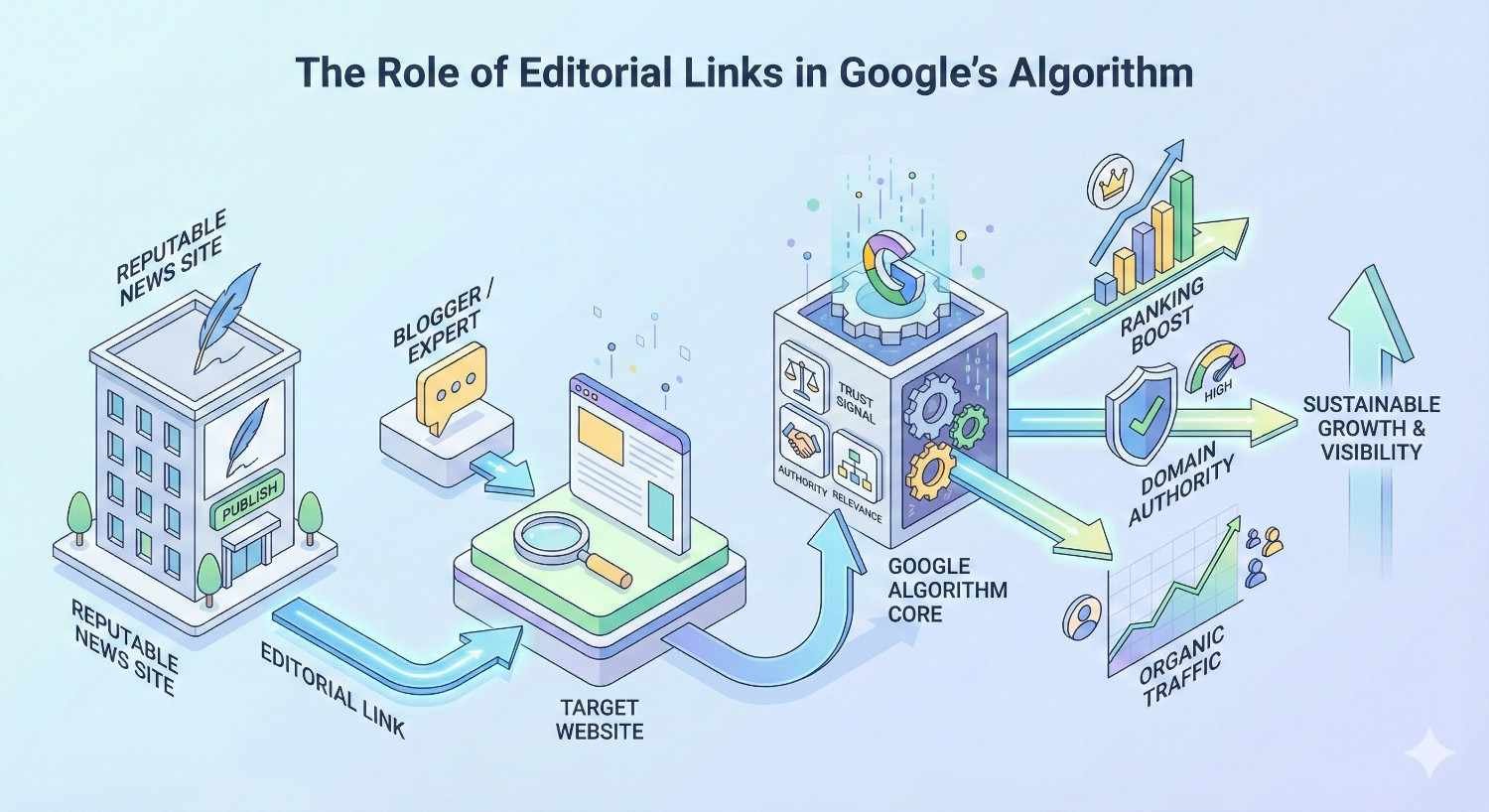
The Role of Editorial Links in Google’s Algorithm
Google’s original PageRank algorithm was built on the premise that links function like academic citations. Pages with more citations from authoritative sources should rank higher.
While the algorithm has evolved dramatically, this foundational concept remains central. Google’s Search Quality Evaluator Guidelines emphasize E-E-A-T (Experience, Expertise, Authoritativeness, Trustworthiness), and editorial links serve as primary evidence of authority and trust.
The algorithm has become sophisticated at distinguishing editorial links from manipulated ones. Patterns like sudden link spikes, irrelevant anchor text, and links from low-quality sites trigger scrutiny. Editorial links, by contrast, appear naturally over time from contextually relevant sources with varied anchor text.
Google’s spam-fighting systems, including the link spam update rolled out in recent years, specifically target artificial link building while preserving the value of genuine editorial endorsements. Sites relying on manipulative tactics have seen rankings collapse, while those with authentic editorial link profiles maintained or improved positions.
Characteristics of High-Quality Editorial Links
Not all editorial links carry equal weight. Understanding what makes an editorial link valuable helps you prioritize efforts and evaluate your link profile’s strength.
Relevance and Contextual Placement
The most valuable editorial links come from content topically related to your page. A link from a marketing blog to your SEO guide carries more weight than a link from an unrelated cooking site.
Contextual placement matters significantly. Links embedded within the main body content, surrounded by relevant text, transfer more value than links buried in sidebars, footers, or author bios.
The surrounding content should naturally lead to your link. If a paragraph discusses a concept and your link provides deeper information on that concept, the placement is contextually strong. Random or forced placements signal lower quality to algorithms.
Relevance extends to the linking site’s overall focus. A niche industry publication linking to your industry-specific content creates stronger topical signals than a general news site covering the same topic.
Authority of the Linking Source
Source authority dramatically impacts link value. A link from The New York Times, Harvard Business Review, or a leading industry publication carries substantially more weight than a link from a small personal blog.
Authority indicators include:
Domain metrics like Domain Rating (Ahrefs) or Domain Authority (Moz) provide rough proxies, though they’re not Google metrics. Sites with higher scores typically have stronger link profiles themselves.
Traffic levels indicate real audience engagement. Sites with significant organic traffic have earned Google’s trust through their own content quality.
Editorial standards matter for trust transfer. Publications with fact-checking processes, editorial oversight, and journalistic standards pass more credible endorsements.
Industry recognition signals expertise. Being linked by the acknowledged leader in your field carries weight beyond raw metrics.
However, don’t dismiss smaller authoritative sources. A respected niche blog with a dedicated audience in your exact market can drive qualified traffic and relevant authority signals that generic high-DA sites cannot match.
Natural Anchor Text Distribution
Anchor text is the clickable text containing your link. Natural editorial links display varied anchor text patterns because different authors describe your content differently.
A healthy anchor text profile includes:
Branded anchors using your company or website name Naked URLs displaying the actual web address Generic anchors like “click here,” “this resource,” or “learn more” Partial match anchors containing some target keywords naturally Exact match anchors using your precise target keyword (sparingly)
Over-optimized anchor text profiles raise red flags. If most links pointing to your “best running shoes” page use that exact phrase as anchor text, it signals manipulation rather than natural editorial linking.
Editorial links naturally produce diverse anchors because authors choose their own wording. One might link using your brand name, another might describe your content as “this comprehensive guide,” and another might use a partial keyword phrase.
Examples of Editorial Links
Seeing editorial links in practice clarifies what you’re working toward. These examples demonstrate how editorial links appear across different publication types.
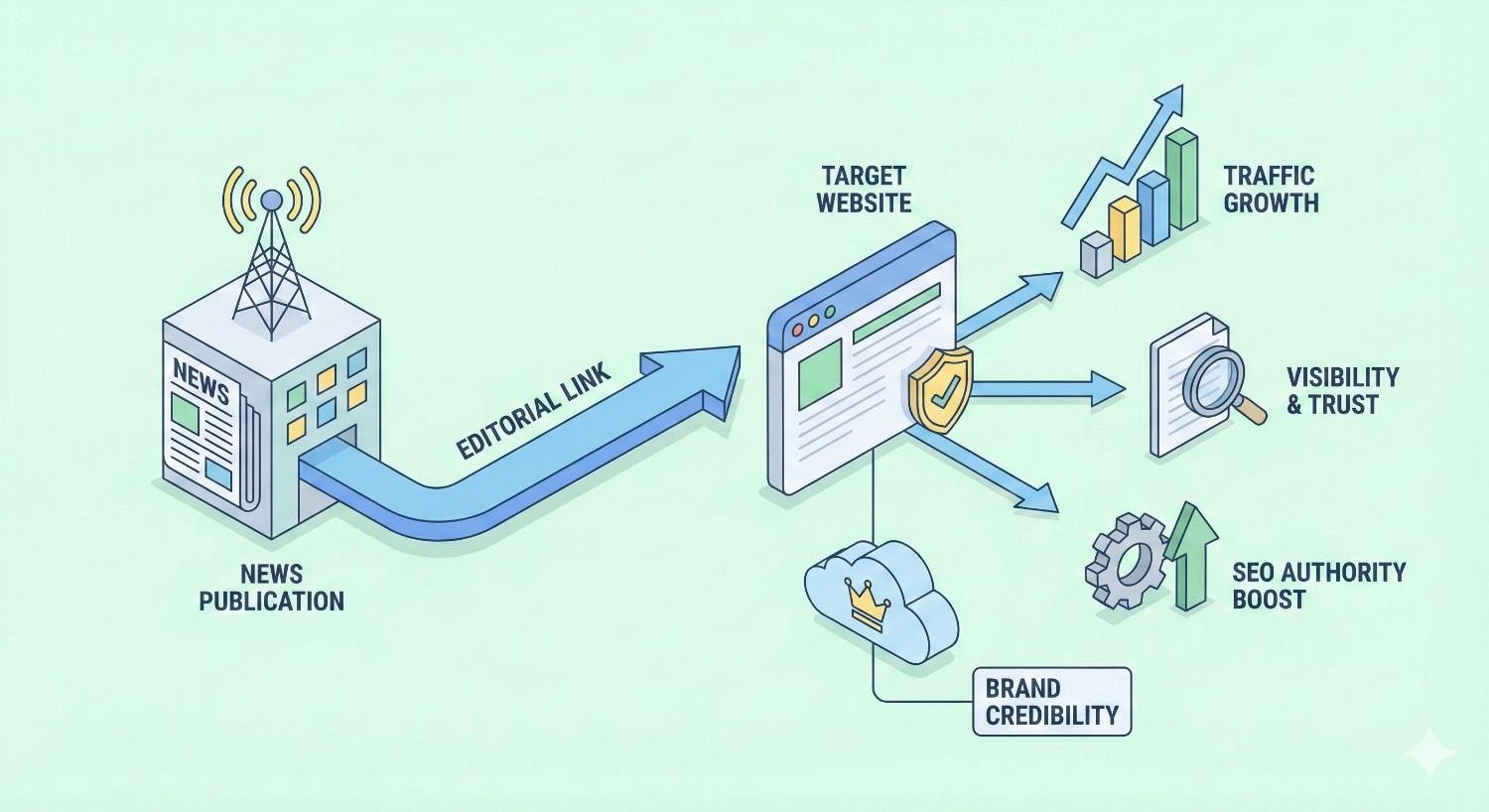
Editorial Links from News Publications
News sites regularly link to sources that inform their reporting. When a journalist writes about industry trends and cites your original research, that’s an editorial link.
For example, a technology reporter covering AI adoption might write: “According to research from [Company Name], enterprise AI implementation increased 40% year-over-year.” The link to your research page happened because your data added credibility to their story.
News editorial links often come from:
Data citations when your research provides statistics reporters need Expert commentary when journalists quote your team and link to your site Resource references when articles point readers to your tools or guides for more information Story sourcing when your content breaks news or provides unique angles
These links carry significant authority because news publications maintain editorial standards and fact-checking processes. The implicit endorsement from a trusted news source transfers substantial trust to your domain.
Editorial Links from Industry Blogs
Industry blogs and publications serve specialized audiences seeking expert information. When these sites link to your content, they’re validating your expertise within your specific field.
A marketing industry blog might write: “For a deeper dive into technical SEO audits, [this guide] covers the complete process.” The author found your content while researching their article and determined it would help their readers.
Industry blog editorial links typically occur when:
Your content fills knowledge gaps the author’s piece doesn’t fully address You’ve published definitive resources on specific subtopics Your unique perspective adds value to the conversation Your tools or templates provide practical utility
These links often drive highly qualified traffic because the linking site’s audience already has interest in your topic area. A visitor clicking through from an industry blog arrives with context and intent.
Editorial Links from Resource Pages
Resource pages curate valuable links on specific topics. Universities, industry associations, and authoritative sites maintain these pages to help their audiences find quality information.
A university library might maintain a page titled “Small Business Marketing Resources” that includes your comprehensive guide. The librarian or content curator evaluated available resources and determined yours merited inclusion.
Resource page editorial links are valuable because:
Curation implies quality judgment by someone with expertise These pages often have strong authority from established institutions Links remain stable as resource pages are maintained long-term Topical relevance is explicit since pages focus on specific subjects
Finding resource page opportunities requires research, but earning placement requires having genuinely useful content that serves the page’s stated purpose.
How to Earn Editorial Links
Editorial links cannot be purchased directly, but you can systematically increase your chances of earning them. The strategies below focus on creating conditions where editorial links become natural outcomes.
Creating Link-Worthy Content
Content earns editorial links when it provides something other content doesn’t. Generic articles covering well-trodden ground rarely attract links because publishers have no reason to cite them over existing resources.
Original research generates links because data is inherently citable. Surveys, studies, and analysis of proprietary data give journalists and bloggers statistics they can’t find elsewhere.
Comprehensive guides earn links when they become the definitive resource on a topic. If your guide covers a subject more thoroughly than anything else available, authors naturally reference it when they need to point readers somewhere for deeper information.
Unique frameworks and methodologies attract links from people explaining concepts. If you develop a useful way to think about a problem, others will cite your framework when discussing the topic.
Tools and calculators earn links because they provide utility. A free tool that solves a real problem gets referenced whenever someone writes about that problem.
Visual assets like infographics, charts, and diagrams get embedded and linked when they explain concepts better than text alone.
The common thread is providing genuine value that doesn’t exist elsewhere. Ask yourself: “Why would someone link to this instead of the dozens of other articles on this topic?” If you don’t have a clear answer, the content likely won’t earn editorial links.
Building Relationships with Publishers
Editorial links often flow from relationships. When journalists and bloggers know you as a reliable source, they’re more likely to cite your content and seek your expertise.
Become a source by responding to journalist queries through platforms like Help a Reporter Out (HARO), Qwoted, or direct outreach. Providing useful quotes and information builds recognition over time.
Engage genuinely with publishers in your space. Comment thoughtfully on their work, share their content, and participate in industry conversations. Relationships built on mutual value creation lead to natural linking opportunities.
Offer expertise without expecting immediate returns. When you help a journalist meet a deadline or provide background information for their research, you become someone they remember and return to.
Attend industry events where publishers gather. Face-to-face connections accelerate relationship building and create opportunities for collaboration.
Relationship building takes time but compounds significantly. A journalist who has quoted you three times is far more likely to link to your new research than one who has never heard of you.
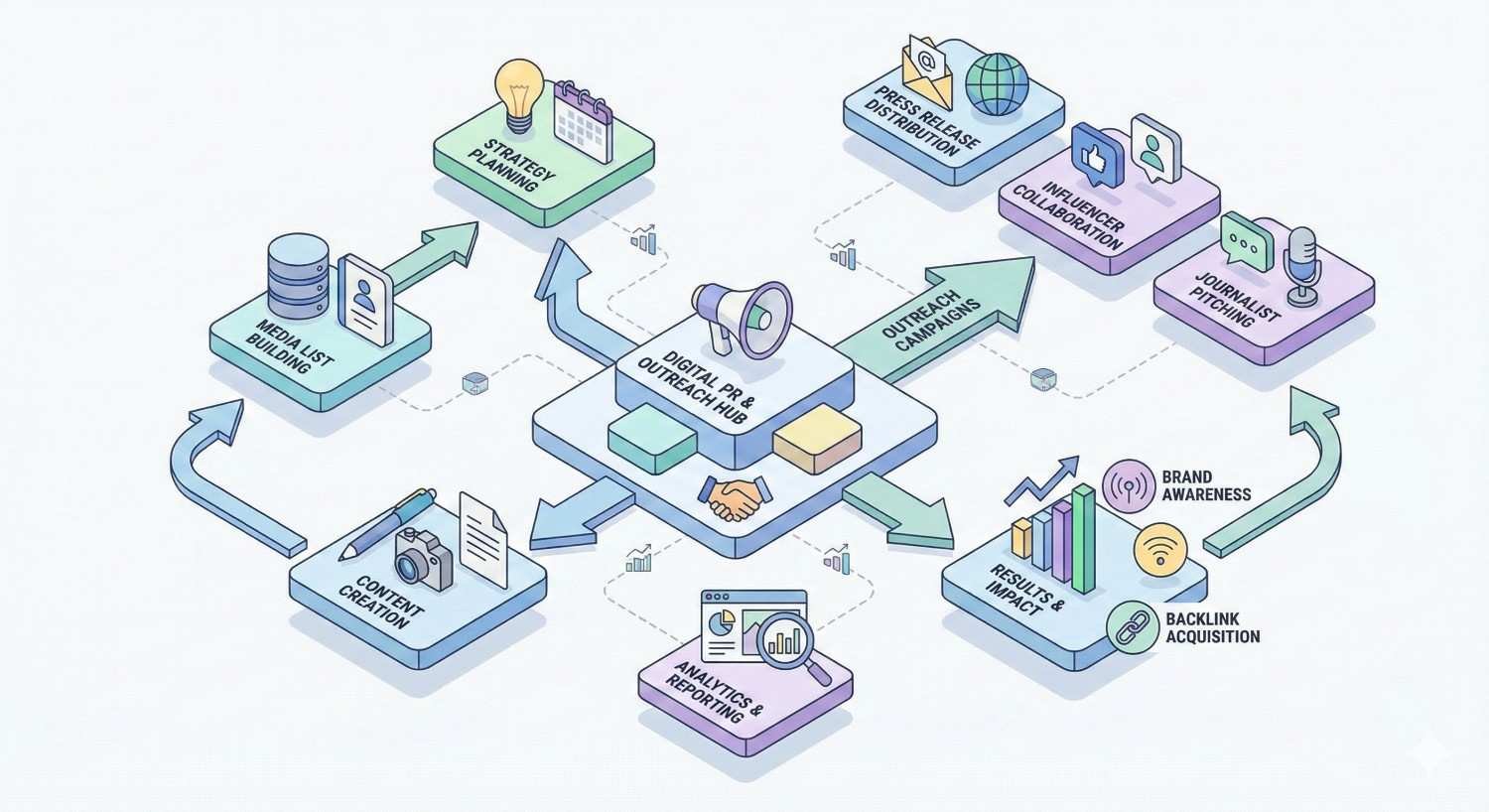
Digital PR and Outreach Strategies
Digital PR applies traditional public relations tactics to earn online coverage and links. The goal is getting your brand, research, or expertise featured in publications that reach your target audience.
Newsjacking involves providing expert commentary on breaking news. When a major development occurs in your industry, reaching out to journalists with informed perspective can earn coverage and links.
Data-driven stories pitch original research to publications. Journalists need data to support their articles, and exclusive access to interesting findings creates incentive for coverage.
Expert positioning establishes your team as go-to sources for specific topics. Consistent availability and reliable expertise lead to recurring mentions and links.
Creative campaigns generate coverage through newsworthy initiatives. Surveys with surprising findings, industry reports, or innovative projects give publications reasons to write about you.
Effective outreach requires understanding what publications need. Pitches should offer clear value to the journalist and their audience, not just promote your brand. The best pitches make the journalist’s job easier by providing a ready-made story angle with supporting information.
Leveraging Original Research and Data
Original research remains the most reliable editorial link magnet because data is inherently citable. When you’re the source of statistics, anyone writing about that topic may need to reference you.
Survey research captures opinions and behaviors from relevant populations. Industry surveys revealing trends, challenges, or preferences give journalists concrete numbers to cite.
Data analysis examines existing information in new ways. Analyzing public data sets, industry reports, or your own customer data can reveal insights others haven’t published.
Benchmarking studies establish standards others reference. If you publish the definitive benchmarks for your industry, anyone discussing performance will cite your numbers.
Longitudinal tracking monitors changes over time. Annual or quarterly reports tracking industry metrics become anticipated resources that earn links with each release.
The investment in original research pays dividends beyond links. The same data supports thought leadership, sales conversations, and content marketing across channels. Links become a natural byproduct of being the authoritative source for information your industry needs.
How Long Does It Take to Get Editorial Links?
Earning editorial links requires patience. Unlike paid placements that happen immediately, editorial links depend on content discovery, editorial decisions, and publication timelines.
Initial traction typically takes 3-6 months for new content. Search engines need time to index and rank your content where publishers can find it. Outreach campaigns may generate faster results, but building a sustainable editorial link profile takes longer.
Compounding effects accelerate over time. As your domain authority grows and your content ranks higher, more publishers discover and link to your work organically. Sites with established authority earn editorial links faster than new domains.
Campaign-specific timelines vary by approach. A digital PR campaign around original research might generate links within weeks of launch. Relationship-based link earning might take months of cultivation before producing results.
Realistic expectations for most businesses: plan for 6-12 months of consistent effort before seeing significant editorial link growth. The links you earn will continue providing value for years, making the investment worthwhile despite the timeline.
Editorial Links vs. Other Backlink Types
Understanding how editorial links compare to other link types helps you allocate resources and evaluate opportunities. Each link type has its place, but editorial links consistently deliver the strongest long-term value.
Editorial Links vs. Guest Post Links
Guest posting involves creating content specifically for publication on another site, typically including a link back to your own site.
Guest post links are earned through content creation and relationship building. You pitch a topic, write the article, and include relevant links to your site within the content or author bio.
Editorial links happen without your involvement in the linking content. Someone else creates the content and independently decides to reference your site.
The key differences:
Control: You control guest post content and link placement. Editorial links depend entirely on the linking author’s decisions.
Scalability: Guest posting scales with your content production capacity. Editorial links scale with your content’s inherent link-worthiness and discoverability.
Perception: Some view guest posting as a gray area when done primarily for links. Editorial links are unambiguously natural.
Value: Both can be valuable, but editorial links from the same source typically carry more weight because they represent unsolicited endorsement.
Guest posting remains a legitimate strategy when focused on audience building and thought leadership rather than pure link acquisition. The best approach combines guest posting for relationship building with content that earns editorial links organically.
Editorial Links vs. Paid Links
Paid links involve direct financial transactions for link placement. This includes sponsored posts, paid directories, and link buying schemes.
Paid links violate Google’s guidelines and carry significant risk. Google’s algorithms have become sophisticated at detecting paid link patterns, and manual penalties can devastate organic traffic.
Editorial links are explicitly what Google wants to reward. They represent genuine endorsements that help users find valuable content.
The differences are stark:
Risk: Paid links risk penalties. Editorial links carry no penalty risk.
Sustainability: Paid links require ongoing investment. Editorial links provide permanent value.
Trust transfer: Google discounts or ignores detected paid links. Editorial links transfer full trust signals.
Scalability: Paid links scale with budget. Editorial links scale with content quality and promotion.
Some businesses still pursue paid links, but the risk-reward calculation has shifted dramatically. The resources spent on paid links typically generate better returns when invested in content and outreach that earn editorial links.
Editorial Links vs. Self-Created Links
Self-created links include forum signatures, blog comments, directory submissions, and social profile links. You create these links yourself without editorial oversight.
Self-created links carry minimal SEO value because they require no third-party validation. Anyone can create them, so they don’t signal content quality.
Editorial links require someone else to vouch for your content. This third-party validation is exactly what makes them valuable.
Comparing the two:
Effort: Self-created links are easy to generate. Editorial links require significant effort.
Value: Self-created links provide negligible ranking benefit. Editorial links directly impact rankings.
Risk: Excessive self-created links can appear spammy. Editorial links never raise spam concerns.
Referral traffic: Self-created links rarely drive meaningful traffic. Editorial links often send qualified visitors.
Self-created links have limited legitimate uses, primarily for brand visibility and ensuring your site appears in relevant directories. They should never be confused with or substituted for editorial link building.
Common Mistakes When Pursuing Editorial Links
Even well-intentioned link building efforts can go wrong. These common mistakes undermine results and can damage your site’s standing with search engines.
Prioritizing Quantity Over Quality
The temptation to chase link numbers leads many businesses astray. A hundred low-quality links provide less value than five editorial links from authoritative, relevant sources.
Quality indicators matter more than raw counts. A single link from an industry-leading publication can move rankings more than dozens of links from obscure blogs.
Low-quality link accumulation raises red flags. Sudden spikes in links from irrelevant or low-authority sites can trigger algorithmic scrutiny or manual review.
Resource allocation suffers when chasing quantity. The time spent acquiring ten mediocre links could earn one exceptional editorial link with greater impact.
Focus your efforts on earning links from sources your target audience actually reads and trusts. These links drive both ranking improvements and qualified referral traffic.
Ignoring Relevance and Context
Links from unrelated sites provide diminished value and can even appear manipulative. A fitness equipment company earning links from gambling sites raises obvious questions about how those links were acquired.
Topical relevance strengthens link signals. Search engines understand that relevant links indicate genuine endorsement within a subject area.
Contextual placement matters. A link dropped randomly into unrelated content provides less value than a link naturally integrated into relevant discussion.
Audience alignment drives traffic quality. Links from relevant sites send visitors already interested in your topic, improving engagement metrics and conversion rates.
Evaluate every link opportunity through the relevance lens. Would this link make sense to a human reader? Does the linking site’s audience overlap with yours? If not, the link probably isn’t worth pursuing.
Using Manipulative Tactics
Manipulative link building tactics might produce short-term results but create long-term liability. Google’s spam-fighting capabilities continue improving, and tactics that work today may trigger penalties tomorrow.
Private blog networks (PBNs) involve creating or acquiring sites solely to link to your main site. Google actively identifies and penalizes these networks.
Link schemes including excessive link exchanges, paid links disguised as editorial, and automated link building violate guidelines and risk penalties.
Anchor text manipulation through over-optimized exact-match anchors signals artificial link building and can trigger algorithmic devaluation.
Fake outreach misrepresenting your intentions to earn links damages relationships and reputation when discovered.
The safest path is also the most effective long-term: create genuinely valuable content and earn links through legitimate means. Shortcuts that seem attractive today often become liabilities that require expensive cleanup later.
How to Identify Genuine Editorial Links
Whether auditing your own link profile or evaluating competitor strategies, distinguishing genuine editorial links from artificial ones helps you understand true authority signals.
Evaluating Link Placement and Context
Genuine editorial links appear naturally within content because an author decided to include them. Several characteristics indicate authentic editorial placement.
Contextual integration means the link fits naturally within the surrounding text. The sentence would make sense with or without the link, and the link adds value for readers wanting more information.
Relevant surrounding content discusses topics related to the linked page. A link to your SEO guide should appear within content about SEO, marketing, or related subjects.
Editorial voice consistency indicates the linking author wrote the content containing your link. Sponsored content or paid placements often have different tonal qualities than the site’s regular content.
Natural anchor text uses varied, contextually appropriate phrasing rather than keyword-stuffed exact matches.
Absence of disclosure language like “sponsored” or “paid partnership” indicates the link wasn’t purchased, though some legitimate editorial links do appear in disclosed sponsored content.
When auditing links, read the actual content containing each link. Does it read like genuine editorial content? Would a real author naturally include this reference? Trust your judgment as a reader.
Assessing Source Credibility
The linking source’s credibility directly impacts link value. Evaluating source quality helps you understand which links actually contribute to your authority.
Publication history reveals whether a site produces consistent, quality content or exists primarily for link placement. Sites with thin content, excessive outbound links, or obvious link selling patterns provide minimal value.
Editorial standards indicate trustworthiness. Publications with named authors, editorial oversight, and fact-checking processes pass more credible endorsements.
Traffic and engagement suggest real audience value. Sites with meaningful organic traffic have earned Google’s trust through their own content quality.
Industry recognition signals expertise. Being linked by acknowledged leaders in your field carries weight beyond raw metrics.
Link profile quality of the linking site matters. Sites that themselves have strong editorial link profiles pass more value than sites with spammy link profiles.
Tools like Ahrefs, Moz, and Semrush provide metrics that help evaluate source quality, but manual review remains essential. Metrics can be manipulated, but actually reading the linking content reveals its true nature.
Measuring the Value of Editorial Links
Demonstrating editorial link building ROI requires tracking the right metrics and understanding how link value manifests over time.
Metrics to Track Editorial Link Performance
Several metrics help quantify editorial link impact, though no single number captures complete value.
Referring domain growth tracks unique sites linking to you over time. Editorial link building should produce steady growth in referring domains from relevant, authoritative sources.
Domain Rating/Authority changes in tools like Ahrefs or Moz indicate overall link profile strength improvements. While not Google metrics, they correlate with ranking ability.
Organic traffic growth ultimately matters most. Editorial links should contribute to increased organic visibility and traffic over time.
Ranking improvements for target keywords indicate link building effectiveness. Track position changes for priority terms as you earn editorial links.
Referral traffic from editorial links provides direct value beyond SEO. Quality editorial links from relevant sites send qualified visitors who may convert.
Link velocity measures how quickly you’re earning new links. Healthy editorial link building produces consistent, gradual growth rather than suspicious spikes.
Anchor text distribution should remain natural and varied. Monitor for over-optimization that could signal problems.
Set up tracking in Google Search Console, Google Analytics, and your preferred SEO tool to monitor these metrics monthly. Look for trends rather than fixating on individual data points.
Long-Term ROI of Editorial Link Building
Editorial link building delivers compounding returns that make it one of the highest-ROI marketing investments available.
Links persist indefinitely in most cases. An editorial link earned today continues passing value for years, unlike paid advertising that stops the moment you stop paying.
Authority compounds as links accumulate. Each new editorial link builds on previous ones, making future content more likely to rank and earn additional links.
Ranking improvements drive traffic that generates leads and revenue. The connection between editorial links, rankings, and business outcomes is well-established.
Brand visibility increases through editorial mentions. Beyond SEO value, being cited by respected publications builds brand awareness and credibility.
Competitive moats form as you accumulate editorial links competitors cannot easily replicate. A strong editorial link profile takes years to build, creating sustainable competitive advantage.
Calculate ROI by comparing editorial link building investment against the value of organic traffic generated. For most businesses, the math strongly favors editorial link building over paid acquisition channels when measured over multi-year timeframes.
Frequently Asked Questions About Editorial Links
Are editorial links the same as organic links?
Editorial links and organic links describe the same concept from different angles. “Editorial” emphasizes that a human editor made the decision to include the link. “Organic” emphasizes that the link occurred naturally without payment or manipulation. Both terms describe links earned through content merit rather than transactions.
Can you buy editorial links?
Genuine editorial links cannot be purchased directly because the defining characteristic is independent editorial decision-making. Some services claim to sell “editorial links,” but these are typically paid placements disguised as editorial content. Purchasing such links violates Google’s guidelines and risks penalties. You can invest in content and outreach that increases your chances of earning editorial links, but the links themselves must be given freely.
How many editorial links do you need to rank?
There’s no universal number because link requirements vary by keyword competitiveness, your current authority, and competitor link profiles. A local service business might rank with a handful of quality editorial links, while competitive national terms might require hundreds. Focus on earning more and better editorial links than your ranking competitors rather than targeting arbitrary numbers.
Do nofollow editorial links have value?
Yes, nofollow editorial links provide value despite not passing traditional PageRank. They drive referral traffic, build brand awareness, and contribute to a natural link profile. Google has also indicated that nofollow is treated as a “hint” rather than directive, meaning some value may pass. A link from a major publication carries brand value regardless of follow status.
What’s the difference between editorial links and backlinks?
Backlinks is the broader category encompassing all links pointing to your site. Editorial links are a specific type of backlink characterized by voluntary placement based on content merit. All editorial links are backlinks, but not all backlinks are editorial links. Other backlink types include paid links, self-created links, and reciprocal links.
How do you know if a link is editorial?
Evaluate whether the link appears within genuine content created by someone with no direct incentive to link to you. Check for natural contextual placement, relevant surrounding content, varied anchor text, and absence of paid placement indicators. If the link exists because an author independently decided your content added value for their readers, it’s editorial.
Why are editorial links better than other link types?
Editorial links carry more weight because they represent genuine third-party validation. Search engines designed their algorithms to reward this type of endorsement because it’s the hardest to fake and most reliable indicator of content quality. Editorial links also tend to come from higher-quality sources and drive more qualified referral traffic than other link types.
Conclusion
Editorial links remain the most valuable currency in SEO because they represent what search engines have always tried to measure: genuine endorsement from trusted sources. Understanding what makes these links different from paid or self-created alternatives helps you focus efforts where they’ll generate real results.
Building an editorial link profile requires patience, quality content, and strategic relationship building. The businesses that succeed treat link earning as a long-term investment in authority rather than a quick fix for rankings.
White Label SEO Service helps businesses develop and execute editorial link building strategies that drive sustainable organic growth. Contact our team to discuss how we can build your site’s authority through genuine editorial endorsements.