Backlink monitoring tools give you real-time visibility into every link pointing to your website, helping you protect rankings and discover growth opportunities. Without consistent link tracking, you’re flying blind in one of SEO’s most competitive arenas.
Your backlink profile directly influences how search engines evaluate your site’s authority. Toxic links can tank rankings overnight. Quality links can accelerate growth for months.
This guide covers everything from core features and essential metrics to setup processes, best practices, and choosing the right tool for your business type.
What Are Backlink Monitoring Tools?
Core Definition and Purpose
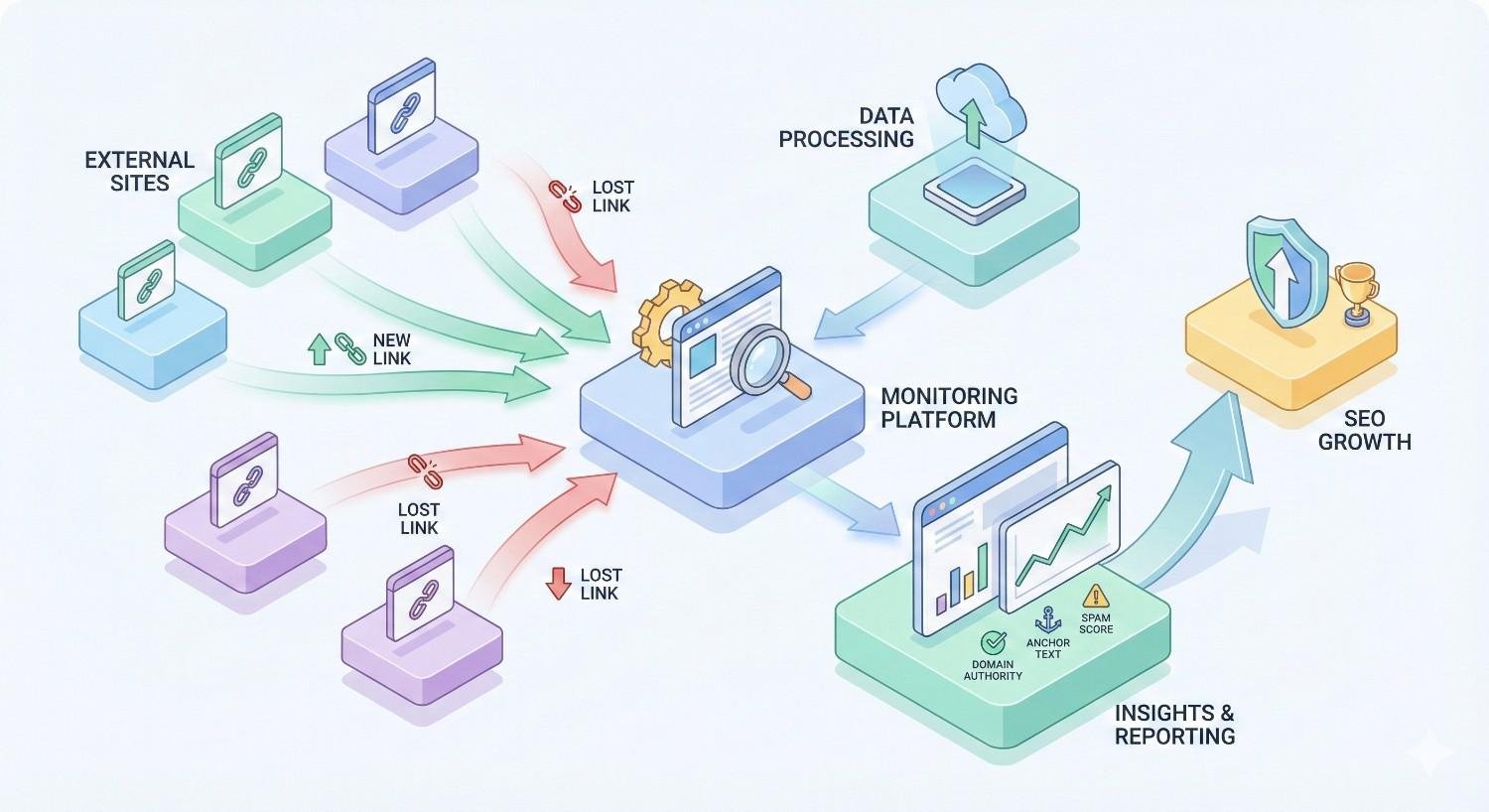
Backlink monitoring tools are software platforms that continuously track, analyze, and report on the external links pointing to your website. They crawl the web to discover new backlinks, identify lost links, and evaluate link quality across your entire profile.
The primary purpose is visibility. You need to know who’s linking to you, whether those links help or hurt your rankings, and how your link profile compares to competitors. These tools transform raw link data into actionable intelligence.
Beyond discovery, monitoring tools assess link attributes including anchor text, follow status, placement context, and referring domain authority. This comprehensive view enables strategic decision-making about link building, disavow files, and outreach priorities.
How Backlink Monitoring Works
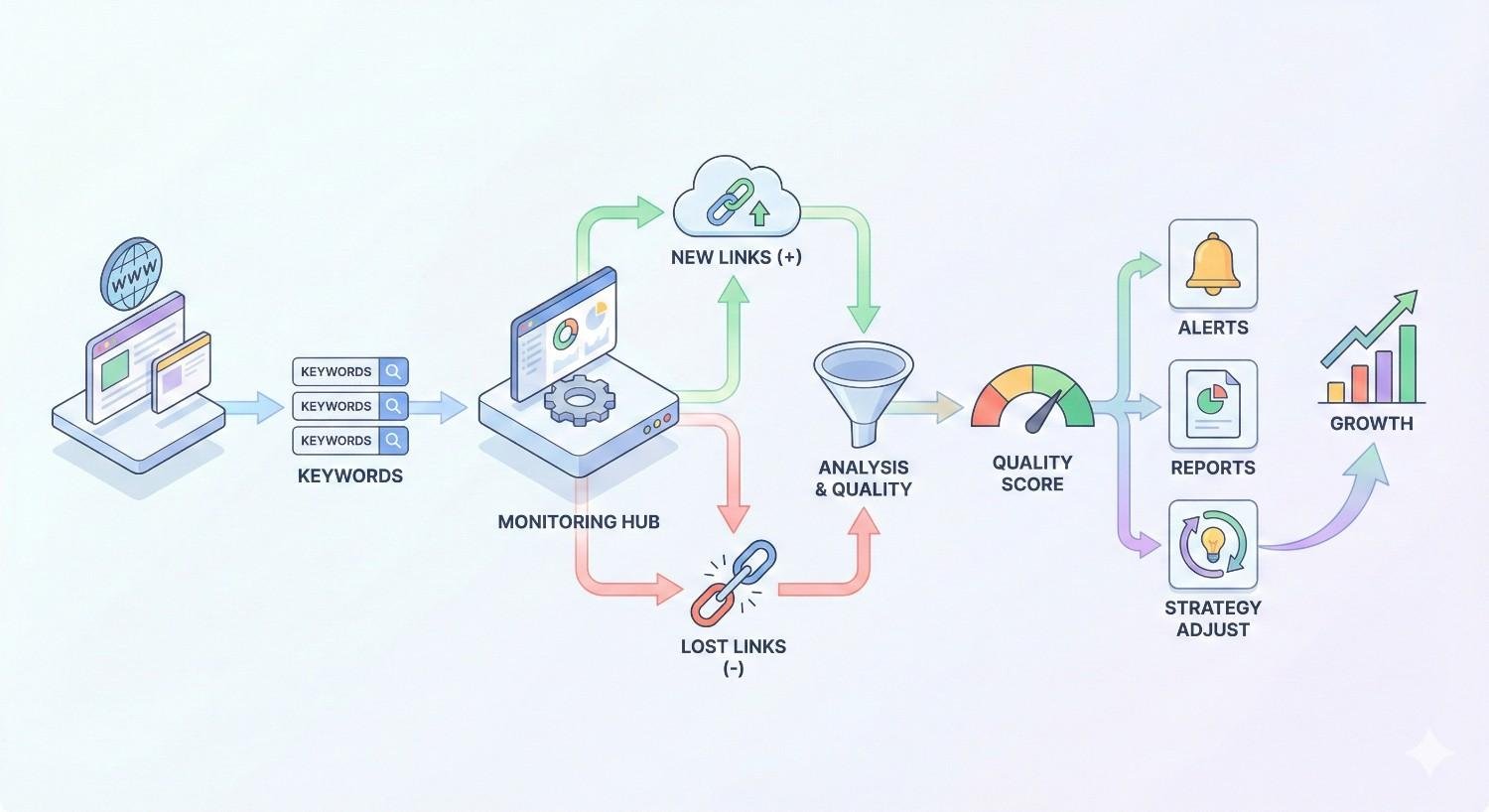
Backlink monitoring tools operate through continuous web crawling. Their bots scan billions of pages, following links and building massive indexes of the web’s link structure. When a crawler discovers a link to your domain, it logs the source URL, anchor text, link attributes, and page context.
Most tools update their indexes on different schedules. Some refresh daily for high-priority domains. Others update weekly or monthly. The freshness of data directly impacts how quickly you’ll see new or lost links in your dashboard.
The technical process involves:
- Crawling referring pages to verify link existence
- Extracting link attributes (dofollow, nofollow, sponsored, UGC)
- Analyzing anchor text and surrounding content
- Calculating proprietary metrics like domain authority
- Comparing current data against historical snapshots
- Triggering alerts when significant changes occur
Why Backlink Tracking Matters for SEO Performance
Backlinks remain one of Google’s most influential ranking factors. Backlinko’s analysis of 11.8 million search results found that the number of domains linking to a page correlated with higher rankings more than any other factor studied.
But quantity alone doesn’t determine success. Link quality, relevance, and diversity all influence how search engines interpret your authority. A single link from a high-authority, topically relevant site often outweighs dozens of low-quality links.
Monitoring matters because your link profile constantly changes. Sites remove links during redesigns. Competitors may attempt negative SEO through spammy link attacks. Guest posts get deleted. Partnerships end. Without monitoring, you won’t know until rankings drop.
Proactive tracking lets you:
- Identify and disavow toxic links before penalties hit
- Recover lost high-value links through outreach
- Benchmark progress against competitors
- Prove ROI from link building campaigns
- Spot negative SEO attacks early
Key Features of Backlink Monitoring Tools
Real-Time Backlink Discovery and Alerts
The most valuable feature of any monitoring tool is timely discovery. When a new link appears, you want to know immediately, not weeks later. Real-time alerts enable rapid response to both opportunities and threats.
Alert configurations typically include:
- New backlink notifications (filtered by quality thresholds)
- Lost link alerts for high-value referring domains
- Competitor new link alerts for outreach opportunities
- Toxic link warnings based on spam indicators
- Anchor text anomaly detection
The best tools let you customize alert frequency and delivery channels. Daily email digests work for routine monitoring. Instant Slack or webhook notifications suit time-sensitive situations like negative SEO detection.
Discovery speed varies significantly between tools. Enterprise platforms with larger crawl budgets typically find new links faster than free alternatives. When evaluating tools, test discovery speed by building a test link and measuring detection time.
Link Quality Assessment and Metrics
Raw link counts mean little without quality context. Monitoring tools provide proprietary metrics to help you evaluate whether a link helps or hurts your profile.
Domain Authority and Trust Metrics
Every major tool calculates its own authority score. Moz uses Domain Authority (DA). Ahrefs uses Domain Rating (DR). Semrush uses Authority Score. Majestic uses Trust Flow and Citation Flow.
These metrics estimate a domain’s ranking potential based on its own backlink profile. Higher scores generally indicate more valuable links. However, no third-party metric perfectly predicts Google’s internal PageRank calculations.
Use authority metrics as directional indicators, not absolute measures. A DA 50 link isn’t automatically twice as valuable as DA 25. Context, relevance, and traffic matter too.
Spam Score Detection
Spam scores identify potentially harmful links. Tools analyze patterns associated with link schemes, PBNs, and manipulative tactics. High spam scores suggest links that could trigger algorithmic penalties or manual actions.
Common spam indicators include:
- Thin or duplicate content on referring pages
- Excessive outbound links relative to content
- Unnatural anchor text patterns
- Links from known link farms or PBN footprints
- Sudden link velocity spikes from low-quality sources
Link Context Analysis
Where a link appears on a page affects its value. Editorial links within main content carry more weight than footer links, sidebar widgets, or comment sections.
Advanced tools analyze:
- Link placement (header, body, footer, sidebar)
- Surrounding text and topical relevance
- Number of other outbound links on the page
- Whether the link appears on multiple pages (sitewide)
- Content quality of the referring page
Competitor Backlink Analysis
Understanding competitor link profiles reveals opportunities you’d otherwise miss. Monitoring tools let you track competitor backlinks alongside your own, identifying gaps and patterns.
Key competitor analysis features include:
- Link gap analysis showing domains linking to competitors but not you
- New competitor link alerts for outreach targets
- Anchor text comparison across competing sites
- Link velocity benchmarking
- Top referring domain overlap analysis
When a competitor earns a link from a relevant, high-authority site, that same site likely accepts similar content. Competitor monitoring turns their wins into your prospecting list.
Lost and Broken Link Tracking
Links disappear constantly. Pages get deleted. Sites go offline. Webmasters remove links during content updates. Each lost link potentially impacts your rankings.
Lost link tracking identifies:
- Recently removed links from your profile
- Broken links pointing to 404 pages on your site
- Links that changed from dofollow to nofollow
- Referring domains that went offline entirely
For high-value lost links, immediate outreach can often recover them. The referring site may have removed the link accidentally during a redesign. A quick email explaining the situation frequently restores the link.
Broken link tracking also reveals internal issues. If external sites link to pages you’ve deleted or moved, you’re losing link equity. Implementing redirects captures that value.
Anchor Text Distribution Monitoring
Anchor text, the clickable text of a hyperlink, signals to search engines what your page is about. Natural anchor text profiles include branded terms, naked URLs, generic phrases, and some keyword-rich anchors.
Over-optimized anchor text profiles raise red flags. If 80% of your anchors contain exact-match keywords, that pattern looks manipulative. Google’s Penguin algorithm specifically targets unnatural anchor text.
Monitoring tools track:
- Anchor text distribution percentages
- Changes in anchor patterns over time
- Comparison against competitor anchor profiles
- Alerts for sudden anchor text anomalies
A healthy anchor profile typically shows:
- 30-40% branded anchors (company name, URL)
- 20-30% naked URLs
- 15-25% generic anchors (click here, learn more)
- 10-20% partial match keywords
- 5-10% exact match keywords
Historical Backlink Data and Trend Analysis
Point-in-time snapshots only tell part of the story. Historical data reveals trends, patterns, and the impact of specific campaigns or algorithm updates.
Trend analysis helps you:
- Correlate link acquisition with ranking changes
- Identify seasonal patterns in link building
- Measure long-term campaign effectiveness
- Detect gradual link decay before it impacts rankings
- Understand how algorithm updates affected your profile
Most tools retain historical data for varying periods. Some offer unlimited history. Others archive data after 6-12 months. When choosing a tool, consider how much historical context you need.
How Backlink Monitoring Tools Support SEO Strategy
Identifying Link Building Opportunities
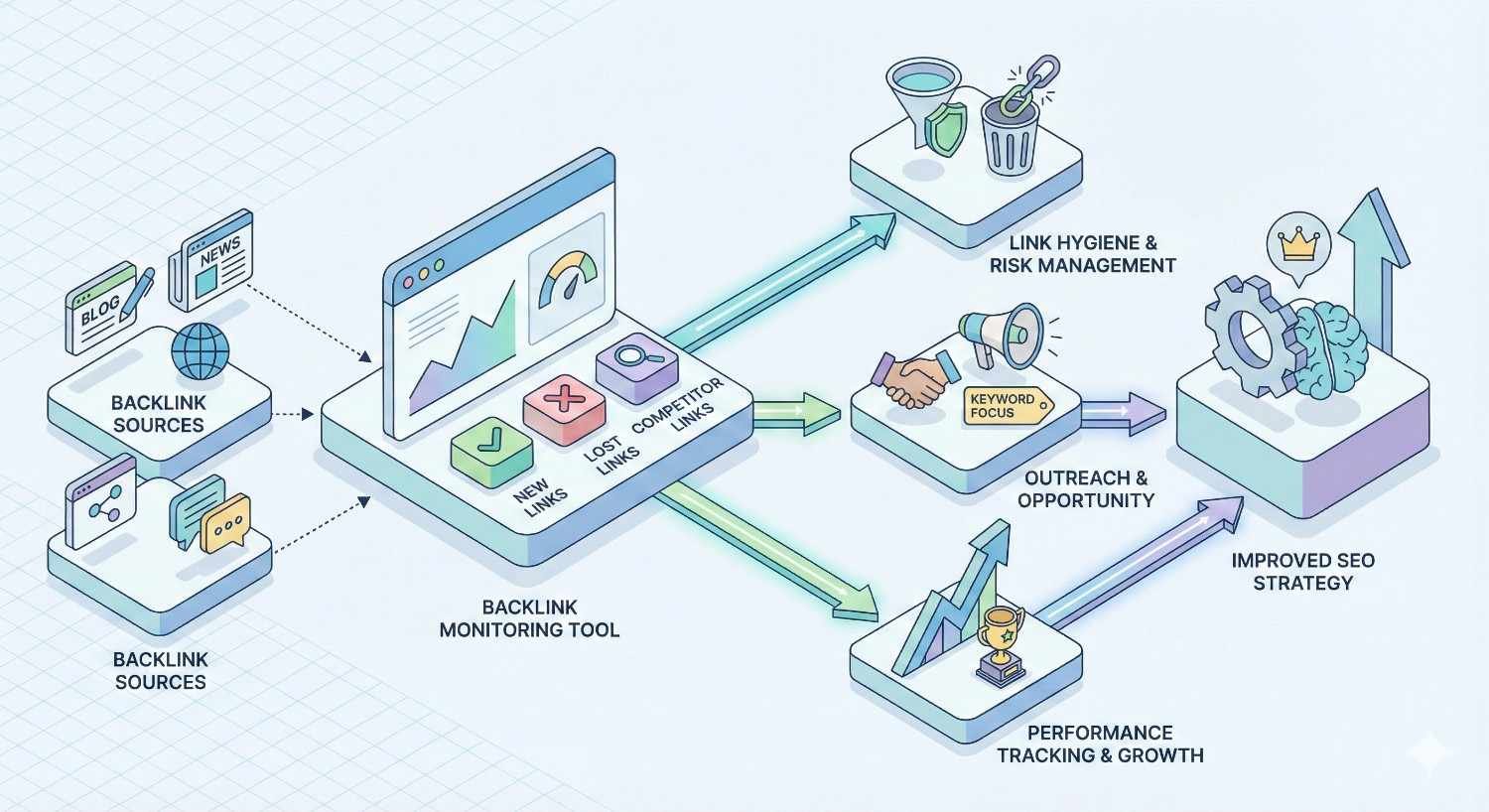
Monitoring tools transform passive observation into active prospecting. Every data point can become an outreach opportunity.
Competitor link gaps show domains linking to competitors but not you. These sites already link to similar content, making them warm prospects for your outreach.
Broken link building uses monitoring data to find broken outbound links on relevant sites. You offer your content as a replacement, providing value while earning a link.
Unlinked brand mentions appear when sites discuss your brand without linking. Monitoring tools that track mentions alongside links identify these opportunities for quick wins.
Resource page prospecting emerges from analyzing where competitors earn links. Resource pages that link to multiple competitors likely accept relevant additions.
Detecting Toxic Links and Negative SEO
Not all links help your rankings. Some actively harm them. Toxic links from spammy, irrelevant, or manipulative sources can trigger penalties.
Negative SEO, where competitors intentionally build harmful links to your site, remains a real threat. While Google claims to ignore most spammy links automatically, concentrated attacks can still cause damage.
Monitoring tools help you:
- Identify sudden spikes in low-quality links
- Detect patterns consistent with negative SEO attacks
- Build disavow files for Google Search Console
- Document link attacks for potential reconsideration requests
- Monitor disavow file effectiveness over time
When you spot toxic links, act quickly. Document the links, add them to your disavow file, and submit to Google. Regular toxic link audits prevent accumulation of harmful links.
Measuring Link Acquisition Performance
Link building requires significant investment. Monitoring tools prove whether that investment delivers results.
Campaign tracking features let you:
- Tag links by campaign or source
- Measure links earned per outreach effort
- Calculate cost per acquired link
- Track link retention rates over time
- Compare campaign performance across strategies
Without measurement, you can’t optimize. Monitoring data reveals which tactics work, which waste resources, and where to focus future efforts.
Tracking Competitor Link Strategies
Competitors invest in link building too. Monitoring their efforts reveals strategies you can adapt or counter.
Watch for:
- New link sources entering competitor profiles
- Content types earning the most links
- Outreach patterns and timing
- Partnership and sponsorship links
- Digital PR campaign results
When competitors consistently earn links from specific site types, that signals opportunity. Their success validates the approach. Your job is executing it better.
Types of Backlink Monitoring Tools
Enterprise SEO Platforms
Enterprise platforms like Conductor, BrightEdge, and seoClarity offer backlink monitoring as part of comprehensive SEO suites. These tools serve large organizations managing complex, multi-site SEO programs.
Enterprise features typically include:
- Unlimited or very high crawl limits
- Custom API access and integrations
- Multi-user permissions and workflows
- White-label reporting for agencies
- Dedicated account management
- Advanced data segmentation
Pricing reflects the enterprise focus. Annual contracts often start at $25,000-$50,000 or higher. For organizations with substantial SEO investments, the comprehensive feature sets justify the cost.
Dedicated Backlink Analysis Tools
Specialized tools focus exclusively on backlink analysis. Majestic and LinkResearchTools exemplify this category, offering deep link intelligence without broader SEO features.
Dedicated tools often provide:
- Larger link indexes than all-in-one platforms
- More granular link metrics and analysis
- Specialized features like link detox scoring
- Historical data going back years
- Bulk analysis capabilities
These tools suit teams that need advanced link analysis but use other platforms for keyword tracking, technical SEO, and content optimization.
All-in-One SEO Suites
Platforms like Ahrefs, Semrush, and Moz combine backlink monitoring with keyword research, rank tracking, site audits, and content tools. For most businesses, these suites provide sufficient backlink monitoring alongside other essential SEO capabilities.
All-in-one advantages include:
- Single platform for multiple SEO functions
- Integrated data across features
- Lower total cost than multiple specialized tools
- Unified reporting and dashboards
- Consistent user experience
The tradeoff is depth. Specialized tools may offer more advanced link analysis features. But for most use cases, all-in-one platforms provide adequate backlink monitoring.
Free vs. Paid Backlink Checkers
Free tools like Google Search Console, Bing Webmaster Tools, and limited versions of paid platforms offer basic backlink data without cost.
Google Search Console provides the most authoritative free data since it comes directly from Google. However, it only shows a sample of links, lacks competitor data, and offers minimal analysis features.
Free tiers of paid tools typically limit:
- Number of tracked domains
- Historical data access
- Export capabilities
- Alert features
- API access
For serious SEO work, paid tools are essential. Free options work for basic awareness but lack the depth needed for strategic link building and competitive analysis.
Essential Metrics Tracked by Backlink Monitoring Tools
Total Referring Domains
Referring domains count unique websites linking to you, regardless of how many individual links each provides. This metric matters more than total backlink count because one site linking 100 times provides less diversity than 100 sites linking once each.
Search engines value link diversity. A profile with 500 referring domains typically outperforms one with 5,000 links from 50 domains. Diversity signals broader recognition and reduces manipulation risk.
Track referring domain growth over time. Healthy profiles show steady, organic growth. Sudden spikes or drops warrant investigation.
New vs. Lost Backlinks
The balance between new and lost links determines whether your profile grows or shrinks. Monitoring this ratio reveals link building effectiveness and potential problems.
Positive velocity (more new than lost) indicates successful link acquisition. Your content earns links faster than natural attrition removes them.
Negative velocity (more lost than new) signals trouble. You’re losing ground. Either link building efforts are insufficient, or something is causing unusual link loss.
Investigate significant lost links individually. High-authority losses deserve outreach attempts. Patterns in lost links may reveal site-wide issues.
Link Velocity and Growth Rate
Link velocity measures how quickly you acquire new links over time. Natural velocity varies by industry, site age, and content output.
Unnatural velocity patterns trigger algorithmic scrutiny. Acquiring 1,000 links in a week after months of 10 links weekly looks manipulative. Gradual, consistent growth appears organic.
Compare your velocity against competitors. If they grow at 50 new referring domains monthly while you add 10, you’re falling behind. Adjust link building investment accordingly.
Dofollow vs. Nofollow Ratio
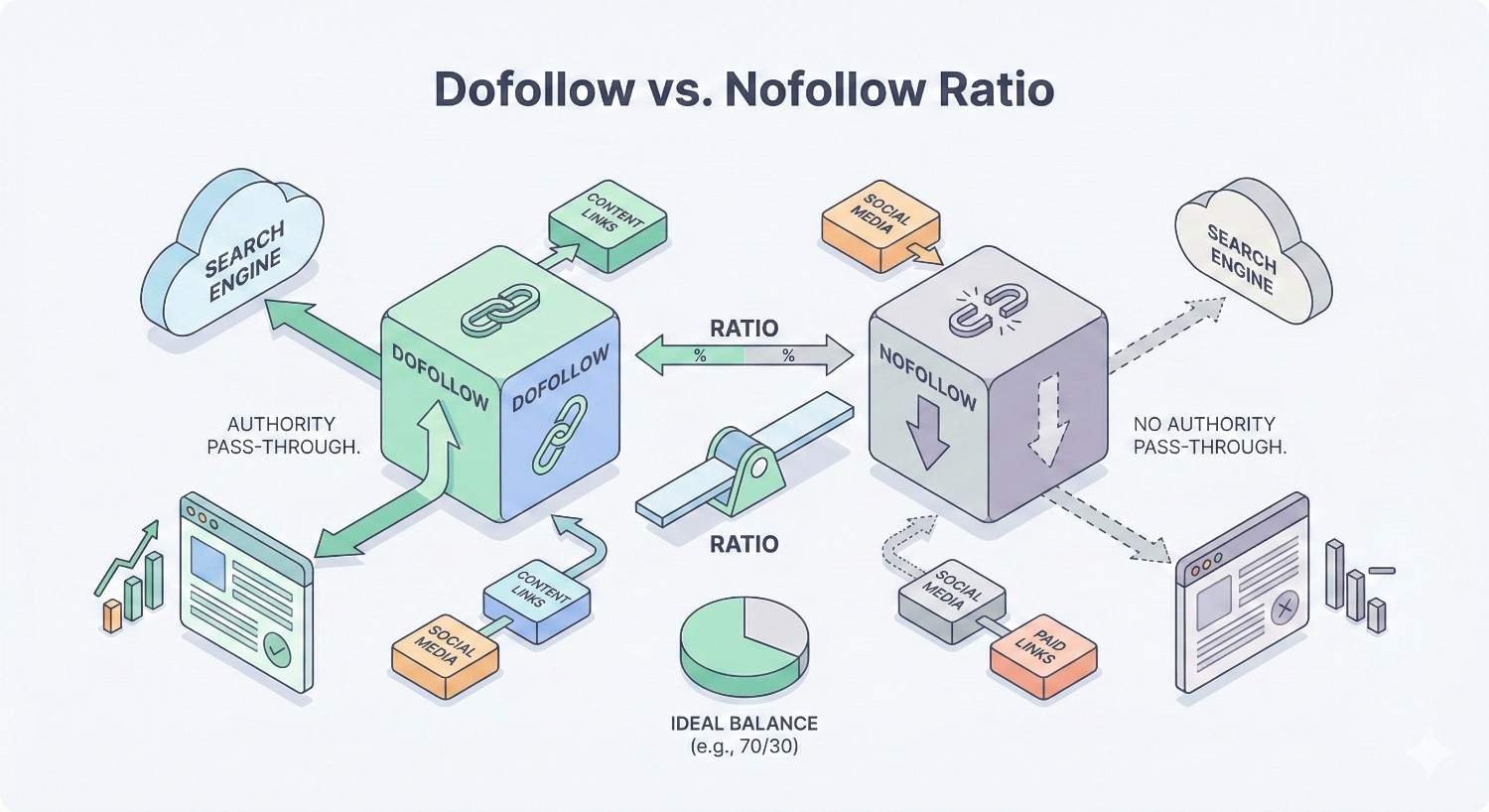
Dofollow links pass PageRank and directly influence rankings. Nofollow links (and newer rel attributes like sponsored and UGC) don’t pass PageRank but still provide traffic and brand visibility.
Natural profiles contain both. A profile with 100% dofollow links looks unnatural. Most legitimate sites earn nofollow links from social media, forums, comments, and sponsored content.
Typical healthy ratios range from 60-80% dofollow. Exact ratios vary by industry and link building tactics. Compare against competitors to establish benchmarks.
Link Placement and Context
Where links appear affects their value. Monitoring tools categorize links by placement:
- Editorial/content links: Highest value, within main page content
- Author bio links: Moderate value, common in guest posts
- Sidebar/widget links: Lower value, often sitewide
- Footer links: Lowest value, frequently ignored by algorithms
- Comment links: Minimal value, usually nofollow
Prioritize earning editorial links within relevant content. These links provide the strongest ranking signals and most referral traffic.
Geographic and Topical Relevance
Links from geographically and topically relevant sources carry more weight. A US-based plumber benefits more from links on US home improvement sites than international tech blogs.
Monitoring tools analyze:
- Country distribution of referring domains
- Language of linking pages
- Topical categories of referring sites
- Industry relevance scores
For local businesses, geographic relevance matters significantly. For global brands, topical relevance takes priority. Align link building efforts with your target audience’s location and interests.
How to Choose the Right Backlink Monitoring Tool
Assessing Your SEO Goals and Budget
Tool selection starts with understanding your needs. A startup tracking one domain has different requirements than an agency managing 50 client sites.
Consider:
- Number of domains to monitor
- Competitor tracking requirements
- Team size and collaboration needs
- Reporting frequency and format
- Integration requirements
- Budget constraints
Entry-level plans from major platforms start around $100-150 monthly. Enterprise needs may require $500-1,000+ monthly. Free tools work for basic awareness but limit strategic capabilities.
Match tool capabilities to actual needs. Paying for enterprise features you won’t use wastes budget. Underpaying for inadequate tools wastes time.
Index Size and Data Freshness
Larger indexes find more links. Freshness determines how quickly new links appear in your dashboard.
Ahrefs reports crawling over 400 billion pages with their index. Semrush, Moz, and Majestic maintain similarly massive indexes. Smaller tools may miss links that larger platforms catch.
Test tools by checking links you know exist. If a tool misses known links, its index may have gaps affecting your monitoring accuracy.
Freshness varies by plan level. Premium tiers often receive faster index updates. For time-sensitive monitoring, prioritize tools with daily or near-real-time updates.
Integration with Existing SEO Stack
Backlink data becomes more valuable when combined with other SEO metrics. Integration capabilities determine how easily data flows between tools.
Common integration needs include:
- Google Search Console for verified link data
- Google Analytics for referral traffic analysis
- Rank tracking tools for correlation analysis
- Project management platforms for workflow
- Reporting tools for client deliverables
- CRM systems for outreach tracking
API access enables custom integrations. Evaluate API limits, documentation quality, and pricing when integration matters.
Reporting and Alert Capabilities
Reporting transforms raw data into actionable insights. Alert systems ensure you don’t miss critical changes.
Evaluate:
- Pre-built report templates
- Custom report builders
- Automated scheduling and delivery
- White-label options for agencies
- Export formats (PDF, CSV, API)
- Alert customization options
- Notification channels (email, Slack, webhook)
For agencies, white-label reporting justifies tool costs through client deliverables. For in-house teams, automated alerts reduce manual monitoring time.
User Interface and Learning Curve
Complex tools with steep learning curves reduce adoption and effectiveness. The best tool is one your team actually uses.
Consider:
- Dashboard clarity and navigation
- Time to find common information
- Training resources and documentation
- Customer support quality
- Mobile accessibility
- Onboarding process
Request demos or trials before committing. Have team members who’ll use the tool daily evaluate usability, not just decision-makers who’ll rarely log in.
How to Set Up Effective Backlink Monitoring
Connecting Your Website and Competitors
Initial setup requires adding your domain and key competitors. Most tools verify ownership through DNS records, HTML files, or Google Search Console integration.
For your own sites:
- Add your primary domain
- Verify ownership through preferred method
- Connect Google Search Console for enhanced data
- Add important subdomains if applicable
- Configure tracking for all relevant properties
For competitors:
- Identify 3-5 primary competitors
- Add their domains to your monitoring dashboard
- Set up comparative tracking views
- Configure competitor alert preferences
Choose competitors strategically. Include direct business competitors and sites ranking for your target keywords. Different competitors may dominate different keyword clusters.
Configuring Alert Preferences
Effective alerts balance awareness with noise reduction. Too many alerts cause fatigue. Too few miss important changes.
Recommended alert configurations:
High priority (immediate notification):
- Lost links from DA 50+ domains
- Sudden spike in new low-quality links
- Links from known toxic sources
- Competitor links from high-authority sites
Medium priority (daily digest):
- New links above quality threshold
- Lost links from moderate-authority sites
- Anchor text anomalies
- Competitor new link summary
Low priority (weekly summary):
- General link profile changes
- Minor metric fluctuations
- Comprehensive competitor updates
Adjust thresholds based on your profile size. A site with 10,000 referring domains needs higher thresholds than one with 100.
Setting Up Custom Reports and Dashboards
Custom dashboards surface the metrics that matter most to your strategy. Default views rarely match specific needs perfectly.
Create dashboards for:
- Executive overview (high-level metrics, trends)
- Link building team (new opportunities, campaign tracking)
- Technical SEO (broken links, redirect needs)
- Competitive intelligence (gap analysis, competitor tracking)
Schedule automated reports for stakeholders who need regular updates but won’t log into tools. Weekly or monthly cadences work for most reporting needs.
Establishing Baseline Metrics
Before measuring progress, document your starting point. Baseline metrics enable meaningful comparison over time.
Record current values for:
- Total referring domains
- Total backlinks
- Domain authority/rating
- Dofollow/nofollow ratio
- Anchor text distribution
- Top referring domains
- Link velocity (past 30/90 days)
Compare baselines against competitors. Understanding where you stand relative to competition contextualizes your metrics and informs goal-setting.
Best Practices for Backlink Monitoring
Monitoring Frequency and Consistency
Consistent monitoring catches issues before they compound. Establish regular review cadences based on your site’s activity level and risk tolerance.
Recommended frequencies:
- Daily: Check alerts, review high-priority notifications
- Weekly: Analyze new and lost links, competitor updates
- Monthly: Comprehensive profile review, trend analysis
- Quarterly: Strategic assessment, goal adjustment
High-traffic sites or those in competitive niches may need more frequent monitoring. Smaller sites with stable profiles can monitor less intensively.
Consistency matters more than frequency. Weekly reviews every week outperform sporadic deep dives.
Prioritizing High-Value Link Opportunities
Not all link opportunities deserve equal attention. Prioritize based on potential impact and acquisition difficulty.
High priority targets:
- Sites already linking to competitors
- High-authority domains in your niche
- Sites that previously linked to you
- Resource pages accepting submissions
- Journalists covering your industry
Lower priority:
- Low-authority general directories
- Irrelevant sites regardless of authority
- Sites with excessive outbound links
- Known link sellers or PBNs
Focus outreach resources on opportunities most likely to move rankings. One DA 70 editorial link typically outweighs ten DA 20 directory links.
Documenting Link Building Campaigns
Documentation enables measurement, optimization, and institutional knowledge. Track campaigns systematically.
Record for each campaign:
- Campaign name and objectives
- Target sites and contacts
- Outreach templates used
- Response rates and outcomes
- Links acquired with dates
- Cost and time investment
- Performance correlation with rankings
Use spreadsheets, project management tools, or CRM systems to maintain records. Consistent documentation reveals what works and what doesn’t over time.
Responding to Link Losses Quickly
When high-value links disappear, rapid response increases recovery chances. The longer you wait, the less likely outreach succeeds.
Link loss response process:
- Identify the lost link and referring domain
- Check if the page still exists (may be temporary issue)
- Determine why the link was removed if possible
- Craft personalized outreach to the site owner
- Offer updated content or additional value
- Follow up if no response within a week
- Document outcome for future reference
Not every lost link warrants outreach. Focus recovery efforts on high-authority, relevant links that significantly impact your profile.
Combining Backlink Data with Other SEO Metrics
Backlink data gains meaning through correlation with other metrics. Isolated link counts don’t tell the full story.
Combine backlink monitoring with:
- Rank tracking: Correlate link acquisition with ranking changes
- Organic traffic: Measure referral traffic from new links
- Conversion data: Track leads from link-driven traffic
- Technical audits: Identify internal linking opportunities
- Content performance: See which content earns links naturally
Integrated analysis reveals cause and effect. When rankings improve after earning specific links, you’ve validated your link building strategy.
Common Backlink Monitoring Mistakes to Avoid
Focusing Only on Quantity Over Quality
Chasing link counts leads to poor decisions. A profile with 1,000 low-quality links often performs worse than one with 100 high-quality links.
Quality indicators matter more than quantity:
- Referring domain authority
- Topical relevance
- Editorial placement
- Traffic potential
- Link neighborhood quality
Avoid tactics that inflate numbers without adding value. Directory submissions, comment spam, and link exchanges may increase counts but rarely improve rankings.
Ignoring Competitor Backlink Intelligence
Your competitors’ link profiles contain valuable intelligence. Ignoring this data means missing opportunities and strategic insights.
Competitor analysis reveals:
- Link sources you haven’t discovered
- Content types that earn links in your niche
- Outreach targets already receptive to similar content
- Gaps in your link profile relative to competition
- Strategies working in your industry
Set up competitor monitoring from day one. Regular competitive analysis should inform your link building priorities.
Neglecting Regular Toxic Link Audits
Toxic links accumulate over time. Without regular audits, harmful links can reach levels that impact rankings.
Schedule toxic link audits:
- Monthly for high-risk sites (previous penalties, competitive niches)
- Quarterly for moderate-risk sites
- Bi-annually for low-risk sites with clean histories
During audits:
- Export links flagged as potentially toxic
- Manually review flagged links for accuracy
- Add confirmed toxic links to disavow file
- Submit updated disavow to Google Search Console
- Document audit findings and actions
Automated spam scores aren’t perfect. Manual review prevents disavowing legitimate links incorrectly flagged.
Not Acting on Monitoring Insights
Data without action wastes resources. Monitoring tools provide intelligence. You must act on it.
Common inaction patterns:
- Seeing opportunities but not pursuing outreach
- Identifying toxic links but not disavowing
- Noticing lost links but not attempting recovery
- Tracking competitors but not adapting strategy
Build processes that connect insights to actions. Assign responsibility for acting on monitoring findings. Track follow-through on identified opportunities.
How Backlink Monitoring Fits Into Your Overall SEO Strategy
Connecting Link Data to Ranking Performance
Links influence rankings, but the relationship isn’t always immediate or linear. Connecting link data to ranking performance requires systematic analysis.
Track correlations between:
- New high-authority links and ranking improvements
- Lost links and ranking declines
- Link velocity changes and SERP volatility
- Anchor text changes and keyword rankings
Use rank tracking tools alongside backlink monitoring. When rankings change, check for corresponding link profile changes. Patterns emerge over time.
Remember that rankings depend on many factors. Links are influential but not the only variable. Content quality, technical SEO, and user signals all contribute.
Informing Content and Outreach Strategy
Backlink data should shape content creation and outreach priorities. Let link performance guide strategy.
Content insights from link data:
- Which content types earn links naturally
- Topics that attract high-authority links
- Formats preferred by linking sites
- Content gaps competitors fill but you don’t
Outreach insights:
- Sites most likely to link based on history
- Optimal timing for outreach campaigns
- Messaging that resonates with target sites
- Relationship-building opportunities
Create more of what earns links. Reach out to sites most likely to respond. Data-driven strategy outperforms guesswork.
Supporting Technical SEO and Site Health
Backlink monitoring intersects with technical SEO in several ways. Link data reveals technical issues affecting your site’s ability to capture link equity.
Technical issues identified through link monitoring:
- Broken inbound links needing redirects
- Links pointing to non-canonical URLs
- Redirect chains diluting link equity
- Links to pages blocked by robots.txt
- HTTPS migration issues affecting links
Coordinate with technical SEO efforts. When monitoring reveals links to broken pages, implement redirects. When links point to HTTP versions, ensure proper HTTPS redirects exist.
Measuring ROI from Link Building Efforts
Link building requires investment. Monitoring tools help prove whether that investment pays off.
ROI measurement framework:
- Track all link building costs (tools, outreach, content, time)
- Attribute acquired links to specific campaigns
- Correlate links with ranking improvements
- Connect rankings to traffic increases
- Measure conversions from organic traffic
- Calculate revenue per link or per campaign
Not every link directly drives revenue. But systematic measurement reveals which efforts generate returns and which don’t justify continued investment.
Backlink Monitoring for Different Business Types
For Startups and Small Businesses
Startups and small businesses typically operate with limited budgets and lean teams. Backlink monitoring must be efficient and focused.
Recommended approach:
- Start with all-in-one tools offering backlink features (Ahrefs Lite, Semrush Pro)
- Focus on 3-5 key competitors maximum
- Prioritize quality over quantity in link building
- Use alerts to minimize manual monitoring time
- Leverage free Google Search Console data
Key metrics to track:
- Referring domain growth rate
- Links from industry-relevant sites
- Competitor link gap opportunities
- Toxic link accumulation
Small businesses benefit from focused strategies. Rather than comprehensive monitoring, concentrate on metrics that directly impact growth.
For Agencies Managing Multiple Clients
Agencies face unique challenges: multiple clients, varied industries, and reporting requirements. Scalable monitoring processes are essential.
Agency-specific considerations:
- Multi-client dashboards and organization
- White-label reporting capabilities
- Bulk analysis and export features
- Team permissions and access controls
- API access for custom integrations
Workflow recommendations:
- Standardize monitoring setup across clients
- Create templated reports customizable per client
- Establish consistent review cadences
- Document processes for team consistency
- Use alerts to surface urgent issues across accounts
Agency pricing tiers from major tools often include features specifically designed for multi-client management.
For Enterprise and Large-Scale Websites
Enterprise sites with thousands of pages and complex link profiles require robust monitoring infrastructure.
Enterprise requirements:
- High crawl limits and API access
- Advanced segmentation and filtering
- Custom metric calculations
- Integration with enterprise SEO platforms
- Dedicated support and account management
Monitoring at scale:
- Segment monitoring by site section or subdomain
- Establish different alert thresholds by page importance
- Automate routine analysis through API integrations
- Build custom dashboards for different stakeholders
- Implement governance around link building activities
Enterprise tools like Conductor, BrightEdge, or enterprise tiers of Ahrefs and Semrush address these needs.
For E-commerce and Local Businesses
E-commerce and local businesses have distinct link building opportunities and monitoring needs.
E-commerce considerations:
- Product page link tracking
- Affiliate and partner link monitoring
- Review site link analysis
- Seasonal link building patterns
- Category page authority building
Local business considerations:
- Local citation consistency
- Geographic relevance of links
- Local news and community site links
- Competitor local link analysis
- Google Business Profile integration
Both business types benefit from monitoring tools that track local and industry-specific link sources alongside general metrics.
The Future of Backlink Monitoring
AI and Machine Learning in Link Analysis
Artificial intelligence is transforming how monitoring tools analyze and interpret link data. Machine learning models identify patterns humans might miss.
Current AI applications:
- Improved spam and toxic link detection
- Predictive link value scoring
- Automated opportunity identification
- Natural language processing for context analysis
- Anomaly detection for negative SEO
Emerging capabilities:
- Predictive ranking impact modeling
- Automated outreach recommendations
- Real-time link quality assessment
- Cross-platform link attribution
- Intent-based link categorization
As AI capabilities advance, expect monitoring tools to provide increasingly sophisticated analysis and recommendations.
Evolving Link Quality Signals
Google continuously refines how it evaluates links. Monitoring tools must adapt to track signals that actually matter.
Evolving quality factors:
- User engagement with linked content
- Brand mention context beyond links
- Social proof and authority signals
- Content freshness and updates
- Mobile experience of linking pages
Future monitoring may incorporate broader signals beyond traditional link attributes. Tools that adapt to algorithm changes will provide more accurate quality assessments.
Integration with Broader SEO Intelligence
Backlink monitoring is converging with other SEO data sources. Integrated platforms provide holistic views of search performance.
Integration trends:
- Unified dashboards combining links, rankings, and traffic
- Cross-channel attribution including links
- Content performance correlation with link acquisition
- Technical SEO integration for comprehensive audits
- Competitive intelligence across all SEO factors
The future of backlink monitoring isn’t isolated link tracking. It’s integrated intelligence that connects links to broader SEO and business outcomes.
Getting Started with Backlink Monitoring
Recommended Tools by Use Case
Different situations call for different tools. Match your selection to your specific needs.
For beginners and small budgets:
- Google Search Console (free, authoritative data)
- Ahrefs Webmaster Tools (free, limited features)
- Ubersuggest (affordable entry point)
For growing businesses:
- Ahrefs (comprehensive link index)
- Semrush (all-in-one capabilities)
- Moz Pro (user-friendly interface)
For agencies:
- Ahrefs Agency (multi-client features)
- Semrush Agency Growth Kit
- SE Ranking (affordable multi-project)
For enterprise:
- Conductor
- BrightEdge
- Ahrefs Enterprise
- Semrush Enterprise
For specialized link analysis:
- Majestic (historical data depth)
- LinkResearchTools (toxic link focus)
Trial multiple tools before committing. Most offer free trials or limited free tiers for evaluation.
Setting Realistic Expectations and Timelines
Backlink monitoring provides intelligence, not instant results. Set appropriate expectations for what monitoring achieves and when.
What monitoring delivers:
- Visibility into your link profile
- Early warning of problems
- Competitive intelligence
- Campaign measurement
- Opportunity identification
What monitoring doesn’t deliver:
- Automatic link acquisition
- Guaranteed ranking improvements
- Instant ROI
- Set-and-forget automation
Realistic timelines:
- Week 1-2: Tool setup, baseline establishment
- Month 1: Initial insights, process development
- Month 2-3: Pattern recognition, strategy refinement
- Month 3-6: Measurable impact from informed decisions
- Ongoing: Continuous optimization and adaptation
Monitoring is a long-term investment. Value compounds as historical data accumulates and patterns become clear.
How Professional SEO Support Can Help
Backlink monitoring tools provide data. Turning that data into results requires expertise, time, and consistent execution.
Professional SEO support offers:
- Expert interpretation of monitoring data
- Strategic link building execution
- Ongoing profile management
- Toxic link remediation
- Competitive analysis and response
- Integration with broader SEO strategy
For businesses lacking internal SEO resources, partnering with experienced providers accelerates results while reducing learning curves.
Conclusion
Backlink monitoring tools transform raw link data into strategic intelligence that drives SEO performance. From real-time discovery and quality assessment to competitor analysis and toxic link detection, these platforms provide the visibility needed to build and protect your site’s authority.
Effective monitoring requires more than tool access. It demands consistent processes, strategic interpretation, and decisive action on insights. The businesses that succeed treat backlink monitoring as an ongoing discipline, not a one-time setup.
We help businesses worldwide implement comprehensive backlink monitoring as part of full-service SEO strategies. Contact White Label SEO Service to discuss how professional link monitoring and building can accelerate your organic growth.
Frequently Asked Questions
What is the best backlink monitoring tool for beginners?
Google Search Console provides free, authoritative backlink data directly from Google. For more features, Ahrefs Webmaster Tools offers a free tier with basic monitoring capabilities. These options let beginners learn backlink analysis without financial commitment.
How often should I check my backlinks?
Review alerts daily for urgent issues. Conduct weekly analysis of new and lost links. Perform comprehensive monthly reviews of your entire profile. Adjust frequency based on your site’s activity level and competitive environment.
What should I do when I find toxic backlinks?
First, verify the links are genuinely harmful through manual review. Then add confirmed toxic links to a disavow file and submit it through Google Search Console. Document your findings and monitor for continued toxic link accumulation.
How many backlinks do I need to rank?
There’s no universal number. Ranking depends on link quality, relevance, and competition. A page might rank with 10 high-quality links in a low-competition niche or need hundreds in competitive markets. Focus on earning relevant, authoritative links rather than hitting arbitrary targets.
Can backlink monitoring tools detect negative SEO?
Yes. Monitoring tools identify sudden spikes in low-quality links, unnatural anchor text patterns, and links from known spam sources. Configure alerts for these patterns to catch potential negative SEO attacks early.
What’s the difference between backlinks and referring domains?
Backlinks count individual links. Referring domains count unique websites linking to you. One website might provide 50 backlinks but counts as one referring domain. Referring domain diversity typically matters more for rankings than total backlink count.
How long does it take for new backlinks to impact rankings?
New links can take weeks to months to influence rankings. Google must discover, crawl, and process the link. The linking page’s authority and your site’s existing profile affect timing. High-authority links from frequently crawled sites typically impact rankings faster than links from obscure sources.