Link building outreach is the strategic process of contacting website owners, editors, and journalists to earn backlinks that improve your search rankings and organic traffic. When executed correctly, outreach campaigns deliver high-authority links that signal trust to Google and drive qualified referral visitors to your site.
This matters because backlinks remain one of Google’s top three ranking factors. Without a systematic approach to earning quality links, your content competes at a disadvantage against competitors who actively build their backlink profiles.
This guide covers everything from prospect research and email templates to follow-up sequences and ROI measurement. You’ll learn exactly how to build a scalable outreach system.
How Link Building Outreach Works: The Strategic Framework
Link building outreach operates on a simple principle: you identify websites that could benefit from linking to your content, then contact the right person with a compelling reason to add that link. The execution, however, requires systematic processes, quality assets, and persistent follow-through.
Unlike passive link acquisition methods where you publish content and hope for links, outreach puts you in control. You select your targets, craft your pitch, and actively pursue placements on sites that matter for your rankings.
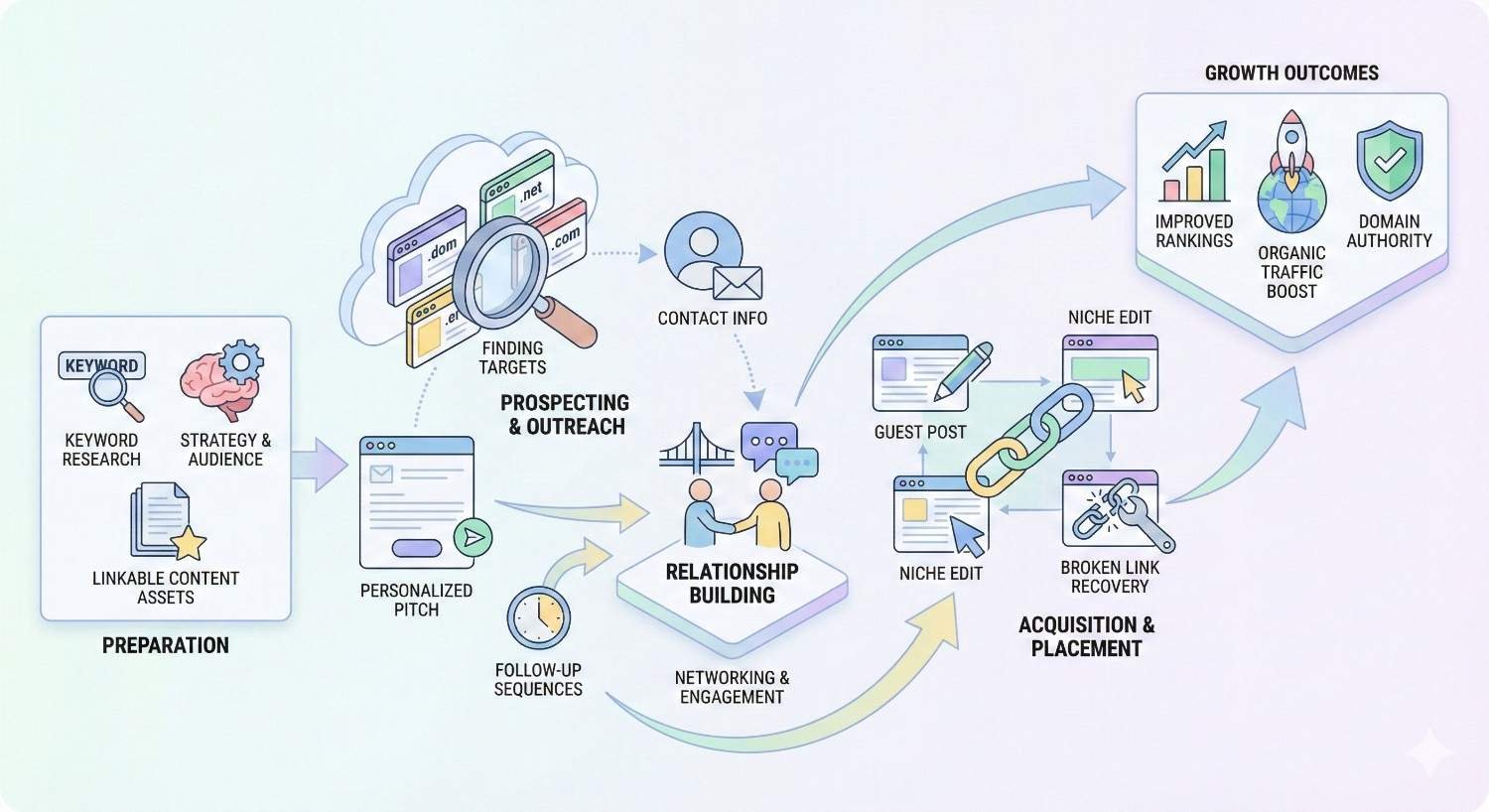
The Link Building Outreach Process: Step-by-Step Overview
Every successful outreach campaign follows a predictable sequence. Understanding this framework helps you identify bottlenecks and optimize each stage for better results.
Stage 1: Asset Creation Before sending a single email, you need something worth linking to. This could be original research, a comprehensive guide, a useful tool, or newsworthy content. The asset determines your pitch angle and target audience.
Stage 2: Prospect Research Identify websites that would genuinely benefit from linking to your content. This includes competitor backlink analysis, resource page discovery, and relationship mapping. Quality matters more than quantity here.
Stage 3: Contact Discovery Find the right person to contact at each target site. Generic contact forms rarely work. You need the editor, content manager, or author who can actually add your link.
Stage 4: Outreach Execution Send personalized emails that clearly communicate value. Your message must answer one question: “Why should I add this link?” Generic templates get ignored.
Stage 5: Follow-Up Sequences Most responses come from follow-up emails, not initial outreach. A structured follow-up sequence typically doubles or triples your response rate.
Stage 6: Relationship Management Successful placements create opportunities for future links. Track your contacts, nurture relationships, and build a network of publishers who know and trust your brand.
Types of Link Building Outreach Campaigns
Different outreach strategies work for different situations. Your choice depends on your available assets, industry, and goals.
Guest Post Outreach You pitch original content to publishers in exchange for a contextual link back to your site. This works well when you have writing resources and want to build thought leadership alongside links. Target sites that accept contributions and have engaged audiences in your niche.
Resource Page Link Building Many websites maintain curated lists of helpful resources on specific topics. If your content genuinely belongs on these lists, outreach is straightforward: show the page owner why your resource adds value for their readers.
Broken Link Building When you find broken links on relevant websites, you can offer your content as a replacement. This provides clear value to the site owner since you’re helping them fix a user experience problem while earning a link.
Digital PR & Journalist Outreach Pitching newsworthy content, data, or expert commentary to journalists and media outlets can generate high-authority links from news sites. This requires genuinely interesting angles and timely pitches.
Unlinked Brand Mention Reclamation When websites mention your brand without linking, a simple outreach email often converts these mentions into links. These are high-conversion opportunities since the site already knows and references your brand.
Skyscraper Technique Outreach Find content that has earned many links, create something significantly better, then reach out to sites linking to the original. Your pitch: “You linked to X, but here’s something more comprehensive and current.”
Link Building Outreach vs. Other Link Acquisition Methods
Outreach is one of several approaches to building backlinks. Understanding the alternatives helps you allocate resources effectively.
Passive Link Earning Publishing exceptional content and waiting for links to accumulate naturally. This works for established brands with existing audiences but is slow and unpredictable for newer sites.
Digital PR Broader media relations focused on brand coverage rather than specific link placements. Often generates links as a byproduct of press coverage.
Link Insertions Requesting links be added to existing content rather than creating new content. Lower effort but requires finding relevant placement opportunities.
Paid Placements Purchasing links directly violates Google’s guidelines and carries significant risk. While common, this approach can result in manual penalties that devastate organic traffic.
Outreach offers the best balance of control, scalability, and compliance with search engine guidelines. You actively pursue links while maintaining editorial standards that keep your backlink profile clean.
Pre-Outreach Foundation: What You Need Before You Start
Launching outreach without proper preparation wastes time and damages your sender reputation. Before sending your first email, establish the foundation that makes campaigns successful.
Link-Worthy Assets: Creating Content That Earns Links
Your outreach is only as good as what you’re promoting. Publishers link to content that serves their audience. If your asset doesn’t provide genuine value, no amount of outreach skill will compensate.
Original Research & Data Studies Data-driven content earns links because it provides unique information unavailable elsewhere. Surveys, industry benchmarks, and original analysis give journalists and bloggers something to cite. Content Marketing Institute research shows original research generates significantly more backlinks than standard blog posts.
Comprehensive Guides & Resources In-depth guides that thoroughly cover a topic become reference materials that other content creators link to when explaining concepts. The key is genuine comprehensiveness, not just length.
Tools, Calculators & Interactive Content Free tools that solve specific problems earn links naturally and through outreach. A mortgage calculator, ROI estimator, or industry-specific tool provides ongoing value that publishers want to share.
Infographics & Visual Assets Well-designed visuals that communicate complex information clearly get embedded and linked across the web. The visual must add genuine value, not just repackage text content.
Expert Roundups & Industry Insights Content featuring multiple expert perspectives earns links from participants and their networks. This approach also builds relationships with influencers who may link to your future content.
Target Link Prospect Research & Qualification
Not all links are equal. A single link from a relevant, authoritative site delivers more ranking value than dozens of links from low-quality sources. Qualification prevents wasted outreach effort.
Identifying High-Quality Link Prospects Start with sites that already link to similar content. If a site linked to your competitor’s guide on the same topic, they’re predisposed to link to quality content in that space. Use backlink analysis tools to find these opportunities.
Evaluating Domain Authority & Relevance Domain Rating (Ahrefs) or Domain Authority (Moz) provide rough proxies for a site’s link equity. However, topical relevance often matters more than raw authority. A DR 40 site in your exact niche typically delivers more value than a DR 70 site in an unrelated industry.
Assessing Traffic & Audience Alignment Links from sites with real traffic provide referral visitors alongside SEO value. Check organic traffic estimates in Ahrefs or SEMrush. Sites with zero traffic may be link farms or abandoned properties.
Competitor Backlink Analysis Your competitors’ backlink profiles reveal proven link opportunities. If a site linked to similar content from a competitor, they may link to yours if you offer something better or different.
Building Your Outreach Infrastructure
Technical setup determines whether your emails reach inboxes or spam folders. Invest time here before scaling outreach volume.
Email Deliverability Setup (SPF, DKIM, DMARC) These authentication protocols verify that emails actually come from your domain. Without proper configuration, email providers may flag your messages as suspicious. Most domain registrars and email providers offer setup guides for these records.
Domain Warming & Sender Reputation New email domains lack sending history. Start with low volumes (10-20 emails daily) and gradually increase over 2-4 weeks. Sudden high-volume sending from a new domain triggers spam filters.
Outreach Tools & CRM Systems Spreadsheets work for small campaigns, but dedicated outreach tools like Pitchbox, BuzzStream, or Hunter Campaigns streamline prospect management, email sequencing, and response tracking at scale.
Email Templates & Personalization Frameworks Develop template structures that can be personalized efficiently. The goal is consistent messaging with genuine personalization, not mass-produced identical emails.
Finding Link Opportunities: Prospect Research & Discovery
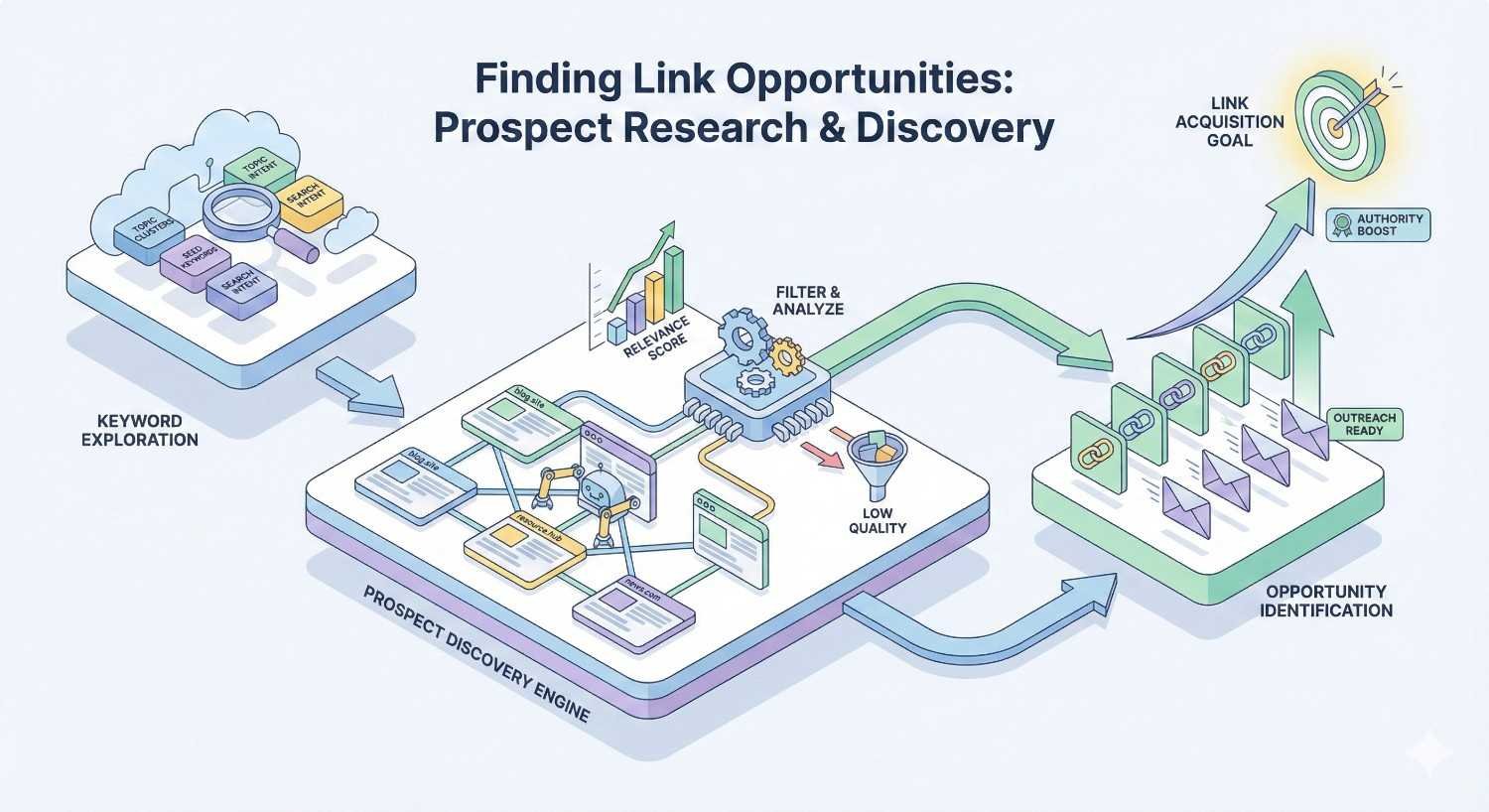
Prospect research determines campaign success more than any other factor. Finding the right targets means higher response rates, better link quality, and more efficient use of outreach resources.
Competitor Backlink Gap Analysis
Your competitors have already done the prospecting work. Their backlink profiles reveal sites willing to link to content in your space.
Export competitor backlinks from Ahrefs, SEMrush, or Moz. Filter for relevant, high-quality domains. Identify patterns: which types of content earn links? Which sites link to multiple competitors? These sites are your highest-probability targets.
The gap analysis specifically identifies sites linking to competitors but not to you. These represent immediate opportunities since the site has demonstrated willingness to link to similar content.
Content-Based Prospecting Methods
Different content types create different prospecting opportunities. Match your approach to your available assets.
Resource Page Identification Search operators like “keyword + resources” or “keyword + useful links” reveal curated resource pages. These pages exist specifically to link to helpful content. If your asset genuinely belongs, the pitch is straightforward.
Roundup Post Opportunities Weekly or monthly roundups in your industry need fresh content to feature. Search for “keyword + roundup” or “keyword + this week” to find publishers who regularly curate content.
Broken Link Discovery Tools like Ahrefs’ Broken Backlinks report or Check My Links browser extension identify broken links on target sites. Finding a broken link to content similar to yours creates a natural outreach angle.
Unlinked Brand Mentions Set up Google Alerts or use Ahrefs’ Content Explorer to find mentions of your brand without links. These are warm prospects since they already know and reference your company.
Relationship-Based Prospecting
The best link opportunities often come from relationships rather than cold outreach. Building your network creates ongoing link opportunities.
Industry Blogger & Publisher Mapping Identify the key publishers in your space. Follow their content, engage on social media, and understand their editorial focus. When you have relevant content, you’re reaching out to someone who recognizes your name.
Journalist & Media Contact Research Build a database of journalists covering your industry. Tools like Muck Rack, Cision, or manual research help identify reporters who write about topics where you can provide expert commentary or data.
Podcast & Interview Opportunities Podcast appearances typically include links in show notes. Search for podcasts in your niche and pitch yourself or your executives as guests. This builds authority alongside links.
Partnership & Collaboration Prospects Complementary businesses often have audiences that overlap with yours. Co-created content, joint research, or mutual promotion creates natural linking opportunities.
Advanced Prospecting Techniques
Beyond standard methods, several advanced approaches uncover opportunities competitors miss.
Reverse Image Search for Visual Assets If you’ve created original images, infographics, or charts, reverse image search reveals sites using your visuals. Many will add attribution links when asked.
HARO & Source Request Platforms Help A Reporter Out (HARO), Qwoted, and similar platforms connect journalists with expert sources. Responding to relevant queries can earn high-authority media links.
Social Listening for Link Opportunities Monitor social conversations about topics where you have relevant content. When someone asks for resources or recommendations, you can suggest your content and potentially earn a link.
Industry Event & Conference Outreach Events create content opportunities: speaker profiles, sponsor pages, recap posts. Participating in industry events opens doors to links from event websites and attendee content.
Contact Discovery & Verification
Finding the right contact transforms outreach results. Generic contact forms and info@ addresses rarely reach decision-makers. Invest time in finding the specific person who can add your link.
Finding Decision-Maker Contact Information
Different situations require different discovery approaches. Layer multiple methods for best results.
Email Pattern Recognition Most companies use consistent email formats: firstname@company.com, firstname.lastname@company.com, or similar patterns. Once you identify the pattern, you can construct emails for specific contacts.
Contact Finder Tools & Databases Hunter.io, Snov.io, and similar tools search for email addresses associated with domains. These databases aggregate publicly available contact information and provide verification.
Social Media Profile Mining LinkedIn profiles often reveal job titles and sometimes direct contact information. Twitter bios may include email addresses. Professional networks provide context about the right person to contact.
Website Contact Page Analysis Team pages, about sections, and author bios reveal names and sometimes direct emails. For smaller sites, the founder or owner often handles content decisions directly.
Email Verification & Validation
Sending to invalid addresses damages your sender reputation. Verify emails before adding them to campaigns.
Email verification tools check whether addresses exist and can receive mail. Services like NeverBounce, ZeroBounce, or Hunter’s built-in verification reduce bounce rates. Aim for bounce rates under 2% to maintain deliverability.
Building Organized Prospect Lists
Structured prospect data enables efficient outreach and accurate tracking.
Your prospect database should include: website URL, contact name, email address, site metrics (DR/DA, traffic), outreach angle, and status tracking. Whether using spreadsheets or dedicated tools, consistent data structure prevents duplicate outreach and enables performance analysis.
Segment prospects by priority, campaign type, or outreach angle. High-value targets may warrant more personalization effort than lower-priority prospects.
Crafting High-Converting Outreach Messages
Your email is the moment of truth. Everything else, the research, the asset creation, the contact discovery, leads to this point. A compelling message converts prospects into links.
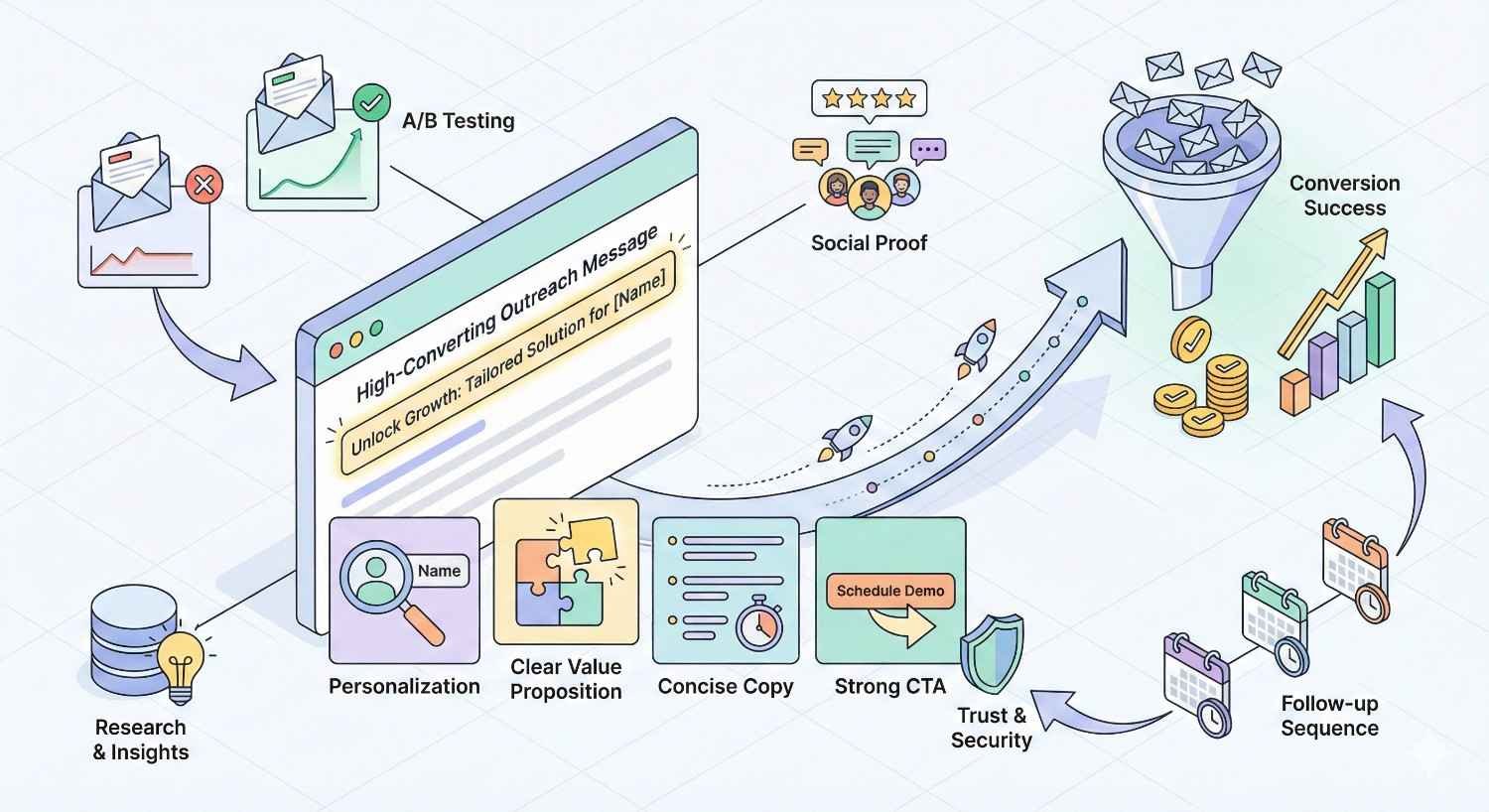
Outreach Email Anatomy: Essential Components
Effective outreach emails share common structural elements. Each component serves a specific purpose.
Subject Line Best Practices Your subject line determines whether the email gets opened. Keep it short (under 50 characters), specific, and curiosity-inducing without being clickbait. Personalization in subject lines can increase open rates. Avoid spam trigger words like “free,” “urgent,” or excessive punctuation.
Personalized Opening Lines The first sentence proves you’re not sending mass emails. Reference something specific: a recent article they wrote, a point they made, or something unique about their site. Generic openings like “I love your blog” signal lazy outreach.
Value Proposition & Pitch Clearly explain what you’re offering and why it benefits them. Focus on their audience, not your needs. “Your readers would find this useful because…” works better than “I’d love a link because…”
Clear Call-to-Action Tell them exactly what you want. Vague requests get vague responses. “Would you consider adding a link to our guide in your resources section?” is clearer than “Let me know what you think.”
Professional Signature Include your name, title, company, and website. A complete signature builds credibility. Optional: include a phone number or LinkedIn profile for additional trust signals.
Personalization Strategies That Scale
True personalization takes time. The challenge is balancing personalization depth with outreach volume.
Tiered Personalization Approach Segment prospects by value. High-priority targets (DR 70+ sites, major publications) get deeply personalized emails. Mid-tier prospects get moderate personalization. Lower-priority targets get template-based outreach with basic customization.
Dynamic Content Variables Beyond {FirstName} and {SiteName}, create variables for specific personalization points: {RecentArticle}, {SpecificPoint}, {RelevantSection}. This enables personalization at scale while maintaining efficiency.
Genuine Compliments & Specific References Reference something specific that demonstrates you actually visited their site. Mention a particular article, quote a specific point, or reference their unique approach. Specificity signals authenticity.
Contextual Relevance Signals Explain why you’re reaching out to them specifically. What about their site or content makes your pitch relevant? This context transforms cold outreach into logical connection.
Outreach Templates by Campaign Type
Different campaigns require different approaches. These frameworks provide starting points for customization.
Guest Post Pitch Template Subject: Content idea for [Site Name]
Hi [Name],
I’ve been following [Site Name] and particularly enjoyed your piece on [specific article]. Your point about [specific insight] resonated with my experience.
I’d love to contribute an article on [topic]. Based on your existing content, I think your readers would find value in [specific angle].
Here are a few potential titles:
- [Title option 1]
- [Title option 2]
- [Title option 3]
I’ve written for [relevant publications] and can send samples if helpful.
Would any of these work for [Site Name]?
[Signature]
Resource Page Addition Template Subject: Suggestion for your [topic] resources page
Hi [Name],
I found your [topic] resources page while researching [related subject]. Great collection, especially [specific resource you liked].
I recently published [brief description of your content] that might be a good fit for your list. It covers [key points] and has been referenced by [social proof if available].
Here’s the link: [URL]
Would you consider adding it to your resources?
[Signature]
Broken Link Replacement Template Subject: Broken link on your [page name]
Hi [Name],
I was reading your article on [topic] and noticed the link to [broken resource] isn’t working anymore.
I have a similar resource that covers [topic]: [your URL]. It includes [key differentiators].
Might be a good replacement if you’re updating the page.
[Signature]
Unlinked Mention Template Subject: Thanks for mentioning [Brand Name]
Hi [Name],
Thanks for mentioning [Brand Name] in your article on [topic]. We appreciate the reference.
Quick question: would you be open to adding a link to our site where you mentioned us? It would help readers find more information.
Here’s the specific URL that would work best: [URL]
Thanks for considering it.
[Signature]
Digital PR Pitch Template Subject: Data on [topic] for your coverage
Hi [Name],
I saw your recent piece on [related topic] and thought you might be interested in some data we just released.
Our [research/survey/analysis] found that [key finding]. This [supports/contradicts/adds context to] the trends you’ve been covering.
Key findings include:
- [Finding 1]
- [Finding 2]
- [Finding 3]
Happy to share the full data or connect you with our [expert name] for commentary.
[Signature]
Collaboration Proposal Template Subject: Partnership idea for [their brand] + [your brand]
Hi [Name],
I’ve been following [their brand]’s work on [topic] and see strong alignment with what we’re doing at [your brand].
I’m wondering if you’d be interested in [specific collaboration idea]. We could [mutual benefit 1] and [mutual benefit 2].
A few ideas:
- [Collaboration option 1]
- [Collaboration option 2]
Would you be open to a quick call to explore this?
[Signature]
What NOT to Do: Common Outreach Mistakes
Avoiding common errors improves results as much as implementing best practices.
Generic Mass Emails “Dear Webmaster” or “To whom it may concern” signals mass outreach. These emails get deleted immediately.
Making It About You “I need a link for SEO” doesn’t motivate anyone. Focus on value for their audience.
Excessive Follow-Ups Three to four follow-ups is reasonable. Ten emails becomes harassment and damages your reputation.
Misleading Subject Lines Clickbait subjects may get opens but destroy trust. “Re: Our conversation” when you’ve never spoken is deceptive.
Ignoring Editorial Guidelines Many sites publish guest post guidelines. Ignoring them signals you didn’t do basic research.
Offering Nothing of Value “Please link to my site” without explaining why provides no motivation. Every pitch needs a clear value proposition.
Outreach Execution: Sending & Timing Strategy
When and how you send emails affects deliverability and response rates. Strategic execution maximizes the impact of your outreach efforts.
Optimal Send Times & Frequency
Timing influences whether your email gets attention or gets buried.
Research from multiple email marketing studies suggests Tuesday through Thursday mornings typically see highest open rates for business emails. However, optimal timing varies by industry and audience. Test different send times and track results.
Avoid Monday mornings (inbox overload) and Friday afternoons (weekend mindset). Consider time zones for your target audience.
Segmentation & Batch Management
Sending all emails at once creates problems. Batch your outreach for better management.
Segment by priority, campaign type, or outreach angle. Send high-priority emails first when your attention is freshest. Limit daily sends to maintain quality and manage responses effectively.
Stagger sends throughout the day rather than blasting hundreds of emails simultaneously. This appears more natural to email providers and prevents overwhelming your inbox with responses.
Email Deliverability Best Practices
Technical deliverability determines whether emails reach inboxes. Poor deliverability wastes all your outreach effort.
Avoiding Spam Filters Avoid spam trigger words, excessive links, and image-heavy emails. Keep formatting simple. Personalization helps since identical mass emails trigger spam detection.
Warm-Up Sequences New email accounts need gradual volume increases. Start with 10-20 emails daily, increasing by 10-20% weekly until reaching target volume. Sudden spikes trigger spam filters.
Send Volume Limits Even established accounts have limits. Google Workspace allows 2,000 emails daily but sending that many cold emails will damage reputation. Keep cold outreach under 100-200 daily for safety.
Bounce Rate Management High bounce rates signal poor list quality to email providers. Verify emails before sending. Remove bounced addresses immediately. Keep bounce rates under 2%.
Multi-Channel Outreach Approaches
Email isn’t the only outreach channel. Multi-touch approaches increase response rates.
Email + Social Media Touch Points Engage with prospects on social media before emailing. Like their posts, leave thoughtful comments, share their content. When your email arrives, your name is already familiar.
LinkedIn Outreach Integration LinkedIn InMail or connection requests can supplement email outreach. Some professionals respond better on LinkedIn than email. Use LinkedIn to find contacts when email discovery fails.
Twitter/X Engagement Strategies Many journalists and bloggers are active on Twitter. Engaging with their content builds familiarity. Direct messages can work for relationship-building, though they’re less effective for cold pitches.
When to Use Alternative Channels If email isn’t working after multiple attempts, try other channels. Some contacts simply don’t respond to email but engage readily on social platforms.
Follow-Up Sequences & Response Management
Most successful outreach comes from follow-ups, not initial emails. A structured follow-up strategy dramatically improves results.
Follow-Up Email Strategy & Timing
Persistence pays, but timing matters. Space follow-ups appropriately and add value with each touch.
First Follow-Up (3-5 Days) A brief bump to the original email. Reference your previous message and reiterate the core value proposition. Keep it short.
Example: “Hi [Name], wanted to follow up on my email about [topic]. Did you have a chance to review? Happy to answer any questions.”
Second Follow-Up (7-10 Days) Add new information or a different angle. Perhaps share additional social proof, a new data point, or an alternative suggestion.
Example: “Hi [Name], following up once more. Since my last email, [new development]. Thought this might make [your content] even more relevant for your readers.”
Final Follow-Up (14-21 Days) Last attempt before closing the loop. Be direct about this being your final follow-up.
Example: “Hi [Name], I’ll keep this brief since I know you’re busy. This is my last follow-up about [topic]. If it’s not a fit, no worries at all. If timing is just bad, happy to reconnect later.”
Break-Up Email Technique The “break-up” email acknowledges you’re stopping outreach, which sometimes prompts responses from people who intended to reply but forgot.
Example: “Hi [Name], I haven’t heard back, so I’ll assume the timing isn’t right. I’ll close this out, but feel free to reach out if [topic] becomes relevant in the future.”
Handling Responses: Yes, No, Maybe
Different responses require different handling. Prepare for each scenario.
Positive Response Management When someone agrees, move quickly. Provide everything they need: content, images, author bio, preferred anchor text. Make their job easy. Delays lose opportunities.
Negotiating Link Placement Terms Sometimes publishers want changes: different anchor text, nofollow links, or content modifications. Decide in advance what’s acceptable. A nofollow link from a high-authority site often still provides value.
Handling Objections & Rejections Rejections happen. Respond graciously since you may have future opportunities with this contact. “Thanks for letting me know. If anything changes or you need content on [topic] in the future, I’d be happy to help.”
Converting “Maybe” to “Yes” “Maybe” responses need nurturing. Ask what would make it a yes. Address concerns directly. Offer to make their decision easier with additional information or modified proposals.
Relationship Nurturing for Future Opportunities
Today’s rejection can become tomorrow’s link. Maintain relationships beyond individual campaigns.
Add positive contacts to a relationship database. Engage with their content periodically. Share their work. When you have new content, you’re reaching out to someone who knows you, not a cold prospect.
Link Placement & Quality Assurance
Securing agreement is only part of the process. Ensuring proper link placement and maintaining link quality over time protects your investment.
Negotiating Link Attributes & Placement
Not all links are equal. Placement details affect the value you receive.
Dofollow vs. Nofollow Links Dofollow links pass PageRank and directly impact rankings. Nofollow links (rel=”nofollow”) don’t pass link equity but can still drive referral traffic and brand awareness. Most outreach targets dofollow links, but nofollow links from high-authority sites still have value.
Anchor Text Optimization The clickable text of your link affects how search engines understand the linked page. Exact-match anchors (using your target keyword) are powerful but can appear manipulative if overused. Aim for natural variation: branded anchors, partial match, and generic phrases.
Contextual Placement vs. Sidebar/Footer Links within body content carry more weight than sidebar or footer links. Contextual links surrounded by relevant text signal editorial endorsement. Push for in-content placement when possible.
Link Positioning Within Content Links higher in content may carry slightly more weight, though this is debated. More importantly, links in relevant context (surrounded by topically related text) provide clearer signals to search engines.
Content Submission & Editorial Guidelines
When providing content for guest posts or contributed articles, follow publisher requirements precisely.
Review editorial guidelines before submitting. Match their style, tone, and formatting preferences. Provide all required elements: author bio, headshots, social links. Professional submissions build relationships for future opportunities.
Link Verification & Monitoring
After placement, verify the link is live and correctly implemented.
Check that the link points to the correct URL, uses appropriate anchor text, and doesn’t have unexpected attributes (like rel=”sponsored” when you expected dofollow). Tools like Ahrefs or manual checking confirm placement.
Set up monitoring to detect if links are removed or modified. Some publishers remove links during site updates or content refreshes. Early detection allows you to reach out and request restoration.
Maintaining Link Quality Over Time
Links can disappear or degrade. Ongoing monitoring protects your backlink profile.
Periodically audit acquired links. Check for: removed links, changed anchor text, added nofollow attributes, or pages that have been deindexed. Address issues promptly through outreach to the original contact.
Outreach Tools & Technology Stack
The right tools increase efficiency and enable scale. Your technology stack should support prospecting, outreach execution, and relationship management.
Email Outreach Platforms
Dedicated outreach tools streamline campaign management beyond what basic email clients offer.
Pitchbox Enterprise-level outreach platform with prospecting, email sequencing, and relationship management. Strong integration with SEO tools. Higher price point suited for agencies and larger teams.
BuzzStream Combines prospecting, outreach, and CRM functionality. Good for teams needing collaboration features. Moderate pricing with scalable plans.
Hunter.io Primarily an email finder, but Hunter Campaigns provides basic outreach functionality. Good for smaller operations or as a supplement to other tools.
Mailshake Sales-focused outreach tool that works well for link building. Strong automation features and deliverability tools. Mid-range pricing.
Lemlist Known for personalization features including personalized images. Good deliverability tools and warm-up functionality. Popular with smaller teams.
Prospect Research Tools
Backlink analysis and prospecting tools identify opportunities and qualify targets.
Ahrefs Industry-leading backlink database with comprehensive prospecting features. Content Explorer, Site Explorer, and Link Intersect tools support various prospecting methods. Premium pricing but essential for serious link building.
SEMrush All-in-one SEO platform with strong backlink analysis. Backlink Gap tool identifies competitor link opportunities. Good value for teams needing multiple SEO tools.
Moz Link Explorer Solid backlink analysis with the original Domain Authority metric. Link Intersect and Spam Score features help with prospecting and qualification.
Majestic Specialized backlink tool with unique metrics (Trust Flow, Citation Flow). Historical index useful for finding older link opportunities.
Contact Finder & Verification Tools
Finding and validating email addresses requires specialized tools.
Hunter.io, Snov.io, and FindThatLead search for email addresses associated with domains. Voila Norbert and RocketReach offer similar functionality with different database coverage.
Verification tools like NeverBounce, ZeroBounce, and BriteVerify validate addresses before sending. Most email finders include basic verification, but dedicated verification tools offer higher accuracy.
CRM & Relationship Management Systems
Tracking contacts and relationships prevents duplicate outreach and enables long-term relationship building.
Dedicated outreach tools (Pitchbox, BuzzStream) include CRM functionality. General CRMs like HubSpot or Pipedrive can be adapted for link building with custom fields. Even well-organized spreadsheets work for smaller operations.
Automation & Workflow Tools
Automation increases efficiency but requires careful implementation to maintain personalization.
Zapier and Make (formerly Integromat) connect tools and automate workflows. Email sequencing tools automate follow-ups. Prospecting automation can identify opportunities at scale.
Balance automation with personalization. Fully automated outreach typically underperforms personalized campaigns. Use automation for repetitive tasks while maintaining human oversight for messaging.
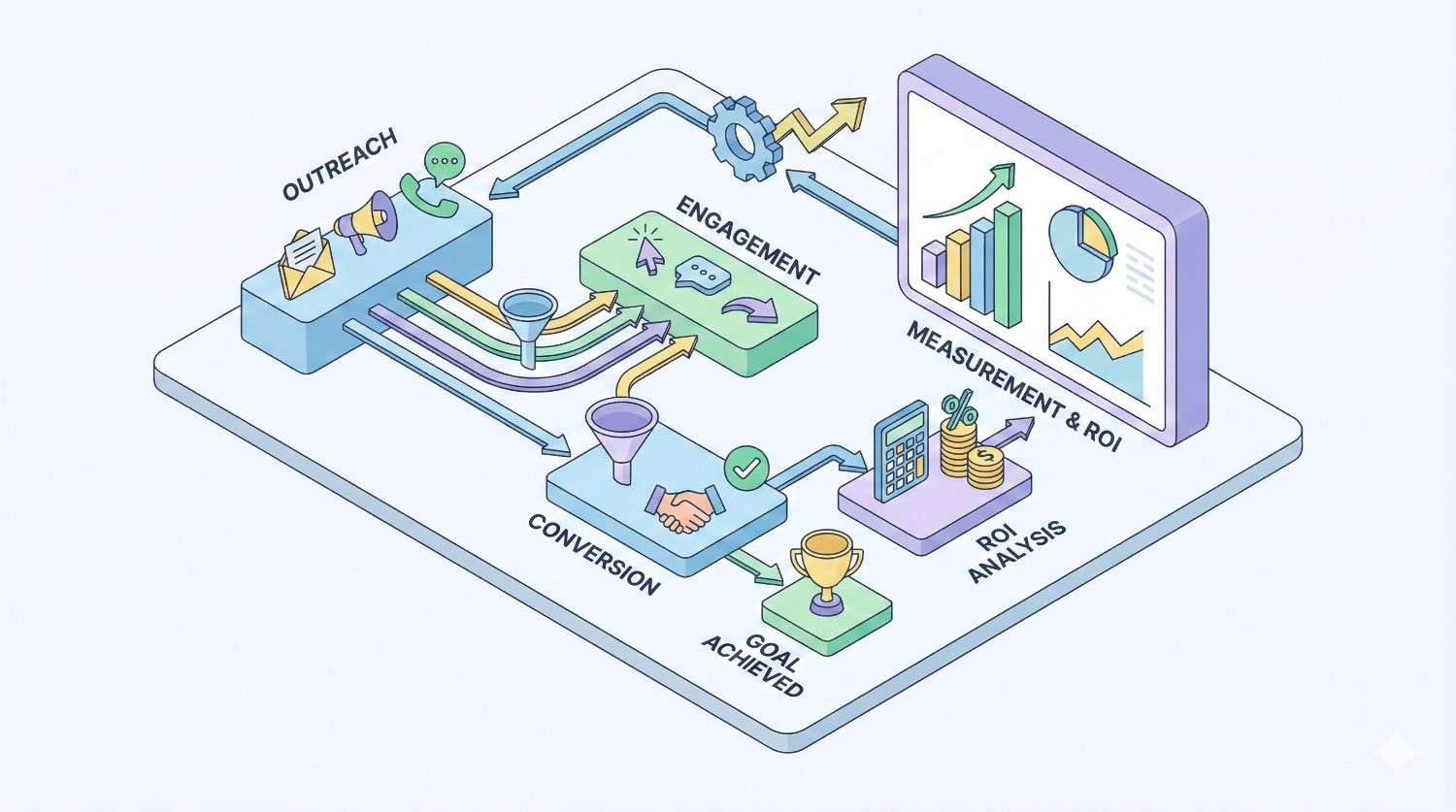
Measuring Outreach Performance & ROI
What gets measured gets improved. Tracking the right metrics helps optimize campaigns and demonstrate value to stakeholders.
Key Outreach Metrics to Track
Monitor these metrics to understand campaign performance and identify improvement opportunities.
Response Rate Percentage of emails that receive any response. Industry benchmarks vary, but 10-20% response rates indicate healthy campaigns. Below 5% suggests messaging or targeting problems.
Conversion Rate (Link Acquisition) Percentage of outreach that results in placed links. This is your ultimate success metric. Rates vary widely by campaign type, but 2-5% of total outreach converting to links is typical for cold campaigns.
Average Time to Link Placement How long from initial outreach to live link. This affects campaign planning and resource allocation. Guest posts may take weeks; simple link additions might happen in days.
Cost Per Acquired Link Total campaign cost divided by links acquired. Include labor, tools, and any content creation costs. This metric enables ROI calculation and budget planning.
Domain Authority of Acquired Links Average DR/DA of linking domains. Higher authority links typically deliver more ranking impact. Track this to ensure you’re acquiring valuable links, not just volume.
Link Quality Assessment Metrics
Beyond quantity, assess the quality of acquired links.
Domain Rating/Authority Higher DR/DA generally indicates more valuable links. However, don’t chase metrics blindly since relevance matters more than raw authority scores.
Organic Traffic Metrics Links from sites with real organic traffic provide referral visitors and signal legitimate sites. Zero-traffic sites may be link farms or abandoned properties.
Topical Relevance Score How closely does the linking site’s content relate to yours? Relevant links from niche sites often outperform irrelevant links from higher-authority general sites.
Link Placement Quality Contextual in-content links beat sidebar or footer placements. Links surrounded by relevant text provide stronger signals.
Referral Traffic Value Some links drive significant referral traffic. Track which placements send visitors and factor this into link value assessment.
Campaign Performance Analysis
Regular analysis identifies what’s working and what needs adjustment.
Compare performance across campaign types, outreach angles, and prospect segments. Which templates get best response rates? Which prospect sources yield highest conversion? Use data to continuously improve.
A/B test subject lines, opening lines, and value propositions. Small improvements compound over time.
Attribution: Linking Outreach to Rankings & Traffic
Connecting link building to business outcomes demonstrates ROI.
Track ranking changes for target keywords after link acquisition. Note that ranking impact typically takes weeks to months to materialize. Correlate link velocity with ranking improvements over time.
Monitor organic traffic to pages receiving new links. Increased rankings should translate to traffic growth. Track conversions from organic traffic to connect link building to revenue.
Reporting & Stakeholder Communication
Clear reporting maintains support for link building investment.
Report on metrics stakeholders care about: links acquired, quality indicators, ranking improvements, and traffic growth. Visualize progress over time. Connect activities to business outcomes.
Set realistic expectations. Link building is a long-term strategy. Monthly or quarterly reporting typically provides better perspective than weekly updates.
Scaling Your Link Building Outreach
Once you’ve proven your process works, scaling increases impact. But scaling requires systems, not just more effort.
Building an Outreach Team
Growing beyond individual contributor capacity requires team structure.
Roles & Responsibilities Typical roles include: prospectors (finding opportunities), outreach specialists (sending emails and managing responses), content creators (producing guest posts and assets), and campaign managers (strategy and oversight). Smaller teams combine roles.
Training & Onboarding Document your processes thoroughly. New team members need clear guidelines for prospect qualification, email templates, personalization standards, and response handling. Shadowing experienced team members accelerates learning.
Quality Control Processes Review outreach before sending, especially for new team members. Spot-check personalization quality. Monitor response rates by team member to identify training needs.
Creating Repeatable Outreach Systems
Scalable link building requires documented, repeatable processes.
Create standard operating procedures for each campaign type. Document prospect qualification criteria, email templates, follow-up sequences, and response handling. Systems enable consistency across team members and campaigns.
Build template libraries that can be customized efficiently. Create prospect databases organized by niche, campaign type, and status. Develop checklists for campaign setup and execution.
Automation vs. Personalization Balance
Automation enables scale but risks quality. Find the right balance for your situation.
Automate repetitive tasks: email scheduling, follow-up sequences, data entry, and reporting. Maintain human oversight for personalization, response handling, and quality control.
Tiered personalization allows different effort levels for different prospect values. High-value targets get manual, deeply personalized outreach. Lower-priority prospects get template-based outreach with basic customization.
Managing Multiple Campaigns Simultaneously
Running parallel campaigns requires organization and prioritization.
Use project management tools to track campaign status, deadlines, and responsibilities. Maintain clear separation between campaigns to prevent confusion. Prioritize based on strategic importance and resource availability.
Monitor aggregate metrics across campaigns. Identify which campaign types deliver best results and allocate resources accordingly.
When to Outsource vs. Build In-House
Both approaches have merits. Your choice depends on resources, expertise, and strategic priorities.
In-House Advantages Greater control over quality and brand voice. Deeper understanding of your business and audience. Relationship building that compounds over time. Better for long-term, ongoing link building.
Outsourcing Advantages Faster ramp-up without hiring and training. Access to established processes and relationships. Flexibility to scale up or down. Better for project-based or supplementary link building.
Many organizations use hybrid approaches: in-house strategy and oversight with outsourced execution, or in-house for high-priority campaigns with agency support for volume.
Common Link Building Outreach Challenges & Solutions
Every outreach program encounters obstacles. Anticipating common challenges helps you respond effectively.
Low Response Rates: Diagnosis & Fixes
When response rates drop below acceptable levels, systematic diagnosis identifies the problem.
Check deliverability first. Use tools like Mail Tester to verify emails reach inboxes. Review bounce rates and spam complaints.
Evaluate targeting. Are you reaching the right people at the right sites? Poor prospect qualification often causes low responses.
Assess messaging. A/B test subject lines and opening lines. Review personalization quality. Ensure clear value propositions.
Consider timing. Test different send times and days. Seasonal factors may affect response rates in some industries.
Spam Filter & Deliverability Issues
Deliverability problems waste all your outreach effort. Address technical issues promptly.
Verify SPF, DKIM, and DMARC records are properly configured. Check if your domain or IP is blacklisted. Reduce send volume if you’ve been flagging spam filters.
Review email content for spam triggers: excessive links, spam words, or suspicious formatting. Simplify emails and remove potential triggers.
Scaling Personalization Challenges
Maintaining personalization quality while increasing volume is a common tension.
Implement tiered personalization based on prospect value. Develop efficient personalization workflows: research templates, variable systems, and quality checklists.
Accept that some personalization depth must be sacrificed for scale. Focus personalization effort on elements that most impact response rates.
Finding Quality Prospects in Competitive Niches
Saturated niches make prospecting harder. Everyone targets the same sites.
Look beyond obvious targets. Second-tier sites in your niche may be less saturated. Adjacent niches with audience overlap offer fresh opportunities.
Create more compelling assets. In competitive spaces, your content must be significantly better to earn attention.
Build relationships before you need links. Long-term relationship building creates opportunities competitors can’t access through cold outreach.
Managing Rejection & Maintaining Motivation
Outreach involves frequent rejection. Maintaining team morale requires perspective.
Set realistic expectations. Even successful campaigns have low conversion rates. Rejection is normal, not failure.
Celebrate wins. Acknowledge successful placements and positive responses. Track progress over time to show cumulative impact.
Focus on controllable factors. You can’t control responses, but you can control outreach quality and volume.
Dealing with Paid Link Requests
Many publishers respond to outreach with payment requests. Handle these carefully.
Paying for links violates Google’s guidelines and carries penalty risk. Politely decline paid placement requests.
Some publishers offer legitimate sponsored content or advertising that includes links. These should use rel=”sponsored” attributes. Evaluate whether the exposure value justifies the cost, separate from SEO considerations.
Link Building Outreach Best Practices & Guidelines
Sustainable link building requires ethical practices aligned with search engine guidelines.
White Hat vs. Black Hat Outreach Tactics
Understanding the spectrum helps you make informed decisions.
White Hat Tactics Earning links through genuine value: quality content, helpful resources, newsworthy information. Outreach that honestly represents your content and intentions. Building real relationships with publishers.
Black Hat Tactics Buying links, participating in link schemes, using deceptive practices. These tactics may work short-term but carry significant penalty risk.
Gray Areas Guest posting, resource page outreach, and similar tactics exist in a gray area. When done with genuine value exchange, they’re acceptable. When done purely for link manipulation, they become problematic.
Google’s Link Scheme Guidelines & Compliance
Google’s guidelines define what constitutes manipulative link building.
Google’s link spam policies explicitly prohibit: buying or selling links for ranking purposes, excessive link exchanges, large-scale guest posting campaigns with keyword-rich anchor text, and automated link building.
The key principle: links should be editorial endorsements, not manufactured signals. If a link wouldn’t exist without SEO motivation, it’s potentially problematic.
Ethical Outreach Principles
Beyond compliance, ethical outreach builds sustainable programs.
Be honest about your intentions. Don’t misrepresent yourself or your content. Respect publisher time and preferences. Accept “no” gracefully.
Provide genuine value. If your content doesn’t deserve links, improve it rather than pushing harder on outreach.
Building Genuine Relationships vs. Transactional Links
Relationship-based link building outperforms transactional approaches over time.
Invest in relationships beyond immediate link needs. Engage with publishers’ content, share their work, provide value without asking for anything. When you do have link-worthy content, you’re reaching out to contacts, not strangers.
Transactional outreach (pure link requests) works but doesn’t compound. Each campaign starts from zero. Relationship building creates ongoing opportunities.
Long-Term Outreach Strategy vs. Quick Wins
Balance immediate needs with sustainable growth.
Quick wins (easy link opportunities, low-hanging fruit) provide early momentum and prove concept. But sustainable programs require ongoing investment in assets, relationships, and processes.
Build systems that improve over time. Document learnings, refine processes, and develop relationships that create compounding returns.
Industry-Specific Outreach Strategies
Different industries require adapted approaches. What works in B2B SaaS differs from e-commerce or local business.
B2B SaaS Link Building Outreach
SaaS companies have unique opportunities and challenges.
Opportunities: Original data from product usage, thought leadership content, integration partnerships, industry research.
Strategies: Target industry publications and analyst sites. Create data studies from anonymized user data. Build relationships with complementary tools for co-marketing. Contribute to industry roundups and comparison content.
E-commerce Link Building Outreach
E-commerce faces challenges since product pages rarely earn editorial links.
Opportunities: Buying guides, product comparisons, industry trend content, supplier relationships.
Strategies: Create informational content that earns links and supports product pages through internal linking. Target gift guides and “best of” lists. Build relationships with bloggers who review products in your category. Leverage supplier and manufacturer relationships.
Local Business Link Building Outreach
Local businesses need locally relevant links alongside general authority.
Opportunities: Local news coverage, community involvement, local business directories, chamber of commerce, local blogger relationships.
Strategies: Sponsor local events and organizations. Contribute to local publications. Build relationships with local bloggers and journalists. Participate in community initiatives that generate coverage.
Healthcare & YMYL Link Building Outreach
Your Money or Your Life (YMYL) topics require extra credibility signals.
Opportunities: Medical publications, health news sites, professional associations, educational institutions.
Strategies: Emphasize credentials and expertise. Partner with medical professionals for content. Target .edu and .gov link opportunities. Focus on authoritative health publications rather than general blogs.
Agency Link Building for Clients
Agencies face unique challenges managing outreach for multiple clients.
Strategies: Develop scalable processes that work across clients. Build publisher relationships that benefit multiple clients. Create clear client communication about realistic expectations and timelines. Maintain quality control across team members and campaigns.
Advanced Link Building Outreach Tactics
Beyond fundamentals, advanced tactics create additional opportunities.
Ego Bait & Influencer Outreach
Content that features influencers earns links from participants and their networks.
Create expert roundups, interview series, or “best of” lists featuring industry influencers. Notify participants when content publishes. Many will share and link to content featuring them.
Data-Driven Digital PR Campaigns
Original research attracts journalist attention and earns media links.
Conduct surveys, analyze industry data, or create studies that reveal newsworthy findings. Pitch results to journalists covering your industry. Data-driven stories earn coverage that pure promotional content cannot.
Newsjacking & Trending Topic Outreach
Timely content tied to current events can earn rapid links.
Monitor news and trends in your industry. Create quick-response content offering expert perspective or relevant data. Pitch to journalists covering the story. Speed matters since newsjacking opportunities are time-sensitive.
Scholarship Link Building
Scholarships earn .edu links, though this tactic has become saturated.
Create legitimate scholarships with real value. Reach out to university financial aid and scholarship pages. Ensure the scholarship is genuine, not just a link building tactic. Google has devalued obvious scholarship link schemes.
Expert Contribution & Quote Outreach
Offering expert commentary earns links in others’ content.
Respond to journalist queries on HARO, Qwoted, and similar platforms. Proactively offer expert perspective on trending topics. Build relationships with journalists who cover your expertise area.
Strategic Partnership Development
Partnerships create natural link opportunities.
Identify complementary businesses with overlapping audiences. Propose co-created content, joint research, or mutual promotion. Partnership links are natural and sustainable since they reflect real business relationships.
Link Building Outreach Timeline & Expectations
Realistic expectations prevent frustration and enable proper planning.
How Long Does Link Building Outreach Take?
Link building is not a quick fix. Understanding timelines helps set appropriate expectations.
Campaign Setup: 1-2 weeks for asset creation, prospect research, and infrastructure setup.
Outreach Execution: Ongoing, but initial campaigns typically run 4-8 weeks before meaningful results accumulate.
Link Placement: Individual links may take days to weeks from agreement to live placement, depending on publisher processes.
Ranking Impact: Links typically take 2-3 months to fully impact rankings as Google discovers and processes them.
Realistic Link Acquisition Rates
Conversion rates vary by campaign type, industry, and execution quality.
Cold outreach typically converts at 1-5% (links acquired per email sent). Warm outreach to existing contacts converts higher. Broken link building and unlinked mention campaigns often see 5-15% conversion rates.
A well-run campaign might acquire 5-20 quality links per month depending on resources and niche competitiveness.
Campaign Duration & Momentum Building
Link building compounds over time. Early campaigns build foundation for future success.
Initial campaigns establish processes and begin relationship building. Subsequent campaigns benefit from refined processes and existing relationships. Expect improving efficiency over 3-6 months of consistent effort.
When to Expect Ranking Impact from Acquired Links
Links don’t impact rankings immediately. Patience is required.
Google must discover, crawl, and process new links. This typically takes weeks to months. Ranking improvements often appear gradually rather than suddenly.
Track ranking changes over 3-6 month periods to accurately assess link building impact. Short-term fluctuations don’t reflect true link value.
Link Building Outreach Costs & Budgeting
Understanding costs enables proper budgeting and ROI calculation.
In-House Outreach Cost Breakdown
In-house link building costs primarily involve labor and tools.
Labor: Outreach specialist salaries range from $40,000-$80,000 annually depending on experience and location. A full-time specialist might acquire 10-30 links monthly.
Tools: Essential tools (Ahrefs or SEMrush, outreach platform, email tools) cost $300-$1,000 monthly.
Content: If creating guest posts or linkable assets, factor in content creation costs.
Agency & Freelancer Pricing Models
External providers offer various pricing structures.
Per-Link Pricing: Agencies charge $100-$1,000+ per acquired link depending on quality targets. Higher authority links command premium prices.
Retainer Models: Monthly retainers of $2,000-$10,000+ for ongoing link building services. Typically includes target link quantities and quality minimums.
Project-Based: Fixed pricing for specific campaigns or link quantities.
Tool & Software Investment
Essential tools represent ongoing costs.
SEO Tools: Ahrefs, SEMrush, or Moz: $100-$500 monthly depending on plan level.
Outreach Platforms: Pitchbox, BuzzStream, or alternatives: $100-$500 monthly.
Email Tools: Hunter, verification services, email platforms: $50-$200 monthly.
Total Tool Stack: Expect $250-$1,000 monthly for a complete toolkit.
Cost Per Link Benchmarks by Industry
Cost per link varies significantly by niche and quality targets.
General benchmarks: $100-$500 per link for standard quality, $500-$1,500 for high-authority placements. Competitive niches (finance, legal, health) often see higher costs.
In-house cost per link depends on team efficiency. Calculate by dividing total program costs by links acquired.
ROI Calculation Framework
Connecting link building costs to business value demonstrates ROI.
Calculate Cost Per Link: Total investment ÷ links acquired.
Estimate Link Value: Consider ranking improvements, traffic increases, and conversion value. If a link helps you rank for a keyword driving $10,000 monthly in revenue, that link has significant value.
Compare to Alternatives: What would equivalent traffic cost through paid advertising? Link building often delivers better long-term ROI than paid channels.
Alternatives & Complements to Outreach-Based Link Building
Outreach isn’t the only path to links. Understanding alternatives helps you build a complete strategy.
Content Marketing & Linkable Asset Creation
Great content earns links passively over time.
Invest in content that naturally attracts links: original research, comprehensive guides, useful tools. This creates ongoing link acquisition without continuous outreach effort.
Content marketing and outreach work together. Create linkable assets, then use outreach to accelerate initial link acquisition.
Digital PR & Media Coverage
PR-driven links come from news coverage rather than direct outreach.
Develop newsworthy angles, build journalist relationships, and pitch stories that earn coverage. Media links often come from high-authority news sites.
Community Engagement & Forum Participation
Active community participation builds relationships and occasional link opportunities.
Participate genuinely in industry forums, communities, and discussions. Helpful contributions build reputation and sometimes earn links naturally.
Strategic Partnerships & Co-Marketing
Business partnerships create natural link opportunities.
Partner with complementary businesses for co-created content, joint webinars, or mutual promotion. Partnership links reflect real business relationships.
When Outreach Isn’t the Right Strategy
Outreach isn’t always the best approach.
If you lack linkable assets, focus on content creation first. If your niche has limited link opportunities, consider alternative strategies. If resources are extremely limited, passive link earning through great content may be more efficient.
Future of Link Building Outreach
The link building landscape continues evolving. Understanding trends helps you prepare.
AI & Automation in Outreach
AI tools are changing outreach execution.
AI can assist with prospecting, personalization at scale, and response handling. However, over-reliance on AI risks generic, detectable outreach. The future likely involves AI-assisted human outreach rather than fully automated campaigns.
Evolving Google Algorithm & Link Value
Google’s treatment of links continues evolving.
Links remain important ranking factors, but Google increasingly evaluates link quality and context. Low-quality link building becomes less effective while genuine editorial links maintain value.
Privacy Regulations & Contact Discovery
Privacy laws affect contact discovery and outreach practices.
GDPR, CCPA, and similar regulations impact how you can collect and use contact information. Ensure compliance with applicable privacy laws in your outreach practices.
Emerging Outreach Channels & Platforms
New platforms create new outreach opportunities.
Emerging social platforms, community spaces, and communication channels offer alternative outreach paths. Stay aware of where your target publishers are active.
Getting Started: Your Link Building Outreach Action Plan
Theory without action produces nothing. Here’s how to begin.
30-Day Link Building Outreach Roadmap
Week 1: Foundation
- Audit existing linkable assets
- Set up email infrastructure (SPF, DKIM, DMARC)
- Choose and configure outreach tools
- Define target link quality criteria
Week 2: Research
- Conduct competitor backlink analysis
- Build initial prospect list (50-100 targets)
- Find and verify contact information
- Develop email templates
Week 3: Launch
- Begin email warm-up if using new domain
- Send first outreach batch (20-30 emails)
- Monitor deliverability and responses
- Refine templates based on initial feedback
Week 4: Optimize
- Send follow-up sequences
- Expand prospect list based on learnings
- Track metrics and identify improvements
- Plan next month’s campaigns
Essential Resources & Templates
Start with these foundational elements:
- Prospect tracking spreadsheet or CRM
- Email templates for each campaign type
- Prospect qualification checklist
- Response handling guidelines
- Performance tracking dashboard
Choosing the Right Approach for Your Business
Your situation determines optimal strategy.
Limited Resources: Focus on high-value targets with personalized outreach. Quality over quantity.
Established Content: Leverage existing assets through resource page and broken link outreach.
New Site: Prioritize creating linkable assets before heavy outreach investment.
Competitive Niche: Invest in differentiated content and relationship building.
Working with an SEO Agency for Link Building Outreach
Partnering with specialists accelerates results.
Agencies bring established processes, existing relationships, and specialized expertise. Look for agencies with transparent reporting, quality-focused approaches, and realistic expectations.
When evaluating agencies, ask about: link quality standards, reporting practices, outreach methods, and how they handle Google guideline compliance.
Conclusion
Link building outreach remains one of the most effective ways to improve search rankings and drive organic traffic growth. Success requires quality assets, systematic processes, and persistent execution over time.
The strategies and frameworks in this guide provide a complete roadmap for building a sustainable outreach program. Whether you’re starting from scratch or optimizing existing efforts, the fundamentals of prospect research, personalized messaging, and relationship building drive results.
We help businesses build authoritative backlink profiles through strategic outreach and content development. Contact White Label SEO Service to discuss how we can accelerate your link building results.
Frequently Asked Questions
What is the average response rate for link building outreach emails?
Response rates typically range from 10-20% for well-executed campaigns. Rates below 5% usually indicate problems with targeting, messaging, or deliverability. Personalization quality and prospect relevance significantly impact response rates.
How many links can I realistically acquire per month through outreach?
Most programs acquire 5-20 quality links monthly depending on resources and niche competitiveness. A full-time outreach specialist might secure 10-30 links monthly. Quality matters more than quantity since one high-authority link often outweighs dozens of low-quality placements.
Is link building outreach still effective in 2025?
Yes, outreach remains highly effective when executed properly. Links continue to be a top ranking factor. However, Google has become better at identifying manipulative link building, making quality and relevance more important than ever.
How long does it take to see ranking improvements from acquired links?
Expect 2-3 months before new links fully impact rankings. Google must discover, crawl, and process links before they influence rankings. Track progress over 3-6 month periods for accurate assessment of link building impact.
What’s the difference between white hat and black hat link building outreach?
White hat outreach earns links through genuine value: quality content, helpful resources, and honest communication. Black hat tactics involve buying links, deceptive practices, or manipulative schemes. White hat approaches are sustainable; black hat tactics risk penalties.
How much does link building outreach cost?
In-house programs cost $3,000-$8,000 monthly including labor and tools. Agency services range from $2,000-$10,000+ monthly depending on link quantity and quality targets. Cost per link typically ranges from $100-$500 for standard quality to $500-$1,500 for high-authority placements.
Should I build an in-house team or outsource link building outreach?
In-house teams offer greater control and relationship continuity but require hiring and training investment. Outsourcing provides faster ramp-up and specialized expertise but less direct control. Many organizations use hybrid approaches, combining in-house strategy with outsourced execution.