Personalized outreach generates response rates up to 3x higher than generic mass messaging, making it the single most impactful lever for improving your lead generation ROI. Whether you’re running email campaigns, LinkedIn prospecting, or multi-channel sequences, the depth and relevance of your personalization directly determines whether prospects engage or ignore you.
This matters now more than ever. Inboxes are flooded, decision-makers are skeptical, and automated spam has trained everyone to delete anything that feels templated. Your outreach competes against hundreds of other messages daily.
This guide covers everything from foundational personalization concepts to advanced scaling frameworks, industry-specific strategies, measurement systems, and the tools that make it all work efficiently.
What Is Personalization in Outreach?
Definition and Core Concepts
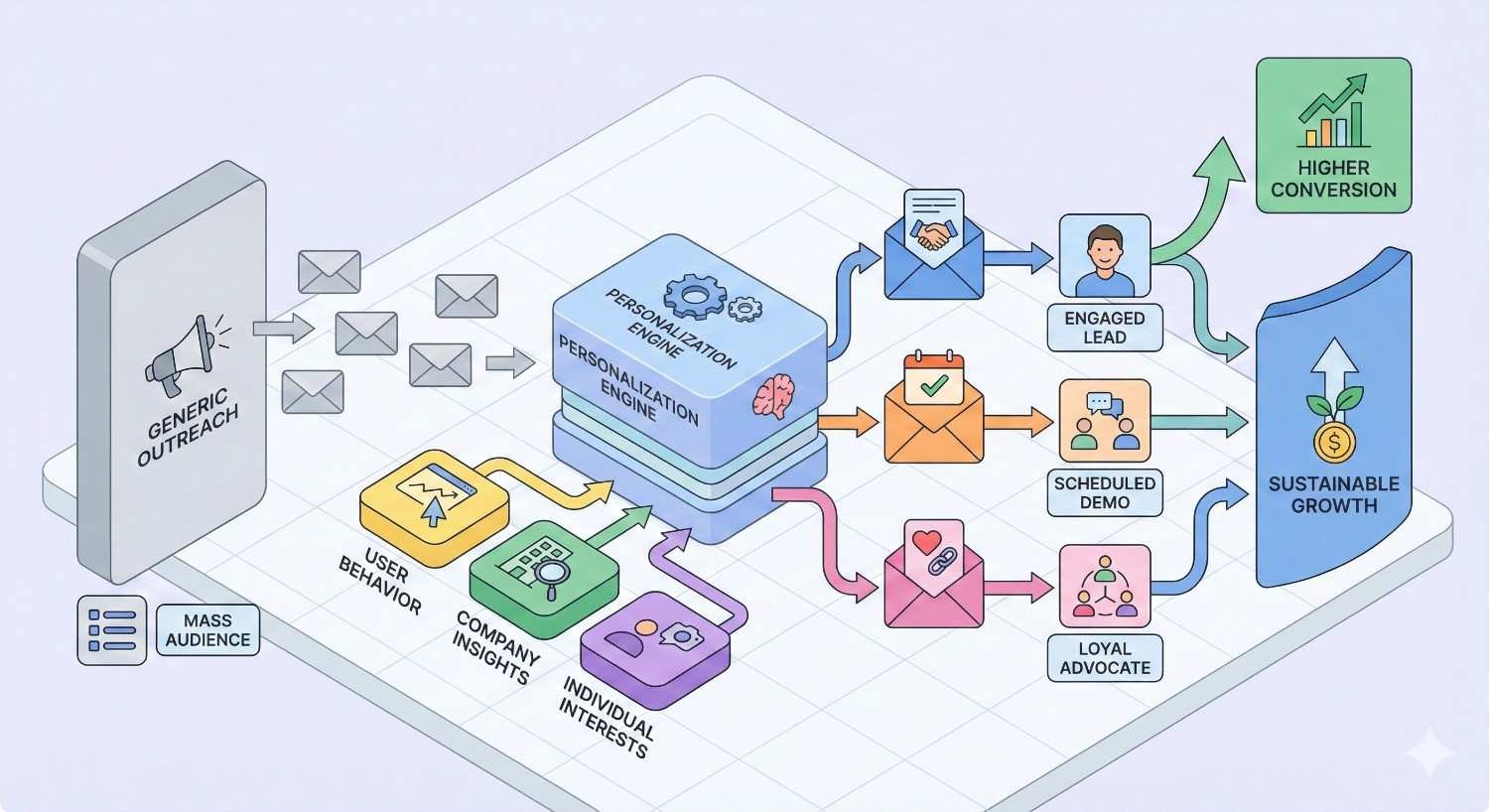
Personalization in outreach is the practice of tailoring your communication to individual prospects based on specific information about them, their company, their challenges, or their context. It goes beyond inserting a first name into a template. True personalization demonstrates that you understand who you’re contacting and why your message is relevant to them specifically.
The core concepts include data-driven customization, contextual relevance, and authentic connection. Data-driven customization means using real information about the prospect to shape your message. Contextual relevance ensures your outreach arrives at the right moment with the right angle. Authentic connection means your personalization feels genuine rather than manufactured.
Effective personalization operates on multiple levels. Surface-level personalization includes names, company names, and job titles. Mid-level personalization incorporates recent company news, shared connections, or industry-specific challenges. Deep personalization references specific content the prospect created, problems they’ve publicly discussed, or strategic initiatives their company announced.
Why Personalization Matters for Business Growth
Generic outreach fails because it signals to prospects that you haven’t invested any effort in understanding them. When someone receives a clearly templated message, they immediately categorize it as spam. The message might technically reach their inbox, but it never reaches their attention.
Personalized outreach changes this dynamic entirely. When prospects see that you’ve done your homework, they’re more likely to read your full message, consider your offer, and respond. This translates directly into higher response rates, more qualified conversations, and ultimately more closed deals.
The business impact compounds over time. Higher response rates mean your sales team spends less time on cold outreach and more time in actual conversations. Better-qualified responses mean fewer wasted meetings with poor-fit prospects. Stronger initial impressions lead to shorter sales cycles because trust is established earlier.
For businesses focused on sustainable growth, personalization isn’t optional. It’s the difference between building a predictable pipeline and constantly struggling to generate enough conversations to hit revenue targets.
Types of Outreach Personalization
Email Outreach Personalization
Email remains the highest-volume outreach channel for most B2B organizations. Personalizing email outreach requires attention to subject lines, opening sentences, body content, and calls to action.
Subject line personalization dramatically impacts open rates. Including the prospect’s company name, referencing a specific trigger event, or mentioning a mutual connection can double or triple your open rates compared to generic subject lines.
Opening sentences carry the heaviest personalization weight. The first two sentences determine whether someone reads the rest of your email or hits delete. Strong openings reference something specific about the prospect: a recent LinkedIn post they wrote, a company announcement, a podcast appearance, or a challenge common to their role.
Body content personalization connects your offer to their specific situation. Rather than listing generic benefits, explain how your solution addresses a problem they likely face given their industry, company size, or role. Use language that matches their context.
Call-to-action personalization means proposing next steps that make sense for their situation. A startup founder might respond better to a quick 15-minute call, while an enterprise buyer might prefer a detailed case study first.
LinkedIn and Social Media Personalization
LinkedIn outreach requires different personalization tactics than email. The platform’s character limits force conciseness, and the social context creates different expectations.
Connection request personalization is your first opportunity. The 300-character limit means every word counts. Reference a specific reason for connecting: shared group membership, mutual connections, content they posted, or a genuine professional interest in their work.
Follow-up message personalization after connection should feel like a natural continuation of why you connected. Avoid immediately pitching. Instead, provide value related to the reason you gave for connecting. Share a relevant resource, offer a genuine insight, or ask a thoughtful question.
Social engagement personalization involves commenting meaningfully on prospects’ posts before reaching out directly. Thoughtful comments that add to the conversation establish familiarity and credibility before you ever send a direct message.
Other social platforms follow similar principles. Twitter personalization might reference specific tweets or threads. Industry forums require demonstrating genuine participation before outreach.
Cold Calling Personalization
Phone outreach benefits enormously from personalization, yet many sales teams still rely on generic scripts. Personalized cold calls convert at significantly higher rates.
Pre-call research should identify at least three personalization points: something about the prospect personally, something about their company, and something about their likely challenges. This research takes 2-5 minutes per prospect but dramatically improves call outcomes.
Opening statement personalization immediately differentiates you from other callers. Instead of “Hi, this is John from Company X,” try “Hi Sarah, I noticed your team just expanded into the European market. I’m calling because we’ve helped three other SaaS companies navigate that exact transition.”
Conversation personalization means adapting your talking points based on what the prospect shares. Listen for cues about their priorities, concerns, and decision-making process. Adjust your pitch in real-time to address what matters most to them.
Voicemail personalization is equally important since most cold calls go to voicemail. A personalized voicemail that references something specific about the prospect is far more likely to generate a callback than a generic message.
Multi-Channel Personalized Campaigns
The most effective outreach strategies coordinate personalization across multiple channels. A prospect might receive a personalized LinkedIn connection request, followed by a personalized email, followed by a personalized phone call, with each touchpoint building on the previous ones.
Sequence design for multi-channel campaigns requires planning how personalization elements carry across touchpoints. If your LinkedIn message referenced their recent product launch, your follow-up email should continue that thread rather than starting fresh with different personalization.
Channel-specific adaptation means adjusting your personalization approach for each medium while maintaining message consistency. The core insight about the prospect stays the same, but how you express it changes based on the channel’s norms and constraints.
Timing coordination ensures your multi-channel touches feel like a coherent campaign rather than disconnected spam. Space touchpoints appropriately and reference previous attempts in a way that feels persistent rather than desperate.
Key Elements of Effective Personalized Outreach
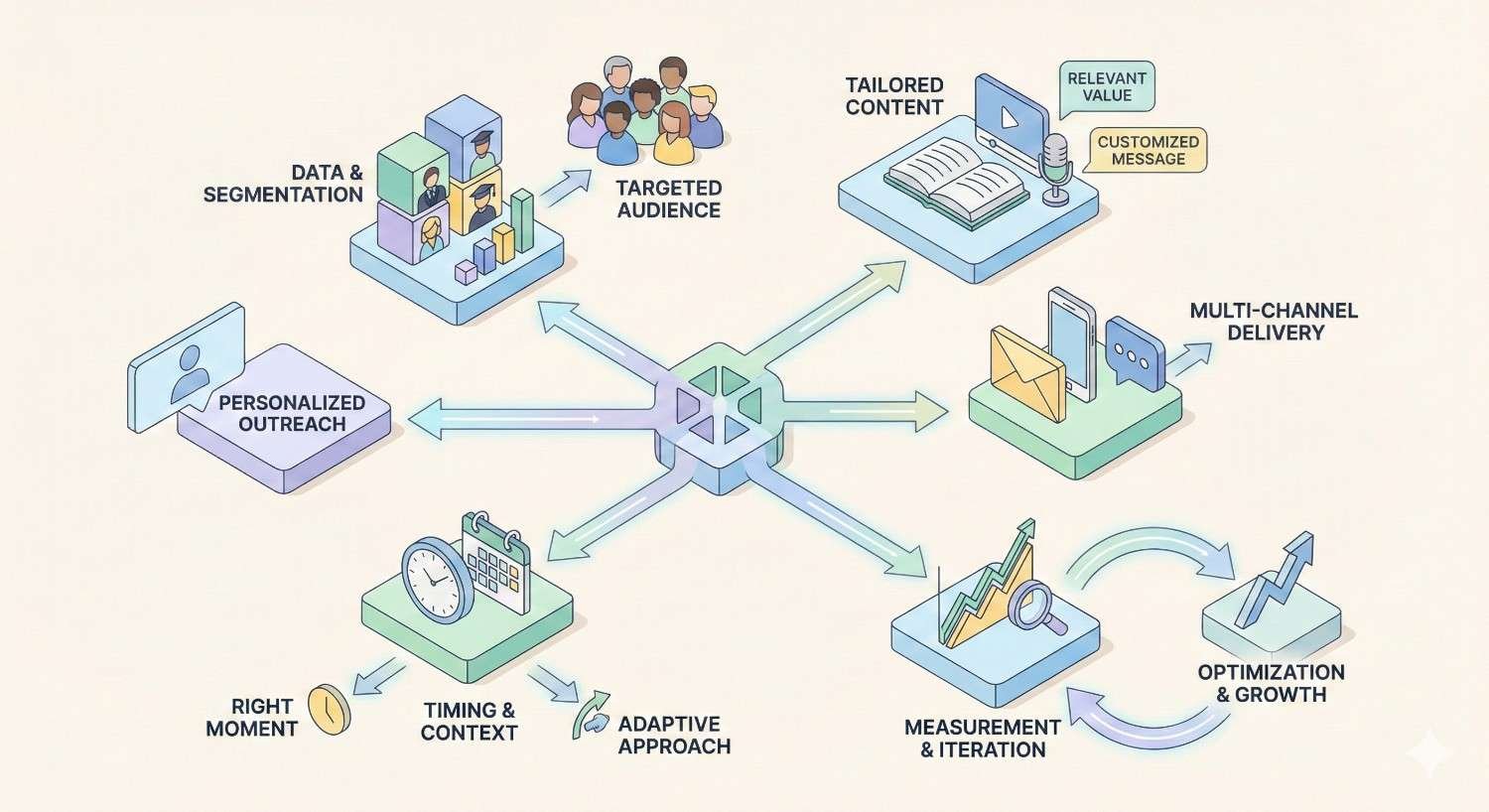
Prospect Research and Data Collection
Quality personalization requires quality data. The research phase determines everything that follows.
Company-level research includes recent news, funding announcements, product launches, leadership changes, strategic initiatives, and public challenges. Set up Google Alerts for target accounts to capture trigger events in real-time.
Individual-level research covers the prospect’s role, tenure, career history, content they’ve created, interviews they’ve given, and professional interests. LinkedIn profiles, company bios, podcast appearances, and conference presentations all provide personalization material.
Technographic data reveals what tools and platforms the prospect’s company uses. This information helps you position your solution relative to their existing stack and identify potential integration points or replacement opportunities.
Intent data signals when prospects are actively researching solutions like yours. Website visits, content downloads, and search behavior indicate heightened interest and optimal outreach timing.
Organize your research in a systematic way. Create a template that captures the most valuable personalization points for your specific outreach goals. Train your team to gather consistent data that feeds directly into message creation.
Segmentation and Audience Targeting
Not all personalization is individual. Segment-level personalization allows you to create highly relevant messaging for groups of similar prospects without researching each one individually.
Industry segmentation groups prospects by vertical. A message to healthcare companies can reference HIPAA compliance challenges, while a message to financial services can reference regulatory requirements. Both feel personalized without individual research.
Role-based segmentation tailors messaging to job function. CTOs care about technical architecture and security. CFOs care about cost savings and ROI. Marketing leaders care about pipeline impact and attribution.
Company size segmentation adjusts your approach for different organizational contexts. Enterprise messaging emphasizes scalability, security, and integration. SMB messaging emphasizes ease of implementation and quick time-to-value.
Behavioral segmentation groups prospects by actions they’ve taken. Someone who downloaded a specific whitepaper has different interests than someone who attended a webinar on a different topic.
Effective segmentation creates the foundation for scalable personalization. You build segment-specific templates that feel personalized because they address segment-specific concerns, then layer individual personalization on top.
Dynamic Content and Variable Insertion
Dynamic content technology enables personalization at scale by automatically inserting prospect-specific information into templates.
Basic variables include first name, company name, job title, and location. These are table stakes for any outreach tool and should be used consistently.
Advanced variables pull in richer data: recent company news, mutual connections, technographic information, or custom fields from your CRM. The more sophisticated your data infrastructure, the more powerful your dynamic content becomes.
Conditional logic allows different content blocks to appear based on prospect attributes. If the prospect is in healthcare, show the healthcare-specific paragraph. If they’re in finance, show the finance-specific paragraph. This creates highly relevant messages from a single template.
Personalization tokens should be tested carefully. Nothing destroys credibility faster than a message that says “Hi {FirstName}” because the variable didn’t populate correctly. Build quality checks into your workflow.
Timing and Frequency Optimization
When you reach out matters as much as what you say. Personalized timing increases response rates significantly.
Trigger-based timing sends outreach immediately after relevant events: funding announcements, job changes, product launches, or content publications. These triggers create natural conversation starters and demonstrate that you’re paying attention.
Day and time optimization varies by audience. Test different send times for your specific segments. Generally, Tuesday through Thursday mornings perform well for B2B outreach, but your data should guide your decisions.
Frequency calibration balances persistence with respect. Too few touches and you never break through the noise. Too many and you annoy prospects into blocking you. Most successful sequences include 8-12 touches over 3-4 weeks, with decreasing frequency over time.
Sequence pacing should feel natural. Don’t send three emails in three days, then nothing for two weeks. Create a rhythm that mimics how a thoughtful human would follow up.
Tone and Messaging Alignment
Personalization extends beyond data insertion to how you communicate. Your tone should match your prospect’s context and preferences.
Industry tone varies significantly. Financial services prospects expect formal, precise language. Tech startup prospects often prefer casual, direct communication. Match the norms of your prospect’s world.
Seniority tone adjustment recognizes that C-suite executives have different communication preferences than individual contributors. Senior leaders typically prefer concise, strategic messaging. Practitioners often want more tactical detail.
Company culture alignment means researching how the prospect’s organization communicates. A company with a playful brand voice might respond better to creative outreach. A traditional enterprise might expect more formal approaches.
Personal style matching, when possible, adapts to individual communication preferences. If a prospect’s LinkedIn posts are casual and emoji-filled, your outreach can be warmer. If their content is formal and technical, match that style.
How to Personalize Outreach at Scale
Building Personalization Frameworks
Scaling personalization requires systematic frameworks that make customization efficient without sacrificing quality.
Tiered personalization models define different levels of customization for different prospect values. Tier 1 prospects (highest value) receive fully custom, deeply researched outreach. Tier 2 prospects receive segment-personalized templates with some individual customization. Tier 3 prospects receive segment-personalized templates with basic variable insertion.
Personalization playbooks document exactly what research to gather and how to use it for each tier. This ensures consistency across your team and makes training new team members faster.
Template libraries organized by segment, use case, and personalization level give your team starting points that are already 70-80% complete. The remaining customization can be done quickly because the foundation is solid.
Research workflows define who gathers what data, where it’s stored, and how it flows into outreach creation. Bottlenecks in research are the most common reason personalization efforts fail at scale.
Automation Tools and Technology Stack
The right technology stack makes scalable personalization possible. Without proper tools, personalization becomes a manual bottleneck that limits your outreach volume.
CRM systems serve as the foundation, storing prospect data that feeds personalization. Ensure your CRM captures the fields you need for personalization and that data quality is maintained.
Sales engagement platforms like Outreach, Salesloft, and Apollo enable sequence automation with dynamic personalization. These tools let you build templates with variables, set up multi-channel sequences, and track engagement.
Data enrichment tools like ZoomInfo, Clearbit, and Apollo automatically populate prospect records with firmographic, technographic, and contact data. This reduces manual research time significantly.
Research automation tools can monitor trigger events, scrape relevant information, and surface personalization opportunities. Some teams use custom solutions built on APIs; others use specialized tools designed for sales research.
Integration between tools is critical. Your data enrichment should flow into your CRM, which should connect to your sales engagement platform. Broken integrations create data silos that undermine personalization efforts.
Balancing Automation with Authenticity
The goal of automation is to handle repetitive tasks so humans can focus on genuine personalization. Over-automation creates messages that feel robotic despite containing personalized data.
Human review checkpoints should exist in your workflow. Even highly automated sequences benefit from a human reviewing messages before they send, especially for high-value prospects.
Authenticity markers are elements that automation can’t easily replicate: genuine observations about the prospect’s work, thoughtful questions that show real understanding, or references to shared experiences. Include these in every message.
Response handling should always be human. When a prospect replies, automated follow-ups destroy the relationship you’ve started building. Ensure your systems route responses to real people immediately.
Testing for authenticity means regularly reviewing your outreach from the prospect’s perspective. Would you respond to this message? Does it feel like a human wrote it? If not, adjust your approach.
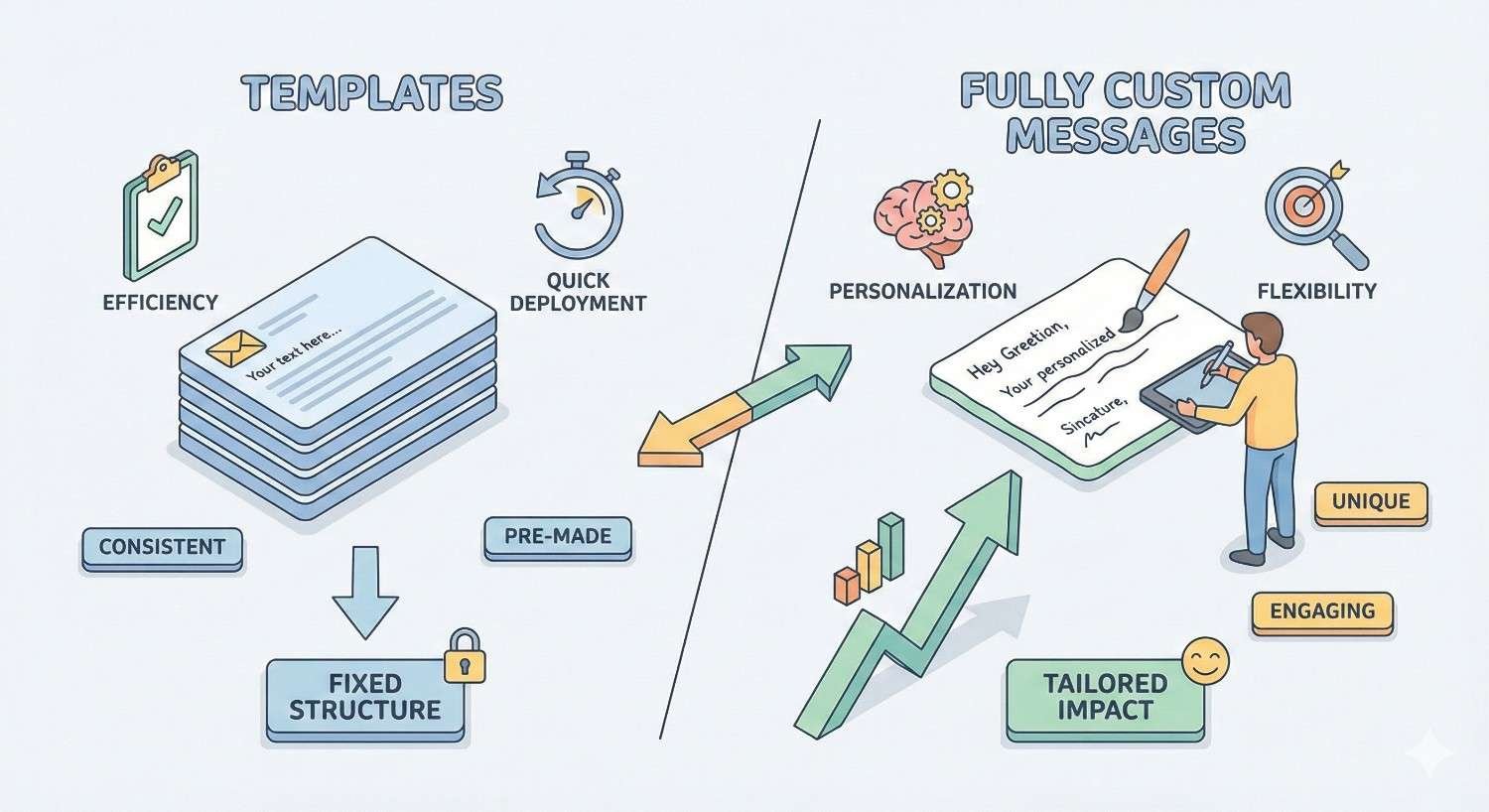
Templates vs. Fully Custom Messages
The template versus custom debate misses the point. The real question is how much customization each prospect warrants given their potential value.
Template advantages include consistency, scalability, and the ability to test and optimize messaging. Well-crafted templates with strong personalization can perform excellently for most outreach scenarios.
Custom message advantages include maximum relevance and the ability to address unique situations. For your highest-value prospects, fully custom outreach often makes sense despite the time investment.
Hybrid approaches work best for most organizations. Start with strong templates, then customize based on prospect tier. A template that’s 80% pre-written but 20% custom often outperforms both fully templated and fully custom approaches at scale.
Template optimization should be ongoing. Track which templates perform best, identify patterns in successful customizations, and continuously improve your starting points.
Personalization Strategies by Industry
B2B SaaS and Technology
Technology buyers are sophisticated and receive enormous volumes of outreach. Standing out requires demonstrating genuine understanding of their technical context.
Technical credibility personalization references specific technologies in their stack, technical challenges common to their architecture, or integration opportunities with tools they already use. Generic “we help tech companies” messaging fails immediately.
Growth stage personalization recognizes that a Series A startup has different priorities than a mature enterprise. Early-stage companies care about speed and flexibility. Larger organizations care about security, compliance, and scalability.
Role-specific technical depth varies your message based on whether you’re reaching engineers, product managers, or executives. Engineers want technical specifics. Executives want business outcomes.
Competitive positioning personalization, when appropriate, references alternatives they might be considering and differentiates your solution. This works best when you have genuine advantages for their specific situation.
E-commerce and Retail
E-commerce outreach personalization focuses on business metrics, seasonal patterns, and competitive dynamics.
Performance metric personalization references publicly available information about their traffic, rankings, or market position. Tools like SimilarWeb provide estimates that can inform your outreach angle.
Seasonal timing personalization aligns your outreach with their business calendar. Reaching out about holiday preparation in Q3 is relevant. The same message in January feels tone-deaf.
Channel-specific personalization addresses their particular sales channels. A brand selling primarily through Amazon has different needs than one focused on direct-to-consumer. Tailor your messaging accordingly.
Competitive landscape personalization demonstrates awareness of their market position and competitors. Reference specific competitive challenges or opportunities relevant to their situation.
Professional Services and Agencies
Agencies and professional services firms respond to personalization that demonstrates understanding of their business model and client relationships.
Client portfolio personalization references the types of clients they serve and challenges common to those engagements. If they specialize in healthcare clients, your outreach should acknowledge that context.
Service offering alignment positions your solution relative to their specific services. An SEO agency has different needs than a full-service marketing agency. Customize accordingly.
Growth model personalization recognizes whether they’re focused on scaling headcount, improving margins, or expanding service offerings. Each growth model creates different priorities.
Partnership framing often works better than vendor positioning for agency outreach. Position your solution as something that enhances their client delivery rather than something they need to buy.
Startups and SMEs
Smaller organizations have different constraints and priorities than enterprises. Personalization should reflect these realities.
Resource constraint acknowledgment recognizes that startups and SMEs have limited time, budget, and personnel. Your outreach should emphasize efficiency and quick wins rather than comprehensive transformations.
Founder and decision-maker access is often easier at smaller companies. Personalization can be more direct and personal because you’re often reaching the actual decision-maker.
Growth stage relevance varies your message based on whether they’re pre-revenue, scaling, or established. Each stage has different priorities and pain points.
Competitive positioning against larger alternatives often resonates. If you offer a solution that competes with enterprise tools, emphasize how you’re better suited for their scale and needs.
Measuring Personalization Success
Key Performance Indicators (KPIs)
Measuring personalization effectiveness requires tracking metrics at each stage of your outreach funnel.
Open rates indicate whether your subject line personalization is working. Compare open rates across different personalization approaches to identify what resonates.
Reply rates measure whether your message personalization drives engagement. This is typically the most important metric for outreach effectiveness.
Positive reply rates distinguish between any response and responses that move toward a conversation. Track how many replies are genuinely interested versus polite rejections.
Meeting booking rates measure conversion from reply to scheduled conversation. Strong personalization should improve this metric by creating better-qualified initial interest.
Pipeline generated connects outreach activity to revenue opportunity. Track how much pipeline originates from personalized outreach versus other sources.
Response Rate and Engagement Metrics
Detailed engagement analysis reveals which personalization elements drive results.
Personalization element testing isolates the impact of specific customization approaches. Test subject line personalization separately from body personalization to understand what matters most.
Segment performance comparison shows which audience segments respond best to which personalization approaches. Your enterprise segment might respond to different tactics than your SMB segment.
Channel performance analysis reveals where personalization has the biggest impact. Email personalization might drive different results than LinkedIn personalization for your specific audience.
Time-to-response tracking shows how quickly prospects engage with personalized versus generic outreach. Faster responses often indicate stronger initial interest.
Conversion and ROI Tracking
Ultimately, personalization must drive business results to justify the investment.
Cost per meeting calculation includes the time spent on research and customization. Personalized outreach takes more time per message but should generate more meetings per message sent.
Pipeline value per outreach hour measures efficiency. If personalized outreach generates more valuable pipeline per hour invested, the approach is working.
Win rate comparison tracks whether deals originating from personalized outreach close at higher rates. Strong initial personalization often correlates with better-qualified opportunities.
Customer lifetime value analysis examines whether customers acquired through personalized outreach have different retention or expansion patterns. Some organizations find that personalized acquisition leads to stronger long-term relationships.
A/B Testing Personalization Variables
Systematic testing improves personalization effectiveness over time.
Subject line testing compares different personalization approaches: company name versus trigger event versus mutual connection. Run tests with sufficient volume to achieve statistical significance.
Opening line testing evaluates which personalization hooks generate the most engagement. Test different research elements to identify what prospects value most.
Personalization depth testing compares light personalization versus heavy personalization. Sometimes less is more; other times, deeper customization wins.
Template versus custom testing for similar prospect tiers reveals whether additional customization effort generates proportional returns.
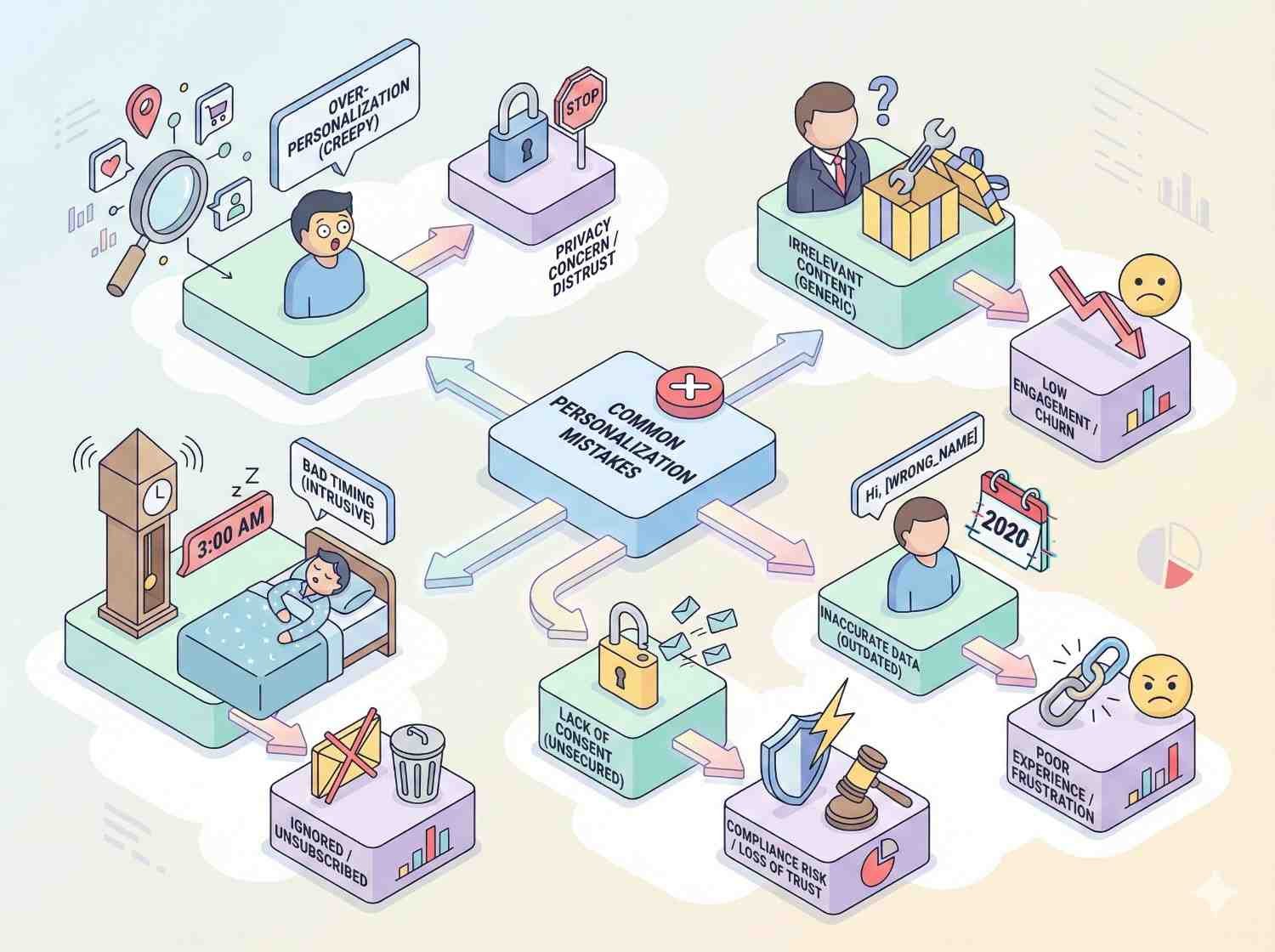
Common Personalization Mistakes to Avoid
Over-Personalization and Creepiness Factor
There’s a line between impressive research and uncomfortable surveillance. Crossing it destroys trust instantly.
Personal information boundaries should be respected. Referencing someone’s professional accomplishments is appropriate. Mentioning their children’s names or personal social media posts is creepy.
Stalker signals include referencing information that required extensive digging, mentioning multiple personal details in a single message, or demonstrating knowledge that feels invasive.
Professional context limits keep personalization focused on business-relevant information. Stick to professional content, company news, and industry context rather than personal life details.
The “how would I feel” test should guide your approach. If receiving this message would make you uncomfortable, don’t send it.
Generic Personalization That Feels Automated
Bad personalization is worse than no personalization because it signals that you tried to fake genuine interest.
Name-only personalization is the most common failure. “Hi John, I noticed your company is growing” contains personalization tokens but zero actual customization.
Obvious template markers include phrases like “I came across your profile” or “I noticed you work at [Company].” These signal automation rather than genuine research.
Irrelevant personalization references information that doesn’t connect to your message. Mentioning someone’s college alma mater before pitching enterprise software feels forced and disconnected.
Outdated personalization references old news or past roles. Congratulating someone on a job they left six months ago demonstrates that your “research” is actually stale data.
Data Accuracy and Outdated Information
Personalization built on wrong information backfires spectacularly.
Job title verification should happen before outreach. People change roles frequently, and messaging someone about responsibilities they no longer have wastes everyone’s time.
Company status confirmation ensures the company still exists, hasn’t been acquired, and is still relevant to your outreach. Reaching out about a company that was acquired last year is embarrassing.
News recency checks verify that the trigger event you’re referencing is actually recent. “Congratulations on your funding round” loses impact when the round closed eight months ago.
Data refresh processes should be built into your workflow. Set expiration dates on prospect data and re-verify before outreach if information is stale.
Ignoring Privacy and Compliance Requirements
Personalization must operate within legal and ethical boundaries.
GDPR compliance affects outreach to European prospects. Understand consent requirements and ensure your data collection and usage practices are compliant.
CAN-SPAM requirements govern commercial email in the United States. Include required elements like physical address and unsubscribe options in all outreach.
Platform terms of service limit automation and outreach practices on LinkedIn and other social platforms. Violating these terms risks account suspension.
Industry-specific regulations may impose additional requirements. Healthcare, financial services, and other regulated industries have specific rules about communication and data handling.
Opt-out respect is both legally required and practically important. When someone asks to be removed from your outreach, honor that request immediately and permanently.
Best Tools for Outreach Personalization
CRM and Data Enrichment Platforms
Your CRM is the foundation of personalization infrastructure. It stores the data that feeds every personalized message.
Salesforce remains the enterprise standard, offering extensive customization and integration capabilities. Its ecosystem includes numerous personalization-focused apps and extensions.
HubSpot provides strong CRM functionality with built-in marketing and sales tools. Its free tier makes it accessible for smaller organizations starting their personalization journey.
Data enrichment platforms like ZoomInfo, Clearbit, and Apollo automatically populate prospect records with firmographic, technographic, and contact data. These tools dramatically reduce manual research time.
Intent data providers like Bombora and G2 reveal when prospects are actively researching solutions. This data enables timing-based personalization that reaches prospects when they’re most receptive.
Email Personalization Software
Dedicated email tools enable sophisticated personalization at scale.
Outreach offers enterprise-grade sequence automation with advanced personalization capabilities. Its AI features can suggest personalization elements based on prospect data.
Salesloft provides similar functionality with strong analytics and coaching features. Its integration ecosystem connects with most major CRM and data platforms.
Apollo combines data enrichment with outreach automation, providing an all-in-one solution for teams that want simplified tooling.
Lemlist focuses specifically on personalization, offering features like personalized images and videos that create standout messages.
Mailshake provides accessible email automation for smaller teams, with straightforward personalization features and reasonable pricing.
AI-Powered Personalization Tools
Artificial intelligence is transforming outreach personalization capabilities.
AI writing assistants like ChatGPT and Claude can help draft personalized messages based on prospect research. They’re particularly useful for generating personalization angles from raw data.
AI research tools can automatically gather and synthesize information about prospects, surfacing personalization opportunities that would take humans much longer to find.
Predictive personalization platforms use machine learning to identify which personalization approaches work best for different prospect segments, continuously optimizing your messaging.
AI-powered send time optimization analyzes engagement patterns to determine the optimal moment to reach each prospect.
LinkedIn Automation and Personalization
LinkedIn-specific tools enable personalization on the platform while managing compliance risks.
LinkedIn Sales Navigator provides advanced search, lead recommendations, and InMail capabilities. Its insights features surface personalization opportunities directly within the platform.
Automation tools like Expandi, Dux-Soup, and Phantombuster enable scaled LinkedIn outreach with personalization. Use these carefully to avoid violating LinkedIn’s terms of service.
LinkedIn content monitoring tools track when prospects post or engage, creating trigger-based outreach opportunities.
Integration between LinkedIn tools and your CRM ensures that LinkedIn activity data flows into your central prospect records.
Personalization in Outreach vs. Mass Outreach
Effectiveness Comparison
The data consistently favors personalized outreach, but the magnitude of difference varies by context.
Response rate differences are substantial. Personalized outreach typically generates 2-3x higher response rates than generic mass outreach. For some audiences and offers, the difference is even larger.
Quality of responses differs significantly. Personalized outreach generates more positive, engaged responses. Mass outreach generates more “please remove me” replies that waste follow-up resources.
Conversion through the funnel favors personalization at every stage. Higher response rates lead to more meetings, which lead to more opportunities, which lead to more closed deals.
Brand perception impact is harder to measure but important. Mass outreach can damage your brand reputation, while thoughtful personalized outreach builds positive associations.
Resource and Time Investment
Personalization requires more investment per message but often delivers better returns on total investment.
Time per message increases significantly with personalization. A fully personalized message might take 10-15 minutes to research and write, while a mass email takes seconds to send.
Volume capacity decreases with personalization. A rep sending mass emails might reach 500 prospects daily. The same rep doing personalized outreach might reach 30-50.
Total results often favor personalization despite lower volume. If personalized outreach converts 5x better, you can reach fewer prospects and still generate more pipeline.
Team structure implications mean personalized outreach often requires different roles: researchers, writers, and senders might be separate functions at scale.
When to Use Each Approach
Neither approach is universally correct. The right choice depends on your specific situation.
Personalization makes sense when prospect value is high, your market is limited, competition for attention is intense, or your solution requires explanation.
Mass outreach makes sense when you’re testing new markets, your offer is simple and broadly applicable, prospect value is relatively low, or you need rapid market feedback.
Hybrid approaches often work best. Use mass outreach for initial market testing and list validation, then shift to personalized outreach for qualified prospects.
Continuous optimization should guide your balance. Track results from both approaches and adjust your mix based on what the data shows.
Future Trends in Outreach Personalization
AI and Machine Learning Applications
Artificial intelligence is rapidly expanding what’s possible in outreach personalization.
AI-generated personalization can now create customized messages at scale that feel genuinely human. The technology continues improving, making it harder to distinguish AI-assisted outreach from fully human-written messages.
Predictive lead scoring uses machine learning to identify which prospects are most likely to respond and convert. This enables smarter prioritization of personalization effort.
Automated research synthesis can gather information from multiple sources and generate personalization recommendations, dramatically reducing the time required for prospect research.
Conversation intelligence analyzes call recordings and email threads to identify what personalization approaches work best, feeding insights back into outreach optimization.
Hyper-Personalization and Predictive Outreach
The frontier of personalization is moving toward anticipating prospect needs before they express them.
Behavioral prediction uses historical patterns to anticipate when prospects will be ready to buy, enabling proactive outreach at optimal moments.
Content personalization at scale creates unique content assets for individual prospects or micro-segments, going beyond message customization to offer customization.
Real-time personalization adapts messages based on prospect behavior between send and open, creating dynamic content that reflects the latest available information.
Cross-channel personalization memory ensures that personalization carries across every touchpoint, creating a coherent experience regardless of how the prospect engages.
Privacy-First Personalization Strategies
Increasing privacy regulation and consumer awareness are reshaping personalization approaches.
First-party data strategies focus on information prospects willingly share rather than data gathered through tracking. This approach is more sustainable as third-party data becomes restricted.
Transparent personalization explicitly acknowledges how you learned about the prospect, building trust rather than creating surveillance concerns.
Permission-based personalization asks prospects what information they want to share and how they want to be contacted, creating better experiences for those who opt in.
Privacy-compliant data practices ensure your personalization efforts don’t violate regulations or platform policies, protecting your organization from legal and reputational risk.
How to Get Started with Personalized Outreach
Step-by-Step Implementation Guide
Starting with personalized outreach doesn’t require perfect systems. Begin with fundamentals and improve over time.
Step 1: Define your ideal customer profile. Before personalizing, know who you’re targeting. Document the characteristics of your best-fit prospects: industry, company size, role, challenges, and goals.
Step 2: Build your prospect list. Use your ICP to identify specific companies and contacts. Quality matters more than quantity at this stage.
Step 3: Establish your research process. Define what information you’ll gather for each prospect and where you’ll find it. Create a simple template to ensure consistency.
Step 4: Create your messaging framework. Develop templates for different segments that include placeholders for personalization. Write strong base messages that customization will enhance.
Step 5: Set up your tools. At minimum, you need a CRM to store prospect data and an email tool that supports personalization. Start simple and add sophistication as you scale.
Step 6: Launch your first campaign. Start with a small batch of prospects to test your approach. Track results carefully and gather feedback.
Step 7: Analyze and optimize. Review what worked and what didn’t. Adjust your research process, messaging, and targeting based on results.
Building Your First Personalized Campaign
Your first campaign should be focused and manageable rather than ambitious.
Select 25-50 prospects for your initial campaign. This is enough to generate meaningful data but small enough to personalize thoroughly.
Spend 10-15 minutes researching each prospect. Look for recent news, content they’ve created, mutual connections, and specific challenges relevant to your offer.
Write genuinely customized opening sentences for each message. The rest of your email can follow a template, but the opening should be unique.
Plan a multi-touch sequence with 5-7 touchpoints over 2-3 weeks. Vary your channels if possible, including email and LinkedIn at minimum.
Track every metric: sends, opens, clicks, replies, meetings booked. This data will guide your optimization.
Scaling Personalization Over Time
Once your initial approach works, systematically expand your capabilities.
Increase volume gradually. Move from 50 prospects to 100, then 200. Ensure quality doesn’t degrade as volume increases.
Add team members with clear processes. Document your research and writing approaches so others can replicate your success.
Invest in better tools as volume justifies the cost. Data enrichment, automation, and AI assistance become more valuable at scale.
Build segment-specific playbooks that capture what works for different prospect types. This institutional knowledge accelerates future campaigns.
Continuously test and optimize. Personalization is never “done.” Keep experimenting with new approaches and refining what works.
Conclusion
Personalization in outreach transforms generic prospecting into meaningful conversations that drive real business results. The strategies, frameworks, and tools covered in this guide provide everything you need to implement personalized outreach that generates higher response rates, better-qualified leads, and stronger ROI.
At White Label SEO Service, we understand that effective outreach is essential for sustainable organic growth. Our approach to link building and authority development relies on the same personalization principles that drive successful sales outreach, creating genuine connections that benefit everyone involved.
Ready to improve your outreach results? We help businesses build comprehensive SEO strategies that include personalized outreach for link acquisition and brand building. Contact our team to discuss how personalized approaches can accelerate your organic growth.
Frequently Asked Questions
What is the difference between personalization and customization in outreach?
Personalization uses data about the prospect to tailor your message to their specific situation, interests, or challenges. Customization typically refers to allowing prospects to choose their own preferences. In outreach, personalization is something you do for the prospect based on research, while customization is something they do for themselves.
How much personalization is enough?
The right amount depends on prospect value and your resources. At minimum, include one specific, researched element that shows you understand their situation. For high-value prospects, invest in deeper research covering company news, personal content, and specific challenges. The personalization should feel genuine without being overwhelming.
Does personalization actually improve response rates?
Yes, consistently and significantly. Personalized outreach typically generates 2-3x higher response rates than generic mass messaging. The improvement comes from demonstrating relevance and effort, which makes prospects more likely to engage rather than delete.
What data do I need for effective personalization?
Start with basics: name, company, role, and industry. Add company-level data like recent news, funding, and growth stage. Include individual data like content they’ve created, career history, and professional interests. Technographic data about their tool stack adds another personalization layer.
How long does it take to see results from personalized outreach?
Initial results appear within your first campaign, typically 2-4 weeks. You’ll see response rate improvements immediately compared to generic outreach. Optimizing your approach for maximum results takes 2-3 months of testing and refinement. Pipeline impact follows your normal sales cycle length.
Can I automate personalization without losing authenticity?
Yes, with the right approach. Use automation for data gathering, variable insertion, and sequence management. Keep human judgment for research interpretation, message review, and response handling. The goal is automating repetitive tasks so humans can focus on genuine customization.
What’s the biggest mistake companies make with outreach personalization?
The most common mistake is surface-level personalization that feels automated: inserting a name and company but providing no genuine customization. This approach is worse than no personalization because it signals fake effort. Invest in real research or don’t personalize at all.