Your outreach response rate directly determines how fast you build backlinks, secure guest posts, and grow domain authority. Most link building campaigns see response rates between 5% and 15nalization and targeting.
%, but top performers consistently achieve 20% or higher through strategic persoUnderstanding these benchmarks matters because every percentage point improvement translates to more links acquired per campaign. This guide covers industry benchmarks, calculation methods, and actionable strategies to boost your outreach performance.
You will learn what response rates to expect, which factors impact results most, and how to systematically improve your campaigns for sustainable SEO growth.
What Are Outreach Response Rates?
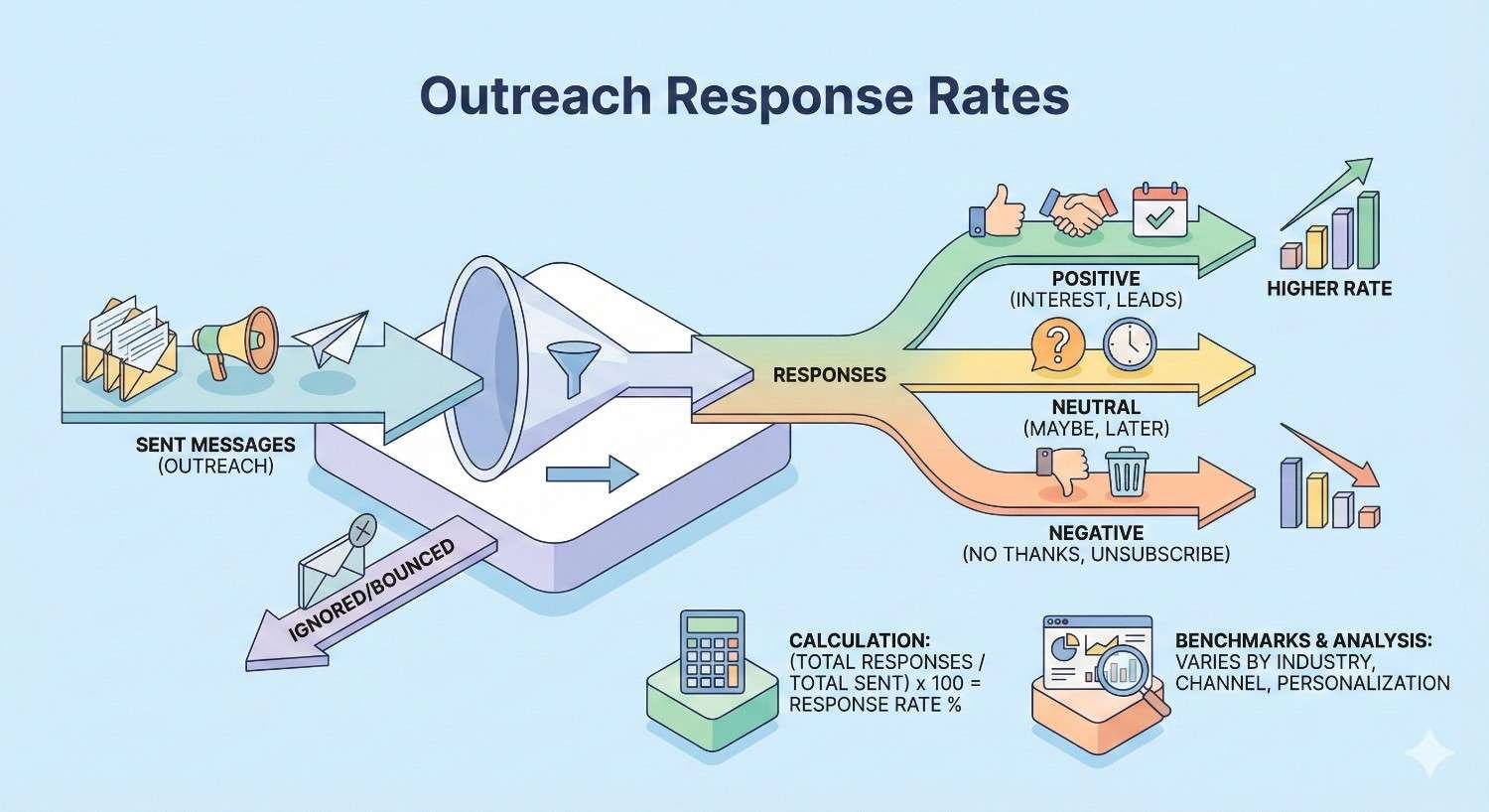
Outreach response rates measure how effectively your email campaigns generate replies from prospects. This metric serves as the primary indicator of campaign health and directly influences link acquisition velocity, partnership opportunities, and overall SEO ROI.
Definition and Core Metrics
Outreach response rate is the percentage of recipients who reply to your outreach emails. This includes positive responses, negative responses, and requests for more information. The metric excludes bounced emails and focuses solely on delivered messages that generate engagement.
Core metrics surrounding response rates include open rates, click-through rates, bounce rates, and conversion rates. Each metric provides different insights into campaign performance. Open rates indicate subject line effectiveness. Click-through rates show content engagement. Response rates reveal overall message resonance with your target audience.
For link building and SEO outreach, response rate matters more than open rate because a reply indicates genuine interest. Someone can open your email without engaging, but a response signals potential for relationship building and link acquisition.
How Response Rates Are Calculated
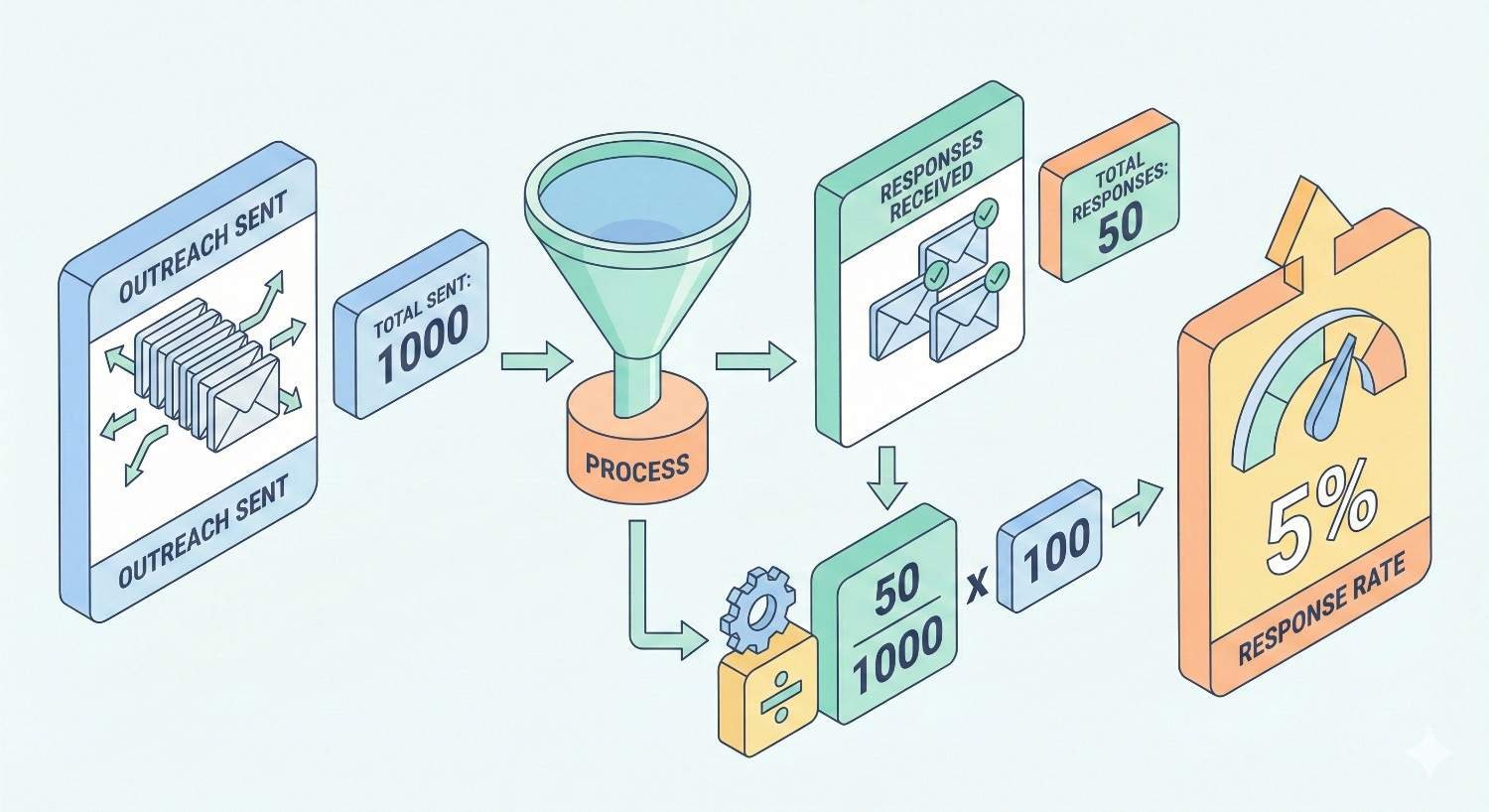
The standard response rate formula divides total responses by total delivered emails, then multiplies by 100.
Response Rate = (Total Responses ÷ Total Delivered Emails) × 100
For example, if you send 500 emails, 480 get delivered, and 48 people respond, your response rate is 10% (48 ÷ 480 × 100).
Important calculation considerations include:
- Exclude bounced emails from your denominator
- Count all responses, including negative ones
- Track unique responses, not total reply threads
- Separate initial responses from follow-up sequence responses
Some teams calculate response rate against total sent emails rather than delivered emails. This approach penalizes list quality issues but provides a more conservative performance view. Choose one method and apply it consistently across campaigns for accurate benchmarking.
Response Rate vs. Reply Rate vs. Conversion Rate
These terms often get confused, but each measures something different.
Response rate counts any reply to your outreach, regardless of sentiment. A “no thanks” counts as a response. This metric shows how many people engaged with your message at all.
Reply rate is often used interchangeably with response rate. Some platforms distinguish between them by counting only positive or neutral replies as “replies” while including all responses in “response rate.” Clarify definitions when comparing data across tools.
Conversion rate measures how many responses result in your desired outcome. For link building, conversion rate tracks how many responses become actual backlinks. For guest posting, it measures how many replies become published articles.
The relationship between these metrics matters for forecasting. If your response rate is 10% and your conversion rate is 30%, you need approximately 33 responses to acquire 10 links. This means sending roughly 330 delivered emails per 10 links acquired.
Industry Benchmark Response Rates
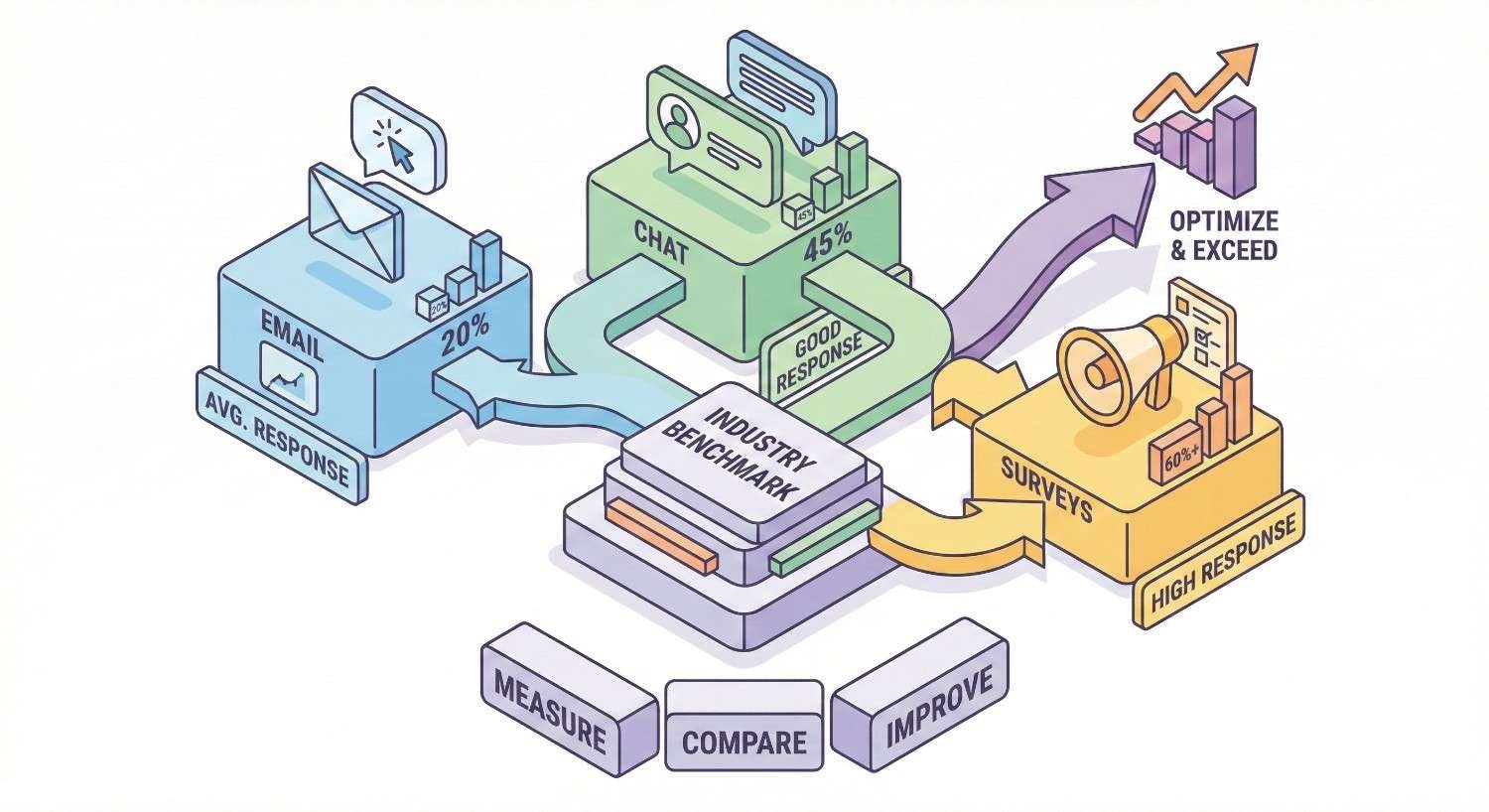
Benchmarks vary significantly by industry, outreach type, and relationship warmth. Understanding these ranges helps you set realistic expectations and identify improvement opportunities.
Average Email Outreach Response Rates by Industry
Response rates differ based on industry competitiveness, email volume recipients receive, and typical relationship dynamics.
Technology and SaaS: Average response rates range from 8% to 15%. Tech professionals receive high email volumes, making personalization critical. However, they also respond well to data-driven pitches and tool-related content.
Marketing and Agencies: Expect 5% to 12% response rates. Marketing professionals are highly targeted by outreach campaigns, creating inbox fatigue. Standing out requires exceptional personalization and clear value propositions.
Finance and B2B Services: Response rates typically fall between 10% to 18%. Decision-makers in these industries respond to professional, well-researched outreach but ignore generic templates.
E-commerce and Retail: Average rates range from 6% to 14%. Bloggers and publishers in this space receive numerous collaboration requests, requiring creative angles to capture attention.
Healthcare and Education: These industries often see higher response rates of 12% to 20% due to lower outreach volume and stronger community orientation.
Cold Outreach vs. Warm Outreach Response Rates
The temperature of your outreach relationship dramatically impacts response rates.
Cold outreach targets prospects with no prior relationship. Typical response rates range from 1% to 10%. Success depends entirely on relevance, personalization, and value proposition clarity. Most link building campaigns start as cold outreach.
Warm outreach involves some prior interaction. This includes social media engagement, previous email exchanges, event connections, or mutual contacts. Warm outreach typically achieves 15% to 40% response rates because recipients recognize your name and have context for your request.
Hot outreach targets existing relationships or referrals. Response rates often exceed 40% and can reach 70% or higher. Building a network of warm contacts over time significantly improves long-term outreach efficiency.
The strategic implication is clear: invest time in warming up prospects before pitching. Engaging with their content, commenting on social posts, or sharing their work creates familiarity that boosts response rates substantially.
Link Building Outreach Benchmarks
Link building outreach has specific benchmarks based on campaign type and target quality.
Resource page link building: Response rates average 5% to 15%. These campaigns target pages that already link to similar resources, making relevance high but competition fierce.
Broken link building: Expect 8% to 18% response rates. Providing value by identifying broken links creates goodwill, but many webmasters ignore these emails due to volume.
Skyscraper technique outreach: Response rates typically range from 3% to 12%. This approach requires exceptional content and highly targeted prospect lists to succeed.
HARO and journalist outreach: Response rates vary wildly from 2% to 25% depending on pitch quality and topic relevance. Journalists receive hundreds of pitches daily, making timing and angle critical.
Niche edits and link insertions: These campaigns see 5% to 15% response rates when targeting relevant, established content for contextual link additions.
Guest Post Outreach Response Rates
Guest posting outreach benchmarks depend on target site authority and your established credibility.
High-authority sites (DR 70+): Response rates typically fall between 2% to 8%. These sites receive numerous pitches and maintain strict editorial standards. Success requires exceptional topic angles and proven writing samples.
Mid-authority sites (DR 40-70): Expect 8% to 18% response rates. These targets balance quality with accessibility, making them ideal for building portfolio pieces and relationships.
Niche blogs and smaller publications: Response rates often reach 15% to 30%. Lower competition and more personal editorial relationships improve success rates significantly.
Industry publications and trade media: Response rates range from 5% to 15% depending on your expertise positioning and topic relevance to their audience.
Key Factors That Impact Outreach Response Rates
Multiple variables influence whether recipients respond to your outreach. Understanding these factors helps you systematically improve campaign performance.
Email Personalization and Relevance
Personalization is the single most important factor affecting response rates. Generic templates get ignored. Personalized emails get responses.
Effective personalization includes:
- Referencing specific content the recipient created
- Mentioning recent achievements or company news
- Connecting your pitch to their stated interests or goals
- Demonstrating you understand their audience and content focus
Surface-level personalization like using first names or company names provides minimal lift. Recipients recognize mail merge fields and discount them accordingly.
Deep personalization requires research investment but delivers significantly higher response rates. Mentioning a specific article, quoting their perspective, or referencing a recent podcast appearance shows genuine engagement.
The relevance of your pitch matters equally. Even perfectly personalized emails fail if the request doesn’t align with recipient interests. A vegan food blogger won’t respond to meat industry content pitches regardless of personalization quality.
Subject Line Quality and Open Rates
Your subject line determines whether emails get opened. Without opens, response rates stay at zero.
High-performing subject line characteristics:
- Brevity: Keep subject lines under 50 characters for mobile optimization
- Specificity: Reference something concrete rather than vague benefits
- Curiosity: Create interest without being clickbait
- Personalization: Include recipient name or site name when natural
Subject line approaches that work for outreach:
- Question format: “Quick question about [their article topic]?”
- Direct approach: “[Their name], collaboration idea”
- Mutual connection: “Referred by [mutual contact name]”
- Value-first: “Resource for your [topic] readers”
Avoid spam trigger words like “free,” “urgent,” “act now,” or excessive punctuation. These phrases trigger spam filters and reduce deliverability.
Testing subject lines through A/B experiments reveals what resonates with your specific audience. Small improvements in open rates compound into significant response rate gains.
Timing and Send Frequency
When you send emails affects open and response rates. Optimal timing varies by audience but follows general patterns.
Best days for B2B outreach: Tuesday, Wednesday, and Thursday consistently outperform Monday and Friday. Recipients are more focused mid-week and less overwhelmed by weekend email backlog.
Best times for sending: Mid-morning (9-11 AM) and early afternoon (1-3 PM) in the recipient’s timezone typically perform best. Avoid early morning sends that get buried and late afternoon sends that get deferred.
Send frequency considerations:
- Avoid sending more than one initial outreach email per day to the same domain
- Space follow-ups 3-7 days apart
- Limit total follow-ups to 2-3 per prospect
- Respect unsubscribe requests immediately
Sending too frequently damages sender reputation and triggers spam filters. Sending too infrequently loses momentum and allows prospects to forget your initial contact.
Target Audience Quality and List Segmentation
List quality determines campaign ceiling. No amount of optimization overcomes a poorly targeted prospect list.
Quality indicators for outreach lists:
- Relevance: Prospects actually cover topics related to your pitch
- Activity: Targets actively publish content and engage online
- Authority: Sites have sufficient domain authority for your goals
- Accessibility: Contact information is accurate and current
Segmentation improves response rates by enabling more targeted messaging. Segment lists by:
- Industry vertical
- Content type (blogs, news sites, resource pages)
- Authority level
- Previous engagement history
- Geographic location when relevant
A segmented campaign with tailored messaging to each group outperforms a single generic campaign to an unsegmented list. The extra effort in list preparation pays dividends in response rates.
Sender Reputation and Domain Authority
Your sending domain’s reputation directly impacts deliverability and, consequently, response rates.
Factors affecting sender reputation:
- Domain age: Newer domains face more scrutiny
- Email authentication: SPF, DKIM, and DMARC records must be properly configured
- Bounce rates: High bounces damage reputation quickly
- Spam complaints: Even a few complaints significantly impact deliverability
- Engagement rates: Low open rates signal poor quality to email providers
Your brand’s authority also matters. Recipients are more likely to respond to outreach from recognized brands or individuals with established credibility. Building thought leadership through content, social presence, and industry participation improves response rates over time.
Value Proposition Clarity
Recipients respond when they clearly understand what’s in it for them. Vague or self-serving pitches get ignored.
Strong value propositions for link building outreach:
- Offering genuinely useful content their audience will appreciate
- Providing data or research they can reference
- Identifying broken links and offering replacement resources
- Suggesting content improvements that benefit their readers
Weak value propositions that fail:
- “I’d love a backlink” (no value offered)
- “This would be great exposure for you” (presumptuous)
- “We have similar audiences” (vague and unsubstantiated)
Frame every outreach email around recipient benefit. Lead with value, make requests secondary. This approach respects recipient time and demonstrates professional courtesy.
How to Calculate Your Outreach Response Rate
Accurate measurement enables optimization. Without proper tracking, you cannot identify what works and what needs improvement.
Essential Metrics to Track
Beyond response rate, track these metrics for comprehensive campaign analysis:
Deliverability metrics:
- Delivery rate: Percentage of emails successfully delivered
- Bounce rate: Percentage of emails that failed delivery
- Spam rate: Percentage flagged as spam
Engagement metrics:
- Open rate: Percentage of delivered emails opened
- Click rate: Percentage of opens that clicked links
- Response rate: Percentage of delivered emails that received replies
Outcome metrics:
- Positive response rate: Percentage of responses expressing interest
- Conversion rate: Percentage of responses resulting in desired outcome
- Link acquisition rate: Links acquired per emails sent
Track metrics at campaign level and aggregate level. Campaign-level data reveals what works. Aggregate data shows overall program health and trends.
Response Rate Formula and Examples
Basic Response Rate Formula: Response Rate = (Total Responses ÷ Total Delivered Emails) × 100
Example 1: Standard Link Building Campaign
- Emails sent: 200
- Emails delivered: 190
- Responses received: 19
- Response rate: 19 ÷ 190 × 100 = 10%
Example 2: Guest Post Outreach
- Emails sent: 150
- Emails delivered: 142
- Responses received: 21
- Response rate: 21 ÷ 142 × 100 = 14.8%
Example 3: Calculating Conversion Rate
- Responses received: 19
- Links acquired: 6
- Conversion rate: 6 ÷ 19 × 100 = 31.6%
Example 4: Full Funnel Calculation
- Emails delivered: 500
- Response rate: 10% (50 responses)
- Conversion rate: 30% (15 links)
- Links per 100 emails: 3 links
These calculations help forecast campaign requirements. If you need 20 links and your historical data shows 3 links per 100 emails, plan for approximately 667 delivered emails.
Tools for Measuring Outreach Performance
Multiple tools help track outreach metrics accurately.
Email outreach platforms with built-in tracking:
- Pitchbox
- BuzzStream
- Hunter Campaigns
- Mailshake
- Lemlist
CRM systems for relationship tracking:
- HubSpot
- Pipedrive
- Salesforce
- Streak (Gmail integration)
Spreadsheet tracking for manual campaigns:
- Google Sheets with custom formulas
- Airtable with automation
- Notion databases
Choose tools based on campaign volume and team size. Small campaigns work fine with spreadsheets. High-volume operations require dedicated platforms with automation and reporting.
Proven Strategies to Improve Outreach Response Rates
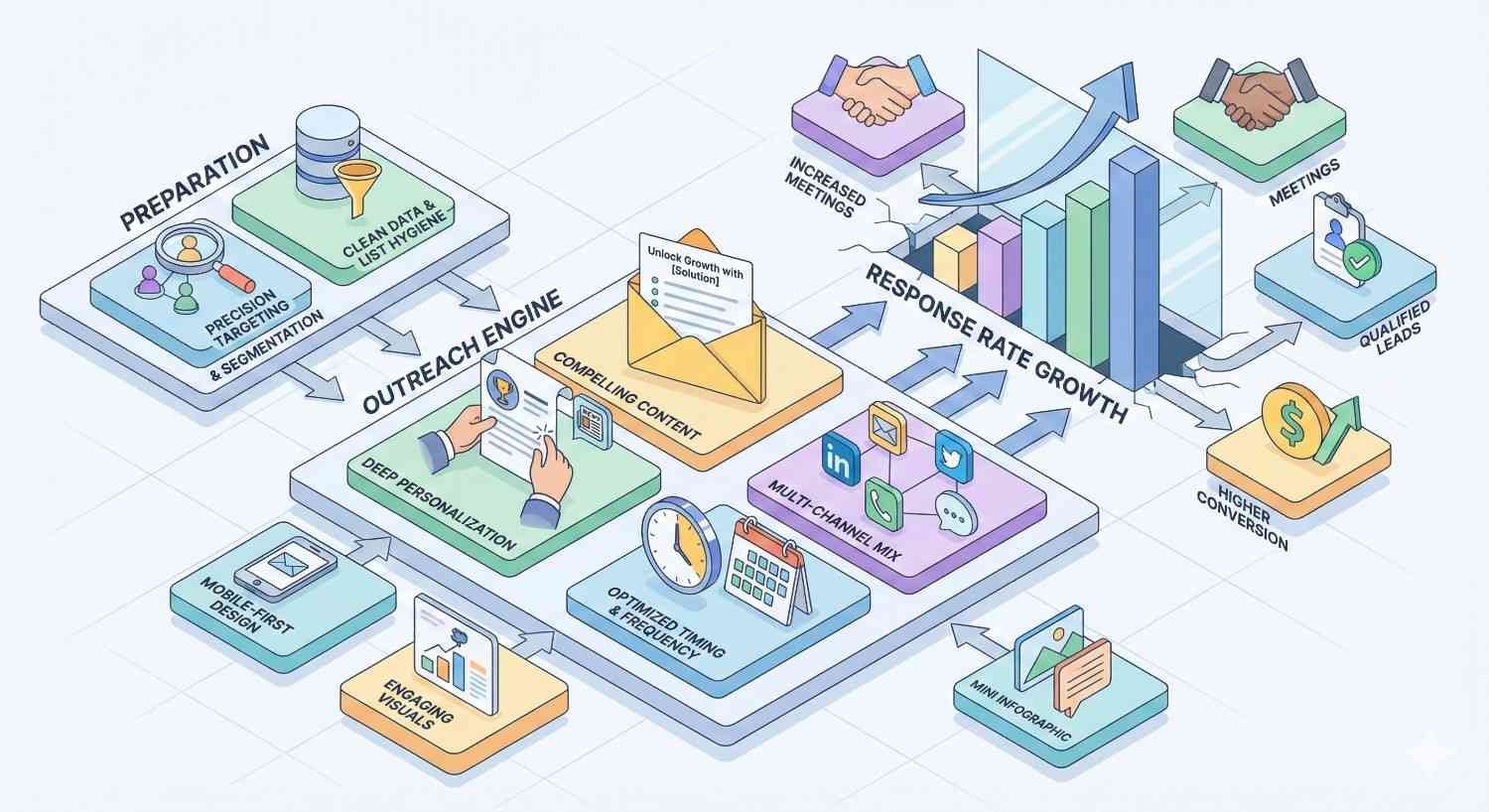
Systematic optimization improves response rates over time. These strategies address the key factors that influence recipient behavior.
Personalization Techniques That Work
Move beyond basic personalization to create genuine connections.
Research-based personalization:
- Read 2-3 recent articles from the prospect
- Note specific points you found valuable or interesting
- Reference these specifics in your outreach
Context-aware personalization:
- Mention recent company news or achievements
- Reference industry trends affecting their business
- Connect your pitch to their stated goals or challenges
Social proof personalization:
- Mention mutual connections when applicable
- Reference similar sites you’ve worked with
- Share relevant results from comparable campaigns
Template personalization framework: Create templates with personalization placeholders that require genuine research to complete. This ensures every email includes meaningful customization while maintaining efficiency.
Crafting Compelling Subject Lines
Subject lines determine open rates. Test these approaches:
Question-based subjects:
- “Quick question about your [topic] guide?”
- “[Name], have you considered [angle]?”
Direct and specific subjects:
- “Resource suggestion for [their article title]”
- “Collaboration idea for [their site name]”
Curiosity-driven subjects:
- “Noticed something about your [topic] content”
- “Idea that might interest your readers”
A/B test subject lines by sending variations to similar prospect segments. Track open rates to identify winning approaches for your specific audience.
Writing Effective Outreach Email Copy
Email body copy must be concise, clear, and value-focused.
Effective email structure:
Opening (1-2 sentences): Establish relevance and demonstrate research. Reference something specific about their work.
Value proposition (2-3 sentences): Clearly explain what you’re offering and why it benefits them. Be specific about the value.
Request (1-2 sentences): Make your ask clear and easy to fulfill. Reduce friction by being specific about next steps.
Closing (1 sentence): Thank them for their time. Keep it brief and professional.
Copy principles:
- Keep total length under 150 words
- Use short paragraphs (1-3 sentences)
- Avoid jargon and buzzwords
- Write at an 8th-grade reading level
- Include one clear call-to-action
Optimal Timing and Follow-Up Sequences
Strategic timing and follow-up significantly impact response rates.
Initial send timing:
- Tuesday through Thursday, mid-morning
- Avoid Mondays (inbox overload) and Fridays (weekend mindset)
- Consider recipient timezone
Follow-up sequence:
- Follow-up 1: 3-4 days after initial email
- Follow-up 2: 5-7 days after first follow-up
- Follow-up 3 (optional): 7-10 days after second follow-up
Follow-up content approach:
- First follow-up: Brief reminder with added value
- Second follow-up: Different angle or new information
- Third follow-up: Final check-in, easy opt-out
Research from Backlinko indicates that follow-up emails can increase response rates by 65.8%. Many responses come from follow-ups rather than initial emails.
Building Quality Prospect Lists
List quality determines campaign ceiling. Invest time in prospect research.
Prospect qualification criteria:
- Publishes content relevant to your pitch
- Has published within the last 6 months (active site)
- Accepts external contributions or links (for guest posts/link building)
- Has sufficient domain authority for your goals
- Contact information is findable and accurate
List building sources:
- Google search operators for relevant content
- Competitor backlink analysis
- Industry directories and resource lists
- Social media following and engagement
- Conference speaker lists and podcast guests
List hygiene practices:
- Verify email addresses before sending
- Remove duplicates and outdated contacts
- Segment by relevance and authority
- Update lists regularly with new prospects
A/B Testing Your Outreach Campaigns
Systematic testing reveals what works for your specific audience.
Elements to test:
- Subject lines (most impactful)
- Opening sentences
- Value proposition framing
- Call-to-action wording
- Email length
- Send timing
Testing methodology:
- Test one variable at a time
- Use statistically significant sample sizes (minimum 50 per variation)
- Track results over consistent time periods
- Document findings and apply learnings
Common testing insights:
- Shorter emails often outperform longer ones
- Questions in subject lines frequently improve open rates
- Specific value propositions beat generic ones
- Personalized openings increase response rates
Warming Up Email Domains
New domains require warming to establish sender reputation.
Domain warming process:
- Start with low volume (10-20 emails daily)
- Gradually increase over 4-8 weeks
- Send to engaged recipients initially
- Monitor deliverability metrics closely
Warming best practices:
- Use email authentication (SPF, DKIM, DMARC)
- Maintain consistent sending patterns
- Avoid sudden volume spikes
- Keep bounce rates below 2%
- Respond to replies to show engagement
Signs of reputation problems:
- Declining open rates
- Increased spam folder placement
- Rising bounce rates
- Blacklist notifications
Address reputation issues immediately. Pause campaigns, identify causes, and resolve before resuming.
Common Outreach Mistakes That Kill Response Rates
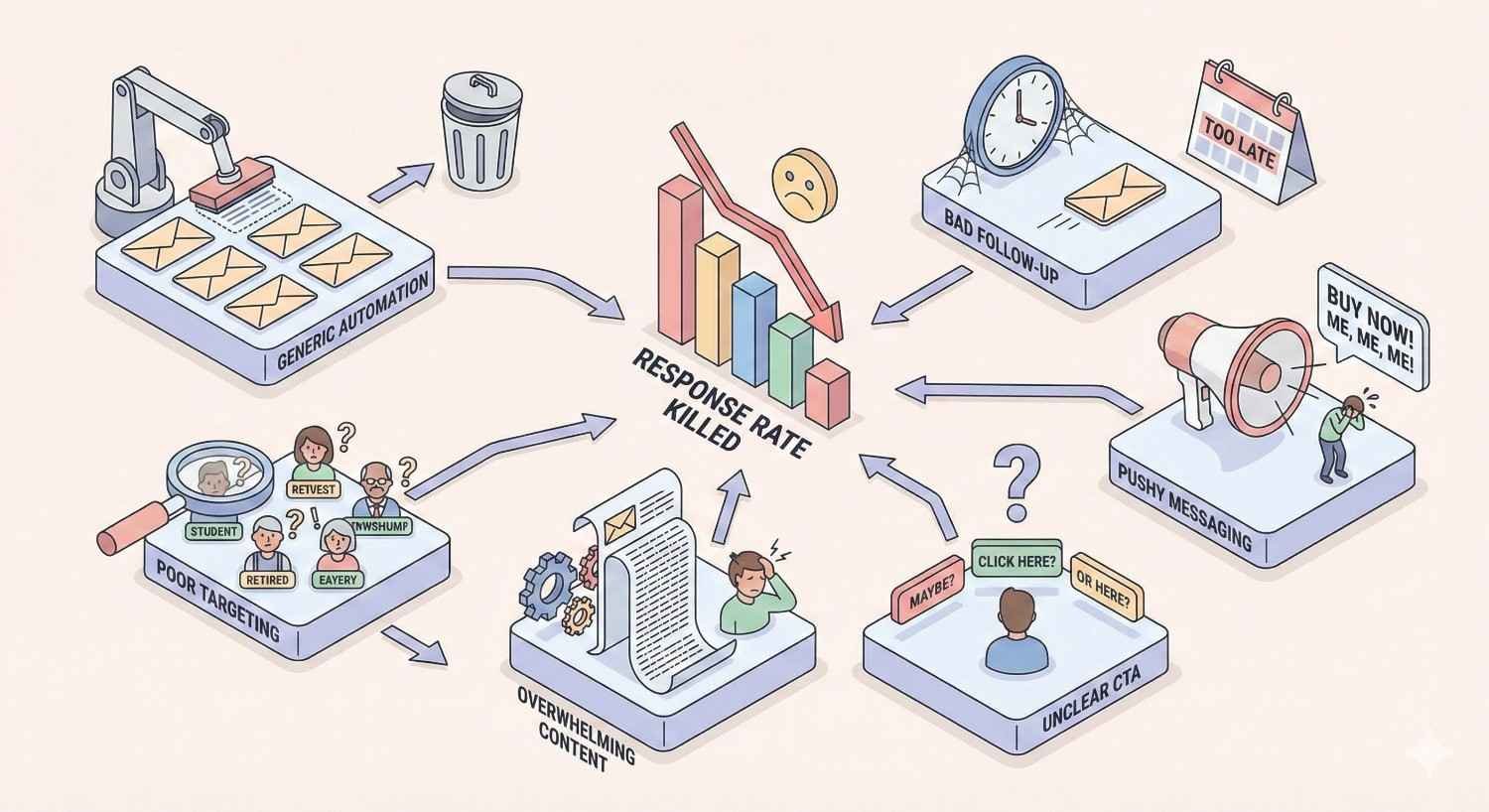
Avoiding these mistakes prevents wasted effort and protects sender reputation.
Generic Template Overuse
Templates save time but destroy response rates when overused without customization.
Signs of template fatigue:
- Declining response rates over time
- Negative responses mentioning “mass email”
- Unsubscribe requests increasing
Template improvement strategies:
- Create multiple template variations
- Require meaningful personalization fields
- Rotate templates regularly
- Personalize at least 20% of each email
Recipients recognize templates. Even well-written templates feel impersonal after recipients see similar emails repeatedly. Continuous template evolution maintains freshness.
Poor Targeting and Irrelevant Pitches
Irrelevant outreach wastes everyone’s time and damages your reputation.
Targeting mistakes:
- Pitching topics the recipient doesn’t cover
- Contacting sites that don’t accept guest posts or links
- Reaching out to inactive or abandoned sites
- Ignoring geographic or industry relevance
Relevance verification checklist:
- Does this site cover my topic area?
- Has this site published similar content?
- Does my pitch align with their audience interests?
- Is my content quality appropriate for this site?
Spending extra time on targeting pays dividends through higher response rates and better relationships.
Aggressive or Pushy Messaging
Pushy outreach creates negative impressions and rarely succeeds.
Aggressive tactics to avoid:
- Multiple follow-ups in short timeframes
- Demanding responses or creating false urgency
- Guilt-tripping about non-response
- Making unreasonable requests
Professional alternatives:
- Patient follow-up sequences with appropriate spacing
- Respectful language acknowledging their busy schedule
- Easy opt-out options in follow-ups
- Reasonable, clearly stated requests
Building relationships requires patience. Aggressive tactics might generate short-term responses but damage long-term reputation and relationship potential.
Technical Issues (Deliverability, Spam Filters)
Technical problems prevent emails from reaching inboxes.
Common deliverability issues:
- Missing or incorrect email authentication
- Sending from blacklisted domains
- High bounce rates from bad lists
- Spam trigger words in content
Technical checklist:
- Configure SPF, DKIM, and DMARC records
- Verify email addresses before sending
- Monitor blacklist status regularly
- Test emails through spam checkers before campaigns
Spam filter triggers:
- Excessive links in email body
- ALL CAPS or excessive punctuation
- Spam trigger words (free, urgent, act now)
- Image-heavy emails with little text
Technical issues are fixable but require attention. Regular monitoring prevents deliverability problems from derailing campaigns.
Lack of Follow-Up Strategy
Most responses come from follow-ups, not initial emails. Failing to follow up leaves significant value on the table.
Follow-up failures:
- No follow-up at all
- Following up too quickly (appears desperate)
- Following up too slowly (loses momentum)
- Sending identical follow-ups (lazy and obvious)
Effective follow-up approach:
- Plan follow-up sequence before campaign launch
- Space follow-ups appropriately (3-7 days)
- Add new value or angle in each follow-up
- Limit total follow-ups to avoid annoyance
- Track follow-up performance separately
A structured follow-up sequence can double or triple effective response rates compared to single-email campaigns.
Outreach Response Rates for Different Campaign Types
Different outreach objectives have distinct benchmarks and optimization strategies.
Link Building Outreach
Link building outreach targets webmasters and content creators for backlink acquisition.
Typical response rates: 5% to 15%
Success factors:
- Content quality and relevance
- Clear value proposition for linking
- Target site alignment with your content
- Personalization demonstrating genuine interest
Optimization strategies:
- Lead with content value, not link requests
- Offer multiple linking opportunities
- Provide easy implementation (exact anchor text, URL)
- Follow up with additional value
Guest Posting Outreach
Guest post outreach seeks publication opportunities on external sites.
Typical response rates: 8% to 20%
Success factors:
- Topic relevance to target publication
- Writing sample quality
- Unique angle or expertise demonstration
- Understanding of their audience
Optimization strategies:
- Pitch specific topics, not generic offers
- Include relevant writing samples
- Demonstrate knowledge of their content
- Offer exclusive, original content
Digital PR and Journalist Outreach
PR outreach targets journalists and media outlets for coverage.
Typical response rates: 2% to 15%
Success factors:
- Newsworthiness of your pitch
- Timing alignment with news cycles
- Journalist beat relevance
- Data or unique angle availability
Optimization strategies:
- Lead with the news hook
- Provide ready-to-use quotes and data
- Respect journalist deadlines
- Build relationships before pitching
Influencer and Partnership Outreach
Partnership outreach targets influencers and complementary brands.
Typical response rates: 10% to 25%
Success factors:
- Audience alignment
- Clear mutual benefit
- Professional presentation
- Reasonable initial ask
Optimization strategies:
- Start with smaller asks to build relationship
- Demonstrate understanding of their brand
- Offer concrete collaboration ideas
- Provide social proof of past partnerships
Content Promotion Outreach
Content promotion outreach seeks shares, mentions, and amplification.
Typical response rates: 5% to 18%
Success factors:
- Content quality and shareability
- Relevance to recipient’s audience
- Easy sharing mechanisms
- Timing with content freshness
Optimization strategies:
- Target people who shared similar content
- Make sharing effortless (provide copy, images)
- Offer exclusive early access
- Follow up with engagement on their shares
Best Tools for Managing and Tracking Outreach Campaigns
The right tools improve efficiency and provide data for optimization.
Email Outreach Platforms
Dedicated outreach platforms streamline campaign management.
Pitchbox: Comprehensive platform for link building and PR outreach. Features include prospect discovery, email sequencing, and relationship management. Best for agencies and high-volume operations.
BuzzStream: Relationship-focused platform with strong prospecting and tracking features. Includes link monitoring and team collaboration tools.
Hunter Campaigns: Email finding combined with simple campaign management. Good for smaller teams needing basic sequencing.
Mailshake: User-friendly platform with strong automation and A/B testing. Integrates with major CRMs and provides detailed analytics.
Lemlist: Known for personalization features including dynamic images. Strong deliverability tools and warming features.
CRM and Tracking Tools
CRM systems help manage relationships beyond individual campaigns.
HubSpot: Full-featured CRM with email tracking, pipeline management, and reporting. Free tier available for basic needs.
Pipedrive: Sales-focused CRM with visual pipeline management. Good for tracking outreach progression and follow-ups.
Streak: Gmail-integrated CRM for teams working primarily in Google Workspace. Simple setup with powerful tracking.
Notion/Airtable: Flexible database tools for custom tracking systems. Good for teams with specific workflow requirements.
Email Verification and Deliverability Tools
Verification tools protect sender reputation and improve deliverability.
Hunter Email Verifier: Verifies email addresses and provides confidence scores. Integrates with Hunter’s email finding tools.
NeverBounce: Real-time email verification with high accuracy. Offers bulk verification and API access.
ZeroBounce: Comprehensive verification including spam trap detection. Provides email scoring and deliverability insights.
Mail-Tester: Free tool for checking email spam score before sending. Identifies potential deliverability issues.
Analytics and Reporting Solutions
Analytics tools provide insights for optimization.
Google Analytics: Track referral traffic from successful outreach. Monitor which placements drive engagement.
Ahrefs/Semrush: Monitor backlink acquisition and domain authority changes. Track competitor outreach success.
Platform-native analytics: Most outreach platforms include reporting dashboards. Use these for campaign-level metrics.
Custom dashboards: Tools like Google Data Studio or Tableau can combine data sources for comprehensive reporting.
How Outreach Response Rates Impact SEO Performance
Outreach response rates directly influence SEO outcomes through multiple mechanisms.
Link Acquisition Velocity and Authority Building
Higher response rates accelerate link acquisition, which impacts ranking velocity.
The connection:
- More responses = more link opportunities
- More links = faster authority building
- Higher authority = improved rankings
- Better rankings = more organic traffic
Quantifying the impact: If improving response rates from 8% to 12% (a 50% improvement), you acquire 50% more links from the same outreach volume. This compounds over time as authority builds.
Authority building timeline: Links acquired through outreach typically take 2-6 months to fully impact rankings. Consistent outreach with strong response rates creates steady authority growth rather than sporadic gains.
Content Distribution and Brand Visibility
Successful outreach extends content reach beyond organic search.
Distribution benefits:
- Guest posts expose your brand to new audiences
- Link placements drive referral traffic
- Mentions increase brand awareness
- Relationships create ongoing promotion opportunities
Visibility compounding: Each successful outreach creates potential for future opportunities. Guest post readers may invite you to contribute elsewhere. Link placements may inspire others to link naturally.
Relationship Building for Long-Term SEO
Outreach builds relationships that provide ongoing SEO value.
Relationship benefits:
- Repeat collaboration opportunities
- Referrals to other contacts
- Early access to link opportunities
- Industry insights and trends
Long-term value: A contact who responds positively once is more likely to respond again. Building a network of warm contacts improves future campaign performance and creates sustainable link acquisition channels.
ROI of Outreach Campaigns
Response rates directly impact campaign ROI calculations.
ROI calculation components:
- Time invested in prospecting and outreach
- Tool and platform costs
- Link value (based on authority and relevance)
- Traffic and conversion value from links
Response rate impact on ROI: Doubling response rates effectively halves the cost per link acquired. This makes the difference between profitable and unprofitable campaigns.
Example ROI comparison:
- Campaign A: 5% response rate, 100 hours invested, 10 links acquired = 10 hours per link
- Campaign B: 10% response rate, 100 hours invested, 20 links acquired = 5 hours per link
Campaign B delivers twice the ROI from the same investment through better response rates.
Setting Realistic Response Rate Goals
Effective goal-setting requires understanding your baseline and industry context.
Benchmarking Against Your Industry
Compare your performance to relevant benchmarks.
Benchmarking process:
- Identify your primary outreach type (link building, guest posts, PR)
- Find industry-specific benchmarks
- Adjust for your target quality (higher authority = lower rates)
- Set goals relative to benchmarks
Benchmark interpretation: If industry average is 10% and you’re at 6%, significant improvement opportunity exists. If you’re at 12%, focus on maintaining performance while scaling volume.
Establishing Baseline Metrics
Before setting goals, understand your current performance.
Baseline measurement:
- Track at least 3 campaigns or 500 emails
- Calculate response rate using consistent methodology
- Note any variables (list quality, template, timing)
- Document conversion rates alongside response rates
Baseline analysis questions:
- What’s your average response rate?
- How does it vary by campaign type?
- Which templates perform best?
- What’s your follow-up response rate?
Progressive Improvement Targets
Set incremental goals rather than dramatic jumps.
Goal-setting framework:
- Short-term (1-3 months): 10-20% improvement over baseline
- Medium-term (3-6 months): 25-40% improvement over baseline
- Long-term (6-12 months): 50%+ improvement over baseline
Example progression:
- Baseline: 8% response rate
- 3-month goal: 9-10% response rate
- 6-month goal: 10-11% response rate
- 12-month goal: 12%+ response rate
When to Pivot Your Outreach Strategy
Sometimes optimization isn’t enough. Recognize when fundamental changes are needed.
Pivot indicators:
- Response rates declining despite optimization
- Conversion rates dropping significantly
- Negative response sentiment increasing
- Industry changes affecting outreach viability
Pivot options:
- Change target audience or industry focus
- Shift outreach type (link building to guest posts)
- Adjust value proposition fundamentally
- Explore alternative link acquisition methods
Pivoting isn’t failure. It’s strategic adaptation to changing conditions.
Case Studies: Outreach Campaigns with High Response Rates
Real-world examples demonstrate effective strategies in action.
B2B SaaS Link Building Campaign
Context: A project management software company seeking authoritative backlinks from productivity and business blogs.
Approach:
- Created original research on remote work productivity trends
- Targeted sites that had covered similar topics
- Personalized outreach referencing specific articles
- Offered exclusive data visualizations for linking sites
Results:
- Response rate: 18%
- Conversion rate: 35%
- 47 links acquired from 750 emails
- Average linking domain authority: DR 52
Key success factors:
- Original research provided unique value
- Deep personalization demonstrated genuine interest
- Clear value proposition for linking sites
- Professional follow-up sequence
Digital PR Campaign for E-commerce Brand
Context: A sustainable fashion brand seeking media coverage and high-authority links.
Approach:
- Developed newsworthy sustainability report with industry data
- Targeted fashion and sustainability journalists
- Timed outreach around Earth Day news cycle
- Provided ready-to-use quotes and statistics
Results:
- Response rate: 22%
- Coverage rate: 40% of responses
- 15 media placements from 170 pitches
- Links from publications including major fashion outlets
Key success factors:
- Newsworthy angle with timely hook
- Journalist-ready materials reduced friction
- Strategic timing aligned with editorial calendars
- Targeted pitch customization for each outlet
Guest Post Outreach for Content Agency
Context: A content marketing agency building thought leadership through guest contributions.
Approach:
- Identified marketing blogs accepting guest posts
- Pitched specific, data-backed topic ideas
- Included relevant writing samples
- Offered exclusive content with original insights
Results:
- Response rate: 24%
- Acceptance rate: 55% of responses
- 28 guest posts published from 210 pitches
- Average host site authority: DR 48
Key success factors:
- Specific topic pitches rather than generic offers
- Strong writing samples demonstrated quality
- Topics aligned with each site’s content gaps
- Professional communication throughout process
Conclusion: Building a Sustainable Outreach Strategy
Outreach response rates determine link building success, content distribution reach, and long-term SEO authority growth. Understanding benchmarks, tracking metrics accurately, and systematically optimizing campaigns creates sustainable competitive advantage.
The strategies outlined here work because they focus on recipient value, genuine personalization, and professional relationship building. Quick fixes and aggressive tactics fail long-term. Patient, value-driven outreach succeeds.
We help businesses build sustainable organic growth through strategic outreach, technical SEO, and authority building. White Label SEO Service provides the expertise and systems to improve your outreach response rates and accelerate link acquisition. Contact us to discuss how we can support your SEO goals.
Frequently Asked Questions
What is a good outreach response rate?
A good outreach response rate typically falls between 10% and 20% for most link building and guest post campaigns. Cold outreach to high-authority sites may see lower rates around 5% to 10%, while warm outreach to established contacts often achieves 25% or higher.
How can I improve my outreach response rates quickly?
Focus on personalization and list quality first. Reference specific content from each prospect, ensure your pitch aligns with their interests, and verify email addresses before sending. These changes often produce immediate improvements of 20% to 50% in response rates.
How many follow-up emails should I send?
Send 2 to 3 follow-up emails spaced 3-7 days apart. Most responses come from follow-ups rather than initial emails. Each follow-up should add new value or present a different angle rather than simply repeating your original request.
What tools are best for tracking outreach performance?
Dedicated platforms like Pitchbox, BuzzStream, and Mailshake provide comprehensive tracking. For smaller operations, CRM tools like HubSpot or even well-organized spreadsheets work effectively. Choose tools based on your volume and team size.
Why are my outreach emails going to spam?
Common causes include missing email authentication (SPF, DKIM, DMARC), sending from new or unwarmed domains, high bounce rates, and spam trigger words in content. Check your technical setup, verify email addresses, and test emails through spam checkers before campaigns.
How long should outreach emails be?
Keep outreach emails under 150 words. Shorter emails respect recipient time and increase the likelihood of reading and response. Include only essential information: personalized opening, clear value proposition, specific request, and brief closing.
What response rate should I expect from cold outreach?
Cold outreach typically achieves 1% to 10% response rates depending on personalization quality, list relevance, and value proposition strength. Warming up prospects through social engagement before emailing can significantly improve these rates.