
Private blog networks can destroy years of SEO progress in a single Google update. Business owners investing in link building need to understand that PBN detection methods have become sophisticated enough to identify manipulative networks within months, not years.
The stakes are significant. A manual penalty can eliminate 90%+ of organic traffic overnight, directly impacting revenue and growth projections.
This guide covers how PBNs work, why Google penalizes them, detection methods, real business consequences, and sustainable alternatives that protect your investment.
What Is a Private Blog Network (PBN)?
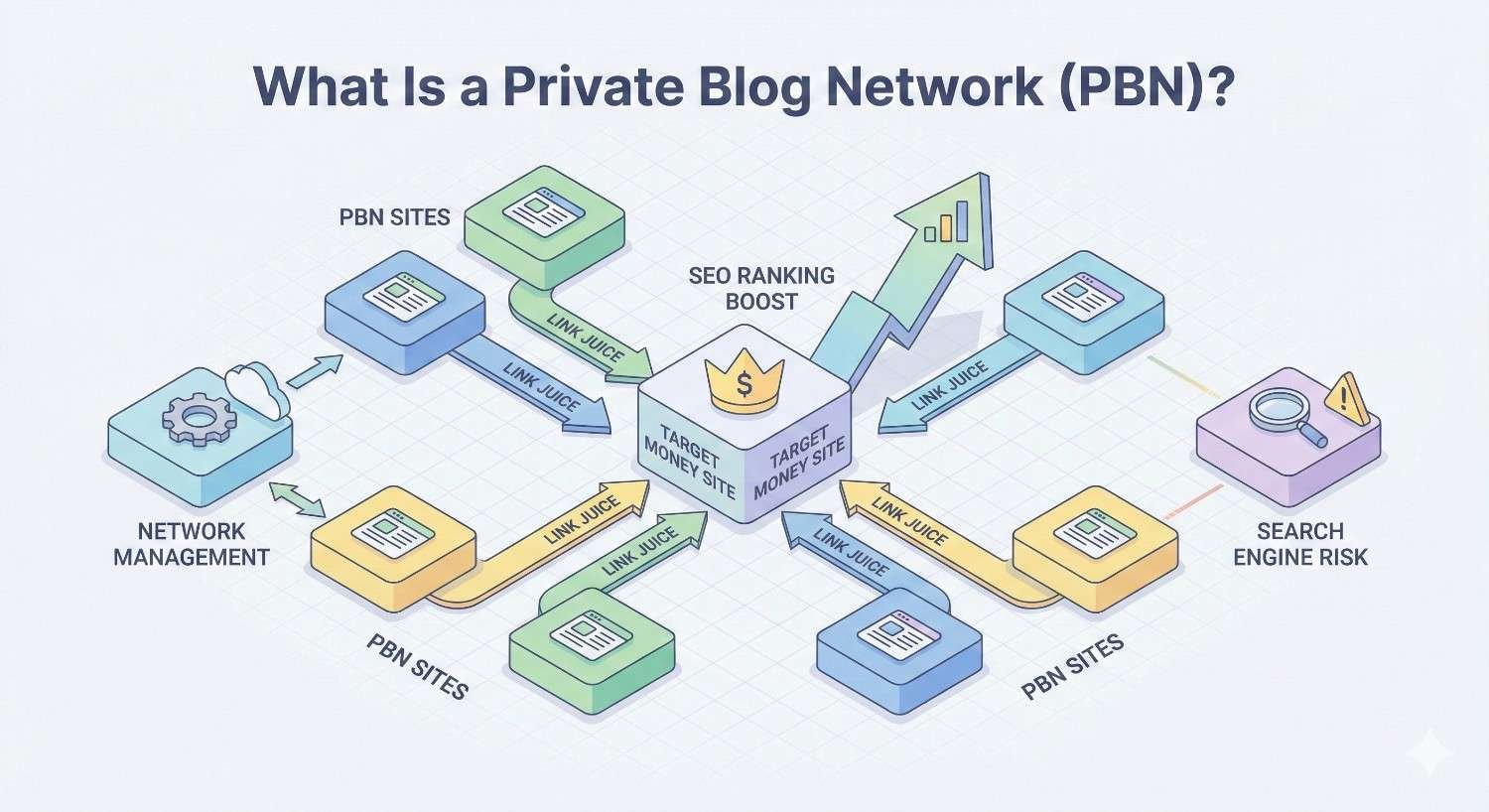
A private blog network is a collection of websites owned or controlled by a single entity, used primarily to build backlinks to a target site. These networks attempt to manipulate search rankings by creating artificial link authority.
PBNs typically consist of expired domains with existing backlink profiles and domain authority. The operator purchases these domains, adds minimal content, and places links pointing to their money site or client websites.
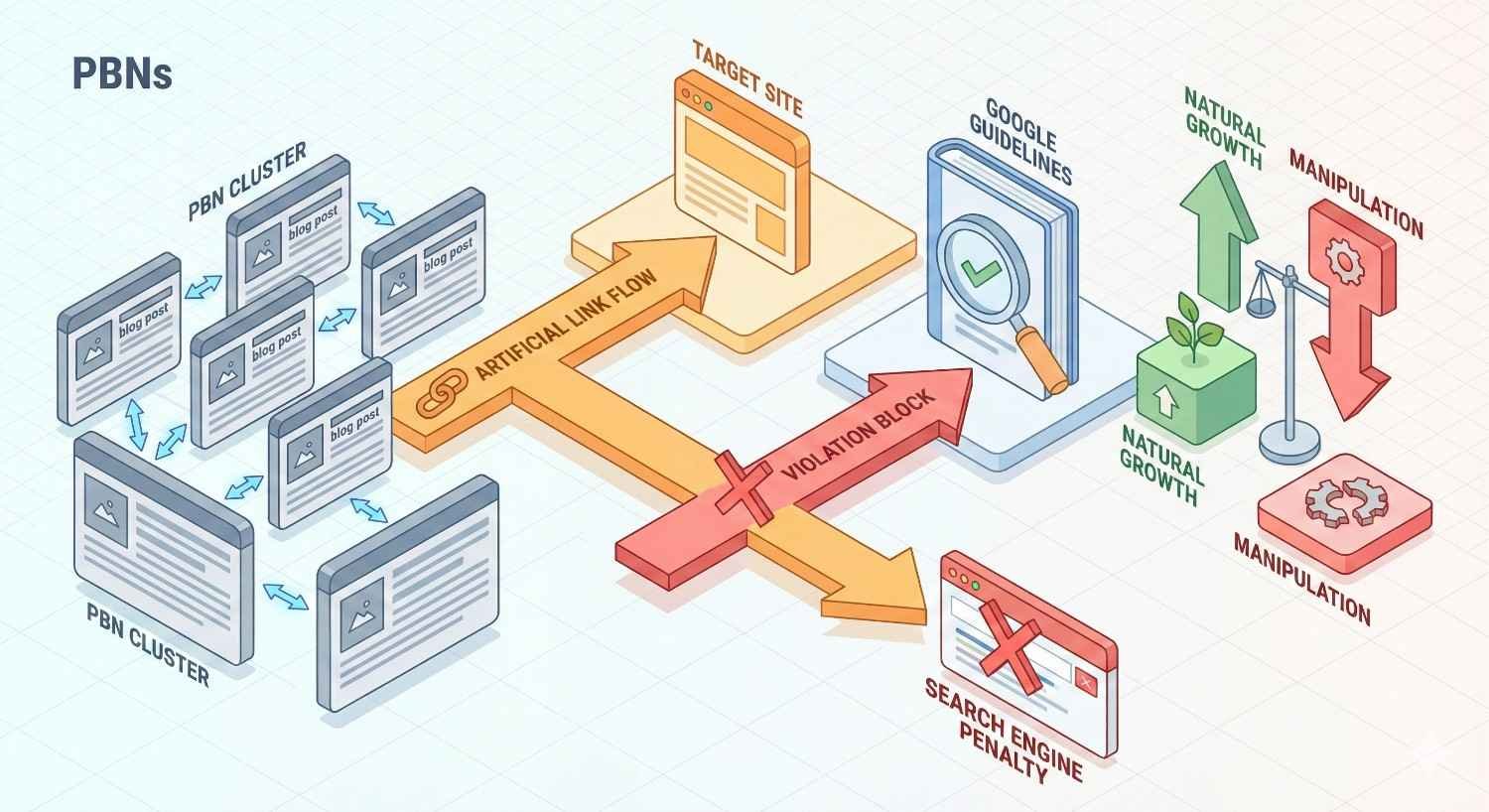
The fundamental premise violates Google’s guidelines because the links exist solely to manipulate PageRank, not to provide genuine editorial endorsements or user value.
How PBNs Are Built and Operated
PBN operators follow a predictable process. They identify expired domains with strong backlink profiles using tools like Ahrefs, Majestic, or specialized auction platforms. Domains with clean history, relevant topical authority, and existing referring domains command premium prices.
After acquisition, operators host these domains across different providers to avoid IP clustering. They install WordPress or similar CMS platforms, add thin content (often AI-generated or spun), and insert links to target sites.
Maintenance involves periodic content updates, hosting rotations, and link placement management. Some operators run networks of 50-500+ domains, charging clients per link placement.
The operational costs include domain renewals, hosting fees, content creation, and management time. Monthly expenses for a mid-sized network can reach $2,000-$10,000, creating pressure to monetize through aggressive link selling.
Why Some SEOs Use PBNs for Link Building
The appeal is straightforward: control and speed. Legitimate link building requires outreach, relationship building, and content creation. Results take months. PBNs offer immediate link placement with controlled anchor text.
Some SEOs argue that PBNs work in competitive niches where editorial links are difficult to acquire. Industries like gambling, payday loans, and certain affiliate markets face editorial resistance from legitimate publishers.
Cost comparisons also drive adoption. A single high-authority editorial link might cost $500-$2,000 through legitimate outreach. PBN links often sell for $50-$200 each, appearing more economical on surface analysis.
However, this calculation ignores risk. When factoring penalty probability and recovery costs, PBN economics collapse entirely.
The Difference Between PBNs and Legitimate Link Networks
Legitimate link networks exist. Industry associations, media companies, and content syndicates operate interconnected websites with genuine editorial standards.
The distinction lies in purpose and editorial independence. A media company owning multiple publications maintains separate editorial teams, genuine audiences, and independent content strategies. Links between properties serve reader interests, not ranking manipulation.
PBNs lack these characteristics. Content exists solely to host links. No genuine audience reads the material. Editorial decisions center entirely on link placement revenue.
Google’s guidelines specifically address this: links intended to manipulate PageRank violate their policies, regardless of how sophisticated the network appears.
Why PBNs Violate Google’s Webmaster Guidelines
Google’s business model depends on delivering relevant search results. Manipulative link schemes undermine result quality, threatening user trust and advertising revenue.
The search engine has invested billions in detection systems specifically targeting artificial link patterns. Understanding why PBNs violate guidelines helps business owners recognize the fundamental risk.
Google’s Link Scheme Policies Explained
Google’s Link Spam documentation explicitly identifies link schemes as violations. The policy states that any links intended to manipulate rankings in Google Search results may be considered link spam.
Specific violations include:
- Buying or selling links for ranking purposes
- Excessive link exchanges
- Large-scale article marketing with keyword-rich anchor text
- Using automated programs to create links
- Requiring links as part of Terms of Service
PBNs fall squarely within “buying or selling links for ranking purposes.” The transaction may involve direct payment or service exchange, but the intent remains manipulation.
Google’s documentation emphasizes that the best way to get other sites to create relevant links is to create unique, relevant content that naturally gains popularity.
How PBNs Manipulate PageRank and Search Rankings
PageRank, Google’s foundational algorithm, treats links as votes of confidence. A link from Site A to Site B transfers ranking signals, suggesting Site A endorses Site B’s content.
PBNs exploit this mechanism by creating artificial endorsements. The expired domain’s existing authority passes to the target site through strategically placed links.
This manipulation distorts search results. Sites with PBN links may outrank genuinely authoritative competitors, degrading result quality for users.
Google’s response has been systematic detection and devaluation. Modern algorithms identify link manipulation patterns and either ignore the links entirely or penalize participating sites.
The Intent vs. Impact: Why Google Considers PBNs Deceptive
Google evaluates links based on editorial intent. A genuine editorial link represents a human decision to recommend content to readers. The publisher gains nothing from the link except providing value to their audience.
PBN links invert this relationship. The link exists because someone paid for placement, not because the content deserves recommendation. The publisher’s only motivation is revenue.
This deception extends to users. Someone clicking a PBN link expects to find content the publisher genuinely recommends. Instead, they encounter paid placement disguised as editorial endorsement.
Google’s guidelines reflect this concern: links should represent genuine editorial choices, not commercial transactions masquerading as recommendations.
How Google Detects Private Blog Networks
Google employs multiple detection methods, combining algorithmic analysis with manual review. Understanding these methods reveals why PBN operators consistently fail to evade detection long-term.
Detection has improved dramatically since 2014, when Google’s first major PBN crackdown eliminated thousands of networks. Modern systems identify patterns that would have escaped earlier algorithms.
Footprint Analysis: Common PBN Detection Signals
PBNs leave identifiable patterns across multiple dimensions. Google’s systems analyze these footprints to identify network relationships.
WHOIS and Domain Registration Patterns
Domain registration data reveals ownership connections. When multiple domains share registrant information, contact details, or registration timing, algorithms flag potential network relationships.
Privacy services partially obscure this data, but registration patterns remain detectable. Domains registered through the same privacy service, on similar dates, with comparable renewal patterns suggest common ownership.
Google’s access to historical WHOIS data enables pattern analysis across time. Even domains that later added privacy protection may have exposed ownership information previously.
Hosting and IP Address Clustering
Shared hosting creates IP address relationships. When multiple domains resolve to the same IP address or IP range, detection systems identify potential connections.
Sophisticated operators use diverse hosting providers, but patterns persist. Hosting account creation timing, nameserver configurations, and technical implementation details create detectable similarities.
Research from SEO tool providers confirms that IP diversity alone doesn’t prevent detection. Other technical footprints remain identifiable regardless of hosting distribution.
Content Similarity and Thin Content Indicators
PBN content typically lacks depth, originality, and genuine value. Algorithms identify thin content patterns including:
- Low word counts relative to topic complexity
- High similarity scores with other network sites
- Absence of multimedia, user engagement, or social signals
- Publication patterns inconsistent with genuine editorial calendars
- Topic coverage that exists solely to justify link placement
Natural language processing has advanced significantly. Google’s systems identify AI-generated content, spun articles, and templated material with increasing accuracy.
Unnatural Link Patterns and Anchor Text Distribution
Link profiles reveal manipulation through statistical analysis. Natural link acquisition produces diverse anchor text, varied linking page types, and organic growth patterns.
PBN links typically show:
- Over-optimized anchor text ratios
- Links from pages with minimal content
- Sudden link velocity spikes
- Links from sites with no topical relationship
- Reciprocal or circular linking patterns within networks
Google’s algorithms compare link profiles against expected distributions. Significant deviations trigger deeper analysis or automatic devaluation.
Algorithmic Detection Methods Google Uses
Google’s SpamBrain system, announced in 2022, uses machine learning to identify spam at scale. The system detects both spammy content and artificial link patterns.
SpamBrain analyzes link relationships across the entire web graph. Machine learning models identify network structures that human reviewers might miss, processing billions of pages to find manipulation patterns.
The December 2022 spam update specifically targeted link spam, with Google stating the update would neutralize the impact of unnatural links. Subsequent updates have continued improving detection capabilities.
Link graph analysis identifies clusters of sites that link to each other or to common targets in unnatural patterns. Even well-disguised PBNs create statistical anomalies detectable at scale.
Manual Review and Spam Reports
Algorithmic detection triggers manual review for significant cases. Google’s Search Quality team evaluates flagged sites, applying human judgment to ambiguous situations.
Competitors frequently submit spam reports identifying PBN usage. The spam report form allows anyone to report suspected manipulation.
Manual actions resulting from review appear in Google Search Console. Site owners receive notification of the violation and required remediation steps.
Manual reviewers examine link profiles, content quality, and network relationships. Their findings inform algorithm improvements, creating a feedback loop that continuously enhances detection.
Third-Party Tools That Identify PBN Links
SEO professionals use specialized tools to identify PBN links in their own or competitor profiles. These same tools help Google understand detection patterns.
Popular detection approaches include:
- Ahrefs/Majestic: Identify low-quality referring domains with thin content
- SEMrush: Flag toxic backlinks and suspicious link patterns
- Majestic Trust Flow: Compare Trust Flow to Citation Flow ratios
- Manual review: Examine linking sites for PBN characteristics
If third-party tools can identify PBN links, Google’s systems with full web access certainly can. The detection gap between public tools and Google’s capabilities continues widening.
The Real Risks of Using PBNs for SEO
Understanding theoretical risks matters less than examining actual consequences. Businesses using PBNs face quantifiable penalties affecting traffic, revenue, and long-term viability.
Google Penalties: Manual Actions vs. Algorithmic Devaluation
Google responds to PBN usage through two mechanisms: manual actions and algorithmic devaluation. Both damage rankings, but recovery processes differ significantly.
What Happens During a Manual Penalty
Manual actions appear in Google Search Console under the Security & Manual Actions section. The notification specifies the violation type and affected pages or site sections.
For unnatural links to your site, Google requires:
- Identifying all artificial links
- Attempting removal through outreach
- Disavowing remaining links
- Submitting a reconsideration request
- Waiting for manual review
The process typically takes 3-6 months minimum. Many sites require multiple reconsideration attempts before penalty removal.
During this period, affected pages or the entire site may be demoted or removed from search results entirely. Traffic losses of 80-95% are common.
How Algorithmic Filters Devalue PBN Links
Algorithmic devaluation occurs without notification. Google’s systems simply stop passing value through identified PBN links, causing gradual ranking declines.
This silent penalty creates diagnostic challenges. Site owners may not realize PBN links caused their decline, attributing losses to algorithm updates or competition.
Algorithmic devaluation doesn’t require reconsideration requests. However, recovery requires removing or disavowing the problematic links and waiting for Google to recrawl and reassess.
The timeline is unpredictable. Some sites recover within weeks of disavowing links; others see no improvement for months.
Recovery Timelines and Success Rates
Recovery success depends on violation severity, remediation thoroughness, and site quality independent of manipulative links.
- First reconsideration success rate: 30-50%
- Average recovery timeline: 4-8 months
- Full traffic recovery: Often incomplete, reaching 60-80% of pre-penalty levels
Sites with diverse, legitimate link profiles alongside PBN links recover more successfully. Sites dependent primarily on PBN links may never fully recover.
Traffic and Revenue Loss: Real-World Impact
Organic traffic directly correlates with revenue for most businesses. A 90% traffic decline translates to proportional lead generation and sales losses.
Consider a business generating $50,000 monthly from organic traffic. A manual penalty reducing traffic by 90% immediately costs $45,000 monthly in lost revenue.
Over a 6-month recovery period, total losses reach $270,000 or more. This figure excludes recovery costs, reputation damage, and opportunity costs from diverted resources.
For e-commerce businesses, the impact compounds through lost customer lifetime value. Customers who would have discovered the brand through organic search never arrive, eliminating future repeat purchases.
Domain Authority and Trust Erosion
Penalties damage more than rankings. They erode the trust signals that support long-term SEO performance.
Domain authority metrics from third-party tools may decline as PBN links are disavowed. More importantly, Google’s internal trust assessments suffer lasting damage.
Sites with penalty history face increased scrutiny on future link acquisition. Legitimate links may receive less value as algorithms apply skepticism to the domain’s link profile.
Rebuilding trust requires sustained legitimate activity over extended periods. The domain may never achieve the authority it would have reached through ethical practices from the start.
Wasted Investment: Cost vs. Return Analysis
PBN investment includes direct costs and opportunity costs. Direct costs encompass link purchases, typically $50-$500 per link depending on claimed authority.
A campaign purchasing 50 PBN links at $150 average costs $7,500. If penalties occur within 12 months, that investment produces negative returns.
Opportunity costs compound the loss. The $7,500 invested in legitimate link building through digital PR or content marketing would have produced durable results without penalty risk.
The risk-adjusted return calculation devastates PBN economics. Even assuming only 20% penalty probability, expected value turns negative when factoring potential losses.
Reputational Damage and Long-Term Brand Impact
Penalties become public knowledge within industries. Competitors, partners, and potential customers may discover penalty history through tools like Wayback Machine or industry discussions.
For B2B companies, reputation damage affects sales conversations. Prospects researching vendors may discover penalty history, raising questions about business practices and judgment.
Agency relationships suffer when clients discover PBN usage. The revelation often triggers contract termination and negative reviews, damaging the agency’s ability to acquire new clients.
Brand equity built over years can evaporate through association with manipulative practices. The long-term cost often exceeds immediate traffic losses.
Case Studies: Businesses Penalized for PBN Use
Examining real penalty scenarios illustrates consequences beyond theoretical risk. These composite cases represent patterns observed across multiple businesses.
E-commerce Site Traffic Collapse After Manual Action
An outdoor equipment retailer invested $15,000 in PBN links over 18 months, targeting competitive product category keywords. Rankings improved initially, with organic traffic increasing 40%.
The manual action arrived without warning. Google Search Console showed an unnatural links penalty affecting the entire site. Organic traffic dropped 92% within two weeks.
Recovery required:
- Comprehensive backlink audit identifying 127 PBN links
- Outreach to PBN operators requesting removal (largely unsuccessful)
- Disavow file creation and submission
- Three reconsideration requests over 8 months
Total recovery costs exceeded $25,000 including consultant fees, lost revenue, and staff time. Traffic eventually recovered to 65% of pre-penalty levels, never reaching previous performance.
The business lost an estimated $180,000 in revenue during the penalty period, plus ongoing losses from incomplete recovery.
SaaS Startup Loses Rankings and Investor Confidence
A B2B software startup used PBN links to accelerate growth before a funding round. The strategy initially succeeded, with demo requests increasing 60% from organic traffic.
The penalty arrived three weeks before scheduled investor meetings. Organic traffic collapsed, and the startup couldn’t explain the sudden decline without revealing the PBN strategy.
Investors discovered the penalty during due diligence. The funding round failed, with investors citing concerns about management judgment and sustainable growth practices.
The startup eventually secured funding at a 40% lower valuation after demonstrating recovery progress. The PBN investment of $8,000 ultimately cost millions in equity value.
Agency Client Exodus Following PBN Discovery
A digital marketing agency used PBNs across multiple client accounts, presenting the links as legitimate placements. When Google’s December 2022 spam update triggered penalties across several clients simultaneously, the pattern became obvious.
Clients compared notes and discovered the common link source. Within 60 days, the agency lost 70% of retainer revenue as clients terminated contracts.
Negative reviews and industry word-of-mouth prevented new client acquisition. The agency closed within 18 months, with principals facing personal reputation damage affecting future employment.
Red Flags: How to Identify If Your SEO Provider Uses PBNs
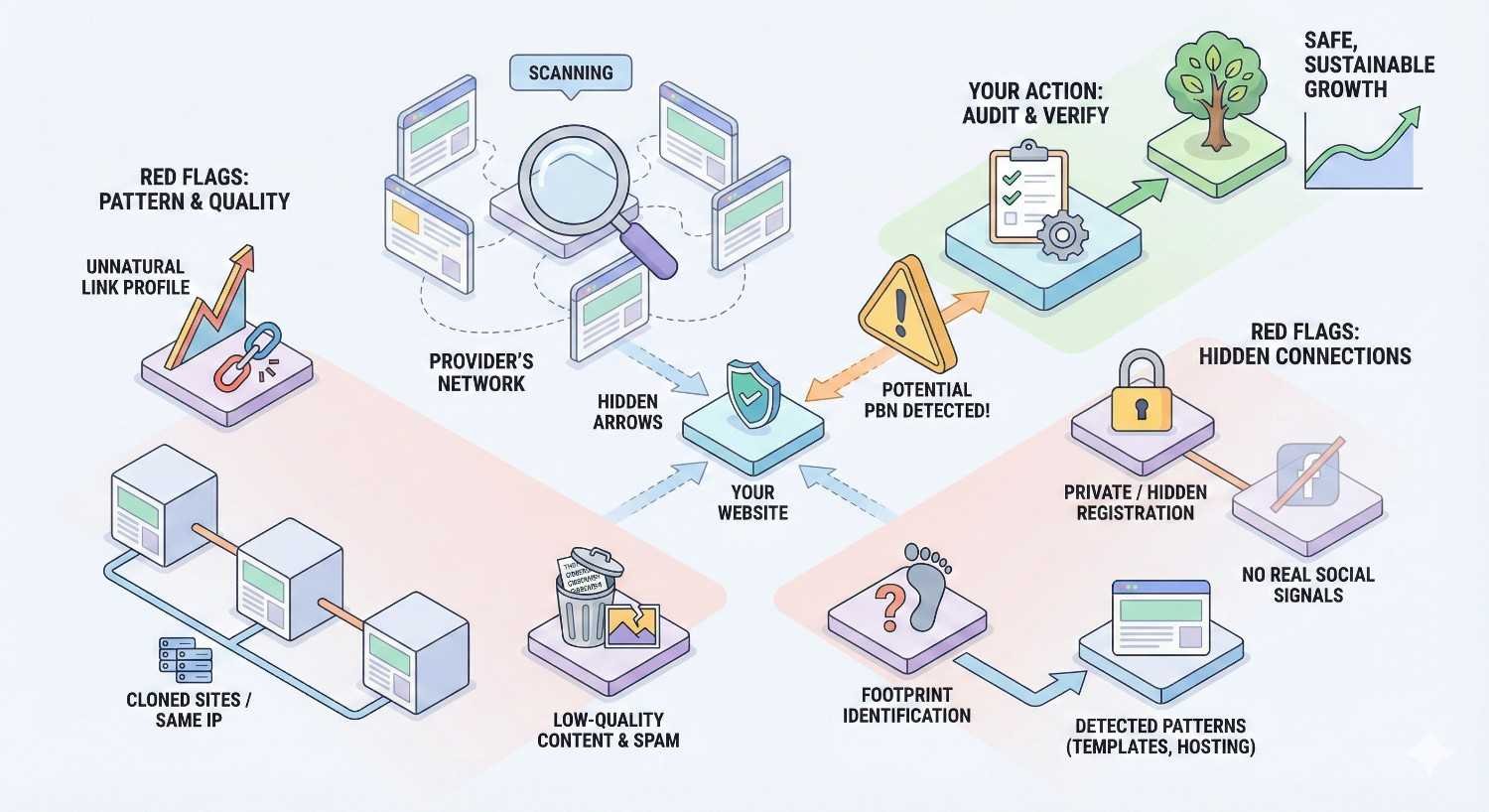
Business owners often unknowingly purchase PBN links through agencies or consultants. Recognizing warning signs protects against inherited risk.
Warning Signs in Link Building Proposals
Proposals emphasizing these elements warrant scrutiny:
- Guaranteed placements: Legitimate publishers don’t guarantee acceptance
- Bulk link packages: “50 links for $X” suggests controlled inventory
- Specific DA/DR promises: Metrics can be manipulated; legitimate outreach can’t guarantee specific authority levels
- Fast timelines: Quality link building takes months, not weeks
- Vague source descriptions: “High-authority blogs” without specific examples
- No content requirements: Legitimate placements require quality content
Request specific examples of previous placements. Examine those sites for PBN characteristics: thin content, no genuine audience, links to unrelated sites.
Questions to Ask Your SEO Agency or Consultant
Direct questions reveal approach and ethics:
- “Can you show me examples of sites where you’ve placed links for other clients?”
- “Do you own or control any of the sites where links will be placed?”
- “What’s your process for earning links from sites you don’t control?”
- “How do you ensure links comply with Google’s guidelines?”
- “What happens if Google penalizes links you’ve built?”
Evasive answers or refusal to provide specifics suggests problematic practices. Legitimate agencies welcome transparency questions.
How to Audit Your Existing Backlink Profile for PBN Links
Regular audits identify problematic links before penalties occur. The process involves:
- Export backlink data from Ahrefs, SEMrush, or Google Search Console
- Sort by referring domain to identify patterns
- Manually review suspicious domains checking for:
- Thin or AI-generated content
- Links to unrelated sites
- No social presence or genuine audience
- Recently expired domain registration
- Generic or templated design
- Document findings for potential disavow file creation
- Discuss with your SEO provider if agency-built links appear problematic
Quarterly audits catch issues early, enabling proactive remediation before penalties.
Tools for Detecting Suspicious Link Sources
Several tools assist PBN identification:
- Ahrefs: Examine referring domain content, traffic estimates, and link patterns
- SEMrush Backlink Audit: Automated toxic score identification
- Majestic: Trust Flow vs. Citation Flow discrepancies indicate manipulation
- Moz Link Explorer: Spam score highlights risky domains
- Manual review: No tool replaces examining actual linking pages
Combine automated analysis with manual verification. Tools flag candidates; human judgment confirms PBN characteristics.
What to Do If You’ve Already Used a PBN
Discovering PBN links in your profile requires immediate action. The remediation process depends on whether you’ve received a manual penalty or want to proactively clean your profile.
Immediate Steps: Audit and Documentation
Begin with comprehensive documentation:
- Export complete backlink profile from multiple tools
- Identify all suspected PBN links through manual review
- Document each link including URL, anchor text, and acquisition date
- Preserve evidence of how links were acquired (invoices, emails, contracts)
- Assess scope to understand total exposure
Documentation supports reconsideration requests and potential legal action against providers who misrepresented their services.
Disavowing PBN Links: Process and Best Practices
Google’s Disavow Tool tells the search engine to ignore specific links when assessing your site. The process requires careful execution:
- Create disavow file in correct format (domain: or specific URLs)
- Include all identified PBN links plus any other suspicious links discovered
- Submit through Google Search Console Disavow Links tool
- Document submission date for reconsideration timeline
Best practices include:
- Disavow at domain level for confirmed PBNs
- Include brief comments explaining link categories
- Keep records of all disavowed domains
- Update file if additional PBN links are discovered
Disavow processing takes weeks to months. Don’t expect immediate ranking changes.
Submitting a Reconsideration Request (Manual Penalties)
Manual penalties require formal reconsideration requests after remediation:
- Complete all remediation steps before requesting review
- Document removal efforts including outreach attempts
- Explain what happened honestly in the request
- Describe preventive measures to avoid future violations
- Submit through Search Console Manual Actions section
Successful requests demonstrate:
- Understanding of the violation
- Thorough remediation efforts
- Genuine commitment to compliance
- Specific preventive measures implemented
Expect 2-4 weeks for initial response. Rejection requires additional remediation and resubmission.
Building a Clean Link Profile Moving Forward
Post-remediation link building must follow guidelines strictly:
- Audit all new links before they go live
- Require transparency from any agency partners
- Document link sources for future reference
- Monitor profile regularly for suspicious additions
- Focus on editorial links from genuine publications
The goal is demonstrating sustained compliance, rebuilding trust through consistent ethical practices.
Realistic Recovery Expectations and Timelines
Set appropriate expectations for recovery:
- Manual penalty removal: 3-8 months typical
- Traffic recovery: 60-90% of pre-penalty levels common
- Full recovery: May never occur for severely penalized sites
- Trust rebuilding: 12-24 months of clean activity
Some businesses never fully recover. Sites heavily dependent on PBN links may lack sufficient legitimate authority to rank competitively post-penalty.
Recovery success correlates with:
- Site quality independent of manipulative links
- Thoroughness of remediation
- Strength of legitimate link profile
- Competitive landscape in target keywords
Sustainable Alternatives to PBNs for Link Acquisition
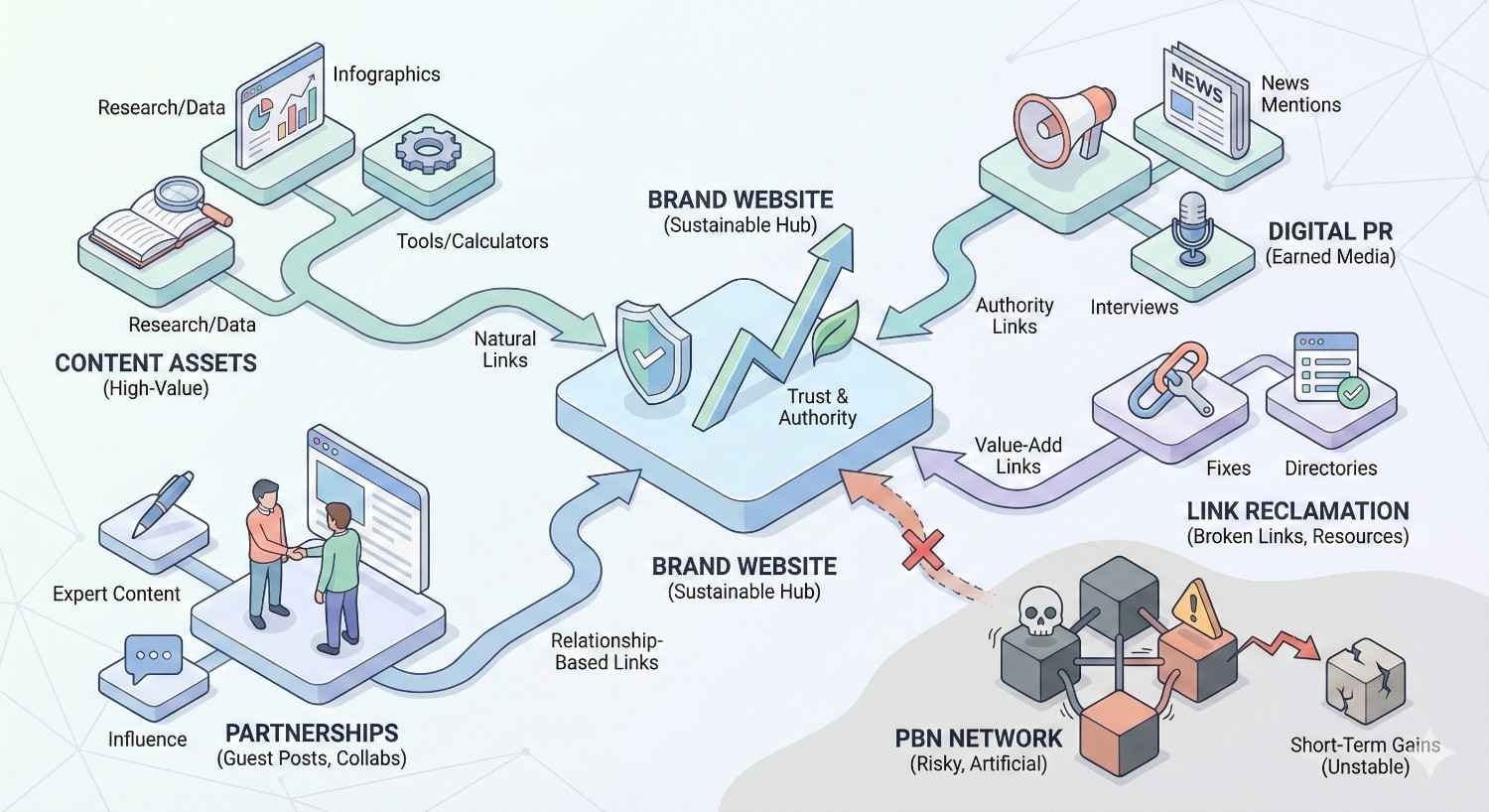
Legitimate link building produces durable results without penalty risk. These approaches require more effort but deliver compounding returns.
Digital PR and Journalist Outreach
Digital PR earns links through newsworthy content and journalist relationships. The approach involves:
- Creating newsworthy assets: Original research, data studies, expert commentary
- Building journalist relationships: HARO responses, direct outreach, social engagement
- Pitching stories: Connecting your expertise to trending topics
- Providing value first: Helping journalists without expecting immediate returns
Digital PR links come from authoritative news sites, industry publications, and respected blogs. These links carry significant ranking value and face no penalty risk.
Timeline: 3-6 months to establish relationships and see consistent placements.
Content Marketing and Linkable Asset Creation
Linkable assets attract links naturally through genuine value:
- Original research: Surveys, data analysis, industry reports
- Comprehensive guides: Definitive resources on important topics
- Tools and calculators: Interactive utilities solving real problems
- Visual content: Infographics, data visualizations, original imagery
The key is creating content others want to reference. When your content becomes the best resource on a topic, links follow organically.
Investment focuses on content creation rather than link acquisition. The content continues attracting links indefinitely, unlike purchased links requiring ongoing investment.
Strategic Guest Posting on Legitimate Publications
Guest posting on genuine publications differs fundamentally from PBN placements:
- Editorial standards: Real publications reject low-quality submissions
- Genuine audiences: Readers actually consume the content
- Topical relevance: Publications cover specific subjects consistently
- Author attribution: Your expertise builds through bylined content
Identify publications your audience reads. Pitch genuinely valuable content ideas. Accept that most pitches will be rejected.
The links earned carry editorial endorsement value. They also drive referral traffic and build brand awareness beyond SEO benefits.
Industry Partnerships and Co-Marketing Initiatives
Business relationships create natural link opportunities:
- Partner directories: Legitimate partner listings on vendor sites
- Co-created content: Joint research, webinars, or guides
- Event sponsorships: Conference and webinar participation
- Industry associations: Membership directories and contributor opportunities
These links reflect genuine business relationships. They’re contextually relevant and editorially justified.
Unlinked Brand Mentions and Link Reclamation
Many sites mention brands without linking. Reclamation converts these mentions to links:
- Monitor brand mentions using Google Alerts or specialized tools
- Identify unlinked mentions on authoritative sites
- Reach out politely requesting link addition
- Provide value by offering updated information or resources
Reclamation success rates of 10-30% are typical. The links are entirely legitimate since the mention already exists.
How Long Legitimate Link Building Actually Takes
Set realistic timeline expectations:
- Month 1-3: Foundation building, content creation, relationship initiation
- Month 4-6: First placements begin appearing
- Month 6-12: Consistent link acquisition establishes
- Year 2+: Compounding returns as reputation builds
Legitimate link building is slower initially but accelerates over time. Reputation compounds, making future links easier to acquire.
Compare this to PBNs: fast initial results followed by penalty risk and potential total loss. Sustainable approaches deliver inferior short-term results but superior long-term outcomes.
How to Build Authority Without Shortcuts
Link acquisition supports broader authority building. Technical foundations, content strategy, and relationship development create sustainable competitive advantages.
Technical SEO Foundations That Support Link Acquisition
Technical excellence makes link building more effective:
- Fast page speed: Publishers prefer linking to fast-loading resources
- Mobile optimization: Essential for user experience and crawlability
- Clean architecture: Logical structure helps link equity flow
- Schema markup: Enhanced SERP presence increases click-through and visibility
Technical issues undermine link building investment. Fix foundations before scaling acquisition efforts.
Content Strategy That Naturally Attracts Links
Strategic content planning identifies link-worthy topics:
- Gap analysis: What questions lack definitive answers?
- Data opportunities: What information could you uniquely provide?
- Format innovation: How could you present information better than competitors?
- Update cycles: What outdated content could you replace?
Content strategy aligns creation with link acquisition goals. Every piece should have clear link potential before production begins.
Building Relationships in Your Industry
Relationships precede links. Industry connections create ongoing opportunities:
- Conference participation: Speaking, attending, networking
- Community involvement: Forums, social groups, professional associations
- Collaboration: Joint projects with complementary businesses
- Generosity: Helping others without immediate expectation
Relationship-based link building scales through reputation. As your network grows, opportunities multiply without proportional effort increase.
Measuring Link Quality Over Quantity
Quality metrics matter more than volume:
- Relevance: Does the linking site relate to your topic?
- Authority: Does the site have genuine influence?
- Traffic: Do real users visit the linking page?
- Editorial context: Is the link naturally integrated?
One high-quality editorial link often outperforms dozens of low-quality placements. Focus resources on acquiring fewer, better links.
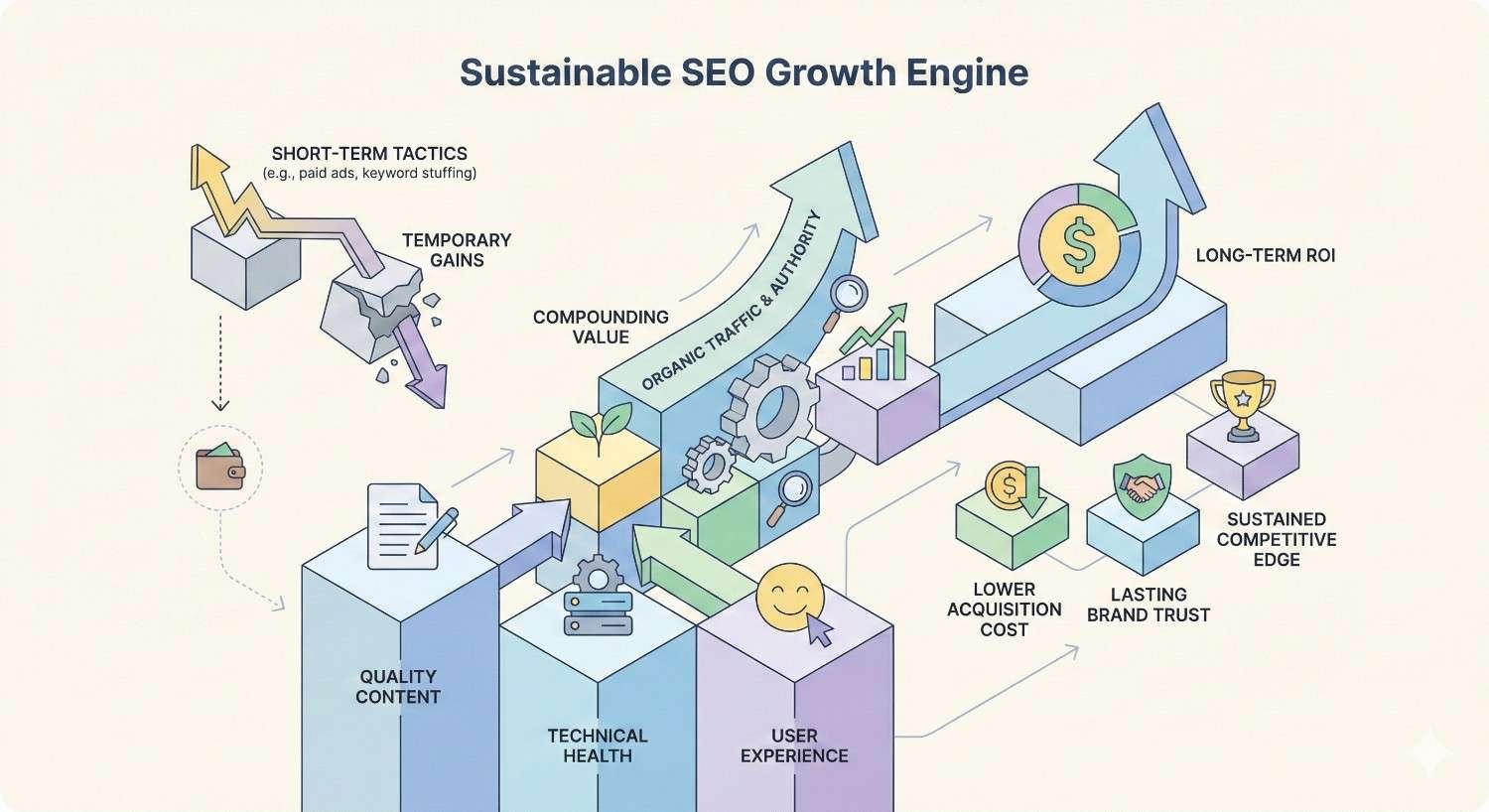
Why Sustainable SEO Delivers Better Long-Term ROI
Financial analysis consistently favors sustainable approaches when accounting for risk and time horizons.
Comparing PBN Costs vs. Legitimate Link Building Investment
Direct cost comparison:
PBN approach (12 months):
- 100 links at $150 average: $15,000
- Penalty probability: 30-50%
- Expected penalty cost: $50,000-$200,000
- Risk-adjusted value: Negative
Legitimate approach (12 months):
- Content creation: $10,000
- Outreach and PR: $8,000
- Total investment: $18,000
- Penalty probability: ~0%
- Asset value: Ongoing
The legitimate approach costs slightly more upfront but eliminates catastrophic risk while creating lasting assets.
Risk-Adjusted Returns: Factoring in Penalty Probability
Expected value calculations reveal true economics:
PBN scenario:
- Best case (no penalty): +$30,000 value
- Worst case (penalty): -$150,000 loss
- Probability-weighted outcome: Negative expected value
Legitimate scenario:
- Expected outcome: +$25,000 value
- Downside risk: Minimal
- Probability-weighted outcome: Positive expected value
Risk-adjusted analysis makes the sustainable choice obvious for rational decision-makers.
Compound Growth from Sustainable Authority Building
Legitimate authority compounds over time:
- Year 1: Foundation building, modest results
- Year 2: Acceleration as reputation establishes
- Year 3: Significant competitive advantage
- Year 5: Dominant market position possible
PBN results don’t compound. Each link requires ongoing investment, and penalty risk increases with scale.
Sustainable approaches create moats. Competitors can’t easily replicate years of relationship building and content development.
Brand Equity and Trust as Competitive Advantages
Brand strength affects all marketing channels:
- Higher conversion rates: Trusted brands convert better
- Lower acquisition costs: Reputation reduces marketing spend
- Premium pricing: Authority supports higher prices
- Partnership opportunities: Strong brands attract better partners
PBN penalties damage brand equity. Sustainable SEO builds it. The difference compounds across all business metrics.
How We Help Businesses Build Clean, Sustainable Link Profiles
White Label SEO Service provides comprehensive link building that protects your investment while delivering measurable results.
Our Link Acquisition Philosophy and Process
We believe effective link building requires:
- Editorial merit: Every link must be editorially justified
- Relevance: Links come from topically related sources
- Transparency: Clients know exactly where links originate
- Sustainability: No tactics that risk future penalties
Our process combines content creation, digital PR, and relationship-based outreach. We earn links through value creation, not manipulation.
Transparency in Link Building: What You Can Expect
We provide complete visibility into our work:
- Monthly reporting: Every link acquired with source details
- Pre-approval: Major placements reviewed before publication
- Source verification: Clients can examine any linking site
- Strategy documentation: Clear explanation of approaches used
No surprises. No hidden tactics. Complete alignment between our methods and your risk tolerance.
Quality Assurance and Link Source Vetting
Every potential link source undergoes evaluation:
- Traffic verification: Real visitors, not just metrics
- Content quality: Genuine editorial standards
- Link profile analysis: Clean history, no spam patterns
- Relevance assessment: Topical alignment with your business
We reject opportunities that don’t meet quality standards, even when clients request faster results. Short-term pressure never justifies long-term risk.
Performance Tracking and ROI Measurement
We measure what matters:
- Link acquisition volume: Monthly placement counts
- Quality metrics: Authority and relevance scores
- Ranking impact: Keyword position changes
- Traffic growth: Organic session increases
- Business outcomes: Leads, sales, revenue attribution
Regular reporting connects link building investment to business results. You’ll understand exactly what your investment produces.
Conclusion: Making Informed SEO Investment Decisions
PBN risks far outweigh potential benefits for businesses building sustainable organic growth. Detection methods continue improving, penalties remain severe, and recovery is never guaranteed.
Legitimate link building requires patience but delivers compounding returns without catastrophic risk. The investment in content, relationships, and genuine authority creates durable competitive advantages.
White Label SEO Service helps businesses build clean, sustainable link profiles through ethical practices that protect your investment. Contact us for a backlink audit or consultation on building authority the right way.
Frequently Asked Questions
What exactly is a PBN and why is it considered risky?
A PBN is a network of websites controlled by one entity, used to place artificial backlinks. Google considers this manipulation because links exist solely to influence rankings, not to provide genuine editorial endorsement. Detection leads to penalties that can eliminate most organic traffic.
How quickly can Google detect PBN links?
Detection timelines vary from weeks to months depending on network sophistication. Google’s SpamBrain system continuously analyzes link patterns, and major algorithm updates often trigger widespread PBN penalties. No PBN remains undetectable indefinitely.
What’s the difference between a manual penalty and algorithmic devaluation?
Manual penalties appear in Search Console and require reconsideration requests for removal. Algorithmic devaluation happens silently, simply stopping link value transfer. Both damage rankings, but manual penalties provide clear notification while algorithmic changes require diagnosis.
Can I recover fully from a PBN penalty?
Full recovery is possible but not guaranteed. Most sites recover 60-80% of pre-penalty traffic after successful remediation. Sites heavily dependent on PBN links may never fully recover due to insufficient legitimate authority.
How much does legitimate link building cost compared to PBNs?
Legitimate link building typically costs $300-$1,500 per quality link through content creation and outreach. PBN links cost $50-$200 each but carry penalty risk that makes risk-adjusted costs far higher.
What should I do if my SEO agency used PBNs without telling me?
Immediately audit your backlink profile, document all suspicious links, and begin the disavow process. Consider terminating the agency relationship and consulting with a reputable provider about remediation strategy.
How long does sustainable link building take to show results?
Expect 3-6 months before consistent link acquisition establishes and 6-12 months before significant ranking improvements appear. Results compound over time, with year two and beyond showing accelerating returns.