

The content writing process is a systematic framework that transforms raw ideas into published, high-performing content through seven distinct stages: research, planning, outlining, drafting, editing, optimization, and performance tracking. Without this structure, even talented writers produce content that fails to rank, engage, or convert.
For business owners and marketing teams investing in organic growth, understanding this process is the difference between content that generates leads and content that sits unread. The stakes are real: companies following a documented content strategy are significantly more likely to report success than those winging it.
This guide breaks down each stage with actionable steps, templates, and tools you can implement immediately. You will learn exactly how professional content teams produce work that ranks, resonates, and delivers measurable ROI.

What Is the Content Writing Process?
Definition and Core Components
The content writing process is a repeatable workflow that guides content from initial concept to published asset. It encompasses research, strategic planning, structural development, writing, revision, technical optimization, and ongoing performance measurement.
Think of it as a production system. Raw materials (topics, keywords, audience insights) enter one end. Finished products (blog posts, guides, landing pages) emerge from the other. Each stage adds specific value and reduces the risk of failure.
The core components include:
- Research foundation covering keyword data, competitor analysis, and audience understanding
- Strategic planning that aligns content with business goals and user needs
- Structural framework organizing information for readability and search intent
- Writing execution producing clear, engaging, and accurate content
- Quality control through editing, fact-checking, and peer review
- Technical optimization for search engines and user experience
- Performance measurement tracking results and informing future content
Each component depends on the others. Skip research, and your writing targets the wrong keywords. Rush optimization, and technically sound content fails to engage readers. The process works as an integrated system.
Why a Structured Process Matters for SEO
Search engines reward content that demonstrates expertise, satisfies user intent, and provides comprehensive coverage of topics. A structured process ensures you hit these targets consistently rather than accidentally.
Random content creation produces random results. One piece might rank well because you happened to cover the right subtopics. The next fails because you missed critical information searchers expected. A documented process eliminates this inconsistency.
From an SEO perspective, structured content writing delivers several advantages. First, it ensures thorough keyword research before writing begins, so you target terms with actual search volume and realistic ranking potential. Second, it builds topical authority by systematically covering related subtopics rather than creating isolated pieces. Third, it maintains quality standards that earn backlinks and social shares.
The business impact is measurable. Teams with documented content processes report higher content marketing ROI. They produce more content, rank for more keywords, and generate more leads per piece published.
For agencies and in-house teams alike, process documentation also enables scaling. New team members can follow established workflows. Quality remains consistent as output increases. The process becomes a competitive advantage.
The 7 Stages of the Content Writing Process
Stage 1 – Research and Topic Discovery
Research is the foundation that determines whether content succeeds or fails. This stage identifies what to write, who to write for, and how to differentiate from existing content.
Effective research answers three questions: What are people searching for? What content already exists? What gaps can we fill? The answers shape everything that follows.
Keyword Research and Search Intent Analysis
Keyword research identifies the specific terms and phrases your target audience uses when searching for information. But raw search volume is only part of the picture. Intent analysis reveals what searchers actually want when they type those queries.
Start by generating seed keywords related to your topic. Use tools like Semrush, Ahrefs, or Google Keyword Planner to expand these into comprehensive keyword lists. Look for terms with meaningful search volume and difficulty scores appropriate for your site’s authority.
Search intent falls into four categories:
Informational intent means users want to learn something. Queries like “what is content writing” or “how to write a blog post” signal educational needs. These searchers want comprehensive explanations, not sales pitches.
Navigational intent indicates users seeking a specific page or brand. They already know what they want and are trying to find it.
Commercial investigation shows users researching before a purchase decision. Queries like “best content writing tools” or “content writing services reviews” indicate comparison shopping.
Transactional intent means users are ready to act. They want to buy, sign up, or download something specific.
Matching content format to intent is critical. Informational queries require educational content. Commercial queries need comparison guides. Misalignment kills rankings regardless of content quality.
Analyze the current search results for your target keywords. What format dominates? Long-form guides? Listicles? Videos? The SERP tells you what Google believes satisfies user intent. Your content should match or exceed that format.
Competitor Content Gap Analysis
Gap analysis identifies opportunities your competitors missed. It reveals subtopics they failed to cover, questions they left unanswered, and angles they overlooked.
Pull the top-ranking content for your target keywords. Read each piece thoroughly. Note what they cover well and where they fall short. Look for:
- Missing subtopics that searchers would expect
- Outdated information that needs updating
- Shallow coverage where deeper explanation would help
- Absent examples or case studies
- Unanswered questions from the “People Also Ask” section
Create a content gap matrix listing competitors across the top and subtopics down the side. Mark which competitors cover each subtopic. Empty cells represent your opportunities.
The goal is not to copy competitors but to surpass them. If every competitor covers the same five subtopics, covering those five plus three additional ones gives you a competitive edge. Comprehensive coverage signals expertise to both readers and search engines.
Stage 2 – Content Planning and Strategy
Planning translates research insights into actionable direction. This stage defines what success looks like and creates the documentation that guides writing.
Without clear planning, writers make assumptions. Those assumptions often miss the mark. A content brief eliminates guesswork and aligns everyone on expectations.
Defining Goals and Target Audience
Every piece of content needs a measurable goal. “Drive traffic” is too vague. “Rank in the top 5 for ‘content writing process’ and generate 50 email signups monthly” is actionable.
Content goals typically fall into categories:
- Traffic goals targeting specific keyword rankings or organic visit numbers
- Engagement goals measuring time on page, scroll depth, or social shares
- Conversion goals tracking leads, signups, or sales attributed to content
- Authority goals earning backlinks or establishing thought leadership
Your goal determines content approach. Traffic-focused content prioritizes keyword coverage and search optimization. Conversion-focused content emphasizes persuasion and clear calls to action. Define the goal before writing begins.
Audience definition goes beyond demographics. Create a detailed picture of your reader:
- What is their role and responsibility level?
- What problem are they trying to solve?
- What do they already know about this topic?
- What objections or concerns might they have?
- What action do you want them to take after reading?
For this guide, the audience includes business owners, marketing managers, and website operators seeking to improve organic visibility. They need practical, actionable guidance rather than theoretical frameworks. They value data-backed recommendations and realistic timelines.
Creating a Content Brief
A content brief is a document that captures all planning decisions in one place. It serves as the writer’s roadmap and the editor’s quality checklist.
Effective content briefs include:
Target keyword and secondary keywords with search volume and difficulty data. This ensures the writer knows which terms to incorporate naturally.
Search intent analysis explaining what users want when they search this term. Include notes on SERP format and competitor approaches.
Content goal and success metrics defining what the piece should achieve and how you will measure it.
Target audience description with specific details about reader knowledge level, pain points, and desired outcomes.
Required sections and subtopics based on gap analysis. List everything the content must cover to be comprehensive.
Word count target based on competitive analysis. If top-ranking content averages 2,500 words, your brief should specify a similar or greater length.
Tone and style guidelines ensuring consistency with brand voice. Include examples of preferred phrasing and approaches to avoid.
Internal linking requirements identifying existing content to reference and link to.
Call to action specifying what readers should do after finishing the content.
The brief takes time to create but saves more time during writing and revision. Writers produce better first drafts. Editors catch fewer strategic errors. The investment pays off in efficiency and quality.
Stage 3 – Content Outline Development
Outlining transforms the content brief into a structural blueprint. This stage organizes information logically, ensures comprehensive coverage, and maps content to user intent.
A strong outline makes writing faster and easier. It also produces better content by ensuring logical flow and complete topic coverage.
Structuring Headings and Subheadings
Headings serve multiple purposes. They help readers scan and navigate content. They signal topic structure to search engines. They break content into digestible sections.
Start with your H1, which should include your primary keyword and clearly state the content topic. The H1 for this guide is “Content Writing Process Explained” because that is exactly what readers will learn.
H2 headings divide content into major sections. Each H2 should cover a distinct aspect of the main topic. For a process guide like this, H2s often follow the process stages chronologically.
H3 headings break H2 sections into specific subtopics. They add granularity and help readers find specific information quickly.
H4 headings provide additional detail within H3 sections when needed. Use them sparingly to avoid over-fragmentation.
Effective heading structure follows these principles:
- Parallel construction using consistent grammatical patterns
- Descriptive language telling readers exactly what each section covers
- Keyword integration where natural, without forcing awkward phrasing
- Logical hierarchy where each level is clearly subordinate to the one above
Review your outline against the content brief. Does every required subtopic have a home? Are sections ordered logically? Does the structure match what top-ranking competitors provide?
Mapping User Intent to Content Sections
Different sections of your content may serve different intents. The introduction answers “what is this about?” Middle sections answer “how does this work?” Later sections might address “what should I do next?”
Map each outline section to the user question it answers. This ensures your content addresses the full range of searcher needs.
For example, in this guide:
- “What Is the Content Writing Process?” answers definitional queries
- “The 7 Stages” answers how-to queries
- “Common Mistakes to Avoid” answers problem-solving queries
- “Tools and Resources” answers resource-seeking queries
- “In-House vs. Outsourced” answers decision-making queries
Each section type requires different treatment. Definitional sections need clear explanations and examples. How-to sections need step-by-step instructions. Decision sections need balanced pros and cons.
Consider the reader’s journey through your content. They likely start with basic questions and progress to more advanced ones. Structure your outline to match this progression, building knowledge systematically.
Stage 4 – Writing the First Draft
Drafting transforms your outline into actual content. This stage focuses on getting ideas onto the page without perfectionism slowing progress.
The first draft is not the final product. It is raw material for refinement. Understanding this frees you to write faster and more freely.
Writing for Readability and Engagement
Readable content keeps readers engaged. Engaged readers stay longer, scroll further, and convert more often. These engagement signals also influence search rankings.
Write in short paragraphs. Online readers scan rather than read linearly. Dense text blocks cause them to bounce. Aim for two to four sentences per paragraph maximum.
Vary sentence length. Mix short, punchy sentences with longer explanatory ones. This creates rhythm and maintains interest. Monotonous sentence patterns bore readers.
Use active voice predominantly. “The writer creates content” is stronger than “content is created by the writer.” Active voice is clearer, more direct, and more engaging.
Choose concrete language over abstract. “Increase traffic by 40%” is more compelling than “significantly improve results.” Specificity builds credibility and helps readers visualize outcomes.
Address the reader directly using “you” and “your.” This creates connection and makes content feel personally relevant. Avoid distant, academic phrasing that creates separation.
Break up text with formatting elements. Subheadings, bullet points, bold text, and numbered lists all improve scannability. But use them purposefully, not excessively.
Incorporating SEO Best Practices
SEO optimization during drafting ensures you do not need major rewrites later. Integrate these practices as you write rather than bolting them on afterward.
Include your primary keyword in the first paragraph naturally. Search engines weight early content more heavily. But force nothing. If natural placement requires the second paragraph, that is fine.
Use semantic variations throughout. If your primary keyword is “content writing process,” also use “content creation workflow,” “writing process stages,” and “content development steps.” This signals topical depth to search engines.
Answer related questions within your content. Check “People Also Ask” boxes for your target keywords. Incorporate those questions and answers where they fit naturally.
Write comprehensive sections that fully address each subtopic. Thin sections that barely scratch the surface signal low quality. Depth demonstrates expertise.
Include relevant entities naturally. For content writing, entities include tools (Grammarly, Hemingway Editor), concepts (search intent, keyword research), and related topics (SEO, content marketing). Mention them where contextually appropriate.
Maintain natural keyword density. There is no magic percentage. If your writing sounds forced or repetitive, you have overdone it. Read sentences aloud. If they sound awkward, revise them.
Stage 5 – Editing and Revision
Editing transforms rough drafts into polished content. This stage catches errors, improves clarity, and ensures the piece meets quality standards.
Effective editing happens in multiple passes, each focusing on different elements. Trying to catch everything at once leads to missed issues.
Self-Editing Techniques
Self-editing is the first quality gate. Before anyone else sees your content, you should catch obvious problems.
Let the draft rest before editing. Even a few hours of distance helps you see the content with fresh eyes. Rushing from writing to editing means you see what you intended to write rather than what you actually wrote.
Read the content aloud. Your ear catches problems your eye misses. Awkward phrasing, run-on sentences, and unclear passages become obvious when spoken.
Check each section against the content brief. Did you cover everything required? Did you hit the target word count? Did you maintain the specified tone? The brief is your quality checklist.
Edit in passes with specific focus:
First pass: Structure and flow. Does the content progress logically? Are transitions smooth? Does each section deliver on its heading’s promise?
Second pass: Clarity and concision. Can any sentence be shorter without losing meaning? Are there unnecessary words or redundant phrases? Is every paragraph earning its place?
Third pass: Accuracy and evidence. Are claims supported? Are statistics current and properly attributed? Are examples accurate and relevant?
Fourth pass: Grammar and mechanics. Check spelling, punctuation, and grammatical correctness. Use tools like Grammarly to catch what you miss.
Peer Review and Feedback Integration
Peer review adds perspectives you cannot provide yourself. Fresh eyes catch blind spots and identify unclear passages that made sense to you but confuse others.
Choose reviewers strategically. Subject matter experts verify accuracy. Target audience representatives confirm relevance and clarity. Editors check quality and consistency.
Provide reviewers with context. Share the content brief so they understand goals and constraints. Specify what feedback you need most. General “what do you think?” requests produce vague responses.
Create a feedback integration process. Not all feedback requires action. Evaluate each suggestion against your content goals. Accept changes that improve the piece. Respectfully decline those that do not.
Track common feedback patterns. If multiple reviewers flag the same issue, it definitely needs attention. If one reviewer has a unique concern, evaluate whether it represents a broader audience reaction.
Document revision decisions. When you reject feedback, note why. This creates a record for future reference and helps you explain decisions to stakeholders.
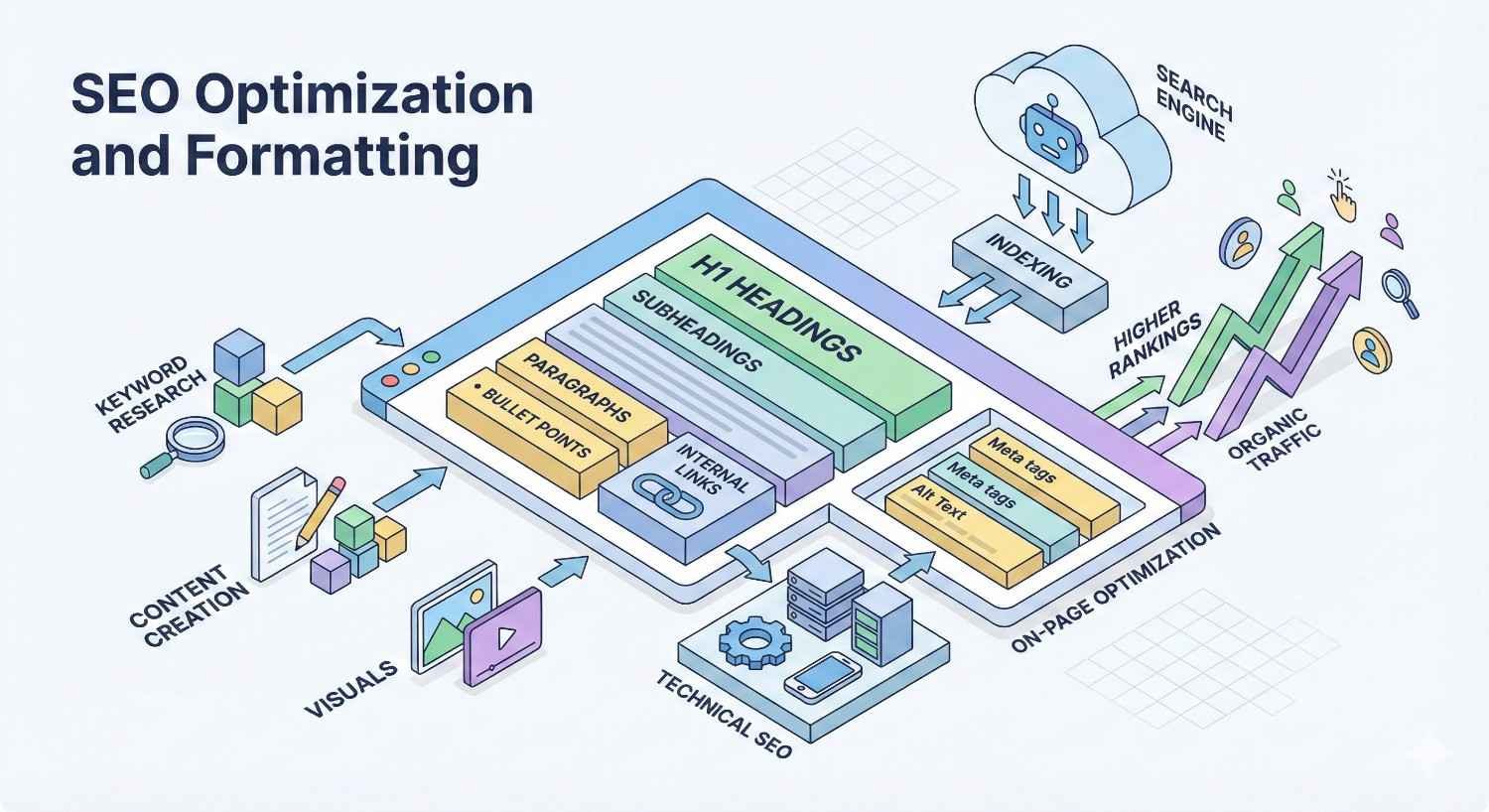
Stage 6 – SEO Optimization and Formatting
Optimization ensures your polished content performs in search results. This stage addresses technical elements that influence rankings and user experience.
Think of optimization as packaging. Great content in poor packaging underperforms. Proper optimization lets your content reach its potential audience.
On-Page SEO Elements
On-page elements signal relevance to search engines and influence click-through rates from search results.
Title tags appear in search results and browser tabs. Include your primary keyword near the beginning. Keep length under 60 characters to avoid truncation. Make it compelling enough to earn clicks.
Meta descriptions do not directly affect rankings but influence click-through rates. Summarize the content value proposition in 150 to 160 characters. Include your primary keyword naturally. End with a subtle call to action.
URL structure should be clean and descriptive. Use your primary keyword. Separate words with hyphens. Keep it short and readable. Avoid parameters, numbers, or unnecessary words.
Header tags (H1 through H6) create content hierarchy. Use one H1 per page containing your primary keyword. Structure H2s and H3s logically. Include secondary keywords where natural.
Image optimization includes descriptive file names, alt text, and appropriate compression. Alt text should describe the image while incorporating relevant keywords naturally.
Schema markup helps search engines understand content structure. FAQ schema, how-to schema, and article schema can enhance search result appearance with rich snippets.
Internal and External Linking
Links connect your content to the broader web and your own site architecture. Strategic linking improves user experience and distributes page authority.
Internal links connect to other relevant content on your site. They help readers discover related information. They distribute ranking authority across your pages. They signal topical relationships to search engines.
Link to your most important pages from new content. Use descriptive anchor text that tells readers what they will find. Avoid generic phrases like “click here” or “read more.”
Update older content to link to new pieces. This creates a web of interconnected content rather than isolated pages. It also helps new content get indexed and ranked faster.
External links to authoritative sources build credibility. They show you have researched the topic and can point readers to additional resources. They also help search engines understand your content’s context.
Link to primary sources when citing statistics or research. Choose authoritative domains (.gov, .edu, recognized industry publications). Ensure linked pages are current and relevant.
Do not overlink. Every link is a potential exit point. Include enough links to be helpful without overwhelming readers or diluting your content’s value.
Visual Content and Media Integration
Visual elements improve engagement, aid comprehension, and break up text walls. They also create additional ranking opportunities through image search.
Images should support and enhance written content. Use original images when possible. Stock photos are acceptable but less distinctive. Ensure images are relevant, high quality, and properly sized.
Infographics work well for process explanations, statistics, and comparisons. They are highly shareable and can earn backlinks. Invest in quality design for key pieces.
Videos increase time on page and engagement. Embed relevant videos where they add value. Consider creating original video content for important topics.
Tables present comparative information clearly. Use them for feature comparisons, pricing information, or data that benefits from structured presentation.
Charts and graphs visualize data effectively. They make statistics more memorable and shareable. Ensure they are accessible with proper alt text and captions.
Optimize all visual elements for page speed. Compress images appropriately. Use modern formats like WebP where supported. Lazy load images below the fold.
Stage 7 – Publishing and Performance Tracking
Publishing is not the end of the content writing process. It is the beginning of performance measurement and optimization.
Content that performs well gets more investment. Content that underperforms gets improved or retired. Data drives these decisions.
Content Management System Best Practices
Your CMS (content management system) is the platform where content lives. Proper CMS practices ensure content displays correctly and performs optimally.
Preview before publishing. Check formatting, images, and links in preview mode. What looks right in the editor may display differently on the live site.
Verify mobile display. Most traffic comes from mobile devices. Ensure your content looks good and functions properly on smaller screens.
Check page speed. Slow pages hurt rankings and user experience. Use Google PageSpeed Insights to identify and fix performance issues.
Set up proper redirects if replacing existing content. Broken links hurt user experience and waste link equity.
Schedule strategically. Consider when your audience is most active. B2B content often performs better on weekday mornings. B2C content may peak on evenings and weekends.
Promote immediately after publishing. Share on social channels, send to email lists, and notify relevant stakeholders. Early engagement signals can influence initial rankings.
Measuring Content Performance and KPIs
Performance measurement tells you whether content achieves its goals. Without measurement, you are guessing about what works.
Traffic metrics show how many people find your content. Track organic sessions, page views, and new versus returning visitors. Use Google Analytics or similar tools.
Ranking metrics reveal search visibility. Track keyword positions for target terms. Monitor ranking changes over time. Use Google Search Console or rank tracking tools.
Engagement metrics indicate content quality. Track time on page, scroll depth, bounce rate, and pages per session. Low engagement suggests content is not meeting user expectations.
Conversion metrics measure business impact. Track goal completions, lead form submissions, and revenue attributed to content. Connect content performance to business outcomes.
Set up dashboards that display key metrics at a glance. Review performance weekly for new content, monthly for established pieces. Look for trends rather than reacting to daily fluctuations.
Use data to inform future content decisions. Double down on topics and formats that perform well. Improve or retire content that consistently underperforms. Let evidence guide strategy.
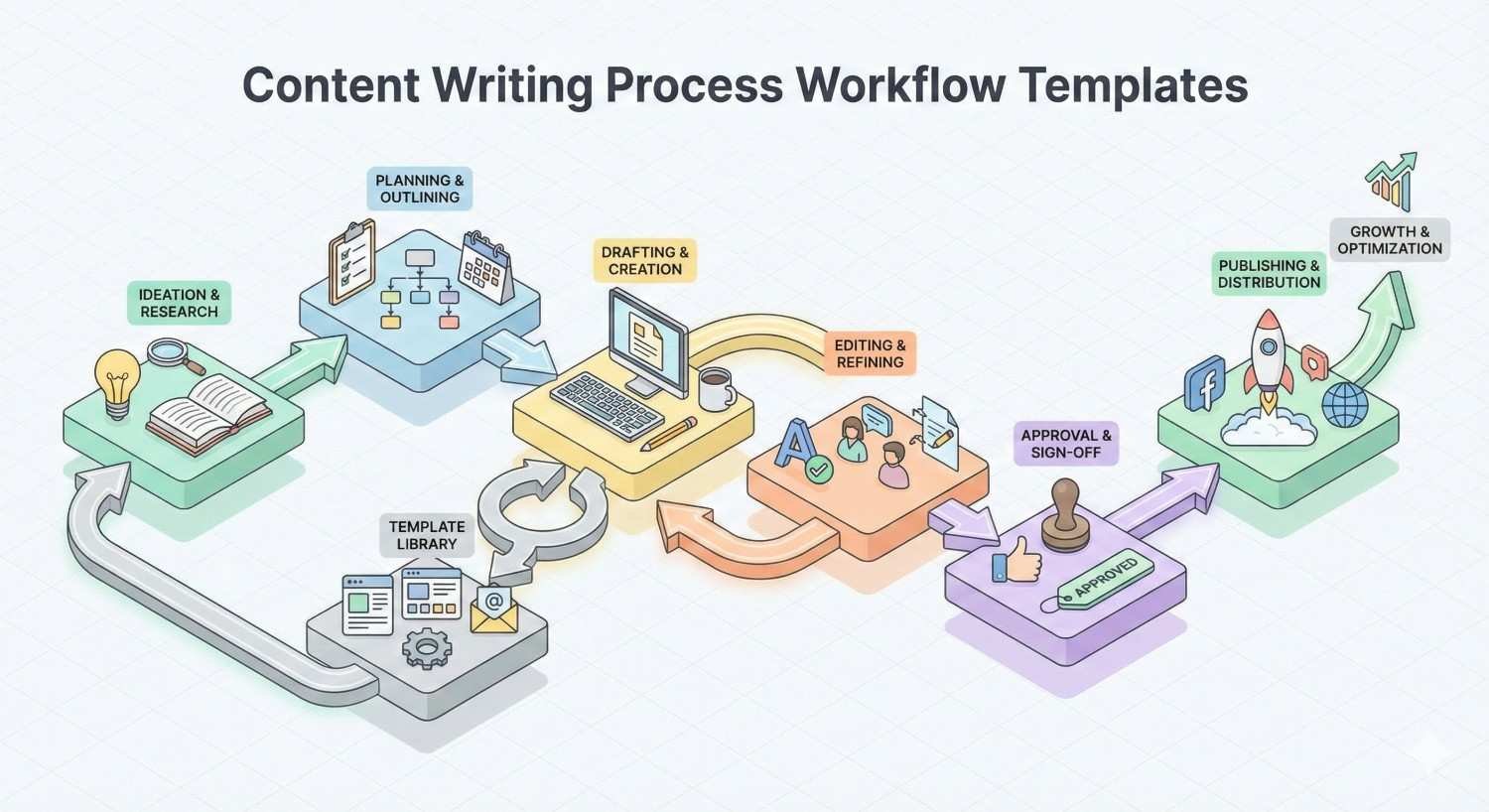
Content Writing Process Workflow Templates
Content Writing Checklist
Use this checklist to ensure no step gets missed. Adapt it to your specific workflow and requirements.
Research Phase
- Primary keyword identified with search volume and difficulty data
- Secondary keywords and semantic variations listed
- Search intent analyzed and documented
- Top 5 competitor content reviewed
- Content gaps identified
- “People Also Ask” questions captured
Planning Phase
- Content goal defined with specific metrics
- Target audience documented
- Content brief completed
- Word count target set
- Internal linking opportunities identified
- Call to action determined
Outline Phase
- H1 finalized with primary keyword
- H2 structure covers all major subtopics
- H3 and H4 headings add appropriate detail
- Each section mapped to user intent
- Outline reviewed against content brief
Writing Phase
- First draft completed
- Primary keyword in first paragraph
- Semantic variations used throughout
- Related questions answered
- Tone matches brand guidelines
- Word count target met or exceeded
Editing Phase
- Self-edit completed (structure, clarity, accuracy, grammar)
- Peer review obtained
- Feedback integrated
- Final proofread completed
Optimization Phase
- Title tag optimized (under 60 characters, keyword included)
- Meta description written (150-160 characters)
- URL structure finalized
- Header tags properly nested
- Images optimized with alt text
- Internal links added
- External links to authoritative sources included
- Schema markup implemented where appropriate
Publishing Phase
- Preview checked on desktop and mobile
- Page speed verified
- Publish date and time scheduled
- Promotion plan activated
- Performance tracking configured
Sample Content Calendar Framework
A content calendar organizes your publishing schedule and ensures consistent output. Here is a framework you can adapt.
Monthly Planning View
Week 1: Publish cornerstone content (comprehensive guides, pillar pages) Week 2: Publish supporting content (related subtopics, how-to posts) Week 3: Publish supporting content (case studies, examples, tools) Week 4: Update and refresh existing content
Weekly Content Slots
Monday: Research and planning for upcoming content Tuesday: Outline development and brief creation Wednesday: First draft writing Thursday: Editing and revision Friday: Optimization and scheduling
Content Mix Guidelines
- 60% informational content (guides, how-tos, explanations)
- 20% commercial content (comparisons, reviews, best-of lists)
- 10% thought leadership (opinions, predictions, industry analysis)
- 10% promotional content (case studies, service pages, announcements)
Tracking Columns
For each content piece, track:
- Target keyword and search volume
- Content type and format
- Assigned writer and editor
- Due dates for each stage
- Publication date
- Performance metrics (30-day, 90-day reviews)
Adjust this framework based on your team size, publishing frequency, and business goals. The key is consistency and accountability.
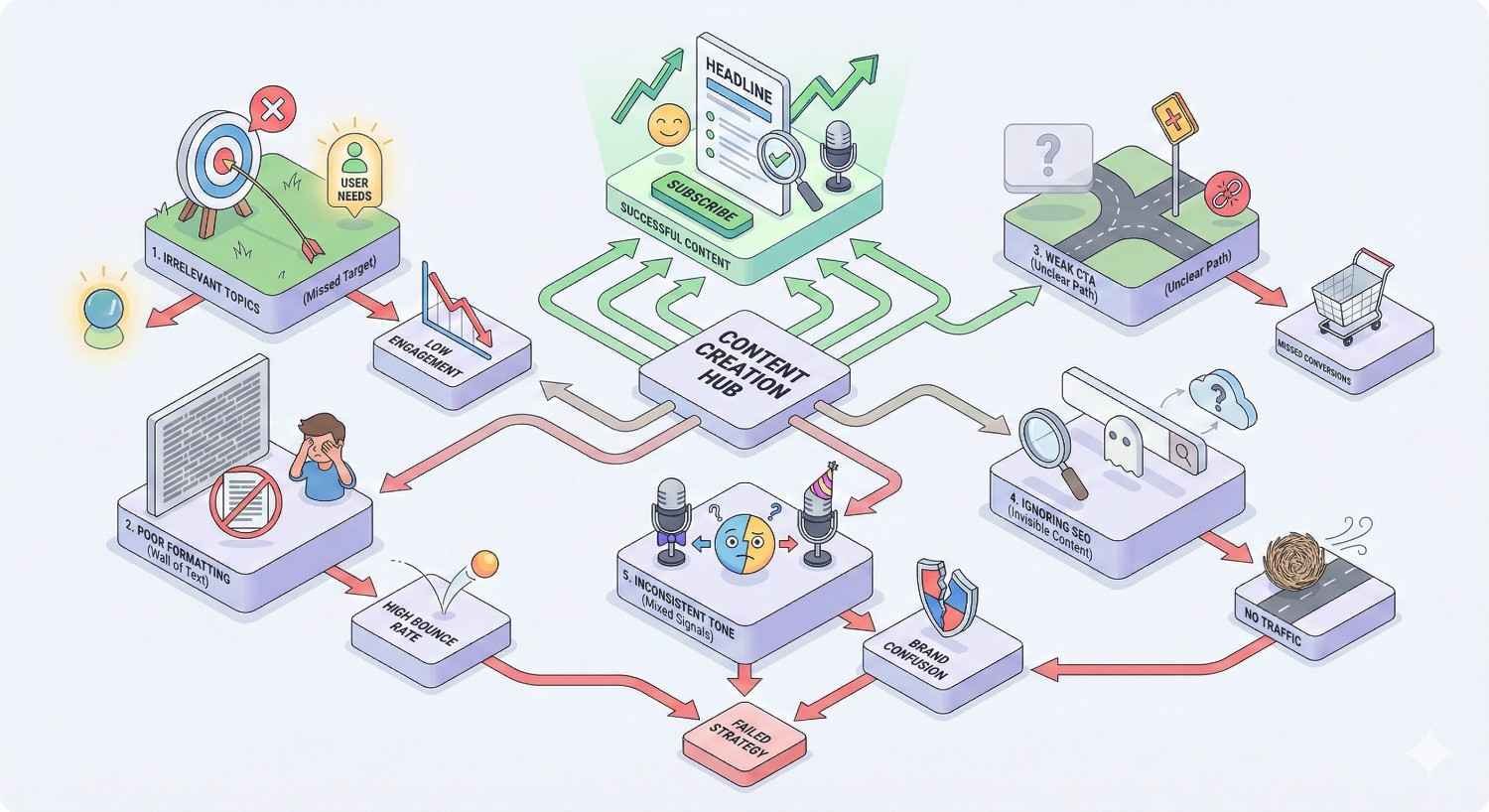
Common Content Writing Mistakes to Avoid
Skipping the Research Phase
The most damaging mistake is writing without research. It feels efficient. It is actually wasteful.
Content created without keyword research targets terms nobody searches. You invest hours writing something that will never be found. Even brilliant content cannot rank for keywords with zero search volume.
Content created without competitor analysis repeats what already exists. You add nothing new to the conversation. Search engines have no reason to rank your version over established alternatives.
Content created without audience research misses the mark. You answer questions nobody asked. You use language that does not resonate. You solve problems your readers do not have.
Research takes time upfront but saves far more time overall. It ensures every piece you create has ranking potential and audience relevance. Skip it, and you are gambling with your content investment.
Ignoring Search Intent
Matching content format to search intent is non-negotiable. Get it wrong, and you will not rank regardless of content quality.
If searchers want a quick answer and you provide a 3,000-word guide, they will bounce. If they want comprehensive information and you provide a brief overview, they will look elsewhere. Either way, engagement signals tell search engines your content does not satisfy the query.
Intent mismatches happen when writers focus on keywords without analyzing SERPs. They see search volume and start writing without checking what currently ranks. The SERP reveals what Google believes users want. Ignore it at your peril.
Before writing any content, search your target keyword. Study the results. Note the format, length, and approach of top-ranking pages. Your content should match or exceed what works.
Neglecting Content Updates and Refreshes
Content is not “set and forget.” Information becomes outdated. Competitors publish better alternatives. Rankings decay without maintenance.
Outdated content damages credibility. Readers who find incorrect information lose trust. They leave and do not return. They certainly do not convert.
Stale content loses rankings over time. Search engines favor fresh, current information. Competitors who update their content will eventually outrank your static pages.
Build content refreshes into your calendar. Review top-performing content quarterly. Update statistics, add new information, and improve sections that underperform. Treat existing content as an asset that requires maintenance.
Track content age and performance together. Pages older than 12 months with declining traffic are refresh candidates. Pages with outdated information need immediate attention regardless of performance.
Content Writing Tools and Resources
Research and Planning Tools
Keyword research tools reveal what people search and how competitive those terms are.
Semrush provides comprehensive keyword data, competitor analysis, and content gap identification. It is an all-in-one platform for SEO research.
Ahrefs offers similar capabilities with particularly strong backlink analysis. Its Content Explorer helps find top-performing content in any niche.
Google Keyword Planner is free and provides search volume data directly from Google. It is less feature-rich but accessible to everyone.
Competitor analysis tools show what works for others in your space.
BuzzSumo identifies the most shared content for any topic. It reveals what resonates with audiences and earns engagement.
SpyFu shows competitor keyword strategies and ad history. It helps identify opportunities they are targeting.
Audience research tools help you understand who you are writing for.
Google Analytics reveals who visits your site, how they behave, and what content they engage with.
SparkToro identifies where your audience spends time online and what they care about.
Writing and Editing Tools
Writing assistance tools help produce cleaner first drafts.
Grammarly catches grammar, spelling, and style issues in real time. It integrates with most writing platforms.
Hemingway Editor highlights complex sentences and passive voice. It helps simplify and strengthen writing.
Editing and proofreading tools catch what you miss.
ProWritingAid provides detailed writing reports and style suggestions. It is particularly useful for long-form content.
Google Docs built-in suggestions catch basic errors and offer alternatives. Collaborative features make peer review easier.
Content organization tools help manage the writing process.
Notion combines notes, databases, and project management. It works well for content calendars and briefs.
Trello provides visual workflow management. It helps teams track content through production stages.
SEO and Analytics Tools
On-page optimization tools ensure content is properly optimized.
Surfer SEO analyzes top-ranking content and provides optimization recommendations. It helps ensure comprehensive topic coverage.
Clearscope offers similar content optimization with a focus on semantic completeness.
Yoast SEO (for WordPress) provides real-time optimization feedback as you write.
Analytics and tracking tools measure content performance.
Google Analytics tracks traffic, engagement, and conversions. It is essential for understanding content impact.
Google Search Console shows how content performs in search results. It reveals impressions, clicks, and ranking positions.
Rank tracking tools monitor keyword positions over time.
Semrush, Ahrefs, and dedicated tools like AccuRanker track rankings and alert you to changes.
How to Measure Content Writing Success
Traffic and Ranking Metrics
Traffic metrics quantify how many people your content reaches. They are the foundation of content performance measurement.
Organic sessions show visits from search engines. This is the primary metric for SEO-focused content. Track total organic sessions and growth rate over time.
Keyword rankings reveal search visibility. Track positions for target keywords. Monitor movement into top 10, top 5, and top 3 positions where most clicks occur.
Impressions and click-through rate from Google Search Console show how often your content appears in search results and how often people click. Low CTR with high impressions suggests title and meta description need improvement.
Page views and unique visitors indicate content reach. Compare performance across content pieces to identify what resonates.
Set benchmarks based on your historical performance and industry standards. A new site might celebrate reaching page one. An established site might target featured snippets.
Engagement and Conversion Metrics
Engagement metrics reveal whether content satisfies visitors once they arrive. High traffic with poor engagement suggests content does not meet expectations.
Time on page indicates how thoroughly people consume content. Longer times generally suggest higher engagement. But context matters. A quick-answer page should have shorter times than a comprehensive guide.
Scroll depth shows how far down the page visitors read. If most visitors leave before reaching your call to action, restructure content to deliver value earlier.
Bounce rate measures single-page sessions. High bounce rates are not always bad. If someone finds their answer and leaves satisfied, that is success. But high bounce rates combined with short time on page suggest problems.
Conversion metrics connect content to business outcomes. Track form submissions, email signups, demo requests, or purchases attributed to content. This is the ultimate measure of content ROI.
Set up goal tracking in Google Analytics. Attribute conversions to the content that drove them. This data justifies content investment and guides future strategy.
Long-Term ROI and Content Lifespan
Content ROI extends beyond immediate performance. Quality content continues generating value for months or years after publication.
Content lifespan varies by type. News and trend content has short lifespans. Evergreen guides can perform for years with periodic updates. Factor lifespan into ROI calculations.
Cumulative traffic over time often exceeds initial performance. A post that generates 500 visits monthly delivers 6,000 visits annually. Over three years, that is 18,000 visits from a single investment.
Cost per acquisition from content typically decreases over time. Initial creation costs are fixed. Ongoing traffic is essentially free. The longer content performs, the lower the effective CPA.
Compound returns occur when content earns backlinks and builds authority. Each piece strengthens your domain, making future content easier to rank. This compounding effect is difficult to quantify but significant.
Calculate content ROI by comparing total investment (research, writing, editing, optimization, promotion) against total value generated (traffic value, leads, conversions). Track this over 12 to 24 months for accurate assessment.
In-House vs. Outsourced Content Writing
Pros and Cons of Each Approach
In-house content writing means employing writers directly or assigning content duties to existing team members.
Pros of in-house:
- Deep brand and product knowledge
- Immediate availability and responsiveness
- Direct control over quality and priorities
- Institutional knowledge accumulates over time
- Easier collaboration with other departments
Cons of in-house:
- Fixed costs regardless of output needs
- Limited skill diversity
- Capacity constraints during high-demand periods
- Recruitment and training investment required
- Risk of stale perspectives without outside input
Outsourced content writing means hiring agencies, freelancers, or content services to produce content.
Pros of outsourcing:
- Scalable capacity matching demand
- Access to diverse expertise and perspectives
- Variable costs aligned with output
- No recruitment or training burden
- Fresh viewpoints and industry knowledge
Cons of outsourcing:
- Learning curve for brand voice and products
- Less immediate availability
- Quality variation across providers
- Ongoing management and communication required
- Potential confidentiality concerns
Most organizations benefit from a hybrid approach. Core content requiring deep expertise stays in-house. Scalable content production goes to trusted partners. The right mix depends on your specific situation.
When to Hire a Professional Content Writing Service
Consider professional content services when:
You need to scale quickly. Launching a new product, entering a new market, or ramping up content marketing requires capacity you may not have internally.
You lack specialized expertise. Technical topics, regulated industries, or unfamiliar markets benefit from writers with relevant experience.
Quality is inconsistent. If internal content varies widely in quality, professional services provide standardization and reliability.
Your team is overwhelmed. When content competes with other priorities and consistently loses, outsourcing ensures content gets done.
You need fresh perspectives. Internal teams can develop blind spots. Outside writers bring new ideas and approaches.
ROI justifies investment. When content demonstrably drives business results, investing in professional production makes financial sense.
Evaluate potential partners on:
- Relevant industry experience
- SEO knowledge and capabilities
- Quality samples and case studies
- Process transparency and communication
- Pricing structure and flexibility
- Revision policies and guarantees
The right partner functions as an extension of your team, not just a vendor. Look for alignment on quality standards, communication preferences, and strategic approach.
Conclusion
The content writing process transforms random content creation into systematic value generation. Each stage builds on the previous one, creating content that ranks, engages, and converts.
Research ensures you target the right topics. Planning aligns content with business goals. Outlining creates logical structure. Writing produces engaging drafts. Editing polishes quality. Optimization maximizes visibility. Measurement drives continuous improvement.
At White Label SEO Service, we help businesses implement this process at scale. Our team handles research, strategy, writing, and optimization so you can focus on your core business while building sustainable organic growth.
Ready to transform your content performance? Contact White Label SEO Service to discuss how professional content writing can drive your organic visibility, lead generation, and long-term ROI.
Frequently Asked Questions
What are the 5 steps of the writing process?
The traditional writing process includes five steps: prewriting (research and planning), drafting (writing the first version), revising (improving content and structure), editing (fixing errors and polishing language), and publishing (releasing the final content). For SEO content, additional steps like keyword research and optimization are essential.
What is the difference between content writing and copywriting?
Content writing focuses on informing, educating, or entertaining readers through blog posts, articles, and guides. Copywriting focuses on persuading readers to take specific actions through ads, sales pages, and promotional materials. Content writing builds trust over time. Copywriting drives immediate conversions.
How do you write SEO-friendly content?
SEO-friendly content starts with keyword research to identify target terms. Include primary keywords in titles, headings, and early paragraphs naturally. Cover topics comprehensively to satisfy search intent. Use semantic variations and related terms throughout. Optimize technical elements like meta descriptions and image alt text.
What skills are needed for content writing?
Effective content writers need strong research abilities to gather accurate information. They need clear writing skills to communicate complex ideas simply. SEO knowledge helps content rank in search results. Adaptability allows matching different brand voices and audiences. Attention to detail ensures accuracy and polish.
How long should a blog post be for SEO?
Blog post length should match search intent and competitor benchmarks. Comprehensive guides often perform best at 1,500 to 2,500 words. Quick-answer posts may need only 500 to 800 words. Analyze top-ranking content for your target keyword to determine appropriate length. Quality and completeness matter more than arbitrary word counts.
How long does the content writing process take?
Timeline varies by content complexity and team resources. A standard blog post typically takes 4 to 8 hours total across all stages. Comprehensive guides may require 15 to 25 hours. Research and planning often take as long as writing itself. Building in review cycles adds time but improves quality.
How much does professional content writing cost?
Professional content writing costs range widely based on quality, expertise, and complexity. Basic blog posts may cost $50 to $150. Expert-level content with research and optimization typically runs $300 to $800 per piece. Specialized technical or industry content can exceed $1,000. Evaluate cost against expected ROI rather than seeking the lowest price.