
Content writing costs range from $0.03 to $2.00+ per word, with most businesses paying between $150 and $3,000 per piece depending on content type, writer experience, and project complexity. Understanding these pricing structures helps you allocate marketing budgets effectively and avoid overpaying or underinvesting.
Whether you need blog posts, website copy, or technical white papers, content pricing varies dramatically based on factors you can control. This guide breaks down every pricing model, cost range by content type, and hidden expenses so you can make informed decisions about your content investment.
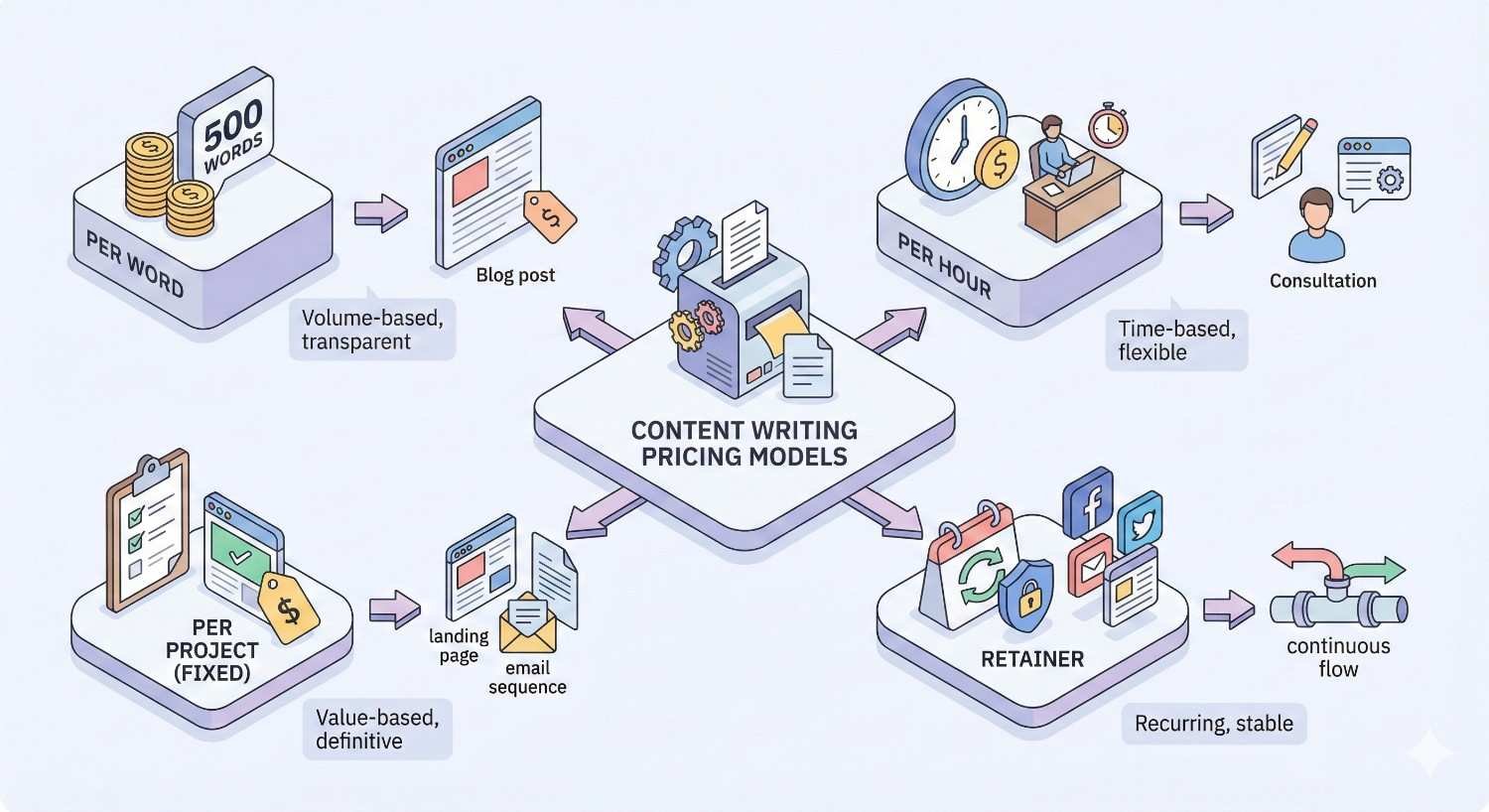
Understanding Content Writing Pricing Models
Content writers and agencies use several pricing structures, each with distinct advantages depending on your project scope, budget predictability needs, and content volume requirements.
Per-Word Pricing
Per-word pricing remains the most transparent model in content writing. You pay a fixed rate for every word delivered, making budget calculations straightforward.
Rates typically range from $0.03 to $2.00+ per word. A 1,500-word blog post at $0.15 per word costs $225. At $0.50 per word, that same article runs $750.
This model works best for clearly defined projects where word count matters. It becomes problematic when writers pad content to increase earnings or when you need extensive research that doesn’t translate directly to word count.
Per-Project Pricing
Project-based pricing bundles all deliverables into a single fee. A landing page might cost $500 flat, regardless of whether it ends up at 400 or 600 words.
Writers prefer this model for complex projects requiring research, interviews, or multiple revision rounds. You get budget certainty, and writers can focus on quality rather than word count.
The challenge lies in scope creep. Without clear project definitions, you may face additional charges for revisions or expanded requirements that weren’t in the original agreement.
Hourly Rate Pricing
Hourly rates for content writers range from $25 to $250+ per hour based on experience and specialization. This model suits ongoing relationships where project scope varies significantly.
Most professional writers complete 500 to 1,500 words per hour depending on topic complexity and research requirements. A $75/hour writer producing 750 words per hour effectively charges $0.10 per word.
Hourly pricing works well for content strategy work, editing, and projects where the final deliverable isn’t purely written content. It requires trust since you’re paying for time rather than output.
Monthly Retainer Pricing
Retainer agreements guarantee a set amount of content or hours each month for a fixed fee. Businesses typically pay $1,000 to $10,000+ monthly depending on content volume and writer caliber.
This model provides priority access to your writer, consistent quality, and predictable budgeting. Writers offer retainer discounts since guaranteed income reduces their business development time.
Retainers make sense when you need 4+ pieces monthly and want a writer who deeply understands your brand voice and industry.
Value-Based Pricing
Value-based pricing ties content costs to business outcomes rather than word count or time. A sales page that generates $50,000 in revenue might command a $5,000 fee regardless of length.
This model appears most often with experienced copywriters working on high-stakes conversion content. The writer shares risk and reward based on content performance.
Few writers offer true value-based pricing because it requires tracking mechanisms and trust between parties. When available, it aligns incentives between you and your content creator.
Average Content Writing Costs by Content Type
Different content formats carry different price expectations based on complexity, research requirements, and strategic importance to your marketing funnel.
Blog Post and Article Writing Costs
Standard blog posts (1,000-2,000 words) cost between $75 and $500 from most professional writers. Premium content from experienced writers runs $500 to $2,000+ per post.
Factors affecting blog pricing include:
- Topic complexity and required expertise
- Original research or data analysis needs
- Interview requirements
- SEO optimization depth
- Image sourcing and formatting
Budget-tier blog content ($50-150) often requires significant editing and may not perform well in search results. Mid-tier content ($150-500) typically delivers publishable quality with solid SEO foundations.
Website Copy and Landing Page Costs
Homepage copy ranges from $500 to $3,000+ depending on business size and conversion requirements. Individual landing pages cost $300 to $2,000 based on complexity.
Full website copywriting projects (5-10 pages) typically run $2,500 to $15,000. This includes messaging strategy, SEO optimization, and conversion-focused writing.
Website copy commands premium pricing because it directly impacts revenue. Poor homepage copy costs you customers daily, making quality investment worthwhile.
SEO Content Writing Costs
SEO-optimized content costs 15-30% more than standard writing due to keyword research, competitor analysis, and technical optimization requirements.
A 2,000-word SEO article typically costs $200 to $800 from writers with demonstrated search ranking results. Premium SEO content agencies charge $500 to $2,500+ per piece.
The premium reflects additional deliverables: keyword mapping, meta descriptions, internal linking recommendations, and content structured for featured snippets.
Product Description Writing Costs
Individual product descriptions cost $25 to $200 depending on length and technical complexity. Bulk pricing drops rates to $10 to $50 per description for large catalogs.
E-commerce businesses with hundreds of products often negotiate package deals. A 500-product catalog might cost $5,000 to $25,000 for complete description writing.
Technical products requiring specification accuracy and industry terminology command higher rates than simple consumer goods.
White Paper and Case Study Costs
White papers represent premium content investments, typically costing $2,000 to $10,000+ for research-backed, authoritative documents of 2,500-5,000 words.
Case studies range from $500 to $3,000 depending on interview requirements, data analysis, and design integration needs.
These formats justify higher pricing through lead generation value. A single white paper can generate hundreds of qualified leads over its lifetime.
Email Copy and Newsletter Costs
Individual marketing emails cost $100 to $500 depending on sequence complexity and conversion goals. Welcome sequences (5-7 emails) run $500 to $2,500.
Newsletter writing typically costs $150 to $500 per issue for 500-1,000 word publications. Monthly retainers for ongoing newsletter production range from $500 to $2,000.
Email copy pricing reflects its direct revenue impact. A well-written sales email can generate returns far exceeding its creation cost.
Social Media Content Costs
Social media content packages range from $500 to $3,000+ monthly depending on platform count, posting frequency, and content complexity.
Individual post writing costs $10 to $100 per post. Most businesses purchase packages covering 20-60 posts monthly across multiple platforms.
Pricing varies significantly based on whether packages include strategy, scheduling, community management, or purely content creation.
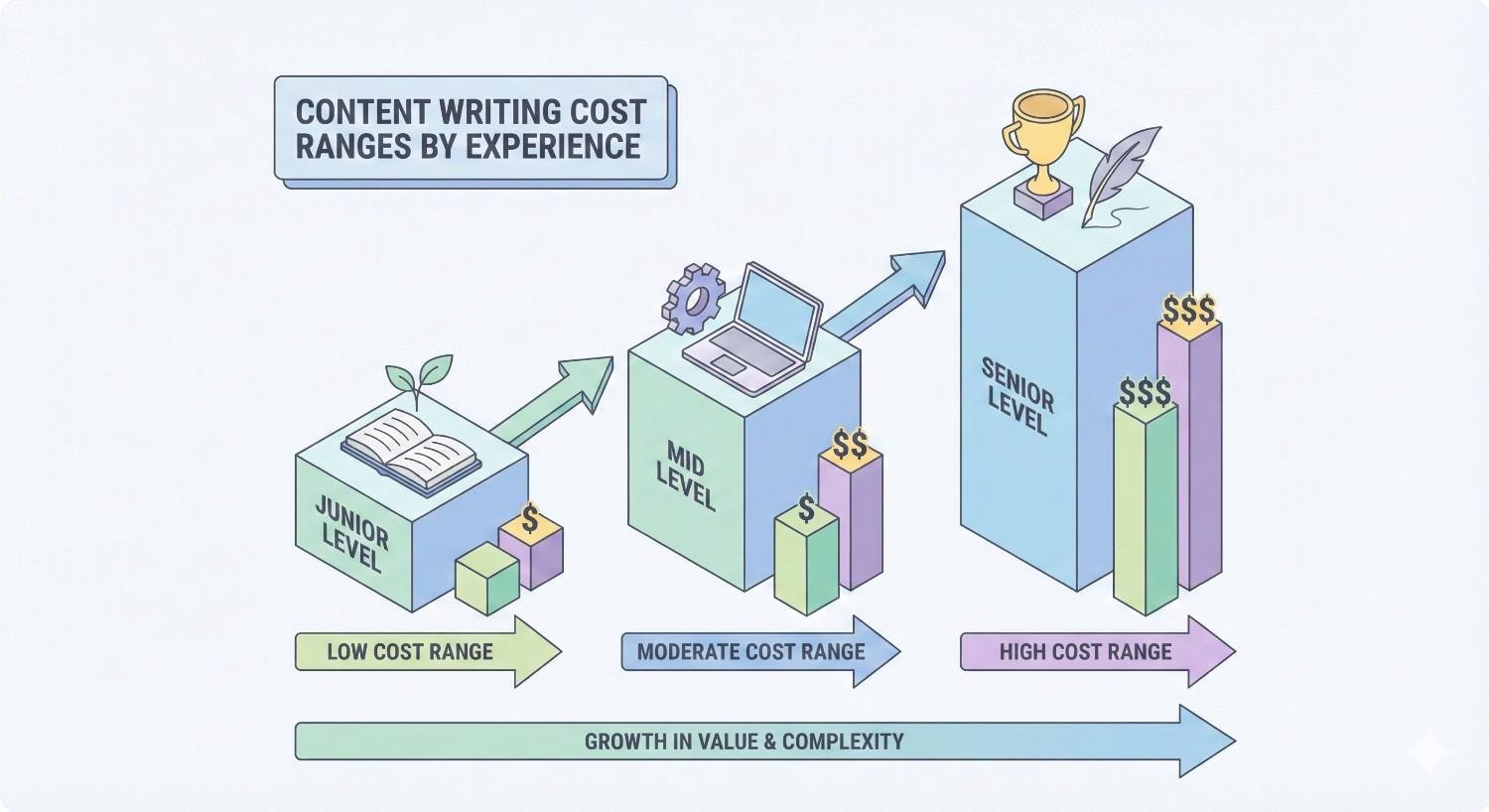
Content Writing Cost Ranges by Writer Experience Level
Writer experience directly correlates with pricing, quality consistency, and strategic value delivered.
Beginner Content Writers ($0.03-$0.10 per word)
Entry-level writers charge $0.03 to $0.10 per word, translating to $30-100 for a 1,000-word article.
At this level, expect:
- Basic grammar and structure competency
- Limited industry knowledge
- Minimal SEO understanding
- Higher revision requirements
- Inconsistent quality
Beginner writers suit businesses with strong editorial oversight, simple topics, and tight budgets. Plan for significant editing time when using this tier.
Intermediate Content Writers ($0.10-$0.30 per word)
Mid-level writers with 2-5 years experience charge $0.10 to $0.30 per word. A 1,500-word blog post costs $150-450.
This tier delivers:
- Consistent, publishable quality
- Basic SEO implementation
- Reasonable research capabilities
- Professional communication
- Moderate revision needs
Most businesses find their best value-to-quality ratio in this range. Writers understand content marketing fundamentals and deliver reliable results.
Experienced Content Writers ($0.30-$0.75 per word)
Seasoned professionals with 5-10+ years experience charge $0.30 to $0.75 per word. Expect $450-1,125 for a 1,500-word piece.
Experienced writers provide:
- Strategic content approach
- Deep SEO knowledge
- Industry expertise development
- Minimal revision requirements
- Brand voice consistency
- Deadline reliability
This tier suits businesses prioritizing content quality and willing to invest in writers who understand marketing strategy beyond basic writing.
Expert/Specialized Content Writers ($0.75-$2.00+ per word)
Top-tier specialists and industry experts charge $0.75 to $2.00+ per word. A 2,000-word article costs $1,500-4,000+.
Expert writers deliver:
- Subject matter authority
- Original insights and perspectives
- Thought leadership positioning
- Conversion-focused copy
- Minimal oversight requirements
- Strategic content recommendations
Businesses invest at this level for cornerstone content, high-stakes conversion pages, and content requiring genuine expertise that builds brand authority.
Factors That Affect Content Writing Costs
Understanding cost drivers helps you budget accurately and negotiate effectively with content providers.
Content Complexity and Research Requirements
Technical topics requiring specialized knowledge cost 25-100% more than general interest content. Medical, legal, financial, and technical writing commands premium rates.
Research-intensive content adds cost through:
- Primary source review time
- Expert interview coordination
- Data analysis and interpretation
- Fact-checking requirements
- Citation management
A general business blog post might cost $200, while a technical SaaS comparison requiring product testing could run $600+ for similar word counts.
Industry Specialization and Niche Expertise
Writers with proven expertise in specific industries charge premium rates. A healthcare content writer with clinical background commands higher fees than a generalist learning your industry.
Specialization premiums range from 20-50% above generalist rates. The investment pays off through:
- Accurate terminology usage
- Credible authority signals
- Reduced revision cycles
- Faster turnaround times
- Better audience resonance
For regulated industries or technical niches, specialized writers often prove more cost-effective despite higher per-word rates.
Content Length and Word Count
Longer content doesn’t always cost proportionally more. Many writers offer volume discounts for extended pieces.
Typical scaling:
- 500 words: Base rate
- 1,000 words: 1.8-2x base rate
- 2,000 words: 3-3.5x base rate
- 5,000+ words: Negotiated project rates
Longer content requires more research, outlining, and structural planning, but writers achieve efficiency gains that benefit both parties.
Turnaround Time and Urgency
Rush fees add 25-100% to standard rates. A 48-hour turnaround typically costs 50% more than a 2-week deadline.
Rush pricing reflects:
- Opportunity cost of displaced projects
- Extended working hours
- Reduced quality control time
- Higher stress and effort
Plan content needs in advance to avoid rush fees. Most writers offer standard turnaround of 5-10 business days for typical blog content.
SEO Optimization Requirements
Basic SEO (keyword placement, meta descriptions) adds 10-20% to content costs. Comprehensive SEO optimization (competitor analysis, content gap identification, technical recommendations) adds 25-50%.
SEO-focused content includes:
- Keyword research and mapping
- Search intent analysis
- Competitor content review
- Internal linking strategy
- Featured snippet optimization
- Schema markup recommendations
Writers with demonstrated SEO results justify premium rates through measurable organic traffic improvements.
Revision and Editing Rounds
Most professional writers include 1-2 revision rounds in their base pricing. Additional revisions cost $25-100+ per round or hourly rates.
Excessive revisions often indicate:
- Unclear project briefs
- Misaligned expectations
- Scope creep
- Style preference differences
Detailed briefs and clear feedback reduce revision needs and total project costs.
Writer Location and Market Rates
Geographic location significantly impacts content writing rates due to cost of living differences and market expectations.
Writers in high-cost markets (major US cities, London, Sydney) charge premium rates reflecting their expenses. Remote writers in lower-cost regions offer competitive rates while maintaining quality.
Location matters less than demonstrated capability. Focus on portfolio quality, communication skills, and relevant experience over geographic considerations.
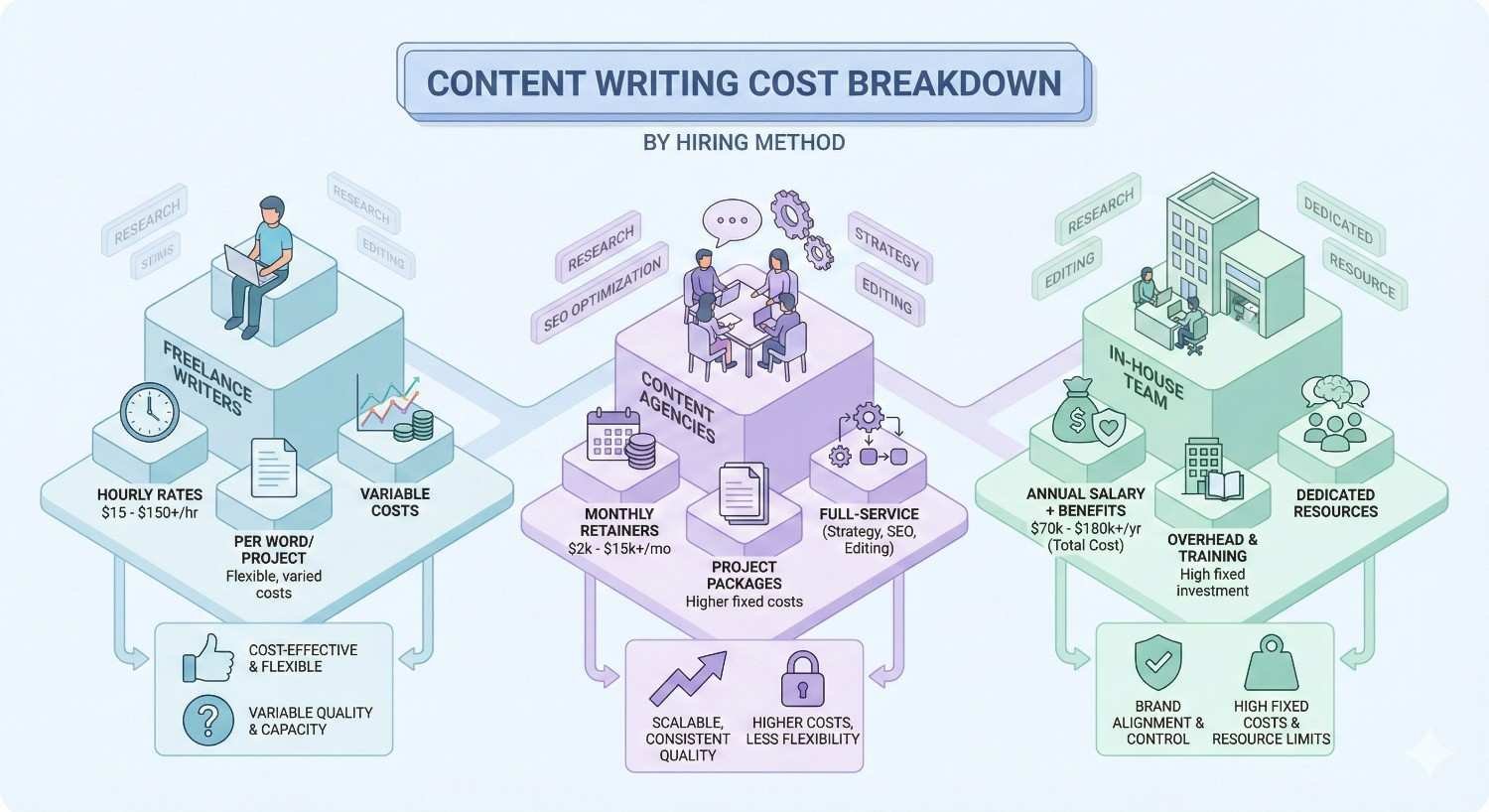
Content Writing Costs by Hiring Method
Your hiring approach affects both cost and quality outcomes.
Freelance Content Writer Costs
Freelance writers offer the widest price range: $0.03 to $2.00+ per word. Direct relationships eliminate agency markups.
Freelancer advantages:
- Direct communication
- Flexible arrangements
- Relationship building
- No agency overhead
- Negotiable rates
Freelancer challenges:
- Vetting time investment
- Availability variability
- No backup coverage
- Administrative overhead
Finding reliable freelancers requires upfront effort but often delivers the best long-term value for consistent content needs.
Content Writing Agency Costs
Agencies charge 30-100% premiums over equivalent freelancer rates. A $300 freelance article might cost $450-600 through an agency.
Agency pricing reflects:
- Project management
- Quality assurance
- Writer vetting and training
- Backup coverage
- Account management
- Administrative handling
Agencies suit businesses needing high-volume content, multiple content types, or lacking bandwidth for freelancer management.
Content Writing Platform Costs
Content platforms (Contently, ClearVoice, Scripted) charge $0.10 to $1.00+ per word with platform fees adding 15-30% to writer payments.
Platform benefits:
- Pre-vetted writer pools
- Workflow management tools
- Payment processing
- Quality guarantees
- Scalable capacity
Platform limitations:
- Less direct writer relationships
- Platform dependency
- Standardized processes
- Variable writer quality
Platforms work well for businesses testing content marketing or needing occasional content without ongoing relationships.
In-House Content Writer Costs
Full-time content writers cost $45,000 to $120,000+ annually in salary plus 25-35% in benefits and overhead.
Total in-house costs include:
- Base salary
- Health insurance
- Retirement contributions
- Equipment and software
- Management time
- Training and development
In-house writers make sense when you need 40+ hours monthly of content work and value deep brand knowledge. Below that threshold, freelancers or agencies typically prove more cost-effective.
Geographic Content Writing Cost Variations
Regional markets establish different pricing norms based on economic factors and competitive landscapes.
North America Content Writing Rates
US and Canadian writers charge among the highest global rates:
- Entry-level: $0.08-0.15 per word
- Mid-level: $0.15-0.40 per word
- Senior: $0.40-1.00+ per word
Major market premiums apply in New York, San Francisco, Los Angeles, and Toronto. Remote US writers often charge 10-20% less than major city counterparts.
North American writers typically offer native English fluency, cultural context understanding, and timezone alignment for US businesses.
Europe Content Writing Rates
European rates vary significantly by country:
- UK: $0.10-0.75 per word (comparable to US)
- Western Europe: $0.08-0.50 per word
- Eastern Europe: $0.05-0.25 per word
UK writers command premium rates for native English content. Eastern European writers offer strong value for businesses comfortable with non-native English that requires editing.
Asia and Offshore Content Writing Rates
Asian content markets offer significant cost savings:
- India: $0.02-0.15 per word
- Philippines: $0.03-0.20 per word
- Pakistan: $0.02-0.10 per word
Quality varies dramatically at lower price points. Top-tier offshore writers charge rates approaching Western levels while offering excellent value.
Offshore content works best for:
- High-volume, lower-stakes content
- Businesses with strong editorial processes
- Topics not requiring cultural nuance
- Budget-constrained startups
Australia and New Zealand Content Writing Rates
ANZ writers charge rates similar to North America:
- Entry-level: $0.10-0.20 per word
- Mid-level: $0.20-0.50 per word
- Senior: $0.50-1.00+ per word
Smaller writer pools mean less competition and potentially higher rates for specialized content. ANZ writers offer timezone advantages for Asia-Pacific focused businesses.
Hidden Costs in Content Writing Projects
Base content rates rarely capture total project investment. Budget for these additional expenses.
Content Strategy and Planning Costs
Content strategy development costs $1,000 to $10,000+ depending on scope. This includes:
- Audience research
- Competitor analysis
- Content audit
- Editorial calendar development
- Topic clustering
- Content gap identification
Some writers include basic strategy in their rates. Comprehensive strategy typically requires separate investment or agency engagement.
Keyword Research and SEO Analysis Costs
Professional keyword research costs $200 to $2,000 per project depending on depth and competitive landscape complexity.
SEO analysis includes:
- Keyword opportunity identification
- Search volume analysis
- Competition assessment
- Content gap mapping
- SERP feature opportunities
Many SEO-focused writers include basic keyword research. Advanced analysis often requires dedicated SEO specialists or tools.
Content Editing and Proofreading Costs
Professional editing costs $0.02 to $0.10 per word. A 2,000-word article requires $40-200 in editing investment.
Editing levels include:
- Proofreading (grammar, spelling): $0.02-0.04/word
- Copy editing (clarity, flow): $0.03-0.06/word
- Developmental editing (structure, argument): $0.05-0.10/word
Budget-tier content often requires more editing investment, potentially negating initial savings.
Image Sourcing and Formatting Costs
Visual content adds $50-500+ per article depending on requirements:
- Stock images: $10-50 per image
- Custom graphics: $50-200 per graphic
- Infographics: $200-1,000+
- Image optimization: $25-100 per article
Some writers include basic image sourcing. Custom visuals and infographics require separate creative investment.
Content Management and Publishing Costs
Publishing and formatting costs $25-100 per piece for:
- CMS formatting
- Internal linking implementation
- Meta data entry
- Schema markup
- Social sharing setup
These tasks often fall to internal teams but represent real time costs. Some agencies include publishing in their packages.
How to Budget for Content Writing Services
Strategic budgeting ensures sustainable content investment aligned with business goals.
Calculating Monthly Content Needs
Determine content volume based on:
- Publishing frequency goals
- Channel requirements (blog, social, email)
- Content types needed
- Seasonal variations
- Campaign support needs
A typical SMB content program might include:
- 4-8 blog posts monthly
- 1-2 landing pages quarterly
- 20-40 social posts monthly
- 4-8 email campaigns monthly
Map these needs against pricing to establish baseline budgets.
Setting Realistic Content Marketing Budgets
Content Marketing Institute research indicates successful B2B marketers allocate 25-30% of marketing budgets to content creation.
Budget allocation guidelines:
- Startups: $1,000-3,000 monthly
- SMBs: $3,000-10,000 monthly
- Mid-market: $10,000-50,000 monthly
- Enterprise: $50,000+ monthly
Start conservatively and scale based on demonstrated ROI rather than industry benchmarks.
Balancing Quality vs. Cost
The quality-cost tradeoff depends on content purpose:
Invest in quality for:
- Cornerstone/pillar content
- Conversion-focused pages
- Thought leadership pieces
- High-competition keywords
- Brand-defining content
Budget options work for:
- Supporting blog content
- Social media posts
- Internal documentation
- Low-stakes informational content
- High-volume needs
A blended approach optimizes budget impact: premium investment for high-value content, efficient spending for supporting materials.
ROI Expectations for Content Investment
Content marketing ROI typically materializes over 6-18 months. Expect:
- Months 1-3: Foundation building, minimal returns
- Months 4-6: Early traction, growing traffic
- Months 6-12: Compounding returns, lead generation
- Year 2+: Mature content assets driving consistent results
Track ROI through:
- Organic traffic growth
- Keyword ranking improvements
- Lead generation attribution
- Conversion rate changes
- Customer acquisition cost trends
Quality content appreciates over time, making initial investment calculations incomplete without long-term perspective.
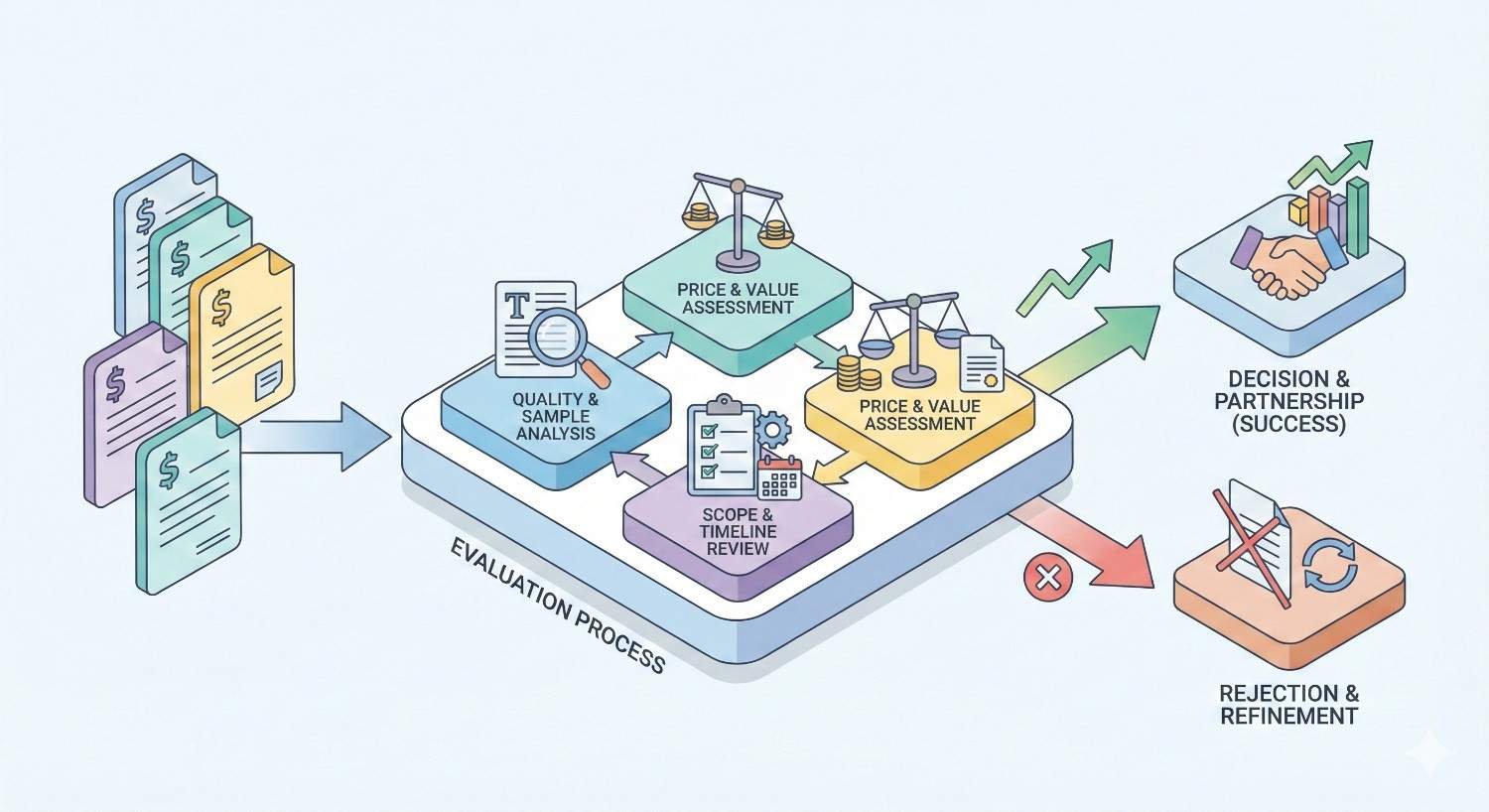
How to Evaluate Content Writing Quotes and Proposals
Effective evaluation prevents costly hiring mistakes and ensures value alignment.
What to Look for in Content Writer Portfolios
Strong portfolios demonstrate:
- Relevant industry experience
- Range of content types
- Consistent quality across samples
- Published work (not just drafts)
- Results metrics when available
- Writing style alignment
Request samples matching your content needs. A brilliant technical writer may struggle with conversational blog content and vice versa.
Red Flags in Low-Cost Content Offers
Warning signs in budget proposals:
- Rates significantly below market ($0.02-0.03/word for native English)
- No portfolio or sample availability
- Guaranteed rankings or traffic claims
- Unlimited revisions promises
- Extremely fast turnaround claims
- Poor communication quality
- No questions about your business
Extremely low rates often indicate content mills, inexperienced writers, or AI-generated content requiring extensive editing.
Questions to Ask Before Hiring a Content Writer
Essential pre-hire questions:
- What’s your experience in our industry?
- Can you share relevant samples?
- What’s your research process?
- How do you approach SEO?
- What’s included in your rate?
- What’s your revision policy?
- What’s your typical turnaround?
- How do you handle feedback?
- What tools do you use?
- Can you provide references?
Answers reveal professionalism, process maturity, and fit for your needs.
Comparing Content Writing Service Packages
Evaluate packages on:
- Included deliverables (research, SEO, images)
- Revision rounds
- Turnaround times
- Communication expectations
- Quality guarantees
- Cancellation terms
- Scaling flexibility
The lowest price rarely represents best value. Compare total cost of ownership including your time investment and potential revision needs.
Cost vs. Quality: When to Invest More in Content
Strategic quality investment maximizes content marketing returns.
High-Value Content That Justifies Premium Pricing
Invest premium rates for:
- Homepage and key landing pages
- Pillar content targeting competitive keywords
- Sales enablement materials
- Thought leadership establishing expertise
- Content targeting high-value keywords
- Evergreen resources with long shelf life
These assets directly impact revenue and brand perception, justifying higher investment.
When Budget Content Makes Sense
Lower-cost content works for:
- Supporting blog posts linking to pillar content
- Social media content
- Internal documentation
- Low-search-volume topics
- Testing new content directions
- High-volume informational content
Budget content fills gaps without premium investment where stakes are lower.
Long-Term Cost Benefits of Quality Content
Quality content delivers compounding returns:
- Higher search rankings drive ongoing traffic
- Better engagement reduces bounce rates
- Stronger authority builds backlinks naturally
- Evergreen content requires less updating
- Premium content attracts premium audiences
A $1,000 article generating 500 monthly visitors for 3 years costs $0.55 per visitor. A $200 article generating 50 monthly visitors costs $1.11 per visitor over the same period.
Negotiating Content Writing Rates
Strategic negotiation creates win-win arrangements.
Volume Discounts and Bulk Pricing
Most writers offer 10-25% discounts for volume commitments:
- 5+ articles monthly: 10-15% discount
- 10+ articles monthly: 15-20% discount
- 20+ articles monthly: 20-25% discount
Volume arrangements benefit writers through predictable income and reduced business development time.
Long-Term Contract Negotiations
Multi-month commitments unlock additional savings:
- 3-month commitment: 5-10% discount
- 6-month commitment: 10-15% discount
- 12-month commitment: 15-20% discount
Contracts should include performance clauses, termination options, and rate review periods.
Trial Projects and Test Assignments
Paid trial projects reduce hiring risk:
- Single article test: Full rate
- 2-3 article trial: Standard rate with continuation discount
- Month trial: Slight discount with commitment option
Never request free trial content. Paid trials demonstrate respect and attract quality writers.
Alternative Content Creation Options and Their Costs
Emerging options expand content creation possibilities.
AI Content Writing Tools and Costs
AI writing tools cost $20 to $500+ monthly depending on features and volume:
- Basic tools (Jasper, Copy.ai): $40-100/month
- Advanced platforms: $100-500/month
- Enterprise solutions: Custom pricing
AI-generated content requires human editing, fact-checking, and optimization. Total cost includes tool subscription plus editing time.
AI works best for:
- First draft generation
- Content ideation
- Outline creation
- Simple, factual content
- High-volume needs
AI struggles with:
- Original insights
- Expert perspectives
- Nuanced topics
- Brand voice consistency
- Factual accuracy
Content Templates and DIY Options
Template-based approaches cost $0-500 for initial setup:
- Free templates: Blog frameworks, email structures
- Premium templates: $50-200 for comprehensive systems
- Custom template development: $200-500
DIY content works when you have:
- Subject matter expertise
- Writing capability
- Available time
- Lower quality requirements
Calculate your hourly value against writing time to determine DIY viability.
Hybrid Models: AI + Human Editing
Hybrid approaches combine AI efficiency with human quality:
- AI draft generation: $0.01-0.03 per word equivalent
- Human editing and enhancement: $0.05-0.15 per word
- Total hybrid cost: $0.06-0.18 per word
This model suits high-volume needs where pure human writing proves cost-prohibitive but AI-only content lacks quality.
How Content Writing Costs Impact SEO Results
Content investment directly influences organic search performance.
Content Quality and Search Rankings
Google’s algorithms increasingly reward content quality signals:
- Comprehensive topic coverage
- Original insights and data
- Expert authorship
- User engagement metrics
- Backlink attraction
Higher-quality content typically ranks better, generates more backlinks, and delivers superior long-term ROI despite higher upfront costs.
Content Volume vs. Content Quality for SEO
The volume-quality balance depends on your situation:
Prioritize volume when:
- Building initial topical coverage
- Targeting long-tail keywords
- Establishing publishing consistency
- Working with limited budgets
Prioritize quality when:
- Targeting competitive keywords
- Building authority in your niche
- Creating linkable assets
- Differentiating from competitors
Most successful strategies blend both: quality pillar content supported by consistent volume of supporting articles.
Measuring Content ROI Through Organic Traffic
Track content investment returns through:
- Organic traffic growth (Google Analytics)
- Keyword ranking improvements (Ahrefs, Semrush)
- Organic conversions and leads
- Content-attributed revenue
- Cost per organic visitor trends
Calculate content ROI: ROI = (Revenue from Organic Traffic – Content Investment) / Content Investment × 100
Mature content programs typically achieve 300-500%+ ROI over 2-3 year periods.
Getting Started: Finding the Right Content Writing Solution for Your Budget
Practical steps to launch your content investment.
Assessing Your Content Needs and Goals
Define requirements before seeking writers:
- Content types needed
- Publishing frequency targets
- Quality expectations
- Industry expertise requirements
- SEO optimization needs
- Budget constraints
- Timeline expectations
Clear requirements enable accurate quotes and better writer matching.
Matching Budget to Business Stage
Align investment with business maturity:
Startup stage ($500-2,000/month):
- Focus on foundational content
- Use mid-tier freelancers
- Prioritize high-impact pages
- Build gradually
Growth stage ($2,000-10,000/month):
- Expand content volume
- Invest in quality for key assets
- Consider agency partnerships
- Develop content systems
Scale stage ($10,000+/month):
- Comprehensive content programs
- Premium writer relationships
- In-house and outsourced blend
- Advanced content operations
Building a Scalable Content Production System
Create sustainable content operations:
- Document content processes
- Develop style guides and briefs
- Build writer relationships
- Implement quality controls
- Track performance metrics
- Iterate based on results
Systems enable scaling without proportional cost increases and maintain quality consistency across growing content volumes.
Conclusion
Content writing costs vary dramatically based on content type, writer experience, project complexity, and hiring method. Understanding these variables helps you budget effectively and invest strategically in content that drives measurable business results.
Quality content represents one of the highest-ROI marketing investments available. The key lies in matching investment levels to content importance, building sustainable production systems, and tracking performance to optimize spending over time.
We help businesses build comprehensive content strategies that balance quality and cost for maximum organic growth impact. Contact White Label SEO Service to discuss your content needs and develop a production approach aligned with your budget and goals.
Frequently Asked Questions
How much should I pay for a 1,000-word blog post?
Professional blog posts of 1,000 words typically cost $100 to $500 depending on writer experience and topic complexity. Budget writers charge $50-100, while expert writers command $500-1,000+ for specialized content requiring deep expertise.
Is it worth paying more for experienced content writers?
Experienced writers deliver higher ROI through better search rankings, fewer revisions, and stronger audience engagement. Premium content often outperforms budget alternatives by generating more traffic and conversions over time, justifying the higher upfront investment.
How do content writing agencies compare to freelancers on cost?
Agencies typically charge 30-100% more than equivalent freelancers due to overhead, project management, and quality assurance costs. Freelancers offer better rates for ongoing relationships, while agencies provide scalability and backup coverage.
What’s the average monthly cost for ongoing content marketing?
Small businesses typically invest $1,000 to $5,000 monthly in content creation. Mid-market companies spend $5,000 to $20,000, while enterprises allocate $20,000+ monthly for comprehensive content programs.
Should I use AI tools instead of hiring content writers?
AI tools work best for draft generation and high-volume simple content but require human editing for quality. Hybrid approaches combining AI efficiency with human expertise often deliver the best cost-to-quality ratio for many businesses.
How can I reduce content writing costs without sacrificing quality?
Negotiate volume discounts, provide detailed briefs to reduce revisions, build long-term writer relationships, use templates for consistent content types, and reserve premium investment for high-stakes content while using efficient options for supporting materials.
What hidden costs should I budget for beyond writing fees?
Budget for content strategy development, keyword research, editing and proofreading, image sourcing, CMS formatting, and ongoing content updates. These costs can add 25-50% to base writing fees depending on your internal capabilities.