
Budget content writing services typically range from $0.01 to $0.10 per word, offering businesses a practical way to scale content production without exhausting marketing budgets. The challenge lies in understanding exactly what you get at these price points and how to maximize value while protecting your SEO investment.
For startups, SMEs, and marketing teams operating with limited resources, affordable content services can fill critical gaps in your publishing calendar. However, the difference between “cheap” and “low-quality” depends entirely on your selection process, quality controls, and strategic approach.
This guide breaks down everything you need to know about budget content writing: how pricing models work, what risks to watch for, how to vet providers, and when investing in premium content makes more sense for your goals.
What Are Cheap Content Writing Services?
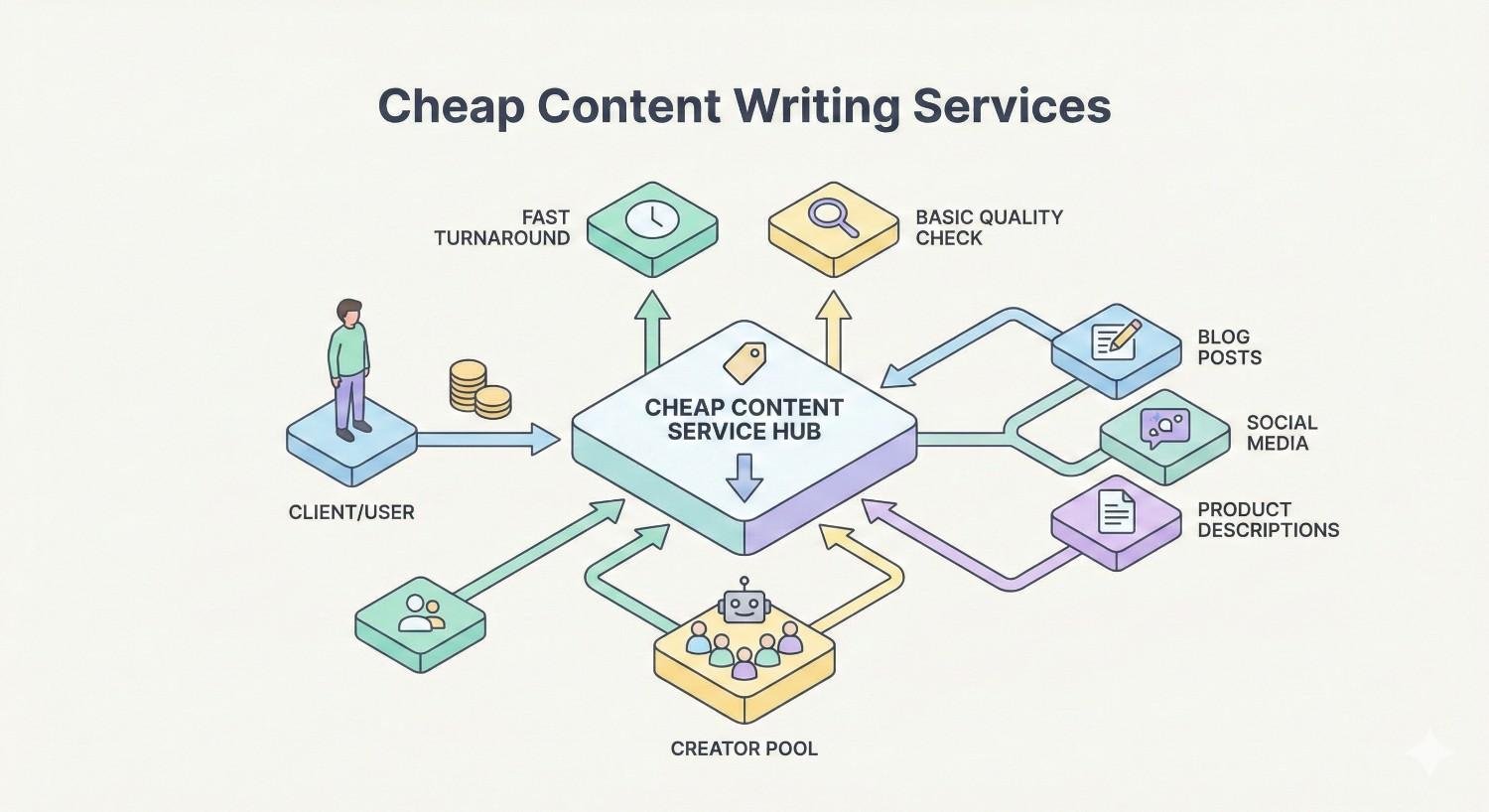
Cheap content writing services occupy a specific segment of the content market, serving businesses that need volume, speed, or basic coverage without premium pricing. Understanding this landscape helps you set realistic expectations and find providers that match your actual needs.
Definition and Service Scope
Cheap content writing services are professional writing offerings priced significantly below industry averages, typically falling between $0.01 and $0.10 per word or $5 to $50 per article. These services prioritize accessibility and volume over specialized expertise or extensive research.
The scope usually includes basic content creation: drafting, light editing, and delivery. Most budget services do not include strategic planning, keyword research, content optimization, or performance tracking. You receive written content; everything else remains your responsibility.
This model works because providers operate on volume. Writers handle multiple projects simultaneously, and platforms minimize overhead through streamlined processes. The trade-off is clear: lower costs mean less individual attention per piece.
Types of Content Covered
Budget content services typically handle:
Blog posts and articles form the core offering. Most providers specialize in general-interest topics, lifestyle content, and basic informational pieces ranging from 500 to 2,000 words.
Product descriptions for e-commerce represent another common category. These shorter pieces suit the quick-turnaround model well, though quality varies significantly for technical products.
Social media content including captions, short posts, and basic copy falls within most budget providers’ capabilities.
Website copy for basic pages like About Us, service descriptions, and FAQ sections can be sourced affordably, though conversion-focused landing pages typically require more expertise.
Email newsletters and basic marketing content round out typical offerings.
Content types that budget services struggle with include technical documentation, YMYL (Your Money or Your Life) content, thought leadership pieces, and anything requiring deep subject matter expertise or original research.
Who Uses Budget Content Writing Services
Several business profiles benefit from affordable content services when used strategically.
Startups and early-stage companies often lack the budget for premium content but need to establish online presence. Budget content helps fill publishing calendars while resources remain limited.
Small and medium enterprises scaling content marketing frequently use affordable services for supporting content while reserving budget for cornerstone pieces.
Marketing agencies managing multiple client accounts sometimes use budget writers for volume work, applying internal editing and optimization before delivery.
Affiliate marketers and niche site builders operating on thin margins rely heavily on cost-effective content to maintain profitability across large content portfolios.
E-commerce businesses with hundreds or thousands of product pages often cannot justify premium pricing for every description.
The common thread: these users understand the limitations and have systems to compensate, whether through editing, strategic content placement, or accepting that not every piece needs to be exceptional.
How Cheap Content Writing Services Work
Understanding the operational model behind budget content services helps you work within the system effectively and avoid common frustrations.
The Ordering and Briefing Process
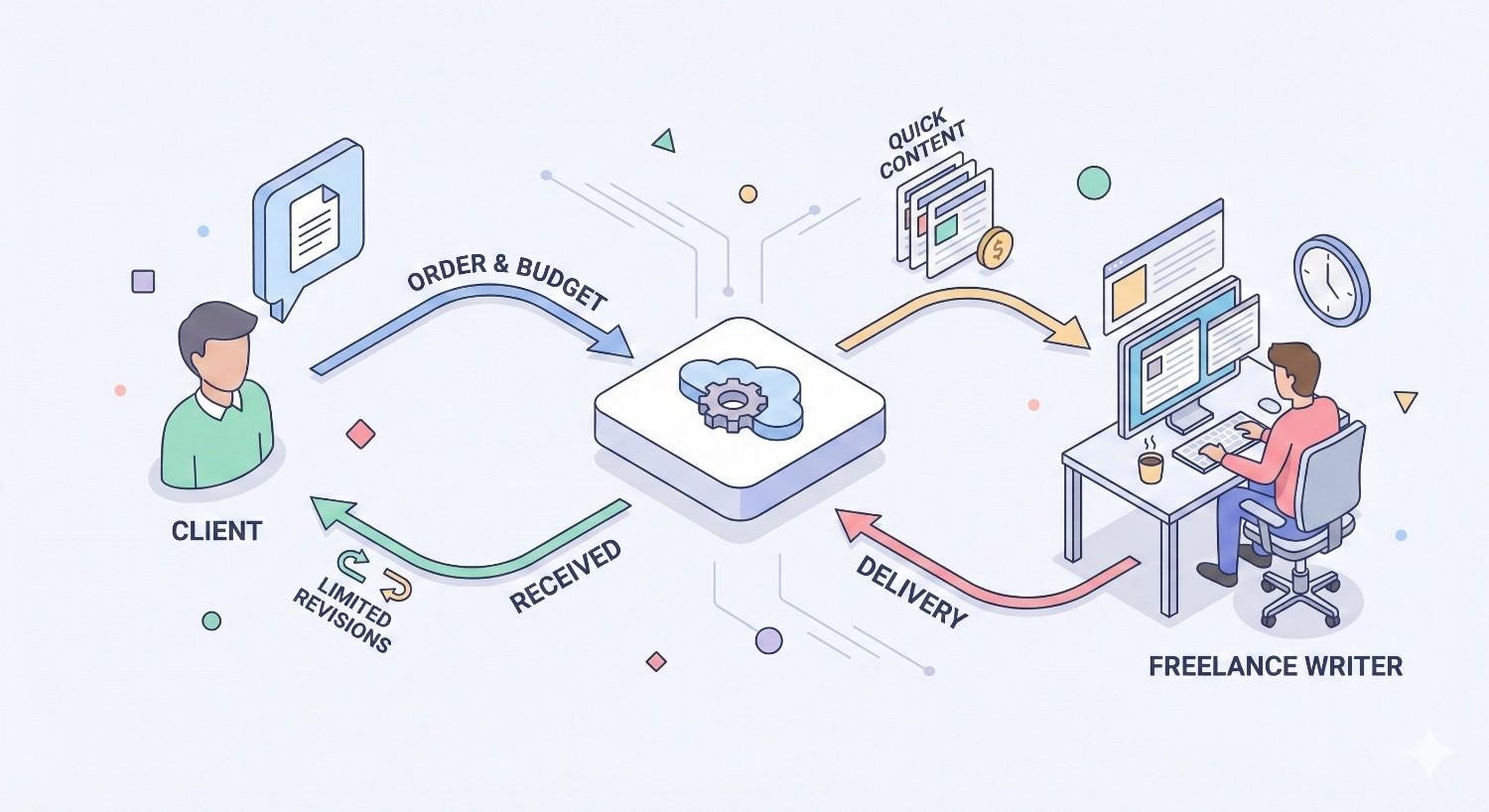
Most affordable content platforms use standardized ordering systems designed for efficiency rather than customization.
You typically select content type, word count, and turnaround time from preset options. Some platforms offer topic categories or industry selections that route your order to writers with relevant experience.
Briefing happens through forms or templates. You provide your topic, target keywords, tone preferences, and any specific requirements. The depth of briefing options varies significantly between platforms. Some allow detailed instructions; others limit you to basic fields.
Critical insight: Your brief quality directly impacts output quality at this price point. Writers working on tight margins cannot afford to spend time interpreting vague instructions or researching your brand. The more specific and complete your brief, the better your results.
Effective briefs include:
- Clear topic and angle
- Target audience description
- Specific keywords to include
- Tone and style examples
- Structural requirements
- Points to cover or avoid
- Links to reference materials
Writer Assignment and Quality Tiers
Budget platforms typically operate tiered systems matching orders to writers based on complexity, topic, and your selected quality level.
Entry-level tiers feature newer writers or those building portfolios. Rates are lowest, but so is consistency. These writers may lack experience with SEO, struggle with complex topics, or produce content requiring significant editing.
Mid-level tiers include writers with proven track records on the platform. They handle most general topics competently and understand basic content marketing principles. This tier often represents the best value for straightforward content needs.
Premium tiers within budget platforms feature experienced writers who command higher rates but still fall below agency pricing. Quality approaches professional standards, though still without the strategic depth of full-service providers.
Writer assignment usually happens automatically based on availability, topic matching, and tier selection. You rarely choose specific writers on budget platforms, though some allow you to request writers after positive experiences.
Delivery Timelines and Revisions
Turnaround times on budget platforms typically range from 24 hours to 7 days, with faster delivery commanding premium pricing.
Standard delivery (3-5 days) offers the best value. Writers have adequate time to produce reasonable quality without rush premiums.
Express delivery (24-48 hours) costs more and often sacrifices quality. Writers working under tight deadlines cannot research thoroughly or refine their work.
Extended timelines (7+ days) sometimes yield better results as writers can fit your project into their schedule without pressure.
Revision policies vary significantly. Most platforms include one or two revision rounds, but the scope of acceptable revision requests is often limited. You can typically request corrections for factual errors, missed requirements, or quality issues, but not complete rewrites or scope changes.
Understanding revision limitations before ordering prevents frustration. If your brief was unclear, most platforms will not provide free rewrites. The responsibility for clear communication falls on you.
Cheap vs. Expensive Content Writing Services: Key Differences
Price differences in content writing reflect real differences in what you receive. Understanding these distinctions helps you choose appropriately for each content need.
Quality and Expertise Levels
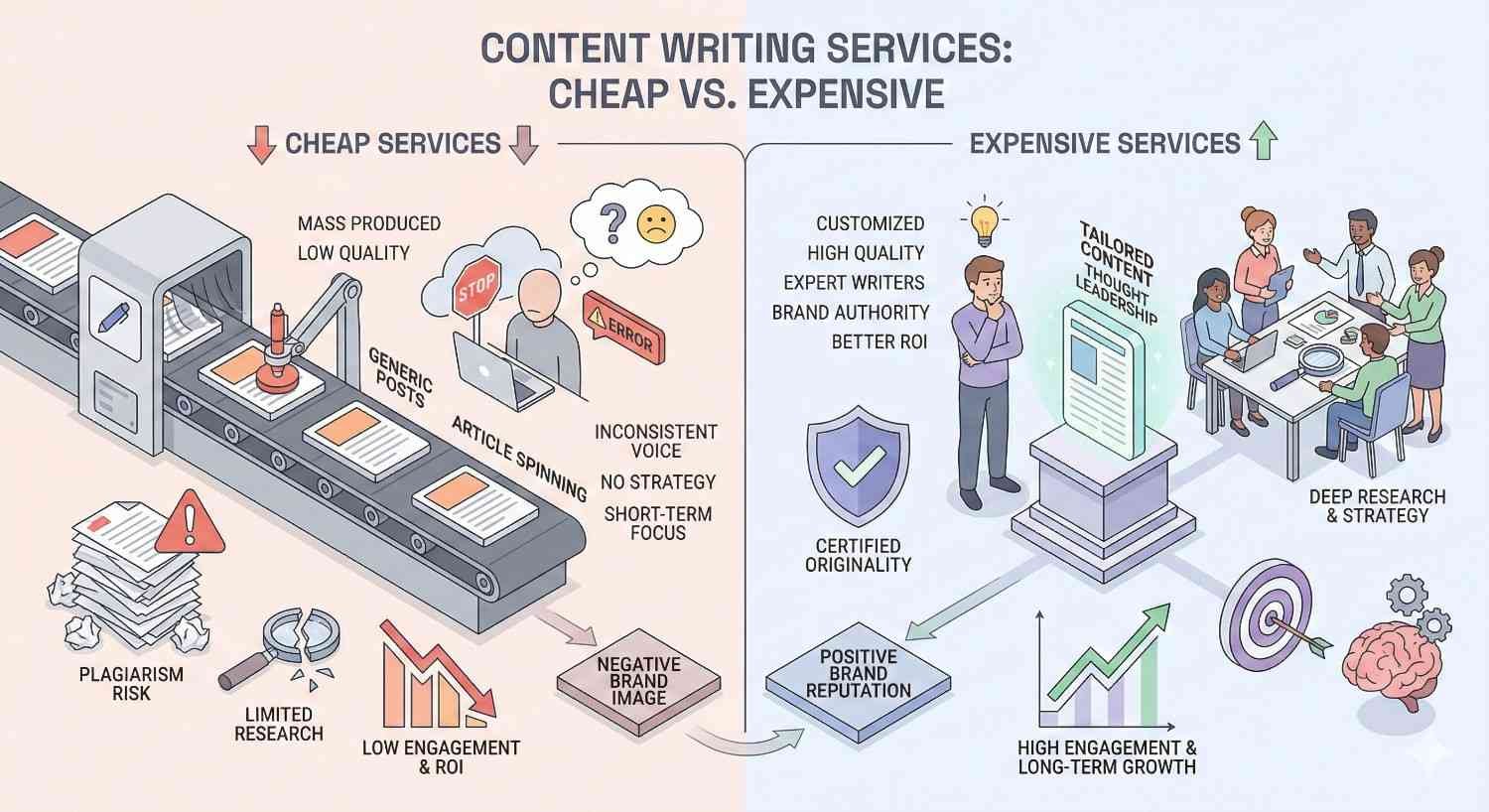
Premium content services typically employ writers with demonstrated expertise, professional backgrounds, or specialized training. Budget services work with a broader talent pool where quality varies more widely.
Writing mechanics at budget levels are generally acceptable. Grammar, spelling, and basic readability meet professional standards on most platforms. The differences emerge in sophistication, depth, and strategic value.
Subject matter expertise represents the largest gap. Premium writers often have industry backgrounds, professional credentials, or years of specialized experience. Budget writers typically research topics as they write, limiting depth and accuracy for complex subjects.
Strategic thinking rarely exists at budget price points. Premium content considers your broader marketing goals, audience journey, competitive positioning, and conversion objectives. Budget content delivers words on a topic.
Voice and brand alignment requires time and familiarity that budget models cannot support. Premium writers invest in understanding your brand; budget writers apply generic professional tones.
Research Depth and Originality
Research capabilities differ dramatically across price points.
Budget content typically relies on surface-level research: scanning top search results, pulling commonly available information, and synthesizing existing content. This approach works for general topics but produces derivative content that adds little new value.
Premium content involves deeper research: primary sources, expert interviews, original data analysis, and comprehensive competitive review. The resulting content offers genuine insights rather than repackaged information.
Originality at budget levels means avoiding plagiarism, not providing unique perspectives. Content passes duplicate checkers but may closely mirror existing articles in structure and substance.
Premium content aims for genuine differentiation: unique angles, proprietary insights, or superior depth that gives readers reasons to choose your content over alternatives.
SEO Optimization Capabilities
SEO knowledge varies enormously among budget writers.
Basic keyword integration is common. Most budget writers understand placing keywords in titles, headings, and body content. However, execution often feels mechanical rather than natural.
Semantic SEO understanding is rare at budget levels. Concepts like topical authority, entity optimization, search intent matching, and content depth for rankings require training most budget writers lack.
Technical SEO elements like proper heading hierarchy, internal linking recommendations, meta descriptions, and structured data optimization typically fall outside budget service scope.
Content strategy alignment does not exist at budget price points. Premium services consider how each piece fits your broader content ecosystem; budget services deliver isolated articles.
If SEO performance matters, budget content requires additional optimization work on your end or acceptance of limited ranking potential.
Turnaround Time and Scalability
Budget services excel at volume and speed when quality requirements are moderate.
Scalability represents a genuine advantage. Need 50 product descriptions this week? Budget platforms can deliver. Premium services often cannot match this capacity without significant lead time.
Turnaround flexibility favors budget options for urgent needs. Large writer pools mean someone is usually available, while premium writers book weeks in advance.
Consistency at scale challenges budget services. Quality varies between writers, and maintaining standards across large orders requires robust quality control on your end.
Premium services offer consistency but limited capacity. You get reliable quality but cannot easily scale to hundreds of pieces monthly without proportional budget increases.
Benefits of Affordable Content Writing Services
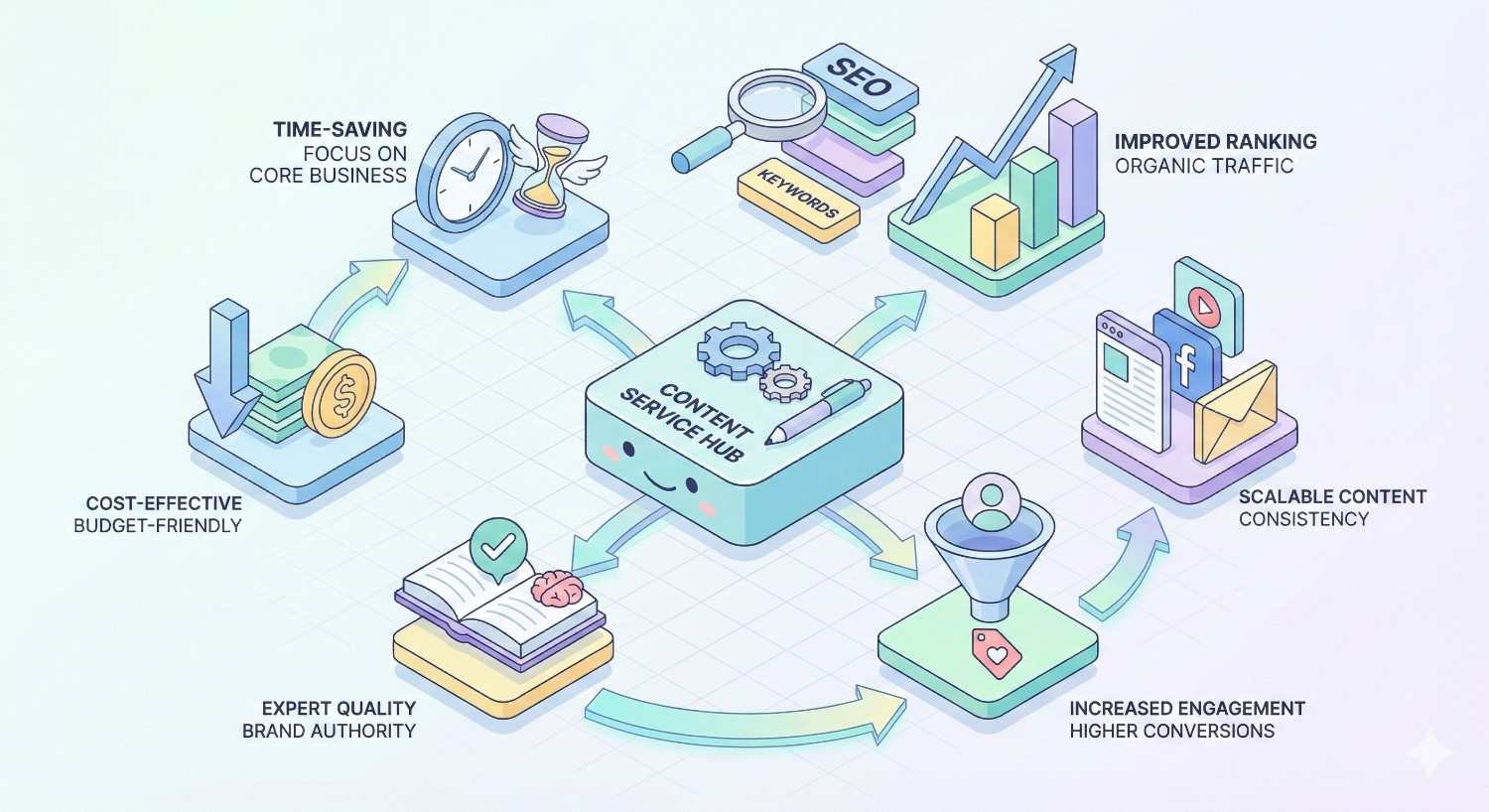
Despite limitations, budget content services offer genuine advantages for the right applications.
Cost-Effective Content Scaling
The math is straightforward. At $0.03 per word, a 1,500-word article costs $45. At premium rates of $0.30 per word, the same article costs $450.
For businesses needing 20 articles monthly, that difference means $900 versus $9,000. The budget approach frees resources for other marketing investments or allows content volume that would otherwise be impossible.
Strategic application maximizes this benefit. Use budget content for:
- Supporting blog posts that build topical coverage
- FAQ content answering common questions
- Product descriptions for large catalogs
- Social media content requiring volume
- Internal documentation and resources
Reserve premium budgets for cornerstone content, conversion pages, and high-stakes topics where quality directly impacts revenue.
Faster Content Production
Budget services operate on speed. Large writer pools, streamlined processes, and standardized workflows enable rapid content delivery.
Publishing velocity matters for SEO. Sites publishing consistently build topical authority faster than those publishing sporadically. Budget content enables consistent publishing schedules that might otherwise be unsustainable.
Market responsiveness improves with faster production. Trending topics, seasonal content, and timely pieces can be produced quickly without premium lead times.
Testing and iteration become practical when content costs less. You can experiment with topics, formats, and angles without significant financial risk.
Access to Diverse Writing Styles
Large writer pools offer variety. Different writers bring different voices, perspectives, and approaches.
Style matching becomes possible through trial and selection. Order from multiple writers, identify those matching your needs, and request them for future work.
Audience testing uses this diversity strategically. Different writing styles resonate with different audience segments. Budget pricing makes testing practical.
Content variety prevents monotony. Readers notice when every article sounds identical. Multiple writers naturally introduce variation.
Flexibility for Startups and SMEs
Budget content services align with startup and SME realities.
No long-term commitments characterize most platforms. Order when needed, pause when budgets tighten, scale when opportunities arise. This flexibility matches unpredictable business cycles.
Low barrier to entry means any business can start content marketing. You do not need thousands in monthly budget to begin building online presence.
Risk mitigation comes from smaller investments. A $50 article that underperforms represents minor loss. A $500 article carries more pressure to succeed.
Learning opportunities emerge from affordable experimentation. Discover what content works for your audience without betting significant resources on unproven approaches.
Risks and Limitations of Low-Cost Content Services
Honest assessment of risks enables informed decisions and appropriate risk mitigation.
Quality Inconsistencies
Variability represents the defining challenge of budget content.
Writer skill ranges widely on budget platforms. Your next order might come from a skilled professional between premium gigs or a beginner learning the craft. Predicting which you will receive is difficult.
Quality control limitations exist because platforms cannot extensively review every piece at these price points. Basic checks catch obvious problems; subtle quality issues pass through.
Topic complexity amplifies inconsistency. Simple topics yield acceptable results more reliably than complex subjects requiring expertise.
Mitigation strategies include:
- Ordering samples before committing to volume
- Building relationships with specific writers
- Implementing internal review processes
- Starting with lower-stakes content
Plagiarism and Duplicate Content Concerns
Content originality risks exist at budget price points.
Plagiarism from direct copying is relatively rare on established platforms with detection systems. However, close paraphrasing that technically passes plagiarism checkers but offers no original value is common.
Duplicate content issues arise when writers use templates or recycle structures across clients. Your content may be technically unique but structurally identical to competitors.
AI-generated content increasingly appears on budget platforms. Some writers use AI tools to increase output, potentially delivering content that lacks human insight or contains AI hallucinations.
Protection measures include:
- Running content through plagiarism checkers
- Reviewing for generic or templated structures
- Checking factual claims independently
- Requesting human-written guarantees where available
Limited Subject Matter Expertise
Budget writers typically lack deep expertise in specialized fields.
Technical accuracy suffers for complex topics. Writers researching as they write may misunderstand concepts, oversimplify nuances, or miss critical details.
Industry credibility requires insider knowledge budget writers rarely possess. Content may be technically correct but lack the depth that establishes authority.
YMYL content (health, finance, legal) carries particular risk. Inaccurate information in these areas can harm readers and expose your business to liability.
Appropriate applications for budget content avoid expertise-dependent topics:
- General interest content
- Basic informational pieces
- Topics you can easily verify
- Supporting content rather than authoritative guides
Hidden Costs and Revision Fees
Advertised prices sometimes understate true costs.
Revision charges apply on some platforms when requests exceed included rounds or fall outside defined scope. Unclear policies create unexpected expenses.
Quality tier upsells push you toward higher-priced options after disappointing results at base levels. The advertised rate attracts; the functional rate is higher.
Editing requirements represent hidden costs even when not charged by the platform. Time spent fixing, improving, or rewriting budget content has real value.
Opportunity costs emerge when poor content fails to perform. The article cost $50, but the lost ranking opportunity or damaged brand perception costs more.
True cost calculation should include:
- Base content price
- Expected revision costs
- Internal editing time
- Potential rewrite or replacement costs
- Performance opportunity costs
How to Choose the Best Cheap Content Writing Service
Selection process quality determines outcome quality. Invest time in choosing well.
Evaluating Writer Portfolios and Samples
Samples reveal more than promises.
Request relevant samples matching your content needs. A writer excelling at lifestyle content may struggle with B2B topics. Genre-specific samples predict performance better than general portfolios.
Evaluate critically for:
- Writing mechanics (grammar, clarity, flow)
- Research depth (sources, specificity, accuracy)
- Engagement quality (readability, interest, value)
- SEO awareness (keyword usage, structure, optimization)
Red flags include:
- Inability to provide samples
- Samples inconsistent in quality
- Generic content lacking specific insights
- Obvious keyword stuffing or poor optimization
Sample orders before committing to volume provide real-world evaluation. A small test order reveals more than any portfolio review.
Checking Reviews and Testimonials
Social proof guides selection but requires critical evaluation.
Platform reviews offer aggregate quality indicators. Look for patterns rather than individual reviews. Consistent complaints about specific issues (missed deadlines, poor communication, quality problems) signal systemic problems.
External reviews on independent sites provide less filtered perspectives. Search for platform or service reviews outside their controlled environment.
Testimonial authenticity varies. Generic praise without specifics suggests manufactured reviews. Detailed feedback describing specific experiences carries more weight.
Review recency matters. Services change over time. Recent reviews reflect current quality better than older testimonials.
Understanding Pricing Models
Pricing structures affect value and incentives.
Per-word pricing aligns writer incentives with word count, potentially encouraging padding. However, it provides predictable costs for defined content lengths.
Per-article pricing incentivizes efficiency but may result in shorter content than expected. Clarify minimum word counts before ordering.
Subscription models offer discounts for commitment but lock you into ongoing expenses regardless of actual needs.
Hidden fees for revisions, rush delivery, or premium features inflate effective costs. Calculate total expected cost, not just base price.
Value assessment considers quality per dollar, not just absolute price. A $75 article requiring no editing may deliver better value than a $30 article needing two hours of revision.
Assessing SEO and Content Strategy Knowledge
SEO capability varies dramatically among budget providers.
Basic SEO understanding should include:
- Keyword placement in titles and headings
- Natural keyword integration in body content
- Proper heading hierarchy (H1, H2, H3)
- Meta description writing
- Readable, scannable formatting
Advanced SEO knowledge to look for:
- Search intent understanding
- Semantic keyword awareness
- Internal linking recommendations
- Content depth for competitive topics
- E-E-A-T signal integration
Assessment methods include:
- Asking specific SEO questions before ordering
- Reviewing samples for optimization quality
- Requesting SEO-focused test orders
- Checking if platforms offer SEO-specific services
Trial Orders and Quality Guarantees
Risk mitigation through testing protects larger investments.
Trial orders should:
- Represent your typical content needs
- Test multiple writers if possible
- Include your standard briefing process
- Evaluate full workflow, not just output
Quality guarantees vary in substance. Understand exactly what guarantees cover:
- Revision scope and limits
- Refund conditions and process
- Quality standards applied
- Dispute resolution procedures
Satisfaction policies that seem too good often have fine print. Read terms carefully before assuming protection exists.
Gradual scaling after successful trials reduces risk. Increase order volume incrementally as confidence builds rather than committing to large volumes immediately.
Pricing Models for Budget Content Writing
Understanding pricing structures helps you optimize spending and set appropriate expectations.
Per-Word Pricing
Per-word rates represent the most common budget content pricing model.
Typical ranges for budget content:
- $0.01-$0.03 per word: Entry-level, highest risk, suitable only for basic content with heavy editing capacity
- $0.03-$0.05 per word: Mid-range budget, reasonable quality for general topics
- $0.05-$0.10 per word: Upper budget range, approaching professional quality for straightforward content
Calculation example: A 1,500-word article at $0.04 per word costs $60.
Advantages include predictable costs and clear value comparison across providers.
Disadvantages include potential padding incentives and difficulty comparing across different content types.
Per-Article Flat Rates
Flat rates simplify budgeting but require careful specification.
Typical ranges:
- $10-$25 per article: Very basic content, often 500-800 words, minimal research
- $25-$50 per article: Standard blog posts, 800-1,500 words, moderate quality
- $50-$100 per article: Longer or more complex content, better research depth
Specification requirements for flat-rate orders:
- Minimum and maximum word counts
- Research expectations
- Revision inclusion
- Delivery timeline
Advantages include budget predictability and simplified ordering.
Disadvantages include potential for shorter content and less flexibility for varying needs.
Monthly Retainer Packages
Retainer arrangements suit consistent content needs.
Typical structures:
- Set number of articles or words monthly
- Discounted per-piece rates versus individual orders
- Priority access to preferred writers
- Dedicated account management on some platforms
Value assessment requires honest evaluation of actual monthly needs. Retainers only save money if you consistently use the full allocation.
Flexibility limitations mean unused capacity typically does not roll over. Overestimating needs wastes budget.
Relationship benefits include writer familiarity with your brand, more consistent quality, and streamlined communication.
Bulk Order Discounts
Volume discounts reward larger commitments.
Typical discount structures:
- 10-20% off for 10+ articles
- 20-30% off for 25+ articles
- Custom pricing for 50+ articles
Strategic application works best when:
- Content needs are predictable
- Topics are defined in advance
- Quality requirements are consistent
- You have capacity to review and use content
Risk considerations include quality degradation at volume, difficulty managing large orders, and commitment to content you may not need.
Phased approaches order bulk content in stages, evaluating quality before committing to additional volume.
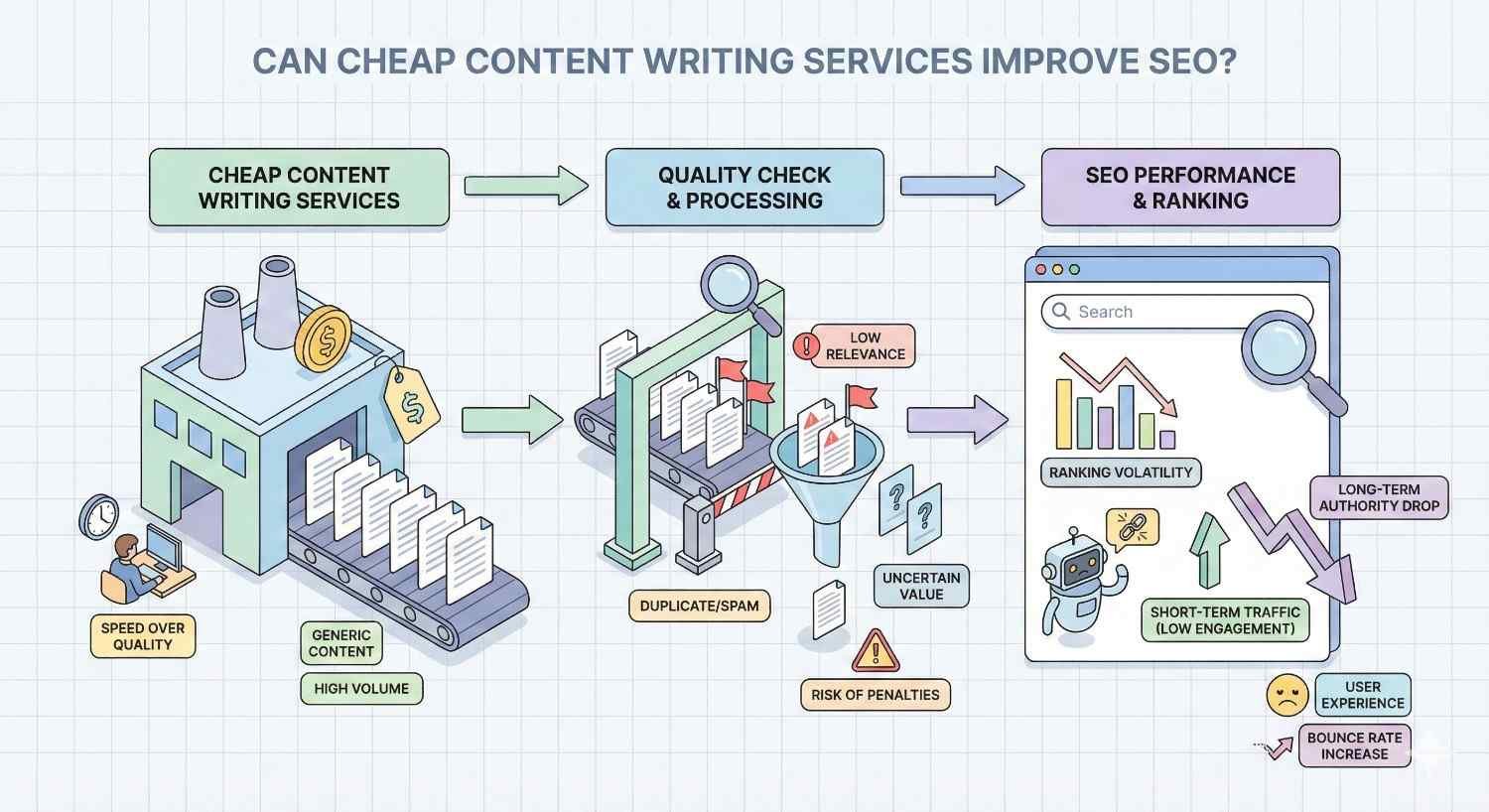
Can Cheap Content Writing Services Improve SEO?
The relationship between budget content and SEO performance requires nuanced understanding.
Content Volume vs. Content Quality for Rankings
Google’s algorithms evaluate both quantity and quality, but not equally.
Volume benefits exist for topical coverage. Sites covering topics comprehensively through multiple related articles build topical authority. Budget content can fill coverage gaps affordably.
Quality requirements have increased significantly. Google’s helpful content updates specifically target low-quality, mass-produced content. Volume without value now carries ranking penalties rather than benefits.
Strategic balance uses budget content for supporting pieces while investing in quality for cornerstone content. Not every article needs to rank; some exist to support those that do.
Diminishing returns apply to volume strategies. Adding your 50th article on a topic provides less value than your 5th. Quality improvements often outperform quantity increases beyond baseline coverage.
Keyword Integration and On-Page Optimization
Budget content can achieve basic on-page optimization.
Achievable elements with budget content:
- Primary keyword in title and H1
- Keywords in subheadings where natural
- Keyword mentions in body content
- Basic meta description optimization
- Proper heading structure
Challenging elements at budget price points:
- Semantic keyword integration
- Search intent alignment
- Competitive content depth
- User engagement optimization
- Conversion element integration
Supplemental optimization may be necessary. Budget content provides the foundation; you add strategic optimization before publishing.
E-E-A-T Considerations with Budget Content
Experience, Expertise, Authoritativeness, and Trustworthiness signals challenge budget content models.
Experience signals require first-hand knowledge budget writers typically lack. Content reads as researched rather than experienced.
Expertise demonstration needs subject matter depth that surface-level research cannot provide. Budget content often lacks the specificity that signals genuine expertise.
Authority building depends on unique insights, original perspectives, and demonstrated knowledge. Generic content does not build authority regardless of volume.
Trust elements like accurate information, proper sourcing, and transparent limitations require care that rushed production may not allow.
Mitigation approaches:
- Add expert review before publishing
- Supplement with original insights and examples
- Include proper citations and sources
- Attribute content to qualified authors
- Focus budget content on lower E-E-A-T-sensitivity topics
Long-Term SEO Impact of Low-Cost Content
Long-term effects depend on how budget content is used.
Positive scenarios:
- Budget content fills topical gaps, supporting overall site authority
- Quality control processes ensure acceptable standards
- Strategic placement uses budget content appropriately
- Continuous improvement refines content over time
Negative scenarios:
- Low-quality content triggers helpful content penalties
- Thin content dilutes site quality signals
- User engagement metrics suffer from poor content
- Brand reputation damage affects broader marketing
Monitoring requirements for budget content strategies:
- Track individual article performance
- Monitor site-wide quality metrics
- Watch for ranking declines after content additions
- Assess user engagement signals
Course correction readiness matters. Be prepared to remove or improve underperforming content rather than letting it drag down site quality.
Best Practices for Working with Affordable Content Writers
Process optimization maximizes value from budget content investments.
Creating Detailed Content Briefs
Brief quality determines output quality at budget price points.
Essential brief elements:
- Topic and angle: Specific focus, not just general subject
- Target audience: Who reads this, what they know, what they need
- Primary keyword: Main term to target
- Secondary keywords: Related terms to include naturally
- Competitor references: Examples of content to match or exceed
- Structure requirements: Heading expectations, section coverage
- Tone and style: Voice characteristics, formality level
- Length requirements: Word count range
- Specific inclusions: Points that must be covered
- Exclusions: Topics or approaches to avoid
- Source requirements: Research expectations, citation needs
Brief templates standardize quality across orders. Create reusable frameworks for different content types.
Example provision accelerates understanding. Link to content matching your expectations rather than describing abstractly.
Establishing Style Guides and Brand Voice
Consistency requires documentation.
Style guide elements:
- Brand voice characteristics
- Tone variations by content type
- Terminology preferences
- Formatting standards
- Common phrases to use or avoid
- Grammar and punctuation preferences
Accessibility matters. Share style guides with every order. Do not assume writers remember previous instructions.
Evolution should be expected. Update guides based on feedback and changing needs.
Implementing Quality Control Processes
Systematic review catches problems before publication.
Review checklist:
- Factual accuracy verification
- Keyword integration check
- Readability assessment
- Brand voice alignment
- SEO element verification
- Plagiarism scanning
- Link and source validation
Editing capacity must exist. Budget for internal editing time or external editing services. Raw budget content rarely publishes without improvement.
Feedback loops improve future orders. Communicate what worked and what did not. Writers who receive feedback improve; those who do not repeat mistakes.
Building Long-Term Writer Relationships
Relationship investment pays dividends.
Writer identification: Note writers who deliver quality. Request them specifically for future orders where platforms allow.
Consistent work: Regular orders to preferred writers build familiarity with your brand and expectations.
Fair treatment: Reasonable deadlines, clear briefs, and respectful communication encourage writers to prioritize your work.
Loyalty benefits: Writers who know your brand require less briefing, make fewer mistakes, and often deliver above-minimum effort.
When to Invest in Premium Content Writing Instead
Budget content is not universally appropriate. Recognize when premium investment makes sense.
High-Stakes Content Types (YMYL, Technical)
Some content categories demand expertise.
YMYL content (Your Money or Your Life) covering health, finance, legal, or safety topics requires accuracy that budget research cannot ensure. Errors in these areas harm readers and expose businesses to liability.
Technical content for specialized industries needs subject matter expertise. Surface-level research produces content that experts immediately recognize as inadequate.
Regulated industries face compliance requirements that generalist writers may not understand. Incorrect claims can trigger regulatory problems.
Risk assessment: If content errors could harm readers, damage your reputation significantly, or create legal exposure, premium investment is justified.
Brand Authority and Thought Leadership Pieces
Authority building requires quality.
Thought leadership content must offer genuine insights, original perspectives, and demonstrated expertise. Generic content cannot establish authority regardless of volume.
Flagship content representing your brand’s best thinking deserves premium investment. These pieces define how audiences perceive your expertise.
Competitive differentiation requires content that stands out. Budget content tends toward similarity; premium content can achieve genuine distinction.
Long-term assets: Content intended to rank and perform for years justifies higher initial investment. Amortized over years of value, premium costs become reasonable.
Conversion-Focused Landing Pages
Revenue-generating pages warrant investment.
Landing pages directly impact conversion rates. Small quality improvements translate to measurable revenue differences.
Sales content must persuade, not just inform. Persuasion requires understanding of audience psychology, objection handling, and conversion optimization that budget writers rarely possess.
ROI calculation: If a page generates $10,000 monthly and premium content improves conversion by 10%, the $500 investment returns $1,000 monthly. Budget content savings become false economy.
Testing capacity: Premium content provides a strong baseline for optimization. Starting with weak content limits how much testing can improve performance.
Top Platforms for Finding Cheap Content Writing Services
Multiple channels offer budget content with different characteristics.
Freelance Marketplaces
Platforms connecting businesses directly with freelancers.
Major platforms include Upwork, Fiverr, and Freelancer. These marketplaces offer vast writer pools with wide quality and price ranges.
Advantages:
- Direct writer communication
- Portfolio and review visibility
- Price negotiation flexibility
- Long-term relationship potential
Disadvantages:
- Quality screening falls on you
- Time investment in finding good writers
- No quality guarantees beyond individual freelancer policies
Best practices:
- Review portfolios thoroughly
- Start with small test projects
- Check reviews and completion rates
- Communicate expectations clearly
Content Mills and Agencies
Platforms specializing in content production at scale.
Content mills like Textbroker and iWriter offer standardized ordering with tiered quality levels. Pricing is predictable; quality varies by tier.
Budget agencies provide more structure than mills with account management and quality processes, but at higher price points than pure mills.
Advantages:
- Streamlined ordering processes
- Built-in quality tiers
- Revision policies
- Scalability for volume needs
Disadvantages:
- Less writer control
- Variable quality within tiers
- Limited customization
- Generic output tendencies
Direct Hiring Options
Building your own writer network.
Job boards and social media allow direct writer recruitment. You control selection entirely but handle all management.
Offshore writers in lower-cost regions offer significant savings. Quality varies; communication and cultural alignment require attention.
Student writers and emerging professionals offer enthusiasm and lower rates. Mentorship investment may be required.
Advantages:
- Complete control over selection
- Relationship building potential
- Customized arrangements
- No platform fees
Disadvantages:
- Time-intensive recruitment
- Management responsibility
- No platform protections
- Payment and contract handling
AI-Assisted Content Services
Emerging options combining AI and human elements.
AI writing tools like Jasper, Copy.ai, and others generate content rapidly at low cost. Quality requires human editing and oversight.
Hybrid services use AI for drafts with human editing and refinement. Costs fall between pure AI and traditional writing.
Advantages:
- Extremely fast production
- Very low per-piece costs
- Scalability without writer limits
- Consistency in style and format
Disadvantages:
- Quality concerns for complex topics
- Potential for AI detection issues
- Factual accuracy risks
- Limited originality and insight
Strategic use: AI-assisted content works for high-volume, lower-stakes content where speed and cost matter more than depth and originality.
Frequently Asked Questions About Cheap Content Writing Services
How much should I pay for cheap content writing?
Budget content typically ranges from $0.01 to $0.10 per word or $15 to $75 per article for standard blog posts. The sweet spot for reasonable quality without premium pricing falls around $0.03 to $0.05 per word. Below $0.02 per word, quality risks increase significantly; above $0.08 per word, you approach mid-tier professional rates where expectations should be higher.
Are cheap content writers reliable?
Reliability varies significantly among budget writers and platforms. Established platforms with review systems offer more accountability than anonymous freelancers. Building relationships with specific writers who have delivered quality improves reliability over time. Expect some inconsistency, especially with new writers or platforms, and build review processes to catch problems before publication.
Can I get SEO-optimized content at low prices?
Basic SEO optimization is achievable at budget price points. Writers can integrate keywords, use proper heading structures, and follow on-page best practices. However, advanced SEO elements like semantic optimization, search intent alignment, and competitive content depth typically require either premium writers or your own optimization work after receiving budget content.
What’s the difference between cheap and low-quality content?
Cheap refers to price; low-quality refers to output. Cheap content can be acceptable quality for appropriate applications when sourced carefully and used strategically. Low-quality content fails to meet basic standards regardless of price. The key is matching price point to content requirements and implementing quality controls that catch problems before publication.
How do I avoid scams with budget content services?
Protect yourself by using established platforms with review systems and payment protection. Start with small test orders before committing to volume. Verify content originality with plagiarism checkers. Read platform terms carefully, especially regarding revisions and refunds. Avoid services requiring large upfront payments or making unrealistic quality promises at extremely low prices.
Making the Right Content Investment Decision
Strategic content investment balances immediate budget constraints with long-term growth objectives.
Balancing Budget and Quality for Your Goals
Content investment should align with business objectives, not just minimize costs.
Goal-based allocation directs premium investment toward content that directly impacts revenue, authority, or competitive positioning. Budget content fills supporting roles where quality requirements are lower.
Portfolio approach recognizes that not all content serves the same purpose. A mix of premium cornerstone content and budget supporting content often outperforms uniform investment at either extreme.
Quality floors must exist. Content below minimum acceptable standards damages rather than helps. Better to publish less content at acceptable quality than more content that harms your brand.
Measurement enables optimization. Track content performance by investment level. Data reveals whether budget content delivers acceptable returns or requires quality upgrades.
Strategic Content Planning for Sustainable Growth
Long-term content success requires strategic thinking beyond individual pieces.
Content calendars should designate investment levels by content type and purpose. Plan premium investment for priority content; schedule budget content for volume needs.
Topical coverage strategies use budget content to build breadth while premium content establishes depth on priority topics.
Iterative improvement upgrades successful budget content over time. Pieces that gain traction deserve investment in enhancement.
Competitive analysis reveals where quality investment matters most. Match or exceed competitor quality on priority topics; accept parity on supporting content.
When to Partner with a Full-Service SEO Provider
Some situations warrant comprehensive partnership over piecemeal content purchasing.
Strategic integration needs arise when content must align with technical SEO, link building, and broader marketing strategy. Full-service providers coordinate these elements; budget content services deliver isolated pieces.
Expertise gaps in your team may require external strategic guidance, not just content production. Providers offering strategy alongside execution add value beyond writing.
Scale transitions from startup to growth phase often require more sophisticated content approaches. What worked at small scale may not support larger ambitions.
Resource constraints sometimes make outsourcing entire functions more efficient than managing multiple vendors and internal processes.
We help businesses build sustainable organic growth through integrated SEO strategy, from technical foundations and content development to authority building and performance tracking. When budget content no longer meets your growth requirements, a full-service partnership provides the strategic depth and execution quality that drives long-term search visibility.
Ready to elevate your content strategy beyond budget limitations? White Label SEO Service delivers the expertise, consistency, and strategic alignment that transforms content from cost center to growth engine.
Frequently Asked Questions
What is the average cost per word for budget content writing services?
Budget content writing typically costs between $0.01 and $0.10 per word, with most services clustering around $0.03 to $0.05 per word for acceptable quality. At the lowest rates, expect minimal research and potential quality issues requiring significant editing.
How can I tell if a cheap content writing service is legitimate?
Legitimate services have established online presence, verifiable reviews on independent platforms, clear pricing and terms, reasonable revision policies, and responsive customer support. Avoid services requiring large upfront payments, making unrealistic promises, or lacking transparent contact information.
Should I use cheap content writing for my main website pages?
Main website pages, especially homepage, service pages, and key landing pages, generally warrant premium investment due to their direct impact on conversions and brand perception. Budget content works better for blog posts, supporting articles, and content where volume matters more than individual piece performance.
How do I provide effective briefs to budget content writers?
Effective briefs include specific topic and angle, target audience description, primary and secondary keywords, competitor examples, structural requirements, tone guidelines, word count expectations, and points to include or avoid. More detailed briefs consistently produce better results at budget price points.
Can budget content writing services handle technical or specialized topics?
Budget services struggle with technical and specialized content due to limited subject matter expertise. For complex topics, either invest in premium writers with relevant backgrounds or plan for substantial internal review and enhancement of budget content before publication.
What revision policies should I expect from cheap content services?
Most budget services include one to two revision rounds for issues like missed requirements, factual errors, or quality problems. Scope changes, complete rewrites, or revisions due to unclear briefs typically fall outside standard policies. Read terms carefully before ordering.
How do I scale content production while maintaining quality with budget services?
Successful scaling requires detailed style guides, standardized brief templates, consistent quality control processes, relationships with reliable writers, and willingness to reject substandard work. Build systems before scaling volume to prevent quality degradation.