Content writing packages deliver consistent, SEO-optimized content at predictable costs, typically ranging from $500 to $5,000+ monthly depending on volume and complexity. For businesses seeking sustainable organic growth, these bundled services eliminate the chaos of ad-hoc content creation while building the topical authority search engines reward.
Whether you’re a startup establishing market presence or an enterprise scaling content operations, the right package transforms content from a sporadic expense into a strategic growth engine. This guide covers everything you need to evaluate, select, and maximize ROI from content writing packages.
We’ll examine package types, pricing structures, selection criteria, and performance metrics. You’ll learn how packages integrate with broader SEO strategy and which mistakes derail results.
What Are Content Writing Packages?
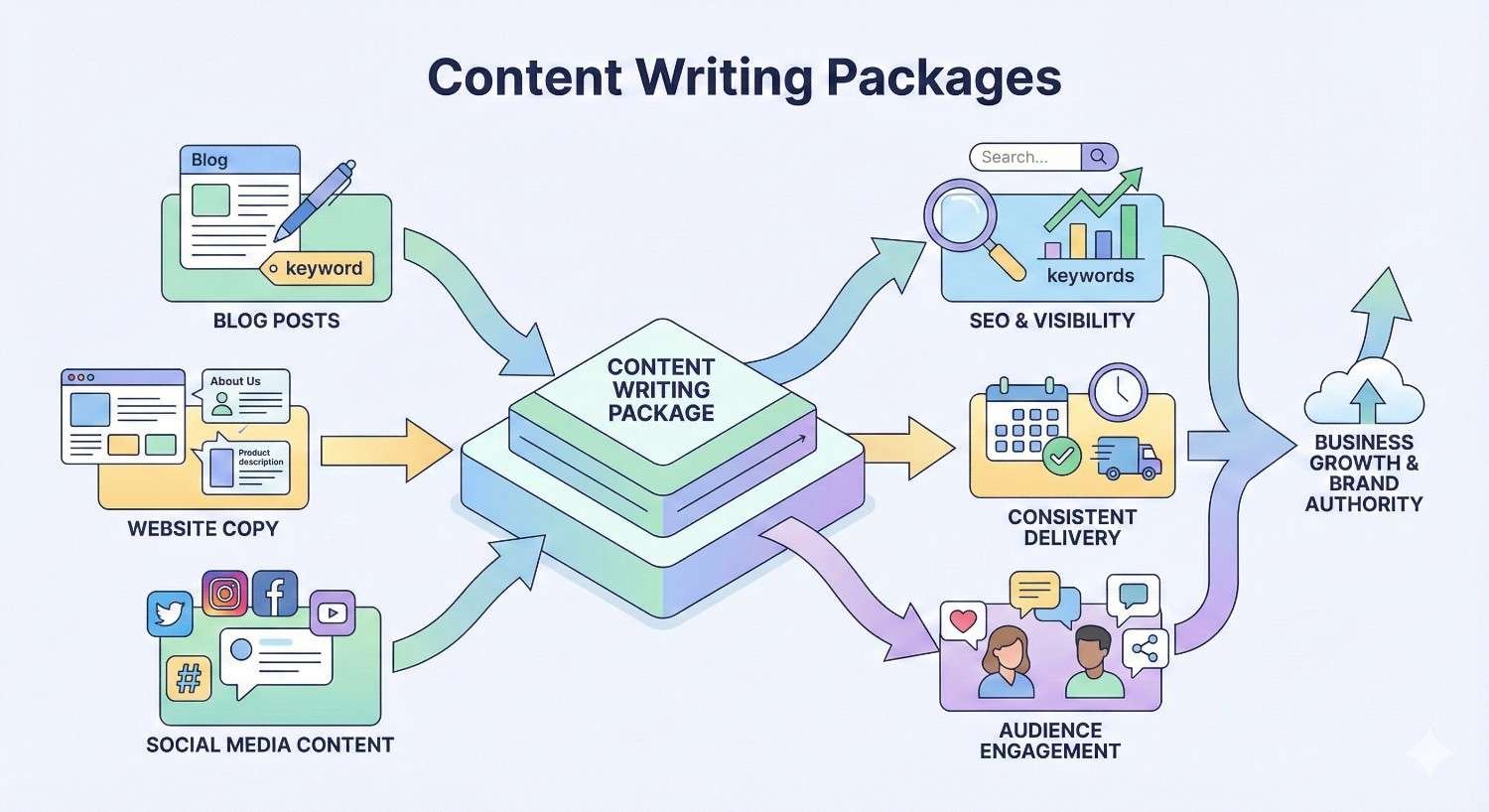
Content writing packages are bundled content services offered at fixed pricing tiers. They combine multiple deliverables into predictable monthly or project-based arrangements. Unlike one-off content purchases, packages provide systematic content production aligned with strategic goals.
These arrangements typically include a defined number of content pieces, specific word counts, and supporting services like keyword research or editorial planning. The package model creates accountability for both provider and client while establishing clear expectations around deliverables, timelines, and quality standards.
Core Components of Professional Content Writing Packages
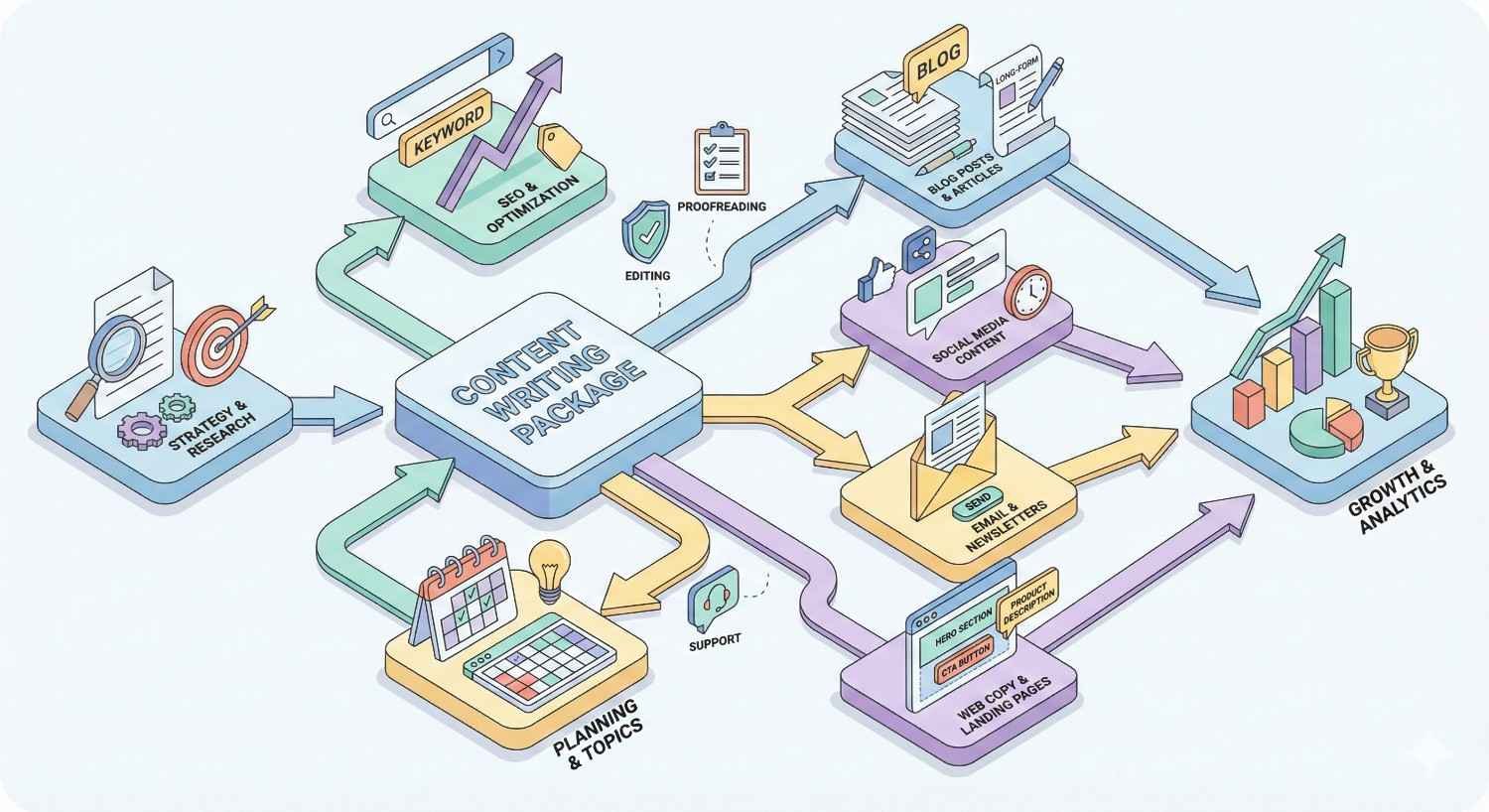
Professional packages include several interconnected elements. Content strategy forms the foundation, determining what topics to cover and how they connect. Keyword research identifies search opportunities worth pursuing. Writing itself follows established brand guidelines and SEO best practices.
Quality assurance processes ensure accuracy and readability. Most packages include revision rounds to refine content before publication. Performance tracking closes the loop, measuring whether content achieves intended outcomes.
The best packages integrate these components rather than treating them as separate line items. Strategy informs keyword selection. Keywords guide writing. Editing ensures strategic alignment. Reporting validates the entire approach.
How Content Writing Packages Differ from Freelance or Ad-Hoc Content
Freelance arrangements offer flexibility but create management overhead. You source writers, provide briefs, manage revisions, and maintain quality standards yourself. Each project requires fresh negotiation around scope, pricing, and timelines.
Ad-hoc content addresses immediate needs without strategic context. You might publish a blog post because someone had an idea, not because research indicated opportunity. This approach produces content islands rather than interconnected topic clusters.
Packages solve both problems. Dedicated teams understand your brand voice over time. Strategic planning ensures each piece serves larger goals. Consistent processes eliminate repetitive management tasks. You gain predictability in both output and investment.
The Role of Content Packages in SEO and Organic Visibility
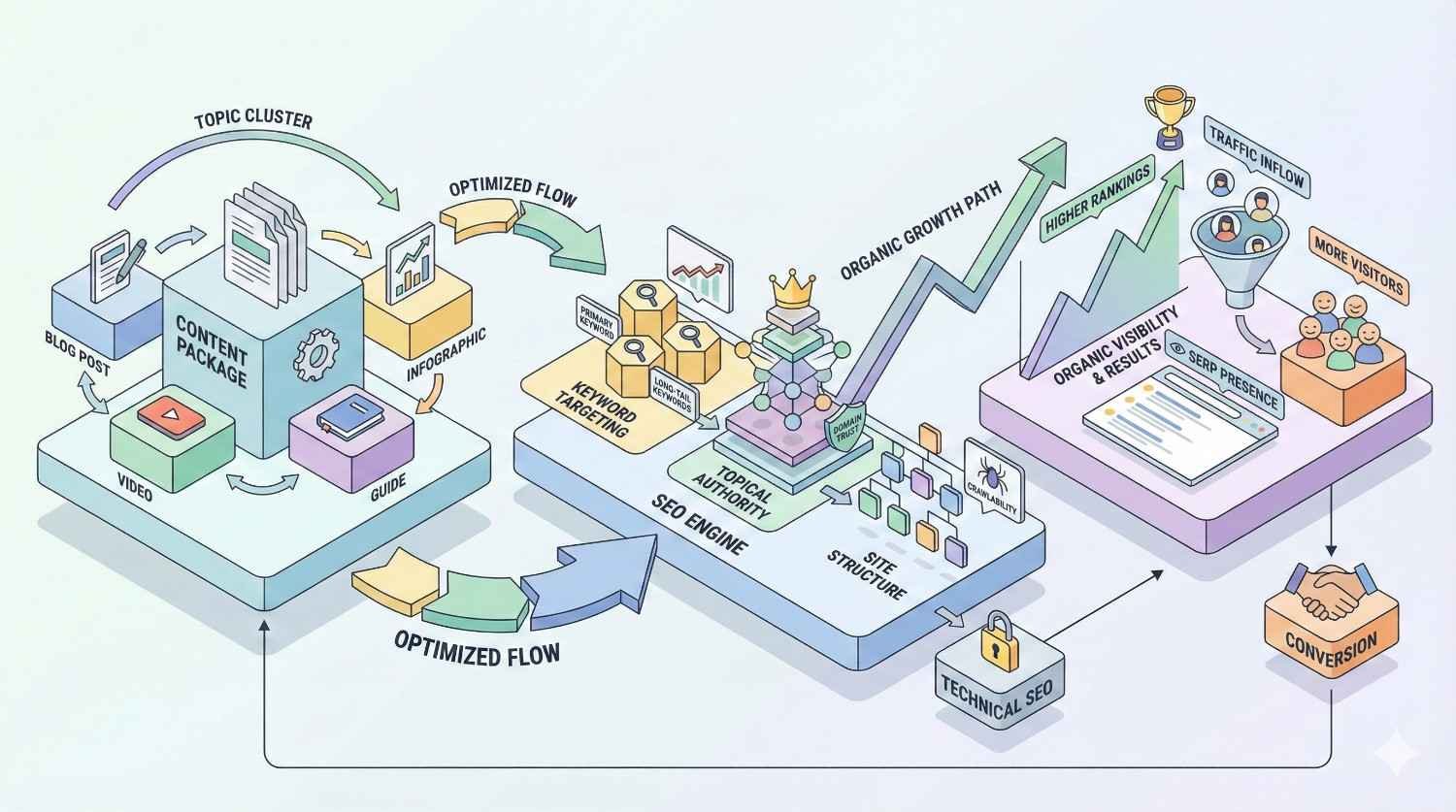
Search engines evaluate websites partly on content comprehensiveness. Sites demonstrating deep expertise across related topics earn higher rankings than those with scattered, shallow coverage. This principle, called topical authority, requires sustained content investment.
Content packages enable the publishing consistency topical authority demands. Rather than sporadic bursts followed by months of silence, packages maintain steady content velocity. This signals to search engines that your site remains active and authoritative.
Packages also support technical SEO through proper content architecture. Internal linking strategies connect related pieces. Consistent formatting aids crawlability. Optimized metadata improves click-through rates from search results.
Types of Content Writing Packages
Different business needs require different content approaches. Package types have evolved to address specific use cases, from ongoing blog programs to comprehensive website overhauls.
SEO Blog Writing Packages
Blog packages focus on regular article publication targeting informational search queries. These packages typically include 4-12 posts monthly, ranging from 1,000 to 2,500 words each. The goal is capturing organic traffic through helpful, search-optimized content.
Effective blog packages include keyword research identifying topics with traffic potential and reasonable competition. Writers create content addressing user questions comprehensively. On-page optimization ensures proper heading structure, meta descriptions, and internal linking.
Blog packages work best for businesses with established websites seeking traffic growth. They require patience, as organic results typically emerge over 3-6 months of consistent publishing.
Website Content Packages
Website packages address core site pages: homepages, service pages, about sections, and landing pages. These projects are typically one-time or periodic rather than ongoing. The focus is conversion optimization alongside search visibility.
Website content requires different skills than blog writing. Pages must communicate value propositions clearly while incorporating keywords naturally. User experience considerations influence structure and formatting. Calls-to-action guide visitors toward desired outcomes.
These packages often include competitive analysis, messaging frameworks, and multiple revision rounds. The investment is higher per page but addresses foundational content that influences all other marketing efforts.
Product Description Writing Packages
E-commerce businesses need scalable product content. Product description packages handle high-volume writing with consistent quality and formatting. Packages might cover hundreds or thousands of SKUs with standardized approaches.
Effective product descriptions balance SEO requirements with conversion focus. They incorporate relevant keywords while highlighting benefits and specifications. Unique descriptions avoid duplicate content penalties that plague sites using manufacturer copy.
Pricing typically follows per-product models, with discounts for volume. Packages may include category page content, buying guides, and comparison content supporting product pages.
Long-Form Content and Pillar Page Packages
Pillar content establishes authority on core topics. These comprehensive pieces, typically 3,000-10,000 words, serve as hub pages linking to related cluster content. They target competitive head terms while supporting broader content strategy.
Long-form packages require significant research and planning. Writers must understand topics deeply enough to cover them comprehensively. The content must be organized logically, with clear navigation for readers and search engines.
These packages often include supporting cluster content. A pillar page on “content marketing” might connect to articles on content strategy, content distribution, content measurement, and related subtopics.
Industry-Specific Content Packages
Certain industries require specialized expertise. Healthcare content must meet accuracy standards and regulatory requirements. Legal content demands precision around terminology and disclaimers. Financial content requires compliance awareness.
Industry-specific packages pair writers with relevant backgrounds to subject matter. They include fact-checking processes and compliance reviews. Pricing reflects the specialized expertise required.
These packages reduce risk for businesses in regulated industries. Generic content providers may produce material that creates liability or damages credibility with knowledgeable audiences.
Custom Content Writing Packages
Not every business fits standard package structures. Custom packages combine elements based on specific needs. A SaaS company might need blog content, help documentation, and case studies in a single arrangement.
Custom packages require detailed scoping conversations. Providers must understand business goals, existing content assets, and resource constraints. Pricing reflects the complexity of managing diverse content types.
The advantage is getting exactly what you need rather than paying for unnecessary components. The disadvantage is higher setup costs and potentially longer onboarding periods.
What’s Included in Content Writing Packages
Understanding package components helps evaluate offerings and ensure you’re getting comprehensive service rather than just words on pages.
Keyword Research and Topic Planning
Quality packages begin with research, not writing. Keyword research identifies search terms your audience uses, their monthly search volumes, and competitive difficulty. This data informs which topics to prioritize.
Topic planning translates keyword data into content calendars. It considers search intent, ensuring content matches what users actually want. Planning also identifies content gaps where competitors rank but you don’t.
Research should be ongoing, not one-time. Search behavior evolves. New opportunities emerge. Effective packages include regular research updates informing content direction.
Content Strategy and Editorial Calendar
Strategy connects content to business objectives. It defines target audiences, brand voice, content themes, and success metrics. Without strategy, content production becomes activity without purpose.
Editorial calendars operationalize strategy. They schedule specific topics, assign deadlines, and coordinate with other marketing activities. Calendars ensure consistent publishing while allowing flexibility for timely opportunities.
Look for packages that include strategy development, not just execution. Providers should ask about your business goals before recommending content approaches.
SEO-Optimized Writing and On-Page Optimization
Writing quality determines whether content engages readers and earns rankings. SEO-optimized writing incorporates target keywords naturally while maintaining readability. It addresses search intent comprehensively without unnecessary padding.
On-page optimization extends beyond writing. It includes meta titles and descriptions, heading structure, image alt text, and internal linking. These elements help search engines understand and rank content appropriately.
Effective packages include optimization checklists ensuring consistent implementation. Writers should understand SEO principles, not just follow keyword density formulas.
Content Editing, Proofreading, and Quality Assurance
Raw drafts rarely meet publication standards. Editing improves clarity, flow, and argument structure. Proofreading catches grammatical errors and typos. Quality assurance verifies factual accuracy and brand alignment.
Multi-stage review processes produce better content. Different editors catch different issues. Fresh eyes spot problems writers miss. Structured QA prevents embarrassing errors from reaching publication.
Ask providers about their review processes. Single-writer operations without editorial oversight carry quality risks. Established packages include multiple review stages.
Content Publishing and Formatting
Some packages include publishing services. Writers format content for your CMS, add images, configure metadata, and schedule publication. This removes technical tasks from your team’s workload.
Publishing services require CMS access and training on your specific setup. They work best with standardized platforms like WordPress. Custom systems may require additional configuration.
Even without full publishing services, packages should deliver content in formats ready for easy upload. Clean formatting, proper heading tags, and organized assets streamline your publishing workflow.
Performance Tracking and Content Reporting
Measurement validates content investment. Tracking monitors organic traffic, keyword rankings, engagement metrics, and conversions. Reporting synthesizes data into actionable insights.
Effective reporting goes beyond vanity metrics. It connects content performance to business outcomes. Which pieces drive leads? What topics generate engagement? Where should future content focus?
Packages with reporting components typically cost more but provide accountability. You can evaluate whether content investment generates returns and adjust strategy accordingly.
Benefits of Content Writing Packages for Businesses
Packages offer advantages over alternative content approaches. Understanding these benefits helps justify investment and set appropriate expectations.
Consistent Content Production at Scale
Consistency matters for SEO. Search engines favor sites demonstrating ongoing activity and expertise development. Sporadic publishing signals neglect. Regular content shows commitment to serving your audience.
Packages guarantee consistent output. Monthly deliverables arrive regardless of internal capacity constraints. You maintain publishing velocity even during busy periods or staff transitions.
Scale becomes manageable with packages. Producing 8 articles monthly internally might require dedicated staff. Packages provide that output without hiring, training, or managing additional employees.
Improved Search Engine Rankings and Organic Traffic
Content directly influences search visibility. More high-quality content means more ranking opportunities. Better optimization improves positions for existing content. Strategic topic selection targets valuable search terms.
HubSpot research indicates companies publishing 16+ blog posts monthly generate 3.5x more traffic than those publishing 0-4 posts. Packages enable this publishing frequency without proportional resource increases.
Traffic growth compounds over time. Each piece of content can rank for multiple keywords. Older content continues generating traffic while new content expands reach. Packages build this compounding asset systematically.
Cost-Effectiveness Compared to In-House Teams
In-house content teams require salaries, benefits, management overhead, and ongoing training. A single content marketing manager might cost $60,000-$100,000 annually before considering supporting resources.
Packages provide equivalent or greater output at lower total cost. A $3,000 monthly package delivers substantial content without employment obligations. You avoid recruitment costs, turnover disruption, and capacity management challenges.
Cost predictability aids budgeting. Package pricing is fixed, unlike variable freelance costs or unpredictable in-house productivity. You know exactly what content investment requires each month.
Access to Specialized Expertise and Industry Knowledge
Quality packages include experienced writers, editors, and strategists. You access expertise that would be difficult or expensive to hire directly. Specialists in SEO, specific industries, or content types contribute to your projects.
This expertise improves content quality. Writers who understand SEO produce naturally optimized content. Industry specialists create credible, accurate material. Strategists ensure content serves business objectives.
Expertise also means efficiency. Experienced teams produce quality content faster than novices. They avoid common mistakes. They know what works based on extensive experience across clients and industries.
Time Savings for Marketing Teams and Business Owners
Content creation consumes significant time. Research, writing, editing, and optimization for a single blog post might require 4-8 hours. Multiply by monthly volume, and content becomes a major time investment.
Packages reclaim this time. Your team provides input and approval rather than execution. Marketing managers focus on strategy and coordination. Business owners concentrate on core operations.
Time savings extend beyond writing. Packages eliminate vendor management for multiple freelancers. They reduce coordination overhead. They provide single points of contact for content needs.
Measurable ROI Through Traffic, Leads, and Conversions
Content investment should generate returns. Packages with tracking components demonstrate ROI through concrete metrics. You can calculate cost per visitor, cost per lead, and revenue attribution.
Measurability enables optimization. Data reveals which content types perform best. You can adjust package composition based on results. Investment flows toward proven approaches.
ROI typically improves over time. Initial content builds foundation. Subsequent content benefits from established authority. Compounding effects mean later content often outperforms earlier pieces.
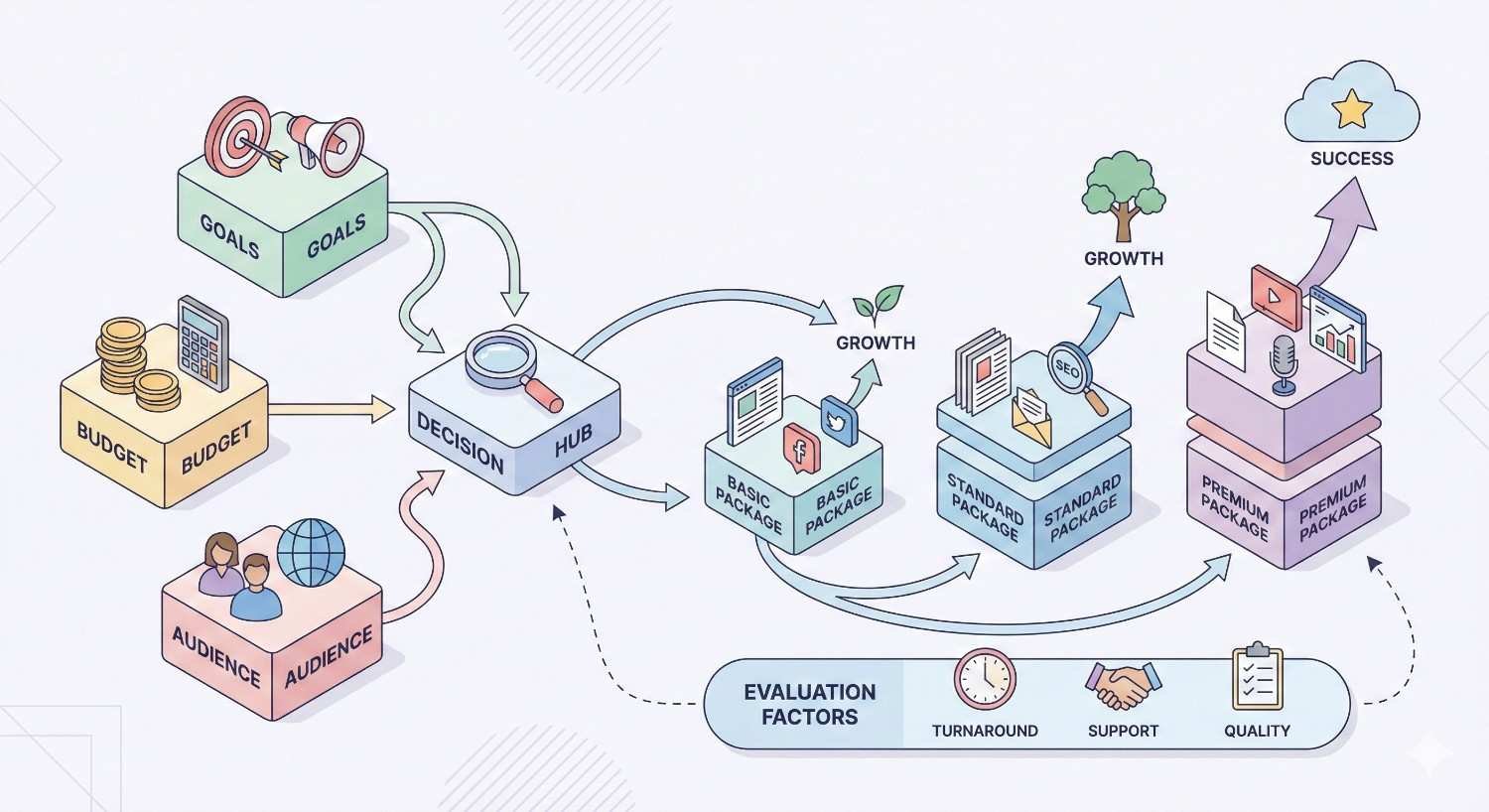
How to Choose the Right Content Writing Package
Selection requires matching package capabilities to your specific situation. Systematic evaluation prevents costly mismatches.
Assessing Your Content Needs and Business Goals
Start with objectives, not tactics. What business outcomes should content support? Lead generation? Brand awareness? Customer education? Sales enablement? Different goals suggest different content approaches.
Audit existing content assets. What do you have? What’s missing? Where are gaps relative to competitors? This assessment reveals whether you need foundational content, ongoing blog production, or specialized materials.
Consider your audience’s content consumption patterns. What formats do they prefer? What questions do they ask? What information do they need at different buying stages? Content should serve audience needs, not just SEO metrics.
Evaluating Package Scope: Volume, Frequency, and Content Types
Volume requirements depend on your goals and competitive landscape. Highly competitive industries may require aggressive publishing. Niche markets might need less volume but higher specialization.
Frequency affects results timelines. More frequent publishing accelerates authority building. However, quality matters more than quantity. Four excellent articles outperform twelve mediocre ones.
Content type mix should align with strategy. Blog content builds traffic. Landing pages drive conversions. Case studies support sales. Ensure packages include the content types your strategy requires.
Understanding Pricing Models and Package Structures
Pricing models vary significantly. Per-word pricing offers transparency but may incentivize padding. Per-article pricing simplifies budgeting but requires clear length expectations. Monthly retainers provide predictability and often include strategic services.
Compare packages on value, not just price. A $2,000 package including strategy, research, and optimization may outperform a $1,500 package offering only writing. Consider total cost of ownership including your team’s time.
Watch for hidden costs. Revision fees, rush charges, and add-on services can inflate actual costs beyond quoted prices. Understand what’s included and what costs extra.
Vetting Content Quality and Writer Expertise
Request samples relevant to your industry and content types. Evaluate writing quality, SEO implementation, and subject matter accuracy. Generic samples may not reflect capability for your specific needs.
Ask about writer backgrounds. What experience do they have in your industry? What training do they receive? How are writers matched to projects? Quality depends on the people doing the work.
Review client testimonials and case studies. Look for results similar to what you’re seeking. Contact references if possible. Past performance indicates future results.
Reviewing SEO Capabilities and Strategic Approach
SEO expertise varies dramatically among content providers. Some offer genuine optimization. Others simply insert keywords without strategic understanding. Evaluate actual SEO capabilities.
Ask about keyword research methodology. What tools do they use? How do they assess competition? How do they identify opportunities? Sophisticated research produces better targeting.
Understand their approach to on-page optimization. Do they optimize meta elements? How do they handle internal linking? Do they consider technical factors? Comprehensive optimization improves results.
Checking Turnaround Times and Revision Policies
Turnaround times affect your publishing schedule. Understand standard delivery timelines and whether rush options exist. Ensure timelines align with your editorial calendar.
Revision policies determine how feedback is handled. How many revision rounds are included? What constitutes a revision versus a rewrite? Clear policies prevent disputes and ensure satisfaction.
Communication expectations matter. How quickly do providers respond? Who is your point of contact? What project management tools do they use? Smooth communication improves the working relationship.
Content Writing Package Pricing: What to Expect
Pricing varies based on multiple factors. Understanding typical ranges helps evaluate whether quotes are reasonable.
Typical Pricing Models (Per Word, Per Article, Monthly Retainer)
Per-word pricing ranges from $0.05 to $0.50+ depending on quality level and specialization. Budget content sits at the low end. Expert-level, industry-specific content commands premium rates.
Per-article pricing typically ranges from $150 to $1,500+ for standard blog posts. Pricing reflects length, research requirements, and expertise needed. Long-form content and technical topics cost more.
Monthly retainers range from $500 to $10,000+ depending on scope. Retainers often include strategic services beyond writing. They provide predictable costs and dedicated attention.
Starter Packages for Small Businesses and Startups
Entry-level packages typically cost $500-$1,500 monthly. They include 2-4 blog posts, basic keyword research, and standard optimization. These packages suit businesses beginning content marketing efforts.
Starter packages build foundation. They establish publishing rhythm and begin accumulating content assets. Results take longer due to lower volume, but they provide affordable entry points.
Limitations exist at this level. Strategic depth may be limited. Writer expertise may be general rather than specialized. Businesses with complex needs may outgrow starter packages quickly.
Growth Packages for Scaling Content Operations
Mid-tier packages range from $2,000-$5,000 monthly. They include 6-12 content pieces, comprehensive keyword research, content strategy, and performance reporting. These packages suit businesses ready to accelerate growth.
Growth packages provide meaningful content velocity. Publishing 8+ pieces monthly builds authority faster. Strategic services ensure content serves business objectives. Reporting enables optimization.
This tier often represents the best value. Volume is sufficient for impact. Services are comprehensive. Pricing remains accessible for most businesses serious about content marketing.
Enterprise Content Packages for Large Organizations
Enterprise packages exceed $5,000 monthly, often reaching $15,000-$50,000+. They include high-volume content production, dedicated teams, advanced strategy, and comprehensive reporting. These packages suit organizations with significant content needs.
Enterprise packages provide scale and sophistication. Dedicated account managers ensure alignment. Multiple writers maintain consistent voice across high volume. Advanced analytics connect content to business outcomes.
Enterprise arrangements often include custom elements. Proprietary processes, exclusive writer teams, and integrated workflows address specific organizational requirements.
Factors That Influence Content Writing Package Costs
Content complexity affects pricing. Technical topics requiring research cost more than general subjects. Specialized industries command premium rates.
Writer expertise influences costs. Experienced writers with industry backgrounds cost more than generalists. Subject matter experts command highest rates.
Service scope determines pricing. Packages including strategy, research, optimization, and reporting cost more than writing-only arrangements. Additional services add value but increase investment.
Volume commitments may reduce per-piece costs. Larger packages often include volume discounts. Long-term contracts may offer better rates than month-to-month arrangements.
Content Writing Packages vs. Other Content Solutions
Understanding alternatives helps determine whether packages are right for your situation.
Content Writing Packages vs. Freelance Writers
Freelancers offer flexibility and potentially lower per-piece costs. You can hire specialists for specific projects. You control the relationship directly.
However, freelancers require management. You provide briefs, manage revisions, and maintain quality standards. Finding reliable freelancers takes time. Availability varies.
Packages reduce management burden. Providers handle writer coordination, quality control, and project management. You receive finished content rather than managing production.
Packages suit businesses wanting consistent output without management overhead. Freelancers suit businesses with variable needs and capacity to manage relationships.
Content Writing Packages vs. In-House Content Teams
In-house teams offer maximum control and brand immersion. Writers understand your business deeply. They’re available for ad-hoc needs. They integrate with other marketing functions.
In-house teams require significant investment. Salaries, benefits, equipment, and management time add up. Hiring takes months. Training extends timelines further.
Packages provide output without employment obligations. They scale up or down easily. They access diverse expertise without hiring multiple specialists.
Packages suit businesses wanting content output without building teams. In-house teams suit businesses with ongoing, diverse content needs and resources to support dedicated staff.
Content Writing Packages vs. Content Agencies
Full-service agencies offer comprehensive marketing services including content. They integrate content with advertising, social media, and other channels. They provide strategic oversight across marketing functions.
Agencies typically cost more than content-focused packages. You pay for capabilities you may not need. Account structures may mean less attention to content specifically.
Content packages focus exclusively on content. Providers specialize in writing and content strategy. Pricing reflects this focused scope.
Packages suit businesses wanting content expertise specifically. Agencies suit businesses wanting integrated marketing services with content as one component.
Content Writing Packages vs. AI Content Tools
AI tools generate content quickly and cheaply. They can produce drafts, suggest topics, and assist with research. Costs are minimal compared to human writing.
AI content has limitations. Quality varies significantly. Factual accuracy requires verification. Content may lack originality and depth. Search engines increasingly identify and potentially devalue AI-generated content.
Packages provide human expertise, creativity, and accountability. Writers research topics, verify facts, and create original perspectives. Quality control ensures standards.
Packages suit businesses prioritizing quality and authenticity. AI tools suit businesses needing high-volume, lower-stakes content or draft assistance for human refinement.
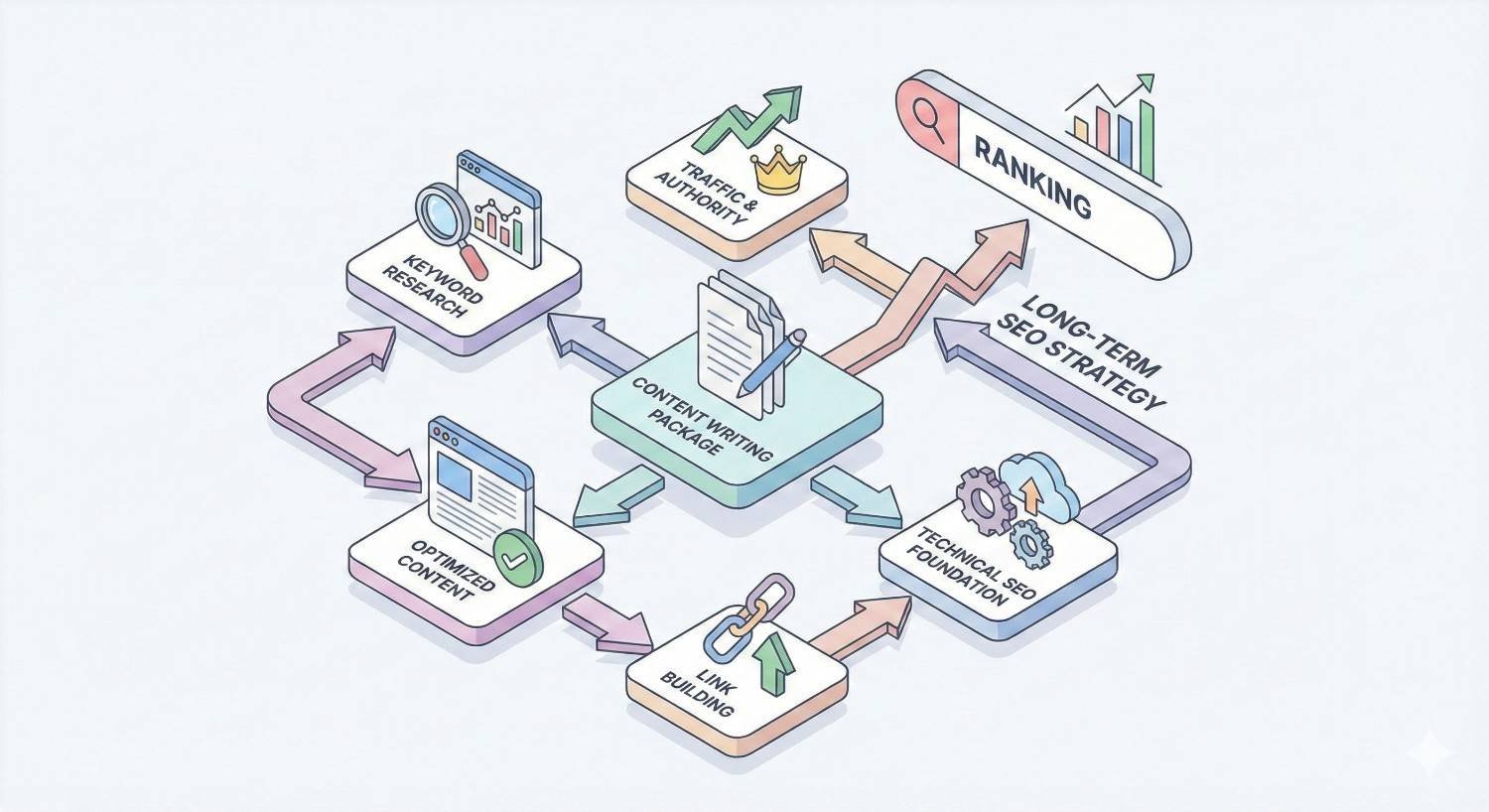
How Content Writing Packages Support Long-Term SEO Strategy
Content packages aren’t isolated tactics. They integrate with broader SEO efforts to build sustainable organic visibility.
Building Topical Authority Through Consistent Publishing
Search engines evaluate expertise through content comprehensiveness. Sites covering topics thoroughly across multiple related pieces demonstrate authority. This topical depth influences rankings across the topic cluster.
Packages enable the consistent publishing topical authority requires. Monthly content production systematically expands topic coverage. Over time, you build comprehensive resources search engines recognize as authoritative.
Authority compounds. Each new piece strengthens the overall topic cluster. Internal links distribute authority across related content. Established authority makes ranking new content easier.
Supporting Technical SEO with Optimized Content Architecture
Content structure affects crawlability and indexation. Proper heading hierarchies help search engines understand content organization. Internal linking distributes page authority and establishes topic relationships.
Packages with strategic components address content architecture. They plan topic clusters and pillar pages. They implement consistent internal linking strategies. They ensure technical elements support SEO goals.
Content and technical SEO work together. Great content on a poorly structured site underperforms. Technical excellence without quality content lacks ranking material. Packages bridge this gap.
Enhancing Link Acquisition Through Linkable Assets
Backlinks remain important ranking factors. Quality content attracts links naturally. Comprehensive resources, original research, and valuable tools earn citations from other sites.
Packages can include linkable asset creation. Long-form guides, data-driven content, and industry resources attract links. These assets support broader link building efforts.
Content quality determines link potential. Thin, generic content rarely earns links. Comprehensive, unique content provides value worth referencing. Packages focused on quality produce more linkable assets.
Aligning Content Packages with User Journey and Conversion Funnels
Effective content addresses users at different buying stages. Awareness content introduces problems and solutions. Consideration content compares options. Decision content supports purchase choices.
Strategic packages map content to journey stages. They ensure coverage across the funnel. They create content supporting both traffic acquisition and conversion.
This alignment improves ROI. Traffic without conversion wastes resources. Conversion content without traffic has no audience. Balanced packages address both needs.
Measuring Success: KPIs and Performance Metrics for Content Packages
Measurement validates investment and guides optimization. Understanding relevant metrics ensures you’re tracking what matters.
Organic Traffic Growth and Keyword Rankings
Traffic measures content reach. Monitor organic sessions, users, and pageviews. Track growth trends over time. Compare performance to pre-package baselines.
Keyword rankings indicate search visibility. Track positions for target keywords. Monitor ranking improvements and new keyword acquisitions. Note featured snippet captures.
These metrics connect directly to content efforts. Traffic growth validates content effectiveness. Ranking improvements demonstrate SEO impact.
Engagement Metrics: Time on Page, Bounce Rate, Pages per Session
Engagement indicates content quality. Time on page suggests readers find content valuable. Low bounce rates indicate content meets expectations. Pages per session shows content encourages exploration.
Engagement metrics help identify content issues. High bounce rates may indicate misaligned intent or poor quality. Low time on page suggests content doesn’t engage readers.
Use engagement data to improve future content. Identify characteristics of high-performing pieces. Apply insights to content briefs and strategy.
Conversion Metrics: Leads, Sign-ups, and Revenue Attribution
Conversions connect content to business outcomes. Track leads generated from organic traffic. Monitor sign-ups, downloads, and other conversion actions. Attribute revenue to content-driven traffic where possible.
Conversion tracking requires proper analytics setup. Goal tracking in Google Analytics captures conversion events. Attribution models connect conversions to content touchpoints.
Conversion metrics justify content investment. Traffic without conversions has limited business value. Demonstrating lead generation and revenue impact supports continued investment.
Content Performance Reporting and Optimization Cycles
Regular reporting synthesizes metrics into insights. Monthly or quarterly reports should cover traffic, rankings, engagement, and conversions. Reports should identify trends and recommend adjustments.
Optimization cycles improve performance over time. Analyze what’s working and what isn’t. Update underperforming content. Double down on successful approaches.
Effective packages include reporting and optimization. Providers should deliver regular performance updates. They should recommend strategy adjustments based on data.
Timeline Expectations: When to See Results from Content Packages
Content marketing requires patience. New content typically takes 3-6 months to rank and generate meaningful traffic. Authority building takes longer. Expect 6-12 months before seeing significant cumulative results.
Early indicators appear sooner. Indexation happens within days or weeks. Initial rankings may appear within 1-2 months. Traffic begins building as rankings improve.
Set realistic expectations. Content is a long-term investment, not a quick fix. Packages that promise immediate results likely can’t deliver. Sustainable growth takes time.
Common Mistakes to Avoid When Purchasing Content Writing Packages
Awareness of common pitfalls helps you avoid costly errors.
Choosing Packages Based on Price Alone
Low prices often indicate low quality. Cheap content may be poorly written, inadequately researched, or ineffectively optimized. It may damage your brand rather than building it.
Value matters more than price. A $3,000 package producing results outperforms a $1,000 package that doesn’t. Calculate cost per result, not just cost per piece.
Budget appropriately for your goals. Ambitious growth targets require adequate investment. Underfunding content efforts produces disappointing results.
Neglecting Content Strategy and Keyword Research
Writing without strategy produces random content. Topics may not align with search demand. Content may not serve business objectives. Resources are wasted on low-potential efforts.
Insist on strategic foundations. Packages should include keyword research and topic planning. Content should target identified opportunities. Strategy should connect to business goals.
Strategy multiplies content effectiveness. The same writing effort produces better results when strategically directed. Don’t skip this foundation.
Failing to Align Content with Business Goals
Content should serve business purposes. Traffic without relevance to your offerings has limited value. Content attracting wrong audiences wastes resources.
Define success in business terms. What outcomes should content produce? Leads? Sales? Brand awareness? Ensure content strategy targets these outcomes.
Review content plans against business objectives. Does proposed content attract your target audience? Does it support their buying journey? Does it differentiate your offerings?
Overlooking Quality Control and Editorial Standards
Poor quality content damages credibility. Errors, inaccuracies, and weak writing reflect poorly on your brand. Low-quality content may not rank regardless of optimization.
Evaluate quality processes. How do providers ensure accuracy? What editorial review occurs? How are standards maintained across writers?
Request quality guarantees. Revision policies should address quality issues. Providers should stand behind their work. Don’t accept substandard content.
Not Tracking Performance or Adjusting Strategy
Untracked content can’t be optimized. Without data, you can’t identify what works. Resources continue flowing to ineffective approaches.
Implement tracking from the start. Set up analytics properly. Define KPIs aligned with goals. Monitor performance regularly.
Use data to improve. Adjust strategy based on results. Optimize underperforming content. Scale successful approaches. Continuous improvement maximizes ROI.
How to Maximize ROI from Your Content Writing Package
Active participation improves package outcomes. These practices help you get maximum value from your investment.
Providing Clear Briefs and Brand Guidelines
Quality input produces quality output. Detailed briefs help writers understand expectations. Brand guidelines ensure consistent voice and messaging.
Develop comprehensive brand documentation. Include voice guidelines, terminology preferences, and messaging frameworks. Share examples of content you admire.
Invest time in briefing. Answer writer questions thoroughly. Provide context about your audience and objectives. Better briefs produce better content.
Integrating Content with Broader Marketing Initiatives
Content shouldn’t exist in isolation. Coordinate with other marketing activities. Align content topics with campaigns. Support product launches with relevant content.
Share marketing calendars with content providers. Inform them of upcoming initiatives. Request content supporting broader efforts.
Integration multiplies impact. Content supporting campaigns reaches larger audiences. Coordinated messaging reinforces key themes. Integrated efforts outperform siloed activities.
Repurposing and Amplifying Published Content
Single-use content wastes potential. Blog posts can become social content, email newsletters, or video scripts. Long-form content can be broken into multiple pieces.
Plan repurposing from the start. Consider how content can be adapted. Request formats supporting multiple uses. Build repurposing into content workflows.
Amplification extends reach. Promote content through social channels. Include in email marketing. Consider paid promotion for high-value pieces.
Maintaining Regular Communication with Your Content Provider
Ongoing communication improves results. Share feedback on published content. Inform providers of business changes. Discuss performance data together.
Establish communication rhythms. Regular check-ins maintain alignment. Quarterly reviews assess strategy. Ad-hoc communication addresses immediate needs.
Treat providers as partners. Share context they need to succeed. Involve them in planning. Value their expertise and recommendations.
Continuously Optimizing Based on Performance Data
Static strategies underperform. Markets change. Competitors adapt. Search algorithms evolve. Continuous optimization maintains effectiveness.
Review performance data regularly. Identify trends and patterns. Note what’s working and what isn’t. Develop hypotheses for improvement.
Implement changes systematically. Test new approaches. Measure results. Scale successes. Abandon failures. Continuous improvement compounds over time.
Industry-Specific Content Writing Package Considerations
Different industries have unique content requirements. Understanding these helps select appropriate packages.
Content Packages for SaaS and Technology Companies
SaaS content must explain complex products clearly. Technical accuracy matters. Content should address different user sophistication levels.
Effective SaaS packages include product-focused content, educational resources, and comparison content. Writers should understand software concepts and user workflows.
Consider documentation and help content alongside marketing content. Comprehensive content programs address both acquisition and retention.
Content Packages for E-commerce and Retail
E-commerce content drives product discovery and purchase decisions. Product descriptions, category content, and buying guides support sales.
Volume requirements are often high. Hundreds or thousands of products need descriptions. Scalable processes maintain quality across volume.
Seasonal content planning matters. Holiday shopping, sales events, and trend cycles require timely content. Packages should accommodate seasonal variations.
Content Packages for Healthcare and Medical Practices
Healthcare content requires accuracy and compliance awareness. Medical claims must be substantiated. Content should follow regulatory guidelines.
Writers need healthcare backgrounds or extensive research capabilities. Fact-checking processes must be rigorous. Legal review may be necessary.
Patient education content differs from marketing content. Both serve important purposes. Packages should address appropriate content types for healthcare contexts.
Content Packages for Legal and Financial Services
Legal and financial content faces regulatory scrutiny. Disclaimers and disclosures may be required. Accuracy is essential given potential liability.
Writers should understand industry terminology and compliance requirements. Content should be reviewed for regulatory alignment.
Trust-building content matters in these industries. Thought leadership, educational resources, and credibility-building content support client acquisition.
Content Packages for B2B and Professional Services
B2B content addresses longer sales cycles and multiple decision-makers. Content should serve different stakeholders with different concerns.
Thought leadership establishes expertise. Case studies demonstrate results. Technical content addresses implementation concerns.
B2B packages often include diverse content types. Blog content, whitepapers, case studies, and sales enablement materials may all be needed.
Questions to Ask Before Committing to a Content Writing Package
Due diligence prevents disappointment. These questions help evaluate potential providers.
What is your content creation process?
Understanding process reveals professionalism. Established providers have documented workflows. They can explain how content moves from concept to publication.
Look for strategic elements. Does the process include research? How is content planned? What optimization occurs?
Process consistency indicates reliability. Ad-hoc approaches produce inconsistent results. Systematic processes deliver predictable quality.
Who will be writing my content?
Writer quality determines content quality. Understand who will actually produce your content. What are their backgrounds? What experience do they have?
Ask about writer selection. How are writers matched to projects? What happens if a writer isn’t working out?
Consistency matters. Rotating writers may produce inconsistent voice. Dedicated writers develop brand understanding over time.
How do you handle revisions and feedback?
Revision policies affect satisfaction. Understand how many rounds are included. What constitutes a revision versus a rewrite?
Feedback processes should be clear. How do you submit feedback? What turnaround is expected? How are disputes resolved?
Reasonable revision policies protect both parties. Unlimited revisions may indicate unclear processes. No revisions suggests inflexibility.
What SEO tools and research methods do you use?
Tool usage indicates sophistication. Professional providers use industry-standard tools like Ahrefs, Semrush, or similar platforms.
Research methodology matters. How do they identify keywords? How do they assess competition? How do they validate opportunities?
Ask for examples. How would they approach research for your industry? What opportunities might they identify?
Can you provide samples and case studies?
Samples demonstrate capability. Request examples relevant to your industry and content types. Evaluate quality, optimization, and style.
Case studies show results. What outcomes have they achieved for similar clients? What metrics improved? Over what timeframe?
References provide validation. Can you speak with current or past clients? What was their experience?
What are the contract terms and cancellation policies?
Contract terms affect flexibility. Understand commitment length, payment terms, and renewal processes.
Cancellation policies matter. What notice is required? Are there penalties? What happens to in-progress content?
Protect your interests. Avoid long commitments before proving fit. Ensure reasonable exit options if the relationship doesn’t work.
Getting Started with Content Writing Packages
Beginning a content package relationship involves several stages. Understanding the process sets appropriate expectations.
Initial Consultation and Content Audit
Engagements typically begin with discovery. Providers learn about your business, goals, and current content situation. You evaluate their approach and capabilities.
Content audits assess existing assets. What content do you have? What’s performing? What gaps exist? Audits inform strategy development.
Use consultations to evaluate fit. Do they understand your business? Do they ask good questions? Do their recommendations make sense?
Defining Goals, KPIs, and Success Metrics
Clear goals enable measurement. Define what success looks like. Establish specific, measurable objectives.
KPIs should connect to business outcomes. Traffic goals should relate to lead generation. Ranking targets should focus on valuable keywords.
Document agreed metrics. Both parties should understand how success will be measured. This prevents disputes and enables accountability.
Onboarding Process and Timeline Setup
Onboarding transfers necessary information. Providers need brand guidelines, access credentials, and background materials. Thorough onboarding improves content quality.
Timeline establishment sets expectations. When will content production begin? What’s the delivery schedule? How long until results appear?
Allow adequate onboarding time. Rushing produces problems. Proper setup pays dividends throughout the engagement.
First 90 Days: What to Expect from Your Content Package
The first 90 days establish foundation. Strategy development, initial content production, and process refinement occur during this period.
Expect learning curves. Writers develop brand understanding. Processes get refined. Feedback loops improve quality.
Results take time. Don’t expect significant traffic or ranking improvements immediately. Focus on content quality and process effectiveness initially.
Evaluate progress at 90 days. Is content quality meeting standards? Are processes working smoothly? Is the relationship productive? Adjust as needed.
Conclusion
Content writing packages transform content from sporadic activity into strategic growth engine. They provide consistent, optimized content at predictable costs while building the topical authority search engines reward.
Selecting the right package requires matching capabilities to your specific goals, industry, and resources. Evaluation should consider quality, strategy, and value rather than price alone.
We help businesses build sustainable organic growth through strategic content packages. Contact White Label SEO Service to discuss how content writing packages can support your growth objectives.
Frequently Asked Questions
How long does it take to see results from content writing packages?
Most businesses see initial ranking improvements within 3-4 months of consistent publishing. Significant traffic growth typically emerges at 6-12 months as content accumulates and authority builds. Patience is essential since content marketing compounds over time.
What’s the difference between cheap and premium content writing packages?
Premium packages include strategic services like keyword research, content planning, and performance tracking alongside higher-quality writing. Cheap packages often provide only basic writing without optimization or strategy. The difference shows in results, not just word counts.
How many blog posts per month do I need for SEO results?
Publishing frequency depends on your competitive landscape and goals. Most businesses see meaningful results with 4-8 quality posts monthly. Highly competitive industries may require more. Quality matters more than quantity, so prioritize comprehensive, well-optimized content over volume.
Can content writing packages work for technical or specialized industries?
Yes, but you need packages with relevant expertise. Look for providers with writers experienced in your industry. Request samples demonstrating technical accuracy. Specialized packages cost more but produce credible content that builds authority with knowledgeable audiences.
What should I provide to get the best results from my content package?
Provide comprehensive brand guidelines, target audience information, and business context. Share examples of content you admire. Respond promptly to questions and provide thorough feedback. The more context writers have, the better they can serve your needs.
How do I measure ROI from content writing packages?
Track organic traffic growth, keyword rankings, and conversions from organic visitors. Calculate cost per organic visitor and cost per lead. Compare content investment to equivalent paid advertising costs. Most businesses find content delivers better long-term ROI than paid channels.
What happens if I’m not satisfied with the content quality?
Quality packages include revision rounds to address concerns. Communicate specific feedback about what needs improvement. If quality issues persist despite feedback, discuss with your provider or consider alternatives. Don’t accept content that doesn’t meet your standards.