

Choosing between a freelance content writer and a content writing agency directly impacts your SEO results, content consistency, and marketing ROI. The right decision depends on your budget, content volume needs, turnaround requirements, and long-term growth strategy.
This comparison matters now more than ever. Content production demands have increased dramatically, with businesses publishing more blog posts, landing pages, and thought leadership pieces to compete for organic visibility. Making the wrong choice can mean wasted budget, inconsistent brand voice, or missed ranking opportunities.
This guide breaks down how freelancers and agencies operate, compares costs and quality, identifies when each option makes sense, and shows you how to evaluate both. You’ll walk away with a clear framework for making this decision confidently.
What Is Freelance Content Writing?
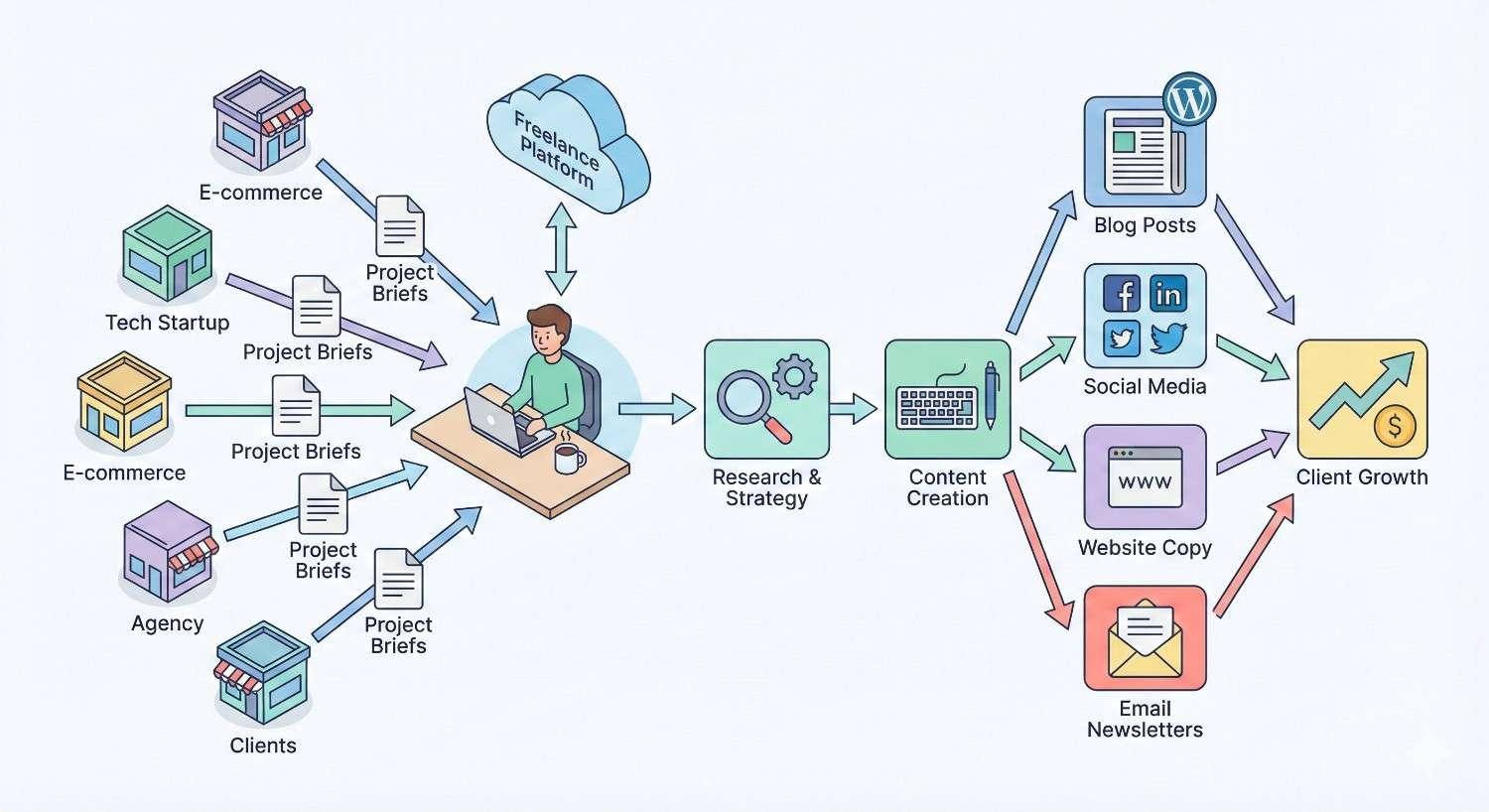
Freelance content writing involves hiring independent writers who work on a project-by-project or retainer basis. These professionals operate their own businesses, managing client relationships, deadlines, and deliverables without the infrastructure of a larger organization.
Freelancers range from generalists who write across multiple industries to specialists with deep expertise in specific niches like SaaS, healthcare, finance, or e-commerce. The freelance content market has grown substantially, with platforms like Upwork, Contently, and LinkedIn making it easier than ever to connect with qualified writers.
How Freelance Writers Operate
Freelance writers typically manage every aspect of their business independently. They handle client acquisition, project scoping, research, writing, revisions, invoicing, and communication. Most work remotely and serve multiple clients simultaneously.
The workflow usually starts with a discovery call or brief where the writer learns about your brand, audience, and content goals. From there, they develop content based on your guidelines, submit drafts for review, and incorporate feedback. Some freelancers use project management tools like Asana or Trello, while others rely on email and shared documents.
Communication frequency varies by writer. Some provide regular updates and are highly responsive. Others work more independently and deliver completed work by the deadline with minimal check-ins. Setting clear expectations upfront about communication preferences prevents misalignment later.
Typical Freelance Content Services
Freelance writers offer a wide range of content services depending on their skills and specialization:
Blog posts and articles remain the most common deliverable. Writers create SEO-optimized content designed to rank for target keywords and drive organic traffic.
Website copy includes homepage content, service pages, about pages, and landing pages. This requires understanding conversion principles and brand voice.
Email marketing content covers newsletters, drip campaigns, and promotional sequences. Strong email writers understand segmentation and persuasion techniques.
Social media content includes post copy, captions, and content calendars. Some writers specialize exclusively in social platforms.
White papers and ebooks require deeper research and longer-form writing skills. These assets typically support lead generation efforts.
Case studies and testimonials showcase client success stories. Writers interview customers and craft compelling narratives.
Product descriptions serve e-commerce businesses needing scalable catalog content.
Freelance Writer Pricing Models
Freelance writers use several pricing structures, each with distinct advantages:
Per-word pricing charges a set rate for each word written. Rates typically range from $0.10 to $1.00+ per word depending on expertise, niche complexity, and writer reputation. A 1,500-word blog post at $0.25 per word costs $375.
Per-project pricing sets a flat fee for each deliverable regardless of word count. This model works well when scope is clearly defined. A standard blog post might cost $150 to $500+ depending on research requirements and writer experience.
Hourly pricing charges for time spent rather than output. Rates range from $25 to $150+ per hour. This model suits ongoing relationships or projects with variable scope.
Retainer agreements guarantee a set number of deliverables or hours monthly for a fixed fee. Retainers typically offer slight discounts compared to project rates and ensure writer availability.
What Is Agency Content Writing?
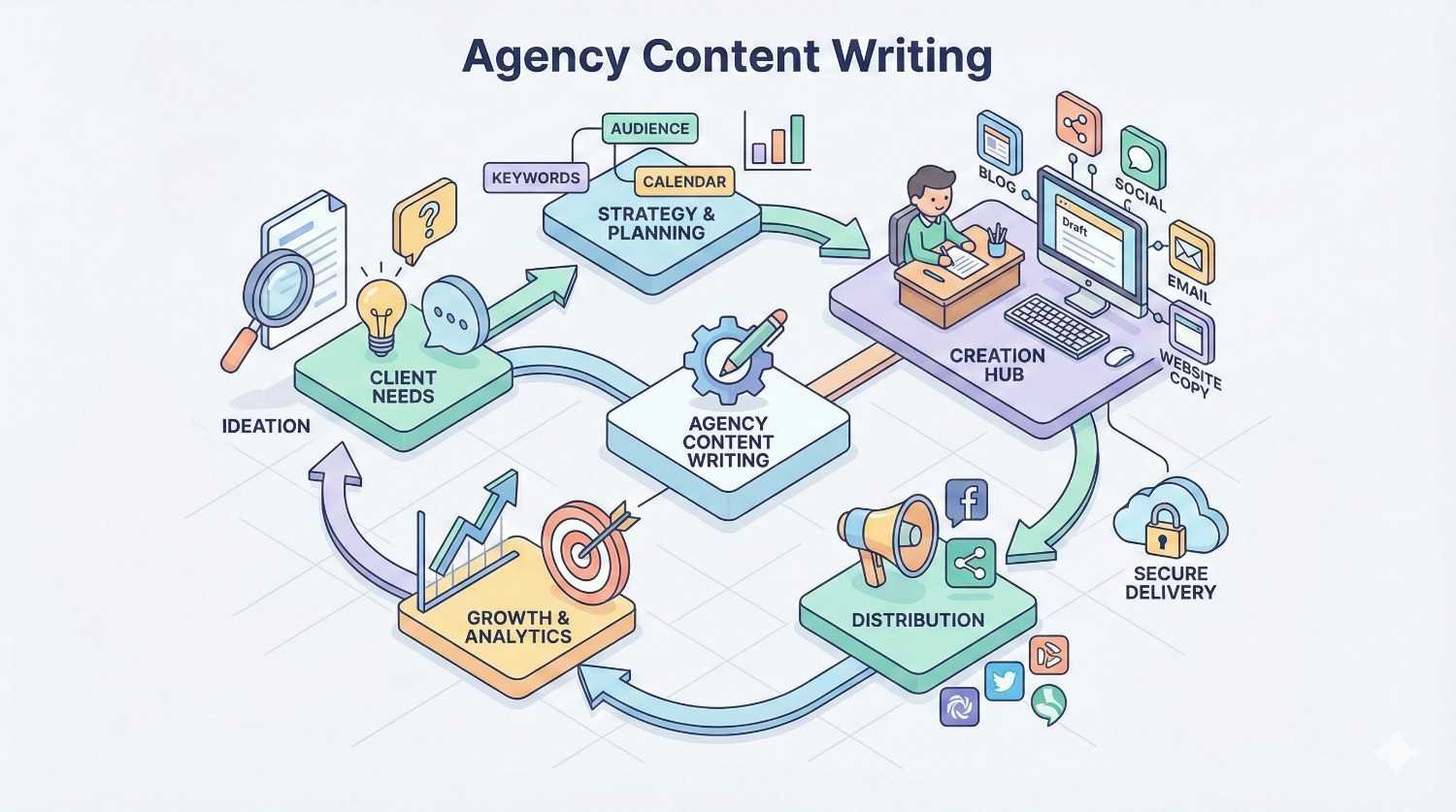
Content writing agencies are companies that employ or contract multiple writers, editors, strategists, and project managers to deliver content services at scale. Agencies provide a team-based approach with built-in quality control, strategic oversight, and operational infrastructure.
Agencies range from boutique firms with specialized focus areas to large-scale content production companies serving enterprise clients. The agency model prioritizes consistency, scalability, and comprehensive service delivery over the individual relationship dynamic of freelance work.
How Content Agencies Operate
Agencies structure their operations around teams and processes. A typical agency workflow involves multiple roles:
Account managers serve as your primary contact, handling communication, project coordination, and relationship management. They translate your needs into actionable briefs for the production team.
Content strategists develop editorial calendars, keyword strategies, and content plans aligned with your business goals. They ensure content serves broader marketing objectives.
Writers create the actual content based on briefs and guidelines. Agencies often match writers to projects based on industry expertise and writing style.
Editors review all content for quality, accuracy, brand voice consistency, and SEO optimization before delivery. This quality control layer distinguishes agencies from individual freelancers.
SEO specialists may handle keyword research, on-page optimization recommendations, and performance tracking. Not all agencies include this function.
The agency model emphasizes process standardization. Style guides, brand voice documents, approval workflows, and revision protocols ensure consistent output regardless of which team members work on your projects.
Typical Agency Content Services
Agencies typically offer broader service packages than individual freelancers:
Full-service content marketing includes strategy development, content creation, distribution planning, and performance analysis. This comprehensive approach treats content as an integrated marketing function.
SEO content programs combine keyword research, content briefs, optimized writing, and ongoing performance tracking. Agencies often guarantee specific deliverable volumes monthly.
Content audits and strategy evaluate existing content, identify gaps, and develop roadmaps for improvement. This strategic work informs ongoing content production.
Multi-format content production delivers blog posts, landing pages, email sequences, social content, and downloadable assets as coordinated campaigns rather than isolated pieces.
Content localization and translation adapts content for different markets, languages, and cultural contexts. Larger agencies maintain networks of native-language writers.
Video scripts and multimedia content support video marketing initiatives with scripting, storyboarding, and production guidance.
Agency Pricing Structures
Agency pricing reflects their higher overhead and comprehensive service delivery:
Monthly retainers represent the most common agency pricing model. Retainers typically start at $2,000 to $5,000 monthly for smaller agencies and can exceed $10,000 to $50,000+ monthly for enterprise-level services. Retainers include a defined scope of deliverables and services.
Project-based pricing applies to defined initiatives like website relaunches, content audits, or campaign-specific content. Projects might range from $5,000 to $50,000+ depending on scope and complexity.
Per-piece pricing charges for individual content assets, though rates are higher than freelance equivalents. Agency blog posts typically cost $300 to $1,000+ each, reflecting the multi-person production process.
Performance-based models tie compensation to results like traffic growth, lead generation, or ranking improvements. These arrangements are less common and typically supplement base retainers.
Key Differences Between Freelance and Agency Content Writing
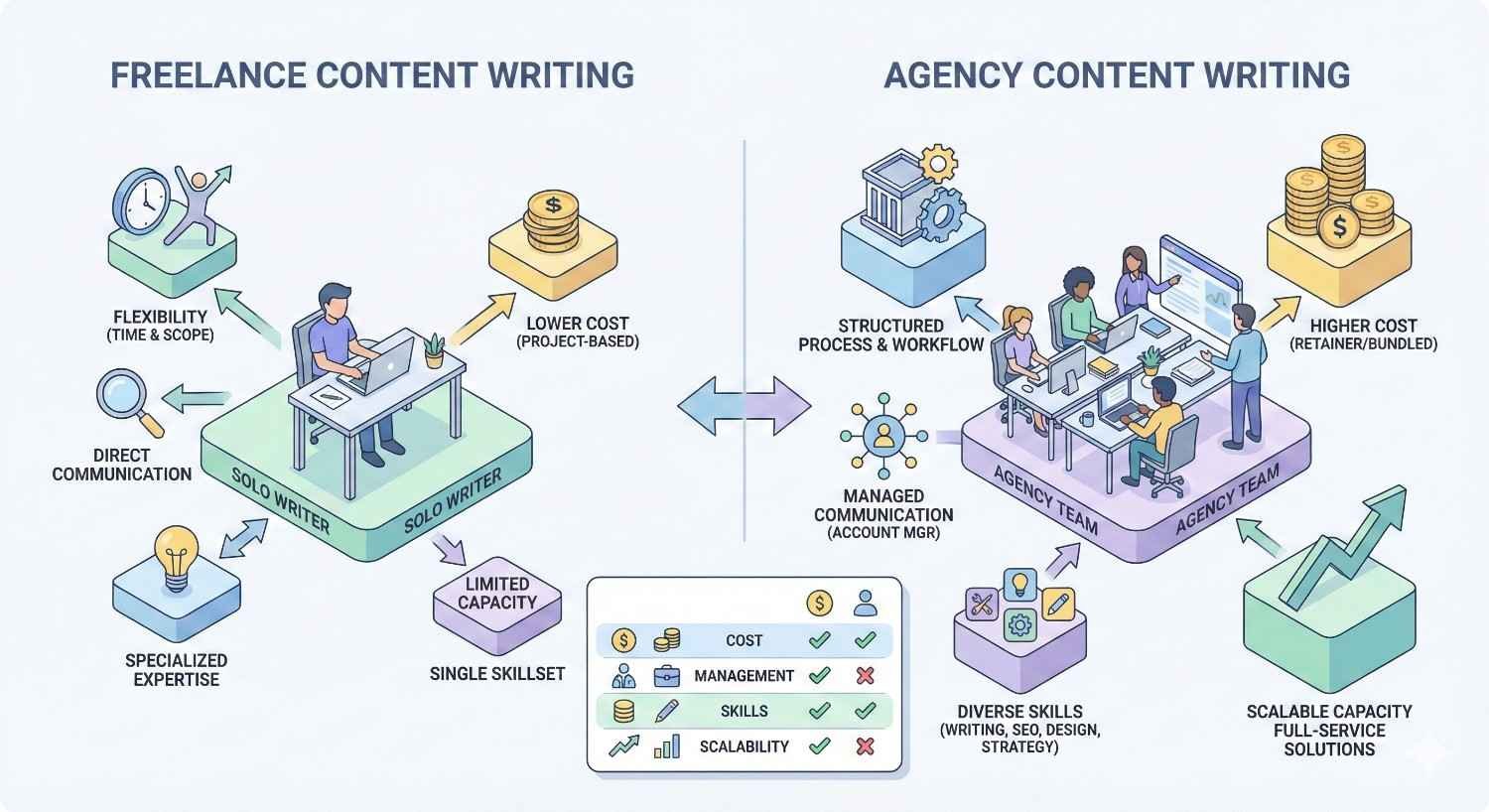
Understanding the fundamental differences between freelancers and agencies helps you match the right solution to your specific situation. These differences span cost, quality, capacity, communication, reliability, and expertise.
Cost Comparison
Freelancers generally cost less per deliverable than agencies. A freelance blog post might cost $200 to $400, while an agency charges $400 to $800 for comparable content. This difference reflects agency overhead including management, quality control, and operational infrastructure.
However, total cost comparison requires looking beyond per-piece pricing. Agencies often include services that freelancers charge separately for or don’t offer at all. Strategy development, editorial calendars, SEO optimization, and performance reporting may be bundled into agency retainers but represent additional costs with freelancers.
Budget efficiency depends on your needs. If you need straightforward content production with minimal strategic support, freelancers deliver better cost efficiency. If you need comprehensive content marketing services, agency pricing may represent better value despite higher absolute costs.
Consider hidden costs as well. Managing freelancers requires your time for briefing, feedback, and coordination. Agencies absorb this management overhead. Your time has value that should factor into total cost calculations.
Quality and Consistency
Quality varies significantly within both categories. Exceptional freelancers produce work matching or exceeding agency output. Mediocre agencies deliver inconsistent content despite their processes. Generalizations about quality based solely on freelancer versus agency status are unreliable.
That said, agencies offer structural advantages for consistency. Multiple review layers catch errors and ensure brand voice adherence. Style guides and documented processes maintain standards across different writers. When your primary writer is unavailable, agencies seamlessly assign alternatives.
Freelancers provide consistency through individual relationship depth. A freelancer who knows your brand intimately may capture your voice better than rotating agency writers. However, this consistency depends entirely on that specific person’s availability and continued engagement.
For brand-critical content, agencies reduce risk through redundancy. For specialized content requiring deep expertise, the right freelancer may deliver superior quality.
Scalability and Capacity
Agencies excel at scaling content production. Need to increase from 4 blog posts monthly to 20? Agencies assign additional writers and adjust workflows. Their infrastructure supports volume fluctuations without proportional increases in your management burden.
Freelancers face inherent capacity constraints. Individual writers can only produce so much content while maintaining quality. Scaling with freelancers means hiring additional writers, each requiring onboarding, relationship building, and ongoing management.
Rapid scaling favors agencies. If you anticipate significant content volume increases, agency partnerships provide flexibility. If your needs are stable and predictable, freelancer capacity limitations matter less.
Consider also the inverse scenario. Agencies may require minimum commitments that don’t suit businesses with variable or declining content needs. Freelancers offer more flexibility to scale down without contractual complications.
Communication and Project Management
Freelancer communication is direct but requires your involvement. You communicate directly with the person creating your content, enabling nuanced feedback and relationship building. However, you’re responsible for project management, deadline tracking, and coordination.
Agency communication flows through account managers. This adds a layer between you and writers but centralizes project management. Account managers handle scheduling, writer coordination, and delivery tracking. You receive a single point of contact rather than managing multiple relationships.
Communication preferences vary by organization. Lean teams often prefer direct freelancer relationships. Larger marketing departments benefit from agency project management infrastructure. Neither approach is inherently superior.
Response times and availability also differ. Freelancers may have limited availability during peak periods or personal commitments. Agencies maintain coverage through team depth, though your specific account manager may still have availability constraints.
Turnaround Time and Reliability
Agencies typically offer more predictable turnaround times. Their team structure provides backup capacity when individual writers face delays. Established processes and dedicated project management reduce delivery variability.
Freelancer reliability depends entirely on the individual. Highly professional freelancers meet deadlines consistently. Others struggle with time management or overcommit to multiple clients. Vetting freelancers thoroughly reduces but doesn’t eliminate reliability risk.
Rush projects favor agencies. When you need content quickly, agencies can often mobilize additional resources. Freelancers may lack capacity for urgent requests, especially if they’re managing other client commitments.
For planned, predictable content needs, reliability differences diminish. Both freelancers and agencies can deliver consistently when given adequate lead time and clear expectations.
Expertise and Specialization
Freelancers often offer deeper niche expertise. Writers who specialize in specific industries develop substantial subject matter knowledge. A freelancer focused exclusively on B2B SaaS content likely understands that space better than a generalist agency writer.
Agencies offer breadth across multiple specializations. Larger agencies maintain writer networks spanning various industries and content types. They can match projects to writers with relevant expertise, though depth may not match dedicated specialists.
Technical and regulated industries often benefit from specialized freelancers. Healthcare, finance, legal, and technical content requires writers who understand compliance requirements and industry terminology. Finding these specialists as freelancers may be easier than finding agencies with equivalent depth.
For general business content without specialized requirements, agency writer pools provide adequate expertise with operational advantages.
Pros and Cons of Hiring Freelance Content Writers
Evaluating freelancers requires understanding both their advantages and limitations. The right freelancer relationship can deliver exceptional results, but the wrong one creates frustration and wasted resources.
Advantages of Freelance Writers
Lower costs per deliverable make freelancers attractive for budget-conscious businesses. Without agency overhead, freelancers can offer competitive rates while still earning sustainable income.
Direct relationships enable nuanced communication and deep brand understanding. Working directly with your writer builds rapport and institutional knowledge that improves content quality over time.
Specialized expertise is often more accessible through freelancers. Writers who focus on specific niches develop expertise that generalist agencies can’t match.
Flexibility in engagement allows you to scale up or down without contractual complications. Project-based work doesn’t require long-term commitments.
Faster iteration happens when you communicate directly with the creator. Feedback loops shorten without intermediary layers.
Diverse perspectives come from working with multiple freelancers. Different writers bring varied approaches and ideas to your content.
Disadvantages of Freelance Writers
Capacity limitations constrain how much content a single freelancer can produce. Scaling requires hiring additional writers with associated management overhead.
Reliability variability means some freelancers miss deadlines or deliver inconsistent quality. Thorough vetting reduces but doesn’t eliminate this risk.
Management burden falls on you. Briefing, feedback, coordination, and quality control require your time and attention.
No backup coverage means your content production stops if your freelancer becomes unavailable. Illness, vacations, or other commitments create gaps.
Limited service scope typically excludes strategy, project management, and comprehensive content marketing services. You may need to source these separately.
Quality control responsibility rests with you. Without editorial layers, errors may reach publication if you don’t catch them.
Pros and Cons of Hiring a Content Writing Agency
Agencies offer a different value proposition with corresponding tradeoffs. Understanding these helps you determine whether agency partnership aligns with your needs.
Advantages of Content Agencies
Scalability and capacity allow agencies to handle volume fluctuations without proportional increases in your management effort. Need more content? They assign additional resources.
Built-in quality control through editorial review processes catches errors and ensures consistency. Multiple eyes review content before delivery.
Comprehensive services often include strategy, SEO optimization, project management, and performance tracking alongside content creation.
Reliability through redundancy means content production continues even when individual team members are unavailable. Agencies maintain backup capacity.
Professional project management handles scheduling, coordination, and delivery tracking. You receive organized, predictable service.
Established processes ensure consistent output quality and brand voice adherence across different writers and projects.
Disadvantages of Content Agencies
Higher costs reflect agency overhead including management, facilities, and operational infrastructure. You pay for services beyond pure content creation.
Less direct communication with writers can limit nuanced feedback and relationship building. Account managers mediate interactions.
Potential for generic content exists when agencies prioritize volume over deep brand understanding. Rotating writers may not capture your unique voice.
Minimum commitments often apply to agency retainers. You may pay for capacity you don’t fully utilize.
Slower iteration can result from multi-layer approval processes. Changes require coordination across team members.
Variable writer quality within agencies means your content quality depends on which writers are assigned to your account.
When to Choose a Freelance Writer
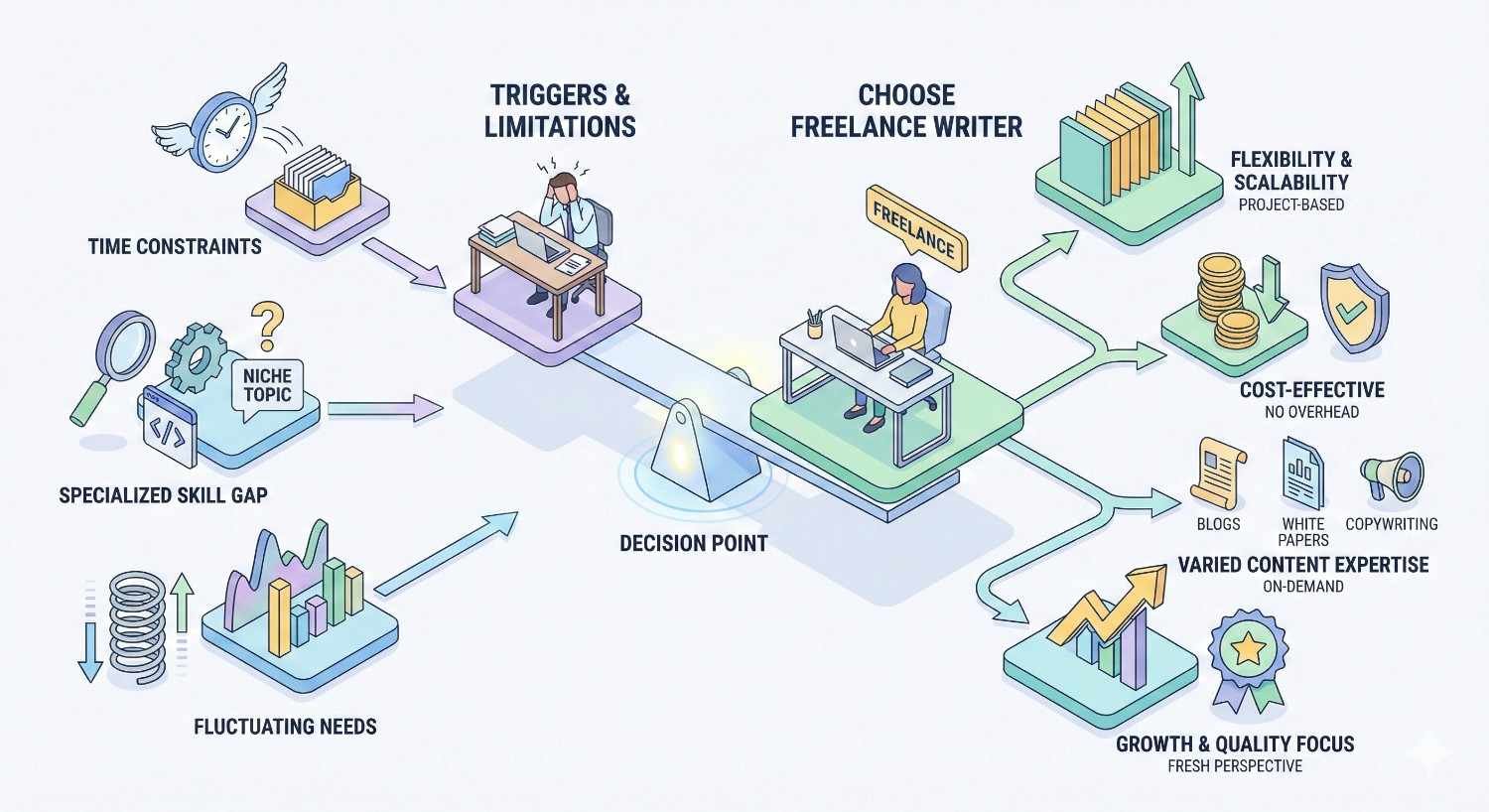
Certain situations favor freelance partnerships over agency relationships. Recognizing these scenarios helps you make the right choice for your specific circumstances.
Best Scenarios for Freelancers
Limited budgets make freelancers the practical choice. When agency retainers exceed your content marketing budget, freelancers deliver results within financial constraints.
Specialized content needs often align better with freelance expertise. Technical, regulated, or niche industry content benefits from writers with deep subject matter knowledge.
Low to moderate content volume doesn’t justify agency infrastructure. If you need a few blog posts monthly, freelancer relationships provide adequate capacity.
Direct creative collaboration matters when you want hands-on involvement in content development. Working directly with writers enables nuanced creative direction.
Testing content marketing before major investment suits freelance flexibility. Start with project-based freelance work to validate content strategy before committing to agency retainers.
Specific voice requirements may be better served by individual writers who can develop deep brand understanding through direct relationship.
Business Types That Benefit from Freelancers
Startups and early-stage companies typically lack budgets for agency retainers. Freelancers provide professional content within startup financial constraints.
Solopreneurs and small businesses often prefer direct relationships over corporate agency interactions. Freelancers offer personalized service matching small business culture.
Niche B2B companies in specialized industries benefit from freelancers with relevant expertise. Finding writers who understand complex products or services is often easier in freelance markets.
Companies with strong internal marketing teams may only need content creation support. If you have strategy and project management covered internally, freelancers fill the production gap efficiently.
Businesses with variable content needs appreciate freelance flexibility. Scale up for campaigns, scale down during quiet periods without contractual complications.
When to Choose a Content Writing Agency
Agency partnerships make sense under different circumstances. Understanding when agencies deliver superior value helps you invest appropriately.
Best Scenarios for Agencies
High content volume requirements justify agency infrastructure. When you need dozens of content pieces monthly, agencies provide scalable production capacity.
Comprehensive content marketing needs align with agency service breadth. If you need strategy, production, optimization, and reporting, agencies deliver integrated solutions.
Limited internal marketing resources make agency project management valuable. When you can’t dedicate staff to content coordination, agencies absorb this function.
Consistency across large content programs benefits from agency processes. Style guides, editorial review, and standardized workflows maintain quality at scale.
Rapid scaling requirements favor agency flexibility. When content needs may increase significantly, agencies can mobilize additional resources quickly.
Risk mitigation through redundancy matters for business-critical content programs. Agencies provide backup capacity that individual freelancers can’t match.
Business Types That Benefit from Agencies
Mid-market and enterprise companies often have budgets supporting agency retainers and content needs justifying comprehensive services.
Companies in growth phases benefit from agency scalability. As marketing efforts expand, agencies grow with you without requiring new vendor relationships.
Businesses with complex content needs spanning multiple formats, channels, and audiences benefit from agency coordination capabilities.
Organizations prioritizing consistency over cost efficiency find agency processes valuable. Brand-sensitive companies appreciate standardized quality control.
Companies without dedicated content managers rely on agency project management. If no one internally owns content coordination, agencies fill this gap.
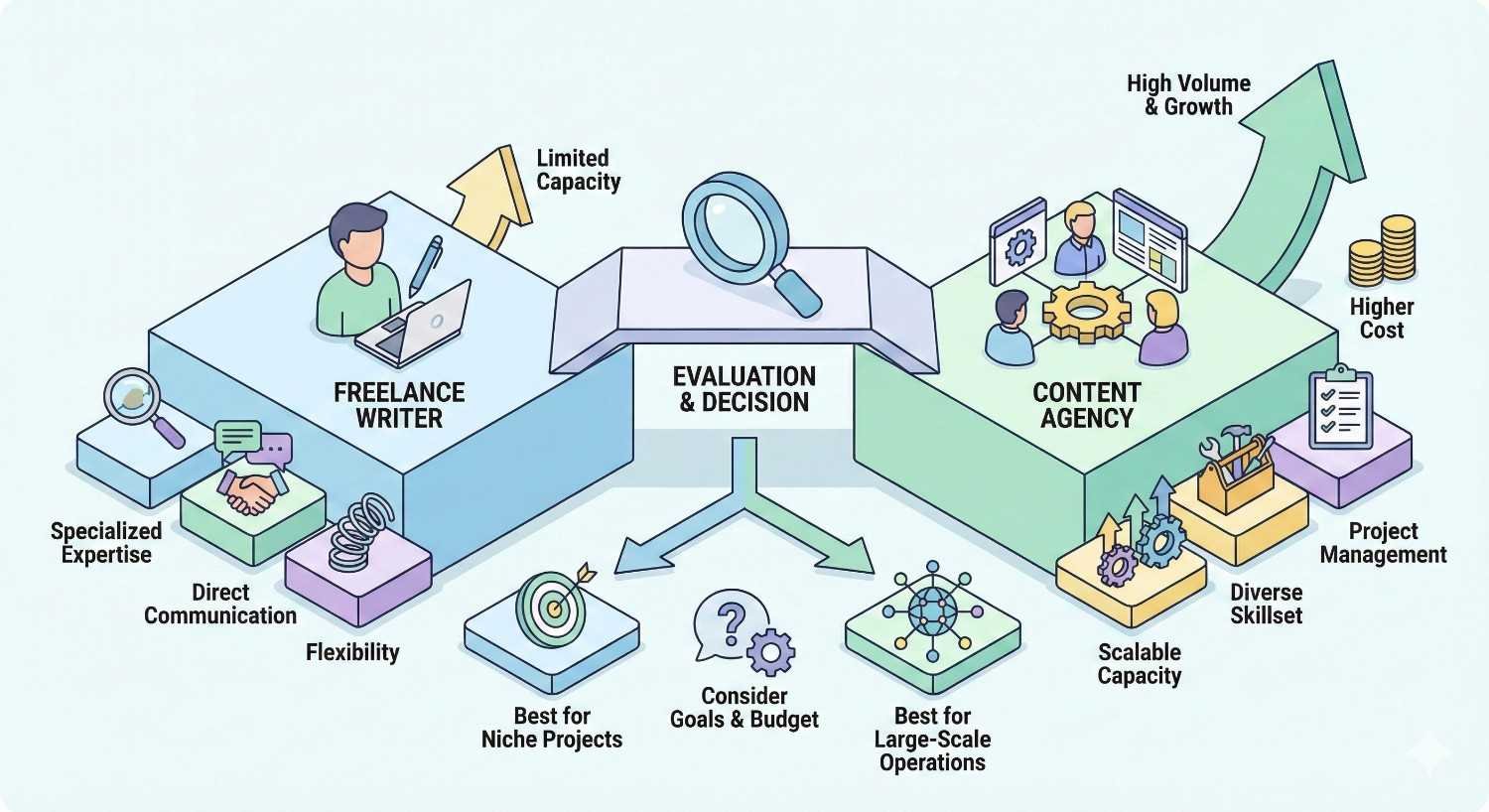
How to Evaluate Freelance Writers vs Agencies
Thorough evaluation prevents costly mistakes regardless of which direction you choose. Asking the right questions and recognizing warning signs protects your investment.
Questions to Ask Before Hiring
For freelancers:
What industries and content types do you specialize in? Relevant experience indicates likely quality and efficiency.
Can you share samples similar to what I need? Portfolio review reveals writing quality and style fit.
What’s your typical turnaround time for this type of content? Capacity understanding prevents deadline conflicts.
How do you handle revisions? Revision policies affect total project cost and timeline.
What’s your availability over the next several months? Capacity constraints may limit your ability to scale.
How do you approach SEO optimization? SEO knowledge varies significantly among writers.
For agencies:
Who will actually write my content? Understanding writer assignment processes reveals quality control approaches.
What’s your editorial review process? Quality control procedures indicate consistency commitment.
How do you maintain brand voice across different writers? Voice consistency mechanisms matter for brand-sensitive content.
What reporting and communication can I expect? Service level expectations should be clear before engagement.
Can you share case studies from similar clients? Relevant experience indicates likely results.
What happens if I’m not satisfied with content quality? Revision and satisfaction policies protect your investment.
Red Flags to Watch For
Freelancer warning signs:
Unwillingness to share relevant samples suggests limited experience or quality concerns.
Vague answers about process and timeline indicate disorganization that may affect delivery.
Significantly below-market pricing often correlates with quality or reliability issues.
Poor communication during the sales process typically continues during engagement.
No questions about your business or audience suggests template-based rather than customized work.
Agency warning signs:
Inability to identify who will write your content indicates potential quality variability.
No clear editorial or quality control process suggests inconsistent output.
Reluctance to share client references or case studies raises credibility questions.
Pressure to sign long-term contracts before demonstrating value prioritizes their interests over yours.
Generic proposals without customization to your needs indicate template-based service delivery.
Vetting Process Checklist
Initial screening:
- Review portfolio or sample work for quality and relevance
- Check references or testimonials from similar clients
- Verify claimed expertise through conversation or test projects
- Assess communication quality and responsiveness
Trial engagement:
- Start with a small project before major commitment
- Evaluate delivered work against expectations
- Assess revision process and responsiveness to feedback
- Confirm cultural and communication fit
Ongoing evaluation:
- Monitor quality consistency over time
- Track deadline adherence and reliability
- Assess value relative to cost
- Evaluate relationship health and communication
How Much Does Content Writing Cost?
Understanding content writing costs helps you budget appropriately and evaluate proposals. Pricing varies significantly based on content type, quality level, and provider type.
Freelance Writer Rates by Content Type
Blog posts (1,000-2,000 words): $100 to $500+ depending on research requirements, writer expertise, and SEO optimization depth. Specialized niches command premium rates.
Website copy (per page): $150 to $1,000+ based on page complexity and conversion optimization requirements. Homepage and key landing pages cost more than standard pages.
Email sequences (per email): $50 to $300+ depending on length, personalization requirements, and strategic complexity.
White papers and ebooks: $500 to $3,000+ reflecting substantial research, writing, and revision requirements.
Case studies: $300 to $1,500+ including customer interviews, narrative development, and design-ready formatting.
Social media content (monthly packages): $300 to $2,000+ depending on platform count, posting frequency, and content complexity.
Agency Retainer and Project Pricing
Entry-level agency retainers: $2,000 to $5,000 monthly typically include 4-8 blog posts plus basic strategy and project management.
Mid-tier agency retainers: $5,000 to $15,000 monthly provide higher volume, more comprehensive strategy, and additional content formats.
Enterprise agency retainers: $15,000 to $50,000+ monthly deliver full-service content marketing including strategy, production, distribution, and performance optimization.
Project-based agency work: $5,000 to $50,000+ for defined initiatives like content audits, website relaunches, or campaign-specific content programs.
Hidden Costs to Consider
Revision rounds beyond included limits may incur additional charges. Clarify revision policies before engagement.
Rush fees apply when you need faster turnaround than standard timelines. Plan ahead to avoid premium pricing.
Strategy and planning may be separate from content production. Agencies often include strategy in retainers while freelancers may charge separately.
SEO optimization varies in depth. Basic keyword inclusion differs from comprehensive on-page optimization. Understand what’s included.
Project management time represents your internal cost when working with freelancers. Factor your time into total cost calculations.
Editing and quality control may require additional investment when working with freelancers who don’t include editorial review.

How Content Writing Impacts SEO Performance
Content quality directly affects search rankings, organic traffic, and lead generation. Understanding this connection helps you evaluate content investments appropriately.
Content Quality and Search Rankings
Google’s algorithms increasingly reward content that demonstrates expertise, provides comprehensive answers, and satisfies user intent. Thin, generic content struggles to rank regardless of technical optimization.
Depth and comprehensiveness matter for competitive keywords. Content that thoroughly addresses topics outperforms superficial coverage. This favors quality over quantity in content strategy.
Originality and unique value differentiate ranking content from commodity alternatives. Search engines recognize and reward genuinely helpful content that adds new perspectives or information.
User engagement signals like time on page, scroll depth, and return visits indicate content quality to search engines. Well-written content that engages readers sends positive signals.
Consistency and Topical Authority
Publishing frequency affects how search engines perceive your site’s authority on topics. Regular content publication signals active expertise and commitment to subject areas.
Topical coverage breadth builds authority through comprehensive treatment of subject areas. Covering related subtopics strengthens your position for primary keywords.
Content freshness matters for topics where information changes. Regular updates and new content maintain relevance and ranking potential.
Internal linking between related content pieces strengthens topical authority signals. Comprehensive content programs enable strategic internal linking architectures.
Strategic Content Planning for Organic Growth
Keyword strategy should drive content planning. Understanding search volume, competition, and intent helps prioritize content investments for maximum impact.
Content gaps in your coverage represent ranking opportunities. Analyzing competitor content reveals topics you should address.
Pillar and cluster models organize content strategically. Comprehensive pillar pages supported by detailed cluster content build topical authority systematically.
Performance tracking through Google Search Console and analytics tools reveals what’s working. Data-driven optimization improves content ROI over time.
Building a Long-Term Content Strategy
Sustainable content marketing requires strategic planning beyond individual content pieces. Long-term thinking maximizes return on content investments.
Hybrid Approach: Combining Freelancers and Agencies
Many businesses benefit from combining freelancers and agencies strategically:
Use agencies for high-volume, consistent content production where scalability and reliability matter most.
Use freelancers for specialized content requiring deep expertise or unique voice that agencies can’t easily replicate.
Use internal resources for brand-critical content requiring intimate company knowledge and rapid iteration.
This hybrid model captures advantages of each approach while mitigating limitations. Strategic allocation based on content type and requirements optimizes both quality and cost.
Scaling Content Production Over Time
Start focused with limited content volume to establish quality standards and refine processes before scaling.
Build relationships with reliable writers or agencies before increasing volume. Proven partners scale more successfully than new ones.
Develop systems for briefing, feedback, and quality control that can handle increased volume without proportional management burden.
Monitor quality as volume increases. Scaling too quickly often degrades content quality. Sustainable growth maintains standards.
Adjust strategy based on performance data. Double down on content types and topics that drive results. Reduce investment in underperforming areas.
Measuring Content ROI
Traffic metrics including organic sessions, page views, and new users indicate content reach and discovery.
Engagement metrics like time on page, scroll depth, and pages per session reveal content quality and relevance.
Conversion metrics including lead generation, email signups, and sales attribution demonstrate business impact.
Ranking metrics tracking keyword positions and SERP visibility show SEO performance.
Cost per acquisition calculations comparing content investment to leads or customers generated reveal true ROI.
Regular measurement and analysis enable continuous optimization of content strategy and resource allocation.
Conclusion: Making the Right Choice for Your Business
The freelance versus agency decision ultimately depends on your specific situation. Budget constraints, content volume needs, internal resources, and strategic priorities all influence the right choice.
Neither option is universally superior. Freelancers excel for specialized, budget-conscious, or relationship-driven content needs. Agencies deliver value for high-volume, comprehensive, or scalability-focused requirements. Many businesses benefit from combining both approaches strategically.
At White Label SEO Service, we help businesses build sustainable organic growth through strategic content that drives rankings, traffic, and conversions. Whether you’re evaluating content partners or developing your content strategy, our team provides the expertise and execution to achieve your SEO goals. Contact us to discuss how we can support your content marketing success.
Frequently Asked Questions
Is it cheaper to hire a freelancer or an agency?
Freelancers typically cost less per deliverable than agencies. However, total cost depends on your needs. If you require strategy, project management, and quality control that agencies include, the cost difference narrows. Evaluate total investment including your time, not just per-piece pricing.
Can freelancers handle large content projects?
Individual freelancers face capacity constraints, but you can scale by hiring multiple freelancers. This requires more management effort on your part. For very large projects, agencies often provide easier scaling with less coordination burden.
Do agencies provide better SEO content?
Not necessarily. Quality depends on the specific agency or freelancer, not the category. Some freelancers specialize in SEO content and outperform generalist agencies. Evaluate SEO expertise specifically rather than assuming agency superiority.
How do I find reliable freelance writers?
Start with referrals from trusted contacts. Use platforms like Contently, Upwork, or LinkedIn to find candidates. Review portfolios carefully, check references, and start with small test projects before major commitments. Consistent communication quality during hiring often predicts reliability.
What should I look for in a content agency?
Evaluate relevant industry experience, editorial processes, writer assignment practices, and client references. Understand who will actually write your content and how quality is controlled. Clear communication about expectations and deliverables indicates professional operations.
How long should I commit to a content partner?
Start with short-term engagements to evaluate fit before long-term commitments. Three to six months provides enough time to assess quality and results. Avoid lengthy contracts before proving the relationship works.
Should I use both freelancers and agencies?
Many businesses benefit from hybrid approaches. Use agencies for scalable, consistent production and freelancers for specialized expertise. Strategic allocation based on content type optimizes both quality and cost efficiency.