Landing page copywriting is the single most influential factor determining whether your paid traffic converts or wastes your ad spend. A well-crafted landing page can achieve conversion rates of 5-10% or higher, while poorly written pages often struggle below 2%. The difference between these outcomes comes down to strategic copy that speaks directly to visitor intent.
This matters because every click costs money. Whether you’re running Google Ads, Facebook campaigns, or email promotions, your landing page copy is the final bridge between interest and action. Get it wrong, and you’re essentially paying for visitors who leave empty-handed.
This guide covers everything from foundational frameworks to industry-specific strategies, testing methodologies, and real examples you can model. You’ll learn the exact process professional copywriters use to create pages that convert.
What Is Landing Page Copywriting?
Landing page copywriting is the strategic craft of writing persuasive text specifically designed to guide visitors toward a single conversion goal. Unlike general website content, landing page copy exists for one purpose: to transform a click into an action, whether that’s a purchase, signup, download, or inquiry.
The discipline combines direct response principles with user psychology. Every word serves the conversion objective. There’s no room for brand storytelling that doesn’t advance the sale, no space for information that distracts from the primary call-to-action.
Professional landing page copywriters understand that visitors arrive with specific expectations based on the ad or link they clicked. The copy must immediately validate that expectation, then systematically build enough desire and trust to overcome purchase resistance.
Landing Page Copy vs. Website Copy
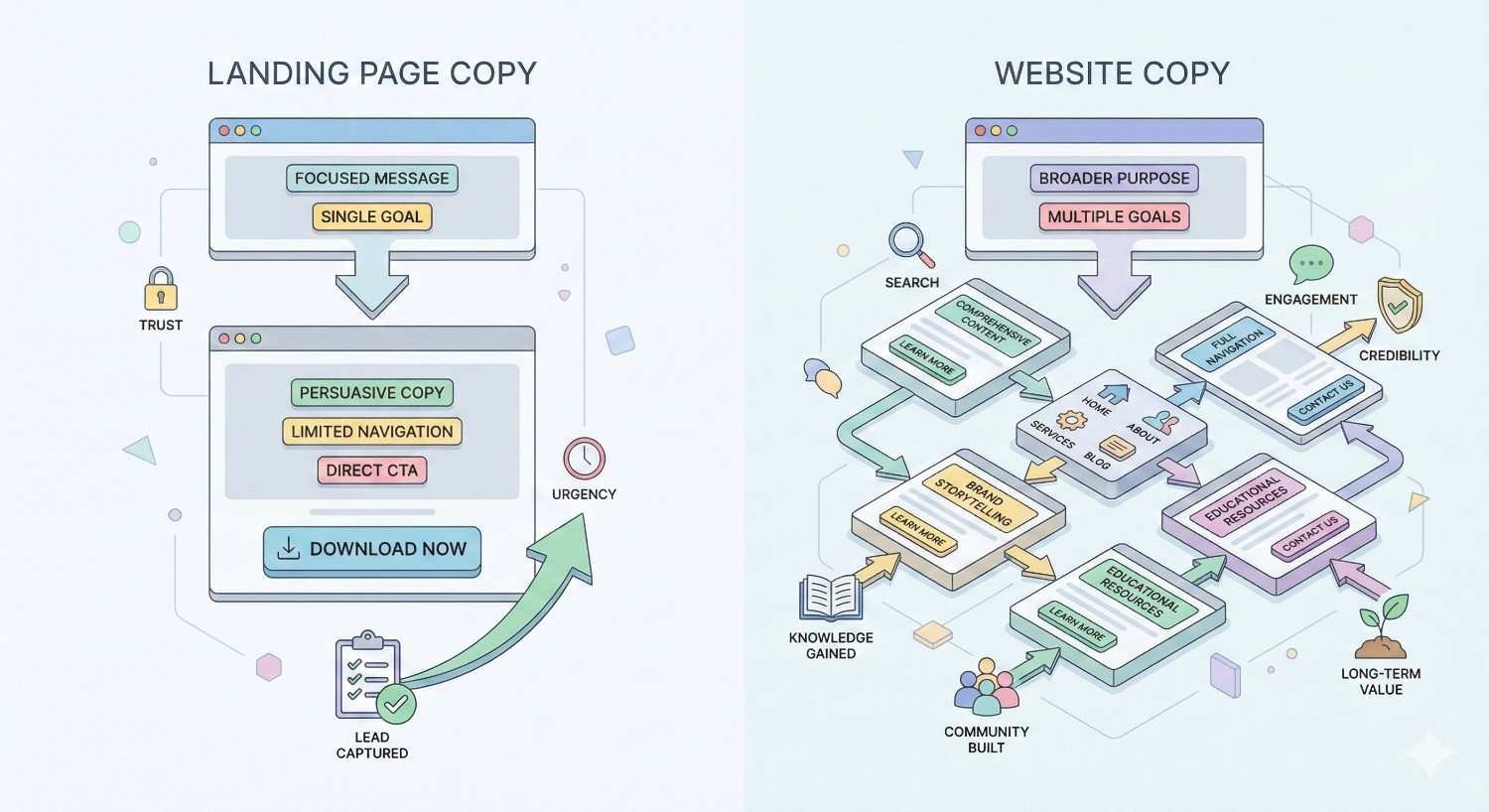
Website copy and landing page copy serve fundamentally different purposes, and confusing them is a common mistake that kills conversions.
Website copy builds brand awareness, educates visitors, and supports multiple user journeys. A homepage might serve returning customers, job seekers, investors, and first-time visitors simultaneously. The copy accommodates diverse intents and encourages exploration.
Landing page copy does the opposite. It eliminates choices. It removes navigation menus, strips away competing messages, and focuses every element on a single conversion action. Where website copy says “explore our offerings,” landing page copy says “get this specific solution now.”
The structural differences are significant. Website pages typically include navigation headers, footer links, sidebar content, and multiple CTAs. Landing pages remove these escape routes. According to Unbounce’s conversion benchmark data, landing pages with a single CTA convert 13.5% better than those with multiple competing actions.
Website copy can afford to be comprehensive. Landing page copy must be ruthlessly focused. Every sentence either advances the conversion or gets cut.
Why Landing Page Copywriting Matters for Conversions
The math is straightforward. If you’re spending $5,000 monthly on paid traffic and your landing page converts at 2%, you’re generating 100 conversions. Improve that copy to achieve 4% conversion, and you’ve doubled results without increasing ad spend.
This leverage effect makes landing page copywriting one of the highest-ROI marketing investments available. Small improvements in conversion rate compound across every visitor, every campaign, every month.
Beyond the numbers, landing page copy shapes perception. Visitors form judgments within seconds. Weak copy signals an amateur operation. Strong copy builds immediate credibility and positions your offer as the obvious choice.
The copy also determines quality of conversions. Vague, hype-driven copy attracts tire-kickers. Specific, benefit-focused copy pre-qualifies visitors and attracts buyers who understand exactly what they’re getting.
Core Elements of High-Converting Landing Page Copy
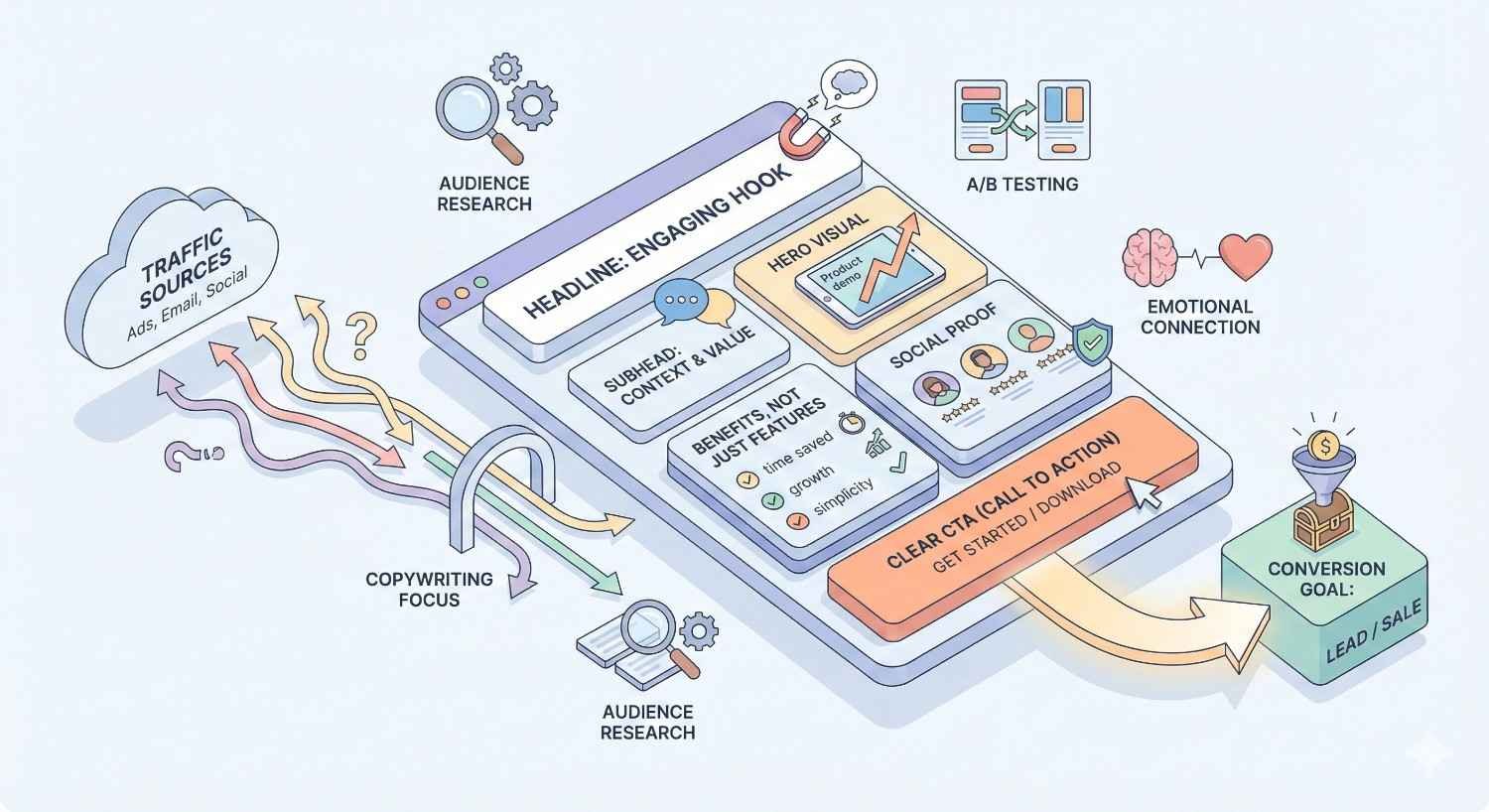
Every high-converting landing page contains the same fundamental elements, arranged strategically to guide visitors through a psychological journey from curiosity to commitment. Understanding these elements allows you to diagnose weak pages and build strong ones systematically.
Headlines That Capture Attention
Your headline carries more weight than any other element on the page. Research from Nielsen Norman Group confirms that 80% of visitors read headlines while only 20% read body copy. If your headline fails, nothing else matters.
Effective landing page headlines accomplish three things simultaneously. They confirm the visitor is in the right place by matching the promise that brought them there. They communicate the primary benefit or outcome. They create enough curiosity or desire to keep reading.
The best headlines are specific rather than clever. “Increase Your Email Open Rates by 47% in 30 Days” outperforms “Revolutionary Email Marketing Solution” because it promises a concrete, measurable outcome.
Headline formulas that consistently perform include:
The outcome headline states the result directly. “Get 50 Qualified Leads Every Month Without Cold Calling.”
The how-to headline promises a method. “How to Write Landing Pages That Convert at 10%+ (Even If You’re Not a Copywriter).”
The question headline engages by prompting self-reflection. “Are You Leaving 67% of Your Potential Revenue on the Table?”
Subheadlines That Build Interest
The subheadline supports and expands the headline’s promise. It provides the second layer of information that keeps visitors engaged and scrolling.
Strong subheadlines often address the “how” when the headline addresses the “what.” If your headline promises increased conversions, your subheadline might explain the mechanism: “Our AI-powered optimization identifies exactly which copy changes will boost your results.”
Alternatively, subheadlines can introduce a secondary benefit or address a common objection. “No technical skills required. Set up in under 10 minutes.”
The subheadline should be scannable, typically one to two sentences. It bridges the attention-grabbing headline to the detailed body copy below.
Value Propositions That Differentiate
Your value proposition answers the critical question every visitor asks: “Why should I choose this over alternatives?”
A weak value proposition describes what you do. A strong value proposition explains why that matters and why you do it better than anyone else.
The formula for a compelling value proposition includes three components. First, identify the specific outcome or benefit. Second, explain how you deliver it differently. Third, provide proof that it works.
For example: “We help B2B companies generate qualified demos through LinkedIn outreach. Unlike agencies that blast generic messages, we research each prospect individually and craft personalized sequences. Our clients average a 23% response rate versus the industry standard of 3%.”
Position your value proposition prominently, typically within the first screen of content. Visitors shouldn’t have to scroll to understand what makes you different.
Benefit-Driven Body Copy
Features describe what your product does. Benefits explain what that means for the customer. Landing page copy that converts focuses relentlessly on benefits.
The translation process is simple. For every feature, ask “so what?” until you reach an emotional or practical outcome the customer cares about.
Feature: “Our software includes automated reporting.” So what? “You don’t have to manually compile data.” So what? “You save 5 hours every week.” So what? “You can focus on strategy instead of spreadsheets.” Benefit: “Reclaim 5 hours weekly to focus on work that actually grows your business.”
Structure body copy around the benefits that matter most to your specific audience. B2B buyers often prioritize efficiency, ROI, and risk reduction. Consumer buyers respond to convenience, status, and emotional satisfaction.
Use concrete language. “Save time” is vague. “Complete your taxes in 15 minutes” is specific and believable.
Social Proof and Trust Signals
Social proof reduces perceived risk by demonstrating that others have successfully made the same decision. It’s one of the most powerful psychological triggers in conversion optimization.
Effective social proof takes multiple forms. Customer testimonials provide narrative evidence. Case studies offer detailed proof of results. Client logos establish credibility through association. Review scores and ratings provide quantified validation. User counts demonstrate popularity.
The most persuasive testimonials are specific and results-focused. “Great product!” means nothing. “We increased our conversion rate from 2.1% to 4.8% within 60 days of implementing this system” is compelling evidence.
Place social proof strategically throughout the page, not just in a dedicated section. Position testimonials near claims they support. Show client logos early to establish credibility. Include specific results near your CTA to overcome final hesitation.
Call-to-Action (CTA) Copy That Converts
Your CTA is the moment of conversion. Weak CTA copy creates friction. Strong CTA copy makes the next step feel natural and desirable.
Effective CTAs share common characteristics. They use action verbs that describe what happens next. They emphasize the benefit of clicking rather than the action itself. They reduce perceived commitment when appropriate.
“Submit” is the worst CTA in existence. It describes a mechanical action with no benefit. Compare to “Get My Free Analysis” or “Start Growing Today.”
Button copy should complete the sentence “I want to…” naturally. “I want to submit” makes no sense. “I want to get my free analysis” flows logically.
For higher-commitment actions, reduce friction with reassuring microcopy near the button. “No credit card required,” “Cancel anytime,” or “Takes less than 2 minutes” can significantly improve click-through rates.
Landing Page Copywriting Frameworks
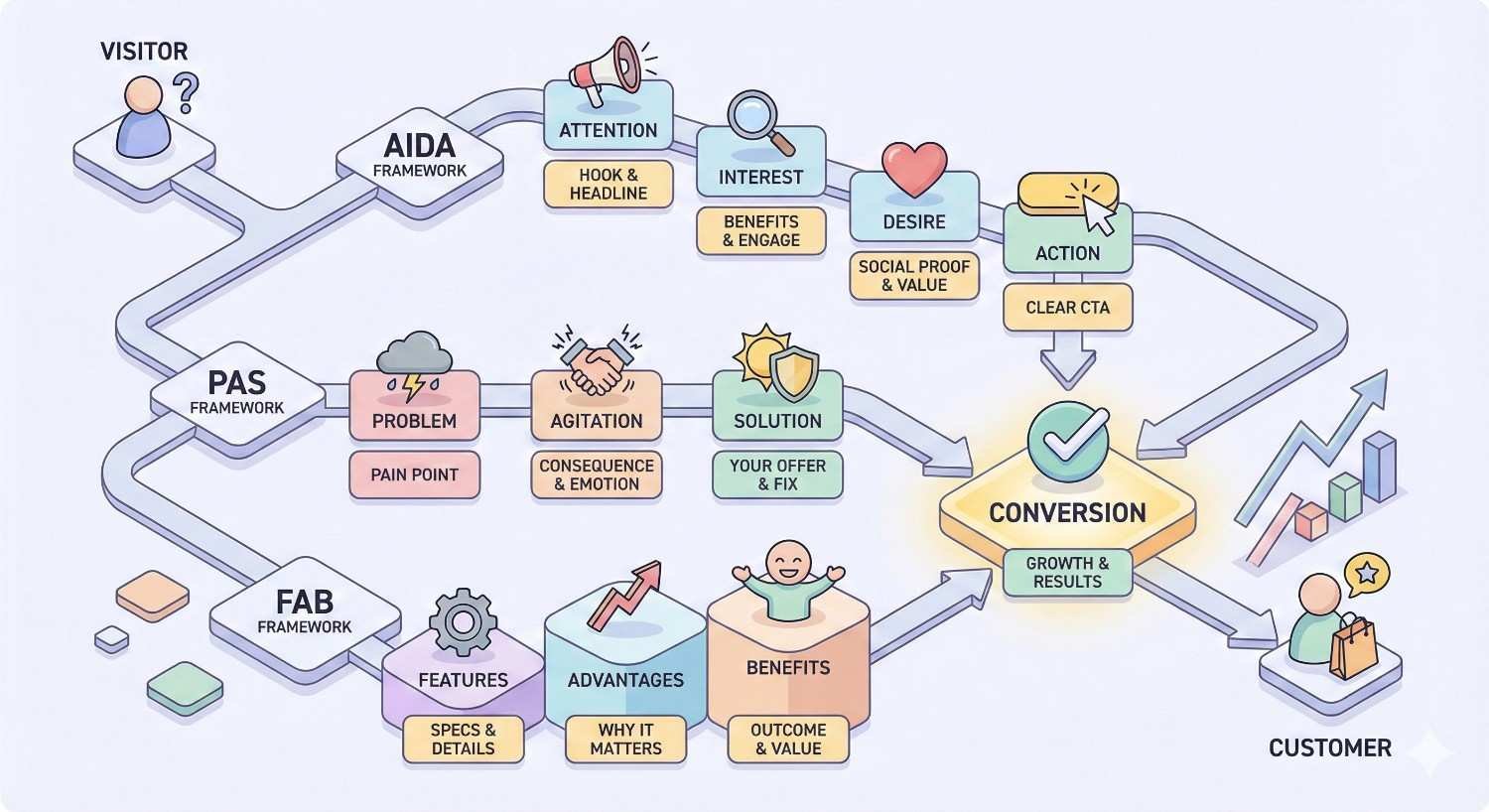
Frameworks provide proven structures for organizing persuasive arguments. Rather than staring at a blank page, you can follow a tested sequence that guides visitors through the psychological stages of conversion.
AIDA Framework (Attention, Interest, Desire, Action)
AIDA is the foundational direct response framework, developed over a century ago and still effective today.
Attention captures the visitor immediately. Your headline and hero section must stop the scroll and earn continued engagement. Use a bold claim, surprising statistic, or direct address of a pressing problem.
Interest builds engagement by expanding on the initial hook. Explain the problem in detail. Share relevant information that makes visitors nod in recognition. Demonstrate that you understand their situation.
Desire shifts from problem to solution. Present your offer as the answer. Stack benefits. Show proof. Paint a picture of life after the purchase. Make visitors want what you’re selling.
Action provides clear direction. Tell visitors exactly what to do next and make it easy to do it. Remove obstacles. Reinforce the value of acting now.
AIDA works particularly well for products with clear, immediate benefits and audiences who arrive with some existing awareness of their problem.
PAS Framework (Problem, Agitation, Solution)
PAS is particularly effective when your audience experiences a painful problem they’re actively trying to solve.
Problem identifies and validates the visitor’s struggle. Name the specific issue they face. Use their language. Demonstrate that you understand their situation intimately.
Agitation intensifies the emotional weight of the problem. Explore the consequences of inaction. Describe how the problem affects their business, relationships, or wellbeing. Make the status quo feel unacceptable.
Solution presents your offer as the relief they need. After building tension, your product becomes the release. The contrast between agitation and solution makes your offer feel more valuable.
PAS works best for problem-aware audiences who haven’t yet found a satisfactory solution. It’s particularly effective for services that solve painful, ongoing issues.
BAB Framework (Before, After, Bridge)
BAB focuses on transformation, making it ideal for offers that promise significant change.
Before describes the visitor’s current state. Paint a vivid picture of their existing situation, including the frustrations, limitations, and missed opportunities they experience.
After shows the transformed future. Describe what life looks like once they’ve used your product or service. Be specific about the improvements they’ll experience.
Bridge explains how to get from before to after. Your product is the bridge. Explain how it enables the transformation and why it’s the best path forward.
BAB works exceptionally well for coaching, courses, software tools, and any offer where the outcome represents meaningful change from the current state.
The 4 Ps Framework (Promise, Picture, Proof, Push)
The 4 Ps framework combines emotional appeal with logical validation.
Promise opens with a bold claim about what you’ll deliver. State the primary benefit clearly and confidently.
Picture helps visitors visualize the outcome. Use descriptive language to paint a mental image of success. Help them see themselves enjoying the benefits.
Proof validates your promise with evidence. Testimonials, case studies, data, credentials, and demonstrations all serve this purpose. The stronger your proof, the more believable your promise.
Push motivates immediate action. Create urgency through limited availability, time-sensitive bonuses, or simply by reinforcing the cost of delay.
This framework balances emotional storytelling with rational justification, making it effective for considered purchases where buyers need both inspiration and reassurance.
How to Write Landing Page Copy: Step-by-Step Process
Professional copywriters follow a systematic process that produces consistent results. This step-by-step approach ensures you gather the right inputs, organize information strategically, and refine copy for maximum impact.
Step 1: Research Your Target Audience
Effective copy starts with deep audience understanding. You cannot persuade someone you don’t understand.
Begin with demographic basics: industry, role, company size, and decision-making authority. Then dig deeper into psychographics: what keeps them awake at night, what they’ve tried before, what objections they’ll raise, and what language they use to describe their problems.
Primary research sources include customer interviews, sales call recordings, support tickets, and survey responses. Secondary sources include industry forums, Reddit discussions, Amazon reviews of competing products, and social media conversations.
Document specific phrases your audience uses. The exact words customers use to describe their problems are more persuasive than any clever copy you could invent.
Create a detailed customer avatar that includes their goals, fears, objections, and decision criteria. Reference this document throughout the writing process.
Step 2: Define Your Unique Value Proposition
Before writing, crystallize what makes your offer different and better. Without a clear value proposition, your copy will be generic and forgettable.
Answer these questions: What specific outcome do you deliver? How do you deliver it differently than alternatives? What proof do you have that it works? Why should someone choose you over doing nothing?
Your value proposition should be expressible in one to two sentences. If you can’t articulate it concisely, you haven’t defined it clearly enough.
Test your value proposition by asking: would a competitor say the same thing? If yes, you haven’t differentiated. “High-quality service” and “dedicated support” are not differentiators. “24-hour response guarantee with dedicated account manager” is specific and ownable.
Step 3: Write Your Headline and Subheadline
With research complete and value proposition defined, write your headline first. It sets the direction for everything that follows.
Generate at least 20 headline variations before selecting one. Push past obvious options to find unexpected angles. Test different formulas: outcome-focused, how-to, question-based, and news-style.
Evaluate headlines against these criteria: Does it match the traffic source? Does it communicate a clear benefit? Is it specific rather than vague? Does it create curiosity or desire?
Your subheadline should complement, not repeat, the headline. If your headline promises an outcome, your subheadline might explain the mechanism. If your headline asks a question, your subheadline might hint at the answer.
Step 4: Craft Benefit-Focused Body Copy
Organize body copy around the benefits that matter most to your audience, ordered by importance.
For each major benefit, follow a consistent structure. State the benefit clearly. Explain how your product delivers it. Provide proof or an example. Connect to the next benefit with a transition.
Use the “feature-advantage-benefit” chain to ensure you’re going deep enough. Feature: what it is. Advantage: what it does. Benefit: why that matters to the customer.
Write more than you need, then edit ruthlessly. First drafts should be expansive. Final copy should be tight. Every sentence must earn its place by advancing the conversion.
Step 5: Add Social Proof and Credibility Elements
Integrate social proof throughout the page rather than isolating it in one section.
Select testimonials that address specific objections or validate specific claims. A testimonial about “great customer service” is weak. A testimonial about “they responded within 2 hours when our system went down on a Saturday” is powerful.
Request results-focused testimonials from customers. Ask: “What specific results have you achieved?” and “What would you tell someone who’s considering this purchase?”
Include credibility indicators appropriate to your audience. B2B buyers respond to client logos, case studies, and industry certifications. Consumer buyers respond to review counts, media mentions, and user-generated content.
Step 6: Write Compelling CTAs
Write multiple CTA variations for testing. Your primary CTA should appear multiple times on longer pages, with consistent messaging.
Match CTA intensity to the commitment level. “Buy Now” works for low-cost impulse purchases. “Schedule a Consultation” works for high-ticket services. “Get Free Access” works for lead generation.
Add supporting microcopy that reduces friction. Address the most common hesitation directly beneath or beside the button.
Ensure visual prominence. CTA buttons should stand out through color contrast, size, and whitespace. The copy matters, but visibility matters too.
Step 7: Edit, Test, and Optimize
First drafts are never final. Professional copywriters revise extensively before considering copy complete.
Edit for clarity first. Remove jargon. Simplify complex sentences. Ensure every paragraph has a clear purpose.
Edit for persuasion second. Strengthen weak claims. Add specificity to vague statements. Ensure benefits are emphasized over features.
Edit for flow third. Read aloud to catch awkward phrasing. Check transitions between sections. Ensure the page builds momentum toward the CTA.
After launch, test systematically. Headlines and CTAs typically offer the highest-impact testing opportunities. Use A/B testing tools to validate improvements with statistical significance.
Landing Page Copywriting Best Practices
Beyond frameworks and processes, certain principles consistently separate high-converting pages from underperformers. These best practices apply across industries and offer types.
Write for Scannability
Most visitors scan before they read. Structure your copy to communicate key messages even to scanners.
Use descriptive subheadings that convey benefits. “Our Process” tells scanners nothing. “How We Generate 50+ Leads Monthly” communicates value.
Front-load important information. Put the most compelling point at the beginning of each section. Visitors who stop reading early should still encounter your strongest arguments.
Keep paragraphs short. Three to four sentences maximum. Dense blocks of text discourage reading.
Use formatting strategically. Bold key phrases. Use bullet points for lists of benefits or features. Create visual hierarchy that guides the eye.
Use Power Words and Emotional Triggers
Certain words consistently trigger stronger emotional responses. Incorporate them naturally throughout your copy.
Urgency words create time pressure: now, today, immediately, limited, deadline, before, while.
Exclusivity words create desire: exclusive, members-only, invitation, private, insider, select.
Safety words reduce risk: guaranteed, proven, secure, protected, certified, trusted.
Value words emphasize benefit: free, bonus, save, discount, value, premium, best.
Use power words authentically. Overuse creates hype that damages credibility. Strategic placement at key moments amplifies impact.
Match Message to Traffic Source
Visitors arrive with expectations based on the ad, email, or link they clicked. Your landing page must immediately validate those expectations.
If your ad promises “50% off first order,” your headline should reference that discount. If your email discusses a specific problem, your landing page should address that problem immediately.
Message match extends beyond headlines. The visual style, tone, and offer details should feel consistent with the traffic source. Disconnects create confusion and increase bounce rates.
For campaigns with multiple traffic sources, consider creating dedicated landing pages for each. The extra effort typically produces significantly better conversion rates than generic pages.
Focus on One Goal Per Page
Landing pages convert best when they pursue a single objective. Multiple CTAs divide attention and reduce overall conversion.
Identify the one action you most want visitors to take. Remove or minimize everything that doesn’t support that action.
This means eliminating navigation menus that offer escape routes. It means removing secondary offers that compete for attention. It means ensuring every element on the page advances the primary conversion goal.
If you need to capture different types of conversions, create separate landing pages for each. A page optimized for demo requests will outperform a page that also offers whitepaper downloads, newsletter signups, and contact forms.
Address Objections Proactively
Every visitor arrives with reasons not to convert. Effective copy anticipates and addresses these objections before they become barriers.
Common objections include: price concerns, timing hesitation, trust issues, complexity fears, and comparison shopping.
Address objections directly in your copy. “You might be wondering if this will work for your industry…” acknowledges the concern and provides an opportunity to resolve it.
Use social proof strategically to counter specific objections. If price is a concern, include testimonials about ROI. If complexity is a concern, include testimonials about ease of implementation.
FAQ sections provide a natural format for objection handling. Include questions that voice common concerns, then answer them persuasively.
Landing Page Copywriting by Industry
While core principles remain constant, effective landing page copy adapts to industry-specific buyer psychology, sales cycles, and decision criteria.
SaaS Landing Page Copy
SaaS landing pages must communicate value quickly while addressing the unique concerns of software buyers.
Lead with the outcome, not the technology. Users don’t buy software; they buy the results software enables. “Automate your invoicing” is less compelling than “Get paid 2x faster with automated invoicing.”
Address the trial-to-paid conversion path. If offering a free trial, your landing page copy should pre-sell the paid version while encouraging trial signup. Set expectations for what users will experience.
Emphasize ease of implementation. Software buyers fear complex onboarding. Copy that promises “set up in 5 minutes” or “no technical skills required” reduces this friction.
Include integration mentions if relevant. SaaS buyers want tools that work with their existing stack. Mentioning popular integrations can be a significant conversion factor.
E-commerce Landing Page Copy
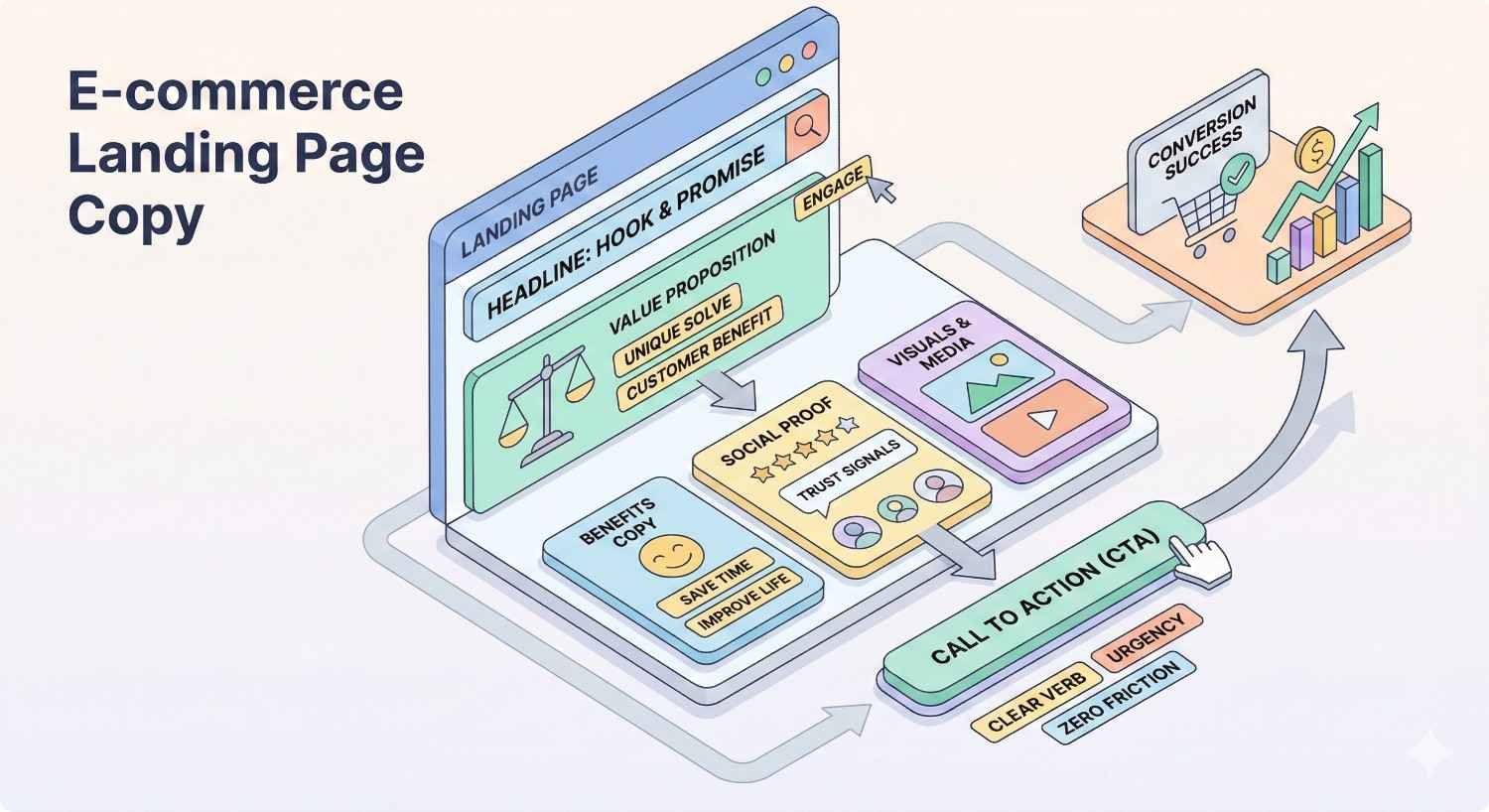
E-commerce landing pages, particularly for product launches or promotional campaigns, require copy that drives immediate purchase decisions.
Product descriptions should emphasize benefits and use cases, not just specifications. Help shoppers visualize using the product in their lives.
Urgency and scarcity are particularly effective in e-commerce. Limited stock notifications, countdown timers for sales, and exclusive access create motivation to buy now rather than later.
Social proof carries exceptional weight. Review counts, star ratings, and user photos provide the validation online shoppers need when they can’t physically examine products.
Shipping and return policies should be prominently displayed. These practical concerns often determine whether browsers become buyers.
B2B Landing Page Copy
B2B landing pages typically support longer sales cycles and multiple decision-makers. Copy must address both emotional and rational buying criteria.
Speak to the business outcome, not just the user benefit. Individual users care about making their jobs easier. Budget holders care about ROI, efficiency gains, and competitive advantage.
Provide substantial proof. B2B buyers conduct extensive research before engaging with sales. Case studies, ROI calculators, and detailed testimonials help your page become part of their evaluation process.
Acknowledge the buying committee. Copy that helps champions sell internally, such as “share this with your team” or downloadable resources, supports the multi-stakeholder B2B buying process.
Lead generation offers should match the buyer’s stage. Early-stage buyers want educational content. Late-stage buyers want demos and consultations.
Lead Generation Landing Page Copy
Lead generation pages exchange valuable content or consultations for contact information. The copy must justify the exchange.
Clearly communicate what the visitor receives. Vague promises like “get our insights” underperform specific offers like “download our 47-point SEO audit checklist.”
Address the implicit question: “Is this worth giving my email?” Emphasize the value of the lead magnet. Preview key insights. Explain why this information matters.
Minimize form friction. Every additional field reduces conversions. Request only information you genuinely need for follow-up.
Set expectations for what happens next. “We’ll send your guide immediately” or “Expect a call within 24 hours” reduces uncertainty about the post-conversion experience.
Service-Based Business Landing Page Copy
Service businesses sell outcomes that are harder to visualize than physical products. Copy must make intangible benefits tangible.
Describe the transformation clients experience. Before-and-after narratives help prospects understand what working with you actually delivers.
Establish credibility through specificity. Vague claims about “years of experience” are less persuasive than specific credentials, methodologies, and results.
Address the service selection process. Prospects often compare multiple providers. Copy that explains your approach and differentiators helps them understand why you’re the right choice.
Include process information. Explaining how you work reduces uncertainty about what the engagement will involve.
Landing Page Copywriting by Page Type
Different landing page types serve different conversion objectives. Copy strategy should align with the specific page purpose.
Sales Page Copy
Sales pages aim to complete transactions. They typically require longer copy that addresses the full range of buyer considerations.
Structure sales pages to build progressive commitment. Open with a compelling hook, establish the problem, present the solution, stack benefits, provide proof, handle objections, and close with a strong CTA.
Price presentation matters. Anchor against higher alternatives. Break down cost per day or per use. Emphasize value relative to price. Include guarantees that reduce purchase risk.
Long-form sales pages work when the offer requires explanation and the audience needs persuasion. Short-form works for simple offers to warm audiences.
Squeeze Page Copy
Squeeze pages focus exclusively on email capture. They’re typically short, with minimal distractions and a single form.
The headline must immediately communicate the value of the lead magnet. Visitors decide within seconds whether to engage.
Bullet points work well for quickly communicating what the visitor will learn or receive. Keep them benefit-focused and specific.
Remove all navigation and competing elements. The only action available should be form submission.
Click-Through Page Copy
Click-through pages warm visitors before sending them to a transaction page. They’re common in e-commerce and affiliate marketing.
The goal is education and desire-building, not immediate conversion. Copy should provide enough information to make visitors eager to see the offer details.
Focus on benefits and social proof. Save pricing and transaction details for the destination page.
The CTA should create curiosity: “See pricing options” or “Check availability” rather than “Buy now.”
Webinar Registration Page Copy
Webinar registration pages must sell the value of attending a future event. Copy competes against the visitor’s time and attention.
Emphasize what attendees will learn, not what you’ll present. “Discover how to double your conversion rate” outperforms “Join our webinar about conversion optimization.”
Include presenter credentials. Attendees want to learn from credible experts. Brief bios establish authority.
Create urgency around registration. Limited seats, replay availability, and exclusive bonuses for live attendees all motivate immediate signup.
Product Launch Page Copy
Product launch pages build anticipation and capture early interest. They often combine waitlist signup with pre-launch content.
Tease the transformation the product enables without revealing everything. Create curiosity that motivates signup.
Emphasize early-access benefits. Discounts, bonuses, or priority access reward those who commit before launch.
Build social proof through waitlist numbers, early testimonials from beta users, or endorsements from industry figures.
Landing Page Copy Testing and Optimization
Writing is the beginning, not the end. Systematic testing transforms good copy into great copy by validating what actually works with your specific audience.
A/B Testing Headlines and CTAs
Headlines and CTAs offer the highest-impact testing opportunities because they influence every visitor’s experience.
Test one element at a time to isolate what’s driving results. Testing a new headline and new CTA simultaneously makes it impossible to know which change mattered.
Run tests until you reach statistical significance. Tools like VWO recommend minimum sample sizes based on your baseline conversion rate and the improvement you want to detect.
Document all tests and results. Over time, patterns emerge that inform future copy decisions.
Key Metrics to Track
Conversion rate is the primary metric, but supporting metrics provide diagnostic insight.
Bounce rate indicates whether your headline and above-fold content match visitor expectations. High bounce rates suggest a message mismatch.
Time on page reveals engagement depth. Very short times suggest visitors aren’t finding what they expected. Very long times might indicate confusion.
Scroll depth shows how much of your page visitors actually see. If most visitors never reach your CTA, placement or content length may need adjustment.
Form abandonment identifies friction in the conversion process. High abandonment suggests form length or field requirements are problematic.
Iterating Based on Data
Data should inform decisions, not dictate them. Combine quantitative metrics with qualitative insights.
Heatmaps and session recordings reveal how visitors actually interact with your page. You might discover that visitors click on non-linked elements, indicating interest you could leverage.
User feedback, whether through surveys, chat transcripts, or sales conversations, explains the “why” behind the numbers.
Iterate continuously. Landing page optimization is never complete. Market conditions change, competitors evolve, and audience preferences shift.
Common Landing Page Copywriting Mistakes to Avoid
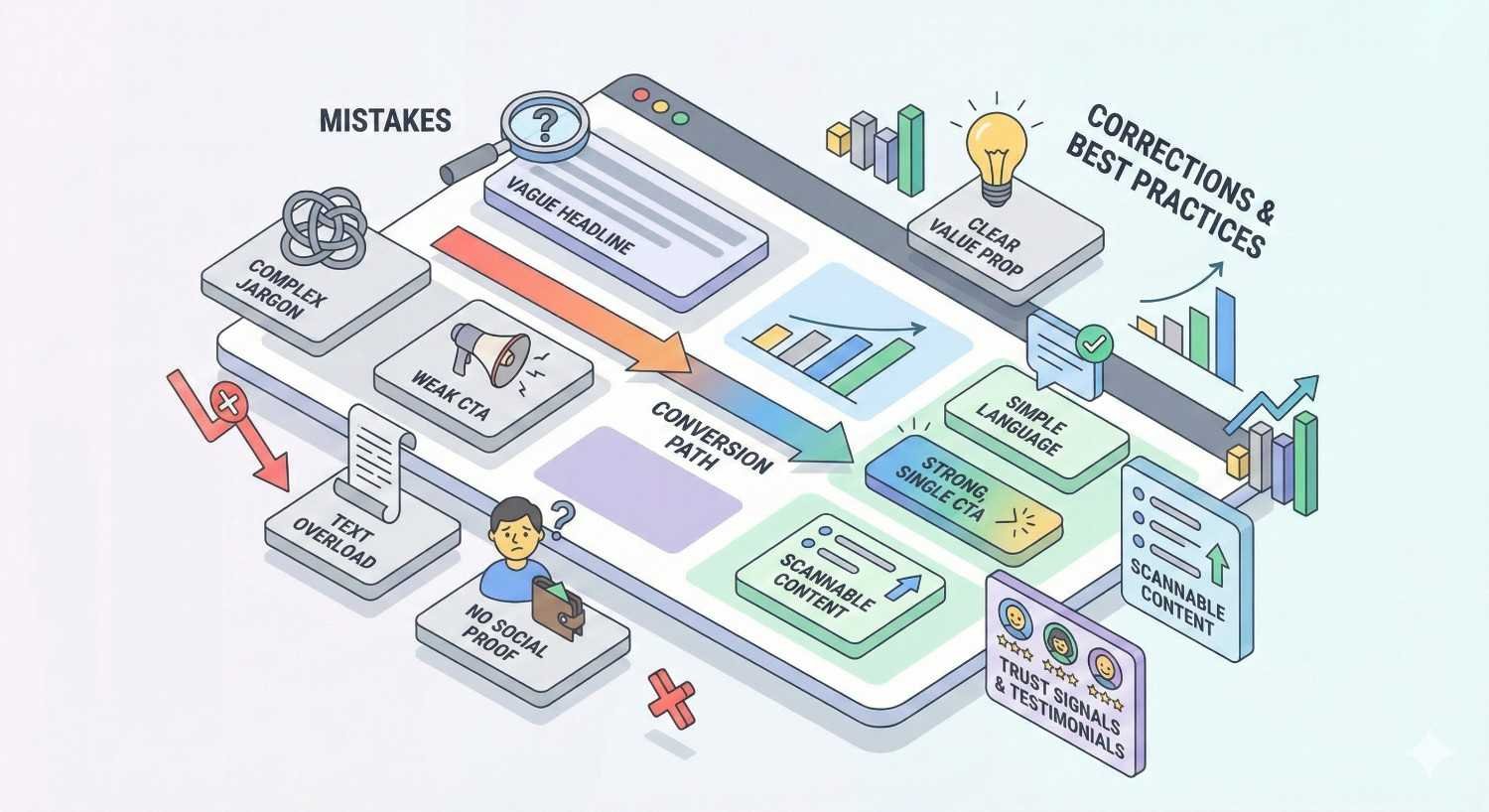
Understanding common mistakes helps you avoid them. These errors consistently undermine landing page performance.
Feature-Focused vs. Benefit-Focused Copy
The most common copywriting mistake is describing what your product does rather than what it does for the customer.
Features are facts about your product. Benefits are improvements in the customer’s life. Customers buy benefits.
Every feature should be translated into a benefit. “Cloud-based storage” becomes “access your files from anywhere.” “24/7 support” becomes “get help whenever you need it, even at 3 AM.”
Review your copy and highlight every feature. For each one, ask: “So what? Why does this matter to the customer?” Keep asking until you reach an emotional or practical outcome.
Weak or Generic CTAs
“Submit,” “Click Here,” and “Learn More” are conversion killers. They describe actions without communicating value.
Strong CTAs complete the thought “I want to…” in a way that emphasizes benefit. “I want to get my free analysis.” “I want to start saving time today.”
Match CTA language to offer value. If you’re offering a free trial, “Start My Free Trial” outperforms “Sign Up.” If you’re offering a consultation, “Get Expert Advice” outperforms “Contact Us.”
Too Much or Too Little Copy
Copy length should match offer complexity and audience awareness. There’s no universal right length.
Too little copy fails to address objections, build desire, or provide enough information for decision-making. Visitors leave with unanswered questions.
Too much copy overwhelms visitors and buries key messages. Important points get lost in walls of text.
The right length provides everything needed to convert and nothing more. Test different lengths to find what works for your specific offer and audience.
Ignoring Mobile Optimization
Mobile devices account for over 60% of web traffic, yet many landing pages are designed desktop-first.
Mobile copy must be even more concise. Smaller screens mean less visible content. Front-load your most important messages.
CTAs must be thumb-friendly. Buttons should be large enough to tap easily and positioned where thumbs naturally rest.
Forms must be mobile-optimized. Minimize fields, use appropriate input types, and ensure the form is easy to complete on a small screen.
Test your pages on actual mobile devices, not just responsive previews. The experience often differs significantly.
Landing Page Copywriting Tools and Resources
The right tools accelerate the copywriting process and improve output quality.
AI Copywriting Tools
AI tools like Jasper, Copy.ai, and ChatGPT can generate draft copy, headline variations, and alternative phrasings.
Use AI as a starting point, not a final product. AI-generated copy often lacks the specificity and strategic intent that drives conversions. Human editing and refinement remain essential.
AI excels at generating variations for testing. Request 20 headline options, then select and refine the most promising candidates.
Headline Analyzers
Tools like CoSchedule’s Headline Analyzer and Sharethrough’s Headline Analyzer score headlines based on factors correlated with engagement.
These tools provide useful feedback on word balance, emotional impact, and clarity. They’re particularly helpful for identifying weak headlines that need strengthening.
Don’t optimize purely for tool scores. A headline that scores well but doesn’t match your audience or offer will underperform a lower-scoring headline that resonates.
Swipe File Resources
Swipe files are collections of proven copy examples that inspire and inform your own writing.
Build your own swipe file by saving landing pages that compel you to act. Analyze what makes them effective.
Resources like Swipe.co and Really Good Emails provide curated examples across industries and formats.
Study swipe files for structure and technique, not to copy directly. Adapt proven approaches to your specific offer and audience.
DIY vs. Hiring a Landing Page Copywriter
The decision to write your own copy or hire a professional depends on your resources, expertise, and the stakes involved.
When to Write Your Own Copy
Writing your own copy makes sense when you have deep audience knowledge that would be difficult to transfer to an outside writer.
Founders and subject matter experts often understand their customers better than any hired copywriter could. That insight is valuable.
DIY also makes sense for testing and iteration. Quick copy changes to test hypotheses don’t require professional involvement.
If your budget is limited and your time is available, learning copywriting fundamentals and applying them yourself is a viable path.
When to Hire a Professional
Hire a professional when the stakes are high. A landing page supporting a major product launch or significant ad spend justifies professional investment.
Hire when you lack time or interest in developing copywriting skills. Your time may be better spent on activities where you have comparative advantage.
Hire when your DIY efforts aren’t producing results. If you’ve tested multiple approaches without improvement, fresh expertise may identify what you’re missing.
What to Look for in a Landing Page Copywriter
Evaluate copywriters based on relevant experience, not just general writing ability. Landing page copywriting is a specialized skill.
Request samples of landing pages they’ve written, ideally with performance data. Results matter more than portfolios of pretty pages.
Look for copywriters who ask detailed questions about your audience, offer, and goals. Good copywriters are researchers first and writers second.
Discuss their process. Professional copywriters follow systematic approaches that include research, drafting, revision, and optimization recommendations.
Landing Page Copywriting Examples
Studying effective examples accelerates learning. These patterns appear consistently in high-converting pages.
High-Converting Headline Examples
Outcome-focused: “Get 3X More Qualified Leads Without Increasing Your Ad Spend”
Specific and measurable: “Join 50,000+ Marketers Who Open Our Emails Every Tuesday”
Problem-aware: “Tired of Landing Pages That Don’t Convert? Here’s the Fix.”
Curiosity-driven: “The Counterintuitive Approach That Doubled Our Client’s Conversion Rate”
Direct and clear: “Website Copywriting That Turns Visitors Into Customers”
Effective CTA Examples
Benefit-focused: “Start Getting More Leads” instead of “Sign Up”
Low-commitment: “See How It Works” instead of “Buy Now”
Specific: “Download the 47-Point Checklist” instead of “Get the Resource”
Urgent: “Claim Your Spot (Only 12 Left)” instead of “Register”
Personal: “Send Me the Guide” instead of “Submit”
Full Landing Page Copy Breakdowns
The most effective landing pages follow predictable patterns.
Above the fold: Headline communicating primary benefit, subheadline expanding on the promise, hero image or video showing the product/outcome, primary CTA.
Problem section: Detailed description of the pain point, agitation of consequences, validation that the reader isn’t alone.
Solution section: Introduction of the product as the answer, explanation of how it works, key differentiators from alternatives.
Benefits section: Three to five major benefits with supporting details, feature-to-benefit translations, visual elements reinforcing each benefit.
Social proof section: Customer testimonials with specific results, client logos or trust badges, case study summaries or links.
Objection handling: FAQ addressing common concerns, guarantee or risk-reversal offer, comparison to alternatives.
Final CTA section: Restated value proposition, urgency or scarcity element, prominent CTA button with supporting microcopy.
Landing Page Copywriting Checklist
Use this checklist to evaluate and improve your landing pages.
Headline and Subheadline
- Communicates primary benefit clearly
- Matches the traffic source message
- Creates curiosity or desire to continue reading
- Uses specific language rather than vague claims
Value Proposition
- Clearly differentiates from alternatives
- Explains the unique mechanism or approach
- Supported by proof or evidence
- Prominently positioned on the page
Body Copy
- Focuses on benefits, not just features
- Addresses the target audience’s specific concerns
- Uses customer language and terminology
- Organized for scannability with subheadings and short paragraphs
Social Proof
- Includes specific, results-focused testimonials
- Features relevant client logos or trust badges
- Provides case studies or detailed examples
- Positioned strategically throughout the page
Call-to-Action
- Uses action-oriented, benefit-focused language
- Stands out visually from surrounding content
- Appears multiple times on longer pages
- Includes friction-reducing microcopy
Objection Handling
- Addresses common concerns proactively
- Includes guarantee or risk-reversal offer
- Provides FAQ section for remaining questions
- Builds trust through transparency
Technical Optimization
- Mobile-responsive and thumb-friendly
- Fast loading with optimized images
- Forms minimized to essential fields
- No competing navigation or exit points
Conclusion
Landing page copywriting combines strategic thinking with persuasive writing to transform traffic into conversions. The frameworks, processes, and best practices in this guide provide a foundation for creating pages that perform.
Success requires understanding your audience deeply, communicating benefits clearly, and testing continuously. Every element, from headlines to CTAs, contributes to the conversion outcome.
We help businesses build landing pages that convert as part of comprehensive organic growth strategies. White Label SEO Service provides the copywriting expertise and optimization support you need to maximize results from every visitor. Contact us to discuss how we can improve your landing page performance.
Frequently Asked Questions
How long should landing page copy be?
Copy length should match offer complexity and audience awareness. Simple offers to warm audiences can convert with minimal copy. Complex offers to cold audiences typically require longer copy that builds understanding and trust. Test different lengths to find what works for your specific situation.
What is the most important part of landing page copy?
The headline carries the most weight because it determines whether visitors continue reading. However, the CTA is where conversion actually happens. Both elements deserve significant attention and testing.
How do I write a landing page headline?
Start by identifying the primary benefit your offer provides. Write at least 20 variations using different formulas: outcome-focused, how-to, question-based, and problem-aware. Select the option that best matches your traffic source and communicates clear value.
Should I use long-form or short-form landing page copy?
Use long-form when your offer requires explanation, your audience is cold, or the purchase decision is significant. Use short-form when your offer is simple, your audience is warm, or the commitment is low. When uncertain, test both approaches.
How much does landing page copywriting cost?
Professional landing page copywriting typically ranges from $500 to $5,000+ depending on complexity, research requirements, and copywriter experience. High-stakes pages supporting significant ad spend often justify premium investment due to the leverage effect on conversion rates.
Can I use AI to write landing page copy?
AI tools can generate useful drafts and variations, but they lack the strategic intent and audience insight that drive conversions. Use AI as a starting point for ideation and iteration, then refine with human judgment and testing.
How do I know if my landing page copy is working?
Track conversion rate as your primary metric, supported by bounce rate, time on page, and scroll depth for diagnostic insight. Compare performance against industry benchmarks and your own historical data. Implement A/B testing to validate improvements systematically.