
AI writing tools for SEO have fundamentally changed how businesses create content that ranks. These platforms combine natural language processing with search optimization features to help teams produce more content, faster, without sacrificing quality or search performance.
The shift is significant. Content teams that once struggled to publish weekly now produce daily. But success depends on understanding which tools fit your workflow and how to use them strategically.
This guide covers everything you need to know about AI writing tools for SEO—from how they work to measuring ROI, avoiding common mistakes, and building a sustainable content strategy.
What Are AI Writing Tools for SEO?
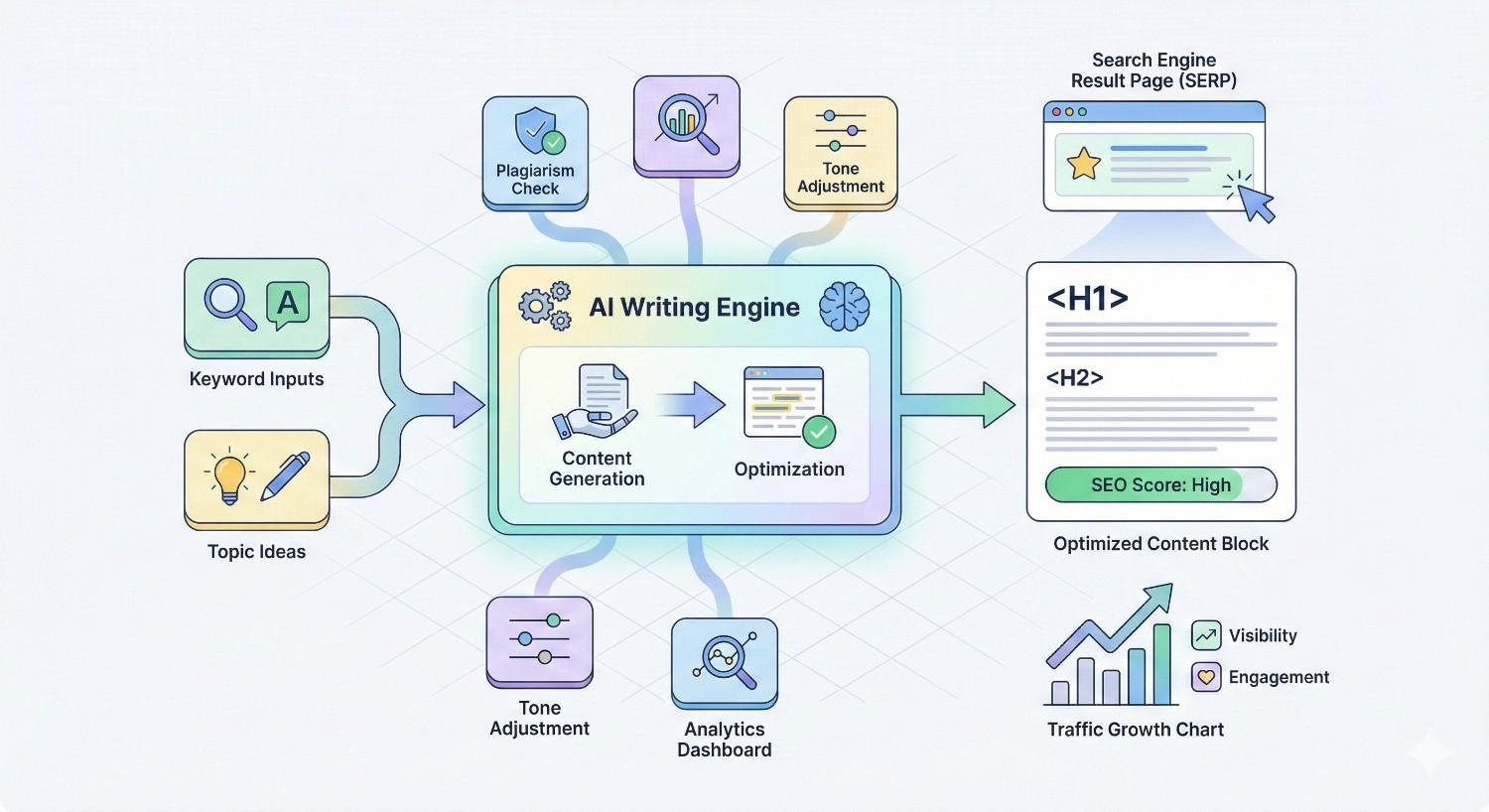
AI writing tools for SEO are software platforms that use artificial intelligence to generate, optimize, and refine written content for search engine performance. They combine content creation capabilities with SEO-specific features like keyword integration, readability analysis, and competitive content scoring.
These tools range from full content generators that produce complete articles to specialized optimization platforms that analyze and improve existing content. The common thread is their ability to accelerate content production while maintaining search relevance.
How AI Writing Tools Work
AI writing tools process your input—whether a topic, keyword, or brief—through large language models trained on billions of text samples. The model predicts the most relevant and coherent text based on patterns learned during training.
For SEO-specific tools, this process includes additional layers. The AI analyzes top-ranking content for your target keywords, identifies common topics and structures, and generates content designed to compete with existing search results.
Most tools work in three stages. First, they analyze your input and search context. Second, they generate initial content based on learned patterns. Third, they refine output based on SEO parameters like keyword density, content length, and topical coverage.
The quality of output depends heavily on input quality. Detailed briefs with clear target keywords, audience information, and structural guidance produce significantly better results than vague prompts.
Key Technologies Behind AI Content Generation
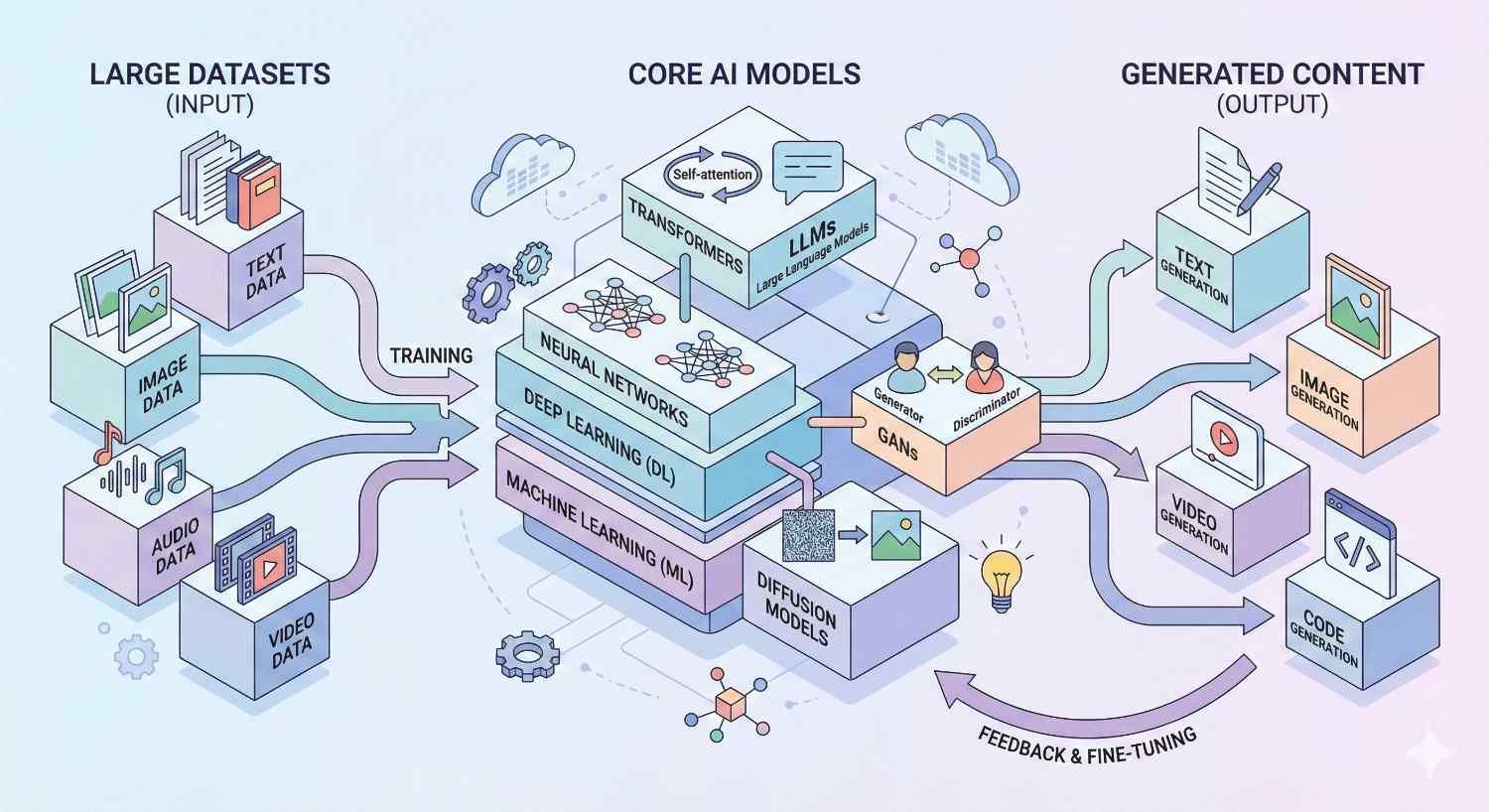
Large language models form the foundation of modern AI writing tools. These neural networks, trained on massive text datasets, understand context, grammar, and semantic relationships between concepts.
Transformer architecture enables these models to process entire sentences simultaneously rather than word by word. This allows for more coherent, contextually appropriate content generation.
Natural language processing handles the interpretation of your prompts and the structuring of output. NLP algorithms parse meaning, identify intent, and ensure generated content addresses the actual topic rather than tangentially related subjects.
For SEO applications, additional technologies layer on top. Semantic analysis tools compare generated content against top-ranking pages. Keyword extraction algorithms identify relevant terms to include. Readability scoring ensures content matches target audience sophistication levels.
Some platforms integrate real-time SERP analysis, pulling current ranking data to inform content recommendations. Others use proprietary content scoring systems that predict ranking potential based on topical coverage and competitive factors.
Why Businesses Are Adopting AI Writing Tools for SEO
The adoption curve for AI writing tools has accelerated dramatically. What started as experimental technology is now standard practice for content teams across industries.
Three primary drivers explain this shift: efficiency gains, scaling requirements, and quality consistency. Each addresses a fundamental challenge that content marketers have faced for years.
Time and Cost Efficiency
Content creation traditionally requires significant time investment. Research, outlining, drafting, editing, and optimization can consume hours per piece. AI tools compress this timeline substantially.
A first draft that might take a writer three hours can be generated in minutes. This doesn’t eliminate human involvement—editing and refinement remain essential—but it shifts where time gets spent.
The cost implications are significant. Teams can produce more content with existing resources or maintain output levels while reducing content budgets. For businesses competing in content-heavy industries, this efficiency translates directly to competitive advantage.
Time savings compound across the content lifecycle. AI tools that handle research, outline generation, and first drafts free human writers to focus on strategic work: adding expertise, refining voice, and ensuring accuracy.
Scaling Content Production
Many businesses face a content gap. They know which topics they should cover but lack the resources to produce content at the required pace. AI tools address this bottleneck directly.
Scaling content production without AI typically requires hiring additional writers, extending timelines, or accepting coverage gaps. Each option carries costs—financial, temporal, or strategic.
AI writing tools enable what might be called “content velocity”—the ability to produce more content faster without proportional resource increases. A team that published ten articles monthly can potentially double or triple output.
This scaling capability matters most for competitive keywords where content freshness and topical coverage influence rankings. Businesses that can cover more ground faster gain visibility advantages.
Consistency in Brand Voice and Quality
Maintaining consistent quality across high-volume content production challenges even well-resourced teams. Different writers bring different styles. Quality varies with workload and deadlines.
AI tools, properly configured, produce consistent baseline quality. They follow the same structural patterns, maintain similar readability levels, and apply uniform optimization standards across all content.
Brand voice consistency requires more configuration but remains achievable. Most AI writing tools allow custom instructions, tone guidelines, and style parameters that shape output to match brand standards.
This consistency extends to SEO elements. Keyword integration, heading structures, and content length remain uniform when AI handles initial drafts. Human editors can then focus on adding unique value rather than correcting basic inconsistencies.
Types of AI Writing Tools for SEO
The AI writing tool landscape includes several distinct categories. Understanding these categories helps match tools to specific workflow needs.
AI Content Generators
Content generators produce complete articles, blog posts, or marketing copy from prompts or briefs. They handle the heavy lifting of initial content creation.
These tools excel at producing structured content quickly. Given a topic and target keywords, they generate coherent drafts covering relevant subtopics. Output quality varies by tool and input quality, but the best generators produce content requiring only moderate editing.
Content generators work best for informational content, product descriptions, and standard blog formats. They struggle more with highly technical content, opinion pieces, or content requiring original research.
Popular content generators include Jasper AI, Copy.ai, and Writesonic. Each offers different strengths in terms of output quality, customization options, and integration capabilities.
AI SEO Optimization Tools
Optimization tools analyze content against SEO best practices and competitive benchmarks. Rather than generating content from scratch, they improve existing drafts.
These platforms typically score content based on factors like keyword usage, topical coverage, readability, and content length. They provide specific recommendations for improvement—add this term, expand this section, simplify this paragraph.
The value lies in data-driven optimization. Instead of guessing whether content covers a topic sufficiently, optimization tools compare your content against what’s actually ranking and identify gaps.
Surfer SEO, Clearscope, and Frase represent leading options in this category. They integrate with content management systems and writing tools to provide real-time optimization guidance.
AI Editing and Proofreading Tools
Editing tools focus on improving content quality at the sentence and paragraph level. They catch grammar errors, suggest style improvements, and enhance readability.
While not SEO-specific, these tools contribute to content quality signals that influence rankings. Clear, error-free content performs better with readers and search engines alike.
Advanced editing tools go beyond grammar checking. They identify passive voice, flag overly complex sentences, and suggest more engaging alternatives. Some analyze tone and adjust suggestions based on target audience.
Grammarly remains the dominant player, but alternatives like ProWritingAid and Hemingway Editor offer different feature sets and pricing structures.
AI Research and Outline Tools
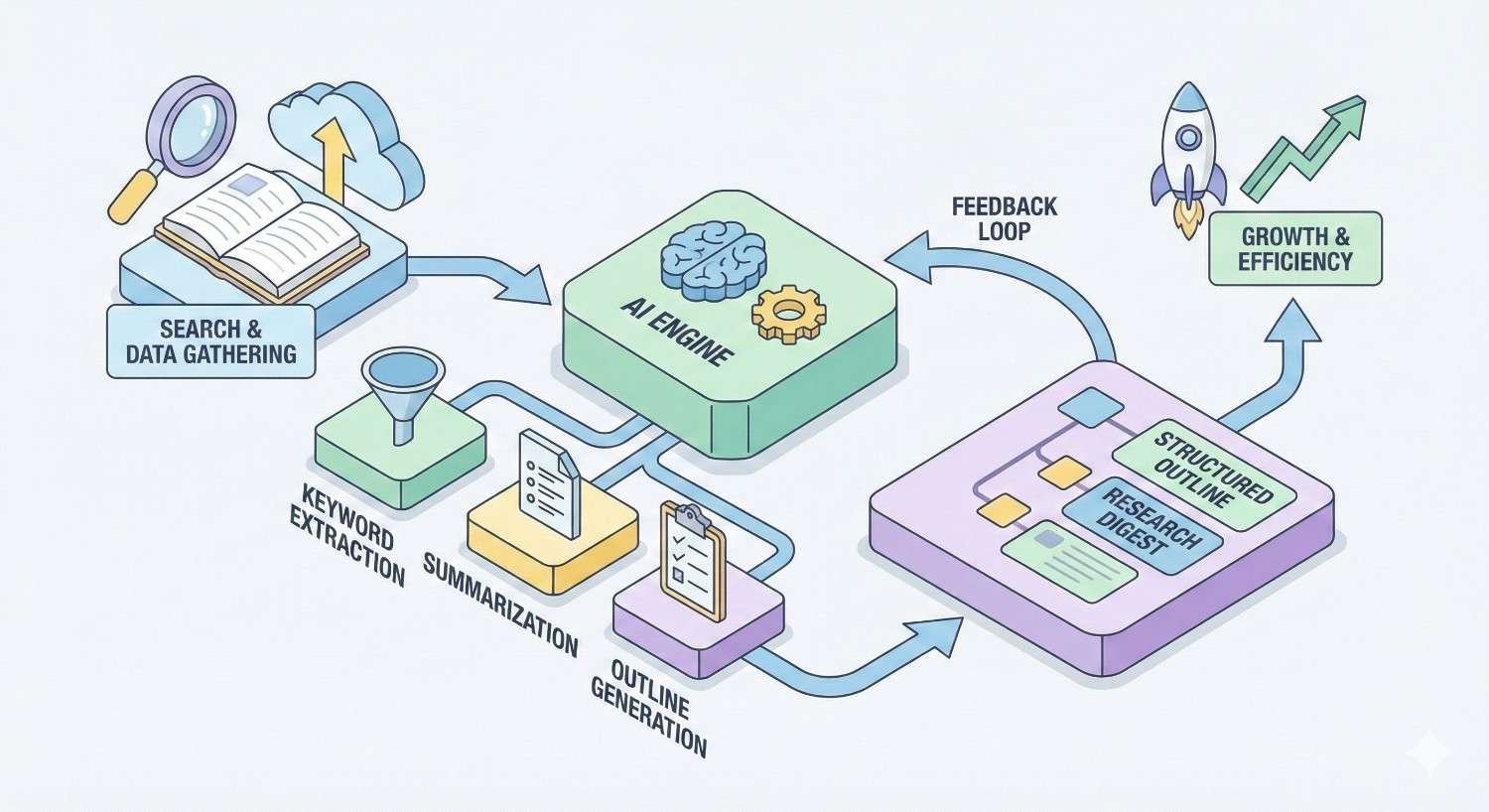
Research tools accelerate the pre-writing phase. They analyze topics, identify relevant subtopics, and generate structured outlines based on competitive content analysis.
These tools answer a fundamental question: what should this content cover? By analyzing top-ranking pages, they identify the topics, questions, and structures that successful content includes.
Outline generation saves significant planning time. Rather than manually reviewing competitor content, writers receive structured frameworks covering essential subtopics.
Frase and NeuronWriter excel in this category, combining research capabilities with outline generation and content optimization features.
Top AI Writing Tools for SEO in 2024
The market includes dozens of AI writing tools, but several stand out for SEO-specific applications. Each offers distinct strengths suited to different workflows and requirements.
Jasper AI
Jasper AI positions itself as an enterprise-grade content platform. It combines content generation with brand voice customization and team collaboration features.
The platform excels at maintaining consistent brand voice across high-volume content production. Custom brand voice settings ensure all generated content matches established style guidelines.
Jasper integrates with Surfer SEO for optimization capabilities, combining generation and optimization in a single workflow. This integration addresses a common pain point—generating content that’s already optimized for target keywords.
Pricing sits at the higher end of the market, making Jasper most suitable for teams with significant content budgets and enterprise requirements.
Surfer SEO
Surfer SEO focuses specifically on content optimization rather than generation. It analyzes top-ranking content and provides detailed recommendations for matching or exceeding competitive benchmarks.
The content editor scores drafts in real-time, showing how content compares against ranking pages for target keywords. Recommendations cover word count, keyword usage, heading structure, and topical coverage.
Surfer’s SERP analyzer provides competitive intelligence, showing exactly what top-ranking pages include. This data informs content strategy beyond individual pieces.
The platform integrates with popular content tools including Google Docs, WordPress, and Jasper AI. This flexibility makes it adaptable to existing workflows.
ChatGPT / OpenAI
ChatGPT democratized AI content generation. Its conversational interface makes AI writing accessible to users without technical expertise.
For SEO applications, ChatGPT requires more manual guidance than purpose-built tools. Users must provide detailed prompts including keyword targets, structural requirements, and optimization parameters.
The platform’s strength lies in versatility. It handles everything from brainstorming to drafting to editing, adapting to whatever task users present.
Custom GPTs allow users to create specialized assistants with pre-configured instructions for SEO content. This addresses some of the manual guidance requirements.
Pricing through ChatGPT Plus or API access remains competitive, making it accessible for smaller teams and individual content creators.
Copy.ai
Copy.ai emphasizes marketing copy and shorter-form content. It excels at generating headlines, ad copy, social media posts, and product descriptions.
The platform includes workflow automation features that chain multiple AI actions together. This enables more complex content production processes without manual intervention between steps.
For SEO applications, Copy.ai works best as part of a broader toolkit. It handles specific content elements efficiently but lacks the comprehensive optimization features of dedicated SEO platforms.
Pricing includes a free tier with limited features, making it accessible for testing before commitment.
Frase
Frase combines research, outline generation, and content optimization in a single platform. It’s designed specifically for SEO content workflows.
The research feature analyzes top-ranking content and extracts key topics, questions, and statistics. This competitive intelligence informs content strategy and ensures comprehensive coverage.
Frase’s AI writer generates content based on research findings, creating drafts already aligned with competitive benchmarks. The optimization editor then refines content for target keywords.
The platform’s question-focused approach aligns well with featured snippet optimization. It identifies questions searchers ask and ensures content addresses them directly.
Writesonic
Writesonic offers AI content generation with built-in SEO features. It includes keyword research, content optimization, and SERP analysis within the platform.
The tool generates various content types including blog posts, landing pages, and product descriptions. Templates guide users through content creation for specific formats.
Writesonic’s Chatsonic feature provides conversational AI access with real-time web data, addressing the knowledge cutoff limitations of some AI models.
Pricing tiers accommodate different usage levels, from individual creators to agency teams.
NeuronWriter
NeuronWriter focuses on content optimization using natural language processing analysis. It examines semantic relationships between terms and topics.
The platform’s content recommendations go beyond keyword density. It analyzes how top-ranking content structures information and suggests similar approaches.
NeuronWriter includes competitor analysis features showing exactly what ranking pages cover. This granular competitive intelligence informs content strategy.
The tool integrates with WordPress for direct publishing and optimization within the CMS.
Clearscope
Clearscope pioneered the content optimization category. It remains a leading choice for enterprise content teams focused on search performance.
The platform grades content based on comprehensive analysis of ranking pages. Recommendations cover terminology, topics, and content structure.
Clearscope’s reports provide clear, actionable guidance. Writers see exactly which terms to include and how thoroughly to cover specific subtopics.
Integration with Google Docs and WordPress enables optimization within existing writing environments. This reduces workflow friction for content teams.
How to Use AI Writing Tools for SEO Effectively
Effective AI tool usage requires more than subscribing to a platform. Success depends on integrating tools strategically into content workflows.
Keyword Research and Topic Ideation
AI tools accelerate keyword research by analyzing search patterns and identifying content opportunities. They surface related terms, questions, and topics that manual research might miss.
Start with seed keywords relevant to your business. AI tools expand these into comprehensive keyword lists including long-tail variations and semantic relatives.
Topic ideation benefits from AI’s ability to identify content gaps. By analyzing what competitors cover and what questions remain unanswered, AI tools suggest topics with ranking potential.
The key is combining AI suggestions with strategic judgment. Not every keyword opportunity aligns with business goals. Human oversight ensures topic selection serves broader content strategy.
Creating SEO-Optimized Content Briefs
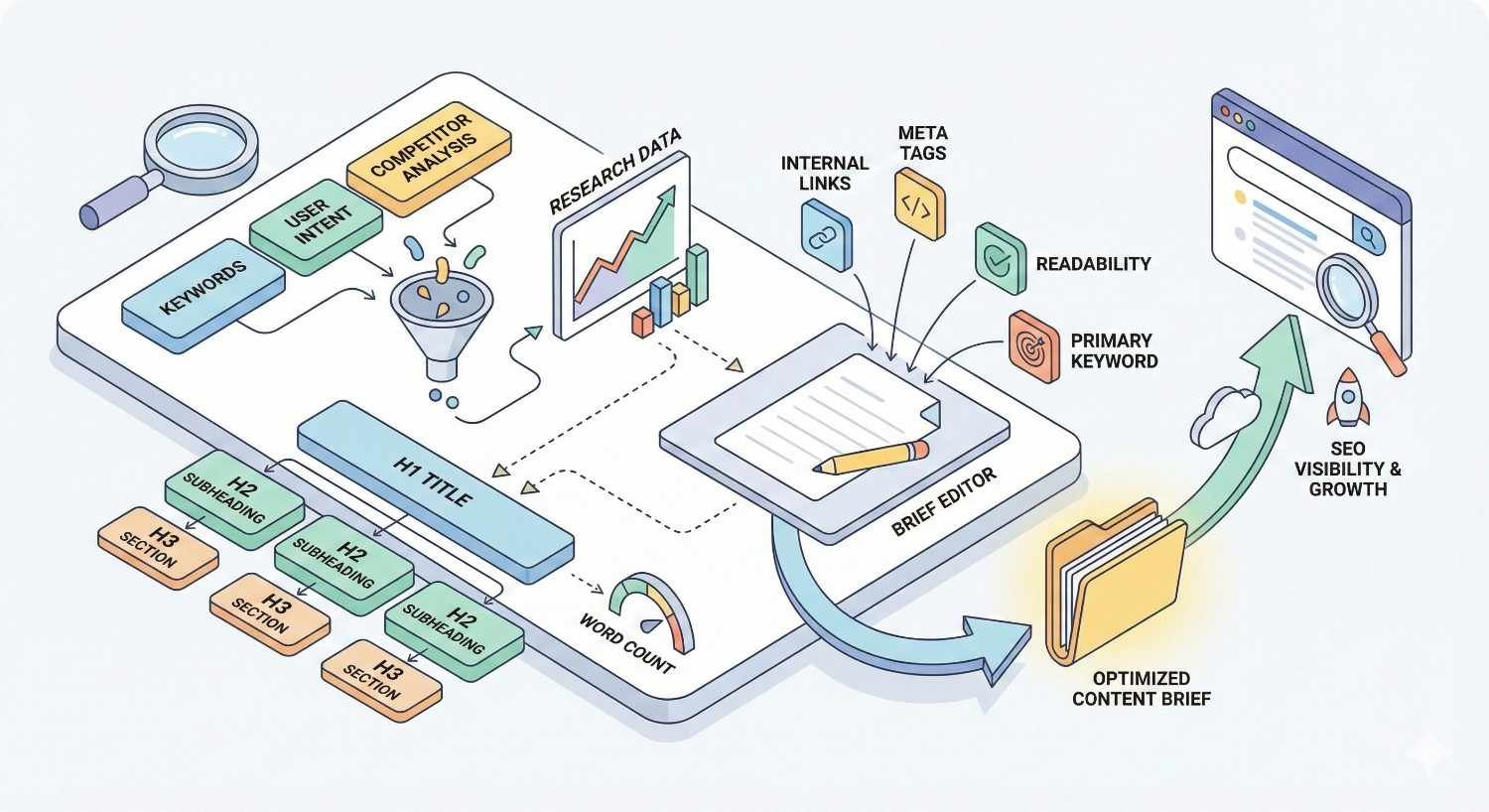
Content briefs bridge strategy and execution. AI tools generate comprehensive briefs that guide writers toward optimized content.
Effective AI-generated briefs include target keywords, recommended word counts, heading structures, and topics to cover. They provide the framework writers need to produce optimized content.
Brief quality directly impacts content quality. Invest time in configuring AI tools to produce briefs matching your standards. Include brand voice guidelines, audience information, and structural preferences.
Review AI-generated briefs before passing to writers. Add context the AI might miss—recent industry developments, brand-specific angles, or strategic priorities.
Generating First Drafts
First draft generation represents the most common AI writing application. AI produces initial content that human writers then refine.
Quality input produces quality output. Detailed prompts including target keywords, audience information, desired structure, and key points yield significantly better drafts.
Treat AI drafts as starting points, not finished products. They provide structure and coverage but typically lack the nuance, expertise, and voice that distinguish great content.
Batch draft generation maximizes efficiency. Generate multiple drafts in a single session, then move to editing and refinement. This workflow separation improves both speed and quality.
Optimizing Content for Search Intent
Search intent alignment determines whether content satisfies user needs. AI optimization tools analyze intent signals and ensure content matches what searchers seek.
Identify the primary intent behind target keywords. Informational queries require educational content. Transactional queries need product-focused content. Commercial investigation queries demand comparison and evaluation content.
AI tools analyze ranking content to infer intent. If top results are how-to guides, your content should probably be a how-to guide. If they’re product comparisons, comparison content likely performs best.
Optimization goes beyond matching format. Ensure content depth matches intent. Simple questions need concise answers. Complex topics require comprehensive coverage.
Editing and Humanizing AI Content
Raw AI content often reads as generic or formulaic. Editing transforms competent drafts into compelling content.
Add expertise that AI lacks. Include industry insights, original perspectives, and specific examples from experience. This expertise differentiates content and builds authority.
Inject personality and voice. AI produces neutral content by default. Editing adds the distinctive voice that builds reader connection and brand recognition.
Verify accuracy rigorously. AI can generate plausible-sounding but incorrect information. Fact-check statistics, claims, and technical details before publishing.
Improve flow and readability. AI sometimes produces choppy transitions or repetitive structures. Editing smooths these rough edges into polished content.
Scaling Content Without Sacrificing Quality
Scaling requires systems, not just tools. Establish processes that maintain quality as volume increases.
Create quality standards and checklists. Define what “good enough” looks like for different content types. Apply these standards consistently across all AI-assisted content.
Build editing workflows that catch issues before publication. Multiple review stages—factual accuracy, SEO optimization, brand voice, final polish—ensure nothing slips through.
Monitor performance metrics to identify quality issues. Declining engagement or rankings may signal quality problems requiring process adjustment.
Balance quantity and quality intentionally. Some content types warrant more investment than others. Allocate editing resources based on content importance and competitive requirements.
AI Writing Tools vs. Human Writers: Finding the Right Balance
The AI versus human debate misses the point. The question isn’t which is better but how to combine both effectively.
What AI Does Best
AI excels at speed and scale. It produces content faster than any human writer and maintains consistent output regardless of volume.
Research synthesis represents another AI strength. AI tools analyze large content volumes quickly, identifying patterns and extracting insights that would take humans hours.
Structural consistency comes naturally to AI. It follows templates reliably, maintains formatting standards, and applies optimization parameters uniformly.
AI handles repetitive content efficiently. Product descriptions, location pages, and templated content benefit from AI’s ability to produce variations quickly.
Where Human Writers Excel
Original thinking remains a human domain. AI recombines existing ideas but struggles to generate truly novel insights or perspectives.
Expertise and authority require human input. AI can write about topics but lacks the firsthand experience and deep knowledge that establish credibility.
Emotional resonance depends on human touch. Compelling storytelling, persuasive arguments, and content that moves readers require human creativity and empathy.
Strategic judgment guides content decisions. Humans understand business context, audience nuances, and competitive dynamics that inform what content to create and how.
The Hybrid Approach for Maximum SEO Impact
The most effective content strategies combine AI efficiency with human expertise. Each handles what it does best.
Use AI for research, outlining, and first drafts. These tasks benefit from AI’s speed without requiring the creativity and expertise that distinguish great content.
Reserve human effort for strategy, expertise injection, and final polish. These high-value activities leverage human strengths while AI handles lower-value tasks.
Establish clear handoff points in your workflow. Define where AI work ends and human work begins. This clarity prevents both gaps and redundant effort.
Measure results to optimize the balance. Track content performance by production method. Adjust AI and human involvement based on what actually drives results.
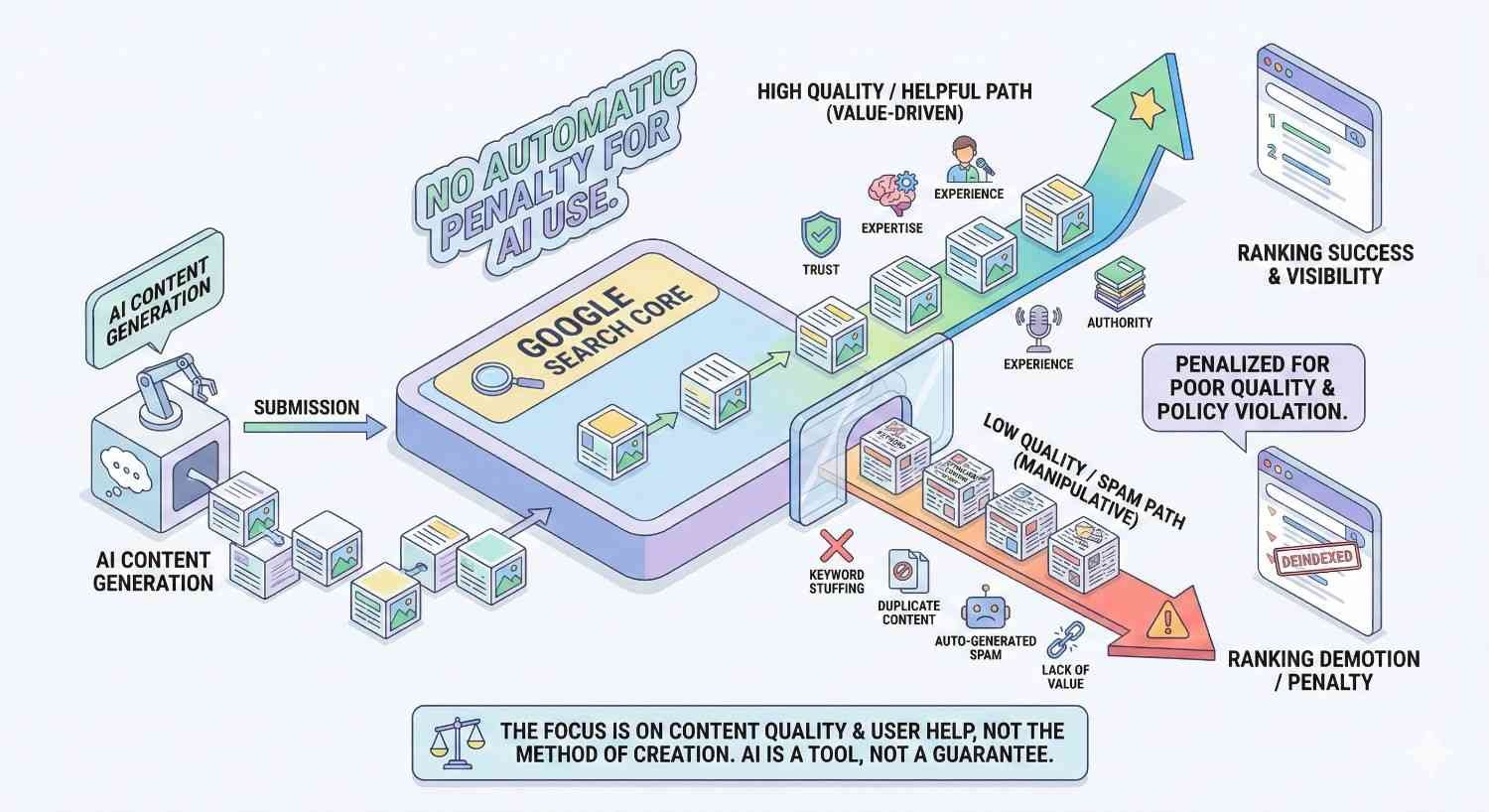
Does Google Penalize AI-Generated Content?
This question concerns many content teams. The answer has evolved as AI content has become ubiquitous.
Google’s Official Stance on AI Content
Google’s position is clear: content quality matters, not production method. AI-generated content isn’t automatically penalized or rewarded.
The search engine evaluates content based on helpfulness, accuracy, and user satisfaction. Content meeting these standards can rank regardless of whether humans or AI produced it.
Google’s helpful content system targets low-quality content created primarily for search engines rather than users. This applies equally to human and AI content.
The key distinction is between AI content created to help users and AI content created to manipulate rankings. The former can succeed; the latter risks penalties.
E-E-A-T and AI Content Quality
Experience, Expertise, Authoritativeness, and Trustworthiness remain central to content evaluation. AI content must demonstrate these qualities to rank well.
Experience signals require human input. AI hasn’t used products, visited locations, or implemented strategies. Human editors must add experiential elements.
Expertise comes through accurate, comprehensive coverage. AI can contribute here when properly guided and fact-checked, but human experts should verify technical content.
Authoritativeness builds through reputation and recognition. This requires human involvement—author credentials, brand reputation, and external validation.
Trustworthiness depends on accuracy and transparency. Rigorous fact-checking and honest representation of AI involvement support trust signals.
Best Practices for Google-Compliant AI Content
Focus on user value above all else. Create content that genuinely helps your audience rather than content designed primarily to rank.
Add human expertise and experience. Don’t publish raw AI output. Enhance it with insights, examples, and perspectives that only humans can provide.
Fact-check everything. AI generates plausible content that may be inaccurate. Verify claims, statistics, and technical details before publishing.
Maintain editorial standards. Apply the same quality standards to AI-assisted content that you would to fully human-written content.
Be transparent when appropriate. While disclosure isn’t required, honesty about content production methods supports trust.
How to Choose the Right AI Writing Tool for Your Business
Tool selection significantly impacts results. The right choice depends on your specific needs, resources, and workflows.
Assessing Your Content Needs and Goals
Start with clarity about what you need. Different tools serve different purposes. Misalignment between needs and capabilities wastes resources.
Consider content types you produce. Blog posts, product descriptions, landing pages, and technical documentation have different requirements. Choose tools suited to your primary content types.
Evaluate volume requirements. High-volume production needs different capabilities than occasional content creation. Ensure tools can handle your scale.
Identify workflow gaps. Where do current processes slow down? Choose tools that address specific bottlenecks rather than adding capabilities you won’t use.
Budget Considerations and ROI
AI writing tools range from free to enterprise pricing. Cost-effectiveness depends on how much value you extract.
Calculate potential time savings. If a tool saves ten hours monthly and your content team’s time costs $50 per hour, that’s $500 in monthly value before considering quality improvements.
Consider total cost of ownership. Subscription fees represent only part of the cost. Factor in training time, workflow adjustment, and potential quality control requirements.
Start with lower-tier plans when possible. Many tools offer scaled pricing. Begin with basic plans and upgrade as you confirm value.
Track ROI systematically. Monitor content performance, production efficiency, and cost metrics. This data informs renewal and upgrade decisions.
Integration with Existing SEO Workflows
Tools that integrate smoothly with existing workflows deliver more value than standalone solutions requiring workflow changes.
Check integrations with your current tools. CMS integration, Google Docs compatibility, and connections to SEO platforms reduce friction.
Evaluate API availability if you need custom integrations. Technical teams can build connections that standard integrations don’t cover.
Consider team adoption requirements. Tools requiring significant behavior change face adoption challenges. Simpler integrations see faster, more complete adoption.
Trial Periods and Testing Strategies
Most AI writing tools offer free trials. Use these strategically to evaluate fit before committing.
Test with realistic use cases. Don’t just explore features—produce actual content you would publish. This reveals practical strengths and limitations.
Involve team members who will use the tool daily. Their feedback matters more than administrator impressions.
Compare multiple tools when possible. Side-by-side evaluation reveals differences that individual testing might miss.
Document findings systematically. Create evaluation criteria before testing and score each tool consistently. This prevents recency bias and ensures fair comparison.
Common Mistakes When Using AI Writing Tools for SEO
AI tools amplify both good and bad practices. Avoiding common mistakes maximizes their value.
Over-Reliance on AI Without Human Oversight
Publishing AI content without human review risks quality and accuracy problems. AI produces competent but imperfect content.
Establish mandatory review processes. No AI content should publish without human editing and approval.
Train reviewers to catch AI-specific issues. Generic content, factual errors, and missing expertise signals require attention.
Maintain human involvement in strategy. AI can execute but shouldn’t determine what content to create or how to position it.
Ignoring Search Intent
AI tools optimize for keywords but may miss intent nuances. Content that targets keywords without satisfying intent underperforms.
Analyze intent before generating content. Understand what searchers actually want, not just what words they use.
Review AI output against intent requirements. Does the content answer the actual question? Does it provide what searchers need?
Adjust AI instructions to emphasize intent. Include intent descriptions in prompts and briefs to guide generation.
Keyword Stuffing and Over-Optimization
AI tools can over-optimize when given aggressive keyword targets. This produces unnatural content that readers and search engines reject.
Set reasonable keyword density targets. Modern SEO doesn’t require high keyword frequency. Natural usage performs better.
Review content for readability. If keyword usage feels forced or repetitive, reduce targets.
Prioritize semantic relevance over exact match keywords. AI tools that understand topical coverage produce more natural content than those focused on keyword counting.
Publishing Without Fact-Checking
AI generates confident-sounding content that may be factually wrong. Publishing errors damages credibility and can harm rankings.
Verify all statistics and claims. Check sources, confirm accuracy, and update outdated information.
Be especially careful with technical content. AI may misunderstand complex topics or conflate related but distinct concepts.
Establish fact-checking as a required workflow step. Build verification into processes rather than relying on ad-hoc checking.
The Future of AI Writing Tools in SEO
AI writing technology continues advancing rapidly. Understanding likely developments helps prepare for coming changes.
Emerging AI Technologies and Capabilities
Multimodal AI combines text, image, and video understanding. Future tools may generate and optimize content across formats simultaneously.
Improved reasoning capabilities will produce more accurate, logically consistent content. Current AI sometimes contradicts itself or makes logical errors that better models will avoid.
Real-time data integration will address knowledge cutoff limitations. AI tools will access current information rather than relying on training data.
Personalization capabilities will enable content tailored to individual users or segments. This creates opportunities for more targeted, effective content.
Predictive Content Optimization
Future tools will predict content performance before publication. Machine learning models trained on ranking data will estimate how content will perform.
This shifts optimization from reactive to proactive. Instead of publishing and adjusting, teams will optimize before content goes live.
Predictive capabilities will inform content strategy. Tools will identify topics with high ranking potential and recommend content investments.
A/B testing at scale will become feasible. AI will generate and test multiple content variations, identifying top performers automatically.
How Search Engines Will Evolve with AI Content
Search engines will continue adapting to AI content proliferation. Expect increased emphasis on signals AI can’t easily replicate.
Original research and data will gain importance. Content offering unique information will differentiate from AI-generated summaries of existing content.
Author expertise and credentials will matter more. Search engines will verify and weight author authority more heavily.
User engagement signals may receive increased weight. How users interact with content provides quality signals independent of content production method.
Search experiences will change. AI-generated answers in search results change how users interact with content. Strategies must adapt to new user behaviors.
Measuring ROI from AI Writing Tools
Investment in AI tools requires justification. Systematic measurement demonstrates value and guides optimization.
Key Performance Metrics to Track
Track production efficiency metrics. Content pieces produced, time per piece, and cost per piece reveal operational impact.
Monitor content performance metrics. Organic traffic, rankings, engagement, and conversions show whether AI content achieves goals.
Measure quality indicators. Editorial revision rates, error frequency, and reader feedback indicate content quality levels.
Calculate cost savings. Compare current costs to pre-AI baselines. Include both direct costs and time savings.
Content Velocity and Output Benchmarks
Establish baseline measurements before implementing AI tools. This enables accurate before-and-after comparison.
Track content velocity—pieces published per time period. AI tools should increase this metric significantly.
Monitor coverage expansion. Are you addressing more topics and keywords than before? Broader coverage indicates strategic value.
Balance velocity against quality. Increased output means nothing if content underperforms. Track performance alongside volume.
Long-Term Traffic and Conversion Impact
Short-term metrics matter, but long-term impact determines true ROI. SEO results compound over time.
Track organic traffic trends over months and years. AI-assisted content strategies should produce sustained traffic growth.
Monitor conversion rates from organic traffic. Traffic without conversions has limited business value.
Calculate customer acquisition cost from organic channels. Compare to paid acquisition costs to demonstrate SEO investment value.
Attribute revenue to content where possible. Connect content performance to business outcomes for complete ROI picture.
Conclusion: Building a Sustainable SEO Strategy with AI Writing Tools
AI writing tools have transformed content production for SEO. They enable scale, efficiency, and consistency that manual processes can’t match. But tools alone don’t guarantee success—strategic implementation determines outcomes.
The businesses seeing the best results combine AI capabilities with human expertise. They use AI for research, drafting, and optimization while reserving human effort for strategy, expertise injection, and quality assurance. This hybrid approach maximizes efficiency without sacrificing the quality signals that drive rankings.
We help businesses build sustainable organic growth strategies that leverage AI tools effectively. If you’re ready to scale your content production while maintaining the quality that earns rankings, White Label SEO Service can help you implement the right tools and processes for your specific goals.
Frequently Asked Questions About AI Writing Tools for SEO
Are AI writing tools worth the investment?
For most businesses producing regular content, AI writing tools deliver positive ROI through time savings and increased output. The value depends on your content volume and current production costs. Teams publishing multiple pieces weekly typically see the clearest benefits.
Can AI writing tools replace SEO agencies?
AI tools handle content production but don’t replace strategic expertise. Agencies provide keyword research, technical SEO, link building, and strategic guidance that tools can’t replicate. Most businesses benefit from combining AI tools with professional SEO support.
How much content can AI tools produce?
Output depends on the tool and content type. Most AI writing tools can generate initial drafts in minutes. The practical limit is usually editing capacity rather than generation speed. Teams typically find they can double or triple output with AI assistance.
Do AI tools work for all industries?
AI tools work across industries but perform better for some content types. General informational content sees strong results. Highly technical, regulated, or specialized content requires more human oversight and expertise injection.
What’s the learning curve for AI writing tools?
Basic functionality is accessible immediately for most tools. Optimizing output quality takes longer—typically a few weeks of experimentation with prompts and settings. Teams should expect an adjustment period before reaching full productivity.
How do I ensure AI content meets Google’s quality standards?
Focus on user value, add human expertise, and fact-check thoroughly. Apply the same editorial standards you would to human-written content. Content that genuinely helps users performs well regardless of production method.
Should I disclose that content was created with AI assistance?
Disclosure isn’t required by Google or most platforms. The decision depends on your brand values and audience expectations. Transparency generally supports trust, but the quality of content matters more than production method disclosure.