A well-structured content brief template is the single most important document separating high-ranking content from pages that never see page one. Without clear direction, even talented writers produce content that misses search intent, lacks topical depth, and fails to convert.
This matters because content production costs continue rising while organic competition intensifies. Teams without standardized briefs waste hours on revisions and publish content that underperforms.
This guide covers everything from core components and template types to step-by-step creation processes, real examples, and advanced strategies for scaling content operations.
What Is a Content Brief Template?
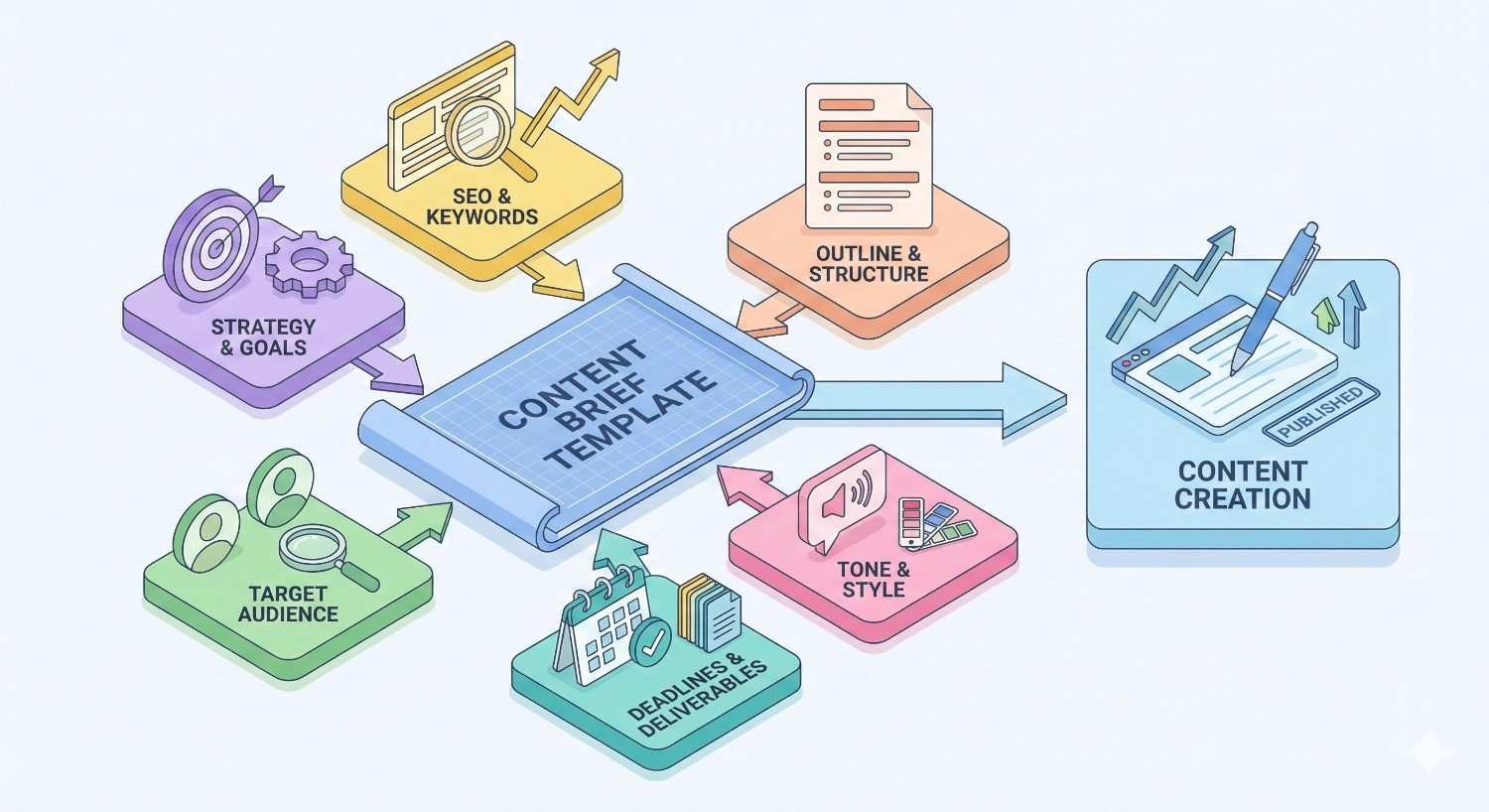
A content brief template is a standardized document that provides writers with all the information needed to create SEO-optimized content. It bridges the gap between keyword research, competitive analysis, and actual content production by translating SEO data into actionable writing instructions.
Think of it as a blueprint. Architects don’t expect builders to guess at measurements. Similarly, content strategists shouldn’t expect writers to guess at search intent, target keywords, or content structure.
The template itself is reusable. You fill in specific details for each piece of content while maintaining consistent quality standards across your entire content operation. This standardization is what separates teams publishing 50+ articles monthly with consistent results from those struggling to maintain quality at scale.
Core Components of a Content Brief Template
Every effective content brief template contains several foundational elements that guide the writing process from start to finish.
Target keyword information sits at the top. This includes the primary keyword, secondary keywords, and search volume data. Writers need to understand which terms matter most and how competitive the landscape is.
Search intent analysis explains what users actually want when they type the query. Are they looking to learn something, compare options, or make a purchase? This shapes everything from tone to content structure.
Content specifications define the practical parameters. Word count targets, heading structure requirements, and formatting guidelines ensure consistency. Most briefs specify a range rather than exact numbers to allow flexibility.
Audience context describes who will read the content. Demographics, pain points, knowledge level, and goals help writers craft messaging that resonates. Generic content written for everyone typically connects with no one.
Competitive insights summarize what top-ranking pages cover. This includes content gaps competitors missed and angles that could differentiate your piece. Writers shouldn’t copy competitors but should understand the baseline expectations.
Brand guidelines ensure voice and tone consistency. This section covers preferred terminology, words to avoid, and stylistic preferences that maintain brand identity across all content.
Content Brief vs. Content Outline: Key Differences
Many teams confuse content briefs with content outlines. While related, they serve different purposes in the content production workflow.
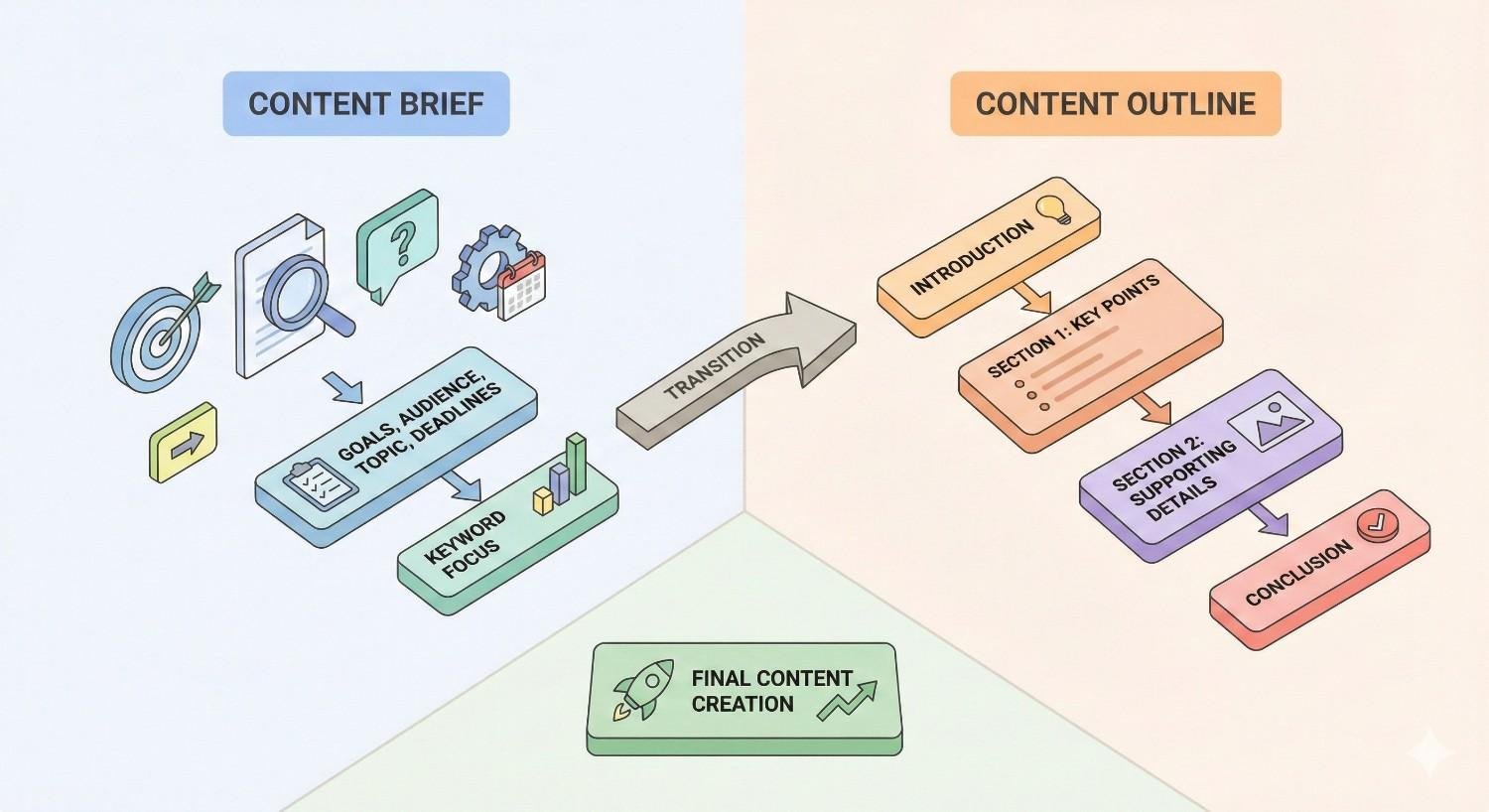
A content brief is strategic. It answers why the content exists, who it serves, and what success looks like. It provides research, context, and direction without dictating exact structure.
A content outline is tactical. It specifies the exact heading hierarchy, key points under each section, and the logical flow of information. Outlines are often created by writers based on brief guidance.
Some organizations combine both into a single document. Others keep them separate, with SEO teams creating briefs and writers developing outlines for approval before drafting.
The key distinction is ownership. Briefs typically come from SEO strategists or content managers. Outlines often come from writers who interpret brief requirements through their expertise.
Neither approach is universally better. The right choice depends on writer experience levels, content complexity, and team workflows. New writers often need detailed outlines. Experienced writers may prefer strategic briefs with creative freedom.
Why Content Brief Templates Are Essential for SEO Success
Content brief templates directly impact organic search performance by ensuring every piece of content is strategically aligned with ranking factors before a single word is written.
Without briefs, content creation becomes reactive. Writers make assumptions about keywords, structure, and depth. Some assumptions prove correct. Many don’t. The result is inconsistent performance and wasted resources.
With standardized briefs, content creation becomes proactive. Every article targets specific keywords with documented search intent. Every piece follows proven structural patterns. Every writer understands success metrics before starting.
Aligning Content Strategy with Search Intent
Search intent alignment is the foundation of modern SEO. Google’s algorithms have become remarkably sophisticated at understanding what users want and matching content accordingly.
Content briefs force explicit intent documentation. Instead of assuming a keyword is informational, the brief states it clearly. Writers then craft content that matches that intent precisely.
Consider the keyword “content brief template.” The intent is primarily informational with commercial undertones. Users want to learn what templates include and potentially find one to use. A brief would specify this, guiding writers toward educational content with practical examples rather than a sales pitch.
Misaligned intent is a common ranking failure. Pages targeting “best project management software” with purely informational content won’t rank because users want comparisons and recommendations. Briefs prevent these mismatches by documenting intent upfront.
Intent also varies by funnel stage. Awareness-stage content educates. Consideration-stage content compares. Decision-stage content converts. Briefs specify which stage the content targets, ensuring appropriate depth and calls to action.
Improving Content Quality and Consistency
Quality inconsistency plagues content teams without standardized processes. One writer produces comprehensive guides. Another produces thin content missing key subtopics. Both claim to follow the same strategy.
Briefs establish minimum quality standards. Word count ranges ensure adequate depth. Required subtopics guarantee comprehensive coverage. Competitor analysis benchmarks set expectations for what “good” looks like.
Consistency matters for topical authority. Search engines evaluate sites holistically. A site with ten excellent articles and ten mediocre ones signals inconsistent expertise. Briefs help maintain quality floors across all content.
Quality also impacts user metrics. Comprehensive, well-structured content earns longer time on page, lower bounce rates, and more engagement. These behavioral signals reinforce ranking positions over time.
Streamlining Content Production Workflows
Efficiency gains from content briefs compound over time. Initial template creation requires investment. Ongoing production becomes significantly faster.
Writers spend less time researching. The brief provides keyword data, competitor insights, and audience context. Writers focus on writing rather than analysis they may not be trained to perform.
Revision cycles shorten dramatically. When expectations are documented upfront, first drafts align more closely with requirements. Teams report 30-50% fewer revision rounds after implementing standardized briefs.
Feedback becomes more objective. Instead of subjective opinions about content quality, reviewers check brief compliance. Did the writer cover required subtopics? Did they hit word count targets? Did they address the documented search intent?
Scaling becomes possible. Without briefs, quality depends entirely on individual writer skill. With briefs, quality depends on process. Processes scale. Individual expertise doesn’t.
Types of Content Brief Templates
Different content types require different brief structures. A blog post brief differs significantly from a product page brief. Using the wrong template leads to misaligned content.
Most organizations maintain multiple templates customized for their common content types. This library approach ensures appropriate guidance regardless of what’s being created.
SEO Content Brief Templates
SEO content briefs prioritize search visibility above all else. They’re heavily data-driven, incorporating keyword research, SERP analysis, and competitive intelligence.
These briefs typically include detailed keyword sections with primary targets, secondary keywords, and semantic variations. They specify exact search volumes and keyword difficulty scores to contextualize the competitive landscape.
SERP feature analysis is common. If featured snippets exist for the target keyword, the brief notes this and provides guidance on optimizing for that format. Similarly for People Also Ask boxes, video carousels, or other SERP features.
Competitor content analysis receives significant attention. The brief summarizes what top-ranking pages cover, their word counts, heading structures, and content gaps. This competitive intelligence shapes content strategy.
Technical SEO requirements may be included. Internal linking targets, URL structure recommendations, and schema markup specifications ensure the content integrates properly with broader site architecture.
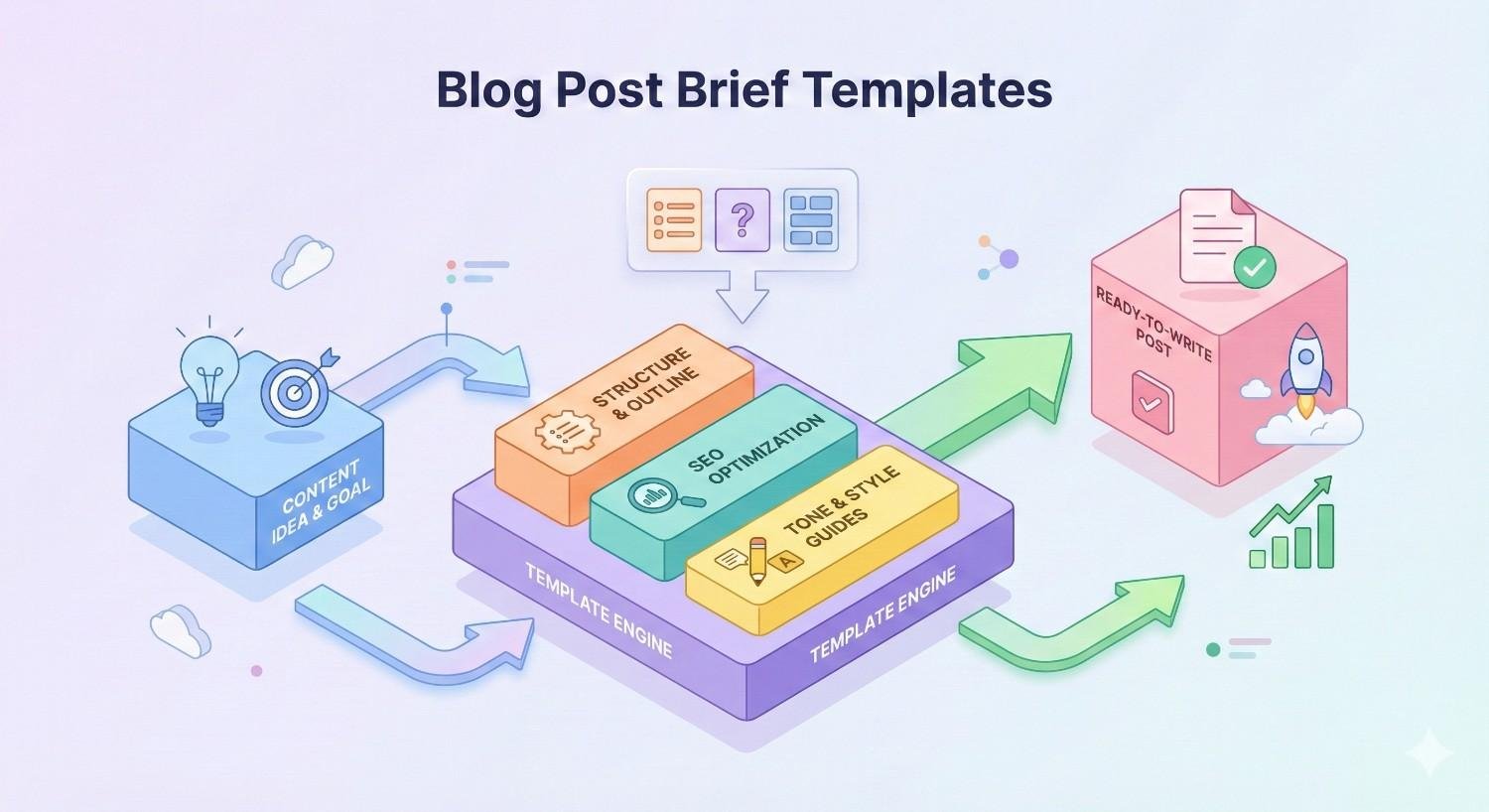
Blog Post Brief Templates
Blog post briefs balance SEO requirements with editorial considerations. They’re designed for content that informs, entertains, or educates while still targeting organic search traffic.
These briefs include standard keyword and intent information but add editorial context. What angle should the post take? What unique perspective can differentiate it from competitors? What stories or examples would resonate with readers?
Tone and voice guidance receives more emphasis than in purely SEO-focused briefs. Blog content often represents brand personality. The brief ensures writers capture that personality consistently.
Content format specifications are common. Should the post be a listicle, how-to guide, opinion piece, or case study? Format affects structure, and structure affects both readability and search performance.
Engagement elements may be specified. Should the post include a poll, downloadable resource, or interactive element? These additions impact user engagement metrics that influence rankings.
Product Page Brief Templates
Product page briefs focus on conversion optimization alongside search visibility. They guide content that must rank and sell simultaneously.
These briefs include product-specific information that writers need. Features, benefits, specifications, and differentiators must be accurately represented. Factual errors on product pages damage trust and conversions.
Competitive positioning receives attention. How does this product compare to alternatives? What objections might customers have? What proof points address those objections?
Conversion elements are specified. Where should CTAs appear? What urgency or scarcity messaging is appropriate? What trust signals should be included?
Technical product information may require subject matter expert input. The brief identifies what information writers can find independently and what requires internal consultation.
Landing Page Brief Templates
Landing page briefs prioritize conversion above all else. While SEO matters, these pages exist primarily to convert traffic from various sources.
These briefs specify the traffic source and user context. Visitors from paid ads have different expectations than organic visitors. The brief ensures content matches the promise that brought users to the page.
Value proposition clarity is paramount. The brief articulates exactly what the page offers and why it matters to the target audience. Vague value propositions kill conversions.
Objection handling is documented. What concerns might prevent conversion? What proof points, testimonials, or guarantees address those concerns?
Form or CTA specifications are detailed. What information should be collected? What happens after submission? How should the conversion action be framed?
Editorial Content Brief Templates
Editorial briefs prioritize thought leadership and brand building over direct SEO performance. They guide content that establishes expertise and builds audience relationships.
These briefs emphasize unique perspectives and original insights. What can your organization say that competitors can’t? What proprietary data, experiences, or viewpoints differentiate your content?
Expert sourcing may be required. The brief identifies internal or external experts who should be quoted or interviewed. Original expert commentary adds credibility and uniqueness.
Distribution considerations are included. Editorial content often supports PR, social media, or email marketing goals. The brief ensures content serves these broader objectives.
Brand narrative alignment is specified. How does this piece fit into the larger story your brand tells? What themes or messages should be reinforced?
Essential Elements Every Content Brief Template Must Include
Comprehensive content briefs share common elements regardless of content type. Missing any of these components creates gaps that writers must fill with assumptions.
The following elements represent the minimum viable brief. Additional elements may be added based on content type, team needs, and organizational complexity.
Target Keyword and Search Intent Analysis
Every brief starts with keyword targeting. This section documents exactly what search queries the content should rank for and why those queries matter.
Primary keyword is the main target. This is the query you most want to rank for, typically with the highest search volume or business value among related terms.
Secondary keywords are supporting targets. These related queries should be addressed within the content but aren’t the primary focus. They often represent long-tail variations or related concepts.
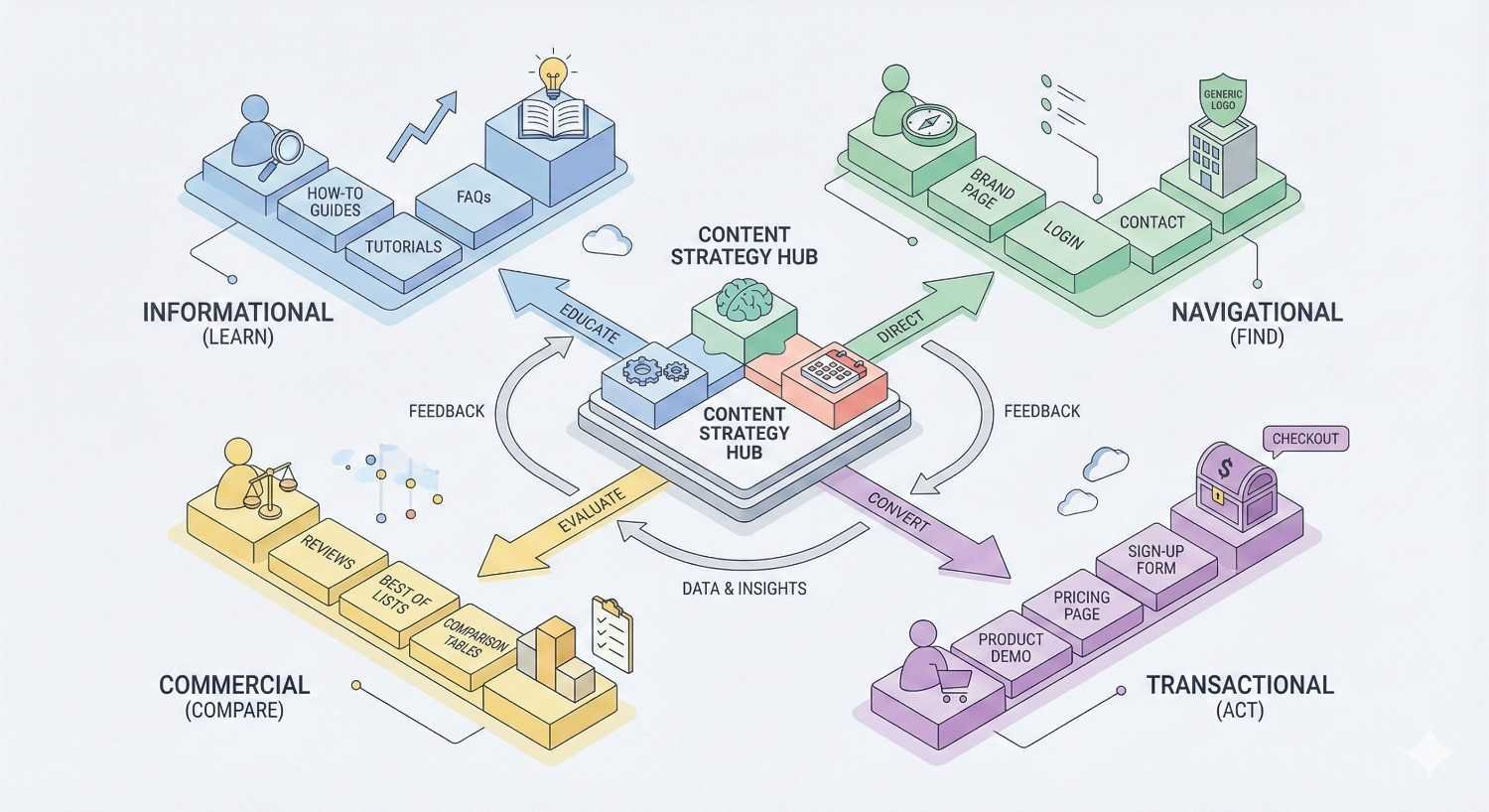
Search intent classification explains what users want. The four primary intent types are informational, navigational, transactional, and commercial investigation. Most content targets informational or commercial intent.
Intent evidence supports the classification. What SERP features appear? What content types rank? What do top-ranking pages actually cover? This evidence validates the intent assessment.
Keyword placement guidance may be included. Where should the primary keyword appear? Title, H1, first paragraph, and conclusion are common requirements. Avoid over-specification that leads to unnatural writing.
Target Audience and User Persona Definition
Audience definition ensures content resonates with the right people. Generic content written for everyone typically connects with no one.
Demographics provide basic context. Age ranges, job titles, industries, and company sizes help writers visualize their readers. This information shapes vocabulary choices and example selection.
Pain points identify what problems the audience faces. Content that addresses real problems earns attention. Content that addresses imaginary problems gets ignored.
Knowledge level calibrates content depth. Expert audiences need advanced insights. Beginner audiences need foundational explanations. Mismatched depth frustrates readers.
Goals and motivations explain what success looks like for readers. What do they want to achieve? How does this content help them get there?
Objections and concerns anticipate resistance. What might prevent readers from accepting your message or taking desired actions? Addressing objections proactively builds trust.
Content Objectives and Success Metrics
Clear objectives prevent scope creep and enable performance measurement. Every piece of content should have defined goals.
Primary objective states the main purpose. Is this content meant to rank for a specific keyword, generate leads, build authority, or support sales conversations?
Secondary objectives acknowledge additional goals. Content often serves multiple purposes. Documenting these prevents single-metric optimization that undermines broader value.
Success metrics define how performance will be measured. Organic traffic, keyword rankings, time on page, conversion rate, and social shares are common metrics. Specify which matter most.
Benchmarks provide context for metrics. What does success look like? A 500-visit article might be excellent for a niche B2B topic but disappointing for a high-volume consumer keyword.
Timeline expectations set realistic performance windows. SEO content typically takes 3-6 months to reach full ranking potential. Setting appropriate expectations prevents premature judgments.
Heading Structure and Content Hierarchy
Heading structure shapes both user experience and search engine understanding. Well-organized content performs better on both dimensions.
H1 specification defines the main title. This should include the primary keyword and clearly communicate what the content covers. Only one H1 per page.
H2 framework outlines major sections. These represent the main topics the content will cover. H2s should be comprehensive enough to address search intent fully.
H3 and H4 guidance provides subsection direction. These headings break down H2 topics into digestible components. They also create opportunities for long-tail keyword targeting.
Logical flow ensures sections connect coherently. Readers should be able to follow the content’s progression without confusion. Each section should build on previous ones.
Flexibility allowance gives writers room to adjust. Heading structures should guide, not constrain. Experienced writers may identify better organizational approaches during drafting.
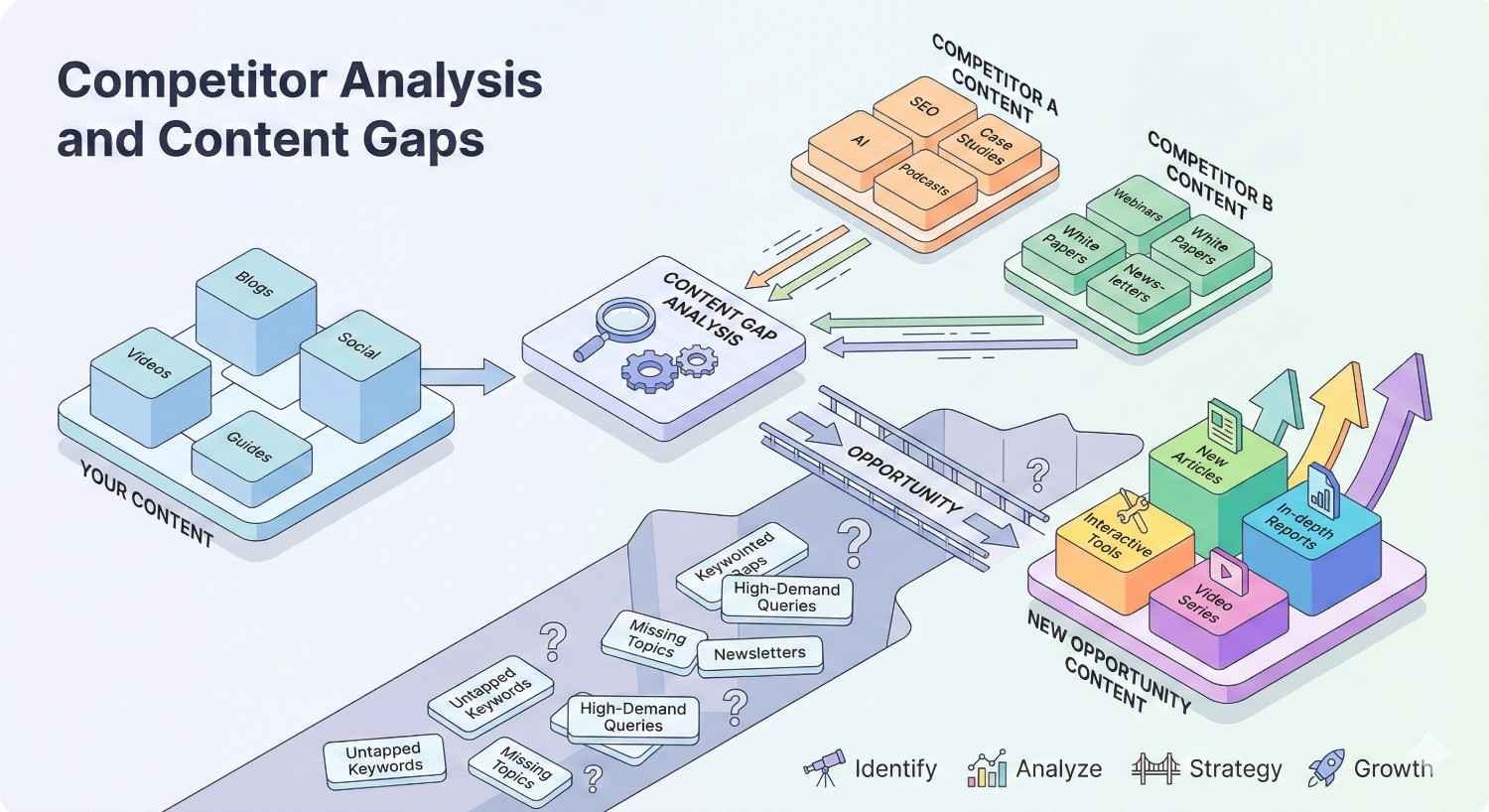
Competitor Analysis and Content Gaps
Competitive intelligence informs content strategy. Understanding what ranks helps you create something better.
Top competitor summary identifies who currently ranks. List the top 3-5 ranking URLs for the primary keyword with brief descriptions of their content approach.
Content coverage analysis documents what competitors include. What topics do they all cover? What subtopics appear in some but not all? This reveals baseline expectations and differentiation opportunities.
Content gaps identify what’s missing. What questions do competitors fail to answer? What perspectives are absent? What depth is lacking? Gaps represent opportunities.
Differentiation opportunities suggest how to stand out. Can you provide more examples? Better data? Unique perspectives? Practical tools? Differentiation drives rankings.
Quality assessment evaluates competitor content objectively. Is it well-written? Comprehensive? Current? Understanding competitor quality levels sets your target.
Required Topics and Subtopics to Cover
Comprehensive topic coverage signals expertise to search engines. Missing important subtopics undermines topical authority.
Must-cover topics are non-negotiable. These subtopics appear in all top-ranking content and are essential to addressing search intent. Omitting them creates content gaps.
Should-cover topics add depth. These subtopics appear in some top-ranking content and strengthen comprehensiveness. Include them if word count allows.
Could-cover topics provide differentiation. These subtopics are rarely covered by competitors but relevant to the audience. Including them creates unique value.
Out-of-scope topics prevent tangents. Some related topics don’t belong in this piece. Explicitly excluding them keeps content focused.
Topic depth guidance specifies how thoroughly each subtopic should be covered. Some deserve multiple paragraphs. Others need only brief mentions.
Context Terms and Semantic Keywords
Semantic SEO requires natural use of related terminology. Search engines understand topics through the language surrounding them.
Semantic keyword list provides related terms to incorporate. These aren’t keywords to stuff but concepts to address naturally. Their presence signals topical relevance.
Entity mentions identify important people, places, organizations, or concepts to reference. Entities help search engines understand content context and build knowledge graph connections.
Industry terminology ensures appropriate vocabulary. Using correct technical terms signals expertise. Avoiding jargon when unnecessary improves accessibility.
Natural language guidance prevents keyword stuffing. Terms should appear where they fit naturally. Forced inclusion damages readability and can trigger spam filters.
Synonym variations encourage vocabulary diversity. Using the same term repeatedly bores readers and looks unnatural. Synonyms maintain meaning while improving flow.
Word Count and Content Depth Guidelines
Word count targets ensure appropriate depth without encouraging fluff. The right length depends on topic complexity and competitive landscape.
Target word count range provides flexibility. Specifying 2,000-2,500 words is better than demanding exactly 2,250. Ranges allow natural content development.
Competitive benchmark contextualizes the target. If top-ranking content averages 3,000 words, targeting 1,500 likely won’t compete. Benchmarks justify requirements.
Depth expectations clarify what word count should accomplish. More words shouldn’t mean more fluff. They should mean more examples, more detail, and more value.
Section-level guidance may allocate words across topics. If one subtopic is more important, it deserves more coverage. Allocation prevents imbalanced content.
Quality over quantity reminder prevents padding. Writers should hit targets through valuable content, not filler. If the topic is fully covered in fewer words, that’s acceptable.
Tone, Voice, and Style Requirements
Consistent tone and voice build brand recognition. Every piece of content should feel like it comes from the same organization.
Brand voice description articulates personality. Is the brand authoritative, friendly, technical, casual, or formal? Voice descriptions guide word choice and sentence structure.
Tone for this piece may differ from overall brand voice. A serious topic might require more formal tone even from a typically casual brand. Specify any adjustments.
Style guide reference points to detailed guidelines. Most organizations have style guides covering grammar preferences, formatting standards, and terminology choices.
Examples of good content show rather than tell. Linking to existing content that exemplifies desired tone helps writers understand expectations concretely.
Things to avoid prevent common mistakes. Specific words, phrases, or approaches that don’t fit the brand should be explicitly prohibited.
Internal Linking and CTA Specifications
Internal links and calls to action serve both SEO and business objectives. Strategic placement maximizes their impact.
Required internal links specify pages that must be linked. These might be cornerstone content, product pages, or other strategic assets. Include target anchor text suggestions.
Contextual linking guidance encourages natural link placement. Links should appear where they add value for readers, not just for SEO. Forced links damage user experience.
CTA placement identifies where conversion actions should appear. Should there be a CTA in the introduction, conclusion, or both? What about mid-content CTAs?
CTA messaging specifies what the call to action should say. Generic “contact us” CTAs underperform specific, benefit-focused alternatives.
Link equity considerations may influence strategy. New content might link to pages needing ranking boosts. Established content might receive links from new pieces.
How to Create a Content Brief Template (Step-by-Step)
Creating effective content brief templates requires systematic process. Following these steps ensures comprehensive briefs that drive results.
The process takes time initially but creates reusable assets. Once templates exist, populating them for specific content becomes much faster.
Step 1: Define Your Content Goals and KPIs
Start with the end in mind. What should this content accomplish? How will you measure success?
Identify primary objectives first. Is this content meant to rank for specific keywords, generate leads, build authority, or support other marketing initiatives? Primary objectives shape everything else.
Select measurable KPIs that align with objectives. Ranking-focused content tracks keyword positions and organic traffic. Lead-focused content tracks conversions. Authority content might track backlinks or social shares.
Set realistic benchmarks based on historical performance and competitive analysis. New sites shouldn’t expect the same results as established domains. Benchmarks should stretch but remain achievable.
Document timeline expectations for when results should materialize. SEO content needs months to rank. Paid traffic content can be evaluated immediately. Mismatched timelines lead to premature optimization or abandonment.
Align stakeholders on goals before proceeding. Disagreement about objectives creates conflict during review. Get buy-in upfront.
Step 2: Conduct Keyword and SERP Research
Keyword research provides the foundation for SEO-focused content. This step identifies what to target and how competitive the landscape is.
Start with seed keywords related to your topic. Use keyword research tools to expand these into comprehensive lists. Ahrefs, Semrush, and Moz are industry-standard platforms.
Analyze search volume to understand demand. Higher volume means more potential traffic but typically more competition. Balance volume against ranking difficulty.
Evaluate keyword difficulty to assess competitiveness. New sites should target lower-difficulty keywords initially. Established sites can pursue more competitive terms.
Examine SERP features for each target keyword. Featured snippets, People Also Ask boxes, and video carousels indicate content format preferences. Optimize for features that appear.
Document findings in your brief template. Include primary keyword, secondary keywords, search volumes, difficulty scores, and SERP feature observations.
Step 3: Analyze Top-Ranking Competitor Content
Competitive analysis reveals what search engines consider quality content for your target keywords. This intelligence shapes your content strategy.
Identify top competitors by searching your primary keyword. The top 5-10 organic results represent your competition. Exclude irrelevant results like forums or directories.
Analyze content structure of each competitor. What headings do they use? How do they organize information? What content formats appear? Structure patterns indicate user preferences.
Assess content depth by examining word counts and topic coverage. Are competitors writing 1,000-word overviews or 5,000-word comprehensive guides? Depth expectations vary by topic.
Identify content gaps that competitors miss. What questions go unanswered? What perspectives are absent? What examples are lacking? Gaps represent differentiation opportunities.
Evaluate content quality subjectively. Is competitor content well-written? Current? Accurate? Understanding quality levels helps you set appropriate targets.
Step 4: Extract Search Intent and User Questions
Understanding what users actually want is essential for content that ranks and satisfies. This step decodes intent from SERP signals.
Classify primary intent based on SERP analysis. Informational intent shows educational content. Commercial intent shows comparisons and reviews. Transactional intent shows product pages. Mixed intent requires balanced content.
Identify user questions from multiple sources. People Also Ask boxes reveal common queries. Keyword research tools show question-format searches. Forums and social media expose real user concerns.
Map the user journey to understand context. Where are users in their decision process? What do they already know? What do they need to learn? Journey stage affects content approach.
Document intent findings explicitly in your brief. Don’t assume writers will infer intent correctly. State it clearly with supporting evidence.
Prioritize questions by importance and relevance. Not every question deserves equal coverage. Focus on questions most aligned with your objectives and audience needs.
Step 5: Structure Your Heading Hierarchy
Heading structure organizes content for both readers and search engines. Well-structured content performs better on both dimensions.
Draft H1 title incorporating your primary keyword naturally. The title should clearly communicate what the content covers while being compelling enough to earn clicks.
Outline H2 sections covering major topics. Each H2 should address a distinct aspect of the overall topic. Together, H2s should comprehensively cover search intent.
Add H3 subsections where topics need breakdown. Complex H2 topics benefit from further organization. H3s also create opportunities for long-tail keyword targeting.
Ensure logical flow between sections. Readers should be able to follow the content’s progression naturally. Each section should build on previous ones.
Leave room for flexibility in your structure. Writers may identify better organizational approaches during drafting. Structures should guide, not constrain.
Step 6: Document Context Terms and Semantic Keywords
Semantic SEO requires natural use of related terminology throughout content. This step identifies terms that signal topical relevance.
Extract semantic keywords from competitor content. What terms appear consistently across top-ranking pages? These represent expected vocabulary for the topic.
Identify entities relevant to your topic. People, organizations, places, products, and concepts that should be mentioned help search engines understand content context.
Use SEO tools to find related terms. Clearscope, Surfer SEO, and MarketMuse analyze top-ranking content to identify important terms.
Organize terms by importance to guide usage. Some terms are essential. Others are nice to have. Prioritization helps writers focus on what matters most.
Provide usage guidance to prevent keyword stuffing. Terms should appear naturally where they fit. Forced inclusion damages readability and can trigger spam filters.
Step 7: Define Content Methodology and Format
Content format significantly impacts both user experience and search performance. This step specifies how information should be presented.
Select primary format based on intent and competition. How-to guides, listicles, comparisons, case studies, and comprehensive guides each serve different purposes. Match format to user needs.
Specify structural elements that should be included. Tables, bullet lists, numbered steps, images, and videos each have appropriate uses. Specify what the content needs.
Define example requirements to ensure practical value. How many examples should be included? What type? Real-world examples make abstract concepts concrete.
Consider multimedia needs beyond text. Should the content include original images, screenshots, diagrams, or videos? Visual elements improve engagement and comprehension.
Document format decisions in your brief template. Writers shouldn’t guess at format. Explicit guidance ensures alignment with strategy.
Step 8: Add Writer Guidelines and Quality Standards
Quality standards ensure consistent output regardless of which writer handles the assignment. This step documents expectations clearly.
Reference brand guidelines for voice and tone. Link to style guides, provide examples of good content, and specify any adjustments needed for this particular piece.
Set quality benchmarks for various dimensions. Readability scores, factual accuracy requirements, and originality expectations should be documented.
Specify review criteria that will be used to evaluate drafts. Writers perform better when they know exactly how their work will be judged.
Include practical requirements like deadlines, file formats, and submission processes. Administrative details prevent confusion and delays.
Provide resources that help writers succeed. Links to research materials, subject matter expert contacts, and reference content support quality output.
Content Brief Template Examples and Use Cases
Abstract guidance becomes concrete through examples. The following templates demonstrate how brief elements come together for different content types.
Adapt these examples to your specific needs. No template works perfectly for every organization or content type.
Example 1: SEO Blog Post Content Brief
Content Title: How to Conduct a Technical SEO Audit: Complete Checklist
Primary Keyword: technical SEO audit Secondary Keywords: SEO audit checklist, website audit, technical SEO issues Search Volume: 2,400/month Keyword Difficulty: 45/100
Search Intent: Informational. Users want step-by-step guidance on performing technical SEO audits. They expect actionable checklists and tool recommendations.
Target Audience: Marketing managers and website operators at SMEs who handle SEO in-house. Intermediate technical knowledge. Looking for systematic approaches they can implement without hiring specialists.
Content Objectives:
- Rank top 10 for “technical SEO audit” within 6 months
- Generate 500+ organic visits monthly
- Capture email signups via downloadable checklist
Word Count Target: 3,000-3,500 words
Required Topics:
- What is a technical SEO audit
- Why technical audits matter
- Crawlability and indexation checks
- Site speed analysis
- Mobile-friendliness evaluation
- URL structure review
- Internal linking assessment
- Schema markup verification
- Security (HTTPS) confirmation
- Recommended audit tools
Competitor Analysis Summary: Top-ranking content averages 2,800 words. Most focus on tool-specific instructions rather than methodology. Gap opportunity: provide framework that works regardless of tools used.
Internal Links Required:
- Link to site speed optimization guide
- Link to mobile SEO best practices
- Link to schema markup tutorial
CTA: Downloadable technical SEO audit checklist (email gate)
Example 2: Product Category Page Content Brief
Page Title: Project Management Software for Small Business
Primary Keyword: project management software small business Secondary Keywords: PM tools for SMBs, small business project management, team collaboration software Search Volume: 1,800/month Keyword Difficulty: 52/100
Search Intent: Commercial investigation. Users are comparing options and want to understand which solutions fit small business needs specifically. They expect feature comparisons, pricing information, and recommendations.
Target Audience: Small business owners and operations managers evaluating project management solutions. Limited technical expertise. Budget-conscious. Need solutions that work without dedicated IT support.
Content Objectives:
- Rank top 5 for primary keyword within 4 months
- Drive qualified traffic to product comparison pages
- Generate demo requests from SMB prospects
Word Count Target: 2,000-2,500 words
Required Topics:
- What small businesses need from PM software
- Key features to evaluate
- Pricing considerations for SMBs
- Implementation complexity factors
- Top solutions for small business (brief overviews)
- How to choose the right option
Competitor Analysis Summary: Most ranking pages are listicles from review sites. Opportunity: provide more strategic guidance on evaluation criteria rather than just listing options.
Internal Links Required:
- Link to individual product pages for featured solutions
- Link to pricing page
- Link to case studies from small business customers
CTA: Free trial signup or demo request
Example 3: Pillar Content Brief Template
Content Title: The Complete Guide to Content Marketing Strategy
Primary Keyword: content marketing strategy Secondary Keywords: content strategy, content marketing plan, content marketing guide Search Volume: 8,100/month Keyword Difficulty: 72/100
Search Intent: Informational with commercial undertones. Users want comprehensive education on content marketing strategy. They may be building strategies themselves or evaluating whether to hire help.
Target Audience: Marketing managers, founders, and business owners seeking to understand content marketing holistically. Mixed experience levels. Need both strategic frameworks and tactical guidance.
Content Objectives:
- Establish topical authority for content marketing cluster
- Rank top 10 for highly competitive primary keyword
- Generate backlinks from industry publications
- Support lead generation for content marketing services
Word Count Target: 5,000-6,000 words
Required Topics:
- What is content marketing strategy
- Benefits of strategic content marketing
- Content marketing strategy framework
- Audience research and persona development
- Content audit and gap analysis
- Content planning and calendaring
- Content creation processes
- Distribution and promotion strategies
- Measurement and optimization
- Common strategy mistakes
- Tools and resources
Cluster Content Links: This pillar should link to and from:
- Blog content strategy guide
- Social media content planning
- Content distribution tactics
- Content ROI measurement
- Editorial calendar templates
Competitor Analysis Summary: Top-ranking content is comprehensive but often outdated. Opportunity: provide current best practices with 2024-2025 examples and data.
CTA: Content strategy consultation or downloadable strategy template
Example 4: Local SEO Content Brief Template
Content Title: Best Italian Restaurants in Chicago: Local’s Guide
Primary Keyword: best Italian restaurants Chicago Secondary Keywords: Italian food Chicago, top Italian restaurants Chicago, Chicago Italian dining Search Volume: 4,400/month Keyword Difficulty: 38/100
Search Intent: Local commercial. Users want restaurant recommendations for Chicago specifically. They expect curated lists with enough detail to make dining decisions.
Target Audience: Chicago residents and visitors looking for Italian dining options. Mixed demographics. Want authentic recommendations, not just paid placements. Value insider knowledge.
Content Objectives:
- Rank in local pack and organic results
- Drive traffic to restaurant partner pages
- Build local authority for food/dining content
Word Count Target: 2,500-3,000 words
Required Topics:
- Selection criteria and methodology
- Best overall Italian restaurants
- Best for specific occasions (date night, family, business)
- Best by neighborhood
- Best by price point
- What to order at each restaurant
- Reservation tips
Local SEO Requirements:
- Include Chicago neighborhood names naturally
- Reference local landmarks and context
- Embed Google Maps for featured restaurants
- Include schema markup for local business mentions
Competitor Analysis Summary: Most ranking content is from national publications with surface-level coverage. Opportunity: provide genuine local expertise with specific dish recommendations and insider tips.
CTA: Newsletter signup for Chicago dining updates
Best Practices for Using Content Brief Templates
Having templates is only the beginning. How you use them determines their impact on content quality and team efficiency.
These best practices emerge from organizations that have successfully scaled content operations with standardized briefs.
Customizing Templates for Different Content Types
One-size-fits-all templates underperform. Different content types have different requirements that templates should reflect.
Create template variations for your common content types. Blog posts, product pages, landing pages, and pillar content each need customized templates with relevant fields.
Adjust required elements based on content purpose. SEO-focused content needs extensive keyword sections. Brand content might prioritize voice and messaging guidance instead.
Scale complexity appropriately to content importance. High-value pillar content deserves comprehensive briefs. Quick blog posts might use streamlined versions.
Review and refine templates based on usage patterns. If writers consistently ignore certain fields, those fields might be unnecessary. If they consistently ask questions, those topics need better coverage.
Maintain template library in accessible location. Templates should be easy to find and use. Buried templates don’t get used consistently.
Balancing SEO Requirements with Creative Freedom
Overly prescriptive briefs stifle creativity. Overly vague briefs produce inconsistent results. Finding the right balance is essential.
Specify what, not how whenever possible. Tell writers what topics to cover, not exactly what to say about them. This preserves creative space while ensuring comprehensive coverage.
Distinguish requirements from suggestions clearly. Some elements are non-negotiable. Others are recommendations. Writers should know which is which.
Trust experienced writers with more freedom. New writers may need detailed guidance. Veterans often produce better work with strategic direction and creative latitude.
Encourage writer input on brief improvements. Writers who use briefs daily often identify gaps or unnecessary constraints. Their feedback improves templates over time.
Evaluate outcomes, not just compliance when assessing content. A piece that deviates from the brief but performs well might indicate brief problems, not writer problems.
Collaborating Between SEO Teams and Writers
Content briefs bridge SEO strategy and content execution. Effective collaboration between these functions maximizes brief value.
Establish clear ownership for brief creation. Typically, SEO strategists or content managers create briefs. Writers execute them. Ambiguous ownership creates gaps.
Create feedback loops for brief quality. Writers should report when briefs are unclear, incomplete, or impractical. This feedback improves future briefs.
Hold brief review sessions for complex content. Walking through briefs together ensures shared understanding. Questions get answered before writing begins.
Document tribal knowledge that briefs assume. If briefs reference internal terminology or processes, ensure writers have access to that context.
Celebrate successful collaboration when content performs well. Recognizing both brief quality and writing quality reinforces the partnership.
Updating Briefs Based on SERP Changes
Search results evolve constantly. Briefs created months ago may no longer reflect current ranking factors or competitive landscape.
Monitor SERP changes for important keywords. Significant ranking shifts might indicate changed intent or new competitive content. Tools like Semrush and Ahrefs track these changes automatically.
Review briefs before content updates rather than using original briefs unchanged. What ranked well a year ago might not rank well today.
Track algorithm updates that might affect brief requirements. Major Google updates sometimes shift what content types or formats perform best.
Update templates periodically to reflect evolving best practices. Annual template reviews ensure your standards stay current.
Archive outdated briefs rather than deleting them. Historical briefs provide context for understanding content evolution and performance changes.
Measuring Content Performance Against Brief Objectives
Briefs should include success metrics. Measuring against those metrics closes the loop between strategy and results.
Track specified KPIs for each piece of content. If the brief targeted specific rankings, traffic levels, or conversions, measure those outcomes.
Compare performance across brief types to identify patterns. Do certain brief elements correlate with better performance? Data reveals what works.
Analyze underperforming content to understand why. Was the brief flawed? Was execution poor? Was the competitive landscape misjudged? Diagnosis enables improvement.
Adjust future briefs based on performance insights. If certain approaches consistently underperform, stop using them. If others consistently succeed, emphasize them.
Report results to stakeholders to demonstrate brief value. Connecting brief quality to content performance justifies investment in the brief creation process.
Common Content Brief Template Mistakes to Avoid
Even well-intentioned brief processes can go wrong. These common mistakes undermine brief effectiveness and content quality.
Recognizing these patterns helps you avoid them in your own processes.
Over-Optimizing for Keywords at the Expense of Readability
Keyword-stuffed briefs produce keyword-stuffed content. This damages both user experience and search performance.
Avoid keyword density targets that encourage unnatural writing. Modern SEO doesn’t require specific keyword frequencies. Natural usage performs better.
Focus on topics, not just terms in your briefs. Covering a topic comprehensively naturally includes relevant keywords. Forcing specific terms creates awkward content.
Prioritize readability in quality standards. Content that reads well earns engagement signals that support rankings. Robotic content drives users away.
Test content with real readers before publishing. If content feels forced or unnatural, it probably is. Reader feedback catches problems keyword tools miss.
Remember the goal is ranking AND converting. Content that ranks but doesn’t engage fails half its purpose.
Providing Insufficient Context or Research
Thin briefs produce thin content. Writers can’t create comprehensive content without comprehensive guidance.
Include competitive analysis in every brief. Writers need to understand what they’re competing against. Expecting them to research independently wastes time and produces inconsistent results.
Provide audience context beyond basic demographics. What problems does the audience face? What do they already know? What motivates them? Rich context enables resonant content.
Document search intent explicitly rather than assuming writers will infer it. Intent misalignment is a common content failure. Clear documentation prevents it.
Share relevant internal knowledge that writers might not have. Product details, customer insights, and strategic context help writers create more valuable content.
Link to reference materials that support research. Industry reports, competitor content, and internal resources give writers starting points for deeper exploration.
Creating Overly Rigid or Restrictive Briefs
Briefs that leave no room for creativity produce formulaic content. Excessive prescription undermines the value writers bring.
Avoid scripting exact sentences or paragraphs. Briefs should guide, not dictate. Writers should have room to craft compelling content within strategic parameters.
Allow structural flexibility for experienced writers. Suggested heading structures are helpful. Mandatory structures that can’t be adjusted are counterproductive.
Trust writer expertise in their craft. SEO strategists understand search. Writers understand writing. Both perspectives contribute to successful content.
Distinguish essential requirements from preferences. Some elements are truly non-negotiable. Others are suggestions that writers might improve upon.
Evaluate results, not just compliance when reviewing content. A piece that deviates from the brief but performs well might indicate brief problems, not writer problems.
Neglecting to Update Templates Over Time
Static templates become outdated. Search algorithms, competitive landscapes, and best practices all evolve.
Schedule regular template reviews at least annually. More frequent reviews may be needed in fast-changing industries or after major algorithm updates.
Incorporate learnings from content performance into template updates. What worked? What didn’t? Templates should reflect accumulated knowledge.
Remove obsolete elements that no longer serve their purpose. Templates tend to accumulate fields over time. Periodic pruning keeps them focused.
Add new elements as needs emerge. New content types, new SEO factors, or new business requirements might necessitate template additions.
Version control templates to track changes over time. Understanding how templates evolved helps explain performance changes in historical content.
Tools and Software for Creating Content Brief Templates
The right tools streamline brief creation and improve brief quality. Various options exist at different price points and complexity levels.
Tool selection depends on team size, budget, and specific needs. Start simple and add complexity as needed.
SEO Research Tools for Brief Creation
SEO research tools provide the data that populates content briefs. They’re essential for keyword research, competitive analysis, and SERP understanding.
Ahrefs offers comprehensive keyword research, competitive analysis, and content gap identification. Its Content Explorer helps identify top-performing content in any niche.
Semrush provides similar capabilities with strong competitive intelligence features. Its SEO Writing Assistant integrates with Google Docs for real-time optimization guidance.
Moz offers accessible keyword research and SERP analysis tools. Its Keyword Explorer provides helpful difficulty scores and opportunity assessments.
Google Search Console provides free data on your own site’s search performance. Understanding what already ranks helps inform new content strategy.
Google Keyword Planner offers free keyword research with search volume data. It’s limited compared to paid tools but useful for basic research.
Content Brief Template Software and Platforms
Dedicated content brief platforms automate much of the brief creation process. They’re particularly valuable for teams producing content at scale.
Clearscope analyzes top-ranking content to identify important terms and topics. It generates content grades that help writers optimize during drafting.
Surfer SEO provides detailed content briefs with word count targets, heading suggestions, and semantic keyword lists. Its Content Editor offers real-time optimization scoring.
MarketMuse uses AI to analyze topical authority and identify content gaps. It generates comprehensive briefs with topic coverage recommendations.
Frase combines research, brief creation, and writing assistance in one platform. It’s particularly strong for question research and answer optimization.
Content Harmony focuses specifically on content brief creation with detailed SERP analysis and competitor insights.
Project Management Tools for Brief Distribution
Project management tools organize brief workflows and ensure smooth handoffs between team members.
Asana enables brief attachment to content tasks with clear ownership and deadlines. Its templates feature supports standardized workflows.
Monday.com offers visual workflow management with customizable content production boards. Briefs can be attached to items and tracked through production stages.
Notion combines documentation and project management. Many teams use Notion databases to store briefs alongside content calendars and production tracking.
Trello provides simple kanban-style workflow management. Briefs attach to cards that move through production stages.
ClickUp offers comprehensive project management with document creation built in. Briefs can be created and managed within the same platform as production tracking.
Free Content Brief Template Resources
Budget constraints shouldn’t prevent brief adoption. Free resources provide starting points for teams building their processes.
Google Docs templates offer simple, accessible starting points. Create a master template and duplicate it for each new brief. Sharing and collaboration are built in.
Spreadsheet templates work well for data-heavy briefs. Google Sheets or Excel can organize keyword data, competitor analysis, and content specifications in structured formats.
HubSpot’s free templates include content brief examples that can be adapted to your needs. They’re particularly useful for inbound marketing-focused content.
Industry blogs often share template examples. Search for “content brief template” to find downloadable resources from SEO and content marketing publications.
Community resources from SEO forums and groups provide peer-tested templates. Communities like r/SEO and various Slack groups share practical resources.
How Content Brief Templates Fit Into Your Content Workflow
Content briefs don’t exist in isolation. They’re one component of broader content production workflows that span planning through publication.
Understanding where briefs fit helps maximize their impact on overall content operations.
Integrating Briefs into Content Planning
Brief creation should align with content planning processes. Briefs operationalize strategic content decisions.
Content calendars drive brief creation timing. When content is scheduled, briefs should be created with enough lead time for thorough research and writer preparation.
Topic selection precedes brief creation in most workflows. Strategic decisions about what to create come first. Briefs then provide tactical guidance for execution.
Brief creation can inform planning by revealing opportunities or challenges. Research during brief creation might identify better keyword targets or competitive obstacles that affect planning.
Batch brief creation improves efficiency for teams producing multiple pieces. Creating several briefs at once allows deeper immersion in research tools and processes.
Brief templates standardize planning outputs ensuring consistent information flows from strategy to execution regardless of who creates individual briefs.
Brief Handoff Process: SEO to Writer
The handoff between brief creator and writer is a critical workflow moment. Poor handoffs create confusion and rework.
Clear ownership transfer should occur at defined points. The writer should know exactly when they’re responsible for the content and what’s expected.
Brief review sessions for complex content ensure shared understanding. Walking through briefs together catches misunderstandings before writing begins.
Question channels should be established for clarification needs. Writers will have questions. They should know how to get answers quickly.
Deadline clarity prevents scheduling conflicts. Writers need to know when drafts are due and how that fits with their other commitments.
Resource access must be confirmed. If briefs reference tools, documents, or experts, writers need access to those resources.
Quality Assurance and Brief Compliance Checking
Quality assurance processes should verify that content meets brief requirements. This closes the loop between strategy and execution.
Compliance checklists derived from briefs streamline review. Did the content cover required topics? Hit word count targets? Include specified links? Checklists make review objective.
SEO tool verification confirms optimization requirements are met. Content optimization platforms can score content against brief specifications automatically.
Editorial review assesses quality beyond compliance. Meeting brief requirements is necessary but not sufficient. Content must also be well-written and valuable.
Feedback documentation captures issues for future improvement. Recurring problems might indicate brief gaps or writer training needs.
Revision processes should be efficient when issues are found. Clear feedback tied to specific brief requirements helps writers address problems quickly.
Scaling Content Production with Standardized Briefs
Standardized briefs enable content scaling that would be impossible with ad-hoc processes. Consistency at scale requires systematic approaches.
Template libraries support diverse content needs without custom brief creation for every piece. Having templates ready for common content types accelerates production.
Writer onboarding becomes faster with standardized briefs. New writers learn the system once rather than adapting to different approaches for each project.
Quality consistency improves as brief standards are applied across all content. Every piece meets minimum requirements regardless of which writer handles it.
Process optimization becomes possible when processes are standardized. You can’t improve what you can’t measure. Standardization enables measurement.
Team expansion is supported by documented processes. Adding writers or brief creators is easier when expectations are clearly documented in templates.
Content Brief Templates for Different Industries
Industry-specific considerations affect brief requirements. What works for e-commerce differs from what works for healthcare or financial services.
Adapting templates to industry needs improves content relevance and compliance.
E-commerce Content Brief Templates
E-commerce content briefs must balance SEO with conversion optimization. Product and category pages have unique requirements.
Product information accuracy is critical. Briefs should specify where to find correct specifications, pricing, and availability information. Errors damage trust and conversions.
Competitive positioning guidance helps differentiate products. What makes this product better than alternatives? What objections might customers have?
Visual content requirements are often extensive. Product images, lifestyle photos, and videos may be required. Briefs should specify what’s needed.
Conversion elements like CTAs, trust signals, and urgency messaging need specification. E-commerce content exists to sell. Briefs should support that goal.
Seasonal considerations may affect content. Holiday shopping, seasonal products, and promotional periods might require brief adjustments.
SaaS and B2B Content Brief Templates
B2B content briefs address longer sales cycles and multiple decision-makers. Content often serves lead generation and nurturing purposes.
Buyer journey mapping is essential. B2B purchases involve multiple stages and stakeholders. Briefs should specify which stage and audience the content targets.
Technical accuracy requirements may be high. B2B buyers often have expertise. Content must demonstrate credibility through accurate, detailed information.
Lead generation integration should be specified. What conversion actions should the content drive? What offers or CTAs are appropriate?
Sales enablement considerations may apply. Will sales teams use this content? If so, what do they need it to accomplish?
Compliance requirements might exist for certain industries. Regulated B2B sectors may have content restrictions that briefs must address.
Healthcare and Medical Content Brief Templates
Healthcare content briefs must prioritize accuracy and compliance. The stakes of misinformation are high.
Medical accuracy verification processes should be specified. Who reviews content for clinical accuracy? What credentials are required?
Regulatory compliance requirements must be documented. FDA, HIPAA, and other regulations may restrict what can be said and how.
Source requirements are typically strict. Medical claims should be supported by peer-reviewed research. Briefs should specify acceptable source types.
Disclaimer requirements may be necessary. Content might need to clarify that it’s not medical advice or specify when to consult healthcare providers.
Sensitivity considerations affect tone and approach. Health topics often involve vulnerable audiences. Briefs should guide appropriate, empathetic communication.
Financial Services Content Brief Templates
Financial content briefs navigate regulatory requirements and trust-building needs. Accuracy and compliance are paramount.
Regulatory compliance with SEC, FINRA, or other bodies must be addressed. Briefs should specify what disclosures or disclaimers are required.
Accuracy verification processes protect against liability. Financial information must be current and correct. Briefs should specify verification requirements.
Risk disclosure requirements may apply. Investment content often requires balanced presentation of risks and potential returns.
Credential requirements for authors may exist. Some financial content must be attributed to licensed professionals.
Update frequency considerations are important. Financial information changes rapidly. Briefs should address how content will be maintained.
Measuring the Impact of Content Brief Templates on SEO Performance
Demonstrating brief value requires measurement. Connecting brief quality to content performance justifies investment in the brief creation process.
Systematic measurement reveals what works and what needs improvement.
Tracking Content Quality Improvements
Quality improvements from brief adoption should be measurable. Several metrics indicate quality changes.
Revision rates often decrease with better briefs. Track how many revision rounds content requires before and after brief implementation.
First-draft quality scores from editorial review can be tracked over time. Are first drafts improving as briefs improve?
Writer satisfaction with briefs indicates usability. Survey writers about brief clarity and helpfulness.
Time to completion may decrease as briefs provide better guidance. Track how long content takes from brief to publication.
Consistency scores across content can be measured. Are quality levels more consistent with standardized briefs?
Monitoring Ranking Performance by Brief Type
Different brief approaches may produce different ranking results. Tracking performance by brief type reveals what works.
Segment content by brief template used. Compare ranking performance across different template types to identify which approaches work best.
Track ranking velocity for content produced with briefs versus without. Does brief-guided content rank faster?
Monitor ranking stability over time. Does brief-guided content maintain rankings better than ad-hoc content?
Analyze top performers to understand what their briefs had in common. Success patterns should inform template improvements.
Identify underperformers and examine their briefs for gaps. Failure patterns reveal what to avoid.
Analyzing Time-to-Publish and Efficiency Gains
Efficiency improvements from briefs should be quantifiable. Time savings justify brief creation investment.
Track production timelines before and after brief implementation. How long does content take from assignment to publication?
Measure brief creation time to understand the investment required. Efficient brief creation processes maximize ROI.
Calculate revision time savings from reduced revision rounds. Fewer revisions mean faster publication and lower costs.
Assess writer productivity changes. Can writers produce more content with better briefs?
Quantify cost savings from efficiency improvements. Time savings translate to cost savings that can be calculated.
Measuring Traffic and Conversion Outcomes
Ultimately, content must drive business results. Traffic and conversion metrics connect briefs to business value.
Track organic traffic for brief-guided content. Compare to historical benchmarks or content produced without briefs.
Monitor conversion rates for content with conversion objectives. Are brief-specified CTAs performing as expected?
Measure engagement metrics like time on page and bounce rate. Do users engage more with brief-guided content?
Calculate content ROI by comparing production costs to traffic and conversion value. Brief investment should improve ROI.
Attribute revenue to content where possible. Connecting content to pipeline and revenue demonstrates ultimate business impact.
Advanced Content Brief Strategies
Basic brief practices establish foundations. Advanced strategies push performance further for teams ready to optimize.
These approaches require more sophistication but deliver greater results.
Semantic SEO and Entity-Based Brief Creation
Modern SEO increasingly focuses on entities and semantic relationships. Advanced briefs incorporate these concepts.
Entity mapping identifies important entities related to your topic. People, organizations, places, products, and concepts that should be mentioned help search engines understand content context.
Semantic relationship documentation shows how entities connect. Understanding relationships helps writers create content that demonstrates topical expertise.
Knowledge graph alignment ensures content matches how search engines understand topics. Briefs can specify entity mentions and relationships that strengthen knowledge graph connections.
Topic clustering in briefs shows how individual pieces fit into broader topical authority strategies. Each brief should reference related content in the cluster.
Entity-first keyword research starts with entities rather than keywords. What entities matter to your audience? What queries do those entities generate?
Creating Briefs for Featured Snippet Optimization
Featured snippets offer significant visibility opportunities. Briefs can specifically target snippet capture.
Snippet type identification determines optimization approach. Paragraph snippets, list snippets, and table snippets each require different content formats.
Question targeting focuses on queries that trigger snippets. Briefs should specify exact questions to answer in snippet-optimized formats.
Format specifications guide snippet-friendly content structure. Direct answers, numbered lists, and comparison tables each have optimal formats.
Competitor snippet analysis reveals what currently wins snippets. Understanding current snippet holders helps you create better alternatives.
Answer positioning guidance ensures snippet-targeted content appears prominently. Answers should appear early and be clearly formatted.
Multi-Intent Content Brief Templates
Some keywords have mixed intent. Advanced briefs address multiple user needs within single pieces.
Intent segmentation identifies different user groups searching the same query. What does each group want? How can one piece serve all of them?
Content structure for multi-intent pieces requires careful organization. Different sections can address different intents while maintaining coherent flow.
Navigation aids help users find relevant sections quickly. Clear headings, jump links, and summaries support multi-intent content usability.
Conversion path mapping for different intents ensures appropriate CTAs. Informational users might get newsletter signups. Transactional users might get product links.
Performance tracking by intent segment reveals which user groups the content serves best. This informs optimization priorities.
Programmatic Brief Generation at Scale
High-volume content operations may benefit from automated brief generation. Technology can accelerate brief creation significantly.
Template automation populates standard fields automatically. Keyword data, competitive metrics, and SERP features can be pulled programmatically.
AI-assisted research accelerates competitive analysis and topic identification. Tools can analyze top-ranking content and extract key themes automatically.
API integrations connect SEO tools directly to brief templates. Data flows automatically rather than requiring manual transfer.
Quality controls ensure automated briefs meet standards. Human review of automated briefs catches errors and adds strategic context.
Hybrid approaches combine automation with human expertise. Machines handle data gathering. Humans add strategic insight and quality assurance.
Getting Started with Content Brief Templates
Implementation doesn’t require perfection. Starting with basic templates and improving over time produces better results than waiting for perfect processes.
These resources and recommendations help you begin.
Downloadable Content Brief Template Starter Kit
Starting from scratch is unnecessary. Existing templates provide foundations you can customize.
Basic template elements to include in any starter kit:
- Target keyword and search intent section
- Audience definition fields
- Content objectives and success metrics
- Heading structure framework
- Competitor analysis summary
- Required topics checklist
- Word count and depth guidelines
- Tone and voice specifications
- Internal linking requirements
- CTA specifications
Format options include Google Docs for simplicity, spreadsheets for data organization, or dedicated platforms for advanced features. Choose based on team needs and technical comfort.
Customization guidance should accompany any template. Generic templates need adaptation to your specific brand, audience, and content types.
Training Your Team on Brief Usage
Templates only work if teams use them correctly. Training ensures consistent, effective brief usage.
Brief creation training for strategists and managers covers research processes, template population, and quality standards. Those creating briefs need to understand what makes briefs effective.
Brief interpretation training for writers covers how to read briefs, what flexibility exists, and how to ask clarifying questions. Writers need to understand how to use briefs effectively.
Feedback processes should be established and trained. Both brief creators and writers should know how to provide constructive feedback that improves the system.
Ongoing education keeps skills current as templates and processes evolve. Regular training sessions address changes and reinforce best practices.
Documentation supports training with reference materials. Written guides, video tutorials, and example briefs help team members learn and remember.
When to Hire an SEO Agency for Content Brief Creation
Internal brief creation isn’t always the best approach. Agencies offer expertise and capacity that may be valuable.
Expertise gaps might justify agency involvement. If your team lacks SEO research skills, agencies can provide that expertise for brief creation.
Capacity constraints make agencies attractive when internal teams are stretched. Agencies can handle brief creation volume that internal teams can’t manage.
Quality benchmarking from agencies shows what good briefs look like. Even if you eventually bring brief creation in-house, agency examples provide quality standards.
Tool access through agencies may be cost-effective. Enterprise SEO tools are expensive. Agencies spread those costs across clients.
Strategic perspective from agencies brings outside viewpoints. Internal teams can develop blind spots. Agencies offer fresh perspectives on content strategy.
Conclusion
Content brief templates transform content production from guesswork into systematic, measurable processes. They align writers with SEO strategy, ensure comprehensive topic coverage, and enable quality consistency at scale.
The investment in creating and maintaining templates pays dividends through improved rankings, reduced revision cycles, and more efficient content operations. Teams that master brief creation gain competitive advantages that compound over time.
We help businesses build content systems that drive sustainable organic growth. Contact White Label SEO Service to discuss how professional content brief creation can accelerate your SEO results.
Frequently Asked Questions
What should be included in a basic content brief template?
A basic content brief template should include target keywords with search intent, audience definition, content objectives, heading structure, competitor analysis summary, required topics, word count guidelines, and tone specifications. These elements provide writers with essential guidance for creating SEO-optimized content that meets strategic goals.
How long does it take to create a content brief?
Creating a thorough content brief typically takes 30-60 minutes for standard blog posts and 1-2 hours for comprehensive pillar content. Time investment depends on topic complexity, competitive landscape, and research depth required. Templates and SEO tools significantly reduce creation time.
Can content briefs be used for all types of content?
Content briefs can be adapted for virtually any content type including blog posts, product pages, landing pages, email sequences, and social media content. Different content types require different template variations with relevant fields and specifications tailored to their unique requirements and objectives.
How often should content brief templates be updated?
Content brief templates should be reviewed and updated at least annually, with more frequent updates after major algorithm changes or significant shifts in your content strategy. Regular updates ensure templates reflect current SEO best practices and organizational needs.
What’s the difference between a content brief and a creative brief?
Content briefs focus on SEO requirements, search intent, and content specifications for digital content. Creative briefs typically address broader marketing campaigns including visual design, messaging strategy, and brand positioning. Content briefs are more tactical while creative briefs are more strategic.
Do content briefs limit writer creativity?
Well-designed content briefs guide rather than constrain creativity. They provide strategic direction and research while leaving room for writers to craft compelling content. The best briefs specify what topics to cover without dictating exactly how to cover them.
How do I measure if my content briefs are effective?
Measure content brief effectiveness through ranking performance, organic traffic growth, revision rates, time to publication, and writer satisfaction. Compare metrics for brief-guided content against historical benchmarks or content produced without briefs to quantify impact.