
A content quality checklist transforms inconsistent publishing into a repeatable system that drives organic traffic, builds authority, and converts readers into customers. Without documented standards, even experienced teams produce content that underperforms.
This guide matters because Google’s algorithms increasingly reward comprehensive, trustworthy content while penalizing thin or misleading pages. Your rankings depend on systematic quality control.
You’ll learn the eight core quality dimensions, pre-publishing and post-publishing checklists, measurement frameworks, and team processes that scale.
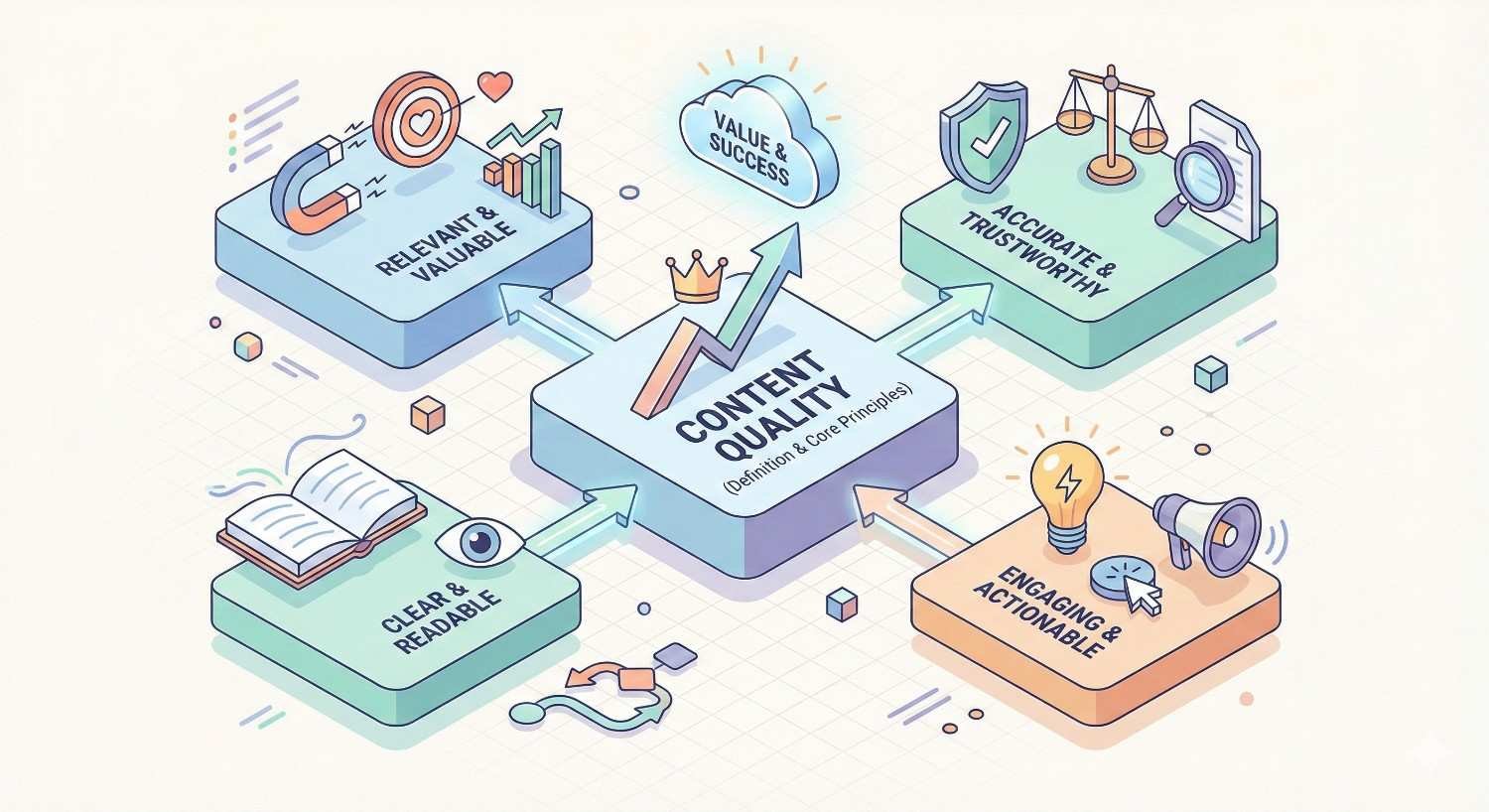
What Is Content Quality? (Definition & Core Principles)
Content quality measures how effectively a piece of content satisfies user intent, demonstrates expertise, and delivers genuine value. High-quality content answers questions completely, provides accurate information, and creates a positive user experience that keeps readers engaged.
Quality isn’t subjective when you understand the signals search engines evaluate. Google’s Search Quality Rater Guidelines provide a framework for assessing content across multiple dimensions including expertise, accuracy, comprehensiveness, and presentation.
How Search Engines Define Content Quality
Search engines evaluate content quality through algorithmic signals and human quality rater assessments. Google’s quality raters use the E-E-A-T framework to assess Experience, Expertise, Authoritativeness, and Trustworthiness across millions of pages.
The algorithm measures user behavior signals including time on page, bounce rate, and pogo-sticking. When users quickly return to search results after visiting your page, it signals that your content failed to satisfy their query.
Technical quality factors include page speed, mobile responsiveness, and Core Web Vitals scores. Content that loads slowly or displays poorly on mobile devices receives lower quality assessments regardless of the writing itself.
Google’s helpful content system specifically targets content created primarily for search engines rather than humans. Pages that demonstrate genuine expertise and provide unique value outperform those that simply aggregate existing information.
The Business Impact of High-Quality Content
High-quality content directly impacts revenue through improved organic visibility, higher conversion rates, and reduced customer acquisition costs. HubSpot research shows companies that prioritize blogging are 13x more likely to see positive ROI.
Quality content builds compounding returns over time. A single comprehensive guide can generate traffic for years, while thin content requires constant replacement as it fails to rank or loses positions.
Brand authority develops through consistent quality publishing. When your content consistently answers questions better than competitors, you become the trusted resource in your industry. This trust translates to higher email signup rates, more qualified leads, and shorter sales cycles.
Customer support costs decrease when quality content addresses common questions. Self-service resources reduce ticket volume while improving customer satisfaction through immediate answers.
Quality vs. Quantity: What Matters More?
Quality wins decisively in modern SEO. Publishing frequency matters less than publishing standards. One comprehensive, authoritative piece outperforms ten shallow articles targeting the same topic cluster.
The quantity approach worked in earlier search eras when algorithms couldn’t effectively evaluate content depth. Today’s systems identify thin content and consolidate ranking signals toward the most comprehensive resource.
However, topical authority requires sufficient coverage. You need enough quality content to demonstrate expertise across your subject area. The goal is maximum quality at sustainable volume, not choosing between the two.
Content velocity should match your capacity for maintaining quality standards. Publishing daily with declining quality damages your domain’s reputation more than publishing weekly with consistent excellence.

The 8 Core Dimensions of Content Quality
Understanding quality dimensions provides a framework for consistent evaluation. Each dimension contributes to overall content performance and user satisfaction.
1. Accuracy & Factual Correctness
Accuracy forms the foundation of content trustworthiness. Factual errors damage credibility immediately and can trigger manual actions from Google for YMYL topics.
Verify all statistics, dates, names, and technical claims against primary sources. Secondary sources introduce error propagation where mistakes get repeated across the web.
Update content when information changes. Outdated statistics or deprecated processes mislead readers and signal neglect to search engines.
Include publication and update dates prominently. Readers and algorithms use these signals to assess information currency.
2. Depth & Comprehensiveness
Comprehensive content addresses all aspects of a topic that users might need. Depth means going beyond surface-level explanations to provide actionable detail.
Analyze top-ranking competitors to identify coverage gaps. Your content should answer every question their content answers plus additional questions they missed.
Depth doesn’t mean length for its own sake. Every section should add value. Remove padding and filler that dilutes the useful information.
Use the “what else would someone need to know?” test. After each section, ask whether a reader would need to search elsewhere for related information.
3. Clarity & Readability
Clear writing communicates complex ideas in accessible language. Readability affects both user experience and search engine understanding.
Match vocabulary to your audience’s expertise level. Technical audiences expect precise terminology while general audiences need plain language explanations.
Short sentences improve comprehension. Vary sentence length for rhythm, but default to concise construction.
Active voice creates direct, engaging prose. Passive constructions obscure meaning and add unnecessary words.
Structure paragraphs around single ideas. Long paragraphs with multiple concepts overwhelm readers and reduce retention.
4. Relevance & Search Intent Alignment
Relevance measures how well content matches what users actually want when they search. Intent alignment determines whether your content satisfies the query.
Analyze SERP features for your target keywords. The types of results Google shows reveal what users expect. Informational queries show featured snippets and knowledge panels. Transactional queries show product listings and comparisons.
Match content format to intent. How-to queries need step-by-step instructions. Comparison queries need structured evaluations. Definition queries need clear explanations.
Address the primary intent immediately. Don’t bury the answer users seek beneath lengthy introductions or tangential information.
5. Originality & Unique Value
Original content provides information, perspectives, or analysis unavailable elsewhere. Unique value gives users a reason to choose your content over alternatives.
First-hand experience creates originality that competitors cannot replicate. Testing products, implementing strategies, or conducting original research produces unique insights.
Proprietary data differentiates your content. Survey results, case study outcomes, and internal benchmarks provide exclusive value.
Unique frameworks and methodologies demonstrate expertise. Developing your own approaches to common problems establishes thought leadership.
Avoid content that simply reorganizes existing information. Aggregation without analysis adds no value to the ecosystem.
6. Credibility & Trustworthiness (E-E-A-T)
E-E-A-T signals demonstrate that content comes from qualified sources and can be trusted. These signals matter most for YMYL topics affecting health, finances, or safety.
Author credentials should be visible and verifiable. Include author bios with relevant qualifications, experience, and links to professional profiles.
Cite authoritative sources for claims. Link to primary research, official documentation, and recognized experts.
Display trust signals including contact information, privacy policies, and editorial standards. Anonymous content from unknown sources receives lower trust assessments.
Demonstrate experience through specific examples, case studies, and first-hand accounts. Generic advice without evidence of practical application lacks credibility.
7. User Experience & Formatting
Formatting affects how easily users can consume and apply your content. Poor presentation undermines even excellent information.
Use descriptive headings that communicate section content. Readers scan headings to find relevant information quickly.
Break up text with visual elements including images, tables, and lists where appropriate. Dense text walls discourage reading.
Ensure mobile readability. Most users access content on mobile devices where formatting issues become more pronounced.
Implement clear visual hierarchy. Important information should stand out through formatting, placement, and emphasis.
8. Freshness & Timeliness
Fresh content reflects current information and recent developments. Timeliness matters more for some topics than others.
Evergreen content requires periodic updates to maintain accuracy. Review and refresh cornerstone content at least annually.
Time-sensitive topics need rapid publication and frequent updates. News, trends, and seasonal content have short relevance windows.
Display last-updated dates to signal content currency. Users and algorithms use these dates to assess information reliability.
Monitor industry changes that affect your content. Algorithm updates, regulation changes, and market shifts can make content outdated overnight.
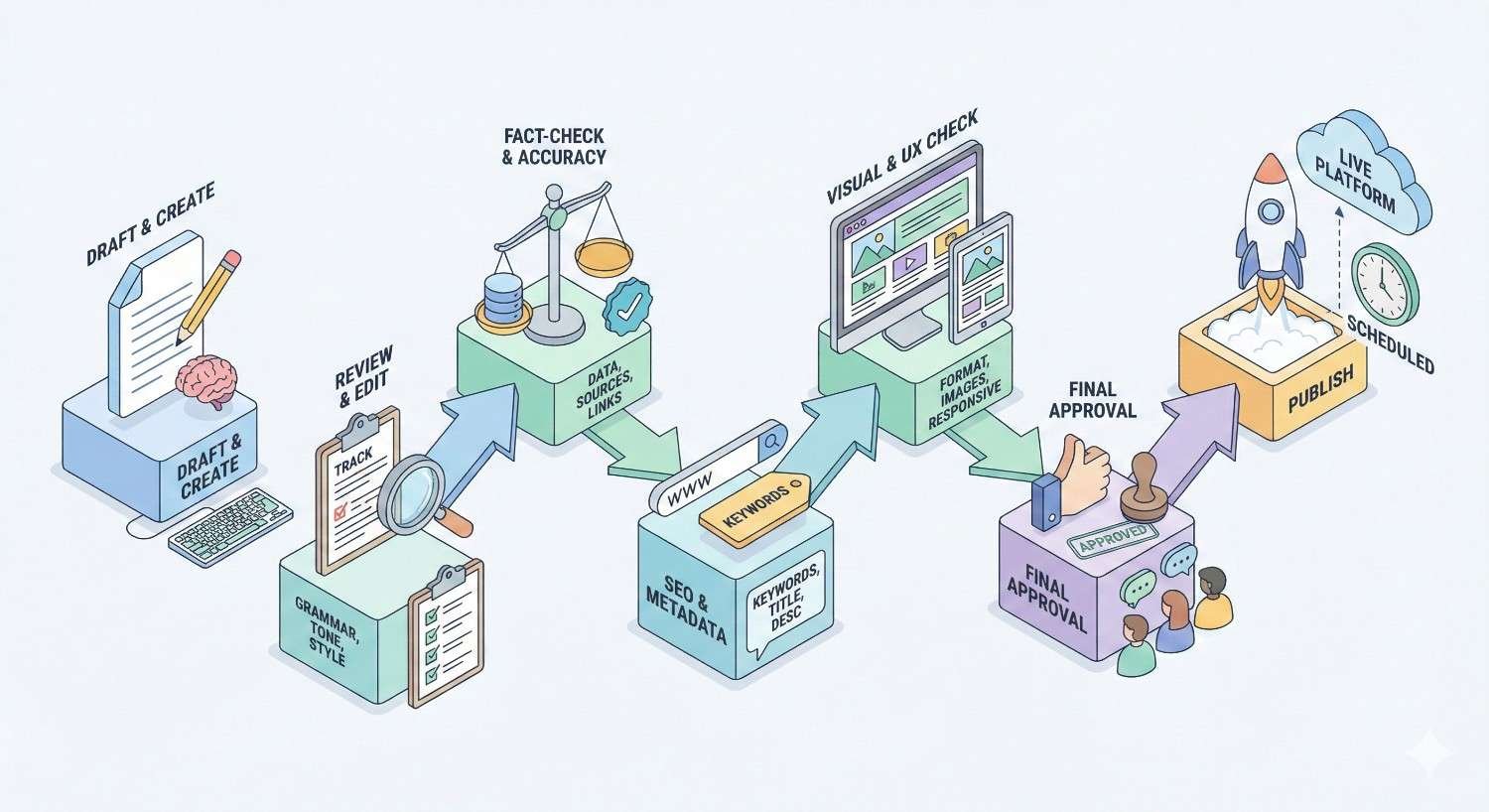
Pre-Publishing Content Quality Checklist
Systematic pre-publishing review catches issues before they affect user experience or search performance. This checklist covers research, creation, technical optimization, and visual elements.
Research & Planning Phase
Quality content starts with thorough research and strategic planning. Skipping this phase produces content that misses user needs or duplicates existing coverage.
Keyword Research & Intent Validation
Identify primary and secondary keywords using tools like Ahrefs, Semrush, or Google Keyword Planner. Analyze search volume, keyword difficulty, and SERP features.
Validate search intent by reviewing top-ranking results. Confirm that your planned content format matches what Google rewards for your target queries.
Map keywords to content sections. Each major heading should target a specific keyword cluster while maintaining natural language flow.
Check for keyword cannibalization against existing content. New pages shouldn’t compete with established pages for the same queries.
Competitor Content Analysis
Analyze the top five ranking pages for your primary keyword. Document their structure, depth, unique angles, and gaps.
Identify what competitors do well that you should match or exceed. Note specific examples, data points, and formats that appear across multiple top results.
Find gaps in competitor coverage. Questions they don’t answer, perspectives they miss, and depth they lack represent opportunities for differentiation.
Assess competitor E-E-A-T signals. Understand what authority markers help them rank and how you can demonstrate equal or greater expertise.
Audience Needs Assessment
Define your target reader’s knowledge level, goals, and pain points. Content that misses audience needs fails regardless of technical optimization.
Review customer questions from support tickets, sales calls, and social media. Real questions reveal actual information needs.
Analyze internal site search data. What users search for on your site indicates content gaps and priorities.
Survey existing customers about content preferences. Direct feedback reveals needs that analytics cannot capture.
Content Creation Phase
The creation phase transforms research into publishable content. Quality standards during writing prevent costly revisions later.
Structure & Organization Checklist
Create a detailed outline before writing. Map each section to specific user questions and keyword targets.
Ensure logical flow from introduction through conclusion. Each section should build on previous sections and lead naturally to the next.
Front-load important information. Users and search engines prioritize content that appears early on the page.
Include clear transitions between sections. Abrupt topic changes confuse readers and reduce engagement.
Balance section lengths appropriately. Avoid single sentences under headings or massive text blocks without breaks.
Writing Quality Standards
Write in active voice with clear subject-verb-object construction. Passive voice obscures meaning and adds words.
Eliminate filler phrases that add no meaning. “It is important to note that” becomes simply stating the important point.
Use specific language over vague generalities. “Increased by 47%” communicates more than “significantly improved.”
Vary sentence length and structure. Monotonous rhythm reduces engagement and comprehension.
Read content aloud to catch awkward phrasing. If it sounds unnatural spoken, it reads unnaturally too.
Source Citation & Fact-Checking
Verify every statistic against primary sources. Secondary citations introduce errors and reduce credibility.
Link to authoritative sources for claims that readers might question. Unsupported assertions damage trust.
Document sources during research for efficient citation during writing. Tracking down sources later wastes time.
Check that linked sources still exist and contain the cited information. Broken links and changed content create credibility problems.
Technical Optimization Phase
Technical SEO elements affect how search engines discover, understand, and rank your content. Optimization during creation is more efficient than retrofitting.
On-Page SEO Elements
Include the primary keyword in the H1, first paragraph, and at least one H2. Natural placement matters more than exact frequency.
Write a compelling meta title under 60 characters with the primary keyword front-loaded. Titles truncate in search results beyond this length.
Craft a meta description under 160 characters that summarizes content value and includes a call to action. Descriptions influence click-through rates.
Use descriptive, keyword-relevant URLs. Short, readable URLs perform better than long strings of numbers or parameters.
Optimize image alt text with descriptive, keyword-relevant language. Alt text improves accessibility and image search visibility.
Internal Linking Strategy
Link to relevant existing content using descriptive anchor text. Internal links distribute authority and help users discover related information.
Identify opportunities to link from existing high-authority pages to new content. Incoming internal links accelerate indexing and ranking.
Create logical content clusters with pillar pages linking to supporting content. Topic clusters demonstrate topical authority to search engines.
Avoid orphan pages with no internal links. Every page should be reachable through site navigation and contextual links.
Schema Markup & Structured Data
Implement appropriate schema types for your content. Article, FAQ, HowTo, and Review schema help search engines understand content structure.
Validate schema implementation using Google’s Rich Results Test. Errors prevent rich result eligibility.
Include all required and recommended properties for your schema type. Incomplete implementation reduces effectiveness.
Update schema when content changes. Mismatched schema and content can trigger manual actions.
Visual & Multimedia Elements
Visual content improves engagement, comprehension, and shareability. Optimization ensures visuals enhance rather than hinder performance.
Image Optimization Checklist
Compress images to reduce file size without visible quality loss. Large images slow page loading and hurt Core Web Vitals.
Use descriptive file names that include relevant keywords. “content-quality-checklist-infographic.jpg” beats “IMG_12345.jpg.”
Specify image dimensions in HTML to prevent layout shift during loading. Cumulative Layout Shift affects Core Web Vitals scores.
Provide alt text for every image describing the visual content. Alt text serves accessibility needs and provides context for search engines.
Use appropriate image formats. WebP offers better compression than JPEG or PNG for most use cases.
Video & Interactive Content
Host videos on YouTube or Vimeo and embed them rather than self-hosting. Third-party hosting reduces server load and provides better playback.
Include video transcripts for accessibility and SEO value. Transcripts make video content indexable and accessible to hearing-impaired users.
Implement video schema markup to enable video rich results. Video carousels drive significant click-through rates.
Ensure interactive elements work across devices and browsers. Test calculators, quizzes, and tools on mobile devices.
Accessibility Standards
Use sufficient color contrast between text and backgrounds. WCAG guidelines specify minimum contrast ratios for readability.
Provide text alternatives for all non-text content. Screen readers cannot interpret images, videos, or infographics without descriptions.
Ensure keyboard navigation works for all interactive elements. Users who cannot use a mouse must be able to access all functionality.
Use semantic HTML elements appropriately. Proper heading hierarchy, list markup, and landmark elements improve screen reader navigation.
Post-Publishing Quality Assurance Checklist
Publishing isn’t the finish line. Post-publishing validation catches issues that testing environments miss and establishes baselines for performance monitoring.
Technical Performance Validation
Technical issues that appear only in production can devastate user experience and rankings. Systematic validation prevents these problems.
Page Speed & Core Web Vitals
Test page speed using Google PageSpeed Insights immediately after publishing. Production environments often perform differently than staging.
Verify Core Web Vitals scores meet “good” thresholds. Largest Contentful Paint under 2.5 seconds, First Input Delay under 100 milliseconds, and Cumulative Layout Shift under 0.1.
Check performance on actual mobile devices, not just emulators. Real-world conditions reveal issues that lab tests miss.
Monitor performance over time using Google Search Console’s Core Web Vitals report. Performance can degrade as content and traffic patterns change.
Mobile Responsiveness Testing
Test on multiple device sizes and orientations. Responsive design should adapt gracefully to any viewport.
Verify touch targets are appropriately sized. Buttons and links need sufficient spacing for accurate tapping.
Check that no horizontal scrolling is required. Content should fit within the viewport width on all devices.
Ensure text is readable without zooming. Font sizes should be large enough for comfortable reading on mobile screens.
Broken Links & Error Checking
Scan for broken internal and external links using tools like Screaming Frog or Ahrefs. Broken links damage user experience and waste crawl budget.
Verify all embedded media loads correctly. Missing images or videos create poor impressions and may indicate hosting issues.
Check for console errors that might affect functionality. JavaScript errors can break interactive elements.
Test all forms and interactive elements. Submission failures frustrate users and lose conversions.
Content Accuracy Review
Fresh eyes catch errors that writers miss. Systematic review processes ensure consistent quality.
Proofreading & Grammar Check
Run content through grammar checking tools like Grammarly or Hemingway Editor. Automated tools catch common errors efficiently.
Have a different person proofread than the writer. Familiarity with content causes writers to miss their own errors.
Read content in a different format than it was written. Printing or changing fonts helps catch errors that blend into familiar layouts.
Check formatting consistency including heading styles, list formats, and emphasis usage. Inconsistent formatting appears unprofessional.
Fact Verification Process
Verify all statistics and data points against original sources one final time. Errors introduced during editing happen frequently.
Confirm that quoted experts actually said what’s attributed to them. Misquotation damages credibility and relationships.
Check that all claims are appropriately qualified. Absolute statements require absolute evidence.
Verify that linked sources still support the claims made. Source content can change between research and publication.
Brand Voice Consistency
Compare content against brand voice guidelines. Tone, vocabulary, and style should match established standards.
Check that terminology usage is consistent with other published content. Inconsistent naming confuses users and dilutes brand identity.
Verify that calls to action align with current campaigns and offerings. Outdated CTAs waste traffic and confuse prospects.
Ensure visual elements match brand standards. Colors, fonts, and imagery should be consistent across all content.
User Experience Testing
User experience determines whether quality content achieves its goals. Testing reveals friction points that analytics alone cannot identify.
Readability Score Analysis
Check readability scores using tools like Hemingway Editor or Yoast SEO. Scores should match your target audience’s reading level.
Identify sentences flagged as difficult to read. Simplify complex constructions without losing meaning.
Verify that technical terms are explained when first used. Jargon without context excludes less experienced readers.
Assess paragraph length distribution. Long paragraphs should be rare and justified by content requirements.
Visual Hierarchy Assessment
Verify that the most important information stands out visually. Key points should be immediately apparent when scanning.
Check that heading hierarchy is logical and consistent. H2s should be more prominent than H3s throughout.
Ensure sufficient white space between sections. Cramped layouts reduce readability and increase cognitive load.
Confirm that visual elements support rather than distract from content. Decorative elements should not compete with information.
Call-to-Action Effectiveness
Test that all CTAs are visible and clickable. Buttons should stand out from surrounding content.
Verify CTA placement at appropriate points in the content journey. Premature CTAs annoy readers while delayed CTAs miss opportunities.
Check that CTA copy clearly communicates the value of clicking. Vague CTAs like “Learn More” underperform specific value propositions.
Ensure CTA destinations match expectations. Clicking “Download the Guide” should immediately provide the guide.
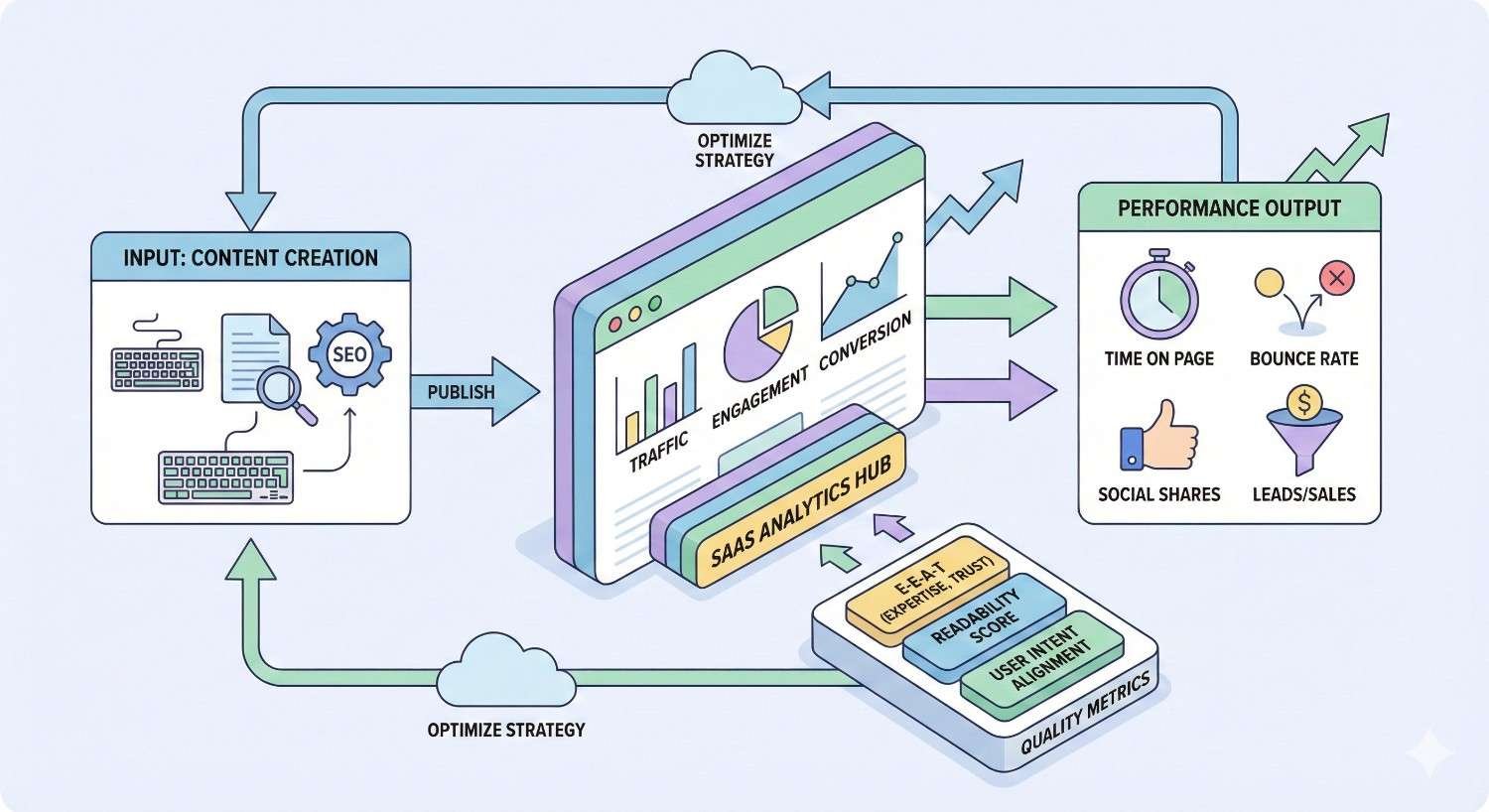
Content Quality Metrics & Measurement
Measurement transforms quality from subjective opinion into objective assessment. The right metrics reveal what’s working and what needs improvement.
Engagement Metrics That Matter
Engagement metrics indicate whether content captures and holds user attention. High engagement correlates with quality and relevance.
Time on Page & Scroll Depth
Average time on page indicates content engagement depth. Longer times generally suggest users are reading rather than bouncing.
Compare time on page to estimated reading time. If average time is much shorter than reading time, users aren’t consuming the full content.
Scroll depth reveals how far users progress through content. If most users stop scrolling before key sections, restructuring may be needed.
Segment these metrics by traffic source. Organic visitors often behave differently than social or referral traffic.
Bounce Rate & Exit Rate Analysis
Bounce rate measures single-page sessions. High bounce rates aren’t always bad if the page fully answers the user’s question.
Compare bounce rates to similar content types. Informational content typically has higher bounce rates than transactional content.
Exit rate shows where users leave your site. High exit rates on non-terminal pages may indicate content or navigation problems.
Analyze bounce rate alongside time on page. Short time plus high bounce indicates content mismatch. Long time plus high bounce may indicate satisfied users.
Social Shares & Comments
Social shares indicate content resonance and perceived value. Shareable content extends reach beyond organic search.
Comment volume and quality reveal engagement depth. Thoughtful comments suggest content sparked genuine interest.
Track which content types and topics generate the most social engagement. Patterns inform future content strategy.
Monitor sentiment in social mentions. Negative reactions may indicate quality issues even if engagement numbers look good.
SEO Performance Indicators
SEO metrics measure how well content performs in search. These indicators directly connect to organic traffic and visibility.
Organic Rankings & Visibility
Track keyword rankings for target terms over time. New content typically takes three to six months to reach stable positions.
Monitor ranking changes after algorithm updates. Drops may indicate quality issues that updates exposed.
Measure overall organic visibility using tools like Semrush’s Visibility Index. Aggregate visibility shows portfolio health beyond individual keywords.
Compare rankings to competitors for shared keywords. Relative position matters as much as absolute position.
Click-Through Rate (CTR)
CTR measures how often searchers click your result when it appears. Low CTR despite good rankings indicates title or description problems.
Compare CTR to position benchmarks. Position one typically sees 25-30% CTR while position ten sees 2-3%.
Test title and description variations to improve CTR. Small improvements compound across thousands of impressions.
Monitor CTR changes after SERP feature additions. Featured snippets and other features can increase or decrease organic CTR.
Featured Snippet & SERP Feature Wins
Track featured snippet ownership for target queries. Snippets dramatically increase visibility and traffic.
Identify SERP features available for your keywords. FAQ results, video carousels, and image packs represent additional opportunities.
Optimize content structure for snippet eligibility. Clear definitions, numbered lists, and tables increase snippet chances.
Monitor snippet volatility. Frequently changing snippets indicate competitive opportunities.
Business Impact Metrics
Business metrics connect content quality to revenue outcomes. These measurements justify content investment to stakeholders.
Conversion Rate & Lead Generation
Track conversions attributed to content pages. Both direct conversions and assisted conversions matter.
Measure lead quality from content-driven conversions. High volume with low quality wastes sales resources.
Compare conversion rates across content types and topics. Patterns reveal which content best supports business goals.
Implement proper attribution modeling. Last-click attribution undervalues content that influences earlier in the journey.
Revenue Attribution
Connect content consumption to closed revenue. Multi-touch attribution reveals content’s role in the sales process.
Calculate content ROI by comparing production costs to attributed revenue. Positive ROI justifies continued investment.
Identify highest-revenue content for optimization priority. Improving top performers often yields better returns than fixing underperformers.
Track revenue trends over content lifetime. Evergreen content should generate increasing returns as authority builds.
Customer Acquisition Cost (CAC)
Calculate CAC for content-driven customers versus other channels. Content marketing typically delivers lower CAC over time.
Factor in content production and promotion costs. True CAC includes all expenses required to generate the customer.
Compare content CAC to customer lifetime value. Sustainable growth requires CAC significantly below LTV.
Monitor CAC trends as content portfolio matures. Established content assets should reduce CAC over time.
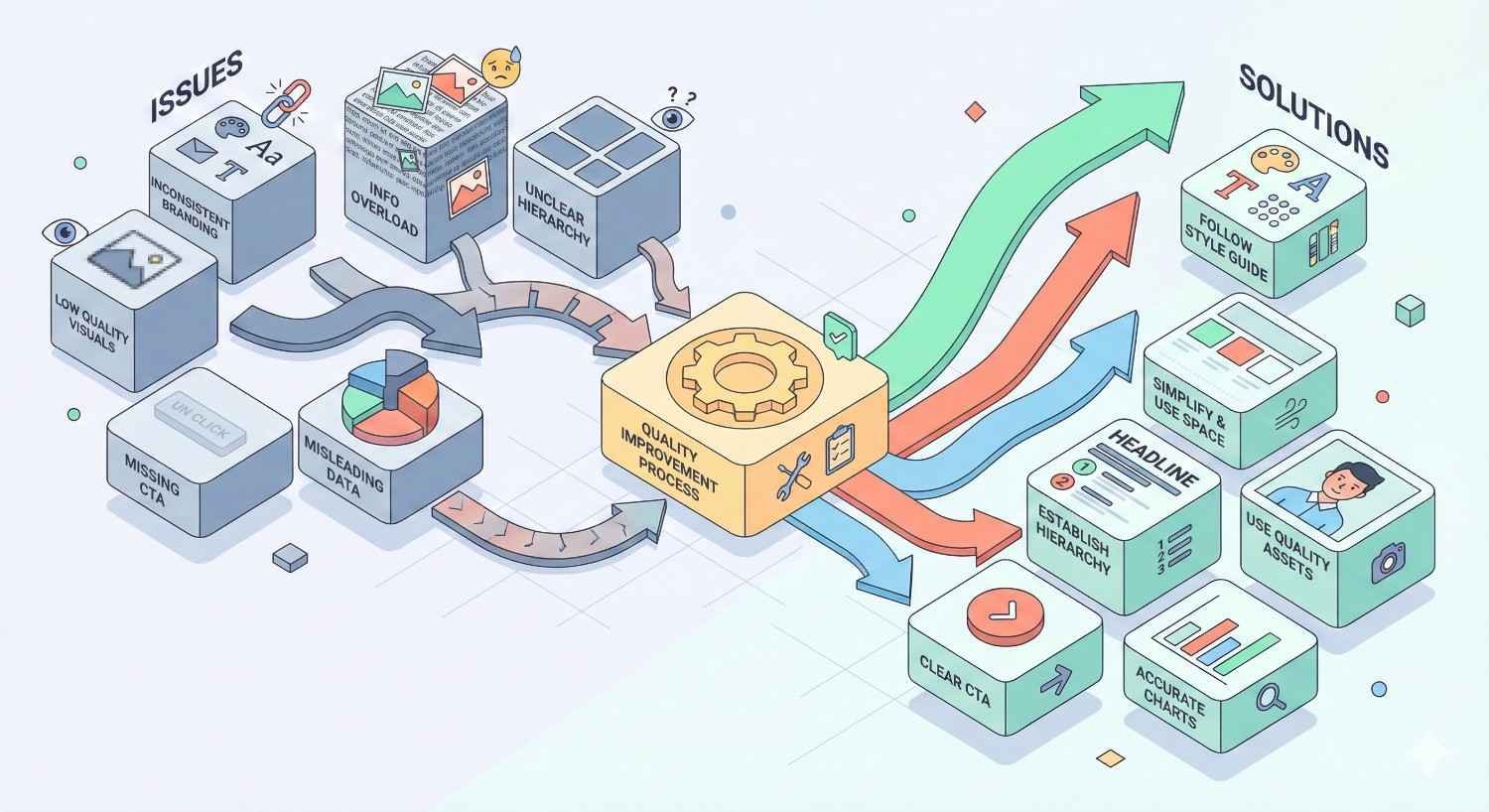
Common Content Quality Issues & How to Fix Them
Recognizing common problems enables faster diagnosis and resolution. These issues appear across industries and content types.
Thin or Shallow Content
Thin content fails to provide sufficient depth to satisfy user intent. Pages with minimal unique value struggle to rank and convert.
Symptoms include high bounce rates, low time on page, and poor rankings despite targeting low-competition keywords.
Fix thin content by expanding coverage, adding examples and data, and incorporating expert perspectives. Sometimes consolidating multiple thin pages into one comprehensive resource works better than expanding each individually.
Prevent thin content through minimum depth requirements in your content brief process. Specify required sections, examples, and word counts before writing begins.
Duplicate or Cannibalized Content
Duplicate content confuses search engines about which page to rank. Cannibalization splits ranking signals across multiple pages targeting the same query.
Identify cannibalization using Google Search Console’s Performance report. Multiple pages ranking for the same query with fluctuating positions indicates cannibalization.
Resolve cannibalization by consolidating content, implementing canonical tags, or differentiating page focus. The best approach depends on the specific situation.
Prevent future cannibalization through keyword mapping. Maintain a document tracking which pages target which keywords.
Outdated or Inaccurate Information
Outdated content damages credibility and can harm users who act on incorrect information. Search engines increasingly favor fresh, accurate content.
Audit content regularly for accuracy. Prioritize YMYL topics and high-traffic pages for frequent review.
Update statistics, examples, and recommendations when information changes. Display last-updated dates prominently.
Remove or redirect content that cannot be accurately updated. Outdated content that remains published damages domain trust.
Poor Readability & Structure
Difficult-to-read content fails to communicate even when information is accurate and comprehensive. Structure problems prevent users from finding what they need.
Assess readability using automated tools and user testing. Target reading levels appropriate for your audience.
Improve structure through clear headings, shorter paragraphs, and logical flow. Break up dense sections with visual elements.
Use formatting to highlight key information. Bold important points, use lists for scannable items, and add tables for comparisons.
Missing E-E-A-T Signals
Content without clear expertise signals struggles to rank for competitive queries. YMYL topics especially require strong E-E-A-T demonstration.
Add author information including credentials, experience, and professional links. Anonymous content lacks credibility signals.
Include citations to authoritative sources. Unsupported claims reduce trust.
Demonstrate first-hand experience through specific examples, case studies, and original insights. Generic advice without evidence of practical application fails E-E-A-T assessment.
Technical SEO Problems
Technical issues prevent search engines from properly crawling, indexing, and ranking content. Even excellent content fails with technical barriers.
Common issues include slow page speed, mobile usability problems, indexing blocks, and structured data errors.
Audit technical SEO using tools like Screaming Frog, Google Search Console, and PageSpeed Insights. Prioritize issues affecting high-value pages.
Implement fixes systematically and verify resolution. Technical problems often recur without proper monitoring.
Content Quality Tools & Resources
The right tools make quality assessment efficient and consistent. These categories cover essential quality management needs.
Content Analysis & Grading Tools
Clearscope, Surfer SEO, and MarketMuse analyze content against top-ranking competitors. These tools identify coverage gaps and optimization opportunities.
Content grading provides objective quality scores based on keyword usage, readability, and comprehensiveness. Scores enable consistent evaluation across writers and topics.
Use these tools during planning to inform content briefs and during editing to verify coverage. Over-reliance on scores without human judgment produces formulaic content.
Grammar & Readability Checkers
Grammarly catches grammar, spelling, and punctuation errors. The premium version provides style and clarity suggestions.
Hemingway Editor highlights complex sentences, passive voice, and readability issues. The visual interface makes problems easy to identify.
ProWritingAid offers deeper analysis including overused words, sentence variety, and pacing. The tool integrates with common writing platforms.
SEO Optimization Platforms
Ahrefs, Semrush, and Moz provide comprehensive SEO data including keyword research, competitor analysis, and rank tracking.
Yoast SEO and Rank Math offer on-page optimization guidance within WordPress. Real-time feedback helps writers optimize during creation.
Google Search Console provides authoritative data on indexing, rankings, and technical issues. This free tool should be every site’s foundation.
Plagiarism & Originality Checkers
Copyscape identifies duplicate content across the web. Check all content before publishing to avoid plagiarism issues.
Originality.ai detects AI-generated content alongside plagiarism. As AI writing tools proliferate, originality verification becomes more important.
Quetext provides detailed plagiarism reports with source identification. The tool helps writers properly attribute sources.
Performance Monitoring Tools
Google Analytics tracks user behavior including engagement metrics, conversion paths, and traffic sources. GA4 provides enhanced measurement capabilities.
Hotjar and Microsoft Clarity offer heatmaps and session recordings. Visual data reveals how users actually interact with content.
ContentKing and Little Warden monitor content changes and technical issues. Automated alerts catch problems before they impact performance.
How to Build a Content Quality Process for Your Team
Systematic processes ensure consistent quality regardless of who creates content. Documentation and workflows scale quality beyond individual expertise.
Creating Content Quality Guidelines
Document your quality standards in a comprehensive style guide. Include voice and tone guidelines, formatting standards, and quality criteria.
Provide examples of excellent content that demonstrates your standards. Abstract guidelines become concrete through illustration.
Update guidelines as standards evolve. Static documentation becomes outdated and ignored.
Make guidelines easily accessible. Buried documentation doesn’t influence behavior.
Editorial Workflow & Review Process
Define clear stages from ideation through publication. Each stage should have specific deliverables and quality gates.
Assign responsibility for each stage. Ambiguous ownership leads to gaps and finger-pointing.
Build in sufficient review time. Rushed reviews miss issues that damage quality.
Document feedback constructively. Reviews should improve future content, not just fix current problems.
Quality Control Roles & Responsibilities
Designate specific roles for quality oversight. Editors, SEO specialists, and subject matter experts each contribute different perspectives.
Define authority for quality decisions. When reviewers disagree, someone must have final say.
Balance thoroughness with efficiency. Excessive review cycles slow publishing without proportional quality improvement.
Measure reviewer effectiveness. Track which reviewers catch issues and which miss them.
Training & Onboarding Content Creators
Develop structured onboarding for new writers. Don’t assume skills transfer from previous roles.
Provide ongoing training as standards and best practices evolve. One-time training becomes outdated.
Create feedback loops that accelerate learning. Regular performance reviews with specific improvement guidance develop skills faster.
Pair new writers with experienced mentors. Tacit knowledge transfers through collaboration better than documentation.
Content Quality at Scale: Agency & Enterprise Approaches
Scaling content production while maintaining quality requires different approaches than small-team operations. Volume introduces complexity that ad-hoc processes cannot handle.
Balancing Volume with Quality Standards
Define minimum quality thresholds that cannot be compromised for speed. Some standards are negotiable; others are not.
Tier content by strategic importance. Flagship content deserves more resources than supporting pages.
Build quality into production processes rather than relying on end-stage review. Catching issues early costs less than fixing them later.
Accept that perfect is the enemy of good. Publishable quality differs from ideal quality, and waiting for perfection means never publishing.
Content Auditing & Improvement Frameworks
Audit existing content systematically. Large content libraries accumulate quality debt that drags down domain performance.
Prioritize audit findings by impact and effort. Quick wins build momentum while major projects require planning.
Decide whether to update, consolidate, or remove underperforming content. Not all content deserves investment.
Schedule regular re-audits. One-time audits address current problems but don’t prevent future accumulation.
Outsourcing vs. In-House Quality Control
In-house teams provide deeper brand knowledge and faster iteration. External resources offer scalability and specialized expertise.
Hybrid models often work best. Core strategic content stays in-house while volume production scales through partners.
Vet outsourced providers thoroughly. Sample work and trial projects reveal quality before commitment.
Maintain quality oversight regardless of production source. Outsourcing production doesn’t mean outsourcing responsibility.
Technology & Automation in Quality Assurance
Automate repetitive quality checks. Grammar, readability, and technical SEO checks don’t require human judgment.
Use AI tools to augment human review, not replace it. Current AI cannot reliably assess accuracy, originality, or strategic alignment.
Implement content management systems with built-in quality workflows. Technology should enforce processes, not just document them.
Track quality metrics automatically. Manual tracking doesn’t scale and introduces inconsistency.
Industry-Specific Content Quality Considerations
Different industries face unique quality challenges. Understanding your sector’s specific requirements prevents common mistakes.
E-commerce Product Content
Product descriptions must be unique across SKUs. Duplicate descriptions across similar products create cannibalization.
Include specifications, use cases, and comparison information. Shoppers need details to make purchase decisions.
Optimize for transactional intent. Product pages should facilitate buying, not just inform.
Manage content at scale through templates and automation. Large catalogs require systematic approaches.
B2B & SaaS Content
Demonstrate expertise through technical depth. B2B buyers research thoroughly before engaging sales.
Address multiple stakeholders with different concerns. Technical evaluators, financial decision-makers, and end users need different information.
Support long sales cycles with content for each stage. Awareness content differs from evaluation content.
Include proof points including case studies, testimonials, and data. B2B buyers require evidence before commitment.
Healthcare & YMYL Content
Accuracy is non-negotiable. Health misinformation can cause real harm.
Cite authoritative medical sources. Primary research, medical institutions, and credentialed experts provide credibility.
Include appropriate disclaimers. Content should not substitute for professional medical advice.
Review content with qualified medical professionals. Subject matter expertise is essential, not optional.
News & Editorial Content
Timeliness matters more than in other categories. News content has short relevance windows.
Verify information before publishing. Speed cannot compromise accuracy.
Distinguish news from opinion clearly. Readers should understand what’s factual versus interpretive.
Update stories as situations develop. Initial reports often require correction or expansion.
Local Business Content
Include location-specific information. Generic content doesn’t serve local search intent.
Optimize for local search features including Google Business Profile and local pack results.
Incorporate local expertise and community knowledge. Local businesses should demonstrate local authority.
Maintain NAP consistency across all content. Name, address, and phone number discrepancies confuse search engines.
Future of Content Quality: AI, Automation & Search Evolution
Content quality standards continue evolving with technology and user expectations. Preparing for changes maintains competitive advantage.
AI-Generated Content Quality Standards
AI can assist content creation but requires human oversight. Fully automated content often lacks accuracy, originality, and expertise signals.
Google’s guidance emphasizes quality regardless of production method. AI-generated content that provides value can rank; low-quality AI content will not.
Use AI for research, outlining, and drafting. Human review ensures accuracy, adds expertise, and maintains brand voice.
Disclose AI involvement appropriately. Transparency builds trust while deception risks penalties.
Google’s Evolving Quality Algorithms
Helpful content updates specifically target low-quality, search-first content. Sites with significant unhelpful content see domain-wide impacts.
E-E-A-T emphasis continues increasing. Experience signals join expertise, authoritativeness, and trustworthiness as ranking factors.
User signals increasingly influence rankings. Content that satisfies users performs better regardless of traditional optimization.
Algorithm updates happen continuously. Major announced updates represent visible changes in ongoing evolution.
User Experience Signals & Ranking Factors
Core Web Vitals establish minimum performance thresholds. Meeting these thresholds is necessary but not sufficient for ranking.
Page experience encompasses more than speed. Mobile usability, safe browsing, HTTPS, and intrusive interstitial guidelines all matter.
Engagement signals indicate content quality indirectly. Content that users engage with deeply likely satisfies their needs.
Accessibility increasingly factors into quality assessment. Content that excludes users with disabilities fails to serve the full audience.
Preparing for Search Generative Experience (SGE)
AI-generated search results change how users interact with content. Direct answers in search reduce clicks for some queries.
Comprehensive, authoritative content feeds AI responses. Being the source AI cites maintains visibility even without clicks.
Unique perspectives and original research become more valuable. AI cannot generate truly original insights.
Focus on queries requiring depth and expertise. Simple factual queries may not drive traffic in an AI-answer world.
Conclusion: Implementing Your Content Quality System
Content quality encompasses eight core dimensions from accuracy and depth to freshness and user experience. Systematic checklists for pre-publishing and post-publishing phases catch issues before they impact performance. Measurement frameworks connect quality to engagement, SEO performance, and business outcomes.
Building a quality system requires documented guidelines, clear workflows, defined roles, and ongoing training. Scaling quality demands automation, auditing frameworks, and strategic decisions about in-house versus outsourced production. Industry-specific considerations and evolving technology require continuous adaptation.
We help businesses build sustainable organic growth through technical SEO, content strategy, and authority building at White Label SEO Service. Contact us to implement a content quality system that drives traffic, leads, and revenue for your business.
Frequently Asked Questions
What is a content quality checklist?
A content quality checklist is a systematic document that outlines standards and verification steps for content before and after publishing. It ensures consistency across all content by providing specific criteria for accuracy, readability, SEO optimization, and user experience that every piece must meet.
How do you measure content quality?
Content quality is measured through engagement metrics like time on page and scroll depth, SEO indicators including rankings and click-through rates, and business metrics such as conversion rates and revenue attribution. Combining quantitative data with qualitative assessment provides a complete quality picture.
What are the most important content quality factors for SEO?
The most important factors include accuracy, comprehensiveness, E-E-A-T signals, search intent alignment, and technical optimization. Google’s algorithms evaluate whether content demonstrates expertise, provides complete answers, and delivers positive user experiences across devices.
How often should you audit content quality?
High-traffic and YMYL content should be audited quarterly. Standard content benefits from annual reviews. Trigger-based audits should occur after algorithm updates, industry changes, or performance declines. Continuous monitoring catches issues between scheduled audits.
What tools help assess content quality?
Essential tools include Clearscope or Surfer SEO for content optimization, Grammarly for grammar checking, Google Search Console for performance data, and PageSpeed Insights for technical assessment. Combining multiple tools provides comprehensive quality evaluation.
How do you maintain content quality at scale?
Maintaining quality at scale requires documented standards, automated quality checks, tiered review processes based on content importance, and systematic auditing frameworks. Technology handles repetitive checks while human review focuses on judgment-dependent assessments.
What is the difference between content quality and content optimization?
Content quality refers to the inherent value, accuracy, and usefulness of content for readers. Content optimization involves technical adjustments that help search engines understand and rank content. High-quality content that isn’t optimized may not rank, while optimized low-quality content won’t satisfy users or sustain rankings.