
AMP no longer provides the direct SEO ranking boost it once did. Google removed AMP as a requirement for Top Stories in 2021, and Core Web Vitals now determine page experience signals. For most websites, optimizing standard pages delivers better results than maintaining AMP infrastructure.
The question isn’t whether AMP works. It’s whether the trade-offs make sense for your specific situation, audience, and resources in 2025.
This guide breaks down AMP’s current SEO value, compares it to modern alternatives, and gives you a clear framework for deciding whether to implement, keep, or remove AMP from your site.
What Is AMP (Accelerated Mobile Pages)?
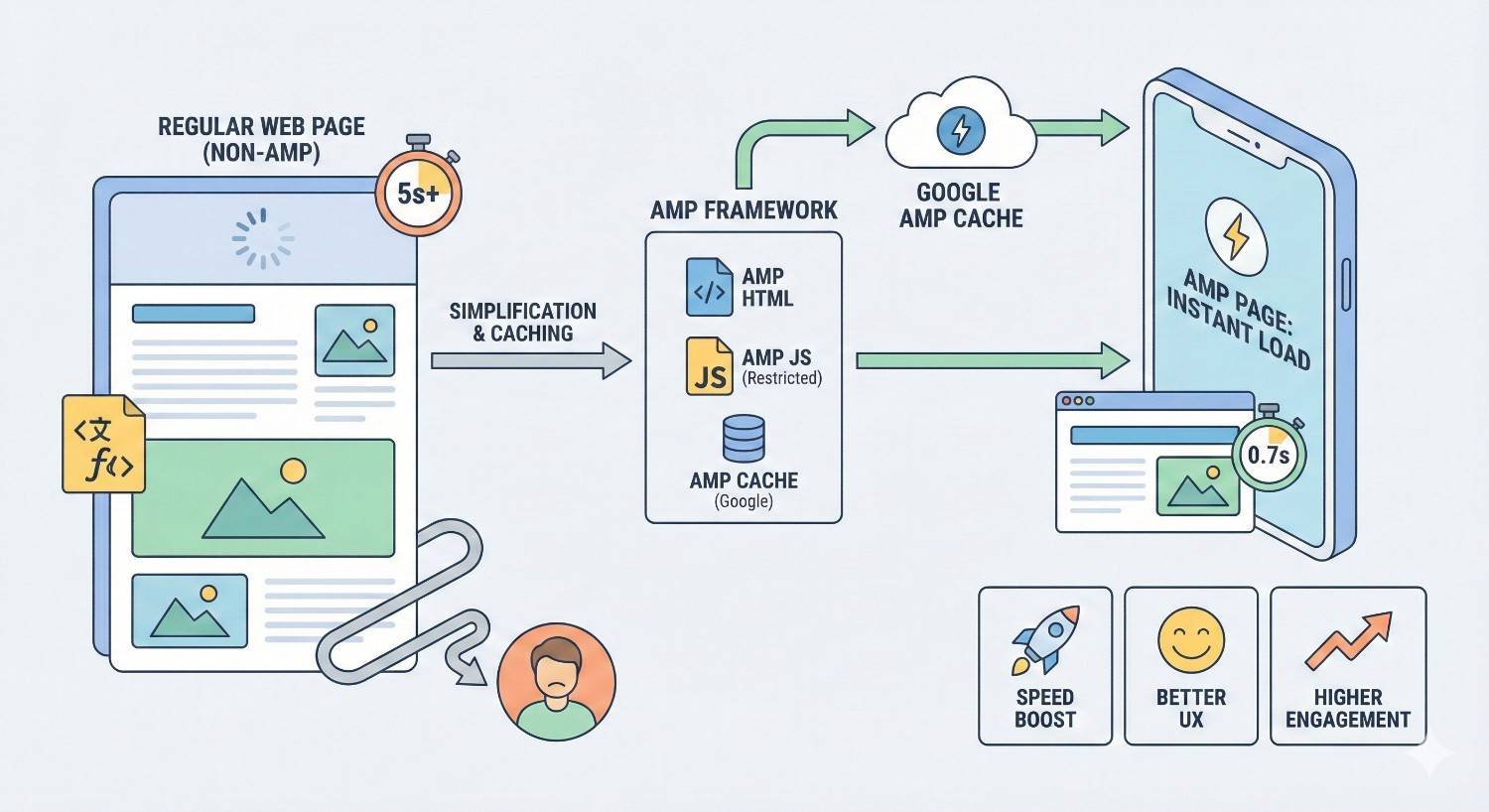
AMP is an open-source HTML framework designed to create fast-loading mobile web pages. Google introduced it in 2015 to address slow mobile experiences that frustrated users and increased bounce rates.
Core Technology Overview
AMP restricts what you can include on a page. It uses a stripped-down version of HTML, limits CSS to 75KB inline styles, and heavily restricts JavaScript. The framework forces developers to follow strict performance guidelines that eliminate common speed bottlenecks.
Three components make up the AMP ecosystem. AMP HTML provides custom tags and restrictions. AMP JS handles resource loading and rendering optimization. AMP Cache delivers pre-rendered pages from Google’s servers.
How AMP Works (Technical Foundation)
When someone clicks an AMP link in Google Search, they load a cached version stored on Google’s servers. This pre-rendering eliminates server response time and reduces the distance data travels to reach users.
AMP pages load asynchronously. Resources like images and ads load only when needed, preventing render-blocking issues. The framework calculates layout dimensions before loading, eliminating the visual jumps that hurt user experience.
The AMP validator enforces compliance. Pages must pass validation to receive AMP benefits. Invalid AMP pages lose caching advantages and may not display the AMP lightning bolt indicator in search results.
AMP vs. Regular HTML Pages
Standard HTML pages offer complete flexibility. You control every element, script, and design decision. This freedom comes with responsibility for performance optimization.
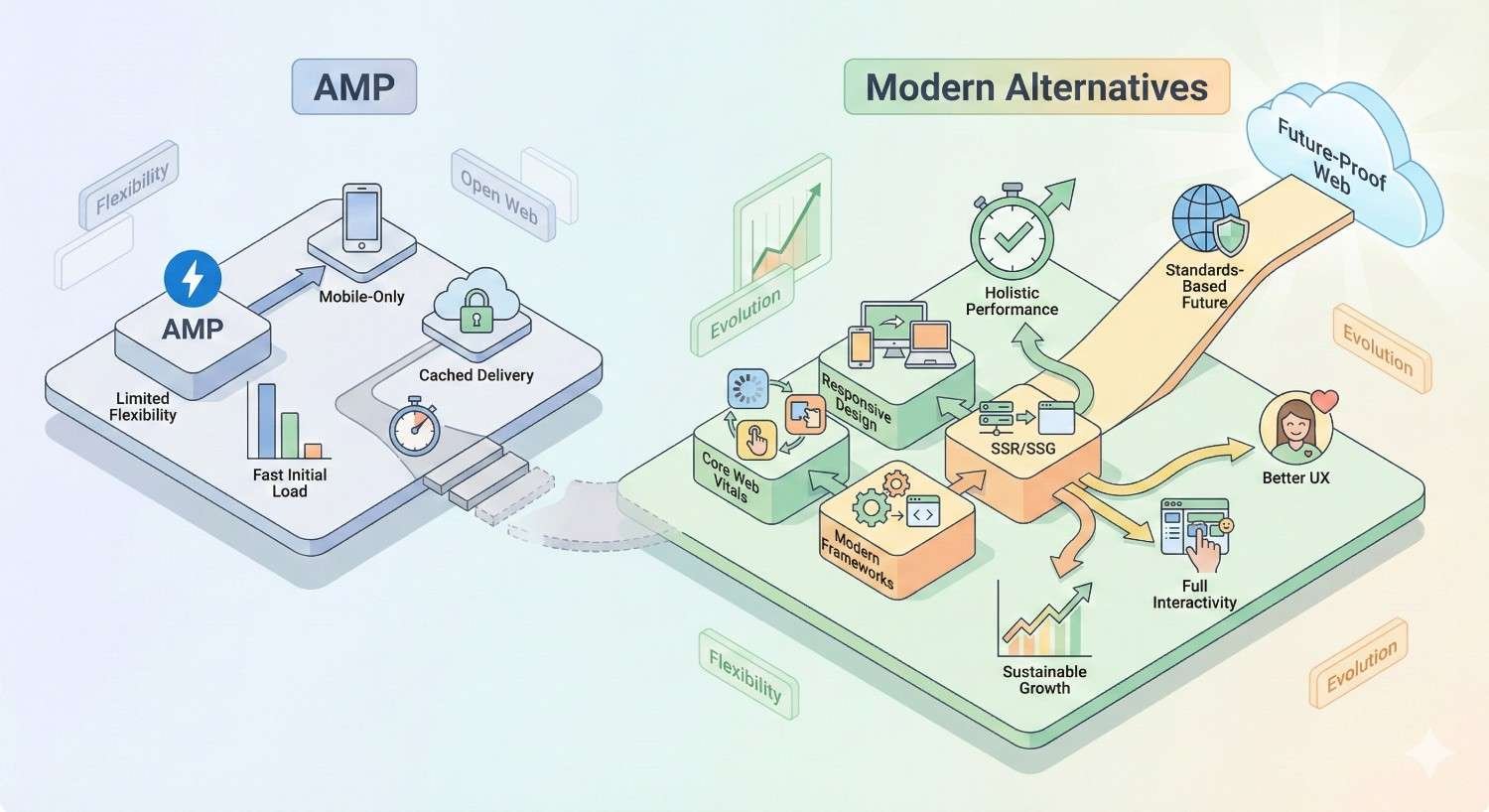
AMP pages trade flexibility for guaranteed speed. The restrictions ensure fast loading but limit functionality. Complex forms, custom animations, and advanced JavaScript features require workarounds or become impossible.
| Feature | AMP Pages | Standard HTML |
| JavaScript | Severely limited | Full access |
| CSS | 75KB inline only | Unlimited |
| Third-party scripts | Restricted components | Any script |
| Design flexibility | Limited | Complete |
| Guaranteed speed | Yes | Depends on optimization |
| Google caching | Yes | No |
The History of AMP and Google’s Mobile-First Push
Understanding AMP’s history explains why opinions remain divided. What started as a near-requirement became optional, leaving many site owners uncertain about its current value.
Why Google Introduced AMP (2015-2016)
Mobile internet usage surpassed desktop in 2015. But mobile web experiences lagged far behind. Pages took an average of 19 seconds to load on 3G connections. Users abandoned sites that didn’t load within three seconds.
Google faced a problem. Slow mobile pages hurt user satisfaction with search results. Users blamed Google when clicking a search result led to a frustrating experience.
AMP solved this by creating a controlled environment. If publishers followed AMP rules, Google guaranteed fast delivery through its cache. The framework launched in February 2016 with support from major publishers including BBC, Washington Post, and Vox Media.
AMP’s Initial SEO Benefits
AMP provided significant advantages during its early years. These benefits drove widespread adoption among publishers and content-heavy sites.
Top Stories Carousel Requirement
From 2016 to 2021, AMP was required for inclusion in Google’s Top Stories carousel on mobile. This prominent placement appeared above standard search results, driving massive traffic to news publishers.
Non-AMP pages couldn’t access this visibility regardless of content quality or site authority. Publishers faced a simple choice: implement AMP or lose Top Stories traffic.
Mobile Search Ranking Boost
While Google never confirmed AMP as a direct ranking factor, AMP pages received indirect benefits. Faster load times improved user engagement metrics. Lower bounce rates and longer session durations sent positive signals to Google’s algorithms.
AMP pages also displayed a lightning bolt icon in search results. This visual indicator increased click-through rates as users learned to associate the symbol with fast-loading content.
Page Speed Advantages
AMP delivered consistent sub-second load times. Google’s cache served pre-rendered pages from edge servers worldwide. Users experienced near-instant page loads regardless of the origin server’s location or performance.
This speed advantage was difficult to match with standard pages. Even well-optimized sites couldn’t compete with Google’s infrastructure serving cached content.
Timeline of Google’s AMP Policy Changes
Google’s relationship with AMP evolved significantly over time:
2015: AMP project announced as open-source initiative
2016: AMP launches with Top Stories integration
2018: AMP stories introduced for visual content
2019: Signed exchanges allow AMP pages to display original URLs
2020: Core Web Vitals announced as future ranking signals
2021: Page Experience Update removes AMP requirement for Top Stories
2022: AMP becomes one option among many for achieving good page experience
2024-2025: Core Web Vitals fully replace AMP as the primary page experience metric
Current State of AMP in 2024/2025
The landscape has shifted dramatically. AMP remains functional but no longer holds privileged status in Google’s ecosystem.
Google’s Official Stance on AMP
Google now treats AMP as one approach to achieving good page experience rather than a preferred solution. The company’s documentation emphasizes Core Web Vitals as the primary metrics for page experience evaluation.
Google continues maintaining the AMP project and cache infrastructure. However, official communications no longer promote AMP as essential for SEO success. The focus has shifted entirely to measurable performance metrics.
Core Web Vitals vs. AMP
Core Web Vitals measure actual user experience through three metrics: Largest Contentful Paint (loading), Interaction to Next Paint (interactivity), and Cumulative Layout Shift (visual stability).
AMP pages typically pass Core Web Vitals automatically due to built-in restrictions. But standard pages optimized for Core Web Vitals achieve the same ranking benefits without AMP’s limitations.
The key difference: Core Web Vitals reward outcomes while AMP enforces methods. You can achieve excellent Core Web Vitals scores through various optimization approaches, not just AMP.
Page Experience Update Impact
Google’s Page Experience Update, fully rolled out by 2022, fundamentally changed AMP’s value proposition. The update made Core Web Vitals a ranking signal while removing AMP’s exclusive access to Top Stories.
Sites with good Core Web Vitals scores now compete equally for Top Stories placement regardless of AMP implementation. This eliminated AMP’s primary competitive advantage for publishers.
AMP No Longer Required for Top Stories
This single change transformed the AMP decision calculus. Publishers who implemented AMP primarily for Top Stories access now had alternatives.
Many major publishers began testing non-AMP pages in Top Stories. Results showed that well-optimized standard pages performed comparably in both rankings and user engagement. The Washington Post, an early AMP adopter, began reducing AMP usage after the policy change.
Does AMP Still Provide SEO Benefits?
AMP offers real advantages, but they’re no longer exclusive. Understanding what AMP still delivers helps you evaluate whether those benefits justify the trade-offs.
Speed and Performance Advantages
AMP’s performance benefits remain genuine. The framework’s restrictions prevent common performance mistakes that plague standard websites.
Load Time Improvements
AMP pages consistently load in under one second when served from Google’s cache. This speed comes from pre-rendering, edge caching, and strict resource limitations.
Standard pages can achieve similar speeds but require deliberate optimization. Many sites struggle to match AMP’s consistency without significant development investment.
Mobile User Experience
AMP’s layout stability prevents the frustrating content jumps that occur when ads and images load. Users can read content immediately without elements shifting unexpectedly.
The framework’s image handling automatically serves appropriately sized images based on device and viewport. This responsive behavior improves both speed and visual experience.
Server Resource Efficiency
Google’s cache handles traffic spikes for AMP pages. Your origin server only needs to serve the initial page load for caching. Subsequent visitors receive cached versions without touching your infrastructure.
This offloading reduces hosting costs and eliminates performance degradation during traffic surges. News sites covering breaking stories particularly benefit from this distributed delivery.
Caching and CDN Benefits
Google’s AMP Cache operates as a free, global CDN. Pages are served from edge locations worldwide, minimizing latency regardless of user location.
The cache also handles HTTPS certificates and serves content over HTTP/2. These technical optimizations happen automatically without configuration on your part.
However, modern CDN services like Cloudflare, Fastly, and AWS CloudFront provide similar benefits for standard pages. The caching advantage is no longer unique to AMP.
Mobile-First Indexing Considerations
Google uses mobile-first indexing for all websites. Your mobile page version determines how Google indexes and ranks your content.
AMP pages are inherently mobile-optimized. If your standard mobile pages have issues, AMP provides a guaranteed mobile-friendly version for indexing.
But responsive design achieves the same result. A well-built responsive site serves appropriate content to mobile users without maintaining separate AMP versions.
Structured Data and Rich Results
AMP supports the same structured data markup as standard pages. You can implement Article, FAQ, HowTo, and other schema types on AMP pages.
Some rich result features historically required AMP, but these restrictions have been removed. Standard pages with proper structured data now access the same rich result opportunities.
The Drawbacks and Limitations of AMP
AMP’s restrictions create real problems for many websites. These limitations often outweigh the performance benefits, especially for sites with complex functionality requirements.
Design and Functionality Restrictions
AMP’s component library limits design possibilities. Custom layouts, animations, and interactive elements require approved AMP components or become impossible.
Brand consistency suffers when AMP pages can’t match your standard site’s look and feel. Users may not recognize AMP versions as part of your brand experience.
Navigation patterns also face restrictions. Complex menus, sticky headers, and custom scroll behaviors require workarounds that may not fully replicate your standard site’s functionality.
Limited JavaScript and Custom Code
AMP prohibits custom JavaScript. All functionality must come from approved AMP components or the limited amp-script component with strict size limits.
This restriction eliminates:
- Custom analytics implementations
- A/B testing tools
- Personalization engines
- Interactive calculators
- Custom form validation
- Third-party widgets
The amp-script component allows limited custom JavaScript but caps execution time and memory usage. Complex applications simply cannot run within AMP’s constraints.
Tracking and Analytics Challenges
Standard analytics implementations don’t work on AMP pages. You must use amp-analytics with specific configurations for each analytics platform.
Data discrepancies commonly occur between AMP and non-AMP tracking. Session stitching becomes complicated when users move between AMP and standard pages. Attribution models may not accurately credit AMP traffic.
Marketing teams often struggle with incomplete data from AMP pages. Conversion tracking, event monitoring, and user journey analysis all require additional configuration and may still produce gaps.
Duplicate Content Concerns
AMP creates a second version of every page. While canonical tags should prevent duplicate content issues, implementation errors can cause problems.
Google must understand the relationship between AMP and canonical pages. Misconfigurations can result in the wrong version appearing in search results or both versions competing for rankings.
Managing two versions of content also increases the risk of inconsistencies. Updates to standard pages may not propagate to AMP versions, creating outdated or conflicting information.
Development and Maintenance Overhead
AMP requires specialized knowledge. Developers must learn AMP-specific components, validation requirements, and debugging approaches.
Every site change potentially requires two implementations. New features, design updates, and content changes must work on both AMP and standard pages.
Testing doubles as well. QA processes must verify functionality on both versions across multiple devices and browsers. Bug fixes may require separate solutions for each version.
User Experience Trade-offs
AMP pages served from Google’s cache display Google’s URL in the browser address bar. Users see google.com/amp/… rather than your domain. This URL display can confuse users and reduce brand recognition.
The “swipe to close” behavior on AMP pages differs from standard navigation. Users may accidentally exit your content or struggle to navigate back to search results.
Some users actively avoid AMP pages due to these UX differences. Browser extensions exist specifically to redirect AMP links to original pages, indicating meaningful user resistance.
AMP vs. Modern Alternatives
Modern web development offers multiple paths to excellent mobile performance. These alternatives often provide better results with fewer restrictions than AMP.
Core Web Vitals Optimization
Core Web Vitals directly measure what matters: loading speed, interactivity, and visual stability. Optimizing for these metrics improves rankings regardless of whether you use AMP.
Largest Contentful Paint (LCP)
LCP measures how quickly the largest visible element loads. Google considers 2.5 seconds or faster as good performance.
Improving LCP involves:
- Optimizing server response times
- Removing render-blocking resources
- Preloading critical assets
- Optimizing images and fonts
Standard pages can achieve excellent LCP scores through proper optimization. AMP’s restrictions help LCP but aren’t the only path to good scores.
Interaction to Next Paint (INP)
INP replaced First Input Delay in 2024 as the interactivity metric. It measures responsiveness throughout the entire page session, not just the first interaction.
Good INP requires 200 milliseconds or less response time. This metric evaluates how quickly pages respond to clicks, taps, and keyboard inputs.
AMP’s JavaScript restrictions naturally improve INP by limiting heavy scripts. But well-optimized standard pages achieve similar responsiveness while maintaining full functionality.
Cumulative Layout Shift (CLS)
CLS measures visual stability. Elements shouldn’t move unexpectedly as pages load. Google considers 0.1 or less as good performance.
AMP prevents layout shift by requiring explicit dimensions for all media elements. Standard pages achieve the same stability by specifying width and height attributes and reserving space for dynamic content.
Progressive Web Apps (PWAs)
PWAs combine web and app-like experiences. They offer offline functionality, push notifications, and home screen installation without app store distribution.
PWAs can achieve AMP-level performance while providing features AMP cannot support. Service workers enable sophisticated caching strategies. App shell architecture delivers instant perceived loading.
For sites needing both performance and functionality, PWAs often provide a better solution than AMP. The development investment pays off through enhanced capabilities rather than just speed.
Modern Page Speed Optimization Techniques
Current optimization approaches achieve excellent performance without AMP’s restrictions.
Image Optimization (WebP, AVIF)
Modern image formats dramatically reduce file sizes. WebP typically delivers 25-35% smaller files than JPEG at equivalent quality. AVIF provides even better compression.
Responsive images with srcset attributes serve appropriately sized images to each device. Lazy loading defers off-screen images until needed.
These techniques match or exceed AMP’s image handling while working on standard pages.
Lazy Loading
Native lazy loading via the loading=”lazy” attribute defers off-screen content. This browser-native feature requires no JavaScript and works across modern browsers.
Intersection Observer API enables more sophisticated lazy loading for custom implementations. Critical content loads immediately while secondary content waits until needed.
Code Splitting and Minification
Modern build tools automatically split JavaScript into smaller chunks. Users download only the code needed for their current page and interaction.
Minification removes unnecessary characters from code. Tree shaking eliminates unused code from bundles. These optimizations significantly reduce JavaScript payload sizes.
Server-Side Rendering (SSR)
SSR generates HTML on the server rather than in the browser. Users receive complete content immediately rather than waiting for JavaScript to render pages.
Frameworks like Next.js, Nuxt, and SvelteKit make SSR implementation straightforward. The resulting pages load faster and work better for SEO than client-rendered alternatives.
Edge Caching and CDNs
Modern CDNs cache content at edge locations worldwide. Cloudflare, Fastly, and similar services provide the same geographic distribution benefits as Google’s AMP Cache.
Edge computing goes further by running code at edge locations. This approach delivers personalized, dynamic content with minimal latency.
Mobile-Responsive Design Best Practices
Responsive design serves all devices from a single codebase. No separate mobile version or AMP implementation required.
Mobile-first development prioritizes mobile experience, then enhances for larger screens. This approach naturally produces fast, focused mobile pages.
Fluid layouts, flexible images, and CSS media queries create seamless experiences across device sizes. Users get optimized experiences without URL changes or version switching.
Should You Still Use AMP for SEO?
The answer depends on your specific situation. AMP isn’t universally good or bad. It’s a tool that fits some contexts better than others.
When AMP Still Makes Sense
Certain scenarios still favor AMP implementation. If your situation matches these criteria, AMP may provide net benefits.
High-Traffic News and Publishing Sites
Major publishers with existing AMP infrastructure may benefit from continued use. The development investment is already made. Removing AMP requires additional work with uncertain benefits.
News sites publishing dozens of articles daily benefit from AMP’s guaranteed performance. The framework prevents individual articles from having performance issues due to embedded content or ad configurations.
Google Discover and News surfaces still display AMP content prominently. Publishers prioritizing these traffic sources may see continued value from AMP.
Content-Heavy Mobile Audiences
Sites with predominantly mobile traffic and content-focused experiences align well with AMP’s strengths. Blog posts, articles, and informational content work within AMP’s restrictions.
If your audience primarily consumes content rather than interacting with complex features, AMP’s limitations matter less. The speed benefits remain valuable without functionality trade-offs.
Limited Development Resources
AMP provides performance guarantees without extensive optimization work. Small teams without dedicated performance engineers get automatic speed improvements.
The framework’s restrictions prevent common performance mistakes. Even inexperienced developers produce fast pages by following AMP requirements.
For resource-constrained teams, AMP’s simplicity may outweigh its limitations. The alternative of comprehensive Core Web Vitals optimization requires more expertise and ongoing attention.
Existing AMP Infrastructure
Sites with mature AMP implementations face switching costs. Removing AMP requires development work, redirect management, and monitoring for ranking changes.
If your AMP pages perform well and don’t limit business goals, maintaining the status quo may be reasonable. The effort to remove AMP might be better spent on other priorities.
Geographic Markets with Slow Mobile Networks
Users in regions with limited mobile infrastructure benefit significantly from AMP’s caching. Google’s edge servers deliver content faster than origin servers can in areas with poor connectivity.
If your audience includes significant traffic from developing markets, AMP’s infrastructure advantages remain meaningful. The speed difference between cached AMP and standard pages is most pronounced on slow connections.
When to Avoid or Remove AMP
Many situations favor standard pages over AMP. These scenarios indicate AMP may hurt more than help.
E-commerce and Conversion-Focused Sites
AMP’s restrictions conflict with e-commerce requirements. Product pages need rich functionality: zoom features, variant selectors, inventory displays, and add-to-cart interactions.
Checkout processes require form handling, payment integrations, and security features that AMP cannot adequately support. Conversion optimization tools and A/B testing become difficult or impossible.
The revenue impact of limited functionality typically outweighs AMP’s speed benefits. E-commerce sites should prioritize optimized standard pages.
Sites Requiring Rich Interactivity
Applications, tools, and interactive content don’t fit AMP’s model. Calculators, configurators, dashboards, and similar features require JavaScript capabilities AMP prohibits.
User-generated content features like comments, reviews, and forums need functionality beyond AMP’s components. Social features and real-time updates require standard page capabilities.
If interactivity drives your site’s value, AMP’s restrictions undermine your core offering.
Advanced Tracking and Personalization Needs
Sophisticated marketing operations require tracking capabilities AMP limits. Customer data platforms, marketing automation, and attribution modeling need full JavaScript access.
Personalization engines that customize content based on user behavior cannot function within AMP’s constraints. Dynamic content insertion and recommendation systems require standard page flexibility.
Organizations with mature marketing technology stacks typically find AMP incompatible with their requirements.
Small Sites with Limited Resources
Maintaining two versions of every page doubles content management burden. Small teams struggle to keep AMP and standard pages synchronized.
The development overhead of AMP implementation may exceed the benefits for sites with limited traffic. Resources spent on AMP might deliver better returns through other SEO investments.
Sites publishing infrequently or with small content libraries often find AMP’s maintenance costs disproportionate to its benefits.
When Core Web Vitals Are Already Optimized
If your standard pages already pass Core Web Vitals, AMP provides minimal additional benefit. You’ve achieved the performance that matters for rankings without AMP’s restrictions.
Well-optimized standard pages offer the same user experience benefits as AMP while maintaining full functionality. Adding AMP to an already-fast site creates overhead without meaningful improvement.
How to Transition Away from AMP (If Needed)
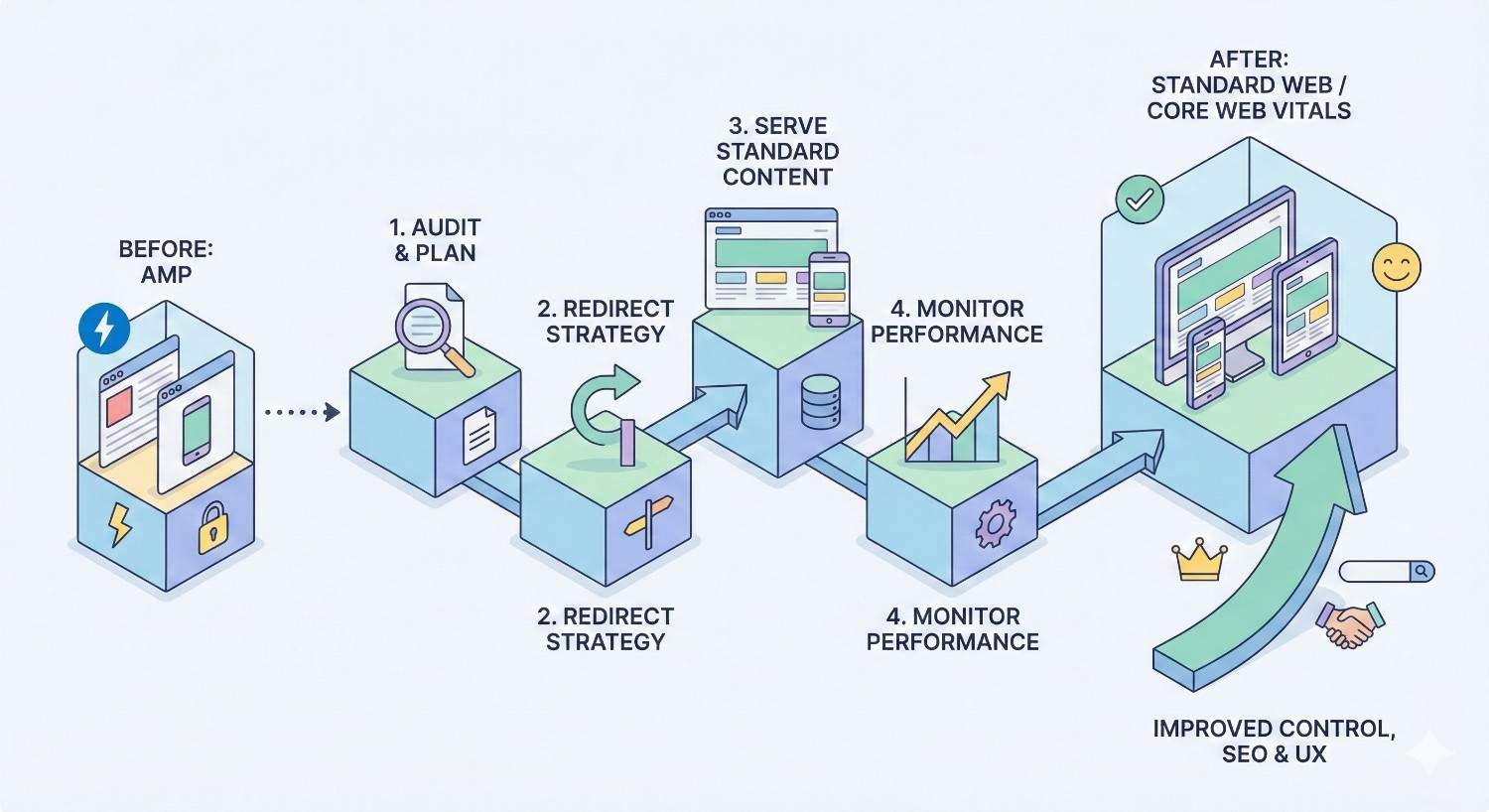
Removing AMP requires careful execution to avoid traffic losses. Follow this process to transition safely.
Audit Current AMP Performance and Traffic
Before removing AMP, understand its current contribution. Use Google Search Console to identify:
- Traffic volume to AMP pages
- Keywords where AMP pages rank
- Click-through rates for AMP vs. non-AMP results
- Core Web Vitals scores for both versions
Google Analytics reveals user behavior differences between AMP and standard pages. Compare bounce rates, session duration, and conversion rates.
This baseline data helps you measure transition impact and identify potential problems early.
Optimize Non-AMP Pages for Core Web Vitals
Your standard pages must perform well before removing AMP. Test all pages using PageSpeed Insights and Chrome User Experience Report data.
Address any Core Web Vitals failures before transition. Focus on:
- LCP optimization through image compression and server improvements
- INP improvements by reducing JavaScript execution time
- CLS fixes by specifying dimensions for all media
Achieve “Good” scores across all three metrics before proceeding. This ensures your standard pages provide equivalent user experience.
Implement Proper Redirects and Canonical Tags
Set up 301 redirects from AMP URLs to canonical pages. This transfers link equity and signals the permanent change to search engines.
Update canonical tags on remaining AMP pages to point to standard versions. Verify the relationship is correctly configured in both directions.
Test redirects thoroughly before full implementation. Broken redirects cause immediate traffic losses and indexing problems.
Update Internal Links and Sitemaps
Remove AMP URLs from your sitemap. Add standard page URLs if not already present. Submit the updated sitemap to Google Search Console.
Audit internal links for AMP URL references. Update any links pointing to AMP versions to use canonical URLs instead.
Check navigation elements, related content modules, and footer links. Any internal reference to AMP pages should redirect or update.
Monitor Rankings and Traffic During Transition
Implement changes gradually if possible. Start with lower-traffic pages to identify problems before affecting high-value content.
Monitor Search Console daily during transition. Watch for:
- Indexing errors or coverage issues
- Ranking changes for key terms
- Click-through rate fluctuations
- Core Web Vitals score changes
Set up alerts for significant traffic drops. Quick response to problems minimizes negative impact.
Remove AMP Markup and Validate Changes
After redirects are working and traffic stabilizes, remove AMP-specific code from your codebase. This includes:
- AMP HTML markup and components
- AMP-specific CSS
- AMP validation scripts
- AMP-related build processes
Validate that standard pages render correctly without AMP dependencies. Test across devices and browsers to ensure consistent experience.
Best Practices for Mobile SEO in 2024/2025 (Without AMP)
Modern mobile SEO focuses on measurable performance and user experience. These practices deliver results without AMP’s limitations.
Prioritize Core Web Vitals
Core Web Vitals directly influence rankings. Make achieving “Good” scores across all three metrics a primary objective.
Use field data from Chrome User Experience Report rather than just lab tests. Real user experience matters more than synthetic benchmarks.
Monitor Core Web Vitals continuously. Performance can degrade as content changes and third-party scripts update. Regular auditing catches problems before they impact rankings.
Mobile-First Design and Development
Design for mobile screens first, then adapt for larger displays. This approach naturally produces focused, fast mobile experiences.
Touch targets should be at least 48×48 pixels with adequate spacing. Text should be readable without zooming. Forms should be easy to complete on mobile keyboards.
Test on actual mobile devices, not just browser emulation. Real device testing reveals performance and usability issues that emulators miss.
Image and Media Optimization
Images often represent the largest page weight. Optimize aggressively:
- Use WebP or AVIF formats with JPEG fallbacks
- Implement responsive images with srcset
- Lazy load below-fold images
- Specify width and height attributes
- Consider using a image CDN for automatic optimization
Video content should use efficient codecs and adaptive streaming. Provide poster images to improve perceived loading speed.
Minimize Render-Blocking Resources
Critical CSS should be inlined in the document head. Defer non-critical CSS loading until after initial render.
JavaScript should load asynchronously or defer until after page content. Identify and eliminate render-blocking scripts that delay content display.
Font loading strategies like font-display: swap prevent invisible text during font loading. Preload critical fonts to reduce layout shift.
Implement Structured Data
Structured data helps search engines understand your content and enables rich results. Implement relevant schema types:
- Article for blog posts and news
- Product for e-commerce
- FAQ for question-answer content
- HowTo for instructional content
- LocalBusiness for location-based businesses
Validate structured data using Google’s Rich Results Test. Monitor Search Console for structured data errors and opportunities.
Optimize for Mobile User Intent
Mobile searches often have different intent than desktop. Users may want quick answers, local information, or immediate actions.
Provide concise answers to common questions near the top of content. Make contact information and calls-to-action easily accessible.
Consider voice search patterns. Mobile users increasingly speak queries rather than typing. Natural language content performs better for voice searches.
Regular Performance Monitoring and Testing
Performance optimization isn’t a one-time project. Establish ongoing monitoring:
- Weekly Core Web Vitals reviews
- Monthly comprehensive performance audits
- Quarterly competitive benchmarking
- Continuous real user monitoring
Set performance budgets and alert thresholds. Catch regressions before they impact users and rankings.
Case Studies: AMP Performance vs. Optimized Non-AMP
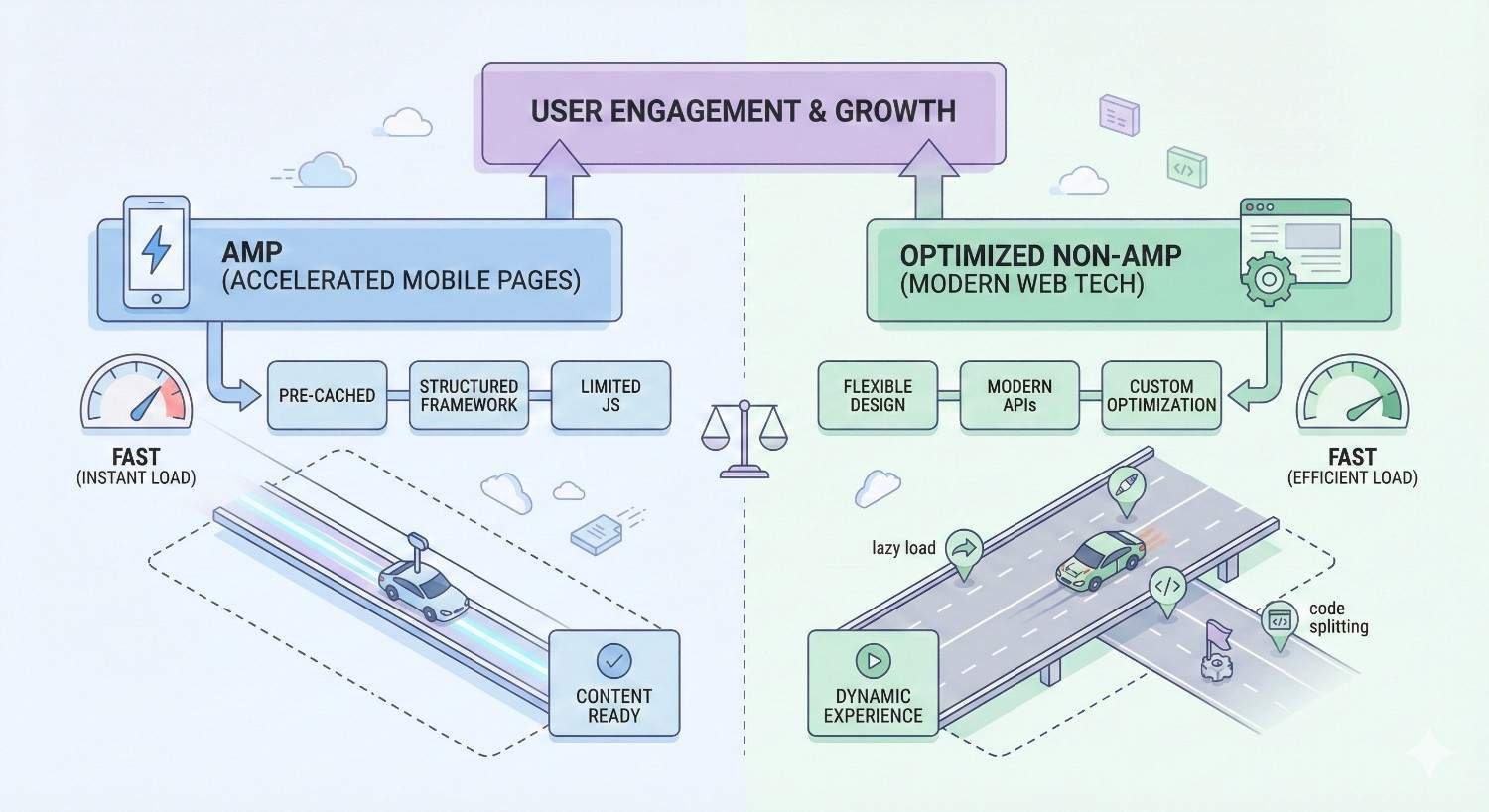
Real-world examples illustrate how different sites approach the AMP decision.
Publisher Case Study (AMP Retention)
A regional news publisher with 2 million monthly mobile visitors evaluated AMP removal in 2024. Their analysis revealed:
- AMP pages loaded in 0.8 seconds average
- Standard pages loaded in 2.1 seconds despite optimization efforts
- Google Discover drove 35% of mobile traffic, predominantly to AMP pages
The publisher chose to retain AMP while continuing standard page optimization. The traffic risk from removing AMP outweighed the maintenance burden. They plan to revisit the decision when standard pages achieve sub-second loading.
E-commerce Case Study (AMP Removal)
A mid-size e-commerce retailer removed AMP from product pages after finding:
- AMP product pages had 40% lower add-to-cart rates
- Limited product imagery and zoom functionality frustrated users
- Conversion tracking gaps created attribution problems
After removal, the retailer invested in Core Web Vitals optimization. Standard product pages achieved 1.4 second LCP while maintaining full functionality. Conversion rates improved 23% within three months.
Blog/Content Site Case Study (Hybrid Approach)
A content marketing agency tested a hybrid approach:
- Informational blog posts retained AMP
- Service pages and landing pages used optimized standard pages
- Lead generation forms existed only on standard pages
This approach maintained AMP’s speed benefits for content discovery while preserving conversion functionality where needed. The agency reports stable traffic with improved lead quality from non-AMP landing pages.
Expert Opinions and Industry Consensus
Industry perspectives have shifted significantly since AMP’s introduction. Understanding current expert views helps contextualize your decision.
Google’s Current Recommendations
Google’s documentation no longer emphasizes AMP for SEO. Current guidance focuses on Core Web Vitals and page experience signals.
Google Search Central states that AMP is “not a ranking factor” and that “any page can appear in Top Stories.” The company recommends focusing on “creating a great page experience” regardless of technology choice.
Google continues supporting AMP infrastructure but positions it as one option among many rather than a preferred approach.
SEO Industry Perspectives
Most SEO professionals now recommend Core Web Vitals optimization over AMP implementation for new projects. The consensus has shifted toward standard page optimization.
Common industry positions include:
- AMP provides diminishing returns as standard optimization improves
- The maintenance overhead rarely justifies AMP’s benefits
- New sites should skip AMP entirely and focus on Core Web Vitals
- Existing AMP implementations should be evaluated case-by-case
Some specialists still recommend AMP for specific use cases, particularly high-volume publishers with existing infrastructure.
Developer Community Insights
Developer sentiment toward AMP has been mixed since its introduction. Concerns about Google’s control over web standards and the framework’s restrictions generated ongoing criticism.
The developer community generally prefers standard web technologies over proprietary frameworks. Modern tooling makes performance optimization accessible without AMP’s constraints.
Open-source alternatives and performance-focused frameworks have reduced AMP’s appeal among developers. Many prefer investing in skills that transfer across projects rather than AMP-specific knowledge.
How We Approach Mobile SEO and Page Speed
At White Label SEO Service, we evaluate AMP decisions based on data and business context rather than assumptions.
Our Performance Optimization Process
We begin with comprehensive performance auditing. This includes Core Web Vitals analysis, competitive benchmarking, and user experience evaluation.
Our recommendations consider your specific situation: traffic patterns, audience characteristics, technical capabilities, and business objectives. We don’t apply one-size-fits-all solutions.
Implementation follows a prioritized roadmap addressing highest-impact opportunities first. We measure results continuously and adjust strategies based on actual performance data.
Core Web Vitals Audit and Implementation
Our Core Web Vitals process includes:
- Field data analysis from Chrome User Experience Report
- Lab testing across device types and connection speeds
- Identification of specific optimization opportunities
- Prioritized implementation recommendations
- Ongoing monitoring and refinement
We focus on sustainable improvements that maintain performance as your site evolves. Quick fixes that degrade over time don’t serve long-term goals.
Mobile-First Technical SEO Strategy
Mobile optimization integrates with broader technical SEO. We ensure mobile pages are properly indexed, structured data is implemented correctly, and internal linking supports mobile user journeys.
Our approach considers how mobile users find and interact with your content. Technical optimization serves user experience goals, not just search engine requirements.
Ongoing Performance Monitoring
Performance requires continuous attention. We establish monitoring systems that track Core Web Vitals, identify regressions, and alert to problems before they impact rankings.
Regular reporting keeps you informed about performance trends and optimization opportunities. We proactively recommend improvements rather than waiting for problems to emerge.
Conclusion: The Verdict on AMP for SEO
AMP’s SEO relevance has fundamentally changed. The framework no longer provides exclusive ranking benefits or required access to premium search features. Core Web Vitals now determine page experience signals, and well-optimized standard pages compete equally with AMP.
For most websites, investing in Core Web Vitals optimization delivers better results than implementing or maintaining AMP. The flexibility of standard pages, combined with modern optimization techniques, provides equivalent performance without AMP’s restrictions.
We help businesses navigate these technical SEO decisions with data-driven analysis and practical implementation. Contact White Label SEO Service to evaluate your mobile performance strategy and identify the approach that best serves your specific goals.
Frequently Asked Questions
Is AMP still a Google ranking factor in 2025?
AMP is not a direct ranking factor. Google confirmed this repeatedly since 2021. Core Web Vitals and page experience signals determine rankings, and any fast page can achieve good scores regardless of AMP implementation.
Should I remove AMP from my website?
It depends on your situation. If your standard pages pass Core Web Vitals and you need functionality AMP restricts, removal makes sense. If AMP drives significant traffic and your standard pages underperform, keep it while optimizing alternatives.
Does AMP help with Google Discover traffic?
AMP pages can appear in Google Discover, but AMP is not required. Well-optimized standard pages with engaging content and proper structured data also appear in Discover. Focus on content quality and page experience rather than AMP specifically.
How long does it take to transition away from AMP?
A careful transition typically takes 4-8 weeks. This includes optimizing standard pages, implementing redirects, monitoring for issues, and removing AMP code. Rushing the process risks traffic losses from technical problems.
Can I achieve AMP-level speed without using AMP?
Yes. Modern optimization techniques including image compression, code splitting, CDN caching, and server-side rendering can match or exceed AMP performance. Many sites achieve sub-second load times without AMP’s restrictions.
Will removing AMP hurt my search rankings?
Not if done correctly. Ensure standard pages pass Core Web Vitals before removal. Implement proper redirects and monitor rankings during transition. Most sites see stable or improved rankings after successful transitions.
Is AMP worth implementing for a new website in 2025?
Generally no. New sites should focus on Core Web Vitals optimization from the start. Building with modern frameworks and optimization practices provides equivalent performance benefits without AMP’s limitations and maintenance overhead.