

Professional blog writing services deliver consistent, SEO-optimized content that drives organic traffic, generates leads, and builds topical authority—without straining internal resources. For businesses competing in search, outsourced blog content has become a strategic growth lever rather than a discretionary expense.
This matters now because search algorithms increasingly reward content depth, publishing consistency, and demonstrated expertise. Companies publishing 16+ blog posts monthly see 3.5x more traffic than those publishing four or fewer.
This guide covers everything from service components and pricing models to SEO mechanics and vendor selection—giving you the framework to invest strategically and measure results accurately.
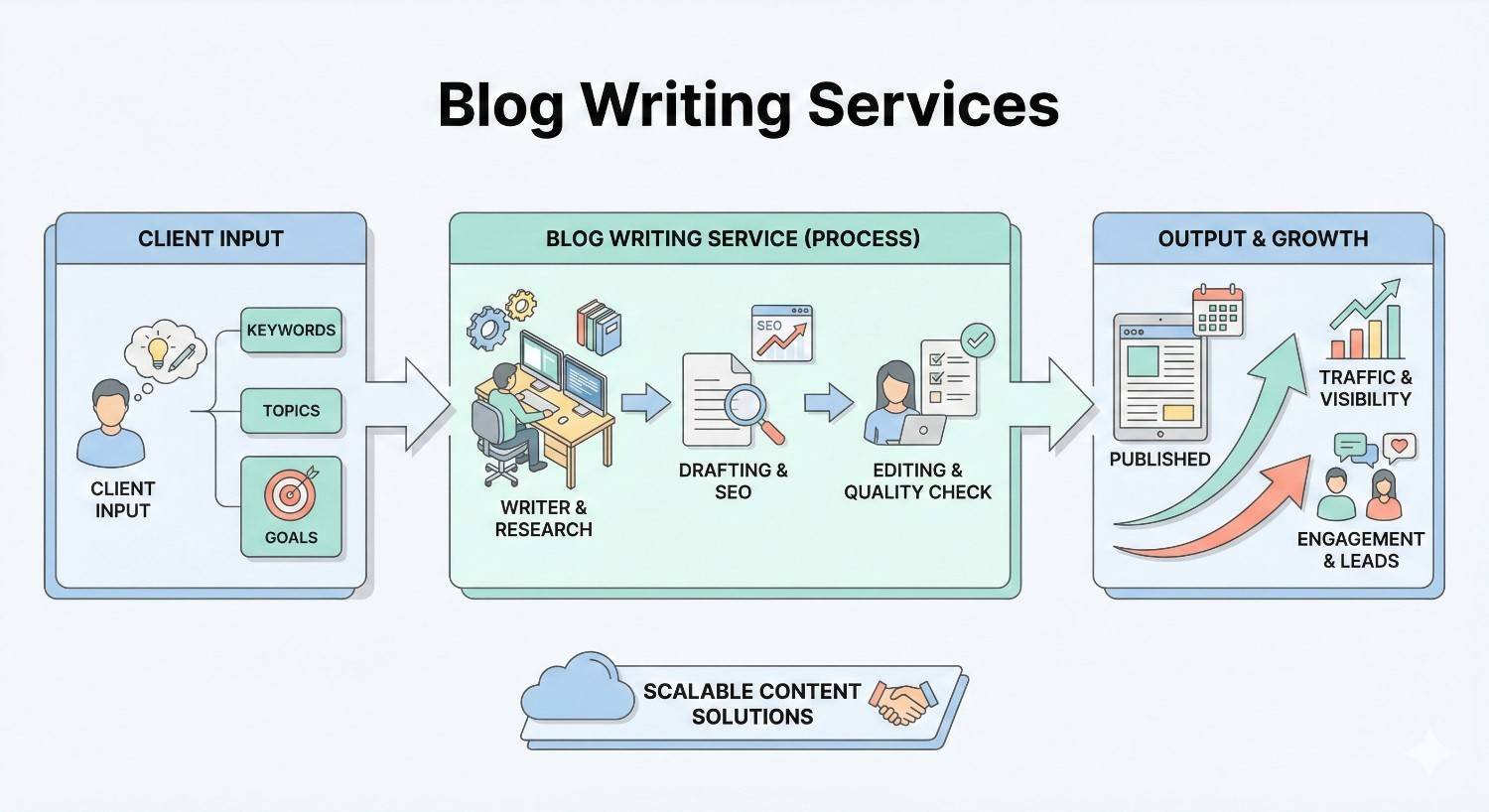
What Are Blog Writing Services?
Blog writing services are professional content solutions that handle the research, creation, optimization, and often the publishing of blog content on behalf of businesses. These services range from individual freelancers to full-service agencies, each offering different levels of strategic support, SEO integration, and quality assurance.
The core value proposition is straightforward: businesses get consistent, high-quality content without building and managing an in-house writing team. For companies prioritizing organic growth, this translates to faster content velocity, broader topical coverage, and more predictable output.
Core Components of Professional Blog Writing
Professional blog writing extends beyond putting words on a page. Quality services integrate multiple disciplines into a cohesive content production system.
Research and topic development forms the foundation. Writers investigate industry trends, competitor content gaps, and keyword opportunities before drafting. This prevents content that exists in a vacuum, disconnected from what audiences actually search for.
SEO integration happens during writing, not after. Professional writers understand search intent, keyword placement, header structure, and internal linking. They write content that satisfies both readers and search algorithms simultaneously.
Editorial oversight ensures consistency and accuracy. This includes fact-checking, brand voice alignment, grammar review, and readability optimization. Multiple review stages catch errors before publication.
Formatting and optimization prepare content for publishing. This covers meta descriptions, image alt text, schema markup recommendations, and CMS-ready formatting.
Types of Blog Writing Services Available
The market offers several distinct service models, each suited to different business needs and budgets.
Per-article services provide individual blog posts on demand. Businesses submit topics or briefs and receive completed articles. This model works for companies with sporadic content needs or those testing a new provider.
Monthly retainer packages deliver a set number of articles per month with ongoing strategic support. Retainers typically include content planning, keyword research, and performance reviews. This model suits businesses committed to consistent publishing schedules.
Full-service content programs combine blog writing with broader content strategy, including content audits, editorial calendars, topic clustering, and performance optimization. These programs function as an extension of your marketing team.
White-label services produce content that agencies or consultants deliver under their own brand. The end client never interacts with the actual writers. This model enables agencies to scale content offerings without hiring.
Industry-specialized services focus on specific verticals like healthcare, finance, technology, or legal. These providers maintain writer pools with relevant expertise and understand compliance requirements.
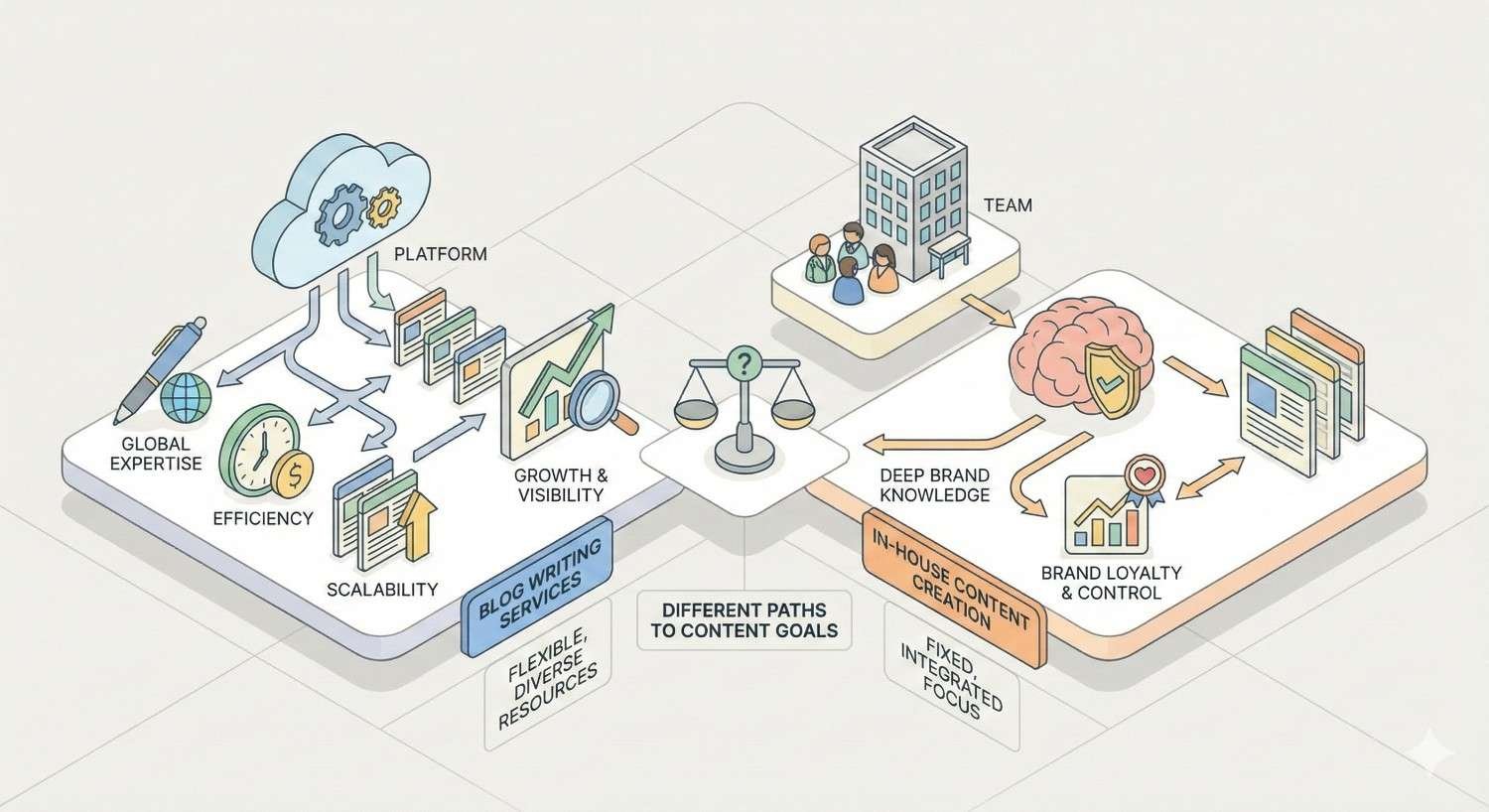
How Blog Writing Services Differ from In-House Content Creation
The in-house versus outsourced decision involves tradeoffs beyond simple cost comparison.
Scalability favors external services. Doubling your content output with an in-house team requires hiring, training, and management overhead. With a service provider, you adjust your package or order volume.
Expertise breadth often favors services. A single in-house writer cannot match the collective knowledge of a service with dozens of specialized writers. For businesses covering diverse topics, this matters.
Brand intimacy favors in-house teams. Internal writers absorb company culture, attend meetings, and understand nuances that external writers must learn through briefs and guidelines.
Cost structure differs fundamentally. In-house writers represent fixed costs (salary, benefits, equipment, management time). Services represent variable costs that scale with output. For businesses with fluctuating content needs, variable costs provide flexibility.
Quality control requires different approaches. In-house teams allow direct oversight and real-time feedback. External services require clear briefs, style guides, and structured review processes.
Why Businesses Invest in Blog Writing Services
Content marketing delivers measurable business outcomes when executed consistently. Blog writing services enable that consistency at scale.
Organic Traffic Growth and Search Visibility
Blogs remain the primary vehicle for capturing informational search queries. These queries represent the largest segment of search volume and the top of most marketing funnels.
Each blog post creates a new indexed page—a new opportunity to rank for relevant keywords. Companies with active blogs have 434% more indexed pages than those without, according to content marketing research.
Search visibility compounds over time. A blog post published today continues generating traffic for years. HubSpot’s analysis found that one in ten blog posts are “compounding posts” that increase traffic over time rather than decay.
For businesses targeting competitive keywords, consistent blogging builds the topical authority necessary to rank for high-value terms. Search engines evaluate your entire content ecosystem, not just individual pages.
Lead Generation and Conversion Support
Blog content serves multiple stages of the buyer journey. Awareness-stage content attracts new visitors. Consideration-stage content educates prospects on solutions. Decision-stage content addresses objections and differentiates your offering.
Strategic blog content includes conversion pathways: email capture forms, content upgrades, product mentions, and calls-to-action. Each post becomes a lead generation asset.
B2B companies with blogs generate 67% more leads monthly than those without. The content-to-lead pipeline requires volume and consistency that many internal teams cannot sustain.
Authority Building and Brand Positioning
Comprehensive blog coverage signals expertise to both search engines and human readers. When your site thoroughly addresses a topic from multiple angles, you become the go-to resource.
This authority translates to business outcomes. Prospects who consume your content before sales conversations arrive more educated and more trusting. Sales cycles shorten when content has already addressed common questions.
Industry authority also attracts backlinks, media mentions, and partnership opportunities. Journalists and bloggers reference authoritative sources. Your content becomes a citation magnet.
Resource Efficiency and Scalability
Content creation consumes significant time. Research, outlining, writing, editing, and formatting a single quality blog post requires 3-6 hours for most writers. Multiply that by the publishing frequency needed for SEO impact.
Blog writing services convert that time investment into a predictable expense. Your team focuses on strategy, review, and distribution while writers handle production.
Scalability becomes straightforward. Launching a new product line? Add more content. Entering a new market? Commission industry-specific articles. Seasonal demand spike? Increase publishing frequency. Services flex with business needs.
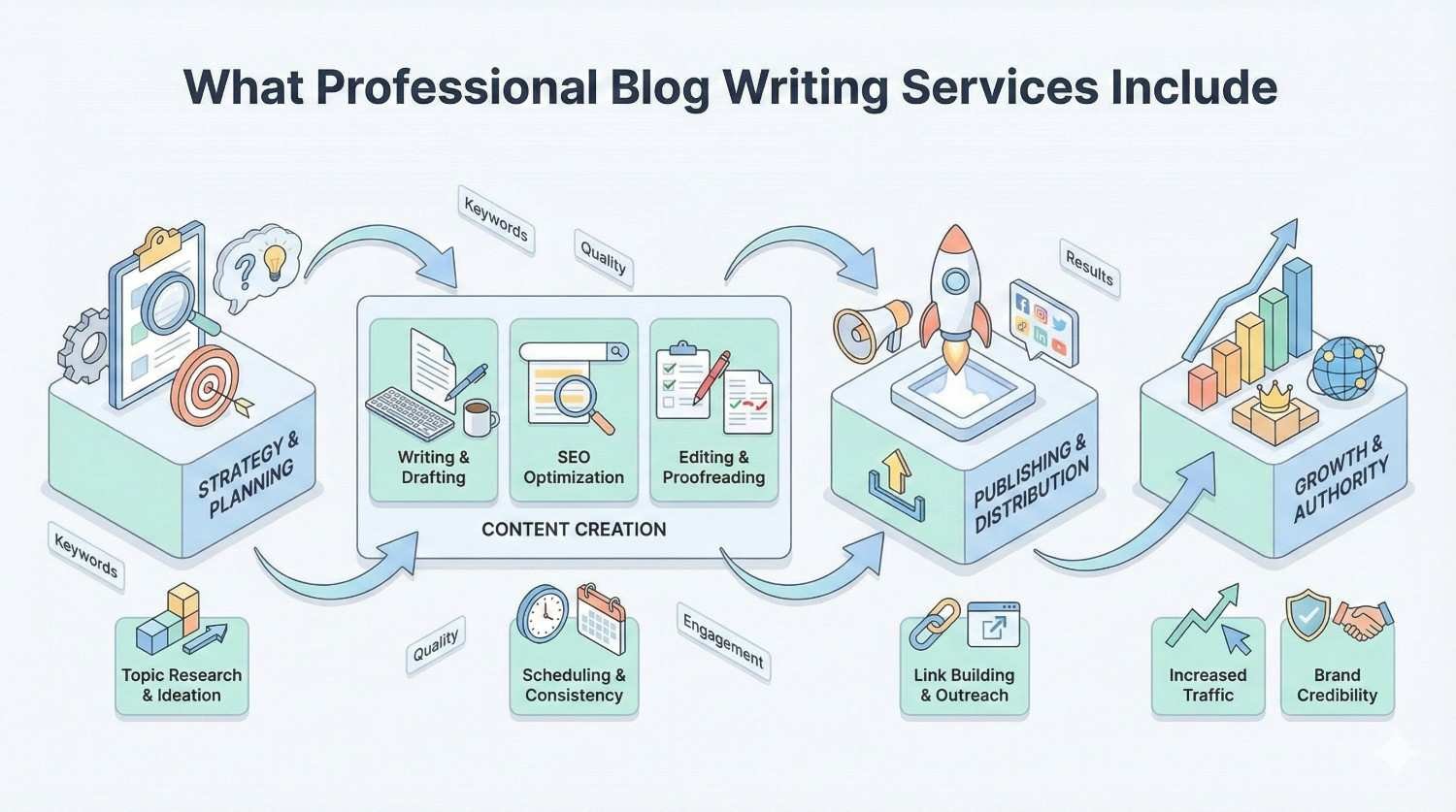
What Professional Blog Writing Services Include
Understanding service components helps you evaluate providers and set appropriate expectations.
Strategic Content Planning and Topic Research
Quality services don’t wait for you to provide topics. They proactively identify content opportunities through systematic research.
Keyword research identifies terms your audience searches for, along with search volume, competition levels, and ranking difficulty. This research prioritizes topics with the best traffic potential relative to effort.
Competitor analysis reveals content gaps—topics your competitors rank for that you don’t cover, or topics they cover poorly that you could address better.
Content gap analysis maps your existing content against search demand. Where are you missing coverage? Which existing posts need updates or expansion?
Editorial calendar development sequences topics strategically. This might mean building topical clusters, aligning with seasonal trends, or supporting product launches.
SEO-Optimized Writing and Keyword Integration
SEO-aware writing differs from keyword stuffing. Professional writers understand how to satisfy search intent while maintaining readability.
Primary keyword integration places target terms in titles, headers, introductions, and conclusions—the positions search engines weight most heavily.
Semantic keyword usage incorporates related terms, synonyms, and conceptually connected phrases. This signals topical depth to search algorithms and captures long-tail variations.
Search intent alignment ensures content format matches what searchers expect. Informational queries need comprehensive explanations. Comparison queries need structured evaluations. How-to queries need step-by-step instructions.
Header structure optimization creates logical hierarchies that help both readers and search engines understand content organization.
Editorial Standards and Quality Assurance
Professional services maintain quality through systematic review processes.
Fact-checking verifies claims, statistics, and technical information. Inaccurate content damages credibility and can create legal exposure in regulated industries.
Style guide adherence ensures consistency across all content. This covers voice, tone, formatting conventions, terminology preferences, and brand guidelines.
Grammar and readability review catches errors and improves clarity. Many services use tools like Grammarly or Hemingway alongside human editors.
Plagiarism checking confirms content originality. Duplicate content creates SEO problems and potential copyright issues.
Content Formatting and Publishing Support
Finished content should be ready for your CMS, not requiring hours of additional formatting work.
CMS-ready formatting delivers content in your preferred format—whether that’s WordPress-ready HTML, Google Docs, or plain Markdown.
Meta description writing provides optimized snippets for search results. These descriptions influence click-through rates from search engine results pages.
Image recommendations suggest visual elements that enhance content. Some services provide images; others specify what you should source.
Internal linking suggestions identify opportunities to connect new content with existing pages, strengthening your site’s link architecture.
Performance Tracking and Content Optimization
The best services treat content as an ongoing asset, not a one-time deliverable.
Performance reporting tracks how content performs against key metrics: organic traffic, keyword rankings, engagement, and conversions.
Content refresh recommendations identify posts that need updates. Search engines favor fresh content, and outdated information hurts credibility.
Optimization suggestions propose improvements based on performance data. Maybe a post ranks on page two and needs additional depth to reach page one.
How to Choose the Right Blog Writing Service
Selecting a provider requires evaluating multiple factors beyond price.
Evaluating Industry Expertise and Niche Knowledge
Generic writers produce generic content. Industry expertise enables the specificity and accuracy that builds authority.
Ask about writer backgrounds. What qualifications do writers have in your industry? Do they have professional experience, relevant education, or demonstrated writing history in your space?
Request niche-specific samples. Don’t accept general portfolio pieces. Ask for examples in your industry or closely related fields.
Test technical accuracy. Have a subject matter expert review sample content. Do writers understand industry terminology? Do they make factual errors?
Evaluate research depth. Quality writers cite authoritative sources, reference current data, and demonstrate genuine understanding rather than surface-level summaries.
Assessing SEO Capabilities and Technical Understanding
Not all writers understand SEO. Not all SEO-focused services produce readable content. You need both.
Ask about their SEO process. How do they conduct keyword research? How do they determine search intent? How do they structure content for rankings?
Review their own rankings. Does the service’s website rank for relevant terms? Their own SEO performance indicates their capabilities.
Evaluate technical knowledge. Do they understand concepts like topical authority, content clusters, and internal linking? Can they explain how their content supports your broader SEO strategy?
Check for over-optimization. Request samples and assess keyword usage. Does it read naturally, or does it feel forced and repetitive?
Understanding Pricing Models and Service Packages
Pricing structures vary significantly. Understanding what you’re paying for prevents surprises.
Per-word pricing charges based on content length. Rates typically range from $0.10 to $0.50+ per word depending on quality level and specialization.
Per-article pricing sets flat rates regardless of length within defined parameters. This provides cost predictability but may incentivize shorter content.
Monthly retainers bundle multiple articles with strategic services. Retainers typically offer better per-article rates than à la carte ordering.
Project-based pricing covers defined scopes like content audits, pillar page creation, or topic cluster development.
Clarify what’s included. Does the price cover revisions? Keyword research? Images? Publishing? Hidden costs add up quickly.
Reviewing Portfolio Quality and Writing Samples
Samples reveal more than sales conversations. Evaluate them critically.
Assess readability. Is the content engaging? Does it flow logically? Would you read it voluntarily?
Check depth and accuracy. Does the content provide genuine value, or does it skim the surface? Are claims supported with evidence?
Evaluate SEO integration. Can you identify target keywords? Is the structure optimized? Does it answer search intent comprehensively?
Look for originality. Does the content offer unique perspectives, or does it rehash what’s already ranking? Differentiation matters for both readers and rankings.
Checking Process, Communication, and Turnaround Times
Operational factors affect your experience as much as content quality.
Understand the workflow. How do you submit briefs? How are drafts delivered? What’s the revision process?
Clarify communication channels. Who’s your point of contact? How quickly do they respond? What happens if issues arise?
Confirm turnaround times. How long from brief submission to draft delivery? What about revisions? Can they accommodate rush requests?
Ask about capacity. Can they scale if you need more content? What happens during their busy periods?
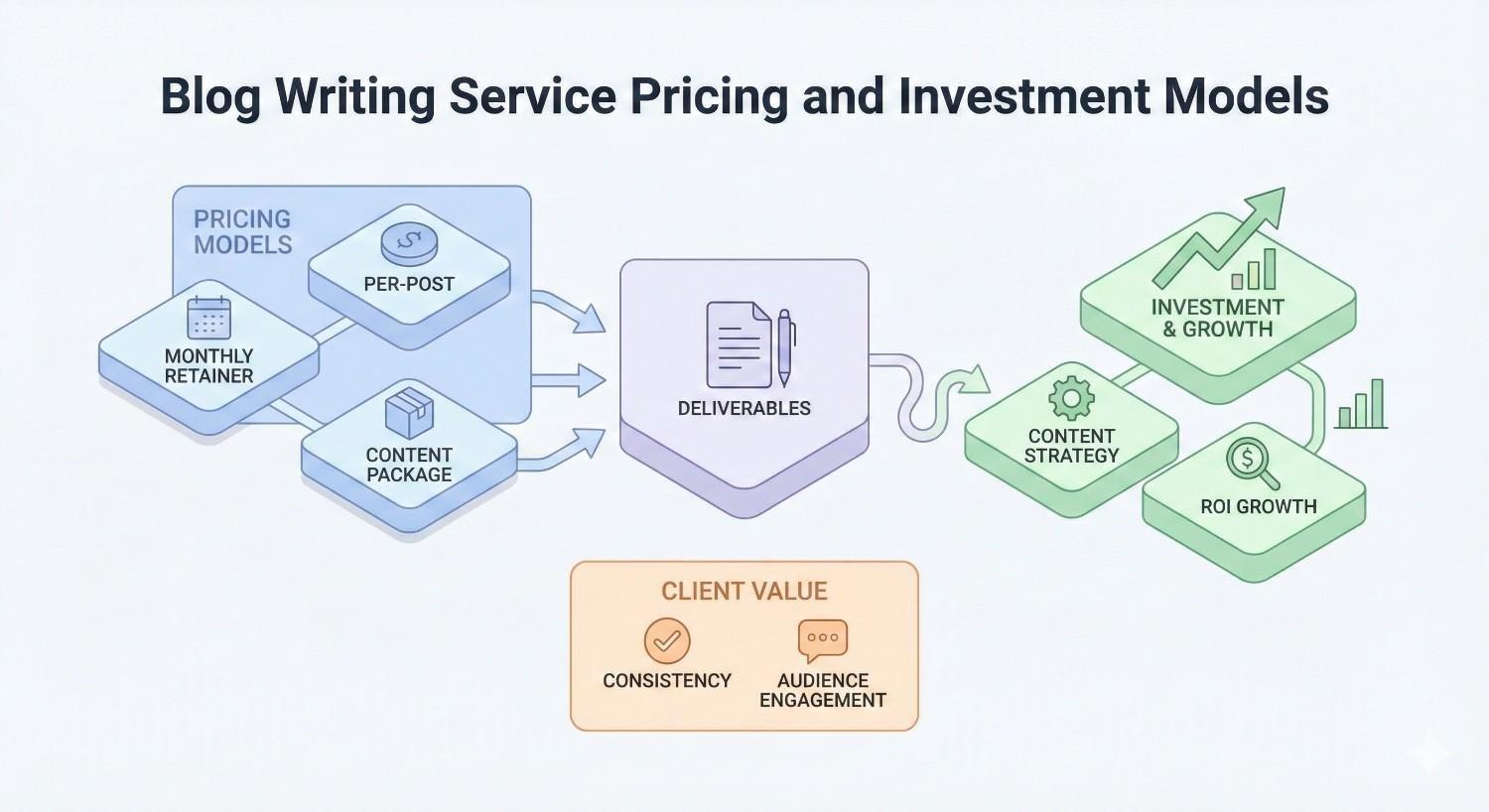
Blog Writing Service Pricing and Investment Models
Understanding pricing helps you budget appropriately and evaluate value.
Per-Article Pricing vs. Monthly Retainers
Both models have advantages depending on your situation.
Per-article pricing works when:
- Content needs are irregular or unpredictable
- You’re testing a new provider before committing
- You need specific one-off pieces (pillar pages, special projects)
- Budget constraints require pay-as-you-go flexibility
Monthly retainers work when:
- You need consistent publishing schedules
- You want strategic support beyond just writing
- Volume justifies bulk pricing discounts
- You prefer predictable monthly expenses
Retainers typically reduce per-article costs by 15-30% compared to à la carte pricing while adding strategic services.
Factors That Influence Blog Writing Costs
Multiple variables affect what you’ll pay.
Content length directly impacts cost. A 500-word post costs less than a 2,500-word comprehensive guide.
Research requirements add time and expense. Technical topics requiring deep research cost more than general business content.
Industry specialization commands premiums. Writers with healthcare, legal, or financial expertise charge more than generalists.
SEO integration level affects pricing. Basic keyword inclusion costs less than comprehensive optimization with competitor analysis and content strategy.
Turnaround speed influences rates. Rush orders typically carry 25-50% premiums.
Revision policies vary. Some services include unlimited revisions; others charge for changes beyond initial rounds.
Expected ROI and Performance Benchmarks
Content marketing ROI requires realistic expectations and proper measurement.
Traffic benchmarks vary by industry and competition. A well-optimized blog post might generate 100-1,000+ monthly visits once it ranks, though results take time to materialize.
Lead generation rates depend on your conversion optimization. Blog traffic typically converts at 1-3% for email signups and 0.5-2% for direct inquiries.
Cost-per-lead calculations should account for content’s compounding nature. A $500 article generating 50 leads over two years costs $10 per lead—often far below paid advertising costs.
Time to results requires patience. New content typically takes 3-6 months to reach stable rankings. Comprehensive content programs show meaningful traffic impact within 6-12 months.
Budget Planning for Sustainable Content Programs
Sustainable programs balance ambition with resources.
Minimum viable programs for SEO impact typically require 4-8 articles monthly. Fewer posts struggle to build momentum; more accelerates results.
Budget ranges for quality services:
- Entry level: $1,000-2,500/month (4-8 basic articles)
- Growth level: $2,500-5,000/month (8-12 optimized articles with strategy)
- Scale level: $5,000-15,000+/month (12-20+ articles with comprehensive support)
Plan for the long term. Content marketing is a marathon. Budget for at least 12 months of consistent investment before expecting significant ROI.
When Should You Hire a Blog Writing Service?
Timing your investment affects outcomes. Certain signals indicate readiness.
Signs Your Business Needs External Content Support
Recognize when internal approaches have reached their limits.
Publishing inconsistency undermines SEO efforts. If you’ve committed to weekly posts but actually publish monthly, external support provides accountability and capacity.
Quality degradation happens when internal teams are stretched. If content quality has declined as other responsibilities increased, dedicated writers restore standards.
Expertise gaps limit content depth. If your team can’t write authoritatively about technical topics, specialized writers fill the knowledge gap.
Opportunity costs mount when skilled employees write content. If your marketing manager spends 15 hours weekly on blog posts, that’s time not spent on strategy, campaigns, or analysis.
Growth ambitions exceed current capacity. If your SEO strategy requires more content than your team can produce, scaling requires external resources.
Timing Your Investment for Maximum Impact
Strategic timing amplifies results.
Website readiness matters. Ensure your site has solid technical SEO foundations before investing heavily in content. Broken sites waste good content.
Align with business cycles. If your industry has seasonal peaks, begin content programs 6-9 months before peak season to allow ranking time.
Coordinate with other marketing. Content supports paid campaigns, product launches, and sales initiatives. Time content production to align with broader marketing calendars.
Start before you’re desperate. Content marketing takes time. Beginning when you urgently need traffic means months of waiting. Start while other channels still perform.
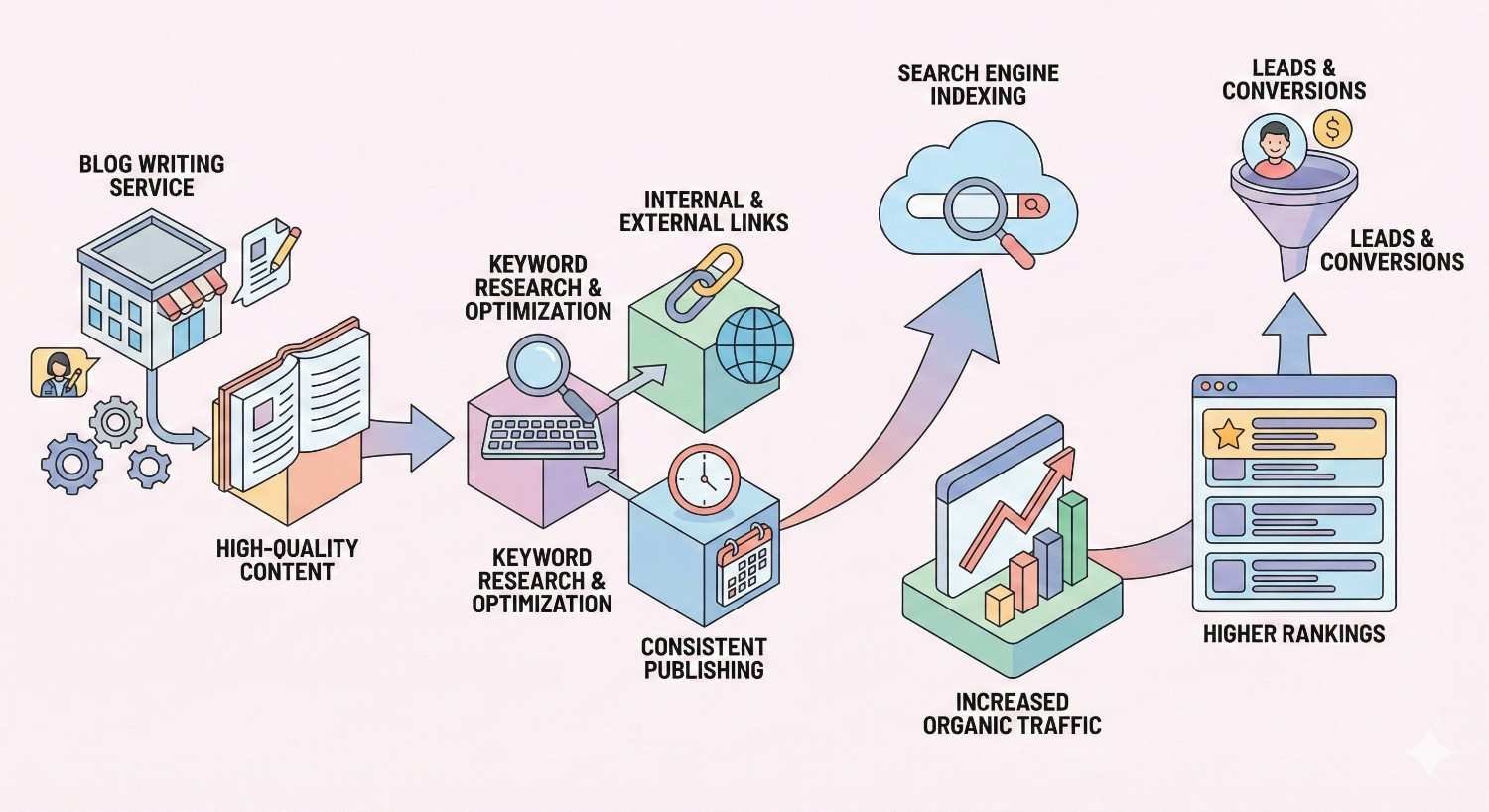
How Blog Writing Services Drive SEO Results
Understanding the mechanics helps you set realistic expectations and optimize your program.
Content Frequency and Ranking Velocity
Publishing frequency affects how quickly you build search visibility.
More content creates more ranking opportunities. Each post targets different keywords, capturing different search queries. Volume expands your keyword footprint.
Consistent publishing signals site activity. Search engines favor active sites. Regular new content encourages more frequent crawling and indexing.
Frequency benchmarks from HubSpot research show companies publishing 16+ posts monthly get 3.5x more traffic than those publishing 0-4 posts. The relationship isn’t perfectly linear, but volume matters.
Quality constraints apply. Publishing frequency only helps if quality remains high. Ten mediocre posts perform worse than four excellent ones.
Topical Authority Development Through Strategic Blogging
Search engines evaluate topical expertise across your entire site, not just individual pages.
Topical authority means comprehensively covering a subject area. If you write one post about “email marketing,” you have thin coverage. If you write 30 posts covering email strategy, automation, deliverability, list building, and analytics, you demonstrate expertise.
Authority affects rankings. Sites with demonstrated topical depth rank more easily for competitive terms within that topic. Your 31st email marketing post benefits from the authority built by the previous 30.
Strategic topic selection builds authority efficiently. Rather than scattered topics, focus content around core themes relevant to your business. Depth beats breadth for authority building.
Internal Linking Architecture and Content Clusters
Blog content strengthens your site’s link structure when properly connected.
Content clusters organize related posts around pillar pages. The pillar provides comprehensive topic coverage; cluster posts address specific subtopics and link back to the pillar.
Internal links distribute authority. Links from high-performing pages boost linked pages. Strategic internal linking helps newer content rank faster.
User experience improves. Connected content keeps visitors engaged longer, reducing bounce rates and increasing pages per session—both positive ranking signals.
Professional services understand linking. Quality providers suggest internal link opportunities and structure content to support your site architecture.
Realistic Timelines for Blog-Driven Organic Growth
Set appropriate expectations for when results materialize.
Individual post timelines:
- Indexing: 1-7 days for Google to discover and index new content
- Initial rankings: 2-8 weeks to appear in search results
- Ranking stabilization: 3-6 months to reach relatively stable positions
- Peak performance: 6-12+ months for well-optimized content
Program-level timelines:
- Months 1-3: Building content foundation, minimal traffic impact
- Months 4-6: Early rankings appear, traffic begins growing
- Months 7-12: Compounding effects, significant traffic increases
- Year 2+: Mature program with predictable growth and established authority
Factors affecting speed:
- Domain authority (established sites rank faster)
- Competition level (less competitive niches show faster results)
- Content quality (better content ranks faster and higher)
- Technical SEO health (site issues slow everything down)
Blog Writing Services vs. Other Content Solutions
Understanding alternatives helps you choose the right approach.
Blog Writing Services vs. Freelance Writers
Both involve external writers, but the models differ significantly.
Freelancers offer:
- Direct relationships with individual writers
- Often lower per-article costs
- Flexibility in engagement terms
- Potential for deep brand familiarity over time
Freelancer challenges:
- You manage the relationship, briefs, and quality control
- Capacity limited to one person’s bandwidth
- No backup if the freelancer is unavailable
- SEO expertise varies widely
Services offer:
- Managed processes and quality assurance
- Scalable capacity across multiple writers
- Built-in editorial oversight
- Typically stronger SEO integration
Services challenges:
- Higher costs than individual freelancers
- Less direct writer relationships
- Potential for inconsistent voice across writers
Choose freelancers when you have management capacity, need limited volume, and find a writer who deeply understands your brand.
Choose services when you need scale, consistency, and don’t want to manage writers directly.
Blog Writing Services vs. Content Agencies
Content agencies offer broader services than blog-focused providers.
Full-service agencies provide:
- Comprehensive content strategy
- Multiple content types (video, social, email, blogs)
- Creative services (design, branding)
- Often larger teams and resources
Agency considerations:
- Higher costs reflecting broader capabilities
- Blog writing may not be their specialty
- Account management layers can slow communication
- Minimum engagements often larger
Blog writing services provide:
- Specialized focus on written content
- Often deeper SEO expertise
- More streamlined processes for blog production
- Typically lower minimums and more flexibility
Choose agencies when you need integrated content strategy across multiple formats and channels.
Choose blog services when written content is your primary need and you want specialized expertise.
Blog Writing Services vs. AI Content Tools
AI writing tools have improved dramatically but have distinct limitations.
AI tools offer:
- Very low per-article costs
- Instant content generation
- Unlimited capacity
- Useful for ideation and first drafts
AI limitations:
- Accuracy issues requiring fact-checking
- Generic output lacking unique insights
- Potential for detectable AI patterns
- No strategic thinking or brand understanding
- Quality inconsistency across topics
Human services offer:
- Original research and genuine expertise
- Brand voice consistency
- Strategic content planning
- Accountability for accuracy
- Nuanced understanding of audience needs
Hybrid approaches often work best. Use AI for research assistance, outline generation, or first drafts. Use human writers for refinement, fact-checking, and strategic content.
Hybrid Models: Combining In-House and External Resources
Many successful programs blend internal and external resources.
Common hybrid structures:
In-house strategy, outsourced production: Your team handles content planning, topic selection, and final review. External writers handle drafting.
In-house expertise content, outsourced volume: Internal experts write thought leadership and technical pieces. External writers handle supporting content and volume needs.
Tiered quality approach: Premium content (pillar pages, key landing pages) gets more investment. Supporting content uses more cost-effective resources.
Seasonal scaling: Maintain baseline in-house capacity. Add external resources during high-demand periods.
Common Mistakes When Hiring Blog Writing Services
Avoid these pitfalls that undermine content investments.
Prioritizing Price Over Quality and Strategy
Cheap content often costs more in the long run.
Low-quality content fails to rank. If articles don’t reach page one, they generate no traffic regardless of how little they cost.
Thin content damages authority. Publishing mediocre content can actually hurt your site’s perceived expertise.
Rewrites waste money. If cheap content requires extensive revision or replacement, you’ve paid twice.
Calculate true costs. A $50 article that generates zero traffic costs infinitely more per visitor than a $300 article generating 500 monthly visits.
Neglecting SEO Integration and Technical Requirements
Content without SEO consideration misses the primary value proposition.
Keyword targeting matters. Content not optimized for specific search terms ranks randomly if at all.
Search intent alignment is essential. Beautiful content that doesn’t match what searchers want won’t rank or convert.
Technical elements affect performance. Proper headers, meta descriptions, and internal links aren’t optional extras.
Verify SEO capabilities before hiring. Ask specific questions about their optimization process.
Failing to Provide Adequate Brand Guidelines
Writers can’t read your mind. Insufficient guidance produces off-brand content.
Create comprehensive briefs. Include target keywords, audience context, desired outcomes, and specific points to cover.
Develop style guides. Document voice, tone, terminology preferences, and formatting standards.
Share examples. Show writers content you like (yours or competitors’) and explain what works.
Provide feedback. Early feedback shapes future content. Silence implies approval.
Setting Unrealistic Expectations for Results
Content marketing requires patience. Unrealistic timelines lead to premature program cancellation.
SEO takes time. Expecting page-one rankings within weeks sets everyone up for disappointment.
Volume requirements are real. A handful of posts won’t transform your organic traffic.
Compounding takes time. The best results come from sustained investment over years, not months.
Set appropriate KPIs. Early metrics might focus on content production and indexing. Traffic and ranking metrics become meaningful later.
How to Work Effectively with a Blog Writing Service
Maximize your investment through effective collaboration.
Establishing Clear Content Goals and KPIs
Define success before starting.
Traffic goals might target specific visitor numbers or growth percentages.
Ranking goals might focus on specific keywords or overall keyword footprint expansion.
Lead generation goals connect content to business outcomes.
Authority goals might measure topical coverage breadth or backlink acquisition.
Share goals with your provider. They can optimize their approach when they understand your objectives.
Providing Comprehensive Briefs and Brand Assets
Better inputs produce better outputs.
Brief elements to include:
- Target keyword(s) and search intent
- Target audience and their knowledge level
- Key points to cover
- Desired content length
- Internal linking opportunities
- Competitor content to beat
- Specific angles or perspectives to take
Brand assets to share:
- Style guide and voice documentation
- Terminology glossary
- Example content you admire
- Brand messaging and positioning
- Product/service information
Maintaining Feedback Loops and Quality Standards
Ongoing communication improves results over time.
Review content promptly. Delayed feedback slows production and frustrates writers.
Be specific in feedback. “This doesn’t feel right” helps less than “The tone is too casual for our enterprise audience.”
Acknowledge good work. Positive feedback reinforces what’s working.
Address issues early. Small problems become patterns if not corrected.
Schedule regular check-ins. Monthly or quarterly reviews assess program performance and adjust strategy.
Integrating Blog Content into Broader Marketing Strategy
Blog content shouldn’t exist in isolation.
Coordinate with campaigns. Align blog topics with product launches, promotions, and marketing initiatives.
Support sales enablement. Create content that addresses common sales objections and questions.
Feed social channels. Blog content provides material for social media distribution.
Build email content. Blog posts can be repurposed for newsletters and nurture sequences.
Inform paid campaigns. High-performing organic content often makes effective paid promotion targets.
Industries That Benefit Most from Blog Writing Services
While most businesses benefit from content marketing, certain industries see particularly strong returns.
SaaS and Technology Companies
Technology companies face unique content opportunities.
Long sales cycles mean prospects research extensively before purchasing. Content influences decisions throughout extended evaluation periods.
Complex products require explanation. Educational content helps prospects understand solutions and use cases.
Competitive markets demand differentiation. Thought leadership content establishes expertise and builds preference.
SEO-driven acquisition often provides the best unit economics for SaaS customer acquisition.
Professional Services and B2B
Service businesses sell expertise, making content a natural fit.
Trust is essential. Prospects hire based on perceived competence. Content demonstrates expertise before any sales conversation.
Long consideration phases mean multiple content touchpoints influence decisions.
Referral amplification happens when content gets shared within professional networks.
Thought leadership differentiates in crowded markets where services seem similar.
E-commerce and Retail Brands
Product-focused businesses benefit from content beyond product pages.
Informational queries capture top-of-funnel traffic. “How to choose running shoes” reaches prospects before “buy Nike running shoes.”
Category authority helps product pages rank. Supporting content strengthens the entire site.
Buying guides assist purchase decisions and reduce returns.
SEO diversification reduces dependence on paid advertising for traffic.
Healthcare, Finance, and Regulated Industries
Regulated industries have specific content needs.
YMYL (Your Money or Your Life) content requires exceptional accuracy and expertise. Search engines scrutinize these topics heavily.
Compliance requirements demand writers who understand regulatory constraints.
Trust signals matter more in high-stakes decisions. Authoritative content builds necessary credibility.
Specialized writers command premiums but prevent costly compliance issues.
Getting Started with Professional Blog Writing Services
Ready to move forward? Here’s how to begin.
Questions to Ask Before Hiring
Vet providers thoroughly with these questions.
About their process:
- How do you conduct keyword and topic research?
- What does your content creation workflow look like?
- How many revision rounds are included?
- What’s your typical turnaround time?
About their team:
- Who will write my content?
- What are your writers’ qualifications in my industry?
- Do you have subject matter experts review technical content?
About their SEO approach:
- How do you optimize content for search?
- How do you determine search intent?
- Do you provide internal linking recommendations?
About results:
- Can you share case studies or results from similar clients?
- How do you measure content performance?
- What results should I realistically expect?
Setting Up Your First Content Program
Launch effectively with proper foundations.
Start with strategy. Before ordering content, define your target topics, keywords, and content priorities.
Create foundational documents. Develop your style guide, brief template, and brand guidelines before the first assignment.
Begin with a pilot. Order 2-4 articles initially to evaluate quality and fit before committing to larger volumes.
Establish workflows. Define how briefs will be submitted, how drafts will be reviewed, and how feedback will be communicated.
Set realistic initial goals. Focus early metrics on production quality and process efficiency. Traffic metrics become meaningful after several months.
Measuring Success and Scaling Your Investment
Track progress and expand strategically.
Early metrics (months 1-3):
- Content production volume and consistency
- Quality scores and revision rates
- Indexing speed and coverage
Growth metrics (months 4-8):
- Keyword ranking improvements
- Organic traffic trends
- Engagement metrics (time on page, bounce rate)
Mature metrics (months 9+):
- Traffic volume and growth rate
- Lead generation from content
- Revenue attribution to content
- Cost per acquisition from organic
Scaling decisions should follow demonstrated results. Increase investment when metrics show positive trends. Adjust strategy when results lag expectations.
Conclusion
Blog writing services transform content marketing from an aspiration into an operational reality. The right provider delivers consistent, SEO-optimized content that builds topical authority, drives organic traffic, and generates leads—all while freeing your team to focus on strategy and growth.
At White Label SEO Service, we help businesses build sustainable organic growth through strategic content programs. Our approach combines SEO expertise with quality writing to deliver content that ranks and converts.
Ready to scale your content marketing? We can help you develop a blog writing program aligned with your business goals and SEO strategy. Let’s discuss how professional content services can accelerate your organic growth.
Frequently Asked Questions
How much do blog writing services typically cost?
Blog writing services range from $100-500+ per article depending on length, complexity, and provider quality. Monthly retainers typically run $1,000-5,000+ for 4-12 articles with strategic support. Specialized industries and longer-form content command premium pricing.
How long does it take to see results from blog content?
Individual posts typically take 3-6 months to reach stable rankings. Program-level results usually become meaningful within 6-12 months of consistent publishing. Factors like domain authority, competition, and content quality affect timelines significantly.
How many blog posts should I publish per month?
Most SEO-focused programs require 4-8 posts monthly as a minimum for meaningful impact. Companies publishing 16+ posts monthly see significantly higher traffic growth. Quality matters more than quantity—fewer excellent posts outperform many mediocre ones.
What’s the difference between blog writing services and content agencies?
Blog writing services specialize in written content with deep SEO expertise. Content agencies offer broader services including video, social media, and creative work. Blog services typically provide more focused expertise and streamlined processes for written content specifically.
Should I use AI tools instead of professional writers?
AI tools work well for ideation, research assistance, and first drafts but require human oversight for accuracy, originality, and strategic alignment. Most successful programs use hybrid approaches—AI for efficiency, humans for quality assurance and expertise.
How do I evaluate blog writing service quality?
Request industry-specific samples and evaluate for accuracy, depth, readability, and SEO integration. Check their own website’s search rankings. Ask about writer qualifications and editorial processes. Start with a small pilot project before larger commitments.
What should I include in content briefs for writers?
Effective briefs include target keywords, search intent, audience context, key points to cover, desired length, competitor content to beat, internal linking opportunities, and specific angles or perspectives. Better briefs consistently produce better content.