White label SEO case studies are documented records of organic search campaigns showing measurable traffic, ranking, and revenue outcomes achieved through outsourced SEO delivery. I’ve reviewed dozens of these across industries, and the patterns that actually hold up matter more than any single win.
Most buyers can’t tell a strong case study from a cherry-picked one. That gap costs real budget every year.
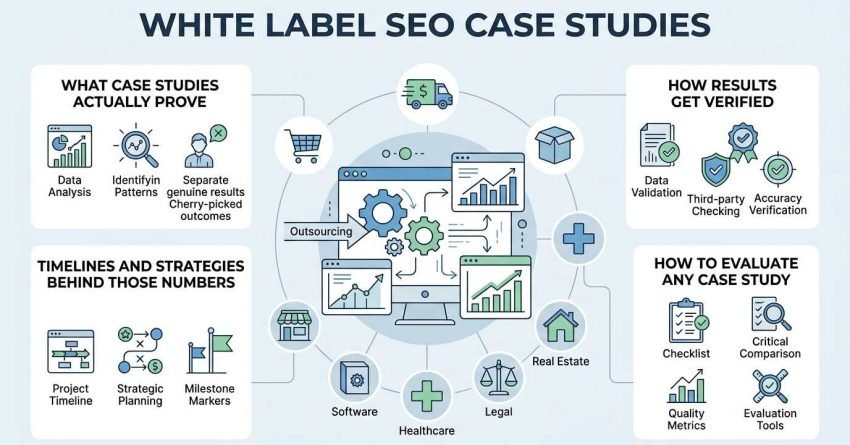
This guide covers what case studies actually prove and how results get verified; real outcomes across e-commerce, local service, SaaS, healthcare, legal, and real estate businesses; the timelines and strategies behind those numbers; and how to evaluate any case study before trusting it with your budget.
What White Label SEO Case Studies Actually Show
A white label SEO case study is a documented account of a campaign’s inputs and outcomes, built to show what actually moved the needle for a client. I look at these constantly, and the honest ones share a structure: starting point, specific actions taken, and measured change over a defined period.
The best case studies name their baseline. A campaign that started at zero organic traffic and reached 10,000 monthly visitors tells a completely different story than one that started at 8,000 and grew to 10,000, even though both end at the same number.
Why Results Data Matters More Than Promises
Promises are cheap in this industry. Data with dates, baselines, and named metrics is not, and that’s the entire reason case study scrutiny exists.
I’ve seen agencies quote “300% traffic growth” from a campaign that started with 40 monthly visitors. The percentage is technically true and completely meaningless without the baseline attached.
A credible SEO case study is a performance record that includes a defined starting baseline, a specific timeframe, and third-party-verifiable metrics such as organic sessions or keyword rankings. Anything short of that is a marketing claim wearing a case study’s clothes.
How SEO Results Are Measured and Verified
SEO results get measured primarily through organic traffic changes, keyword ranking positions, and conversion data pulled from analytics platforms tied to the client’s own property. That last part matters: the data has to live somewhere the client controls, not just in an agency’s private dashboard.
Core Metrics Agencies Track
Organic sessions, non-branded keyword rankings, and goal completions form the backbone of almost every legitimate report I’ve reviewed. Backlink growth and crawl health round out the technical side.
A Backlinko analysis of 11.8 million Google search results found that the average first-page result is nearly three years old, which explains why timeline expectations matter so much when reading any case study’s timeframe.
E-Commerce SEO Case Study Results
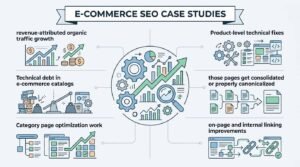
E-commerce SEO case studies typically report revenue-attributed organic traffic growth alongside category and product page ranking improvements over six to twelve-month windows. Product-level technical fixes tend to show up first, before content or link gains compound.
One pattern shows up constantly: sites with thousands of thin or duplicate product pages see disproportionate early gains once those pages get consolidated or properly canonicalized. The technical debt in e-commerce catalogs is usually the biggest lever, not the last one pulled.
Category page optimization work often produces the clearest before-and-after numbers, since these pages carry the highest commercial search volume and respond quickly to on-page and internal linking improvements.
Local Service Business SEO Case Study Results
Local service business case studies center on Google Business Profile visibility, map pack rankings, and phone call or form conversions tied to specific service areas. These campaigns move faster than e-commerce or SaaS because the competitive set is narrower and geographically bounded.
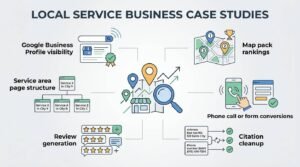
I’ve watched HVAC and plumbing clients see map pack movement within 60 to 90 days when citation cleanup and review generation get addressed early. The ceiling is lower than national campaigns, but the timeline to visible results is shorter.
Service area page structure plays a bigger role here than most business owners expect, since one page per service-location combination gives search engines a clean way to match local intent.
SaaS and B2B SEO Case Study Results
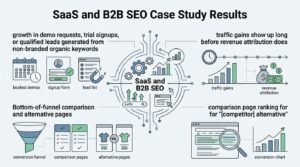
SaaS and B2B SEO case studies most often report growth in demo requests, trial signups, or qualified leads generated from non-branded organic keywords over nine to eighteen-month campaigns. The sales cycle length in B2B means traffic gains show up long before revenue attribution does.
Bottom-of-funnel comparison and alternative pages tend to convert at the highest rate in these campaigns, even though they rarely drive the largest traffic volume. A single comparison page ranking for “[competitor] alternative” can outperform ten blog posts on conversion terms.
Healthcare and Legal SEO Case Study Results (Regulated Industries)
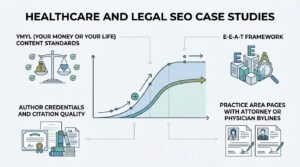
Healthcare and legal SEO case studies must account for YMYL (Your Money or Your Life) content standards, meaning author credentials and citation quality carry more ranking weight than in other verticals. Google applies additional scrutiny here through its E-E-A-T framework.
Google’s Search Quality Rater Guidelines explicitly call out medical and legal content as requiring demonstrated expertise, which is why case studies in these industries often show slower initial movement but higher long-term stability once authority signals are established.
Practice area pages with attorney or physician bylines consistently outperform anonymous or agency-authored pages in these campaigns.
Real Estate and Home Services SEO Case Study Results
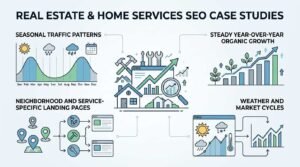
Real estate and home services SEO case studies typically show seasonal traffic patterns layered on top of steady year-over-year organic growth, driven by neighborhood and service-specific landing pages. Search demand in these categories fluctuates with weather and market cycles, which case studies need to account for rather than hide.
A campaign showing flat traffic in December and a spike in March isn’t underperforming; that’s often just how home services search behaves.
Realistic SEO Timelines Behind These Case Studies
SEO case studies across industries most commonly show meaningful ranking movement between four and six months, with compounding growth continuing through month twelve and beyond. Anyone promising page-one rankings in 30 days is either describing a low-competition niche or not describing SEO.
Month-by-Month Progress Patterns
Months one and two are dominated by technical audits and foundational fixes, which rarely produce visible traffic change. Months three through six typically show the first ranking movement for lower-competition terms.
By months six through twelve, compounding content and authority gains start affecting higher-value, more competitive keywords. This is where most of the dramatic before-and-after numbers in case studies actually come from.
Technical SEO Fixes That Preceded Ranking Growth
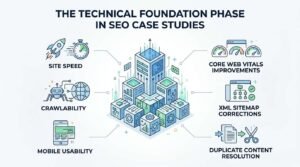
Nearly every documented SEO case study I’ve reviewed includes a technical foundation phase covering site speed, crawlability, and mobile usability before content or link work begins. Skipping this step is the single most common reason campaigns underperform their projected timeline.
Core Web Vitals improvements, XML sitemap corrections, and duplicate content resolution show up as prerequisite work in the vast majority of the strongest case studies, regardless of industry.
Content Strategy Patterns Across Successful Case Studies
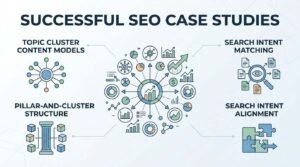
Successful SEO case studies consistently pair topic cluster content models with search intent matching, rather than publishing isolated blog posts around scattered keywords. Content built around a pillar-and-cluster structure shows up disproportionately in the highest-performing campaigns.
Search intent alignment, meaning matching content format to what searchers actually want to find, separates case studies with strong conversion numbers from those with traffic gains but flat business results.
Link Building’s Role in the Reported Results
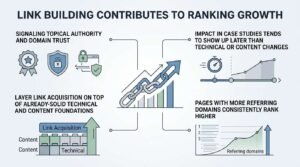
Link building contributes to ranking growth primarily by signaling topical authority and domain trust, and its impact in case studies tends to show up later than technical or content changes. Campaigns that layer link acquisition on top of already-solid technical and content foundations see the clearest attribution.
Ahrefs’ study of two million search queries found that pages with more referring domains consistently rank higher, reinforcing why link-focused phases appear in nearly every long-term case study reviewed here.
How White Label SEO Delivery Impacts These Outcomes
White label SEO delivery affects reported outcomes mainly through the reporting transparency and communication structure between the agency, the reseller, and the end client. When an extra layer sits between strategist and client, reporting clarity becomes the deciding factor in whether results actually get understood and trusted.
Agency-to-Client Reporting Transparency
Dashboards that pull live data directly from Google Search Console and Google Analytics, rather than manually compiled summaries, produce case studies that hold up better under scrutiny. Manual reporting introduces both delay and room for selective framing.
How to Evaluate an SEO Case Study Before Trusting It
An SEO case study should be evaluated on whether it names a specific baseline, timeframe, and traceable metric, rather than relying on vague percentage claims or unnamed clients. If any of those three elements are missing, the case study can’t really be verified.
Red Flags in Reported SEO Results
Unnamed clients, missing timeframes, and metrics reported only as percentages without baseline numbers are the three most common signs of a case study built for marketing rather than accuracy. Screenshots without visible date ranges or account names fall into the same category.
Realistic ROI Expectations Based on Aggregate Case Study Data
Businesses investing in SEO most commonly report positive ROI between six and twelve months, with return multiples varying heavily by industry competitiveness and average customer value. A local service business with a $3,000 average job value reaches ROI faster than an e-commerce store selling $25 items, even with identical traffic growth.
A 2024 industry survey by Databox found that most marketers expect measurable SEO ROI within seven to twelve months, aligning closely with the timelines reflected across the case studies covered here.
Conclusion
Real SEO case studies connect technical fixes, content strategy, and link building to measurable traffic, rankings, and revenue across every industry examined here. Timelines and outcomes vary by vertical, but the underlying patterns of verified data stay consistent.
We built White Label SEO Service to deliver exactly this kind of transparent, trackable performance. Partner with White Label SEO Service to get organic results you can actually verify.
Frequently Asked Questions
What is a white label SEO case study?
A white label SEO case study is a documented record of an outsourced SEO campaign’s results, including baseline metrics, actions taken, and measured outcomes. It’s used to demonstrate real performance rather than theoretical claims.
How long does it take to see SEO results?
Most SEO campaigns show initial ranking movement within four to six months, with significant compounding growth by month twelve. Technical fixes come first and rarely produce visible traffic change on their own.
What metrics prove SEO is working?
Organic session growth, non-branded keyword rankings, and conversion or lead data prove SEO is working. Backlink growth and crawl health serve as supporting technical indicators.
Can SEO results be trusted across different industries?
Results patterns hold directionally across industries, but timelines and ROI vary based on competition and average customer value. E-commerce, local, and B2B campaigns each follow distinct measurement patterns.
What ROI should I expect from SEO investment?
Most businesses report measurable ROI between six and twelve months, with return size depending on industry and customer value. Higher-ticket services typically reach positive ROI faster than low-margin e-commerce.
How do agencies verify reported SEO case study data?
Agencies verify data through direct access to Google Search Console, Google Analytics, and CRM conversion records tied to the client’s own accounts. Live dashboard access is more reliable than manually compiled reports.
What’s the difference between white label SEO and in-house SEO results?
White label SEO results depend heavily on reporting transparency between the fulfillment agency, reseller, and client. In-house SEO removes that extra communication layer but often lacks the specialized tooling and cross-industry pattern recognition agencies bring.