
Bottom-of-funnel SaaS keywords target buyers ready to purchase, delivering conversion rates 3-5x higher than awareness-stage terms. These high-intent search queries represent prospects comparing solutions, evaluating pricing, and seeking demos. They’re the shortest path from organic traffic to revenue.
For SaaS companies competing in crowded markets, BOFU keywords offer a direct line to qualified leads actively searching for solutions like yours. The challenge? Most teams either ignore these terms or target them incorrectly.
This guide covers everything you need to identify, prioritize, and create content for bottom-of-funnel SaaS keywords. You’ll learn the specific keyword types that drive conversions, research methods that uncover hidden opportunities, and content frameworks that turn searchers into customers.
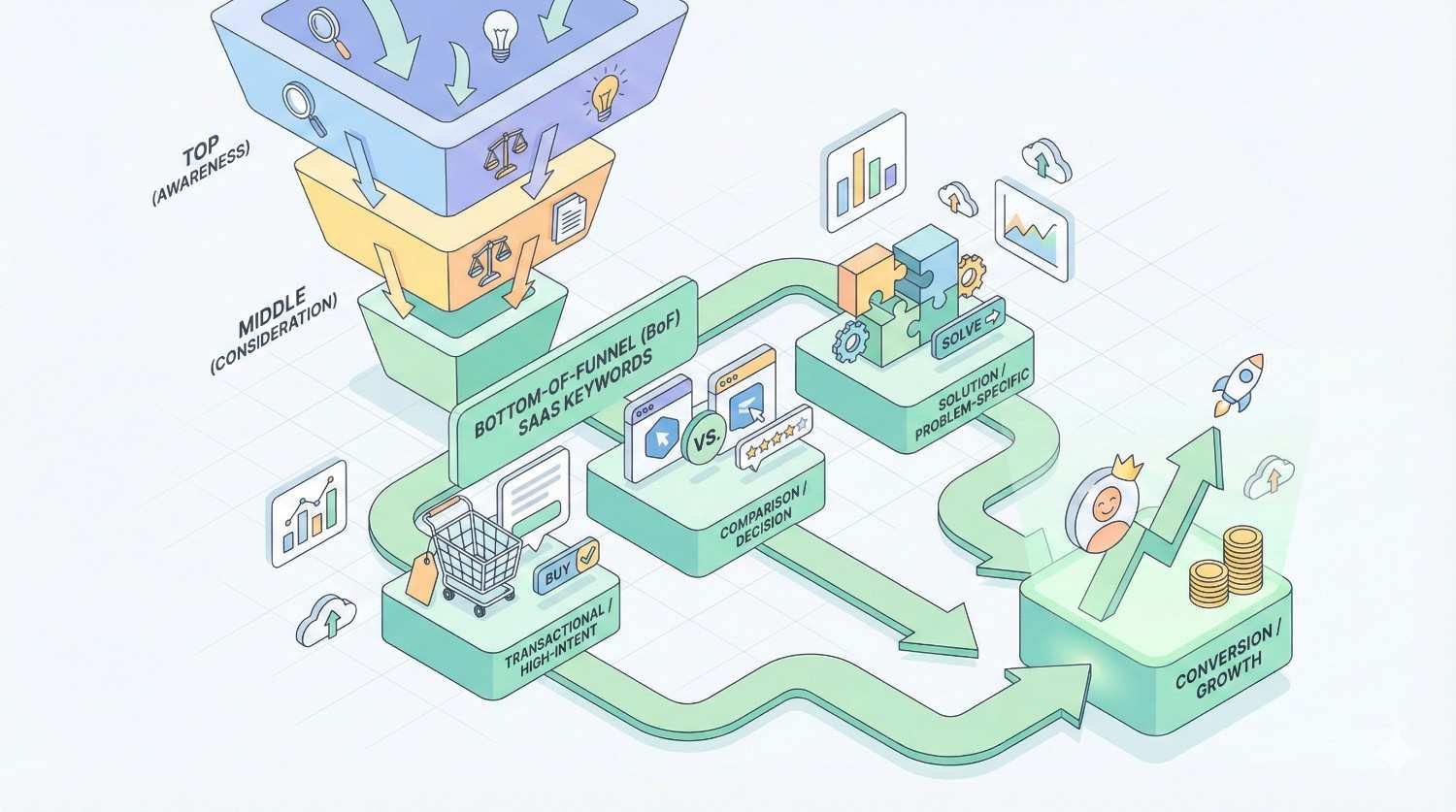
What Are Bottom-of-Funnel SaaS Keywords?
Definition and Core Characteristics
Bottom-of-funnel keywords are search terms used by prospects in the final stage of their buying journey. These searchers have already identified their problem, researched potential solutions, and narrowed their options. Now they’re looking for specific information to make a purchase decision.
BOFU keywords share distinct characteristics that separate them from earlier-stage terms. They typically include brand names, product comparisons, pricing inquiries, or explicit purchase intent signals. The search volume is usually lower than broader terms, but the conversion potential is significantly higher.
Think of someone searching “best CRM software” versus “HubSpot vs Salesforce pricing.” The first query indicates research mode. The second signals someone comparing specific options before buying. That intent difference translates directly to conversion rates and revenue impact.
How BOFU Keywords Differ from TOFU and MOFU Keywords
The marketing funnel divides buyer intent into three stages, each with distinct keyword patterns.
Top-of-funnel (TOFU) keywords target awareness. Searchers are exploring problems or learning about topics. Examples include “what is project management software” or “how to improve team collaboration.” These terms drive traffic but rarely immediate conversions.
Middle-of-funnel (MOFU) keywords capture consideration. Prospects are evaluating solution categories and comparing approaches. Searches like “best project management tools for remote teams” or “Asana features list” fall here. Intent is stronger, but buyers aren’t ready to commit.
Bottom-of-funnel (BOFU) keywords signal decision readiness. Searchers want pricing, demos, trials, or direct comparisons between finalists. “Asana vs Monday pricing,” “Asana free trial,” and “buy Asana business plan” represent BOFU intent.
The practical difference? TOFU content builds audience. MOFU content nurtures interest. BOFU content captures revenue. Most SaaS companies over-invest in TOFU while leaving BOFU opportunities to competitors or paid search.
The Role of BOFU Keywords in the SaaS Buyer Journey
SaaS purchases follow a predictable pattern. Buyers recognize a problem, research solutions, evaluate options, and make a decision. BOFU keywords intercept prospects at the critical moment between evaluation and purchase.
At this stage, buyers have specific questions. How much does it cost? How does it compare to alternatives? Can I try it first? What do existing customers say? Each question represents a keyword opportunity.
The buyer journey isn’t always linear. Prospects may revisit earlier stages or jump directly to BOFU searches based on recommendations or urgency. A startup founder who just lost a key employee to poor project management might skip straight to “Monday.com pricing” without extensive research.
Understanding this journey helps you create content that meets buyers wherever they enter. BOFU keywords capture those ready to convert while supporting prospects who need additional information before committing.
Why Bottom-of-Funnel Keywords Matter for SaaS Growth
Higher Conversion Rates and Purchase Intent
BOFU keywords convert at dramatically higher rates than awareness-stage terms. While a blog post targeting “what is CRM” might convert at 0.5-1%, a well-optimized pricing page can convert at 5-15% or higher.
This difference stems from intent alignment. Someone searching “Salesforce pricing plans” has already decided CRM software solves their problem. They’ve likely evaluated alternatives. Now they need specific information to finalize their choice.
The math becomes compelling at scale. Ranking for a BOFU keyword with 500 monthly searches and a 10% conversion rate delivers 50 leads monthly. A TOFU keyword with 5,000 searches and 0.5% conversion delivers 25 leads. Lower volume, higher value.
Intent signals in BOFU searches also indicate lead quality. These prospects understand their needs, have budget conversations internally, and are prepared to move quickly. Sales teams consistently report that BOFU-sourced leads close faster and churn less.
Lower Customer Acquisition Cost (CAC)
Organic traffic from BOFU keywords reduces customer acquisition costs compared to paid alternatives. Once you rank, the traffic flows without per-click costs.
Consider the economics. Bidding on “project management software pricing” might cost $15-30 per click in competitive markets. A page ranking organically for that term captures the same traffic at zero marginal cost. Over months and years, the CAC difference compounds significantly.
BOFU SEO also reduces dependency on paid channels. Many SaaS companies find themselves trapped in escalating PPC costs as competition increases. Organic BOFU rankings provide a hedge against rising ad prices and platform changes.
The investment shifts from ongoing ad spend to upfront content creation and optimization. A well-built comparison page might cost $2,000-5,000 to create but generate leads for years with minimal maintenance.
Shorter Sales Cycles and Revenue Impact
Leads from BOFU keywords enter the sales process further along. They’ve completed their own research. They understand the product category. They’re comparing specific options rather than exploring possibilities.
This head start shortens sales cycles measurably. Instead of educating prospects on why they need your solution category, sales teams can focus on differentiation and closing. Conversations start at “why us” rather than “why this.”
Revenue impact follows directly. Faster closes mean more deals per sales rep. Higher-quality leads mean better close rates. Combined with lower acquisition costs, BOFU keywords improve unit economics across the customer lifecycle.
For SaaS companies tracking metrics like months to close or touches per deal, BOFU-sourced leads consistently outperform other channels. The efficiency gains compound as you scale.
Competitive Advantage in Saturated Markets
Most SaaS markets are crowded. Dozens of competitors target the same awareness-stage keywords, creating content saturation that makes ranking increasingly difficult.
BOFU keywords offer a different competitive landscape. Many companies neglect these terms, focusing content efforts on high-volume TOFU topics. Others assume BOFU searches belong exclusively to paid campaigns.
This creates opportunity. A comprehensive comparison page, well-optimized pricing content, or targeted integration pages can capture traffic competitors ignore. The competition exists, but it’s often less intense than for broader terms.
Strategic BOFU content also positions your brand at the decision moment. Even if prospects discovered competitors first, appearing in their final research phase keeps you in consideration. You’re present when it matters most.
Types of Bottom-of-Funnel SaaS Keywords
Branded Keywords and Competitor Comparisons
Branded BOFU keywords include your company name combined with purchase-intent modifiers. These searches indicate prospects who know your product and want specific decision-making information.
[Brand] vs [Competitor] Keywords
Comparison keywords represent prospects actively evaluating alternatives. “Slack vs Microsoft Teams,” “Notion vs Coda,” and “Stripe vs PayPal” capture buyers weighing specific options.
These searches signal late-stage evaluation. The prospect has narrowed choices and needs help deciding. Creating comparison content for these terms lets you control the narrative rather than leaving it to third-party review sites.
Effective comparison pages address both products honestly. Acknowledge competitor strengths while highlighting your differentiation. Buyers researching comparisons want balanced information, not obvious sales pitches.
[Brand] Alternative Keywords
Alternative keywords target prospects considering competitors. “Salesforce alternatives” or “Mailchimp alternatives” capture buyers who know the market leader but want options.
These terms offer acquisition opportunities. Someone searching for alternatives may be dissatisfied with a competitor, priced out, or simply exploring. Your content can position your product as the solution to their specific concerns.
Alternative pages work best when they address why someone might seek alternatives. Price concerns? Feature gaps? Complexity issues? Understanding the motivation helps you position effectively.
[Brand] Review Keywords
Review searches indicate prospects seeking validation before purchase. “HubSpot reviews,” “Zendesk customer reviews,” and “Intercom ratings” capture buyers wanting social proof.
Creating review-focused content or optimizing pages that aggregate customer feedback captures this intent. Testimonials, case studies, and third-party review aggregation all serve review searchers.
These keywords also present reputation management opportunities. Ranking your own content for “[Your Brand] reviews” ensures prospects see your best customer stories rather than random forum complaints.
Pricing and Cost-Related Keywords
Pricing keywords signal serious purchase consideration. Prospects asking about cost have moved beyond feature evaluation into budget discussions.
[Product] Pricing Keywords
Direct pricing searches like “Asana pricing,” “Zoom plans and pricing,” or “Shopify monthly cost” indicate buyers ready to evaluate affordability.
These searches deserve dedicated, optimized pricing pages. Many SaaS companies hide pricing or make it difficult to find, frustrating prospects and pushing them toward competitors with transparent pricing.
Pricing pages that rank well include clear plan breakdowns, feature comparisons between tiers, and answers to common pricing questions. They convert because they give buyers exactly what they’re searching for.
[Product] Cost Keywords
Cost-related variations capture slightly different intent. “How much does Salesforce cost,” “HubSpot cost per user,” or “total cost of Slack” indicate prospects calculating budget impact.
These searches often seek more than list prices. Prospects want to understand implementation costs, per-user scaling, add-on expenses, and total cost of ownership. Content addressing these concerns captures cost-focused searchers.
Creating content that honestly addresses cost considerations builds trust. Hiding fees or downplaying expenses damages credibility when prospects discover the full picture later.
[Product] Free Trial Keywords
Trial searches indicate prospects ready to experience your product. “Notion free trial,” “Monday.com trial,” or “try Ahrefs free” capture buyers wanting hands-on evaluation.
These keywords deserve dedicated landing pages optimized for trial signup conversion. The searcher has already decided to try your product. Remove friction and get them into the experience quickly.
Trial pages should emphasize what’s included, how long the trial lasts, and what happens after. Address concerns about credit card requirements or automatic billing upfront.
Feature-Specific and Use Case Keywords
Feature and use case keywords capture prospects with specific requirements. They’ve identified needs and want to confirm your product addresses them.
[Product] for [Specific Use Case]
Use case keywords like “Trello for marketing teams,” “Slack for remote work,” or “QuickBooks for freelancers” indicate prospects with defined applications.
These searches present segmentation opportunities. Creating dedicated pages for specific use cases lets you speak directly to prospect needs rather than offering generic product information.
Use case pages convert well because they demonstrate understanding. A marketing team evaluating project management tools wants to see how the product serves marketing workflows specifically, not generic project management features.
[Product] [Feature] Keywords
Feature-specific searches like “Asana Gantt charts,” “HubSpot email automation,” or “Zoom breakout rooms” indicate prospects confirming capability.
These keywords often represent deal-breakers. The prospect needs a specific feature and wants confirmation before proceeding. Ranking for feature keywords captures these validation searches.
Feature pages should demonstrate capability clearly. Screenshots, videos, and specific use examples prove the feature exists and works as expected.
Integration and Compatibility Keywords
Integration keywords capture prospects evaluating ecosystem fit. SaaS buyers increasingly prioritize tools that work with their existing stack.
[Product] + [Integration] Keywords
Integration searches like “Slack Salesforce integration,” “Zapier Monday.com,” or “HubSpot WordPress plugin” indicate prospects confirming compatibility.
These keywords represent qualification searches. The prospect wants your product but needs to verify it works with tools they already use. Failing to rank for integration keywords means losing qualified prospects to competitors.
Integration pages should detail setup processes, available features, and limitations. Prospects want to understand what’s possible before committing.
Demo, Trial, and Purchase Intent Keywords
Explicit purchase intent keywords signal the final decision stage. These searchers are ready to act.
[Product] Demo Keywords
Demo searches like “Salesforce demo,” “request HubSpot demo,” or “Marketo product demo” indicate prospects ready for sales engagement.
Demo request pages should minimize friction while qualifying leads appropriately. Balance the need for contact information against the risk of abandonment from lengthy forms.
These pages benefit from social proof, clear expectations about the demo process, and immediate confirmation of next steps.
[Product] Sign Up Keywords
Signup keywords like “create Slack account,” “sign up for Notion,” or “register for Zoom” indicate immediate action intent.
These searches deserve streamlined signup experiences. The prospect has decided. Don’t introduce obstacles between their intent and your conversion.
Signup pages should load quickly, work flawlessly on mobile, and minimize required fields. Every additional step costs conversions.
Buy [Product] Keywords
Direct purchase keywords like “buy Shopify plan,” “purchase Semrush subscription,” or “order HubSpot” indicate transaction readiness.
These high-intent keywords deserve dedicated purchase flows. Ensure your checkout process is optimized, secure, and trustworthy.
Purchase pages benefit from trust signals, security badges, and clear refund policies. Reduce anxiety at the moment of transaction.
How to Find Bottom-of-Funnel SaaS Keywords
Keyword Research Tools and Methods
Systematic keyword research uncovers BOFU opportunities you might otherwise miss. Multiple tools and approaches reveal different keyword types.
Using SEMrush, Ahrefs, and Google Keyword Planner
Professional keyword tools provide the foundation for BOFU research. Each platform offers unique capabilities for identifying high-intent terms.
Ahrefs excels at competitor keyword analysis. Enter competitor domains to see which BOFU terms drive their traffic. Filter by keywords containing “pricing,” “vs,” “alternative,” “review,” or “demo” to isolate purchase-intent terms.
SEMrush offers keyword intent classification, automatically categorizing terms as informational, navigational, commercial, or transactional. Filter for commercial and transactional intent to surface BOFU opportunities.
Google Keyword Planner reveals search volume and competition data directly from Google. While designed for ads, the data informs organic strategy. High commercial intent keywords often show elevated CPC, indicating value.
Combine tools for comprehensive coverage. Each platform indexes slightly different keyword variations. Using multiple sources ensures you don’t miss opportunities.
Analyzing Competitor BOFU Keyword Strategies
Competitor analysis reveals proven BOFU opportunities. If competitors rank for specific terms, those keywords likely drive value.
Start by identifying your top 5-10 organic competitors. These may differ from your direct business competitors. Use Ahrefs or SEMrush to find sites ranking for your target keywords.
Analyze their site structure for BOFU content patterns. Do they have comparison pages? Pricing pages optimized for search? Integration directories? Alternative pages targeting competitor brands?
Export competitor keyword rankings and filter for BOFU intent signals. Look for patterns in their successful terms. These patterns reveal keyword templates you can adapt for your brand.
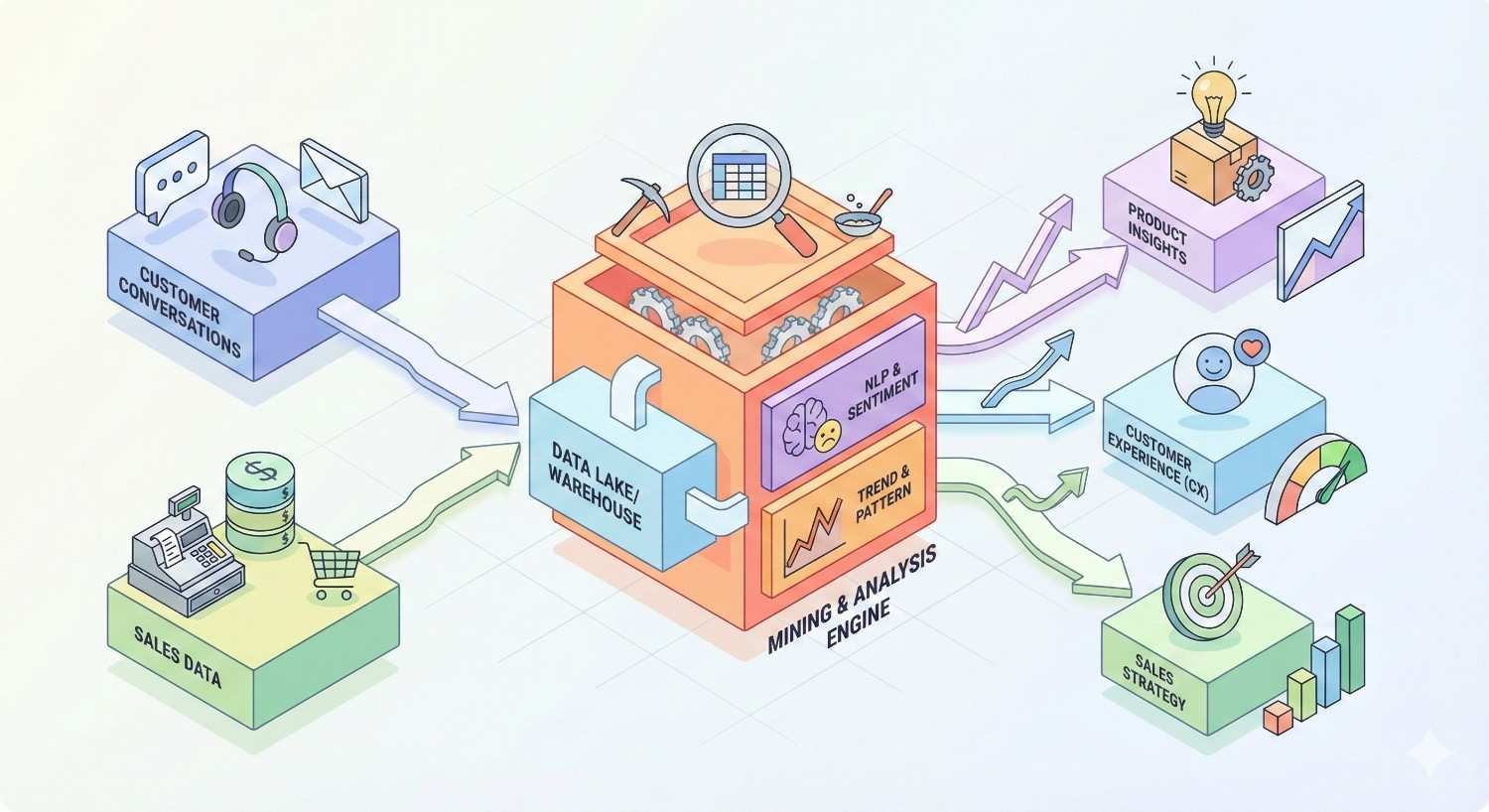
Mining Customer Conversations and Sales Data
Your existing customers and prospects reveal BOFU keywords that tools might miss. Real conversations surface the exact language buyers use.
CRM and Sales Call Analysis
Sales conversations contain keyword gold. Prospects describe their needs, ask questions, and reveal decision criteria in their own words.
Review CRM notes for patterns in prospect questions. What do they ask before converting? What concerns do they raise? What comparisons do they mention?
If you record sales calls, analyze transcripts for recurring phrases. Tools like Gong or Chorus can identify common questions and objections at scale.
These insights reveal keywords that match actual buyer language rather than assumed search behavior. The phrases prospects use in conversations often match their search queries.
Support Ticket and Chat Log Mining
Support interactions reveal post-purchase questions that often mirror pre-purchase searches. Prospects and customers ask similar questions at different stages.
Analyze support tickets for feature questions, integration inquiries, and comparison requests. These topics indicate information gaps that BOFU content could address.
Chat logs from sales or support reveal real-time buyer language. Look for questions that appear repeatedly. Frequent questions indicate search demand.
SERP Analysis for Purchase Intent Signals
Search results themselves reveal intent signals. Google’s displayed features indicate how the algorithm interprets query intent.
Identifying Transactional SERP Features
Transactional SERPs look different from informational ones. Recognizing these patterns helps identify BOFU opportunities.
Shopping results indicate commercial intent. If Google shows product listings, the query has purchase intent.
Ad-heavy SERPs signal commercial value. Multiple ads suggest advertisers find the keyword profitable, indicating conversion potential.
Local packs for SaaS-related terms might indicate service-based intent. “CRM implementation services” might show local results.
Featured snippets with pricing tables, comparison charts, or “best” lists indicate commercial investigation intent.
Analyze the top organic results. If ranking pages are pricing pages, comparison articles, or product pages, the keyword has BOFU intent. If results are educational blog posts, the intent is likely earlier-stage.
Analyzing Competitor Landing Pages
Top-ranking pages reveal what Google considers relevant for specific queries. Analyzing these pages informs your content strategy.
For target BOFU keywords, examine the top 5 organic results. What page types rank? What content do they include? How are they structured?
Note common elements across ranking pages. If every top result includes a comparison table, your page probably needs one too. If all include pricing information, omitting it puts you at a disadvantage.
Identify gaps in competitor content. What questions do they leave unanswered? What information is missing? These gaps represent differentiation opportunities.
Using Google Search Console for BOFU Opportunities
Google Search Console reveals keywords you already rank for, including BOFU terms you might not have targeted intentionally.
Filter Search Console data for queries containing BOFU signals: “pricing,” “cost,” “vs,” “alternative,” “review,” “demo,” “trial,” “buy.”
Look for queries where you rank on page 2 or positions 8-20. These represent quick-win opportunities. You’re already visible. Optimization could push you into higher-converting positions.
Identify queries with high impressions but low clicks. These might indicate content that ranks but doesn’t match intent well. Improving content alignment could capture more traffic.
Search Console also reveals queries you rank for unintentionally. A blog post might rank for comparison keywords it barely addresses. Creating dedicated comparison content could capture that demand more effectively.
How to Create Content for Bottom-of-Funnel SaaS Keywords
Landing Page Optimization Strategies
BOFU landing pages serve different purposes than blog content. They must inform and convert simultaneously.
Conversion-Focused Page Structure
Effective BOFU pages follow proven structural patterns. The layout should guide visitors toward conversion while providing necessary information.
Above the fold: Clear value proposition, primary CTA, and key differentiator. Visitors should understand what you offer and what action to take within seconds.
Social proof section: Logos, testimonials, or metrics that build credibility. Place this early to establish trust before detailed content.
Feature/benefit breakdown: Address the specific needs that brought visitors to this page. For pricing pages, detail what each tier includes. For comparison pages, highlight key differences.
Objection handling: Anticipate and address concerns. FAQ sections, guarantee information, and security details reduce friction.
Multiple CTAs: Include conversion opportunities throughout the page. Don’t make visitors scroll back to the top to take action.
Supporting content: Case studies, detailed specifications, or additional resources for visitors who need more information before converting.
Trust Signals and Social Proof Placement
Trust elements reduce conversion anxiety. Strategic placement maximizes their impact.
Customer logos work best near the top of the page. Recognizable brands signal credibility immediately.
Testimonials should appear near decision points. Place them adjacent to CTAs or pricing information where visitors might hesitate.
Metrics and results quantify value. “10,000+ companies trust us” or “Average 40% productivity increase” provide concrete proof.
Security badges matter for pages involving transactions or data. SSL certificates, compliance certifications, and payment security logos reduce anxiety.
Review aggregations from G2, Capterra, or TrustRadius provide third-party validation. Embedding ratings or linking to review profiles adds credibility.
Comparison and Alternative Pages
Comparison content captures prospects evaluating specific options. These pages require careful positioning and honest assessment.
Structuring Effective Comparison Content
Comparison pages should help buyers make informed decisions, not just promote your product.
Start with context: Explain what both products do and who they serve. Establish that you understand both options.
Use comparison tables: Visual side-by-side comparisons help buyers evaluate quickly. Include pricing, key features, integrations, and support options.
Address specific use cases: Different buyers have different priorities. Show which product fits which situation better.
Include honest assessments: Acknowledge competitor strengths. Buyers researching comparisons will find this information elsewhere. Being honest builds trust.
Provide a clear recommendation: After presenting information, offer guidance. “Choose [Competitor] if you need X. Choose us if you need Y.”
Honest Positioning Against Competitors
Credibility requires honesty. Comparison pages that only praise your product and criticize competitors damage trust.
Acknowledge where competitors excel. If they have better pricing, more integrations, or longer track records, say so. Then explain why your strengths matter more for specific buyers.
Focus on differentiation rather than criticism. What makes you different? What do you do that competitors don’t? These points matter more than competitor weaknesses.
Update comparison content regularly. Competitors change. Outdated information damages credibility and may violate guidelines if claims are no longer accurate.
Pricing Pages That Rank and Convert
Pricing pages serve dual purposes: ranking for pricing keywords and converting visitors into customers or leads.
SEO-Optimized Pricing Page Elements
Many pricing pages fail to rank because they lack sufficient content for search engines to understand and index.
Include descriptive text: Don’t rely solely on pricing tables. Add paragraphs explaining your pricing philosophy, what’s included, and how to choose the right plan.
Answer pricing questions: Address common concerns directly on the page. “Is there a free trial?” “Can I change plans later?” “What payment methods do you accept?”
Add schema markup: Pricing schema helps search engines understand your pricing structure. Product schema with price information can enhance SERP appearance.
Optimize for variations: Include natural mentions of pricing-related terms. “Cost,” “plans,” “subscription,” “monthly,” “annual,” and “per user” variations capture different search patterns.
Addressing Pricing Objections
Pricing pages should anticipate and address objections before they prevent conversion.
Value justification: Explain what buyers get for their investment. ROI calculators, cost comparison tools, or value breakdowns help justify pricing.
Flexibility options: Highlight monthly vs. annual options, startup discounts, or nonprofit pricing. Flexibility reduces “too expensive” objections.
Risk reduction: Free trials, money-back guarantees, or no-contract options reduce commitment anxiety.
Comparison context: Show how your pricing compares to alternatives or to the cost of not solving the problem.
Case Studies and ROI-Focused Content
Case studies provide proof that your product delivers results. They serve BOFU searchers looking for validation.
Data-Driven Case Study Structure
Effective case studies follow a proven format that demonstrates measurable impact.
Challenge: Describe the customer’s situation before your product. What problems did they face? What were they trying to achieve?
Solution: Explain how they implemented your product. What features did they use? How did the process work?
Results: Quantify the impact. Specific numbers matter. “Reduced response time by 40%” beats “improved efficiency.”
Quote: Include customer testimonials that reinforce the narrative. Direct quotes add authenticity.
Context: Provide company details that help prospects identify with the customer. Industry, size, and use case help readers see themselves in the story.
Industry-Specific Success Stories
Segmented case studies capture industry-specific BOFU searches.
Create case studies for each major industry you serve. A marketing agency evaluating your product wants to see marketing agency results, not manufacturing examples.
Optimize case study pages for industry keywords. “CRM for real estate agents case study” or “project management software healthcare results” capture segmented searches.
Organize case studies by industry, use case, or company size. Make it easy for prospects to find relevant examples.
Product Demo and Free Trial Pages
Demo and trial pages capture the highest-intent BOFU traffic. Optimization here directly impacts conversion rates.
Demo Page SEO Best Practices
Demo pages often lack content, making them difficult to rank. Adding relevant content improves visibility without hurting conversion.
Explain what the demo includes: Describe what prospects will see and learn. This content helps pages rank while setting expectations.
Address common questions: What’s the time commitment? Who should attend? What should they prepare? Answering these questions adds content and reduces friction.
Include social proof: Testimonials from demo attendees or statistics about demo-to-customer conversion rates build confidence.
Optimize for demo variations: “Product demo,” “live demo,” “demo request,” “schedule demo,” and “watch demo” capture different search patterns.
Trial Signup Conversion Optimization
Trial pages should minimize friction while capturing necessary information.
Reduce form fields: Every additional field reduces conversion. Ask only for essential information. You can gather more data during onboarding.
Clarify trial terms: How long is the trial? What’s included? Is a credit card required? What happens when it ends? Ambiguity creates hesitation.
Provide immediate access: Instant trial access converts better than “we’ll contact you” approaches. If possible, let users start immediately after signup.
Set success expectations: Tell new users what to do first. A clear path to value increases trial-to-paid conversion.
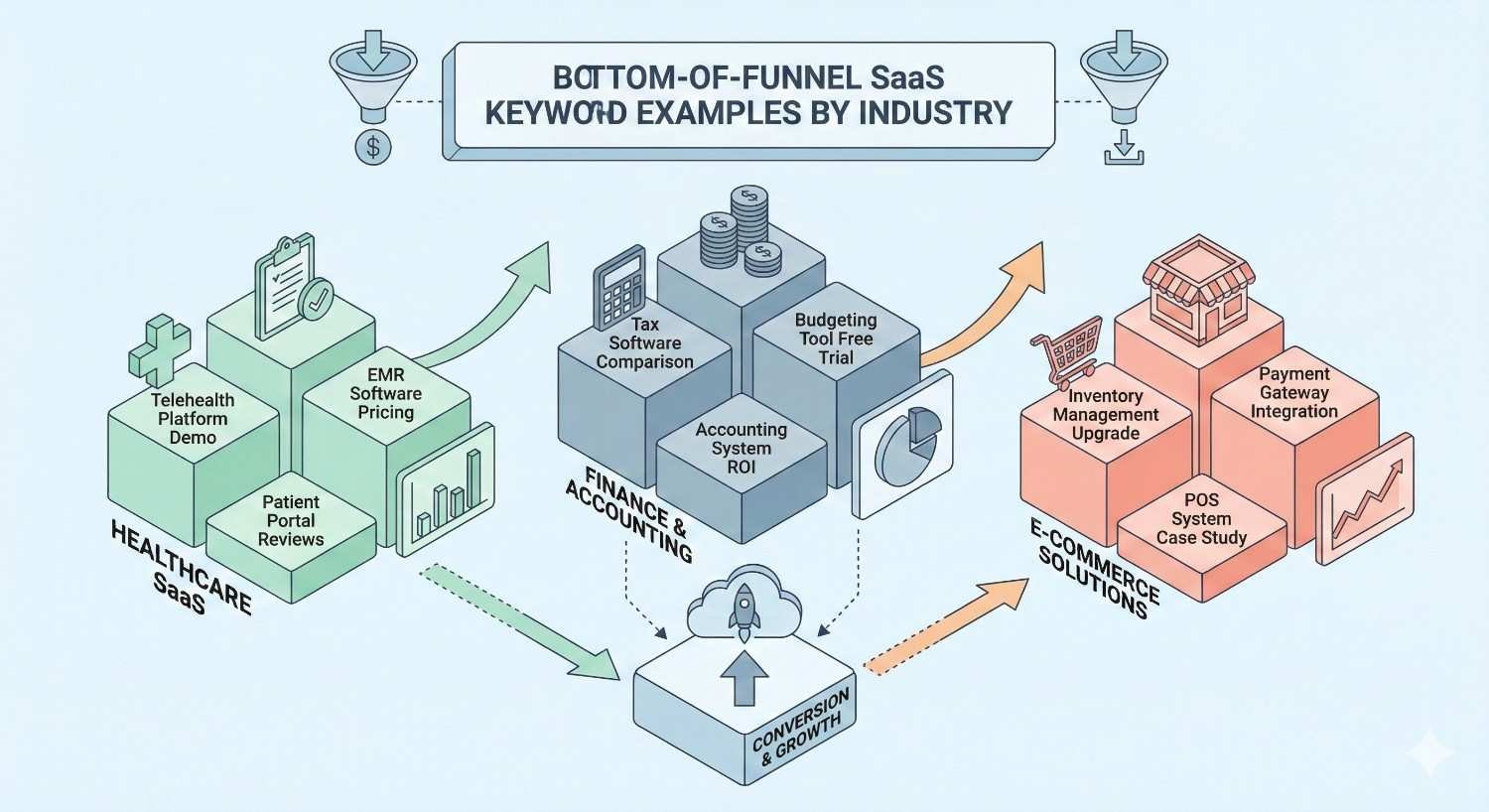
Bottom-of-Funnel SaaS Keyword Examples by Industry
B2B SaaS BOFU Keyword Examples
B2B SaaS keywords often include company size modifiers, industry specifications, and enterprise-focused terms.
Comparison keywords: “Salesforce vs HubSpot for small business,” “enterprise project management software comparison,” “best B2B marketing automation platforms”
Pricing keywords: “Slack enterprise pricing,” “Microsoft 365 business plans cost,” “Zoom business account pricing”
Integration keywords: “Salesforce SAP integration,” “HubSpot Marketo connector,” “Slack Microsoft Teams bridge”
Use case keywords: “CRM for B2B sales teams,” “project management for consulting firms,” “invoicing software for agencies”
Marketing Software BOFU Keyword Examples
Marketing software keywords often reference specific channels, campaign types, or marketing functions.
Comparison keywords: “Mailchimp vs Klaviyo for ecommerce,” “SEMrush vs Ahrefs pricing,” “HubSpot vs Marketo features”
Pricing keywords: “Hootsuite pricing plans,” “Sprout Social cost per month,” “Canva Pro annual subscription”
Feature keywords: “Mailchimp automation workflows,” “HubSpot landing page builder,” “SEMrush keyword tracking”
Alternative keywords: “Mailchimp alternatives for small business,” “cheaper Hootsuite alternatives,” “HubSpot competitors”
Project Management Tools BOFU Keyword Examples
Project management keywords often include team size, methodology, or specific workflow references.
Comparison keywords: “Asana vs Monday vs Trello,” “Jira vs Azure DevOps,” “Basecamp vs Teamwork”
Pricing keywords: “Monday.com pricing per user,” “Asana premium cost,” “ClickUp free vs paid”
Use case keywords: “project management for marketing teams,” “Agile project management software,” “Kanban board tools for remote teams”
Feature keywords: “Asana timeline view,” “Monday.com Gantt charts,” “Trello power-ups”
CRM Software BOFU Keyword Examples
CRM keywords frequently include industry verticals, company sizes, and specific sales process references.
Comparison keywords: “Salesforce vs HubSpot CRM,” “Pipedrive vs Zoho CRM,” “best CRM for real estate agents”
Pricing keywords: “HubSpot CRM pricing tiers,” “Salesforce small business cost,” “Zoho CRM free plan limitations”
Integration keywords: “Salesforce Gmail integration,” “HubSpot Outlook sync,” “CRM Slack integration”
Feature keywords: “Salesforce reporting features,” “HubSpot email tracking,” “Pipedrive sales pipeline”
Accounting and Finance SaaS BOFU Keyword Examples
Finance software keywords often include compliance requirements, business types, and specific accounting functions.
Comparison keywords: “QuickBooks vs Xero,” “FreshBooks vs Wave,” “best accounting software for freelancers”
Pricing keywords: “QuickBooks Online pricing,” “Xero monthly cost,” “FreshBooks plans comparison”
Feature keywords: “QuickBooks payroll features,” “Xero bank reconciliation,” “FreshBooks invoicing templates”
Use case keywords: “accounting software for contractors,” “bookkeeping software for Amazon sellers,” “invoicing for consultants”
Measuring BOFU Keyword Performance
Key Metrics for Bottom-of-Funnel SEO Success
BOFU keyword performance requires different metrics than awareness content. Traffic matters less than conversion and revenue impact.
Conversion Rate by Keyword
Track conversion rates at the keyword level to understand which terms drive action.
Set up goal tracking in Google Analytics 4 for key conversion actions: demo requests, trial signups, purchases, or contact form submissions.
Use Search Console data combined with Analytics to attribute conversions to specific keywords. While not perfect due to “(not provided)” limitations, landing page analysis provides useful approximations.
Compare conversion rates across BOFU keyword categories. Pricing keywords might convert differently than comparison keywords. Understanding these patterns informs content prioritization.
Revenue Attribution to Organic Search
Connect organic traffic to actual revenue to demonstrate SEO ROI.
Implement proper UTM tracking for organic landing pages. While organic traffic doesn’t use UTMs by default, you can track landing page entry points and subsequent conversions.
Integrate CRM data with analytics to follow leads from first touch through closed deal. This reveals which keywords generate not just leads but actual customers.
Calculate average deal value by keyword category. Some BOFU terms might generate more leads while others generate higher-value customers.
Cost Per Acquisition from SEO
Calculate the true cost of acquiring customers through organic BOFU content.
Include all costs: content creation, optimization, link building, tools, and team time. Divide by conversions attributed to BOFU content.
Compare SEO CPA to paid search CPA for the same keywords. This comparison justifies continued SEO investment and informs budget allocation.
Track CPA trends over time. Initial investment is high, but CPA should decrease as content matures and rankings stabilize.
Setting Up Proper Tracking and Attribution
Accurate measurement requires proper technical setup. Without correct tracking, you’re guessing at performance.
Google Analytics 4 Configuration
GA4 requires specific configuration to track BOFU performance effectively.
Set up conversions: Define key events as conversions. Demo requests, trial signups, and purchases should all be tracked as conversion events.
Enable enhanced measurement: Automatic tracking of scrolls, outbound clicks, and file downloads provides additional engagement data.
Create audiences: Build audiences based on BOFU page visitors. These audiences enable remarketing and deeper analysis.
Configure attribution: Understand GA4’s data-driven attribution model. Consider how it credits conversions across touchpoints.
CRM Integration for Lead Tracking
Connecting analytics to CRM data reveals the full customer journey.
Pass landing page and source data to your CRM when leads convert. This enables attribution analysis within your sales system.
Track lead status changes to understand which organic leads progress through your pipeline. Not all leads are equal. Some sources produce better-qualified prospects.
Calculate time-to-close by traffic source. BOFU organic leads often close faster than other sources, but data confirms this assumption.
Reporting and ROI Calculation
Regular reporting demonstrates value and identifies optimization opportunities.
Monthly metrics: Track rankings, traffic, and conversions for priority BOFU keywords. Note changes and investigate significant movements.
Quarterly analysis: Calculate ROI, compare to other channels, and identify trends. Quarterly timeframes smooth out monthly fluctuations.
Annual review: Assess overall BOFU strategy performance. Which keyword categories performed best? Where should you invest more?
Build dashboards that connect SEO metrics to business outcomes. Executives care about revenue impact, not ranking positions.
Common Mistakes When Targeting BOFU SaaS Keywords
Ignoring Search Intent Mismatches
Intent mismatches occur when content doesn’t match what searchers actually want. This kills conversion rates regardless of rankings.
A pricing page that ranks for “how much does [product] cost” but doesn’t clearly display pricing frustrates visitors. They wanted a number. You gave them a contact form.
Analyze SERP results for target keywords. If top results are comparison articles and you’re creating a product page, you’ve misread intent.
Test different content approaches for keywords where you rank but don’t convert. Intent assumptions might be wrong.
Over-Optimizing and Keyword Stuffing
BOFU pages sometimes suffer from aggressive optimization that damages user experience and trust.
Repeating “pricing” fifteen times on a pricing page doesn’t help rankings. It makes content awkward and signals manipulation to both users and search engines.
Write naturally first. Optimize second. If optimization makes content worse for users, you’ve gone too far.
Focus on comprehensive coverage rather than keyword density. Answering all relevant questions naturally incorporates semantic variations without forced repetition.
Neglecting Technical SEO on Conversion Pages
Technical issues on BOFU pages directly impact revenue. A slow pricing page loses customers.
Page speed: BOFU pages must load quickly. Every second of delay reduces conversions. Optimize images, minimize scripts, and use caching.
Mobile experience: Many BOFU searches happen on mobile. Ensure forms work, buttons are tappable, and content is readable on small screens.
Indexation: Verify BOFU pages are indexed and crawlable. Accidental noindex tags or robots.txt blocks can hide your most valuable content.
Structured data: Implement appropriate schema markup. Product, FAQ, and review schema can enhance SERP appearance for BOFU pages.
Failing to Update Comparison Content
Comparison pages require ongoing maintenance. Outdated information damages credibility and may create legal issues.
Competitors change pricing, add features, and update positioning. Your comparison content must reflect current reality.
Set calendar reminders to review comparison pages quarterly. Check competitor websites for changes and update your content accordingly.
Add “last updated” dates to comparison pages. This signals freshness to both users and search engines.
Not Aligning Content with Sales Team Insights
Sales teams hear objections and questions that never appear in keyword tools. Ignoring this intelligence leaves gaps in BOFU content.
Regular sales-marketing alignment ensures content addresses real buyer concerns. What questions do prospects ask before signing? What objections delay deals?
Create feedback loops where sales can flag content gaps. If prospects consistently ask questions your content doesn’t answer, that’s a content opportunity.
Use sales call recordings to identify exact language buyers use. This language often matches search queries better than marketing assumptions.
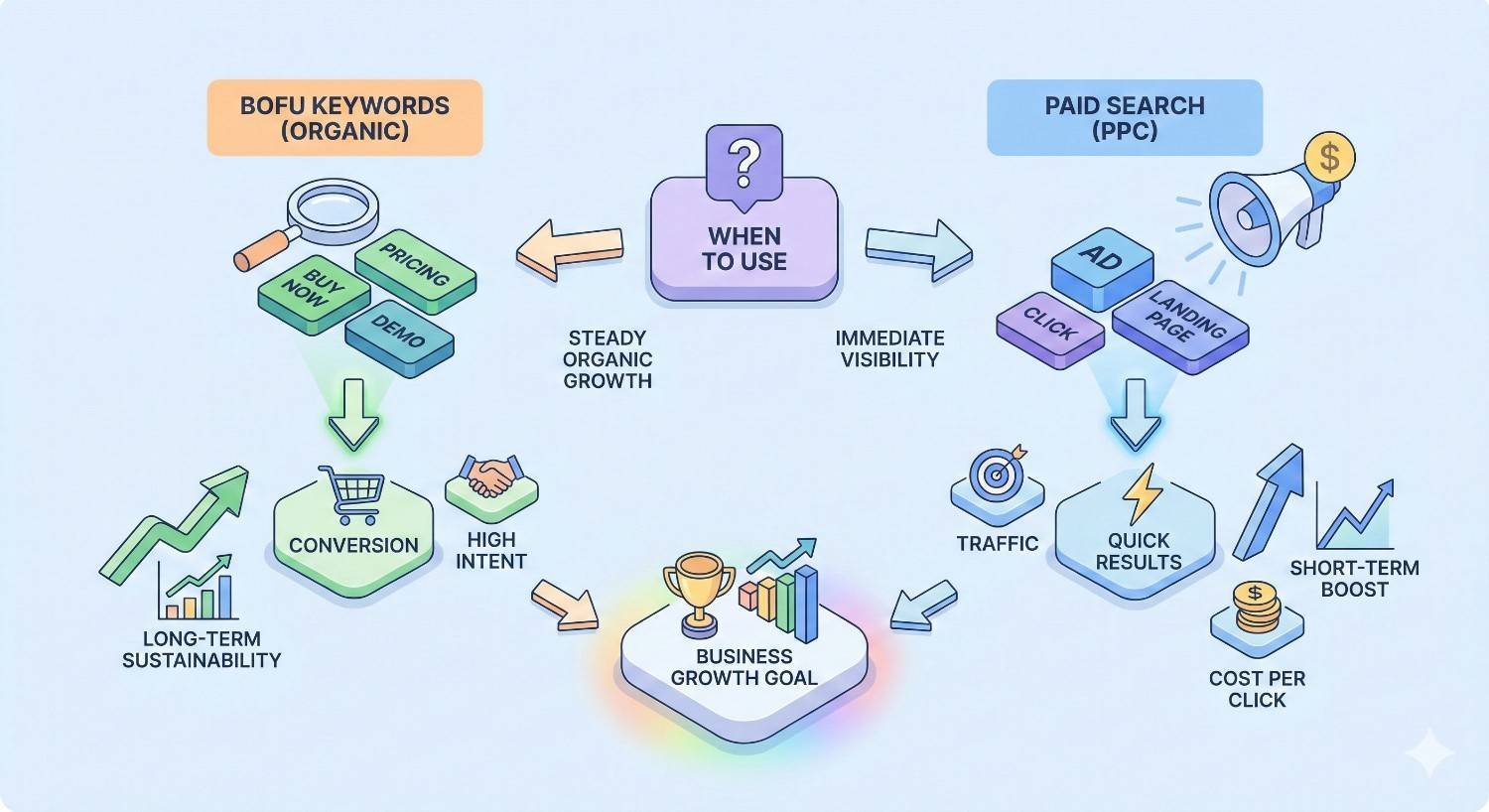
BOFU Keywords vs. Paid Search: When to Use Each
Cost-Benefit Analysis of SEO vs. PPC for BOFU
Both channels can capture BOFU traffic. The right choice depends on your situation, timeline, and resources.
SEO advantages: No per-click costs once ranking, builds long-term asset, compounds over time, higher trust from some users.
SEO disadvantages: Takes time to rank, requires ongoing investment, less control over positioning, algorithm changes create risk.
PPC advantages: Immediate visibility, precise targeting, easy testing, predictable costs, full control over messaging.
PPC disadvantages: Costs per click, stops when budget stops, ad blindness from some users, increasing competition raises prices.
For most SaaS companies, the answer isn’t either/or. Both channels serve different purposes and timeframes.
Combining Organic and Paid Strategies
Integrated strategies capture more BOFU traffic than either channel alone.
Use PPC to test keywords: Before investing in SEO content, test keywords with paid campaigns. Conversion data reveals which terms actually drive business results.
Cover while building: Run ads for priority BOFU keywords while SEO efforts mature. This captures traffic during the ranking timeline.
Dominate SERPs: Appearing in both paid and organic results increases total clicks and reinforces brand presence.
Retarget organic visitors: Use paid retargeting to re-engage visitors who found you through organic BOFU content but didn’t convert.
Budget Allocation Recommendations
Budget allocation depends on your current position, competitive landscape, and growth timeline.
New or low-authority sites: Lean toward PPC initially. SEO takes time, and you need leads now. Invest in SEO for long-term, but don’t starve short-term growth.
Established sites with rankings: Shift budget toward SEO. You have authority to leverage. Reduce PPC dependency as organic rankings strengthen.
Highly competitive keywords: Consider whether SEO investment will pay off. Some keywords may never be worth the SEO investment if PPC costs are manageable.
Budget-constrained situations: Focus SEO on lower-competition BOFU keywords where you can rank faster. Use PPC selectively for highest-value terms.
How Long Does It Take to Rank for BOFU SaaS Keywords?
Factors Affecting BOFU Keyword Ranking Timeline
Ranking timelines vary significantly based on multiple factors. Understanding these helps set realistic expectations.
Domain authority: Higher-authority sites rank faster. A new site targeting competitive BOFU keywords faces a longer timeline than an established brand.
Keyword competition: Some BOFU keywords are highly contested. “Salesforce pricing” is harder than “[Niche tool] pricing.”
Content quality: Better content ranks faster. Comprehensive, well-structured pages that satisfy intent outperform thin content.
Technical foundation: Sites with strong technical SEO see faster results. Crawlability, speed, and mobile experience all impact ranking velocity.
Link profile: Pages with quality backlinks rank faster. BOFU pages often need deliberate link building since they don’t attract links naturally.
Realistic Expectations by Competition Level
Set expectations based on competitive analysis, not wishful thinking.
Low competition BOFU keywords: 2-4 months to page one for sites with moderate authority. These include long-tail comparisons, niche product terms, and specific integration keywords.
Medium competition BOFU keywords: 4-8 months for established sites. Brand comparison keywords, category pricing terms, and popular alternative searches fall here.
High competition BOFU keywords: 8-18+ months, sometimes longer. Major brand comparisons, high-volume pricing keywords, and category-defining terms require sustained effort.
These timelines assume consistent effort: quality content, technical optimization, and link building. Sporadic attention extends timelines significantly.
Accelerating Results with Strategic Link Building
Link building accelerates BOFU ranking timelines. These pages rarely attract links naturally, making proactive building essential.
Digital PR: Newsworthy content related to your BOFU topics can earn links. Industry reports, original research, or trend analysis attract coverage.
Resource link building: Create genuinely useful resources that others want to reference. Comprehensive guides, tools, or data sets earn links over time.
Guest posting: Strategic guest content on relevant sites can include contextual links to BOFU pages.
Broken link building: Find broken links pointing to competitor BOFU content. Offer your page as a replacement.
Partnership links: Integration partners, technology allies, and complementary services may link to relevant BOFU content.
Building a Complete BOFU Keyword Strategy
Prioritizing Keywords by Revenue Potential
Not all BOFU keywords deserve equal attention. Prioritize based on potential business impact.
Estimate search volume: Use keyword tools to understand demand. Higher volume means more potential traffic.
Assess conversion likelihood: Some keywords convert better than others. Pricing keywords often outperform comparison keywords.
Calculate potential value: Multiply estimated traffic by expected conversion rate by average deal value. This reveals revenue potential.
Evaluate competition: Factor in ranking difficulty. A lower-volume keyword you can rank for beats a high-volume keyword you can’t.
Consider strategic value: Some keywords matter beyond direct conversion. Ranking for “[Competitor] alternative” has brand positioning value.
Creating a BOFU Content Calendar
Systematic content production ensures consistent progress toward BOFU coverage.
Audit existing content: What BOFU pages do you have? What’s missing? What needs improvement?
Map keyword gaps: List all priority BOFU keywords. Identify which have dedicated content and which don’t.
Prioritize creation: Order new content by revenue potential and competitive opportunity. Start with highest-impact gaps.
Schedule production: Assign realistic timelines for content creation. Quality BOFU content takes time. Don’t rush.
Plan updates: Schedule regular reviews of existing BOFU content. Comparison pages need quarterly updates. Pricing pages need immediate updates when pricing changes.
Integrating BOFU SEO with Full-Funnel Strategy
BOFU content works best as part of a complete funnel strategy, not in isolation.
Internal linking: Connect TOFU and MOFU content to BOFU pages. Guide readers through the funnel with strategic links.
Content upgrades: Offer BOFU content as next steps from earlier-stage pieces. A blog post about project management challenges can link to your comparison page.
Retargeting integration: Use BOFU page visitors for retargeting campaigns. They’ve shown high intent. Stay visible as they decide.
Sales enablement: Share BOFU content with sales teams. These pages answer questions prospects ask. Sales can send links during conversations.
Scaling BOFU Content Production
As you exhaust obvious BOFU opportunities, scaling requires systematic expansion.
Expand comparison coverage: Beyond direct competitors, compare against adjacent solutions. “Asana vs spreadsheets” or “CRM vs email for sales tracking.”
Deepen use case content: Create BOFU pages for increasingly specific use cases. “Project management for creative agencies” then “project management for video production teams.”
Build integration libraries: Create pages for every meaningful integration. Each represents a BOFU keyword opportunity.
Localize content: For international markets, create localized BOFU content. Pricing in local currencies, region-specific comparisons, and local competitor alternatives.
Segment by buyer type: Create BOFU content for different buyer personas. Enterprise buyers have different questions than SMB buyers.
Frequently Asked Questions About Bottom-of-Funnel SaaS Keywords
What is a bottom-of-funnel keyword?
A bottom-of-funnel keyword is a search term used by prospects ready to make a purchase decision. These keywords indicate the searcher has already identified their problem, researched solutions, and is now comparing final options or seeking specific purchase information like pricing, demos, or reviews.
What are examples of BOFU keywords for SaaS?
Common BOFU SaaS keyword examples include “[Product] pricing,” “[Product] vs [Competitor],” “[Product] alternatives,” “[Product] demo,” “[Product] free trial,” “[Product] reviews,” and “[Product] for [specific use case].” These terms signal purchase intent rather than general research.
How do I know if a keyword is bottom-of-funnel?
Identify BOFU keywords by looking for purchase intent signals: pricing terms, brand comparisons, alternative searches, demo or trial requests, and specific feature confirmations. Also analyze SERP results. If top-ranking pages are pricing pages, comparison articles, or product pages rather than educational content, the keyword likely has BOFU intent.
Are BOFU keywords harder to rank for?
BOFU keywords vary in difficulty. Brand-specific terms like “[Your Product] pricing” are often easier since you have inherent relevance. Competitive comparison keywords like “Salesforce vs HubSpot” are highly contested. Long-tail BOFU keywords targeting specific use cases or integrations often present easier ranking opportunities.
Should startups focus on BOFU keywords first?
Startups benefit from early BOFU focus because these keywords drive immediate revenue. However, limited domain authority makes competitive BOFU terms difficult. Start with lower-competition BOFU keywords like specific use cases, niche comparisons, and long-tail pricing variations while building authority for more competitive terms.
How many BOFU keywords should I target?
Target as many relevant BOFU keywords as you can create quality content for. Most SaaS companies have dozens to hundreds of potential BOFU keywords across pricing, comparisons, alternatives, integrations, and use cases. Prioritize by revenue potential and competitive opportunity, then expand systematically.
What’s the difference between BOFU SEO and BOFU PPC?
BOFU SEO builds organic rankings for purchase-intent keywords through content and optimization. BOFU PPC buys visibility through paid ads. SEO takes longer but creates lasting assets with no per-click costs. PPC provides immediate visibility but stops when budget stops. Most companies benefit from combining both approaches.
Next Steps: Implementing Your BOFU Keyword Strategy
Audit Your Current BOFU Keyword Coverage
Start by understanding your current position. What BOFU content exists? What’s missing? Where are you ranking?
Export your current keyword rankings from Search Console or a rank tracking tool. Filter for BOFU intent signals. Identify where you rank well and where gaps exist.
Review your site structure. Do you have dedicated pricing pages? Comparison content? Integration pages? Demo landing pages? Map what exists against what should exist.
Assess content quality. Are existing BOFU pages comprehensive? Do they match search intent? Are they technically optimized? Identify improvement opportunities.
Prioritize Quick Wins and High-Impact Pages
Focus initial efforts where you can make the fastest impact.
Quick wins: Keywords where you rank positions 8-20. These need optimization, not creation. Improving existing content is faster than building new pages.
High impact: Keywords with strong revenue potential regardless of current ranking. These justify larger investments in content and link building.
Low competition: BOFU keywords where competitors haven’t invested heavily. These offer faster ranking timelines.
Create a prioritized list combining these factors. Start with quick wins to build momentum while planning larger projects.
Partner with SEO Experts for Sustainable Growth
BOFU keyword strategy requires ongoing expertise across content, technical SEO, and link building. Most internal teams lack bandwidth for comprehensive execution.
Professional SEO partners bring specialized knowledge, proven processes, and dedicated resources. They accelerate timelines and avoid common mistakes that delay results.
We help SaaS companies build sustainable organic growth through strategic BOFU keyword targeting. From technical foundations to content creation and authority building, White Label SEO Service provides the expertise and execution your BOFU strategy needs. Contact us to discuss how we can accelerate your path from BOFU keywords to revenue.
Conclusion
Bottom-of-funnel SaaS keywords represent the highest-value organic search opportunities for software companies. These purchase-intent terms connect you with prospects ready to buy, delivering conversion rates and revenue impact that awareness-stage content cannot match.
Success requires systematic execution across keyword research, content creation, technical optimization, and performance measurement. The companies winning BOFU search treat it as a strategic priority, not an afterthought to broader content marketing.
We specialize in helping SaaS companies capture BOFU search demand through comprehensive SEO strategy. White Label SEO Service brings the expertise, processes, and resources to accelerate your BOFU keyword performance. Reach out to explore how we can help you turn high-intent searches into sustainable revenue growth.